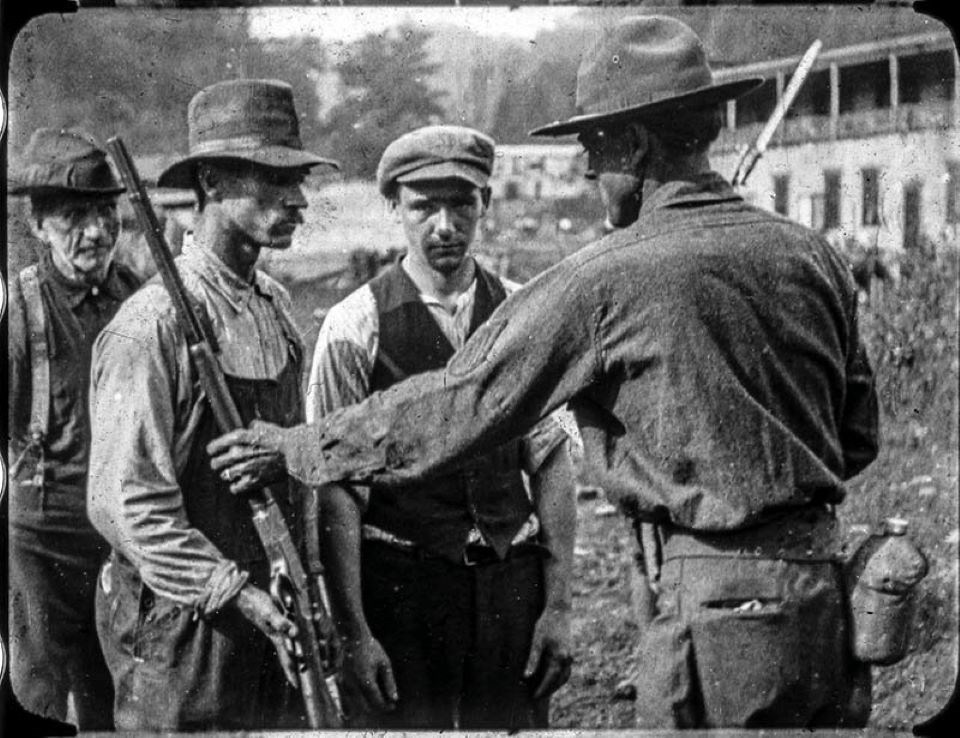
September 2, 1921: The largest labor uprising in American history takes place in Logan County, West Virginia. It becomes known as the Battle of Blair Mountain.
Coal companies had been exploiting their workers for decades. Due to the prosecution of miners' union leaders, things came to a head in the Summer of 1921. The United Mine Workers called for a rally at the State Capitol in Charleston for August 7. The UMW's leaders, including organizer Bill Blizzard, met with Governor Ephraim Morgan, who owed his election to the coal companies, and rejected their demands.
Labor leader Mary "Mother" Jones, for whom a liberal magazine would later be named, feared a bloodbath between the union men and the better-armed Logan County Sheriff's Department, led by Sheriff Don Chafin. So she warned the union men against taking further action.
Nevertheless, on August 24, 13,000 men began marching toward the Logan County mine, to try to force the strikebreakers out of their jobs. The next day, President Warren Harding threatened to send federal troops to protect the mine -- not the miners. A meeting was arranged between Chafin and the union leaders, and a truce was called. It seemed to be over.
It wasn't: Chafin wanted to break the union for once and for all, and assembled a "private army." Rumor got around that this army had shot union sympathizers, and caught families in the crossfire, in Sharples, just north of Blair Mountain. The union men turned back, believing that Chafin had done more than just front up with a private army, and that he had flat-out broken his word.
The Chafin army, now including some State Police officers, was outnumbered, but had the high ground and better weapons. On August 29, private planes dropped homemade bombs on the miners. One did not explode, and that proved crucial. The next day, Governor Morgan called out the West Virginia National Guard. On September 2, federal troops arrived. Many of the miners were World War I veterans, and refused to fire on the U.S. Army. The miners surrendered.
The number of casualties is unclear. The actual Army reported 3 deaths, because one of their planes crashed upon its return. On the Chafin side, the number of deaths has been reported as being between 10 and 30; on the miners' side, anywhere from 50 to 100. After the battle, 985 miners were indicted for murder, conspiracy to commit murder, accessory to murder, and treason -- not against the United States of America, but against the State of West Virginia.
At Blizzard's trial, the unexploded bomb was used as evidence of the government and companies' brutality, and he was acquitted. Though some were acquitted by sympathetic juries, others were imprisoned. The last was paroled in 1925.

Bill Blizzard
The UMW was crippled, and was a spent force throughout the 1920s. The Great Depression enabled them to come back, and they appealed to President Franklin D. Roosevelt in the 1930s. FDR's New Deal programs gave them much of what they wanted.
Mother Jones, already elderly by the time of Blair Mountain, died in 1930. In 1924, Sheriff Chafin was arrested in connection with moonshining, and sentenced to two years in prison. He died in 1954. UMW leader John L. Lewis expelled Blizzard, but the union revolted, and he had to be hired back. The two men were never friendly, and Lewis expelled Blizzard again in 1955. Blizzard died in 1958.
*
September 2, 1921 was a Friday. These baseball games were played that day:
* The New York Yankees beat the Washington Senators, 9-3 at the Polo Grounds. Babe Ruth, Bob Meusel and Roger Peckinpaugh hit home runs for the Yankees. Waite Hoyt was the winning pitcher.
* The Boston Red Sox beat the Philadelphia Athletics, 4-3 at Fenway Park in Boston.
* The St. Louis Cardinals beat the Pittsburgh Pirates, 1-0 at Forbes Field in Pittsburgh. Bill Doak started for the Cardinals, and pitched to 1 batter, giving up a single to Carson Bigbee. Manager Branch Rickey then took him out, and put in Jesse Haines, who went the rest of the way, pitching shutout ball for 9 innings, allowing 6 hits and a walk.
I don't know why Rickey did this. Both Doak and Haines were righthanded pitchers, so it wasn't as if Rickey was trying to trick Pirate manager George Gibson into loading his lineup with lefthanded hitters, with the intention of then switching to a lefthanded pitcher.
Doak does have 2 distinctions worth mentioning. He was 1 of the 17 pitchers who, at the start of the season, was allowed to continue using various pitches that fell under the category of "spitball" until they retired, with the pitches banned for everyone else. Doak may have been the only one who actually did spit on the ball, instead of licking his fingers or putting some other "foreign substance," such as grease or Vaseline, on the ball, earning him the nickname "Spittin' Bill."
And, in 1920, he suggested to sporting goods company Rawlings, maker of all major league baseball gloves, that a "web" should be laced between the index finger and the thumb, saying it would create a natural pocket. This design soon replaced all other baseball gloves, and remains the standard.
* The Chicago Cubs beat the Cincinnati Reds, 7-0 at Redland Field in Cincinnati. (It was renamed Crosley Field in 1934.) Grover Cleveland Alexander pitched a 5-hit shutout.
* The Cleveland Indians beat the Detroit Tigers, 12-1 at Navin Field in Detroit. (It was renamed Briggs Stadium in 1938, and Tiger Stadium in 1961.) Tris Speaker went 2-for-5 with an RBI for Cleveland. Ty Cobb went 1-for-3 for Detroit. Each was, by this point, his team's manager.
* The St. Louis Browns beat the Chicago White Sox, 3-0 at Comiskey Park in Chicago. Urban Shocker pitched a 4-hit shutout. George Sisler went 4-for-5 with 2 RBIs. Eddie Collins went 0-for-3 with a walk for the White Sox.
* Concerned about possible bad weather on September 2, the New York Giants and the Brooklyn Dodgers (or the Brooklyn Robins as they were known from 1914 to 1931, due to their manager being Wilbert Robinson), arch-rivals, moved their game at Ebbets Field back to September 1. Brooklyn won, 5-1. Zack Wheat went 2-for-4, in support of Burleigh Grimes, who turned out to be the last legal spitballer, retiring in 1934.
* As it turned out, there was enough rain to postpone the game in Brooklyn, though not in Upper Manhattan, as the Yankees played. There was also enough rain to postpone the game in Philadelphia, and a doubleheader was set up for Baker Bowl the next day. The Philadelphia Phillies won the opener, 4-1. The Boston Braves won the nightcap, 15-4. So the Phillies scored the same number of runs in both games, winning one comfortably and getting blown out in the other.


No comments:
Post a Comment