Showing posts with label thanksgiving day. Show all posts

Wednesday, November 30, 2022

November 30, 1922: Chicago Football's Thanksgiving Brawl

Paddy Driscoll

November 30, 1922: It is Thanksgiving Day in Chicago. After 2 years under the name of the American Professional Football Association, this is the 1st season the league operates under the name of the National Football League. And, after playing in Decatur, Illinois as the Decatur Staleys in 1920, and as the Chicago Staleys in 1921, this is the 1st year that the NFL's flagship franchise uses its familiar name: The Chicago Bears.

Note: Until 1940, Thanksgiving Day was always celebrated on the last Thursday in November, regardless of whether that was the 4th Thursday or the 5th. Since then, it has been celebrated on the 4th Thursday in November, regardless of whether there was a 5th.

The Bears played their home games at Cubs Park, on the North Side. In 1926, it was renamed Wrigley Field. The other team in the city, the Chicago Cardinals, played on the South Side, previously at Normal Field. But, for this season, they moved into the much larger Comiskey Park, home of baseball's Chicago White Sox.

George Halas was 27 years old. He was the Bears' end on offense and defense. By the standards of the time, he was a very good player. He was also their head coach. He was their general manager. And he was their owner. When the Pro Football Hall of Fame was established in 1963, he was the first man elected. His line had 2 other future Hall-of-Famers, center George Trafton and tackle Ed Healey. The offense was led by quarterback Joey Sternaman and his brother, halfback Ed "Dutch" Sternaman.
The 1922 Bears. George Halas is 5th from the right.

The Cardinals were also coached by a man still at the height of his playing career, John "Paddy" Driscoll. The position of quarterback wasn't what it would become over the next 20 years, but he was a good passer. He was a good runner. And he was the best kicker in the game. Being good at all 3, he was called a "triple threat." He might have been the best player in the game. Also in the backfield were the brothers Arnold and Ralph Horween.

(While baseball has the concept of "the five-tool player," meaning one who can hit for average, hit for power, run, catch and throw; football has never gone beyond the term "triple threat." I suppose one who can do it all would run, throw, catch, block, tackle and kick, making him a "six-tool player." But since the early 1950s, when players began playing only on offense or only on defense, going from "single-platoon football" to "double-platoon football," it hasn't really been applicable.)

Halas was a graduate of the University of Illinois; Driscoll, of Northwestern University. Eventually, those schools would be thought of as arch-rivals, but, until 1940, the University of Chicago still had a football team, and usually a good one, so UC was Northwestern's big rival. Driscoll and Halas had been teammates on the Great Lakes Naval Training Station team out of the Chicago area, winning the 1919 Rose Bowl.

(Due to the manpower drain of World War I, military bases fielded sports teams that played college teams. This would be done again in World War II. The Great Lakes station had a baseball team led by pitcher Bob Feller, and was good enough to be called "the 17th Major League Team.")

The Cardinals won their 1st 6 games, with their defense allowing an average of only 2.7 points per game. Then they played back-to-back games against the league's best team, the Canton Bulldogs, and lost both. So they needed to prove themselves, and, as the saying goes, they were loaded for Bear. At that point, the Bears had also lost to the Bulldogs and to nobody else: The Bears were 8-1 going into the game; the Cardinals, 6-2.

The Cardinals had been averaging 6,000 fans per game at Charlie Comiskey's South Side ballpark. A crowd of 14,000 fans attended the Thanksgiving game against the Bears. This is an indication of where pro football was in its early years: Anybody calling the NFL "major league" was on shaky ground. But those 14,000 fans got plenty of bang for their buck.

As the unidentified reporter covering the game for Chicago Herald-Examiner wrote -- and I have not changed a word, or the spelling, or the grammar:

Chicago's Cardinals carved the Chicago turkey yesterday, gobbled all the white meat, stuffing and left the Bears the neck, wing, gizzard and a bunch of black eyes. The struggle between the post-grad teams of north and south sidesended with the score of 6-0 in favor of the south siders, after a battle which included a half-riot, two fist-fights, and finished peacefully enough with the clanging pf patrol wagons bringing the reserves."

Halas himself, in his autobiography Halas on Halas, told the story:

What happened was this: Paddy Driscoll made a good run around end, reaching our 20. Joe Sternaman and I thought that must not be allowed to happen again. On the next play, Driscoll set off with the ball. Joey and I brought him down with all the force we could muster, which was considerable. Paddy was down but not out. He pulled himself to his feet, wobbled toward Joey and started pummeling him with both fists. That is when the thugs came out. So did reserve players. So did fans from both stands. The police came out, too, wielding sticks and blowing whistles and shouting. In time, in quite a time, order was restored.
George Halas, in his playing days.
Photo obviously colorized.

The referee threw Driscoll out of the game. Halas, recovering his sense of sportsmanship, asked the ref to reconsider. Hugh Fullerton of the Chicago Tribune wrote:
The Bearsoffered to waive the rules and let Driscoll return to play. The officials declined, and during the argument another fight started suddenly with three of the Cardinals swinging at Halas, who was knocked flat with a burly Cardinal riding him.
On December 10, the teams would play each other again, also at Comiskey, which was larger than Cubs Park, and thus guaranteed more gate receipts. (In spite of the benefits of having the home field, Halas had his priorities.) The Cards won this one, too, 9-0.

Driscoll spent the last 28 years of his life with the Bears as an assistant coach (1941–55), head coach (1956–57), and later as the director of the Bears' research and planning unit (the position that would, today, be called their director of scouting, 1958-68).

The Cardinals won the NFL Championship in 1925, under controversial circumstances. But Halas built a much stronger team that dominated the early 1930s, and another that dominated the 1940s. The Cardinals won another Championship in 1947, and reached the NFL Championship Game again in 1948.

But as television became big, Halas cultivated the networks, and Cardinal owner Violet Bidwill Wolfner didn't. In 1960, the Cardinals gave up, and moved to St. Louis, leaving Chicago to the Bears, eventually moving to Arizona in 1988. While Bears vs. Cardinals was once a very rough rivalry, it no longer feels like one, even though the Phoenix area is often a target for retirees from the Midwest, effectively being to Chicago what South Florida is to New York.

*

November 30, 1922, like all Thanksgiving Days, was a Thursday. There were 4 other games played in the NFL that day, each of them, more or less, a local rivalry:

* The Buffalo All-Americans beat the Rochester Jeffersons, 21-0 at the Bay Street Ball Grounds in Rochester, New York.

* The Canton Bulldogs beat the Akron Pros, 14-0 at Lakeside Park in Canton, Ohio.

* The Oorang Indians beat the Columbus Panhandles, 18-6 at Neil Park in Columbus, Ohio. The Indians were owned by Walter Lingo, who owned the Oorang Kennel in LaRue, Ohio, outside Marion, the hometown of the man who was then the President of the United States, Warren G. Harding. It was a team staffed entirely of Native Americans, with Jim Thorpe as player-coach. His brother Jack Thorpe also played for them. But this game was an anomaly: Aside from the Thorpes, they weren't professional grade, going 3-6 in 1922 and 1-10 in 1923, before folding.

* And the Racine Legion beat the Milwaukee Badgers, 3-0 at Horlick Park in Racine, Wisconsin.

Not one of these teams played after 1929.

Among the college football games played that Thanksgiving Day were some games that are now thought of as familiar rivalries, and some others that aren't:

* Colgate beat Columbia, 59-6 at South Field in Upper Manhattan. Columbia were the only New York Tri-State Area team playing on the day. Most of the Area teams had finished their seasons the preceding Saturday.

* Cornell beat the University of Pennsylvania, 9-0 at a newly-rebuilt Franklin Field that still stands today.

* Washington & Lee beat Johns Hopkins, 14-0 at Homewood Field in Baltimore.

* North Carolina beat Virginia, 10-7 at Lambeth Field in Charlottesville, Virginia.

* The University of Richmond beat the College of William & Mary, 13-3 at the unimaginatively-named Stadium Field in Richmond, Virginia.

* Virginia Polytechnic Institute (the school usually called Virginia Tech) beat Virginia Military Institute -- VPI over VMI -- 7-3 at the Fair Grounds in Roanoke, Virginia.

* Maryland beat North Carolina State, 7-6 at Riddick Stadium in Raleigh, North Carolina.

* Georgia Tech beat Alabama Tech (renamed Auburn University in 1960), 14-6 at Grant Field in Atlanta.

* Tennessee beat Kentucky, 14-7 at Shields-Watkins Field (since expanded into the huge Neyland Stadium) in Knoxville, Tennessee.

* Alabama beat Mississippi State, 59-0 at Rickwood Field in Birmingham, Alabama.

* Oklahoma A&M College beat the University of Arkansas, 13-0 at Andrew's Field in Fort Smith, Arkansas -- but on the Oklahoma State Line, so it was kind of a "neutral site game." A&M became Oklahoma State University in 1957.

* Louisiana State University (LSU) beat Tulane, 25-14 at State Field in Baton Rouge, Louisiana.

* Texas A&M beat Texas, 14-7 at Clark Field in Austin, Texas.

* The University of Pittsburgh beat Penn State, 14-0 at Forbes Field in Pittsburgh.

* West Virginia beat Washington & Jefferson, 14-0 at WVU Athletic Field in Morgantown, West Virginia. WVU went undefeated, though tied by Washington & Lee (not to be confused with Washington & Jefferson). Though the Rose Bowl was the only "bowl game" played then that survives today, there were other warm-weather end-of-season invitational games. On Christmas Day, WVU beat Gonzaga, 21-13, in the San Diego East-West Christmas Classic, at Balboa Stadium, later to be the AFL home of the San Diego Chargers.

* Missouri beat Kansas, 9-7 at Rollins Field in Columbia, Missouri.

* Kansas State beat Texas Christian University (TCU), 45-0 at Memorial Stadium in Manhattan, Kansas.

* Nebraska beat Notre Dame, 14-6. This was the last game the Cornhuskers played at Nebraska Field in Lincoln. The next season, they moved into Memorial Stadium, where they still play, albeit in a vastly expanded form.

* The University of Wyoming beat Brigham Young University (BYU), 13-0 at the Campus Athletic Grounds in Laramie, Wyoming. It was the only game that Wyoming won all season, finishing 1-8. BYU finished 1-5, having beaten only Wyoming, on November 14. So each team's only win was against the other.

* Utah beat Utah State, 14-0 at Cummings Field in Salt Lake City, Utah.

* The University of Southern California beat Washington State, 41-3 at the newly-opened Rose Bowl stadium in the Los Angeles suburb of Pasadena, California. They returned on New Year's Day, and beat Penn State in the 1923 Rose Bowl.

* Oregon and Washington played to a 3-3 tie at Husky Stadium in Seattle.

Friday, November 25, 2022

November 25, 1982: The Minneapolis Thanksgiving Day Fire

November 25, 1982: Downtown Minneapolis is hit by a fire on Thanksgiving Day. It destroys the former Donaldson's department store, in front of which Mary Tyler Moore had thrown her hat into the air for the opening sequence of her show in 1970.

The other building that was damaged to the point where it had to be demolished was the 16-story Northwestern National Bank Building.

Nobody was injured or killed as a result of the fire, though 10 firefighters were treated at hospitals.

Donaldson's, the largest department store chain in Minnesota, had recently moved across the street to the new City Center mall. But it was still in trouble, and in 1987 was bought Carson Pirie Scott, which phased the Donaldson's name out in 1995. Most Donaldson's became Target stores. Based in Minneapolis, Target bought the naming rights to the NBA Timberwolves' arena, the Target Center, in 1990; and the MLB Twins' new ballpark, Target Field, in 2010.

The Norwest Center (now the Wells Fargo Center) was built on the site of the Northwestern National Bank Building. It stands 775 feet tall, now the 3rd-tallest building in the City and in the State, behind the 792-foot IDS Center, built in 1973; and the 776-foot Capella Tower, built in 1992.

*

November 25, 1982 was a Thursday, Thanksgiving Day. The NFL had its usual 2 games. The Detroit Lions lost to the New York Giants, 13-6 at the Silverdome in the Detroit suburb of Pontiac, Michigan. And the Dallas Cowboys beat the Cleveland Browns, 31-14 at Texas Stadium in the Dallas suburb of Irving, Texas.

There were 3 games in college football:

* Number 14 Texas walloped arch-rival Texas A&M, 53-16 at Memorial Stadium in Austin.

* Virginia Tech beat arch-rival Virginia, 21-14 at Lane Stadium in Blacksburg.

* And in a non-rivalry game, North Carolina beat Bowling Green, 33-14 at Kenan Stadium in Chapel Hill, North Carolina.

And in New Jersey high school football, East Brunswick, the Middlesex County school I would begin attending in 2 years' time, lost away to Woodbridge school Colonia, 34-14. We played them because pretty much every other school in the County already had an arch-rival to play on T-Day, while we hadn't played on the day for our 1st 20 years of varsity football, with 1 exception (and that due to a postponement, in 1963, after the assassination of President Kennedy).

Baseball was out of season. Only 1 game was played in the NBA: The Kansas City Kings beat the Houston Rockets, 88-79 at The Summit in Houston. When the Rockets moved to the Toyota Center in 2003, The Summit was bought by televangelist Joel Osteen, who converted it into the centerpiece of his "megachurch," the Central Campus of Lakewood Church.

And there were 2 games in the NHL. The New York Islanders and the Boston Bruins played to a tie, 1-1 at the Boston Garden. And the Quebec Nordiques beat the Calgary Flames, 3-2 at the Stampede Corral in Calgary.

Thursday, November 24, 2022

November 24, 1966: New York's Smoggy Thanksgiving, 168 Dead

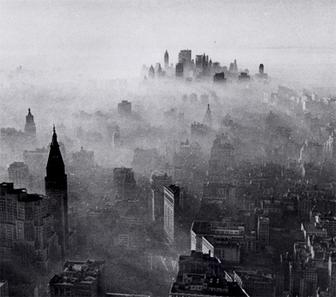
Photo on the front page of The New York Times,
November 25, 1966

November 24, 1966: New York City is struck with a major air-pollution episode and environmental disaster, coinciding with that year's Thanksgiving holiday weekend.

Smog -- the word is a combination, a portmanteau, of "smoke" and "fog" covered the New York Metropolitan Area (or "the New York Tri-State Area," including portions of the States of New York, New Jersey and Connecticut) from November 23 to 26, filling the City's air with damaging levels of several toxic pollutants. It was the City's 3rd major smog attack, following events of similar scale in 1953 and 1963.

On November 23, a large mass of stagnant air over the East Coast trapped pollutants in the city's air. For 3 days, New York City was engulfed in dangerously high levels of carbon monoxide, sulfur dioxide, smoke, and haze. Pockets of air pollution pervaded the Tri-State Area.

By November 25, the smog became severe enough that regional leaders announced a "first-stage alert." Leaders of local and State governments asked residents and industry to take voluntary steps to minimize emissions. Health officials advised people with respiratory or heart conditions to remain indoors. The City shut off garbage incinerators, requiring massive hauling of garbage to landfills.

Energy companies Consolidated Edison (called Con Ed for short) and the Long Island Lighting Company (LILCO) were asked to burn natural gas rather than fuel oil, to minimize the release of sulfur dioxide. Both companies voluntarily cut back emissions, with Con Ed reducing its emissions by 50 percent.

(Con Ed still runs New York City's electricity. LILCO lost favor over the years, and was replaced in 1998 by the Long Island Power Authority. In 2014, LIPA was bought out by Public Service Enterprise Group, or PSEG, which runs electricity for much of New Jersey.)

In spite of the danger, Macy's ran its Thanksgiving Day Parade as scheduled. Indeed, it ran the Parade every year from its 1st in 1924 until 2019, holding a virtual Parade due to COVID restrictions in 2020, and resuming in 2021. But fewer people than usual came out to attend.

A cold front dispersed the smog on November 26, and the alert ended. In the months that followed, medical researchers studied the smog's impact on health. City officials initially maintained that the smog had not caused any deaths, but it soon became clear that the smog had significantly harmed public health.

A study published in December 1966 estimated that 10 percent of the City's population -- around 800,000 people -- had suffered adverse health effects, such as stinging eyes, coughing and respiratory distress. A statistical analysis published in October 1967 found that 168 deaths had likely been caused by the smog. For comparison's sake: The smog event of 1953 is believed to have killed 260; the one in 1963, perhaps as many as 400.

The smog catalyzed greater national awareness of air pollution as a serious health problem and a political issue. The government of New York City updated local laws on air-pollution control. Prompted by the smog, President Lyndon B. Johnson and members of Congress worked to pass federal legislation regulating air pollution in the United States, culminating in the 1967 Air Quality Act and the 1970 Clean Air Act. The extent of harms from subsequent pollution events, including the health effects of pollution from the September 11, 2001 terrorist attack, have been judged by reference to the 1966 smog in New York.

*

November 24, 1966 was a Thursday, Thanksgiving Day. English singer Russell Watson, known for singing "Where My Heart Will Take Me," the theme from Star Trek: Enterprise, was born.

For the 1st time, the Dallas Cowboys hosted a Thanksgiving Day game, beating the Cleveland Browns, 26-14 at the Cotton Bowl in Dallas. The NFL's established T-Day team, the Detroit Lions, lost to the San Francisco 49ers, 41-14 at Tiger Stadium in Detroit. And in the American Football League, the Buffalo Bills beat the Oakland Raiders, 31-10 at the brand-new Oakland-Alameda County Coliseum.

There were 5 games played in college football:

* Number 4 Nebraska were upset by arch-rival Oklahoma, 10-9 at Memorial Stadium (later Owen Field, now Gaylord Family Memorial Stadium) in Norman, Oklahoma.

* Villanova beat George Washington University, 16-7 at District of Columbia Stadium in Washington. This turned out to be the last football game that GWU ever played: The school's trustees dropped its football program on January 17, 1967. In 1969, D.C. Stadium was renamed Robert F. Kennedy Memorial Stadium.

* Virginia Tech beat Virginia Military Institute, 70-12 at Victory Stadium in Roanoke, Virginia. VMI now compete in the NCAA Football Championship Subdivision (FCS), formerly Division I-AA.

* The University of Tulsa beat Wichita State, 47-14 at Skelly Stadium in Tulsa, Oklahoma. Wichita State dropped its program after the 1986 season.

* And Texas beat arch-rival Texas A&M, 22-14 at Memorial Stadium in Austin, Texas.

Baseball was out of season. There were 2 games played in the NBA. The Philadelphia 76ers beat the San Francisco Warriors, 140-123 at the Philadelphia Civic Center. Wilt Chamberlain scored 27 points and grabbed 36 rebounds against his former team. Rick Barry scored 36 in defeat.

And the Boston Celtics beat the St. Louis Hawks, 101-78 at the Kiel Auditorium in St. Louis. Larry Siegfried of the Celtics led all scorers with 24 points, while Bill Russell, now also the head coach of the Celtics, scored 8 points and grabbed 33 rebounds.

There were 2 games in the NHL. The Boston Bruins beat the Detroit Red wings, 8-3 at the Boston Garden. And the Chicago Black Hawks beat the Montreal Canadiens, 5-0 at the Chicago Stadium. The New York Rangers and the Toronto Maple Leafs were not scheduled.

Saturday, March 26, 2022

March 26, 1928: The Philadelphia Museum of Art Opens

March 26, 1928: The Philadelphia Museum of Art opens, at 2600 Benjamin Franklin Parkway, at 26th Street, at the western end of the Parkway, on the banks of the Schuylkill River.

It had originally been established at Memorial Hall, part of the Centennial Exhibition of 1876, That building now hosts a children's museum, the Please Touch Museum, at 4231 Avenue of the Republic, 2 miles away across the Schuylkill River.

A larger museum had been planned since 1895, but one thing led to another, and it was delayed. It took until 1907 to decide on a site, Fairmount, a high point in the city, surrounded by Fairmount Park, where the city's main reservoir was then located. So then, they had to find a location for a new reservoir.

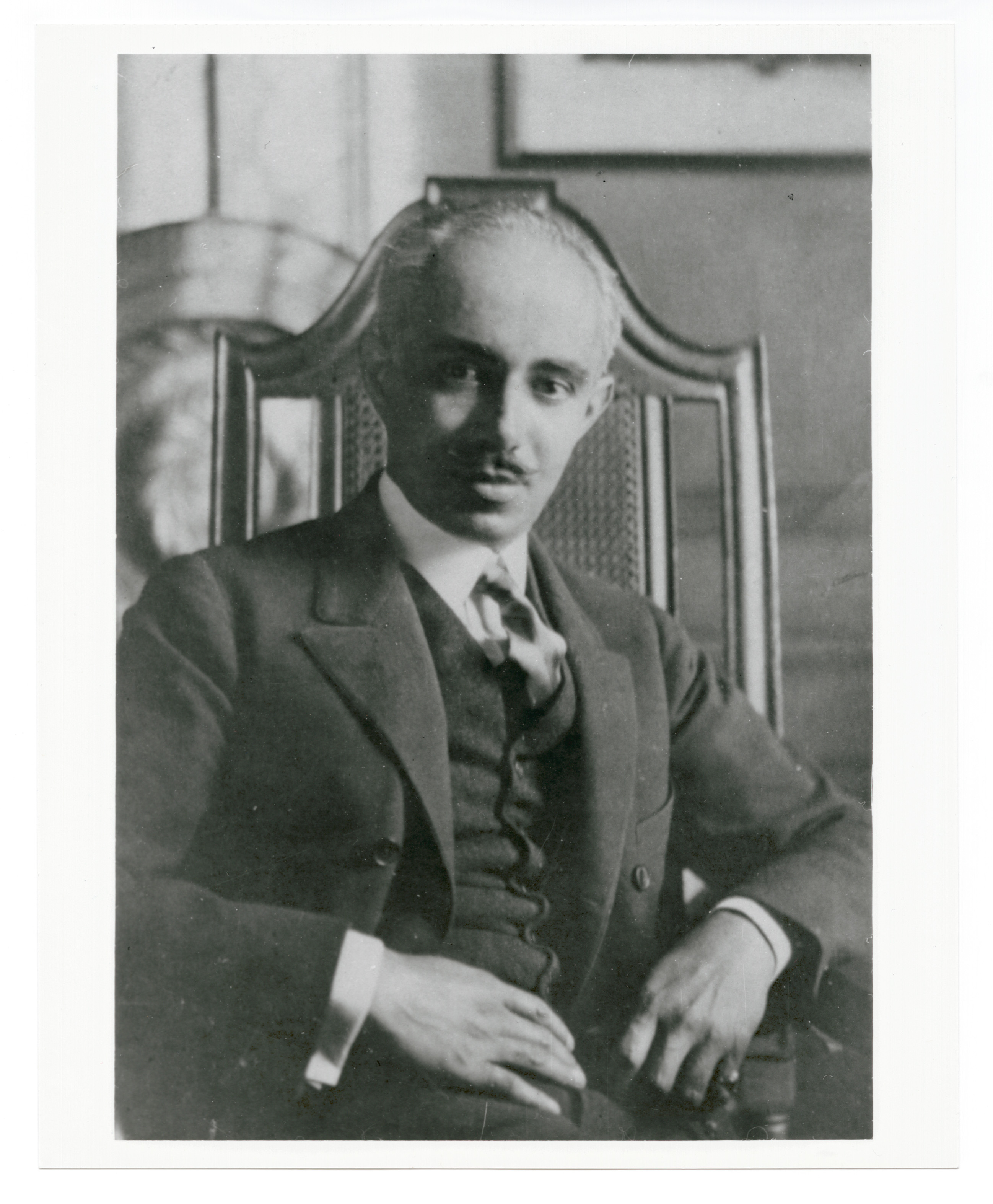
Julian Abele, the 1st black graduate of the University of Pennsylvania's School of Design, had his design for the building accepted in 1914. He later designed the Free Library of Philadelphia, 6 blocks away; then joined the faculty of Duke University, designing their 2 best-known buildings: University Chapel and what became Cameron Indoor Stadium.
But the city still wasn't home free: World War I interfered with the gaining of building materials, and it took until 1928 to build and open the place. A major renovation was completed in 1976, and an expansion in 2004.

The Museum of Art houses more than 240,000 objects, highlighting the creative achievements of the Western world and those of Asia, in more than 200 galleries spanning 2,000 years. Modern artwork includes works by Pablo Picasso, Marcel Duchamp and Salvador Dalí. The expanding collection of contemporary art includes major works by Agnes Martin, Cy Twombly, Jasper Johns and Sol LeWitt, among many others.

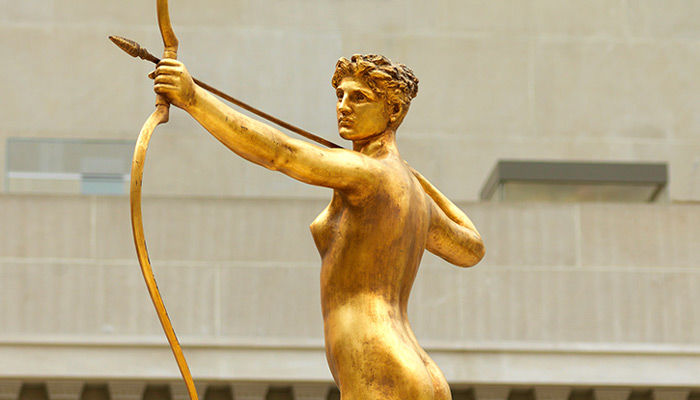
A Philadelphia art critic said rotten things about the statue of Diana, sculpted by Augustus Saint-Gaudens, atop the 2nd Madison Square Garden from 1891 to 1925. Where is that statue today? Of course, on display at the Philadelphia Museum of Art.
Every year, on Thanksgiving Day, the floats in the nation's oldest continuously-running Thanksgiving Day Parade go up the Ben Franklin Parkway, and put on a televised spectacle in front of the Art Museum at the end.

But if there's one thing anyone outside Philadelphia knows about the Museum of Art, it's the connection to the Rocky films. In the 1976 film Rocky, Sylvester Stallone, playing boxer Rocky Balboa, ran up the Museum's 72 steps as part of his training. When he got to the top, he had a great view of the city. As the City Council eliminated the "unwritten law" that said that no building in the city could be higher than the statue of William Penn atop City Hall, the view from the Art Museum Steps changed, to show the new skyscrapers.
I've done it. I don't mind telling you,
72 is a lot of steps.

In the 1982 film Rocky III, a statue of Rocky was unveiled on the Art Museum Steps. For a while, it was moved to the city's main sports arena, The Spectrum. It was moved back to the Art Museum Steps every time they had to film there, and is now at the bottom right of the Steps, permanently.

Since those films began, there have been certain things that tourists must do in Philadelphia: See the Liberty Bell, eat a cheesesteak sandwich, and run up "the Rocky Steps." At the end of the 1991 film Rocky V, Stallone and his real-life son, Sage, playing Rocky Jr., spoke for so many:

Rocky Sr.: "I been runnin' up an' down these steps for 20 years, and I never knew there was valuable pictures in this building, y'know?" 
Rocky Jr.: "Well, you're never too old to learn something new. You're gonna love Picasso."
Rocky Sr.: "Yeah, well, I love almost everybody."

*

March 26, 1928 was a Monday. Baseball was in Spring Training. Football was out of season. The NBA hadn't been founded yet. And the NHL was between the end of the regular season and the start of the Stanley Cup Playoffs. So there were no scores on this historic day.

December 31, 1999 & January 1, 2000: The Millennium

December 31, 1999:  The Millennium arrives. The people of planet Earth survived. At a terrible cost. But we hadn't destroyed ourselves. ...