Showing posts with label maine. Show all posts

Thursday, November 3, 2022

November 3, 1936: President Franklin D. Roosevelt Is Re-Elected

November 3, 1936: President Franklin D. Roosevelt defeats his Republican opponent, Governor Alfred M. Landon of Kansas, winning 46 out of 48 States, all but Vermont and Maine. He wins 523 Electoral Votes, Landon just 8. FDR wins 60.8 percent of the popular vote, to Landon's 36.5 percent.

Landon's next-best States? He won almost 48 percent in New Hampshire, almost 46 percent in his native Kansas, almost 45 percent in Delaware. If he had won those States, the Electoral Vote would have been 507-24 Roosevelt.
There were 8 other States where he got at least 40 percent. But even if he had won all of those, it would still have been 406-125 Roosevelt.

FDR increased his 1932 totals in part because black voters, still sticking with Herbert Hoover because he represented "the Party of Lincoln," saw that, while the Great Depression hit them harder than white people, as all economic slowdowns do, the New Deal helped them tremendously. (Though not fully: There was sharp criticism over a refusal to hire black people, including officials, in the various "Alphabet Soup" agencies.) Black voters gave Hoover a majority in 1932, but gave Roosevelt 71 percent of their vote in 1936.

In addition, Roosevelt broke the back of the Socialist movement in America. Norman Thomas, the Presbyterian minister who was the Socialist Party's nominee for President in every election from 1928 to 1948, was asked in 1936 if he thought Roosevelt had "carried out the Socialist platform." He said, "No, unless you mean he carried it out on a stretcher."

With Socialist labor leaders like Sidney Hillman, who ran the left-leaning Congress of Industrial Organizations (CIO), leading the way, people who had been voting Socialist voted Democratic. Thomas got 2.2 percent of the vote in 1932, but just 0.41 percent in 1936.

He actually finished 4th, behind the 1.9 percent of William Lemke, a former Republican Congressman from North Dakota. His Union Party was supported by such agitators as Father Charles Coughlin, the Detroit-based "radio priest" who turned on FDR for his seeming ingratitude in making the difference for him in 1932 (a delusion, as Coughlin's support made absolutely no difference); Gerald L.K. Smith, a Disciples of Christ minister from Wisconsin, who started out as a leftist populist like Senator Huey Long of Louisiana, whose Presidential ambitions died with his assassination in 1935, but turned far-right, and who was one of the few public figures in America willing to be as publicly anti-Semitic as Coughlin; and Francis Townsend, a California physician known for a pension plan that presaged the Social Security Act that FDR signed in 1935.

In other words, the Union Party couldn't decide whether it wanted to be far-left (like Townsend or Long) or far-right (like Coughlin and Smith), an early example of what would come to be known as "Horseshoe Theory": That each extreme began to resemble the other.

Aside from his home State of North Dakota, where he got 13 percent, Lemke's best performance was 6.6 percent in neighboring Minnesota. Thomas topped out at 1.5 percent in New York.

Seeing the array of would-be candidates for 1936 in 1935, including the still-living Long, who was bold enough to say, "I can take him," FDR said, "Gosh, everyone seems to be against me. Everyone but the people."

Because Maine had previously held its Presidential election a few weeks earlier, and it usually matched the vote in the country overall, there was a saying: "As Maine goes, so goes the nation." In November 1936, that became, "As Maine goes, so goes Vermont." Indeed, those would be the only 2 States that FDR never won. (Times have changed: Neither of those States have voted for the Republican Presidential nominee since 1988.)

A prankster put up a sign on the Badger's Island Bridge, over the Piscataqua River, connecting Portsmouth, New Hampshire with Kittery, Maine. Intended to be seen by people going to Maine, it read, "You are now leaving the United States."

Let the record show that Thomas did not swing a single State from Landon to Roosevelt. Nor did Lemke, with the possible exception of the other northern New England State, New Hampshire, where FDR got 49.7 percent, Landon got 48.0 percent, Lemke got 2.2 percent, and Thomas wasn't even on the ballot.

The Great Depression wasn't nearly as bad as it was in 1932, but by no means was it over. FDR winning was understandable -- but why by that much?

Well, the American people still did not trust the Republican Party. It had been just 4 years since the depth of the Depression. Plus, there were crazy people on the right wing back then, as there are now; and they made the GOP look not like the bunch of moderates their big names claimed to be, and Landon actually was, but like a bunch who couldn't be trusted with power.

Then there was the media. The major newspaper chains were all Republican-owned, and behind Landon. And in an era when they were the entirety of the media, Landon might have been a great candidate. He was smart, honest, and understood that he served the public, not the other way around. But this was now the era of radio and newsreels. He wasn't well-suited to it. FDR was.

The GOP didn't have anyone else who could beat FDR, either. Most of their big guns who had been elected in the Congressional elections of 1918, '20, '24 and '28 had been beaten in the elections of 1922, '26, '30, '32 and '34.

Finally, credit must be given to FDR: He was the master politician of his era, and his New Deal worked. Not perfectly, of course, but for the people for whom it did work, it was the difference between destitution and a living.

A story FDR liked to tell as he ran for a 2nd term in 1936 was this:

A wealthy man in a fine suit and top hat fell into deep water. He didn't know how to swim, and was on the verge of drowning. Hearing his cries, another man dove into the water, and saved him, as his top hat floated away. The man who had almost drowned regained his breath, and, for a moment, seemed grateful.

Three years later, though, he returned, and denounced his rescuer for not saving his hat, too!

The very rich, and their hired spokesmen, said FDR was trying to "destroy capitalism." Sound familiar? Their successors have said it about every Democratic President since.

Presidential candidates have frequently held rallies close to the election, sometimes in New York, sometimes in their hometowns. FDR, from Hyde Park, in Dutchess County, actually closer to Albany than to Midtown Manhattan, did have a home in Manhattan, so New York, for practical purposes, could be called his hometown. And so he had his close-to-Election Day rally at Madison Square Garden, arguably already, even though it did not use the slogan until well after its 1968 replacement was built, the world's most famous arena. Among other things, he said:

We had to struggle with the old enemies of peace -- business and financial monopoly, speculation, reckless banking, class antagonism, sectionalism, war profiteering. They had begun to consider the Government of the United States as a mere appendage to their own affairs. We know now that Government by organized money is just as dangerous as Government by organized mob.

Never before in all our history have these forces been so united against one candidate as they stand today. They are unanimous in their hate for me -- and I welcome their hatred.

I should like to have it said of my first Administration that, in it, the forces of selfishness and of lust for power met their match. I should like to have it said of my second Administration that, in it, these forces met their master!

And so they did.

FDR would be elected to a 3rd term in 1940, and a 4th in 1944, dying in office in 1945. Landon would serve out his term as Governor, return to the oil industry where he had made his money, and never ran for office again. He lived to be 100 years old, dying in 1987. His daughter, Nancy Landon Kassebaum, served Kansas in the U.S. Senate from 1978 to 1997.

*

November 3, 1936 was, as all American Election Days are, a Tuesday. Baseball season had ended the month before. Football was in midweek. The NBA hadn't been founded yet. And hockey season wouldn't start for another 2 days. So there were no scores on this historic day. But a sports legend was born on this day: Australian tennis star Roy Emerson.

Wednesday, May 25, 2022

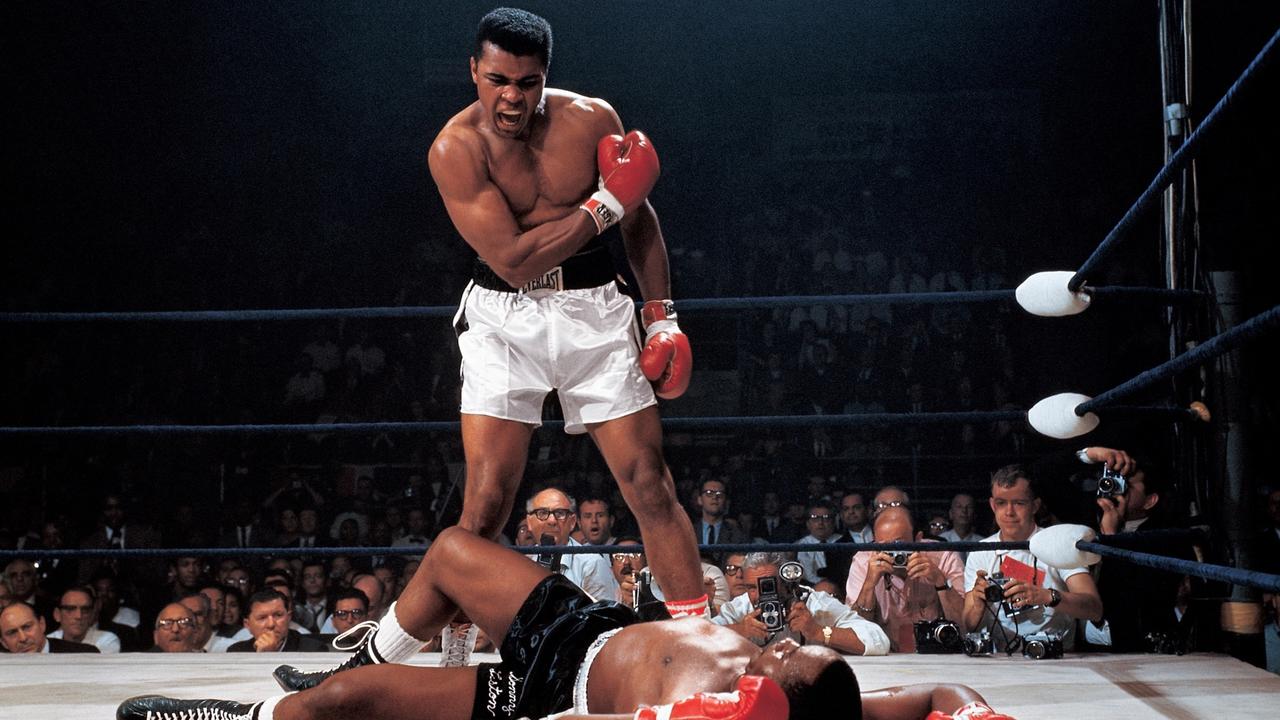
May 25, 1965: Ali-Liston II: The Phantom Punch

May 25, 1965: A fight is held for the Heavyweight Championship of the World. It's not the greatest such fight. But it might be the most controversial. Certainly, it is the strangest.

Writing this entry enabled me to have one set in the State of Maine -- and thus at least one entry in each of the 50 States.

Arguably, the most significant sports building in Maine is the Androscoggin Bank Colisée in Lewiston, about 36 miles north of Portland. Not because it was home to the Maine Nordiques, a farm team of hockey's Quebec Nordiques, from 1973 to 1977. Not because it hosted the Lewiston Maineiacs of the Quebec Major Junior Hockey League from 2003 to 2011, before they moved to Sherbrooke from whence they came. Not because it hosted the Portland Pirates in the 2013-14 season while the Cross Insurance Arena in Portland was being renovated. Not because it is now home to another team named the Maine Nordiques, of the North American Hockey League.
No, it's because, after the Boston Garden balked at holding it due to both men's controversies, the rematch between Heavyweight Champion Muhammad Ali and former Champion Charles "Sonny" Liston as held at this arena, then known as the Central Maine Civic Center, on May 25, 1965. Built in 1958, it is the smallest building to host a Heavyweight Title fight: 3,677 seats.

Ali, born Cassius Clay, had taken the title from Liston on February 25, 1964 in Miami Beach. Shortly thereafter, he announced his name change and his conversion to Islam. Both men were shrouded in controversy: Ali due to his association with the Nation of Islam, Liston due to his status as an ex-convict and his suspected ties to organized crime. Lewiston was chosen as a site because boxing's governing bodies were committed to a New England venue, but nobody else in the 6-State region (Maine, New Hampshire, Vermont, Massachusetts, Rhode Island and Connecticut) seemed to want it.

To make matters worse, the fight, originally scheduled for November 16, 1964, had to be delayed, as Ali needed surgery due to a hernia. So it was delayed to May 25, 1965, allowing all the simmering resentments to come to a near boil. There was even talk that the fight was fixed -- though both men's fans were suggesting it was fixed for the other.

The referee was former Champion Jersey Joe Walcott. Both fighters were booed upon their introductions. Midway through the 1st round, Liston threw a left jab, and Ali went over it with a fast right, knocking the former Champion flat on his back. Liston rolled over, got to his right knee, and then fell on his back again.

Walcott had a hard time getting Ali to go to a neutral corner. Ali initially stood over Liston, yelling, "Get up, sucker!" At this point, Neil Leifer of Sports Illustrated took the picture above, one of the most famous photographs in sports history.

When Walcott got back to Liston, and looked at the knockdown timekeeper, Francis McDonough, to pick up the count, Liston had fallen back on the canvas. Walcott never did pick up the count. He said he could not hear McDonough, who did not have a microphone. Also, McDonough did not bang on the canvas or motion a number count with his fingers. McDonough, however, claimed Walcott was looking at the crowd and never at him.

After Liston arose, Walcott wiped off his gloves. He then left the fighters to go over to McDonough. Waltcott later said McDonough had told him, "I counted him out. The fight is over." Nat Fleischer, editor of The Ring magazine, had no authority over the fight, but he backed McDonough up, saying the fight should be over. Walcott then rushed back to the fighters, who had resumed boxing, and stopped the fight, awarding Ali a knockout victory.

It remains one of the quickest heavyweight title knockouts in history. Many in the small crowd had not even settled in their seats when the fight was stopped. The official time of the stoppage was announced as 1:00 into the first round, which was wrong. Liston went down at 1:44, got up at 1:56, and Walcott stopped the fight at 2:12.

McDonough and Fleischer were wrong in their interpretation of how the rule should have been applied. Under the rule, the timekeeper is supposed to start the count at the time of a knockdown. The referee's duty is to get the boxer scoring the knockdown to a neutral corner, pick up the count from the timekeeper. and continue it aloud for the knocked down boxer.

Nevertheless, Liston was down for 12 seconds -- 2 seconds fewer than Gene Tunney was down in his "Long Count" fight with Jack Dempsey in 1927. But Liston was no Tunney. He was more like the Mike Tyson of his era: Show him that you're not afraid of him, and that you can hit him, and he would fold, or even start cheating. In his 1st fight with Ali, he tainted his gloves to try to blind Ali. In the 2nd fight, he never got the chance to cheat.

Some people wondered if Ali had even hit Liston, or if Liston had gone down on his own, quitting the way he'd quit on his stool between the 6th and 7th rounds of their 1st fight. The suggestion was that he lost on purpose for more money from gamblers -- in ring parlance, "took a dive." The film shows this not to be the case: It clearly shows that Ali's punch was no "Phantom Punch." Instead, it had lifted Liston off the canvas entirely. Liston didn't dive: He fell, from being hit.

James Braddock was Heavyweight Champion from 1935 to 1937. He said of Ali, "I have a feeling that this guy is a lot better than any of us gave him credit for. It isn't the knockout punch that sticks in my mind as much as a punch he let go earlier... It was a right to Liston's jaw, and it shook him to his shoetops. For all we know, it could have been the one that set up the knockout."

Rocky Marciano was Heavyweight Champion from 1952 to 1955. After seeing the replay, he said, "I didn't think it was a powerful punch when I saw the fight from ringside. Now, I think Clay, seeing the opening, snapped the punch the last six inches." But he still didn't think the punch was hard enough to be a knockout, only a knockdown.

Liston had 16 more fights, winning 15 of them, 14 by knockout. So the suggestion that "He was never the same fighter" is ridiculous. But he never got another shot at the title, not even after Ali was stripped of it in 1967, following his refusal to accept being drafted into the U.S. Army. Of course, by then, Liston was officially 35 years old -- but Walcott had been 37 when he won the title. Liston died in 1970, also under mysterious circumstances.

McDonough died in 1968, Fleischer in 1972, Walcott in 1994.

*

May 25, 1965 was a Tuesday.  These baseball games were played that day:

* The New York Yankees lost to the Cleveland Indians, 5-1 at Yankee Stadium. The Indians scored 4 runs in the top of the 6th inning, including 1 of the 2 home runs hit by Vic Davalillo, knocking Jim Bouton out. Sonny Siebert was the winning pitcher. Mickey Mantle and Roger Maris each went 0-for-3, with Mantle adding a walk.

* The New York Mets lost to the Philadelphia Phillies, 10-3 at Connie Mack Stadium in Philadelphia.

* The Minnesota Twins beat the Boston Red Sox, 17-5 at Fenway Park in Boston. Harmon Killebrew went 3-for-6. Carl Yastrzemski went 1-for-3.

* The Baltimore Orioles beat the Kansas City Athletics, 6-3 at Memorial Stadium in Baltimore. Brooks Robinson did not play.

* The Washington Senators swept a doubleheader from the California Angels, 7-3 and 6-5 at District of Columbia Stadium in Washington. (It was renamed Robert F. Kennedy Memorial Stadium in 1969).

* The Pittsburgh Pirates beat the Chicago Cubs, 7-6 at Forbes Field in Pittsburgh. Ernie Banks, Billy Williams and Len Gabrielson hit home runs. For the Pirates, Roberto Clemente went 1-for-6, but Donn Clendenon went 4-for-5 with an RBI, and Andre Rogers went 3-for-5 with 3 RBIs, including a single that scored Clendenon in the bottom of the 12th inning to win it.

* The Detroit Tigers beat the Chicago White Sox, 7-5 at Comiskey Park in Chicago. Al Kaline went 3-for-5 with 2 RBIs.

* The Cincinnati Reds beat the Houston Astros, 7-4 at the Astrodome in Houston. Frank Robinson went 2-for-5 with a RBI. Pete Rose went 1-for-4 with a walk.

* The Los Angeles Dodgers beat the St. Louis Cardinals, 2-0 at Dodger Stadium in Los Angeles. Curt Flood led off the game with a single, and then Don Drysdale didn't allow another hit, outpitching Bob Gibson. In fact, except for Dick Groat reaching on an error in the 5th, Drysdale didn't allow another baserunner.

* And the Milwaukee Braves beat the San Francisco Giants, 14-1 at Candlestick Park in San Francisco.

Saturday, February 26, 2022

February 26, 1972: Ed Muskie vs. William Loeb

February 26, 1972: Two Saturdays before the New Hampshire Primary, the frontrunner for the Democratic Party's nomination for President, Senator Edmund S. Muskie of neighboring Maine, delivers a speech in front of the offices of the State's largest newspaper, the Manchester-based Union Leader.

A U.S. Navy Lieutenant in World War II, Muskie had led the building of the Democratic Party in his State. Maine and Vermont were the only States that refused to vote for Franklin D. Roosevelt in all 4 of his runs for President. In 1954, after serving in the State House of Representatives, Muskie became the 1st Democrat elected Governor of Maine in 22 years. In 1958, he became the 1st Democrat that the State sent to the U.S. Senate in 48 years.

In 1968, having won the Democratic nomination for President, the outgoing Vice President, Hubert Humphrey, asked Muskie to be his Vice Presidential nominee. Comparisons between Muskie and the Republican nominee, the bumbling, bigoted, and eventually revealed to be crooked Governor Spiro Agnew of Maryland, were among the factors that nearly swung the election to Humphrey, but former Vice President Richard Nixon won in a squeaker, anyway.

On the eve of the 1970 Congressional elections, Muskie delivered a speech that served as a nationally-televised half-hour campaign commercial. It was widely seen as helpful, as the Democrats gained 12 seats in the House of Representatives and, despite a heavy effort by Nixon to get more Republicans in the Senate, the Democrats held them to a net gain of only 2.

Muskie's tall, lean physical appearance and plain speaking began to gain him comparisons to Abraham Lincoln. While Humphrey returned to the Senate (from Minnesota) in 1970, it wasn't clear that he was going to make another run for the Presidency, and so Muskie was widely seen as the front-runner for the Democratic nomination for it for 1972.

But the Union Leader was run by William Loeb III, a man ahead of his time as far as the conservative movement was concerned. The son of William Loeb Jr., an adviser to Presidents Theodore Roosevelt and William Howard Taft, Loeb III was a hardline anti-Communist, the godfather of the anti-tax activism of New Hampshire Republicans, and a self-appointed moral arbiter.
William Loeb

Never mind that he was a draft dodger, claiming ulcers to avoid serving in World War II; that he always carried a gun, and once shot the family cat; and that he was married 3 times, and in 1949 was caught cheating on his 2nd wife with his eventual 3rd wife, Elizabeth "Nackey" Scripps-Gallowhur, granddaughter of E.W. Scripps, founder of the Scripps-Howard newspaper chain and what eventually became United Press International (UPI).

(UPDATE: In 2022, his stepdaughter, known in adult life as Nackey Scagliotti, accused him of molesting her when she was 7, and also doing so with the daughter he and the elder Nackey had together, known as an adult as Edie Tomasko, who died in 2014. Edie's son subsequently backed this up, saying that his mother told her the same thing.)

Loeb had a habit of referring to politicians he didn't like by nasty names, well before the country at large ever heard of Donald Trump. He went after both Democrats and Republicans he considered insufficiently conservative, and it didn't stop with 1972:

* President Dwight D. Eisenhower, after a 1955 treaty with the Soviet Union: "Dopey Dwight" and "The Prince of Appeasement."

* President John F. Kennedy: "The No. 1 liar in the United States." JFK responded: "I believe there is probably a more irresponsible newspaper than that one right over there. But I've been through 40 States, and I have not found it yet. I believe that there is a publisher who has less regard for the truth than William Loeb, but I can't think of his name."

* Governor Nelson Rockefeller of New York, whose move from his 1st wife to his 2nd mirrored that of Loeb from his 2nd to his 3rd: "A wife-swapper."

* Senator Eugene McCarthy of Oregon, a Presidential candidate in 1968, later switching from Democratic to Independent: "A skunk's skunk's skunk."

* Muskie: "Moscow Muskie."

* Later, in 1976, President Gerald Ford: "Jerry the Jerk."

* President Jimmy Carter: "An out-and-out leftist coated over and disguised with peanut oil."

* And, in 1980, in what turned out to be the last Presidential campaign of his lifetime, he wrote an editorial telling Democratic Primary voters that their choice of Carter, Senator Ted Kennedy of Massachusetts, and Governor Jerry Brown of California was, respectively, between "the stupid, the coward and the flake." 

Loeb's critics in New Hampshire called him "Mr. Low Ebb." But he loved Richard Nixon and Ronald Reagan. His biggest mistake may have been firing a young reporter from a paper The Union Leader absorbed, The New Hampshire Sunday News. His name was Ben Bradlee, and he went on to run The Washington Post, which led to Nixon's downfall.

On February 24, 1972, with Muskie still the front-runner in the Democratic field, The Union Leader -- on its front page, mind you -- published a letter, under the headline, "Senator Muskie Insults Franco-Americans."

The alleged author's name was Paul Morrison, of Deerfield Beach, Florida. He claimed to have met Muskie and his staff in Florida, where he asked Muskie how he could understand the problems of black people when his home State of Maine had such a small black population. (Black people make up only a little over 1 percent of Maine's population, slightly more than Asians, and a little more than Native Americans.)

According to the author, Muskie said, "We don't have blacks but we have Cannocks," and laughed about it, and said, "Come to New England and see."

The letter had several misspellings, including the key word itself, which is "Canucks." While an NHL team that began play in 1970 was proudly named the Vancouver Canucks, people of French descent in New England, nearly all of them having ancestors who came down from Quebec, then considered "Canuck" to be a slur.

New England in general has a large French-Canadian population: They made up about 17 percent of New Hampshirites, and 40 percent of Democratic Primary voters. They make up about 20 percent of Vermonters, 10 percent of Massachusetts residents and Rhode Islanders, 8 percent of Mainers, and 6 percent of Connecticut residents.

The letter was written by Ken Clawson, White House Deputy Director of Communications. (If you're a fan of the TV show The West Wing, this was Sam Seaborn's role, then Will Bailey's.) The letter was planted by Nixon campaign operative Donald Segretti.
Donald Segretti

The next day, February 25, The Union Leader reprinted an accusation made a few weeks earlier in Newsweek, claiming that Jane Muskie, the candidate's wife, was an alcoholic. This was also a lie. Attacking the candidate was one thing. Attacking his wife was another. Even Nixon hadn't done that until now, and hadn't authorized it himself this time.

The Senator decided that enough was enough. He had a flatbed truck driven up to the newspaper's headquarters in Manchester, stood on the bed to allow himself to be seen by a crowd of about 200, including one holding up a sign reading, "NOUS AIMONS MUSKIE" (French for "We Like Muskie").

Among those on hand to support Muskie were 3 Maine politicians of French descent, including Louis Jalbert, a State Representative from Lewiston. He said, "I got up at 4 AM to get here. I would go to Latrobe, Pennsylvania in my bare feet if I could be with this man."

Muskie said, "That letter is a lie," adding, "I remember as a boy being called a Polack. I hated it. I'd never use that kind of term with respect to another ethnic group."

Loeb was not on hand, and Muskie noted it: "This man doesn't walk, he crawls." He added, "By attacking me, by attacking my wife, he has proved himself to be a gutless coward!"

Then he lowered his voice, and lowered his head, and said, "Maybe I've said all I should." He paused, and said, "It's fortunate for him he's not on this platform beside me." The words look defiant, but, in sound, they seemed like a man who, rather than wanting to hurt someone, had been, himself, deeply hurt.

Muskie maintained that if his voice cracked, it cracked from anger. Some witnesses thought he'd started crying. Others suggested it was just the light snow melting on his face.

But between the letter and the editorials, Muskie was successfully sabotaged by conservative dirty tricks: He won the New Hampshire Primary, but with just 46 percent of the vote, winning 14 of the available Delegates. Senator George McGovern of South Dakota, the most openly antiwar candidate in the field, won 37 percent, and was awarded the other 6 Delegates. No other candidate took more than 7 percent.

Muskie came to be regarded as weak and emotional. Two weeks later, he won the Illinois Primary. But the only other Primary he won was in another New England State, Rhode Island.

Not content with getting Muskie out of the way, Segretti, having had some paper with Muskie's letterhead stolen, faked accusations (which were then wrongly attributed to Muskie) that Humphrey was guilty of sexual misconduct, and that another contender for the nomination, Senator Henry "Scoop" Jackson of Washington State, had an affair and an illegitimate child with a 17-year-old girl. Both stories were quickly proven false.

McGovern ended up winning the nomination. Aside from serving as Secretary of State in the last 8 months of the Carter Administration, Muskie never got so close to the Presidency again.

Loeb died in 1981. Nackey Loeb continued to run The Union Leader in her husband's archconservative fashion until 1999, when she sold it due to failing health. She died the next year.

For most of 1974, including the transition from Nixon to Ford, Ken Clawson served as White House Director of Communications. He died in 1999.

After Nixon's resignation, Segretti was arrested, and pleaded guilty to 3 misdemeanor counts of distributing illegal campaign literature. He was sentenced to 6 months in prison, and served 4. He returned to his native Orange County, California, and briefly ran for a local judgeship, before local outrage forced him to drop out. In 2000, he was co-chair of John McCain's Presidential campaign in Orange County. As of February 26, 2022, he is still alive, one of the last surviving Nixon insiders.

Muskie died in 1998. That night, on The MacNeil-Lehrer Newshour on PBS, George Mitchell, appointed to the Senate seat Muskie gave up to become Secretary of State, said that if a politician cried while defending his wife from unfair attacks in a speech today, he'd be cheered.

Mitchell was right. There were moments in the 1992 Presidential campaign when Bill Clinton seemed to tear up, and nobody cared. While George W. Bush in 2000 and Donald Trump in 2016 could swear and act like petulant teenagers over an open microphone, and it didn't stop them.

*

March 4, 1972 was a Saturday. Baseball was in Spring Training. Football was in the off-season. There were 5 games played in the NBA that day:

* The New York Knicks lost to the Baltimore Bullets, 104-97 at Madison Square Garden.

* The Chicago Bulls beat the Golden State Warriors, 107-106 at the Oakland Coliseum Arena. Bob Love scored 33 points.

* The Milwaukee Bucks beat the Phoenix Suns, 119-117 in overtime at the Milwaukee Exposition & Convention Center Arena, a.k.a. The MECCA. Kareem Abdul-Jabbar scored 44 points and had 20 rebounds.

* The Houston Rockets beat the Detroit Pistons, 122-106 at the Hofheinz Pavilion (now the Fertitta Pavilion) in Houston. Elvin Hayes scored 36 points and had 18 rebounds.

* And the Seattle SuperSonics beat the Cincinnati Royals, 122-106 at the Seattle Center Coliseum. Spencer Haywood scored 38 points and had 21 rebounds.

There were 4 games played in the American Basketball Association:

* The New York Nets lost to the Virginia Squires, 121-119 at The Scope in Norfolk. Charlie Scott scored 45 points.

* The Carolina Cougars beat the Pittsburgh Condors, 146-130 at the Greensboro Coliseum. George Carter scored 34 points.

* The Kentucky Colonels beat the Memphis Pros, 123-100 at Freedom Hall in Louisville. Johnny Neumann scored 40 points.

* And the Indiana Pacers beat the Dallas Chaparrals, 115-113 in overtime at the Moody Coliseum in Dallas. George McGinnis scored 35 points.

And there were 6 games played in the NHL:

* The Montreal Canadiens beat the Detroit Red Wings, 8-1 at the Montreal Forum. Yvan Cournoyer scored 2 goals, and brothers Frank and Pete Mahovlich each had 1.

* On the CBC's nationally-broadcast Hockey Night In Canada, the Toronto Maple Leafs beat the Vancouver Canucks, 7-1 at Maple Leaf Gardens in Toronto. Paul Henderson scored 3 goals, Norm Ullman 2. In September of that year, Henderson would become one of the biggest heroes in Canadian history, in any walk of life.

* The Pittsburgh Penguins beat the Philadelphia Flyers, 5-2 at the Civic Arena in Pittsburgh.

* The Chicago Black Hawks beat the California Golden Seals, 3-0 at the Chicago Stadium.

* The St. Louis Blues beat the Minnesota North Stars, 3-2 at the Metropolitan Sports Center in the Minneapolis suburb of Bloomington, Minnesota.

* The Boston Bruins beat the Los Angeles Kings, 5-4 at The Forum outside Los Angeles in Inglewood, California.

* And the New York Rangers and the Buffalo Sabres were not scheduled.

December 31, 1999 & January 1, 2000: The Millennium

December 31, 1999:  The Millennium arrives. The people of planet Earth survived. At a terrible cost. But we hadn't destroyed ourselves. ...