Showing posts with label ann arbor. Show all posts

Sunday, December 11, 2022

December 11, 2010: Hockey's Biggest Crowd

December 11, 2010: The largest paid attendance ever at a hockey game sees "The Big Chill at the Big House."

The seeds for this epic event had been sowed 9 years earlier. The University of Michigan in Ann Arbor, outside Detroit, and Michigan State University in East Lansing, outside the State capital of Lansing, are arch-rivals, although UM also claims big rivalries with Ohio State and Notre Dame. Although the rivalry is at its biggest in football, it is also big in basketball and hockey.

Someone at MSU got the idea to play a UM-MSU hockey game outdoors, at MSU's Spartan Stadium. UM liked the idea, and the game was played on October 6, 2001, billed as "The Cold War." The game ended in a 3-3 tie.

The attendance was 74,544, the biggest crowd ever to see a hockey game anywhere. It broke the record set at the 1957 Ice Hockey World Championships at the Lenin (later Luzhniki) Stadium in Moscow, where the Soviet Union beat Sweden in the Final. It also surpassed the largest crowd ever to attend a National Hockey League game, set on October 9, 1993, when the Florida Panthers beat the Tampa Bay Lightning before 27,227 fans at the ThunderDome (now Tropicana Field) in St. Petersburg, Florida.

The Cold War inspired other outdoor hockey games. On November 22, 2003, the Edmonton Oilers hosted the Montreal Canadiens in a "Heritage Classic" at Commonwealth Stadium in Edmonton, with the regular game preceded by an old-timers' game representing the teams. That got 57,167, setting a new NHL record, but was well short of the world record.

The NHL instituted the Winter Classic, to be held every New Year's Day (or on January 2 if January 1 falls on a Sunday, as has happened in 2012 and 2017 -- or not at all in 2013 due to a team owners' lockout, and in 2021 due to the COVID-19 pandemic). The 1st was held on January 1, 2008, at Ralph Wilson (now Highmark) Stadium in the Buffalo suburb of Orchard Park, New York. A new NHL record crowd, but not world record crowd, of 71,217 saw the Pittsburgh Penguins beat the Buffalo Sabres, 2-1 in a shootout.

A new world record crowd of 77,803 came to the Veltins-Arena in Gelsenkirchen, Germany, home of soccer team Schalke 04, to see Germany defeat the U.S. in the Final of the International Ice Hockey Federation (IIHF) World Championship on May 7, 2010.

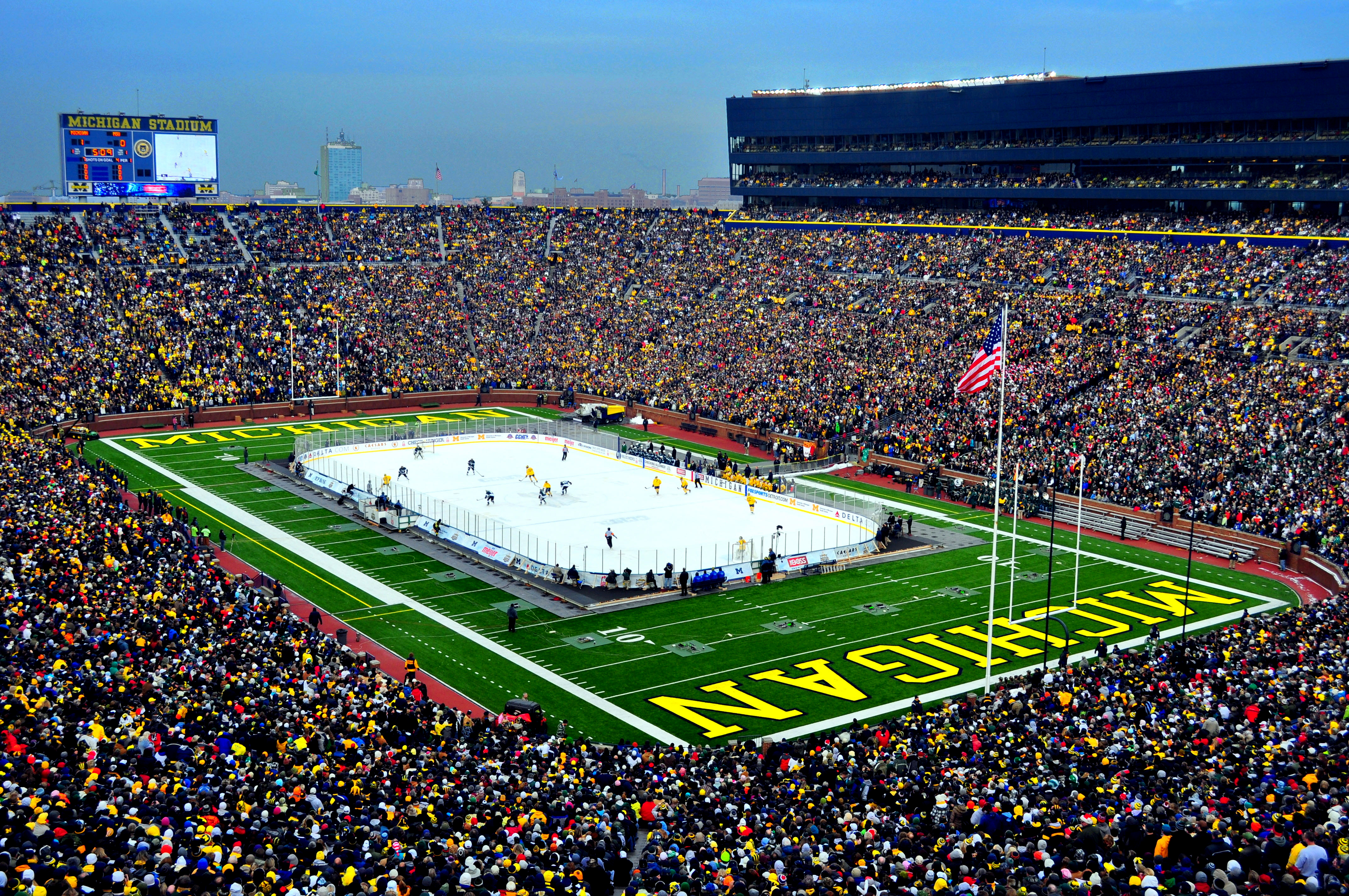
So the U.S. was determined to retake the record. Again, it was the Michigan Wolverines and the Michigan State Spartans, only this time, at Michigan Stadium in Ann Arbor. Due to its immense size, Michigan Stadium is known as "The Big House," so this game was billed as "The Big Chill at the Big House."

The crowd was announced as 113,411, which, at the time, would even have broken the record for a football game at the place. But it was revealed that the actual paid attendance was 104,173. Still, this was far and away a new record, anywhere on Earth, for a hockey game. And the result was no contest: The Wolverines won, 5-0.

On January 1, 2014, Michigan Stadium hosted the NHL Winter Classic, and the Toronto Maple Leafs beat the "host" Detroit Red Wings, 3-2 in a shootout. The paid attendance was a new record: 105,491. However, UM officials still count the 2010 Big Chill as the record. Regardless, this is the current NHL record. And, since 2010, no hockey game other than this one in 2014 has surpassed 100,000. So, whichever of these games you consider to be the record will remain so, at least for a while.

*

December 11, 2010 was a Saturday. Baseball was out of season. The NFL played the next day. The regular season of college football had only 1 game left, and it was played at Lincoln Financial Field in Philadelphia: Navy beat Army, 31-17.

There were 8 games played in the NBA:

* The Boston Celtics beat the Charlotte Bobcats, 93-62 at what's now named the Spectrum Center in Charlotte. Yes, that's a full 48-minute game, and the Hornets-to-be only scored sixty-two points.

* The Atlanta Hawks beat the Indiana Pacers, 97-83 at what's now the State Farm Arena in Atlanta.

* The Houston Rockets beat the Cleveland Cavaliers, 110-95 at the Toyota Center in Houston. Kevin Martin scored 40 points.

* The Dallas Mavericks beat the Utah Jazz, 103-97 at the American Airlines Center in Dallas.

* The Toronto Raptors beat the Detroit Red Wings, 120-116 at The Palace in the Detroit suburb of Auburn Hills, Michigan.

* The Chicago Bulls beat the Minnesota Timberwolves, 113-82 at the United Center in Chicago.

* The Memphis Grizzlies beat the Los Angeles Clippers, 84-83 at what's now the Crypto.com Arena in Los Angeles.

* And the Miami Heat beat the Sacramento Kings, 104-83 at what's now the Sleep Train Arena in Sacramento. Dwyane Wade scored 36.

There were 13 games played in the NHL, none of them having an attendance of higher than 23,000:

* The New Jersey Devils lost to the Detroit Red Wings, 4-1 at the Prudential Center.

* The New York Rangers lost to the Columbus Blue Jackets, 3-1 at the Nationwide Arena in Columbus.

* The New York Islanders lost to the Atlanta Thrashers, 5-4 at the Nassau Coliseum.

* The Philadelphia Flyers beat the Boston Bruins, 2-1 in overtime at the TD Garden in Boston.

* The Colorado Avalanche beat the Washington Capitals, 3-2 at what's now the Capital One Arena in Washington.

* The Pittsburgh Penguins beat the Buffalo Sabres, 5-2 at what's now the KeyBank Center in Buffalo.

* In the 1st game of CBC's Saturday Hockey Night In Canada doubleheader, the Toronto Maple Leafs beat the Montreal Canadiens, 3-1 at what's now the Scotiabank Arena in Toronto.

* The Nashville Predators beat the Florida Panthers, 3-0 at the Bridgestone Arena in Nashville.

* The Carolina Hurricanes beat the St. Louis Blues, 2-1 in a shootout at what's now the Enterprise Center in St. Louis.

* The Phoenix Coyotes beat the Dallas Stars, 5-2 at what's now the Desert Diamond Arena in the Phoenix suburb of Glendale, Arizona.

* The Minnesota Wild beat the Los Angeles Kings, 3-2 at what's now the Crypto.com Arena in Los Angeles.

* The Chicago Blackhawks lost to the San Jose Sharks, 2-1 in overtime at the SAP Center in San Jose.

* In the 2nd Hockey Night In Canada game, the Tampa Bay Lightning beat the Vancouver Canucks, 5-4 in overtime at what's now the Rogers Arena in Vancouver.

* The Anaheim Ducks, the Calgary Flames, the Edmonton Oilers and the Ottawa Senators were not scheduled.

Thursday, November 24, 2022

November 24, 1973: The Ohio State-Michigan Tie

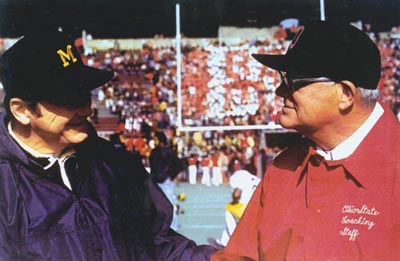
Glenn Edward Schembechler Jr. (left) and Wayne Woodrow Hayes

November 24, 1973: The football teams of Ohio State University and the University of Michigan play each other at Michigan Stadium in Ann Arbor. This was intended as the 30th time that the winner of this game would win the Big Ten Conference Championship. (And there have been many more since.)

Wayne Woodrow Hayes, known as Woody, had coached at Ohio State since 1951, and had already won the Big 10 title 7 times, and the National Championship in 1954, 1957, 1961 and 1968. Glenn Edward Schembechler Jr., known as Bo, had played for him at Miami University in Ohio, and had coached under him there and at Ohio State, before becoming head coach at Miami and then at Michigan in 1969.

Ohio State was going for back-to-back National Championships in 1969, with a supposedly unbeatable team, but Bo's Wolverines shocked Woody's Buckeyes in Ann Arbor, re-establishing Michigan as a national football power, and beginning what would eventually be known as "The Ten-Year War" between not just the two programs, but between the two men. Ohio State won in 1970, Michigan in 1971 and Ohio State in 1972.

Ohio State came into the game at 9-0, having been ranked Number 1 for most of the season. The closest any team had come to beating them was Wisconsin, and they lost 24-0. The Buckeyes had hung 60 points on Northwestern, 56 on Minnesota, 55 on Iowa, 37 on both Texas Christian and Indiana, and 35 on Michigan State. With sophomore running back Archie Griffin, on his way to becoming the only 2-time Heisman Trophy winner, and future All-Pro linebacker Randy Gradishar, they looked unbeatable -- just as they were in 1968, and just as they looked in 1969.

Michigan came into the game 10-0, and ranked Number 4. They'd had some closer calls, only beating Navy by 14 points and Illinois by 15. But they scored 49 on Indiana, 47 on Stanford, 35 on Wisconsin, and 34 on both Minnesota and Purdue. And they had a strong defense, shutting out Navy, Oregon and Michigan State. Only Stanford and Indiana reached double figures against them. Cornerback Dave Brown, defensive tackle Dave Gallagher, tight end Paul Seal and placekicker Mike Lantry were named All-Americans.

A crowd of 105,223 plowed into the enormous bowl in Ann Arbor, nicknamed The Big House. Millions more watched Chris Schenkel and former Michigan State coach Duffy Daugherty call the game on ABC. It was Ohio State vs. Michigan. It was "The Game."

It rained before the game. Coupled with both coaches' distaste for the forward pass -- Hayes famously said, "There are three things that can happen when you throw the football, and two of them are bad," meaning an incompletion and an interception -- this game was destined to remain mostly on the ground. Michigan passed for only 90 yards, and Ohio State attempted only 4 passes.

The game was scoreless after the 1st quarter. Early in the 2nd quarter, Blair Conway kicked a field goal to put Ohio State up 3-0. Michigan struggled, and Ohio State gained a lot on the ground through Griffin. But it was the other big back, Pete Johnson, who ended up scoring the Buckeye touchdown, putting them up 10-0 just before halftime.

Midway through the 3rd quarter, Ohio State got to the Michigan 34-yard line, but on 4th and 2, Hayes, that most conservative of football coaches, refused to gamble on a 51-yard field goal attempt, and went for the 1st down, and couldn't convert it. That gave the Wolverines new life, and they drove 11 plays, and Lantry got them on the board with a field goal.

Midway through the 4th quarter, Michigan was able to drive down to the Ohio State 10-yard line, but the Buckeyes held them, and it was 4th and inches. Hayes put 9 men on the line of scrimmage, making a "goal-line stand" on the 10, because he had predicted that Wolverine quarterback Dennis Franklin would once again hand off to Ed Shuttlesworth.

But Schembechler, unlike Hayes, was willing to gamble: He had Franklin fake the handoff to Shuttlesworth, and got himself through the line for a touchdown. It was 10-10.

With 6 minutes left, Michigan got the ball on their 10. Franklin drove into Buckeye territory, but with 2:23 to go, he was injured and had to leave the game. Schembechler decided to gamble again, and had Lantry try a 58-yard field goal. It had the distance, but was just wide left.

Ohio State couldn't do anything with their opportunity, and quarterback Greg Hare threw an interception that must have driven Hayes up the wall. The Wolverines got the ball to the Buckeye 28, and Lantry attempted a game-winning 45-yard field goal. But he missed, and 10-10 was the final score.
So now, there was a tie not just in the game, but for the Big 10 title. And, at the time, the Big 10 had a rule that now seems ridiculous: Only the league's Champion could go to a bowl game, the Rose Bowl. Until 1971, they had another ridiculous rule: No team could go to the Rose Bowl 2 years in a row. In other words, if a team won back-to-back titles, the 2nd place team would go to the Rose Bowl instead.

With that rule having gone by the wayside, and the title being tied, the Big 10's representative to play the University of Southern California (USC) in the Rose Bowl would be up to a vote the next day, held in a telephone conference call of the league's athletic directors. Since Ohio State had gone to the Rose Bowl the year before, it seemed simple enough: It was Michigan's turn.

Even Hayes agreed. He hated Michigan as much as any coach has ever hated his school's arch-rival. You approached him with great care during "Michigan Week." And he usually referred to them as "that school up north." Ohio State fans began referring to them by the initials of that epithet: "TSUN." But as competitive as Woody was, this time, he admitted, "We had to win this one to go, and we didn't. If they vote Michigan, Michigan deserves to go." And if the vote were a 5-5 split, then the old rule would be observed, and Michigan would go.

The vote was 6-4 for Ohio State. The Buckeyes voted for themselves, of course; and also got the votes of Illinois, Northwestern, Purdue, Wisconsin and Michigan State. The Wolverines voted for themselves, and also got the votes of Indiana, Iowa and Minnesota.

Bo blew his stack. He would have blown it again if he had lived long enough to hear a recording released in connection with the 2013 Big Ten Network documentary Tiebreaker, of Michigan State athletic director J. Burt Smith, 4 days after the game and 3 days after the vote, that he had voted for Ohio State, because they "best met the definition of the most representative team."

Another rumor came out that MSU voted for Ohio State in retaliation for Michigan's "No" vote on their admittance to the Big Ten in 1949. (The University of Chicago had dropped out in 1940, and so the league was a Big Nine for a few years.) Granted, Michigan State hates Michigan as much as Ohio State does, but 24 years is a long time to hold a grudge, especially over a move that didn't even work.

In his 1989 memoir, Schembechler said that Illinois coach Bob Blackman was told by his athletic director, Cecil Coleman, that he would vote for Michigan, but that Coleman voted for Ohio State anyway.

Bo also suggested in that memoir that the Big Ten knew that Franklin's injury would make it problematic for Michigan, and they'd already lost the last 4 Rose Bowls to the league then known as the Pacific-Eight, and they thought Ohio State would have a better chance to win. As it turned out, that was correct: Ohio State won the 1974 Rose Bowl, beating USC 42-21.

But the tie ended up hurting Ohio State, if not as much as it hurt Michigan. Notre Dame, ranked Number 3, upset the new Number 1, Alabama, in the Sugar Bowl, and were awarded the National Championship. Ohio State ended up Number 2 in both the Associated Press poll (AP, the football writers) and the United Press International poll (UPI, the football coaches). Michigan finished Number 6 in both polls.

In 1972, '73 and '74 combined, Michigan went 30-2-1, their only non-wins being the '72 loss to Ohio State, 14-11; the '73 tie with Ohio State, 10-10; and the '74 loss to Ohio State, 12-10. Three non-wins, by a combined total of 5 points. And yet, they didn't go to a bowl game in any of those seasons. Even fans of the other 9 schools in the league at the time, used to hating Michigan and wanting them to suffer, had to admit that this was a bit unfair.

Finally, in 1975, the Big Ten voted to open postseason bids to as many as 4 teams, which has since been expanded to 6. Fittingly, Michigan became the 1st team to benefit, going 8-0-2 in 1975 before losing to Ohio State, and then going to the Orange Bowl, where they lost to Oklahoma.

*

November 24, 1973 was a Saturday. And there were other big games in college football that day, some of them rivalries, besides Number 1 Ohio State vs. Number 4 Michigan:

* Number 2 Alabama had already played 2 days earlier, on Thanksgiving, beating Number 7 Louisiana State, 21-7 at Tiger Stadium in Baton Rouge, Louisiana.

* Number 3 Oklahoma played the day before, the day after Thanksgiving, beating Nebraska, 27-0 at Memorial Stadium in Norman, Oklahoma. This clinched them the Big Eight title. However, they were on probation, and couldn't accept the Big Eight Champions' bid to the Orange Bowl.

* Number 5 Notre Dame had also played on Thanksgiving, beating the Air Force Academy, 48-15 at Notre Dame Stadium in South Bend, Indiana.

* Number 6 Penn State beat Number 20 Pittsburgh, 35-13 at Beaver Stadium in State College, Pennsylvania. Led by Heisman Trophy-winning running back John Cappelletti, Joe Paterno's Nittany Lions went on to beat LSU in the Orange Bowl, and finished undefeated. But they only finished Number 5 in the polls, behind fellow undefeated Notre Dame, undefeated-but-one-tie Ohio State, undefeated-but-one-tie Oklahoma, and one-loss Alabama.

* Number 9 USC beat Number 8 UCLA, 23-13 at the Los Angeles Coliseum. This clinched the Pac-8 title. But, as I said, USC lost the Rose Bowl to Ohio State.

* Number 11 Texas played on Thanksgiving, beating Texas A&M, 42-13 at Kyle Field in College Station, Texas. That clinched the Southwest Conference title. But they lost the Cotton Bowl to Nebraska.

* In a rare Sunday game for college football in those days, Number 13 Arizona State played arch-rival Arizona the next day, November 25, and won, 55-19 at Sun Devil Stadium in the Phoenix suburb of Tempe, Arizona. This clinched the title of the Western Athletic Conference. In 1978, Arizona and Arizona State left the WAC, and made the Pac-8 a Pac-10.

* Number 16 North Carolina State, then coached by Lou Holtz in his 2nd season of his 1st NCAA Division I-A head coaching job, beat Wake Forest, 52-13 at Carter Stadium in Raleigh. (It's now named Carter-Finley Stadium.) This game won N.C. State the Atlantic Coast Conference title.

* Dartmouth beat Princeton, 42-24 at Palmer Stadium in Princeton, New Jersey, to wrap up the Ivy League title.

* New York City's only remaining major-college football team, Columbia, lost to Brown, 37-14 at Brown Stadium in Providence, Rhode Island.

* And Rutgers got pasted by Colgate, 42-0 at Rutgers Stadium in Piscataway, New Jersey.

There were 5 games played in the NBA that day:

* The New York Knicks lost to the Golden State Warriors, 107-99 at Madison Square Garden. Walt "Clyde" Frazier scored 34 points, but it wasn't enough.

* The Buffalo Braves beat the Kansas City-Omaha Kings, 143-131 at the Buffalo Memorial Auditorium. Bob McAdoo had 43 points and 17 rebounds for the Braves, who became the San Diego Clippers in 1978 and the Los Angeles Clippers in 1984.

* The Milwaukee Bucks beat the Atlanta Hawks, 112-91 at The Omni in Atlanta.

* The Chicago Bulls beat the Detroit Pistons, 114-112 in overtime at the Chicago Stadium.

* And the Los Angeles Lakers beat the Portland Trail Blazers, 113-108 at the Portland Memorial Coliseum.

There were also 5 games played in the ABA:

* The New York Nets beat the Utah Stars, 119-113 at the Salt Palace in Salt Lake City. Julius "Dr. J" Erving scored 38 points for the Long Island club.

* The Virginia Squires beat the Indiana Pacers, 108-102 at The Scope in Norfolk, Virginia.

* The Denver Rockets beat the Carolina Cougars, 127-122 in overtime at the Greensboro Coliseum. The Rockets became the Denver Nuggets in 1974.

* The Kentucky Colonels beat the San Diego Conquistadors, 124-121 at Freedom Hall in Louisville.

* And the San Antonio Spurs beat the Memphis Tams, 121-118 in double overtime at the HemisFair Arena in San Antonio.

There were 6 games played in the NHL:

* The New York Rangers played the Los Angeles Kings to a tie, 5-5 at The Garden.

* The New York Islanders lost to the Detroit Red Wings, 6-4 at the Olympia Stadium in Detroit.

* The Montreal Canadiens beat the Pittsburgh Penguins, 5-2 at the Civic Arena in Pittsburgh.

* The Chicago Black Hawks beat the Toronto Maple Leafs, 3-1 at Maple Leaf Gardens in Toronto.

* The Minnesota North Stars beat the California Golden Seals, 6-3 at the Metropolitan Sports Center in the Minneapolis suburb of Bloomington, Minnesota.

* The Philadelphia Flyers beat the St. Louis Blues, 1-0 at the St. Louis Arena.

* The Atlanta Flames, the Boston Bruins, the Buffalo Sabres and the Vancouver Canucks were not scheduled.

And there were 2 games played in the World Hockey Association. The Cleveland Crusaders beat the Toronto Toros, 2-1 at the Cleveland Arena. And the Houston Aeros beat the Chicago Cougars, 5-3 at the Sam Houston Coliseum in Houston. 
Tuesday, November 22, 2022

November 22, 1969: The Michigan Wolverines Return to Glory

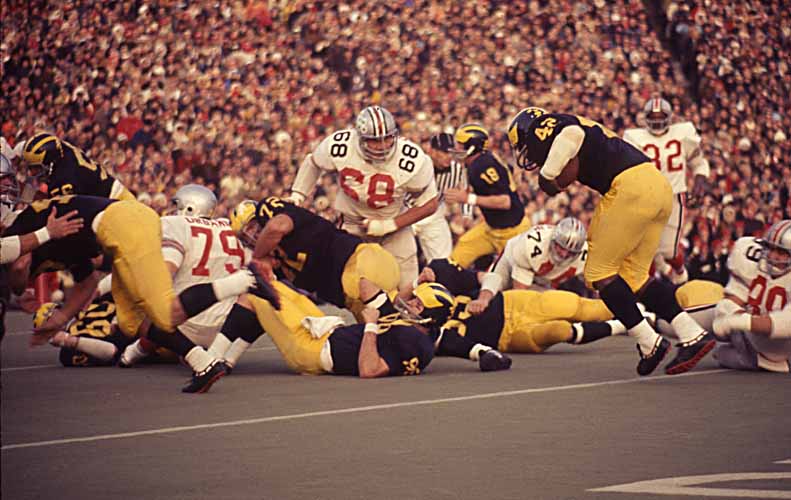
November 22, 1969: The most famous game in the history of the Midwest's greatest college football rivalry is played in front of 103,588 fans at Michigan Stadium in Ann Arbor.

Glenn Edward Schembechler Jr. had played for Wayne Woodrow Hayes at Miami University of Ohio, and coached under him at Ohio State, before becoming Miami's head coach, and was now in his 1st year at Michigan. "Bo" had the Wolverines ranked Number 12 in the nation. But "Woody" had won the previous year's National Championship at Ohio State, his Buckeyes had won 22 straight games, and were still ranked Number 1.

Michigan had long been the leading football power in the Big Ten, but the 1950s saw the rise of Woody's Buckeyes, and of Duffy Daugherty's Michigan State University, and the Wolverines fell back. From 1950 to 1968, Big 10 football titles had been won (some of these races ending in ties) by Illinois in 1951, 1953 and 1963; Wisconsin in 1952, 1959 and 1962; Purdue in 1952 and 1967; Michigan State in 1953, 1965 and 1966; Iowa in 1958 and 1960; Minnesota in 1960, 1962 and 1967; Indiana in 1967 (a 3-way tie with Purdue and Minnesota); Ohio State in 1954, 1955, 1957, 1961 and 1968; and Michigan only in 1964. Only Northwestern had failed to win a title.

Chalmers "Bump" Elliott, a former Michigan star, coached them to that 1964 Conference Championship. Over the next 4 years, Michigan went 4-6, 6-4, 4-6 and 8-2. Elliott was fired, and Schembechler was hired away from Miami. Just as Woody had made beating Michigan -- or, refusing to say the name, calling it "That school up north," or TSUN for short -- Bo made beating Ohio State, and Woody, the Wolverines' priority.

The Wolverines came in at 7-2, having lost a non-conference game to then-Number 9 Missouri at home, and away to Michigan State. That was their only Big 10 loss, so this game would be for the title. And the Buckeyes were looking to win another National Championship, with fellow undefeateds Texas, Arkansas and Penn State keeping an eye on them. Which they could do, because it was televised nationally on ABC.

Ohio State had quarterback Rex Kern, running backs Jim Otis and John Brockington, and nose tackle Jim Stillwagon, and safety Jack Tatum. Michigan had offensive tackle Dan Dierdorf, guard Reggie McKenzie, receiver Glenn Doughty and tight end Jim Mandich. In other words, both teams were loaded.

But while Michigan had a great offensive line, it was their defense that told the story. Ohio State scored the 1st touchdown, but missed the extra point. Michigan scored a touchdown, and made their extra point, and the 1st quarter ended with Michigan up, 7-6. Ohio State scored another touchdown, but Michigan stopped him on the two-point conversion attempt. But Michigan came right back, scored another touchdown, then another, and then a field goal. At the half, it was Michigan 24, Ohio State 12.

Bo remembered his defensive coordinator, Jim Young, telling his players that Ohio State would not score in the 2nd half. He bounded the blackboard with the formations written on it with each word: "They! Will! Not! Score! Again!" Young went on to become the head coach at Arizona, Purdue and Army.

He was right: Neither team scored again. Michigan missed a field goal, then ended the next 2 Ohio State drives with interceptions. Woody hated the passing game, saying, "Three things can happen when you throw the football, and two of them are bad," meaning an incompletion and an interception. The Ohio State defense got better in the 4th quarter, but their offense didn't, and it remained 24-12. Michigan forced 6 interceptions and a fumble, and had ended Ohio State's streak, and become the Big Ten Champions.
As the fans rushed onto the field, and the Wolverines carried Bo off their shoulders, ABC announcer Bill Flemming said, "There it is! What has to be the upset of the century!" He had forgotten about Army losing to Carlisle in 1912, Notre Dame in 1913, and Army in 1947; and Centre College beating Harvard in 1921.

Michigan's upset of Ohio State was the 1st of 10 games between Woody and Bo, from Bo's arrival in Ann Arbor in 1969 until Woody had to be fired in 1978, were known as The Ten-Year War, with Bo "winning," 5-4-1. Michigan won in 1969, '71, '76, '77 and '78. Ohio State won in 1970, '72, '74 and '75. The '73 game was a tie.
Bo (left) and Woody

Woody and Bo remained friends until Woody's death in 1987. Bo lived on until 2006, dying the day before that year's game, which became one of college football's periodic "Games of the Century."

*

November 22, 1969 was a Saturday. These other noteworthy games were played that day:

* Number 2 Texas were idle. The next week, they beat arch-rival Texas A&M. Number 3 Arkansas were idle. The next week, they beat Texas Tech, setting up the "Game of the Century" showdown. Texas won it, winning the Southwest Conference title, and its automatic berth in the Cotton Bowl. Arkansas fell to Number 3,

* Rivalry: Number 4 Penn State beat the University of Pittsburgh, 27-7 at Pitt Stadium in Pittsburgh. A win the next week over North Carolina State gave Penn State, an independent with no conference title available to them, an undefeated regular season, and an invitation to the Orange Bowl.

* Rivalry: Number 5 University of Southern California (USC) beat Number 6 University of California at Los Angeles (UCLA), 14-12 at the Los Angeles Memorial Coliseum. USC thus won the Pacific-Eight Conference title. They went on to beat Michigan in the Rose Bowl.

* Rivalry: Number 7 Missouri beat Kansas, 69-921 at Memorial Stadium in Lawrence, Kansas. This gave "Mizzou" the Big Eight Conference title, and an automatic berth in the Orange Bowl. Penn State beat them, to complete an undefeated season, and make a claim for the National Championship.

* Number 8 Notre Dame beat Air Force, 13-6 at Notre Dame Stadium in South Bend, Indiana. For the 1st time since their "Four Horsemen" season of 1924, 45 years, the Fighting Irish accepted a bowl berth, taking on Number 1 Texas in the Cotton Bowl. Texas won, and were awarded the National Championship. Penn State fans have whined about being bypassed for that title ever since.

* Rivalry: Number 9 Tennessee beat Kentucky, 31-26 at McLean Stadium in Lexington, Kentucky. The next week, Tennessee beat Vanderbilt, and won the Southeastern Conference title. They had only lost 1 SEC game, to the University of Mississippi, who had lost 2 of them. By rights, the Sugar Bowl should have invited Tennessee, as both SEC Champions and the higher-ranked team. Instead, they invited Arkansas and "Ole Miss," as neighbors with an established inter-conference rivalry.

Ole Miss won the Sugar Bowl, and so, in the span of 64 minutes of football, Arkansas went from a good shot at the National Championship to a 2-loss team with nothing to show for it.

* Rivalry: Number 10 Louisiana State University beat Tulane, 27-0 at Tiger Stadium in Baton Rouge, Louisiana. Stuck behind Tennessee and Ole Miss in the SEC, LSU were not invited to any bowl game.

* Rivalry: Number 14 Stanford beat the University of California, 29-28 at the old Stanford Stadium in the San Francisco suburb of Palo Alto, California.

* Rivalry: Number 16 Nebraska beat Oklahoma, 44-14 at Owen Field in Norman, Oklahoma.

* Rivalry: Number 17 Purdue beat Indiana, 44-21 at Seventeenth Street Stadium (now Memorial Stadium) in Bloomington, Indiana.

* Rivalry: Boston College beat the University of Massachusetts, 35-30 at Alumni Stadium just outside Boston in Chestnut Hill, Massachusetts.

* Rivalry: Yale beat Harvard, 7-0 at the Yale Bowl in New Haven, Connecticut. It did not make up for the previous year's famous 29-29 tie.

* Rivalry: Maryland beat Virginia, 17-14 at Byrd Stadium (now SECU Stadium) in the Washington suburb of College Park, Maryland.

* Rivalry: The University of Richmond beat the College of William & Mary, 28-17 at Cary Field in Williamsburg, Virginia.

* Rivalry: Duke beat North Carolina, 17-13 at Duke Stadium (now Wallace Wade Stadium) in Durham, North Carolina.

* Rivalry: South Carolina beat Clemson, 27-13 at Carolina Stadium (now Williams-Brice Stadium) in Columbia, South Carolina.

* Rivalry: Miami University beat the University of Cincinnati, 36-20 at Nippert Stadium in Cincinnati.

* Rivalry: Minnesota beat Wisconsin, 35-10 at Memorial Stadium in Minneapolis.

* Rivalry: New Mexico beat New Mexico State, 24-21 at Aggie Memorial Stadium in Las Cruces, New Mexico.

* Rivalry: Oregon State beat Oregon, 10-7 at Autzen Stadium in Eugene, Oregon.

* Rivalry: Washington beat Washington State, 30-21 at the old Husky Stadium in Seattle.

* And in New Jersey, Rutgers beat Colgate, 48-12 at Rutgers Stadium in Piscataway; while Princeton beat Dartmouth, 35-7 at Palmer Stadium in Princeton. Earlier in the season, these 2 Jersey teams, who had played in the 1st college football game 100 years earlier, played at Rutgers, and Rutgers won, 29-0. Both teams finished the Centennial season at 6-3.

The other major rivalries were played the next week. On Thursday, November 27, Thanksgiving Day, Texas beat Texas A&M, Virginia Tech beat Virginia Military Institute (VMI -- Virginia were not yet Tech's biggest rival), and Ole Miss beat Mississippi State.

On the Saturday, November 29, Army beat Navy, Georgia Tech beat Georgia, Florida beat the University of Miami, Tennessee beat Vanderbilt, Auburn beat Alabama, Oklahoma beat Oklahoma State, and Arizona State beat Arizona.

Pro football was played the next day. Baseball was out of season. There were 5 games played in the NBA:

* The New York Knicks beat the Phoenix Suns, 128-114 at Madison Square Garden. Willis Reed scored 37 points.

* The Philadelphia 76ers beat the Atlanta Hawks, 132-116 at the Alexander Memorial Coliseum (now the McCamish Pavilion) in Atlanta.

* The Chicago Bulls beat the Milwaukee Bucks, 125-106 at the Chicago Stadium.

* The San Diego Rockets beat the Boston Celtics, 125-116 at the San Diego Sports Arena (now the Pechanga Arena). Elvin Hayes scored 41 points and grabbed 22 rebounds.

* And the Los Angeles Lakers beat the team that was supposed to be their arch-rivals, the San Francisco Warriors, 106-98 at the Cow Palace outside San Francisco in Daly City, California. Jerry West scored 40 points.

There was 1 game in the American Basketball Association: The Los Angeles Stars beat the Carolina Cougars, 120-117 in overtime at the J.S. Dorton Arena in Raleigh, North Carolina.

And there were 5 games in the NHL:

* The New York Rangers beat the St. Louis Blues, 5-0 at the St. Louis Arena.

* The Montreal Canadiens beat the Oakland Seals, 4-2 at the Montreal Forum.

* The Toronto Maple Leafs beat the Detroit Red Wings, 4-0 at Maple Leaf Gardens in Toronto.

* The Pittsburgh Penguins beat their arch-rivals, the Philadelphia Flyers, 5-3 at the Civic Arena in Pittsburgh.

* The Minnesota North Stars beat the Los Angeles Kings, 4-1 at the Metropolitan Sports Center in the Minneapolis suburb of Bloomington, Minnesota.

* And the Boston Bruins and the Chicago Black Hawks were not scheduled.

Friday, September 30, 2022

October 1, 1927: Michigan Stadium Opens

October 1, 1927: Michigan Stadium opens in Ann Arbor, 38 miles west of downtown Detroit. The University of Michigan defeats Ohio Wesleyan (not Ohio State), 33-0. At the time, it seated 72,000. By 1956, it would top 100,000. Today, officially, capacity is 107,601.
The Michigan Wolverines had previously played at the Washtenaw County Fairgrounds from 1883 to 1892; Regents Field from 1893 to 1906, winning the National Championship in 1901, 1902, 1903 and 1904; and Ferry Field from 1907 to 1926, winning the National Championship in 1918 and 1923.
Fielding Yost, Michigan's head coach from 1901 to 1926, and its athletic director from 1921 to 1940, had it set Michigan Stadium up so that the foundations could handle an expansion well beyond 72,000. He imagined as much as 150,000, since Soldier Field in Chicago could supposedly hold that many. A later Michigan coach, Herbert "Fritz" Crisler, resumed the Wolverines' winning tradition that Yost began. In 1969, athletic director Don Canham laid down the Big Ten Conference's 1st artificial turf field.
This led the school's radio broadcaster, Bob Ufer, to call the Stadium "The hole that Yost dug! Crisler paid for! And Canham carpeted!" It was switched back to real grass in 1991, and then to FieldTurf in 2003.
Michigan Stadium was built across the railroad from Ferry Field. Yost Ice Arena (formerly Yost Field House) was built next to Ferry Field in 1924, and Crisler Center (formerly Crisler Arena) was built next to Michigan Stadium in 1967.
Since moving in, the Wolverines have won 32 Big Ten Conference Championships, and 5 National Championships: 1932 and 1933 under head coach Harry Kipke; 1947 under Crisler; 1948 under Bennie Oosterbaan; and 1997 under Lloyd Carr. (UPDATE: In the 2023 season, they added a 6th under Jim Harbaugh. And their Conference Championship haul rose to 34.)
Originally, it was not an architectural marvel, just a very, very big stadium. A 2010 expansion gave it an outer brick shell that made it resemble many other 1920s-built stadiums, including the ones built as World War I Memorials, including other Big Ten stadiums like Ohio State's Ohio Stadium, Iowa's Kinnick Stadium, Purdue's Ross-Ade Stadium, and the Memorial Stadiums in Illinois and the now-demolished one in Minnesota. The field was converted to artificial turf in 1969, back to natural grass in 1991, and to FieldTurf in 2003.
"The Big House" holds the following all-time single-game attendance records: College football, in any on-campus stadium, 115,109 (September 7, 2013, Michigan 41, Notre Dame 30); hockey, anywhere in the world, 105,491 (January 1, 2014, Toronto Maple Leafs 3, Detroit Red Wings 2 in the NHL Winter Classic); and soccer, anywhere in the United States, 109,318 (August 2, 2014, Manchester United 3, Real Madrid 1 in the International Champions Cup).
*
October 1, 1927 was a Saturday. These other notable college football games were played that day:
* Army beat the University of Detroit, 6-0 at Michie Stadium in West Point, New York.
* Navy beat Davis & Elkins University, 27-0 at Thompson Stadium in Annapolis, Maryland.
* Columbia beat Union College, 28-0 at Baker Field (now Wien Stadium) in Upper Manhattan.
* New York University (NYU) beat West Virginia Wesleyan (WVW), 29-13 at Ohio Field in The Bronx.
* Rutgers beat Manhattan College, 24-6 at Nielson Field in New Brunswick, New Jersey.
* Princeton beat Amherst, 14-0 at Palmer Stadium in Princeton, New Jersey.
* Ohio State beat Wittenberg, 31-0 at Ohio Stadium in Columbus, Ohio.
* Notre Dame beat Coe College, 28-7 at Cartier Field in South Bend, Indiana.
* Indiana beat rivalry Kentucky, 21-0 at McLean Stadium in Lexington, Kentucky.
* Oklahoma upset the University of Chicago, 13-7 at Stagg Field in Chicago.
* The University of Texas and Texas Christian University (TCU) played to a 0-0 tie at Memorial Stadium in Austin, Texas.
These baseball games were played:
* The New York Yankees beat the Washington Senators, 4-3 at Yankee Stadium. The day before, Babe Ruth had hit his record-breaking 60th home run of the season, and the Senators' legendary pitcher Walter Johnson had made his last big-league appearance. In this game, Ruth went 0-for-3 with a walk, while Lou Gehrig hit his 47th home run. At the time, that was the most of any player other than Ruth.
* The New York Giants beat their arch-rivals, the Brooklyn Dodgers (or the Robins, as they were known during Wilbert Robinson's managerial tenure, 1914-1931), 6-1 at Ebbets Field. Travis Jackson hit a home run. Rogers Hornsby went 2-for-3 with a walk and an RBI. Bill Terry went 2-for-4 with an RBI.
* The Boston Braves swept a doubleheader from the Philadelphia Phillies, 14-9 and 8-6 at Braves Field in Boston.
* The Philadelphia Athletics swept a doubleheader from the Boston Red Sox, 10-2 and 3-2 at Shibe Park in Philadelphia.
* The Pittsburgh Pirates beat the Cincinnati Reds, 9-6 at Redland Field (later renamed Crosley Field) in Cincinnati. Paul Waner went 2-for-5, and Lloyd Waner went 3-for-5.
* The Chicago White Sox beat the St. Louis Browns, 8-5 at Comiskey Park in Chicago, in the 1st game of a doubleheader. The White Sox were leading the 2nd game, 5-3 after 5 innings, when it was stopped by rain.
* The Cleveland Indians and the Detroit Tigers were rained out at Navin Field (later renamed Briggs Stadium and Tiger Stadium) in Detroit. The game was made up as part of a doubleheader the next day, the last day of the regular season. The Tigers swept, 11-5 and 5-4. Jack Warner doubled Bob Fothergill home in the bottom of the 11th inning, to win the 2nd game.
* And the Chicago Cubs and the St. Louis Cardinals were rained out at Sportsman's Park in St. Louis. The game was never made up.
And in English soccer, London teams Arsenal (North) and West Ham United (East) played to a 2-2 draw at Arsenal Stadium, a.k.a. Highbury.
Also on this day, Thomas Edward Bosley is born in Chicago. He won a Tony Award playing New York's Mayor LaGuardia in the 1960 musical Fiorello! But he became a legend as Howard Cunningham, the genial dad trying to understand the changes in the 1950s and '60s in the Milwaukee-based 1974-85 sitcom Happy Days. He was the 1st member of the main cast to die, in 2010.
Howard was once shown taking his son Richie, played by Ron Howard, to a Braves game at Milwaukee County Stadium, where he caught a home run ball hit by Hank Aaron. He also mentions having run away from home at age 15, and going to New York, and seeing Babe Ruth play.
On another episode, when Arthur Fonzarelli (Henry Winkler) bemoaned his difficulty in teaching high school kids his automotive skills, Howard reminded him of Rogers Hornsby, the great hitter who couldn't win as a manager, because he had no patience with players who weren't as good as he was. Howard reminded The Fonz that the reason he's there to teach is that these kids aren't as good as he is, but they want to learn. The Fonz went on to become one of the most popular teachers as Jefferson High School.
(Milwaukee doesn't actually have a Jefferson High, but it has a Washington High, where exterior scenes for Jefferson were filmed.)

Thursday, September 1, 2022

September 1, 2007: Appalachian State Upset Michigan

Coach Jerry Moore

September 1, 2007: One of the biggest upsets in college football history occurs.

Appalachian State University, located in Boone, North Carolina, had been successful in football at the "small college" level. In 1972, with the NCAA realigning into Divisions I-A, I-AA, II and III, they entered I-AA and joined the Southern Conference. As I-A became the FBS (Football Bowl Subdivision) and I-AA became the FCS (Football Championship Subdivision), they made the Playoffs in I-AA/FCS many times, and won the National Championship in 2005 and 2006.

They opened the 2007 season away to the University of Michigan. The Wolverines had been one of the most successful programs in college football for over 100 years, and had gone 11-2 and finishing with the nation's Number 9 ranking the season before. They came into this game with the preseason ranking of Number 5 in FBS, while Appalachian State was ranked Number 1 in FCS.

But no team in Division I-AA/FCS had ever beaten a ranked team in Division I-A/FBS. Appalachian State had regularly scheduled games against FBS teams, but hadn't won such a game since beating nearby Wake Forest in their 2000 season opener.

This game was scheduled because each team had an open date, and ASU coach Jerry Moore and Michigan coach Lloyd Carr were friends. Moore told his school to accept any offer Michigan made, and an offer of $400,000 was accepted. Thus, this game, at Michigan Stadium in Ann Arbor, Michigan, and the 1st ever telecast on the new Big Ten Network, was an economic bonanza for the visitors, as "The Big House" drew 109,218 fans for the game; and was expected to be an easy win for the hosts, as Las Vegas sportsbooks refused to take bets on the game or to set a point spread.

The Wolverines got the ball first, and scored a touchdown on their 1st possession. But the Mountaineers came right back, and Armanti Edwards threw a 68-yard touchdown pass to Dexter Jackson, tying the game at 7-7. Michigan scored again, and ended the 1st quarter on top, 14-7.

But as that quarter ended, Appalachian State were in the middle of a drive the resulted in another game-tying touchdown pass. After holding Michigan and forcing them to punt, the Mountaineers engineered another drive, resulting in a 3rd touchdown pass from Edwards, and a 21-14 Appalachian State lead. Michigan turned the ball over on downs, and Appalachian State scored another touchdown, this time on a 6-yard run by Edwards. The Mountaineers led, 28-14. Michigan kicked a field goal at the end of the half, and trailed, 28-17.

The teams traded field goals, to make it 31-20. Later in the 3rd quarter, the Mountaineers missed a field goal attempt, and the Wolverines took that opportunity and scored a touchdown, but failed in their 2-point conversion attempt, making it 31-26 Appalachian State at the end of the quarter.

Each team stiffened its defense in the 4th quarter until, with 4:34 left in regulation, Mike Hart ran 54 yards for a touchdown, giving Michigan the lead. The 2-point conversion was missed, but the Wolverines were on top, 32-31. Edwards was intercepted early on the Mountaineers' next drive, and the Wolverines attempted a field goal that was blocked. Still, there was 1:37 to go, and the Mountaineers had no timeouts.

But the game was not over, and Edwards drove his team on. He got them to the Wolverines' 7-yard line with 26 seconds left, setting up a 24-yard field goal attempt by Julian Rauch. It was good, and Appalachian State led, 34-32.

The game was still not over. A good kick return and a pass from Chad Henne to Mario Manningham got Michigan to a 37-yard field goal attempt by Jason Gingell. He had already connected from 22 and 42 yards out. But the kick was blocked, and Appalachian State had the upset win.
Appalachian State became the 1st FCS team to defeat a ranked FBS team. In the next Associated Press poll, Michigan dropped out of the Top 25 completely, marking the 1st time that this had happened to any Top 5 team. As a result of this result, the AP amended its polling policy to make FCS teams eligible for the AP Poll, which had previously been limited to FBS teams.

Appalachian State went 13-2, and won their 3rd straight FCS Championship. Michigan lost their next game as well, home to Oregon. Then they got off the deck, beat Notre Dame and Number 10 Penn State at home, and got back up to Number 13 on November 10, meaning they still had a chance at the Big Ten Conference Championship. Then they lost back-to-back games, away to Wisconsin and home to Ohio State. They ended the season 9-4, 2nd in the Big Ten, ranked Number 18, and beat Florida in the Capital One Bowl (formerly the Citrus Bowl) in Orlando.

In 2014, Appalachian State joined FBS, also joining the Sun Belt Conference. Again, they opened the season away to Michigan. There would be no upset this time: Michigan took care of business, and then some, winning 52-14.

From 2014 onward, a win by Appalachian State over an FBS team would not be seen as a big upset. But the 2007 win over Michigan remains one of the biggest, alongside such games as Carlisle over Army in 1912, Notre Dame over Army in 1913, Centre over Harvard in 1921, Holy Cross over Boston College in 1942, Columbia over Army in 1947, Rutgers over Tennessee in 1979, and Oregon State over Washington in 1985. Certainly, no other game in the 21st Century (so far) can match it for shock value.

*

September 1, 2007 was a Saturday. The night before, Navy beat Temple, 30-19 at Lincoln Financial Field in Philadelphia. The night before that, Number 2 Louisiana State (LSU) beat Mississippi State, 45-0 at Davis Wade Stadium in Starkville, Mississippi; Number 10 Louisville beat Murray State, 73-10 at Cardinal Stadium in Louisville; and Number 16 Rutgers beat the University of Buffalo, 38-3 at the new Rutgers Stadium (now SHI Stadium) in Piscataway, New Jersey.

Among the other college football games played on September 1 were these:

* Number 1 Southern California (USC) beat Idaho, 38-10 at the Los Angeles Memorial Coliseum.

* Number 3 West Virginia beat Western Michigan, 62-24 at Milan Puskar Stadium in Morgantown, West Virginia.

* Number 4 Texas beat Arkansas State, 21-13 at Memorial Stadium in Austin, Texas.

* Number 6 Florida beat Western Kentucky, 49-3 at Ben Hill Griffin Stadium in Gainesville, Florida.

* Number 7 Wisconsin beat Washington State, 42-21 at Camp Randall Stadium in Madison, Wisconsin.

* Number 8 Oklahoma beat North Texas, 79-10 at Memorial Stadium in Norman, Oklahoma.

* Number 9 Virginia Tech beat East Carolina, 17-7 at Lane Stadium in Blacksburg, Virginia.

* Number 12 University of California beat Number 15 Tennessee, 45-31 at California Memorial Stadium in Berkeley.

* Among the other service academies, Army lost to the University of Akron, 22-14 at Cleveland Browns Stadium (now FirstEnergy Stadium); and Air Force beat South Carolina State, 34-3 at Falcon Stadium in Colorado Springs, Colorado.

* Alabama beat Western Carolina, 52-6 at Bryant-Denny Stadium in Tuscaloosa. This was 1 of 5 games that 'Bama had to forfeit after the season due to various rule violations.

* And Colorado beat Colorado State, 31-28 at Invesco Field at Mile High (now Empower Field at Mile High) in Denver.

And these Major League Baseball games were played:

* The New York Yankees beat the Tampa Bay Buccaneers, 9-6 at Yankee Stadium. Ian Kennedy was the winning pitcher. Alex Rodriguez went 3-for-4 with a home run and 4 RBIs. Derek Jeter went 1-for-3 with a walk.

* The New York Mets beat the Atlanta Braves, 5-1 at Turner Field (now Center Parc Stadium) in Atlanta.

* The Boston Red Sox beat the Baltimore Orioles, 10-0 at Fenway Park in Boston. Clay Buchholz pitched a no-hitter -- and, due to the Appalachian State upset, nobody outside New England noticed.

* The Washington Nationals beat the San Francisco Giants, 4-1 at Robert F. Kennedy Memorial Stadium in Washington.

* The Florida Marlins beat the Philadelphia Phillies, 12-6 at Dolphin Stadium (now Hard Rock Stadium) in Miami Gardens, Florida.

* The Toronto Blue Jays beat the Seattle Mariners, 2-1 at the Rogers Centre in Toronto.

* The Cleveland Indians beat the Chicago White Sox, 7-0 at Progressive Field in Cleveland. Paul Byrd pitched a 4-hit shutout.

* The Chicago Cubs beat the Houston Astros, 4-3 at Wrigley Field in Chicago.

* The Milwaukee Brewers beat the Pittsburgh Penguins, 12-3 at Miller Park (now American Family Field) in Milwaukee.

* The Minnesota Twins beat the Kansas City Royals, 6-4 at the Metrodome in Minneapolis.

* The St. Louis Cardinals beat the Cincinnati Reds, 11-3 at Busch Memorial Stadium in St. Louis.

* The Arizona Diamondbacks beat the Colorado Rockies, 13-7 at Chase Field in Phoenix.

* The San Diego Padres beat their arch-rivals, the Los Angeles Dodgers, 7-0 at Petco Park in San Diego. Jake Peavy pitched 7 innings of 2-hit ball, with 2 relievers finishing the 3-hit shutout.

* The Texas Rangers beat the Los Angeles Angels, 7-6 at Angel Stadium of Anaheim.

* And the Detroit Tigers beat the Oakland Athletics, 6-1 at the Oakland Coliseum (then named the McAfee Coliseum).

Tuesday, August 2, 2022

August 2, 2014: American Soccer's Biggest Crowd

August 2, 2014: The largest crowd ever to watch a soccer game in the United States of America files into Michigan Stadium in Ann Arbor, Michigan.

Every Summer, the U.S. Soccer Federation works with FIFA to set up the International Champions Cup, a series of exhibition games, or "friendlies," on American soil. This time, they got one of the biggest stadiums in the world, the University of Michigan's "Big House"; the biggest sports team in the English-speaking world, Manchester United; and the biggest sports team in the Spanish-speaking world, Real Madrid.

Prior to this, the biggest crowd ever to watch a soccer game played in America was 101,799, at the Rose Bowl in the Los Angeles suburb of Pasadena, California, to watch the Gold Medal game at the Olympics in Los Angeles on August 11, 1984. On that occasion, France beat Brazil, 2-0.

This time, the crowd was 109,318. Manchester United won, 3-1. United's Ashley Young scored 2 goals in the 1st half, bracketing a penalty taken by Real's Welsh star Gareth Bale. Javier Hernández, a.k.a. Chicharito, also scored for United. Cristiano Ronaldo, formerly of United, took the pitch as a substitute for Real, but had no effect on the game.
As of the Summer of 2022, Michigan Stadium has hosted 3 of the 4 biggest crowds in American soccer history. There were 105,826 in 2016 for a 3-2 Real Madrid win over West London team Chelsea, and 101,254 in 2018 for a 4-1 Liverpool win over Manchester United.

The stadium also holds the record for the largest hockey crowd in American, and world, history. But, surprisingly, not the record for the largest college football crowd ever.

*

August 2, 2014 was a Saturday. At the Emirates Stadium in North London, Arsenal beat Benfica of Lisbon, Portugal, 5-1 in the Emirates Cup tournament.

These games were played in Major League Baseball that day:

* The New York Yankees beat the Boston Red Sox, 6-4 at Fenway Park in Boston. Mark Teixeira hit a home run, the soon-to-retire Derek Jeter went 2-for-5 with 2 RBIs, and Shawn Kelley won in relief of Shane Greene.

* The Seattle Mariners beat the Baltimore Orioles, 6-3 at Camden Yards in Baltimore.

* The Washington Nationals beat the Philadelphia Phillies, 11-0 at Nationals Park in Washington. Jordan Simmons (7 innings) and 2 relievers pitched a 7-hit shutout.

* The Tampa Bay Rays beat the Los Angeles Angels, 10-3 Tropicana Field in St. Petersburg, Florida.

* The Miami Marlins beat the Cincinnati Reds, 2-1 at Marlins Park (now LoanDepot Park) in Miami. Christian Yelich singled home the winning run in the bottom of the 10th.

* The Cleveland Indians beat the Texas Rangers, 2-0 at Progressive Field in Cleveland. It shouldn't have taken 5 Cleveland pitchers to throw a 5-hit shutout, but it did.

* The Detroit Tigers beat the Colorado Rockies, 11-5 at Comerica Park in Detroit.

* The Minnesota Twins beat the Chicago White Sox, 8-6 at U.S. Cellular Field (now Rate Field) in Chicago.

* The St. Louis Cardinals beat the Milwaukee Breweres, 9-7 at Busch Stadium in St. Louis.

* The Houston Astros beat the Toronto Blue Jays, 8-2 at Minute Maid Park (now Daikin Park) in Houston.

* The Pittsburgh Pirates beat the Arizona Diamondbacks, 8-3 at Chase Field in Phoenix. Will Venable singled home the winning run in the 

* The San Diego Padres beat the Atlanta Braves, 3-2 at Petco Park in San Diego. Will Venable singled home the winning run in Will Venable singled home the winning run in the bottom of the 12th.

* The Los Angeles Dodgers beat the Chicago Cubs, 5-2 at Dodger Stadium in Los Angeles. Hanley Ramirez won the game with a home run in the bottom of the 12th.

* And the Oakland Athletics beat the Kansas City Royals, 8-3 at the Oakland Coliseum (then named the O.co Coliseum).

Sunday, May 22, 2022

May 22, 1964: President Lyndon Johnson's "Great Society" Speech

May 22, 1964: President Lyndon B. Johnson gives the commencement address at the graduation ceremony at the University of Michigan, in Ann Arbor. Although he had already used the phrase "a Great Society" 15 days earlier, on the campus of Ohio University in Athens, this address becomes known as "the Great Society Speech."

Johnson had been a young aide to Representative Richard Kleberg of Texas in 1933 when President Franklin D. Roosevelt launched his "New Deal" in response to the Great Depression. The New Deal contained emergency measures, but some of them, such as banking insurance and Social Security, worked so well that they were kept in operation.

Johnson was a Congressman himself in 1944 when, with American troops marching toward victory in World War II, FDR created the G.I. Bill of Rights, allowing for a postwar economic boom.

With the economy booming again in the early 1960s, in part due to the measures enacted over the previous 3 years by the recently assassinated President John F. Kennedy, Johnson thought now was the time for another New Deal -- not out of necessity, like in 1933; or out of gratitude, like in 1944; but out of opportunity. There had never been a better chance for the American federal government to help the people who had "fallen through the cracks." He told the commencement crowd:

For a century, we labored to settle and to subdue a continent. For half a century, we called upon unbounded invention and untiring industry to create an order of plenty for all of our people.
The challenge of the next half century is whether we have the wisdom to use that wealth to enrich and elevate our national life, and to advance the quality of our American civilization.
Your imagination, your initiative, and your indignation will determine whether we build a society where progress is the servant of our needs, or a society where old values and new visions are buried under unbridled growth. For in your time we have the opportunity to move not only toward the rich society and the powerful society, but upward to the Great Society.
The Great Society rests on abundance and liberty for all. It demands an end to poverty and racial injustice, to which we are totally committed in our time. But that is just the beginning.
The Great Society is a place where every child can find knowledge to enrich his mind and to enlarge his talents. It is a place where leisure is a welcome chance to build and reflect, not a feared cause of boredom and restlessness. It is a place where the city of man serves not only the needs of the body and the demands of commerce but the desire for beauty and the hunger for community.
It is a place where man can renew contact with nature. It is a place which honors creation for its own sake and for what it adds to the understanding of the race. It is a place where men are more concerned with the quality of their goals than the quantity of their goods.
But most of all, the Great Society is not a safe harbor, a resting place, a final objective, a finished work. It is a challenge constantly renewed, beckoning us toward a destiny where the meaning of our lives matches the marvelous products of our labor.
Johnson had already declared "War On Poverty" in his State of the Union Address on the preceding January 8. That war, with the founding of the Office of Economic Opportunity (OEO), became a subset of the Great Society. He noted in his speech that the University of Michigan was the birthplace of the Peace Corps, and he added VISTA, Volunteers In Service To America, as a kind of "domestic Peace Corps" for poor places on our own shores, both urban and rural.

Head Start created better preschools for millions of children. His Higher Education Act of 1965 expanded college access. The Social Security Act of 1965 created Medicaid for the poor and Medicare for people age 65 and up.

Most of all, despite being a white Southerner, LBJ attacked the problem of racism. He created the Equal Employment Opportunity Commission (EEOC) to alleviate discrimination in hiring based on race and gender. He saw JFK's civil rights bill through to passage as the Civil Rights Act of 1964. He demanded, and got, the Voting Rights Act of 1965. And the Civil Rights Act of 1968, the Fair Housing Act, made it easier for black people to move into houses wherever they wanted, and to repair the homes they already had.

LBJ gave the speech just as the 1964 Republican Presidential Primaries were nearing their conclusion. Senator Barry Goldwater of Arizona won the nomination, and ran against the Great Society -- what had already been passed, and what LBJ had hinted -- and, beyond that, what the conservative movement suspected was yet to come -- as "overreach." He believed such things were unconstitutional, powers not specifically granted to the federal government by the Constitution of the United States.

It is likely that Johnson would have defeated Goldwater solidly even if Goldwater hadn't voted against the Civil Rights Act of 1964, which he challenged on constitutional grounds. He may have forgotten that the Constitution, in its very Preamble, says it was ordained an established in part to perform the rather vaguely worded tasks to "promote the general welfare and secure the blessings of liberty to ourselves and our posterity."

But the full term that Johnson won would be stricken with a different challenge: The Vietnam War. In essence, he got one full term as President, 4 years: From JFK's assassination on November 22, 1963 until November 30, 1967, when Senator Eugene McCarthy of Oregon announced he would challenge him in the 1968 Democratic Primaries, LBJ pretty much had free rein to govern how he wanted.

This was true in large part because he was backed by large Congressional majorities. In the 1964 election, led by LBJ as JFK's "heir," the Democrats gained 37 seats in the U.S. House of Representatives, giving them 295 seats for the 1965-66 term, which remains their highest total since the 1937-38 session. And they gained 2 Senate seats, giving them 68, which remains their highest total since 1939-40.

But in the 1966 elections, while they only lost 4 Senate seats, they lost 47 seats in the House, proving that LBJ was not invincible. And the public turned on him. So did the media: On August 1, 1967, Herbert Block, the editorial cartoonist for The Washington Post, under the name "Herblock," drew Johnson arm-in-arm with a trash-looking woman, whose mink stole was labeled "VIETNAM WAR," while he pointed a finger at a thin woman in a raggedy dress labeled "U.S. URBAN NEEDS," and tells her, "There's money enough to support both of you - Now doesn't that make you feel better?"
(In addition, Barbara Garson, one of the University of California students who was arrested during the "Free Speech Movement" protest of late 1964, wrote a satirical play titled MacBird! in 1966, imagining LBJ as Macbeth, assassinating JFK, and talking about his plan for "The Smooth Society." Interviewed in 2006, she said it was just a satire, and that she never believed that LBJ had anything to do with the assassination, adding, "If he did, it's the least of his crimes.")

The intraparty challenge by McCarthy made LBJ nervous. But then, JFK's brother, Senator Robert F. Kennedy of New York, got into the race. Unlike McCarthy, with his obsession with Vietnam, RFK was not a one-issue candidate, and could out-promise LBJ on issues connected with the Great Society, because, as his brother's Attorney General, he had a record on such issues, one that LBJ had built on.

On March 31, 1968, LBJ announced he wouldn't run for a 2nd full term. In June, RFK knocked McCarthy out, then was assassinated. LBJ's Vice President, Hubert Humphrey, was nominated, then lost the general election to former Vice President Richard Nixon.

How Nixon handled it depends on who you talk to. Most liberals thought that Nixon "dismantled" the Great Society. He did end the OEO, and cut spending on many programs. But many conservatives, especially those affiliated with the later Presidency of Ronald Reagan, thought that Nixon had let them down on the issue, especially with his institution of what became known as "Food Stamps": After Nixon's death in 1994, Fred Barnes of The New Republic said that Nixon "let the Great Society flower."

After leaving office, Johnson told his aide Doris Kearns -- who would later marry Richard Goodwin, author of the Great Society Speech -- with his usual away-from-microphones earthiness:

I knew from the start that I was bound to be crucified, either way I moved. If I left the woman I really loved, the Great Society, in order to get involved in that bitch of a war on the other side of the world, then I would lose everything at home. All my programs, all my hopes, all my dreams.

But if I left that war and let the Communists take over South Vietnam, then I would be seen as a coward, and my nation would be seen as an appeaser, and we would both find it impossible to accomplish anything, for anybody, anywhere on the entire globe.

Johnson died in 1973. Running for President in 1980, Reagan said in his speeches, "We fought a war on poverty, and poverty won." He wasn't lying, but he was far from completely correct: Just as FDR's New Deal had cut poverty in America by 1/3rd in its 1st 30 years, 1933 to 1963, so too did LBJ's Great Society cut poverty in America by another 1/3rd in its 1st 30 years, 1964 to 1994.

*

May 22, 1964 was a Friday. These baseball games were played:

* The New York Yankees beat the Los Angeles Angels, 4-3 at Yankee Stadium. Whitey Ford started, but left after 3 innings due to an injury, and Pete Mikkelsen ended up as the winning pitcher. Mickey Mantle went 2-for-4 with an RBI. Roger Maris went 1-for-4.

* The New York Mets beat the Houston Colt .45s, 2-1 at Colt Stadium in Houston. The Colts became the Houston Astros the next season.

* The Kansas City Athletics beat the Boston Red Sox, 4-3 at Fenway Park in Boston. Earl Wilson was the Boston starter and loser, despite hitting a home run in his own cause. Carl Yastrzemski went 1-for-4.

* The Baltimore Orioles beat the Minnesota Twins, 6-5 at Memorial Stadium in Baltimore. The O's trailed 5-4 in the bottom of the 9th, but got back-to-back home runs by Sam Bowens and John Orsino to win it. Bowens had already homered. Brooks Robinson went 0-for-4. Harmon Killebrew went 3-for-3 with 2 walks and 2 RBIs.

* The Cleveland Indians beat the Detroit Tigers, 5-3 at Cleveland Municipal Stadium. Al Kaline went 0-for-4, although he did draw a walk.

* The Chicago Cubs beat the Cincinnati Reds, 9-1 at Crosley Field in Cincinnati. Ernie Banks did not play. Frank Robinson went 1-for-4. Pete Rose went 0-for-4.

* The Chicago White Sox beat the Washington Senators, 3-1 at Comiskey Park in Chicago.

* The St. Louis Cardinals beat the Milwaukee Braves, 6-1 at Milwaukee County Stadium. Hank Aaron went 0-for-4.

* The Philadelphia Phillies beat the Los Angeles Dodgers, 2-0 at Dodger Stadium in Los Angeles. Chris Short allowed 8 hits, but kept the shutout, and beat Don Drysdale.

* And the San Francisco Giants beat the Pittsburgh Pirates, 8-3 at Candlestick Park in San Francisco. The Giants got home runs from Willie Mays, Willie McCovey, Orlando Cepeda and Tom Haller. For the Pirates, Roberto Clemente went 0-for-5, and Willie Stargell went 1-for-4 with an RBI.

December 31, 1999 & January 1, 2000: The Millennium

December 31, 1999:  The Millennium arrives. The people of planet Earth survived. At a terrible cost. But we hadn't destroyed ourselves. ...