Showing posts with label cincinnati reds. Show all posts

Friday, December 16, 2022

December 16, 1976: The Trade That Broke the Big Red Machine

December 16, 1976: The Cincinnati Reds of the 1970s were one of the greatest baseball teams of all time. They included the game's all-time hits leader, Pete Rose; one of its greatest catchers ever, Johnny Bench; and perhaps the best all-around player in the game at the time, Joe Morgan. Between them, those 3 men won the National League Most Valuable Player award 5 times in a span of 7 years.

What few people, including the Reds' organization until it was too late, realized at the time was that none of those men was the most important player on the team.

Those Reds, also known as the Big Red Machine, were one of the most dominant teams in baseball history. Playing their home games on the artificial turf of Riverfront Stadium, they won 5 National League Western Division titles, 4 NL Pennants and 2 World Series in a span of 6 years, with a lineup of Hall of Famers and All-Stars, that became known as "The Great Eight":

3rd Base, Number 14: Pete Rose
2nd Base, Number 8: Joe Morgan
Catcher, Number 5: Johnny Bench
1st Base, Number 24: Tony Pérez
Left Field, Number 15: George Foster
Shortstop, Number 13: Dave Concepción
Right Field, Number 30, Ken Griffey (Sr.)
Center Field, Number 23, César Gerónimo
Pitcher (No Designated Hitter in the National League until 2022)

But after their 2nd World Series win in 1976, they made a trade that changed everything.

Atanasio Pérez Rigal, who had fled Cuba just after the 1959 revolution, had been a cornerstone of the Reds' offense, driving in at least 90 runs every year since 1967. He was also a leader in the clubhouse and a fan favorite, earning the nickname "The Mayor of Riverfront" for his popularity. His teammates called him "Big Doggie."

But, as they did after the 1965 season, when they traded Frank Robinson to the Baltimore Orioles for Milt Pappas, the Reds needed more pitching, and they had a young 1st baseman in Dan Driessen waiting in the wings. So, the Reds' front office decided that Pérez was expendable.

They sent Pérez and relief pitcher Will McEnaney to the Montréal Expos for pitchers Woodie Fryman and Dale Murray. It was supposed to make the Reds stronger over the long haul, but it had the opposite effect. Instead, it broke the heart and the spirit of the team.

And despite the argument in favor of better pitching, it was really over money. The Reds were perennially a cheap organization. Pérez agreed to waive his no-trade clause as a 10-and-5 player (10 years in the major leagues, 5 years with the same team), and accepted a lucrative 3-year contract from the Expos.

Although Driessen was a good hitter and a good 1st baseman, he was not as productive as Pérez. Without his bat in the lineup, they finished 2nd in 1977, 10 games behind the Los Angeles Dodgers. In 1978, they finished 2 1/2 games behind the Dodgers. In 1979, they won the NL West, but were swept in the NL Championship Series by the Pittsburgh Pirates, whom they had beaten in the NLCS in 1970, '72, '74 and '75.

Pérez, meanwhile, thrived in Montreal. In his 3 seasons with the team, his home run totals were 19, 14 and 13, compared to Driessen's 17, 16 and 18; and his RBI totals were 91, 78 and 73, compared to 91, 70 and 75. Based on stats alone, it seems like it wasn't a downgrade. But the Reds' lost Pérez's leadership, which was now mentoring not their young players, but young Expos like Gary Carter and Andre Dawson, which led to them nearly winning the NL Eastern Division in 1980, and winning it in 1981. And both Murray and Fryman were shaky for the Reds. It took them until 1990 to win another Pennant, and that's the only Pennant and World Series they've won since this trade.

Pérez would rejoin his former Reds teammates Rose and Morgan on the Philadelphia Phillies in 1983, and, together with Mike Schmidt and Steve Carlton, they won another Pennant. Pérez was inducted into the Hall of Fame in 2000, joining Bench, Morgan, Schmidt, Carlton, and Reds manager Sparky Anderson. He also would have joined Rose, had Rose not been banned from baseball in 1989. Carter and Dawson were later elected as well.

Murray returned to the Expos in 1979, and in 1981, he signed with the Toronto Blue Jays. After the 1982 season, he would be involved in another lopsided trade involving a power-hitting 1st baseman: With Don Mattingly waiting in the wings, the New York Yankees sent 1st base prospect Fred McGriff to the Jays for Murray. Murray was a bust for the Yankees, while McGriff went on to hit 493 career home runs.

*

December 16, 1976 was a Thursday. Baseball was out of season. Football was in midweek. There were 3 games in the NBA:

* The New York Nets lost to the Kansas City Kings, 100-90 at the Kemper Arena (now the Hy-Vee Arena) in Kansas City.

* The Cleveland Cavaliers beat the Indiana Pacers, 111-105 at The Coliseum in the Cleveland suburb of Richfield, Ohio.

* And the Houston Rockets beat the Atlanta Hawks, 118-107 at The Summit in Houston. Rudy Tomjanovich, later to coach the Rockets to 2 NBA Championships, led all scorers on the night with 36 points. (The arena has since been converted into the Central Campus of the Lakewood Church, Dr. Joel Osteen's "megachurch.")

There were no games in the NHL, but there were 2 in the World Hockey Association. The Minnesota Fighting Saints beat the Indianapolis Racers, 5-3 at the Market Square Arena in Indianapolis. And the San Diego Mariners beat the Edmonton Oilers, 3-0 at the San Diego Sports Arena (now the Pechanga Arena).

Wednesday, December 14, 2022

December 15, 1900: The Rusie-Mathewson Trade

December 15, 1900: The New York Giants trade Amos Rusie to the Cincinnati Reds for Christy Mathewson.

Known as the Hoosier Thunderbolt, for his Indiana origin and the best fastball in the game at the time, Rusie was 28 years old, and had already won 246 games in the major leagues, striking out 1,944 batters, then the all-time record. He had led the National League in strikeouts 5 times, wins twice, and earned run average once. In 1894, he led in all 3, "the Triple Crown of Pitching."

"It took a lot of pitching to strike a man out in those days," Rusie explained years later. "The foul strike rule hadn't come in. A guy had to miss three of 'em clean before he was out."

Not only had he continued to pitch well following the 1893 move of the distance between the pitcher's mound and home plate from 50 feet to 60 feet 6 inches -- some pitchers did not, and dropped off dramatically -- but it didn't seem to have any effect on him at all. Indeed, some observers thought that his speed was the reason for the move: 50 feet was too close for a batter to get out of the way of a pitch that might hit him. Maybe Rusie realized he didn't have to worry as much, and gained some confidence.
Connie Mack, who played in the major leagues from 1886 to 1896, and then managed in them until 1950, saw every great fastball pitcher in that time. He batted against Cy Young, managed Rube Waddell and Lefty Grove, and managed against Walter Johnson and Bob Feller. "Rusie was the fastest, without a doubt," he said. "They looked like peas as they sailed by me. All I saw of them was what I heard when they went into the catcher’s mitt."

So why would the Giants trade the man who, along with Cy Young and Kid Nichols, was probably the best pitcher in baseball at the time, and at what should have been his physical peak? Because he was a headache for them. After the 1895 season, he got into a contract dispute with Giants owner Andrew Freedman. He ended up holding out for the entire 1896 season.

Freedman settled just before the 1897 started, because Rusie threatened to take the National League to court and get the reserve clause overturned. Keeping the reserve clause was more important than the money, because there's one thing a rich person values more than money, and that's control.

Rusie was once again a great pitcher in 1897 and most of 1898. But on August 12, he injured his shoulder making a pickoff throw against the team that would, in 1903, be renamed the Chicago Cubs. "My arm felt dead," he said. "I finished the game throwing floating curves. The following day saw the start of a parade of doctors. Each examined my arm. Each had a different diagnosis. The X-ray was unknown then, so their job wasn't an easy one."

He took a month off, and was fine after that: "For the rest of the season, everything was fine. But the following spring, when I tried to pitch, my arm felt dead." On top of that, he and his wife May split up, and he tried to patch things up with her. Between his arm and his personal issues, he didn't pitch at all in the 1899 and 1900 regular seasons.

So, in spite of his earlier greatness, Rusie was now a liability, from the neck up and from the neck down. So Freedman, having had enough of him, traded him to the Reds. It's not that the Reds didn't know about his issues. The Giants didn't put one over on him. They were willing to take a risk on him coming back, and trading away a 20-year-old pitcher who'd appeared in all of 6 major league games, winning exactly none of them.

That pitcher's name was Christy Mathewson. The Giants had bought his contract the preceding July, from the Norfolk team in the Virginia-North Carolina League. They loaned him back to Norfolk, and then he was chosen by the Reds in the 1900 Rule 5 Draft. They decided they didn't want him, anyway, and traded him back to the Giants.

Over the next 16 years, Mathewson became the best pitcher that baseball had ever seen to that point, winning 373 games against 188 losses, with a career ERA of 2.13, an ERA+ of 136, and a WHIP of 1.058. In 1916, he was traded back to the Reds, along with Bill McKechnie and Edd Roush, for Buck Herzog and Red Killefer. This trade was a bit more even: Mathewson was done, but Roush became a Hall-of-Famer. So do McKechnie, but as a manager. And Herzog helped the Giants win the Pennant in 1917.

Mathewson died of lung problems in 1925. In 1936, he was one of the 1st 5 players elected to the Baseball Hall of Fame.

Having reconciled with May, Rusie tried pitching for the Reds in 1901, but could only manage 3 appearances, 22 innings, and an 0-1 record. He was done at 30. Interviewed late in life, he said, "Even today, I'm often bothered by twinges of pain." He died in 1942. In 1977, he, too, was elected to the Hall of Fame.

Despite their long history, which includes 14 postseason appearances, 10 Pennants and 5 World Series wins, the Reds have only 9 players who are in the Baseball Hall of Fame mainly due to their performance with them. Only 1 is a pitcher, Eppa Rixey, and if the Hall ever had to remove 10 players from its ranks, he might be 1 of them.

*

December 15, 1900 was a Saturday. Baseball was in the off-season. The college football season had ended. Basketball was in its infancy, and while there was hockey, it was all-amateur.

There were scores on this historic day, if you count England's Football League. In one of their games, Leicester Fosse beat Woolwich Arsenal, 1-0 at Filbert Street. Woolwich Arsenal moved from Plumstead, then in Kent but now in Southeast London, to North London, in 1913, and dropped the locality from their name, becoming simply "Arsenal." In 1919, Leicester Fosse changed their named to Leicester City, although they are still nicknamed the Foxes.

Friday, December 9, 2022

December 9, 1965: The Frank Robinson-Milt Pappas Trade

December 9, 1965: Branch Rickey, baseball's greatest executive ever, dies at age 84. A mediocre catcher in the major leagues from 1905 to 1914, he wasn't much of a field manager, either, from 1913 to 1925. But he served as general manager of the St. Louis Browns from 1913 to 1919, then of the St. Louis Cardinals until 1942, then of the Brooklyn Dodgers until 1950, and finally of the Pittsburgh Pirates until 1955.

As those teams' GMs, he did the following:

* He  practically (if not completely) invented the farm system, revolutionizing baseball.

* He brought Grover Cleveland Alexander to the Cardinals, setting up the most dramatic moment of the 1926 World Series.

* He traded Rogers Hornsby for Frankie Frisch, one future Hall-of-Famer for another.

* He built the team known as "The Gashouse Gang," the 1934 World Champion St. Louis Cardinals.

* He built the team led by Stan Musial that would dominate the National League in the World War II years.

* He built on the success of his Brooklyn predecessor Larry MacPhail, and built the team that became known as "The Boys of Summer."

* He revolutionized baseball, a 2nd time by racially integrating the Dodgers by signing Jackie Robinson.

* And he rebuilt the Pirates by signing Roberto Clemente and Bill Mazeroski, though he was no longer there by the time they won a World Series.

The teams he built won 16 Pennants and 8 World Series, the 1st in 1926 and the last in 1960.

He was what country singer Kris Kristofferson would have called "a walking contradiction, partly truth and partly fiction." He was a devout Methodist who would not work on Sundays, and thus would not even go to the ballpark on Sundays, letting a coach manage for him while he was the manager. Yet he would still accept the gate receipts from Sunday, the most lucrative day of the week.

It was said that he had money and he had players, and he didn't like to see them mix. He would be forced out of the Dodgers by Walter O'Malley. The two men had these things in common: They were cheap, they loved cigars, and they were Republicans. That was it: On important matters -- human dignity, racial sensitivity, and the Borough of Brooklyn -- they were incredibly different men.

On November 13, 1965, he was making his acceptance speech for his induction into the Missouri Sports Hall of Fame in Columbia, when he suffered a stroke. He never regained consciousness, and died on December 9, at the age of 84.

He was posthumously elected to the Baseball Hall of Fame in 1967, 5 years after Robinson was elected. Oddly, while Rickey's plaque at the Hall in Cooperstown, New York mentions his signing of Robinson, Robinson's original plaque made no mention of the fact that he was the 1st black player in modern baseball. A new plaque, cast in 2008, mentions it.

*

Frank Robinson, no relation to Jackie, was rising through the Cincinnati Reds' minor-league system during Rickey's final days as GM of the Pirates. Rickey was so desperate to improve the team, he offered the Reds $1 million -- about $10.3 million in today's money -- for a man who had yet to reach the majors. Gabe Paul was the GM of the Reds, in his 1st major league job, and told Rickey, "I wouldn't give you Frank Robinson for your entire team."

Paul was fired after the 1960 season, and his replacement, Bill DeWitt Sr., father of the man who now owns the Cardinals, was hired, and got the credit for the Reds' 1961 National League Pennant, a year in which Robinson was named the NL's Most Valuable Player. Robinson continued to be one of the best players in baseball over the next 4 seasons.

But on December 9, 1965, DeWitt traded Robinson to the Baltimore Orioles for Milt Pappas, Jack Baldschun and Dick Simpson. Baldschun and Simpson were throw-ins, designed to make the trade a 3-for-1, so it didn't look like the Reds were trading Robinson even-up for a single pitcher.

This looked like a bad trade rather quickly, as, in the very next season, 1966, Robinson led the Orioles to their 1st American League Pennant and their 1st World Championship, winning the Triple Crown and the Most Valuable Player award for himself, thus becoming the 1st man to win the MVP in both Leagues. (He's still the only one. Six pitchers have won the Cy Young Award in both Leagues: Gaylord Perry, Pedro Martinez, Randy Johnson, Roger Clemens, Roy Halladay and Max Scherzer.)

As for the Reds, they wouldn't win another Pennant until 1970, and another World Series until 1975. To make matters worse, when the Reds did win the Pennant in 1970, who beat them in the World Series? Robinson and the Orioles, although Brooks Robinson (no relation, of course) was a bigger reason than Frank on that occasion.

So why did they trade Robinson? Because he was "an old 30." Or maybe it was "not a young 30." The wording varies, depending on who tells the story.

Pappas was making $32,500, Baldschun $24,000, and Simpson $8,000; total, $64,500. Robinson, all by himself? $57,000. Robinson wanted $64,000 for 1966, and DeWitt decided he couldn't throw that kind of money around for just 1 player.

Orioles owner Jerry Hoffberger gave Frank his $64,000. He made it $100,000 after the Triple Crown/MVP/World Series season. The most he ever made? $160,000 in 1973 and '74. He actually took a pay cut in '75, to $105,000, even though he was both playing and managing. (He was the 1st black manager in Major League Baseball. By 1971, that was predictable; in 1965, it wasn't.)

The Reds needed pitching, and Pappas was a very good pitcher. He was then 26 years old, and had already won 110 games in the major leagues, against just 74 losses. In 1965, for an Oriole team that finished a distant 2nd to the Minnesota Twins, he went 13-9, with a 2.60 ERA -- an ERA+ of 133, so he wasn't just taking advantage of a pitching-friendly period in baseball history. His WHIP was a nifty 1.102.

He had made the All-Star Team for the 2nd time in 4 seasons. He'd won 16 games in '63 and did it again in '64, and had just won 13 in '65. That's 45 wins over the preceding 3 seasons. Not great, but very good. And he was reliable: He'd never had a significant injury.
His career record turned out to be 209-164 -- by 1 win in the National League, he missed winning at least 100 games in each League. Ten pitchers have done that: Cy Young, Al Orth, Jim Bunning, Ferguson Jenkins, Gaylord Perry, Nolan Ryan, Dennis Martinez, Kevin Brown, Randy Johnson and Pedro Martinez. (UPDATE: As of the end of the 2025 season, Max Scherzer is 7 AL wins away from turning the trick.)

Does this sound like a failed pitcher to you? Hardly. The problem wasn't that the Reds acquired him, it was that they let him go too soon. He had a down year in 1966, just 12-11, 4.29. But, even then, he won just 1 fewer game than he did the season before. In 1967, he went 16-13, 3.35. Much better. And then, in 1968, they traded him to the Atlanta Braves, in a 3-for-3 deal.

The names that mattered in that trade turned out to be Pappas and Clay Carroll. Carroll did turn out to be a key cog in the Big Red Machine bullpen of the 1970s. Then again, you wouldn't trade Frank Robinson and Milt Pappas for Clay Carroll, would you?

In 1970, between the Braves and the Chicago Cubs, Pappas went 12-10, 3.34. If he'd been available for the Reds against the Orioles during the 1970 World Series, it might have been a very different story.

*

December 9, 1965 was a Thursday. This was also the day that A Charlie Brown Christmas premiered. I have a separate entry for that event.

Baseball was out of season. Football was in midweek. Only 1 NBA game was played that night. The San Francisco Warriors beat the Cincinnati Royals, 110-109 -- in Dayton, Ohio, at the University of Dayton Fieldhouse, now known as the Thomas J. Frericks Center, 45 miles northeast of the Royals' usual home court, the Cincinnati Gardens.

And only 1 NHL game was played that night. The New York Rangers lost to the Detroit Red Wings, 7-3 at the Olympia Stadium in Detroit. The Wings pulled off a rare feat, one which might even be worthy of a "Scores On This Historic Day" post all by itself: 7 different goalscorers. Floyd Smith and Doug Barkley scored in the 1st period; Norm Ullman, Gordie Howe and Ab McDonald in the 2nd; and Alex Delvecchio and former Ranger star Andy Bathgate in the 3rd. 

Tuesday, November 29, 2022

November 29, 1971: The Trade That Made the Big Red Machine

November 29, 1971: The Cincinnati Reds trade 1st baseman Lee May, 2nd baseman Tommy Helms and utility player Jimmy Stewart to the Houston Astros for 2nd baseman Joe Morgan, center fielder César Gerónimo, outfielder Ed Armbrister, utility player Denis Menke and pitcher Jack Billingham.

May was a power-hitting All-Star, and gave the Astros 3 strong seasons before they foolishly traded him to the Baltimore Orioles. Helms, a former National League Rookie of the Year, a 2-time All-Star and a 2-time Gold Glove, gave the Astros 3 decent seasons, but stopped hitting in his 4th. Stewart stopped hitting, and only played 2 more seasons in the major leagues. Still, getting May in the trade meant that the Astros were not exactly robbed.

If Morgan had gotten hurt and done nothing for the Reds, this would still have been a good trade for them. Menke didn't do much for them, but Billingham was a good starting pitcher, Gerónimo won 4 straight Gold Gloves as their center fielder and even batted .307 in 1976, and Armbrister was a key reserve, famously involved in the play that won Game 3 of the 1975 World Series.

But Morgan became perhaps the best all-around player in baseball, the sparkplug of what had already been known since the 1970 season as "The Big Red Machine." In 1972, he led the NL in walks, on-base percentage and runs scored, and helped the Reds win the Pennant. In 1975 and 1976, he helped them win the World Series, and was named the NL Most Valuable Player both times. In the top of the 9th inning of Game 7, his RBI single was the Series' winning run. He stole 689 bases in his career, 406 of them in his 8 seasons with Cincinnati. He also surpassed Helms by winning 5 straight Gold Gloves.

Unfortunately for Reds fans, their team had a cheap organization, and when his contract ran out after the 1979 season, they didn't try to re-sign him. He went back to the Astros, and helped them win the 1980 NL Western Division title. He was elected to the Baseball Hall of Fame in his 1st year of eligibility.

On this same day, another big trade was made: The San Francisco Giants, coming of a season in which they beat the Reds out for the NL West title, traded their best pitcher, Gaylord Perry, to the Cleveland Indians for their best pitcher, Sam McDowell.
Sam McDowell

It would be a huge mistake: "Sudden Sam" had succeeded Sandy Koufax as baseball's top strikeout artist, but his drinking was out of control, and he was out of the major leagues 3 1/2 years later, only 32 years old. He beat his problem to become one of baseball's foremost substance-abuse counselors.
Gaylord Perry

Perry won the American League's Cy Young Award in 1972, but the Indians made the trade less consequential than it could have been by letting him go too soon, probably for the same reason they traded McDowell: Salary concerns, as the Indians were always short on cash. In 1978, with the San Diego Padres, Perry won the NL's Cy Young Award, becoming the 1st man to win it in both Leagues. McDowell had been considered a possibility to join the 300 Wins and 3,000 Strikeouts Clubs, and the Baseball Hall of Fame. Perry actually did join them.

Two dumb trades in one day. Do I hear three? The Chicago Cubs traded pitcher Ken Holtzman to the Oakland Athletics for center fielder Rick Monday. Holtzman helped the A’s win 3 straight World Series, and Monday did little for the Cubs, until they traded him to the Los Angeles Dodgers.

*

November 29, 1971 was a Monday. Baseball was out of season. No NBA, ABA or NHL games were scheduled. On ABC Monday Night Football, the Miami Dolphins beat the Chicago Bears, 34-3 at the Orange Bowl in Miami.

Thursday, November 3, 2022

November 3, 1992: The O'Neill-Kelly Trade

November 3, 1992: The New York Yankees trade center fielder Roberto Kelly and 1st baseman Joe DeBerry to the Cincinnati Reds, in exchange for right fielder Paul O'Neill.
At the time, I thought this was a great trade for both teams. O'Neill was a good hitter and a good fielder, who had done well in Cincinnati, the team he grew up rooting for in Columbus, Ohio. In Cincinnati, he had played for an equally fiery right fielder, his manager, Yankee Legend Lou Piniella. (Sweet Lou doesn't have his Number 14 retired or a Plaque in Monument Park, but he helped the Yankees win 4 Pennants and the YES Network gave him a Yankeeography, so I'm calling him a Yankee Legend -- capital Y, capital L.)
Playing in Yankee Stadium, with the short porch in right field, I figured O'Neill would hit more home runs than in the more neutral confines of Cincinnati's Riverfront Stadium, and that Yankee Fans would love his intense personality.
I was right on both counts, as Paulie was our right fielder for the next 9 years, effectively taking the spot that many fans thought that Jay Buhner should have still had. In those 9 years, the Yankees made the Playoffs 7 times, winning 5 Pennants and 4 World Series. (He also won the Series with the Reds in 1990.) His Number 21 has been retired, and he's been given a Plaque in Yankee Stadium's  Monument Park. He is now a broadcaster for the Yankees' YES Network.
Jay Buhner for Ken Phelps has been mocked as a lousy trade. Think of it, instead, as Jay Buhner for Paul O'Neill: 5 Pennants for New York, none for Seattle.
I also figured that Kelly, a native of Panama and an All-Star in 1992, would find the Reds a better fit. He'd been held back by being a righthanded hitter in Yankee Stadium, where left-center and center fields, while not as pronounced as in the pre-renovation era, was known as Death Valley. Riverfront was not only friendlier to righthanders, but had artificial turf, accommodating his speed. I thought the Reds were getting a great player.
As it turned out, I was wrong on this count. Although he made another All-Star Team with the Reds in 1993, injuries plagued him, and while he was on postseason teams with the 1995 Los Angeles Dodgers, the 1997 Seattle Mariners, and the 1998 and 1999 Texas Rangers, he never played on a Pennant winner. In 2000, the Yankees brought him back, but released him in April, and he never played in the majors again.

A sad story? Not so fast. He managed in the minor leagues, and from 2008 to 2016, he was the 1st base coach and hitting instructor for the San Francisco Giants. With them, he won 3 World Series rings, only 2 fewer than O'Neill. Also on manager Bruce Bochy's staff were former Yankees Dave Righetti, Hensley "Bam Bam" Meulens and Joe Lefebvre. How about that? Kelly now manages the Sultanes de Monterrey in the Mexican League, a team whose 
home uniforms are white with navy blue pinstripes, just like the Yankees. He managed them to a Pennant in 2018.

Not that this gives the Reds any comfort: They still haven't won a Pennant, or even a National League Championship Series game, since 1990. "Curse of Paul O'Neill," Ohio Valley?

*

November 3, 1992 was a Tuesday. It was Election Day, and the Democratic nominee for President, Governor Bill Clinton of Arkansas, defeated the Republican incumbent, President George H.W. Bush. This was also the day that Bill Clinton was elected President. I have a separate entry for that event.


The baseball season was over. Football was in midweek. And there were no NBA games played that day. But there were 5 NHL games:

* The only team from the New York Tri-State Area in action was the New York Islanders, and they lost to the Pittsburgh Penguins, 2-0 at the Civic Arena in Pittsburgh.

* The Quebec Nordiques and the Hartford Whalers played to a tie, 3-3 at the Hartford Civic Center (now the PeoplesBank Arena).

* The Washington Capitals beat the Chicago Blackhawks, 4-1. This was one of the NHL's early-1990s experiments with neutral-site games. It was played at the Market Square Arena in Indianapolis, formerly home to the World Hockey Association's Indianapolis Racers. This made it a lot closer to a home game for the Hawks than it was for the Caps, but the Caps won.

* The expansion Tampa Bay Lightning beat the St. Louis Blues, 6-4 at the Florida State Fairgrounds Expo Hall in Tampa.

* And the Edmonton Oilers beat the expansion Ottawa Senators, 5-2 at the Northlands Coliseum in Edmonton.

Saturday, October 22, 2022

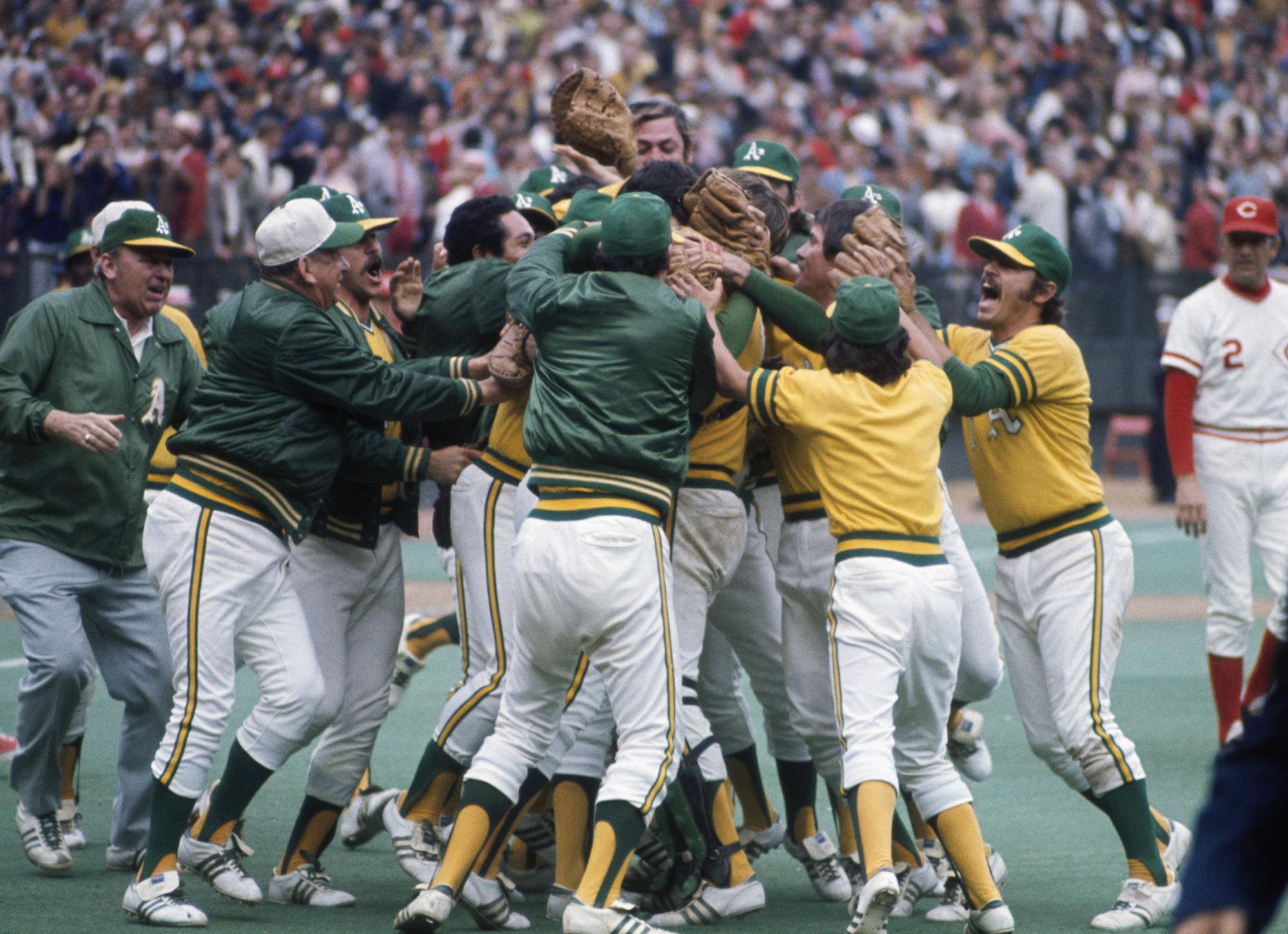
October 22, 1972: The "Hairs" Beat the "Squares"

October 22, 1972: Game 7 of the World Series is played at Riverfront Stadium in Cincinnati. It is not just a baseball clash, but a culture clash.

The Cincinnati Reds, as their name implies, were dressed simply: White uniforms at home, gray ones on the road, and red lettering. Managed by George "Sparky" Anderson, with stars such as left fielder Pete Rose, catcher Johnny Bench, 1st baseman Tony Pérez and 2nd baseman Joe Morgan, and a bullpen led by Clay Carroll, whose 37 saves had just set a new major league record (which lasted all of 1 year), "The Big Red Machine" were dominant. They had won the National League Pennant in 1970, losing the World Series to the Cincinnati Reds. Now, they had won the Pennant again, and were ready to take the title.

The Reds were clean-cut, and clean-shaven. Nothing unusual about that in baseball at the time: The sport has often seemed to be 10 years behind the rest of the country. But until the 21st Century, the Reds had a rule banning facial hair. They were good, but not flashy. Appropriate for Cincinnati, one of the most conservative cities in the country. Good for southern Ohio and southern Indiana on one side of the Ohio River. Good for the actually-Southern State of Kentucky and the quasi-Southern State of West Virginia on the other side.

The Oakland Athletics -- "A's" for short -- were not designed to appeal to "Middle America." Insurance tycoon Charles Oscar Finley saw to that when he bought the team in 1960, while they were still in Kansas City, the major city closest to the geographic center of "the 48 Contiguous States." Finley changed the team's colors from their traditional red, white and blue to what he termed "Kelly Green, Wedding Gown White and Fort Knox Gold." After looking into the ideas of Louisville, Dallas and Denver, he moved them to Oakland in 1968.

By that point, he already had some of the players who would dominate the American League Western Division in the early days of Divisional Play. In Spring Training in 1972, with the rest of the world having gotten used to men letting their hair grow long, and growing facial hair, Finley saw his best player, slugging right fielder Reggie Jackson, grow a mustache.

Instead of fining him for not "looking like a big-league ballplayer," he used reverse psychology: He offered a $300 bonus to every player who grew a mustache by Opening Day. He figured, if everybody did it, it would no longer be an act of rebellion, and they'd stop. The move backfired, and Finley, famously cheap, had to pay nearly everybody on the team $300 -- about $2,100 in 2022 money -- at a time when the average salary was about $34,000 (or $238,000 today).

Most notable was the 19th-Century-style "handlebar" mustache worn by the Oakland relief ace, Rollie Fingers. He would end his career in 1986 with 341 saves, more than any pitcher to that point. Ironically, the reason he retired is that the only team willing to offer him a contract -- he was 39 years old at the time -- was the Reds, and they insisted that he shave off the mustache, which had become his trademark. He wouldn't do it, and hung up his cleats.

Both teams needed to go the full 5 games in their League Championship Series. The Reds trailed the Pittsburgh Pirates in the bottom of the 9th, but Bench hit a game-tying home run, kept it going, and then Bob Moose threw a wild pitch that scored George Foster with the Pennant-winning run. (This turned out to be the last game for Pirates' star Roberto Clemente.)

The A's played the Detroit Tigers, and won, but lost Jackson to a torn hamstring as he scored the winning run in Game 5. They would have to go into the franchise's 1st World Series in 41 years -- since 1931, when they were the Philadelphia Athletics -- without their best player.

In Game 1, at Riverfront, A's catcher Gene Tenace hit home runs in his 1st 2 World Series at-bats, which had never been done before. The A's won, 3-2. In Game 2, Joe Rudi hit a home run, and made a spectacular catch in left field off a drive by Denis Menke. Despite a Reds comeback in the 9th, the A's hung on to win, 2-1.

Just when it looked like the Reds would be utterly humiliated, they waited out a one-day rain delay, and won Game 3 at the Oakland Coliseum, 1-0. The only run came in the top of the 7th inning, when César Gerónimo singled Pérez home. The Reds won despite Bench getting fooled on a trick play in the 9th: After Bobby Tolan stole 2nd base on a pitch that made the count 3-and-2, manager Dick Williams went to the mound for conference. It then appeared that Williams had ordered Fingers to intentionally walk Bench. But after Tenace motioned for the outside ball 4, Fingers threw a strike on the outside corner, and Bench was out.

The Reds led Game 4, 2-1 with 1 out in the bottom of the 9th. But Gonzalo Márquez singled, Tenace did the same, Don Mincher added another that scored pinch-runner Allan Lewis, and Ángel Mangual singled Tenace home with the winning run, 3-2.

The A's looked to close it out in Game 5, at home. They led 3-1 after 2 innings, 4-2 after 4, and were still up 4-3 after 7, thanks to Tenace's 4th home run of the Series. That tied a Series record, which would be broken in 1977, by Reggie Jackson. But the Reds tied it in the 8th, and won it in the 9th, 5-4. The winning run was singled home by Rose, who had homered earlier.

Back in Cincinnati, the Reds won Game 6, 8-1, and tied the Series. Game 7 was Catfish Hunter against Jack Billingham. Tolan's error on a Mangual fly ball gave the A's a 1-0 lead in the 1st. The Reds tied it in the 5th on a sacrifice fly by Hal McRae. But in the 6th, Sparky Anderson replaced an exhausted Billingham with Pedro Borbón, who gave up RBI doubles to Tenace and Bando. The Reds scored a run in the 8th, but couldn't find a tying run, and the A's won, 3-2.

The A's had won their 1st World Championship in 42 years, since the 1930 Philadelphia team. Tenace‚ who had only 5 homers in the regular season, had 4 in the Series‚ and was named the Series' Most Valuable Player.

The Reds eventually won the World Series in 1975 and 1976, and won more games in the decade than the A's. They win 4 Pennants and 6 Division Titles in the decade, to the A's' 3 Pennants and 5 Division Titles. For these reasons, their surviving players are convinced that they, not the A's, were the team of the decade.

However, the A's won 3 World Series in a row, something not achieved by any other franchise in baseball history except for the New York Yankees. What's more, in the one head-to-head matchup between the A's and the Reds, the A's won, winning 3 of the 4 games in Cincinnati, including the clincher, and doing so without their best player, Reggie Jackson, who was injured in the American League Championship Series clincher. So there can be no doubt that the A's were the Team of the Seventies.

Besides, neither team was the one that won the most games in the decade: It was the Baltimore Orioles who did that, while winning 5 Division Titles and 3 Pennants, but only 1 World Series.

It would take until 1990 for the Reds to get revenge on the A's.

Having a fascinating (if occasionally controversial) history, even if you only count the Oakland years, the A's have had several books written about them, although they don't always put the team in a good light. The ones about the "Swingin' A's" of the 1970s invariably mention Finley's successes and excesses, including his cheapness and pettiness. And the players often don't come off much better in these books.

These books include Bruce Markusen's 2002 A Baseball Dynasty: Charlie Finley's Swingin' A's; Roger D. Launius and G. Michael Green's 2010 Charlie Finley: The Outrageous Story of Baseball's Super Showman; Finley Ball: How Two Baseball Outsiders Turned the Oakland A's Into a Dynasty and Changed the Game Forever, by Nancy Finley, daughter of Charlie's cousin Carl, who was also involved with the team; and Jason Turbow's Dynastic, Bombastic, Fantastic: Reggie, Rollie, Catfish, and Charlie Finley's Swingin' A's.

In 2016, Ed Gruver published Hairs vs. Squares: The Mustache Gang, the Big Red Machine, and the Tumultuous Summer of '72, which culminates in the World Series between the A's and the Cincinnati Reds. Matthew Silverman wrote Swinging '73: Baseball's Wildest Season, and John Rosengren wrote Hammerin' Hank, George Almighty and the Say Hey Kid: The Year That Changed Baseball Forever, whose cover includes a photo of Reggie Jackson at Yankee Stadium -- the pre-renovation Stadium, and he's wearing an A's uniform.

*

October 22, 1972 was a Sunday. Gordon Banks crashed his Ford Consul into an Austin A60 van in Stoke-on-Trent, Staffordshire, England, and ended up in a ditch. He needed over 300 stitches on his face, and lost the sight in his right eye. The goalkeeper who had helped Stoke City win its 1st (and still only) major trophy the season before, the League Cup, and had backstopped the England team that won the 1966 World Cup, retires at the end of the season. He briefly came back to play in America for the Fort Lauderdale Strikers, but never played in Europe again.

Also on this day, Arthur Agee Jr. (no middle name) is born in Chicago. Along with William Gates, he was the focus of the documentary Hoop Dreams. He attended St. Joseph High School in the Chicago suburb of Westchester, Illinois, as had his hero, Detroit Pistons star Isiah Thomas. But it was too expensive for his parents, and he transferred to John Marshall High School in the city, winning the 1991 Public League Championship.

He played at Arkansas State, but never professionally. He now runs the Arthur Agee Role Model Foundation, "to help underprivileged kids to understand that their role models are not professional athletes, but their parents at home."

Gates -- no relation to legendary basketball coach William "Pop" Gates, and definitely not to Bill Gates -- stayed at St. Joseph, played at Marquette University in Milwaukee, also fell short of playing pro ball, and is now a minister outside San Antonio. His son, William Gates Jr., now plays basketball at Furman University in South Carolina. Neither man's hoop dream came true, but both are doing a lot of good now.

Being a Sunday, there were NFL games:

* The New York Giants beat the St. Louis Cardinals, 27-21 at Yankee Stadium.

* The New York Jets beat the Baltimore Colts, 24-20 at Shea Stadium. Yes, both New York teams were at home at the same time. (Both games were 1:00 starts.)

* The Washington Redskins beat their arch-rivals, the Dallas Cowboys, 24-20 at Robert F. Kennedy Memorial Stadium.

* The Miami Dolphins beat the Buffalo Bills, 24-23 at the Orange Bowl in Miami.

* The San Francisco 49ers and the New Orleans Saints played to a tie, 20-20 at Candlestick Park in San Francisco.

* The Cleveland Browns beat the Houston Oilers, 23-17 at the Astrodome in Houston.

* The Pittsburgh Steelers beat the New England Patriots, 33-3 at Three Rivers Stadium in Pittsburgh.

* The Detroit Lions beat the San Diego Chargers, 34-20 at Tiger Stadium in Detroit.

* The Atlanta Falcons beat the Green Bay Packers, 10-9 at Milwaukee County Stadium.

* The Philadelphia Eagles beat the Kansas City Chiefs, 21-20 at Arrowhead Stadium in Kansas City.

* The Los Angeles Rams beat the Cincinnati Bengals, 15-12 at the Los Angeles Memorial Coliseum. So, not a good day for Cincinnati sports. And the NBA's Cincinnati Royals couldn't help them, because they'd just moved, becoming the Kansas City-Omaha Kings.

* The Denver Broncos beat the Oakland Raiders, 30-23 at the Oakland Coliseum.

* And, the next night, on ABC Monday Night Football, the Chicago Bears beat the Minnesota Vikings, 13-10. Metropolitan Stadium in the Minneapolis suburb of Bloomington, Minnesota.

There were 3 games in the NBA:

* The Milwaukee Bucks beat the Cleveland Cavaliers, 104-84 at the Cleveland Arena.

* The Los Angeles Lakers beat the Chicago Bulls, 104-99 at The Forum outside Los Angeles in Inglewood, California. Jerry West scored 35 points.

* And the Seattle SuperSonics beat their arch-rivals, 120-119 in overtime at the Seattle Center Coliseum.

There was 1 game in the American Basketball Association: The New York Nets beat the Utah Stars, 119-116 at the Nassau Coliseum.

There were 5 games in the NHL:

* The New York Rangers and the Montreal Canadiens played to a tie, 1-1 at Madison Square Garden.

* The Vancouver Canucks beat the Boston Bruins, 5-4 at the Boston Garden.

* The Buffalo Sabres beat the Atlanta Flames, 7-2 at the Buffalo Memorial Auditorium.

* The Detroit Red Wings beat the Toronto Maple Leafs, 6-2 at the Olympia Stadium in Detroit.

* The Chicago Black Hawks beat the California Golden Seals, 4-2 at the Oakland Coliseum Arena.

* And the New York Islanders, the Philadelphia Flyers, the Pittsburgh Penguins, the Minnesota North Stars, the St. Louis Blues and the Los Angeles Kings were not scheduled.

And there were 4 games in the World Hockey Association:

* The New York Raiders lost to the Minnesota Fighting Saints, 5-4, as Madison Square Garden hosted both an NHL game and a WHA game on the same day.

* The Ottawa Nationals beat the Quebec Nordiques, 3-2 at the Colisée de Québec.

* The Winnipeg Jets beat the Philadelphia Blazers, 6-3 at the Winnipeg Arena.

* And the Chicago Cougars beat the Los Angeles, Sharks, 4-2 at the Los Angeles Sports Arena.

Friday, October 21, 2022

October 21, 1975, The Carlton Fisk Game

October 21, 1975: In The Curse of the Bambino, his somewhat skewed history of his beloved Boston Red Sox, Boston Globe columnist Dan Shaughnessy called it "a brilliant autumn day in New England," following a 3-day delay for rain. Brilliant though the Tuesday afternoon may have been, Game 6 of the 1975 World Series is played at night at Fenway Park.

The Red Sox, Champions of the American League after winning its Eastern Division and beating the 3-time defending World Champions, the Oakland Athletics, in the AL Championship Series, trail the Cincinnati Reds, a.k.a. the Big Red Machine, Champions of the National League after winning its Western Division and beating the Pittsburgh Pirates in the NLCS, 3 games to 2, and must win to force a Game 7.

The Sox haven't won the World Series in 57 years, including a loss as recently as 1967. The Reds haven't won the World Series in 35 years, including 2 Series losses in this decade already. Boston is looking for its 1st title since 1918; Cincinnati, for its 1st since 1940. Both teams need it badly. Something's gotta give.

Just 14 years later, Shaughnessy wrote, "Game Six has taken on a life of its own in the years since it was played, and it gets larger and more thrilling in each retelling. Some distance allows that there may be other contenders for the title of The Greatest Game Ever Played, but by any measure, 1975's Game Six will stand as one of the top ten games in World Series history, and one that came at a time when baseball needed it most." Shaughnessy was right.
In The New Yorker magazine, Roger Angell wrote, "Game Six... what can we say of it without seeming to diminish it by recapitulation or dull it with detail?" Roger, one of the greatest writers ever on the subject of baseball, was wrong on this one: The details are necessary.

Due to the rain, Sox manager Darrell Johnson was able to start Luis Tiant, winner of Games 1 and 4, on full rest. Reds manager Sparky Anderson started Gary Nolan. Fred Lynn, who, that season, became the 1st player ever to be awarded his league's Rookie of the Year and its Most Valuable Player award in the same season, hit a home run that gave the Sox a 3-0 lead in the 1st inning, and Tiant pitched shutout ball through 4.

But, as they would say in English soccer, Three-nil, and they fucked it up. The Reds got 2 men on in the 5th, and Ken Griffey Sr. sent Lynn to the wall. Lynn crashed, telling NBC's Bob Costas years later that he'd hurt his ribs, and that, for a moment, he was barely conscious and couldn't feel his legs. Griffey's triple scored 2 runs, and then Johnny Bench singled Griffey home to tie the game. A 2-run double by George Foster in the 7th and a solo homer by Cesar Geronimo in the 8th gave the Reds a 6-3 lead, with just 6 outs to go for the title.

Typical Boston choke, leading to a Reds win? As ESPN college football analyst Lee Corso would say, "Not so fast, my friend!" Six-three, and they fucked it up. In the bottom of the 8th, Reds reliever Pedro Borbon (who, like Griffey, would later see his son and namesake play in the major leagues) gave up a single to Lynn and a walk to Rico Petrocelli.

Sparky brought in Rawley Eastwick, who struck out Dwight Evans and got Rick Burleson to line out to left. He got 2 strikes on Bernie Carbo, a former Red, pinch-hitting for pitcher Roger Moret (who had relieved Tiant in the 8th), but Carbo drove one to dead center, and tied it up.

In the bottom of the 9th, Denny Doyle drew a leadoff walk. Carl Yastrzemski singled him over to 3rd. Sparky brought in reliever Will McEnaney, and had him intentionally walk Carlton Fisk. Did Sparky have a premonition? If so, it didn't help him later on.

Lynn flew to left, and Foster threw home. Doyle tagged up and broke for home, because he thought Sox 3rd-base coach Don Zimmer was telling him, "Go, go, go!" In fact, Zim was saying, "No, no, no!" Doyle was out at the plate. Had he scored, winning it for the Sox right there, this would still have been a superb game, but not the legendary game that it became -- except within New England. Outside those 6 States, few baseball fans would have ranked it as an all-time great game. Instead, it went to extra innings.

Dave Concepcion singled and stole 2nd with 1 out in the top of the 10th, but Sox reliever Dick Drago stranded him. Pat Darcy sent the Sox down 1-2-3 in the bottom of the 10th.

Pete Rose led off the top of the 11th, and turned to Sox catcher Fisk, and said, "Can you believe this game?" (Some sources have Rose's comment as, "Some kind of a game, isn't it?") Fisk may not have taken kindly to that, because Drago -- who would bean Thurman Munson in a Yanks-Sox game at Fenway 3 years later -- hit Rose with a pitch.

Griffey bunted, and, unlike the Ed Armbrister play in Game 3, did not even appear to interfere with Fisk, who threw Rose out at 2nd. With Griffey on 1st and 1 out, Joe Morgan, who would be named the NL's MVP that season and the next, drove the ball to right field, and at Fenway the right-field fence was, and remains, only 3 feet high. Evans reached over the fence to make a great catch, and then started a double play, throwing to Yaz, who threw to Burleson who had run over to cover 1st, to eliminate Griffey and end the Reds' rally.

The Sox went down 1-2-3 in the bottom of the 11th. In the top of the 12th, Tony Perez and Foster singled off Rick Wise, but Wise stranded them.

At 12:34 AM on October 22, 1975, Fisk led off the bottom of the 12th against Darcy, and hit a 1-0 pitch down the left-field line. It had enough distance. But would it be fair? Or would it be foul? Fisk, as though it would actually influence the flight of the ball, waved his arms to his right. The ball hit the pole near its top, for a home run. Final score, Boston 7, Cincinnati 6. The Series was tied, and would go to a Game 7.

John Kiley, the organist at Fenway Park (and also at the Boston Garden, thus the answer to the corny old trivia question about "the only man to play for the Red Sox, Celtics and Bruins"), played George Friedrich Handel's "Hallelujah Chorus." Then he played "Stout-Hearted Men." Then he played "The Beer Barrel Polka." ("Roll out the barrel, we'll have a barrel of fun.") Then he played "Seventy-six Trombones" from the Broadway musical The Music Man. (I have no idea why he played that one.)

The shot of Fisk thinking he can wave the ball fair, which I've dubbed the Fenway Twist, is the most familiar clip in the history of televised sports. (As they had with every World Series since 1947, NBC was televising it, although they would begin to alternate with ABC starting with the 1977 season, until 1989.)

From seeing this clip so much, and hearing so much talk about Game 6 of '75 from Red Sox fans, a reasonable person might have asked (through 2004 anyway), "Wait a minute. The Red Sox haven't won the World Series since 1918. That means... they lost Game 7! So why do people make such a big deal about this homer?" Well, it won one game, not a World Series, but it was still one of sports' greatest epics.

Game 6 of the 1975 World Series has been called "The Greatest Baseball Game Ever Played" by many people. Certainly, it is in the discussion, along with Game 8 in 1912 (Game 2 was tied when called due to darkness), Game 7 in 1924, Game 7 in 1960, and Game 7 in 1991, and also with the 1951 Giant-Dodger Playoff and the 1978 Yanks-Sox Playoff.

In 1981, baseball historian John Thorn published Baseball's 10 Greatest Games. He included this game as one of them. In 2010, the MLB Network listed this game on top of their list of MLB's 20 Greatest Games -- limited in scope, due to the availability of surviving videotape, to 1975 onward. Due to the timing -- 1975 to 1980 -- along with the Bucky Dent Game, it was 1 of 2 games to make both lists.

Dick Stockton, born in Philadelphia but grew up in Queens, then the 32-year-old lead broadcaster on Sox games for WSBK-Channel 39, and previously for Boston Celtics games on WBZ-Channel 4, then an NBC station, was the lead broadcaster for NBC in this Series.

A 22-year-old writer from Quincy named Lesley Visser was part of The Boston Globe's coverage. Stockton and Visser would both go on to become key cogs in CBS Sports' programming. Supposedly, they met on this night. Other sources say they met at another Boston-based event in 1982. Either way, they married in 1983, but got divorced in 2010, and each has since married someone else.

And, of course, this game has also been cited in the 1997 film Good Will Hunting, discussed by the characters played by Robin Williams and Matt Damon.

Of course, as Shaughnessy pointed out in his book, in the 1986 World Series, Game 6 would prove disastrous for the Red Sox. So now, if you're in New England, or in the presence of a Red Sox fan anywhere else, and you say the words, "Game Six," they have to ask, "Which one?"

UPDATE: The Reds have a team Hall of Fame. Elected from this 1975 "Big Red Machine" have been 1st baseman Tony Pérez, 2nd baseman Joe Morgan, shortstop Dave Concepción, 3rd baseman Pete Rose, left fielder George Foster, center fielder César Gerónimo, right fielder Ken Griffey Sr., catcher Johnny Bench; pitchers Gary Nolan, Don Gullett, Pedro Borbón, Jack Billingham, Fred Norman and Clay Carroll; manager George "Sparky" Anderson, general manager Bob Howsam, and broadcasters Joe Nuxhall and Marty Brennaman.

The Red Sox also have a team Hall of Fame. From their 1975 Pennant winners, they have inducted 1st baseman Yastrzemski, 3rd baseman Petrocelli, catcher Carlton Fisk, shortstop Rick Burleson, left fielder Jim Rice, center fielder Fred Lynn, right fielder Dwight Evans, pitchers Luis Tiant and Bill Lee, team owner Tom Yawkey, general manager Dick O'Connell, scout George Digby, executives Edward Kenney and Dick Bresciani, groundskeeper Joe Mooney, guest relations director Al Green, public address announcer Sherm Feller, broadcasters Ken Coleman and Ned Martin, and longtime vendor Arthur D'Angelo. 1st baseman George Scott had been traded away, but would be brought back.

*

October 21, 1975 was a Tuesday. Tom Waits releases his album Nighthawks at the Diner, including the song “Eggs and Sausage.” In that song, he sings, "Baby, you gotta understand, I'm in a graveyard charade, a spaceship masquerade." Good metaphors for the 1970s.

It was midweek for football, and the World Football League folded. I have a separate entry for that event.

The NBA and the ABA wouldn't start their seasons for another 2 days. But 3 games were played in the NHL:

* The New York Islanders and the Vancouver Canucks played to a tie, 5-5 at the Nassau Coliseum.

* The Montreal Canadiens beat the Pittsburgh Penguins, 7-1 at the Civic Arena in Pittsburgh.

* And the St. Louis Blues beat the Los Angeles Kings, 6-1 at the St. Louis Arena. From 1977 to 1983, the Arena was named the Checkerdome, because the Blues were owned by St. Louis-based Ralston Purina, whose logo was (and is) a "checkerboard square."

In the World Hockey Association that night:

* The Quebec Nordiques beat the New England Whalers, 6-1 at the Colisee de Quebec.

* The Minnesota Fighting Saints beat the Indianapolis Racers, 2-1 at the Market Square Arena in Indianapolis.

* And the Winnipeg Jets beat the Cincinnati Stingers, 7-0 at the Winnipeg Arena. 

October 21, 1975: The Death of the World Football League

October 21, 1975: Mere hours before Game 6 of the World Series (for which I have a separate entry), the World Football League folds in the middle of its 2nd season. Unlike the 1946-49 AAFC and the 1960-69 AFL, it didn't get to merge or even partly merge with the NFL. Unlike the 1983-85 USFL, it didn't go out with a bang (in the USFL's case, the bang of a judge's gavel). It went out with a whimper. Indeed, if you weren't a fan of a WFL team, most likely, in the wake of Games 6 and 7 of the World Series, you might not have even heard about the league's folding for days.

Gary Davidson, one of the founders of the American Basketball Association, and one of the founders of the World Hockey Association, thought his third time would be the charm. What he didn't realize was that both the ABA and the WHA had several team owners who either didn't know what they were doing, or didn't have enough money to field their visions on the court or the ice, or both.

And the WFL was worse than both. Before the 1st season, 1974, could even get underway, they were set to be on the cover of Sports Illustrated, with Davidson and 2 of the league's big signings: Calvin Hill of the Dallas Cowboys and Ted Kwalick of the San Francisco 49ers, both of whom went to the Honolulu Hawaiians. But the week that the cover was supposed to appear, Hank Aaron hit his 715th career home run, and that was put on the cover instead. For once, "The Dreaded SI Cover Jinx" jinxed something because SI didn't put it on the cover!
The cover that never was

Would that cover getting out have helped the league? Probably not, because the mismanagement really was bad. One of the intended teams, the Toronto Northmen, owned by former Toronto Maple Leafs co-owner John Bassett, had to move, due to Canadian law allowing only the Canadian Football League to host professional football games in Canada.

So Bassett moved the team, the Northmen becoming the Memphis Southmen. They had the biggest signing coup, getting Paul Warfield, Larry Csonka and Jim Kiick away from the 2-time defending NFL Champions, the Miami Dolphins. They did make the SI cover, and went 17-3, but after a bye in the Quarterfinals, they lost in the Semifinals, to the Birmingham Americans.
The league couldn't get a contract with one of the Big Three TV networks, settling for a minor network, TVS, which syndicated the games to "independent" stations. And, in order to avoid scheduling conflicts with the NFL, college and high football, they could only play on Tuesdays, Wednesdays and Thursdays. That drove attendance and viewership down.

A a 20-game season was intended. But the Houston Texans had to move after just 11 games, becoming the Shreveport Steamer (no S on the end). The WFL desperately needed a New York team to survive, but the timing was bad: Yankee Stadium was being renovated, Giants Stadium wouldn't be ready until 1976, and with the WFL starting in mid-July, and the Yankees and the Jets already sharing Shea Stadium with the Mets, there simply weren't enough open dates for the New York Stars, so they had to play at the 22,000-seat Downing Stadium on Randall's Island. It had opened in 1939, and its only update since had been the addition of lights from Ebbets Field. After their 13th game, at home to the Detroit Wheels, a 37-7 win in front of just 4,220 fans, they moved, becoming the Charlotte Hornets.

As for those Detroit Wheels, they had a similar venue issue, with Tiger Stadium being shared by the NFL's Lions, and the Silverdome in suburban Pontiac still under construction. They were forced to play 40 miles away at Eastern Michigan University in Ypsilianti. They lost that game against the New York Stars, 37-7, and, that very day, they filed for bankruptcy. They played 1 more game, folded, and forfeited the reason of their games, finishing 1-19.

Typical of the WFL's ineptitude was the "Papergate" scandal. The Philadelphia Bell, named for the Liberty Bell, had announced a crowd of 55,534 fans for their home opener at John F. Kennedy Stadium. For their 2nd game, they announced an even bigger crowd, 64,719. For comparison's sake, the NFL's Eagles, playing at Veterans Stadium a couple of blocks to the north, topped that figure only twice in 1974, and only once in 1973.

But when the Bell had to pay city taxes on the attendance figures, it was revealed that they had massively inflated the gate. They had sold block tickets to several area businesses at a discount, and it was not reported. The actual paid attendance for the 1st home game was 13,855, which wouldn't have sold out The Spectrum; and for the 2nd, just 6,200, which wouldn't have sold out The Palestra. There were high school games in the Philly area that drew more than that.

And so, with a game scheduled for a Wednesday night, October 16, 1974, with rain coming down hard on the Delaware Valley, only 750 fans came to JFK Stadium to see the Bell, who lost 30-25 to Shreveport.  Steamer. (No S on the end.) They finished 9-11. But 8 of their 11 losses were by a touchdown or less, and they did qualify for the Playoffs, losing to the Orlando-based Florida Blazers in the Quarterfinals. 

The Chicago Fire forfeited their last game, to the Bell, because they literally could not afford to make the trip to Philadelphia. The Orlando-based Florida Blazers, who lost the 1974 title game, World Bowl I, to Birmingham, had to move after that season, becoming the San Antonio Wings.

Another weird feature of the WFL is how many teams changed their names without moving: The Champion Birmingham Americans became the Birmingham Vulcans, the Chicago Fire became the Chicago Winds, the Jacksonville Sharks became the Jacksonville Express, and the Portland Storm became the Portland Thunder.

The 1975 season would not only be no better than '74 for the WFL, but worse. TVS canceled their contract, leaving the league with only local TV coverage. The Chicago Winds were expelled from the league after 5 games, because they had failed to keep a promise to the league office to sign quarterback Joe Namath away from the NFL and the New York Jets. So there was no team in the nation's Number 1 market (New York), Number 3 market (Chicago) or Number 4 market (the San Francisco Bay Area); and the team in the Number 2 market, the Southern California Sun, while having a winning record at 7-5, topped out at 17,811 fans at Anaheim Stadium.

By October 21, most of the 10 teams that were still going had played 11 games, but the money just wasn't coming in. And with sports fans' attention focused on the established NFL and the World Series, they folded. They folded the same day as, as it turned out, one of the greatest games in the history of baseball. The WFL couldn't even die with dignity.

The NFL held no consequences against the players who had jumped to the WFL. And the names of 3 teams would live on: The Houston Texans became the name of an NFL team in 2002, the Charlotte Hornets that of an NBA team in 1988, and the Chicago Fire that of a team in Major League Soccer in 1998. Charlotte and Jacksonville, neither of which had ever had an NFL team before, got NFL expansion teams in 1995.

John Bassett used his WFL experiences, both the good and the bad, to guide him in putting together an ownership group for the USFL, which included actor and former Florida State football player Burt Reynolds. The team was named the Tampa Bay Bandits, after one of Reynolds' movies, Smokey and the Bandit. It was easily the best-run team in that league, even though it never made a championship game, but the illness that would claim Bassett's life in 1986 helped to derail that league's chances of a settlement with the NFL.

*

October 21, 1975 was a Tuesday. Game 6 of the World Series was played at Fenway Park in Boston, and it was an all-time classic, with the Boston Red Sox beating the Cincinnati Reds, 7-6, on Carlton Fisk's home run in the bottom of the 12th inning. This forced a Game 7 the next night, which the Reds would win.

Football was in midweek. And the NBA season didn't start for another 2 days, and the ABA season for another day after that. There were 3 games played in the NHL:

* The New York Islanders and the Vancouver Canucks played to a tie, 5-5 at the Nassau Coliseum.

* The Montreal Canadiens beat the Pittsburgh Penguins, 7-1 at the Civic Arena in Pittsburgh.

* And the St Louis Blues beat the Los Angeles Kings, 6-1 at the St. Louis Arena.

And there were 3 games played in the World Hockey Association:

* The Quebec Nordiques beat the New England Whalers, 6-1 at the Colisée de Québec.

* The Minnesota Fighting Saints beat the Indianapolis Racers, 2-1 at the Market Square Arena in Indianapolis.

* And the Winnipeg Jets beat the Cincinnati Stingers, 7-0 at the Winnipeg Arena. 

December 31, 1999 & January 1, 2000: The Millennium

December 31, 1999:  The Millennium arrives. The people of planet Earth survived. At a terrible cost. But we hadn't destroyed ourselves. ...