Showing posts with label nebraska cornhuskers. Show all posts

Friday, December 9, 2022

December 9, 1961:The Gotham Bowl

The Polo Grounds, set up for football.
Judging by the number of fans and the number of cars,
this is probably for a Titans (proto-Jets) game in the early 1960s.
Definitely not for the 1961 Gotham Bowl.

December 9, 1961: New York City, despite its status as a cold-weather city, tries to get into the college football bowl business. The Gotham Bowl is staged at the Polo Grounds.

The organizers had tried to stage the event the year before, with Syracuse University, defending National Champions and with future Heisman Trophy-winning running back Ernie Davis. But the school announced that it would not accept any bowl bids.

That was not unusual: There weren't so many bowl games in those days, and if you weren't invited to one of the "Big Four" games that were annually held on New Year's Day -- the Rose in Pasadena, the Orange in Miami, the Sugar in New Orleans or the Cotton in Dallas -- it seemed pointless. Notre Dame accepted a bid to the 1925 Rose Bowl, and didn't accept another bowl bid until the 1970 Cotton Bowl.

The organizers then invited the Air Force Academy, figuring that, as a new program -- the Academy had only been founded in 1954, and started playing football the next year -- they would jump at the chance to showcase their team in the Big Apple. But they insisted upon playing Army, since they hadn't played each other in the regular season, even though this would be, essentially, a home game for Army. (West Point is only 47 miles up the Hudson River from the site of the Polo Grounds.) But Army also declined: The Academy never accepted a bowl bid until the 1984 Cherry Bowl. (In contrast, Navy had accepted 8 bowl bids before that, including each of the Big Four at least once, and Air Force had already been to the 1958 Cotton Bowl before considering the Gotham Bowl.)

So the Gotham Bowl organizers invited Holy Cross, Colorado and Oregon State. Only Oregon State accepted, so there was no opponent for them, and the game was canceled.

They tried again in 1961. This time, they got an acceptance from Utah State, undefeated at 9-0-1, Champions of the Skyline Conference, and ranked Number 10 in the nation; and Baylor University, only 6th out of 8 teams in the Southwest Conference, and only 5-5 overall, but willing to go to a cold-weather city for a bowl game. But only 15,123 fans came out, leaving the Polo Grounds with over 40,000 empty seats. Baylor pulled the upset, winning 24-9.

They tried again in 1962. Instead of a Northeastern team going to Miami to play in the Orange Bowl game in the Orange Bowl stadium, the University of Miami, who played their home games in that stadium, came north to play in the Gotham Bowl. They were 7-3, and, while not a ranked team -- the Associated Press then only ranked the Top 10 teams, not the Top 20 -- they had beaten one, one of their rivals, then-Number 9 Florida State.

But the organizers had trouble finding an opponent. It took until December 4, 11 days before the game, for the University of Nebraska to accept a bid. In their 1st season under head coach Bob Devaney, the Cornhuskers started the sellout streak at Memorial Stadium which extends to this day -- the 2020 games with no tickets sold due to COVID restrictions are not counted against it -- and they went 8-2, although they were not ranked, and lost their only game against a ranked opponent, then-Number 10 Oklahoma.

The game was moved to Yankee Stadium, in the hopes that, being in better condition than the Polo Grounds, and then being in a better neighborhood, it would attract more fans. But, in those days before television saturation of college football, and the growth of alumni organizations for faraway schools in big cities like New York, there weren't very many Nebraska fans or Miami fans there. Nebraska and Miami have played each other in some famous games since, raising their relationship to the status of a quasi-rivalry. But, at the time, there was no reason to consider that particular matchup special.

And while ABC had agreed to televise the game live, as part of ABC Wide World of Sports, the New York newspaper workers' unions were on strike, so the papers weren't being published, and they weren't publicizing the game. It got more attention outside the New York Tri-State Area than inside. Advance ticket sales were minimal.

As if enough things hadn't gone wrong, the day before the game, at the airport in Lincoln, the pilot for the Cornhuskers' plane refused to take off until the bowl's check for expenditures cleared. Phone calls went back and forth, the check cleared, and the plane took off. In contrast, the Hurricanes got their promised $30,000 up front.

Finally, on the day of the game, it was damp, and only 14°F. Attendance at the 67,224-seat Bronx ballyard was just 6,166, with another 5,000 tickets given away. In spite of the game actually being a good one, with Nebraska winning, 36-34, the staging of the game was an embarrassment from announcement to final gun.

If there was any consideration of another Gotham Bowl for December 1963, it died with President John F. Kennedy on November 22: Few people would be in the mood to sit in a cold Yankee Stadium to watch two college football teams with whom they were not familiar.

There would not be another bowl game in the New York Tri-State Area until Giants Stadium in the New Jersey Meadowlands hosted the Garden State Bowl, which lasted until 1981. In 2010, the Yankees began sponsoring the Pinstripe Bowl at the new Yankee Stadium, and it has been held every year since, except for the COVID-restricted 2020.

*

December 9, 1961 was a Saturday. Actor Joe Lando was born.

There was 1 other college football game played that day, the Aviation Bowl, in the Wright Brothers' hometown of Dayton, Ohio. The University of New Mexico beat Western Michigan University, 28-12. The game was played at Welcome Stadium. Built in 1949, and seating 11,000, it is the home field of the University of Dayton, which plays in NCAA FCS (formerly Division I-AA), and some high school teams.

There were no games played in the NFL that day, but there was 1 in the American Football League: The Boston Patriots beat the Oakland Raiders, 35-21 at Candlestick Park in San Francisco. (The Raiders played home games at Kezar Stadium in San Francisco in 1960, and Candlestick in 1961. Despite having the Oakland name, they took until 1962 to start playing home games in Oakland.)

Baseball was out of season. There were 4 games played in the NBA:

* The New York Knicks lost to the St. Louis Hawks, 102-91 at the Kiel Auditorium in St. Louis. Bob Pettit scored 32 points and grabbed 21 rebounds.

* The Philadelphia 76ers beat the Chicago Packers, 135-113 at the Philadelphia Civic Center. Yes, the Chicago Packers, named for the city's meatpacking industry. Having the same name as the football team that Chicagoans hate the most didn't help attendance. Being an expansion team didn't, either. Walt Bellamy scored 39 for them on this day. But, for the Warriors, Wilt Chamberlain scored 61 points and grabbed 36 rebounds. And that was only his 4th-best game of the season.

* The Boston Celtics beat the Syracuse Nationals, 106-102 at the Onondaga County War Memorial Auditorium (now the Upstate Medical University Arena) in Syracuse.

* And Los Angeles Lakers beat the Detroit Pistons, 114-107 at Cobo Hall (now Huntington Place) in Detroit. Elgin Baylor scored 38 points.

And the NHL's entire "Original Six" were in action:

* The New York Rangers and the Montreal Canadiens played to a tie, 2-2 at the Montreal Forum.

* The Toronto Maple Leafs beat the Boston Bruins, 9-2 at Maple Leaf Gardens in Toronto.

* And the Detroit Red Wings beat the Chicago Black Hawks, 3-0 at the Olympia Stadium in Detroit.

Sunday, December 4, 2022

December 4, 1982: The Nebraska Cornhuskers Go to Hawaii

Aloha Stadium

December 4, 1982: The University of Nebraska plays a football game. The weather was perfect. Some 16,000 people from Nebraska attended.

Doesn't sound like much, does it? Especially by Nebraska standards.

The game was in Hawaii.

And the recession that the nation was in had hit farm communities especially hard. But 16,000 Nebraskans were among the 46,876 fans inside Aloha Stadium in Halawa, a suburb of Honolulu, that day. Nebraska, ranked Number 3 in the country, beat the University of Hawaii, 37-16.

The Cornhuskers had already won the Big Eight Conference title. On New Year's Day, they beat Louisiana State University (LSU) in the Orange Bowl. But a loss to Penn State earlier in the season decided the National Championship: Had Nebraska won that game, they, rather than Penn State, would have been awarded it.

In 1982 and 1983 combined, Nebraska went 24-2, losing 2 games by a total of 4 points, but didn't win a National Championship between 1971 and 1994.

Built in 1975, the 50,000-seat Aloha Stadium hosted UH's Rainbow Warriors from then until 2020; "The Hawaiians" of the World Football League in 1975; the Aloha Bowl, usually on Christmas Day, from 1982 to 2000; the Oahu Bowl from 1998 to 2000; the Hawai'i Bowl from 2002 to 2019; the Hula Bowl, a postseason East-West All-Star game, from 1976 to 2020; and the Pro Bowl, the NFL's postseason All-Star game, from 1980 to 2009, again from 2011 to 2014, and once more in 2016.

It also hosted Team Hawaii in the North American Soccer League in 1977. And from 1976 to 1987, it hosted the Hawaii Islanders of baseball's Pacific Coast League. The stands rotated to set up something resembling a baseball configuration. In 1997, the St. Louis Cardinals and the San Diego Padres played 3 regular-season games there.
Rutgers had gone to Hawaii in 1974, losing to the Rainbow Warriors at Honolulu Stadium. Built as a baseball park in 1926, by the 1960s, it was in such bad shape that it was nicknamed the Termite Palace. Aloha Stadium replaced it, and, inspired by Nebraska's trip, other schools wanted to play there for their last regular-season game, to avoid cold weather, and have the equivalent of a bowl game, even if they were already expecting to go to one. Oklahoma attracted 45,143 in 1983, Iowa a sellout of 50,000 in 1984, Michigan 50,000 in 1986, Arkansas 42,712 in 1987, Notre Dame 50,000 in 1991, the University of Pittsburgh 46,281 in 1992, Tulane 36,576 in 1993, Missouri 33,979 in 1994, Wisconsin 34,727 in 1996, Notre Dame again with 41,509 in 1997, Michigan again with 34,193 in 1998, Wisconsin again with 41,313 in 2000, Miami University of Ohio with 33,148 in 2001, the University of Cincinnati (Miami's arch-rivals) with 36,851 in 2002, Army with 41,668 and Alabama with 43,477 in 2003, Northwestern with 33,846 and Michigan State with 41,654 in 2004, Wisconsin again with 34,031 in 2005, Purdue with 47,825 and Oregon State with 50,000 in 2006, Cincinnati again with 40,549 in 2008, Navy with 40,643 and Wisconsin again with 40,069 in 2009.

The stadium was not built with Hawaii's climate in mind, and deteriorated much sooner than expected. By 2011, sections had to be closed off, and crowds topped out at 37,000. The University moved out after the 2019 season, to a much smaller on-campus stadium. As of 2022, the plan is to demolish the old stadium in 2024, and build the new one, seating 35,000, on the site.

UPDATE: Demolition began in 2025, and the new stadium is expected to open in time for the 2029 season.

*

December 4, 1982 was a Saturday. These other college football games were played that day:

* Number 12 Texas beat Number 6 Arkansas, 33-7 at Memorial Stadium in Austin, Texas, to clinch the Southwest Conference title.

* Florida upset Number 15 Florida State, 13-10 at Doak Campbell Stadium in Tallahassee, Florida.

* And Navy beat Army, 24-7 at Veterans Stadium in Philadelphia.

Baseball was out of season. There were 7 games played in the NBA:

* The New York Knicks beat the Atlanta Hawks, 80-79 at Madison Square Garden.

* The Cleveland Cavaliers beat the Indiana Pacers, 109-89 at The Coliseum in the Cleveland suburb of Richfield, Ohio.

* The Boston Celtics beat the Detroit Pistons, 119-112 at the Silverdome in the Detroit suburb of Pontiac, Michigan.

* The Washington Bullets beat the Dallas Mavericks, 115-105 at the Reunion Arena in Dallas.

* The Houston Rockets beat the San Antonio Spurs, 94-93 at The Summit in Houston. (The arena has since been converted into the Central Campus of the Lakewood Church, Dr. Joel Osteen's "megachurch.")

* The Utah Jazz beat the Chicago Bulls, 131-124 at the Salt Palace in Salt Lake City. Adrian Dantley scored 57 points.

* And the San Diego Clippers beat the Phoenix Suns, 113-103 at the Arizona Veterans Memorial Coliseum in Phoenix.

And there were 10 games in the NHL:

* The New York Rangers lost to the Hartford Whalers, 5-2 at the Hartford Civic Center (now the PeoplesBank Arena).

* The New York Islanders lost to the Toronto Maple Leafs, 4-1 at Maple Leaf Gardens in Toronto.

* The New Jersey Devils lost to the Detroit Red Wings, 6-2 at the Joe Louis Arena in Detroit.

* The Quebec Nordiques beat the Buffalo Sabres, 3-2 at Le Colisée de Québec.

* In an "Original Six" matchup, the Boston Bruins beat the Montreal Canadiens, 6-4 at the Montreal Forum.

* The Washington Capitals beat the Chicago Black Hawks, 4-2 at the Capital Centre in the Washington suburb of Landover, Maryland.

* The Philadelphia Flyers and the Pittsburgh Penguins, arch-rivals, played to a 0-0 tie at the Civic Arena in Pittsburgh.

* The Minnesota North Stars beat the Winnipeg Jets, 4-1 at the Metropolitan Sports Center in the Minneapolis suburb of Bloomington, Minnesota.

* The Edmonton Oilers beat their arch-rivals, the Calgary Flames, 7-5 at the Northlands, Coliseum.

* The Los Angeles Kings beat the St. Louis Blues, 6-3 at The Forum outside Los Angeles in Inglewood, California.

* And the Vancouver Canucks were the only team not scheduled to play.

Friday, November 25, 2022

November 25, 1971: Nebraska vs. Oklahoma, "The Game of the Century"

Number 20: Johnny Rodgers

November 25, 1971: One of college football's occasional "Games of the Century" is played.

They seemed to be coming every year. 1966 saw Michigan State vs. Notre Dame, in the Big Ten region if not a Big Ten game in its own right. 1967 saw USC vs. UCLA, in the league now known as the Pac-12. 1969 saw Texas vs. Arkansas, in the now-defunct Southwest Conference. In 1971, it was the turn of the league then known as the Big 8, now the Big 12.

For many years, the University of Nebraska's big rival was the University of Oklahoma. The rivalry was usually played on Thanksgiving weekend. In 1959, Nebraska beat Oklahoma, ending the Sooners' 74-game conference winning streak. In 1963, Nebraska won a game that the Big 8 refused to postpone, despite President Kennedy's assassination the day before.

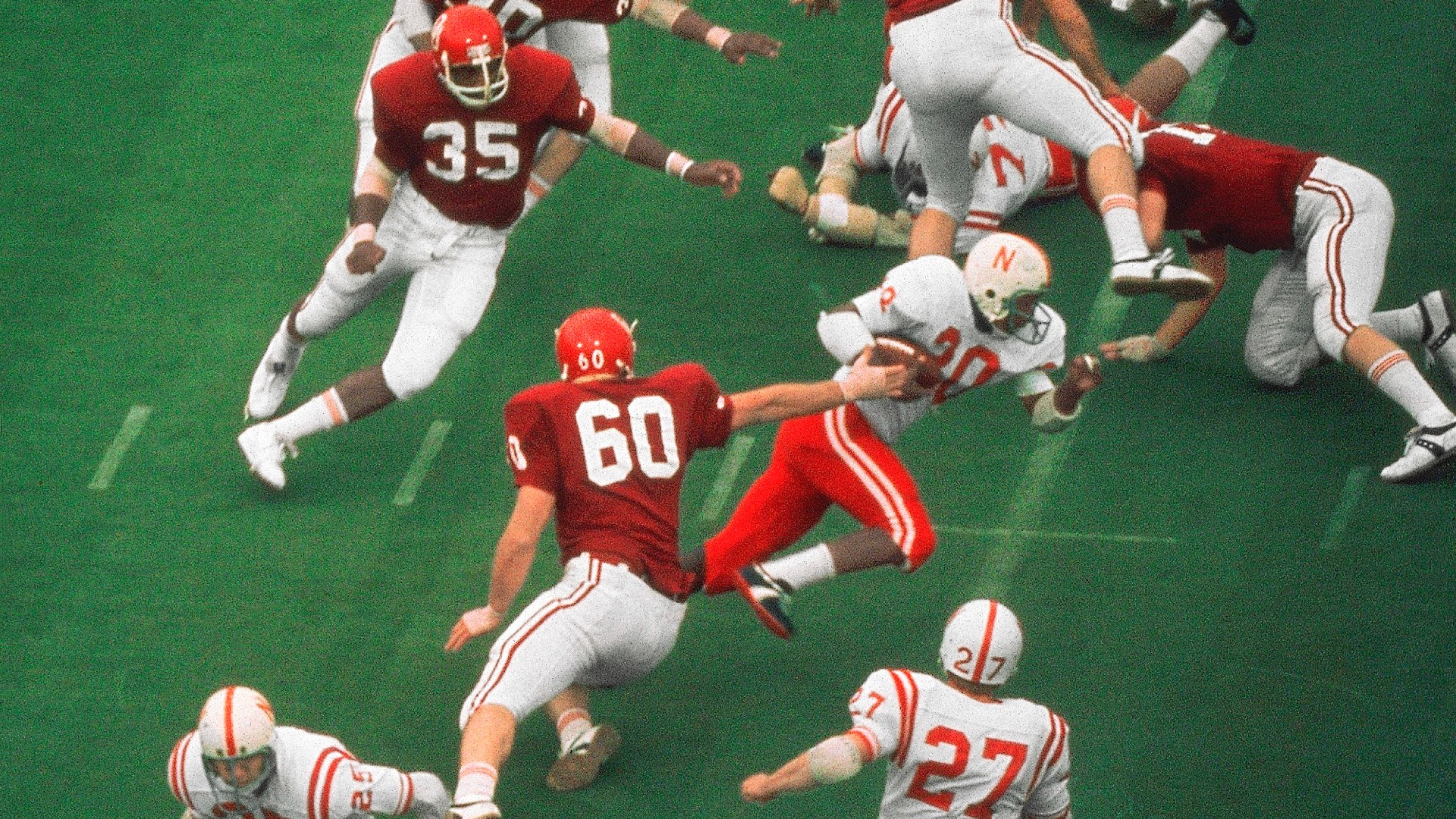
On November 25, 1971, the Nebraska Cornhuskers and the Oklahoma Sooners met at Oklahoma Memorial Stadium, a.k.a. Owen Field, in Norman. The 'Huskers had won the National Championship the season before, were riding a 28-game unbeaten streak (27-0-1, without losing since October 11, 1969), and were ranked Number 1 in the country. The Sooners ranked Number 2. The entire country was watching that Thanksgiving Day.

Each team had a superstar running back. Nebraska, coached by Bob Devaney, had Johnny Rodgers, also a great receiver, from Omaha, running as the last back in the "I formation." He was known as "Johnny the Jet" and "Johnny R Superstar." The nickname clearly came from the theme song to the Broadway musical Jesus Christ Superstar, although it's not known if Nebraska fans made up a song for it, the way fans of London soccer team Arsenal made one up for "Charlie George, superstar."

Oklahoma had Greg Pruitt, a Houston native, running out of the wishbone offense, installed by coach Chuck Fairbanks, after he was impressed at how the Sooners' other big rivals, the University of Texas, ran it under coach Darrell Royal. (Ironically, Royal had played quarterback at Oklahoma.)

Chris Schenkel and Bud Wilkinson, who had established the Oklahoma dynasty before retiring (there were 2 other head coaches between him and Fairbanks), called the game for ABC, and the largest college football audience ever to that point, 55 million people, watched. It kicked off at 2:00 PM Central Time (3:00 Eastern, the ABC broadcast beginning 10 minutes before).
Nebraska stopped Oklahoma's 1st possession, and the Sooners had to punt. Rodgers returned the punt 72 yards for a touchdown. Twice in the 1st half, the Sooners fumbled the ball away. Rich Glover, the 'Huskers' middle guard, toyed with the Oklahoma offensive line.

The Sooners kicked a field goal, then teach team scored a touchdown in the 2nd quarter. But quarterback Jack Mildren led the Sooner offense on a long drive at the end of the 1st half, and Oklahoma had a 17-14 lead. It was the 1st time Nebraska had been behind all season long.

But a 3rd Sooner fumble led to the 'Huskers retaking the lead, and they expanded it to 28-17 late in the 3rd quarter, on Jeff Kinney's 3rd touchdown of the day. But near the end of the 3rd quarter, Mildren led the Sooners on another drive, and it was 28-24 'Huskers. He did it again, and with 7:10 left in regulation, Oklahoma led, 31-28.

The 'Huskers made the most of the time they had left. They got to the Sooner 48, and Husker quarterback Jerry Tagge through to Rodgers, who made a 2nd "signature play" in 1 game, breaking tackles and getting to the 15. Kinney scored his 4th touchdown of the game with 1:38 left. Oklahoma got the ball back, but the 'Huskers sacked Mildren on 3rd and 4th down to put it away. Final score: Nebraska 35, Oklahoma 31.

Nebraska thus clinched the Big 8 title, kept the Number 1 ranking, and set themselves up for the National Championship. They did have 1 more regular-season game, traveling to Hawaii, and they won, 45-3. They closed with another Number 1 vs. Number 2 matchup, beating Alabama in the Orange Bowl in Miami, 38-6.

Oklahoma only dropped to Number 3, and also had 1 more regular-season game, against in-State rival Oklahoma State. They traveled to Stillwater, and beat the Cowboys, 58-14. The aforementioned Alabama beat their big rivals, Auburn, in "the Iron Bowl" in Birmingham, 2 days after Thanksgiving, and Auburn, holding their Number 5 ranking, played Oklahoma in the Sugar Bowl in New Orleans. Oklahoma won, 40-22. Nevertheless, they finished the season with only the Sugar Bowl trophy, while Nebraska were the National Champions and the Big Eight Conference Champions.

Nebraska's 31-game unbeaten streak (30-0-1) ended with the opening game of the 1972 season, 20-17 against UCLA at the Los Angeles Coliseum. Then they went 9-0-1, with only a tie against Iowa State further marring their record. They had gone 40-1-2 over 3 years, a staggering total, for a .942 winning percentage. Then they hosted Oklahoma at Memorial Stadium in Lincoln on Thanksgiving, and the Sooners got some revenge, 17-14. 

After beating Notre Dame in the 1973 Orange Bowl, Devaney retired as Nebraska head coach, becoming athletic director, and elevating his offensive coordinator Tom Osborne to the head job. Osborne had a great deal of success, winning 13 Conference Championships, and 12 bowl games including 9 of those traditionally contested on New Year's Day; but also some staggering near-misses for the National Championship, before winning it in the 1994, 1995 and (in a split poll) 1997 seasons.

Nebraska's Johnny Rodgers was awarded the Heisman Trophy for the 1972 season. The San Diego Chargers took him with their 1st round pick in the 1973 NFL Draft. Instead, he signed with the Montreal Alouettes of the Canadian Football League. He won a Rookie of the Year award, 2 Most Valuable Player awards, and the 1974 Grey Cup (CFL Championship.)

In 1977, with the Chargers still holding his NFL rights, he signed with them. But he was plagued with injuries, and retired after the 1978 season, having played only 17 NFL games.

Oklahoma's Greg Pruitt had a much better pro career. He made 5 Pro Bowls, 4 with the Cleveland Browns and 1 with the Los Angeles Raiders, and was a member of the Raiders' Super Bowl XVIII winners in 1984. Both Rodgers and Pruitt were elected to the College Football Hall of Fame, but neither made it to the Pro Football Hall of Fame.

In 1978, Nebraska won the regular-season game, as Number 4 beating Number 1 Oklahoma, but a rematch was set up in the Orange Bowl (which then took the Big 8 winner), and Oklahoma won it. In 1987, Oklahoma were Number 2 when they beat Number 1 Nebraska.

The Big 8's 1996 conversion into the Big 12 put the teams in separate divisions, as Oklahoma and Oklahoma State were put in with the 4 teams brought in from Texas to form the South Division, to balance the divisions out, ending Huskers-Sooners as an annual rivalry.

Nebraska's 2011 move to the Big Ten made the matchup even rarer: They stopped playing each other after Oklahoma beat them in the 2010 Big 12 Championship Game. They finally met again on September 18, 2021, in Norman, to celebrate the 50th Anniversary of that Game of the Century. Oklahoma won, 23-16.

Overall, Oklahoma leads the rivalry 46-38-3, but it's 43-23 Oklahoma since 1943, 11-8 Nebraska since 1988, and 7-2 Oklahoma since 2000.

*

November 25, 1971 was Thanksgiving Day, so it was a Thursday. 'Huskers-Sooners was 1 of 4 college football games played that day. Number 7 Georgia beat Georgia Tech, 28-24 at Grant Field in Atlanta. Number 12 Texas beat Texas A&M, 34-14 at Kyle Field in College Station, Texas. And Number 18 Mississippi, a.k.a. Ole Miss, beat Mississippi State, 48-0 at Hemingway Stadium in Oxford, Mississippi. (It's now named Vaught-Hemingway Stadium.)

In the NFL doubleheader, NBC telecast the opener, and the Detroit Lions beat the Kansas City Chiefs, 32-21 at Tiger Stadium in Detroit. (Remember: This was 50 years ago.) CBS aired the nightcap, and the Dallas Cowboys beat the Los Angeles Rams, 28-21 at Texas Stadium in the Dallas suburb of Irving Texas.

There were 3 games played in the NBA. The Phoenix Suns beat the Detroit Pistons, 122-103 at the Arizona Veterans Memorial Coliseum in Phoenix. The Philadelphia 76ers beat the Golden State Warriors, 112-111 at the Oakland Coliseum Arena. And the Los Angeles Lakers beat the Seattle SuperSonics, 139-115 at the Seattle Center Coliseum.

There were 2 games played in the American Basketball Association. The New York Nets lost to the Kentucky Colonels, 133-117 at Freedom Hall in Louisville. And the Virginia Squires beat the Pittsburgh Condors, 131-118 at the Civic Arena in Pittsburgh.

And 1 game was played in the NHL: The Boston Bruins beat the Philadelphia Flyers, 4-2 at the Boston Garden.

Also, actress Christina Applegate was born.

Thursday, November 3, 2022

November 3, 1962: The Birth of Nebraska's Red Sea

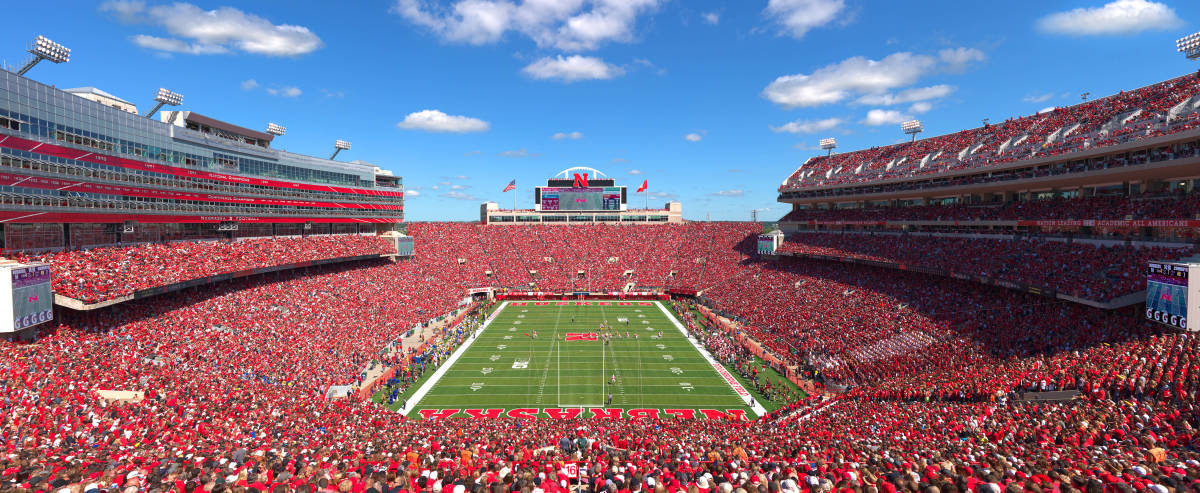
November 3, 1962: The University of Nebraska loses its Homecoming game, to Missouri, 16-7, at Memorial Stadium in Lincoln. The attendance is 36,501, a sellout. Despite Memorial Stadium now officially seating 85,458, the Cornhuskers sold out every home game for the next 57 years.
The Nebraska home crowd is known as the Red Sea. With no major league teams in the State -- the highest-ranking professional team is the Omaha Storm Chasers of Class AAA baseball -- Cornhusker football is it in the Cornhusker State. This is true for many States were there is no major league team, including Alabama, Arkansas and West Virginia.
The Nebraska fan base is devoted. How devoted is it? On December 4, 1982, 16,000 Nebraska fans showed up for a game against the University of Hawaii -- in Honolulu, a game they couldn't drive to. Nebraska won, 37-16, against a Hawaii team that were 6-4 going in, so it's not like they were a bad team.
Due to COVID-19 restrictions preventing fans from attending games in the 2020 season, Nebraska hosted 3 games there, with a combined attendance of exactly zero. The NCAA has chosen to exempt those games from the streak.
In 2021, despite a 3-9 season, one of the worst in Nebraska's modern history, the Cornhuskers played 6 home games, each with an attendance of at least 85,663. As of October 29, 2022, Nebraska's home sellout streak is officially 387 straight games. Since any other school with a sellout streak would also have seen it snapped in 2020, for the same reason, if you consider the 372 straight games from 1962 to 2019 to be the record and now over, that record is unlikely ever to be broken -- at least, not until the 2078 season.
*
November 3, 1962 was a Saturday. Among the other college football games played that day were these:
* Number 1 Northwestern beat Indiana, 26-21 at Seventeenth Street Stadium (now Memorial Stadium) in Bloomington, Indiana. Yes, Northwestern were ranked Number 1 in November. But they lost their next 2 games, to Wisconsin and Michigan State. They did go to the Orange Bowl stadium, but that was for a scheduled game with the University of Miami, which they won.
* Number 2 Alabama beat Mississippi State, 20-0 at Scott Field (now Davis Wade Stadium) in Starkville, Mississippi. Alabama blew its chances at the Southeastern Conference and National Championships by losing to Georgia Tech 2 weeks later. They were still invited to the Orange Bowl.
* Number 3 Southern California beat Number 9 Washington, 14-0 at the Los Angeles Memorial Coliseum. USC won the title of the Athletic Association of Western Universities (AAWU, a precursor to the Pacific-Twelve Conference).
* Number 4 Louisiana State were beaten by Number 6 Mississippi, 15-7 at Tiger Stadium in Baton Rouge, Louisiana. This was LSU's only loss of the season, although they had also been tied by Rice University. "Ole Miss" won the SEC Championship.
* Number 5 Texas beat Southern Methodist (SMU), 6-0 at Memorial Stadium in Austin, Texas. Texas won the Southwest Conference title, but lost the Cotton Bowl to LSU.
* Number 7 Michigan State were upset by Minnesota, 28-7 at Spartan Stadium in East Lansing, Michigan.
* Number 8 Arkansas beat Texas A&M, 17-7 at Kyle Field in College Station, Texas. Arkansas had already lost their shot at the SWC title by losing to Texas, but were invited to the Sugar Bowl, where they lost to Ole Miss.
* Number 10 Auburn were upset by Florida, 22-3 at Florida Field in Gainesville.
* Wisconsin, then unranked, beat Michigan, 34-12 at Michigan Stadium in Ann Arbor. Wisconsin won the Big Ten Conference title, but lost the Rose Bowl to USC, making USC the National Champions.
* Oklahoma, then unranked, beat Colorado, 62-0 at Folsom Field in the Denver suburb of Boulder, Colorado. Oklahoma won the Big Eight Conference title, then beat Alabama in the Orange Bowl.
* Among the service academies, Army beat Boston University, 26-0 at Nickerson Field in Boston; Navy lost to Notre Dame, 20-12 at Municipal Stadium (later John F. Kennedy Stadium) in Philadelphia; and Air Force beat Wyoming, 35-14 at Falcon Stadium in Colorado Springs.
* And among New Jersey teams, Rutgers beat Lafayette, 40-0 at the old Rutgers Stadium in Piscataway; and Princeton beat Brown, 28-12 at Palmer Stadium in Princeton.
There were 4 games played in the NBA that day:
* The Boston Celtics beat the Detroit Pistons, 125-11 at the Boston Garden.
* The Syracuse Nationals beat the Cincinnati Royals, 130-111 at the Onondaga County War Memorial (now the Upstate Medical University Arena) in Syracuse, New York. This would be the last season for the Nationals: The next season, 1963-64, they moved, becoming the Philadelphia 76ers.
* The St. Louis Hawks beat the Chicago Zephyrs, 114-109 at the Kiel Auditorium in St. Louis. The next season, the Zephyrs moved, becoming the Baltimore Bullets. They moved to Washington in 1973, and became the Washington Wizards in 1997.
* And the Los Angeles Lakers beat the San Francisco Warriors, 127-115, despite Wilt Chamberlain scoring 72 points -- yes, seventy-two -- for the Warriors, in their 1st season in the San Francisco Bay Area, having previously been the Philadelphia Warriors.
And there were 2 games played in the NHL. The New York Rangers and the Montreal Canadiens played to a tie, 3-3 at the Montreal Forum. And the Detroit Red Wings beat the Toronto Maple Leafs, 7-3 at Maple Leaf Gardens in Toronto. The Boston Bruins and the Chicago Black Hawks were not scheduled.

Thursday, October 13, 2022

October 13, 1923: Nebraska's Memorial Stadium Opens

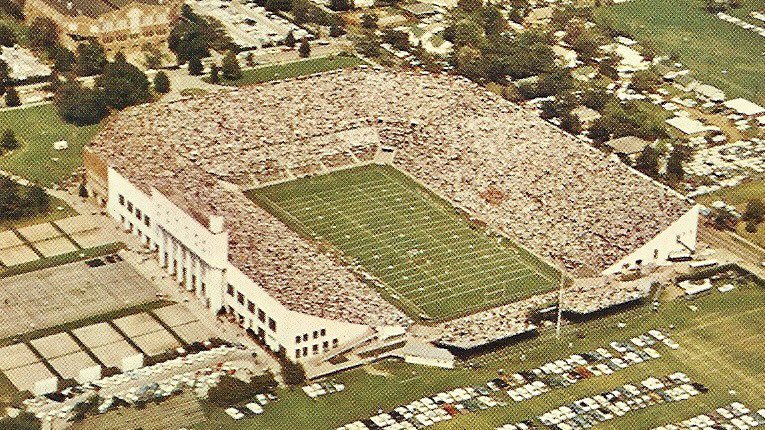
October 13, 1923: Memorial Stadium opens on the campus of the University of Nebraska in Lincoln. The Cornhuskers are not yet arch-rivals with the University of Oklahoma, but that's who they play in the 1st game, and they beat the Sooners 24-0. A week later, Oklahoma opened its own Memorial Stadium.
From 1909 to 1922, the 'Huskers had played at Nebraska Field. Their new stadium originally seated 31,080. In 1962, with Bob Devaney in his 1st season as head coach, they got good, and began a streak of selling out that lasted through the 2019 season. The COVID restrictions of 2020 meant that the 4 Nebraska home games that season were played behind closed doors, so the NCAA recognizes the streak as still being intact as of October 13, 2022.
Because of the team's success, the stadium was expanded to 64,000 in 1967, 73,000 in 1972, 74,000 in 1999, 81,000 in 2006, and 87,000 in 2013. Subsequently, wider seats were installed, and by 2017, capacity was reduced to 85,458. Every seat is still filled, known as "The Sea of Red." The field was concerted to artificial turf in 1970, was renamed for coach Tom Osborne in 1998, and since 1999 has been FieldTurf.
Since moving in, Nebraska have won 30 Conference Championships: 1923 in the Missouri Valley Intercollegiate Athletic Association; in the league alternately known as the Big Six, the Big Seven and the Big Eight, in 1928, '29, '31, '32, '33, '35, '36, '37 and '40, '63, '64, '65, '66, '69, '70, '71, '72, '75, '78, '81, '82, '83, '84, '88, '91, '92, '93, '94, '95; and in 1997 and '99 in the Big Twelve. They joined the Big Ten in 2011, and have won their Division in 2013, but not the Conference. They were awarded National Championships under Devaney in 1970 and 1971; and under Osborne in 1994, 1995 and 1997.
UPDATE: On August 30, 2023, Nebraska's renowned women's volleyball team, in a sport normally played indoors, played at Memorial Stadium, defeating the University of Nebraska at Omaha in 3 straight games. The attendance was 92,003, a record for the stadium, and a record for any women's sporting event, at any level, anywhere in the world. The football attendance record is 91,585, for the Cornhuskers' 41-31 win over the University of Miami on September 20, 2014.
*
October 13, 1923 was a Saturday. Among the other notable college football games played that day were these:
* Notre Dame beat Army, 13-0 at Ebbets Field.
* Navy beat West Virginia Wesleyan, 26-7 at Worden Field in Annapolis, Maryland.
* Columbia beat Wesleyan University, 12-6 at Baker Field (now Wien Stadium) in Upper Manhattan.
* Rutgers beat Lehigh, 10-0 at Neilson Field in New Brunswick, New Jersey
* Princeton beat Georgetown, 17-0 at Palmer Stadium in Princeton, New Jersey.
* Harvard were held to a 6-6 tie by Middlebury College at Harvard Stadium in Boston.
* In a rivalry that would one day be known as the "Backyard Brawl," West Virginia beat the University of Pittsburgh, 13-7 at Forbes Field in Pittsburgh.
* Ohio State were held to a 23-23 tie by Colgate at Ohio Stadium in Columbus.
* Unusually, there were 3 North vs. South matchups on this day, all held in the North. Yale beat Georgia, 40-0 at the Yale Bowl in New Haven, Connecticut. Syracuse beat Alabama, 23-0 at Archbold Stadium in Syracuse, New York.
And Michigan beat Vanderbilt, 3-0 at Ferry Field in Ann Arbor, Michigan. Given that each was a major power in its own region, this was a major measuring stick for Southern college football, and the fact that Vandy only lost by 3 points on the road was taken as a good sign.
Game 4 of the World Series was played that day. A 6-run 2nd inning leads the New York Yankees to an 8-4 win over the New York Giants at the Polo Grounds, and ties up the Series. Bob Shawkey was the winning pitcher, and Babe Ruth went 1-for-3 with 2 walks.
Also, Dutch soccer legend Servaas "Faas" Wilkes was born on this day.

Tuesday, September 20, 2022

September 21, 1901: The 1st American League Pennant

Clark Griffith

September 21, 1901: The Chicago White Stockings lose to the Philadelphia Athletics, 10-4 at Columbia Park in Philadelphia. Bill Bernhard outpitches Roy Patterson, who falls to 20-15.

However, the Boston Americans lose to the Detroit Tigers, 3-1 at the Huntington Avenue Grounds in Boston. This means that Chicago clinch the Pennant of the American League, in its 1st season.

The White Stockings were owned by Charles A. Comiskey, a former 1st baseman for the St. Louis Browns of the American Association, who joined the National League and later became the Cardinals. Comiskey had founded the AL with sportswriter Byron Bancroft "Ban" Johnson, who served as the League's 1st President.

The White Stockings were managed by Clark Griffith, who was also their ace pitcher. He had previously pitched in the city for the National League team, formerly named the White Stockings. Their outfielders included Fielder Jones (his actual birth name), who would manage them to win the 1906 World Series; and William "Dummy" Hoy, a sensational fielder and baserunner, who was deaf, but not mute, or "dumb" in the parlance of the time, yet didn't mind, as many deaf men were, being called "Dummy." They finished 83-53, and won the Pennant by 4 games.

In 1903, Griffith became the 1st manager and the 1st pitcher of the New York Highlanders, forerunners of the Yankees. In 1904, the White Stockings officially shortened their name to the "White Sox," presaging the 1908 decision by Boston to become the "Red Sox," rather than adopt the former National League name of "Red Stockings."

In 1910, Comiskey built the ballpark that would bear his name, where the White Sox would play until 1990. In 1912, Griffith bought the Washington Senators, and named their ballpark for himself. In 1955, the Athletics moved to Kansas City; in 1968, to Oakland. (UPDATE: In 2025, to Sacramento, with the intent of, in 2028, to Las Vegas.)

*

September 21, 1901 was a Saturday. These other baseball games were played:

* The New York Giants beat the Cincinnati Reds, 5-1 at League Park in Cincinnati.

* The Baltimore Orioles beat the Milwaukee Brewers, 5-2 and 7-2 at Oriole Park in Baltimore. These are not the teams we know by those names today. These Orioles went out of business after the 1902 season, and were replaced by a new franchise, which became the New York Yankees. These Brewers moved for the 1902 season, becoming the St. Louis Browns. In 1954, they moved again, becoming... the Baltimore Orioles.

* The Philadelphia Phillies beat the Pittsburgh Pirates, 4-2 in 10 innings at Exposition Park in Pittsburgh. Despite this, on September 27, the Pirates clinched the NL Pennant. There would be no World Series between the Leagues until a peace agreement was made in 1903.

* The Washington Senators swept a doubleheader from the Cleveland Blues, 18-7 and 11-3 at American League Park in Washington. The Blues became the Naps, in honor of Napoleon Lajoie, in 1903; the Cleveland Indians after Lajoie left, in 1915; and the Cleveland Guardians in 2022. The Senators became the Minnesota Twins in 1961.

* The Chicago Orphans beat the Boston Beaneaters, 1-0 in 17 innings at the West Side Grounds in Chicago. Boston had already been known as Beantown for some time. They went through several name changes before becoming the Braves in 1912, and moving to Milwaukee in 1953 and Atlanta in 1966.

The original Chicago White Stockings had a 1st baseman and manager named Adrian Anson. Because he was the team captain, he became known as Cap. As he got older, he became known as Pop; and his team, because of their comparative youth, were known as the Colts. In 1898, their 1st season without him, the team was called the Orphans, because "they missed their Pop." In 1903, they became the Cubs.

* And the Brooklyn Superbas beat the St. Louis Cardinals, 3-1 at Robison Field in St. Louis. The Superbas became the Dodgers in 1911.

This was also the opening week of the college football season. Few schools now recognized as being from "Power Five" conferences were in action. The most interesting games were 2 teams playing high school teams, which would certainly not be allowed now. Minnesota, generally agreed to be one of the top teams of the era, were held to a 0-0 tie, on home ground at Northrop Field, by Minneapolis Central High School. Nebraska, on the other hand, had no trouble with Lincoln High School, beating them 22-0 at Antelope Field in Lincoln. 

Wednesday, January 12, 2022

January 12, 1907: The Big Eight Conference Is Founded

January 12, 1907: The Missouri Valley Intercollegiate Athletic Association is founded in Kansas City, Missouri. It eventually became known as the Big Eight Conference, or the Big 8.

The 5 original members were the University of Kansas, the University of Missouri, the University of Nebraska, Washington University of St. Louis, and the University of Iowa. Iowa only competed in the MVIAA for football and track, remaining in the league that would become the Big Ten Conference, and left the MVIAA entirely in 1911, leading to a split between Iowa and Iowa State that lasts to this day, and one between Iowa and neighboring Nebraska that lasted until 2011.

Iowa State University and Drake University of Des Moines, Iowa joined in 1908. Kansas State University joined in 1913. Grinnell College of Grinnell, Iowa was admitted in 1919, the University of Oklahoma in 1920, and Oklahoma State University (known as Oklahoma A&M until 1958) in 1925.

In 1928, Iowa State, Kansas, Kansas State, Missouri, Nebraska and Oklahoma left to form a new league. The remainders -- Drake, Grinnell, Oklahoma A&M and Washington University formed the Missouri Valley Conference. The 6 schools that left took on the MVIAA name, but began to informally call themselves the Big Six Conference. Both leagues traced their founding to the original MVIAA of 1907.

The University of Colorado was added in 1928, making the MVIAA a Big Seven. In 1957, Oklahoma State left the MVC and joined the MVIAA, making it the Big Eight. In 1964, the Big Eight name was made official.

From 1954 to 1995, the Orange Bowl in Miami usually invited the Big 8 football champion to participate. Of those 42 appearances: Oklahoma and Nebraska, the league's biggest football rivals, each made 15. In 1978, Nebraska beat Oklahoma in the regular season, then lost their last regular-season game, setting up a rematch in the Orange Bowl, which Oklahoma won.

Colorado appeared 5 times, Missouri 2, Kansas 1. Iowa State, Kansas State and Oklahoma State never made it. No Big 8 school appeared in the Orange Bowls of 1965, 1967, 1974 and 1975.

Kansas and Missouri, and to a lesser extent Kansas and Kansas State, would be heated rivals in basketball first, football second. Oklahoma and Oklahoma State would be college wrestling's greatest rivalry, but their "Bedlam" rivalry in football became heavily favored in OU's favor, and OU considers both Nebraska and Texas to be bigger rivals than OSU.

Iowa State also developed a great wrestling program, though not as great as Iowa, their Big 10 rivals. Kansas became, far and away, the league's greatest basketball program, and, to a lesser extent, in soccer; Oklahoma, its best in track & field; Oklahoma State, its best in baseball.

In the 1995-96 schoolyear, 4 schools from the Southwest Conference applied for, and received, membership to the Big 8: The University of Texas, Texas A&M, Texas Tech, and Baylor University of Waco, Texas. The 4 remaining SWC schools -- Texas Christian, Southern Methodist, Houston and its crosstown rival Rice -- joined other leagues.

Thus did 2 of the great college sports leagues, the Big 8 and the SWC, come to an end, but a better league, the Big Twelve Conference, was formed. The 4 Texas schools and the 2 Oklahoma schools formed the South Division, the other teams the North Division.

But that league did not hold: Nebraska went to the Big Ten, Colorado went to the Pac-10, and Texas, Texas A&M and Oklahoma all left for the Southeastern Conference. The Big 12 resembled the old Big 8, but little remains of that Great Plains collegiate sports tradition.

*

January 12, 1907 was a Saturday. Baseball and football were out of season. Professional basketball barely existed. There were no hockey games on this day, but, a few days later, the Kenora Thistles would beat the Montreal Wanderers for the Stanley Cup.

English soccer played the 1st Round Proper of its Football Association (FA) Cup. Teams winning that day were Aston Villa, Bolton Wanderers, Bradford City, Brentford, Bristol City, Burslem Port Vale, Bury, Crystal Palace (beating eventual League Champions Newcastle United in a big upset), Everton, Liverpool, Middlesbrough, Millwall, Norwich City, Notts County, Oldham Athletic, Sheffield Wednesday, Southampton Sunderland and West Ham United.

Playing to draws, and requiring a replay: Woolwich Arsenal, 1-1 away to Grimsby Town at Blundell Park, winning the replay 3-0; Accrington Stanley over Crewe Alexandra; Barnsley over Nottingham Forest; Blackburn Rovers over Manchester City; Bristol Rovers over Queens Park Rangers, Derby County needing a 2nd replay to defeat Chesterfield; Fulham over Stockport County, Lincoln City over Chelsea; Luton Town over Gainsborough Trinity; New Brompton needing a 2nd replay to defeat Burton United; Portsmouth over Manchester United, Tottenham Hotspur needing a 2nd replay to defeat Hull City; and West Bromwich Albion over Stoke City.

Sheffield Wednesday would go on to win the Final over Everton.

Sunday, January 2, 2022

January 2, 1984: Miami Shocks Nebraska In the Orange Bowl

Bernie Kosar, on an NBC screen capture

January 2, 1984: The Orange Bowl is played, at the stadium of the same name in Miami. The usual date, New Year's Day, fell on a Sunday, so, not wanting to compete with the NFL for TV viewers, the game was pushed back a day.

Since winning back-to-back National Championships in 1970 and 1971, the University of Nebraska had won 6 Big Eight Conference Championships, 2 Orange Bowls, a Sugar Bowl and a Cotton Bowl. But they hadn't won another National Championship. They only lost 1 game in 1982, by 3 points, away to Penn State.

In 1983, head coach Tom Osborne's Cornhuskers put up one of the most stunning seasons in college football history in 1983. They were ranked Number 1 to open the season, and their 1st game was the Kickoff Classic at the Meadowlands, against Number 4 Penn State, the defending National Champions. The 'Huskers crushed Joe Paterno's Nittany Lions, 44-6.

What followed was the most devastating offensive display in the history of college football. With quarterback Turner Gill handing off to Heisman Trophy winner Mike Rozier, and Outland Trophy winner Dean Steinkuhler blocking for them, they beat Wyoming at home, 56-20. They went into the Metrodome and beat Minnesota 84-13. That is not a misprint: Eighty-four to thirteen. They beat UCLA at home, 42-10. They beat Syracuse at home, 63-7.

Their next game was a tough one: Away to Number 20 Oklahoma State. Nebraska won that one, 14-10. They won away to Missouri, 34-13; beat Colorado at home, 69-19; won away to Kansas State, 51-25; beat Iowa State at home, 72-29; beat Kansas at home, 67-13. They closed the regular season by beating arch-rival Oklahoma away, 28-21, clinching the Big Eight Conference Championship.

They outscored their opponents 634-186. In other words, in the 1983 regular season, the average score of a Nebraska football game was Cornhuskers 53, Opponents 10. Fifty-three to ten.

To be fair: Some of these opponents were better than others. Minnesota finished 1-10, and, in other games, gave up 69, 61, 58, 56 and 50. Kansas State finished 3-8, Colorado and Iowa State 4-7, Kansas 4-6-1. But Penn State finished 8-4-1, both Oklahoma and Oklahoma State 8-4, UCLA 7-4-1 and as Pac-10 Champions, Wyoming and Missouri 7-5. UCLA won the Rose Bowl, Penn State the Aloha Bowl, Oklahoma State the Bluebonnet Bowl. Missouri reached the Holiday Bowl.

As Big 8 Champions, they were locked into the Orange Bowl, at the Orange Bowl stadium in Miami. It was also the home stadium of the University of Miami. And that would be their opponents.

The Hurricanes were coached by Howard Schnellenberger, who, with his stocky build and his big mustache, looked more like an old big-city butcher than a football coach. But he was smart, and was recruited by Bear Bryant to play end, both offensively and defensively, at Kentucky.

After playing in the Canadian Football League, he became one of Bryant's assistants at Alabama, and recruited Joe Namath. He then served as an assistant to George Allen with the Los Angeles Rams, and to Don Shula with the Miami Dolphins, including the undefeated season of 1972-73.

In 1979, the University of Miami hired him as head coach. He coached them to a 9-3 season in 1980, 9-2 in 1981, and 7-4 in 1982. They were then an independent, so there was no conference title for them to win. But they won the 1981 Peach Bowl, would have gone to a bowl game for the 1981 season had they not been on probation, and were denied a bowl bid for 1982.

In 1983, they opened the season with a bad 28-3 loss away to Number 16 Florida. But they cruised from there: Beating Houston away, 29-7; Purdue at home, 35-0; Number 13 Notre Dame at home, 20-0; Duke away, 56-17; Louisville at home, 42-14; Mississippi State away, 31-7; Cincinnati away, 17-7; Number 12 West Virginia at home, 20-3; East Carolina at home, 12-7; and Florida State away, 17-16.

So here's how the bowl games stood: Number 1 Nebraska vs. Number 5 Miami in the Orange Bowl; Number 2 Texas vs. Number 7 Georgia in the Cotton Bowl in Dallas; Number 3 Auburn vs. Number 8 Michigan in the Sugar Bowl in New Orleans; and Number 4 Illinois vs. unranked UCLA in the Rose Bowl in Pasadena.

But in the early afternoon, on CBS, Georgia beat Texas, 10-9. So that eliminated the Longhorns. In the late afternoon, on ABC, UCLA crushed Illinois, 45-9. (Students at Caltech, responding to a recent prank by MIT students at the Harvard-Yale game, hacked the Rose Bowl scoreboard, so that it read "CALTECH 38 MIT 9.") So that eliminated the Fighting Illini.

In those days, the Orange Bowl and the Sugar Bowl were usually held at the same time, the former on NBC, the latter on ABC. Auburn's hope was that they would beat Michigan solidly, and that Miami would pull the tremendous upset against Nebraska. Miami's hope was that they would pull the upset, and then Michigan would upset Auburn.
The Orange Bowl stadium at night -- probably not that night

What followed was one of the lamest games in New Year's Day bowl history -- and one of the most stunning football games ever played at any level.

Nebraska were favored by 10 1/2 points. Most fans expected Miami to put up a fight, but Nebraska to win solidly. And yet, Miami stopped their opening drive, and blocked a field goal attempt. Miami quarterback Bernie Kosar threw a touchdown pass to Glenn Dennison. Miami held Nebraska again, and Jeff Davis kicked a field goal. Miami intercepted Gill, and Kosar threw another touchdown pass to Dennison.

At the end of the 1st quarter, it was Miami 17, Nebraska 0. The nation -- or, at least, its football fans -- were stunned. Meanwhile, in the Superdome, Michigan quarterback Steve Smith ran for a touchdown, and put the Wolverines up 7-0 on Auburn.

Despite having a potent wishbone attack led by the next season's Heisman winner, running back Vincent "Bo" Jackson, Auburn couldn't score in the 2nd quarter, either. It was still 7-0 at the half, and it was looking like Miami had a shot at the National Championship: They were Number 5, they were beating Number 1, Number 2 and Number 4 had already lost, and Number 3 were losing.

Nebraska got back on track, intercepted Kosar, and drove into Miami territory. With a 3rd & 5 on the Hurricane 19, Gill took the snap, and ran to his right. So did fullback Mark Schellen, who appeared to have the ball. So did tight end Monte Engebritson. It looked like a power sweep.

Except Gill didn't give the ball to Schellen. He just set it on the ground. Officially, it was a fumble. But none of the Miami players saw it. Steinkuhler, by design, did, picked it up, and ran for a touchdown. Had it been a pass, he would have been an ineligible receiver. But, under the rules of the time, when the ball was fumbled, all offensive players were permitted to pick it up and run it forward. It was a trick play known as the fumblerooski, and would be outlawed in 1992.

For the moment, though, it was 'Canes 17, 'Huskers 7. Gill led another drive, ending with a quarterback sneak. At halftime, it was Miami 17, Nebraska 14. The upset was still on, but the sense that Nebraska had shaken off the shock of Miami's initial attack, and was ready to run their momentum straight down the Hurricanes' throats, was now strong.

It got stronger when Miami fumbled early in the 3rd quarter, and Nebraska tied it 17-17 on a Scott Livingston field goal. But the fact that they got only a field goal, not a touchdown, would matter later on. Meanwhile, in New Orleans, Al Del Greco kicked a 31-yard field goal to close Auburn to within 7-3 of Michigan.

Miami got its act together, and Kosar engineered 2 more touchdown drives, capped by runs by Alonzo Highsmith and Albert Bentley. At the end of the 3rd quarter, it was 31-17 Miami. And Rozier, after running for 147 yards, had to leave the game with an injured ankle.

Midway through the 4th quarter at the Sugar Bowl, Del Greco kicked a 32-yard field goal, to close Auburn to within 7-6 of Michigan. They still had a chance.

So did Nebraska. With 7 minutes left, Gill got them to the 1-yard line, and Jeff Smith ran it over for a touchdown. That made it 31-23. Osborne could have gone for a 2-point conversion here, and made a big difference. Instead, he went for the 1-point kick, and it was 31-24 Miami.

With 58 seconds left in the Sugar Bowl, Del Greco attempted a 19-yard field goal. It was good, and Auburn beat Michigan, 9-7. The Tigers had done what they absolutely had to do: Win. But they did it by just 2 points, and without having scored a touchdown. Would it be enough to convince poll voters, in case Miami hung on to beat Nebraska?

The Orange Bowl also came down to the last minute. Davis missed a field goal that would have iced it for the 'Canes. Gill drove the 'Huskers down, and Smith broke off a 24-yard run, scoring with 48 seconds left. It was Miami 31, Nebraska 30.

Going for one, and a 31-31 tie, presuming Nebraska's defense could hold Miami for the last 48 seconds, would have left Nebraska at 12-0-1, and almost certainly gained them the National Championship. Going for two, and a 32-31 win, would not only guarantee the 13-0 Cornhuskers the National Championship, but perhaps certify them as the greatest college football team of all time, especially since they could, in this scenario, add to their resume, "Their last test was their greatest, and they passed it." But fail on the conversion, and there would be no title, and the poll voters would have to choose between Miami and Auburn.

There was a principle at hand: If you can't gain 3 yards on 1 play to win 1 game, you don't deserve to win the National Championship.

There was also a memory to contend with: That of the 1966 "Game of the Century" between Notre Dame and Michigan State. As Notre Dame head coach, Ara Parseghian went for a tie, knowing it wouldn't cost him the National Championship, whereas a loss would have. But, in the ensuing 17 years, the words had been spoken many times: "Parseghian had no guts."

Osborne was not going to be accused of having no guts. He knew that, for all Parseghian had achieved, that 10-10 tie was the thing for which he was most remembered. "We were trying to win the game," Osborne said at the time. "I don't think you go for a tie in that case. You try to win the game. We wanted an undefeated season and a clear-cut National Championship."

Clear-cut. Because Americans hate ties. Long ago, though the identity of the coach who first said it depends on who's telling the story, a coach lost a game on a 1-yard run attempt rather than kick a tying field goal, and explained to the reporters, "A tie is like kissing your sister."

It's not like in European soccer, where a win is worth 3 points to your team in the league standings (or "table"), and a tie (or "draw") is worth 1 point. A tie that gave Nebraska the 1983 National Championship would have satisfied very few people -- outside the State of Nebraska, anyway. Americans hate ties, to the point that the NHL no longer has them. Sure, with a tie, Nebraska would still have been National Champions. But any pretense to "Greatest Team Ever" status would have been gone.

The ball was placed on Miami's 3-yard line. Once again, Gill rolled to his right, and looked for Smith. But Smith was double-covered, and Miami's Kenny Calhoun knocked the pass away. It was still Miami 31, Nebraska 30. Nebraska kicked off, and Miami ran out the clock, and won the game.

When the Associated Press and United Press International released their polls the next day, they both awarded Miami the National Championship. The AP (the sportswriters) gave 11-1 Miami 47 1/2 1st-place votes, 11-1 Auburn 7, and 12-1 Nebraska 4 1/2. UPI (the coaches) gave Miami 30, Nebraska 6, and Auburn 4.

Auburn won a major bowl game. They won the Sugar Bowl, the 2nd-best thing an SEC team could do in those pre-Playoff days, behind winning the National Championship. And they were ranked Number 3, and the teams ranked Number 1 and Number 2 had both lost. But their performance in that game was so weak, both polls put them behind Miami, and UPI also put them behind a defeated Nebraska.

This would begin a run for Miami of 12 seasons in which they were, effectively, in 6 National Championship Games, winning 4 of them (in the seasons of 1983, 1987, 1989 and 1991). They would win another in 2001, and come very close in 2000 and 2002.

Schnellenberger wouldn't be there for any more of it. After 1 more season, he left Coral Gables to become head coach at the University of Louisville, in the city where he grew up. He built them into a powerhouse, winning a Fiesta Bowl over Alabama, and later returned to the Miami area as head coach at Florida Atlantic University.

The '84 Orange Bowl would haunt Nebraska. They lost the Orange Bowl to Miami again in 1988 (thus blowing a shot at the title and letting Miami win it), and lost it to Florida State in 1994 (again blowing the title to a team from Florida).

Finally, on January 1, 1995, they again went to the Orange Bowl, again played Miami, and beat them 24-17, to win the 1994 National Championship, finally getting the monkey off Osborne's back. They would win the National Championship again in 1995, and share the 1997 title with Michigan, the last "split poll" title. That 1995 team is considered by some to be what the 1983 team should have been: The greatest team in college football history.

*

January 2, 1984 was a Monday. In addition to the aforementioned, Orange, Sugar, Rose and Cotton Bowls, the Fiesta Bowl was played that day, at Sun Devil Stadium in the Phoenix suburb of Tempe, Arizona. Number 14 Ohio State beat Number 15 Pittsburgh, 28-23.

There was 1 game played in the NBA: The Indiana Pacers beat the Atlanta Hawks, 96-86 at the Market Square Arena in Indianapolis.

And there were 2 games played in the NHL. The New York Rangers played the Washington Capitals to a tie, 2-2 at the Capital Centre in the Washington suburb of Landover, Maryland. And the Minnesota North Stars beat the Chicago Black Hawks, 6-5, at the Metropolitan Sports Center in the Minneapolis suburb of Bloomington, Minnesota. 

Saturday, January 1, 2022

January 1, 1995: Nebraska Redeemed

January 1, 1995: The World Trade Organization (WTO) begins operation. The History Channel is launched.

And the Orange Bowl is played in Miami, at the stadium of the same name. It was also the home field for the football team at the University of Miami, who were ranked Number 3 in the country, and invited to play in it.

The Number 1 team in the country was also invited to play in it. This was the University of Nebraska.

In spite of Nebraska being ranked higher, all signs pointed to a Miami win.

Since winning back-to-back National Championships in 1970 and 1971, Nebraska had won 12 Big Eight Conference Championships, 3 Sugar Bowls, 2 Orange Bowls and a Cotton Bowl. But they hadn't won another National Championship. They only lost 1 game in 1982, by 3 points, away to Penn State. They put up one of the most stunning seasons in college football history in 1983, but lost the Orange Bowl to Miami on a missed 2-point conversion.

That started Miami on a quasi-dynasty that saw them awarded that season's National Championship, and win it again in 1987, 1989 and 1991, and just miss it in 1986, 1988 and 1992. So in a stretch of 10 seasons, they reached an official or unofficial game for the National Championship 7 times, winning 4 of them. In those 10 seasons, they ended up Number 1 in the final poll 4 times, Number 2 twice, and Number 3 3 times.

But Nebraska couldn't get over the hump. Head coach Tom Osborne had been an assistant to Bob Devaney on those early 1970s titles, but since taking over in 1973, he couldn't win one himself. From 1982 to 1993, 12 seasons, the Cornhuskers had regular seasons of 11-1, 12-0, 9-2, 9-2, 9-2, 10-1, 11-1, 10-1, 9-2, 9-1-1, 9-2 and 11-0. They lost 3 Orange Bowls to Miami. And just 1 year earlier, on New Year's Day 1994, they thought they had the National Championship won with a last-minute field goal over Florida State. But they gave up a field goal, and then missed one on the last play.

At this point, the Chicago Cubs hadn't won a World Series in 86 years, the Boston Red Sox hadn't won one in 76 years, the New York Rangers had just ended a Stanley Cup drought at 54 years, and Nebraska football, while their drought was a much shorter 33 years, it was similarly tinged with painful close calls.

So when football fans found out that Nebraska's opponents for the de facto National Championship game were the Miami Hurricanes, it seemed like, as baseball legend Yogi Berra would have said, "Déjà vu all over again."

This was a typical Nebraska team, pounding weak opponents and doing enough, sometimes just enough, to beat the stronger ones. They opened the season ranked Number 4, and beat Number 24 West Virginia in the Kickoff Classic at the Meadowlands. They hung 70 points on the University of the Pacific, 49 on Number 13 UCLA, 45 on Kansas, 42 on Texas Tech, 42 on Wyoming, 42 on Missouri.

Kansas State was ranked Number 16 when Nebraska went there and won, 17-6. The 'Huskers essentially wrapped up the Big Eight Conference title when, ranked Number 3, they beat Number 2 Colorado at home, 24-7. And they went to arch-rival Oklahoma and beat them, 13-3.

Miami were 10-1 under head coach Dennis Erickson. Their only loss was to Number 17 Washington, but it did come at the Orange Bowl. They did manage to beat Number 3 Florida State, Number 10 Syracuse, Number 13 Virginia Tech, and Number 25 Boston College, winning the Big East Conference title.

Cliché Alert: In football, home-field advantage is said to be worth 3 points. The Las Vegas oddsmakers took that into account, and installed Miami as favorites by 1 point.

Midway through the 1st quarter, Dan Prewitt kicked a field goal to put Miami on the board. At the end of the quarter, Frank Costa threw a touchdown pass to Trent Jones, and now the Hurricanes were up 10-0. It was looking like another bad ending for Nebraska.

But the 'Huskers made the only score of the 2nd quarter, as Brook Berringer threw a touchdown pass to Mark Gilman. The teams went into the locker room with the score 10-7 Miami, and the game still either team's to win.

Early in the 3rd quarter, Costa threw to Jonathan Harris, who ran 44 yards for a touchdown. It was 17-7 Miami, and with 28 minutes to go, it looked like Nebraska were beaten. Within 2 minutes, Nebraska had to punt the ball away. But with 11:35 left in the 3rd, Dwayne Harris sacked Costa in the end zone for a safety. The 3rd quarter ended 17-9 in Miami's favor.

Theoretically, it was now a one-score game. Quarterback Tommie Frazier drove the 'Huskers down the field. With 7:38 left in regulation, running back Cory Schlesinger scored on a 15-yard run. Frazier threw to Eric Alford for the 2-point conversion, the play that had doomed Nebraska on that very field 11 years earlier (and had helped to do so 1 year earlier). This time, it was successful, and the game was tied, 17-17.

Miami could do nothing with their next possession. Nebraska got the ball back, and Frazier drove them again. With 2:46 left, Schlesinger broke off a nearly identical run, and rumbled into the end zone. The extra point was good, and Nebraska led. Their defense held, and they were 24-17 victors.

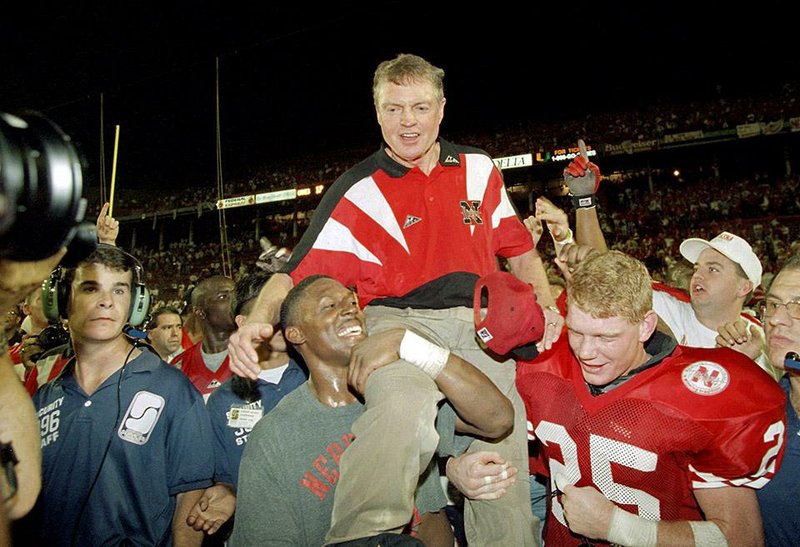
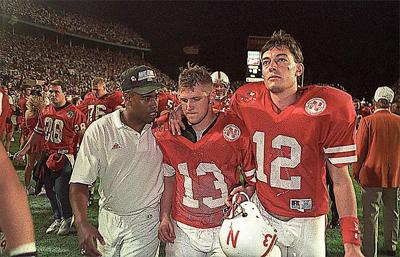
The Nebraska Cornhuskers were redeemed. Tom Osborne had his National Championship. And his greatest victory had just been won on the site of his greatest defeat.

Two weeks later, Erickson resigned from Miami, to become head coach of the NFL's Seattle Seahawks. He did not do well there. In contrast, Osborne won another National Championship in 1995, and another in 1997 (albeit with the polls split, one poll choosing Nebraska, the other choosing Michigan).

Schlesinger played 12 seasons in the NFL, mostly as a blocking back for the Detroit Lions, making 3 Pro Bowls. Despite quarterbacking the 'Huskers to back-to-back National Championships, Frazier was not drafted, because NFL teams were afraid of his history of blood clots. He played 1 season with the CFL's Montreal Alouettes, but his illness took hold again, and he had to retire. Like Turner Gill, the quarterback on the 1983 Nebraska team that crashed through everybody before losing the title to Miami, he went into coaching. He was still better off than his backup, Berringer, who was killed in a plane crash in 1996.

*

January 1, 1995 was a Sunday. Only 1 other bowl game was played that New Year's Day: Number 23 North Carolina State beat Number 16 Mississippi State in the Peach Bowl, at the Georgia Dome in Atlanta.

The rest of the major bowl games were played the next day, January 2 -- and it could have been argued that Nebraska still didn't have the National Championship won. Penn State was undefeated, and playing in the Rose Bowl. They beat Oregon, 38-20, and their fans still claim the 1994 season as a National Championship.

But both the final AP poll (the Associated Press, the sportswriters) and the final UPI poll (United Press International, the coaches) gave it to Nebraska. I guess they didn't want to take Osborne's great moment away. Or maybe they already knew about the harm that was being caused in Joe Paterno's program.

The reason there were comparatively few bowl games played on New Year's Day is that it was a Sunday, and it was the 1st round of the NFL Playoffs. Two games were played in those Playoffs. The Cleveland Browns beat the New England Patriots, 20-13, in what turned out to be the last postseason game, in any sport, at Cleveland Municipal Stadium. The Browns didn't win another Playoff game for 16 years. And the Chicago Bears beat the Minnesota Vikings, 35-18 at the Metrodome in Minneapolis.

No NBA games were played, and the NHL players were locked out by the owners.

January 1, 1994: Florida State Finally Does It

 
January 1, 1994: The Orange Bowl is played, at the stadium of the same name in Miami. The University of Nebraska hasn't won the National Championship since the 1971 season, 32 years earlier. Florida State University has never won it. Both teams have had some agonizing close calls the last few years. Something's got to give.

Bobby Bowden had been an assistant coach at Florida State before becoming the offensive coordinator, and then the head coach, at West Virginia. After taking the Mountaineers to victory in the 1975 Peach Bowl, FSU asked him to come back.

He inherited a mess. As he said at the time, "At West Virginia, the bumper stickers say, 'BEAT PITT.' At Florida State, they say, 'BEAT ANYBODY.'" It took him just 2 years to turn them into a 10-2 team and winners of the Tangerine Bowl.

The Seminoles were not in a league until joining the Atlantic Coast Conference in 1992. But they put together some great teams. In 1979, they had an undefeated regular season, 11-0. In 1980, they went 10-1. But, both seasons, they lost a chance at the National Championship by losing the Orange Bowl.

In 1987, they went 11-1 and won the Fiesta Bowl. In 1988, they went 11-1 and won the Sugar Bowl. But, both times, they lost a regular season game to the University of Miami, one of their main rivals, costing them a shot at the National Championship. In 1989 and 1990, they went 10-2.

The 1991 season seemed like the year. They began the season ranked Number 1, and won their 1st 10 games. And then it all fell apart. In back-to-back games -- though with a bye week in between -- they faced Number 2 Miami at home at Doak Campbell Stadium in Tallahassee, and lost 17-16; and then faced their other main rivals, Number 5 University of Florida, away, and lost 14-9. A win over Texas A&M in the Cotton Bowl did little to console them, as Miami won the National Championship for the 4th time in the last 9 seasons.

Could 1992 be the year? They won their 1st 5 games, then had to go to the Orange Bowl stadium to play Miami: The Hurricanes were Number 2, the Seminoles Number 3, so it was a big game, if not the big game of the regular season, as it was the year before. Miami won, 19-16. Florida State won the rest of their games, including a return to the Orange Bowl where they beat Nebraska, but finished Number 3. Miami lost the Sugar Bowl to Alabama, costing them another National Championship.

In both 1991 and 1992, Miami won because Florida State missed a last-play field goal: The 1st time, by Gerry Thomas from 34 yards; the 2nd time, by Dan Mowrey from 39. Both were wide and to the right. These games are now known as Wide Right I and Wide Right II.

Seminole fans could only console themselves by calling on Miami's "thug" image, saying, "You can't spell SCUM without UM." In time, a free sneakers scandal would lead to Miami (and Florida) fans saying, "FSU" stood for "Free Shoes University."

Again in 1993, Florida State opened the season at Number 1. And they tempted fate by recruiting Scott Bentley, a native of the Denver suburbs and the country's highest-ranked high school kicker, and letting him be put on the cover of Sports Illustrated's 1993 College Football Preview Issue. It was as if they were telling "The Dreaded SI Cover Jinx," "Come on, then!"

As it turned out, Bentley missed 7 extra points in the team's 1st 5 games. Not 7 field goals. Seven extra point attempts. The Jinx was punishing Bentley for his team's defiance.

As it turned out, it didn't matter: It was only Bentley, not the team as a whole, that was getting punished. They won those 1st 5 games: 42-0 over Kansas in the Kickoff Classic at the Meadowlands, 45-7 away to Duke, 57-0 home to Number 17 Clemson, 33-7 away to Number 13 North Carolina, and 51-0 home to Georgia Tech.

This time, with Miami coming into Doak Campbell with the Number 3 ranking, the Seminoles left no doubt, winning 28-10. No last-play, or even last-minute, heroics necessary. They followed this with a 40-14 win home to Number 15 Virginia, a 54-0 home win over Clemson, and a 49-20 win away to Maryland.

That set up a showdown with Number 2 Notre Dame in South Bend, Indiana. NBC tried billing it as "The Game of the Century," and it lived up to the hype, being in doubt until a last-gasp FSU pass was broken up in the end zone. Notre Dame won, 24-17, and rose to Number 1.

It looked like the Seminoles' dreams had been shattered again. But the very next week, Notre Dame were upset by Boston College on a last-play field goal. Meanwhile, Florida State beat North Carolina State 62-3 to clinch the ACC title, and won 33-21 away to Number 7 Florida to regain the Number 1 ranking.

Since winning back-to-back National Championships in 1970 and 1971, Nebraska had won 11 Big Eight Conference Championships, 3 Sugar Bowls, 2 Orange Bowls and a Cotton Bowl. But they hadn't won another National Championship. They only lost 1 game in 1982, by 3 points, away to Penn State. They put up one of the most stunning seasons in college football history in 1983, but lost the Orange Bowl to Miami on a missed 2-point conversion, starting Miami's quasi-dynasty.

Expectations for 1993 were not especially high, as the Cornhuskers started out ranked Number 9. Putting up 76 points on North Texas, 50 on Texas Tech, 49 on Missouri, 49 on Iowa State, 48 on Colorado State, and 45 on Kansas State were not unusual for The 'Huskers under head coach Tom Osborne.

What did get people's attention was a nationally-televised 14-13 win over UCLA at the Rose Bowl stadium; a 21-17 win away to Colorado, which had been the top team in the Big 8 the last few years; and a 21-7 day-after-Thanksgiving win over their arch-rivals, Number 16 Oklahoma.

It pushed Nebraska up to Number 2, and set up a New Year's Day prime-time matchup between Osborne's 'Huskers and Bowden's 'Noles. One of these teams was going to end their years of heartbreak, while the other was going to extend it. It was college football's equivalent of having a World Series between the pre-2004 Boston Red Sox and the pre-2016 Chicago Cubs.

Nebraska were undefeated. Florida State were not. And yet, Florida State were favored by 17 1/2 points. Was it because they had the Heisman Trophy winner, quarterback Charlie Ward? It shouldn't have been: Nebraska had the country's best defense. Was it because Nebraska had a history of choking? It shouldn't have been: So did Florida State.

Was it because Florida State were used to playing on this field? Not really: So were Nebraska. And being in the same State didn't make any difference: It was 482 miles from Doak Campbell Stadium to the Orange Bowl, so this was no "home game" for the Seminoles and their fans.

The 1st quarter ended scoreless, but it shouldn't have been: Nebraska returned a punt for a touchdown, but it was called back due to an illegal block, which the instant replay showed didn't happen. Bentley opened the scoring with a field goal midway through the 2nd quarter. Nebraska scored a touchdown, but with time running out in the half, Bentley kicked another field goal. It was Nebraska 7, Florida State 6.

Nebraska got robbed again early in the 3rd quarter. William Floyd appeared to have scored a touchdown for FSU, but the replay showed that he fumbled before crossing the goal line. The 2-point conversion attempt failed, and the Seminoles led 12-7. Bentley kicked another field goal, and it was 15-7 Seminoles at the end of the quarter. By all rights, it should have been 14-9 Cornhuskers.

At the beginning of the 4th quarter, Lawrence Phillips scored a touchdown for Nebraska. Just as it had on the same field 10 years earlier, the 2-point conversion attempt did not go Nebraska's way, and it was still 15-13 Seminoles. Time began to run out. But quarterback Tommie Frazier drove the 'Huskers down, and with 1:16 left, Byron Bennett kicked a 27-yard field goal. Nebraska led, 16-15.

But it wasn't over yet. The 'Noles still had Heisman winner Ward. He got them down to a 1st & goal on the Nebraska 3-yard line. The 'Husker defense held, and, with 21 seconds left, Scott Bentley finally had his date with destiny. It was an attempt from 22 yards out. Basically, an extra point attempt. If he makes it, he's a Seminole hero for all time. If he misses it, he's the biggest flop in team history. He nailed it, and his teammates piled onto him.

But the game still wasn't over. The Seminoles were penalized for excessive celebration. That, and a bad kickoff -- by Bentley, mind you -- gave the 'Huskers the ball at their own 43. They only needed about 25 yards for a game-winning field goal.

Frazier got Nebraska to the Seminole 28, with a pass to Trumane Bell. That would make a field goal attempt 45 yards. Not easy on natural grass, but with hardly any wind, certainly possible. But the clock seemed to run out when Bell went down. Thinking their coach had finally won his National Championship, some Florida State players dumped the Gatorade on Bowden.

But referee John Soffey ruled that Bell was down with 1 second left. By NCAA rules, the clock must stop to move the first down marker. This gave Nebraska time to get their field goal unit on in time. If Bennett made his attempt, it would have been the cruelest loss yet for Florida State: Losing on a last-play field goal when you thought you already had the National Championship won.

Bennett missed. Not wide right, but wide left.
Like Ralph Branca, a victim of big-game fate
in baseball in 1951, he wore Number 13.

Now, Florida State were the National Champions -- clinching it with the other team missing a field goal attempt. No one cared about the irony, or that they hadn't played especially well: They were Champions at last.

It was another crushing defeat for Nebraska. Finally, the next season, they went all the way -- and in the perfect way, beating Miami on their own field in the Orange Bowl game. This started a run of 3 National Championships in 4 seasons.

Byron Bennett would not be a part of it. The man who thought he'd made the field goal to get Tom Osborne his 1st National Championship as a head coach -- he'd been an assistant to Bob Devaney in 1970 and '71 -- and then missed the one that would have really done it, became a parole officer in Dallas, and then a high school football coach. He's done rather well at it.

Bobby Bowden would lead Florida State to another National Championship in 1999. His successor, Jimbo Fisher, did so in 2013.

Scott Bentley remained with Florida State through the 1996 season, and graduated. In 1997, the Atlanta Falcons signed him as a kickoff specialist, but released him after 2 games. The Denver Broncos picked him up, as a backup to Jason Elam, and he played 1 game, kicking 2 field goals in 3 attempts and going 4-for-4 on extra points. He remained a kickoff specialist, playing 2 games in 1999 for the Kansas City Chiefs; and, in 2000, 1 more for the Broncos and 6 for the Washington Redskins, making 1 field goal, for 50 yards. He is now an operations manager for Amazon.com.

One other note: This game was broadcast on NBC, with Dick Enberg and former Cincinnati Bengals star Bob Trumpy in the booth, and legendary USC and Buffalo Bills running back O.J. Simpson as the sideline reporter. If what happened between Florida State and Nebraska on January 1, 1994 was shocking, what Simpson did in the week of June 12 to 17, 1994 was even more so.

*

January 1, 1994 was a Saturday. In the other New Year's Day bowl games:

* Rose Bowl, Pasadena, California: Number 9 Wisconsin beat Number 14 UCLA, 21-16.

* Sugar Bowl, Superdome, New Orleans: Number 8 Florida beat Number 3 and previously undefeated West Virginia, 41-7. West Virginia fans were hoping that the Orange Bowl, being played at the same time, would be a dull, or mistake-filled, game, giving them hope for the National Championship. But Florida, who'd lost only to Florida State and Auburn, put a quick stop to that.

* Cotton Bowl, Dallas: Number 4 Notre Dame beat Number 7 Texas A&M, 24-21.

* Fiesta Bowl, Sun Devil Stadium, Tempe, Arizona: Number 16 Arizona beat Number 10 Miami, 29-0. Arizona did this despite playing on the home field of their arch-rivals, Arizona State.

* Hall of Fame Bowl, Tampa Stadium: Number 23 Michigan beat unranked North Carolina State, 42-7.

* Florida Citrus Bowl, Orlando, Florida: Number 13 Penn State beat Number 6 Tennessee, 31-13.

* Carquest Bowl, Joe Robbie Stadium, Miami Gardens, Florida: Number 15 Boston College beat unranked Virginia, 31-13. This game debuted in 1990 as the Blockbuster Bowl, and has gone through many names. It moved to Orlando in 2001, and took up the former name of the Florida Citrus Bowl, the Tangerine Bowl. Still in Orlando, it is now known as the Cheez-It Bowl.

This was also the last weekend of the NFL regular season. No games were played that day: Most were played the next day, January 2, with 1 played on Friday, New Year's Eve; and a Monday Night Football game played on January 3.

Baseball, of course, was out of season. No NBA games were scheduled. But 5 NHL games were:

* The New Jersey Devils beat the Ottawa Senators, 7-1 at the Ottawa Civic Centre. (It's now named the TD Place Arena.) Bernie Nicholls scored a hat trick, and the Devils also got goals from Corey Millen, Stéphane Richer, Bill Guerin and Tom Chorske.

* The New York Islanders lost to the Hartford Whalers, 4-3 at the Nassau Coliseum. (The New York Rangers were not scheduled.)

* The Tampa Bay Lightning and the Washington Capitals played to a 5-5 tie, at the Capital Centre in the Washington suburb of Landover, Maryland.

* The League's 2 new expansion teams played each other, and the Florida Panthers beat the team then known as the Mighty Ducks of Anaheim, 4-2 at the Miami Arena.

* And the Los Angeles Kings beat the Toronto Maple Leafs, 7-4 at Maple Leaf Gardens in Toronto.

Also, Arsenal beat Wimbledon FC, 3-0. The game was played at Selhurst Park, home of Crystal Palace FC, in the Croydon section of South London. Wimbledon's former home of Plough Lane was deemed unable to be adapted to all-seater status in the wake of the Hillsborough Stadium Disaster and the subsequent Taylor Report.

December 31, 1999 & January 1, 2000: The Millennium

December 31, 1999:  The Millennium arrives. The people of planet Earth survived. At a terrible cost. But we hadn't destroyed ourselves. ...