Showing posts with label hank aaron. Show all posts

Monday, October 24, 2022

October 24, 1999: The Major League Baseball All-Century Team

Top row, left to right: Johnny Bench, Willie Mays, Stan Musial.
Middle row: Mike Schmidt, Brooks Robinson,
Ken Griffey Jr., Sandy Koufax and Nolan Ryan.
Bottom row: Bob Gibson, Yogi Berra, Cal Ripken, Warren Spahn,
then-Commissioner Bud Selig, Roger Clemens and Hank Aaron.

October 24, 1999: The New York Yankees beat the Atlanta Braves, 7-2 at Turner Field (now Center Parc Stadium), behind the pitching of David Cone and 3 hits from Bernie Williams, and take a 2 games to 0 lead in the World Series.

Before the game, the winners in the fan balloting for the Major League Baseball All-Century Team were introduced. With some older players overlooked by young fans, some "wild cards" were added by a "select panel."

Pitchers
* Cy Young, born in 1867, pitched for several teams from 1890 to 1911. He died in 1955.
Christy Mathewson, born in 1880, New York Giants, 1900-16. He died in 1925, and was added by the panel.
Walter Johnson, born in 1887, Washington Senators, 1907-27. He died in 1946.
Robert "Lefty" Grove, born in 1900, Philadelphia Athletics and Boston Red Sox, 1925-41. He died in 1975, and was added by the panel.
* Warren Spahn, born in 1921, Boston/Milwaukee Braves, 1942-65. He was added by the panel. He was on hand for the ceremony, and threw out the ceremonial first ball before Game 1, even though he never pitched for the Braves in Atlanta. He died in 2003.
* Sandy Koufax, born in 1935, Brooklyn/Los Angeles Dodgers, 1955-66. He was on hand, making a rare public appearance, and joked that Spahn had to be added to the All-Century Team, "because he pitched for most of the century." As of October 24, 2022, he is still alive.
* Bob Gibson, born in 1935, St. Louis Cardinals, 1959-75. He was on hand for the ceremony, and died in 2020.
* Nolan Ryan, born in 1947, and pitched his best years with the California Angels and Houston Astros, pitching overall 1966-93. He was on hand, and is still alive.
* Roger Clemens, born in 1963, pitched his best years with the Boston Red Sox, was then still active with the Yankees, and would start and win Game 4. His career lasted 1986-2007. He was on hand, and is still alive.

Catchers
* Lawrence "Yogi" Berra, born in 1925, Yankees, 1946-63. He was on hand, and died 2015.
* Johnny Bench, born in 1947, Cincinnati Reds, 1967-83. He was on hand, and is still alive.

1st Basemen
* Lou Gehrig, born in 1903, Yankees, 1923-39. He died in 1941.
* Mark McGwire, born in 1963, Oakland Athletics and St. Louis Cardinals, 1986-2001. He was on hand, and then still active. He is still alive.

2nd Basemen
* Rogers Hornsby, born in 1896, best years with the St. Louis Cardinals, 1917-37. He died 1963.
* Jackie Robinson, born in 1919, Brooklyn Dodgers, 1947-56. He died in 1972. Joe Morgan, one of the finalists on the ballot, was part of the NBC broadcasting crew for this Series, and said that if he were one of the 2nd basemen chosen, and Robinson was not, he would forfeit his place to Robinson. Morgan finished 3rd in the 2B voting, so it wasn't necessary.

Shortstops
* John "Honus" Wagner, born in 1874, Pittsburgh Pirates, 1897-1917. He died in 1955, and was added by the panel.
* Ernie Banks, born in 1931, Chicago Cubs, 1953-71. He was on hand, and died in 2015.
* Cal Ripken Jr., born in 1960, Baltimore Orioles, 1981-2001. He was then still active, was on hand, and is still alive.

3rd Basemen
* Brooks Robinson, born in 1937, Baltimore Orioles, 1955-77. He was on hand, and is still alive.
* Mike Schmidt, born in 1948, Philadelphia Phillies, 1972-89. He was on hand, and is still alive.

Outfielders
* Ty Cobb, born in 1886, Detroit Tigers, 1905-28. He died 1961.
* Babe Ruth, born in 1895, Yankees, 1914-35. He died in 1948.
* Joe DiMaggio, born in 1914, Yankees, 1936-51. He had died earlier in 1999.

* Ted Williams, born in 1918, Boston Red Sox, 1939-60. He was on hand despite already being ill, and it turned out to be his last appearance in a big-league ballpark, following his emotional appearance at that season's All-Star Game at Fenway Park in Boston, his former home field. As he did on that occasion, he tipped his cap to the fans. He died in 2002.
* Stan Musial, born in 1920, St. Louis Cardinals, 1941-63. He was added by the panel. He was on hand, and died in 2013.
* Mickey Mantle, born in 1931, Yankees, 1951-68. He died in 1995.
* Willie Mays, born in 1931, New York/San Francisco Giants, 1951-73. He was on hand, and is still alive.
* Hank Aaron, born in 1934, Milwaukee/Atlanta Braves, 1954-76. He was on hand, and threw out the first ball that night. He died in 2021.
* Pete Rose, born in 1941, Cincinnati Reds and Philadelphia Phillies, 1963-86. He is probably better known as a 3rd baseman or a 1st baseman. Despite having been permanently banned from baseball, for betting on baseball games while a manager, he was permitted to attend, and did. He is still alive.
* Ken Griffey Jr., born 1969, Seattle Mariners and Cincinnati Reds, 1989-2010. He was still active, was on hand, and is still alive.

(UPDATE: Mays and Rose both died in 2024.)

With the steroid accusations against Clemens and McGwire, the ban on Rose, and the "kid vote" for Griffey in mind, the next-highest vote getters at the positions in question were Greg Maddux (who was on hand as an active Brave) for Clemens' spot, Jimmie Foxx (who died in 1967) for McGwire's, and Roberto Clemente (who died in 1972) for Griffey's and Shoeless Joe Jackson (who died in 1951) for, with some irony, Rose's. So if Jackson, also banned permanently for gambling-related offenses, is also removed, the next-highest outfielder was Reggie Jackson (who was on hand, being a Yankee front-office man).

*

October 24, 1999 was a Sunday. These NFL games were played that day:

* The New York Giants beat the New Orleans Saints, 31-3 at Giants Stadium in the Meadowlands.

* The New York Jets lost to the Oakland Raiders, 24-23 at the Oakland Coliseum (then named the Network Associates Coliseum).

* The New England Patriots beat the Denver Broncos, 24-23 at Foxboro Stadium in the Boston suburb of Foxborough, Massachusetts.

* The Detroit Lions beat the Carolina Panthers, 24-9 at Ericsson Stadium (now Bank of America Stadium) in Charlotte.

* The Tampa Bay Buccaneers beat the Chicago Bears, 6-3 at Raymond James Stadium in Tampa.

* The Miami Dolphins beat the Philadelphia Eagles, 16-13 at Pro Player Stadium (now Hard Rock Stadium) in Miami Gardens, Florida.

* The Indianapolis Colts beat the Cincinnati Bengals, 31-10 at the RCA Dome in Indianapolis.

* The Minnesota Vikings beat the San Francisco 49ers, 40-16 at the Metrodome in Minneapolis.

* The St. Louis Rams beat the Cleveland Browns, 34-3 at the TWA Dome (now the Dome at America's Center) in St. Louis.

* The Dallas Cowboys beat their arch-rivals, the Washington Redskins, 38-20 at Texas Stadium in the Dallas suburb of Irving, Texas.

* The Green Bay Packers beat the San Diego Chargers, 31-3 at Qualcomm Stadium in San Diego.

* The Seattle Seahawks beat the Buffalo Bills, 26-16 at the Kingdome in Seattle.

* The preceding Thursday, the Kansas City Chiefs beat the Baltimore Ravens, 35-8 at PSINet Stadium (now M&T Bank Stadium) in Baltimore.

* The next night, on ABC Monday Night Football, the Pittsburgh Steelers beat the Atlanta Falcons, 13-9 at Three Rivers Stadium in Pittsburgh.

* And the Arizona Cardinals, the Jacksonville Jaguars and the Tennessee Titans all had a bye week.

The NBA season started 9 days later. There were 4 games in the NHL:

* The New York Rangers lost to the Vancouver Canucks, 3-0 at Madison Square Garden.

* The Philadelphia Flyers beat the Florida Panthers, 2-0 at the First Union Center (now the Xfinity Mobile Arena) in Philadelphia.

* The Boston Bruins beat the Mighty Ducks of Anaheim, 3-2 at the Arrowhead Pond of Anaheim (now the Honda Center).

* And the Los Angeles Kings beat the San Jose Sharks, 4-3 at the brand-new Staples Center (now the Crypto.com Arena) in Los Angeles.

Monday, October 3, 2022

October 3, 1976: A Career, a Race and a Dynasty End In Baseball

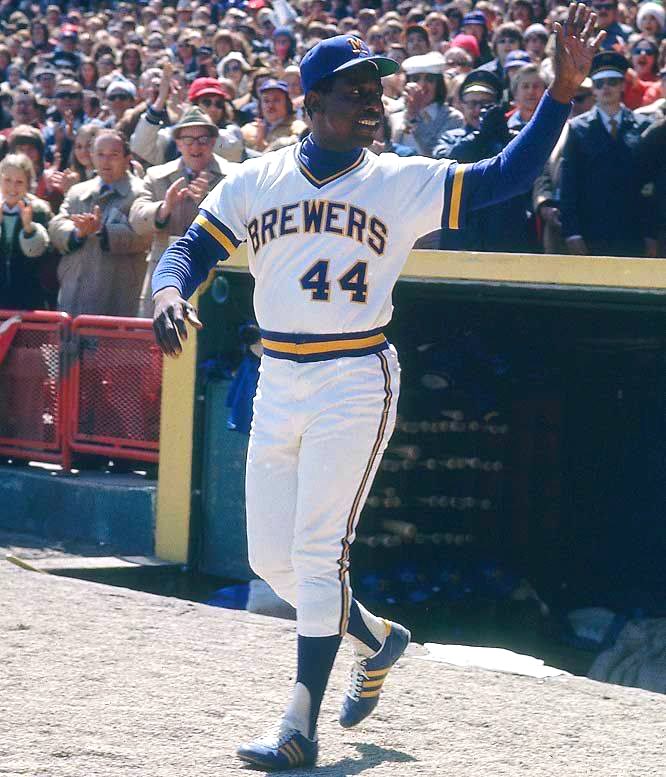
October 3, 1976: Hank Aaron plays his last game. In his last at-bat, playing for the Milwaukee Brewers at Milwaukee County Stadium, where he had previously played for the Milwaukee Braves, he singles off Dave Roberts of the Detroit Tigers -- the same pitcher who, for the Houston Astros, had given up his 712th and 713th career home runs. But the Tigers win the game, 5-2.

Hank retires with 3,771 hits and 2,174 runs scored, both 2nd at the time only to Ty Cobb; a .305 batting average, a 155 OPS+; and with these all-time records: 755 home runs, 2,297 RBIs, 6,856 total bases, and 1,477 extra-base hits (624 doubles, 98 triples and 755 homers). Only the home run record has been broken, and that, dubiously.

The Brewers retire his Number 44 on this day, even though he only played 2 seasons for them. It's more of a recognition for his contribution to baseball in Milwaukee, which was 14 seasons counting his tenure there with the Braves. The Atlanta version of the Braves will retire Number 44 for him on their next Opening Day.

On the same day, the last day of the regular season, the Kansas City Royals' George Brett and Hal McRae, and the Minnesota Twins' Rod Carew, 3 players, are separated by .001 for the AL batting title -- and their teams are playing each other at Royals Stadium in Kansas City. (It was renamed Kauffman Stadium in 1993.)

Brett, who goes 3-for-4, edges his Royals teammate for the crown with the deciding hit, an inside-the-park home run, a line drive that outfielder Steve Brye misplayed, leading McRae to believe the lack of effort was intentional and racist. (Carew's thoughts on this are unrecorded.) The final totals: Brett .333, McRae .332, Carew .331. Or, to take the decimal point one step further: Brett .3333, MeRae .3321, Carew .3306.

In case you're wondering about on-base percentage: McRae .407 (to lead the AL), Carew .395, Brett .377. So Brett had the lowest of the 3 in that category.

Both Carew and Brett would win more batting titles, and both would flirt with a .400 batting average: Carew finished at .388 in 1977, while Brett finished at .390 in 1980.

Also on this day, only 9,155 fans come out to the Oakland Coliseum to witness the end of an era. The California Angels beat the Oakland Athletics, 1-0. Nolan Ryan and Mike Torrez each go the distance.

Having already lost ace pitcher Jim "Catfish" Hunter to a legal wrinkle, and having traded away his best player, right fielder Reggie Jackson, A's owner Charlie Finley goes on to make absolutely no effort to re-sign reliever Rollie Fingers, 3rd baseman and team captain Sal Bando, left fielder Joe Rudi, 1st baseman Gene Tenace, shortstop Bert Campaneris, or even the recently acquired right fielder Don Baylor. He also looks to trade pitcher Vida Blue, this time without the interference of Commissioner Bowie Kuhn.

This was also the last game in Oakland uniforms for future Hall-of-Famers Billy Williams, the great former Chicago Cub left fielder, who retires; and Willie McCovey, who heads back across the Bay and re-signs with the San Francisco Giants.

Over the next 3 seasons, the A's would lose 299 games, and play before a total of 1,329,361 home fans -- an average of 5,471 fans per game. Their attendance had never been good, and the Coliseum, even when new and considered suitable, had already been nicknamed the Oakland Mausoleum. Finley's cheapness and stubbornness had blinded him to what needed to be done, and one of the best teams in baseball history became a joke franchise almost overnight.

*

October 3, 1976 was a Sunday. These other Major League Baseball games were played that day:

* The New York Mets lost to the Philadelphia Phillies, 2-1 at Veterans Stadium in Philadelphia. Steve Carlton outpitched Craig Swan. Mike Schmidt went 0-for-2 with 2 walks.

* The Boston Red Sox beat the Baltimore Orioles, 3-2 at Fenway Park in Boston. Rick Burleson singled home the winning run in the bottom of the 15th inning. Carl Yastrzemski did not play. Brooks Robinson went 2-for-6.

* The Pittsburgh Pirates swept a doubleheader from the St. Louis Cardinals at Three Rivers Stadium, winning both games by a 1-0 score. Jim Rooker pitched a 7-hit shutout in the opener, while Jerry Reuss pitched a 5-hit shutout in the nightcap. Neither the Pirates' Willie Stargell nor the Cardinals' Lou Brock got into either game.

* The Cincinnati Reds beat the Atlanta Braves, 11-1 at Riverfront Stadium in Cincinnati. Pete Rose went 2-for-3 with 2 walks and an RBI. Johnny Bench went 0-for-2 with 2 walks.

* The Chicago Cubs beat the Montreal Expos, 8-2 at Wrigley Field in Chicago.

* The Texas Rangers beat the Chicago White Sox, 3-0 at Arlington Stadium in the Dallas suburb of Arlington, Texas. Len Barker pitched a 3-hit shutout.

* The San Diego Padres beat the Los Angeles Dodgers, 3-2 at Dodger Stadium in Los Angeles. Dave Winfield did not play.

* The New York Yankees, the Cleveland Indians, the Houston Astros and the San Francisco Giants finished their seasons the day before.

And these games were played in the NFL:

* The New York Giants lost to the St. Louis Cardinals, 27-21 at Busch Memorial Stadium in St. Louis.

* The New York Jets lost to the San Francisco 49ers, 17-6 at Candlestick Park in San Francisco.

* The New England Patriots beat the Oakland Raiders, 48-17 at Schaefer Stadium (later Sullivan Stadium and Foxboro Stadium) in the Boston suburb of Foxborough, Massachusetts. But the Raiders would beat the Pats in the Playoffs, en route to winning Super Bowl XI.

* The Baltimore Colts beat the expansion Tampa Bay Buccaneers, 42-17 at Memorial Stadium in Baltimore.

* The Philadelphia Eagles beat the Atlanta Falcons, 14-13 at Atlanta-Fulton County Stadium.

* The Los Angeles Rams beat the Miami Dolphins, 31-28 at the Orange Bowl in Miami.

* The Houston Oilers beat the New Orleans Saints, 31-26 at the Superdome in New Orleans.

* The Buffalo Bills beat the Kansas City Chiefs, 50-17 at Rich Stadium (later Ralph Wilson Stadium) in Orchard Park, New York.

* The Cincinnati Bengals beat their arch-rivals, the Cleveland Browns, 45-24 at Cleveland Municipal Stadium.

* The Chicago Bears beat the Washington Redskins, 33-7 at Soldier Field in Chicago.

* The Green Bay Packers beat the Detroit Lions, 24-14 at Lambeau Field in Green Bay.

* The Denver Broncos beat the San Diego Chargers, 26-0 at Mile High Stadium in Denver.

* The Dallas Cowboys beat the expansion Seattle Seahawks, 28-13 at the Kingdome in Seattle.

* And the next night, on ABC Monday Night Football, the Minnesota Vikings beat the Pittsburgh Steelers, 17-6 at Metropolitan Stadium in the Minneapolis suburb of Bloomington, Minnesota.

Actor Seann William Scott was born on this day.

Friday, September 23, 2022

September 23, 1957: Hank Aaron Walks a Pennant Off

Aaron with his 1957 MVP award

September 23, 1957: Hank Aaron hits the 109th home run of his career. He would later say it was the most important.

In hindsight, it probably was his most important home run, as it gave his team the Pennant. But the qualifier "probably" needs to be used, since he would go on to hit 755 home runs, and the 715th was also very important.

But no one could have foreseen that on this night. All anyone knew then was that Aaron was the defending National League batting champion, and that he had power, too, going into the game with 42 home runs on the season. He was the favorite for the NL's Most Valuable Player award, and did win it. Teammate Warren Spahn was awarded the Cy Young Award.

Managed by Fred Haney, and with an attack that also included Eddie Mathews, Joe Adcock, Del Crandall, Red Schoendienst, Wes Covington, Bill Bruton and Frank Torre, the Braves were in their 5th season in Milwaukee, after having moved from Boston. They had finished 1 game behind the Brooklyn Dodgers the season before. Now, with the Dodgers aging and in transition, it was the Braves' year.

The St. Louis Cardinals began the day 5 games behind the Braves, with 6 games to go, including the next 3 against each other at Milwaukee County Stadium. One more Braves win, or one more Cards loss, and the Braves had the Pennant. Before the Braves moved in, the minor-league version of the Milwaukee Brewers won the American Association Pennant in 1913, 1914, 1936, 1943, 1944, 1945, 1947 and 1951. This would be the city's 1st major league Pennant.

But this game wouldn't be easy. The Braves got a run on an error in the bottom of the 2nd inning. Alvin Dark singled 2 runs home for the Cards in the top of the 6th. Mathews doubled Schoendienst home in the 7th. (Schoendienst had starred for the Cardinals in the 1940s, would manage them to 2 Pennants in the 1960s, and remained in their organization until his death in 2018.)

The game went to extra innings. Lew Burdette pitched 10 innings for the Braves, before Gene Conley pitched the top of the 11th. Billy Muffett took the mound for the Cardinals in the bottom of the 11th. He got Schoendienst to fly to center, but allowed a single to Johnny Logan. (Logan, the Braves' shortstop, was once told that something that appeared in the newspaper was "a typographical error." Without thinking, his hitter's instinct kicked in, and he said, "The hell it was! It was a clean base hit!")

Muffett got Mathews to fly to center. But that brought Aaron up. He hit a drive into the center field bleachers, and the Braves were 4-2 winners. They weren't called "walkoff" home runs at the time, but a full house of 40,926 at County Stadium seemed to run out of the stands and onto the field.

Stan Musial went 3-for-4 in a losing cause for the Cardinals.

The Braves would face the New York Yankees in the World Series. Years later, Aaron said that the Braves weren't intimidated by the Yankees, but that they were intimidated by Yankee Stadium. They must have gotten over it, because they won Game 7 there, 5-0, and became World Champions.

The Green Bay Packers had won 6 NFL Championships by this point. The title of the National Basketball League had been won by the Oshkosh All-Stars in 1941 and 1942, and the Sheboygan Red Skins in 1943. And the University of Wisconsin had had some athletic success. So the State of Wisconsin had won titles before. But this was the 1st major league championship won by a Milwaukee team. They have been few and far between since.

*

September 23, 1957 was a Monday. The film The Three Faces of Eve premiered on this day. I have a separate entry for this event.

There were 3 other games in the major leagues that day:

* The Boston Red Sox beat the Washington Senators, 9-4 at Griffith Stadium in Washington. Frank Malzone hit a home run for the Red Sox. Ted Williams went 1-for-1... with 3 walks. Harmon Killebrew hit a home run as a pinch-hitter.

* The Cleveland Indians beat the Detroit Tigers, 5-4 at Cleveland Municipal Stadium. Dick Brown singled Billy Harrell home with the winning run in the bottom of the 11th inning. Cal McLish -- in full, Calvin Coolidge Julius Caesar Tuskahoma McLish -- went the distance for the win. Hitting home runs for the Indians were Brown, Rocky Colavito, and a rookie named Roger Maris. It is interesting that, on a night when Aaron hit a major home run, Maris -- who, like Aaron, would break a home run record set by Babe Ruth -- also hit a home run. For the Tigers, Al Kaline went 3-for-4 with 2 walks and 2 RBIs.

* And the Kansas City Athletics beat the Chicago White Sox, 6-5 at Kansas City Municipal Stadium.

There was another notable sporting event: Carmen Basilio won a split decision over Sugar Ray Robinson to win the Middleweight Championship of the World at Yankee Stadium. They would have a rematch 6 months later, at Chicago Stadium on March 23, 1958. It was another split decision, awarded to Robinson. 

Wednesday, July 13, 2022

July 13, 1971: The Shelling of Tiger Stadium

Reggie Jackson

July 13, 1971: Major League Baseball holds its All-Star Game at Tiger Stadium in Detroit. It was a ballpark that strongly favored hitters, but nobody expected the onslaught that came that night.

For the 1st time in All-Star Game history, both starting pitchers were black: For the American League, Vida Blue of the Oakland Athletics; for the National League, Dock Ellis of the Pittsburgh Pirates. The year before, Ellis had pitched a no-hitter, which he later claimed to have done while under the influence of the drug LSD. From September 11, 1970 to August 15, 1971, Blue was 24-4 with an ERA of 1.76. That remains one of the best stretches of starting pitching in the post-1968, 10-Inch Mound Era.

Tiger Stadium was a hitter's park, with a 325-foot right field pole, an overhanging upper deck that made it even closer, and close power alleys on both sides. And, on this night, a strong wind was blowing out to right field.
Tiger Stadium set up for the 1971 All-Star Game.
Note the red, white and blue stars in the outfield.
It got the familiar blue and orange seats in the 1977-78 off-season.

In the top of the 2nd inning, with Ellis' Pirate teammate Willie Stargell on 1st base, Johnny Bench of the Cincinnati Reds, the previous season's (and the next season's) NL Most Valuable Player, hit a 2-run home run to the opposite field, to make the score 2-0 in the NL's favor. In the top of the 3rd, Hank Aaron hit one to the opposite field, also wind-aided. Although he would become the game's all-time home run leader, this was his 1st extra-base hit in an All-Star Game, in his 18th season. It was 3-0 NL.

Luis Aparicio, the former Chicago White Sox shortstop now playing with the Boston Red Sox, singled to lead off the bottom of the 3rd. The AL manager, Earl Weaver of the Baltimore Orioles, sent Reggie Jackson up to pinch-hit for Blue, his Oakland teammate. Reggie was already one of the top sluggers in the game, but nobody expected this: He crushed a drive that looked like it might clear the right-field roof. Instead, it hit the transformer of a light tower. It became Reggie's signature moment -- until the 1977 World Series.
The transformer is the box at the lower right of this light tower.

The AL was not done for the inning. Rod Carew of the Minnesota Twins walked. Bobby Murcer of the New York Yankees popped up. Carl Yastrzemski of the Red Sox hit one against the wind, to left field, and it was held up so that the shortstop, Bud Harrelson of the New York Mets, caught it. That brought up Frank Robinson of the Orioles, and he hit a home run with the wind to right field. The AL led, 4-3.

In the bottom of the 6th, against Ferguson Jenkins of the Chicago Cubs, Al Kaline of the host Detroit Tigers singled, and Harmon Killebrew of the Twins, like Jackson one of the few sluggers with enough power to beat the kind of wind this game had, did so, into the upper deck in left field. That made it 6-3.

In the top of the 8th, Mickey Lolich of the Tigers came in to pitch, to the delight of the home crowd. He gave up an opposite-field home run to Roberto Clemente of the Pirates. That made the score 6-4 AL, but the NL got no closer. Although previous pitchers have been retroactively credited with saves in All-Star Game competition, Lolich was the 1st one to be credited with one after the stat's official recognition in 1969.

Lolich ended up winning more games that season than Blue, going 25-14 to Blue's 24-8. But Blue edged Lolich in the voting of the AL's Cy Young Award, and also won the AL's MVP. For many years, my schoolmates, knowing I was a baseball trivia whiz, tried to trip me up with a trick question: Who was the last switch-hitter to win the MVP? In the AL, it was a pitcher, Blue. But they tended to forget that Pete Rose was a switch-hitter, and had won it in the NL in 1973, so he was the answer.

Since then, in the NL, it's been won by switch-hitters Willie McGee in 1985, Terry Pendleton in 1991, Ken Caminiti in 1996, Chipper Jones in 1999, and Jimmy Rollins in 2007. But Vida Blue remains the last switch-hitter to win the Most Valuable Player award in the American League.

In 1978, pitching for the San Francisco Giants, Blue was selected as the National League's starting pitcher. This made him the 1st pitcher to start the All-Star Game for both Leagues.

On May 15, 1984, playing for the team then known as the California Angels, on an NBC Game of the Week, Reggie Jackson, 38 years old, finally hit a home run over the roof of Tiger Stadium. It was the 485th homer of his career.

The 6 Hall-of-Famers who hit home runs in the 1971 All-Star Game would finish as follows: Hank Aaron, 755; Frank Robinson, 586; Harmon Killebrew 573, Reggie Jackson, 563; Johnny Bench, 389; Roberto Clemente, 240.

Clemente's total doesn't sound like much, but he played most of his home games at Forbes Field in Pittsburgh, whose dimensions were similar to those of the pre-renovation original Yankee Stadium: Close in right field, too far everywhere else. In contrast, Aaron and Clemente were the only ones of this group to collect at least 3,000 hits, and Clemente's .317 lifetime batting average was easily higher than any of the others.

Tiger Stadium was the home of the Detroit Tigers from 1912 to 1999, and the NFL's Detroit Lions from 1938 to 1974. It was named Navin Field from 1912 to 1937, and Briggs Stadium from 1938 to 1960. There were over 30 home runs hit over the right field roof, including 4 by the Tigers' Norm Cash, and 2 by the Yankees' Mickey Mantle, as a switch-hitter batting lefthanded.

But only 4 players hit one over the left-field roof: Harmon Killebrew, Frank Howard, Cecil Fielder and Mark McGwire. Mantle certainly had the power to hit one over the left field roof batting righthanded, having done so twice at Comiskey Park in Chicago and once at Shibe Park in Philadelphia, but he never did that at Tiger Stadium.

Tiger Stadium had also hosted the All-Star Game in 1941 and 1951. Its successor, Comerica Park, hosted its 1st All-Star Game in 2005.

*

July 13, 1971 was a Tuesday, as the day of the All-Star Game usually is. There were no other scores on this historic day.

Thursday, May 26, 2022

May 26, 1959: The Harvey Haddix Game

May 26, 1959: Harvey Haddix puts on the greatest pitching performance of all time. And loses.

In 1981, baseball historian John Thorn published Baseball's 10 Greatest Games. He included this game as one of them. He began the chapter on it by referring to Game 3 of the 1951 National League Playoff and Game 5 of the 1956 World Series, saying, "Fate can be cruel, as it was to Ralph Branca; or it can be kind, as it was to Don Larsen. Today, it will be both to Harvey Haddix."

Haddix, a native of Medway, Ohio, outside Dayton, arrived in the major leagues with the St. Louis Cardinals in 1952. Like his teammate, Harry Brecheen, he was a lefthanded pitcher. Brecheen was nicknamed The Cat, so Haddix was nicknamed The Kitten. He wasn't just a protégé: He made the National League All-Star Team in 1953, '54 and '55.

On the night of May 26, 1959, a crowd of 19,194, a good crowd for a Tuesday night in that era, filed into Milwaukee County Stadium, and saw the 33-year-old Haddix take the mound for the Pittsburgh Pirates against the Milwaukee Braves. His fastball and breaking ball were both very sharp: He later said, "I could have put a cup on either corner of the plate, and hit it." Bill Mazeroski, often called the greatest-fielding 2nd baseman of all time, said, "Usually, you have one or two great or spectacular defensive plays in these no-hitters. Not that night: It was the easiest game I ever played in."

The problem was, the Pirates weren't scoring, either. Their starter, Lew Burdette, who won 3 games in the 1957 World Series, was also really on his game. At the end of 9 innings, the Pirates had 9 hits, the Braves none -- but the score was 0-0. Haddix hadn't allowed a single baserunner. He had pitched not just a no-hitter, but a perfect game. Indeed, he had been a baserunner: He had singled off Burdette. And yet, he hadn't won. The game continued.

Pirate 3rd baseman Don Hoak singled in the top of the 10th. He couldn't score. Haddix kept the perfecto going. Shortstop Dick "Ducky" Schofield singled to lead off the top of the 11th. But for the 3rd time in the game, Burdette induced a ground ball that was turned into a double play. Haddix kept his end going, becoming, still, to this day, the only man to go through the 1st 11 innings of a game without allowing a hit, and he still hadn't allowed a baserunner.

Mazeroski singled in the top of the 12th, but was stranded. Haddix still didn't budge in the bottom of the 12th: 36 men up, 36 men down. It had never happened before, and it has never happened since. Schofield singled again in the top of the 13th, to no avail. Haddix took the mound for the bottom of the 13th. It was still 0-0. He still hadn't allowed a baserunner.

Félix Mantilla led off for the Braves. He hit a bouncer to Hoak at 3rd, but Hoak bobbled it, lost his composure, and made a bad throw to 1st base. Mantilla was safe. An error. The perfect game was gone. But the no-hitter still had a chance.

Eddie Mathews, one of the best sluggers in the game, bunted Mantilla over to 2nd. With 1st base open and 1 out, the next batter was Hank Aaron. Pirate manager Danny Murtaugh ordered Haddix to intentionally walk him. It was the 39th batter of the game for Haddix, and his 1st walk. But it did set up an inning-ending double play.

There would be no double play. Joe Adcock was the next man up, and he hit the ball over the right-center field fence, into the bleachers, for a game-winning home run.

Or so everyone thought. With less than 2 outs, Aaron didn't know whether the ball would be caught, so he was stuck between 1st and 2nd base. He later said he thought the ball landed in front of the fence, so he got to 2nd base, and the next thing he knows, Adcock has passed him. National League President Warren Giles ruled that Adcock was out, since only Aaron was entitled to the base, and ruled that the final score was Braves 1, Pirates 0.

It didn't matter to Haddix: He had pitched 12 perfect innings, only to lose the perfect game, the no-hitter, the shutout, and the win. For his valiant effort, he walked away with only a loss.

God, or "the baseball gods," or Fate, or whatever you want to ascribe it to, made it up to Haddix: He became the winning pitcher for the Pirates in Game 7 of the 1960 World Series, the Bill Mazeroski Game. (John Thorn included that game in his book, too.) He finished his career in 1965, with a record of 136-113, an ERA of 3.63, 1,575 strikeouts, 3 Gold Gloves, and a World Series ring.

Haddix later became a pitching coach. In 1991, Major League Baseball officially redefined a "no-hitter" as "a game in which a pitcher or pitchers complete a game of nine innings or more without allowing a hit." This retroactively disqualified Haddix: Despite his having thrown more perfect innings than anyone in a single game, his achievement was taken off the lists of perfect games and no-hitters. He said, "It's okay. I know what I did." So did everybody else. He died in 1994, at the age of 68.

*

May 26, 1959 was a Tuesday. Ed Walsh, who pitched a no-hitter for the Chicago White Sox in 1911, and was on the losing side of Addie Joss' 1908 perfect game despite striking out a then-record 15 batters, died that day. These other baseball games were played:

* The New York Yankees lost to the Boston Red Sox, 12-2 at Yankee Stadium. The Red Sox did this without Ted Williams, who did not play. Tom Brewer outpitched Bob Turley. Mickey Mantle went 2-for-3 with a walk and an RBI. Yogi Berra went 0-for-3.

* The Baltimore Orioles beat the Washington Senators, 6-5 at Memorial Stadium in Baltimore. Brooks Robinson did not play for the Orioles. Harmon Killebrew went 0-for-4 with a walk for the Senators.

* The Cincinnati Reds beat the Philadelphia Phillies, 2-1 at Crosley Field in Cincinnati. Frank Robinson went 1-for-4. The winning pitcher was former Brooklyn Dodger ace Don Newcombe.

* The Cleveland Indians beat the Chicago White Sox, 3-0 at Comiskey Park in Chicago. Don Ferrarese (6 2/3rds innings) and Jim Perry combined for a 4-hit shutout.

* The Detroit Tigers beat the Kansas City Athletics, 9-5 at Kansas City Municipal Stadium. Al Kaline went 3-for-5 with an RBI. Roger Maris was on the A's roster, but did not play in this game. But future managing great Dick Williams hit a home run, and another, Whitey Herzog, went 3-for-4.

* The San Francisco Giants beat their arch-rivals, the Los Angeles Dodgers, 6-4 at Seals Stadium in San Francisco. Sandy Koufax, not yet the superstar that he would become, started for the Dodgers, but ran out of gas in the bottom of the 9th, allowing a game-winning grand slam to Leon Wagner. Willie Mays went 1-for-2 with 2 walks.

* And the Chicago Cubs and the St. Louis Cardinals, arch-rivals, having wrapped up a series the day before, were not scheduled.

Tuesday, May 17, 2022

May 17, 1970: Hank Aaron Is the 1st Player to 3,000 Hits & 500 Homers

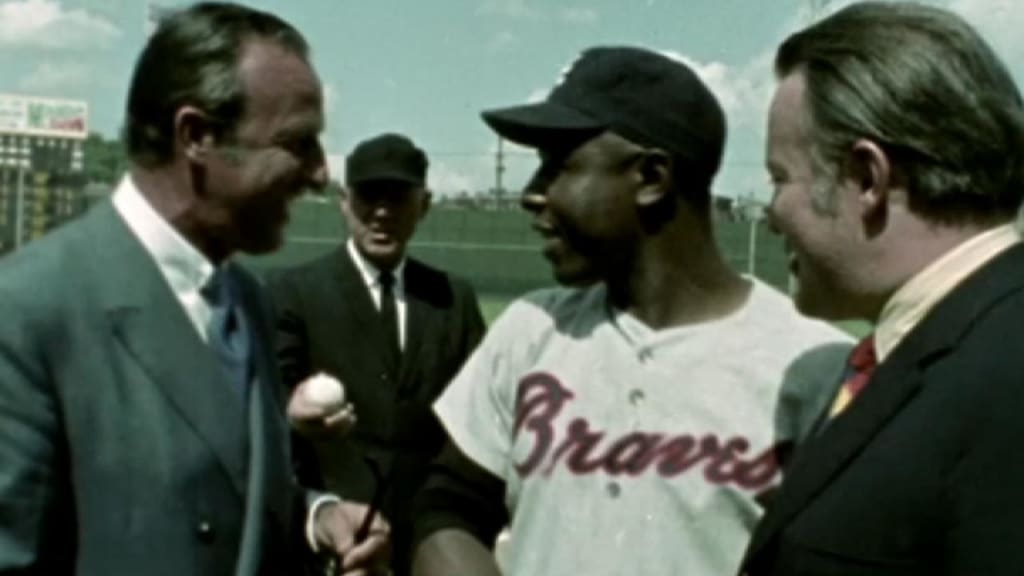
Left to right: Stan Musial, unknown umpire,
Hank Aaron, Braves owner Bill Bartholomay

May 17, 1970: Hank Aaron of the Atlanta Braves singles home a run against Wayne Simpson of the Cincinnati Reds, at Crosley Field in Cincinnati. It is the 3,000th hit of his career, making him the 1st player in Major League Baseball history to have both major career hitting milestones: 3,000 hits and 500 home runs.

Aaron beats Willie Mays to this distinction by 62 days. Later in the game, he hit his 570th home run, and finished the game 3-for-5 with 5 RBIs. But the Reds carried the day, which went 15 innings. It was pitcher Don Gullett, batting for himself because he was the last unused man on the Cincinnati roster, who singled home the winning run, and the Reds won, 7-6, completing a doubleheader sweep.

The Reds had won the 1st game, 5-1, with Jim Merritt outpitching Pat Jarvis. Five days earlier, Jarvis had pitched against the Chicago Cubs, and gave up the 500th career home run of Ernie Banks. The Cubs won that game, 4-3 in 11 innings at Wrigley Field in Chicago.

Over the 2 games, Aaron went 3-for-9 with a home run, 2 walks and 3 RBIs; Pete Rose went 2-for-9 with 2 home runs, 2 walks, and 3 RBIs; and Johnny Bench went 3-for-11 with a home run and and 3 RBIs.

Aaron joining the 500 Home Run Club in 1968, only 34 years old, was the first sign that maybe he would be the player to break Babe Ruth's record of 714 career home runs. Up until then, the player who seemed most likely to do it was Mays, who had surpassed Mickey Mantle as such when he surpassed Mantle on the home run list in 1964.

Among those on hand to congratulate Aaron on his milestone was Stan Musial, who, until then, was the last player to reach 3,000 hits. He finished his career with 475 home runs.

The list of players who have done 3000/500 is more surprising for who is not on it than it is for who is on it. The greatest hitter who ever lived? Most people will say either Ruth or Ted Williams. Ruth hit 714 home runs, a record that lasted until Aaron surpassed him with 755, but he finished with 2,873 hits. I suspect that if someone had told him that, one day, 3,000 hits would be considered a big deal, he would have gone for it.

As for Williams, he closed his career by hitting a home run in his last at-bat, his 521st homer. But, because he missed the equivalent of 5 seasons serving in 2 different wars, his career hit total was 2,654. Barry Bonds, who would use steroids to surpass Aaron's record and finish with 762 home runs, had 2,935 hits. Mantle's many injuries did not prevent him from hitting 536 home runs, but they did limit him to 2,415 hits.

Musial had 3,630 hits, but, as I said, fell short of 500 home runs, at 475. Carl Yastrzemski had 3,419 hits, but 452 home runs. Dave Winfield had 3,110 hits, but 465 home runs. Frank Robinson hit 586 home runs, but fell short of 3,000 hits, with 2,943. Mel Ott hit 511 home runs, but had 2,876 hits.

Here's the players who have done both:

1. May 17, 1970: Hank Aaron. He finished with 3,771 hits, including 755 home runs. In other words, without counting his home runs, he still had over 3,000 hits.

2. July 18, 1970: Willie Mays. He finished with 3,283 hits, including 600 home runs.

3. September 6, 1996: Eddie Murray. He is the only player, so far, to get his 3,000th hit first, and his 500th home run second. He finished with 3,255 hits, including 504 home runs.

4. July 15, 2005: Rafael Palmeiro. He finished with 3,020 hits, including 569 home runs. He would have finished with more, but he failed a steroid test, got benched, got released, and was not signed by anyone else, essentially blackballed from baseball.

5. June 19, 2015: Alex Rodriguez. He finished his career with 3,115 hits, including 696 home runs. But he, too, was exposed as a steroid user.

6. May 14, 2018: Albert Pujols. He finished his career with 3,308 hits, including 703 home runs.

7. April 23, 2002: Miguel Cabrera. As of May 17, 2022, he is still active. (UPDATE: He retired after the 2023 season, with 3,174 hits, including 511 home runs.)

So, out of 22,000 or so men who have played Major League Baseball since it began in 1871, only 7 have both 3,000 hits and 500 home runs -- and only 5 have done so honestly.

*

May 17, 1970 was a Sunday. Basketball player Hubert Davis and New Kids On The Block singer Jordan Knight were born.

These other games were played in Major League Baseball:

* The Montreal Expos beat the Pittsburgh Pirates, 8-7 at Forbes Field in Pittsburgh. Roberto Clemente went 2-for-5 with 2 RBIs. Willie Stargell appeared as a pinch-hitter, and drove in a run with a bases-loaded walk.

* The Kansas City Royals swept a doubleheader from the Chicago White Sox, 3-2 and 8-4 at Comiskey Park. Both games went to extra innings. In the opener, Joe Keough doubled Amos Otis home in the top of the 10th. In the nightcap, the Royals scored 4 runs in the top of the 11th, including a home run by Pat Kelly.

* The Minnesota Twins beat the Milwaukee Brewers, 6-1 at Milwaukee County Stadium. Harmon Killebrew went 0-for-3 with a walk. Rod Carew went 2-for-5 with an RBI.

* The St. Louis Cardinals beat their arch-rivals, 4-3 at Busch Memorial Stadium in St. Louis. Lou Brock went 0-for-4. Ernie Banks also went 0-for-4, but had an RBI on a groundout.

* The San Diego Padres beat the Houston Astros, 5-3 at San Diego Stadium (later Jack Murphy Stadium and Qualcomm Stadium).

* The Los Angeles Dodgers beat their arch-rivals, the San Francisco Giants, 8-0 at Dodger Stadium in Los Angeles. Claude Osteen pitched a 4-hit shutout. Willie Mays went 1-for-3 with a walk. Willie McCovey went 0-for-2 before getting the rest of the game off.

* A doubleheader was split at the Oakland Coliseum. The California Angels won the 1st game, 7-1. The Oakland Athletics won the 2nd game, 6-5. Greg Garrett walked Bert Campaneris with the bases loaded, forcing Sal Bando home, in the bottom of the 10th inning. Over the 2 games, Reggie Jackson went 1-for-8 with a walk and an RBI.

* The Baltimore Orioles and the Washington Senators were rained out at Robert F. Kennedy Stadium in Washington. The game was made up on June 29. The Senators won, 5-3. The Senators scored 3 runs, including a home run by Aurelio Rodríguez, off Mike Cuellar in the bottom of the 8th to come from behind, making Jim Shellenback the winning pitcher. Frank Howard also hit a home run. For the O's, Brooks Robinson and Frank Robinson each went 1-for-4.

* The New York Mets and the Philadelphia Phillies were rained out at Connie Mack Stadium in Philadelphia. The game was made up as part of a doubleheader on July 2. The Phils swept, 6-1 and 3-2.

* The Boston Red Sox and the Cleveland Indians were rained out at Fenway Park in Boston. The game was made up as part of a doubleheader on July 3. The Red Sox swept, 2-1 and 5-4. Over the 2 games, Carl Yastrzemski went 4-for-7 with a home run, 2 walks, and an RBI.

* The New York Yankees and the Detroit Tigers were rained out at Yankee Stadium. The game was made up as part of a doubleheader on August 6. The Tigers won the 1st game, 2-1. Mike Kilkenny outpitched Mel Stottlemyre. Al Kaline went 1-for-4, then got the 2nd game off.

The Yankees won the 2nd game, 7-5. Stan Bahnsen and Joe Niekro started, but Ron Klimkowski was the winning pitcher, and John Hiller was the losing pitcher. Roy White and Bobby Murcer hit home runs.

There was 1 other score to report: Game 2 of the American Basketball Association Finals was played at the Indiana State Fair Coliseum (now the Corteva Coliseum) in Indianapolis. The Indiana Pacers beat the Los Angeles Stars, 114-111. The Stars went on to win the title in 6 games.

The NBA Championship had been decided 9 days earlier, with the New York Knicks beating the Los Angeles Lakers in Game 7 of the Finals. The NHL Championship had been decided 7 days earlier, with the Boston Bruins sweeping the St. Louis Blues in the Stanley Cup Finals in 4 straight. And football was out of season.

Sunday, May 1, 2022

May 1, 1975: Hank Aaron Becomes the All-Time RBI Leader

May 1, 1975: Hank Aaron breaks another career record that had been held by Babe Ruth -- and hardly anybody notices.

On April 8, 1974, playing for the Atlanta Braves, Aaron hit the 715th home run of his career, surpassing Ruth as the all-time leader in that category. He finished the season with 733. On November 2, the Braves, who had moved from Milwaukee to Atlanta for the 1966 season, traded him to the team that replaced them in the beermaking city, the Milwaukee Brewers, for Dave May and Roger Alexander. Aaron returned to the city where he began his career, and was warmly welcomed by their fans.

At the age of 41, in the American League for the 1st time, Aaron, formerly a right fielder and 1st baseman, was now usually the Brewers' designated hitter. He came into the game of May 1 with 2,209 career runs batted in, tied with Ruth for the most all-time. But, with only a fraction of the attention that his pursuit of 715 home runs had gotten, it seemed like hardly anyone cared, or even noticed, his pursuit of 2,210 RBIs.

In the bottom of the 3rd inning at Milwaukee County Stadium, Aaron singled home Sixto Lezcano. This gave him 2,210 career RBIs, and also gave the Brewers a 2-2 tie with the Detroit Tigers. In the 5th, he hit a double, scoring Robin Yount, for his 2,211th RBI. That gave the Brewers a 5-3 lead.

Yount, who would one day join Aaron in the Baseball Hall of Fame, went 2-for-6 with 4 RBIs. He and Darrell Porter would both hit home runs. The Brewers won in a blowout, 17-3. The Brewers were slowly improving, but would not contend for the Playoffs until 1978. But, for the moment, they were better than the Tigers: In their 1st season without Al Kaline on their roster since 1952, they had one of their worst seasons ever.

On February 3, 1976, Major League Baseball's Records Committee revised Ruth's career RBI total to 2,204. In actuality, Aaron set the record with 2,205 on April 18, 1975. But nobody knew that at the time.

Aaron retired after the 1976 season, with 3,771 hits, 1,477 extra-base hits, 6,856 total bases, 755 home runs, and 2,297 RBIs. The hit total was then 2nd all-time behind Ty Cobb. The other figures were all-time records. While Barry Bonds used steroids to hit 762 career home runs, Aaron still holds the career records for extra-base hits, total bases and RBIs.

*

May 1, 1975 was a Thursday. These other Major League Baseball games were played that day:

* The New York Yankees beat the Baltimore Orioles, 5-0 at Shea Stadium, where they played while Yankee Stadium was renovated in the 1974 and '75 seasons. Catfish Hunter pitched a 5-hit shutout, beating Jim Palmer. Thurman Munson hit a home run.

* The New York Mets lost to the Chicago Cubs, 5-2 at Wrigley Field in Chicago.

* The Boston Red Sox beat the Cleveland Indians, 7-6 at Fenway Park in Boston. Carl Yastrzemski went 1-for-4. Frank Robinson, who had just become MLB's 1st black manager, was still playing, and went 1-for-3 with a walk and an RBI.

* The Kansas City Royals beat the California Angels, 11-10 at Royals Stadium (now Kauffman Stadium) in Kansas City. The Angels scored a run in the top of the 13th inning, but a Cookie Rojas double and a Buck Martinez single won it for the Royals in the bottom of the 13th. Harmon Killebrew, running out the string with the Royals, went 0-for-7, but had an RBI on a groundout. George Brett went 4-for-7 with an RBI.

* The Texas Rangers beat the Chicago White Sox, 2-1 at Arlington Stadium in the Dallas suburb of Arlington, Texas.

* And the Houston Astros beat the San Diego Padres, 6-3 at San Diego Stadium (later Jack Murphy Stadium and Qualcomm Stadium).

Both the NBA and the ABA were in their Playoffs, but no games were scheduled for that day. Two games were played in the Stanley Cup Playoffs. The Montreal Canadiens beat the Buffalo Sabers, 7-0 at the Montreal Forum. Guy Lafleur had a hat trick. But the Sabres would win the series.

And the Philadelphia Flyers beat the New York Islanders, 5-4 at The Spectrum in Philadelphia. Bobby Clarke won the game, 2:56 into overtime. The Flyers would beat the Sabres, to make it back-to-back Cups.

There were also 2 games in the World Hockey Association Playoffs. The Houston Aeros beat the San Diego Mariners, 5-4 in overtime at the Sam Houston Coliseum in Houston. And the Quebec Nordiques beat the Minnesota Fighting Saints, 4-2 at the St. Paul Civic Center in St. Paul, Minnesota.

And soccer player Marc-Vivien Foé was born in Cameroon. Sadly, he died of a heart attack while playing for his national team in 2003.

Wednesday, April 13, 2022

April 13, 1954: A Big Day of Baseball Debuts

Curt Roberts

April 13, 1954: A big day in baseball. The Baltimore Orioles, formerly the St. Louis Browns, debut on the road, losing to the Detroit Tigers, 3-0 at Briggs Stadium. (It is renamed Tiger Stadium in 1961.) Their 1st batter is 2nd baseman Bobby Young, who grounds out to 1st base. Steve Gromek pitches a 7-hit shutout. The losing pitcher will see better days: His name is Don Larsen.

The Cincinnati Reds beat the Milwaukee Braves, 9-8 at Crosley Field in Cincinnati. Making his major league debut for the Braves is Hank Aaron, batting 5th, playing left field, and wearing Number 5. In the 1st inning, batting against Clarence "Bud" Podbelian, he grounds to short, starting an inning-ending double play. He grounds out to 3rd base in the 3rd. He pops up to 2nd in the 4th. He leads off the top of the 7th, and flies to right. And he flies out to right again in the 8th.
Hank Aaron at the Polo Grounds, early in his career

He ends the day at 0-for-5. Over the next 23 seasons, wearing Number 44 from the 2nd season onward, he would collect 3,771 hits, 755 of them home runs.

The Pittsburgh Pirates beat the Philadelphia Phillies, 4-2 at Forbes Field in Pittsburgh. 2nd baseman Curt Roberts becomes the 1st black player to play for the Pirates, and goes 1-for-3.

The Chicago Cubs beat their arch-rivals, the St. Louis Cardinals, 13-4 at Busch Stadium, formerly Sportsman's Park, in St. Louis. 1st baseman Tom Alston becomes the 1st black player to play for the Cardinals, and goes 0-for-4. The previous September Ernie Banks had become the Cubs' 1st black player.
Tom Alston

Four days later, on April 17, Saturnino "Nino" Escalera, an outfielder from Puerto Rico, became the 1st black player for the Cincinnati Reds, who were known as the Cincinnati Redlegs from 1953 to 1958, because the only thing dumber than caving in to McCarthyism was McCarthyism itself.

In 2014, 60 years later, New York Daily News baseball columnist Bill Madden published 1954: The Year Willie Mays and the First Generation of Black Superstars Changed Major League Baseball Forever. In the introduction, he wrote, "Whether baseball and America realized it, 1954 was the launching pad for a new era, when the dominant players in baseball were to be blacks and Hispanics."

The Pirates' pioneer would not be one of those dominant players: Curt Roberts, who had previously been a teammate of Banks on the Kansas City Monarchs of the Negro Leagues, only lasted 2 years in the majors, last playing on June 8, 1956, as the emergence of Bill Mazeroski made other 2nd basemen surplus to requirements. He starred in the high minors, with teams like the Denver Bears, the Montreal Royals and the Spokane Indians, but a broken leg in 1961 led to the end of his career in 1963. In 1969, he was changing a tire on his car in Oakland, California when he was hit by a drunk driver, and killed. He was only 40 years old, and should still have been playing.

The Cards' barrier-breaker also felt short of stardom: Tom Alston played 4 full seasons for them, but fell victim to neurasthenia, a neurotic disorder, and never played again after the 1957 season. He spent the rest of his life in hospitals, dying in 1993, at 67.

And Escalera only played 73 games in the majors, all for the '54 Redlegs. He does have the distinction of being the last lefthanded thrower to play shortstop in the National League. He played in the high minors until 1962, then scouted Puerto Rico for the New York Mets and the San Francisco Giants. Among the players he discovered were Jerry Morales, Ed Figueroa and José Oquendo. He lived until 2021, at 91.

All 3 franchises would find more suitable representatives. After being openly hostile to the integration of the sport in 1947, the Cardinals began to develop black players like Bob Gibson, and acquire Curt Flood, Bill White and Lou Brock; while developing Hispanic players like Julián Javier and Mike Cuellar, eventually acquiring Orlando Cepeda. That team would win 3 Pennants in the 1960s.

In 1955, the Pirates obtained Roberto Clemente, and he was a key figure in their team that won the 1960 World Series. In 1971, with Clemente and Mazeroski still there, and Willie Stargell building a career that would allow him to join them in the Baseball Hall of Fame, they fielded the 1st starting lineup in MLB history to be entirely made up of players who were black, Hispanic, or both; and went on to win another World Series.

In 1956, the Reds brought Frank Robinson up, and followed him with other black and/or Hispanic players like Vada Pinson, winning the Pennant in 1961.

*

April 13, 1954 was a Tuesday. These other games were played in Major League Baseball that day:

* The New York Yankees lost to the Washington Senators, 5-3 at Griffith Stadium in Washington. President Dwight D. Eisenhower threw out the ceremonial first ball. Uncharacteristically, Whitey Ford didn't get out of the 4th inning. The Yankees used 5 pitchers, the last of them Allie Reynolds. Mickey Mantle and Yogi Berra each went 0-for-5. 

Cliché Alert: Walks can kill you, especially the leadoff variety. In the bottom of the 10th inning, Reynolds walked Eddie Yost -- known as the Walking Man, with 8 seasons of 100 or more walks, leading the American League 6 times, so his lifetime batting average was .254 but his on-base percentage was .394 -- and gave up a game-winning home run to Mickey Vernon, to make a winning pitcher out of Chuck Stobbs.

* The National League's New York arch-rivals played each other at the Polo Grounds. The New York Giants beat the Brooklyn Dodgers, 4-3. Sal Maglie outpitched Carl Erskine. Mays, Hank Thompson (who became the Giants' 1st black player in 1949), and Alvin Dark each hit home runs. Roy Campanella hit 2 for the Dodgers, while Jackie Robinson went 1-for-4, and Duke Snider went 2-for-5. From 1951 to 1956, either the Giants or the Dodgers won the Pennant every year.

* The Philadelphia Athletics beat the Boston Red Sox, 6-4 at Connie Mack Stadium in Philadelphia. Bobby Shantz outpitched Mel Parnell. Gus Zernial hit a home run, and A's 2nd baseman Forrest "Spook" Jacobs went 4-for-5. Ted Williams did not play, but in his place in left field, Billy Goodman went 4-for-5. Sammy White and Jackie Jensen hit home runs for Boston. No one knew it at the time, but this would be the last season in Philadelphia for the A's.

* And the Cleveland Indians beat the Chicago White Sox, 8-2 at Comiskey Park in Chicago. Early Wynn, later to be the ace for the White Sox' 1959 American League Pennant winners, outpitched Billy Pierce. Wally Westlake and George Strickland hit home runs. The Indians went on to break the Yankees' streak of 5 straight Pennants, and win 111 games, to break the Yankees' AL record of 110 wins in 1927. But the Giants swept them in the World Series.

Football was out of season. The NBA season, and an era, ended the night before, as the Minneapolis Lakers beat the Syracuse Nationals, 87-80 at the Minneapolis Auditorium, to win the Finals in 7 games. George Mikan retired, and the NBA instituted the 24-second shot clock for the next season.

And Game 6 of the Stanley Cup Finals was played. The Montreal Canadiens beat the Detroit Red Wings, 4-1 at the Montreal Forum, to send the Finals to a Game 7. Floyd Curry scored 2 goals, while Bernie "Boom-Boom" Geoffrion and Maurice "the Rocket" Richard each added 1. But the Wings would win Game 7 in Detroit, 3 days later, on an overtime goal by Tony Leswick.

Friday, April 8, 2022

April 8, 1974: Hank Aaron Hits His 715th Home Run

April 8, 1974: A testament to longevity, perseverance, strength of body and strength of character is finalized, as Hank Aaron becomes Major League Baseball's all-time home run leader.

Henry Louis Aaron was born on February 5, 1934 in Mobile, Alabama. Like Mickey Mantle, he had to play local semipro baseball because his high school did not have a baseball team. His timing was right: He was 13 years old when Jackie Robinson reintegrated what we would now call Major League Baseball, with the Brooklyn Dodgers. When he was 15, he got a tryout with the Dodgers, but did not get a pro contract. He remained with the Mobile Black Bears, earning $3.00 per game.

Also like Mantle, he began his professional career as a shortstop, but his fielding was such that he was switched to the outfield. In between, he was also tried at 2nd base. In 1952, he was signed by the Indianapolis Clowns of the Negro American League. He was soon noticed by the New York Giants, who already had former Negro League stars Willie Mays and Monte Irvin; and the Boston Braves, who had integrated with 1948 National League Rookie of the Year Sam Jethroe.

"I had the Giants' contract in my hand," Aaron would later say, "but the Braves offered $50 a month more. That's the only thing that kept Willie Mays and me from being teammates: Fifty dollars." $50 in 1952, with inflation, is about $552 in 2022 money. On such hinge moments does the history of a sport sometimes hang in the balance. On June 12, 1952, the Braves paid the Clowns $10,000 for his contract. 

For the 1953 season, the Braves moved to Milwaukee. He made their major league roster in 1954. He made his major league debut on April 13, at Crosley Field in Cincinnati. Wearing Number 5, batting 5th, and playing left field, he went 0-for-5. Eddie Mathews hit 2 home runs, but the Cincinnati Reds beat the Braves, 9-8. On April 23, at Busch Stadium (formerly Sportsman's Park) in St. Louis, he hit his 1st career home run, off former Yankee Vic Raschi, by then with the St. Louis Cardinals.

For the 1955 season, he switched to Number 44, and was moved to right field. Don Davidson, the Braves' public relations director, began listing him as "Hank" in official releases. From then on, "Henry" and "Hank" would be used interchangeably. He even had competing nicknames: "Bad Henry" (being bad for pitchers to face) and "Hammerin' Hank" (a nickname previously given to Detroit Tigers Hall-of-Famer Hank Greenberg).

In 1956, he won his 1st batting title with a .328 average, and the Braves finished just 1 game behind the Brooklyn Dodgers for the Pennant. In 1957, the Braves won their 1st Pennant since 1914. They clinched on September 23, with Aaron hitting a game-winning home run in the bottom of the 11th, off Billy Muffett of the Cardinals. Aaron was also named the NL's Most Valuable Player. It would be his only MVP award.

They faced the Yankees in the World Series. Hank later said that Yankee Stadium intimidated them, but that the Yankees did not. The Braves won the Series in 7 games, clinching at Yankee Stadium. They won the Pennant again in 1958, but lost the Series to the Yankees.

In 1959, Hank won another batting title, but the Braves finished in a tie for the Pennant with the Dodgers, who had moved to Los Angeles, and the Dodgers won the subsequent Playoff. As it turned out, that would be the closest Hank would get to another World Series.

The Gold Glove Award for fielding excellence was first given in 1958, and Hank won it for National League right fielders in each of its 1st 3 seasons. He would never win another, through no fault of his own, as Frank Robinson and Roberto Clemente would dominate that award.

In the Winter of 1960, Hank appeared on the TV show Home Run Derby. He was the show's most successful player, winning 6 games. With the show's prizes, including bonuses for consecutive homers, he won $13,500. He had been paid $35,000 the season before.

By this point, he was already regarded as one of the best all-around players in the game, along with Mantle and Mays. Most observers, including Home Run Derby host Mark Scott, took note of how he was then a bit skinny, but had "quick wrists." At that point, if you had told longtime baseball people that he would end up with over 3,000 hits, they probably would have believed it. If you had told them he would hit 500 home runs, they might have believed that.

But if you had told them that Hank Aaron would be the man to break Babe Ruth's career record of 714 home runs, that would have never occurred to them. Most people thought that, if it ever happened, it would be either Mantle or Mays who did it.

The Braves remained in contention in the early 1960s, but didn't win another Pennant. The novelty of Milwaukee being in the major leagues began to wear off. And the arrival of the Minnesota Twins in 1961 took the States of Minnesota, North Dakota and South Dakota, and even westernmost Wisconsin, out of what would now be called the Braves' "market." Attendance dropped, and team owner Bill Bartholomay moved them to Atlanta for the 1966 season.

Hank led the NL in homers and RBIs again in 1966. He led it in homers, slugging, runs and total bases in 1967. Moving from Milwaukee County Stadium to Atlanta Stadium helped his hitting: Atlanta had the highest elevation of any major league city until Denver got the Colorado Rockies in 1993, and the ball flew out of the stadium. It became known as "The Launching Pad."

On July 14, 1968, at Atlanta Stadium, against Mike McCormick of the San Francisco Giants, Hank hit the 500th home run of his career. He was only the 8th player to reach that milestone, following Babe Ruth, Jimmie Foxx, Mel Ott, Ted Williams, Mays, Mantle, and Mathews.

He was only 34 years old, showed no sign of slowing down, and was playing in a great hitter's park. Mantle was succumbing to his injuries, and would retire just before the next season, with 536 home runs. Mays had surpassed Mantle, and had also surpassed Ott (511) to become the NL's all-time home run leader. He had surpassed Williams (521) and Foxx (534). With Mantle having fallen away, the consensus was that, if any player would surpass Ruth's all-time record of 714, it was going to be Mays. Suddenly, baseball fans had to reckon with the possibility that it could be Aaron. He ended the season with 510.

In 1969, the Divisional Play Era began. The Braves and the Reds were put into the NL's Western Division, and the Cubs and the Cardinals into the Eastern Division, despite Atlanta and Cincinnati being further east than Chicago and St. Louis. The Braves won the Division, as Hank matched his uniform number with 44 home runs in a season for the 4th time, including his 537th, to pass Mantle; and again led the NL in total bases. But the Braves were swept by the New York Mets in the 1st-ever NL Championship Series. It would be Hank's last postseason appearance. He now had 554 home runs.

On May 17, 1970, at Crosley Field in Cincinnati, off Wayne Simpson, he singled home Félix Millán. It was his 3,000th career hit. It made him the 1st player to reach both 3,000 hits and 500 home runs, beating Mays to the dual distinction by 2 months. Also in that game, he hit a home run, and singled and scored the winning run in the 10th inning. He finished the season with 592 home runs.

In 1971, Hank tied Mathews' franchise record with 47 home runs, including the 600th of his career, on April 27, off Gaylord Perry of the Giants at Atlanta Stadium. He finished the season with 641. It wasn't enough to lead the NL, as Willie Stargell of the Pittsburgh Pirates hit 48. But it was a career high: For all the homers he hit, he never hit 50 in a season. And he only shared the team record, with Mathews, until Andruw Jones hit 51 in 2005.

In 1972, Hank surpassed Stan Musial's career record of 6,134 total bases, joined Ruth as the only players with 2,000 career RBIs, and, on June 11, hit the 649th home run of his career, surpassing Mays for 2nd all-time. Mays would retire the next season, with 660.

When the 1972 season ended, Henry, or Hank (he answered to both), had 673. He would turn 39 in the off-season, but, except for his ankle injury as a rookie, he had never been seriously hurt. It was no longer a question of, "Can he do it?" Only of, "When?" and "Will anything short of a career-ending injury stop him?"

In 1973, it looked like no pitcher could stop him. He just kept slugging away. As America dealt with the fallout from the end of its role in the Vietnam War, and the drip-drip-drip of revelations of the Watergate scandal then engulfing President Richard Nixon, the chase for the record was a welcome distraction for baseball fans. On July 21, at Atlanta Stadium, against Ken Brett of the Phillies (whose brother George would soon make his major league debut for the Kansas City Royals), Hank tallied Number 700.

The attention mounted. Soon, he was getting more mail than anybody in America, except Nixon himself. But, as with Nixon, some of it was hate mail. And some of it was terribly racist in nature. I won't quote any of it here. But at a time when civil rights legislation was an established fact of life, black people were leading the way in popular music, and black directors were making some of the most popular movies (including "blaxploitation films" like Shaft, Superfly, Blacula, Foxy Brown, Cleopatra Jones and Uptown Saturday Night), some people were furious that a black man was in position to break Ruth's record.

Even some people who didn't seem to be racist didn't want the record broken, saying that Hank getting to 715 would make people "forget" Ruth. "I don't want them to forget Babe Ruth," Hank said. "I just want them to remember me."

It didn't help that Ruth was dead. He would have been 66 years old when Roger Maris of the Yankees broke the single-season record of 60 with his "61 in '61." He had a very unhealthy lifestyle, but had he taken care of himself, it wouldn't have been impossible for him to still be alive at age 78 in 1973, and offer his support. His widow, Claire Ruth, didn't want either 60 or 714 to fall. But it's easy to imagine a still-living Bambino saying, on either occasion, "This is good for baseball. And anything that's good for baseball is good for me."

And with Jackie Robinson having died the preceding October, Maris, who got 100 men's shares of hate mail and phone calls, was the one man who had any idea of what Hank was going through. Now retired and running a beer distributorship in Gainesville, Florida, he made the 330-mile trip to Atlanta to meet Hank on July 16.
This photo is rare not just because it shows the two "home run kings" together,
but because it shows Roger Maris without his famous crew cut.

One thing Maris did not have to deal with in 1961 was racism. But he was mocked as "a .270 hitter." Aaron finished the 1973 season with a .301 average. Plagued by injuries, Maris retired in 1968, only 34 years old, with 275 home runs. Aaron was still going strong, in spite of the stress.

Hank realized he had another advantage. If Roger had fallen short, he would have had to start all over again the next year. If Hank fell short in 1973, he wouldn't go back down to zero: He would still be able to break the record the next year. There was no pressure coming from the calendar. (It was coming from the haters.)

On September 29, the next-to-last day of the season, playing at home to the Houston Astros, Hank hit Number 713 off Jerry Reuss. The Braves won, 7-0. On September 30, Hank had an RBI single in the 1st. He singled again in the 4th. He singled again in the 6th. Three hits, a successful game by almost anybody's standard. But now, it was almost impossible to break the record on this day. And he flew out in the 8th. The Astros won, 5-3.

The season was over, and Hank Aaron had 713 career home runs. And so began a long wait. And the threats kept coming in. There was even a mailed threat to kidnap his daughter at college. Hank hired a personal bodyguard, an Atlanta policeman named Calvin Wardlaw. He even stayed in a separate hotel from his teammates -- not because he wasn't allowed in the same hotel with his white teammates, as had been the case 20 years ago, but for his teammates' protection from anyone who might come after Hank.

On April 4, 1974, the Braves opened the new season against the Reds at Riverfront Stadium. In the top of the 1st inning, Hank drilled a pitch from Jack Billingham over the fence in left-center field. It was Number 714. When he got to 3rd base, he got a handshake from Pete Rose, who would have a similar moment on that field in 1985, when he officially surpassed Ty Cobb for most career hits. When Hank got to home plate, he received a handshake from Reds catcher Johnny Bench.

April 8, 1974. Opening Night in Atlanta. The attendance was announced as 53,774, and it remains a home record for the Braves franchise, in any city. The game was broadcast live on NBC, just in case. The Braves were playing the Los Angeles Dodgers, who were wearing black armbands in memory of Bobbie McMullen, wife of Dodger 3rd baseman Ken McMullen. She had died of cancer 2 days earlier.

Commissioner Bowie Kuhn was not in attendance. Nor was Nixon, who was getting deeper and deeper into Watergate. But the Governor of Georgia, Jimmy Carter, was there. So was the Mayor of Atlanta, the city's 1st black man so elected, Maynard Jackson. So was Pearl Bailey, who sang the National Anthem, as she had for the Mets' World Series clincher in 1969. So was Sammy Davis Jr.: The great song-and-dance man said he would pay $25,000 -- about $119,000 in today's money -- for the record-breaking home run ball.

Al Downing was the starting pitcher for the Dodgers. The lefthander from Trenton, New Jersey had been the 1st black pitcher for the Yankees, in 1961. In 1964, he had led the American League in strikeouts, the 1st black pitcher to have done that. He had worn Number 24 for the Yankees, the same number that Mays had made famous with the Giants. Now, with the Dodgers, he was wearing 44, the same number as Aaron. Their manager, Walter Alston, had 24, and it would be retired for him.

Hank led off the bottom of the 2nd, and drew a walk. Dusty Baker doubled him home, to give the Braves a 1-0 lead. The Dodgers took a 3-1 lead in the top of the 3rd, and still held it in the bottom of the 4th. Darrell Evans reached 1st base on an error. That brought Hank to the plate.

Downing threw a curveball, and it went into the dirt for ball 1. At 9:07 PM Eastern Daylight Time, he threw a fastball.
Milo Hamilton had the call for WGST, 920 on the AM dial (now WGKA):

Henry Aaron, in the second inning, walked and scored. He's sittin' on 714. Here's the pitch by Downing. Swinging. There's a drive into left-center field! That ball is gonna be... outta here! It's gone! It's 715! There's a new home run champion of all time, and it's Henry Aaron! The fireworks are going! Henry Aaron is coming around third! His teammates are at home plate! And listen to this crowd! This sellout crowd is cheering Henry Aaron, the home run king of all time!"

Because of Hamilton's call, Aaron would spend the rest of his life being called "the Home Run King," much more often than "the home run leader."

The Dodgers' telecast, on KTTV-Channel 11, had Vin Scully with the call. Having broadcast for the team since 1950, when they were still in Brooklyn, and still had black MLB pioneers like Jackie Robinson, Roy Campanella and Don Newcombe, he knew what the moment meant:

One ball and no strikes, Aaron waiting, the outfield deep to straightaway. Fastball, there's a high drive to deep left-center field! Buckner goes back, to the fence, it is gone!

Scully then paused, as Aaron got around the bases and reached home plate, then resumed:

What a marvelous moment for baseball. What a marvelous moment for Atlanta and the State of Georgia. What a marvelous moment for the country and the world: A black man is getting a standing ovation, in the Deep South, for breaking a record of an all-time baseball idol.

It was a marvelous moment, and it was embraced by 99.99 percent of baseball fans. Writing about the event 30 years later, Tom Stanton would title his book about the record chase Hank Aaron and the Home Run That Changed America.

Bill Buckner was the Dodgers' left fielder that night. He climbed the fence to try to catch the ball, but he had no chance. After his error allowed the winning run to score in the Mets' Game 6 win over the Boston Red Sox in the 1986 World Series, someone suggested that, in concert with "The Curse of the Bambino" on the Red Sox, Ruth was punishing Buckner for not catching the ball. This was stupid: How did this person explain all the other outfielders who failed to catch Aaron's home run balls, and weren't "punished"? Or Downing, and the other pitchers who gave them up?

There was a scary moment. With all of the death threats, including from some men claiming they would be in attendance with rifles to shoot Hank before he could reach home plate (as if the home run wouldn't have counted anyway), bodyguard Wardlaw was looking around with binoculars for men with guns, like a Secret Service agent, and had his own gun ready.

After all, it had been 11 years since the assassinations of President John F. Kennedy and civil rights leader Medgar Evers; 9 years since that of Malcolm X; 8 years since The Beatles had gotten death threats from the Deep South on their last tour; 6 years since the assassinations of Dr. Martin Luther King Jr. and Senator/Presidential candidate Robert F. Kennedy, and the shooting of painter Andy Warhol; 5 years since the murder of actress Sharon Tate and 3 of her friends; 4 years since an attempted assassination of Pope Paul VI; and 2 years since an attempted assassination of Governor George Wallace of Alabama during a Presidential campaign. People already knew that celebrities were not necessarily safe.

(There was also an attempt to assassinate Queen Elizabeth II of Britain in 1970, but this was not revealed until many years later. The year 1975 would see 2 failed attempts to assassinate new President Gerald Ford. Five years after that, former Beatle John Lennon would be shot and killed. Within 4 months of that, President Ronald Reagan would be shot and nearly killed; Pope John Paul II was shot a few weeks later, and nearly died; and, 4 months after that, President Anwar Sadat of Egypt was assassinated.)

Wardlaw knew that Hank was still in danger. And Britt Gaston (on the left in the photo) and Cliff Courtenay, 2 long-haired 17-year-olds from Waycross, Georgia, ran onto the field, and patted Hank on the back. It happened quickly, and Wardlaw had to make a quick decision as to what do to. In 2005, he recalled:

People asked me afterward, "Where were you for the big moment, Calvin?" And I tell them that my instinct was, at that moment, that, even if I could have gotten out there, my man was not in danger. And I tell them something else: What if I had decided to shoot my two-barreled .38 at those two boys, if I thought he was in a life-threatening situation, and had hit Hank Aaron instead, on the night he hit No. 715?
Gaston and Courtenay were arrested for disorderly conduct and trespassing, but nothing worse than that. Gaston's father bailed them out of jail at 3:30 AM, paying $100 for each of them. The next morning, the charges were dropped.

Gaston went on to run a graphics business in South Carolina, was a season-ticket holder for University of Georgia football, and died of cancer in 2012, at age 55. Courtenay is now 64 years old, and an optometrist in Valdosta. Both had become friends with Aaron.

Taking no chances, Estella Aaron wrapped her arms around her son right after he got to home plate, as if to say, "If you want to hurt my son, you'll have to go through me, first." Herbert Sr., and brothers Herbert Jr. and Tommie, were also there.

The ball dropped in front of an ad for BankAmericard, whose name was changed to Visa in 1976. It landed in the Braves' bullpen, where it was caught by reliever Tom House. House left the bullpen, and presented Hank with the ball. It was not sold to Sammy Davis Jr. It now resides in the museum section of the Baseball Hall of Fame in Cooperstown, New York, as does the bat Hank hit it with, and so does the entire uniform that he wore that day.

Governor Carter gave him a Georgia license plate with his initials and the magic number: HLA 715. "Thank God it's over," Hank said. 
Jimmy, Hank and Billye

Downing had been in the Yankee dugout when Maris hit his 61st home run in 1961. I don't know if anybody else was in the ballpark for both moments, but Downing was definitely the only one in uniform for both.

Oh, yes, the game: The Braves scored twice more in that bottom of the 4th inning, and went on to win, 7-4.

Hank finished the season with 20 home runs at age 40, and 733 for his career. That remains a record for home runs for a single team. (Ruth hit 659 for the Yankees.)

In 1970, Bud Selig, a Milwaukee car dealer who had been trying to bring MLB back to his hometown after the Braves left, had bought the bankrupt Seattle Pilots, moved them to Milwaukee County Stadium, and given them the name of every pro baseball team in the city before the Braves: The Milwaukee Brewers. At the time, they were in the American League, which, unlike the National League, had adopted the designated hitter.

On November 2, 1974, recognizing that even he had slowed down -- he had been mainly a 1st baseman from 1971 onward, and was playing left field the night he hit Number 715 -- the Braves traded Hank Aaron back to his 1st major league city. He went to the Brewers, who sent the Braves outfielder Dave May, who had been an All-Star in 1973; and Roger Alexander, a pitcher then in Class AA, who ended up never making the major leagues.

Milwaukee fans welcomed Hank back with open arms. But it soon became clear that he was at the end of the line. In 1975, he batted .234 with just 10 home runs, giving him 745. He was still selected to the All-Star Game, held in Milwaukee. It was his 24th, tying a record held by Musial and Mays.

In 1976, he batted .229. On July 20, batting at County Stadium against Dick Drago of the California Angels, he hit his 755th career home run. Nobody knew it at the time, but, with more than 2 months left in the season, it would be his last.

On October 3, the Brewers closed the season at home against the Tigers. Hank was the DH, and batted in his customary 4th position, despite all evidence that he was done. He singled home Charlie Moore in the bottom of the 6th, and was replaced by pinch-runner Jim Gantner, to a standing ovation.

It was his 3,771st career hit, then 2nd all-time behind only Ty Cobb. In other words, he had over 3,000 hits that weren't home runs. He had 1,477 extra-base hits, still a record: 624 doubles and 98 triples, to go with his 755 home runs. It was his 2,297th run batted in, also still a record. It gave him 6,856 total bases, also still a record.

He also retired with these statistics: A .305 batting average, a .374 on-base percentage, a .555 slugging percentage, and a 155 OPS+. And he retired with another interesting distinction: He was the last former Negro League player who was still playing Major League Baseball.

In 1982, his 1st year of eligibility, he was elected to the Baseball Hall of Fame. In 1999, The Sporting News named its 100 Greatest Baseball Players. Hank was ranked 5th, trailing Ruth, Mays, Cobb and Walter Johnson. In 2022, ESPN named its 100 Greatest Baseball Players. Hank actually rose, ranking 3rd behind Ruth and Mays.

When Turner Field opened for the 1997 season, its address was 755 Hank Aaron Drive. Atlanta-Fulton County Stadium (the name was changed in 1975) was torn down, to make way for parking for Turner Field, but the sign beyond the left field fence to mark where the record-breaking ball fell was restored to its former spot, on a fence.
In 2017, Turner Field was replaced by SunTrust Park, now named Truist Park, whose address is 755 Battery Avenue. Because the City of Atlanta didn't want to give up the Aaron statue outside Turner Field, a new statue of Hank was dedicated at Truist Park's Monument Garden. The Brewers also put up a statue of him at American Family Field, and both teams retired his Number 44.

In 1997, his hometown of Mobile opened the 6,000-seat Hank Aaron Stadium. Honoring him, but also a family of local activists, the address is 755 Bolling Brothers Boulevard. In 2002, President George W. Bush, a former owner of the Texas Rangers, gave him the Presidential Medal of Freedom, the closest thing America has to a knighthood.

After his retirement, Aaron was hired by the Braves' front office. Even more so than as an active player, he fought for more inclusiveness in baseball.

On August 7, 2007, Barry Bonds of the San Francisco Giants stepped to the plate against Mike Bascik of the Washington Nationals, and hit his 756th career home run. Already having the single-season home run record, with 73 in 2001, he now held the career record as well. He would finish the season with 763, and retire.

I did not see Hank hit Number 715. Even though it was only 9:07 PM Eastern Time, my mother made me go to bed. And, at the age of 4, I wouldn't have been aware of it, anyway.

I did not see Barry hit Number 756. It was 11:46 PM Eastern Time, but, at that point in my life, staying up late wasn't an issue. Nor was access: The game was on ESPN. I chose not to watch it, because I knew that Bonds had cheated, using performance-enhancing drugs. Aaron was a better sport about it than I was. Although he didn't go to San Francisco for the game, he taped a message to be played on the video board at what's now named Oracle Park:

I would like to offer my congratulations to Barry Bonds on becoming baseball's career home run leader. It is a great accomplishment which required skill, longevity, and determination. Throughout the past century, the home run has held a special place in baseball, and I have been privileged to hold this record for 33 of those years.

I move over now and offer my best wishes to Barry and his family on this historical achievement. My hope today, as it was on that April evening in 1974, is that the achievement of this record will inspire others to chase their own dreams. 

Bonds was now, and remains, and is likely to remain for a very long time, the all-time home run leader. But, for so many, Aaron was, and is, still the Home Run King. Including myself: Every time I look at a digital clock and see either 7:15 or 7:55, I think of Hank Aaron. Even though I wasn't old enough to have watched it, and have never lived anywhere near either Milwaukee or Atlanta.

Hank Aaron died in Atlanta on January 22, 2021, just short of his 87th birthday.

*

April 8, 1974 was a Monday. Only 2 other games were played in Major League Baseball that day:

* The New York Yankees beat the Cleveland Indians, 5-3 at... Shea Stadium. It was their 3rd game there, as the original Yankee Stadium was undergoing a renovation that would take 2 years. Oscar Gamble hit a home run for the Indians, and would later play for the Yankees. Graig Nettles, a former Indian, hit one for the Yankees. George "Doc" Medich went 8 innings for the win.

One year to the day later, these same 2 teams would play the season's opener, in Cleveland, and Frank Robinson would become the 1st black man to manage in an MLB game -- and also hit a home run off Catfish Hunter, to lead the Indians to victory.

* And the San Francisco Giants beat the Cincinnati Reds, 4-3 at Candlestick Park in San Francisco. Garry Maddox, known for his glove, hit a home run for the Giants, while Merv Rettenmund hit one for the Reds.

The NFL was out of season. No games were scheduled for the NBA that day. But 3 games were played in the American Basketball Association:

* The New York Knicks beat the Virginia Squires, 108-96 at the Nassau Coliseum.

* The Kentucky Colonels beat the Carolina Cougars, 128-119 at the Greensboro Coliseum.

* And the Utah Stars beat the San Diego Sails, 110-99 at the San Diego Sports Arena. (It's now named the Pechanga Arena.)

The NHL was in the off-day between the end of the regular season and the start of the Stanley Cup Playoffs. The World Hockey Association had one Playoff game that day: The Houston Aeros, led by Gordie Howe, then pro hockey's all-time leading goalscorer, beat the Winnipeg Jets, led by Bobby Hull, then 2nd, 5-2 at the Winnipeg Arena.

And Chris Kyle, the U.S. Navy Iraq War veteran who was the subject of the film American Sniper, released a year after his 2013 murder, was born on this day.

December 31, 1999 & January 1, 2000: The Millennium

December 31, 1999:  The Millennium arrives. The people of planet Earth survived. At a terrible cost. But we hadn't destroyed ourselves. ...