Showing posts with label ottawa. Show all posts

Tuesday, November 15, 2022

November 15, 1948: Canada's Longest-Serving Prime Minister Retires

November 15, 1948: William Lyon Mackenzie King retires as Prime Minister of Canada and as Leader of the country's Liberal Party.

He was born on December 17, 1874 in Berlin, Ontario, a town renamed Kitchener due to anti-German sentiment during World War I. His maternal grandfather was William Lyon Mackenzie, the 1st Mayor of Toronto, and the leader of the Upper Canada Rebellion in 1837. Within his family, he was known as Willie, but, while at the University of Toronto, he adopted "W. L. Mackenzie King" as his signature, and began using "Mackenzie" as his preferred name with those outside the family.

Influenced by the settlement house movement, he was elected to Parliament in 1908, and was soon appointed the country's 1st Minister of Labour by Prime Minister Wilfrid Laurier. He lost his seat in the 1911 Conservative Party landslide, and was hired by John D. Rockefeller Jr. to work for the Rockefeller Foundation. He was criticized for working for them instead of serving his country, in any capacity, during World War I, though he was 39 years old when the war began.

But King had been working for his Party behind the scenes, and when Laurier died in 1919, leaving the Party Leadership vacant, he ran for it and won, with the aide of prominent Quebec politician Ernest Lapointe Lapointe was aptly-named, because, for the rest of his life, he would be King's point man on Quebec: King never learned how to speak French, but, through Lapointe, he kept Quebec's Liberals on his side. Now, to keep it, he needed to run for a seat in the House of Commons, and won a seat in 1921. Forming a coalition to outflank the Conservatives, he became Prime Minister.

That year, Julian Byng, 1st Baron Byng of Vimy, Canada's leading hero of World War I, was named Governor-General of Canada by King George V. In 1925, Arthur Meighen, the Prime Minister that King had defeated in 1921, returned to power with a coalition government, as he took the Tories to a lead in the Commons, but not a majority.

King, however, thought he could retake the government by peeling off some members of the coalition. He combined the Liberal and Progressive caucuses to gain a plurality, and hung on to power. But the following year, due to a scandal that didn't involve King himself, the coalition fell apart.

King turned to Lord Byng, and asked him to exercise his power and dissolve Parliament, so that a new election could be called. Byng refused, citing the will of the people that had given Meighen the lead in the most recent election, and the right to form his coalition. On June 29, 1926, Byng asked Meighen to form a government, and he did.

King accused Meighen of acting irresponsibly by accepting Byng's appointment, attracting Progressive Party support to take down the fledgling government. The government lost a motion regarding Meighen's acting Ministers by 1 vote, only 3 days after Meighen's appointment. With no other parliamentary leader to call upon, Byng called a new election for September 14.

King effectively campaigned against Byng, instead of against Meighen, and won the most seats in the House of Commons. It became known as "The King-Byng Affair," and Byng returned to Britain at the end of the year, while Meighen resigned as Conservative Leader. King had not only defeated his predecessor: He had, for all intents and purposes, forced the Governor-General to resign, showing the Crown that Canada was its own nation, with its own government, speaking for its own people. Since 1926, no Governor-General of Canada, and no monarch of Great Britain, has tried to impose his or her will on the Prime Minister. All of which makes it weirder that the Prime Minister would be named "King."

He strengthened the Provincial governments of the Western Provinces: Manitoba, Saskatchewan, Alberta and British Columbia. In collaboration with the Provincial governments, he inaugurated a system of old-age pensions based on need. In February 1930, he appointed Cairine Wilson as the 1st female Senator in Canadian history.

With the Great Depression having started, Mackenzie King was slow to react, and lost the 1930 election to a Conservative Party now led by Richard B. Bennett. But Bennett could not get Canada out of the Depression, and held off calling a new election for as long as he constitutionally could, finally standing for one in 1935. Campaigning under the slogan "King or Chaos," King and the Liberals won it. While there have been other Prime Ministers of Canada who lost the office and regained it, King remains the only one to have held it 3 times.

King not only had an indisputable majority government for the 1st time, he had, like his American counterpart Franklin Delano Roosevelt, the largest majority any party in his country had ever had, and for the same reason: The rejection of the country's conservative party for its handling of the Depression. But King knew he had to respond in 1935, as he had not in 1930. Instead of a "New Deal," which was FDR's term, he promised "a new era, where poverty and adversity, want and misery are the enemies which liberalism will seek to banish from the land."

He and FDR negotiated the Reciprocal Trade Agreement of 1935, aiding both countries. He started youth-work, farm-work, and conservation-work programs, similar to FDR's. His National Housing Act of 1938 led to the federal government building low-rent housing. He established Trans-Canada Air Lines, which became Air Canada in 1965; and nationalized both the Bank of Canada and the nation's railroads, forming the Canadian National Railway.

Canada entered World War II along with Britain in 1939. Despite this, an election was held on time in 1940, and the Liberals slightly increased their majority. Another was held on time in 1945 -- between V-E Day and V-J Day, as it turned out, just as Britain's was -- and the Liberals lost seats, but hung on to enough seats to keep their majority.

King hosted FDR and British Prime Minister Winston Churchill at the Quebec Conference in Quebec City in 1943, though he objected to Churchill seeming to ignore him. The men were the same age, having been born 17 days apart, and had similar back-and-forth electoral histories. But Churchill had served in a combat role in 2 wars, and had that over King. 

It's also worth pointing out that, like FDR, King ordered the internment of citizens of his country of Japanese descent. In some ways, Canada has been ahead of the curve compared to America; but it has had its own moments of bigotry.

He had attended the founding conference of the United Nations at San Francisco in the Spring of 1945, but played only a minor role. He realistically conceded that the major powers would dominate the UN, although he did argue for a "functional principle" that would give such middle powers as Canada an influence based on their contributions to the settlement of disputes.

After World War II, King introduced the Canadian Citizenship Act: Effective January 3, 1947, Canadians were citizens of Canada, not citizens of the United Kingdom. And he began the process of bringing the British Dominion of Newfoundland into Canada, gaining it status as the Province of Newfoundland and Labrador on March 31, 1949.

But King's health was declining, and he announced in May 1948 that he would not be Liberal Leader going in the next election. On August 7, a Party Convention selected Louis St. Laurent, his handpicked successor and his Minister of Justice, as its new Leader. King officially retired on November 15, having served as Prime Minister for 13 consecutive years, and 21 total years, in each case a record.

He did not live long thereafter, dying of pneumonia on July 22, 1950, at the age of 75, at "The Farm," his country estate in Kingsmere, Quebec, outside Ottawa. He bequeathed the estate to the government, which, in 1955, made it the official residence of the Speaker of the House of Commons. King is buried in Mount Pleasant Cemetery in Toronto.

King never married, and is not known to have had any children. Rumors have gone in several places: That he had quiet affairs with prominent women in the capital, some of them married to other politicians; that he satisfied his desires with prostitutes; and that he was gay. None has ever been proven. What was proven, and shocked people, were the publication of his diaries and their content of his interest in the occult, including seances where he tried to contact dead relatives, especially his mother; his dogs, which were known by the public to be a keen interest of his; and even, after 1945, President Roosevelt.

In 1951, the Mackenzie King Bridge opened over the Rideau Canal in the capital city of Ottawa. Since 1975, his portrait has appeared on Canada's $50 bill. In 1997, and again in 2016, Maclean's, Canada's leading newsmagazine, conducted polls that ranked King as the greatest Prime Minister in Canadian history. A 2011 poll ranked him 3rd, behind Wilfrid Laurier and John A. Macdonald, the country's 1st Prime Minister.

*

November 15, 1948 was a Monday. Fashion designer Jimmy Choo, famous for his women's shoes, was born on this day.

Baseball was out of season. Football was in midweek. No games were played in the league that became the NBA, or in the NHL. So there were no scores on this historic day.

Friday, November 4, 2022

November 4, 2015: The Trudeaus: Like Father, Like Son

November 4, 2015: Having led the Liberal Party to victory in Canada's general election, Justin Trudeau is sworn in as Prime Minister in the national capital of Ottawa, Ontario. At 44, he is not quite the youngest in the country's history. But, as the son of Pierre Trudeau, he is the 1st child of a Prime Minster to also reach the post.

Justin Pierre James Trudeau was born on a Christmas Day, December 25, 1971, in Ottawa, during his father's 1st term in the office. He graduated from McGill University, in the family's seat of Montreal, and also got a degree from the University of British Columbia in Vancouver. He taught in Vancouver and then Montreal, before being appointed as chair of the Liberal Party's Task Force on Youth Renewal.

Like his father before him, he ran for the House of Commons from a riding (what Americans would call a district) in Montreal (albeit in one adjoining his father's), and was elected on his 1st try, in 2008. Over the next 3 years, he was appointed his Party's "official critic" for 3 different topics in the House, addressing the House on those topics.

In 2013, 13 years after his father's death, 29 years after he last held the post, and 6 years younger than he first held it, Justin was elected Leader of the Liberal Party. He took it to victory in the October 19, 2015 general election, defeating the Conservative Party led by Stephen Harper. At 44, he was the 2nd-youngest Prime Minister in the country's history. With some irony, the youngest was Joe Clark, who was just short of 40 when, for a few months in 1979 and 1980, he interrupted Pierre Trudeau's tenure (1968-1984).

Because Canada is a huge country in area, but not one in population -- just under 37 million people in its most recent Census, in 2021 -- they are more dependent upon trade than the United States. In office, Justin Trudeau negotiated new trade agreements, with the U.S. and Mexico, and another with various "Pacific Rim" nations like China, Japan and Australia and the South American nation of Peru.

He also established a national ban on assault weapons, a federal carbon tax, and marijuana reform. He was very aggressive in handling the COVID pandemic of 2020, and has joined with President Joe Biden in sending military and economic aid to Ukraine in the face of Russia's invasion. (Despite its much lower population, Canada has more people of Ukrainian descent than America does.)

The Conservative Party -- like its British progenitor, known as the Tories -- has accused him of ethics violations, although nothing has stuck. They made gains in the national elections of 2019 and 2021, each time resulting in Trudeau having to form a coalition to sustain a "minority government." (The next Canadian general election can come no later than October 20, 2025.)

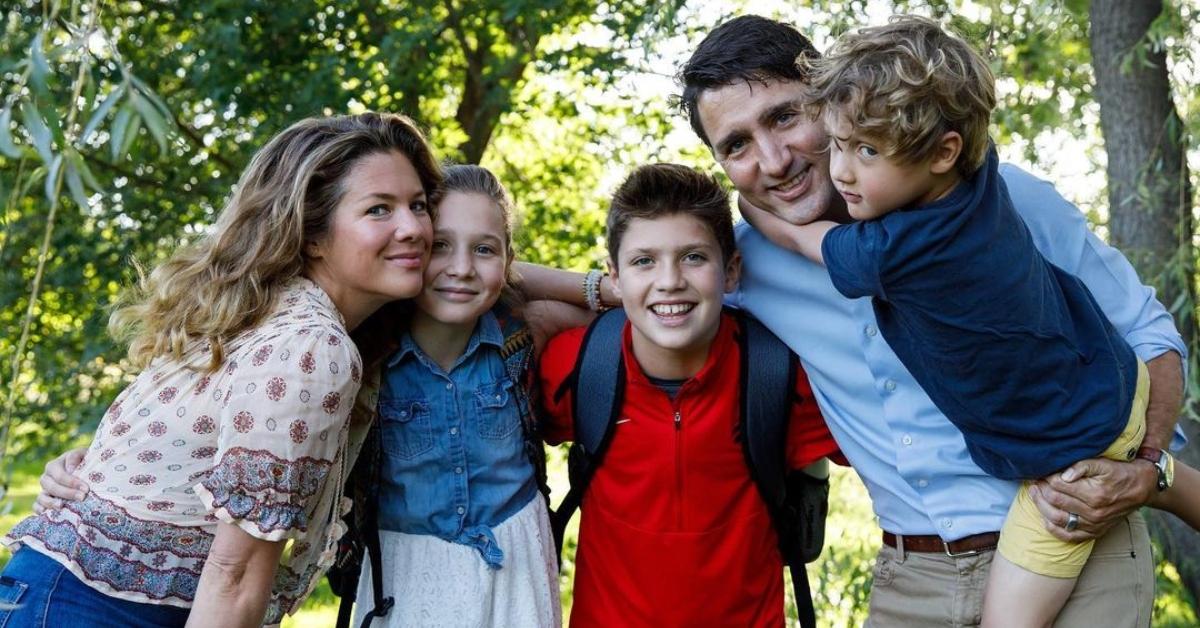
In 2005, Trudeau married Sophie Grégoire. They have 2 sons and a daughter. (UPDATE: In 2023, the Trudeaus separated, but did not yet begin divorce proceedings.)
Pierre Trudeau had been Prime Minister through the Administrations of 5 Presidents of the United States, but only one head of State, Queen Elizabeth II, as Canada is still a member of the British Commonwealth. Justin Trudeau has been Prime Minister through 3 Presidents: Barack Obama, Donald Trump and Joe Biden; but also through 2 monarchs, as he was in office when the Queen died, and her son became King Charles III.

People in North America liked to contrast Trudeau: Young, handsome, charismatic, smart, hands-on with policy, and quite liberal; with Trump: Old, gross, stupid, delegating to get his demands met, and quite bigoted, although also, one must admit, charismatic. Trudeau always comes out looking better.
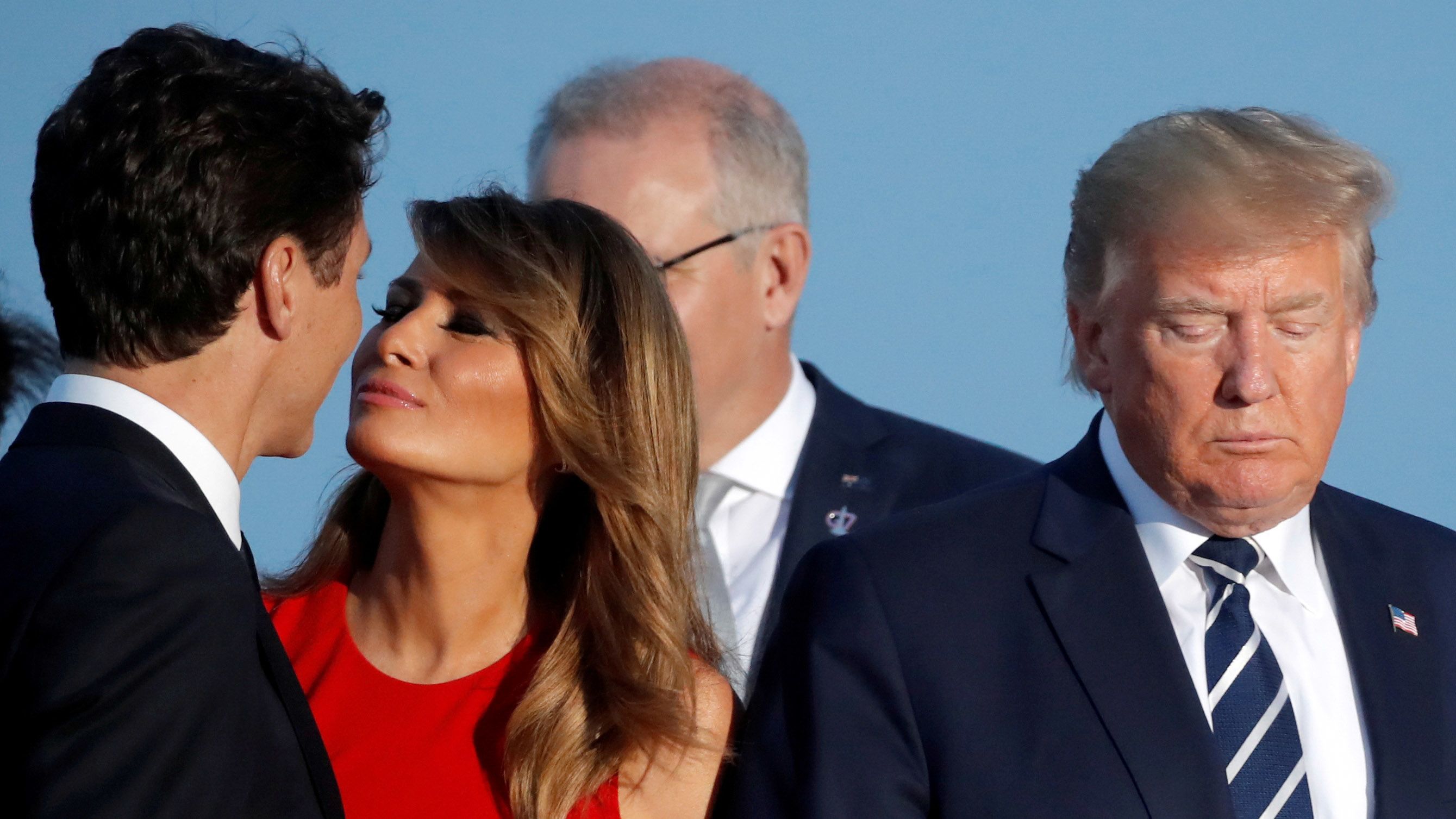
Even Melania Trump thinks so.

But, as with opponents of liberal Presidents in the Democratic Party, Trudeau has had to face stupid charges from conservatives that he is "destroying the country" with his policies. When people in America say they don't like the results of an election, they often say they'll move to Canada. Where do Canadians threaten to go?

In the 2019 election, Trudeau's Liberals lost 20 seats and their majority, but were still the leading Party. Trudeau formed a coalition to stay in power. In 2021, the Liberals gained 5 seats, and Trudeau again had to form a coalition government.

(UPDATE: With the Liberals trailing badly in the polls, Trudeau resigned as Leader of the Liberal Party on January 26, 2025, pending the election of a new Party Leader, though he would keep his seat in the House of Commons. On March 9, Mark Carney was chosen. He took office as Prime Minister on March 14.)

*

November 4, 2015 was a Wednesday. Baseball season had ended 3 days earlier, when the Kansas City Royals beat the New York Mets in the World Series. Football was in midweek. There were 10 games played in the NBA:

* The New York Knicks lost to the Cleveland Cavaliers, 96-86 at the Quicken Loans Arena (now the Rocket Arena) in Cleveland.

* The Brooklyn Nets lost to the Atlanta Hawks, 101-87 at the Philips Arena (now the State Farm Arena) in Atlanta.

* The Washington Wizards beat the San Antonio Spurs, 102-99 at the Verizon Center (now the Capital One Arena) in Washington.

* The Indiana Pacers beat the Boston Celtics, 100-98 at the Bankers Life Fieldhouse (now the Gainbridge Fieldhouse) in Indianapolis.

* The Milwaukee Bucks beat the Philadelphia 76ers, 91-87 at the Bradley Center in Milwaukee.

* The Oklahoma City Thunder beat the Toronto Raptors, 103-98 at the Chesapeake Energy Arena (now the Paycom Center) in Oklahoma City.

* The Houston Rockets beat the Orlando Magic, 119-114 in overtime at the Toyota Center in Houston.

* The Portland Trail Blazers beat the Utah Jazz, 108-92 at the Delta Center (then named the Vivint Smart Home Arena) in Salt Lake City. Damian Lillard led all players on the night with 35 points.

* The Phoenix Suns beat the Sacramento Kings, 118-97 at the Talking Stick Resort Arena (now the Mortgage Matchup Center) in Phoenix.

* And the Golden State Warriors beat the Los Angeles Clippers, 112-108 at the Oakland Coliseum Arena (then named the Oracle Arena).

And there were 4 games in the NHL:

* In an All-Canadian matchup, the Winnipeg Jets beat the Toronto Maple Leafs, 4-2 at the Air Canada Centre (now the Scotiabank Arena) in Toronto.

* The St. Louis Blues beat their arch-rivals, the Chicago Blackhawks, 6-5 at the United Center in Chicago. Vladimir Tarasenko scored the winning goal with 1:06 left in overtime.

* The Anaheim Ducks beat the Florida Panthers, 3-2 in a shootout at the Honda Center in Anaheim.

* And the Pittsburgh Penguins beat the Vancouver Canucks, 3-2 at the Rogers Arena in Vancouver.

Monday, July 11, 2022

July 11, 1896: Canada's 1st Francophone Prime Minister

July 11, 1896: Wilfrid Laurier is sworn in as Prime Minister of Canada. After 29 years of a partial independence, 8 elections, and 6 previous Prime Ministers, this country founded by a coalition of British citizens and Frenchmen has elected a head of government of French ancestry, raised speaking French before he spoke English.

Sir John A. Macdonald, serving 1867 to 1873, and again from 1878 until his death in 1891, was born and raised in Scotland. So was Alexander Mackenzie, who served between Macdonald's defeat and his next victory. Sir John Abbott, who succeeded Macdonald and served for a year and a half, was from the Quebec side of the Ottawa area. Sir John Thompson, who served for 2 years until dying in office in 1894, was from Halifax, Nova Scotia. Mackenzie Bowell, who served for the next year and a half, was from Suffolk in England. And Sir Charles Tupper was also from Nova Scotia.

Tupper only served 3 months, the shortest tenure in the office's history, because his government failed over the Manitoba Schools Question, which was triggered by the government of the Province of Manitoba eliminating funding for Catholic schools. Although the Conservative Party, with Tupper as Leader, got more popular votes than Laurier's Liberal Party, and a larger share of the popular vote, the Liberals gained a net 29 seats in the House of Commons, enough to take control, and make Laurier the Prime Minister -- premier ministre.

Henri Charles Wilfrid Laurier was born on November 20, 1841 in Saint-Lin-Laurentides, Quebec, 30 miles north of Montreal. At age 11, he was sent by his father, a Justice of the Peace and a former Mayor, to a boarding school in New Glasgow, Nova Scotia. "Nova Scotia" is Latin for "New Scotland," so it's not surprising that it has a city named New Glasgow. And it was populated largely by people of Scottish descent. Not only did young Wilfrid learn English there, but he developed an appreciation for the British way of doing things, which would serve him well in his dual-culture country.

He studied law at Montreal's Anglophone McGill University, and married Zoé Lafontaine. To his regret, they had no children. Stepping aside from the practice of law to run a newspaper, he opposed Confederation, Canada's original version of independence from Britain, because he felt it would favor Anglophones and hurt Francophones.

He was first elected to office in 1871, to the Legislative Assembly of Quebec. In 1874, he was elected to the national Parliament. He would serve in the House of Commons for 45 years, which remains a record. On June 2, 1887, he was elected Leader of the Liberal Party, and would hold that post for nearly 32 years, another record. Although he lost the 1891 election to Macdonald, he led his Party to gain 10 seats. Macdonald's death led to disarray in the Conservatives, and Laurier was able to lead the Liberals to victory on June 23, 1896, taking office 18 days later.

He solved the Manitoba Schools Question by allowing Catholic students to have a Catholic education on a school-by-school basis. Despite his controversial handling of the dispute and criticism from some French Canadians who believed that the resolution was insufficient, he was nicknamed "the Great Conciliator" for offering a compromise between French and English Canada.

Two issues, the United Kingdom demanding Canadian military support to fight in the Second Boer War (1899-1902), and the United Kingdom asking Canada to send money for the Royal Navy, divided the country: Canadians of English and Scottish descent supported Britain's requests; whereas those of Irish and French descent did not.

Laurier's government sought a middle ground between the two groups, deciding to send a volunteer force to fight in the Boer War, and passing the 1910 Naval Service Act, which created the Royal Canadian Navy, putting the country's sailors and naval officers under direct control from Ottawa, not London.

In addition, his government dramatically increased immigration, oversaw the dual entry of Alberta and Saskatchewan as Provinces in Confederation in 1905, constructed the Grand Trunk Pacific and National Transcontinental Railways, and took other efforts into establishing Canada as an autonomous country within the British Empire.

He wanted a reciprocity agreement with the United States, and the Conservatives went into the 1911 election saying that it would lead to an American takeover of Canada. The fearmongering worked, as the "Tories" ended the 4-election, 15-year winning streak of the "Grits." Robert Borden became the new Prime Minister, and would be the 1st Conservative one other than Macdonald to win more than 1 national election. Still, Laurier's 15-year unbroken governance remains a record, although, when their separate terms are counted, he served less total time than Macdonald, William Lyon Mackenzie King and Pierre Trudeau.

Britain's entry into World War I in 1914 meant that Canada had to enter as well. The need for more soldiers led to the Conscription Crisis of 1917, in which French-Canadians and Irish-Canadians did not want to be drafted to fight for the British Empire. Laurier, still Leader of the Liberal Party and thus Leader of the Opposition, stood opposed to the draft. Borden and the Conservatives appealed to patriotism, and, while the Liberals dominated in Quebec, they were nearly wiped out in the other Provinces. The war ended less than a year after the election: Over 650,000 Canadians and Newfoundlanders served, more than 66,000 of them died, and more than 172,000 were wounded.

In spite of his resistance to British demands, he did his duty to the Mother Country. In 1897, he attended the Diamond Jubilee of Queen Victoria, and she knighted him. He took part in the 1902 Colonial Conference and the 1907 and 1911 Imperial Conferences, and attended the Coronation of King Edward VII in 1902.

The election and the war took its toll on Sir Wilfrid Laurier, and he died of a stroke on February 17, 1919, in Ottawa, at the age of 77. He was buried in Notre-Dame Cemetery in Ottawa, in a tomb showing a coffin supported by 9 women, 1 for each Province then in Confederation. (Newfoundland and Labrador remained a British Dominion until it became the 10th Province in 1949.) Zoé, known as Lady Laurier, joined him in 1921.

Maclean's, the national newsmagazine of Canada, occasionally polls historians to rank the country's Prime Ministers. In 1997, Laurier was ranked 3rd, behind Mackenzie King and Macdonald. In 2011, he was ranked 1st. (Another poll that year backed up the 1997 rankings: Mackenzie King, then Macdonald, then Laurier.) In 2016, the Maclean's poll put Laurier 2nd behind Mackenzie King.

(Mackenzie King was clearly helped by the facts of not just his longevity, and his dramatic comebacks in 1926 and 1935 after losing the office, but by the fact that he was Prime Minister during World War II. In contrast, Borden doesn't get the same credit for serving during World War I, never getting above 7th.)

In 1973, Waterloo Lutheran University in Waterloo, Ontario, renamed itself Wilfrid Laurier University. Montreal erected a statue of him in Dorchester Square, and named a station on its subway system, the Metro, for him.

Since 1972, his portrait has appeared on Canada's $5 bill. At some point, someone decided that this portrait bore a resemblance to the Star Trek character Spock, played by Leonard Nimoy, and people began defacing the bills, using pen ink to make Laurier look like a Vulcan. The Bank of Canada issued an official objection in 2002, since it led to wear and tear on the bills and reduced their lifespans, and the practice declined. In 2013, a new series of bills was released, with a different, less Nimoy-resembling portrait. When Nimoy died in 2015, this practice of "Spocking" the previous series of bills picked up again. 

Up until the 1970s, the bills usually had the British monarch on them, but now, this is only true for the $20 bill. The $1 and $2 bills have been retired in favor of coins. The $10 had Macdonald from 1971 to 2018, when he was replaced by Viola Desmond, "the Rosa Parks of Canada." Since 1975, the $50 has had Mackenzie King, and the $100 has had Borden.

*

July 11, 1896 was a Saturday. The only professional sports league then operating in North America was baseball's National League, and these games were played:

* The New York Giants lost to the Chicago Colts, 3-2 at West Side Park in Chicago. The Colts, named for the relative youth of their players, would, in 1903, adopt another youthful name: The Chicago Cubs.

* The Brooklyn Bridegrooms beat the Pittsburgh Pirates, 5-1 at Exposition Park in Pittsburgh. The Brooklyn team got the name when several of their players got married in a single off-season. In 1911, they became the Dodgers.

* The Baltimore Orioles beat the Cleveland Spiders, 10-1 at League Park in Cleveland.

* The Cincinnati Reds beat the Washington Senators, 9-5 at League Park in Cincinnati.

* The Louisville Colonels beat the Philadelphia Phillies, 9-1 at Eclipse Park in Louisville.

* And a doubleheader was split at one of the earlier versions of Sportsman's Park in St. Louis. The Boston Beaneaters won the opener, 12-5. The St. Louis Browns won the nightcap, 12-7. This Browns team is not the one that was formed in the American League and became the new Baltimore Orioles in 1954. This one became the Cardinals in 1900. It would take 3 name changes and until 1912 for the Beaneaters to take the name by which the franchise has been known since: The Braves.

The Orioles, the Senators, the Spiders and the Colonels would be dismissed from the NL after the 1899 season.

Tuesday, June 28, 2022

June 28, 1924: The Death of Jack Darragh

June 28, 1924: Jack Darragh dies in Ottawa. He was only 33 years old, and was the best hockey player of the last 5, maybe 10 years.

John Proctor Darragh was born on December 4, 1890 in Ottawa, Ontario, the national capital of Canada. The right wing arrived with the Ottawa Senators at the start of the 1910-11 season, only 20 years old, and he helped them win the Stanley Cup in his 1st season.

The Senators went into rebuilding mode, and the game was led by men like "Phantom" Joe Malone of the Quebec Bulldogs and Édouard "Newsy" Lalonde of the Montreal Canadiens. Eventually, the Senators built a new team, with Darragh forming a forward-line partnership with Frank Nighbor.

The Ottawa Citizen newspaper called him a "model athlete" who never smoked or tasted liquor in any form, and that he "trained assiduously both in and out of the hockey seasons and always kept himself in perfect condition." According to the newspaper, Darragh was a "beautiful specimen of an athlete and his weight, coupled with terrific speed and magnificent stickhandling, made him a terror to opposing teams."

With a 1st line of Nighbor flanked by Darragh and team Captain Eddie Gerard at left wing, plus right wing Harry "Punch" Broadbent, left wing Cy Denneny, defensemen Sprague Cleghorn and George "Buck" Boucher, and goaltender Clint Benedict, 8 men who would one day be elected to the Hockey Hall of Fame, the Ottawa Senators won the Stanley Cup in 1920 and 1921.

Though only 30 years old, Darragh retired after the 1921 Cup. The Toronto St. Patricks, forerunners of the Maple Leafs, won the Cup in 1922. Darragh came out of retirement, and helped the Senators win the Cup again in 1923. In the 1923-24 season, he collided with Edmond Bouchard of the Hamilton Tigers, breaking his kneecap. He missed much of the season, and retired again.

Three months after the season ended, on June 28, 1924, Darragh's appendix ruptured, and, in those pre-antibiotic days, he died of peritonitis. Indeed, several members of the 1911 Cup-winning Senators died young, none of them as a result of serving in World War I: Marty Walsh of tuberculosis in 1915, Hamby Shore in the Spanish flu epidemic in 1918, Darragh of appendicitis in 1924, Bruce Ridpath of a stroke in 1925, Fred Lake in 1937 from the effects of a car accident 2 years earlier, and Albert Kerr of unknown causes in 1941. Only goaltender Percy LeSueur lived to be older than 54, living to be 80.

Darragh was elected to the Hockey Hall of Fame in 1962. His brother, Harold Darragh, also played in the NHL, and lived to be 90.

*

June 28, 1924 was a Saturday. These baseball games were played:

* The New York Yankees beat the Boston Red Sox, 4-3 at Fenway Park in Boston. Bobby Veach hit a sacrifice fly to tie the game for the Red Sox in the bottom of the 9th inning. In the top of the 12th, Everett Scott singled Wally Pipp home, and the Yankees got another run thanks to an error by the Sox' 2nd baseman, Bill Wambsganss, famous for turning an unassisted triple play for Cleveland in the 1920 World Series. The Sox got a run back in the bottom of the 12th, and had the tying run on first. But Herb Pennock got the last out, finishing a 12-inning win.

 * The New York Giants beat the Boston Braves, 9-8 at the Polo Grounds. The Braves scored 2 runs in the top of the 9th, tying the game. But Emil "Irish" Meusel doubled Frankie Frisch home with the winning run.

* The Brooklyn Robins -- as the Dodgers were known during Wilbert Robinson's managing from 1914 to 1931 -- swept a doubleheader from the Philadelphia Phillies, 9-1 and 10-1 at Baker Bowl in Philadelphia.

* The Washington Senators swept a doubleheader from the Philadelphia Athletics, 4-1 and 4-0 at Griffith Stadium in Washington. George Mogridge pitched a 6-hit shutout in the nightcap.

* The Pittsburgh Pirates beat the Chicago Cubs, 3-0 at Forbes Field in Pittsburgh. Ray Kremer pitched a 4-hit shutout.

* The Detroit Tigers beat the Cleveland Indians, 9-3 at League Park in Cleveland. Ty Cobb, by this point also the manager of the Tigers, went 2-for-5. Tris Speaker, by this point also the manager of the Indians, went 1-for-4.

* The St. Louis Browns beat the Chicago White Sox, 13-12 at Comiskey Park in Chicago. Ken Williams singled George Sisler home with the winning run in the top of the 14th inning. For the Browns, Marty McManus and William "Baby Doll" Jacobson each had 4 hits; Williams, Sisler and Jack Tobin each had 3. Williams and McManus each had 3 RBIs. For the White Sox, Eddie Coolins went 2-for-5 with a home run, 3 walks and 4 RBIs. Bibb Falk had 4 hits; Johnny Mostil, Harry Hooper, Bill Barrett and Roy Elsh (who didn't even start the game), 3 each.

* And the Cincinnati Reds swept the St. Louis Cardinals, 5-2 and 8-7 at Sportsman's Park in St. Louis. Rogers Hornsby went 0-for-4 in the 1st game, but 3-for-3 with a walk and 2 RBIs in the 2nd game.

Sunday, April 17, 2022

April 17, 1982: Canada Gets a Charter of Rights and Freedoms

The Queen (in green) signs, as Trudeau looks on

April 17, 1982: Queen Elizabeth II of Great Britain signs the Constitution Act, 1982, "patriating" the Constitution of Canada. Until then, the British Parliament could still amend that Constitution, created by the British North America Act of 1867.

That act made Canada a separate country in the British Empire, but not fully independent. As the years passed, various acts made the country more and more independent, but still not fully so, as the Empire became the British Commonwealth.

Pierre Trudeau became Prime Minister of Canada, and thus the nation's head of government, in 1968. In his previous post, as Minister of Justice to Prime Minister Lester Pearson, he had expanded the country's freedoms. But he knew that the patriation of the Constitution would eventually be necessary. Eventually, the British Parliament, under their Prime Minister, Margaret Thatcher, agreed.

As Canada's head of state, Queen Elizabeth signed the Act at the Canadian Parliament in the national capital of Ottawa, Ontario. Immediately afterward, Trudeau signed it. The British monarch remains head of state for Canada, but with very little power over the nation.

The Act included the Canadian Charter of Rights and Freedoms. It is not just Canada's answer to the Bill of Rights in the Constitution of the United States: It goes further than that, enacting into law the United Nations' Universal Declaration of Human Rights.

It also granted Canada full separation of church and state: While the Church of England overall, and the Roman Catholic Church in Quebec and in other pockets within the country, had long had some power, no longer would they be able to dictate to any citizen of Canada to violate their conscience.

*

April 17, 1982 was a Saturday. The Stanley Cup Playoffs were underway, but no games were played that day. The NBA was still in its regular season, and these 3 games were played:

* The New Jersey Nets beat the Detroit Pistons, 147-132 at the Silverdome in the Detroit suburb of Pontiac, Michigan. Ray Williams scored 52 points for the Nets.

* The Denver Nuggets beat the Dallas Mavericks, 130-124 at the McNichols Arena in Denver.

* And the Seattle SuperSonics beat the Golden State Warriors, 95-94 at the Oakland Coliseum Arena.

Football was out of season. But a full slate, and then some, of Major League Baseball games was played:

* The New York Yankees lost to the Detroit Tigers, 5-3 at Tiger Stadium in Detroit. Bobby Murcer hit a home run, but Jack Morris outpitched Tommy John.

* The New York Mets beat the Montreal Expos, 2-1 at Shea Stadium.

* The Boston Red Sox beat the Toronto Blue Jays, 5-4 at Fenway Park in Boston. Carl Yastrzemski went 1-for-4, his hit being a triple.

* The Chicago Cubs beat the Pittsburgh Pirates, 10-2 at Three Rivers Stadium in Pittsburgh.

* The Kansas City Royals beat the Cleveland Indians, 12-10 at Cleveland Municipal Stadium.

* The Chicago White Sox swept a doubleheader from the Baltimore Orioles at Comiskey Park in Chicago. The Pale Hose won the opener, 3-1; and the nightcap, 10-6. Rookie Cal Ripken Jr. went 0-for-3 in the 1st game, and didn't play in the 2nd game. His streak began 13 days later. Eddie Murray went 5-for-5 in the nightcap, but with no RBIs.

* The Texas Rangers beat the Milwaukee Brewers, 5-3 at Milwaukee County Stadium.

* The St. Louis Cardinals beat the Philadelphia Phillies, 6-0 at Busch Memorial Stadium in St. Louis. Joaquín Andújar pitched a 3-hit shutout, allowing a double to Gary Mathews, and singles to Pete Rose and Dick Davis. Mike Schmidt did not play. Steve Carlton only lasted 5 innings.

* The Atlanta Braves beat the Houston Astros, 2-1 at the Astrodome in Houston.

* The San Diego Padres beat the Los Angeles Dodgers, 4-3 at Jack Murphy Stadium in San Diego.

* The California Angels beat the Minnesota Twins, 6-2 at Anaheim Stadium. (It was renamed Edison International Field in 1998, and Angel Stadium of Anaheim in 2004.) Brian Downing hit 2 home runs, Rod Carew went 1-for-4 with 2 RBIs, and Reggie Jackson went 1-for-3.

* The Cincinnati Reds beat the San Francisco Giants, 8-2 at Candlestick Park in San Francisco. Paul Householder hit a home run, and Johnny Bench went 3-for-4 with an RBI.

* And the Oakland Athletics beat the Seattle Mariners, 10-3 at the Kingdome in Seattle. The A's got home runs from Dwayne Murphy, Jim Spencer and Davey Lopes. Rickey Henderson went 2-for-4 with a walk, 2 stolen bases (on his way to a record 130 that season) and an RBI.

Also, Arsenal defeated Nottingham Forest, 2-0 at Highbury.

Wednesday, April 13, 2022

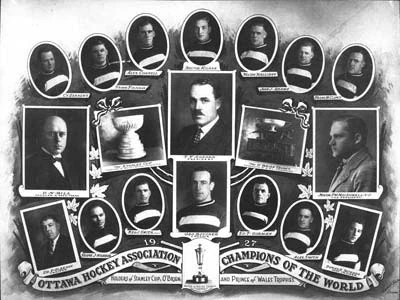
April 13, 1927: Ottawa's Last Stanley Cup

April 13, 1927: The Ottawa Senators beat the Boston Bruins, 3-1 at the Ottawa Auditorium, taking the Finals 3 games to 1, and winning the Stanley Cup.

It was their 9th win, and their 4th in the last 8 seasons. They were a dominant team in their sport, the way the New York Yankees were in the process of becoming in baseball. Indeed, the Senators were the 1st NHL dynasty.
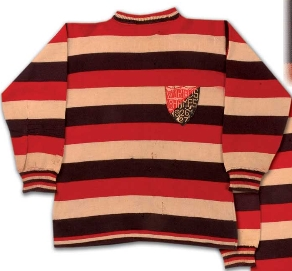
A 1927-28 Ottawa Senators sweater,
complete with shield denoting them as defending World Champions.
They really were "sweaters" rather than "jerseys" in those days.
Moths put an end to that tradition.

No one knew it at the time, but it was a last stand. The Senators made the Playoffs again in 1928, losing the Quarterfinals to the Montreal Maroons; missing them in 1929; and losing the Quarterfinals to the New York Rangers in 1930.
The Ottawa Auditorium

Then the Great Depression took hold. The Senators didn't make the Playoffs in 1931, then suspended operations for the 1931-32 season, played 1933-34, played their last game on March 17, 1934, and moved to become the St. Louis Eagles in 1934-35, and then folded.

The Memorial Cup, the championship of Canadian junior hockey, was won by Ottawa-area teams in 1958, 1971, 1972, 1980, 1981 and 1984. (And again in 1999 after the new Senators arrived.) But it would be October 8, 1992 before another Ottawa team would take the ice in an NHL regular-season game -- 58 years, 6 months and 22 days. Although the uniforms look very different, they have the same color scheme: Red, white and black.

It would be 1996 before the new Ottawa Senators made the Playoffs, 2003 before they reached the Conference Finals, and 2007 before they reached the Stanley Cup Finals.

UPDATE: What are now known as the "Original Senators" or the "Old Senators" did not last long enough to establish a team Hall of Fame. These figures have been elected to the Hockey Hall of Fame:

* 1903 Stanley Cup: Goaltender John "Bouse" Hutton, defenseman Harvey Pulford, rover Harry "Rat" Westwick, center Frank McGee, right wing Billy Gilmour.

* 1904 Stanley Cup: Hutton, Pulford, Westwick, McGee, Gilmour, right wing Alf Smith.

* 1905 Stanley Cup: Pulford, Westwick, McGee, Gilmour, Alf Smith.

* 1906 Stanley Cup: Pulford, Westwick, MeGee, Alf Smith, goaltender Percy LeSueur, center Tommy Smith.

* 1907-08 season only: Rover Fred "Cyclone" Taylor, left wing Tommy Phillips.

* 1909 Stanley Cup: LeSueur, center Bruce Stuart.

* 1911 Stanley Cup: LeSueur, left wing Jack Darragh, center Marty Walsh. Oddly, Pete Green, head coach of their 1911, '20, '21 and '23 Cup winners, has never been elected to the Hockey Hall of Fame.

* 1920 Stanley Cup: Darragh, goaltender Clint Benedict, defenseman Sprague Cleghorn, left wings Cy Denneny and Eddie Gerard, right wing Harold "Punch" Broadbent, centers Georges "Buck" Boucher and Frank Nighbor, and general manager Tommy Gorman.

* 1921 Stanley Cup: Darragh, Benedict, Cleghorn, Denneny, Gerard, Broadbent, Boucher, Nighbor, Gorman.

* 1923 Stanley Cup: Darragh, Benedict, Denneny, Gerard, Broadbent, Boucher, Nighbor, Gorman, defenseman Frank "King" Clancy.

* 1927 Stanley Cup: Denneny, Boucher, Nighbor, Clancy, goaltender Alex Connell, and center Jack Adams, who had previously starred for other teams, and went on to coach the Detroit Red Wings. Head coach Dave Gill has never been elected to the Hockey Hall of Fame.

* All Cups: Team owner Frank Ahearn. Ted Dey, builder and owner of the Senators' various arenas, and a part owner from 1917 to 1934, has never been elected to the Hockey Hall of Fame.

In addition, these Hall-of-Famers played for the Senators in non-Cup seasons: Defensemen William "Hod" Stuart, Art Ross, Samuel Russell "Rusty" Crawford, Harry Cameron; left wings Gordon Roberts Syd Howe; centers Frank Boucher (Buck's brother), Ralph "Cooney" Weiland and Carl Voss; right wing Reginald "Hooley" Smith. Ross had starred with the Montreal Wanderers, and would later be the longtime coach of the Boston Bruins. Although he later played for the Detroit Red Wings, Syd was no relation to later Wings legend Gordie Howe.

In 1998, The Hockey News released their list of the 100 Greatest Hockey Players. Cy Denneny was ranked 62nd, and Frank Nighbor was ranked 100th.


*


April 13, 1927 was a Wednesday. There were 4 baseball games played at this early point in the season:

* The New York Yankees beat the Philadelphia Athletics, 10-4 at Yankee Stadium. Babe Ruth went 2-for-4 with a walk. Lou Gehrig went went 2-for-4 with 3 RBIs. For the A's, Ty Cobb went 2-for-4, Eddie Collins went 0-for-5, and Al Simmons went 4-for-4 with a home run and 3 RBIs.

* The Brooklyn Dodgers lost to the Boston Braves, 4-2 at Braves Field in Boston.

* The Chicago White Sox beat the Cleveland Indians, 7-2 at League Park in Cleveland.

* And the St. Louis Cardinals beat the Chicago Cubs, 5-0 at Wrigley Field in Chicago. Jesse Haines pitched a 2-hit shutout.

Wednesday, March 16, 2022

March 17, 1906: Hockey's "Greatest Game Ever Played"

The 1906 Wanderers. Lester Patrick is in the center
of the top row of players.

March 17, 1906: A hockey game is played. It gets called the sport's "greatest game ever played." Maybe, by the standards of the time, it was. But it would be surpassed, many times over. Still, some game had to be the first "game of the century" in the sport.

And what's really weird by modern standards is, the team that got clobbered in it was declared the champions.

The Eastern Canada Amateur Hockey Association was wrapping up its 1st season, and there was a tie for 1st place, between the Montreal Wanderers and the Ottawa Hockey Club, both of whom finished 9-1. Although the Ottawa HC never deviated from that official name, by the time of their 1st Stanley Cup win in 1903, they were known as "The Silver Seven." By 1908, they were nicknamed the Senators, and it is by this name that they would become best known.

(Yes, "Silver Seven." At the time, there were 7 players on the ice, including a "rover," who switched between offense and defense. The National Hockey Association, the 1st pro league, founded in 1910, didn't use it, and most leagues stopped by the 1920s.)

The 9 most-used members of the Silver Seven were goaltender Billy Hague; defensemen Harvey Pulford (also their Captain) and Arthur Moore; rovers Frank McGee and Harry "Rat" Westwick; centers Tommy and Harry Smith; and wingers Alf Smith (also their head coach) and Billy Gilmour. Alf and Tommy Smith, Pulford, McGee, Westwick, Gilmour would be elected to the Hockey Hall of Fame. They had already won the Stanley Cup in 1903, 1904 and 1905.

The Wanderers, known as "the Little Men of Iron," are probably better-remembered today, if only because their Captain, rover Lester Patrick, would go on to coach and manage the New York Rangers. Their memory is also stronger due to a player they would acquire the following year, defenseman Art Ross, who would go on to coach and manage the Boston Bruins. Each man would eventually have an NHL Division and an NHL trophy named for him. And yet, for all they achieved as what the Hockey Hall of Fame calls "Builders," they were elected as "Players." This would also be true for Jack Adams, later the coach and general manager of the Detroit Red Wings.

Joining Patrick (and eventually Ross, and another 1907 Wanderer, William "Hod" Stuart) in the Hall of Fame, were forwards Frank "Pud" Glass, Ernie "Moose" Johnson and Ernie Russell. Oddly, Cecil Blachford, both their Captain and their head coach, has not been elected. Nor have their defensemen, Billy Strachan and Rod Kennedy; or their goaltender, Henri "Doc" Menard.

They finished in a tie for the title. Each team had handed the other their only loss. So the Stanley Cup would be decided by a tiebreaker series: Two games, one at each team's home rink, totals goals to decide it. Game 1 was a wipeout, as the Wanderers won, 9-1 at the Montreal Arena. Russell scored 4 goals, Glass 3, Johnson 2.

Game 2 was played at Dey's Arena in Ottawa, in front of 5,400 fans, believed to be a record for a hockey game at that point. Among the attendees was Albert Grey, the 4th Earl Grey, Governor-General of Canada (representative of the country's head of state, King Edward VII of Britain), and the man who would go on to donate the championship trophy for Canadian football, the Grey Cup. (His grandfather, Charles, the 2nd Earl, is the namesake of Earl Grey tea. Lord Stanley of Preston, who had donated the Stanley Cup in 1893, had also been Governor-General.)
Dey's Arena

All the Wanderers had to do to win the Stanley Cup was avoid losing this game by 8 or more goals. But that proved difficult, as the Silver Seven took advantage of the home ice and the home crowd. They also took advantage of a rule that allowed them to "bring in a ringer," Percy LeSueur, the goalie from the Smiths Falls Senators of Smiths Falls, Ontario, about 50 miles southwest of Ottawa. LeSueur would go on to the Hall of Fame.

Still, Johnson scored 12 minutes in, to give the Wanderers a 9-goal lead. But then, the Silver Seven exploded. Before the 1st half ended (they played 2 halves then, not 3 periods), McGee scored twice and Harry Smith once. In the 2nd half, Harry scored, Westwick scored, and Harry scored 3 more goals. The last of these came with 10 minutes to play, tying the series at 10-10 on aggregate, and bringing a 5-minute standing ovation.

But history would not remember the Wanderers for the greatest choke in hockey history. Patrick pulled their fat out of the fire, scoring with 90 seconds left, and then once more just before time expired. The Silver Seven had won the game, 9-3; but had lost the series, 12-10.

The next day's edition of the Toronto Globe called Game 2 the "greatest game of hockey ever played on Canadian ice, or any other." The Sporting News would later call it the "Greatest Hockey Game in History."

At some point during the game, Earl Grey's top hat had been knocked off. A fan found it, and, after the game, gave it to the Wanderers' Moose Johnson.

The Wanderers would lose the Cup to the Kenora Thistles in 1907, then regain it later that year, and win it again in 1908 and 1910. They would join the NHA in 1910 and the NHL in 1917, but the Montreal Arena burned down during their 1st season, and they went out of business.

The Silver Seven/Senators rebuilt, and won the Cup in 1909 and 1911. They would also be founding members of the NHA and the NHL, winning the Cup in 1920, 1921, 1923 and 1927. But the Great Depression did them in, and they moved in 1934, becoming the St. Louis Eagles, playing 1 season, and folding.

*

March 17, 1906 was a Saturday. Baseball was in Spring Training. Football was out of season. Professional basketball barely existed. In English soccer, Woolwich Arsenal, eventually to become the North London team I would support, beat East Midlands team Derby County, 1-0 at the Manor Ground in Plumstead, South-East London.

Tuesday, February 15, 2022

February 15, 1965: Canada Adopts the Maple Leaf Flag

February 15, 1965: Canada raises its new Maple Leaf Flag over Parliament Hill in the capital of Ottawa for the 1st time.

Shortly after Canadian Confederation in 1867, the need for distinctive Canadian flags emerged. The first Canadian flag was that then used as the flag of the Governor General of Canada, a Union Flag (a.k.a. the Union Jack, the national flag of the United Kingdom of Great Britain and Ireland, as the country was then known), with a shield in the center, bearing the quartered arms of Ontario, Quebec, Nova Scotia and New Brunswick, surrounded by a wreath of maple leaves.

This flag became known as the Red Ensign. As new Provinces joined the Confederation, their arms were added to the shield. The composite shield was replaced with the Coat of Arms of Canada upon its grant in 1921.
The Red Ensign

In 1925, with Canada's brave role in World War I still fresh in the nation's mind, Prime Minister William Lyon Mackenzie King established a committee to design a flag to be used at home, but it was dissolved before the final report could be delivered. Despite the failure of the committee to solve the issue, public sentiment in the 1920s was in favor of giving Canada a flag that didn't have the mother country's flag in it.

The question was, what would be the replacement? There was difficulty agreeing on a design. It has been suggested that the main reason that Australia still flies a flag with the Union Jack as the canton is that nobody can agree on what the replacement should be.

World War II generated a new wave of patriotism and national identity. The desire for a flag that was the nation's own, not a British flag, rose again. But, still, no one new design got much support. In 1963, the minority Liberal Party government of Lester Pearson gained power. Pearson had won the Nobel Peace Prize for his role in negotiating a settlement to the Suez Crisis of 1956. At that time, he was disturbed when the Egyptian government objected to Canadian peacekeeping forces on the grounds that the Canadian flag (the Red Ensign) contained the same symbol (the Union Flag) also used as a flag by the United Kingdom, one of the belligerents.
Lester Pearson

So Prime Minister Pearson's goal was for the Canadian flag to be distinctive and unmistakably Canadian. The main opponent to changing the flag was the Leader of the Opposition, the previous Prime Minister, John Diefenbaker. His idea of Canadian nationalism was tied to the British Commonwealth, and he made keeping the Red Ensign a personal crusade. (To add a sports perspective, so did Conn Smythe, the general manager of the country's most famous sports team, the Toronto Maple Leafs.)

In February 1964, Pearson suggested a flag with 3 red maple leaves on a white background, bracketed by blue borders. This became known as the Pearson Pennant, and pretty much everybody but the Prime Minister hated it.
On March 23, 1964, historian George Stanley offered a new design, inspired by the flag of the Royal Military College of Canada in Kingston, Ontario -- the country's version of the U.S. Military Academy at West Point, New York. 
The flag of the Royal Military College of Canada

Diefenbaker told his Party to support the new design, figuring that the Liberal Party would stand with their Leader, Pearson, and reject it, thus forcing the keeping of the Red Ensign, at least for a while longer. But the Liberals liked the design, too. And so, on December 15, 1964, the House of Commons approved Stanley's Maple Leaf Flag by a majority vote. Two days later, the Senate approved it.

Pearson, more interested in having the debate settled and a distinctive flag agreed upon than in getting his own choice approved, approved it. On February 15, 1965, the Maple Leaf Flag was raised over the Peace Tower in Parliament. Pearson said:

May the land over which this new flag flies remain united in freedom and justice; a land of decent God-fearing people; fair and generous in all its dealings; sensitive, tolerant and compassionate towards all men; industrious, energetic, resolute; wise and just in the giving of security and opportunity equally to all its cultures, and strong it its adherence to those moral principles which are the only sure guide to greatness.
The Peace Tower

*

February 15, 1965 was a Monday. Baseball and football were out of season. No games were scheduled for the NBA. You would think that, on such a day in Canada, there would be an NHL game scheduled. But there weren't any. So there were no scores on this historic day.
Sunday, January 16, 2022

January 16, 1905: The Strangest Stanley Cup Finals

January 16, 1905: The strangest Stanley Cup Finals come to an end, with the biggest blowout in hockey history. Whether the most famous story about the series is true remains in dispute.

The Dawson City Nuggets were an amateur hockey team -- pretty much every hockey team was amateur at the point -- based in Dawson City, in Canada's Yukon Territory. In the country's 2021 Census, its population was 1,577. That's considerably lower than it was at the beginning, in 1896, due to the Klondike Gold Rush.

Due to the weather conditions, sports other than ice hockey were pretty much impossible. And the Nuggets were good. Good enough, they thought, to challenge for the Stanley Cup. This was the era when the Cup was still a challenge trophy: You challenged the holder to a game, or a series, agreed upon the format before playing, and, if you won, you received the Cup.

This was also a time when, instead of 6 men on a side, hockey usually had 7, with the addition of a "rover," who alternated between offense and defense. When the NHL was founded, it did away with the position. By 1923, all professional leagues had. And defensemen were called "point" and "counter-point."

Anyway, because of the 7-man setup, the holders of the Stanley Cup, the Ottawa Hockey Club, were known as "The Silver Seven": Goalkeeper Dave Finnie, point Arthur "Bones" Allen, counter-point Arthur Moore, rover Harry "Rat" Westwick, left wing Fred White, center Frank McGee, and right wing Alf Smith. Harvey Pulford was a reserve defenseman, and had previously been a bigger star for the team. They had already won the Cup in 1903 and 1904.

But the Nuggets thought they could beat them, with goalie Albert Forrest, point Jim Johnstone, counter-point Lorne Hanna, rover Randy McLennan, left wing Norman Watt, center Hector Smith, and right wing George Kennedy.

In October 1904, the Silver Seven accepted the challenge. It was set for Dey's Arena in Ottawa, Ontario, the national capital and the OHC's home, starting on January 13, 1905 -- a Friday the 13th. All the Nuggets had to do was show up. It's only 6,000 kilometers. Well, 5,969. Or, 3,709 miles. Actually, due to the roads available at the time, it was more like 6,400 kilometers, or just under 4,000 miles. But it was possible, right?
Dey's Arena

Yes, it was possible. First, they had to get to Whitehorse, the capital of the Yukon Territory. They started on December 18, 1904. Why so early? Because, at the time, the only way to get from Dawson City to Whitehorse was by dog sled. No, I'm not joking: That's what happened. The team spent the nights in police sheds along the road.

When they got to Whitehorse, the weather turned bad, causing the trains not to run for 3 days. That caused them to miss their steamer ship from Skagway, Alaska to Vancouver, British Columbia. (You're reading that right: They had to cross the border into the U.S., and then again, back into Canada.) The next steamer could not dock for 3 days, due to the ice buildup.

The club found the sea journey treacherous, causing seasickness amongst the team. When the steamer reached Vancouver, the area was too fogged in to dock, and the steamer headed south, and docked in Seattle -- so they had to go through Customs again. From there, they caught a train to Vancouver -- so they had to go through Customs again. Through all this, they spent Christmas away from their families.

They finally left Vancouver on January 6, 1905, arriving in Ottawa on January 11, 24 days after leaving Dawson City, just 2 days before puck-drop. The Nuggets received a huge welcome at the train station, were given a welcoming dinner, and the Ottawa Amateur Athletic Club offered them free use of their rooms for the duration of their stay. But the Silver Seven refused to postpone the series, to give them a little bit of rest.

The 1st game started decently for Dawson, as they trailed only 3–1 at the half. But things turned ugly afterwards. Norman Watt of Dawson tripped Ottawa's Art Moore, who retaliated with a stick to the mouth of Watt. Watt promptly knocked Moore out, hitting him on the head with his stick. The game ended 9–2 for Ottawa, with Alf Smith scoring 4 goals. The game left a poor taste in the Yukoners, who claimed that several goals were offside.

Frank McGee, then Ottawa's biggest star, scored 1 goal in the game. Afterward, Watt was quoted as saying, "McGee doesn't look like too much." As Michael Jordan would say, "And McGee took that personally." He scored 4 goals in the 1st half, and 10 in the 2nd half. Ottawa clinched the series, winning the 2nd game 23–2.
Frank McGee

This game proved that the "challenge cup" idea really wasn't a good one. The Nuggets did not belong on the same rink as the Silver Seven. It was, and remains, the most lopsided in Stanley Cup Playoff history. McGee's 14-goal game, which included 8 consecutive goals scored in less than 9 minutes, is still the record for the most goals scored by a single player in a Stanley Cup game, or any other major senior hockey game.

After the second game, The Globe reported:

The visiting team was outclassed to-night quite as decisively as the score indicates. In fact had it not been for the fact of Forrest's presence in the Dawson goal the score against them might have been a great deal larger. Ottawa simply skated away from them at the whistle, and continued to pile up the goals with a merciless monotonous regularity which was farcical in the extreme.

Ottawa celebrated its victory by hosting Dawson at a banquet at the Ottawa AAA clubhouse. Legend has it that the Ottawa players took the Cup and attempted to drop-kick it over the Rideau Canal. The stunt was unsuccessful, with the Cup landing on the frozen ice, and was retrieved the next day. Hockey historians disagree on whether the attempt was actually made. Given the size of the Cup at the time, it would seem that a good solid kick would have seriously damaged it.
The Stanley Cup, as it appeared
from its 1893 inception until 1912

The news got worse for McLennan and Watt, who were employed by the Yukon Territory gold commissioner's office when not playing hockey. The day after the 2nd game, the Territory announced that the pair would be laid off from work, effective immediately, albeit with pay until June 30, 1905.

After playing Ottawa, the Nuggets team played a series of exhibition games in the east before returning to the Yukon. The team did not last much longer. The Silver Seven lost the Cup to the Montreal Wanderers in 1906, but would win it again in 1909 (by which point, they were known as the Ottawa Senators), 1911, 1920, 1921, 1923 and 1927. They went out of business in 1934, and were replaced by a new Ottawa Senators in 1992.

By the time they won again in 1909, Frank McGee was no longer playing for them, having retired at the age of 23. He was killed in action for the Canadian Army in World War I, in France in 1916.

The Dey brothers, directors of the Ottawa Hockey Club, built 3 different arenas with their name on it, on the same plot of land. The 2nd, the site of this series, lasted from 1902 until a fire in 1920.
In 1997, a team from Dawson competed against Senators alumni in a re-enactment of the 1905 match, this time at the Senators' arena, then named the Corel Center (now named the Canadian Tire Centre), complete with organ music, spotlights, and other such hullabaloo.

The Dawson team symbolically recreated the trip to Ottawa, though train service no longer ran between Whitehorse and the Pacific Coast. Dawson managed a slight improvement in score: 18–0, with 25 shots-on-goal. The event was held for charity with 45 percent, the Senators' take of receipts, was contributed to the Heart Institute, while the Dawson team donated 25 ounces of gold, or the cash equivalent, to the Yukon Special Olympics, another 45 percent of the receipts. The rest was designated to Yukon Minor Hockey.

Shortly before the re-enactment, Michael Onesi, a Whitehorse newspaper columnist, wryly commented that had the Dawson team triumphed in 1905, they would have had the longest dynasty in Stanley Cup history. Challenges normally took place in the cupholder's town, and visiting teams could not effectively play, after the brutal journey by overland coach to Dawson, their bodies blacker than a hockey puck from all the bruises of a dog sled ride.

In 1945, Frank McGee and Harvey Pulford would be 2 of the 1st 9 players elected to the Hockey Hall of Fame.

*

January 16, 1905 was a Monday. Baseball and football were out of season. And basketball barely existed. So there were no other scores on this historic day.

December 31, 1999 & January 1, 2000: The Millennium

December 31, 1999:  The Millennium arrives. The people of planet Earth survived. At a terrible cost. But we hadn't destroyed ourselves. ...