
October 16, 1969: Yes, the Miracle on 126th Street really happened. Was it actually a "miracle"? Not really: The Mets unquestionably outplayed the Baltimore Orioles in the World Series. And while varying amounts of luck are necessary for any sports victory, the Mets pretty much made their own luck in this Series.
A crowd later listed as 57,397 -- including Jacqueline Kennedy Onassis, her children Caroline and John, and her 2nd husband, Aristotle Onassis -- files into "The William A. Shea Municipal Stadium" for Game 5. The skies on this Thursday afternoon are a mix of Sun and clouds, and the temperature is in the mid-60s throughout the game.

Left to right: Caroline, then, 11; John-John, 8; Jackie; Ari.
I wonder how much of the game Ari understood.
The Orioles do their best to win the game and send the Series back to Baltimore. They take a 3-0 lead in the bottom of the 6th, thanks to the pitching and home run of Dave McNally, and it looks like the Series is going back to Baltimore for at least a Game 6.
Cleon Jones‚ the only Met to have hit .300 that season – in fact, his .340 remained a Met single-season record until John Olerud's .359 in 1998 – is hit on the foot with a pitch, much like the unrelated Nippy Jones of the Milwaukee Braves in the 1957 World Series. And, like Nippy, Cleon is awarded 1st base after his manager proves he was hit, by showing the umpire a shoe-polish stain on the ball.
On the official World Series highlight film, Pearl Bailey, who had sung the National Anthem, can be seen asking if the pitch had hit Jones, and being delighted that it had, she used the slogan: "Did it hit him? Oh, it hit him! It's amazing! It's amazing!"
He is awarded 1st base, and then Clendenon hits a home run to close the Mets to within 3-2. Light-hitting 2nd baseman Al Weis ties it up with a homer in the 7th, and in the 8th, Swoboda doubles, and the Orioles uncharacteristically make 2 errors, leading to Mets 5, Orioles 3.

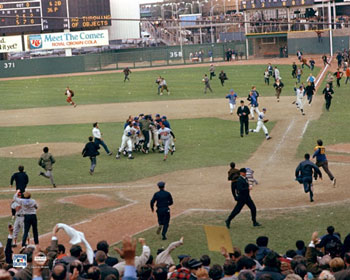
As Curt Gowdy says on NBC, "The 2-1 pitch: There's a fly ball to left, waiting is Jones, the Mets are the World Champions! Jerry Koosman is being mobbed! Look at this scene!"
Naming the Most Valuable Player of the World Series was a tough call. Koosman had won 2 games. Agee had won Game 3 with a home run and 2 sensational catches. Weis was a surprising star. In the end, though, the sportswriters decided they couldn't ignore 3 home runs, including the one that got the Mets back into the ballgame in Game 5, and awarded it to Clendenon. Formerly given out by the now-defunct SPORT magazine, in 2017, this award was renamed the Willie Mays Award.
The New York branch of the Baseball Writers' Association of America (the guys who vote for the Hall of Fame) awarded a separate Babe Ruth Award, and had just expanded its scope to cover the entire postseason (and would again in 1995). They gave it to Weis. Sports Illustrated named Seaver their Sportsman of the Year.
It had been 5 years since New York had a World Series appearance. It had been 12 years since Met fans, most of them previously fans of the New York Giants or Brooklyn Dodgers, lost their old teams. It had been 13 years since the Dodgers last won a New York Pennant, 15 years for the Giants. And it had been 14 years since the '55 Dodger title, 15 years since the '54 Giant title.
And New York was in a hell of a mess in '69, with rising crime, bad weather (the February blizzard), poverty, racial discontent, the sense that the whole world was spiraling out of control, and the feeling that Mayor Lindsay didn't know what the hell to do, with anything. But by tying himself to the Mets' World Series win, he managed to get re-elected.
If the Mets had finished 2nd to the Cubs in the new 6-team NL East, after 7 seasons of either 9th or 10th in the single-division 10-team NL, most Met fans would have gladly taken it. If they had won the Division but lost the Pennant to the NL West Champion Braves, it would have been a disappointment, but they would have gotten over it.
And if they had won the Pennant but lost the Series to the overwhelming favorite Orioles, it would have been fairly easy to take, as just being in the World Series is quite an honor – that is, so long as you don't lose it on a bonehead move or play, as the Red Sox did against the Mets in '86 (and I mean John McNamara's managerial decisions and Bob Stanley's wild pitch, not Bill Buckner's error), or as the Mets did against the Yankees in 2000 (the baserunning blunders and Armando Benitez's walk of Paul O'Neill).
The '69 Mets acted as if there was no pressure, as if the pressure was all on the other guys. It really wasn't on the Mets. They had fun. And their fans had fun. It was fun they did not expect to have. And sometimes, that's the best kind of fun of all. And that's why the win was not just glorious, but, to use the cliché, Amazin'.
And New York was in a hell of a mess in '69, with rising crime, bad weather (the February blizzard), poverty, racial discontent, the sense that the whole world was spiraling out of control, and the feeling that Mayor Lindsay didn't know what the hell to do, with anything. But by tying himself to the Mets' World Series win, he managed to get re-elected.
If the Mets had finished 2nd to the Cubs in the new 6-team NL East, after 7 seasons of either 9th or 10th in the single-division 10-team NL, most Met fans would have gladly taken it. If they had won the Division but lost the Pennant to the NL West Champion Braves, it would have been a disappointment, but they would have gotten over it.
And if they had won the Pennant but lost the Series to the overwhelming favorite Orioles, it would have been fairly easy to take, as just being in the World Series is quite an honor – that is, so long as you don't lose it on a bonehead move or play, as the Red Sox did against the Mets in '86 (and I mean John McNamara's managerial decisions and Bob Stanley's wild pitch, not Bill Buckner's error), or as the Mets did against the Yankees in 2000 (the baserunning blunders and Armando Benitez's walk of Paul O'Neill).
The '69 Mets acted as if there was no pressure, as if the pressure was all on the other guys. It really wasn't on the Mets. They had fun. And their fans had fun. It was fun they did not expect to have. And sometimes, that's the best kind of fun of all. And that's why the win was not just glorious, but, to use the cliché, Amazin'.
It was also the last Major League Baseball game played before I was born, exactly 9 weeks later. So I was born with both the Mets and the Jets as defending World Champions.
But I still hate the Mets. But that's not why. I hate them because I'm a Yankee Fan.
For all that the Yankees have achieved, for all that the New York Giants and the Brooklyn Dodgers achieved before moving to California, for all the joy brought to the New York Tri-State Area by the Super Bowl wins of the Giants and the Jets, the Knicks' 1970 NBA Championship, and the Stanley Cups won by the Rangers, the Islanders, and the New Jersey Devils, the 1969 New York Mets remain the most beloved single-season sports team in New York history.
Nolan Ryan, who seemed like a minor figure on the team, though with a key performance in Game 3, was the last active player for the 1969 Mets, pitching until 1993.
*
October 16, 1969 was a Thursday. No other baseball games were played on this day. No football games. One game was played in the NBA: The Phoenix Suns beat the San Diego Rockets, 116-114 at the Arizona Veterans Memorial Coliseum. Jim Fox of the Suns led all scorers with 29 points. The Rockets moved to Houston in 1971. The American Basketball Association opened its season the next day.
And one game was played in the NHL: The Minnesota North Stars beat the Detroit Red Wings, 3-2 at the Olympia Stadium in Detroit. Gordie Howe scored a goal for the Wings, but Claude Larose scored 2 for the Stars.
Singer Wendy Wilson, daughter of Beach Boy Brian Wilson and a member of Wilson Phillips, was born on this day.


