Showing posts with label bonus army. Show all posts

Thursday, July 28, 2022

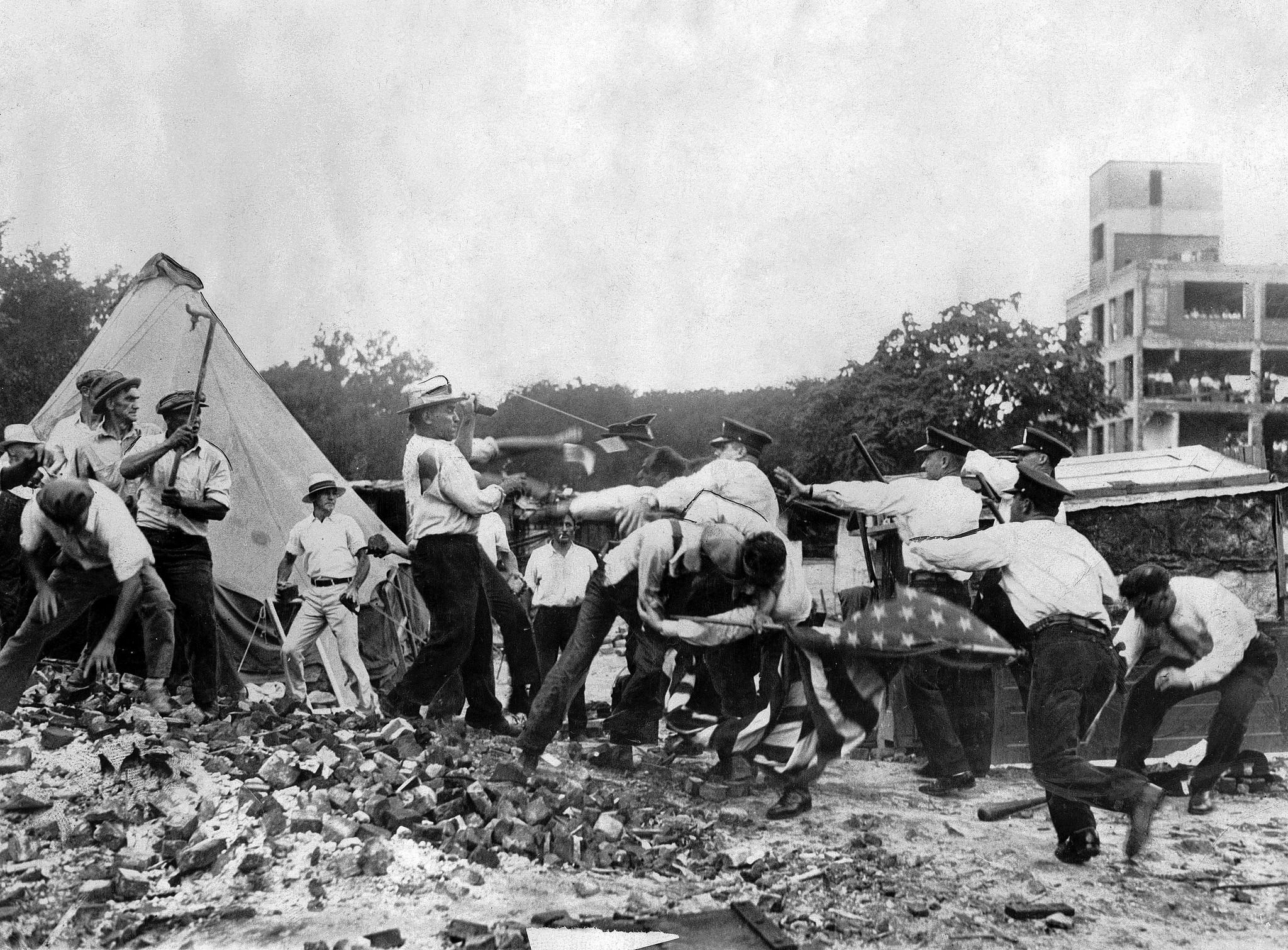
July 28, 1932: The Rout of the Bonus Army

July 28, 1932: The Bonus Army is chased off Capitol Hill by the United States Army.

Those words might not make sense to you. Let's go back, much further than 1932:

The practice of war-time military bonuses began in 1776, as payment for the difference between what a soldier earned and what he could have earned had he not enlisted. America first did this, as you might expect, in the War of the American Revolution. 

In 1783, as the war ended, hundreds of veterans from Pennsylvania marched on the nation's capital, Philadelphia, demanding an increase in their bonuses. They surrounded the State House, which was doubling as the home of the U.S. Congress, and was soon to be renamed Independence Hall. Congress evacuated, and a few weeks later, the U.S. Army arrived, and kicked them out. Nobody died.

The U.S. entered World War I on April 6, 1917, and made the difference for the Allies, gaining the Armistice on November 11, 1918. In 1924, Congress passed a bill awarding that war's veterans $1.00 per day of domestic service, up to $500; and $1.25 per day of overseas service, up to $625.

Lest you think that Republican Presidents being conservative assholes is a relatively new phenomenon, President Calvin Coolidge vetoed the bill. Congress overrode his veto, and the bill became law. But here's the kicker: This bonus would not be made available to the veterans until 1945. (Which turned out to be the year that World War II ended.) They would have to wait 21 years.

Then came the stock market crash of 1929, and the Great Depression. President Herbert Hoover did not cause these things, but in 1930 and 1931, he didn't seem to be trying very hard to turn them around. (He never publicly said the infamous sentence, "Prosperity is just around the corner," and he knew it wasn't.)

By early 1932, with 13 years to go before the bonus kicked in, one out of every four men in the workforce could not find a job. Many of these men were veterans of the war. Some men sold their medals to get money for food, bringing to mind the expression, "What price glory?" The plight of unemployed veterans worked its way into songs, including Bing Crosby's "Brother, Can You Spare a Dime?", although that song was not released until a few weeks after the Bonus Army march.

Not for the first time in human history, or even in American history, and not for the last time, men asked the question, "I was there when my country needed me, so where is my country now that I need it?" And now, Hoover had to run for re-election.

On March 11, 1932, Oregon veteran Walter W. Waters organized a group of fellow veterans and began leading them East toward Washington. Taking their name from that of American troops in France in World War I, the American Expeditionary Force, he called them the Bonus Expeditionary Force. Most news reports just called them the Bonus Army.

They arrived in Washington 43,000 strong -- 17,000 veterans and their families -- on May 28, and camped in tents to the south of the U.S. Capitol Building, on the Anacostia Flats. Like so many other encampments of the homeless across America, it was quickly labeled a "Hooverville."

They demanded that Congress pass, and Hoover sign, a bill into law mandating the paying of their 1945-due bonuses immediately. On June 15, the House of Representatives, controlled by the Democratic Party, passed such a bill, 211-176. There was hope.

That hope was crushed only 2 days later: The Senate voted it down, and it wasn't even close, 62-18. So even though the Senate was controlled by the Republican Party, many Democratic Senators also voted it down.

There seemed to be very little reason for the Bonus Army army to stay. But they did. Through the 2nd half of June. And almost all the way through July.

Finally, on July 28, Hoover had had enough. He ordered Pelham Glassford, the Superintendent of the District of Columbia Police, to get the Bonus Army out.

The Bonusers refused to leave. The police opened fire, and killed 2 of them: William Hushka, 37, an immigrant from Lithuania who became a butcher in Chicago; and Eric Carlson, 38, of Oakland, California. Both, as they were legally entitled as honorably discharged veterans, were buried across the Potomac River in Arlington National Cemetery. Still, the campers refused to leave.

Finally, Hoover ordered Secretary of War Patrick J. Hurley to use the current real Army to get those aggrieved heroes away from Washington. Hurley passed the order to the U.S. Army's Chief of Staff. This 4-star General sent in cavalry and tanks, and told his troops to do whatever it took to disperse the Bonus Army. Nobody else died, but many were brutally beaten.

Had modern television coverage been available at the time, the outrage throughout the country would have meant that this General would have been forced to resign. Instead, his career continued. His name was Douglas MacArthur.

On November 8, 1932, Hoover was defeated for re-election, losing 42 out of the 48 States then in the Union to the Democratic Party's nominee, the Governor of New York, Franklin Delano Roosevelt.

In 1933, there was a smaller march on Washington demanding the Bonus. FDR responded by offering them federal government jobs. Those who accepted were better off. Those who refused were given transit fare home.

In 1935, Canada held its own version of the Bonus Army march, the On-to-Ottawa Trek. They never got anywhere near their country's capital, ending with the Regina Riot.

In 1936, with the Depression easing but by no means over, both houses of Congress passed a bill awarding the Bonus, now just 9 years ahead of schedule. FDR vetoed it -- something his hagiographers usually don't mention. Congress overrode his veto, and the Bonus was paid.

In 1944, with the end of World War II in sight, and determined not to make the same mistake, FDR asked Congress to pass a G.I. Bill of Rights. It did, and the returning veterans got immediate benefits far beyond what those who returned from World War I got.

Walter Waters was never prosecuted for anything he may have done with the Bonus Army. He lived until 1959. MacArthur died in 1964. Later that year, so did Hoover.

*

July 28, 1932 was a Thursday. It was the off-season for the NFL and the NHL, and the NBA hadn't been founded yet. But these games were played in Major League Baseball:

* The New York Yankees beat the Cleveland Indians, 10-1 at League Park in Cleveland. Babe Ruth hit 2 home runs in support of Red Ruffing.

* The New York Giants got swept in a doubleheader at the Polo Grounds. The Pittsburgh Pirates beat them in the 1st game 10-7, and in the 2nd game 9-1.

* The Brooklyn Dodgers split a doubleheader at Ebbets Field. They beat the St. Louis Cardinals in the opener, 9-6, before dropping the nightcap, 8-6.

* The Chicago Cubs beat the Boston Braves, 4-1 at Braves Field in Boston.

* The Cincinnati Reds beat the Philadelphia Phillies, 7-4 at Baker Bowl in Philadelphia. 

* The Detroit Tigers beat the Philadelphia Athletics, 4-2 at Navin Field in Detroit. (It was renamed Briggs Stadium in 1938 and Tiger Stadium in 1961.)

* The Boston Red Sox beat the Chicago White Sox, 2-1 at Comiskey Park in Chicago.

* And the St. Louis Browns beat the Washington Senators, 6-4 at Sportsman's Park in St. Louis. 

Friday, July 1, 2022

July 1, 1935: The Regina Riot

July 1, 1935: A confrontation between Canadian troops and unemployed demonstrators results in 2 deaths. It becomes known as the Regina Riot.

The Great Depression that began with the stock market crash of October 29, 1929 led to the Canadian federal election of July 28, 1930, and the defeat of the Liberal Party. William Lyon Mackenzie King was out as Prime Minister, and Richard Bedford Bennett, Leader of the Conservative Party, was in.

Installed in the national capital at Ottawa, Ontario, R.B. Bennett had sought to stimulate the economy during his first few years through a policy of high tariffs and trade within the British Empire. This didn't work, and voters turned against the Tories.

Bennett had not been in charge when the Depression began, but, like American President Herbert Hoover, he was seen as doing nothing, or at least too little, to alleviate the dire economic conditions. Hitching a horse up to your car, because you couldn't afford gasoline but you didn't dare sell your car, earned the vehicles the nickname Hoover wagons in America. In Canada, they were known as Bennett buggies.

The Bennett government ordered the Department of National Defence to organize work camps where single unemployed men were used to construct roads and other public works at a rate of 20 cents per day. After the 1932 U.S. Presidential election, new President Franklin D. Roosevelt instituted similar programs, including the Works Project Administration and the Civilian Conservation Corps.

But the men in the Canada relief camps were living in poor conditions with very low wages. They decided to unite and, in 1933, led by Arthur "Slim" Evans, created the Workers' United League. The WUL helped the men organize the Relief Camp Workers' Union. As Bennett stalled as much as he could, refusing to call an election sooner than he legally had to on October 14, 1935, the RCWU called for a strike on April 4, 1935.

The strikers' demands were: “(1) that work with wages be instituted at a minimum of 50 cents per hour for unskilled workers and trade union rates for skilled labour on the basis of a six-hour day, a five-day week with a minimum of twenty work days per month; (2) that all workers in the camps be covered by the Workmen's Compensation Act and that adequate first aid supplies be carried on the jobs at all times; (3) that the National Defence and all military control with the system of blacklisting be abolished; (4) that democratically elected committees be recognized in every camp; (5) that there be instituted a system of noncontributory unemployment insurance; (6) that all workers be given their democratic right to vote; (7) that Section 98 of the Criminal Code, Sections 41 and 42 of the Immigration Act and all vagrancy laws and anti-working class laws be repealed."

With no action taken, they decided to take their grievances to the federal government. On June 3, 1935, hundreds of men began boarding boxcars headed east in what became known as the "On-to-Ottawa Trek." The protesters reached Regina (that's "REJ-ih-nah," not "Reh-JEE-nah"), Saskatchewan on June 14.

Three days later, they met with 2 federal cabinet ministers: Robert Manion, Minister of Railways and Canals; and Robert Weir, Minister of Agriculture. They invited 8 elected representatives of the protest, including Slim Evans, to Ottawa to meet Bennett, on the condition the rest of the protesters stay in Regina, where a large contingent of the Royal Canadian Mounted Police was stationed. The remaining trekkers stayed in the stadium located on Regina Exhibition Grounds, with food and shelter supplied by townspeople and the Saskatchewan Provincial government.

The meeting was held on June 22, and it was a disaster. Bennett called Evans an "embezzler." Evans called Bennett "a liar." The delegation was escorted out, and arrived back in Regina on June 26. Attempts of the Trekkers to travel east by car or truck or train were thwarted by RCMP. A public meeting was called for July 1, in Market Square in Germantown to update the public on the progress of the movement. It was attended by 1,500 to 2,000 people, of whom only 300 were Trekkers. Most Trekkers decided to stay at the exhibition grounds.

At 8:17 PM on July 1 -- the 68th Anniversary of Canadian independence -- the police, unprovoked, charged the crowd with batons from all 4 sides. The attack caught the people off guard before their anger took over. They fought back with sticks, stones, and anything at hand. Mounted RCMP officers then started to use tear gas and fired guns. Driven from the Square, and with the RCMP blocking the roadway back to the Stadium grounds, the battle continued in the surrounding streets for 6 hours.

Police fired revolvers above and into groups of people. Tear gas bombs were thrown at any groups that gathered together. Plate glass windows in stores and offices were smashed, but with one exception, these stores were not looted, they were burned. The Trekkers who had attended the meeting made their way individually or in small groups back to the exhibition stadium where the main body of Trekkers were quartered.

When it was over, 140 Trekkers and citizens had been arrested. Charles Miller, a plainclothes policeman, died. Nick Schaack, a Trekker, later died in the hospital from injuries sustained in the riot. There were hundreds of injured residents, and Trekkers were taken to hospitals or private homes. Those taken to a hospital were also arrested. The police claimed 39 injuries in addition to the dead police officer, but denied that any protesters had been killed in the melee. The hospital records were subsequently altered to conceal the actual cause of death.

The next day, a barbed-wire stockade was erected around the area. News of the police-instigated riot was front-page news across Canada. About midnight, one of the Trek leaders telephoned Premier James Gardiner of Saskatchewan (equivalent to the Governor of an American State), who agreed to meet their delegation the next morning.

Gardiner sent a wire to Bennett, accusing the police of "precipitating a riot" while he had been negotiating a settlement with the Trekkers. He also told the Prime Minister the "men should be fed where they are and sent back to camp and homes as they request," and stated his government was prepared to "undertake this work of disbanding the men." An agreement to this effect was subsequently negotiated. Bennett was satisfied that he had smashed what he believed was a Communist revolt, and Gardiner was glad to rid his Province of the strikers.

The Federal Minister of Justice, Hugh Guthrie, probably on the orders of his boss, Bennett, lied to the House of Commons on July 2, saying, "Shots were fired by the strikers, and the fire was replied to with shots from the City Police." During the lengthy trials that followed, no evidence was ever produced to show that strikers fired so much as a single shos during the riot.

For his part, Bennett characterized the On-to-Ottawa Trek as "not a mere uprising against law and order but a definite revolutionary effort on the part of a group of men to usurp authority and destroy government."
The voters Canada weren't having it. As Mackenzie King, still the Leader of the Liberal Party, promised reforms to restore economic health, and as the Liberal campaigned under the slogan "King or Chaos," Bennett finally bowed to reality, and called an election for October 14. The Liberals went from 89 seats in the House to 173; the Conservatives, from 137 to 39. It remains the greatest repudiation any sitting Prime Minister of Canada has ever received. (Brian Mulroney had already resigned before he could receive an even greater smacking in 1993, and the defeat the Progressive Conserves suffered under Kim Campbell's leadership was a repudiation of the Party and of Mulroney, not of Campbell herself.)

Bennett remained Leader of the Opposition until 1938, as Mackenzie King's reforms worked. In 1939, Bennett resigned his seat for Calgary West, left the homeland that had rejected him, and moved to England, settling at a mansion in Surrey, outside London.

In 1941, he became the first and only former Canadian Prime Minister to be elevated to the peerage, as Viscount Bennett, Mickleham in the County of Surrey and of Calgary and Hopewell in the Dominion of Canada. He served in the House of Lords until he died on June 26, 1947, just short of his 77th birthday. He is buried in Mickleham, making him the only deceased former Canadian Prime Minister not buried in Canada.

Mackenzie King held power until his retirement in 1948, and then his handpicked successor, Louis St. Laurent, until 1957. Only then, 22 years and a World War later, did the Conservative Party -- by this point renamed the Progressive Conservative Party -- win another election, as John Diefenbaker became the next Prime Minister of their party.

*

July 1, 1935 was a Monday. These baseball games were played that day:

* The Boston Red Sox beat the Washington Senators, 8-3 at Fenway Park in Boston. The year before, Joe Cronin was the Senators' shortstop, best player, manager, and the son-in-law of team owner Clark Griffith. But with Griffith needing money, and Sox owner Tom Yawkey having lots of it, Cronin was now the Red Sox' shortstop, manager, and, for the moment, best player, before Yawkey began spending more money. He hit a home run in this game.

* The Detroit Tigers beat the Cleveland Indians, 4-1 at Navin Field in Detroit. (That ballpark was renamed Briggs Stadium in 1938, and Tiger Stadium in 1961.) Hank Greenberg went 0-for-4, but a 2-run triple by Marv Owen made the difference.

* The Chicago Cubs beat the Cincinnati Reds, 8-4 at Crosley Field in Cincinnati. Billy Herman went 4-for-5, and Ken O'Dea went 3-for-5 with 3 RBIs.

* And the Chicago White Sox beat the St. Louis Browns, 4-1 at Comiskey Park in Chicago.

December 31, 1999 & January 1, 2000: The Millennium

December 31, 1999:  The Millennium arrives. The people of planet Earth survived. At a terrible cost. But we hadn't destroyed ourselves. ...