Showing posts with label hawaii. Show all posts

Sunday, December 25, 2022

December 25, 1991: Mikhail Gorbachev Resigns, the End of the Soviet Union

December 25, 1991: Mikhail Gorbachev resigns as President of the Soviet Union. The next day, the Supreme Soviet dissolved, its last act being to dissolve the Soviet Union itself after 74 years.
Gorbachev had been named President in 1985, after the death of Konstantin Chernenko, the last of the old-line Communists. Born in 1931, Gorbachev was the 1st Soviet leader who did not remember the Bolshevik Revolution of 1917. So he was uniquely poised to lead reforms, which he called "perestroika" (reconstruction) for domestic change, and "glasnost" (openness) for foreign relations.
That gave the West a chance to make peaceful overtures to a changing adversary. Britain's Prime Minister, Margaret Thatcher, said in an interview, "I like Mr. Gorbachev. We can do business together." The equally conservative American President, Ronald Reagan, met with him in 5 summits: In Geneva, Switzerland in 1985; in Reykjavik, Iceland in 1986; in Washington in 1987, signing the Intermediate-Range Nuclear Forces (INF) Treaty; in Moscow in the Summer of 1988; and in New York toward the end of the year, including President-elect George H.W. Bush.
In 1987, Time magazine named Gorbachev its Man of the Year, recognizing him as the person who had most affected the news during the calendar year. (Remember: It's not an "award" that a person "wins.") In 1989, suggesting that he deserved it again, and then som, Time named him Man of the Decade. In 1990, he was awarded the Nobel Peace Prize.
But the hardline Communists of Gorbachev's generation didn't like the changes he was making to what those of their forefathers had done. In August 1991, he was overthrown in a coup. But Boris Yeltsin, already President of the substate the Russian Federation, rallied the country, getting the Red Army on his side. With several of the Soviet "republics" having already declared their independence, the plotters could not expect help from elsewhere, and the coup collapsed. After 4 days, Gorbachev was back in power.
But he had very little support. The country had still rallied around Yeltsin, who was seen as even more of a reformer. Gorbachev become the opposite of "a man without a country": He was, in effect, a one-man country. On Christmas Day, he bowed to the inevitable, and resigned his office.
Gorbachev continued to advocate for social-democratic reform, was a critic of current Russian President Vladimir Putin, and died on August 30, 2022, at the age of 91.
The sad part is, the end of the Soviet Union was not the end of tyranny in its former lands. Putin ruled the Russian Federation with an iron fist from 2000 until 2008, when the country's Constitution term-limited him out. So his Prime Minister, Dmitry Medvedev, became President, while Putin became Prime Minister. Before Medvedev's term ran out in 2012, the Constitution was amended to allow Putin to return in 2012, and to have no limits.
Meanwhile, some of the other former Soviet "republics" had their own dictators: Saparmurat Niyazov, Turkmenistan, 1990-2006; Islam Karimov, Uzbekistan, 1991-2016; Nursultan Nazarbayev, Kazakhstan, 1991-2019; Alexander Lukashenko, Belarus, since 1994; Emomali Rahmon, Tajikistan, since 1994; and Ilham Aliyev, Azerbaijan, since 2003.
It's as if these countries decided, "We don't want to be a part of the Soviet Union, but we do like what the Soviets do, we just want to do it ourselves."

Following viewer demands for a battle with a Russian, a 2013 episode of the YouTube series Epic Rap Battles of History, featured a five-man "battle royale": "Nice" Peter Shukoff played Rasputin, Vladimir Lenin and Vladimir Putin; while "Epic" Lloyd Ahlquist played Joseph Stalin and Mikhail Gorbachev.

*
December 25, 1991 was a Wednesday. Baseball was in midseason. There was 1 college football game: Georgia Tech beat Stanford, 18-17, in the Aloha Bowl at Aloha Stadium in Honolulu, Hawaii.
The NHL, as usual, did not play on Christmas Day. The NBA usually does, and there were 2 games. The Chicago Bulls beat the Boston Celtics, 121-99 at the Chicago Stadium. Michael Jordan scored 14 points; on his own team, he was outscored by Scottie Pippen (27), B.J. Armstrong (18) and Horace Grant (17). But the Celtics were crumbling, and this would be the last season for Larry Bird.
And the Los Angeles Lakers went back to their 1st home in L.A., the Los Angeles Memorial Sports Arena, and beat the Los Angeles Clippers, 85-75.

Wednesday, December 7, 2022

December 7, 1941: The Japanese Bomb Pearl Harbor

December 7, 1941: As President Franklin D. Roosevelt said the next day, asking Congress for a Declaration of War against the Empire of Japan, and getting it, it is "a date which will live in infamy." Japanese planes attack the U.S. Naval base at Pearl Harbor in Honolulu, Hawaii.

American casualties and losses: 2 battleships totally lost, 2 battleships sunk and recovered, 3 battleships damaged, 1 battleship grounded, 2 other ships sunk, 3 cruisers damaged, 3 destroyers damaged, 3 other ships damaged, 188 aircraft destroyed, 159 aircraft damaged, 2,403 people killed, 1,178 wounded.

To put that in perspective: In 1941, the U.S. had about 130 million people, and we lost 2,400 in Honolulu that day. In 2001, we had about 300 million, and lost 3,000 on 9/11. Proportionately, we lost about twice as many people at Pearl Harbor as we did at the World Trade Center and the Pentagon combined 60 years later.

The 1970 film Tora! Tora! Tora! -- named for the code given that the attack was on -- is usually still considered the best film about the attack, more so than From Here to Eternity (1953, in which the attack is secondary to the story), The Final Countdown (1980, ditto), and Pearl Harbor (2001, in which the acting has been heavily criticized). Playing the Japanese commander, Admiral Isoroku Yamamoto, Japanese actor Sō Yamamura said, "I fear that all we have done is to awaken a sleeping giant, and fill him with a terrible resolve." Yamamoto may have believed this, but there is no record of him actually saying it.

But it was true: For Japan, the attack on Pearl Harbor was a "Pyrrhic victory." The phrase originates from a quote from Pyrrhus of Epirus, whose triumph against the Romans in the Battle of Asculum, in what is now Southern Italy, in 279 BC destroyed much of his forces, forcing the end of his campaign. According to legend, he said, "If we are victorious in one more battle with the Romans, we shall be utterly ruined." The more common translation is, "Another such victory, and I am undone."

About 18,000 people were stationed at Pearl Harbor at the time. In 2013, 2,000 to 2,500 survivors were thought to be still alive, according to Eileen Martinez, chief of interpretation for the USS Arizona Memorial. But I can find no definitive number of how many people who were there who are still alive, only that there are believed to be 3 still alive who served on the Arizona.

UPDATE: An obituary for Lou Conter, the 102-year-old last survivor of the Arizona, who died on April 1, 2024, said that there were only 21 overall survivors left. A CNN report on December 6, 2024 said that 16 were left. A report the next day by Voice of America confirmed that total, and said that only 2 of them made it to a memorial service at the site, 83 years after the attack. One was 104 years old; the other, 102.

A CNN story about the memorial ceremony held at Pearl Harbor on December 7, 2025 said that there were only 12 survivors left, and, for the 1st time, 84 years after the attack, none was able to attend.

*

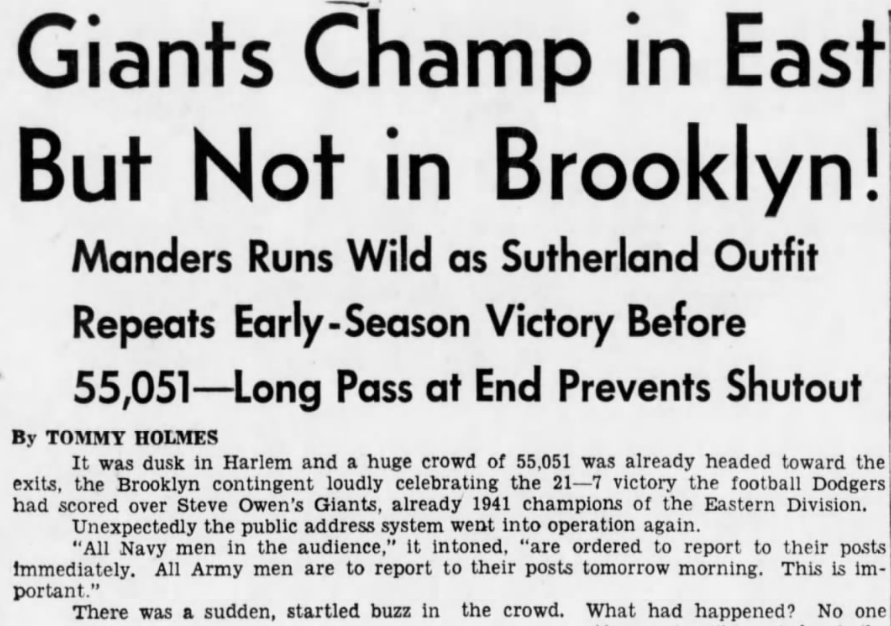
December 7, 1941 was a Sunday, and 3 games were played in the National Football League. The most notable was at the Polo Grounds in New York, between 2 teams that were named for established baseball teams: The New York Giants and the Brooklyn Dodgers.

The Giants had won the NFL's Eastern Division title, as they had previously done in 1933, 1934, 1935, 1938 and 1939, winning the NFL Championship Game in 1934 and 1938 -- Super Bowl -XXXIII and Super Bowl -XXIX, if you prefer. But before they could face the Chicago Bears in the 1941 edition (having beaten them in 1934 and lost to them in 1933), they had to face the football Dodgers, who, like their baseball namesakes, played home games at Ebbets Field.

It was Tuffy Leemans Day at the Polo Grounds. Alphonse Emil Leemans (1912-1979) was a native of Superior, Wisconsin, and had been an All-American back (offensive and defensive) at George Washington University in Washington, D.C. The Giants would later retire his Number 4, and he was elected to the Pro Football Hall of Fame.
The Dodgers didn't care. They were going for a season sweep of the Giants, and they got it, winning 21-7. The Giants may have been the official Division Champions, but the Dodgers were the unofficial City Champions.
The Brooklyn Eagle, December 8, 1941

The attack started at 7:48 AM Hawaii time, which was 1:48 PM East Coast time. During the 2nd half, word got to the press box, and announcements began to come over the public address system. In those days, it was rare for someone to get paged at a sporting event. Usually, it was a doctor, who had to go and attend to a medical emergency.

This time, with the draft already in place, and enlistments already well underway as well, military officers attending the game were paged, and told to report to their various bases in and around New York City.

At Comiskey Park in Chicago, home to the Great Lakes Naval Training Center on Lake Michigan, another crosstown battle was held. The Bears beat the host Cardinals 34-24. And at Griffith Stadium in Washington, in the capital so the number of government officials and military officers present was considerably larger than in New York and Chicago, the host Redskins beat the Philadelphia Eagles 20-14.

When the game in New York ended, Dodger fans could not openly celebrate, and Giant fans didn't care, either, because it was then announced to the crowd that Pearl Harbor had been attacked.

The NFL Championship Game was played as scheduled, at Wrigley Field in Chicago on December 21, and, despite a 9-9 deadlock in the 3rd quarter, the Bears went on to beat the Giants 37-9.

This was during Major League Baseball's offseason, so none of their games were played. This was 5 years before the founding of the NBA, so none of their games were played. There were 3 National Hockey League games played on the day that Pearl Harbor was attacked:

* At the old Madison Square Garden, the host New York Rangers beat the defending Stanley Cup Champions, the Boston Bruins, 5-4. Alex Shibicky scored 2 goals.

* At the Olympia Stadium, the host Detroit Red Wings beat the Montreal Canadiens, 3-2.

* And at the Chicago Stadium, the host Chicago Blackhawks beat the Brooklyn Americans, 5-4. Only in this, what turned out to be their last season, were the former New York Americans, or "Amerks," using the Brooklyn name, even though they still played all their home games at The Garden. A plan for a new arena in Brooklyn was proposed for after The War, but it never happened, and the franchise suspended at the conclusion of the 1941-42 season, was officially folded in 1946.

* The Toronto Maple Leafs were not scheduled to play that day.

Time magazine named Roosevelt its Man of the Year for the 3rd time, due to his efforts to aid Britain, France and the Soviet Union without getting Congress to declare war on the Axis Powers, until Pearl Harbor made it unavoidable.

Sunday, December 4, 2022

December 4, 1982: The Nebraska Cornhuskers Go to Hawaii

Aloha Stadium

December 4, 1982: The University of Nebraska plays a football game. The weather was perfect. Some 16,000 people from Nebraska attended.

Doesn't sound like much, does it? Especially by Nebraska standards.

The game was in Hawaii.

And the recession that the nation was in had hit farm communities especially hard. But 16,000 Nebraskans were among the 46,876 fans inside Aloha Stadium in Halawa, a suburb of Honolulu, that day. Nebraska, ranked Number 3 in the country, beat the University of Hawaii, 37-16.

The Cornhuskers had already won the Big Eight Conference title. On New Year's Day, they beat Louisiana State University (LSU) in the Orange Bowl. But a loss to Penn State earlier in the season decided the National Championship: Had Nebraska won that game, they, rather than Penn State, would have been awarded it.

In 1982 and 1983 combined, Nebraska went 24-2, losing 2 games by a total of 4 points, but didn't win a National Championship between 1971 and 1994.

Built in 1975, the 50,000-seat Aloha Stadium hosted UH's Rainbow Warriors from then until 2020; "The Hawaiians" of the World Football League in 1975; the Aloha Bowl, usually on Christmas Day, from 1982 to 2000; the Oahu Bowl from 1998 to 2000; the Hawai'i Bowl from 2002 to 2019; the Hula Bowl, a postseason East-West All-Star game, from 1976 to 2020; and the Pro Bowl, the NFL's postseason All-Star game, from 1980 to 2009, again from 2011 to 2014, and once more in 2016.

It also hosted Team Hawaii in the North American Soccer League in 1977. And from 1976 to 1987, it hosted the Hawaii Islanders of baseball's Pacific Coast League. The stands rotated to set up something resembling a baseball configuration. In 1997, the St. Louis Cardinals and the San Diego Padres played 3 regular-season games there.
The stadium was not built with Hawaii's climate in mind, and deteriorated much sooner than expected. The University moved out after the 2019 season, to a much smaller on-campus stadium. As of 2022, the plan is to demolish the old stadium in 2024, and build the new one, seating 35,000, on the site.

*

December 4, 1982 was a Saturday. These other college football games were played that day:

* Number 12 Texas beat Number 6 Arkansas, 33-7 at Memorial Stadium in Austin, Texas, to clinch the Southwest Conference title.

* Florida upset Number 15 Florida State, 13-10 at Doak Campbell Stadium in Tallahassee, Florida.

* And Navy beat Army, 24-7 at Veterans Stadium in Philadelphia.

Baseball was out of season. There were 7 games played in the NBA:

* The New York Knicks beat the Atlanta Hawks, 80-79 at Madison Square Garden.

* The Cleveland Cavaliers beat the Indiana Pacers, 109-89 at The Coliseum in the Cleveland suburb of Richfield, Ohio.

* The Boston Celtics beat the Detroit Pistons, 119-112 at the Silverdome in the Detroit suburb of Pontiac, Michigan.

* The Washington Bullets beat the Dallas Mavericks, 115-105 at the Reunion Arena in Dallas.

* The Houston Rockets beat the San Antonio Spurs, 94-93 at The Summit in Houston. (The arena has since been converted into the Central Campus of the Lakewood Church, Dr. Joel Osteen's "megachurch.")

* The Utah Jazz beat the Chicago Bulls, 131-124 at the Salt Palace in Salt Lake City. Adrian Dantley scored 57 points.

* And the San Diego Clippers beat the Phoenix Suns, 113-103 at the Arizona Veterans Memorial Coliseum in Phoenix.

And there were 10 games in the NHL:

* The New York Rangers lost to the Hartford Whalers, 5-2 at the Hartford Civic Center (now the PeoplesBank Arena).

* The New York Islanders lost to the Toronto Maple Leafs, 4-1 at Maple Leaf Gardens in Toronto.

* The New Jersey Devils lost to the Detroit Red Wings, 6-2 at the Joe Louis Arena in Detroit.

* The Quebec Nordiques beat the Buffalo Sabres, 3-2 at Le Colisée de Québec.

* In an "Original Six" matchup, the Boston Bruins beat the Montreal Canadiens, 6-4 at the Montreal Forum.

* The Washington Capitals beat the Chicago Black Hawks, 4-2 at the Capital Centre in the Washington suburb of Landover, Maryland.

* The Philadelphia Flyers and the Pittsburgh Penguins, arch-rivals, played to a 0-0 tie at the Civic Arena in Pittsburgh.

* The Minnesota North Stars beat the Winnipeg Jets, 4-1 at the Metropolitan Sports Center in the Minneapolis suburb of Bloomington, Minnesota.

* The Edmonton Oilers beat their arch-rivals, the Calgary Flames, 7-5 at the Northlands, Coliseum.

* The Los Angeles Kings beat the St. Louis Blues, 6-3 at The Forum outside Los Angeles in Inglewood, California.

* And the Vancouver Canucks were the only team not scheduled to play.

Tuesday, September 20, 2022

September 20, 1968: "Hawaii Five-O" Premieres

Left to right: Gilbert "Zulu" Kauhi, Jack Lord,
Kam Fong and James MacArthur

September 20, 1968: Hawaii Five-O premieres on CBS. It runs for 12 seasons, and becomes one of the most popular crimefighting dramas in television history.

The timing was problematic. It had been 3 weeks since the "police riot" at the Democratic National Convention in Chicago. Fortunately, at this point, the number of people who wanted to see the police as good guys -- either presuming they always were, or wanting to see good examples rather than the bad ones in Chicago -- far outnumbered the people who saw the police as bad guys, and the show was a hit.

The show was shot nearly entirely on location in Hawaii, the 50th and most recent State to enter the Union, hence, "Five-Oh." Jack Lord -- previously the 1st actor to play CIA Agent Felix Leiter in the James Bond films, and an early choice to play Captain James T. Kirk on Star Trek before William Shatner was cast -- played Captain Steve McGarrett, a former U.S. Navy officer who is appointed by Governor Paul Jameson, played by Richard Denning, to lead a special task force of the State Police, answerable only to him, headquartered at the ʻIolani Palace, the former royal residence of the monarchs of the Kingdom of Hawai'i. (In real life, it is now a public museum, and the only former royal palace on American soil. Also in real life, the Governor at that time, John A. Burns, cooperated with filming.)

James MacArthur, son of Helen Hayes, "The First Lady of the American Theater," and ex-husband of actress Joyce Bulifant, played Steve's young second-in-command, Danny Williams, often called "Danno" by Steve. Often, at the show's end, Steve would tell Danny to book the perpetrator with the appropriate charge. Example: "Book 'em, Danno. Murder one." (Murder in the first degree.)

Kam Tong Chung, a Hawaiian native who was a witness to the attack on Pearl Harbor in 1941, and later served 16 years with the real-life Honolulu Police Department, appeared on the show under his stage name Kam Fong (the result of a school's clerical error), and played Detective Chin Ho Kelly, the most veteran member of Steve's team. In 1978, when Fong got tired of the show, the character was killed off on an undercover assignment, soon avenged by the team.

Another native, Gilbert Lani Kauhi, using the stage name "Zulu" -- making him sound African instead of Hawaiian -- played Detective Kono Kalakaua. He was the team's muscle: If Steve was equivalent to Bonanza's Ben Cartwright, Danny to Little Joe, and Chin Ho (though the oldest actor and character) to Adam, then Kono was Hoss. After 4 seasons, Kauhi got tired of being treated like the dumb tough guy, saying little more than, "Yes, boss," and quit.

Chin Ho was named for Chinn Ho, the Hawaii real-estate developer who got the Ilikai Hotel built in Honolulu. It was the State's 1st luxury high-rise hotel. The show's opening sequence, perhaps the best-remembered feature from the show, opened with a huge wave, and showed various Hawaii landmarks, including the Aloha Tower, and zoomed in on Lord as Steve, standing on the balcony of the Ilikai. The theme song was one of the most memorable instrumental songs of the era, and a rocked-up version became a Top 10 hit for the instrumental band The Ventures.

From 1969 to 1975, Tausau Ta'a, a Samoan actor using the stage name Al Harrington (after his stepfather), played Detective Ben Kokua. From 1972 until the show ended in 1980, Herman Wedemeyer played Detective Sergeant Duke Lukela, a character apparently named for the legendary king of Hawaiian surfers, Duke Kahanamoku.

Both Harrington and Wedemeyer had played college football in the San Francisco Bay Area: Harrington at Stanford, but he turned down a lowball offer to play for the Baltimore Colts; and "Squirmin' Herman," nicknamed for his ability to break tackles, at St. Mary's College in the East Bay, and he did play for the Colts. Before being cast on the show, Wedemeyer had been elected to the Honolulu City Council as a Democrat in 1968, and then to the Hawaii House of Representatives as a Republican in 1970 and 1972. I can't find a reason for his switch of parties.

From 1974 to 1976, Douglas Kinilau Mossman played Detective Frank Kamana. From 1977 until the series ended, Sharon Farrell played Detective Lori Wilson. In 1979, for what turned out to be the show's last season, MacArthur left the cast, and William Smith joined as Detective James "Kimo" Carew, and Wilfred Nalani "Moe" Keale, one of Hawaii's leading native musicians (and the uncle of another, Israel "Brother Iz" Kamakawiwoʻole), joined as Detective "Truck" Kealoha.

Danny Kamekona appeared in 33 different episodes, in 23 different roles, including 4 different doctors. In 3, all of them in 1969, he played Che Fong, the team's forensic specialist. In 8, 6 of them in 1974, he played Chief Nick of the Honolulu Police Department. From 1969 to 1977, Harry Endo replaced Kamekona as the forensic specialist, though the character's name of Che Fong was kept. Al Eben played Doc Bergman (his first name was never mentioned), the team's coroner.

While the Five-O team took on all kinds of criminals, including organized crime, the show's main villain was Wo Fat, played by Kenneth Dickerson, who cited his part-Chinese ancestry and used the stage name Khigh Dheigh.

The character appeared in the pilot, as a Chinese intelligence agent, and became a recurring character. By 1976, he was depicted as the head of the Chinese Mafia (a branch of the nationalist Tongs in Hong Kong, not the Communists in Beijing). In the series finale, airing on April 5, 1980, after trying for nearly 12 years, getting only the little fish around him, Steve McGarrett finally defeated and arrested Wo Fat.

The term "five-oh" has become a slang term for police, and "Book 'em, Danno" has also entered the lexicon. Jack Lord loved being in Hawaii so much, he made it his permanent home. He closed every episode by narrating a preview of the next week's episode, saying, "Be there. Aloha!" (Like the Hebrew "Shalom," "Aloha" can mean many things, including "Hello," "Goodbye" and "Peace.")

Leonard Freeman died in 1974, when the show was still near its peak. Khigh Dheigh died in 1991, Danny Kamekona in 1996, Jack Lord and Richard Denning in 1998, Herman Wedemeyer in 1999, Kam Fong and Moe Keale in 2002, Al Eben in 2003, Gilbert Kauhi in 2004, Harry Endo in 2009, and James MacArthur in 2010.

From 2010 to 2020, CBS aired a rebooted version of the show, with the slightly altered title of Hawaii Five-0, the last character being a zero instead of a capital letter O. The dynamic of the 2 lead characters was changed: Steve (played by Australian actor Alex O'Loughlin) and Danny (Scott Caan, son of James) were no longer 17 years apart in age, with a father-son or mentor-protegé relationship; they were the same age, and acted more like partners but bickering brothers. (The same age? In fact, Caan was born on August 23, 1976, just before the original show began its 9th season, and O'Loughlin was born the very next day.)

Lost veteran Daniel Dae Kim played Chin Ho Kelly as a much younger character, who succeeded Steve as the quarterback for their high school's football team, breaking all his records. (Video footage showed quarterback Steve wearing, naturally, uniform number 50.) And Kono Kalakaua was completely different in this version: As played by Grace Park, Kono was female, thin, a surfing champion, and Chin Ho's cousin. This was the 2nd time Park had played a gender-bent character in a rebooted classic: She played Boomer on the 2000s version of Battlestar Galactica.

Al Harrington appeared on the new H50, although not as Ben Kokua. Doug Mossman also appeared on it, but not as Frank Kamana. Both of them died in 2021. So did William Smith, although he did not appear in the reboot series. As of September 20, 2022, Sharon Farrell is the only notable actor from the original series still alive.

*

September 20, 1968 was a Friday. Author and political commentator Van Jones was born that day.

These baseball games were played on that day:

* The New York Yankees lost to the Boston Red Sox, 4-3 at Yankee Stadium. In the 3rd inning, Mickey Mantle hit a home run off Jim Lonborg. It was the Mick's 18th of the season, and the 536th, and last, of his career. Bill Robinson also hit a home run for the Yankees. Carl Yastrzemski hit a home run for the Red Sox.

* The New York Mets swept a doubleheader from the Philadelphia Phillies at Connie Mack Stadium in Philadelphia, 3-2 and 5-4. Tom Seaver won the opener. For the nightcap, the Mets went with what would now be called "an opener game" or "starter by committee": 2 innings each by Don Cardwell, Nolan Ryan and Don Shaw, and 3 by Cal Koonce, who was credited as the winning pitcher.

* The Detroit Tigers beat the Washington Senators, 6-3 at District of Columbia Stadium in Washington. (It was renamed Robert F. Kennedy Memorial Stadium the next season.) Jim Northrup hit 2 home runs, and Al Kaline went 4-for-4 with a solo home run.

* The Pittsburgh Pirates beat the Chicago Cubs, 5-0 at Forbes Field in Pittsburgh. Steve Blass pitched a 2-hit shutout. Roberto Clemente went 2-for-4. Willie Stargell did not play. Ernie Banks went 0-for-3.

* The Chicago White Sox beat the Baltimore Orioles, 2-1 at Comiskey Park in Chicago. Brooks Robinson went 0-for-4, but Frank Robinson went 1-for-2 with 2 walks.

* The Houston Astros beat the Cincinnati Reds, 7-6 at the Astrodome in Houston. Pete Rose went 3-for-5 with 2 RBIs. Johnny Bench went 1-for-5 with an RBI.

* The Oakland Athletics beat the Minnesota Twins, 7-1 at Metropolitan Stadium in the Minneapolis suburb of Bloomington, Minnesota. Reggie Jackson went 2-for-4 with an RBI. Harmon Killebrew went 2-for-4. Rod Carew, uncharacteristically, went 0-for-4.

* The Los Angeles Dodgers beat the St. Louis Cardinals, 5-4 at Dodger Stadium in Los Angeles. Lou Brock went 3-for-5 with a solo home run.

* The San Francisco Giants beat the Atlanta Braves, 8-1 at Candlestick Park in San Francisco. Hank Aaron goes 0-for-2, and is replaced by his brother Tommie Aaron, who also goes 0-for-2. They hold the career record for most home runs by a pair of brothers: 768. Hank hit 755, and Tommie hit 13. By a weird coincidence, Willie Mays also went 0-for-2 before being replaced.

Juan Marichal was not replaced: He went the distance to win his 26th game of the year. But with the pitching achievements of Don Drysdale and Bob Gibson in his own League, of Denny McLain in the other, and Gibson and Mickey Lolich in the upcoming World Series, hardly anybody remembers Marichal's great season.

* And the California Angels and the Cleveland Indians were not scheduled.

Thursday, September 8, 2022

September 9, 1924: The Hanapēpē Massacre

September 9, 1924: The Hanapēpē Massacre takes place in Hawaii. Police kill 16 striking Filipino sugarcane plantation workers.
To oppose organized labor, the Hawaiian Territorial Legislature -- dominated by non-natives -- passed the Criminal Syndicalism Law of 1919, the Anarchistic Publications law of 1921, and the Anti-Picketing Law of 1923. These laws, with penalties of up to 10 years in prison, increased the discontent of the workers.
The Filipinos, who were rapidly becoming the dominant plantation labor force, had deep-seated grievances: as the latest immigrants they were treated most poorly. Although the planters had claimed there was a labor shortage and they were actively recruiting workers from the Philippines, they wanted only illiterate workers, and turned back any arrivals who could read or write, as many as 1 out of every 6.
The conflict began when two Ilocano youth, allegedly breaking a Filipino-led labor strike, were detained and harassed by a group of Visayans at the Hanapēpē strike camp. When the local police were called to settle the dispute, they arrived with a group of heavily armed special deputies. Upon arrival, the officers issued warrants of arrest for the two detained Illocanos, causing the collection of Filipino strikers to rally in opposition.
Despite previously ridiculing the two Ilocanos, the remaining Filipinos armed themselves, and demanded the boys be released.  A violent exchange ensued wherein 16 Filipino laborers and 4 police officers were left dead.
The police rounded up all male protesters they could find, and a total of 101 Filipino men were arrested. Of these, 76 were brought to trial. Of these, 60 received 4-year jail sentences. After 8 months, the strike disintegrated, the labor movement in Hawaiʻi dwindled, and discontent among the workers rarely surfaced again.
*
September 9, 1924 was a Tuesday. Actress Sylvia Miles was born. And these baseball games were played:
* The New York Yankees beat the Boston Red Sox, 5-4 at Fenway Park in Boston. Herb Pennock got his 20th win of the season. Babe Ruth went 0-for-4 with a walk, and rookie Lou Gehrig appeared as a pinch-hitter, but struck out. But Bob Meusel hit a home run.
* The Detroit Tigers beat the Chicago White Sox, 7-3 at Navin Field (later Briggs Stadium and Tiger Stadium) in Detroit. Ty Cobb, by this point also the Tigers' manager, went 1-for-3 with a walk. For the White Sox, Eddie Collins went 2-for-4 with a walk.
* The Chicago Cubs beat the Cincinnati Reds, 4-3 at Cubs Park (later Wrigley Field) in Chicago.
* The St. Louis Cardinals swept a doubleheader from the Pittsburgh Pirates, 7-4 and 6-4 at Sportsman's Park in St. Louis. Over the 2 games, Rogers Hornsby went 3-for-7 with a walk and an RBI.
* The New York Giants and the Boston Braves were rained out at the Polo Grounds. The game was made up as part of a doubleheader the next day. The Giants swept, 22-1 and 8-0. Nope, that's not a misprint on the opener: Twenty-two to one. They didn't score more than 5 runs in any inning, but they scored in every inning but the 2nd (and, of course, the 9th, since it wasn't necessary).
Frankie Frisch went 6-for-7 with a home run and 4 RBIs. Emil "Irish" Meusel, Bob's brother, went 5-for-6 with 3 RBIs. Lewis "Hack" Wilson, not yet the star he would be on the Chicago Cubs, went 3-for-5 with a walk and an RBI. Hank Gowdy, no longer the star he was leading Boston's "Miracle Braves" past the Giants for the 1914 Pennant, went 2-for-3 with a home run, a walk and 4 RBIs. Ross Youngs also hit a home run for the Giants.
And that was just in the 1st game! In the 2nd, game, Hugh McQullain pitched a 3-hit shutout, and Travis Jackson hit a home run. Wilson, Youngs and Meusel each added another RBI.
* The Washington Senators and the Philadelphia Athletics were rained out at Shibe Park in Philadelphia. The game was made up as part of a doubleheader the next day. The A's won the opener, 2-1. The Senators won the nightcap, 6-5.  

* The Brooklyn Robins (as the Dodgers were known during Wilbert Robinson's managing from 1914 to 1931) and the Philadelphia Phillies were rained out at Ebbets Field. The game was made up on an off-day, 2 days later. Brooklyn won, 8-7. Eddie Brown singled Andy High home with the winning run in the bottom of the 11th inning.

* And the Cleveland Indians and the St. Louis Browns were not scheduled.

Sunday, August 21, 2022

August 21, 1959: Hawaii Is Admitted As the 50th State

August 21, 1959: Hawaii -- or "Hawai'i," as its natives write its name -- is admitted to the Union as the 50th State. It remains the most-recently-added State.

The 1st 48 States are known as the "Contiguous States." But Alaska and Hawaii, the 2 newest States, are separated from them, and neither borders any other State.

Because new States mean new stars added to the American Flag on the following July 4, the addition of a 50th Star on July 4, 1960 produced the American Flag that has flown ever since. On July 5, 2007, it surpassed the 48-Star Flag of July 4, 1912 to 1959 as the longest-lasting American Flag.
Hawaii's State Flag is a combination of the American Stars & Stripes and the British Union Jack. It is a legacy of the British Royal Navy's historical relations with the Kingdom of Hawai'i, and, in particular, the pro-British sentiment of the 1st ruler of a united Hawaiian Islands, King Kamehameha I. This flag was retained after the overthrow of the Hawaiian monarchy in 1893, after U.S. annexation in 1898, and after Statehood in 1959. The original State Capitol building, replaced by the current one in 1969, was the Royal Palace, and is the only royal palace on what is now American soil.

Hawaii is a chain of islands in the Pacific Ocean. There are 8 main islands. From west to east, they are: Ni'ihau, The Forbidden Isle (population just 84); Kaua'i, The Garden Isle; O'ahu, The Gathering Place; Moloka'i, The Friendly Isle; Lānaʻi, The Pineapple Isle; Kaho'olawe, The Target Isle (no permanent residents); Maui, The Valley Isle; and Hawai'i, The Big Island. Ka Lae, on the Big Island, is the southernmost point in the United States.

Hawaii is known for each beach resorts, its flowers, its volcanoes, and its U.S. Navy base at Pearl Harbor, whose attack by Japanese airplanes on December 7, 1941 brought America into World War II.

Hawaii has the lowest percentage of white residents of any State, just 21 percent; and 57 percent as Asian and/or "Pacific Islander." Because of this multicultural background Hawaii tends to be liberal politically. Since its 1st Presidential election in 1960 -- when a recount turned it from Richard Nixon to John F. Kennedy -- it has only voted for the Republican nominee for President twice: Nixon in 1972, and Ronald Reagan in 1984, the 2 elections where 49 of the 50 States were won.

Hawaii has about 1.4 million people, with O'ahu having the vast majority of them, just over 1 million people. It is home to Honolulu, the State's capital and, at 350,000, its largest city. The State's size, and its distance from the American mainland -- 2,556 air miles from Honolulu to Los Angeles, almost as much as from the Pacific Coast to the Atlantic Coast -- and its time zones, 3 hours behind Pacific Time and 6 hours behind Eastern Time, make major league sports there almost impossible.

The Hawaii Islanders played in the Class AAA Pacific Coast League from 1961 to 1987. A team known simply as "The Hawaiians" played in the World Football League in 1974 and '75. The State has hosted college football bowl games and early-season college basketball tournaments. The University of Hawaii has had a prominent football program.

It is unlikely that there will be a 51st State anytime soon. Potential candidates tend to include the District of Columbia and Puerto Rico, but the former has Republicans in Congress standing in its way, since they don't want a majority-black State electing 1 liberal to the U.S. House of Representatives and 2 to the Senate; and the latter has voted to remain a "commonwealth," instead of for Statehood or independence, every time the subject has come up.

*

August 21, 1959 was a Friday. Jim McMahon, the only quarterback ever to lead the Chicago Bears to victory in a Super Bowl, was born.

These baseball games were played:

* The New York Yankees beat the Kansas City Athletics, 9-7 at Kansas City Municipal Stadium. Duke Maas was the winning pitcher. Héctor López hit a home run. Mickey Mantle went 1-for-3 with 2 walks. Yogi Berra went 1-for-4 with a walk and 2 RBIs. For the A's, future major league manager Dick Williams hit a home run, and Roger Maris drew a walk as a pinch-hitter. After the season, the Yankees traded for Maris.

* The San Francisco Giants swept a doubleheader from the Philadelphia Phillies, 6-0 and 10-6 at Connie Mack Stadium in Philadelphia. In the opener, Johnny Antonelli allowed 8 hits, but kept the shutout to beat Robin Roberts, and even hit a home run in his own cause. Over the 2 games, Willie Mays went 1-for-10, and Willie McCovey went 2-for-9 with 2 RBIs.

* The Los Angeles Dodgers beat the Pittsburgh Pirates, 6-5 at Forbes Field in Pittsburgh. Roberto Clemente went 1-for-3.

* The Cleveland Indians beat the Baltimore Orioles, 5-0 at Cleveland Municipal Stadium. Jack Harshman pitched a 3-hit shutout.

* The Cincinnati Reds beat the St. Louis Cardinals, 2-1 at Crosley Field in Cincinnati. Frank Robinson went 1-for-3 with a walk. Stan Musial appeared as a pinch-hitter, and drew a walk.

* The Detroit Tigers beat the Boston Red Sox, 2-0 at Briggs Stadium in Detroit. (It was renamed Tiger Stadium in 1961.) Paul Foytack pitched a 4-hit shutout. Al Kaline hit a home run. Ted Williams appeared only as a pinch-hitter, and struck out.

* The Chicago White Sox beat the Washington Senators, 5-4 at Comiskey Park in Chicago.

* And the Chicago Cubs and the Milwaukee Braves were rained out at Milwaukee County Stadium. The game was made up as part of a doubleheader the next day. The Braves swept, 7-0 and 3-2. Carl Willey pitched a 6-hit shutout in the 1st game. In the 2nd game, with Stan Lopata batting in the bottom of the 9th, Bill Henry threw a wild pitch, allowing Bobby Ávila to score the winning run.

Over the 2 games, Hank Aaron went 0-for-8 with a walk, Eddie Mathews went 4-for-8 with a walk and 2 RBIs, and Ernie Banks went 0-for-8.

Wednesday, June 1, 2022

June 1, 1958: The Kingston Trio Launch the Folk Music Boom

Left to right: Bob Shane, Dave Guard, Nick Reynolds

June 1, 1958: The Kingston Trio release their self-titled debut album, sparking a revival in folk music. This was embraced by millions of adults who were looking for an alternative to rock and roll, but also by many teenagers, who found the music as authentic as the teen-oriented songs they were listening to.

Folk music had suffered from the blacklisting of left-leaning performers like The Weavers, including their lead singer, Pete Seeger. In late 1956, Harry Belafonte had a hit with "Jamaica Farewell," which led to the rise of the Caribbean form of folk music, known as "calypso," but he was the only singer who got much mileage out of it. "Grownup" singers like Frank Sinatra and Patti Page were not going to take it up.

Nicholas Wells Reynolds was born on July 27, 1933 in San Diego, and grew up in nearby Coronado, California. He went to Menlo College, outside San Francisco. Robert Castle Schoen was born on February 1, 1934 in Hilo, Hawaii, and grew up in Honolulu, where he anglicized his name to Bob Shane. Donald David "Davey" Guard was born on October 19, 1934 in San Francisco. He grew up in Honolulu, where he met Shane. Shane also went to Menlo, where he met Reynolds. Guard went to nearby Stanford University, and Shane introduced him to Reynolds.

They all loved calypso music, and in honor of Jamaica's capital, they named themselves The Kingston Trio. In June 1957, they were hired at San Francisco's Purple Onion club, and became local stars. Bob Hope saw them, and this led to them to being signed by Capitol Records.

They recorded their self-titled debut album at Capitol Studio in Los Angeles, and it was released on June 1, 1958. It included mostly established songs, including "(The Wreck of The) 'John B,'" which would be turned into a hit by The Beach Boys, as "Sloop John B." Guard wrote 2 songs for the album, "Scotch and Soda" and "Little Maggie." But most were traditional songs.

One was "Tom Dooley," which was based on the murder of Laura Foster on May 25, 1866 in the Great Smoky Mountains of North Carolina. Tom Dula, her boyfriend, was hanged for his murder on February 1, 1868. Most likely, he didn't kill her: It is now believed to have been a rival for Tom's affections, Anne Melton. There was a Colonel James Grayson, who employed Dula across the State Line in Tennessee. But the song that developed totally got that part wrong, making it sound like Grayson was the rival for the woman's affections, and that he ratted Tom out, and that Tom never made it to Tennessee.

Nevertheless, the song got passed down through oral tradition, and was recorded by the Colonel's nephew, G.B. Grayson, in 1929. Frank Profitt recorded it in 1940. Frank Warner knew the Profitt version, and recorded the song in 1952. The Kingston Trio's version was, essentially, a copy of that version, and hit Number 1 in America on November 17, 1958.

It sparked a revival of folk music in 1958 that would last until the arrival of The Beatles in America in 1964. It enabled the rise of Bob Dylan, Paul Simon & Art Garfunkel, and "folk-rock" acts like The Byrds and The Lovin' Spoonful.

The Trio packed auditoriums all over the country over the next few years. It's not clear if they had enough support to fill sports arenas like The Beatles did starting in 1964, but their style was more intimate, anyway, so those 3,000-seat theaters were more up their alley.

They recorded the 1948 Boston political song "M.T.A." in 1959, and between the 4th and 5th verses, Shane can be heard saying, "Pick it, Davey!" Davey Guard then played his banjo so fast that he could be heard saying, "Kinda hurts my fingers!" In 1961, Guard left the group, and John Stewart was hired as his replacement. Stewart is better known as the writer of "Daydream Believer," a Number 1 hit for The Monkees in 1967.

Guard died of cancer in 1991, only 56 years old. Stewart and Reynolds continued to perform with Shane as The Kingston Trio. Stewart and Reynolds lived until 2008, ages 68 and 75, respectively. Shane was the last survivor, dying on January 26, 2020, just short of his 86th birthday.

*

June 1, 1958 was a Sunday. These baseball games were played:

* The New York Yankees beat the Boston Red Sox, 10-4 at Fenway Park in Boston. Bob Turley went the distance for the win, striking out 10. He went on to become the 1st Yankee to win the Cy Young Award, preceding Whitey Ford by 3 years.

3rd baseman Andy Carey had a career day, going 5-for-5 with 2 home runs and 4 RBIs. Elston Howard went 3-for-5 with 2 RBIs. Bill "Moose" Skowron went 1-for-5 with 3 RBIs, including 1 on a groundout. Mickey Mantle went 2-for-4 with a walk. Yogi Berra went 1-for-5.

For the Red Sox, Ted Williams went 0-for-2 with 2 walks and an RBI on a groundout; while Jackie Jensen, a former Yankee, went 1-for-4 with 3 RBIs, on his way to being named the American League's Most Valuable Player, an award that should have gone to Mantle for the 3rd straight season, or perhaps to Turley.

* The Cincinnati Redlegs, in their last of 6 seasons under that stupid McCarthyism-inspired name before going back to "Reds," beat the Philadelphia Phillies, 2-1 at Connie Mack Stadium. Frank Robinson went 0-for-5. It was the opener of a doubleheader.

The nightcap got underway, but, because a vestige of Pennsylvania's old Sunday "blue law" was still in effect, the game was suspended in the top of the 9th, with the score tied, 11-11. It was completed on August 11, and the Reds won it, 12-11, when an error by Phils pitcher Turk Farrell, mishandling a Johnny Temple bunt, allowed Robinson to score.

Robinson had entered the game as a pinch-runner, played left field and center field, and went 1-for-2. Temple went 5-for-11 with a home run and 6 RBIs on the day, while Steve Bilko went 3-for-5 in the nightcap.

* The Washington Senators beat the Baltimore Orioles, 5-2 at Memorial Stadium in Washington. Brooks Robinson went 0-for-4. Harmon Killebrew, with the Senators at the time, did not play.

* The Pittsburgh Pirates beat the Milwaukee Braves, 5-1 at Forbes Field in Pittsburgh. Roberto Clemente went 1-for-4 with an RBI. Hank Aaron went 1-for-3. Eddie Mathews went 0-for-1 with 2 walks.

* The Los Angeles Dodgers beat the Chicago Cubs, 1-0 at Wrigley Field in Chicago. Stan Williams pitched a 2-hit shutout, outpitching Dick Drott. The only run came in the 4th, when Don Zimmer singled Carl Furillo home. Ernie Banks went 0-for-3.

* The Kansas City Athletics beat the Cleveland Indians, 6-2 at Kansas City Municipal Stadium. Roger Maris had an RBI on a sacrifice fly as a pinch-hitter for the Indians, and reached base when the KC right fielder, Bill Tuttle, dropped the ball. Two weeks later, the A's acquired Maris in a trade, settling their right field problem -- for a year and a half, until the Yankees made them an offer they couldn't refuse.

* The San Francisco Giants beat the St. Louis Cardinals, 7-2 at the 1st Busch Stadium, formerly the last Sportsman's Park, in St. Louis. Willie Mays went 2-for-3 with a walk and an RBI. Stan Musial did not play.

* And the Chicago White Sox and the Detroit Tigers were rained out at Briggs Stadium in Detroit. (It was renamed Tiger Stadium in 1961.) The game was made up as part of a doubleheader on August 10. The White Sox won the 1st game, 5-2. Jim Rivera went 2-for-3 with a home run and 4 RBIs. The Tigers won the 2nd game, 4-3, when Reno Bertoia bunt-singled Frank Bolling home in the bottom of the 12th inning. Rivera got the game off. Over the 2 games, Al Kaline went a miserable 0-for-9.

Sunday, January 16, 2022

January 17, 1893: The Hawaiian Kingdom Is Overthrown

Queen Liliʻuokalani of Hawai'i

Note: When using terms that existed at the time, I am using the name and the English-language spelling as they then stood "Hawaii." When discussing the place itself, I am using the current version: "Hawai'i."

January 17, 1893: The Hawaiian Kingdom is overthrown, ending the 98-year Kamehameha Dynasty, and bringing the Hawaiian Islands under corporate control.

Kamehameha the Great established the Kingdom in 1795, and united the Islands in 1810. He was succeeded by his son, Kamehameha II, in 1819. He died in 1824, and was succeeded by his brother, who became Kamehameha III. He died in 1854, and was succeeded by his nephew, who became Kamehameha IV. He died in 1863, and was succeeded by his brother, who became Kamehameha V.

He died in 1873, and the line of succession had to go back to a grandnephew of Kamehameha I, a first cousin of Kamehamehas II and III, who took the name Lunalilo. But he died after only 13 months on the throne, and they really had to go back in the line of succession, finding Kalākaua, a first cousin once removed of Kamehamehas IV and V.

He died after only 2 years, and, with no available legitimate male heir, the throne passed to his sister, Lili'uokalani. She and her husband, a white man from Schenectady, New York named John Owen Dominis, had no children of her own, but adopted 3. It's not clear who would have succeeded her. Dominis died in 1891, shortly after his wife became Queen.

American and British commercial interests pushed for autonomy, with sugar plantations, and the shipping of their product, making rich men richer. The Kings made one concession after another, but, as is usually the case for rich men, no amount is ever enough.

On January 20, 1887, the United States began leasing a naval base at Pearl Harbor in Honolulu. Shortly afterwards, a group of mostly non-Hawaiians calling themselves the Hawaiian Patriotic League began the Rebellion of 1887. They drafted their own constitution on July 6. Greatly diminishing the monarchy's power, it was written by Lorrin Thurston, the Hawaiian Minister of the Interior, who used the Hawaiian militia as threat against Kalākaua. Kalākaua was forced, under threat of assassination, to dismiss his cabinet ministers and sign what became known as the "Bayonet Constitution."

Both candidates for office and voters were now required to own property valuing at least $3,000, or have an annual income of no less than $600. (In 2022 dollars, those figures would be about $92,500 and $18,500, respectively.) This resulted in disenfranchising 2/3rds of the native Hawai'ians, as well as other ethnic groups who had previously held the right to vote. Asian immigrants were completely shut out and were no longer able to acquire citizenship or vote at all.

Lili'uokalani became Queen upon her brother's death on January 20, 1891. The McKinley Tariff -- written by Representative William McKinley of Ohio, starting the economic downturn that Governor  William McKinley pledged to stop, and President William McKinley did so only with the Spanish-American War -- had removed the duties on sugar imports from other countries into the U.S., eliminating the previous Hawaiian advantage gained via the Reciprocity Treaty of 1875.

Liliʻuokalani wanted to scrap the Bayonet Constitution for a new one, an idea that seems to have been broadly supported by the Hawaiian population, improving voting rights for natives and removing them for non-natives. But when she told her Cabinet, they ratted her out to the legislature, where Euro-American business elites held disproportionate power.

On January 16, 1893, the Marshal of the Kingdom, Charles B. Wilson, was tipped off by detectives to the imminent planned overthrow. Wilson requested warrants to arrest the 13-member council of the Committee of Safety, and put the Kingdom under martial law. Because the members had strong political ties with John L. Stevens, the U.S. Minister to Hawaii (who had founded the Republican Party in Maine and served as a U.S. Senator for that State), the requests were repeatedly denied by Attorney General Arthur P. Peterson and the Queen's cabinet, fearing if approved, the arrests would escalate the situation.
Using the excuse of being concerned about Japanese imperialism -- nearly half a century before such concerns became a reality in Hawai'i -- Stevens obliged the Committee's request for official American backup, and summoned 162 U.S. sailors and Marines from the cruiser USS Boston, one of the U.S. Navy's earliest steel warships, to land on Oahu, under orders of neutrality.
Henry E. Cooper

On January 17, Henry E. Cooper, the Chairman of the Committee of Safety, addressed a crowd assembled in front of 'Iolani Palace, the official royal residence, and read aloud a proclamation that formally deposed Queen Liliʻuokalani, abolished the Hawaiian monarchy, and established a Provisional Government of Hawaii, under President Sanford B. Dole.
Sanford B. Dole

The deposed Queen was kept in ʻIolani Palace under house arrest. The American sailors and Marines did not enter the Palace grounds or take over any buildings, and never fired a shot, but their presence served effectively. The Queen never had an army, the local police did not support her, and no one mobilized any pro-royalist forces. Due to the Queen's desire "to avoid any collision of armed forces, and perhaps the loss of life" for her subjects and after some deliberation, at the urging of advisers and friends, the Queen ordered her forces to surrender.

President Benjamin Harrison was a lame duck, having been defeated in the 1892 election by former President Grover Cleveland. When Cleveland took office on March 4, 1893, he called for an investigation into the overthrow. As a result, Minister Stevens was recalled, and the military commander of forces in Hawaiʻi was forced to resign his commission.

President Cleveland stated, "Substantial wrong has thus been done which a due regard for our national character as well as the rights of the injured people requires we should endeavor to repair the monarchy." But a large majority in Congress, including in his own Democratic Party, was in favor of annexation, and Cleveland's efforts to restore the Islands' sovereignty and to put the Queen back on the throne stalled. Shortly after he took office, the recession that led to his election became a depression with the Panic of 1893, and even people who favored the liberation of Hawai'i, especially Cleveland himself, had other priorities.

Queen Liliʻuokalani remained in Hawai'i, living in exile until her death in 1917, at the age of 79. John L. Stevens did not live to see the annexation, as he died in 1895. So did Arthur P. Peterson, as he and Stevens were both already ill in 1893.

Sanford B. Dole served as President of Hawaii from the overthrow until the annexation in 1898, at which point he was named Territorial Governor. He held that post until 1903, when he was appointed Judge of the U.S. District Court for the Territory, serving until 1915. A cousin, James Dole, took advantage of Hawai'is pineapple crop, and founded the food production company that bears the family name. Sanford Dole died in 1926. So did Charles B. Wilson. Henry E. Cooper died in 1929, and Lorrin Thurston in 1931.

Congress formally annexed Hawai'i in 1898, making it a U.S. Territory, and granted it Statehood on August 21, 1959, making it the 50th State, and, so far, the most recent one. There is an independence movement in Hawai'i, but it is not as big as the one in Puerto Rico, which has lost a lot of steam in recent years.

ʻIolani Palace, the only royal palace on U.S. soil, remained the capitol building of the Republic, the Territory, and the State until 1969, when the current Hawaii State Capitol opened. The 1968-80 CBS crime drama Hawaii Five-O featured exterior shots of the Palace, suggesting that it was the headquarters of the fictional eponymous law-enforcement unit.
In 1993, the 100th anniversary of the overthrow of the Hawaiian Kingdom, Congress passed a resolution, which President Bill Clinton signed into law, offering an apology to Native Hawai'ians on behalf of the United States for its involvement in the overthrow of the Hawaiian Kingdom.

*

January 17, 1893 was a Tuesday. Baseball and football were out of season. Hockey was all-amateur. And basketball was a brand-new sport. So there were no scores on this historic day.

Friday, January 14, 2022

January 14, 1973: Elvis Says Aloha

January 14, 1973: NBC had the rights to cover Super Bowl VII. They also had the rights to air Elvis: Aloha from Hawaii via Satellite. This concert was broadcast all over the world from the Honolulu International Center, now named the Neal S. Blaisdell Center, after the Mayor who got it built. The one major country on Earth that did not broadcast it live was America, because NBC thought it would be too much to ask of their viewers to watch 2 epic events in one day. So they held it back, and broadcast it on April 4, 1973.

Elvis Presley had just turned 38, and had also just finalized his divorce from his wife Priscilla. He came onstage wearing a white jumpsuit with an eagle on the front, an eagle on the back, and a big belt with a double-eagle buckle.

He sang hits from all phases of his career: The early "Memphis Flash" days, his Hollywood exile, and his Las Vegas comeback. As usual, he closed with "Can't Help Falling In Love," which was certainly appropriate on this occasion, because it was used in his 1961 film Blue Hawaii.

It was not one of his better performances. Certainly, he wasn't as into it was he was for his "Comeback Special" in 1968 (also on NBC), or for the Vegas show he did that was included in the 1970 documentary Elvis: That's the Way It Is. He was tired, and the emotional stress of the divorce was weighing on him. He looked like he was still in good shape, but the prescription drugs he was taking had already begun to take their toll. Within 5 years, the King of Rock and Roll was dead.

UPDATE: It took me until 2024 to think of this, but the 1970s were Schrödinger's Decade. There was too much overwrought music, and, at the same time, not enough of it.

*

January 14, 1973 was a Sunday. In Super Bowl VII -- obviously, the only football game played that day -- the Miami Dolphins beat the Washington Redskins, 14-7 at the Los Angeles Memorial Coliseum, completing their unique undefeated season. I have a separate entry for that event.

Baseball was out of season. There were 4 games played in the NBA:

* The New York Knicks beat the Seattle SuperSonics, 86-84 at the Seattle Center Coliseum.

* The Los Angeles Lakers beat the Atlanta Hawks, 102-100 at The Omni in Atlanta. Jerry Wes scored 37 points for the Lakers.

* The Milwaukee Bucks beat the Chicago Bulls, 100-95 at the Milwaukee Exposition & Convention Center Arena, a.k.a. The MECCA. Kareem Abdul-Jabbar had 35 points and 17 rebounds.

* And the Baltimore Bullets beat the Phoenix Suns, 95-94 at the Arizona Veterans Memorial Coliseum in Phoenix.

There were 2 games played in the American Basketball Association. The Carolina Cougars beat the Memphis Tams, 104-100 at the Mid-South Coliseum in Memphis. And the Kentucky Colonels beat the San Diego Conquistadors, 100-97 at the San Diego Sports Arena (now the Pechanga Arena).

There were 7 games played in the NHL that day: 

* The New York Rangers beat the Philadelphia Flyers, 5-2 at The Spectrum in Philadelphia.

* The New York Islanders, in their 1st year of play, lost to the St. Louis Blues, 2-1 at the Nassau Coliseum.

* The Boston Bruins beat the Buffalo Sabres, 6-0 at the Boston Garden.

* The other expansion team, the Atlanta Flames, beat the Los Angeles Kings, 4-1 at The Omni in Atlanta. This building, in its 1st season, hosted both the NBA and the NHL on this day.

* The Detroit Red Wings beat the Pittsburgh Penguins, 3-2 at the Olympia Stadium in Detroit.

* The Chicago Black Hawks and the California Golden Seals played to a tie, 6-6 at the Chicago Stadium.

* The Montreal Canadiens beat the Vancouver Canucks, 3-0 at the Pacific Coliseum in Vancouver.

* And the Toronto Maple Leafs and the Minnesota North Stars were not scheduled.

And the World Hockey Association, in its 1st season, played 2 games that day. The Minnesota Fighting Saints beat the Ottawa Nationals, 3-2 in overtime at the St. Paul Civic Center. And the Winnipeg Jets beat the Cleveland Crusaders, 3-1 at the Winnipeg Arena.

December 31, 1999 & January 1, 2000: The Millennium

December 31, 1999:  The Millennium arrives. The people of planet Earth survived. At a terrible cost. But we hadn't destroyed ourselves. ...