Showing posts with label u.s. senate. Show all posts

Wednesday, December 7, 2022

December 7, 2017: The Railroading of Al Franken

December 7, 2017: Al Franken announces that he will resign from the U.S. Senate.

Alan Stuart Franken was born on May 21, 1951, in Manhattan, grew up in Albert Lea, Minnesota, and graduated from Harvard University. An original writer for Saturday Night Live, he wrote for and acted on the show from 1975 to 1980, and again from 1985 to 1995. He and his co-writer Tom Davis played Amtrak workers in the 1983 film Trading Places.

He entered politics for the first time, sort of, during the 1988 Presidential primaries: On SNL, in a Democratic debate, he played Senator Paul Simon of Illinois, complete with… (basso profundo) "the bow tie"; while in a Republican debate, he played a considerably more excitable, and higher-pitched, Reverend Pat Robertson.

In 1996, he wrote his first political book: Rush Limbaugh Is a Big Fat Idiot and Other Observations. In 2003, he took conservatives on again with Lies and the Lying Liars Who Tell Them: A Fair and Balanced Look at the Right. But after the disappointment of the incredibly dirty 2004 election, he published a (mostly) bitter book titled The Truth (With Jokes).

He finally put his money where his mouth was, and in 2008, won the closest U.S. Senate election in Minnesota history, defeating a Republican incumbent, Norm Coleman. He won with a little more room in 2014. Even his critics admitted that the comedian was serious about his job.

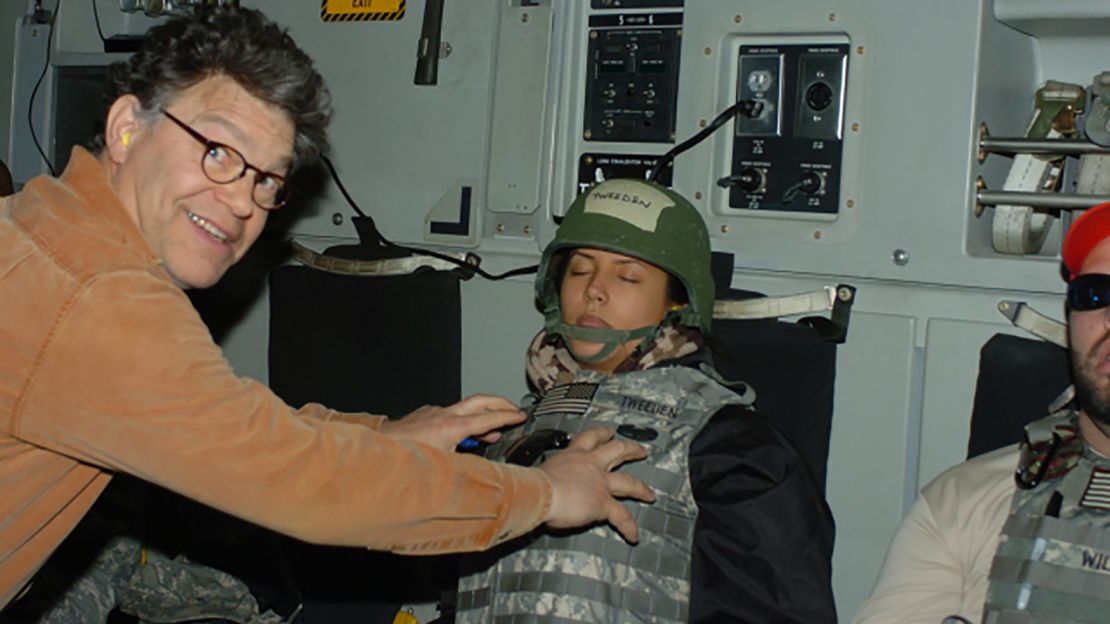
But in 2017, his own fellow Senate Democrats forced him to resign – for nothing. Well, not for nothing: On November 16, radio broadcaster and model Leeann Tweeden alleged in a blog post, and an interview with her radio station, KABC, that Franken (who has been married to Franni Bryson since 1975, and has never been seriously accused of cheating on her) kissed her on a 2006 USO tour, during a rehearsal for a skit. Longtime Republican campaign operative Roger Stone circulated news of the allegations to right-wing media.

At first, it was her word against his. But, soon, a photo from the tour was released, showing him holding his hands above Tweeden's breasts -- but not touching her -- while she was asleep.

In particular, Senator Kirsten Gillibrand of New York, a fellow Democrat, demanded he resign -- at a time when the Democrats had only 46 Senators, plus 2 independents who usually caucused with them, and at a time when Franken was a proven winner of close elections, and had never previously been accused of any wrongdoing.

He should have stood up, and said, "I will resign my office the day after Donald Trump resigns his. Not before," and then walked away from the podium. Because Trump was already known to be guilty of actual sexual assault.

But his fellow Democrats ganged up on him, and he resigned, effective January 2, 2018. Governor Mark Dayton of Minnesota appointed Lieutenant Governor Tina Smith to serve out his term.

On March 17, 2019, Kirsten Gillibrand announced that she was running for President. On August 28, she suspended her campaign, because the sight of blood from Franken's back on her knife still being fresh meant that nobody wanted her. She shifted to running for re-election to the Senate in 2020. She won, while Tina Smith was elected to a full term in the Senate.

Al Franken has not run for public office since. But he is more popular in the Democratic Party than Kirsten Gillibrand. He got railroaded.

*

December 7, 2017 was a Thursday. Baseball was out of season. Football was in midweek. There were 4 games played in the NBA:

* The Brooklyn Nets beat the Oklahoma City Thunder, 100-95 at the Barclays Center.

* The Los Angeles Lakers beat the Philadelphia 76ers, 107-104 at the Wells Fargo Center (now the Xfinity Mobile Arena) in Philadelphia.

* The Houston Rockets beat the Utah Jazz, 112-101 at the Vivint Smart Home Arena (now the Delta Center) in Salt Lake City, Utah.

* And the Washington Wizards beat the Phoenix Suns, 109-99 at the Talking Stick Resort Arena (now the Mortgage Matchup Center) in Phoenix. Bradley Beal of the Wizards led all scorers on the night with 34 points.

And there were 9 games played in the NHL:

* The New York Islanders lost to the Pittsburgh Penguins, 4-3 at the PPG Paints Arena in Pittsburgh. Matt Hunwick scored the winning goal with 3:31 left in overtime.

* The Montreal Canadiens and the Calgary Flames played to a tie, 3-3 at the Bell Centre in Montreal.

* The Boston Bruins beat the Arizona Coyotes, 6-1 at the TD Garden in Boston.

* The Tampa Bay Lightning beat the Colorado Avalanche, 5-2 at the Amalie Arena (now the Benchmark International Arena) in Tampa.

* The Florida Panthers beat the Winnipeg Jets, 6-4 at the BB&T Center (now the Amerant Bank Arena) in the Miami suburb of Sunrise, Florida.

* The St. Louis Blues beat the Dallas Stars, 3-0 at the Scottrade Center (now the Enterprise Center) in St. Louis.

* The Los Angeles Kings beat the Ottawa Senators, 4-3 at the Staples Center (now the Crypto.com Arena) in Los Angeles. Drew Doughty scored the winning goal, 32 seconds into overtime.

* The San Jose Sharks beat the Carolina Hurricanes, 5-4 at the SAP Center in San Jose. Brent Burns scored the winning goal, 22 seconds into overtime.

* And the Philadelphia Flyers beat the Vancouver Canucks, 4-1 at the Rogers Arena in Vancouver.

Tuesday, November 8, 2022

November 8, 1994: The Gingrich Revolution

November 8, 1994: Election Day is a repudiation of the Democratic Party, in particular of President Bill Clinton, his now-withdrawn health care reform plan, and his Assault Weapons Ban. The Republican Party gains 52 seats in the U.S. House of Representatives, giving them control of that body for the 1st time in 40 years, and making Newt Gingrich of Georgia the Speaker. It also gains 9 seats in the U.S. Senate, giving them control of that body for the 1st time in 8 years, returning Bob Dole of Kansas to the office of Senate Majority Leader.

In New York State, Mario Cuomo is defeated for a 4th term as Governor by Peekskill Mayor George Pataki. In Texas, George W. Bush, son of the most recent Republican President, is elected Governor, defeating the State's 1st female Governor, Ann Richards. Bush's brother, John Ellis "Jeb" Bush, narrowly loses to Governor Lawton Chiles of Florida. I suspect that, had it not been for the Savings & Loan Scandal, another brother, Neil Bush, would have run for Governor of Colorado.

Among the new Republicans elected to the Senate: Bill Frist of Tennessee, later the Senate Majority Leader; Rick Santorum of Pennsylvania, who ran for President in 2012 and 2016; Mike DeWine of Ohio, later elected Governor; and Representative Olympia Snowe of Maine, who was married to John "Jock" McKernan, then wrapping up his 2nd and last term as Governor.

In addition, Senators Richard Shelby of Alabama and Ben Nighthorse Campbell of Colorado switched parties to become Republicans. Shelby had previously called himself "the most conservative member of the Senate"; and Campbell, then the only Native American in either house of Congress (a member of the Cheyenne tribe), was more of a Western libertarian than a traditional conservative, but favored gun rights. So neither switch was a big surprise, although they didn't exactly show courage by jumping ship after the election.

Gingrich knew that it wasn't enough to be against Clinton, or against Democrats in general: You had to give the voters something to vote for. He had a 10-point "Contract With America," which includes some reforms of Congress itself, including some items that Democrats were willing to work with them to pass, if with some minor adjustments. But some were drastic, and opposed by most Americans.
The backlash that hit him even before he could take office as Speaker led to him, with Christmas coming up, to being compared with two of the villains of pop-culture Christmas: Time compared him to Ebenezer Scrooge of Charles Dickens' A Christmas Carol, while Newsweek compared him to the title character of How the Grinch Stole Christmas.
As promised, all 10 items passed the House in the 1st 100 days of Republican control. And 9 of them passed the Senate. But some of these, including a radical reform of the nation's welfare laws, and a significant tax cut for the wealthiest 1 percent of Americans, were vetoed by Clinton.

The 1 item that passed the Senate, but not by enough, was an Amendment to the Constitution requiring that the federal budget be balanced. On its face, this seemed like a good idea. The devil was in the details: Because Republican Presidents Ronald Reagan and George H.W. Bush had run the federal budget deficit so high in their 12 consecutive years in the White House, balancing the budget would have required significant spending cuts to Social Security, Medicare, Medicaid, educational spending, and environmental spending. The Republicans were fine with all of that. But they weren't willing to cut spending on new military projects, and Clinton and the Democrats called them out on that.

In the end, requiring a 2/3rds "supermajority" of both houses on Congress -- 290 votes in the House, and 67 in the Senate, instead of a simple majority of 218 and 51, respectively -- the Amendment fell 1 vote short in the Senate.

One Republican voted against it: Mark Hatfield of Oregon. As a former Governor of a State whose budget was already constitutionally required to be balanced -- a lot easier, since States have far lesser, and lesser-ranging, expenses than the country at large, but by no means easy -- Hatfield understood that the Amendment would have been dangerous. It would have cast millions of people into poverty, made things worse for those already poor, and might even have killed people.

And so, the battle was on: Gingrich would lead a Congressional campaign for 1996 on a revised Contract with America, while Senate Majority Leader Bob Dole of Kansas would be the Republican nominee for President, supporting it; and Clinton would run for re-election, calling the Republican proposal "the Contract On America," and making the increasingly unpopular Gingrich "Dole's running mate," no matter who Dole ultimately selected to be his Vice Presidential nominee. Gingrich's successes in early 1995 led Time magazine to name him its Man of the Year.
(Dole chose Jack Kemp, former pro quarterback, an 18-year Congressman where he became one of the champions of tax-cutters, an unsuccessful Presidential candidate in 1988, and President Bush's Secretary of Housing and Urban Development.)

In the end, Clinton was re-elected solidly over Dole, but the Democrats were unable to take back either house of Congress. Over the course of his 2nd term, even as the Republicans tried to impeach Clinton over things that were none of their, or the American people's, concern, failing to get conviction and removal, they were forced to work with him. In 1997, the federal budget was balanced. Clinton, Gingrich, Dole, and Dole's successor as Senate Majority Leader, Trent Lott of Mississippi, could all legitimately claim some credit for that.

But the Republicans' effort to remove Clinton from office angered many Americans, and, incredibly unusual for a party in its 6th straight year of holding the White House, the Democrats actually gained seats in the 1998 Congressional election. Gingrich resigned later that week, pressured into it not because of his own personal and legal failings, in each case worse than Clinton's, but because he had failed as a leader. The conservative movement will accept anything except failure.

The evangelical takeover of the Republican Party became complete with the election of George W. Bush, son of the former President, in 2000. Like Richard Nixon before him, Gingrich bided his time, mended some fences, supported Republican candidates wherever he could, and built a new constituency. In 2008, Barack Obama was elected President, and Gingrich ran for the Republican nomination to beat him for re-election in 2012. He won some Primaries, but his personal scandals came back to haunt him, and he lost too many Primaries to continue.

At the age of 79, he is now seen as an elder statesman in the Party, but, as long as Donald Trump is its emotional leader, the last true "ideas man" in the Republican Party has no place in directing its course.

UPDATE: As of the 2024 election, no Republican freshman elected to the House in 1994 is still in it. But 2 Democrats elected then are: Zoe Lofgren of California and Lloyd Doggett of Texas. Roger Wicker was elected as a Republican from Mississippi, and was elected to the Senate in 2008, and still serves, making him the last remaining "Newtoid."

*

November 8, 1994 was a Tuesday. The baseball players were on strike, and the season would have been over by this point, anyway. The NHL players were locked out, meaning that 2 of the "Big Four" sports in North America were stopped cold due to management's unfairness to the players. And football was in midweek. But there were 5 games in the NBA:

* The New York Knicks beat the Los Angeles Lakers, 117-113 at Madison Square Garden.

* The Houston Rockets beat the Cleveland Cavaliers, 100-98 at the Gund Arena (now the Rocket Mortgage FieldHouse) in Cleveland.

* The Detroit Pistons beat the Minnesota Timberwolves, 126-112 at The Palace in the Detroit suburb of Auburn Hills, Michigan. Joe Dumars scored 40 points.

* The Denver Nuggets beat the Dallas Mavericks, 115-107 at the Reunion Arena in Dallas. Jim Jackson scored 37 points for the Mavs, but the Nugs won thanks it part to 28 points from Rodney Rogers.

* And the Golden State Warriors beat the Miami Heat, 121-114 at the Oakland Coliseum Arena.

November 8, 1966: The 1st Elected Black U.S. Senator

November 8, 1966: For the 1st time since the Reconstruction Era, the 1st time since the 17th Amendment allowed voters to directly elect them, voters of a State elect a black person as their U.S. Senator.

Edward William Brooke III was born on October 26, 1919 in Washington, D.C. After earning a Bronze Star in World War II, he went to Boston for law school, and never left. Starting in 1950, running as a Republican -- black Americans still thought of it as the Party of Lincoln, and the Democrats as the party of segregation -- he ran for several offices in Massachusetts, but lost every time, until 1962, when he was elected his State's Attorney General, the 1st black person elected to that office in any State. (Most States elect their Attorneys General. My home State of New Jersey does not: There, the office is appointed by the Governor.)

In 1966, following the retirement of 4-term Senator Leverett Saltonstall, Ed Brooke ran for the Republican nomination to succeed him. Alan MacKay, a conservative activist, opposed Brooke, for refusing to endorse Senator Barry Goldwater's hard-right campaign for the Presidency 2 years earlier. But Goldwater understood which of them stood a better chance of winning the general election, and endorsed Brooke.

The Republicans gained 3 seats in that election, and 47 in the House, wiping out the huge Congressional advantage that President Lyndon B. Johnson had used to pass much of his Great Society agenda. Among the other new Senators the Republicans added were Howard Baker of Tennessee, joining John Tower of Texas as only the 2nd Republican Senator ever elected by popular vote in the South; and also Charles Percy of Illinois and Mark Hatfield of Oregon. Most of the Democrats elected were re-elected.

Civil rights had no bearing on the election: Less than 3 percent of Massachusetts voters were black, and his Democratic opponent, former Governor Endicott Peabody, had a good record on civil rights. Brooke won 60 percent of the vote, having united the State's Republicans, and peeled off enough Democrats, who were never especially enthusiastic about Peabody.

Brooke was among the authors of the Civil Rights Act of 1968, better known as the Fair Housing Act, and was a major supporter of Title IX, aiding women's participation in college sports. He was re-elected in 1972, and a year later, became the 1st Republican in either house of Congress to publicly suggest that President Richard Nixon resign over Watergate.

He lost his bid for a 3rd term in 1978, because he angered the State's Catholic majority due to his divorce and his pro-choice stance on abortion. He had also been investigated for improprieties in the divorce case, by Middlesex County Prosecutor John Kerry. He found insufficient evidence to charge Brooke with a crime, and dropped the case. The Democratic winner was Congressman Paul Tsongas, who chose not to run for re-election in 1984. Kerry then ran for the seat, and won it.

Brooke returned to his hometown of Washington, and to the practice of law. In 2000, the Commonwealth of Massachusetts named a courthouse after him. In 2004, President George W. Bush awarded him the Presidential Medal of Freedom. He died in 2015. At 95, he had been the oldest living former U.S. Senator.

*

November 8, 1966, as are most modern American Election Days, was a Tuesday. Scottish celebrity chef Gordon Ramsay was born.

Baseball season was over. Football was in midweek. There were 4 games played in the NBA:

* The New York Knicks lost to the St. Louis Hawks, 135-121 at the old Madison Square Garden.

* The Philadelphia 76ers beat the Detroit Pistons, 118-100 at Cobo Hall (now Huntington Place) in Detroit.

* The Boston Celtics beat the Chicago Bulls, 112-101 at the International Amphitheatre in Chicago. This was the Bulls' 1st season of play. The next season, they moved to the Chicago Stadium.

* And the Baltimore Bullets beat the Los Angeles Lakers, 104-102 at the Los Angeles Memorial Sports Arena.

Only 1 game was played in the NHL: The New York Rangers lost to the Chicago Black Hawks, 3-1 at the Chicago Stadium.

Monday, November 7, 2022

November 7, 1983: The U.S. Senate Bombing

November 7, 1983: A bomb explodes on the Senate side of the U.S. Capitol Building in Washington. There were no injuries.

The Senate adjourned at 7:02 PM. For the next 2 hours, a well-attended reception was held near the Senate Chamber. At 10:58, there was an explosion on the 2nd floor of the Capitol's north wing. The adjacent hallways were mostly unoccupied at the time.

A few minutes before the explosion, a tape-recorded message was telephoned to The Washington Post news desk and the Capitol switchboard, claiming to represent the Armed Resistance Unit, and warning that a bomb was about to be detonated near the Senate Chamber, in retaliation for recent U.S. military involvement in Lebanon and Grenada. The "Armed Resistance Unit" also plotted to murder former Secretary of State Henry Kissinger.

The force of the explosive device, placed beneath a bench at the eastern end of the corridor outside the Chamber, blew off the door to the office of Robert Byrd of West Virginia, the Senate Minority Leader. Byrd was an active supporter of involvement in Grenada, and had recently made attempts to garner support for retaliating against recent attacks against U.S. Marines stationed in Lebanon.

The bomb blast also tore a hole in a wall partition, sending pulverized brick and plaster into the Republican cloakroom. The cloakroom's glass windows were shattered.[7] Major damage was done to arches, walls, and the glazed-tile floor near the blast.

A grandfather clock that had in been place by the Senate chamber since 1859 was destroyed, and 6 paintings were ripped, shredded or damaged, including a portrait of early 19th Century Senator and Secretary of State Daniel Webster. A conservator worked for months to restore the painting to a semblance of the original. While the explosion caused no structural damage to the Capitol Building, officials calculated damages of $1 million.

The group Resistance Conspiracy was a United States-based branch of the wider communist organization known as the May 19th Communist Order. This group existed from its first attack in 1976 until later attacks in 1985. Throughout the lifespan of the organization, 20 incidents of domestic terrorism were committed, including one murder. The organization is also known as the Armed Resistance Unit, the Red Guerilla Resistance, and the Revolutionary Fighting Group.

The group mailed a recorded communique to National Public Radio stating, "We purposely aimed our attack at the institutions of imperialist rule rather than at individual members of the ruling class and government. We did not choose to kill any of them this time. But their lives are not sacred."

After a 5-year investigation, federal agents arrested 6 members of the Armed Resistance conspiracy group on May 12, 1988, and charged them with bombing the Capitol, as well as Fort McNair and the Washington Navy Yard.

The area outside the Senate Chamber, previously open to the public, was permanently closed after the 1983 bombing. Congressional officials also set up a system requiring staff ID cards for entry and installed metal detectors at building entrances. These metal detectors were in addition to those already in place at the Chamber Gallery doors following a prior Capitol bombing in 1971.

*

November 7, 1983 was a Monday. Actor Adam DeVine, known for his roles in the Pitch Perfect films and his role as Andy Bailey on the TV show Modern Family, was born on this day. This was also the day that the NATO military exercise titled Able Archer 83 began, triggering a close call between NATO and the Warsaw Pact. Despite the lucky fact that nothing ended up happening, I have a separate entry for this event.

The baseball season was over. There were no NBA or NHL games scheduled. On ABC Monday Night Football, the Detroit Lions beat the New York Giants, 15-9 at the Silverdome in the Detroit suburb of Pontiac, Michigan.

November 7, 1950: Tricky Dick vs. the Pink Lady

November 7, 1950: Imidterm Congressional elections, the Democratic Party retains its majority, but loses 28 seats in the House of Representatives, from 263-171 to 235-199; and 5 in the Senate, from 54-42 to a two-seat lead of 49-47.

In the closest Senate race, in Connecticut, incumbent Democrat William Benton narrowly defeats Republican investment banker Prescott Bush, by 802 votes, averting a 48-48 tie. Bush tries again in a special election in 1952, and wins, and is re-elected in 1956, but doesn't run again in 1962, and dies 10 years later. He does not get to see his son George and, 50 years later to the day, and even more narrowly, his grandson George be elected President.

U.S. Representative Richard Nixon becomes one of California's U.S. Senators by defeating Helen Gahagan Douglas. Riding his fame as the Communist-finder who brought down former State Department official Alger Hiss 2 years earlier, Nixon had tried to tie Douglas to Communism: Since she was not an active agent, or a "Red," she was considered a "Communist sympathizer," and therefore a "Pink" or a "Pinko."

So he called her "the Pink Lady," and "pink right down to her underwear." God only knows what would have happened if Nixon had known that, while both were serving in the House, she had an affair with now-Senator Lyndon Johnson of Texas.
A former actress, and wife of actor Melvyn Douglas, she got the last laugh: She gave him the nickname that stuck with him for the rest of his life, "Tricky Dick," and lived long enough to see his downfall.

Also in California, James Roosevelt, son of FDR, is defeated by the incumbent Governor, Republican Earl Warren. In 1954, James would win the 1st of 5 terms in Congress. By then, Warren was the Chief Justice of the United States.

*

November 7, 1950 was a Tuesday. Serbian soccer star Vladislav Bogićević was born.

Baseball was out of season. Football was in midweek. The NHL season was underway, but there were no games scheduled. There were 2 games played in the NBA. The New York Knicks lost to the Indianapolis Olympians, 86-73 at the Butler Fieldhouse (now the Hinkle Fieldhouse) in Indianapolis. And the Boston Celtics beat the original version of the Baltimore Bullets, 83-64 at the Baltimore Coliseum.

Saturday, November 5, 2022

November 5, 1974: The "Watergate Babies"

November 5, 1974: Elections for the Congress of the United States are held, the 1st major election after the resignation of President Richard Nixon as a result of the Watergate scandal, and his pardon by the new President, Gerald Ford.

Voters punished the Republican Party of Nixon and Ford: The Democratic Party picked up 5 Senate seats and 49 seats in the House of Representatives – a House pickup it has never again managed.

Among the new Representatives:

* George Miller of California, who served 40 years, eventually Chairman of the Natural Resources Committee and the Education and Labor Committee.

* Norman Mineta of California, who served 21 years, eventually Chairman of the Transportation Committee, and later Secretary of Transportation. The airport in San Jose, of which he had been Mayor, was named for him.

* Henry Waxman of California, who served 40 years, eventually the Chairman of the Energy Committee, but most famous for his 1990s hearings that helped break the tobacco lobby's hold on Congress.

* Tim Wirth of Colorado, who served 12 years, then won a term in the Senate.

* Chris Dodd of Connecticut, who served 6 years, then won 5 terms in the Senate. His father, Tom Dodd, also served the State in both houses of Congress.

* Larry McDonald of Georgia, who served 8 years, becoming perhaps the most conservative of these Democrats, before being one of the victims of the shooting down of Korean Air Lines Flight 007 by the Soviet Union in 1983.

* Paul Simon of Illinois, who served 10 years, then won 2 terms in the Senate. He ran for President in 1988, but only won his home State's Primary, getting him 74 of his 115 Delegates. He released those Delegates before the Democratic Convention.

* Tom Harkin of Iowa, who served 10 years, then won 5 terms in the Senate. He ran for President in 1992, winning 49 Delegates in the Iowa Caucuses, because nobody wanted to challenge him in his home State, but won only 6 more the rest of the way.

* Paul Tsongas of Massachusetts, who served 4 years, then won a term in the Senate. He ran for President in 1992, winning 209 Delegates, including the Primaries in New Hampshire, Maryland, Massachusetts and Rhode Island, and finishing 3rd at the Democratic Convention.

* James Blanchard of Michigan, who served 8 years, then won 2 terms as Governor, and served as U.S. Ambassador to Canada.

* Jim Oberstar of Minnesota, who served 36 years, becoming the longest-serving Congressman in his State's history, eventually chairing the Transportation and Infrastructure Committee.

* Max Baucus of Montana, who served 4 years, before winning 6 terms in the Senate, and serving as U.S. Ambassador to China.

* Jim Florio of New Jersey, who served 15 years, before being elected Governor.

* William J. Hughes of New Jersey, who served 20 years.

* Helen Stevenson Meyner of New Jersey, who served 6 years. She was the wife of former Governor Robert Meyner, and a cousin of Democratic Party icon Adlai Stevenson.

* Stephen Neal of North Carolina, who served 20 years. He won his 1st term by defeating a Republican incumbent, Wilmer "Vinegar Bend" Mizell, a former major league pitcher.

* John Jenrette of South Carolina, who served 6 years, before being defeated due to his involvement in the ABSCAM scandal, serving a year in prison.

* Harold Ford of Tennessee, who served 22 years, becoming the 1st black person elected to Congress from his home State.

* Bob Krueger of Texas, who served 4 years, later briefly serving as a U.S. Senator, the last Democrat to do so as of the 2022 election. He later served as U.S. Ambassador to the African nations of Burundi and Botswana.

There were 13 Republican freshmen who bucked the trend and were elected, either through defeating a Democratic incumbent or winning an open seat. One was Henry Hyde of Illinois, who became famous for the Hyde Amendment is a legislative provision barring the use of federal funds to pay for abortion, except to save the life of the woman, or if the pregnancy arises from incest or rape. He later chaired the Judiciary Committee, and, despite having been himself exposed as an adulterer and a homewrecker, led the House's effort to impeach President Bill Clinton in 1998-99.

The Republican freshmen also included Chuck Grassley of Iowa, who served 6 years, before being elected to the Senate, where, as of the 2022 election, he still serves; Millicent Fenwick of New Jersey, who served 8 years, and served as the basis for the character of Lacey Davenport in the comic strip Doonesbury; Larry Pressler of South Dakota, who served 4 years, before winning 3 terms in the Senate; and Bob Kasten of Wisconsin, who served 4 years, before winning 2 terms in the Senate.

And then there was Jim Jeffords of Vermont. He 14 years in the House and 18 years in the Senate. In 2001, angry at his Party, he left the Republicans and became an independent, caucusing with the Democrats, throwing control in the Senate to them.

Speaking of Bill Clinton: He also made his 1st run for public office in 1974, for the House, but losing, was Bill Clinton, challenging John Paul Hammerschmidt in the 3rd District of Arkansas. Two years later, Clinton was elected the State's Attorney General; 2 years after that, Governor.

There were 11 new Senators elected. The 8 Democrats were Dale Bumpers of Arkansas, Gary Hart of Colorado, Richard Stone of Florida, John Culver of Iowa, Wendell Ford of Kentucky, Robert Morgan of North Carolina, John Glenn of Ohio, and Patrick Leahy of Vermont. The 3 Republicans were Paul Laxalt of Nevada, Louis Wyman of New Hampshire, and Jake Garn of Utah.

Glenn was the 1st American to orbit the earth. Garn became the 1st sitting Senator to fly in space -- and Glenn became the 2nd. Glenn and Hart ran for President in 1984, and Hart tried again in 1988.

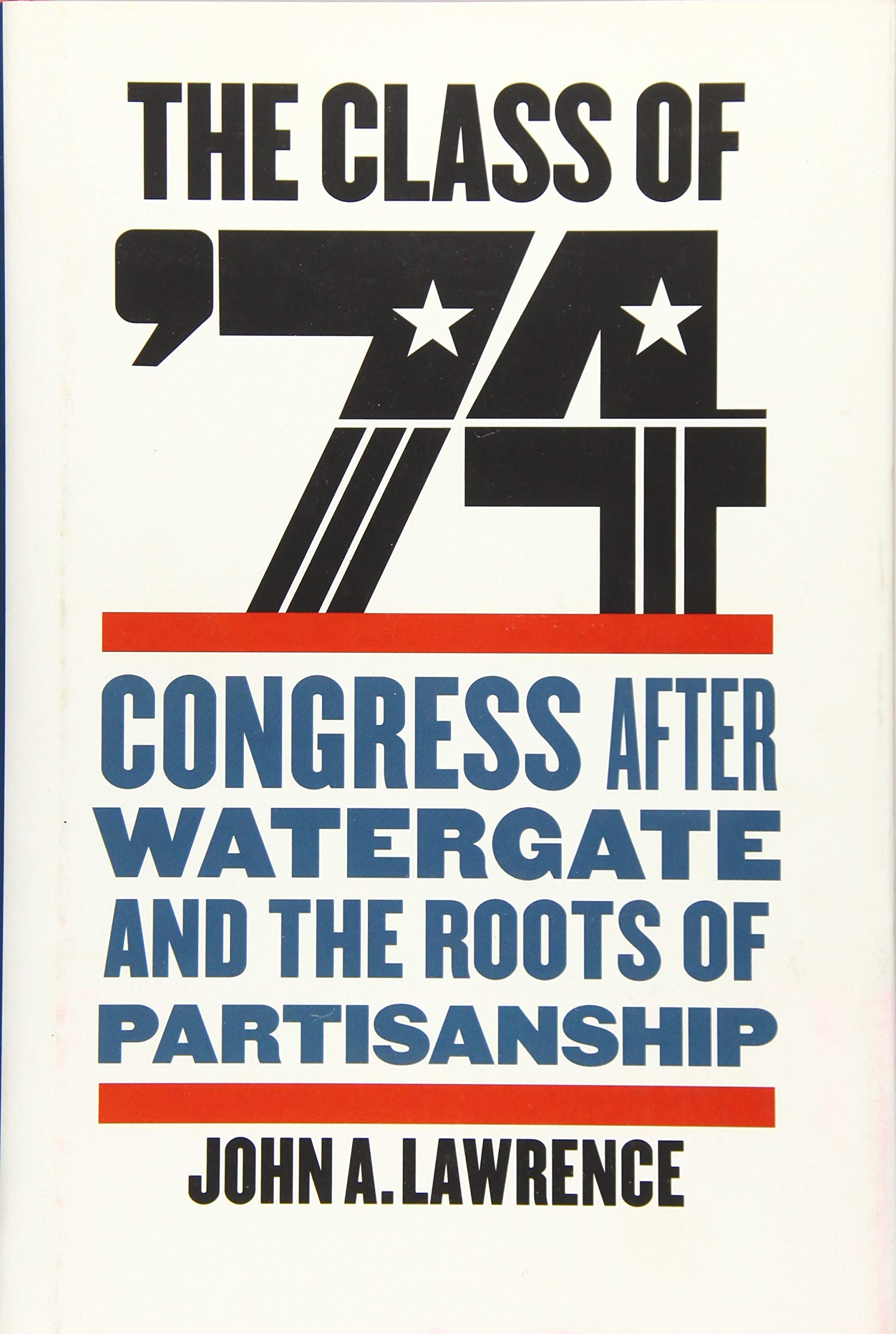
Many of the freshman Congressmen were young, and rode the issue of Watergate scandal to victory. So the media dubbed them the "Watergate Babies."

Some of the new House members made challenges to Chairmen of the various Committees, who held those posts due to seniority. Some of them had grown stale and/or conservative in office, and deserved something of a shake-up.

But those Chairmen had the loyalty of many of their colleagues, and that led to many of the insurgents blowing their chances at gaining favor with those established members.

But the writing was on the wall: Those Chairmen began to retire and/or die in office. Those Class of '74 Congressmen who survived the Republican-heavy elections of 1978 and 1980 went on to become leaders of Congress themselves. The last remainder of them was Senator Patrick Leahy of Vermont, the President Pro Tempore of the Senate, retiring for the election of 2022.
Patrick Leahy

Several States also elected Governors in 1974. With Ronald Reagan, elected in 1966 by defeating incumbent Edmund G. "Pat" Brown, not running for a 3rd term, California elected Pat's son, Edmund G. "Jerry" Brown.
Jerry Brown

He was re-elected in 1978, but hurt his reputation with some left-leaning stances, and a personality that led Tonight Show host Johnny Carson, operating out of the Los Angeles suburb of Burbank, to nickname him "Governor Moonbeam."

Brown didn't help himself at home with his ill-advised, ill-fated runs for President in 1976 and 1980. As a result, the Republicans won 4 straight gubernatorial elections, including a defeat of his sister, State Treasurer Kathleen Brown, by incumbent Pete Wilson in 1994.

But Jerry made a comeback. With California enacting term limits, limiting State officials to 2 terms, he was twice elected Mayor of Oakland, was twice elected State Attorney General, and was returned to the Governorship in 2010 and 2014. Having previously been the youngest Governor in California history, he had become the oldest.

Also elected in 1974 was Congresswoman Ella Grasso, as the new Governor of Connecticut. She was the 1st woman elected Governor of any State without having ascended to the job on the death of the previous Governor, or having been the wife of a Governor.
She was instrumental in building (and, after a roof collapse, the restoring) the Hartford Civic Center (now the XL Center) and in bringing the Boston-based New England Whalers to Hartford, and would be re-elected in 1978, but developed cancer, and died in 1981.

*

November 5, 1974 was, like all modern Election Days in America, a Tuesday. Baseball season was over. Football was in midweek. There were 2 games in the NBA. The New York Knicks beat the Houston Rockets, 106-93 at the Hofheinz Pavilion (now the Fertitta Center) in Houston. And the Kansas City-Omaha Kings, playing 1 of their 3 "home games" a year at the Omaha Civic Auditorium in Nebraska, beat the expansion New Orleans Jazz, 115-97.

There was 1 game in the American Basketball Association: The Denver Nuggets beat the Utah Stars, 145-101 at the Denver Auditorium Arena.

There were 5 games in the NHL:

* The New York Rangers lost to the Vancouver Canucks, 2-1 at the Pacific Coliseum in Vancouver.

* The New York Islanders and the Philadelphia Flyers played to a tie, 4-4 at the Nassau Coliseum.

* The Boston Bruins and the Buffalo Sabres played to a tie, 2-2 at the Boston Garden.

* The Los Angeles Kings beat the St. Louis Blues, 4-3 at the St. Louis Arena.

* And the Pittsburgh Penguins beat the Kansas City Scouts, 5-3 at the Kemper Arena (now the Hy-Vee Arena) in Kansas City.

And there were 5 games in the World Hockey Association:

* The Toronto Toros beat the Michigan Stags, 5-2 at Cobo Hall (now Huntington Place) in Detroit.

* The Phoenix Roadrunners beat the Indianapolis Racers, 3-0 at the Market Square Arena in Indianapolis.

* The Vancouver Blazers beat the Chicago Cougars, 5-4 at the International Amphitheatre in Chicago.

* The Winnipeg Jets beat the Minnesota Fighting Saints, 6-4 at the Winnipeg Arena.

* And the Houston Aeros beat the San Diego Mariners, 9-3 at the Sam Houston Coliseum in Houston.

Friday, November 4, 2022

November 4, 1958: The Anti-Ike Landslide?

November 4, 1958: Election Day. The Democratic Party, already in control of both houses of Congress, gain 49 seats in the House of Representatives, a total they have matched only once since, with the "Watergate Babies" Class of '74. They gain 12 seats in the Senate, a total they have matched only once since, in 1986.

Among the new Senators elected were some names that would get bigger as the years went by. They included these Democrats: Eugene McCarthy of Minnesota, Edmund Muskie of Maine, Robert Byrd of West Virginia, Thomas Dodd of Connecticut, Philip Hart of Michigan, and Harrison Williams of New Jersey. On the Republican side: Barry Goldwater of Arizona, Hugh Scott of Pennsylvania, and Ken Keating of New York.

Muskie had been his State's Governor, while most of the others were "promoted" from the House. Byrd died in 2010, making him not only the last 1958 winner still serving, but the longest-serving Senator in history.

Among the new Democratic Governors elected: Edmund G. "Pat" Brown of California, J. Millard Tawes of Maryland, Michael DiSalle of Ohio, David L. Lawrence of Pennsylvania, Ernest "Fritz" Hollings of South Carolina, and Gaylord Nelson of Wisconsin. On the Republican side, Nelson Rockefeller was elected in New York, defeating Democratic incumbent Averell Harriman; and Mark Hatfield in Oregon. Hollins, Nelson and Hatfield would later be elected to the Senate.

Another Democratic Governor elected was John Patterson of Alabama, who essentially won by winning the Primary over George Wallace, by running an outright racist campaign. Wallace swore he would never be "out-(N-word)ed again." Since the State Constitution then forbid Governors from succeeding themselves, Patterson didn't run again in 1962, and Wallace did, and, for want of a better choice of words, kept his word, and won.

This election is a hard one to figure out. President Dwight D. Eisenhower, a Republican, was personally popular, but his Party was not. There was a recession, but it had ended earlier in the year, and it wasn't as severe as those that would follow in 1973-76, 1981-83, 1990-93, 2001-02, 2007-10 and 2020-21.

Some people blamed U.S.-Soviet tensions, but 1958 wasn't an especially "cold" year in the Cold War. And the 2 biggest scandals to come out of the Eisenhower Administration -- the one surrounding his White House Chief of Staff, Sherman Adams, and the U-2 "spy plane" incident -- were both yet to come. Both of those may have helped the Democrats win the Presidency in 1960, but the Republicans actually gained Congressional seats at the same time.

During the recession, the unemployment rate rose from 3.7 percent in March 1957 to a peak of 7.5 percent in July 1958. In addition, industrial production declined by approximately 14 percent, and real Gross Domestic Project contracted by 3.7 percent. As a result, the stock market experienced significant losses, with the Standard & Poor 500 index falling by more than 20 percent.

The government extended unemployment benefits to those who lost their jobs during the recession. In September 1958, Congress passed the Temporary Unemployment Compensation Act, providing additional financial assistance to unemployed workers for 13 weeks.

Since Congress was already controlled by the Democrats, maybe the 1958 election wasn't so much a punishment of "Ike" as it was a reward to the Democrats.

The "Baby Boom" can't be credited, or blamed: The voting age was still 21, so the youngest voters would have been born in 1937, during the Depression. So maybe this election was the result of a "Baby Bust," as fewer children who would have grown up to vote Republican were born.

Who knows: Maybe the people were just sick of a Republican President playing so much golf.

*

November 4, 1958 was, like all modern American Election Days, a Tuesday. Baseball season was over. Football was in midweek. There were no games scheduled in the NBA.

There was 1 game played in the NHL: The Chicago Black Hawks beat the New York Rangers, 4-2 at the Chicago Stadium.

Thursday, November 3, 2022

November 3, 1998: The Voters Tell the Republicans to Leave President Clinton Alone

November 3, 1998: The Republican Party was counting on this Election Day, to send a message to the leader of the Democratic Party, President Bill Clinton: Resign, because the people are against you. If you don't, we will impeach you in the U.S. House of Representatives, and convict you in a trial in the U.S. Senate.

There was reason to believe it would work out that way. Clinton had fallen into an ugly scandal, due to how he covered up his extramarital affair with former White House intern Monica Lewinsky. They had spent almost the entire calendar year telling the country how the President was "immoral," while they, the Republicans -- the Party of Watergate and Iran-Contra -- stood for the Constitution of the United States and "the rule of law."

In addition, this was Year 6 of Clinton's Presidency. Off-year Congressional elections are usually bad for the Party in the White House, and Year 6 elections have, historically, been even worse than Year 2 elections. In the 20th Century, Year 6 elections were bad for Franklin D. Roosevelt in 1938, for the Administration of FDR and Harry Truman in 1946 if you count FDR's 3rd election in 1940 as a restart, For Truman in 1950, for Dwight D. Eisenhower in 1958, for the Administration of John F. Kennedy and Lyndon B. Johnson in 1966, for the Administration of Richard Nixon and Gerald Ford in 1974, and for Ronald Reagan in 1986.

So the idea that the Republicans, already in control of both houses of Congress, would increase their numbers at such a level to make it overwhelming for Clinton was strong.

Instead, the voters heard Clinton's self-defense -- claiming that it was a private matter, that no laws were broken, and that it was nobody's business but his and his family's -- and saw that Clinton was actually doing a very good job as President, and bucked the Year 6 trend. The Democrats actually gained 5 seats in the House, and broke even in the Senate.

Among the new Senators elected were Democrats Chuck Schumer of New York (a "promoted" Congressman who beat 3-term incumbent "Senator Pothole" Al D'Amato), Evan Bayh of Indiana (the outgoing Governor and the son of former Senator Birch Bayh) and John Edwards of North Carolina; and Republicans Jim Bunning of Kentucky (a promoted Congressman and a pitcher in the Baseball Hall of Fame) and George Voinovich of Ohio (a former Governor and Mayor of Cleveland).

This was a stunning result, and it sent a message not to the Democrats in general, or to Clinton in particular, but to the Republicans: The President is doing a great job, and his private life is just that, private, so leave him alone.

Did the Republicans listen? No: They doubled down, and impeached him, anyway. But they didn't come close to convicting him in the Senate, and he served out his term.

One other note: In Wisconsin, Republican Paul Ryan became the 1st person born after I was elected to Congress. The Republicans nominated him for Vice President under Mitt Romney in 2012, and in no way can Romney's loss be blamed on Ryan. He was Speaker of the House in the 2015-16 and 2017-18 terms, before resigning.

*

November 3, 1998 was, like all modern American Election Days, a Tuesday. Baseball was out of season. Football was in midweek. And the NBA team owners had locked the players out, so the new season was not able to start on time.

There were 4 games in the NHL:

* The New Jersey Devils beat their arch-rivals, the New York Rangers, 3-1 at the Continental Airlines Arena at the Meadowlands.

* The Buffalo Sabres beat the Boston Bruins, 4-2 at the Marine Midland Arena (now the KeyBank Center) in Buffalo.

* The Philadelphia Flyers and the Pittsburgh Penguins, intra-State rivals, played to a tie, 4-4 at the Civic Arena in Pittsburgh.

* And the Calgary Flames beat the Detroit Red Wings, 5-2 at the Joe Louis Arena in Detroit.

Tuesday, October 25, 2022

October 25, 2002: Senator Paul Wellstone Is Killed In a Plane Crash

October 25, 2002: Senator Paul Wellstone, Democrat of Minnesota, running for a 3rd term, is killed in a plane crash outside Eveleth, Minnesota. One of the leading liberals in the U.S. Senate, he was 58 years old. His wife Sheila and his daughter Marcia are also killed. His sons David and Mark were not on the plane.
Paul David Wellstone was born on July 21, 1944 in Washington, D.C., the son of Ukrainian Jewish immigrants. His father had changed the family name from Wexelstein to lessen anti-Semitism. Paul grew up across the Potomac River in Arlington, Virginia. He was an ACC Champion wrestler and a Phi Beta Kappa at the University of North Carolina, where he married Sheila Ison. They moved to Minnesota, where he became a college professor and she became a librarian, having 2 sons and a daughter.
His youthful activism hit all the usual liberal notes: Opposing the Vietnam War, labor rights, public education, health care, child care, rights for women and racial minorities, fair housing. In 1990, he beat incumbent Republican Rudy Boschwitz to gain election to the U.S. Senate, the 1st time that both major-party nominees for a Senate seat were Jewish. He gained a reputation as a fighting young liberal, and was re-elected in 1996.
He had a youthful following, hoping that he would become President one day, not unlike his Vermont contemporary, Bernie Sanders. But a 1998 diagnosis of multiple sclerosis made him drop plans for a Presidential campaign in 2000. (This was before the TV show The West Wing used a President-with-MS storyline.)
On October 25, 2002, Wellstone, along with 7 others, died in an airplane crash outside Eveleth, Minnesota, at 10:22 AM. He was 58 years old. The other victims were his wife, Sheila; one of his three children, Marcia; the two pilots, Richard Conry and Michael Guess; and campaign staffers Mary McEvoy, Tom Lapic and Will McLaughlin.
The Beechcraft King Air A100 was en route to Eveleth, where Wellstone was to attend the funeral of Martin Rukavina, a steelworker whose son Tom Rukavina served in the Minnesota House of Representatives.
Wellstone decided to go to the funeral instead of a Minneapolis rally and fundraiser attended by former Vice President and Senator Walter Mondale, and fellow Senator Ted Kennedy of Massachusetts -- who, ironically, survived a plane crash while running for re-election in 1964. That night, Wellstone was scheduled to debate the Republican nominee for his office, Mayor Norm Coleman of St. Paul, in Duluth.
A supporter hearing the news

It was 11 days before the election. His memorial service was held at Williams Arena on the campus of the University of Minnesota. In accordance with State law, his name was removed from the ballot, and was replaced by Mondale. He lost the election to Coleman, by 49,000 votes.
Some observers blamed Wellstone's last vote in the Senate, to deny President George W. Bush the authority to go to war against Iraq. Others blamed the Williams Arena rally, calling it too partisan. Well, excuse the attendees for their love for their Senator.
The Republicans gained 8 seats in the House, and 2 in the Senate, the best Year 2 performance by the party in the White House since the Democrats under Franklin Roosevelt in 1934.
In addition to Coleman, among the new Republican Senators elected was Saxby Chambliss, who ran attacking the patriotism of his Democratic opponent, for voting against giving Bush the blank check on Iraq. That opponent was Max Cleland, who had lost both legs and his right arm in combat in Vietnam. Chambliss got deferments for that war. This proved that the Republicans were hypocrites on the subject of patriotism.
On the Democratic side, Mark Pryor was elected, as his father David had been before him.
In 2008, Coleman would be defeated by New York-born, by Minneapolis-raised comedian Al Franken, in one of the closest Senatorial elections ever: 312 votes.
*
October 25, 2002 was a Friday. The World Series was between Games 5 and 6, and the Anaheim Angels would beat the San Francisco Giants in 7 games. 
There was 1 college football game played: The University of Hawaii beat Fresno State, 31-21 at Bulldog Stadium (now Valley Children's Stadium) in Fresno, California.
The NBA season started 5 days later. There were 5 games played in the NHL:
* The New York Rangers lost to the Los Angeles Kings, 6-2 at Madison Square Garden.
* The New Jersey Devils beat the Buffalo Sabres, 2-1 at the HSBC Arena (now the KeyBank Center) in Buffalo.
* The Tampa Bay Lightning beat the Washington Capitals, 3-2 at the St. Pete Times Forum (now the Benchmark International Arena) in Tampa.
* The San Jose Sharks beat the Columbus Blue Jackets, 5-4 at the Nationwide Arena in Columbus.
* And the Detroit Red Wings beat the Pittsburgh Penguins, 7-3 at the Joe Louis Arena in Detroit.

Monday, October 17, 2022

October 17, 1939: "Mr. Smith Goes to Washington" Premieres

October 17, 1939: Mr. Smith Goes to Washington premieres, at Constitution Hall in Washington, D.C. It was the 2nd of the 3 films that were directed by Frank Capra and starred James Stewart. The 1st was You Can't Take It With You in 1938. The 3rd was It's a Wonderful Life in 1946, which became the defining Frank Capra film and the defining Jimmy Stewart film.

U.S. Senator Sam Foley -- his State is never identified, but is said to be in the West -- dies in office. The Governor Hubert "Happy" Hopper (played by Guy Kibbee) appoints Jefferson Smith (Stewart) to replace him, thinking the young activist will be easy to manipulate. Senator Joseph Paine (Claude Rains), a friend of Smith's late father, mentors him, and Smith takes a liking to the Senator's daughter, Susan (Jean Arthur).

The Washington press take advantage of Smith's naïveté, and he ends up looking like a dim country bumpkin. He comes up with a bill to authorize a federal government loan to buy some land in his home State for a national boys' camp, to be paid back by youngsters across America. It sounds like a typical Franklin Roosevelt-style New Deal bill, and the public likes it, with donations pouring in immediately. However, the proposed campsite is already part of a dam-building graft scheme included in an appropriations bill framed by the the political machine of the State's party boss, Jim Taylor (Edward Arnold), and supported by Paine.

Unwilling to politically destroy Smith so that their graft plan will go through, Paine tells Taylor he wants out, but Taylor reminds him that Paine is in power primarily through Taylor's influence. Paine then advises Smith to keep silent about the matter. The following day, when Smith speaks out about the bill at Senate, the machine, through Paine, accuses Smith of trying to profit from his bill, by producing fraudulent evidence that Smith already owns the land in question. Smith is too shocked and angry by Paine's betrayal to defend himself, and runs away.

Saunders, who looked down on Smith at first, but has come to believe in him, talks him into launching a filibuster, to postpone the appropriations bill and prove his innocence on the Senate floor just before the vote to expel him. In his last chance to prove his innocence, he talks non-stop for about 25 hours, reaffirming the American ideals of freedom and disclosing the dam scheme's true motives. Yet none of the other Senators are convinced.

Newspapers and radio stations in Smith's home State, on Taylor's orders, refuse to report what Smith has to say, and even distort the facts against the Senator. The Boy Rangers' effort to spread the news in support of Smith results in vicious attacks on the children by Taylor's gangsters.

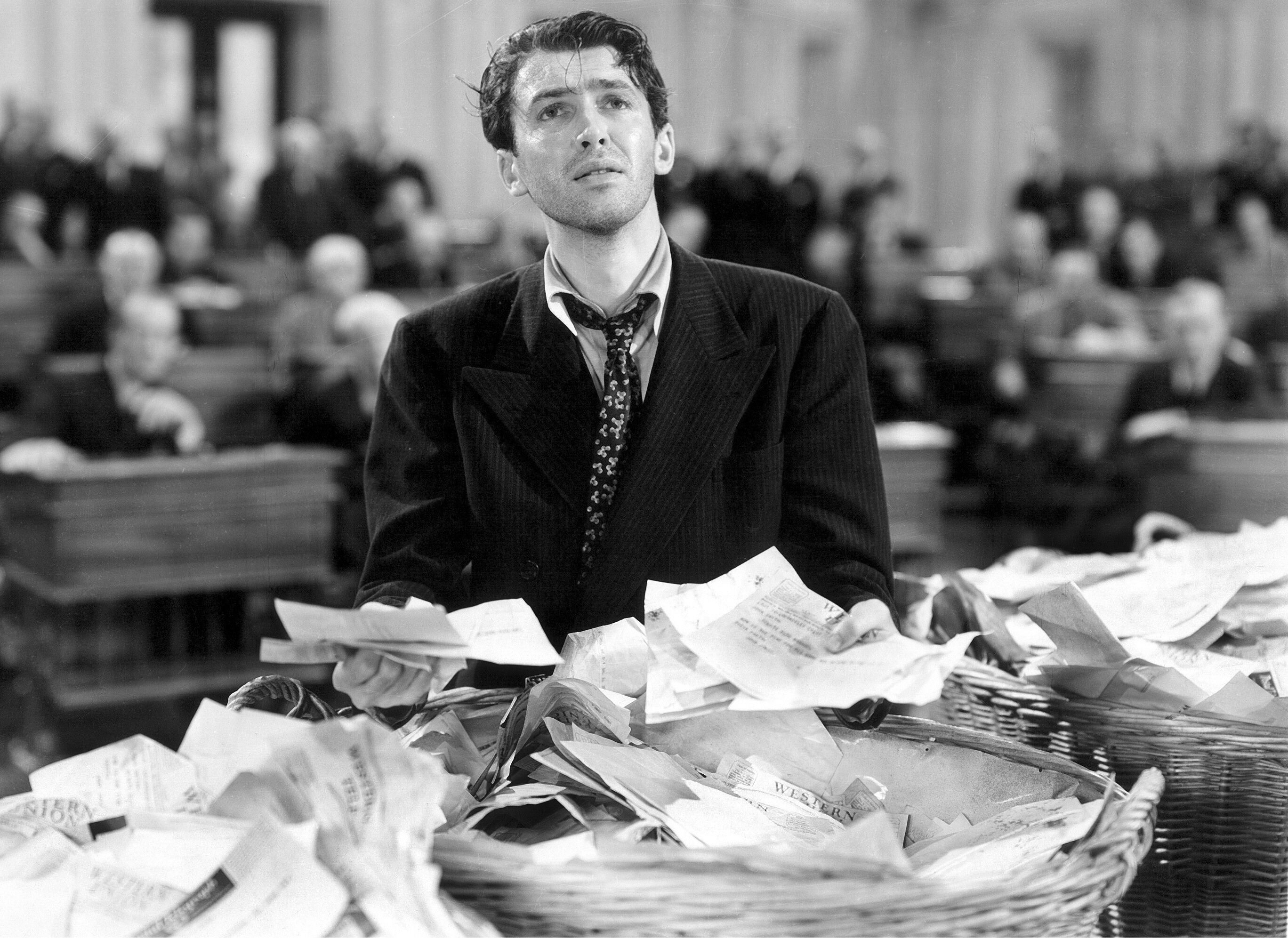
Although all hope seems lost, the Senators begin to pay attention as Smith approaches utter exhaustion. Paine has one last card up his sleeve: He brings in bins of letters and telegrams from the home State, purportedly from average people demanding his expulsion. Nearly broken by the news, Smith finds a small ray of hope in a friendly smile from the President of the Senate. Smith vows to press on until people believe him, but immediately collapses in a faint.

Overcome with the pangs of remorse, Paine leaves the Senate chamber, and attempts to commit suicide by gunshot, but is stopped by onlooking Senators. He then bursts back into the Senate chamber, shouting a confession to the whole scheme. The reformed Paine further insists that he must be expelled from the Senate, and affirms Smith's innocence.

Because the film even suggested that the American federal government might harbor corruption, it was slammed as anti-American and pro-Communist. Senator Alben Barkley of Kentucky, the Majority Leader (and later Vice President under Harry Truman), called the film "a grotesque distortion."

Joseph P. Kennedy, the U.S. Ambassador to Britain (and later father to 3 U.S. Senators, 1 of whom became President), wrote to Harry Cohn, head of Columbia Pictures, the film's distributor, and urged that it be withdrawn from European release, because it would damage America's prestige in Europe. He needn't have worried: The major Fascist dictators -- Adolf Hitler in Germany, Benito Mussolini in Italy, and Francisco Franco in Spain -- all banned it in their countries. It wasn't shown in the Soviet Union until 1950.

Since World War II, the words "Mr. Smith goes to Washington" have become code for a "citizen legislator" getting himself elected and fighting the entrenched interests in Congress. Many such candidates have proven to have been already bought by special interests before they got there.

*

October 17, 1939 was a Tuesday. Baseball season had just ended, with the New Yankees sweeping the Cincinnati Reds in the World Series. The NBA hadn't been founded yet. And the NHL season didn't start for another 2 weeks. There was one score on this historic day, and it was in college football: William & Mary and VPI played to a 6-6 tie at City Stadium in Richmond, Virginia.

"VPI" was the abbreviation for what was known from 1896 to 1944 as the Virginia Agricultural and Mechanical College and Polytechnic Institute; and from 1944 to 1970 as simply the Virginia Polytechnic Institute. Since 1970, it has been Virginia Tech University.

December 31, 1999 & January 1, 2000: The Millennium

December 31, 1999:  The Millennium arrives. The people of planet Earth survived. At a terrible cost. But we hadn't destroyed ourselves. ...