Saturday, December 31, 2022

December 31, 1999 & January 1, 2000: The Millennium

December 31, 1999: The Millennium arrives. The people of planet Earth survived. At a terrible cost. But we hadn't destroyed ourselves. It felt like a great achievement. It was, "Hey, we made it! We actually made it! This is something really worth celebrating!"

ABC News covered it for 24 hours straight, from 4:00 AM U.S. Eastern Time on December 31 to 4:00 AM U.S. Eastern Time on January 1. Eventually, even anchorman Peter Jennings looked half-asleep in his tuxedo.

January 1, 2000: As time zone after time zone turned over from 11:59 to 12:00, there was great joy -- literally, all over the world.

It didn't last. So far, the 21st Century has been a bust. In words that have been attributed to, among others, New York Yankees legend Yogi Berra, then 74 years old, "The future ain't what it used to be."

December 31, 1999 was a Friday. It was the day that Boris Yeltsin resigned as President of Russia, handing the office over to the Prime Minister -- Vladimir Putin.

It was the day that Elliot Richardson died. He remains the only person to serve the President of the United States in 4 different Cabinet posts, including Attorney General, an office he resigned rather than follow Richard Nixon's unconstitutional order in "the Saturday Night Massacre" in 1973.

In the Pacific, Portugal handed its colony of Macau over to China, just as Britain had handed Hong Kong over to China on June 30/July 1, 1997. In Central America, as per the 1978 treaty, America handed control of the Panama Canal Zone, including the Panama Canal itself, over to Panama.

It was also the day that actors Michael Douglas and Catherine Zeta-Jones announced their engagement. They had to wait to get married until Douglas' divorce from current wife Diandra Luker was final. The ceremony was held on November 18, 2000.

And the computer problem known as "The Y2K Bug"? Not much happened. A few minor things, like scattered automatic teller machines (ATMs) at banks not quite working properly. But that was it: The computers didn't cause an apocalypse, or even an inconvenient power outage.

Why? Because changing the format from one that would have followed 12-31-99 with 01-01-00, and thus caused computers to think it was January 1, 1900, and thus confuse them into not working, into one that would recognize 01-01-2000, was a problem that human society took seriously, and properly handled. We'll never know what would have happened if we got it wrong, because we, as a people, stepped up, did what we had to do, and got it right.

And nobody stepped forward to say that the Y2K Bug was just a hoax perpetrated by liberals to take away your freedom, like gun control already had been for 20 years, and COVID-19 would be 20 years later.

The London Eye, a 443-foot-high Ferris wheel, opened on the day. Until 2006, it was the tallest Ferris wheel in the world.

Several big-city arenas hosted concerts, usually (but not exclusively) by local artists. Billy Joel played Madison Square Garden. James Taylor, who grew up in North Carolina and wrote and sang "Carolina In My Mind," played the Raleigh Entertainment and Sports Arena (now the Lenovo Center) in Raleigh.

Cher played Boardwalk Hall in Atlantic City. From the New York side of New Jersey rather than from New England, Bruce Springsteen played the FleetCenter (now the TD Garden) in Boston. Quebec native Celine Dion played the Molson Centre (now the Bell Centre) in Montreal.

John Denver, singer of "Rocky Mountain High," the natural choice to play the Pepsi Center (now the Ball Arena) in Denver, was already dead, so the artist in residence that night was New York native Neil Diamond. Elton John played Circus Maximus at Caesars Palace outside Las Vegas. Los Angeles-based rock band The Eagles played that city's Staples Center (now the Crypto.com Arena). NSYNC played the Blaisdell Arena in Honolulu, the arena that had hosted Elvis Presley's "Aloha from Hawaii via Satellite" concert in 1973.

This was also the day that the American Airlines Arena opened in Miami. Naturally, the choice to open it was a New Year's Eve concert by Gloria Estefan and the Miami Sound Machine. The building is now named the Miami-Dade Arena. (UPDATE: In 2023, it became the Kaseya Center.)

Neither Paul McCartney nor Bob Dylan played a concert that night. Michael Jackson was scheduled to play Aloha Stadium in Honolulu, but had to cancel after being injured in a concert in Munich, Germany.

Baseball was out of season, and no NFL games were played. As it turned out, no NBA games were scheduled for the day, either.

There were 2 games scheduled in the NHL. One was, by NHL standards, an ancient rivalry, going back to 1926. At the Joe Louis Arena in Detroit, the host Detroit Red Wings and the Chicago Blackhawks played to a 4-4 tie. (There would be no shootouts in the NHL until the 2005-06 season.)

And in a matchup that had only been possible for 6 years, the Dallas Stars beat the team then known as the Mighty Ducks of Anaheim, 5-4 at the Reunion Arena in Dallas.

*

January 1, 2000 was a Saturday. Isis Naija Gaston was born that day, and grew up to become the rapper Ice Spice.

Still no baseball, and still no NFL games. But there were 7 NHL games, about a half-full slate:

* One team in the New York Tri-State Area was in action: The New Jersey Devils traveled to what's now named the TD Garden, and played the Boston Bruins to a 2-2 tie.

* The St. Louis Blues and the Washington Capitals played to a 1-1 tie at what's now named the Capital One Arena in Washington, D.C.

* In a regional rivalry, the Buffalo Sabres beat the Toronto Maple Leafs, 8-1 at what's now named the KeyBank Center in Buffalo.

* In a regional rivalry, the Carolina Hurricanes beat the Atlanta Thrashers, 4-2 at what's now State Farm Arena in Atlanta. (The Thrashers became the new Winnipeg Jets in 2011.)

* In not just a regional but an intrastate rivalry, the Florida Panthers beat the Tampa Bay Lightning, 7-5 at what's now named the Amerant Bank Arena in Sunrise, Florida.

* The Nashville Predators beat the San Jose Sharks, 3-2 at what's now named the Bridgestone Arena in Nashville.

* And the Edmonton Oilers beat the Phoenix Coyotes, 5-4 at the America West Arena (now the Mortgage Matchup Center) in Phoenix. (The Coyotes were renamed the Arizona Coyotes in 2014.)

And 6 college football bowl games were played:

* At 11:00 AM Eastern Time, at Raymond James Stadium in Tampa, the Outback Bowl was played: Number 21 Georgia beat Number 19 Purdue, 28-25.

* Also at 11 Eastern, 10:00 AM Central Time, at the Cotton Bowl stadium in Dallas, the Cotton Bowl Classic was played: Number 24 Arkansas beat Number 14 Texas, 27-6. This was once an intense rivalry, but Arkansas' 1992 move from the Southwest Conference to the Southeastern Conference moved it to the back burner.

* At 12:30 PM Eastern Time, at Alltel Stadium (now TIAA Bank Field) in Jacksonville, the Gator Bowl was played: Number 23 Miami beat Number 17 Georgia Tech, 28-13.

* At 1:00 PM Eastern Time, at the Florida Citrus Bowl (now Camping World Stadium) in Orlando, the Florida Citrus Bowl was played: Number 9 Michigan State beat Number 10 Florida, 37-34.

* At 4:30 PM Eastern Time, 1:30 Pacific Time, at the Rose Bowl in the Los Angeles suburb of Pasadena, the game of the same name was played: Number 4 Wisconsin beat Number 22 Stanford, 17-9.

* And at 8:30 PM Eastern Time, at Pro Player Stadium (now Hard Rock Stadium) in Miami Gardens, the Orange Bowl was played: Number 8 Michigan beat Number 5 Alabama, 35-34.

It was a bit strange for it to be New Year's Day, and see Michigan playing in a game other than the Rose Bowl, and also to see Alabama playing on the day, but not in the Sugar Bowl.

Under the format then in place, the Bowl Championship Series, the Fiesta Bowl was played on January 2, at Sun Devil Stadium in the Phoenix suburb of Tempe. Number 3 Nebraska beat Number 6 Tennessee, 31-21.

And the matchup that the BCS was intended to set up? It was hard to argue that these 2 undefeated teams weren't the top 2 teams in the country. At the Louisiana Superdome in New Orleans, the Sugar Bowl was played between Number 1 Florida State and Number 2 Virginia Tech. Florida State won, 46-29.

December 31, 2011: The Last American Combat Troops Leave Iraq

December 31, 2011: The last American combat troops leave Iraq. It had been 8 years, 9 months and 11 days since the first ones got there.

And what did America get out of it? Well, we got rid of Saddam Hussein, and replaced him with... a government that we're still not sure is trustworthy. And we emboldened neighboring Iran, who were glad to see Saddam out. And we emboldened terrorists in the Middle East, ditto.

Over 1 million Iraqis, the vast majority of them civilians, died as a result of this war. American combat deaths were, officially, 4,507; with another 32,292 wounded, another 47,541 listed under "Injured/diseases/other medical." How many have psychiatric issues as a result of being sent there, we may never know.

In his 1988 book 1968 In America, Charles Kaiser reasoned that the only good thing about the Vietnam War was that America had apparently learned its lesson, and had never had another "Vietnam." That was before George W. Bush, who actively sought to avoid serving in Vietnam even as he supported the war effort (as Donald Trump did, but Bill Clinton, Al Gore and Joe Biden did not) wanted Iraq's oil.

Why is it that Democratic Presidents always have to clean up the messes left by their Republican predecessors? Barack Obama got the Democratic nomination for President in 2008 because, unlike Hillary Clinton, he did not vote in the U.S. Senate (which she was then in, but he was not) to authorize the Iraq War in any way. Maybe he would have won the general election even without the economic crash later that year. But it was the war, and the atrocities committed by certain Americans in it, some of them civilians, that ruined Bush's legacy before the crash did.

Obama said he would end the war. His Republican opponent, John McCain said he would end it by winning it. America preferred an ending sooner rather than later, and voted for Obama. And he ended it.

And we will be paying for it, in many ways, for a long time to come. Which we can truthfully say about a lot of Republican policies.

*

December 31, 2011 was a Saturday. Baseball was out of season. All the NFL games that weekend were played the next day, New Year's Day. There were 5 college football bowl games played:

* The Meineke Car Care Bowl of Texas was played at what's now NRG Stadium in Houston. This used to be known as the Texas Bowl, and is the successor to the old Bluebonnet Bowl that was played at the Astrodome. Texas A&M beat Northwester, 33-22.

* The Hyundai Sun Bowl was played at the Sun Bowl Stadium in El Paso, Texas. Utah beat Georgia Tech, 30-27 in overtime.

* The AutoZone Liberty was played at Liberty Bowl Memorial Stadium in Memphis. (A memorial to a game that's still being played?) The University of Cincinnati beat Vanderbilt, 31-24.

* The Kraft Fight Hunger Bowl was played at what's now Oracle Park in San Francisco. Illinois beat UCLA, 20-14.

* And the Chick-fil-A Bowl, the once-and-future Peach Bowl, was played at the Georgia Dome in Atlanta. Auburn beat Virginia, 43-24.

There were 7 games played in the NBA:

* The New York Knicks beat the Sacramento Kings, 114-92 at the Sleep Train Arena in Sacramento.

* The Detroit Pistons beat the Indiana Pacers, 96-88 at The Palace in the Detroit suburb of Auburn Hills, Michigan.

* The Oklahoma City Thunder beat the Phoenix Suns, 107-97 at what's now the Paycom Center in Oklahoma City.

* The Houston Rockets beat the Atlanta Hawks, 95-84 at the Toyota Center in Houston.

* The San Antonio Spurs beat the Utah Jazz, 104-89 at what's now the Frost Bank Center in San Antonio.

* The Los Angeles Lakers beat the Denver Nuggets, 92-89 at what's now the Crypto.com Arena in Los Angeles. Andrew Bynum led all scorers on the night with 29 points.

* And the Philadelphia 76ers beat the Golden State Warriors, 107-79 at the Oakland Coliseum Arena (then named the Oracle Arena).

There were 12 NHL games played that day:

* The New Jersey Devils beat the Pittsburgh Penguins, 3-1 at the Prudential Center. Ilya Kovalchuk, David Clarkson and Zach Parise scored.

* The New York Islanders beat the Edmonton Oilers, 4-1 at the Nassau Coliseum.

* The Tampa Bay Lightning beat the Carolina Hurricanes, 5-2 at the St. Pete Times Form (now the Benchmark International Arena) in Tampa.

* The Florida Panthers beat the Montreal Canadiens, 3-2 at the BankAtlantic Center (now the Amerant Bank Arena) in the Miami suburb of Sunrise, Florida.

* The Dallas Stars beat the Boston Bruins, 4-2 at the American Airlines Center in Dallas.

* The Ottawa Senators beat the Buffalo Sabres, 3-2 in a shootout at the First Niagara Center (now the KeyBank Center) in Buffalo.

* The Washington Capitals beat the Columbus Blue Jackets, 4-2 at the Nationwide Arena in Columbus.

* The Detroit Red Wings beat the St. Louis Blues, 3-0 at the Joe Louis Arena in Detroit.

* The Phoenix Coyotes beat the Minnesota Wild, 4-2 at the Xcel Energy Center in St. Paul.

* The Winnipeg Jets beat the Toronto Maple Leafs, 3-2 at the MTS Centre (now the Canada Life Centre) in Winnipeg.

* The Colorado Avalanche beat the Anaheim Ducks, 4-2 at the Honda Center in Anaheim.

* The Los Angeles Kings beat the Vancouver Canucks, 4-1 at the Staples Center (now the Crypto.com Arena) in Los Angeles.

* The New York Rangers, the Calgary Flames, the Chicago Blackhawks, the Nashville Predators, the Philadelphia Flyers and the San Jose Sharks were not scheduled.

December 31, 1993: The Murder of Brandon Teena

December 31, 1993: Brandon Teena is murdered by bigots in Humboldt, Nebraska. He was 21 years old, and unwittingly becomes perhaps the first famous pre-surgery transgender person – not post-surgery, what was then called a "transsexual."

The subject of this essay was born on December 12, 1972, in Lincoln, Nebraska, with female characteristics, and the name Teena Brandon. The child's father died before the birth, and was raised, along with an older sister, by a single mother. Both children were abused by an uncle.

Teena was described by others as a "tomboy," and, in adolescence, began identifying as male. He was kicked out of a Catholic high school for dressing like a boy, and rejected by the U.S. Army by listing "male" on his enlistment form.

In 1993, Teena began dating a woman named Lana Tisdel, who was 2 years younger. Teena was arrested for forging checks, and it was only upon going to bail him out and seeing "her" in the female section of the jail that Tisdel learned that Teena was transgender. He assured her that he was seeking what would then have been called a sex change operation (today, it would be called "gender reassignment surgery"), and she stuck with him.

Five days later, on Christmas Eve, Teena was beaten and raped by 2 male ex-convicts. They told him that if he went to the police, they would kill him. He went to the police. They refused to file charges. Seven days later, on New Year's Eve, the rapists kept their word, shooting Teena in the stomach. Both men were convicted, and, as of December 31, 2022, are still in prison.

In 1999, Hilary Swank played Brandon Teena in the film Boys Don't Cry, and won an Academy Award for Best Actress, as a woman playing, as would have been said at the time, "a man trapped in a woman's body."

*

December 31, 1993 was a Friday. Baseball was out of season. No NBA games were scheduled. There were 4 college football bowl games played:

* Number 12 North Carolina were beaten by Number 18 Alabama, 24-12 in the Gator Bowl, at the stadium of the same name in Jacksonville, Florida.

* Number 21 Indiana were beaten by Number 22 Virginia Tech, 45-20 in the Independence Bowl, at Independence Stadium in Shreveport, North Carolina.

* Number 24 Clemson beat Kentucky, 14-13 in the Peach Bowl, at the Georgia Dome in Atlanta.

* And California beat Iowa, 37-3 in the Alamo Bowl, at the Alamodome in San Antonio.

In the fictional world of the ABC sitcom Coach, the next day, January 1, 1994, the Pioneer Bowl was held at the Alamodome, to decide the National Championship. Minnesota State, coached by the titular Hayden Fox, played by Craig T. Nelson, beat West Texas, 24-20. Footage of a Minnesota-Wisconsin game, at the Metrodome in Minneapolis, was used.

At the time, there was no real school named Minnesota State University. In 1998, Mankato State University was renamed Minnesota State University, Mankato. In 2000, Moorhead State University was renamed Minnesota State University Moorhead. Unlike the Mankato campus, there is no comma in the title.

There were no NBA games scheduled. There were 7 games in the NHL:

* The New York Rangers lost to the Buffalo Sabres, 4-1 at the Buffalo Memorial Auditorium.

* The Quebec Nordiques beat the Pittsburgh Penguins, 5-4 at the Civic Arena in Pittsburgh.

* The Detroit Red Wings and the Los Angeles Kings played to a tie, 4-4 at the Joe Louis Arena in Detroit.

* The Dallas Stars beat the Chicago Blakchawks, 5-2 at the Chicago Stadium.

* The Philadelphia Flyers beat the Boston Bruins, 4-3. This was part of the NHL's experiment in the 1992-93 and 1993-94 seasons, with neutral-site games, in a search for future expansion sites. This one was at the Target Center in Minneapolis, 8 months after the Minnesota North Stars moved to Dallas. Minnesota did get a new team for the 2000-01 season, the Minnesota Wild, playing at the new Xcel Energy Center in St. Paul, built on the site of the St. Paul Civic Center, which had been home to the World Hockey Association's Minnesota Fighting Saints.

* The Montreal Canadiens beat the Calgary Flames, 5-2 at the Saddledome in Calgary.

* And the San Jose Sharks beat the Vancouver Canucks, 3-2 at the Pacific Coliseum in Vancouver.

December 31, 1988: The Fog Bowl & Five-Way Mario

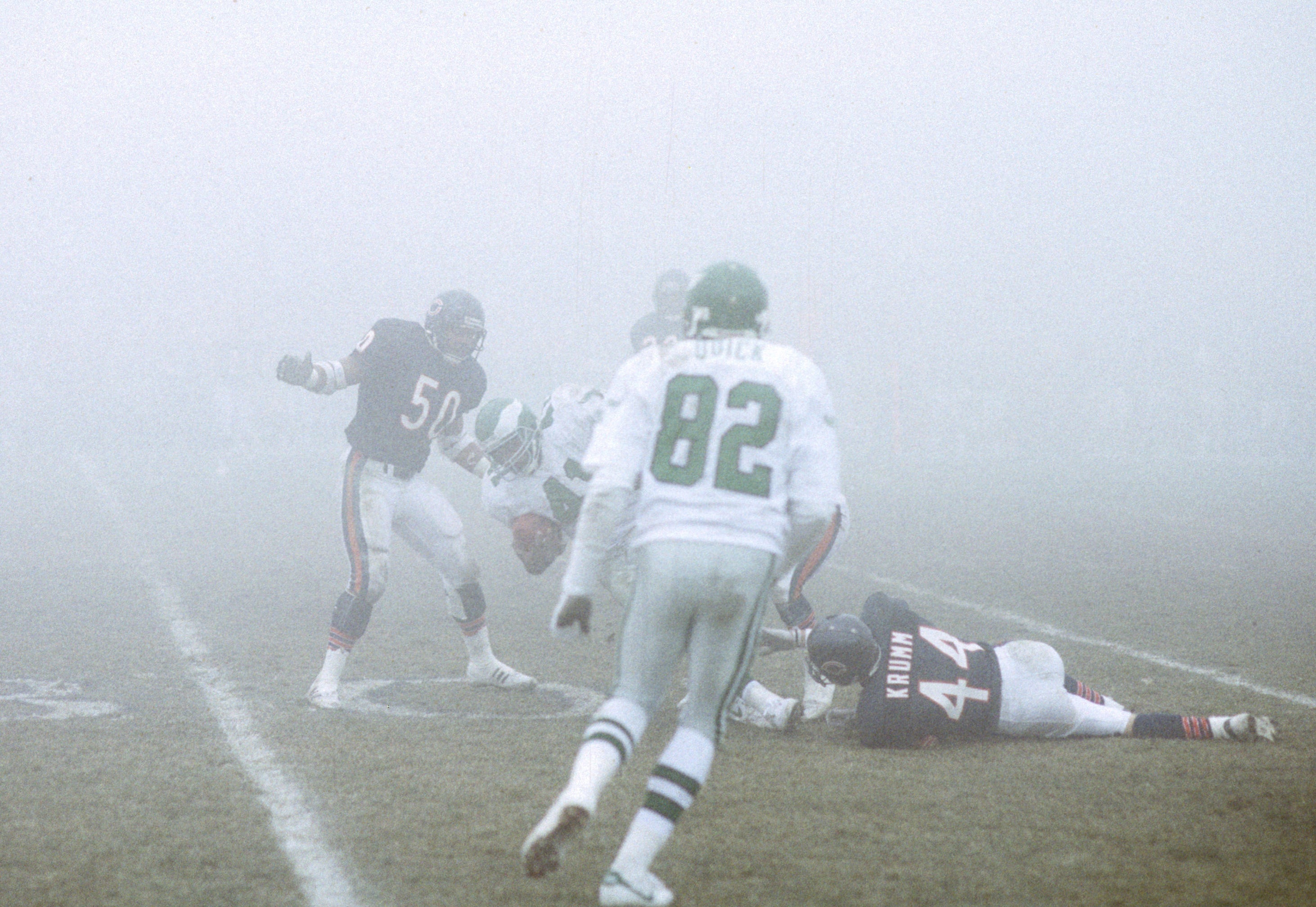
December 31, 1988: The Chicago Bears host the Philadelphia Eagles in an NFC Divisional Playoff at Soldier Field in Chicago. It was Mike Ditka coaching the team he'd led to a Super Bowl win 3 seasons before, against a team coached by Buddy Ryan, who'd been the defensive coordinator for those Bears, and with whom he'd never gotten along.

Chicago is known for nasty Winter weather, and plenty of games at Soldier Field, both at its 1924 original (as this one was) and at its 2003 replacement, have had bitter cold, or snow, or rain, or wind blasting in off Lake Michigan, just 2 blocks away, or some combination thereof.

But they'd never been hit by fog before. San Francisco is the American city best known for fog, and while Giants games at Candlestick Park had to be called due to fog, 49ers games there never have. Cleveland Municipal Stadium had seen some Indians games called due to fog, but not Browns games. Chicago? Fog was one weather condition they were not used to.

At kickoff, the sky was a perfect, cloudless blue. Mike Tomczak threw a 64-yard touchdown pass to Dennis McKinnon, putting the Bears up, 7-0. The Eagles came right back, but only got to the 26-yard line, and Luis Zendejas missed a field goal attempt.

A Seth Joyner interception of Tomczak gave the Eagles a quick next chance, but they committed 2 penalties that nullified touchdowns. Coach Buddy Ryan, so great with defense but totally clueless on offense, went for the field goal again, and, this time, Zendejas converted, making it 7-3 Chicago.

Kevin Butler missed a field goal for the Bears. Randall Cunningham drove the Eagles down the field, and got to 4th & 1 on the Bear 4. He tried a quarterback sneak, but a measurement suggested that he didn't get it, turning the ball over. A fumble recovery early in the 2nd quarter gave the Eagles another chance, but, again, they could only get a field goal attempt out of it, and it was 7-6 Chicago.

Neal Anderson ran for a touchdown, increasing the Bears' lead to 14-6. A Butler field goal made it 17-6, with 2:03 left in the half. This was when the fog arrived, coming in off the Lake. The Eagles managed a field goal before the half, and the teams went into the locker rooms with the score Bears 17, Eagles 9.

CBS had hired a helicopter to provide aerial images. The copter was forced to land, because the fog was so thick. The right thing for the officials to do would have been to suspend the game until the fog lifted. But they didn't, deciding that the fog posed no danger to fans or players (unlike, say, lightning), and they sent the teams out for the 2nd half.

Tomczak and Cunningham couldn't see their receivers. Terry Bradshaw was CBS' color commentator, and he said it was the most frustrating game he had ever seen. I watched this game on CBS, and I couldn't see anything, either. I was reminded of one of the earliest games I'd ever seen, a Los Angeles Rams vs. Minnesota Vikings Playoff game that was so muddy, I couldn't tell which team was which, despite the contrast in their colors. (The Rams' blue and gold, the Vikings' purple and white.) Come to think of it, that game was also on a New Year's Eve, in 1978, exactly 10 years earlier. The Rams won it, 34-10.

The Eagles had the 1st drive of the 2nd half, getting to the Bear 12, but an interception put an end to that. The Bears drove, but stalled, and Butler missed another field goal. An interception was turned into Zendejas' 4th field goal of the game, and the Eagles closed to within 17-12 by the end of the 3rd quarter.

Tomczak was knocked out of the game with an injury, and former starter Jim McMahon was back. He got the Bears into field goal range, and Butler added the 3 points. Around this time, Dan Hampton, the Bears' Hall of Fame defensive end, asked referee Jim Tunney what the score was, because he couldn't see the scoreboard. Never mind read it well enough to make out the numbers, he couldn't see the board. After the game, Hampton told the media, "If I'd known it was only 20-12, I would've played harder!"

The Eagles had 1 last chance, but Cunningham threw his 3rd interception of the game. He threw for 407 yards, but no touchdowns.

There had been football games known as "The Fog Bowl" before. On December 1, 1962, the Grey Cup, the Championship game of the Canadian Football League, at Exhibition Stadium in Toronto, also off a Great Lake (Lake Ontario), was suspended and resumed the next day. The Winnipeg Blue Bombers beat the Hamilton Tiger-Cats, 28-27. And on December 28, 1974, steam rising off the frozen artificial turf at the Sun Bowl in El Paso, Texas resembled fog. Mississippi State beat North Carolina, 28-26.

Within half an hour of the final gun of this game at Soldier Field, the fog lifted. Eagle fans still believe that if the game had been suspended once the fog rolled in, and restarted once it lifted, their team would've won. I don't think so: These were still Ditka's Bears, and Ryan was a terrible head coach who would have found a way to lose. And even if they had won it, they would have had to play the NFC Championship game away to the 49ers at their Joe Montana-to-Jerry Rice peak. The Bears did play the 49ers, at Soldier Field (the Bears had the better record), and, with no weather issues, the 49ers won.

This game has been cited as part of "The Curse of Billy Penn": From 1983, when the Philadelphia 76ers won the NBA Championship, until 2008, when the Phillies won their next World Series, no Philadelphia professional sports team won a World Championship. The suggestion was that the construction of One Liberty Place in 1987, making it taller than the statue of William Penn atop City Hall, caused Penn's spirit to put a curse on the city's teams.

*

December 31, 1988 was a Saturday. One other NFL Playoff game was played: The Cincinnati Bengals beat the Seattle Seahawks, 21-13 at Riverfront Stadium in Cincinnati. The Bengals won the AFC Championship Game, and the 49ers beat them in Super Bowl XXIII.

There were no NBA games scheduled. But there were 9 NHL games, including all 3 New York Tri-State Area teams:

* The New Jersey Devils lost to the Pittsburgh Penguins, 8-6 at the Civic Arena in Pittsburgh. This was the game in which Mario Lemieux scored all 5 ways in which a player can score: Even-strength (at 4:17 of the 1st period), shorthanded (at 7:50 of the 1st), on the power play (at 10:59 of the 1st), a penalty shot (11:14 of the 2nd, and this was also shorthanded), and empty net (19:59 of the 3rd, in other words with 1 second left in regulation).
* The New York Rangers beat the Chicago Blackhawks, 4-1 at Madison Square Garden.

* The New York Islanders beat the Washington Capitals, 6-4 at the Nassau Coliseum

* The Philadelphia Flyers beat the Buffalo Sabres, 3-2 at the Buffalo Memorial Auditorium.

* The Toronto Maple Leafs beat the Quebec Nordiques, 6-1 at Maple Leaf Garden in Toronto, in the 1st half of CBC's Hockey Night In Canada doubleheader.

* The Hartford Whalers beat the Detroit Red Wings, 3-2 at the Joe Louis Arena in Detroit.

* The Minnesota North Stars beat the St. Louis Blues, 6-2 at the Metropolitan Sports Center in the Minneapolis suburb of Bloomington, Minnesota.

* The Winnipeg Jets played the Calgary Flames to a 4-4 tie, at the Olympic Saddledome in Calgary.

* And the Montreal Canadiens beat the Edmonton Oilers, 4-2 at the Nassau Coliseum, in the 2nd half of the CNBC doubleheader. 

December 31, 1984: Rick Allen's Car Crash

December 31, 1984: Rick Allen, the drummer for British hard-rock band Def Leppard, is badly injured in a car crash, outside the hometown of most of the band's members, Sheffield, South Yorkshire.

Allen, himself from Dronfield, in Derbyshire, in the East Midlands, was thrown from his Chevrolet Corvette. He had a seat belt on. The belt did not restrain him. It did restrain his left arm, severing it.

Until this moment, Allen seemed to be living a charmed life with one of the biggest bands in the world. On his 15th birthday, November 1, 1978, he was admitted to the band, after responding to their classified ad for a new drummer. On his 16th birthday, they opened for one of the biggest rock bands in the world, AC/DC.

But at 21, his career seemed to be over. As lead singer Joe Elliott said, "If I lose my arm, I can still sing. If he loses his voice, he can still play drums." How can a drummer play drums with one arm?

Allen had a specially-rigged drum kit made by Whirlwind USA, whose cables allowed his left foot to play the parts his left hand would have. This setup made its debut on August 5, 1986, at the Monsters of Rock festival, at the Donington Park race track in Leicestershire, England. The band went on to have its biggest album, Hysteria, in 1987.

Def Leppard's guitarists, Phil Collin and Steve Clark, were known as "The Terror Twins." Clark died from excessive drinking in 1991. He was subsequently replaced by Dio guitarist Vivian Campbell. He, Allen, Elliott, Collin and bass guitarist Rick Savage (his real name, not a stage name) are still together in 2022.

*

December 31, 1984 was a Monday. Baseball was out of season. The NFL was between its Divisional Playoffs and its Conference Championships. There were 2 college football bowl games. Virginia beat Purdue, 27-24 in the Peach Bowl at Atlanta-Fulton County Stadium. And West Virginia beat Texas Christian University (TCU), 31-14 in the Bluebonnet Bowl at the Astrodome in Houston.

There were no games played in the NBA, but there were 4 games played in the NHL:

* The New York Islanders lost to the Minnesota North Stars, 4-3 at the Metropolitan Sports Center in the Minneapolis suburb of Bloomington, Minnesota.

* The New Jersey Devils lost to the Buffalo Sabres, 6-4 at the Buffalo Memorial Auditorium.

* The Quebec Nordiques and their arch-rivals, the Montreal Canadiens, played to a 4-4 tie at the Montreal Forum.

* And the Pittsburgh Penguins and the Detroit Red Wings played to a 4-4 tie at the Joe Louis Arena in Detroit.

December 31, 1975: Hockey's "Game of the Century"

Left to right: Peter Mahovlich,
Vladislav Tretiak, Yvan Cournoyer

December 31, 1975: A hockey game is played at the Montreal Forum. It not only ends up getting labeled "The Game of the Century," but it is often credited with "saving the sport."

Super Series '76 was scheduled, with 2 Soviet club teams taking on NHL teams. One was the reigning Soviet Champions, CSKA Moscow. Translated into English, "CSKA" (pronounced "CHESS-kah") became "Central Sports Club of the Army." It was a team sponsored by the country's Red Army, and that's what they were called in the American media: "The Red Army." The other was Krylya Sovetov, translated as "Soviet Wings." This suggests they were sponsored by the country's Air Force. Not quite: They were sponsored by the country's aircraft builders.

The Super Series began on December 28, 1975, at Madison Square Garden, and the Red Army pounded the New York Rangers, 7-3. This was understandable: Despite celebrating their 50th Season, the Broadway Blueshirts were in total disarray, having recently fired their head coach and general manager, Emile Francis; and traded away several key players, including goaltender Eddie Giacomin, defenseman Brad Park and center Jean Ratelle. On December 29, the Soviet Wings beat the Pittsburgh Penguins, 7-4. Also not a surprise: The Pens were not a good team at the time.

The next game got people's attention, though: On New Year's Eve, at the Montreal Forum, the Red Army took on the Montreal Canadiens, a team loaded with future Hall-of-Famers, and one of the favorites to win the Stanley Cup.

Les Habitantes got on the board first, as Steve Shutt scored 3:10 into the game. At 7:25, Yvon Lambert made it 2-0. Boris Mikhailov scored for the Soviets, 3:54 into the 2nd period. At 9:39, Canadien Captain Yvan Cournoyer scored, to make it 3-1. So, of the Habs' 1st 3 goals, 2 were scored by men with the French variation on the Russian name "Ivan," meaning "John."

At 16:21, Valery Kharlamov scored, to make it 3-2. At 4:04 into the 3rd period, Boris Aleksandrov scored to tie the game. It ended in a 3-3 tie, and the entire game only saw 8 penalties called. Montreal goalie Ken Dryden saved 10 of 13 shots, while the Soviets' Vladislav Tretiak saved 35 of 38. Each man was reprising a fine performance in the 1972 "Summit Series." It has been called one of the greatest games in the sport's history.

"We outshot them 38 to 13, and that was pretty indicative of the way the game went," the Canadiens' Doug Risebrough said. "Vladislav Tretiak stole the game. He was just great. But the final score didn’t matter. Whether we won, lost or tied the game, we knew we had something special."

On January 4, 1976, an NHL team finally got a win. The Buffalo Sabres, who had advanced to the previous season's Stanley Cup Finals, beat the Wings, 12-6 at the Buffalo Memorial Auditorium. But the Russians re-established their dominance: On January 7, the Wings went into the Chicago Stadium, and beat the Chicago Black Hawks, 4-2.

On January 8, the Red Army went into the Boston Garden and, playing a Boston Bruins team with Bobby Orr injured, Phil Esposito traded to the Rangers for Park and Ratelle, and Park and Ratelle not really settled in yet, dominated the Beantown Brats, 5-2. And on January 10, the Wings went out to Long Island, and beat the rising New York Islanders, 2-1.

There was one game left to play. On January 11, the Red Army went into The Spectrum in Philadelphia, to play the Philadelphia Flyers, 2-time defending Stanley Cup Champions. And the Flyers, in the process of standing up for America, undid a lot of the undoing of the damage.

They had a well-balanced team led by Captain Bobby Clarke and goaltender Bernie Parent. But they were also the most violent team hockey had ever seen, known as "The Broad Street Bullies." Philadelphia fans, enjoying their image as a city for tough people, loved it. 

In the 1st period, Ed Van Impe was sent to the penalty box for hooking. When his penalty ended, with the score still 0-0, he went right at Kharlamov, and elbowed him in the head. The referee, Lloyd Gilmour, did not call a penalty. Red Army coach Konstantin Loktev decided that his players were not going to be treated fairly, and, with the clock reading 11:21 of the 1st period (in other words, 9:39 to go), pulled his team off the ice. Bob Cole, calling the game for CBC (the Canadian Broadcasting Corporation), yelled, "They're going home! They're going home!"

With the threat of losing their share of the gate receipts, the Russians were talked back into going back onto the ice, and the Flyers beat them, 4-1. Tretiak said the Flyers won by playing "rude hockey." Loktev called them "a bunch of animals." They were both right. But the Flyers had won, and came away believing the Russians were skilled but soft. They were right, too.

The Flyers made it 3 straight trips to the Stanley Cup Finals, and printed up memorabilia reading, "HAT TRICK IN '76." But the Canadiens put a stop to that, sweeping them in 4 straight, for the 1st of 4 straight Stanley Cups. They credited the New Year's Eve tie with the Soviets for sparking them into that dynasty. Dryden, Cournoyer, Shutt, Guy Lafleur, Jacques Lemaire, Bob Gainey, Serge Savard, Guy Lapointe and Larry Robinson would all be elected to the Hockey Hall of Fame.

*

December 31, 1975 was a Wednesday. There were 4 regular-season games in the NHL that day:

* The New York Rangers lost to the Atlanta Flames, 8-1 at Madison Square Garden.

* The Pittsburgh Penguins beat the Los Angeles Kings, 5-1 at the Civic Arena in Pittsburgh.

* The Detroit Red Wings beat the Washington Capitals, 4-0 at the Olympia Stadium in Detroit.

* And the Boston Bruins beat the Minnesota North Stars, 6-1 at the Metropolitan Sports Center in the Minneapolis suburb of Bloomington, Minnesota.

There were no games in the World Hockey Association. Nor were there any in the NBA. There was 1 in the American Basketball Association: The Denver Nuggets beat the Kentucky Colonels, 141-137 at the McNichols Arena in Denver.

Baseball was out of season. There were 2 college bowl games played. Number 4 Alabama beat Number 8 Penn State, 13-8 in the Sugar Bowl in New Orleans. It was the 1st Sugar Bowl indoors, at the Superdome, after being outdoors at Tulane Stadium since New Year's Day 1935. And West Virginia beat North Carolina State, 13-10 in the Peach Bowl, at Atlanta-Fulton County Stadium.

December 31, 1974: The Yankees Hook a Catfish

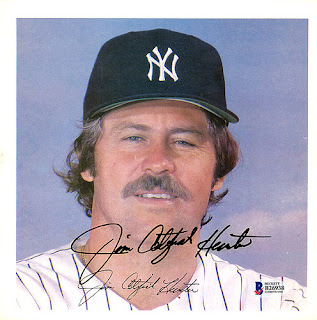
December 31, 1974: The era of baseball free agency begins, as the Yankees "hook a Catfish."

James Augustus Hunter was signed out of Perquimans High School in North Carolina by the Kansas City Athletics on June 8, 1964. Team owner Charles O. Finley thought "Jim Hunter" was too ordinary a name, and that he needed a nickname. Charlie asked "Jimmy" (as he was always known to his family) what he liked to do. Jim said he liked to hunt and fish, a common pair of passions for baseball players from rural areas in those days.

So Finley made up a story about how, when he was a boy, Jimmy caught a whole bunch of catfish, and that he had been nicknamed "Catfish Hunter" -- or, sometimes, just "Cat" -- from then on. Of course, no one had ever called him "Catfish" -- or "Cat" -- until June 8, 1964.

Hunter made his debut with the A's in 1965. In 1966, he made the 1st of what turned out to be 8 All-Star Games. The A's moved to Oakland in 1968. That season, Catfish pitched a perfect game. He helped them win the American League Western Division in 1971, and the World Series in 1972, 1973 and 1974. He won the AL Cy Young Award in 1974, leading in both wins (he went 25-12) and ERA. That year, despite Tom Seaver, Steve Carlton, Jim Palmer and Nolan Ryan all being in their prime, he was the best pitcher in baseball.

Charlie Finley was so cheap! (How cheap was he?) He was so cheap, he let the best pitcher in baseball get away because he refused to fulfill a part of the man's contract. The contract that Catfish signed for 1974 was for 2 years -- unusual under the still-holding reserve clause -- for $200,000, or $100,000 per year, which, while no longer a record, was still a benchmark for ballplayers.

But not all of that was salary: The contract stipulated that, in 1974 and again in 1975, Finley would make a $50,000 payment to a life insurance annuity. Since Finley had become rich selling insurance, he should have not only understood this, but respected this.

But after the 1974 season, Finley found out he had to pay $25,000 in taxes, due immediately. (Worth about $148,000 in 2022 money.) So he refused to pay the annuity. Catfish, who had been trying to secure his family's post-baseball future, was normally a very even-tempered man, which helped him a lot while pitching. Over this, though, he hit the roof, and appealed to Peter Seitz, Major League Baseball's arbitrator for contract disputes.

On December 16, 1974, foreshadowing the decision he would make a year later, killing the reserve clause, Seitz ruled in Catfish's favor: He was now a free agent, and the 24 teams then in Major League Baseball were all permitted to bid for his services for 1975 and beyond.

Suddenly, the small town of Hertford, in the Inner Banks of North Carolina, a small town of about 2,000 people, 60 miles south of the Class AAA city of Norfolk, Virginia, became the center of the baseball world. Every team, except the San Francisco Giants, bid for Catfish.

The winning bid came from the New York Yankees. Although team owner George Steinbrenner was suspended from operating the team until the 1976 season, general manager Gabe Paul had his permission to offer Catfish $3.35 million over 5 years -- $670,000 per season, a record at the time. (In today's money, about $3.98 million per year. How quaint that now sounds.)

Catfish actually refused 2 higher bids: From the San Diego Padres, because he was tired of being on the opposite coast from home; and from the Kansas City Royals, because he wanted to play on real grass, and Royals Stadium had artificial turf. (In 1993, that stadium was given both real grass and a new name, Kauffman Stadium, both of which it still has.)

To put the figure in perspective: The player who was paid the most for the 1974 season was Hank Aaron, MLB's new all-time home run leader: $240,000. (About $1.42 million in 2022 money.) Catfish's contract had broken the barriers of $250,000 (a quarter of a million), $300,000, $400,000, $500,000 (half a million) and $600,000.

Catfish struggled at first in 1975, losing his 1st 3 games. In fact, his debut, on April 8, 1975, was also Frank Robinson's 1st game as baseball's 1st black manager, and he hit a home run off Catfish to give the Cleveland Indians the win. But Catfish settled down, and went 23-12. It was his 5th straight season of at least 21 wins.

But all that pitching began to wear on his arm. He went just 17-15 in 1976, still helping the Yankees win the Pennant. He was injured for much of the 1977 and 1978 seasons, but a procedure on his shoulder allowed him to win 6 straight games down the stretch in 1978. After being hit hard in Game 2 of the 1977 World Series, but the Yankees won the Series anyway, Catfish won the clinching Game 6 of the 1978 World Series.

After the 1979 season, the 5th and last year of his contract, Catfish retired. He had always intended to, but his bad shoulder took the decision out of his hands. His final record was 224-166. After that season, the Houston Astros signed Ryan to the 1st contract to break the $1 million-per-season barrier.

Jim "Catfish" Hunter was elected to the Baseball Hall of Fame in 1987. Charlie Finley has never been elected. Then again, neither have George Steinbrenner, Gabe Paul and Peter Seitz.

Catfish died in 1999, like Lou Gehrig from amyotrophic lateral sclerosis, the disease now named for Gehrig.

For the 2023 season, the New York Mets will pay Max Scherzer and Justin Verlander, 2 pitchers whose statistics will make them sure Hall-of-Famers if they don't do anything stupid like Pete Rose did, record salaries of $43,333,333 each. In 1974, that would have been $7.1 million, or 10.6 times Catfish Hunter's former record salary.

*

December 31, 1974 was a Tuesday. Baseball was out of season. The NFL was in midweek. No college football bowl games were played that day. No NBA games were played. One game was played in the American Basketball Association: The San Antonio Spurs beat the Indiana Pacers, 140-105 at the HemisFair Arena in San Antonio. Despite that high score, the leading scorer for the Spurs was George Gervin: "The Iceman" scored 27.

Two games were played in the NHL. The Detroit Red Wings beat the California Golden Seals, 4-3 at the Olympia Stadium in Detroit. And the Los Angeles Kings beat the Chicago Black Hawks, 3-1 at the Chicago Stadium.

And 2 games were played in the World Hockey Association. The Chicago Cougars beat the Cleveland Crusaders, 4-3 at The Coliseum in the Cleveland suburb of Richfield, Ohio. And a 1-1 tie was played between the Phoenix Roadrunners and the Michigan Stags, at Cobo Hall in Detroit.

December 31, 1972: Color TV Sets Overtake Black-and-White

A 1972 Zenith print ad,
complete with period-typical shag carpeting

December 31, 1972: The end of the year leads the Federal Communications Commission to announce that this is the 1st year that Americans bought more color television sets than black-and-white sets, and the 1st year that a majority of American homes had color TV sets.

Although all-electronic color television sets were introduced in the U.S. in 1953, high prices and the scarcity of color programming greatly slowed its acceptance in the marketplace. It would take until the 1965-66 TV season for most American shows that had not already switched to color to do so.

But it still took until 1972 for color sets to overtake black-and-white sets. Indicative of this was TV Guide magazine making a switch: Until then, when they listed a show in color, it would have an icon next to it, a white "C" on a black background. Afterward, if a program was a black-and-white broadcast, such an old movie or a TV rerun, the icon next to the listing would be a black "BW" on a white background.

Oddly, while Britain developed what Americans would come to call "network television" in 1936, and we didn't really do so until 1947, their BBC and ITV didn't switch to color broadcasting until 1969.

*

December 31, 1972 was a Sunday. This was also the day that baseball star Roberto Clemente was killed in a plane crash. I have a separate entry for that event.

It was the off-season for baseball. The NFL played its Conference Championship Games:

* Although the Miami Dolphins had an undefeated regular season, the Pittsburgh Steelers hosted the AFC Championship Game at Three Rivers Stadium, because the NFL was still using a rotating system for hosting the title game, not home field advantage.

Eight days after the franchise's 1st-ever Playoff win, on the Franco Harris "Immaculate Reception," the Steelers led 10-7 in the 3rd quarter. But the Dolphins came from behind to win, 21-17.

* The Washington Redskins dominated the defending NFL Champions, the Dallas Cowboys, 26-3 at Robert F. Kennedy Stadium. Head coach George Allen led his veteran "Over-the-Hill Gang" to the team's 1st Playoff win in 30 years. 

But the Dolphins would complete the perfect season by beating the Redskins in Super Bowl VII, 2 weeks later at the Los Angeles Memorial Coliseum.

There were no games played in the NBA or the ABA on New Year's Eve 1972. There were 3 NHL games played that day:

* The New York Rangers beat the St. Louis Blues, 6-1 at Madison Square Garden. 

* The Detroit Red Wings and the Minnesota North Stars played to a tie, 4-4 at the Olympia Stadium in Detroit. 

* And the Chicago Black Hawks beat the Buffalo Sabres, 4-2 at Chicago Stadium. 

And there were 3 games played in the World Hockey Association, which was in its 1st season:

* The New England Whalers beat the New York Raiders, 3-0 in the other game played on Madison Square Garden ice that day.

* The Quebec Nordiques beat the Ottawa Nationals, 8-4 at Le Colisée de Québec. Rene Levesque must have loved that.

* And the Philadelphia Blazers beat the Los Angeles Sharks, 3-1 at the Los Angeles Memorial Sports Arena.

December 31, 1972: Roberto Clemente Is Killed

December 31, 1972: Roberto Clemente is killed in a plane crash, trying to get relief supplies from his native Puerto Rico to earthquake-ravaged Nicaragua.

Eight days earlier -- the same day as the football play known as the "Immaculate Reception" -- an earthquake measuring 6.3 on the Richter scale struck the Nicaraguan capital of Managua.

As with the San Francisco earthquake of 1906, there were fires started, and the city's firefighting equipment was damaged by the earthquake. Between the initial quake and the fires, the Managua disaster killed about 11,000 people, and left about 300,000 of the city's 1 million or so people homeless. The city's top 4 hospitals were destroyed, and there were food shortages.

The world responded with relief, but the country's right-wing dictator, Anastasio Somoza Debayle -- my autocorrect poignantly tried to turn that into "Debacle" -- had it distributed according to his own purposes, much like an old-style American city "machine politician."

Enter Roberto Clemente. The right fielder for the Pittsburgh Pirates had just completed his 18th major league season. At age 38, he showed no signs of slowing down. That season, he batted .312, helped the Pirates win their 3rd straight National League Eastern Division title, was named to his 15th All-Star game, was awarded his 12th Gold Glove, and collected his 3,000th career hit. 

He had won 4 NL batting titles, was named the NL's Most Valuable Player in 1966, and had helped the Pirates win the World Series in 1960 and 1971, being named the Series MVP in the ladder. 

He was not the first black Hispanic player in the major leagues, but, at this point, he was easily the greatest. Indeed, like actor-comedian Jackie Gleason was, and hockey star Wayne Gretzky later would be, he was nicknamed "The Great One." He was a point of pride for baseball fans all over Latin America, not just in his native Puerto Rico.

Already heavily involved in charities all over Latin America, Clemente had visited Managua only a few weeks before the earthquake. He organized three planeloads of relief supplies, but heard they had all been diverted by the Somoza government. He decided to accompany the fourth flight himself, to make sure that it didn't happen again.

The plane was a propeller-driven cargo plane, a DC-7. This particular plane, one of 338 that McDonnell-Douglas built between 1953 and 1958, was a bad choice, as it had a history of mechanical problems. On December 31, 1972, New Year's Eve, it was loaded up at Isla Verde International Airport outside the Puerto Rican capital of San Juan.
A DC-7, similar to the Clemente relief plane

Between cargo, and regular supplies like fuel, the plane ended up 4,200 pounds over its recommended limit. The plane took off at 9:20 PM (8:20 PM, U.S. East Coast time), for a 4-hour flight from San Juan to Managua -- meaning the New Year of 1973 would have begun for them in midflight.

But within 3 minutes, the pilot, Jerry Hill, realized he couldn't get the plane high enough due to the weight, and told the San Juan control tower that he had begun to turn around. Just afterward, one of the plane's four engines exploded, and it crashed into the Atlantic Ocean. 

Although most pieces of the plane were found, Hill was the only one of the five people on board whose body was found. There is no grand memorial for Roberto Clemente at any cemetery: He still lies somewhere off the coast of his homeland. He left behind a wife and three sons.
For baseball fans, January 1, 1973 did not present a "Happy New Year." The Pirates retired Clemente's Number 21, and wore that number in a patch on their sleeves all season long. It would be the only season from 1970 to 1975 that they didn't win the NL East title. On March 20, a special election was held for the Baseball Hall of Fame, and the five-year waiting period after a player's last game was waived, making Clemente eligible. He was elected with nearly 93 percent of the vote.
Manager Bill Virdon with the patch

The Pirates dedicated a statue of him outside Three Rivers Stadium. When they moved to the adjacent PNC Park in 2001, the statue went with them, and the neighboring 6th Street Bridge connecting the North Side with downtown Pittsburgh was renamed the Roberto Clemente Bridge.

An arena that was nearly ready to open in San Juan at the time of his death was named the Roberto Clemente Coliseum. New York City named a park across from the Bronx apartment building where Hank Greenberg grew up after a member of the Hall of Fame -- not Greenberg, but, reflecting that this neighborhood is now mostly Puerto Rican, Clemente.

On December 31, 1985, 13 years later, another New Year's Eve would be struck by air travel tragedy, as the crash outside Dallas of another McDonnell-Douglas plane with a troubled history, this one an old DC-3, killed seven people including early rock and roll star Ricky Nelson.

Earlier in 1985, Isla Verde International Airport in San Juan was renamed Luis Muñoz Marín International Airport, after the 1st elected Governor of the island, who had presided over the airport's opening in 1955.

*

December 31, 1972 was a Sunday. The end of the year marked the 1st year that Americans bought more color television sets than black-and-white sets, and the 1st year that a majority of American homes had color TV sets. I have a separate entry for that event.

It was the off-season for baseball. The NFL played its Conference Championship Games:

* Although the Miami Dolphins had an undefeated regular season, the Pittsburgh Steelers hosted the AFC Championship Game at Three Rivers Stadium, because the NFL was still using a rotating system for hosting the title game, not home field advantage.

Eight days after the franchise's 1st-ever Playoff win, on the Franco Harris "Immaculate Reception," the Steelers led 10-7 in the 3rd quarter. But the Dolphins came from behind to win, 21-17.

* The Washington Redskins dominated the defending NFL Champions, the Dallas Cowboys, 26-3 at Robert F. Kennedy Stadium. Head coach George Allen led his veteran "Over-the-Hill Gang" to the team's 1st Playoff win in 30 years. 

But the Dolphins would complete the perfect season by beating the Redskins in Super Bowl VII, 2 weeks later at the Los Angeles Memorial Coliseum.

There were no games played in the NBA or the ABA on New Year's Eve 1972. There were 3 NHL games played that day:

* The New York Rangers beat the St. Louis Blues, 6-1 at Madison Square Garden. 

* The Detroit Red Wings and the Minnesota North Stars played to a tie, 4-4 at the Olympia Stadium in Detroit. 

* And the Chicago Black Hawks beat the Buffalo Sabres, 4-2 at Chicago Stadium. 

And there were 3 games played in the World Hockey Association, which was in its 1st season:

* The New England Whalers beat the New York Raiders, 3-0 in the other game played on Madison Square Garden ice that day.

* The Quebec Nordiques beat the Ottawa Nationals, 8-4 at Le Colisée de Québec. Rene Levesque must have loved that.

* And the Philadelphia Blazers beat the Los Angeles Sharks, 3-1 at the Los Angeles Memorial Sports Arena. 

December 31, 1967: The 1st Oakland Championship

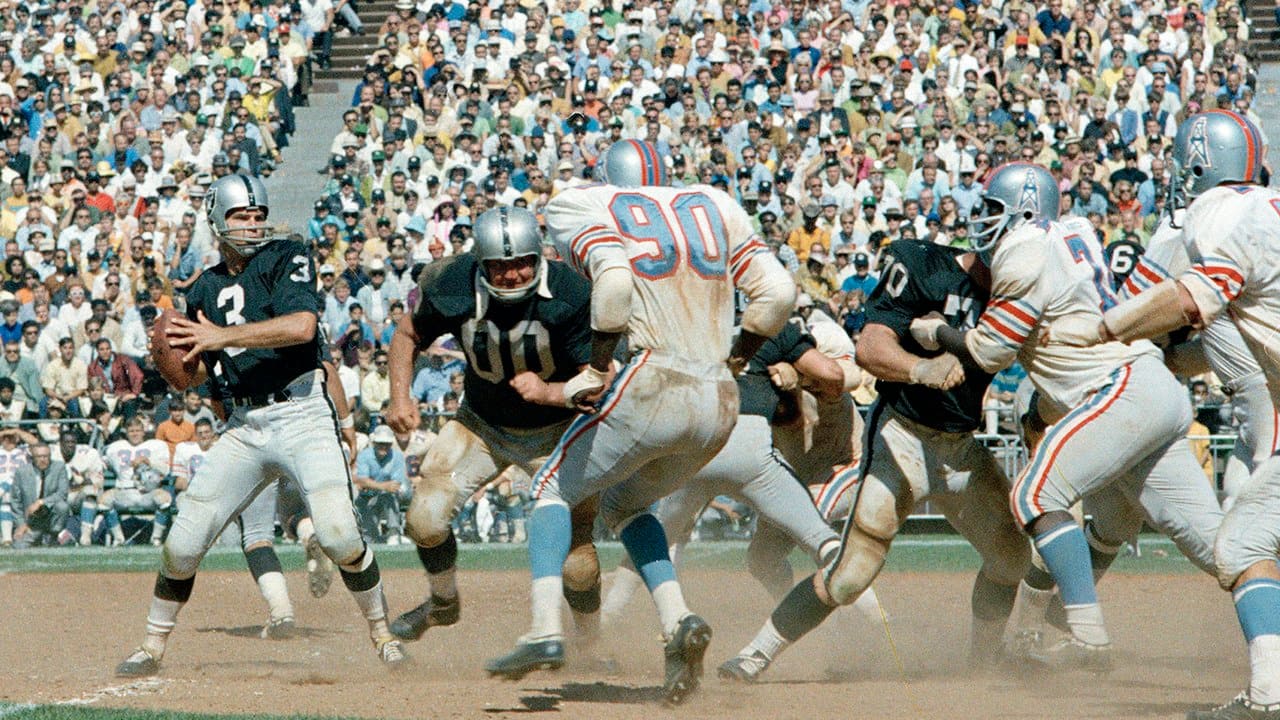
Daryle Lamonica (3) back to pass. Blocking for him
are Jim Otto (00), Dan Archer (78) and Jim Harvey (70).
Note the infield dirt, left over for baseball.

December 31, 1967: The American Football League Championship Game is played at the Oakland-Alameda County Coliseum on this New Year's Eve. The Oakland Raiders hosted the Houston Oilers.

The Oilers had played in the 1st 3 AFL Championship Games, winning in 1960 and 1961, but losing in 1962. Their starting quarterback was George Blanda. Pete Beathard was now the Oilers' quarterback. This would be the Raiders' 1st title game. Blanda was now playing for them.

But while he was their main placekicker, he was not their starting quarterback. That would be Daryle Lamonica, who threw the ball so often, and so far, he became known as "The Mad Bomber." Raider coach John Rauch, having been a quarterback himself, knew he had two good ones. Lamonica would not be elected to the Pro Football Hall of Fame, but Blanda would, along with receiver Fred Biletnikoff, center Jim Otto, guard Gene Upshaw, and cornerback Willie Brown.

The game kicked off at 2:00 Pacific Standard Time (5:00 Eastern), and the temperature was 47 degrees. Just a few minutes earlier, the NFL Championship Game had ended in Green Bay, Wisconsin, and, to those inside Lambeau Field, 47 degrees would have seemed like beach weather in comparison.

The only scoring in the 1st quarter was a 37-yard field goal by Blanda. But the Raiders pulled away in the 2nd quarter, with Hewritt Dixon scoring on a 69-yard run, and Lamonica throwing a 17-yard touchdown pass to Dave Kocourek. It was 17-0 Raiders at the half.

In the 3rd quarter, Lamonica scored on a quarterback sneak, and Blanda kicked a 40-yard field goal. Blanda kicked one from 42 yards, giving the Raiders a 30-0 lead early in the 4th quarter. The Oilers finally scored on a 5-yard touchdown pass from Beathard to Charley Frazier. But the Raiders put it away with another field goal from Blanda, this one 36 yards, and a 12-yard touchdown pass from Lamonica to Bill Miller. The final was Oakland 40, Houston 7.

This was the 1st league championship for Raiders owner Al Davis. There would be more. Moreover, while Oakland had been the much-maligned "little brother" to cosmopolitan San Francisco across the Bay, this game was the beginning of a shift.

The San Francisco Giants had won the National League Pennant in 1962, and just missed Pennants in 1964, '65 and '66. But the Raiders were now AFL Champions, and Oakland had just become home to the NHL's Seals and the ABA's Oaks, and were about to become home to baseball's Athletics. Oakland would soon have 4 teams, to San Francisco's 3 -- and when the San Francisco Warriors moved in 1971, taking the name "Golden State Warriors," taking the place of the Oaks who had moved, Oakland would, briefly, have 4 teams to San Francisco's 2.

From this game until the 49ers' NFC Championship of January 10, 1982, the City of San Francisco had no league champions in any sport, while the City of Oakland had 8: The 1967 AFL Champion Raiders; the 1969 ABA Champion Oaks; the 1972, 1973 and 1974 World Series Champion Athletics; the 1975 NBA Champion Warriors; and the 1976 and 1980 NFL Champion Raiders. And that doesn't even count the Oakland Clippers, earlier in 1967, winning the title in the National Professional Soccer League, which could hardly have been called "major league." But it did happen.

For a few years, sports-wise, Oakland was the place to be. It was a golden age -- or, as A's and Seals owner Charlie Finley might have put it, a Green and Golden Age.

*

December 31, 1967 was a Sunday. The 1967 NFL Championship Game was played the same day. While the Oakland Coliseum has been known for chilly conditions, there was no issue with the weather there on that day. That would not be the case for the NFL title game: It was well below zero at Lambeau Field in Green Bay, Wisconsin. The Green Bay Packers beat the Dallas Cowboys, 21-17, in a game that became known as the Ice Bowl. I have a separate entry for that event. The Packers went on to beat the Raiders, 33-14 in Super Bowl II, in a much-warmer Orange Bowl in Miami.

There were 2 games played in the NBA. The Los Angeles Lakers beat the expansion San Diego Rockets, 147-118. It was the 1st game the Lakers played at their new arena, The Forum, outside Los Angeles in Inglewood, California.

And the San Francisco Warriors beat the other expansion team, the Seattle SuperSonics, 126-124 at the Seattle Center Coliseum. For the Warriors, Nate Thurmond had 34 points and 25 rebounds.

There was 1 game played in the American Basketball Association, which was in its 1st season: The Pittsburgh Pipers beat the Indiana Pacers, 121-106 at the Civic Arena in Pittsburgh. The Pipers would go on to win the 1st ABA Championship. But before the 1972-73 season, they were out of business. The Pacers would win the ABA title in 1970, '72 and '73, and were 1 of the 4 teams absorbed from the ABA into the NBA in 1976.

There were 4 games played in the NHL that day:

* The New York Rangers beat the Toronto Maple Leafs, 4-0, in one of the last events at the old Madison Square Garden.

* The Philadelphia Flyers beat the Los Angeles Kings, 9-1 at The Spectrum in Philadelphia.

* The Detroit Red Wings beat the Boston Bruins, 6-4 at the Olympia Stadium in Detroit.

* The Chicago Blackhawks beat the Oakland Seals, 3-0 at the Chicago Stadium.

* The Montreal Canadiens, the Pittsburgh Penguins, the St. Louis Blues and the Minnesota North Stars were not scheduled. 

December 31, 1967: The Ice Bowl

Lambeau Field as it appeared in 1967.
Note the shadow cast by the scoreboard
at the south end. This will matter later on.

December 31, 1967: As the narrator for a 1987 NFL Films production put it, "On a day savage enough to make a Saint Bernard whimper, they played the 1967 NFL Championship Game." Or, as it has become known in football lore, The Ice Bowl.

I don't know who the narrator was -- the Internet has failed me in this regard -- but the film was made in 1987, so it wasn't John Facenda, the voice of NFL Films from 1966 until his death in 1984. Let the record show that Facenda never actually spoke the words "the frozen tundra of Lambeau Field." ESPN's Chris Berman, imitating Facenda, made that up.

The Ice Bowl isn't even the coldest game in NFL history anymore. The 1981 AFC Championship Game, played at Riverfront Stadium in Cincinnati on January 10, 1982, was 9 degrees below zero without the wind chill factor, and 37 below with it. The San Diego Chargers, used to warm weather, had played one of the hottest games in NFL history just 8 days earlier, against the Miami Dolphins at the Orange Bowl, and were totally unused to this kind of cold. The Bengals won, 27-7. This one is known as the Freezer Bowl.

Many NFL Championship Games, nearly all played in December to that point, had been plagued by cold weather. Vince Lombardi had been born and raised in Brooklyn, and had coached the Green Bay Packers since 1959, so he could handle cold weather.

But from having coached in the title games of 1956, 1958 (these 2 as an assistant coach with the New York Giants), 1961, 1962 and 1965, he knew that cold weather could be a problem for football. Fortunately, since the Packers' unusual ownership structure, and his role as both head coach and general manager, left him a virtual dictator, he had the field torn up, and heating coils placed under the field. When resodded, the idea was that the coils would keep the field from freezing. It became known as "Lombardi's Electric Blanket."

Lombardi had been offensive coordinator to Giants head coach Jim Lee Howell. The defensive coordinator was Tom Landry, who became the 1st head coach of the Dallas Cowboys, the team the Packers had defeated to win the 1966 NFL Championship, and whom they would have to beat again to win for 1967. Lombardi and Landry were opposites: Landry was a great stone face, never showing emotion during the game; while Lombardi was, in the words of his Hall of Fame guard Jerry Kramer, "a raving Italian lunatic!"

But the teams were the other way around: The Cowboys -- not yet the dominant team that they would become -- were braggarts, having earned very little right to do so thus far; while the Packers let their performance do the talking for them. The exception was Hall of Fame running back Paul Hornung, but he was retired by this point. The Packers were going for their 5th NFL Championship in 7 years, which included ending the previous season by winning "The AFL-NFL World Championship Game," retroactively named "Super Bowl I."

The day before the game, NFL Commissioner Pete Rozelle made some phone calls, and was told that the game-time temperature would be about 5 degrees above zero. (All temperatures mentioned in this post will be in degrees Fahrenheit.)

Rozelle didn't like that, and began to consider postponing the game to the next day, Monday, New Year's Day 1968, despite the fact that it would compete for TV ratings with the college bowl games. But he was told that the oncoming cold front would make it even colder on Monday. So, already in Green Bay, he called Lombardi at his house, and Landry at his hotel, and told them the game would go on as scheduled.

But the cold front arrived sooner, and was worse than expected. As Cowboy receiver Rentzel reported, he was told that it was 15 degrees below zero. The official NFL Films record of the game shows a rotating bank clock backing that up, reading "-15°."
I couldn't find a photo online.
I had to photograph it off my computer screen.
Yes, that's me and my phone in the reflection.

When Lombardi got to Lambeau Field, he discovered that it was so cold (This was before comedians began doing things like, "How cold was it?"), the mechanism for the heating coils broke. With the machine inoperable, the field was frozen. To make matters worse, when the tarp was taken off the field, it had left moisture on it, which froze. The field was an ice rink.

At the time, Lambeau Field held 50,861 people. That was the official attendance: In spite of the cold, there was not an empty seat in the house -- until an elderly spectator died from exposure. Yes, only one fan died from the cold. Among those in attendance was a 12-year-old boy from Appleton, Wisconsin, who went on to become a renowned actor: Willem Dafoe. In 2017, NFL Films released a 50th Anniversary documentary on the Ice Bowl, with Dafoe narrating. 

The marching band of the University of Wisconsin-La Crosse was scheduled to perform the pregame and halftime shows. But during -- pardon the choice of words -- the warmups, the spit inside their woodwind instruments froze, rendering them impossible to play. The mouthpieces of brass instruments stuck to their players' lips. Seven members of the band were taken to the hospital for hypothermia.

The officials' whistles also had the spit freeze inside, and, during the pregame midfield meeting with the team captains, they said that play would be stopped by the officials putting their hands on the backs of players who, due to concentrating on the ballcarrier, couldn't otherwise see that play had stopped.

Frank Gifford, the Hall of Fame running back for the Giants who was serving as one of the CBS announcers for the game, said, on the air, "I'm going to take a bite of my coffee."
The game was played anyway. When it kicked off at 1:00 PM Central Standard Time -- 2:00 Eastern -- it was 13 below, with a wind-chill factor, on the since-changed current scale, of -36.
Note the ticket price: $10. That's about $83 in 2022 money.
For the Championship Game. Today, a regular-season game
would almost certainly cost you much more.

The game did affect the Cowboys more than the Packers. The film shows Hall of Fame linebacker Ray Nitschke running onto the field in short sleeves, with no gloves. He was from Chicago. He could handle it. But Meredith's face froze, to the point where he couldn't make his words understood in the huddle unless he pressed on his cheeks. Bob Hayes, the Olympic sprinting champion who'd hauled in so many of Meredith's passes, had to run with his hands tucked in a hole cut in his jersey.

The Packers opened the game with a 9-minute drive that ended with a touchdown pass from Bart Starr to Boyd Dowler. Starr connected with Dowler again in the 2nd quarter, giving the Packers a 14-0 lead. It would then have been very easy to guess that the Texas-based team were done in by the cold, and were finished.

They weren't. They showed a tremendous amount of courage, and came back. They didn't get a single 1st down in the 2nd quarter, but fumbles by Starr and of a punt return by Wood led to Cowboy scores, making it 14-10 Green Bay at the half.

In the 3rd quarter, the Packers stopped a Cowboy drive with a fumble, and ended another that resulted in a missed field goal by Danny Villanueva. At the start of the 4th quarter, Landry gambled, and called an option pass for Dan Reeves -- later to coach the Denver Broncos, the Giants and the Atlanta Falcons -- to Rentzel. It went for 50 yards and a touchdown.

Despite seemingly everything going against them, the Cowboys led 17-14. The Packers' Don Chandler missed a field goal, and it looked like the Packers would be dethroned.

With 4 minutes and 50 seconds left, the Packers took over on their own 32-yard line. Since the goalposts would be on the goal line until the 1974 season, but Chandler had already missed a 40-yard attempt, this meant that they probably needed to get the ball to the Dallas 30-yard line for a field goal -- but that would only have tied it, and sent this already-miserable experience to overtime.

Starr advanced the Packers with short passes to Dowler and Donny Anderson. But a hit knocked Dowler down, and his head hit the frozen turf. Even with the protection of a football helmet, he was knocked unconscious. As with the Super Bowl nearly a year earlier, Max McGee came in to replace him. Unlike that Super Bowl, McGee would not turn out to be the hero this time.

Lombardi's most famous play was the "power sweep": Both guards, Kramer and Fred "Fuzzy" Thurston, would pull out of the line at the snap, and run in the same direction (either left or right), and Starr would pitch to a running back, who would then run behind the guards. This had worked so many times with Hornung and Jim Taylor, and now with Anderson and Elijah Pitts.

This time, Lombardi had a trick up his sleeve, a play known in the Packer playbook as "54-Give." He called it the "sucker play": It was a fake power sweep, with Gale Gillingham, having replaced Thurston, pulling to the right. This caught the attention of the Cowboys' Hall of Fame defensive tackle, Bob Lilly, and he followed. This left a hole up the middle, and running back Chuck Mercein got to the 3-yard line.

The Packers then needed to get to the 1-yard line for a 1st down, and did. Some of the Cowboys thought Anderson had scored. Had there been a rule at the time, allowing a coach to challenge a call via instant replay, what happened next might not have happened, and Anderson would have been the big hero of the game. But the officials didn't see the ball cross the plane of the goal line, and so it was 1st and goal on the 1.

It was getting late. Lambeau Field did have lights, so darkness was not going to be an issue. But a lack of sunlight was. To make matters worse, the action was now at the south end of the field, where the shadow of the scoreboard loomed, making it even colder. I've seen sources say that, with the wind chill factor (on the old scale), it was as low as 48, or even 55, degrees below zero.

There was less than a minute left. On 1st down, Starr handed off to Anderson, but he slipped on the icy field. On 2nd down, Anderson slipped even before Starr could get the ball to him. Now, it was 3rd and goal on the 1. The Packers called their last timeout. There were 16 seconds left.

On the film, Lilly can be shown kicking the field, and he kicks up specks of frost. The Cowboys actually considered getting a drill, and drilling holes in the field, to get a better footing. I don't know if that was legal at the time, or if they would have had time for it, even if they took all their remaining timeouts.

The Packers' dilemma was equally tricky. Run the ball and fail, and they wouldn't be able to stop the clock in time to kick the tying field goal. Pass the ball, and it could fall incomplete, leaving 4th down with the clock stopped with a few seconds left, and you could still kick the field goal -- but it could also be intercepted, as Tom Brown did with Meredith's desperation pass with just under a minute to play, which clinched the Packer victory in the Championship Game the year before, in Dallas. Kick the field goal now, on 3rd down, and Chandler could miss again; and, even if he makes it, the game is still only tied.

Starr wasn't as good a passer as his contemporaries Johnny Unitas, Sonny Jurgensen and Joe Namath, but he was smarter than any of them. He recommended a play called "31-Wedge," telling Lombardi, "Coach, the linemen can get their footing on the wedge, but the backs are slipping. I'm right there. I can just shuffle my feet and lunge in."

At this point, Lombardi, who had famously said, "Fatigue makes cowards of us all," was as cold and as tired as anyone, and was not looking forward to overtime, so he told Starr, "Run it, and let's get the hell out of here!"

Starr called the play. It required guard Kramer and center Ken Bowman to double-team the Cowboys' other tackle, Jethro Pugh. Bowman snapped the ball, Starr took it, lowered his head, and followed the block.

Touchdown. On the film, Mercein can be shown raising his hands. He's not signaling, "Touchdown!" He's showing the referee that he's not illegally helping Starr. To this day, Cowboy fans insist that Kramer was offside. As if the Cowboys wouldn't win a whole slew of games due to cheating and favorable officials' calls in the years to come. Besides, Anderson might have broken the plane of the goal line 3 plays earlier, and the refs missed that.
Starr (15) over the goal line. Mercein (30) with his hands up.
Kramer (64) having blocked Pugh (75).
This is Walter Iooss Jr.'s photo for Sports Illustrated.
The most familiar shot of the touchdown is in black & white,
and I wanted a color photo.

In his 1981 book Pro Football's 10 Greatest Games, in which he included both this game and the previous season's NFL Championship Game between the Packers and the Cowboys, sports historian (usually specializing in baseball) John Thorn wrote, "It is the most famous touchdown in football history."

He published that book before the 1982 Dwight Clark "The Catch," but put Starr's Sneak ahead of the 1958 Alan Ameche overtime score (he included that title game in the book), and the 1974 Clarence Davis "Sea of Hands" catch (he included that game, too), and apparently ahead of the 1972 Franco Harris "Immaculate Reception" (he did not include that game).

Chandler kicked the extra point to make it 21-17. There were still 13 seconds left. The Packers kicked off, and the Cowboys let it go into the end zone. Meredith threw 2 incompletions, and, at 3:44 PM Central Time (4:44 Eastern), the game was over.
How anybody still had any desire to remain outside
long enough to tear down the goalposts, I'll never know.

The Packers went Super Bowl II, in considerably friendlier weather at the Orange Bowl in Miami, and beat the AFL Champion Oakland Raiders, 33-14. Lombardi retired as head coach after that game, but stayed on as general manager. As with the 1964-65 Yankees, the team seemed to get old all at once, and the dynasty collapsed. The team wouldn't reach the title game again for 29 years, winning Super Bowl XXXI in the 1996-97 season.

After the 1968 season, Lombardi accepted Edward Bennett Williams' offer to be head coach and general manager of the Washington Redskins, and began to rebuild them in 1969. But he developed colon cancer -- much more easily treatable now, but fatal then. He died on September 3, 1970, only 57 years old. The Redskins hired George Allen away from the Los Angeles Rams, and reached Super Bowl VII 3 seasons later.

The Cowboys got tagged as a team that "can't win the big one." They reached Super Bowl V, but lost to the Baltimore Colts. Finally, they came to dominate the NFC in the 1970s, reaching 5 Super Bowls, winning Super Bowls VI and XII. They began calling themselves "America's Team." They were featured on TV so much that people joked that CBS stood for "Cowboys Broadcasting System." Landry remained head coach until 1989, and died in 2000.

The Ice Bowl lives on in sports memory. It still gives chills, even to people like me who weren't even born yet. In 2019, a poll ranked this game 3rd on a list of the 100 Greatest Games of the NFL's 1st 100 years.

*

December 31, 1967 was a Sunday. The 1967 AFL Championship Game was played the same day. The Oakland Raiders beat the Houston Oilers, 40-7 at the Oakland Coliseum. While that stadium has been known for chilly conditions, there was no issue with the weather there on that day.

There were 2 games played in the NBA. The Los Angeles Lakers beat the expansion San Diego Rockets, 147-118. It was the 1st game the Lakers played at their new arena, The Forum, outside Los Angeles in Inglewood, California.

And the San Francisco Warriors beat the other expansion team, the Seattle SuperSonics, 126-124 at the Seattle Center Coliseum. For the Warriors, Nate Thurmond had 34 points and 25 rebounds.

There was 1 game played in the American Basketball Association, which was in its 1st season: The Pittsburgh Pipers beat the Indiana Pacers, 121-106 at the Civic Arena in Pittsburgh. The Pipers would go on to win the 1st ABA Championship. But before the 1972-73 season, they were out of business. The Pacers would win the ABA title in 1970, '72 and '73, and were 1 of the 4 teams absorbed from the ABA into the NBA in 1976.

There were 4 games played in the NHL that day:

* The New York Rangers beat the Toronto Maple Leafs, 4-0, in one of the last events at the old Madison Square Garden.

* The Philadelphia Flyers beat the Los Angeles Kings, 9-1 at The Spectrum in Philadelphia.

* The Detroit Red Wings beat the Boston Bruins, 6-4 at the Olympia Stadium in Detroit.

* The Chicago Blackhawks beat the Oakland Seals, 3-0 at the Chicago Stadium.

* The Montreal Canadiens, the Pittsburgh Penguins, the St. Louis Blues and the Minnesota North Stars were not scheduled.

December 31, 1999 & January 1, 2000: The Millennium

December 31, 1999:  The Millennium arrives. The people of planet Earth survived. At a terrible cost. But we hadn't destroyed ourselves. ...