Showing posts with label u.s. soccer. Show all posts

Saturday, November 19, 2022

November 19, 1989: The Game That Saved American Soccer

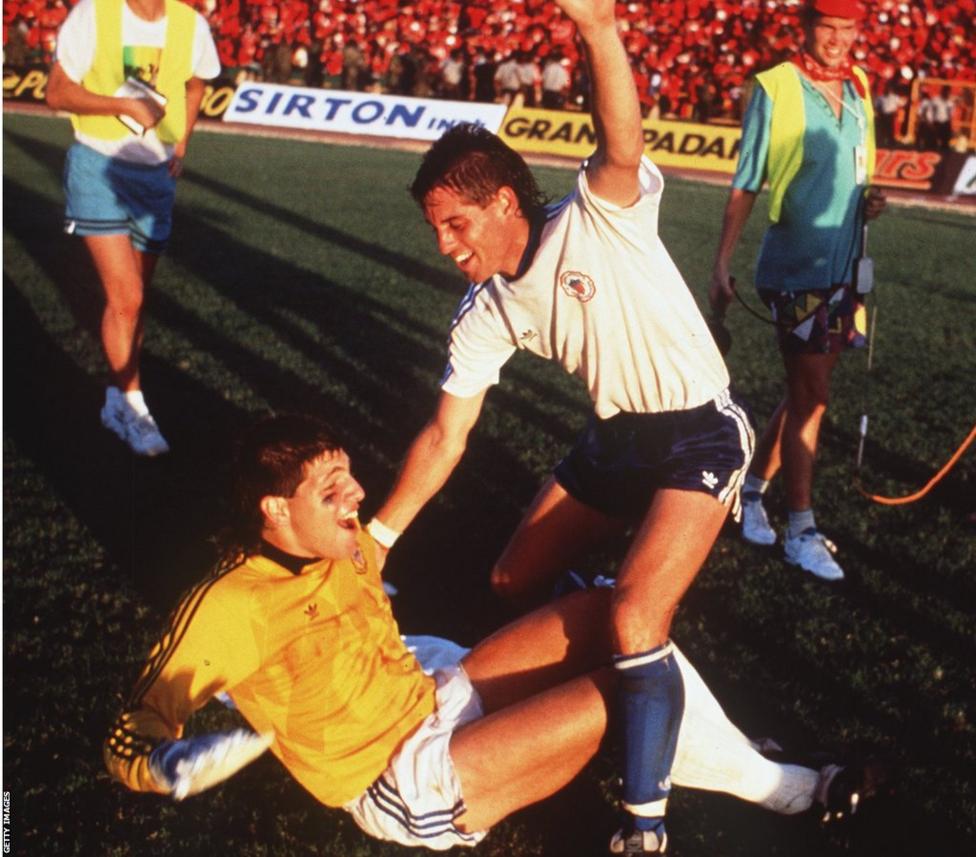
Tony Meola (left) and John Harkes, two of the Kearny boys

November 19, 1989: The U.S. national soccer team plays a game that will determine whether they qualify for the 1990 World Cup. Win it, and it could launch the country into a new era of soccer. Fail to win it, and it could be disastrous for the sport in the country.

The U.S. beat England at the 1950 World Cup in Brazil -- and hadn't qualified for the World Cup since. They were given hosting rights for the 1994 World Cup, but there was talk that, if they couldn't qualify in 1990, they might be stripped of those rights. So qualification was vital.

Bob Gansler, a German-Hungarian immigrant, became the U.S. team's head coach. His players, most in or just out of college, had grown up watching the North American Soccer League, with such stars as PelĂ© and Johan Cruijff, but few from the U.S. itself. That league had failed in 1984, preventing them from having a "top flight" league in which to play home games.

As the BBC's Adam Elder put it: "Many of them were 2nd-generation immigrants, their parents and family lives different from an 'apple pie' American ideal. They loved a sport that many around them reviled and yet there was no nationwide outdoor league for them to play in. Instead, most of the squad either played the indoor game or on teams in the so-called ethnic leagues found in large cities. Only three players had contracts in Europe."

And American fans weren't into it, either. Elder again: "For most of the 20th Century, football in the States was for "the others," to put it politely: Expats, cab drivers, dishwashers, exchange students, leftists, intellectuals, Euro snobs and the like." So the U.S. Men's National Team, or USMNT as we might now abbreviate it, had to generate excitement for people who weren't into soccer.

The heart of the team was from New Jersey: Peter Vermes, from Delran in the South; and, from Kearny in the North, Scot John Harkes, Uruguayan TabarĂ© "Tab" Ramos, and Italian goalkeeper Tony Meola. But the task before them was huge: "None of us were alive in 1950," said defender Paul Krumpe, from Southern California and of German descent.

FIFA, the governing body for world soccer, put the U.S. in CONCACAF: The Confederation of North, Central America and Caribbean Association Football. Aside from Canada and a few Caribbean nations and colonies, most of it was Spanish-speaking, and identified more with their roots as former colonies of Spain than their proximity to the U.S. So their big sport was soccer, not baseball. This wasn't true for Puerto Rico and Cuba, which had been taken by the U.S. in the Spanish-American War of 1898. but it was true for most of the others. (Mexico and the Dominican Republic are baseball-loving exceptions, but Mexico still prefers soccer.)

And those Latin American countries already had established soccer culture, including nasty rivalries between their domestic clubs and with neighboring nations. (El Salvador and Honduras had even had a "Football War" in 1969.) And many of those countries hated the U.S., for the CIA's role in trying to overthrow their elected leftist governments, sometimes succeeding. U.S. players, who had nothing to do with such things, recalled going down there and being hit with rocks, fruit, batteries, and even bags of urine. For them, winning on home soil was hard enough; winning on foreign soil was nearly impossible.

Advancing to the final round of CONCACAF qualification for the World Cup were 5 teams: The U.S. and, in alphabetical order: Costa Rica, El Salvador, Guatemala, and Trinidad and Tobago. (While they are separate islands, "Trinidad and Tobago" is one country.) That meant 8 games, home and home against each of 4 opponents.

On April 16, 1989, the U.S. lost away to Costa Rica, 1-0. On April 30, they beat Costa Rica, 1-0 at St. Louis Soccer Park in Fenton, Missouri. On May 13, they played Trinidad and Tobago to a 1-1 draw at Murdoch Stadium in Torrance, California (Krumpe's hometown), allowing a heartbreaking equalizer in the 88th of 90 minutes.

On June 17, they beat Guatemala, 2-1 at Veterans Stadium -- not the 67,000-seat one in Philadelphia, but the 8,448-seat high school football stadium in New Britain, Connecticut, outside Hartford. On September 17, they actually managed an away win, beating El Salvador, 1-0 in Tegucigalpa. They got a 0-0 draw away to Guatemala on October 8. A win against El Salvador on November 5 in Fenton would have qualified them with a game to spare, but they could only manage a 0-0 draw.

So, to qualify, along with the already-qualified Costa Rica, they had to beat Trinidad and Tobago, at their National Stadium, in their capital of Port of Spain, on November 19. A draw would have given T&T the 2nd CONCACAF slot.

The weather was hot and windy, with a very bright Sun. The pitch was dry and bumpy. T&T controlled the game for the 1st half-hour. But in the 32nd minute, Paul Caligiuri, a midfielder from Walnut, in Southern California, fired a 35-foot shot into the wind, and scored. Harkes later said, "I thought, 'There's no way he's hitting this.' But he just smacked it, and the ball dipped like crazy." The goalkeeper lost the ball in the Sun, and the home crowd seemed to scream in horror.

T&T would have their chances in the 2nd half, but the American defense held, and it ended 1-0. The U.S. had qualified for the World Cup, for the 1st time in 40 years. In the locker room, Budweiser, as American a product as there is, flowed freely -- until the Trinidadians graciously donated the champagne that they were expecting to drink.

The game was broadcast on NBC -- on tape delay after an American football game, and only 432,000 people watched it.

The U.S. did not do well at the World Cup in Italy. They were clobbered in their 1st game, 5-1 by Czechoslovakia in Florence. But they held the hosts to only a 1-0 win in Rome, and Austria to a 2-1 win in Florence. So it wasn't as bad as it looked like it would be after the opening game. But they still finished last in their Group.

Nevertheless, they were there. At the time, that was what mattered. They advanced to the Round of 16 on home soil in 1994, then crashed out of the Group Stage in 1998, made the Quarterfinals in 2002, crashed out of the Group Stage in 2006, and reached the Round of 16 in 2010. In 2014, they broke the pattern, reaching the Group Stage again -- and then, for 2018, failed to qualify for the 1st time in 32 years. They have qualified for 2022. (UPDATE: They reached the Round of 16, and will host again, or rather co-host with Canada and Mexico, in 2026.)

It was the 1990 team that laid the groundwork for America finally having the right to be taken seriously as a soccer-playing country. Every major league in Europe has had American players, and nobody laughs at us anymore.

Then again, we haven't gotten past the Quarterfinals since the very first World Cup, in 1930. And the women's team... Let's just say that, in American soccer, "You play like a girl!" is a huge improvement.

*

November 19, 1989 was a Sunday. Michael Ray Stevenson, the rapper known as Tyga, was born.

Baseball was out of season. These NFL games -- each with far more people watching it than the soccer game in question -- were played:

* The New York Giants beat the Seattle Seahawks, 15-3 at Giants Stadium in the Meadowlands.

* The New York Jets lost to the Indianapolis Colts, 27-10 at the Hoosier Dome in Indianapolis.

* The New England Patriots beat the Buffalo Bills, 33-24 at Sullivan Stadium (formerly Schafer Stadium, later Foxboro Stadium) in the Boston suburb of Foxborough, Massachusetts.

* The Philadelphia Eagles beat the Minnesota Vikings, 10-9 at Veterans Stadium in Philadelphia.

* The New Orleans Saints beat their arch-rivals, the Atlanta Falcons, 26-17 at Atlanta-Fulton County Stadium.

* The Pittsburgh Steelers beat the San Diego Chargers, 20-17 at Three Rivers Stadium in Pittsburgh.

* The Kansas City Chiefs and the Cleveland Browns played to a tie, 10-10 at Cleveland Municipal Stadium.

* The Cincinnati Bengals beat the Detroit Lions, 42-7 at Riverfront Stadium in Cincinnati.

* The Tampa Bay Buccaneers beat the Chicago Bears, 32-31 at Soldier Field in Chicago.

* The Miami Dolphins beat the Dallas Cowboys, 17-14 at Texas Stadium in the Dallas suburb of Irving, Texas.

* The Houston Oilers beat the Los Angeles Raiders, 23-7 at the Astrodome in Houston.

* The Los Angeles Rams beat the Phoenix Cardinals, 37-14 at Anaheim Stadium (now Angel Stadium of Anaheim).

* The Green Bay Packers beat the San Francisco 49ers, 21-17 at Candlestick Park in San Francisco.

* And on ABC Monday Night Football, the Denver Broncos beat the Washington Redskins, 14-10 at Robert F. Kennedy Memorial Stadium in Washington.

There were 3 games played in the NBA:

* The Houston Rockets beat the Miami Heat, 132-94 at The Summit (now the Central Campus of the Lakewood Church) in Houston.

* The Los Angeles Lakers beat the Washington Bullets, 120-115 at The Forum outside Los Angeles in Inglewood, California.

* And the Portland Trail Blazers beat their arch-rivals, the Seattle SuperSonics, 119-109 at the Portland Memorial Coliseum.

There were 2 games played in the NHL, both in Western Canada, and both went to overtime. The Buffalo Sabres and the Vancouver Canucks played to a 2-2 tie at the Pacific Coliseum in Vancouver. And the Edmonton Oilers beat the Chicago Blackhawks, 5-4 at the Northlands Coliseum in Edmonton. Mark Messier scored just 8 seconds into overtime.

Saturday, October 1, 2022

October 1, 1961: America's National Stadium

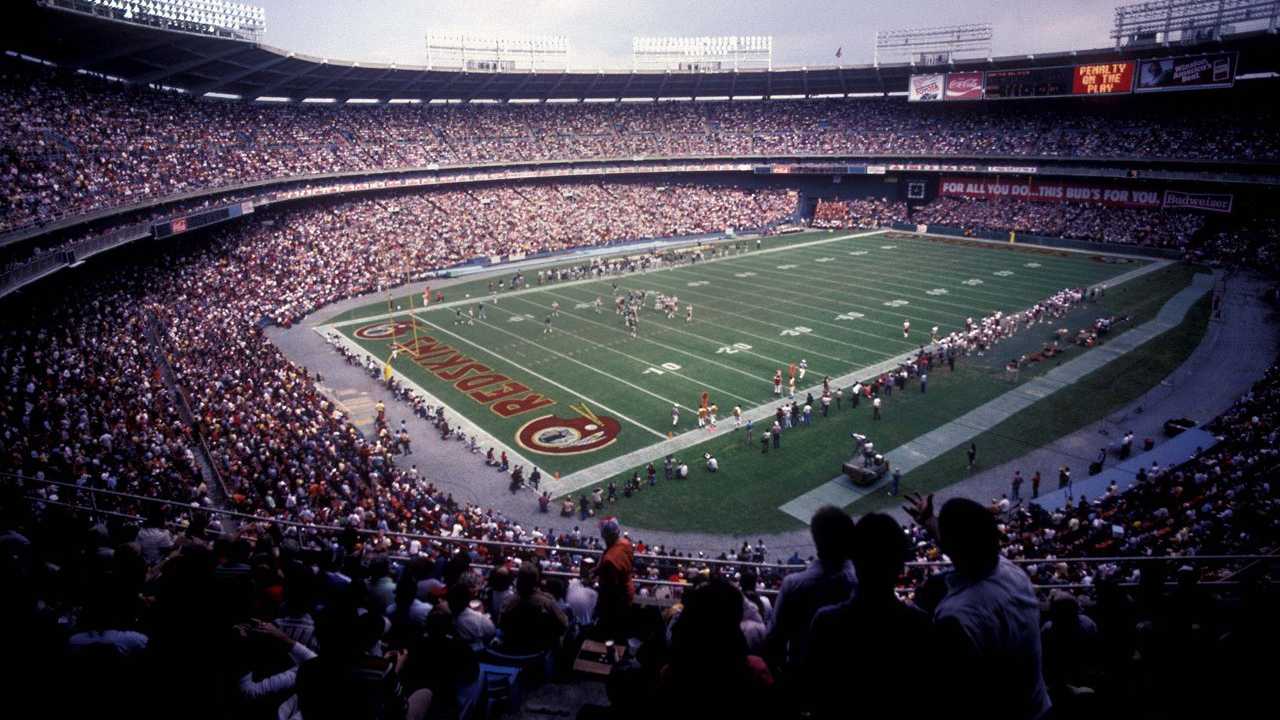
October 1, 1961: District of Columbia Stadium opens in Washington, D.C. The Washington Redskins lose to the New York Giants, 24-21.

As with most major American cities early in the 20th Century, the biggest stadiums were the baseball parks. The biggest stadiums built for football were on the campuses of State universities, which tended to be in or near State capitals, which were not necessarily the biggest city in their State.

In 1916, Representative George Hulbert, a Democrat, proposed the construction of a 50,000-seat "national stadium" -- not in New York City, where the Rochester native had practiced law, but in the nation's capital, Washington, D.C.. The idea was that it would host the 1920 Olympics, the Army-Navy football game, and Davis Cup tennis matches. It wasn't taken seriously.

Later, another Representative from New York, Representative Hamilton Fish III, and D.C.'s Director of Public Buildings and Parks, Ulysses S. Grant III -- the former's grandfather had been Secretary of State under the latter's grandfather -- decided to build a 100,000-seat national stadium, as a memorial to President Theodore Roosevelt, either on the island in the Potomac River that bore TR's name, or on the National Mall, as a bookend to the Lincoln Memorial. In addition to the preceding events, it was thought that Presidential Inaugurations could be held there. But Los Angeles won America's bid to host the 1932 Olympics, and, eventually, the National World War II Memorial became the Lincoln Memorial's bookend.

In 1944, a 9-man National Memorial Stadium Commission was appointed, and a site was chosen for a national stadium, next to the D.C. Armory, which opened in 1941, where East Capitol Street met the Anacostia River. But, with World War II still ongoing, getting Congress to fund a 100,000-seat stadium for the 1948 Olympics was impossible, and the Games were held in London.

In 1956, Representative Charles R. Howell, Democrat of New Jersey (I wasn't born yet, but, had I lived then where I live now, he would have been "my Congressman") proposed legislation funding a national stadium, after the National Capital Planning Commission re-proposed "the East Capitol Site."

Clark Griffith, longtime owner of baseball's Washington Senators, had recently died, leaving the team to his nephew, Calvin Griffith, and he didn't want to play at Griffith Stadium, a 27,000-seat stadium, expandable to only 35,000 for the NFL's Washington Redskins, and in a neighborhood that was growing increasingly black -- to the point where, after the ballpark was demolished, Howard University, the school known as "the Black Harvard," built its hospital on the site. It was thought that a national stadium could not only attract the Olympics and the Army-Navy Game, but save the Senators and Redskins from moving.

This time, Congress passed the District of Columbia Stadium Act, authorizing a 50,000-seat stadium, and President Dwight D. Eisenhower signed it into law on July 29, 1958. It was the 1st stadium built from scratch for both baseball and football -- up the Parkway, Baltimore repurposed the existing Municipal Stadium as Memorial Stadium for both sports in a conversion process from 1950 to 1954 -- and it opened in time for the Redskins to open the 1961 season there. (By a weird coincidence, both that stadium and DC/RFK Stadium would be built across the street from a school named Eastern High School.)

There was a snag, though: The Redskins were the last NFL team that hadn't racially integrated, and the stadium was on federal government property. When John F. Kennedy became President on January 20, 1961, he appointed Representative Stewart Udall of Arizona as Secretary of the Interior, overseeing the site. (Stew's brother, Morris "Mo" Udall, won his seat, and each of them had a son who went on to be elected to the U.S. Senate.) The Secretary told Redskins owner George Preston Marshall, a known racist, that he had to integrate the team, or he couldn't have D.C. Stadium. Marshall caved.

Griffith moved the Senators for the 1961 season, anyway, making them the Minnesota Twins. An expansion franchise was placed at Griffith Stadium for 1961, named the Washington Senators. D.C. Stadium became their home on April 9, 1962, and they beat the Detroit Tigers, 4-1. It hosted the 1962 and 1969 Major League Baseball All-Star Games. JFK threw out the ceremonial first ball at both Opening Day and the All-Star Game in 1962.
JFK is flanked by Vice President Lyndon Johnson
and White House aide Dave Powers. Also identifiable behind him:
Senators Hubert Humphrey, Everett Dirksen and Mike Mansfield;
and White House aide Larry O'Brien, later Chairman of the Democratic Party
(his offices at the Watergate were bugged in 1972) and NBA Commissioner.

On January 18, 1969, having served the entirety of the JFK and Lyndon B. Johnson Administrations, Secretary Udall announced that the stadium had been renamed Robert F. Kennedy Memorial Stadium, for JFK's brother and Attorney General, who had been elected to the Senate in 1964, had run for President in 1968, and, like JFK, had been assassinated. A formal rededication ceremony was held on June 7. (Most people dropped the "Memorial" when talking about it, and called it "RFK Stadium," or even just "RFK.")

On July 1, 1977, the Washington Metropolitan Area Transit Authority opened the Stadium-Armory subway station, serving RFK Stadium and the D.C. Armory on the Blue Line and the Orange Line, with the Silver Line later added. It was a bit of a walk, though: The station was at 19th and A Streets Southeast, a 10-minute walk from the Stadium, whose mailing address was 2400 East Capitol Street Northeast.

Not having subway access hurt the Senators, who left after the 1971 season, and, with a few exceptions such as preseason exhibitions and old-timers' games, baseball did not return until 2005. The Washington Nationals arrived, and remained through the 2007 season, then moved into Nationals Park.

The Redskins played there until 1996, building the NFL's most intimidating home-field advantage, reaching 4 Super Bowls, winning 3. Their last game there was on December 22, 1996, a 37-10 pasting of their arch-rivals, the Dallas Cowboys. Moving out to the far larger stadium in suburban Landover, Maryland turned the 'Skins from the team with the best home-field advantage in the NFL to the worst.
This seat would have been behind home plate
in the stadium's baseball configuration.
You can make out the dugouts.

Unlike most countries, the United States does not have an official "national stadium." RFK is the closest we come to it: Not only is it in the nation's capital, but it has hosted the national soccer team more times than any other venue, 24 times. (The Los Angeles Memorial Coliseum is 2nd, with 20; with the now-demolished Orange Bowl in Miami right behind, with 19.) Which become more amazing when you realize that the 1st such match wasn't until 1977, and the 2nd not until 1991. Why? Interest in the team was too low: RFK Stadium was too big for them until they reached the 1990 World Cup.

In those 24 matches, the U.S. won 15, lost 3, and drew 6. These matches include the 100th Anniversary match of the U.S. Soccer Federation, held on June 2, 2013, a 4-3 U.S. win over Germany. I was there -- it was hot and humid, and it had rained earlier -- and I took this photo.
This seat would have been in center field
in the stadium's baseball configuration.
Again, you can make out the dugouts.
After hosting the Washington Wolves and the Washington Diplomats of the old North American Soccer League, the latter including Dutch superstar Johan Cruyff, in 1996, RFK Stadium became the home of D.C. United, a charter team in Major League Soccer. It continued to be DCU's home through the 2017 season, after which they moved into Audi Field. DCU won the MLS Cup while playing there in 1996, 1997, 1999 and 2004, with the MLS Cup Final being played there in 1997, 2000 and 2007.
The last event at RFK Stadium was on October 22, 2017, a 2–1 D.C. United loss to the New York Red Bulls. It has been announced that RFK Stadium will be demolished in 2021. The 1st of the multi-purpose oval stadiums built in America in the 1960s, '70s and '80s, it is one of the last to still be standing. The only one still in use is the Oakland Coliseum, although the Astrodome is still standing.
In the 2014 film X-Men: Days of Future Past, Erik Lensherr, a.k.a. the supervillain Magneto (played in the flashback sequences by Michael Fassbender, and as an old man by Ian McKellen), ripped the circular stadium off its foundation, levitated it, and moved it across town, surrounding the White House, with the intention of killing President Richard Nixon. He failed. Computer-generated imagery was used to simulate the stadium's appearance in 1973, complete with period-appropriate advertising.
UPDATE: Demolition was delayed until 2025. That year, the District, the NFL, and the renamed Washington Commanders agreed on a deal to built a new stadium on the site, intending to open it in time for the 2030 season.
In "death," RFK Stadium still holds the record for most times hosting the U.S. Men's National Team (USMNT), with 24. The L.A. Coliseum is still 2nd, with 20. But Dignity Health Sports Park, in the Los Angeles suburb of Carson, California, has tied the Orange Bowl for 3rd, with 19. The Landover replacement for RFK Stadium, currently named Northwest Stadium? Only 2.
*
October 1, 1961 was a Sunday. This was also the day that television network CTV went on the air in Canada. I have a separate entry for that event.
These other games were played in the NFL:
* The football version of the St. Louis Cardinals beat the Philadelphia Eagles, 30-27 at Franklin Field in Philadelphia.
* The Baltimore Colts beat the Minnesota Vikings, 34-33 at Memorial Stadium in Baltimore.
* The Cleveland Browns beat the Dallas Cowboys, 25-7 at Cleveland Municipal Staidum.
* The San Francisco 49ers beat the Detroit Lions, 49-0 at Tiger Stadium in Detroit.
* The Green Bay Packers beat their arch-rivals, the Chicago Bears, 24-0 at Green Bay City Stadium (later renamed Lambeau Field).
* And the Los Angeles Rams beat the Pittsburgh Steelers, 24-14 at the Los Angeles Memorial Coliseum.
In the American Football League:
* The New York Titans beat the Boston Patriots, 37-30 at the Polo Grounds. The Titans became the Jets in 1963, and the Patriots became the New England Patriots in 1971.
* The Dallas Texans beat the Houston Oilers, 26-21 at the Cotton Bowl in Dallas. The Texans became the Kansas City Chiefs in 1963, and the Oilers became the Tennessee Titans in 1999.
* The Oakland Raiders beat the Denver Broncos, 33-19 at Candlestick Park in San Francisco. The Raiders wouldn't actually play a game in Oakland until 1962, moved to Los Angeles in 1982, moved back to Oakland in 1995, and moved to Las Vegas in 2020.
* And, the day before, the San Diego Chargers beat the Buffalo Bills, 19-11 at War Memorial Stadium in Buffalo. This was the Chargers' 1st game as a San Diego team, after spending the AFL's founding year of 1960 in Los Angeles. They returned to Los Angeles in 2017.
And it was the last day of baseball's regular season:
* The New York Yankees beat the Boston Red Sox, 1-0 at Yankee Stadium. The only run of the game came in the 4th inning, when Roger Maris hit his record-breaking 61st home run of the season, off Tracy Stallard. Bill Stafford (3 hits over 6 innings), Hal Reniff (a perfect 7th) and Luis Arroyo (1 hit over 2) combined on a 4-hit shutout. I have a separate entry for this game.
* The St. Louis Cardinals beat the Philadelphia Phillies, 2-0 at Connie Mack Stadium in Philadelphia. Bob Gibson pitched a 6-hit shoutout. Stan Musial appeared only as a pinch-hitter, and did not reach base.
* The Pittsburgh Pirates beat the Cincinnati Reds, 3-1 at Forbes Field in Pittsburgh. Roberto Clemente did not play. Frank Robinson went 0-for-2 with a walk. Despite this game, the Reds had dethroned the Pirates as National League Pennant winners, and would face the Yankees in the World Series. The Yankees won in 5 games.
* The Los Angeles Dodgers beat the Chicago Cubs, 8-2 at Wrigley Field in Chicago. Ernie Banks went 1-for-4 with an RBI. Duke Snider drew a walk as a pinch-hitter.
* A doubleheader was split at Milwaukee County Stadium. The San Francisco Giants won the opener, 8-2. The Milwaukee Braves won the nightcap, 3-2. Al Spangler singled Hank Aaron home with the winning run in the bottom of the 10th inning. Over the 2 games, Aaron went 4-for-9, and Willie Mays went 3-for-7 with a home run and 3 RBIs.
* The Detroit Tigers beat the Minnesota Twins, 8-3 at Metropolitan Stadium in the Minneapolis suburb of Bloomington, Minnesota. Norm Cash hit a home run, and Al Kaline had an RBI double as a pinch-hitter. This was the Tigers' 101st win of the year, but the Yankees won 109 to take the American League Pennant.
For the Twins, completing their 1st season after being "the old Washington Senators," Harmon Killebrew went 0-for-3 with a walk, and relief pitcher Pedro Ramos hit a home run, 1 of 3 he hit on the season, and 1 of 15 he hit in a surprisingly powerful career for a pitcher who was mainly a reliever.
* The Kansas City Athletics beat "the new Washington Senators," 3-2 at Kansas City Municipal Stadium.
After providing a venue for the Pacific Coast League's Los Angeles Angels from 1925 through 1957, and the major league expansion team with the same name this season, the West Coast version of Wrigley Field hosts its last professional baseball game. The Halos are defeated by the Cleveland Indians, 8-5 in front of 9,868 fans. Wrigley West will be torn down in 5 years, to make room for an eventual public playground and senior center.
* And the Baltimore Orioles and the Chicago White Sox completed their seasons the day before, against each other, with the O's winning, 4-3 at Memorial Stadium in Baltimore.

Saturday, August 20, 2022

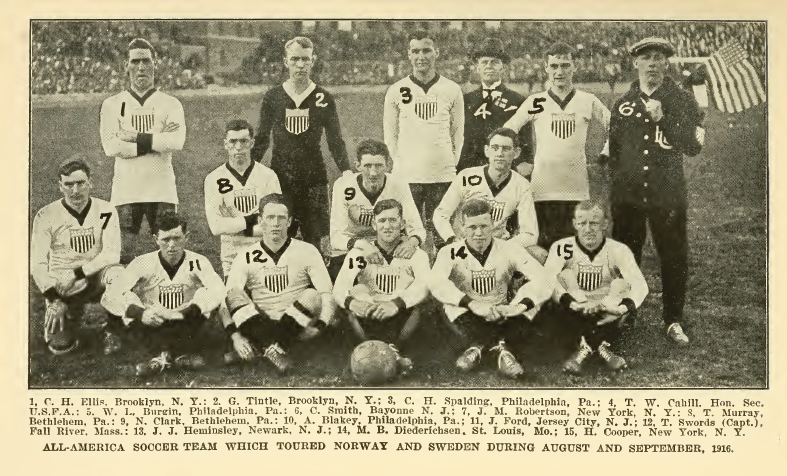
August 20, 1916: The 1st Game of the U.S. National Soccer Team

August 20, 1916: The United States of America fields a national soccer team for the 1st time.

Sponsored by the United States Soccer Federation (USSF), founded in 1913, the team took the pitch against Sweden at the Stockholm Olympiastadion, site of the 1912 Olympics, where Jim Thorpe had won the decathlon. A crowd of 16,000 attended. The referee was Hagbard Vestergaard of Denmark.

This was the U.S. team for the game, keeping in mind that uniform numbers were not used in soccer until 1933:

* Goalkeeper: George Tintle of Harrison, New Jersey
* Right Back: Tommy Murray of Bethlehem, Pennsylvania
* Left Back: Jimmy Robertson of New York
* Defender: Dick Spalding of Philadelphia
* Defender: Neil Clarke of Scotland, moved to Paterson, New Jersey
* Defender: Clarence Smith of Bayonne, New Jersey
* Outside Right: Jimmy Ford of Kearny, New Jersey
* Inside Right: Charles Ellis of New York
* Center Forward: John Hemingsley of Newark
* Inside Left: Thomas Swords of Fall River, Massachusetts (Captain)
* Outside Left: Harry "Buck" Cooper of Newark

As you can see, the tradition of soccer in Newark, its across-the-Passaic-River towns of Harrison and Kearny, and its across-Newark-Bay town of Bayonne goes back at least this far. Bethelehem, in the Lehigh Valley of northeastern Pennsylvania, was home to Bethlehem Steel Football Club, a "company team" (or, as the English would have called it, a "works side"), one of the top U.S. teams of the era.

And Fall River and nearby New Bedford, Massachusetts, manned by Portuguese immigrants and their sons, would have strong teams into the 1950s, including the legendary Ponta Delgada, named for an island in the Portugal-controlled Azores Islands. Because of Massachusetts' "blue laws," if these teams wanted to play on Sunday, they would go right across the State Line, and play at St. Mark's Stadium in Tiverton, Rhode Island.

James Robertson is a very common name among soccer players, especially in Scotland. A later Jimmy Robertson was the 1st player ever to score for both Tottenham Hotspur against Arsenal and for Arsenal against Tottenham in the North London Derby.

Konrad Törnqvist scored for Sweden, in only the 7th minute of the game. But Spalding equalized in the 22nd. Ellis scored in the 53rd. Cooper scored in the 68th. Törnqvist brought the Swedes back within 1 in the 81st, but the U.S. defense held on for a 3-2 win.

On September 3, still in Scandinavia, the U.S. team played Norway to a 1-1 draw in Kristiana. Ellis scored the only goal.

History seems to have lost track of some of these players. As far as I can tell, the last survivor was Cooper, who died in 1963.

The stadium still stands. DjurgĂĄrdens IF, Sweden's most successful soccer team, played there until the new Tele2 Arena opened, but maintain their offices there.
Due to World War I continuing through 1918, and then for longer for reasons I don't have, the U.S. national team didn't play another game until 1924, and then seemed to play only 2 or 3 games a year until World War II. This may have held them back. The U.S. team didn't play its 1st game on home soil until November 8, 1925, beating Canada 6-1 at Ebbets Field in Brooklyn, thanks to 5 goals from Archie Stark. Like so many early U.S. soccer stars, Stark was born in Glasgow, Scotland but grew up in Kearny, New Jersey.

This period did include reaching the Semifinal of the 1st World Cup in 1930, and reaching the World Cup again in 1934, before failing to qualify in 1938.

*

August 20, 1916 was a Sunday. Because many States still banned professional sports on Sunday, only 3 games were played in what would later be known as Major League Baseball:

* The New York Giants lost to the St. Louis Cardinals, 5-0 at Robison Field in St. Louis. Bob Steele allowed the Giants 8 hits, but kept the shutout. Rogers Hornsby, a rookie, went 2-for-2 with 2 walks for the Cardinals.

* The Boston Braves beat the Cincinnati Reds, 4-3 at Redland Field (renamed Crosley Field in 1934) in Cincinnati.

* The Brooklyn Robins (as the Dodgers were known from 1914 to 1931) beat the Chicago Cubs, 1-0 at Weeghman Park (renamed Cubs Park in 1920 and Wrigley Field in 1926) in Chicago. Jack Coombs allowed only 1 hit, a single by Max Flack. Coombs even got a hit for Brooklyn. So did the man who is still the Dodger franchise's all-time leader in hits, Zack Wheat. So did future managing legend Casey Stengel.

Monday, August 15, 2022

August 15, 2012: U.S. Soccer's 1st Win at the Azteca

Left to right: Graham Zusi, Terrence Boyd, Michael Orozco.
The result was a lot better than the uniform.

August 15, 2012: For the 1st time, the U.S. national soccer team defeats Mexico on Mexican soil.

Starting on September 12, 1937, with a 7-2 loss at Parque Asturias in Mexico City, they were 0-19 before getting so much as a draw, until November 2, 1997, a 0-0 draw in a 1998 World Cup Qualifier. The U.S. was 0-23-1, including 0-10 at Mexico's national stadium, the Estadio Azteca in Mexico City.

Part of this was due to Mexico's better organization. But the elements were also a factor: the country's largest cities are in areas that are both desert and mountain, and the heat and the elevation tend to work in their favor. It is no coincidence that Mexico's 2 best performances in the World Cup have come as hosts, reaching the Quarterfinals in 1970 and 1986.

But it's not as though the U.S.' record against Mexico in other countries was much better. The 1st game between the teams was on May 24, 1934, in a play-in game for the World Cup in Rome, a 4-2 U.S. win. After that, we didn't beat Mexico at all until November 23, 1980, 2-1 at Lockhart Stadium in Fort Lauderdale, in a 1982 World Cup Qualifier. That raised our all-time record against them to 2-21-3.

There were 6 wins, 2 losses and 5 draws in Los Angeles and environs, 3 wins in Columbus, and 2 wins at the Meadowlands. There were wins in San Diego, in Denver, in the Phoenix area, in Chicago, a win and a draw in Washington, and a win and a loss in Dallas. Most famously, there was the "Dos A Cero" win in the 2002 World Cup in Jeonju, South Korea. There was a draw in Foxboro, 2 draws in Houston, a draw in Philadelphia, a loss in a tournament in Uruguay, and a loss in pre-Castro Cuba.

All told, when the U.S. and Mexico took the pitch in front of over 105,000 fans at the Azteca for an exhibition game, or "friendly," on August 15, 2012, Mexico had won 32 games, the U.S. 15, with 12 draws.

And in the 1st half, it appeared that nothing would change. Mexico controlled the flow of play most of the way. The only real chance for the Americans ended when Herculez Gomez was knocked down, and, not surprising given the opponent and the location, was denied the penalty he thought he had earned. Nevertheless, the U.S. defense held its own, and the teams went into the locker room at 0-0.

In the 2nd half, there were nearly a goal from Javier Hernández, known as "Chicharito" (meaning "Little Pea," because his father, also named Javier Hernández, was "Chicharo" or "Pea"), and as "Cheaterito" for the unrepentant diving that made him fit in so well at Manchester United, but he missed a sitter. 

But the defense, led by goalkeeper Tim Howard and centerback Geoff Cameron, held, and it looked like the U.S. might hold on for a hard-earned 0-0 draw, and most American soccer fans would have been okay with that.

U.S. manager JĂĽrgen Klinsmann, who seemed to specialize in big away wins in friendlies while losing big competitive matches, was not okay with a draw. He made substitutions, and they worked. Shortly after the hour, Kyle Beckerman just cleared the bar. In the 80th minute, forward Brek Shea looked like he was about to shoot, but hit a left-footed cross over to forward Terrence Boyd. Boyd tried to backheel the ball into the net. Centerback Michael Orozco got to it first, and poked it in with his left foot. Shea, Boyd and Orozco were all subs.

Fourteen minutes, and 2 great saves by Howard, later, it was over: U.S. 1, Mexico 0 -- or, in standard soccer terminology, with the home team listed at the left, Mexico 0-1 USA. After 25 tries over 75 years, the Americans -- with men of Mexican descent in their lineup, of course -- had defeated Mexico in Mexico. And not just in Mexico, and not just in Mexico City, but in Estadio Azteca, which had been an unassailable fortress until then.

As of March 24, 2022, the most recent game between the teams (a scoreless draw in a World Cup Qualifier at the Azteca), the count stands at Mexico 36, U.S. 22, 16 draws; on Mexican soil, Mexico 23, U.S. 1, 4 draws; and, at the Azteca, Mexico 9, U.S. 1, 4 draws. But, from August 15, 2012, it's been U.S. 7, Mexico Mexico 4, 4 draws; and in Mexico, all at the Azteca, U.S. 1, Mexico none, and 3 draws.

*

August 15, 2012 was a Wednesday. These Major League Baseball games were played that day:

* The New York Yankees beat the Texas Rangers, 3-2 at the new Yankee Stadium. Eric Chavez went 3-for-3 with a walk and an RBI, to make a winning pitcher out of Freddy Garcia.

* The New York Mets lost to the Cincinnati Reds, 6-1 at Great American Ball Park in Cincinnati.

* The Baltimore Orioles beat the Boston Red Sox, 5-3 at Camden Yards in Baltimore.

* The Atlanta Braves beat the San Diego Padres, 6-1 at Turner Field (now Center Parc Stadium) in Atlanta.

* The Miami Marlins beat the Philadelphia Phillies, 9-2 at Marlins Park (now LoanDepot Park) in Miami.

* The Chicago White Sox beat the Toronto Blue Jays, 9-5 at the Rogers Centre in Toronto.

* The Los Angeles Dodgers beat the Pittsburgh Pirates, 9-3 at PNC Park in Pittsburgh.

* The Chicago Cubs beat the Houston Astros, 7-2 at Wrigley Field in Chicago.

* The St. Louis Cardinals beat the Arizona Diamondbacks, 5-2 at Busch Stadium in St. Louis.

* The Kansas City Royals beat the Oakland Athletics, 3-2 at Kauffman Stadium in Kansas City.

* The Detroit Tigers beat the Minnesota Twins, 5-1 at Target Field in Minneapolis.

* The Colorado Rockies beat the Milwaukee Brewers, 7-6 at Coors Field in Denver.

* The Los Angeles Angels beat the Cleveland Indians, 8-4 at Angel Stadium of Anaheim.

* The Washington Nationals beat the San Francisco Giants at AT&T Park (now Oracle Park) in San Francisco.

* And the Seattle Mariners beat the Tampa Bay Rays, 1-0 at Safeco Field (now T-Mobile Park) in Seattle. FĂ©lix Hernández went the distance for the shutout, allowing 4 hits and no walks, striking out 12.

Sunday, July 17, 2022

July 17, 1994: The World Cup Final On American Soil

The Rose Bowl, Pasadena, California, July 17, 1994.
Attendance: 94,194.

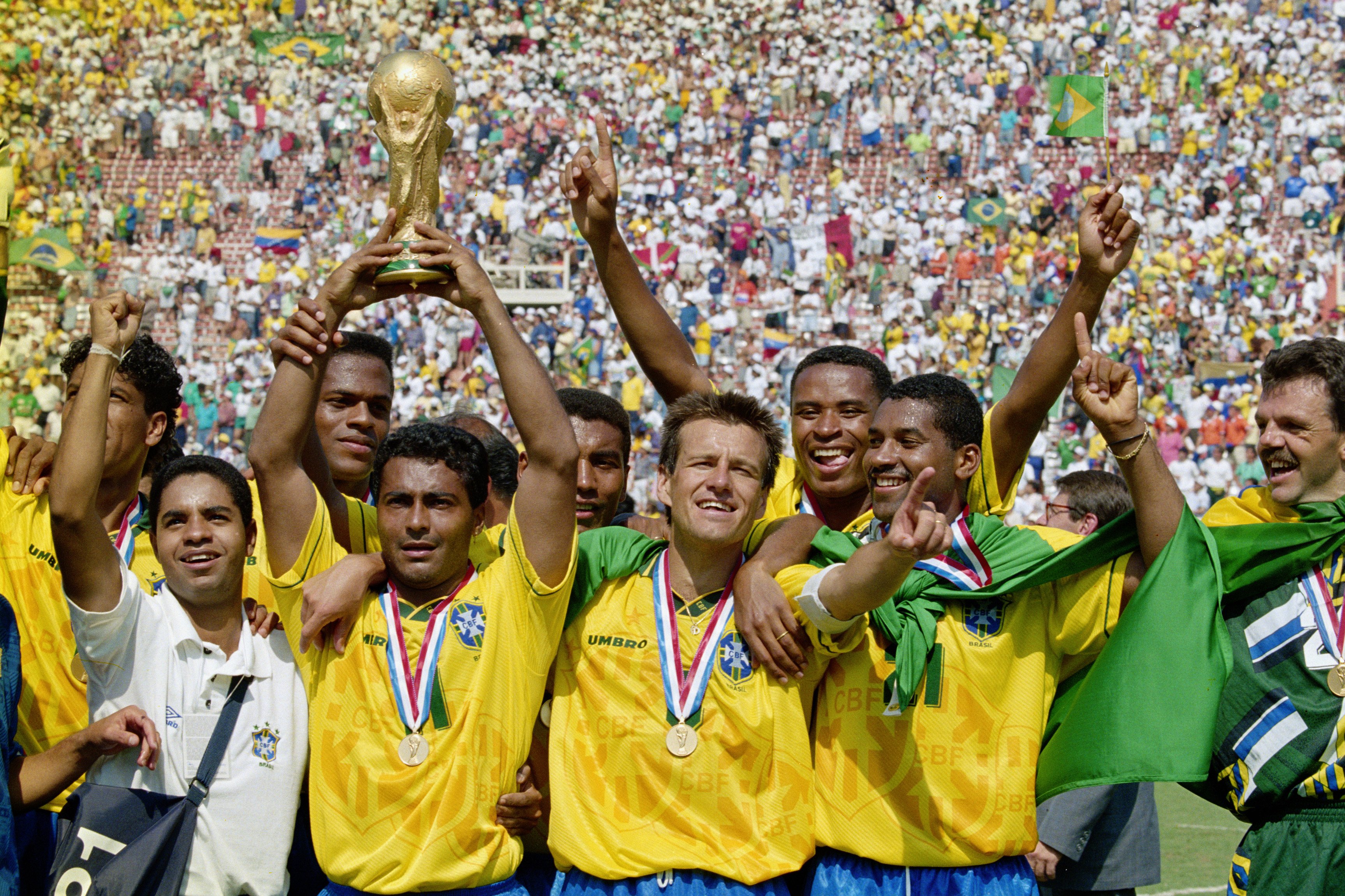
July 17, 1994: For the 1st time -- and, so far, for the only time -- the Final of soccer's World Cup is held on American soil. ABC broadcast it.

There were 9 venues. From East to West:

* Foxboro Stadium, built in 1971, in the Boston suburb of Foxboro, Massachusetts, home of the NFL's New England Patriots. It had been the home of the North American Soccer League's Boston Minutemen and New England Tea Men, and would become the home of Major League Soccer's New England Revolution.

* Giants Stadium, 1976, in the New York suburb of East Rutherford, New Jersey, home of the NFL's New York Giants and New York Jets. It had been the home of the NASL's New York Cosmos, and would become the home of MLS' New York/New Jersey MetroStars, who became the New York Red Bulls.

* Robert F. Kennedy Memorial Stadium, known as District of Columbia Stadium from 1961 to 1969, in Washington, D.C., home of the NFL's Washington Redskins (now the Washington Commanders). It had been the home of the NASL's Washington Darts and Washington Diplomats, and would become the home of MLS' D.C. United.

* The Citrus Bowl, 1936, now named Camping World Stadium, in Orlando, Florida, the only venue not then the regular home of a professional or college football team. It was home of college football's annual Florida Citrus Bowl. It would later become the home of MLS' Orlando City Soccer Club.

* The Silverdome, 1975, in the Detroit suburb of Pontiac, Michigan, home of the NFL's Detroit Lions. It had been the home of the NASL's Detroit Express. Alone among these 9 metropolitan areas, Detroit has never had an MLS team.

* Soldier Field, 1924, in Chicago, home of the NFL's Chicago Bears. It had been the home of the NASL's Chicago Sting, and would become the home of MLS' Chicago Fire.

* The Cotton Bowl, 1930, in Dallas, home of the annual Cotton Bowl game, and the former home of the NFL's Dallas Cowboys. It had been the home of the NASL's Dallas Tornados, and would become the home of MLS' Dallas Burn, who became F.C. Dallas.

* The Rose Bowl, 1922, in the Los Angeles suburb of Pasadena, California, home of the football team at the University of California at Los Angeles (UCLA) and the annual Rose Bowl game. It had been the home of the NASL's Los Angeles Wolves and Los Angeles Aztecs, and would become the home of MLS' Los Angeles Galaxy.

* And Stanford Stadium, 1921, in the San Francisco suburb of Palo Alto, California, home of the football team at Stanford University.

Thus, the Silverdome, Soldier Field, the Rose Bowl and Stanford Stadium became the only stadiums to host both a Super Bowl and a World Cup match -- and the Rose Bowl would become the only one to host both a Super Bowl and a World Cup Final.
 
This tournament remains the World Cup with the highest per-game attendance: 68,991. And what an array of talent, not dampened in the slightest by England, which still thinks of itself as the country in world "football," failing to qualify for the 1st time since 1978:

* From finalists Brazil: Romário, Ronaldo, Cafu, Bebeto, Dunga, Leonardo, and Claudio Taffarel.

* From finalists Italy: Franco Baresi, Paolo Maldini, Gianfranco Zola, Mauro Tassotti, Roberto Donadoni, Antonio Conte, and Roberto and Dino Baggio (not related).

* From semifinalists Sweden: Henrik Larsson and Tomas Brolin.

* From semifinalists Bulgaria: Hristo Stoichkov.

From quarterfinalists the Netherlands: Frank Rijkaard, Ronald Koeman, Dennis Bergkamp, Marc Overmars, Danny Blind, Edwin van der Sar, and the twins Frank and Ronald de Boer. (Marco van Basten had already had to retire due to injury.)

* From quarterfinalists Germany: Lothar Matthäus, JĂĽrgen Klinsmann, JĂĽrgen Kohler, Rudi Völler, Thomas Häßler, Andreas Brehme, Matthias Sammer and Oliver Kahn.

* From quarterfinalists Romania: Gheorghe Hagi and Gheorghe Popsecu.

* From quarterfinalists Spain: Pep Guardiola and Luis Enrique.

* From the Round of 16: From Argentina: Diego Maradona (who ended up getting suspended for drugs), Gabriel Batistuta and Claudio Caniggia. From Ireland: Roy Keane, Paul McGrath, Ray Houghton, John Aldridge, Steve Staunton, Ronnie Whelan, Tony Cascarino and Packie Bonner. From Nigeria: Jay-Jay Okocha.

* From teams that didn't make it to the knockout round: Roger Milla from Cameroon, and Carlos Valderrama and his hair from Colombia.

* And from our own team, which did make it past the Group Stage for the 1st time since 1930: Alexi Lalas, Eric Wynalda, Cobi Jones, Marcelo Balboa, Paul Caligiuri and Jersey Boys Tony Meola, John Harkes, Tab Ramos and Claudio Reyna.

True, we got knocked out by Brazil, on home soil, on the 4th of July no less, at the old Stanford Stadium in the San Francisco suburb of Palo Alto, California. And we wore horrid uniforms. But it was still a big boost for American soccer, just what the upcoming founding of Major League Soccer (MLS) needed going into 1996.
Yes, we actually wore these things.

Certainly, we got the pageantry right. Having America play on the 4th of July worked out well, despite the loss. And the New York market got lucky, as 2 of the country's, and particularly the Tri-State Area's, biggest ethnic groups ended up having their ancestral homelands playing each other at the Meadowlands: The Republic of Ireland and Italy.
Ireland vs. Italy, Giants Stadium, June 18, 1994.
Attendance: 75,338. Ireland pulled the upset, winning 1-0.

But, from the American perspective, the 2 worst things that could have happened did happen. Someone got killed. Not in the stadium, or in the streets; it wasn't a fight between hooligans. Not even in the country. After his own goal sent Colombia down to defeat against us, AndrĂ©s Escobar of AtlĂ©tico Nacional went back home to MedellĂ­n, and was shot and killed. He was only 27 years old.

The other was that the Final ended scoreless. There were the 2 best teams in the world, Brazil and Italy, and, after a full 90 minutes, plus extra time making it 120 minutes, the final score was 0-0. Nil-nil. Nothing to nothing. Americans like scoring, and any American watching this Final, not knowing all that goes into a soccer game, would have found it boring as hell. It probably set American interest in the sport back several years.

Roberto Baggio blasted a penalty kick over the crossbar, and Brazil won the penalty phase, 3-2. And Americans not already into soccer shrugged their shoulders, and either went back to watching baseball or began preparing for a new NFL season.
Romário (Number 11) lifts the Jules Rimet Trophy,
next to Dunga (8), the Captain

Foxboro Stadium was torn down in 2002, having been replaced by the next-door Gillette Stadium. Soldier Field was torn down in 2002, and replaced by a new stadium on the same site. Stanford Stadium was torn down in 2004, and replaced by a new stadium on the same site. Giants Stadium was torn down in 2010, having been replaced by the next-door MetLife Stadium. The Silverdome was torn down in 2017, after the Detroit Lions moved into Ford Field in 2002. RFK Stadium is scheduled to be torn down in 2023.

The 2026 World Cup was awarded jointly to all 3 North American nations: The United States, Canada (which has never hosted), and Mexico (which hosted in 1970 and 1986). Most of the host stadiums from 1994 are unlikely to host again in 2026, since they've been replaced.

If Los Angeles gets the Final again, it won't be played at the Rose Bowl, even though it is still in use and still in good shape. It will probably go to the new SoFi Stadium in Inglewood, because of its retractable roof. If New York gets the Final, it will be at MetLife Stadium, Giants Stadium's replacement.

UPDATE: In 2024, the 2026 World Cup Final was awarded to MetLife Stadium. SoFi Stadium got a Quarterfinal, while the Semifinals went to Mercedes-Benz Stadium in Atlanta and AT&T Stadium outside Dallas.

An article for ESPN.com, published after the 2026 World Cup, ranking all 23 tournaments, rated the 1994 edition 10th, citing "turmoil" and "tension"; but adding, "In terms of pure imagery, it will be difficult to ever top 1994." 

*

July 17, 1994 was a Sunday. It was the off-season for the NFL, the NBA and the NHL. But, in addition to the World Cup Final, there was a full slate of Major League Baseball games played that day. It was, however, well past the age of Sunday doubleheaders:

* The New York Yankees beat the Seattle Mariners, 14-4 at the Kingdome in Seattle. Jim Leyritz hit 2 home runs, and Danny Tartabull added another, to make a winning pitcher out of Scott Kamieniecki. Tino Martinez hit one of the M's, and would be a big part of them driving the Yankees crazy in the 1995 Playoffs. But the Yankees traded for him, and he became a part of their next Dynasty.

* The New York Mets lost to the San Diego Padres, 10-1 at Shea Stadium.

* The Philadelphia Phillies beat the Los Angeles Dodgers, 9-7 at Veterans Stadium in Philadelphia.

* The San Francisco Giants beat the Montreal Expos, 6-4 at the Olympic Stadium in Montreal.

* The Houston Astros beat the Pittsburgh Pirates, 9-0 at Three Rivers Stadium in Pittsburgh.

* The Atlanta Braves beat the Florida Marlins, 2-1 at Atlanta-Fulton County Stadium.

* The Cincinnati Reds beat the Chicago Cubs, 3-2 at Riverfront Stadium in Cincinnati. Reggie Sanders singled home the winning run in the bottom of the 10th inning.

* The Chicago White Sox beat the Cleveland Indians, 5-2 at the new Comiskey Park in Chicago. (It is now named Rate Field.)

* The Milwaukee Brewers beat the Minnesota Twins, 5-3 at the Metrodome in Minneapolis.

* The Kansas City Royals beat the Detroit Tigers, 4-1 at Kauffman Stadium in Kansas City.

* The Toronto Blue Jays beat the Texas Rangers, 3-1 at The Ballpark (now Choctaw Stadium) in the Dallas suburb of Arlington, Texas.

* The Colorado Rockies beat the St. Louis Cardinals, 10-6 at Mile High Stadium in Denver.

* The Baltimore Orioles beat the California Angels, 10-5 at Anaheim Stadium in the Los Angeles suburb of that name. (It is now named Angel Stadium of Anaheim.)

* And the Boston Red Sox beat the Oakland Athletics, 4-3 at the Oakland Coliseum. 

Tuesday, July 12, 2022

July 12, 1998: A France for the Whole World

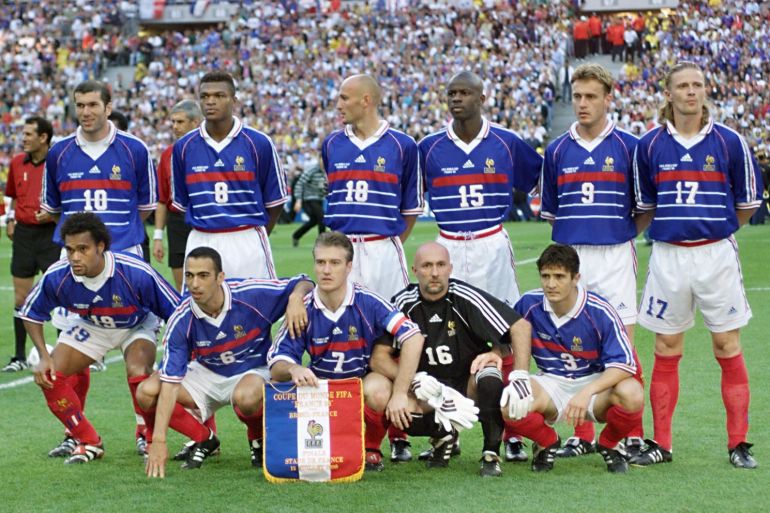
Top row, left to right: Zinedine Zidane, Marcel Desailly, Frank Leboeuf,
Lilian Thuram, StĂ©phane Guivarc'h, Emmanuel Petit.
Bottom row, left to right: Christian Karembeu, Youri Djorkaeff,
Didier Deschamps, Fabien Barthez, Bixente Lizarazu.
Thierry Henry did not play in the Final.

July 12, 1998: The World Cup Final is held, at the new Stade de France, in the Paris suburb of Saint-Denis. The host nation takes on defending Champions Brazil.

France had hosted the World Cup once before, in 1938, and reached the Quarterfinals. They reached the Semifinals in 1958, and did it again in 1982, with a team that many had thought would win. They won Euro 84, and reached the World Cup Semifinals again in 1986. But they failed qualify in 1990 and 1994.

The French team, known as Les Bleus for their blue shirts, had never shied away from using players who were citizens of France but not ethnically French. Their 1938 team featured Abdelkader Ben Bouali of Algeria; Frenchmen of Italian descent in Julien Darui, Laurent Di Lorto and Mario Zatelli; Jules Vandooren, of Dutch descent; Oscar Heisserer, of German descent; Ignace Kowalczyk and Martin Povolny, of Polish descent; and Hector Cazenave, born in Uruguay to French parents.

Their 1958 team was led by Raymond Kopa, a son of Polish immigrants; and also featured another Polish Frenchman, Maryan Wisniewski; Dominique Colonna, Bernard Chiarelli and Roger Piantoni, of Italian descent; Raymond Kaelbel, of German descent; Kazimir Hnatow, of Ukrainian descent.

The team that won Euro 84 was led by Michel Platini, of Italian descent. And their best player in between 1984 and 1998, but not on either team, was Eric Cantona, with a mother from Spain's Catalonia region and a father from Italy's island of Sardinia.

The 1998 team, managed by AimĂ© Jacquet, was alliteratively described, in a mixture of French and English, as "Blanc, black, beur." "Blanc" meaning white, and "beur" was a term, usually now considered a slur, meaning someone born in France, but with his ancestry coming from the Maghreb, the former French colonies of North Africa? Mauritania, Morocco, Algeria, Tunisia and Libya.

Some on the far right, including the fascist Le Pen family of politicians, treated the black and beur players, and even the "blanc" players whose ancestry wasn't fully French, as not fully French, flying in the face of the country's motto: LibertĂ©, Ă©galitĂ©, fraternitĂ© (Liberty, equality, brotherhood). Under French law, whether the Le Pens and their supporters like it or not, all people born in France, or in a French territory before it achieved independence, are considered citizens of France.

Here was the 1998 French squad:

"Blanc," of entirely French descent: Midfielder and team Captain Didier Deschamps, goalkeeper Fabien Alain Barthez (unusually among starting goalkeepers, chose a number other than 1, wearing 16 for clubs and country), defender Laurent Blanc, forward StĂ©phane Guivarc'h, midfielder Emmanuel Petit, defender Frank Leboeuf, forward Christophe Dugarry, and 3rd-string goalkeeper Lionel Charbonnier.

"Blanc," but of other descent: Defender Vincent Candela, Italian; defender Bixente Lizarazu, Basque descent; midfielder Youri Djorkaeff, half-Polish, half-Armenian; midfielder Robert Pires, half-Portuguese, half-Spanish; midfielder Alain Boghossian, Armenian; David Trezeguet, born in France as the son of an Argentine playing his club football there, and grew up in Argentina, but exercised his right to play for France. 

"Black": Midfielder Patrick Vieira, from Senegal in Africa, but entitled to play for France through his parents, as Senegal was a French colony; defender Marcel Desailly, born in Ghana but entitled to play for France through his adoptive father; forward Thierry Henry, born outside Paris, but his parents were from the Caribbean, his father from Guadeloupe and his mother from Martinique; midfielder Bernard Diomède, born in France to Guadeloupean parents; defender Lilian Thuram, born in Guadeloupe but grew up in France; and backup goalkeeper Bernard Lama, born in Central France but grew up in French Guiana, in South America.

"Beur": Midfielder Zinedine Zidane was the only one, but was already recognized as one of the best players in the world.

And one player who didn't fit any of these categories: Christian Karembeu, who came from the "overseas department" of New Caledonia, off the coast of Australia, and was therefore Polynesian.

Club-wise:

* The 1990 and 1992 French league-winning Olympique de Marseille had Deschamps. When they won the Champions League in 1993, they had Deschamp, Desailly and Barthez.
* The 1994 French league-winning Paris Saint-Germain had Lama.
Juventus, when they won the Italian league in 1995, and the UEFA Champions League in 1996, had Deschamps. When they won the Italian league in 1997 and 1998, they had Deschamps and Zidane.
* The 1995 French league-winning Nantes had Karembeu. So did the Real Madrid team that won the Champions League in 1998.
* The 1996 French league-winning Auxerre had Blanc, Guivarc'h and Diomède.
* The 1996 Italian league-winning AC Milan had Viera.
* The 1997 French league-winning AS Monaco had Henry, Trezeguet, Petit and Barthez.
* The 1998 English Double-winning Arsenal had Vieira and Petit.

So France certainly had a talented team. But the games still had to be played. Of course, they would be played on home soil. They beat South Africa, 3-0 at Marseille; Saudi Arabia, 4-0 at Saint-Denis; and Denmark, 2-1 at Lyon. France and Argentina were the only teams in the tournament to get through the Group Stage with wins in all 3 games.

The U.S. team, encouraged by reaching the knockout stage in 1994, completely flopped. They lost 2-0 to Germany in Paris, and 1-0 to Yugoslavia (at this point, reduced to Serbia and Montenegro) in Nantes, both understandable defeats. But their 2-1 loss to Iran in Lyon was inexcusable defeat.

In the Round of 16, France needed extra time, until Blanc scored in the 114th minute to beat Paraguay, 1-0 at Lens. Also in that round was England losing on penalties, as so often happens, this time to Argentina in Saint-Étienne. Argentina ran out of luck in the Quarterfinal, as Arsenal star Dennis Bergkamp scored in the 90th minute, and the Netherlands beat them, 2-1 in Marseille. France played Italy at Saint-Denis, and it went to penalties, after 120 minutes of no scoring. France won the penalty round, 4-3.

The Semifinals were set up with interesting stories. France played Croatia at Saint-Denis. Croatia having gotten this far was a very big deal: Not only was it as far as its former parent country, Yugoslavia, had ever gotten, but it was the first time a postwar, post-Yugoslavia country had gotten that far. Just after the 2nd half started, Davor Ĺ uker scored for Croatia, but Thuram scored right after that, and scored later in the game -- a defender with 2 goals -- to put France in the Final.

The other Semifinal saw defending Champions Brazil, masters of "samba football," against the Netherlands, inventors of "total football," Marseille. Ronaldo de Lima, usually referred to by only his first name, scored early in the 2nd half, and Patrick Kluivert equalized for the Dutch in the 87th minute. The game went to extra time, and then to penalties. Like England, the Netherlands are notorious for losing on penalties, and Brazil beat them, 4-2.

The Final would be the hosts against the defending Champions. It should have been the perfect matchup. But on the morning of the Final, Ronaldo, thus far having justified his label as the best player in the world, suffered a convulsive fit. When the starting lineups were released to the media, 72 minutes before the 9:00 PM kickoff (3:00 PM, U.S. East Coast time), his name was not included with Brazil's. John Motson, announcing the game for the BBC, said, "The scenes in the commentary box have been absolute mayhem and chaos." 
Stade de France

And yet, right before kickoff, Ronaldo talked manager Mário Zagallo, who had played on their 1970 winners and managed their 1994 winners, into putting him into the starting XI.
Left to right: Ronaldo, Leonardo, Roberto Carlos,
Claudio Taffarel, Aldair, CĂ©sar Sampaio

I watched the game on ABC, and Jim McKay, who had broadcast so many sporting events for the network since the debut of Wide World of Sports in 1961, said the moment had come for which all of France had waited. No, not hosting the World Cup Final on home soil, but singing the National Anthem before the Final. No country does a National Anthem quite the way France does "La Marseillaise."

Ronaldo had nothing, and he even got hurt further in a collision with Barthez. Zagallo admitted that the fears over Ronaldo affected his team psychologically, and stated "for the whole of the first half, I was wondering whether to take him off," but feared a public outcry in Brazil had he done so.

So the star of the game would be a man with a shaved head, but not Ronaldo: It was Zidane. He scored in the 27th minute, and again in stoppage time in the 1st half. Brazil never recovered, despite Desailly receiving 2 yellow cards, resulting in his being sent off in the 68th minute. Guivarc'h nearly scored in the game's 1st minute, and just missed another shot in the 63rd. It could have been 5-0, but France had to settle for 3-0, when Arsenal men Vieira (on the assist) and Petit (on the goal) combined to score on the last kick of the game.
Zidane with the Jules Rimet Trophy

Over 1.5 million people poured into the Avenue des Champs-ÉlysĂ©es in downtown Paris, and photos of the players' faces were rotated in projections on the Arc de Triomphe. It was said to be the biggest celebration in Paris since the liberation from the Nazis on August 26, 1944. France were the Champions of the World, and had united the world within France.

Lizarazu played for Bayern Munich as they won the German league in 1999, 2000, 2001, 2003, 2005 and 2006, and the Champions League in 2001. Guivarc'h and Charbonnier played for Rangers when they won the Scottish league in 1999. Trezeguet and Barthez helped Monaco win the French league again in 2000. Karembeu helped Real Madrid win the Champions League again in 2000, and Olympiacos win the Greek league in 2002 and 2003. Candela went on to play for the AS Roma team that won the Italian league in 2001.

Vieira, Henry and Pires helped Arsenal win another Double in 2002, and an unbeaten League season in 2004, with Vieira as Captain and Henry leading the League in scoring. Vieira then helped Internazionale Milano win the Italian league in 2007, 2008 and 2009. Henry went on to help Barcelona win the Spanish league in 2009 and 2010, and the Champions League in 2009.

Zidane helped Real Madrid win the Champions League in 2002 and the Spanish league in 2003. Thuram and Trezeguet helped Juventus win the Italian league in 2002 and 2003. Barthez played for Manchester United when they won the Premier League in 2001. Their 2003 team had Barthez and Blanc.

France won the next major tournament, Euro 2000, with Trezeguet scoring a "golden goal" to beat Italy in extra time. After a dissension-ridden 2002 tournament that saw them crash out in the Group Stage, France regrouped, and, with Zidane as Captain, announcing that he would retire after the Final, they got back to the Final, against Italy.

But they lost it in controversial fashion, as Zidane was sent off in extra time for head-butting Italian defender Marco Materazzi, who had provoked him with racist remarks. Italy then won on penalties, with Materazzi available to take one and make it, and Zidane not available. That result left the team still admired by the whole country, but sparked anger at Zidane from the right.

In 2018, Deschamps managed France to win the World Cup, beating Croatia in the final in Moscow, Russia. He became only the 3rd man to both play on and manage a World Cup winner, joining Zagallo and Franz Beckenbauer of Germany. He also got them into the 2022 World Cup Final, losing to Argentina in Lusail, Qatar. In both tournaments, Boghossian was one of his assistants. The 2022 squad included Marcus Thuram, son of another former teammate.

Brazil recovered from their 1998 defeat, and, in 2002, made their 3rd straight Final. This time, Ronaldo was fine, and scored both goals in a 2-0 win over Germany. He became not just one of the greatest players in world history, but one of the most popular. How popular was he? He managed to play for both Spanish giants, FC Barcelona and Real Madrid; and for both Milan teams, Inter and AC Milan -- and remains beloved by fans of all 4 teams.

He began his career with Belo Horizonte team Cruzeiro, and ended it with SĂŁo Paulo team Corinthians. When people talk about the greatest players of all time, some of those too young to have seen him play call Portuguese star Cristiano Ronaldo the greatest ever. I have to remind them that Cristiano isn't even the greatest Ronaldo to have played for Real Madrid in the 21st Century.

In 2024, the Stade de France will be the main stadium for the Olympic Games. This means it will join the old Wembley Stadium in London and the Olympiastadions in Munich and Berlin, as 1 of 4 stadiums to have hosted an Olympic Games, a World Cup Final and a UEFA European Cup/Champions League Final.

UPDATE: An article for ESPN.com, published after the 2026 World Cup, ranking all 23 tournaments, rated this one 12th.

*

July 12, 1998 was a Sunday. These games were played in Major League Baseball:

* The New York Yankees beat the Tampa Bay Devil Rays, 9-2 at Tropicana Field in St. Petersburg, Florida. The Yankees scored 7 runs in the top of the 9th inning. making a winning pitcher of Mike Stanton in relief of David Wells. Derek Jeter and Tino Martinez each went 2-for-5, with Derek having 2 RBIs and Tino having 4.

* The New York Mets beat the Montreal Expos, 5-2 at Shea Stadium.

* The Baltimore Orioles beat the Boston Red Sox, 11-7 at Camden Yards in Baltimore. Cal Ripken went 1-for-4 with a walk.

* The Florida Marlins beat the Atlanta Braves, 5-3at Pro Player Stadium in Miami Gardens, Florida.

* The Philadelphia Phillies beat the Pittsburgh Pirates, 10-4 at Three Rivers Stadium in Pittsburgh.

* The Minnesota Twins beat the Cleveland Indians, 11-6 at Jacobs Field (now Progressive Field) in Cleveland.

* The Toronto Blue Jays beat the Detroit Tigers, 7-2 at Tiger Stadium in Detroit.

* The Kansas City Royals beat the Chicago White Sox, 4-3 at the new Comiskey Park (now Rate Field) in Chicago.

* The Chicago Cubs beat the Milwaukee Brewers, 3-0 at Milwaukee County Stadium. Mark Clark pitched a 3-hit shutout.

* The St. Louis Cardinals beat the Houston Astros, 6-4 at Busch Memorial Stadium in St. Louis. Mark McGwire hit 2 home runs, giving him 40 on the season. At the same time, Ken Griffey Jr. of the Mariners had 37, and Sammy Sosa of the Cubs had 35.

* The Colorado Rockies beat the San Francisco Giants, 5-3 at Coors Field in Denver. Barry Bonds hit his 19th home run of the season. As far as is now known, he wasn't yet using steroids.

* The Cincinnati Reds beat the Arizona Diamondbacks, 5-3 at Bank One Ballpark (now Chase Field) in Phoenix.

* The San Diego Padres beat their arch-rivals, the Los Angeles Dodgers, 6-3 at Dodger Stadium in Los Angeles. Tony Gwynn went 0-for-3 with a walk. Ken Caminiti had 3 home runs and 5 RBIs. He later admitted to using steroids.

* The Oakland Athletics beat the Texas Rangers, 7-5 at the Oakland Coliseum (then named the Network Associates Coliseum). Rickey Henderson went 1-for-3 with a walk and an RBI.

* And the Anaheim Angels beat the Seattle Mariners, 8-5 at the Kingdome in Seattle. Ken Griffey Jr. went 2-for-3 with 2 walks.

The mention of steroids leads me to close on this note: While Zinedine Zidane played for Juventus and Real Madrid, 2 teams known for various forms of cheating, he is not known to have been a dirty player. Except, of course, for that last game, against Marco Materazzi.

December 31, 1999 & January 1, 2000: The Millennium

December 31, 1999:  The Millennium arrives. The people of planet Earth survived. At a terrible cost. But we hadn't destroyed ourselves. ...