Showing posts with label grace kelly. Show all posts

Wednesday, September 14, 2022

September 14, 1982: Princess Grace Kelly Dies

Princess Grace, 1982

September 14, 1982: Princess Grace of Monaco dies, one day after a car crash. She was only 52 years old.

Grace Patricia Kelly was born on November 12, 1929 in Philadelphia. Her father, John B. Kelly Sr., won 2 Gold Medals in rowing at the 1920 Olympics in Antwerp, Belgium; and another in 1924 in Paris. Her brother, John B. Kelly Jr., a.k.a. Jack Kelly, never won more than a Bronze Medal -- in 1956, in Melbourne, Australia, a few months after his sister's royal wedding -- but later served as President of the U.S. Olympic Committee.

Grace began acting in a school play at age 12. By 1950, she was a star on Broadway. In 1952, she played the female lead opposite Gary Cooper in the classic Western High Noon.

If you remember the film Die Hard, Hans Gruber, played by Alan Rickman, tells John McClane, played by Bruce Willis, that he considers him "just another American cowboy." At the end, when it looks like Gruber has won, he tells McClane, prematurely as it turns out, "This time, John Wayne does not walk off into the sunset with Grace Kelly." And McClane tells him, "It was Gary Cooper, asshole!"

She starred opposite Clark Gable in John Ford's film Mogambo, Ray Milland in Alfred Hitchcock's Dial M for Murder, Jimmy Stewart in Hitchcock's Rear Window, and Cary Grant in Hitchcock's To Catch a Thief. She was heavily in demand: By directors, by would-be male leads, by the public, and by men in general.

She wasn't a "blonde bombshell" like Marilyn Monroe. Rather, the wealth and sophistication to which she was born made her seem graceful and unattainable onscreen, but still very much desirable. In 2006, writing The Great Book of Philadelphia Sports Lists, with some lists having nothing to do with sports, the authors, radio talk-show hosts Big Daddy Graham and Glen Macnow, put her on top of their list of the most beautiful women ever to come from Philadelphia and environs.

Oh, she was desired. And some of those desires came true. She had an affair with Cooper while filming, even though he was 28 years older. She had an affair with Gable while filming, even though he was also 28 years older. She had an affair with Milland while filming, even though he was 22 years older. She had an affair with Aly Khan, even though he was 18 years older, and of a different religion: He was a notorious Pakistani prince who later married another of the era's leading actresses, Rita Hayworth.

In 1954, she filmed The Country Girl, playing the wife of a character played by Bing Crosby -- and the mistress of a character played by William Holden. Holden, 11 years older, couldn't resist her, and rumors flew that he was going to leave his wife for her.

But she dumped him for Crosby, 26 years older. He was a strict Catholic with his family. With himself, not so much, although it should be pointed out that, at the time, he was widowed, not married. Grace and Der Bingle had an affair, and it was still ongoing on March 30, 1955, the night of the Academy Awards.

Many people thought the Oscar for Best Actress should go to Judy Garland, for her turn in the remake of A Star Is Born, because they were longtime fans of hers, and knew she had gone through a lot to get the nomination. Others thought it should go to Dorothy Dandridge, for starring in Carmen Jones, which would have made her the 1st black actor of either gender to win an Oscar for a leading role.

Instead, it went to Kelly for The Country Girl. It was hardly her best work, and she was not better in it than Garland or Dandridge were in their nominated roles. (It would take until 2002 for a black woman to win Best Actress: Halle Berry, for playing the title role in Introducing Dorothy Dandridge. Both Dandridge and Berry were natives of Cleveland.)

People began to ask questions like, "Who did Grace Kelly have to sleep with to get that Oscar?" It wasn't Bing Crosby: That night, he expected to, um, celebrate with her. But when he walked into her hotel room, she was, um, celebrating with the night's winner for Best Actor, for On the Waterfront: Marlon Brando. In a weird twist of events, Kelly had been offered the female lead in that film, but turned it down. It went to Eva Marie Saint: It was her first film, and she won Best Supporting Actress for it. (As far as I know, this is the only time the winners for Best Actor and Best Actress in the same year fooled around with each other.)

Crosby dumped Kelly, but the affairs with him and Holden -- two co-stars in one film -- became the worst-kept secret in Hollywood: Nobody would report on it, but everybody seemed to know about it. She was branded a "homewrecker." 

Kelly had an affair with fashion designer Oleg Cassini. He proposed to her, and she accepted. But her parents said no, because he had been previously divorced. A rumor got out that she had gotten pregnant with Cassini's child, and had an abortion.

And John B. Kelly Sr. was a friend of another fabulously wealthy Irish-American, Joseph P. Kennedy Sr. Maybe Joe's son, Senator John F. Kennedy, and Grace could have kept each other satisfied. But JFK married Jacqueline Bouvier in 1953. While hospitalized for back surgery the following year, Grace allegedly visited Jack, and... I'll let your imagination run wild, but the rumor of JFK and Grace is more likely than the rumor of JFK and Marilyn Monroe.

Finally, the Kellys had had enough. It seemed like the only way to keep Grace out of Hollywood's bedrooms was to marry her off to someone far from Hollywood. They found someone: Rainier Louis Henri Maxence Bertrand Grimaldi, the Hereditary Prince of Monaco.

On April 18, 1956, 3 months before the release of her last film, High Society -- about rich Philadelphians like herself, and based on an earlier film titled The Philadelphia Story -- Grace and Rainier married in Monte Carlo, the capital of Monaco. She became Her Serene Highness, Princess Gracia Patricia.

Monaco is 2nd only to Vatican City as the world's smallest country by area: 2 1/2 miles long by 1 mile wide, surrounded on 3 sides by France and 1 by the Mediterranean Sea, and 8 miles from France's border with Italy. Then as now, it was home to less than 40,000 people, and is known for beaches, lax tax laws that allow rich people to keep much of what they have, and one of the world's foremost gambling casinos. It is ownership of Casino Monte Carlo that makes the royal family of Monaco one of the richest families in the world.

The marriage meant the end of her film career, but not the end of her celebrity. She surpassed Eleanor Roosevelt as the most famous woman in the world. She became perhaps the world's leading charity fundraiser. And she gave the Prince 3 children: Caroline, Albert (now the monarch, Prince Albert II), and Stéphanie.

All 3 children have had complicated love-lives, with the media watching them much more than they watched Grace while she was acting. Albert is believed to have had at least 1 child out of wedlock, who is not in the line of succession. But Stéphanie was the real "wild child," having her mother's libido, but not nearly having her brother's sense of discretion.

On September 13, 1982, with Stéphanie, then only 17 years old, in the car, Princess Grace had a stroke while driving back to Monte Carlo from the House of Grimaldi's country home in Mont Agel, France. Stéphanie suffered a neck injury, but recovered. Grace did not, and died the next day. The following day, USA Today published its 1st edition, and its 1st headline was of an event from outside the U.S.A.: The death of Princess Grace, America's sweetheart and Monaco's.

In his eulogy, former co-star Jimmy Stewart -- as far as I know, never one of her lovers -- said, "You know, I just love Grace Kelly. Not because she was a Princess, not because she was an actress, not because she was my friend, but because she was just about the nicest lady I ever met. Grace brought into my life as she brought into yours, a soft, warm light, every time I saw her, and every time I saw her was a holiday of its own."

Prince Rainier never remarried, and lived until 2005.

*

September 14, 1982 was a Tuesday. Another national leader died on this day: President-elect Bachir Gemayel of Lebanon was assassinated. I have a separate entry for that event.

Football was in midweek. The NBA and the NHL were out of season. These Major League Baseball games were played:

* The New York Yankees were swept by the Baltimore Orioles, in a doubleheader at Memorial Stadium in Baltimore. The O's won the opener, 5-4. Willie Randolph and Lee Mazzilli hit home runs in support of Shane Rawley, but Dave Winfield went 0-for-3 with a walk. The O's won the nightcap, 5-3. Andre Robertson hit a home run in support of Mike Morgan. Dave Winfield appeared only as a pinch-hitter, and did not reach base. Storm Davis got the win.

Rookie Don Mattingly did not appear in either game. Eddie Murray went 1-for-8 with an RBI, but Cal Ripken went 2-for-7, including a grand slam in the 2nd game.

* The New York Mets lost to the Montreal Expos, 3-1 at the Olympic Stadium in Montreal.

* The Boston Red Sox beat the Cleveland Indians, 12-1 at Fenway Park in Boston. Carl Yastrzemski, 43, did not play. Wade Boggs went 2-for-5 with an RBI.

* The St. Louis Cardinals beat the Philadelphia Phillies, 2-0 at Veterans Stadium in Philadelphia. John Stuper needed a 5-out save from Bruce Sutter to complete a 5-hit shutout. Mike Schmidt and Pete Rose each went 1-for-4.

* The Houston Astros beat the Atlanta Braves, 4-0 at Atlanta-Fulton County Stadium. Mike LaCoss needed a 6-out save from Frank LaCorte to finish a 2-hit shutout.

* The Pittsburgh Pirates beat the Chicago Cubs, 15-5 at Three Rivers Stadium in Pittsburgh.

* The Milwaukee Brewers beat the Detroit Tigers, 6-3 at Tiger Stadium in Detroit. Robin Yount went 2-for-5. Paul Molitor went 1-for-5 with a walk.

* The California Angels beat the Chicago White Sox, 7-0 at Comiskey Park in Chicago. Bruce Kison pitched a 7-hit shutout. Reggie Jackson went 1-for-3 with 2 walks. Rod Carew went 1-for-5.

* The Minnesota Twins beat the Texas Rangers, 3-2 at the Metrodome in Minneapolis.

* The Kansas City Royals beat the Seattle Mariners, 5-2 at Royals Stadium (later Kauffman Stadium) in Kansas City. George Brett went 2-for-4 with 2 RBIs.

* The Los Angeles Dodgers beat the San Diego Padres, 1-0 at Dodger Stadium in Los Angeles.

* The San Francisco Giants beat the Cincinnati Reds, 2-1 at Candlestick Park in San Francisco.

* And the Oakland Athletics and the Toronto Blue Jays were rained out at Exhibition Stadium in Toronto. It was made up as part of a doubleheader the next day. The Jays swept, 3-2 and 12-11. Dave Baker won the nightcap with a single in the bottom of the 9th. In that game, Jeff Burroughs went 2-for-4 with a home run and 6 RBIs for the Jays, but was taken out for a pinch-runner, Rickey Henderson, in what turned out to be Henderson's only appearance in the series.

Sunday, July 24, 2022

July 24, 1952: "High Noon" Premieres

Gary Cooper and Grace Kelly

July 24, 1952: High Noon premieres. Despite a lot of trouble, it becomes one of the most beloved films of all time.

Carl Foreman was a screenwriter, and joined the Communist Party in 1938, leaving it in 1942. In 1951, at the height of the Korean War and during the Red Scare, he bought the rights to John W. Cunningham's Western-themed short story "The Tin Star," finding it similar to a screenplay he'd written, and didn't want to get sued.

That same year, he was called to testify before the House Un-American Activities Committee, but he refused to name names. He was labeled an "uncooperative witness," which meant that, once his current project was done, he would be put on the blacklist. He sold his partnership in the production of High Noon to his partner, Stanley Kramer, and moved to Britain, knowing it would be easier to find work there and in Europe.

Fred Zinneman was appointed the director. John Wayne was offered the lead role, but he refused, his right-wing sensibilities leading him to believe that the story was an allegory against blacklisting. Years later, he told an interviewer, "I will never regret having helped run Foreman out of the country."

Kramer offered the role to Gregory Peck. He turned it down, not for political reasons, but because it was too similar to a recent role he played, The Gunfighter. He would call turning High Noon down the biggest mistake of his career. The role was was offered to Marlon Brando, Montgomery Clift and Charlton Heston. They all turned it down. (Yes, Heston turned down the role of a man with a gun. No, it wasn't because of politics.)

Finally, the role of Will Kane was offered to Gary Cooper. Already a Hollywood legend, he had been a "friendly witness" before HUAC, but did not implicate anyone, and became an opponent of blacklisting. For the role of Will's bride, Amy Fowler, they got Grace Kelly, whom Kramer saw in an off-Broadway play.

It didn't seem to make much sense: Cooper was 50, and Kelly was just 21. Also, while it was not generally known to the public, one of the worst-kept secrets in Hollywood was that Cooper slept with most of his female co-stars. Kelly would gain the same bed-on-the-set reputation, although rumors of she and Cooper making sheet music remain unsubstantiated.

High Noon was also the film debut of Lee Van Cleef, although he had no lines, and he became identified with Westerns. Ian McDonald was cast as the villain, Frank Miller; Sheb Wooley, later to have a Number 1 hit with "The Purple People Eater" as Miller's brother and gang member Ben; Thomas Mitchell, best known as Uncle Billy in It's a Wonderful Life, as Mayor Jonas Henderson; Lloyd Bridges as Deputy Marshal Harvey Pell; a pre-M*A*S*H Harry Morgan as Sam Fuller; Lon Chaney Jr. as Kane's predecessor as Marshal, Martin Howe; and Mexican actress Katy Jurado in a key role as Helen Ramírez, who had been Miller's girlfriend, then Kane's, and is now Pell's, and was part of the reason Kane sent Miller to prison.

The story, which moves in real time, begins in 1898, in Hadleyville, New Mexico Territory, with the wedding of Marshal Will Kane to Amy Fowler, a Quaker and therefore a pacifist. For this reason, Will is giving up his role as Marshal, and they have signed a deal to run a store in a nearby town.

However, the town gets word that Miller has been released from prison, and will arrive on the train coming into Hadleyville at 12:00 noon. Miller's gang, made up of his brother Ben, Jack Colby and Jim Pierce, are already waiting for him at the station.

The Kane's plan was to leave town after the ceremony, and Amy is sure that now they have even more reason to do so. But Will knows that if he leaves town now, the town will be defenseless against the Miller Gang. Amy tells Will she is leaving on the noon train, with or without him.

But no one will back Will up. Acting Marshal Pell is angry that Will didn't nominate him as his successor, and says he'll only help if Will will now do so. Will refuses again, and Pell turns in his badge and pistol. Will tries to raise a posse, but some of the men are cowards. Some believe that a gunfight, however it turns out, will damage the town's reputation. Some actually support the Millers. The former Marshal is old, and too arthritic to properly fire a gun. The only ones ready to support Will are a man with one good eye and a 14-year-old kid.

The "gunfight on Main Street at high noon" has become a trope of Westerns on film and TV, but, in this case, the title High Noon refers to the time the train is supposed to arrive. In fact, it arrives one minute late. Frank Miller disembarks, and Amy Kane gets on.

The Miller Gang and Will face each other, four against one. They draw. The gunshots are heard at the station, and Amy jumps off the train, and runs back to town. Will kills Ben and Colby, but is wounded by Frank. Amy chooses her husband over her faith, and takes Pell's gun and kills Pierce. Frank grabs Amy, and uses her as a human shield to draw Will out to where he can shoot him. Amy claws Frank's face, and he pushes her to the ground. This gives Will the chance he needs to kill him.

Amy rushes into Will's arms. Only now do the townspeople rush to Will's side. He responds to their hypocrisy by removing his Marshal's star and throwing it in the dirt. He and Amy climb about their wagon and drive away.

The film was nominated for 7 Academy Awards, winning 4, including Cooper for Best Actor. Since he was working in Europe at the time, he asked Wayne to accept the Oscar on his behalf. Although Wayne's contempt for the film and refusal of its lead role were well known, he said, "I'm glad to see they're giving this to a man who is not only most deserving, but has conducted himself throughout the years in our business in a manner that we can all be proud of."

But later, Wayne told an interviewer that he considered High Noon "the most un-American thing I've ever seen in my whole life," and later teamed with director Howard Hawks to make Rio Bravo in response. Hawks explained, "I didn't think a good town marshal was going to run around town like a chicken with his head cut off asking everyone to help. And who saves him? His Quaker wife. That isn't my idea of a good Western."

In 1953, President Dwight D. Eisenhower, a known fan of Westerns, screened High Noon at the White House. President Ronald Reagan, himself a very conservative Republican and a former actor, who appeared in some Westerns, called it his favorite movie of all time. So did later Democratic Presidents Bill Clinton and Barack Obama.

In 1980, CBS aired High Noon, Part II: The Return of Will Kane. Lee Majors, better known for starring in The Six Million Dollar Man, played Will, with Katherine Cannon as Amy. Will finds the successor appointed to replace him has been corrupt, and, this time, the townspeople support him, and he wins. In 2000, Stanley Kramer's widow, Karen Sharpe Kramer, produced a remake of the original for TBS, with Tom Skerritt as Will and Susana Thompson as Amy.

Near the end of the 1988 film Die Hard, when Hans Gruber (Alan Rickman) thinks he's won, holding Holly McClane (Bonnie Bedelia) in much the same way that Frank Miller held Amy Kane, he tells John McClane (Bruce Willis), "Still the cowboy, Mr. McClane? Americans, all alike! Well, this time, John Wayne does not walk off into the sunset with Grace Kelly!" And McClane tells him, "That was Gary Cooper, asshole!" And the Kanes drove off into the sunset, not walking off. But John manages to save Holly and everyone else, anyway.

*

July 24, 1952 was a Thursday. There was another notable piece of film history on this day, although no one would know it for decades: Film director Gus Van Sant was born.

These baseball games were played on that day:

* The New York Yankees lost to the Cleveland Indians, 4-2 at Cleveland Municipal Stadium. Mike Garcia went the distance, outpitching Tom Morgan. Joe Tipton and Dale Mitchell hit home runs. For the Yankees, Yogi Berra hit a home run, but Mickey Mantle went 0-for-4.

* The New York Giants beat the St. Louis Cardinals, 9-5 at the Polo Grounds. Max Lanier went the distance for the Jints, who knocked Harry Brecheen out of the box in the 2nd inning, despite not having Willie Mays available due to the Korean War. Lanier was backed by home runs from Davey Williams, Sal Yvars, Dusty Rhodes and Bobby Thomson.

* A doubleheader was split at Ebbets Field. The Cincinnati Reds won the opener, 3-2, with Bubba Church outpitching Clem Labine. The Brooklyn Dodgers won the nightcap, 2-1, with Duke Snider hitting a home run in the bottom of the 11th inning, as Ben Wade went the distance. Over the 2 games, Jackie Robinson went 2-for-8 with a home run, a walk and an RBI.

* The Boston Braves beat the Chicago Cubs, 3-1 at Braves Field in Boston.

* The Detroit Tigers beat the Washington Senators, 4-2 at Briggs Stadium in Detroit. (It became Tiger Stadium in 1961.)

* The Chicago White Sox beat the Boston Red Sox, 3-0 at Comiskey Park in Chicago. Lou Kretlow pitched a 2-hit shutout. Ted Williams was serving in the Korean War, and was unavailable for the Red Sox.

* The St. Louis Browns beat the Philadelphia Athletics, 4-3 at Sportsman's Park in St. Louis.

* And the Philadelphia Phillies were supposed to play the Pittsburgh Pirates at Shibe Park in Philadelphia, but the game was moved back 2 days, for a doubleheader on July 22. The Phillies swept, 14-4 and 8-1.

Monday, April 18, 2022

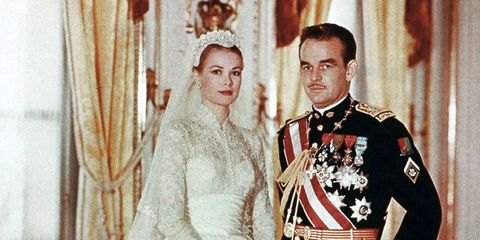
April 18, 1956: Grace Kelly Marries Prince Rainier III of Monaco

April 18, 1956: Actress Grace Kelly marries Prince Rainier III, the monarch and dictator of the tiny nation of Monaco.

Grace Patricia Kelly was born on November 12, 1929 in Philadelphia. Her father, John B. Kelly Sr., won 2 Gold Medals in rowing at the 1920 Olympics in Antwerp, Belgium; and another in 1924 in Paris. Her brother, John B. Kelly Jr., a.k.a. Jack Kelly, never won more than a Bronze Medal -- in 1956, in Melbourne, Australia, a few months after his sister's royal wedding -- but later served as President of the U.S. Olympic Committee.

Grace began acting in a school play at age 12. By 1950, she was a star on Broadway. In 1952, she played the female lead opposite Gary Cooper in the classic Western High Noon.

If you remember the film Die Hard, Hans Gruber, played by Alan Rickman, tells John McClane, played by Bruce Willis, that he considers him "just another American cowboy." At the end, when it looks like Gruber has won, he tells McClane, prematurely as it turns out, "This time, John Wayne does not walk off into the sunset with Grace Kelly." And McClane tells him, "It was Gary Cooper, asshole!"

She starred opposite Clark Gable in John Ford's film Mogambo, Ray Milland in Alfred Hitchcock's Dial M for Murder, Jimmy Stewart in Hitchcock's Rear Window, and Cary Grant in Hitchcock's To Catch a Thief. She was heavily in demand: By directors, by would-be male leads, by the public, and by men in general.

She wasn't a "blonde bombshell" like Marilyn Monroe. Rather, the wealth and sophistication to which she was born gave her an onscreen persona that made her seem, well, graceful, and unattainable, but still very much desirable. In 2006, writing The Great Book of Philadelphia Sports Lists, with some lists having nothing to do with sports, the authors, radio talk-show hosts Big Daddy Graham and Glen Macnow, put her on top of their list of the most beautiful women ever to come from Philadelphia and environs.

(The remainder of their Top 10, in descending order: Dancer Lola Falana, model Gia Carangi, actress Maria Bello, actress-talk show host Kelly Ripa, actress Holly Robinson Peete, rapper Eve, actress Kim Delaney, and singers Lauren Hart and Pink.)

Oh, she was desired. And some of those desires came true. She had an affair with Cooper while filming, even though he was 28 years older. She had an affair with Gable while filming, even though he was also 28 years older. She had an affair with Milland while filming, even though he was 22 years older. She had an affair with Aly Khan, a notorious Pakistani prince who later married another of the era's leading actresses, Rita Hayworth; he was a mere 18 years older than Grace. (He was 7 years older than Rita.)

In 1954, she filmed The Country Girl, playing the wife of a character played by Bing Crosby -- and the mistress of a character played by William Holden. Holden, 11 years older, couldn't resist her, and rumors flew that he was going to leave his wife for her.

But she dumped him for Crosby, 26 years older. He was a strict Catholic with his family. With himself, not so much, although it should be pointed out that, at the time, he was widowed, not married. Grace and Der Bingle had an affair, and it was still ongoing on March 30, 1955, the night of the Academy Awards.

Many people thought the Oscar for Best Actress should go to Judy Garland, for her turn in the remake of A Star Is Born, because they were longtime fans of hers, and knew she had gone through a lot to get to that point. Others thought it should go to Dorothy Dandridge, for starring in Carmen Jones, which would have made her the 1st black actor of either gender to win an Oscar for a leading role.

Instead, it went to Kelly for The Country Girl. It was hardly her best work, and she was not better in it than Garland or Dandridge were in their nominated roles. Sidney Poitier won Best Actor in 1964, for Lilies of the Field. It would take until 2002 for a black woman to win Best Actress: Halle Berry, for playing the title role in Introducing Dorothy Dandridge. (Both Dandridge and Berry were natives of Cleveland.)

People began to ask questions like, "Who did Grace Kelly have to sleep with to get that Oscar?" It wasn't Bing Crosby: That night, he expected to, um, celebrate with her. But when he walked into her hotel room, she was, um, celebrating with the night's winner for Best Actor, for On the Waterfront: Marlon Brando. (He was only 5 years older.) In a weird twist of events, Kelly had been offered the female lead in that film, but turned it down. It went to Eva Marie Saint: It was her first film, and she won Best Supporting Actress for it.

Crosby dumped Kelly, but the affairs with him and Holden -- two co-stars in one film -- became the worst-kept secret in Hollywood: Nobody would report on it, but everybody seemed to know about it. She was branded a "homewrecker." 

Kelly had an affair with fashion designer Oleg Cassini, 16 years older. He proposed to her, and she accepted. But her parents said no, because he had been previously divorced. A rumor got out that she had gotten pregnant with Cassini's child, and had an abortion. Was it true? If so, did her parents know? Did these uber-Catholic Kellys arrange the abortion? We will never know: Some secrets were taken to the grave.

And John B. Kelly Sr. was a friend of another fabulously wealthy Irish-American, Joseph P. Kennedy. Maybe Joe's son, Senator John F. Kennedy, and Grace could have kept each other satisfied. But JFK married Jacqueline Bouvier in 1953. While hospitalized for back surgery the following year, Grace allegedly visited Jack, and... I'll let your imagination run wild, but the rumor of JFK and Grace is more likely to be true than the rumor of JFK and Marilyn Monroe.

Finally, the Kellys had had enough. It seemed like the only way to keep Grace out of Hollywood's bedrooms was to keep her out of Hollywood, and marry her off to someone far away -- and farther than Washington, D.C. They found someone: Rainier Louis Henri Maxence Bertrand Grimaldi, the Hereditary Prince of Monaco.

On April 18, 1956, 3 months before the release of her last film, High Society -- about rich Philadelphians like herself, and based on an earlier film titled The Philadelphia Story -- Grace and Rainier married in Monte Carlo, the capital of Monaco. She became Her Serene Highness, Princess Gracia Patricia.

Monaco is 2nd only to Vatican City as the world's smallest country by area: 2 1/2 miles long by 1 mile wide, surrounded on 3 sides by France and 1 by the Mediterranean Sea, and 8 miles from France's southeastern border with Italy. Then as now, it was home to less than 40,000 people, and is known for beaches, lax tax laws that allow rich people to keep much of what they have, and one of the world's foremost gambling casinos. It is ownership of Casino Monte Carlo that makes the House of Grimaldi, the royal family of Monaco, one of the richest families in the world.

The marriage meant the end of her film career, but it was hardly the end of her celebrity. She surpassed Eleanor Roosevelt as the most famous woman in the world. She became perhaps the world's leading charity fundraiser. And she gave the Prince 3 children: Caroline, Albert (now the monarch, Prince Albert II), and Stéphanie.

All 3 children have had complicated love-lives, with the media watching them much more than they watched Grace while she was acting. Albert is believed to have had at least 1 child out of wedlock, who is not in the line of succession. But Stéphanie was the real "wild child," having her mother's libido, but not nearly having her mother's sense of discretion.
Princess Grace, 1982

On September 13, 1982, with Stéphanie in the car, Princess Grace had a stroke while driving back to Monte Carlo from the Grimaldis' country home in Mont Agel, France. Stéphanie suffered a neck injury, but recovered. Grace did not, and died the next day. The following day, USA Today published its 1st edition, and its 1st headline was of an event from outside the U.S.A.: The death of Princess Grace, America's sweetheart and Monaco's. She was only 52 years old.

In his eulogy, Jimmy Stewart -- one of the few co-stars with whom Grace didn't have an affair -- said, "You know, I just love Grace Kelly. Not because she was a Princess, not because she was an actress, not because she was my friend, but because she was just about the nicest lady I ever met. Grace brought into my life, as she brought into yours, a soft, warm light, every time I saw her, and every time I saw her was a holiday of its own."

Prince Rainier never remarried, and lived until 2005.

*

April 18, 1956 was a Wednesday. Three notable American actors were born on this day: Eric Roberts, better known as Julia's brother and Emma's father; John James, of the prime-time soap operas Dynasty and its spinoff The Colbys; and Melody Thomas Scott, of the daytime soap opera The Young and the Restless.

Football was out of season. The NBA season had ended 11 days earlier, with the Philadelphia Warriors dethroning the defending NBA Champions, the Syracuse Nationals, in a 5-game Finals. The NHL season had ended 8 days earlier, with the Montreal Canadiens dethroning the Stanley Cup holders, the Detroit Red Wings, also in 5 games.

There were just 3 games played in what would later be called Major League Baseball:

* The New York Yankees beat the Washington Senators, 9-5 at Griffith Stadium in Washington. Johnny Kucks was the winning pitcher. Mickey Mantle went 1-for-3, with an RBI on a sacrifice fly.

* The New York Giants beat the Pittsburgh Pirates, 5-4 at the Polo Grounds. Foster Castleman and Gail Harris hit home runs to offset 2 by Frank Thomas (not the later "Big Hurt"), making a winning pitcher out of reliever John William "Windy" McCall. Willie Mays went 2-for-5 with an RBI. Roberto Clemente went 2-for-3 with 2 RBIs.

* And the Boston Red Sox beat the Baltimore Orioles, 8-4 at Fenway Park in Boston. Ted Williams went 1-for-1 with 2 walks and an RBI.

Wednesday, March 30, 2022

March 30, 1955: And the Winner Is… Grace Kelly?

Left to right: William Holden, Grace Kelly, Bing Crosby

March 30, 1955: The Academy Awards ceremony is held at the RKO Pantages Theatre in Los Angeles. Bob Hope is the host, and the ceremony is broadcast live on NBC.

On the Waterfront was nominated for 12 "Oscars," and received 8, including Best Picture, Best Director for Elia Kazan, Best Actor for Marlon Brando, and Best Supporting Actress for Eva Marie Saint.

Brando, still only 28 years old, had beaten out some heavyweights: Humphrey Bogart for The Caine Mutiny, Bing Crosby for The Country Girl, James Mason for a remake of A Star Is Born, and Dan O'Herlihy for a new version of Robinson Crusoe.

The nominees for Best Actress were, in alphabetical order: Dorothy Dandridge for Carmen Jones (an all-black musical version of the opera Carmen), Judy Garland for A Star Is Born, Audrey Hepburn for Sabrina, Grace Kelly for The Country Girl, and Jane Wyman for Magnificent Obsession.
Dorothy Dandridge

Dandridge was the 1st black person nominated for a lead role, and, in the wake of the Supreme Court's Brown v. Board of Education ruling, there was a lot of support for her to get Best Actress. Many people thought it should go to Garland, because they were longtime fans of hers, and knew she had gone through a lot to get to that point. Time magazine had labeled her performance as "just about the greatest one-woman show in modern movie history," and she had already received the Golden Globe Award for the role.
James Mason and Judy Garland,
in the 1954 version of A Star Is Born

Garland could not attend the Oscar ceremony, having recently given birth to her son, Joey Luft, only the day before. Cameramen were present in her home, ready to broadcast her acceptance speech. In spite of the sentiment for Dandridge, Garland was considered that much of a favorite.

And then there was Kelly. She wasn't a "blonde bombshell" like Marilyn Monroe. Rather, the wealth and sophistication to which she was born gave her an onscreen persona that made her seem, well, graceful, and unattainable, but still very much desirable. In 2006, writing The Great Book of Philadelphia Sports Lists, with some lists having nothing to do with sports, the authors, radio talk-show hosts Big Daddy Graham and Glen Macnow, put her on top of their list of the most beautiful women ever to come from Philadelphia and environs.

Oh, she was desired. And some of those desires came true. She had an affair with Gary Cooper while filming High Noon, even though he was 28 years older. She had an affair with Clark Gable while filming Mogambo, even though he was also 28 years older. She had an affair with Milland while filming Dial M for Murder, even though he was 22 years older. She had an affair with Aly Khan, a notorious Pakistani prince who later married another of the era's leading actresses, Rita Hayworth; he was a mere 18 years older.

In 1954, she filmed The Country Girl, playing the wife of a character played by Crosby -- and the mistress of a character played by Holden. Holden, 11 years older, couldn't resist her, and rumors flew that he was going to leave his wife for her.

But she dumped him for Crosby, 26 years older. He was a strict Catholic with his family. With himself, not so much, although it should be pointed out that, at the time, he was widowed, not married. Grace and Der Bingle had an affair, and it was still ongoing on March 30, 1955, the night of the Academy Awards.

Garland was the favorite. Dandridge had her supporters. If either one had gotten the Oscar, it would have been a great story.

Instead, it went to Kelly. The Country Girl was hardly her best work, and she was not better in it than Garland or Dandridge were in their nominated roles. 

The camera crew set up in the Garland house packed up, and were out of her bedroom before Kelly even got to the stage. Groucho Marx sent Judy a telegram, telling her that her loss was "the biggest robbery since Brink's," referring to the famous armored car heist of 1950.

People began to ask questions like, "Who did Grace Kelly have to sleep with to get that Oscar?" It wasn't Bing Crosby: That night, he expected to, um, celebrate with her. But when he walked into her hotel room, she was, um, celebrating with Brando. (He was only 5 years older. As far as I know, this is the only time a holder of Best Actor and a holder of Best Actress have ever been sexually involved.) In a weird twist of events, Kelly had been offered the female lead in On the Waterfront, but turned it down, leading to Saint being cast in her first film, and she won Best Supporting Actress for it.

Crosby dumped Kelly, but the affairs with him and Holden -- two co-stars in one film -- became the worst-kept secret in Hollywood: Nobody would report on it, but everybody seemed to know about it. She was branded a "homewrecker." Finally, she was set up with Prince Rainier III of Monaco. It meant the end of her acting career, but more money and security than she would have had otherwise.

Sidney Poitier won Best Actor in 1964, for Lilies of the Field. It would take until 2002 for a black woman to win Best Actress: Halle Berry, for playing the title role in Introducing Dorothy Dandridge. (Both Dandridge and Berry were natives of Cleveland.)

*

March 30, 1955 was a Wednesday. In more recent years, the Oscar ceremony has been held on Sundays.

Baseball was in Spring Training. Football was out of season. No games were scheduled for the NBA. And the Stanley Cup Playoffs were underway, but no games were played on this day. So there were no scores on this historic day.

December 31, 1999 & January 1, 2000: The Millennium

December 31, 1999:  The Millennium arrives. The people of planet Earth survived. At a terrible cost. But we hadn't destroyed ourselves. ...