Showing posts with label cleveland guardians. Show all posts

Tuesday, October 4, 2022

October 4, 1948: The Gene Bearden Game


Gene Bearden

October 4, 1948: A Playoff for the American League Pennant is played at Fenway Park in Boston. The Boston Red Sox and the Cleveland Indians had both finished 1 game ahead of the New York Yankees in the AL race.

The Red Sox were managed by Joe McCarthy. Although he'd never played in the major leagues, he had led the Chicago Cubs to the 1929 National League Pennant. Fired after not repeating in 1930, the Yankees immediately hired him. He won the 1932 World Series, then missed 3 straight years, then won the American League Pennant in 7 of the next 8: 1936, '37, '38, '39, '41, '42 and '43, winning the World Series on each of those occasions but '42. Those 7 World Series wins remain a record, matched by Casey Stengel, but never surpassed.

He left the Yankees in the middle of the 1946 season, because he did not like the new owners, Dan Topping, Del Webb and Larry MacPhail. When Joe Cronin retired as Red Sox manager, team owner Tom Yawkey hired McCarthy, who seemed to still be the best manager in baseball.

The Indians were managed by Lou Boudreau. A former pro basketball player (in the Midwest-based National Basketball League, before there was an NBA), he had been their regular shortstop since 1940. After the 1941 season, they needed a new manager. Having been Captain of the basketball team at Bradley University in Peoria, Illinois, he suggested himself.

But he was only 24 years old. Aside from Roger Peckinpaugh, who had been interim manager for the last 15 games of the 1914 Yankees' season at age 23, he would, by far, be the youngest manager in baseball history. (Ironically, he would be replacing Peckinpaugh, now 50, in Cleveland.)

He was named manager by team owner Alva Bradley. It didn't matter much during World War II. But when the veterans came back in 1946, one of them was Bill Veeck, who bought the team from Bradley. Veeck had been an executive with the Chicago Cubs, and had built the minor-league version of the Milwaukee Brewers into a Pennant winner. He believed Boudreau was the best shortstop in baseball, but didn't care for him as a manager. Boudreau fought to keep his job, and won. At 31, he had gotten the Indians closer to a Pennant than they'd ever been, except for their 1920 World Series win.

McCarthy picked Denny Galehouse as his starting pitcher. It's true that he was 36 years old, and left the game with an 8-8 record, an ERA of an even 4.00, and a WHIP of 1.445, and only pitched 2 more games in the major leagues.

But his ERA+ for the 1948 season was 110. For those of you unfamiliar with the stat, ERA-plus is earned run average in relation to the rest of the league. Meaning that an ERA+ of 100 means that a pitcher is exactly at the league average when it comes to preventing earned runs. An ERA+ of 110 meant that Galehouse was 10 percent better at preventing earned runs than the average American League pitcher in 1948, even after the game in question.
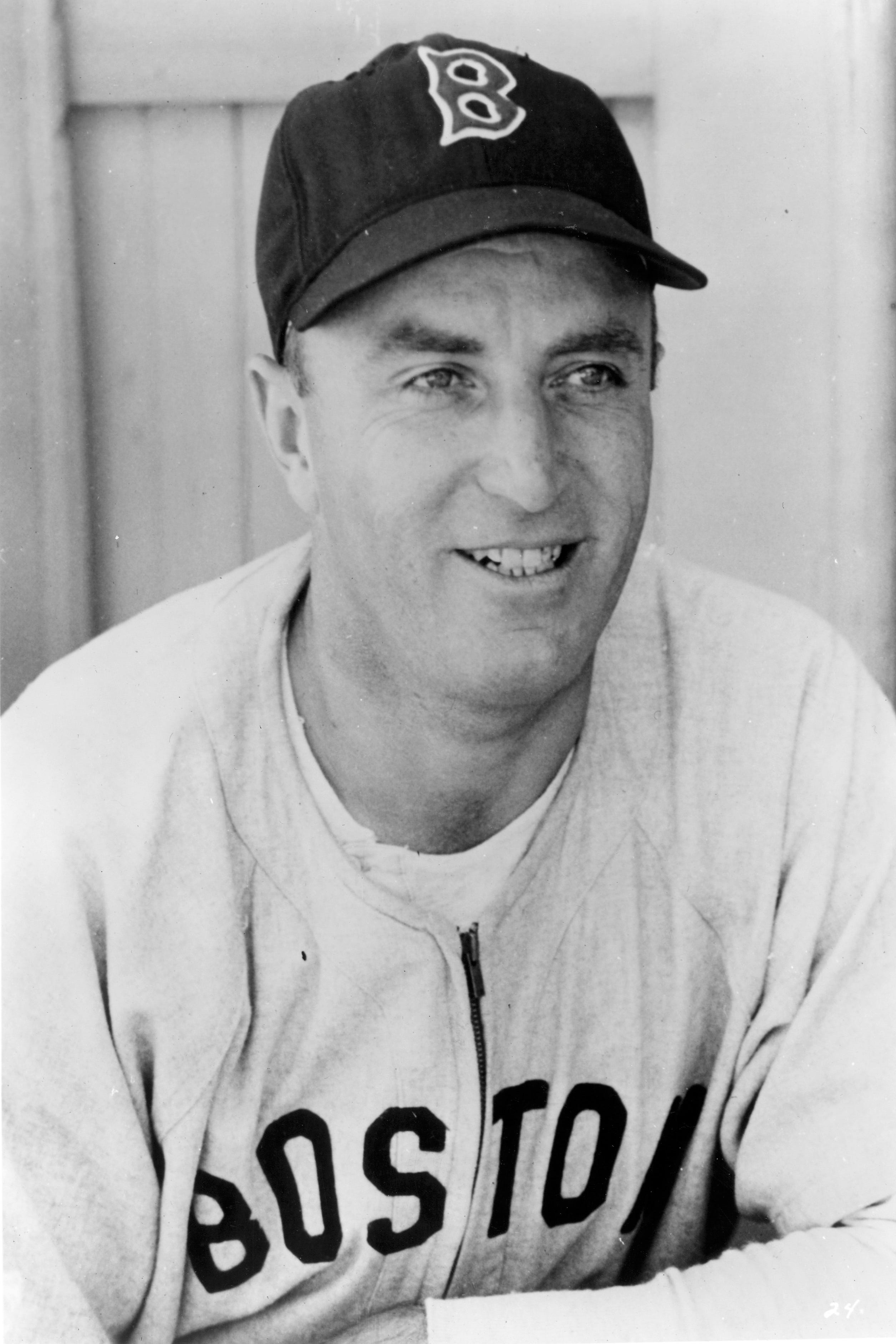
Denny Galehouse

In other words, Galehouse was not a bad pitcher. He was 109-118 lifetime, but most of that was for weak Indians and St. Louis Browns teams. And while he was only 9-10 for the Browns in 1944, his ERA of 3.12, and his ERA+ of 117, helped them win the Pennant that year, the only one they ever won.

Furthermore, Galehouse had pitched for the Indians, so he knew the tendencies of some of their players. Sometimes, a mental edge can make all the difference.

This time, it didn't. He got the 1st 2 outs in the top of the 1st inning. But Boudreau was the next hitter, and he hit a home run. 1-0 Cleveland.

Boudreau picked Gene Bearden as his starting pitcher. If anything, Boudreau gambled more than McCarthy did. Yes, Bearden was already 19-7 that season, and, at age 28, was in his prime. But he was a rookie, having faced just 4 batters in the major leagues prior to May 8 of that season. And he was a lefthander, pitching in Fenway. And he was a knuckleballer, adding the threat of passed balls, even for a very good-fielding catcher like Jim Hegan.

And, arm-easier knuckler or no, he was pitching on just 1 day's rest, having pitched a complete game victory just 2 days earlier. In fact, from September 6 to October 4, less than 1 full month, he pitched 71 innings. This included, counting the Playoff, 4 complete games in 10 days. Even by the standards of the Fighting Forties, that was insane.

He allowed a tying run. The score remained 1-1 through the end of the 3rd inning. In the top of the 4th, Boudreau and former Yankee 2nd baseman Joe Gordon singled, and 3rd baseman Ken Keltner hit a home run, making the score 4-1, and chasing Galehouse. McCarthy brought in Ellis Kinder, who allowed another run. Boudreau hit another homer in the 5th, to make it 6-1.

The Red Sox closed to within 6-3 on a 6th-inning home run by Bobby Doerr, but a dropped fly ball by the great Ted Williams in left field led to an 8-3 Indians lead. That was the final score, as Bearden went the distance.

The Boston Braves, playing just 1 mile to the west at Braves Field, had won the National League Pennant. This was the closest baseball ever got to an All-Boston World Series. Instead, the Indians stayed in Boston to play Games 1 and 2 of the World Series, and came back to clinch at Braves Field in Game 6.

Despite Pennants in 1954, 1995, 1997 and 2016, the Indians have never won another World Series. Their drought of 74 years is not only the current longest in Major League Baseball, it is now longer than the Red Sox' drought was when they blew the Series in 1986, and longer than the Cubs' drought was when they blew the National League Championship Series in 1984.

Which makes the Indians' heroes of 1948 all the larger: Bearden, Gordon, Keltner, and Hall-of-Famers Boudreau, Bob Feller, Larry Doby and Satchel Paige, the latter 2 having starred in the Negro Leagues.

Earlier in the year, on August 12, the Indians got hits from 14 different players, a record that still stands, as they beat the St. Louis Browns, 26-3 at Sportsman’s Park in St. Louis.

Hits: Gene Bearden (the starting pitcher!) and Hal Peck, 4; Lou Boudreau, Joe Gordon, Dale Mitchell and Jim Hegan, 3; Eddie Robinson, 2; Larry Doby, Wally Judnich, Thurman Tucker, Ken Keltner, Allie Clark, Joe Tipton and Bob Kennedy, 1. This included home runs by Bearden, Doby, Hegan and Judnich. RBIs: Bearden and Boudreau, 4; Peck, 3; Doby, Mitchell, Robinson and Keltner, 2; Gordon, Hegan, Judnich, Clark and Tipton, 1. Bob Feller closed the game out, but did not come to bat. 

The Red Sox recovered from their Playoff defeat, and took the Yankees down to the wire in 1949. Again, McCarthy made a fateful pitching change: With the last game of the regular season deciding the Pennant, the Yankees led 1-0 in the bottom of the 8th, and McCarthy took Kinder out for a pinch-hitter. It didn't work, and the bullpen was awful, and the Yankees won the game 5-3. Ever since, he has been ripped for both decisions: Starting Galehouse in '48, and relieving Kinder in '49.

He managed the 1950 season, fell short, and retired. Ironically, his successor as Red Sox manager was Lou Boudreau: Veeck had sold the Indians after the 1949 season, and new owner Ellis Ryan had fired Boudreau. 

The way Red Sox fans talked about McCarthy, you'd never know he had won 9 Pennants. Until his death in 1978, they never forgave him. Did they give him a bum rap? Maybe: After all, as I said, Galehouse was a decent pitcher, and Bearden was a big gamble for Boudreau.

In addition, Fenway Park's left-field wall, recently nicknamed The Green Monster, was listed as being 315 feet from home plate. Most people thought it was closer. It was eventually relabeled 310. Then as now, it was a tempting target for righthanded hitters. 

And Mel Parnell, usually cited as the best other option for Boston in this game, was a lefthanded pitcher. Add the fact that he would have been pitching on 3 days' rest, and he wasn't that much better a choice to start the Playoff than Denny Galehouse.

What were McCarthy's other options? The day before, Joe Dobson had pitched 4 innings, Earl Johnson 2, and Dave "Boo" Ferriss 3. They would have been too tired to pitch. The day before, Jack Kramer, Galehouse's '44 Browns teammate (and no relation to the tennis star of the same name, who was then at the peak of his game), had gone the distance, so he wasn't ready for this game.

The day before that was a day off. The day before that, Parnell had gone into the 7th inning, and, as I said, would have been on 3 days' rest. The day before that, Kinder had pitched a complete-game victory, had won his last 5 decisions, and hadn't been the losing pitcher since August 4 -- 2 months.

Except McCarthy did bring Kinder into this game, to pitch in relief of Galehouse, allowing 4 runs, 3 of them earned, on 4 hits and 2 walks. Stretch that over 9 innings, and it becomes 6 runs, 6 hits and 3 walks. He was not appreciably more effective than Galehouse. Would he have been, had he started the game? We can't know for sure. What we do know is that, counting only the runs scored while he was the Sox pitcher, it was Indians 4, Red Sox 2. That's closer than Indians 8, Red Sox 3, but it's still a loss.

Bearden then pitched in 2 games of the World Series, throwing 10 2/3rds innings without allowing a run. He was never so effective again, going just 25-31 in a career that ended only 5 seasons later. But he came through for his manager on this day.
Lou Boudreau

Not only did Boudreau's roll of the dice come up seven, but he was the game's hitting star, too. He went 4-for-4, hitting a solo home run off Galehouse in the 1st inning, and another off Kinder in the 5th. He also fielded 8 chances without an error: 3 putouts, 5 assists. He was named the AL's Most Valuable Player for the season.

At 31, the former "boy manager" had led his team to a Pennant. He remains the last player-manager to do so. And, in so doing, he outmanaged Joe McCarthy, the man then considered the best manager in baseball. Boudreau ended up in the Hall of Fame, although that was more for his playing than his managing. He collected 1,578 hits in the 1940s, more than any other player. Keep in mind that he did not serve in World War II, and kept playing through it; while Stan Musial missed 1 season, Joe DiMaggio and Ted Williams each missed 3, and Hank Greenberg missed nearly 4.

Boudreau managed the Red Sox from 1952 to 1954, the Kansas City Athletics from 1955 to 1957, and the Chicago Cubs for most of 1960. He had broadcast for the Cubs in 1958 and '59, and did so again from 1961 to 1987. He died in 2001. His daughter Sharyn married Detroit Tigers pitcher Denny McLain.

Bearden returned to his native Arkansas, managed a radio station, owned a restaurant and an auto dealership, and coached youth baseball. He died in 2004, at 83. Eddie Robinson, who pinch-hit, and then took over at 1st base, for Allie Clark, turned out to be the last survivor of this game, living until 2021, 100 years old.

*

October 4, 1948 was a Monday. Actress Meg Bennett was born.

There were no other baseball games that day. It was too early for the NBA and NHL seasons. Football was underway, but there would be no Monday Night Football until 1970. So there were no other scores on this historic day.

Sunday, July 24, 2022

July 24, 1911: The Addie Joss Benefit Game

July 24, 1911: A benefit game is played at League Park in Cleveland, for the family of Addie Joss.

Adrian Joss was born on April 12, 1880 outside Milwaukee in Woodland, Wisconsin. Known as the Human Hairpin for his slender build and his tight pitching motion, he pitched for the Cleveland Naps from 1902 to 1910, going 160-97.

The Cleveland Whats? Napoleon Lajoie, one of the greatest all-around players of the era, a member of the 3,000 Hits Club and a great fielder, too, was the Cleveland team's 2nd baseman and manager. Starting as the Cleveland Blues in 1901, and the Cleveland Bronchos in 1902, they were renamed the Cleveland Naps in his honor in 1903. He left after the 1914 season, and they were renamed the Indians, which they would remain until becoming the Cleveland Guardians in 2022.

Addie Joss' career WHIP -- walks plus his, divided by innings pitches -- of 0.968 is the lowest ever, and his ERA of 1.89 is the 2nd-lowest. The lowest ERA belongs to Ed Walsh of the Chicago White Sox, at 1.82. And his WHIP, exactly 1.000, is 2nd all-time to Joss. In the 1900s (the 1900-09 decade), Joss and Walsh were the 2 best pitchers in the American League.

On October 2, 1908, they opposed each other as their teams and the Detroit Tigers all went down to the wire for the AL Pennant. Walsh struck out 15 batters, and AL record that stood for 30 years. But Joss pitched a perfect game, and the Naps won, 1-0. It remains the greatest pitching duel in AL history, but it ended up not mattering, as the Tigers won the Pennant, by half a game over the Naps and one and a half over the ChiSox.

Joss led the major leagues in wins in 1907, and led the major leagues in ERA in 1904 and 1908. On April 20, 1910, he pitched a no-hitter against the White Sox, making him the 1st pitcher to pitch no-hitters against the same team twice. Only one pitcher since has matched that: Tim Lincecum of the San Francisco Giants, against the San Diego Padres in 2013 and 2014.
Addie Joss

Joss died of meningitis on April 14, 1911, the eve of what would have been his 10th in the major leagues. He was only 31. Upon hearing of his death, the Cleveland Press newspaper wrote "every train brings flowers" and "floral tributes by the wagonload are hourly arriving at the Joss home from all sections of the country." Billy Sunday, then America's foremost evangelist, had been a major league pitcher from 1883 to 1890, mostly with the team now known as the Chicago Cubs, and accepted the Joss' family's request to preside over Addie's funeral.

A benefit "all-star" game for Joss's family was scheduled by the Naps for July 24, 1911. They invited players from the other 7 AL teams to play against them. Jimmy McAleer would manage the All-Stars against Lajoie. At the time, he was the manager of the Washington Senators. He had been the Cleveland team's 1st manager in 1901, and had played for their previous National League team, the Cleveland Spiders. He said, "The memory of Addie Joss is sacred to everyone with whom he ever came in contact. The man never wore a uniform who was a greater credit to the sport than he."

Cy Young, who had also played for the Spiders, was in his last season in the major leagues, and started for the Naps, pitching the 1st 3 innings. (He would be traded later in the season, to the Boston team that became known as the Braves, and end his career there.) Lajoie played in the game, but went 0-for-2. "Shoeless" Joe Jackson, in his 1st big season in the majors, also went 0-for-2. From the other 7 teams:

* From the Boston Red Sox: Pitcher "Smoky" Joe Wood (who started, and pitched the 1st 2 innings), center fielder Tris Speaker (who would be traded to Cleveland in 1916 and lead them to the 1920 World Series).

* From the Detroit Tigers: Right fielder Ty Cobb (who forgot his Tigers uniform, so he wore a Cleveland road uniform during the game), and left fielder Sam Crawford.

* From the New York Highlanders: 1st baseman Hal Chase, and pitcher Russ Ford, who pitched the last 4 innings.

* From the Philadelphia Athletics: 2nd baseman Eddie Collins, 3rd baseman Frank Baker (who would become known as "Home Run Baker" for his heroics in that year's World Series), and catcher Patrick "Paddy" Livingston.

* From the St. Louis Browns: Shortstop Bobby Wallace.

* From the Washington Senators: Pitcher Walter Johnson (who told the press, "I'll do anything they want for Addie Joss' family"), and pitched the 3rd, 4th and 5th innings; catcher Gabby Street and center field Clyde Milan.

* Only the Chicago White Sox did not send a representative. Ed Walsh had volunteered to play, but the team's travel schedule simply didn't allow it.

The game was attended by approximately 15,270 fans, and raised nearly $13,000 (about $40,000 in 2022 money) to help Joss' family members pay remaining medical bills. The All-Stars beat the Naps, 5–3. No home runs were hit.

Baseball would not have an official All-Star Game until 1933, when a team of AL stars beat a team of NL stars at Comiskey Park in Chicago, making the All-Star Game an annual event. Oddly, in 1920, when Ray Chapman, shortstop for the team by then known as the Cleveland Indians, became the only player ever to die as a result of an in-game incident, there was no benefit game for his family.

In 1978, the Baseball Hall of Fame gave Joss a special waiver on the rule that says players must have played at least 1 game in at least 10 different seasons to qualify for election, since he would have pitched in 1 such game had he been stricken just 1 week later. He was soon elected. It was deserved.

*

July 24, 1911 was a Monday. One reason why this date was chosen for the game is that only 3 games were scheduled. All were in the National League:

* The New York Giants beat the Cincinnati Reds, 8-3 at the Palace of the Fans in Cincinnati. Rube Marquard went the distance for the win.

* The Brooklyn Dodgers lost to the Pittsburgh Pirates, 8-2 at Forbes Field in Pittsburgh. Honus Wagner went 0-for-3, but did draw a walk.

* And the St. Louis Cardinals beat the Philadelphia Phillies, 10-2 at Baker Bowl in Philadelphia.  

Saturday, July 23, 2022

July 23, 2021: The Cleveland Indians Become the Cleveland Guardians

July 23, 2021: The Cleveland Indians announce that, after 107 seasons, they are changing their name to the Cleveland Guardians.

The franchise began in the American League in 1901, as the Cleveland Blues. They became the Cleveland Bronchos -- pronounced like "Broncos" -- in 1902. That season, they acquired Napoleon Lajoie, one of the greatest all-around players of the era, eventually a member of the 3,000 Hits Club, and a great fielder, too, to be their 2nd baseman and manager. They were renamed the Cleveland Naps in his honor in 1903. He left after the 1914 season, and they were renamed the Indians.

Legend had it that they were named the Indians in honor of Louis Sockalexis, the 1st major league player to identify as a Native American, who had played for the National League's Cleveland Spiders from 1897 to 1899. Another story said they were named the Indians in honor of the Native tribes that lived on the shore of Lake Erie before the white man came.

Neither story was true. Terry Pluto, the longtime Cleveland newspaper columnist who's written several books about the team and its history, and knows more about them than anyone, decisively determined that Lajoie's departure coincided with the Boston Braves winning the World Series, and so, trying to match the Braves' luck, the Cleveland team renamed itself the Indians.

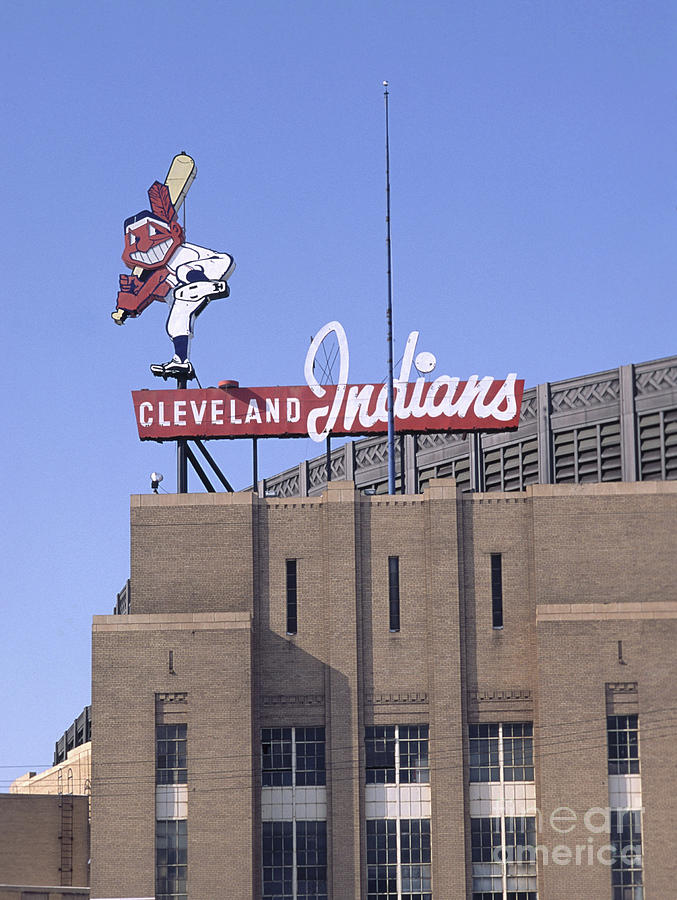
Some "luck": Between them, these 2 teams won only 6 Pennants between 1915 and 1990. And 2 of those 6 were against each other, in 1948. By that point, the Indians had adopted a character known as Chief Wahoo as their mascot. Pluto would later describe the Chief as a "grinning idiot."  
The Chief at Cleveland Municipal Stadium

For years, fans were divided between those who clung to the Chief as a symbol of team "heritage" -- much like people who say that about the Confederate flag -- and those who thought it was disgustingly racist. The Indians moved from Municipal Stadium to Jacobs Field in 1994 (it was renamed Progessive Field in 2007), and won Pennants in 1995, 1997 and 2016, and were more often than not Playoff contenders since the stadium switch.

Nevertheless, after the 2019 season, the Indians removed all references to the Chief, including from their caps, replacing him with a block letter C for Cleveland. In 2020, the NFL's Washington Redskins finally did what they said they would never do, and dropped their Native American name. They played 2 years as "The Washington Football Team" while they selected a new name. On February 2, 2022, they became the Washington Commanders.

With that in mind, Indians management decided it was time to consider alternatives. On July 23, 2021, they announced that, starting with the 2022 season, they would be the Cleveland Guardians. It was exactly 1 year to the day after the Washington Football Team dropped "Redskins."

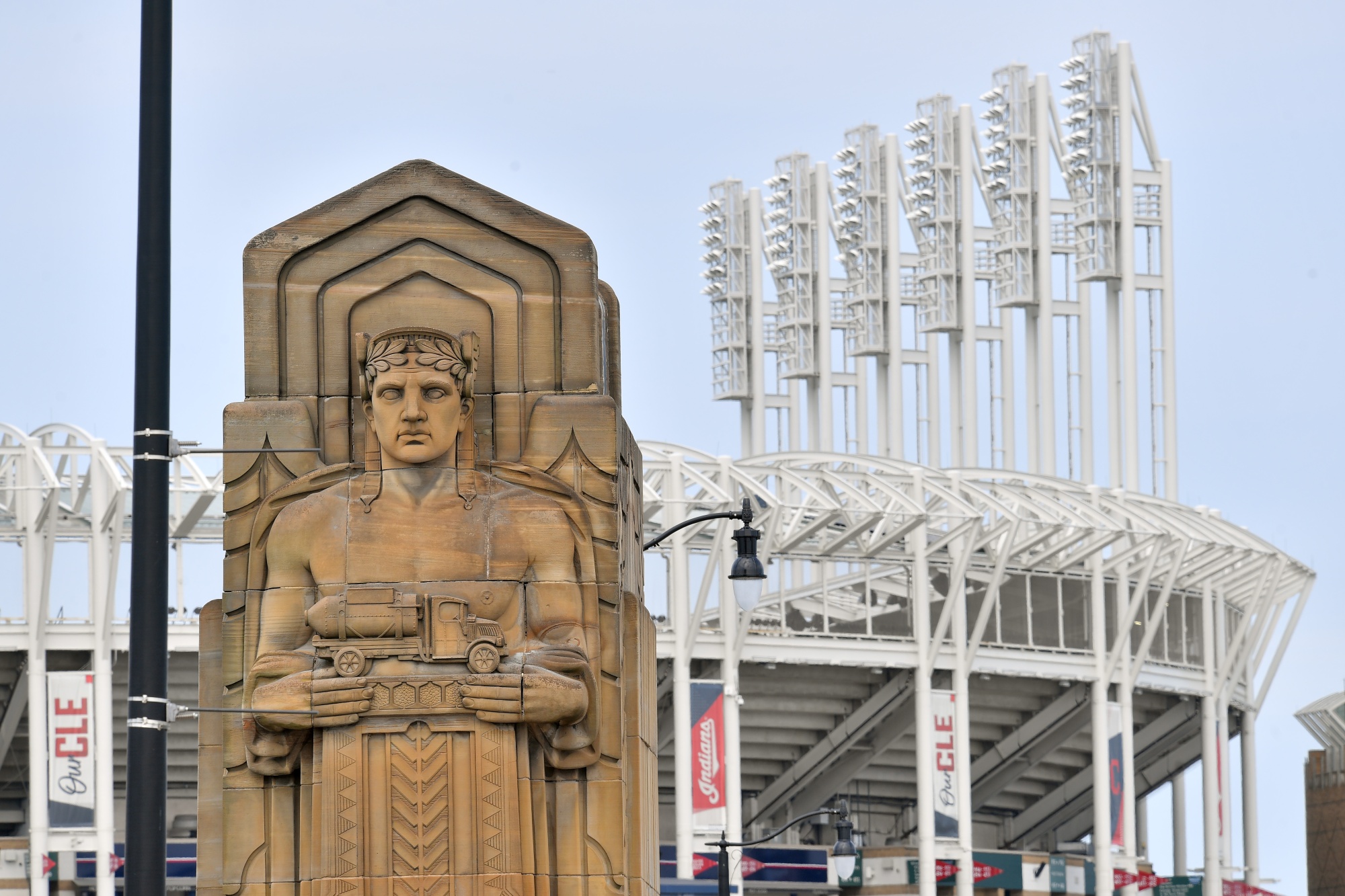
The team's name references "the Guardians of Traffic," 8 monolithic 1932 Art Deco sculptures by Henry Hering on the city's Hope Memorial Bridge, which is adjacent to Progressive Field.
One of the Guardians of Traffic,
with Progressive Field in the background

A minority of fans was furious, throwing out stupid labels like "politics" and "woke." The truth is, not only was the change long overdue, but changing from "Indians" to "Guardians" really didn't even change half the name: It still ended in "-dians."

The 1st game under the name "Cleveland Indians" was on April 14, 1915, a 5-1 win over the Detroit Tigers at Navin Field (eventually named Tiger Stadium) in Detroit. The last game under the name was on October 3, 2021, a 6-0 win over the Texas Rangers at Globe Life Field in Arlington, Texas. And the 1st game under the name "Cleveland Guardians" was on April 7, 2022, a 3-1 loss to the Kansas City Royals at Kauffman Stadium in Kansas City.

For those still upset over the change: "Indians" wasn't the team's original name, either. In fact, of the 16 teams that Major League Baseball had prior to 1961, only the Detroit Tigers are still using their original name. Only 7 of the 30 current teams are using their original names: The Tigers, the Royals, the New York Mets, the San Diego Padres, the Toronto Blue Jays, the Seattle Mariners and the Arizona Diamondbacks.

*

July 23, 2021 was a Friday. These Major League Baseball games were played:

* The name change didn't help the Cleveland franchise that day: They lost to the Tampa Bay Rays, 10-5 at Progressive Field. Since they are the team in question, I have deviated from my usual path of starting with the New York teams, and then going from North to South, East to West, which I now resume:

* The New York Yankees lost to the Boston Red Sox, 6-2 at Fenway Park in Boston. The Red Sox used an "opener game," and were able to defeat Yankee ace Gerrit Cole. Rafael Devers hit 2 home runs.

* The New York Mets beat the Toronto Blue Jays, 3-0 at Citi Field. How many Met pitchers does it take to pitch a 3-hit shutout? This time, 4: Tylor Megill (6 innings, 2 hits, 1 walk, winning pitcher), Seth Lugo (7th inning, 1 hit), Trevor May (a perfect 8th inning) and Edwin Díaz (a perfect 9th, save).

* The Philadelphia Phillies beat the Atlanta Braves, 5-1 at Citizens Bank Park in Philadelphia.

* The Baltimore Orioles beat their neighbors, the Washington Nationals, 6-1 at Oriole Park at Camden Yards in Baltimore.

* The San Diego Padres beat the Miami Marlins, 5-2 at LoanDepot Park in Miami.

* The Houston Astros beat their cross-State rivals, the Texas Rangers, 7-3 at Minute Maid Park (now Daikin Park) in Houston.

* The Cincinnati Reds beat the St. Louis Cardinals, 6-5 at Great American Ball Park in Cincinnati.

* The Chicago Cubs beat the Arizona Diamondbacks, 8-3 at Wrigley Field in Chicago.

* The Milwaukee Brewers beat the Chicago White Sox, 7-1 at American Family Field in Milwaukee.

* The Minnesota Twins beat the Los Angeles Angels, 5-4 in Minneapolis.

* The Kansas City Royals beat the Detroit Tigers, 5-3 in Kauffman Stadium in Kansas City.

* The Colorado Rockies beat the Los Angeles Dodgers, 9-6 at Dodger Stadium in Los Angeles. The Rockies scored 3 runs in the top of the 10th inning, including a home run by Charlie Blackmon.

* The Pittsburgh Pirates beat the San Francisco Giants, 6-4 at Oracle Park in San Francisco.

* And the Seattle Mariners beat the Oakland Athletics, 4-3 at T-Mobile Park in Seattle.

Monday, July 11, 2022

July 11, 1914: Babe Ruth's 1st Major League Game

July 11, 1914: The Boston Red Sox beat the Cleveland Naps, 4-3 at Fenway Park in Boston. The winning pitcher is a 19-year-old lefthander from Baltimore, making his major league debut. His name is George Herman Ruth Jr.

He had been purchased from the Baltimore Orioles of the International League, run by former major league pitcher Jack Dunn. When he got to Boston, the immature kid was known as "Jack Dunn's Baby." This was shortened to "Baby," and then to "Babe." Although some friends continued to call him "George," or the slangy "Jidge," he was pretty much "Babe Ruth" from then on.

He pitched 7 innings, allowing 3 runs, 2 of them earned, on 8 hits. He only struck out 1 batter, but he didn't walk any. Dutch Leonard pitched the last 2 innings, picking up the save.

The Naps got their name from their manager and 2nd baseman, Napoleon "Nap" Lajoie, who collected his 3,000th career hit later in the season. It would be his last with them. The following season, they became known as the Cleveland Indians. In 2022, they became the Cleveland Guardians.

Lajoie went 0-for-4 against Ruth in this game, but Shoeless Joe Jackson went 2-for-4 with an RBI. Also going 2-for-4 was left fielder Jack Graney, who went on to become the 1st former player to broadcast a Major League Baseball game. Going 1-for-4 was shortstop Ray Chapman. Chapman was there for Ruth's 1st major league game. Six years later, Ruth would be there for Chapman's last. as he became the only MLB player ever to die as the result of an on-field incident.

Ruth himself, showing no sign of what was to come, went 0-for-2 at the plate. In the bottom of the 2nd inning, in his 1st at-bat as a major leaguer, he struck out against Cleveland pitcher Willie Mitchell. In the bottom of the 4th, he hit the ball to right field, where it was caught by Jackson, who would later be better known as a left fielder. Duffy Lewis pinch-hit for Ruth in the bottom of the 7th, as he'd allowed 2 runs in the top half to make it 4-3 Boston, but Leonard made that score hold up.

Tris Speaker went 1-for-4 with an RBI. Larry Gardner went 3-for-4 with an RBI.

It was a successful day for the Red Sox, and Ruth was 1-0 for his career. It would be another 10 months before he hit his 1st major league home run. From 1915 to 1918, Ruth became the best lefthanded pitcher in baseball, going 78-32. Overall, his pitching record would be 94-46 with a 2.28 ERA and a 1.159 WHIP. Had he continued as a pitcher, without concerning himself with hitting, he could well have been a Hall-of-Famer anyway.

As we now know, that was not the case. After 4 seasons of being a lefthanded pitcher as good as Randy Johnson, he then spent 16 years as a lefthanded hitter better than Ted Williams or even a steroided-up Barry Bonds. Babe Ruth was the greatest hitter, and the greatest player, that baseball has ever known.

But anybody guessing on July 11, 1914 that such a thing would happen would have been considered crazy. At the time, he was a promising rookie, but nobody, not even Ruth himself, knew how far that promise could go -- or in what direction.

*

July 11, 1914 was a Saturday. These other games were played. In the American League:

* The New York Yankees beat the Chicago White Sox, 9-4 at the Polo Grounds. Center fielder William "Birdie" Cree went 3-for-4 with an RBI in support of Leonard "King" Cole, who relieved Carroll "Boardwalk" Brown, after Brown allowed 4 runs in the top of the 1st inning. (It was a good time for baseball nicknames.)

* A doubleheader was split at Shibe Park in Philadelphia. The St. Louis Browns won the opener, 4-3 in 12 innings. The Philadelphia Athletics won the nightcap, 6-4.

* And the Washington Senators beat the Detroit Tigers, 4-2 at American League Park (later Griffith Stadium) in Washington. Ty Cobb did not play for the Tigers.

In the National League:

* The New York Giants beat the St. Louis Cardinals, 13-9 at Robison Field in St. Louis.

* The Brooklyn Robins lost to the Cincinnati Reds, 6-5 at Redland Field (later Crosley Field) in Cincinnati. The Dodgers were in their 1st season with Wilbert Robinson as manager, and were called the Robins until he was fired in 1931.

* The Pittsburgh Pirates beat the Philadelphia Phillies, 3-1 at Forbes Field in Pittsburgh. Honus Wagner went 1-for-3.

* And the Boston Braves beat the Chicago Cubs, 5-2 at West Side Park in Chicago.

In the Federal League:

* The Brooklyn Tip-Tops swept a doubleheader from the Pittsburgh Rebels at Washington Park in Brooklyn. The Tip-Tops won the 1st game, 1-0, and the 2nd game, 8-2.

* A doubleheader was played at Terrapin Park in Baltimore. The Baltimore Terrapins won the 1st game, 2-1. The 2nd game was tied, 3-3 after 13 innings, when it was called due to darkness.

* The Indianapolis Hoosiers beat the Chicago Whales, 3-2 at Weeghman Park in Chicago. It was renamed Cubs Park in 1920 and Wrigley Field in 1926.

* And the St. Louis Terriers beat the Kansas City Packers, 6-3 at Handlan's Park in St. Louis.

Friday, June 3, 2022

June 4, 1902: The Cleveland Naps

June 4, 1902: The case of Napoleon Lajoie is settled. He plays his 1st game for Cleveland.

Napoléon Lajoie (that's pronounced "LAH-zhoh-ay," and he had no middle name) was born on September 5, 1874, in Woonsocket, Rhode Island. He would be the 1st of 2 natives of that town to be elected to the Baseball Hall of Fame, followed by 1930s Chicago Cubs catcher Charles "Gabby" Hartnett.

A son of French-Canadian immigrants, Napoléon dropped out of school to work in a textile mill, a major industry in late 19th Century New England. He joined a semi-professional baseball team, where a teammate, unable to pronounce his last name, started calling him "Larry." Others began calling him "Nap" for short.

He was playing for a team in nearby Fall River, Massachusetts when he was signed by the Philadelphia Phillies of the National League. They put him at 1st base, and he roomed with their biggest star, the hard-hitting Ed Delahanty. In 1897, he batted .363, had 127 RBIs, and led the NL in total bases and slugging percentage. In 1898, he was moved to 2nd base, again had 127 RBIs (which would remain a career high), and led the NL with 43 doubles.

Despite injuries that cost him significant playing time in 1899 and 1900, in the latter year, Ned Hanlon, manager of the Brooklyn Superbas, offered the Phillies $10,000 for Lajoie. At the time, it would have matched the record purchase for a ballplayer. Phillies owner John Rogers turned him down.

Rogers should have taken it. He had promised Lajoie the same salary as Delahanty, $2,600. When Lajoie found out that Delahanty was actually making $3,000, they both believed Rogers was untrustworthy. As the American League was ready to start play and raid NL rosters in 1901, Lajoie said, "Because I felt I had been cheated, I was determined to listen to any reasonable American League offer."

(Eventually, so was Delahanty: He stayed with the Phillies for 1901, but "jumped" to the Washington Senators in 1902. He was still with them in 1903, when he died under mysterious circumstances.)

Former Phillies part-owner Ben Shibe founded the AL's Philadelphia Athletics, borrowing the name from at least 2 previous professional teams. He hired Connie Mack, former Washington Senators (NL) and Pittsburgh Pirates catcher, and former Pirates manager, to be his team's manager and treasurer. Lajoie made $2,800 in 1900. He was offered $24,000, about 8 1/2 times what he was making. He said, "You can bet I signed in a hurry," adding, "The Phillies opened their season, and drew 6,000 fans. A week later, when we opened, there were 16,000 in the stands. The American League was here to stay."

Lajoie won the AL's 1st batting title, although his average was in dispute for many years. Until 1954, it was listed at .405. A transcription error was discovered, and it was revised to .422, making it the highest in AL history to this day. Later on, another error was found, and it was discovered that his average was actually .426, making it the 2nd-highest in major league history, trailing only the .440 of Hugh Duffy with the 1894 Boston Beaneaters.

That season, Lajoie also hit 14 home runs and had 125 RBIs. These also led the League, giving him the Triple Crown. He also led the AL with 232 hits, 48 doubles (which, through the 2021 season, remains an A's franchise record, in any city), 350 total bases, 145 runs, a .463 on-base percentage, a .643 slugging percentage, a 1.106 OPS, and a 198 OPS+. (He also had 14 triples, a fine total in any era, but it did not lead the League.)

Over the next 120 years, the American League would have multi-category-leading seasons produced by Ty Cobb, Babe Ruth, Lou Gehrig, Jimmie Foxx, Hank Greenberg, Joe DiMaggio, Ted Williams, Mickey Mantle, Frank Robinson, Carl Yastrzemski, Rod Carew, Reggie Jackson, George Brett, Ken Griffey Jr., Miguel Cabrera, Mike Trout and Shohei Ohtani. Lajoie's performance in the AL's 1st season stands alongside the best of these.

Mack said of Lajoie, "He plays so naturally and so easily, it looks like lack of effort." Ed Walsh, Hall of Fame pitcher for the Chicago White Sox, once said, "Did you ever see Larry Lajoie bat? No. Then you missed something. I want to tell you that there was one of the greatest hitters, and fielders, too, ever in baseball. There's no telling the records he'd have made if he'd hit against the lively ball."

But the next season, the Phillies sought an injunction to prevent Lajoie from playing in the American League. On April 21, 1902, the Supreme Court of Pennsylvania upheld the reserve clause in contracts between players and NL teams -- but also said that the injunction was only enforceable in Pennsylvania. That is, he could only play in the Keystone State if it was for the Phillies. This meant that he could play for the A's in away games.

Since he could only play away games -- and there was no health risk as there would be over a century later, as with Kyrie Irving and the Brooklyn Nets -- the A's let him go. To return the favor of Charles Somers, owner of the Cleveland Bronchos (the H was silent), lending the A's money to help them get started, on May 31, Mack traded Lajoie and pitcher Bill Bernhard, who had also jumped from the Phillies to the A's and to whom the injunction also applied, to the Bronchos.

Lajoie made his debut with the Bronchos on June 4. They beat the Boston Americans, 4-3 at League Park in Cleveland. Lajoie went 1-for-3 with an RBI. He completed the 1902 season with a .378 batting average, leading the AL again.

In 1903, Somers made Lajoie his manager, and even changed the name of the team to the Cleveland Naps, to capitalize on his popularity. He batted .344 in 1903 and .376 in 1904. The American League had been in business for 4 years, and only 1 man had ever led it in batting average: Nap Lajoie.

In the middle of the 1905 season, Lajoie contracted sepsis from an untreated spike injury. Dye from his stockings entered his bloodstream, and led to blood poisoning. As a result, a rule was put into place requiring white socks to be worn underneath a player's colored socks. Doctors considered amputating the leg, but he recovered. The Naps were 52-29 on July 24 when he was hurt, but only went 24-47 the rest of the way. Lajoie's Cleveland teammate, right fielder Elmer Flick, who had been their best player before Lajoie arrived, won the batting title.

Lajoie bounced back in 1906, batting .355 (which did not lead the League), and collecting 214 hits including 48 doubles (both of which did). That same year, he married Myrtle Smith, but they never had children. He tailed off a bit in 1907, and did not have a great season in 1908, but the team did, finishing just half a game behind the Detroit Tigers, led by Ty Cobb. That would be his best performance as a manager. He had another good by not great season in 1909.

In 1910, the Chalmers auto company promised a new car to the AL's batting champion. Lajoie, turning 36 late in the season, and Cobb, just 23, both wanted it. With 3 games left in the season, Cobb was batting .383, and stayed out of the lineup to preserve that average. On the last day, Lajoie went 8-for-8 in a doubleheader in which the St. Louis Browns, hating Cobb for his seemingly dirty play, played their infield back. Of Lajoie's 8 hits, 6 were bunt singles. Lajoie finished at .384, but few thought that was legitimate. Chalmers settled it by giving each man a car.

Lajoie batted .365 in 1911, .368 in 1912, and .335 in 1913. But with Cobb at his peak, Lajoie never won another batting title. He dropped to .258 in 1914, although he collected his 3,000th career hit. With the injunction long gone, he returned to the A's for the 1915 and 1916 seasons, and retired with a lifetime batting average of .338; 3,243 hits (at the time, 2nd all-time behind Honus Wagner) including 657 doubles, 153 triples and 82 home runs; 380 stolen bases; and an OPS+ of 150.

Had the Phillies paid Lajoie what he was worth, who knows? Most likely, they wouldn't have won a Pennant, either, as one man could only have done so much.

In 1917, he was player-manager for the Toronto Maple Leafs of the International League, for whom the hockey team would later be named. At age 43, he batted .380, won the IL batting title, and managed them to the Pennant. He played for the American Association's Indianapolis Indians in the war-shortened 1918 season, and then retired.

In 1937, he was among the 2nd class of players elected to the Baseball Hall of Fame. In 1939, he attended the Hall's opening ceremony. In 1958, living in Daytona Beach, Florida, he had a fall and broke his arm. He never recovered, and died on February 7, 1959, at the age of 84.

In 1949, Ogden Nash, my grandmother's favorite poet, wrote "Line-Up for Yesterday" for Sport magazine, an alphabetical list of star players. For the letter L, he wrote: 

L is for Lajoie
Whom Clevelanders love,
Napoleon himself,
With glue in his glove.

In 1999, despite his not having played in a major league game in 83 years, The Sporting News ranked him 29th on their list of the 100 Greatest Baseball Players, 3rd among 2nd basemen behind Rogers Hornsby and Eddie Collins. In 2022, ESPN ranked him 48th, 4th among 2nd basemen behind Hornsby, Joe Morgan and Jackie Robinson. (Hornsby fell from 9th to 20th, Collins all the way from 24th to 82nd.)

The Cleveland team kept the name Naps until he left them after the 1914 season. They then became the Indians, and the Guardians in 2022. (The Boston Americans became the Red Sox in 1908.)

*

June 4, 1902 was a Wednesday. These baseball games were played:

* The New York Giants beat the Chicago Orphans, 4-3 in 10 innings at the Polo Grounds. The Chicago team, formerly known as the White Stockings and, for their youth, as the Colts, had long been led by 1st baseman and manager Adrian Constantine Anson. He was known as "Cap," for "Captain," until he got older, and became known as "Pop." He retired after the 1897 season, and the team became known as the "Orphans," because "they missed their Pop." They were renamed the Chicago Cubs in 1903.

* The Brooklyn Superbas beat the Cincinnati Reds, 5-2 at Washington Park in Brooklyn. The Superbas became the Dodgers in 1911.

* The Boston Beaneaters beat the St. Louis Cardinals, 7-3 at the South End Grounds in Boston. The Beaneaters went through some name changes, and became the Braves in 1912.

* The Chicago White Sox beat the Philadelphia Athletics, 3-0 at South Side Park in Chicago. Roy Patterson pitched a 4-hit shutout.

* The St. Louis Browns beat the Baltimore Orioles, 6-2 at Oriole Park in Baltimore. The Orioles would fold at the end of the season, and a new franchise would take their place, eventually becoming the New York Yankees.

* The Pittsburgh Pirates beat the Philadelphia Phillies, 7-4 at National League Park (later renamed Baker Bowl) in Philadelphia. Honus Wagner went 1-for-3 with 2 walks and 2 RBIs.

* And the Washington Senators beat the Detroit Tigers, 13-6 at Boundary Field in Washington.

Wednesday, April 20, 2022

April 21, 1910: Halley's Comet & Mark Twain

April 21, 1910: Halley's Comet makes its closest approach to Earth on its 75 1/2-year trip around the Sun. It had last done so on November 30, 1835.

On that date, in Hannibal, Missouri, on the Mississippi River, a boy was born. He was named Samuel Langhorne Clemens. He would go on to do a lot of things with his life, including work on riverboats, drive a wagon on a westward wagon train, and write for newspapers from coast to coast.

From his work on riverboats, he took the pen name Mark Twain. "Mark" meaning distance and "Twain" meaning "two," the combined meaning of "Mark Twain" was, roughly, the point at which water became safe to travel -- or unsafe. And he did often seem to live his life on the border between safe and unsafe -- but also on the border between America's slaveholding South and its abolitionist North, and on the border between its established East and its then-wide-open, freewheeling "Wild West."

William Faulkner called him "The Father of American Literature," based mainly on The Adventures of Tom Sawyer, published in 1876, the 1st major American novel written on a typewriter; and its sort-of sequel, The Adventures of Huckleberry Finn, published in 1884.

He became America's leading lecture-circuit figure, unafraid to mock the high and the mighty and point out that their foibles were much the same as those of the low and the powerless. As has been said of journalists since, he sought to comfort the afflicted, and afflict the comfortable.

On June 2, 1897, the New York Journal, the hub of the journalism empire of William Randolph Hearst, ran a rebuttal to an article it had written, claiming that Twain had died, including Twain's own words:

I can understand perfectly how the report of my illness got about, I have even heard on good authority that I was dead. James Ross Clemens, a cousin of mine, was seriously ill two or three weeks ago in London, but is well now. The report of my illness grew out of his illness. The report of my death was an exaggeration.

This was one of many quotes of Twain that have either been gotten wrong, or incorrectly attributed to him. It is usually remembered as, "Reports of my death have been greatly exaggerated." A friend of his, novelist Charles Dudley Warner, said, "Everybody complains about the weather, but nobody does anything about it." And Twain went out of his way to credit Warner for the line. But most people credit it to Twain.

One quote definitely correctly attributed to Twain came in 1909:

I came in with Halley's Comet in 1835. It is coming again next year, and I expect to go out with it. It will be the greatest disappointment of my life if I don't go out with Halley's Comet. The Almighty has said, no doubt: "Now here are these two unaccountable freaks, They came in together, they must go out together."

Twain's prediction was accurate: He died of a heart attack on April 21, 1910, at Stormfield, his home in Redding, Connecticut. (The house burned down in 1923, and a replica was built on the site.) He was buried in Woodlawn Cemetery in Elmira, New York. So were Hal Roach, producer of the Laurel & Hardy and Our Gang films; and Ernie Davis, the 1st black Heisman Trophy winner.

*

April 21, 1910 was a Thursday. These baseball games were played that day:

* The New York Highlanders beat the Philadelphia Athletics, 1-0 at Shibe Park in Philadelphia. Russ Ford -- that's Russ, pitching for the team that would officially become the Yankees in 1913, not Whitey -- outpitched Cy Morgan. Despite this game, while the Highlanders did finish 2nd, they would be 14 1/2 games behind the Pennant-winning A's.

* The New York Giants beat the Boston Doves, 3-2 at the Polo Grounds. Rube Marquard was the winning pitcher, and Larry Doyle hit a home run, once again proving his quote: "It's great to be young and a Giant." The Doves, named for their owners, the Dovey brothers, became the Boston Braves in 1912.

* The Brooklyn Superbas lost to the Philadelphia Phillies, 1-0 at Washington Park in Brooklyn. Lew Moren pitched a 2-hit shutout, outpitching Irvin Wilhelm, already known as "Kaiser" in those pre-World War I years. The Superbas officially renamed themselves the Dodgers the next season.

* The Boston Red Sox beat the Washington Senators, 10-3 at the Huntington Avenue Grounds in Boston. Tris Speaker went 2-for-3 with a walk and an RBI.

* The Pittsburgh Pirates beat the St. Louis Cardinals, 9-4 at Forbes Field in Pittsburgh. Honus Wagner went 1-for-3 with 2 walks.

* The Detroit Tigers beat the Cleveland Naps, 5-0. This was the 1st game played at the 2nd League Park in Cleveland, replacing the one that stood at the same location, East 66th Street & Lexington Avenue, since 1891. Ty Cobb went 0-for-4. Napoleon "Nap" Lajoie, Cleveland's 2nd baseman, manager and namesake, went 1-for-4.

The team was renamed the Cleveland Indians in 1915, and the Cleveland Guardians in 2022. They played all their games at League Park until 1932, then alternated between there and Municipal Stadium until 1946, then only at Municipal Stadium until 1993, and then moved into Jacobs Field in 1994, renaming it Progressive Field in 2008.

* The Chicago Cubs beat the Cincinnati Reds, 6-1 at the West Side Grounds in Chicago.

* And the St. Louis Browns beat the Chicago White Sox, 4-1 at Sportsman's Park in St. Louis.

April 20, 1912: Tiger Stadium Opens

April 20, 1912: Two of baseball's legendary ballparks open: Fenway Park in Boston, and Tiger Stadium in Detroit. Given their respective historical natures, I've decided to do separate entries for each.

The Detroit Tigers had debuted in 1901, as a charter team in the American League, at Bennett Park. After the 1911 season, that park was torn down, and a new one put on the site. Originally, it was named Navin Field, for team owner Frank Navin.

The opponent for the inaugural game was the Cleveland Naps, named for their manager, 2nd baseman and star slugger, Napoleon "Nap" Lajoie. Mayor William B. Thompson threw out the first ball to Charley Bennett. Bennett had been a catcher for the Detroit Wolverines of the National League, but had lost his legs in a railroad accident. As a result, when the previous Detroit ballpark opened in 1896, it was named Bennett Park in his honor. He continued to attend games at Navin Field until his death in 1927.

As with the Fenway opener, this game went back and forth: The Naps scored a run in the 1st, and the Tigers answered with 2. In the 3rd, the Naps scored 2, and the Tigers 1, tying it back up. The Naps scored 2 in the 5th, but the Tigers came through with 2 in the 8th.

This game also went to the 11th inning. The Naps loaded the bases, but the Tigers got out of it. Despite having pitched all the way, Tiger manager Donie Bush let George Mullin bat for himself, and he singled home Bush himself with the winning run. Detroit 6, Cleveland 5. Unlike at Fenway, both starting pitchers at the Navin Field lid-lifter went the distance: Mullin won it for Detroit, and Vean Gregg lost it for Cleveland.

Ty Cobb went 2-for-4 with an RBI for the Tigers that day. Shoeless Joe Jackson played for the Naps, going 1-for-4. Lajoie left Cleveland after the 1914 season, and the team was renamed the Cleveland Indians. They kept that name through the 2021 season, and have been renamed the Cleveland Guardians.

In 1927, Walter Briggs became half-owner of the team. Navin died right after the 1935 World Series win, and Briggs became sole owner. In 1938, he extended the ballpark's upper deck all the way around it, into what became its most familiar configuration, and renamed it for himself: Briggs Stadium. He died in 1952, and his son Walter Jr., a.k.a. Spike Briggs, and his 3 daughters feuded over control of the team.

In 1956, radio executive John Fetzer bought the team from the Briggs family, and in 1961, he bought out the other owners. This allowed him to renovate the ballpark, and he renamed it Tiger Stadium. He oversaw the 1968 World Series win. In 1972, he was offered a chance to join the Detroit Lions in playing in the suburban Silverdome, but refused.

He sold the team to Domino's Pizza founder Tom Monaghan in 1983, and, while the Tigers won the World Series in 1984, his determination to replace Tiger Stadium led to its closing. He couldn't make a deal, and, in 1992, sold the team to his pizza competitor, Mike Ilitch, founder of Little Caesars, and owner of the NHL's Detroit Red Wings, Mike Ilitch. It was Ilitch who made the deal to build Comerica Park, downtown.
As set up for the 1971 All-Star Game

The Tigers won Pennants in 1934, 1935, 1940, 1945, 1968 and 1984. They won the World Series in 1935, 1945, 1968 and 1984. The Detroit Lions played at Tiger Stadium from 1938 to 1974, winning NFL Championships in 1952, 1953 and 1957. The ballpark also hosted some notable prizefights and concerts.
Toward the end. Note the 4 World Series banners in right field.

It closed on September 27, 1999, with an 8-2 Tiger win over the Kansas City Royals. Replaced by Comerica Park, it was demolished in 2008. In 2018, the Corner Ballpark opened on the site, and serves as the headquarters of the Detroit branch of the Police Athletic League.

*

April 20, 1912 was a Saturday. A full slate of games was played in what we would now call Major League Baseball. As stated, this included the opener at Fenway Park in Boston, which the Boston Red Sox won, 7-6 in 12 innings, over the New York Highlanders, who changed their name to the Yankees the next season.

In addition to the preceding:

* The New York Giants beat the Brooklyn Dodgers, 4-3 at the Polo Grounds.

* The Boston Braves beat the Philadelphia Phillies, 5-1 at Baker Bowl in Philadelphia.

* The Philadelphia Athletics beat the Washington Senators, 6-3 at National Park in Washington. (It was renamed Griffith Stadium in 1922.)

* The Pittsburgh Pirates beat the St. Louis Cardinals, 7-0 at Forbes Field in Pittsburgh. Honus Wagner went 1-for-5.

* The Chicago Cubs beat the Cincinnati Reds, 5-4 in 10 innings at West Side Park in Chicago.

* And the Chicago White Sox and the St. Louis Browns played 15 scoreless innings at Sportsman's Park in St. Louis, before the game was called due to darkness.

Although it was a Saturday, Arsenal, then still known as Woolwich Arsenal, did not play. They may have had a game that was pushed back by very cold weather or unplayable grounds. Two days later, on the Monday, they beat Blackburn Rovers, 5-1 at the Manor Ground in Plumstead, Southeast London.

This was the day of the FA Cup Final, at the Crystal Palace stadium in South London. Barnsley F.C., of Yorkshire, played West Bromwich Albion, of the Birmingham area, to a 0-0 tie. A replay was held 4 days later, at Bramall Lane in Sheffield, and that nearly went a full 120 minutes without scoring, before Barnsley won it, 1-0.

Sunday, April 17, 2022

April 17, 1960: The Colavito-Kuenn Trade

Rocky Colavito

April 17, 1960: A trade is made in baseball. At the time, it was merely curious. In hindsight, it was very damaging.

Rocco "Rocky" Colavito had been the right fielder for the Cleveland Indians. He had the best right field arm in the American League, along with Roberto Clemente of the Pittsburgh Pirates having the best in the National League. He was also a heavy hitter: In the last 2 seasons, he had hit 41 and 42 home runs, and 113 and 111 RBIs.

He was the most popular player on the team, and his league-leading 42 homers helped them finish 2nd in the AL in 1959, behind the Chicago White Sox, whose Nellie Fox was named Most Valuable Player. It was generally agreed that, had the Indians won the Pennant instead, Colavito would have been named the MVP.

But just 1 day before the Indians were set to begin the 1960 season, their general manager, Frank Lane, traded Colavito to the Detroit Tigers for Harvey Kuenn. Kuenn had led the AL with a .353 batting average, and had led it in doubles 2 years in a row. This was the 1st time the defending batting champion and the returning home run leader had been traded for each other, in either League. People wondered why.
Harvey Kuenn

It has been suggested that "Trader Lane," a.k.a. "Frantic Frank," wanted to get rid of any star on the team, so as to keep salaries down. Kuenn was a good player, but he wasn't as big a star as Colavito. The effect on the Indians was immediate: After going 89-65 and finishing just 5 games out of 1st place in 1959, they fell to 76-78 in 1960, 21 games behind the Pennant-winning Yankees.
At first, the trade worked pretty well for Colavito: Tiger Stadium's short power alleys suited him well, and, in 1961, he had career highs with 45 home runs and 140 RBIs, helping Detroit win 101 games. But that was the year that Roger Maris hit 61 home runs and Mickey Mantle hit 54, leading the Yankees to 109 wins. So not only did his best year as a player, individually and team-wise, not give him the league lead in any major offensive category -- although, in this 1st year of AL expansion, he did become the 1st player to officially play in 163 games, thanks to a rainout and replay -- it didn't even get him as close to the Pennant as he got with the '59 Indians.

The Indians continued to struggle. In 1964, the Tigers traded Colavito to the Kansas City Athletics. The following year, the Indians got him back, in a 3-way deal with the A's and the White Sox that sent Tommie Agee and Tommy John to Chicago.

That season, Colavito had 108 RBIs, good enough to lead the AL. But in 1966, though his home run total went up from 26 to 30, his RBIs dropped to 72, and his batting average fell from .287 to .238. Injuries ended his career 2 years later, only 35 years old. He finished with 374 home runs and 9 All-Star berths -- but, oddly, no Gold Gloves. He is one of the best all-around baseball players not in the Hall of Fame.

Terry Pluto, longtime Cleveland newspaper columnist and the man who knows more about the franchise now known as the Cleveland Guardians than anyone, titled his 1994 book about the team's history The Curse of Rocky Colavito, pointing out that, from 1960 to 1993, the Indians never even finished within 10 games of 1st place, except for the strike-split season of 1981.

Pluto has also suggested that the worst trade the franchise has ever made is the one in which they got rid of Colavito. And the 2nd-worst was the one where they got him back. Fans can't blame that one on Frank Lane, who was already gone.

Lane died in 1981. Commissioner Bowie Kuhn asked Bobby Bragan, who had managed under Lane with the 1958 Indians, to be Major League Baseball's official representative at Lane's funeral. When Bragan got there, he saw that he was the only person connected with baseball there. Lane was that much of a pariah.

In 1971, as GM of the Milwaukee Brewers, Lane hired Kuenn, a native of the Milwaukee suburbs, as a Brewer coach. Lane was fired in 1972, but Kuenn was still there in 1982, when he was named Brewers manager, and led them to the American League Pennant. He died in 1988, from diabetes, only 57 years old.

As of April 17, 2022, Rocky Colavito is still alive, and remains beloved by Cleveland baseball fans.

UPDATE: He died on December 10, 2024, at the age of 91. He was the last surviving player to have participated in the TV show Home Run Derby in the Winter of 1959-60.

The Guardians have a team Hall of Fame. From Colavito's rookie season of 1955 to his near-MVP season of 1959, they have honored him, and also ill-fated pitcher Herb Score. It says something about the gap between their 1959 Pennant race and their 1995 American League Pennant that only these players have been honored from that period: Sam McDowell, Gaylord Perry, Frank Robinson and Andre Thornton. And Robinson is honored mainly because the Indians made him MLB's 1st black manager, not because he hit much for them.

Score has also been elected to the Greater Cleveland Sports Hall of Fame. So have 1970s players Andre Thornton Rick Manning and Mike Hegan, and coach Joe Nossek. But Colavito has not. And Manning, Hegan and Nossek have likely been elected because they were Cleveland natives. (Hegan was the son of Indians star Jim Hegan.)

*

April 17, 1960 was a Sunday. This was the same day as the car crash in England that killed early rock and roll star Eddie Cochran. I have a separate entry for that event.

Football was out of season. Hockey season had ended 3 days earlier, when the Montreal Canadiens beat the Toronto Maple Leafs for the Stanley Cup. Basketball season ended 5 days before that, when the Boston Celtics beat the St. Louis Hawks for the NBA Championship.

There were 5 baseball games played that day:

* The Milwaukee Braves beat the Philadelphia Phillies, 8-4 at Connie Mack Stadium in Philadelphia. Bob Buhl outpitched Robin Roberts. Eddie Mathews hit a home run. Hank Aaron went 0-for-4, but had an RBI on a sacrifice fly.

* The Pittsburgh Pirates swept a doubleheader from the Cincinnati Reds, 5-0 and 6-5 at Forbes Field in Pittsburgh. Bob Friend pitched a 4-hit shutout in the opener. Over the 2 games, Roberto Clemente and Frank Robinson both went 2-for-8 with 2 RBIs, although Clemente also hit a home run in the opener.

* The Los Angeles Dodgers beat the St. Louis Cardinals, 7-5 at the Los Angeles Memorial Coliseum. Larry Sherry pitched 6 innings for the win, and Sandy Koufax pitched 3 innings of relief for the save. Brooklyn holdovers Gil Hodges and Duke Snider, and Los Angeles acquisition Wally Moon, hit home runs for the Dodgers. Stan Musial homered for the Cards.

* And the San Francisco Giants beat the Chicago Cubs, 4-3 at the newly-opened Candlestick Park in San Francisco. Jim Davenport singled relief pitcher Billy Loes home with the winning run in the bottom of the 14th inning. Willie Mays went 1-for-5 with an RBI. Orlando Cepeda hit a home run. Ernie Banks went 1-for-5 with 2 walks and 2 RBIs.

Thursday, April 14, 2022

April 14, 1912: The Titanic Sinks

April 14, 1912: The cruise ship RMS Titanic sinks in the North Atlantic Ocean, leading to more than 1,500 deaths. There were 710 survivors. At the time, it was the worst maritime disaster in human history.

There have since been bigger ones. But the reason the Titanic -- the RMS stood for "Royal Mail Ship" -- has stayed in the public memory is that it was the largest ship of any kind ever built, on its maiden voyage, from Southampton on the English Channel coast to New York City, and that it was said to be "unsinkable." Also, it was a case where the rich suffered along with the nonrich, showing them that they weren't better than the rest of us.

An Englishwoman named Millvina Dean was the last survivor of the sinking of the RMS Titanic, living until May 31, 2009, at the age of 97. She was an infant survivor, with no memory of the event.

*

April 14, 1912 was a Sunday. There was, as yet, no National Football League, and no professional basketball league of any name. The National Hockey League hadn't yet been founded. There was a National Hockey Association in Eastern Canada, and a Pacific Coast Coast Hockey Association with teams in Western Canada and America's Pacific Northwest, but their seasons were already over, with the Quebec Bulldogs as Stanley Cup winners.

But the Major League Baseball season had just gotten underway, and 4 games were played. None of the 3 teams then in New York City were involved:

* The Detroit Tigers beat the Cleveland Naps, 1-0 at League Park in Cleveland. The home team was named after their manager and 2nd baseman, Napoleon "Nap" Lajoie. After he left the team following the 1914 season, they were renamed the Cleveland Indians.

* The Cincinnati Reds beat the Pittsburgh Pirates, 11-7 at Redland Field in Cincinnati. This ballpark had hosted its 1st game only 3 days earlier. Its name would be changed to Crosley Field in 1934, and the Reds left it in 1970. On April 20, 6 days after the Titanic sank, Fenway Park would open in Boston, and Navin Field would open in Detroit. Fenway has been seriously altered a few times, but is still in use. Navin Field would be expanded and renamed Briggs Stadium in 1938, renamed Tiger Stadium in 1961, and closed in 1999.

* The St. Louis Browns beat the Chicago White Sox, 4-1 at Comiskey Park in Chicago.

* And the St. Louis Cardinals beat the Chicago Cubs, 5-4 at Robison Field in St. Louis. 

Friday, April 8, 2022

April 8, 1975: Frank Robinson Becomes Baseball's 1st Black Manager

April 8, 1975: The Cleveland Indians beat the New York Yankees, in their season opener at Cleveland Municipal Stadium. The Indians are managed for the 1st time by Frank Robinson. This makes Robinson the 1st black manager in Major League Baseball.

In 1961, Frank Robinson led the Cincinnati Reds to the National League's Pennant, and was named its Most Valuable Player. For the 1966 season, they traded him to the Baltimore Orioles. It was a big mistake, and the best thing that ever happened to the Orioles other than their move from being the St. Louis Browns in 1954: Robinson was immediately named team Captain, won the Triple Crown, led them to their 1st American League Pennant and their 1st World Series win, and was named the AL's MVP. He remains the only player to win the MVP in both Leagues. The Orioles won the Pennant again in 1969, 1970 and 1971, and the World Series again in 1970.

(UPDATE: Shohei Ohtani was named the AL's MVP in 2021 and 2023, with the Los Angeles Angels. In 2024, with the Los Angeles Dodgers, he was named the NL's MVP, making him the 2nd player so honored.)

After the 1973 season, New York Yankees owner George Steinbrenner saw manager Ralph Houk quit, and he had to scramble to find a new manager. He considered hiring Frank Robinson, who was then playing for the team then named the California Angels. This would have made him the 1st black manager in the major leagues, a little over a year after a dying Jackie Robinson spoke at the 1972 World Series, and said he wanted to "see a black face managing in baseball."

George didn't care about making history: He wanted the best man for the job, and, in the Autumn of 1973, having already been denied the right to hire Dick Williams, winner of the last 2 World Series as manager of the Oakland Athletics, by A's owner Charlie Finley, he thought the best remaining choice that might be available was Frank Robinson.

Gene Autry, the legendary entertainer who owned the Angels, wouldn't let Robinson go. Was it because Autry didn't want a black manager in MLB? No. Was it because he simply didn't want to lose Frank? No, as you'll soon see. It was because he didn't like George, and didn't want to give him the satisfaction.

Nevertheless, Autry could have named Frank the 1st black manager in the major leagues, but on September 12, 1974, he traded Frank to the Cleveland Indians for Ken Suarez, Rusty Torres and cash. (The last part is ironic: The Indians were constantly short on cash, and Autry was one of the richest owners. In another irony, the next manager Autry hired was Dick Williams.) 

After the season, Indians manager Ted Bonda fired manager Ken Aspromonte. Who to hire? Bonda knew that, racial history aside, Frank was qualified for the job. He'd been Captain of a 2-time World Series winner, and had managed in the Caribbean Winter Leagues. Bonda knew that if he didn't hire him as manager, somebody else might, and he didn't want to lose him, either as a still-active player or as a potential manager.

So, on October 3, 1974, he did the right thing for history, as well as the right thing for his team. He signed Frank at a salary of $175,000 to do both jobs. Frank said his only regret was that Jackie, no relation, didn't live to see the day.

I could have done this entry for that day. But it wouldn't have been official until he actually managed a regular-season game. And, besides, that 1st such game makes for a better story.

On April 8, 1975, for the 1st time, a regular-season game in Major League Baseball was played with a black man managing one of the teams. Frank had already posed for the cover of Sport magazine, handing a lineup card to the cameraman. Now, at Cleveland Municipal Stadium, in front of 56,715 fans, he did it for real, giving his lineup card to home plate umpire Nestor Chylak, who would join Frank in the Hall of Fame.

Gaylord Perry, also on his way to the Hall, started for the Indians, and George "Doc" Medich did so for the Yankees. In the bottom of the 1st inning, after Oscar Gamble popped up to 3rd base, Frank Robinson, having made himself the Indians' designated hitter and put himself 2nd in the batting order, hit a home run off Medich, the 575th of his career, which would end with 586.

The Yankees took a 3-1 lead in the top of the 2nd, the Indians made it 3-2 in the bottom of the 2nd, and, in the bottom of the 4th, Robinson's former Baltimore teammate John "Boog" Powell -- who said the Indians' all-red uniform made him, rotund as he was, "look like the world's largest Bloody Mary" -- hit a home run to tie the game. Boog broke the tie with an RBI double in the 6th, and the Indians went on to win, 5-3.
Boog had a point.

But the Indians never had enough money to build a contending team. Early in the 1977 season, Frank Robinson became the 1st black manager to get fired -- not because he wasn't as good as most white managers, but because he was as good as most of them, and that wasn't good enough.

In 1981, he achieved another both-leagues distinction: The San Francisco Giants made him the 1st black manager in the NL. The next year, in his 1st year of eligibility, he was elected to the Baseball Hall of Fame.

He would later return to the Orioles, coming within 2 games of managing them to an AL Eastern Division title in 1989. He was also the manager of the Montreal Expos when they moved to become the Washington Nationals in 2004-05. He died in 2019, at age 83.

In 1978, having been the 1st black player in the American League and the 2nd black player in the previously all-white major leagues, Larry Doby became the 2nd black manager in MLB, finishing out the season with the Chicago White Sox.

As of Opening Day of the 2022 MLB season, 11 of the 30 current teams have never had a black manager: The New York Yankees, the Arizona Diamondbacks, the Atlanta Braves, the Boston Red Sox, the Los Angeles Angels, the Miami Marlins, the Minnesota Twins, the Oakland Athletics, the Philadelphia Phillies, the St. Louis Cardinals and the San Diego Padres.

The the D-backs, Braves, the Red Sox, the Angels, the Marlins, the Cardinals and the Padres have each had a Hispanic manager, but not an African-American one. Dave Roberts was interim manager of the Padres for 1 game, but not a "permanent" manager for them, as he has been for the Los Angeles Dodgers, so the Padres still count as not having hired a black manager.

(UPDATE: In 2024, the Angels hired Ron Washington.)

*

April 8, 1975 was a Tuesday. There were 5 other games in Major League Baseball that day:

* The New York Mets beat the Philadelphia Phillies, 2-1 at Shea Stadium in New York. Tom Seaver outpitched Steve Carlton for the win, aided by a home run from Dave Kingman. Mike Schmidt went 0-for-4.

* The Boston Red Sox beat the Milwaukee Brewers, 5-2 at Fenway Park in Boston. For the Red Sox, Carl Yastrzemski went 1-for-4. For the Brewers, Hank Aaron went 0-for-3, and Robin Yount hit a home run.

* The Minnesota Twins beat the Texas Rangers, 11-4 at Arlington Stadium in the Dallas suburb of Arlington, Texas. For the Twins, Rod Carew went 2-for-6, while Tony Oliva and Larry Hisle hit home runs.

* The Atlanta Braves beat the Houston Astros, 2-0 at the Astrodome in Houston.

* And the Oakland Athletics beat the Chicago White Sox, 3-2 at the Oakland Coliseum. They did this despite Reggie Jackson going 0-for-4.

Football was out of season. There were 2 NBA Playoff series beginning on the day. The New York Knicks lost to the Houston Rockets, 99-84 at the Hofheinz Pavilion in Houston. And the Seattle SuperSonics beat the Detroit Pistons, 90-77 at the Seattle Center Coliseum.

There was 1 American Basketball Association Playoff game: The Kentucky Colonels beat the Memphis Tams, 119-105 at Freedom Hall in Louisville.

Four Stanley Cup Playoff series began that day: 

* The New York Islanders, in their 1st-ever Playoff game, shocked their established neighbors, the New York Rangers, 3-2 -- at Madison Square Garden no less. An arch-rivalry is born.

* In an "Original Six" matchup, the Boston Bruins beat the Chicago Black Hawks, 8-2 at the Boston Garden.

* The Pittsburgh Penguins beat the St. Louis Blues, 4-3 at the Civic Arena in Pittsburgh.

* And the Los Angeles Kings beat the Toronto Maple Leafs, 3-2 at The Forum outside Los Angeles in Inglewood, California. Mike Murphy scored the goal, 8 minutes and 53 seconds into overtime.

And 1 Playoff game was played that day in the World Hockey Association: The Quebec Nordiques beat the Phoenix Roadrunners, 5-2 at Le Colisée de Québec.

December 31, 1999 & January 1, 2000: The Millennium

December 31, 1999:  The Millennium arrives. The people of planet Earth survived. At a terrible cost. But we hadn't destroyed ourselves. ...