Showing posts with label new haven. Show all posts

Monday, December 5, 2022

December 6, 1873: Eton vs. Yale

December 6, 1873: Eton vs. Yale, in football? Or in "foot ball," written as two words? Given the existence of the scorecard in this photo, apparently, it happened, if not officially, as the NCAA would say today.

Yale University, in New Haven, Connecticut, is America's 3rd-oldest college, following Harvard, and William & Mary. They are traditionally elitist and stuck-up, and that's two of the many things that they like about themselves.

But Eton College, in Eton, Berkshire, England, makes the Yalies look like nouveau riche. Founded in 1440 by King Henry VI, intended as a sister institution to King's College, Cambridge, Eton (pronounced "EE-ton") is known for its history, wealth, and notable alumni, known as Old Etonians. It is 1 of 3 public schools (what the English call private schools), along with Harrow and Radley, to have retained the boys-only-boarding-only tradition, which means that its boys live at the school, 7 days a week, with no girls. It's been called "the nurse of England's statesmen."

I quote Richard Hershberger, a historian who tends to specialize in baseball during this period:

A group of rich former students of Eton (this is more or less redundant) are tourists in America. While in Connecticut, they get up a game with some students at Yale. This is in no sense the Eton football team. I have my doubts about this being the Yale football team, or if that even had meaning in 1873. The most interesting aspect of this game is that it shows Yale playing more or less under the Football Association rules, i.e. soccer, and doing it well enough to beat a pickup team of Eton "old boys." The dominance of rugby in American college football is still a bit in the future.

The Earl of Rosebery is an interesting figure. This is Archibald Primrose, 5th Earl of Rosebery. He is 26 years old at this point.
"This point" being in 1873. This photo was taken years later.

After matriculating from Eton in 1866, he went to Oxford, but was kicked out two years later. He had bought a race horse, which was prohibited to undergraduates. When the school found out, they gave him the choice of selling the horse or of leaving school. He left. You have to respect that.

His lack of a degree did not hold him back. He became UK Prime Minister in 1894. Honestly, I could not have named a Victorian prime minister not named Disraeli, Gladstone, or Palmerston, but apparently there were some. In this case, it was brief and not terribly successful, but still...

What has this to do with football? Just as Yale's performance tells us something about how football was played in America in 1873, Archie's presence tells us something about the social status of football in Britain.

The game was played at Hamilton Park in New Haven. According to a newspaper, the Brooklyn Union, "After a closely contested match, played according to the English rules, with one or two American variations mutually agreed upon, it was won by Yale." No score is mentioned, nor a citation of the goalscorers. The Hartford Courant cited Yale as having won, 2-1, with Sherman being the scorer. Neither newspaper listed Sherman's first name.

Earlier in the season, both also at Hamilton Park, on October 25, Yale beat Rutgers, 3-1; and, on November 15, Yale lost to Princeton, 3-0. So Yale were 2-1 on the "season." A few months later, Harvard played McGill University of Montreal in 2 different "codes" of football, and it led to the game that would become known outside the United States as "American football."

Hamilton Park was the first home field for Yale's football team, from 1870 until the land for Yale Field was acquired in 1884. The park hosted horse races, and was home to the New Haven Elm Citys baseball team of the National Association during the 1875 season. The Hartford Dark Blues of the National League hosted a game there in 1877.

*

December 6, 1873 was a Saturday. It was the only college football game played that day. No other sporting events were played: Baseball was out of season, ice hockey barely existed, and basketball wouldn't be invented for another 18 years.

Monday, November 21, 2022

November 21, 1914: The Yale Bowl Opens

November 21, 1914: The Yale Bowl opens, a mile and a half west of the main campus of Yale University in New Haven, Connecticut. Arch-rival Harvard spoil the party, as the Crimson beat the Bulldogs, 36-0. Yale were a good team that season, going 6-2. But Harvard might have been the best team in the country, going 7-0-2.

Prior to the Yale Bowl, Yale had played since 1884 at Yale Field, across Derby Avenue, where they built the current baseball version of Yale Field in 1928. It seated 33,000 fans, while the Yale Bowl seated 70,896. After decades of deterioration, a much-needed renovation was completed in 2006, with a more modern facility, and wider seats, reducing seating capacity to 61,446.

While Yale claim 27 retroactively-awarded National Championships, only one of these, in 1927, has been won since the Yale Bowl opened. The Ivy League was founded in 1954, and in 2022, Yale won its 17th Ivy League title. (UPDATE: In 2023, they won their 18th.)
With the combined Harvard-Yale logo at midfield

When the New York Giants needed a temporary home between the October 1973 closing of the original Yankee Stadium and the October 1976 opening of Giants Stadium, they considered several facilities in the New York Tri-State Area. Being 76 miles northeast of Midtown Manhattan, the Yale Bowl was at the very edge of that area.

Indeed, New Haven is the terminus of one of the lines of what's now the Metro-North Commuter railroad. And, with ties to both New York and New England, the city often serves as something of a "neutral zone" between New York and Boston sports fandoms.

Nevertheless, the Giants played 5 home games at the ale Bowl in 1973, and 7 in 1974, before being allowed to use Shea Stadium in Queens for the 1975 season. The commute, the traffic and the parking situation were terrible, and as the Giants got worse and worse, attendance dropped from a peak of 70,168 to a trough of 21,170. The Giants went 1-11 at the Yale Bowl, including a 1974 overtime loss to the Jets -- and that doesn't include the 1st game ever played between the Giants and the Jets, a 1969 preseason game at the Yale Bowl, which the Jets also won.

In the 1976 and 1977 seasons, the Connecticut Bicentennials of the North American Soccer League played at the Yale Bowl. But, except for the 17,302 they got for a 1977 game against the PelĂ©-led New York Cosmos, they never got more than 7,000 fans.

*

November 21, 1914 was a Saturday. These other notable college football games were played that day:

* Army beat Springfield College, 13-6 on The Plain in West Point, New York. Army went 9-0 that season.

* Navy beat Ursinus, 33-2 at Worden Field in Annapolis, Maryland.

* Illinois beat Wisconsin, 24-9 at Randall Field in Madison, Wisconsin. Illinois went 7-0, and won the title of the Western Conference, which later became the Big Ten.

* Nebraska beat Iowa, 16-7 at Iowa Field in Iowa City. Nebraska finished 7-0-1 and won the Missouri Valley Conference title.

* Tennessee did not play that week. They went 9-0, and won the Southern Intercollegiate Athletic Association title.

* Texas also did not play that week. They went 8-0, and won the 1st-ever Southwest Conference title.

* Rivalry: Lehigh beat Lafayette, 17-7 at March Field in Easton, Pennsylvania.

* Rivalry: Purdue beat Indiana, 23-13 at Stuart Field in West Lafayette, Indiana.

* Rivalry: Minnesota beat the University of Chicago, 13-7 at Stagg Field in Chicago.

* Rivalry: Missouri beat Kansas, 10-7 at McCook Field in Lawrence, Kansas.

* Among New York City teams, New York University lost to Wesleyan, 29-13 at Ohio Field in The Bronx; Fordham beat Boston College, 14-3 at Fordham Field in The Bronx; and Columbia had suspended its program for the season.

* And for the New Jersey schools, Rutgers beat the Stevens Institute of Technology, 83-0 at Castle Field in Hoboken; while Princeton had concluded its season the week before, losing to Yale.

Baseball was out of season. Professional basketball barely existed. And, in that era, it was a little early for hockey season to start.

In English soccer, North London team Arsenal went to Yorkshire, and lost to Huddersfield Town, 3-0 at Leeds Road.

Sunday, November 20, 2022

November 21, 1877: Thomas Edison Invents the Phonograph

November 21, 1877: Thomas Edison invents the phonograph at his laboratory in the Menlo Park section of Raritan Township, Middlesex County, New Jersey. It is the 1st device capable of recording sound.

It recorded on tinfoil around a grooved cylinder. Into its speaker -- partly because it was the only way it could be done, and partly because he was hard of hearing -- Edison shouted into it, an old nursery rhyme:

Mary had a little lamb!
Its fleece was white as snow!
And everywhere that Mary went
the lamb was sure to go!

Although that recording does not survive, Edison recorded it again for a demonstration years later, and that one does survive.

Edison already had many patents to his name, making him wealthy. But the phonograph was the one that first got him national attention. Over the next few years, other scientists, including telephone inventor Alexander Graham Bell, made improvements that made the recording industry possible.

Edison died in 1931. In 1954, to differentiate itself from the other towns in New Jersey named Raritan, the town that included the neighborhood of Menlo Park changed its name to the Township of Edison. It later erected a monument on the site of Edison's laboratory, a "Light Tower" that referenced his invention of the incandescent lamp, the 1st practical light bulb, in 1879.

*

November 21, 1877 was a Wednesday. Traditionally, this is not a day on which football games are played. But one was: On what was then its home field, Hamilton Park in New Haven, Connecticut, Yale University beat Trinity College of Hartford, 7-0.

Saturday, November 12, 2022

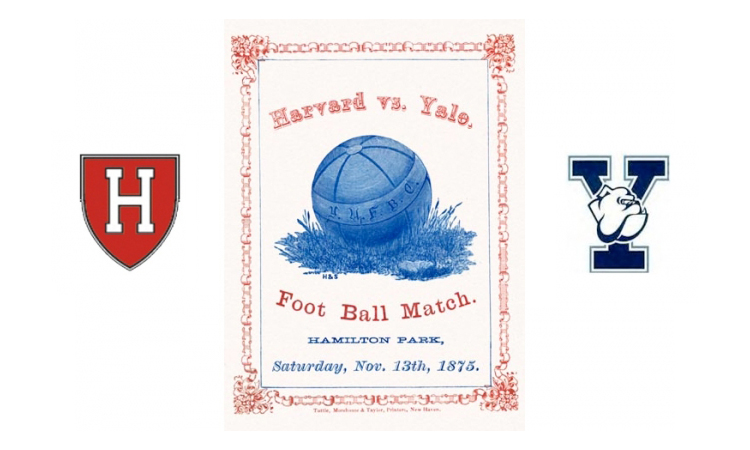
November 13, 1875: The 1st Harvard-Yale Game

November 13, 1875: Harvard University and Yale University, America's oldest and 3rd-oldest colleges, and both pioneers of college football, play each other in the sport for the 1st time. The game is played at Hamilton Park, a horse-racing track in New Haven, Connecticut, and, with one touchdown, under the scoring system of the time, Harvard won, 4-0.

The first American intercollegiate sporting event took place on August 3, 1852, after Yale invited Harvard to a race of crews. Harvard won "The Boat Race" on that 1st occasion. The first intercollegiate contests in ice hockey, soccer, and 5-on-5 basketball featured teams from Harvard and Yale.

Many now century-old, or older, aspects of American football were introduced by Harvard or Yale students or athletes. Yale introduced cheerleading at athletic events in 1890, and tailgate parties in 1905. Harvard introduced spring practice to collegiate football March 14, 1889.

Yalies sang "Hold the Fort" during the 1892 Harvard game, considered the first public performance of a collegiate "fight song." It predated "Boola Boola," in 1900, and what became their official fight song, "Bull Dog," written by Cole Porter when he was a senior at Yale in 1913.

In 1883, Harvard and Yale played each other at the Polo Grounds in New York, with Yale winning, 23-2. From 1891 to 1894, they played each other at Hampden Park in Springfield, Massachusetts. There was fan violence at the 1894 game, won by Yale, 12-4, leading to the schools taking the next 2 seasons off. They resumed in 1897, and have alternated between Boston and New Haven ever since.

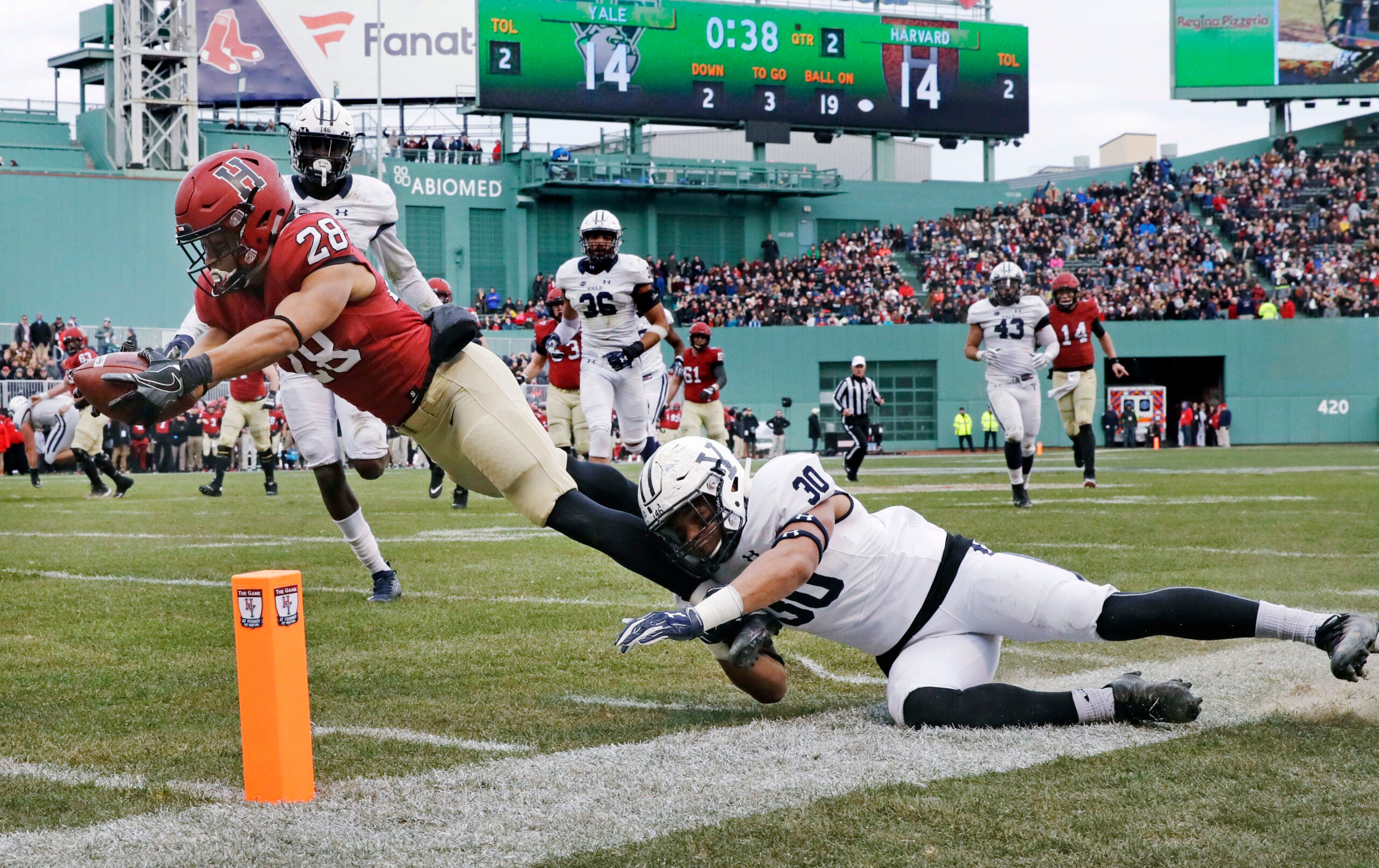
They took 1917 and 1918 off due to World War I; 1943, 1944 and 1945 due to World War II; and 2020, due to COVID. But, since WWII, they have played at Harvard Stadium (built in 1903) in even-numbered years, and the Yale Bowl (built in 1914) in odd-numbered years. An exception was made in 2018, when Harvard, having the choice of home field, talked Yale into playing at Fenway Park in Boston. Harvard won that one, 45-27, making it the highest-scoring contest in the history of "The Game."
November 17, 2018

Both teams went into the 1900 game undefeated, and Yale won, 28-0. The 1908 game saw both teams undefeated as well, and Harvard won, 4-0. In 1914, Harvard spoiled the opening of the Yale Bowl, winning 36-0.
The Yale Bowl, with the field marked for "The Game"

Before the opening kickoff of the 1923 game, Yale coach Dwight Jones told his undefeated Bulldogs, "Gentlemen, you are about to play Harvard. You will never do anything else so important for the rest of your lives."

They certainly wouldn't have done so under worse conditions: According to the era's greatest sportswriter, Grantland Rice, the field at Harvard Stadium was "a gridiron of seventeen lakes, five quagmires and a water hazard." Perhaps it was fitting that the key play, a return of a fumble 67 yards for a touchdown, was made by a man named Raymond Pond, known as Ducky. Yale won, 13-0. Pond later served as Yale's head coach, from 1934 to 1940.

In 1947, the only way for a Harvard football player to win his varsity letter was to play in the Yale game. Legend has it that, knowing this, Robert F. Kennedy played in the Harvard-Yale game on a broken leg. In 1955, his brother, Ted Kennedy, caught a touchdown pass against Yale. What the Kennedy legend doesn't say is that Bobby really played on "only" a sprained ankle, and that Yale won both of these games. (Ted was good enough to receive interest from the Green Bay Packers, but his father told him to go to law school instead.)
Harvard Stadium

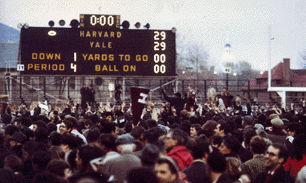
Both teams were undefeated going into the 1968 game at Harvard Stadium, making it the 1st Ivy League title decider between them. Yale led 29-13 with 42 seconds to go, but Harvard scored 2 touchdowns and 2 2-point conversions to tie the game, and split the honors. The Harvard Crimson newspaper had the headline: "HARVARD BEATS YALE, 29-29."
November 23, 1968

In 1982, students at the Massachusetts Institute of Technology, Harvard's Cambridge neighbors, pulled one of the great college football pranks, pushing a balloon with the letters "MIT" on it through the turf at Harvard Stadium. (Harvard won, 45-7.) Not to be outdone, a little over a year later, during the 1984 Rose Bowl, students at California Institute of Technology in Pasadena hacked into the Rose Bowl scoreboard, so that what should have read "UCLA 38" and "ILLINOIS 9" read "CALTECH 38" and "MIT 9." (UCLA ended up winning, 45-9.)
November 20, 1982

Going into the 2022 game, Yale leads the all-time series, with 69 wins to Harvard's 60, while there have been 8 ties. (UPDATE: Through the 2024 game, Yale leads, 71-61.)

*

November 13, 1875 was a Saturday. This was still early in the history of football, college or otherwise. Only 1 other game was played that day: Princeton (then still known as the College of New Jersey) beat Columbia, 6-2 at University Field in Princeton, New Jersey.

Wednesday, August 17, 2022

August 17, 1969: Jets vs. Giants, the 1st Time

August 17, 1969: The New York Jets and the New York Giants play each other for the 1st time.

It's an exhibition game, part of the merger process between the Giants' National Football League and the Jets' American Football League. It's played nearly 80 miles from Midtown Manhattan, at the Yale Bowl in New Haven, Connecticut, as the Albie Booth Memorial Game. Booth was a football and basketball star at Yale University, and died in 1959.

The Jets had won Super Bowl III, 7 months earlier, making them the World Champions of pro football, and stunning the NFL. But the Giants and their fans refused to accept them as champions. Why? “Giants fans still don’t feel we’re on a parity with their team and we feel we’ve got to prove it,” Jets linebacker Larry Grantham said, early in training camp in 1969. “A lot of people, NFL fans, still regard the Super Bowl as a fluke.” They bought into the propaganda that, if the Jets had played the Baltimore Colts 10 times, the Colts would have won 9? Apparently.

So the Jets realized that the only way to convince the New York media that they were the best team in the world was to prove they were the best team in New York. To make the point, Jet coach Weeb Ewbank appointed Grantham, Don Maynard and Bill Mathis, all original 1960 New York Titans who became Jets and had played through the entire history of the AFL, as team Captains for the day. Three Jet players had retired after the Super Bowl, and actually came out of retirement, just to play in this 1 game. 

John Mara, son of Giants owner Wellington Mara, and later the team's owner himself, was interviewed in 2019, for the 50th Anniversary of the game. He recalled: “Players were talking about this being the biggest game they had ever played in. The tension was unreal. The build-up to that game was unlike anything I had ever experienced, almost like a modern playoff game.”

As with the Woodstock festival, 131 miles to the west, traffic was an issue, jamming the Connecticut Turnpike and the Merritt Parkway, although, unlike the New York State Thruway, neither was closed, man. It was 86 degrees and muggy, but they managed to avoid the rain that drenched the festival. The crowd was 70,874, about evenly split between Big Blue and Gang Green, and there were fights in the already-old Ivy League football plant.

The Jets removed all doubts. Joe Namath, who was named Most Valuable Player of the Super Bowl despite not having an especially good game, was considerably better. He completed 16 of 18 passes, for 188 yards and 3 touchdowns, including 1 to Mathis.

John Mara was 14, and remembered, just before halftime, the Giants' Dave Lewis punting: “The one play I remember was Mike Battle returning a punt for a touchdown, and leaping over our punter. The rest I have managed to successfully block out.”

That made the score 24-0 Jets, and they cruised to win, 37-14. “Today, we proved we have the best team in New York, a team that can compete on any field with any team at any time,” Grantham said.

Wellington Mara fired head coach Allie Sherman, replaced him with former Giant running back Alex Webster, and he finished the 1969 season 6-8. The Jets went 10-4, won the AFL Western Division, and lost in the Divisional Playoffs.

The 1st regular-season game between the teams was played on November 1, 1970, at Shea Stadium. In a game with considerably less hype, even though it actually counted for something, the Giants won, 6-1.

As it turned out, between the Giants' moving around due to the renovation of Yankee Stadium, the Jets' injuries, and dumb management decisions by both teams, neither team made the Playoffs again until 1981.

*

August 17, 1969 was a Sunday. It was also the day the Woodstock festival ended, and the day that Hurricane Camille crashed into America's Gulf Coast. I have separate entries for those events. Also, basketball star Christian Laettner and New Kids On The Block singer turned actor Donnie Wahlberg were born on this day.

And these Major League Baseball games played:

* New York Yankees 5, Chicago White Sox 2 at Comiskey Park in Chicago. Jimmie Hall hit a home run for the Bronx Bombers. Stan Bahnsen started, and Mike Kekich won it in relief.

* Another doubleheader at Shea Stadium: The New York Mets beat the San Diego Padres 3-2 in each game. Duffy Dyer hit a home run in support of Jerry Koosman in the opener, and Ed Kranepool and Bud Harrelson each got 2 hits in support of Don Cardwell in the nightcap.

* Houston Astros 3, Philadelphia Phillies 2 at Connie Mack Stadium in Philadelphia.

* Minnesota Twins 4, Washington Senators 3 at Robert F. Kennedy Stadium in Washington. Tony Oliva's RBI single won it in the top of the 13th inning.

* Los Angeles Dodgers 9, Montreal Expos 3 at Jarry Park in Montreal.

* St. Louis Cardinals 5, Atlanta Braves 3 at Atlanta Stadium (later Atlanta-Fulton County Stadium). Hank Aaron, Bob Tillman and Rico Carty hit home runs for the Braves, but all were solo blasts, and Steve Carlton was the winning pitcher for the Cards, as Lou Brock went 2-for-5, and Joe Torre went 1-for-4 with an RBI.

* Pittsburgh Pirates 8, Cincinnati Reds 5 at Crosley Field in Cincinnati. Gene Alley, Al Oliver and Willie Stargell hit home runs. Roberto Clemente went 2-for-5. The Reds got homers from Pete Rose, Bobby Tolan, Johnny Bench and Tony Perez, but it wasn't enough.

* Boston Red Sox 1, Kansas City Royals 0 at Kansas City Municipal Stadium. Carl Yastrzemski went 0-for-4, but Vicente Romo, Sparky Lyle and Sonny Siebert combined for a 4-hit shutout.

* California Angels 7, Cleveland Indians 6 at Anaheim (now Angel) Stadium.

* Detroit Tigers 9, Oakland Athletics 4 at the Oakland Coliseum. Catfish Hunter was knocked out of the box in the 4th inning, as the Tigers got 2 homers from Al Kaline, and 1 each from Jim Northrup, Don Wert, former Yankee Tom Tresh and Mickey Stanley. Denny McLain went the distance, despite giving up a home run to Reggie Jackson.

* Doubleheader at Candlestick Park in San Francisco. 1st game: San Francisco Giants 5, Chicago Cubs 3. 2nd game, Cubs 3, Giants 1. Over the 2 games, Willie Mays went 2-for-4 with a home run and 3 RBIs. Ernie Banks only appeared in this game as a pinch-hitter, and did not reach base.

* Baltimore Orioles 4, Seattle Pilots 1 at Sick's Stadium in Seattle. Dave May (filling in at right field for Frank Robinson, who got the day off), Don Buford and Brooks Robinson homered for the O's, while Don Mincher hit one for the Pilots. Tom Phoebus won it, Fred Talbot lost it. Jim Bouton did not get into the game. A sweep for the Birds over the Pilots.

As Pilot manager Joe Schultz no doubt said, "Ah, shitfuck. Let's get 'em tomorrow, and then go pound some Budweiser." If Jim Bouton and his book Ball Four are to be believed, Joe Schultz would not have fit in well at Woodstock. 

December 31, 1999 & January 1, 2000: The Millennium

December 31, 1999:  The Millennium arrives. The people of planet Earth survived. At a terrible cost. But we hadn't destroyed ourselves. ...