Showing posts with label tv westerns. Show all posts

Friday, October 14, 2022

October 14, 1972: The "Kung Fu" TV Franchise Premieres

October 14, 1972: Kung Fu premieres on ABC, television's response to the movies' wave of "revisionist Westerns."

David Carradine plays the half-American-half-Chinese Kwai Chang Caine, wandering through America's "Wild West," battling anti-Asian bigotry and other issues that afflicted that place and that time -- and some that can afflict any place at any time.

In the pilot episode, Caine's beloved mentor and elder, the blind Master Po (played by veteran Chinese-American actor Keye Luke), is murdered by the nephew of the Emperor of China, with a firearm. Outraged, Caine retaliates by killing the nephew, with everyone unaware that the man was reloading his weapon to attack him again. With a price on his head, Caine flees China to the western United States, where he seeks his family roots, and ultimately, his half-brother, Danny Caine.

In the pilot episode, a telegram dated November 21, 1873 indicates that most of the episode's American story takes place before that. In a Season 3 episode, a recent tombstone has a death date of 1874.

Flashbacks often used to recall specific lessons from Caine's training as a child (Radames Pera, 12 years old when the show began) at the monastery from his teachers, Master Po and Master Chen Ming Kan (Philip Ahn). Po advises his young student, "Patience, Grasshopper," a name derived from a lesson he taught a young Caine about being aware of the world around him, including the grasshopper that happened to be at his feet at that moment.

During 4 episodes of Season 3, Caine finds his brother Danny (Tim McIntire) and his nephew Zeke (John Blyth Barrymore, grandson of John and half-brother of Drew). 

One way to tell the sequence of the episodes: Carradine started the series with a completely shaved head, and never cut his hair once through the 3 seasons.

Kung Fu and the films of Bruce Lee helped to make martial arts, and the movies based on them, enormously popular in America. There is some question as to whether Lee was robbed of the idea. He spoke in 1971 of having a similar concept, but having trouble pitching it to film studios. Carradine himself said that Lee was passed over for the role. However, a treatment for the series, without Lee's involvement, was dated 1969.

In 1986, Kung Fu: The Movie aired on CBS. Carradine returned as Caine, and met his previously unknown son, Chung Wang, played by Brandon Lee, the real-life son of Bruce. In 1987, CBS aired Kung Fu: The Next Generation, taking place in the present day, without Carradine's involvement. Brandon Lee played Johnny Caine, the great-great-grandson of Kwai Chang Caine.

A sequel series, Kung Fu: The Legend Continues, aired in syndication starting in 1993, and it ignored the events of Kung Fu: The Next Generation -- but not necessarily those of Kung Fu: The Movie. Carradine, then 56 years old, returned, as the grandson of the original Caine; and Chris Potter played his son, Peter Caine, a Los Angeles cop. (Despite the L.A. setting, the show was filmed by a Canadian production company, in Toronto, and a map of Southern Ontario can easily be seen at Peter's desk.) It lasted longer than the original, 4 years, and was only canceled because its production company went bankrupt.

In 2021, The CW began airing a new Kung Fu series, with a female protagonist, Olivia Liang as Nicky Shang, living in present-day San Francisco. Aside from the title and the basic idea, this show has nothing in common with either of the Carradine series, and there is no mention of the Caine family. Ed Spielman, co-creator of the original series, has been involved with the production of all 3 series. (UPDATE: That series lasted 3 seasons, the same as the original.)

Philip Ahn died in 1978, Tim McIntire in 1986, Keye Luke in 1991, Brandon Lee under tragic circumstances in 1993, and David Carradine under bizarre circumstances in 2009. As of October 14, 2022, John Blyth Barrymore and Chris Potter are still alive.

*

October 14, 1972 was a Saturday. Game 1 of the World Series was played. The Oakland Athletics beat the Cincinnati Reds, 3-2 at Riverfront Stadium in Cincinnati. Ken Holtzman outpitched Gary Nolan. A's catcher Gene Tenace hit home runs in his 1st 2 World Series at-bats.

Among the college football games played on this day were these:

* Number 1 University of Southern California beat the University of California, 42-14 at the Los Angeles Memorial Coliseum. USC won the Pacific-Eight Conference Championship, and accepted the accompanying bid to the Rose Bowl.

* Rivalry: Number 2 Oklahoma beat Number 10 Texas, 27-0 at the Cotton Bowl stadium in Dallas. It was the only game Texas lost all season, and they won the Southwest Conference Championship and the accompanying bid to the Cotton Bowl.

Oklahoma lost the next week, to Colorado, but still managed to win the Big Eight Conference Championship. Instead of accepting the accompanying bid to the Orange Bowl, they accepted an invitation from the Sugar Bowl. They faced Penn State, who had risen to Number 5, and beat them. But USC having already won the Rose Bowl earlier in the day, Oklahoma were frozen out of the National Championship.

* Number 3 Alabama beat Florida, 24-7 at Denny Stadium (now Bryant-Denny Stadium) in Tuscaloosa, Alabama. 'Bama went on to win the Southeastern Conference Championship, but instead of accepting the accompanying bid to the Sugar Bowl, they went to the Cotton Bowl instead, where they lost to Texas.

* Number 4 Ohio State beat Illinois, 26-7 at Ohio Stadium in Columbus. Ohio State went on to win the Big Ten Conference Championship, and the accompanying bid to the Rose Bowl. If they could beat USC, and Oklahoma were to lose the Sugar Bowl, Ohio State could have won the National Championship. But USC won the Rose Bowl, and the title.

* Rivalry: Number 5 Michigan beat Michigan State, 10-0 at Michigan Stadium in Ann Arbor. Michigan would rise to Number 3, before losing to Ohio State, blowing their chances at the Big Ten Conference and National Championships.

* Number 6 Nebraska beat Missouri, 62-0 at Memorial Stadium in Lincoln, Nebraska. Nebraska blew its shot at the Big 8 title by losing to Oklahoma. But when Oklahoma went to the Sugar Bowl, Nebraska were invited to the Orange Bowl.

* Number 7 Notre Dame beat the University of Pittsburgh, 42-16 at Notre Dame Stadium in South Bend, Indiana. As an independent, Notre Dame did not have a Conference Championship to win, and could accept a bid to any of the New Year's Day bowls except the Rose. They went to the Orange Bowl, where they lost to Nebraska.

* Number 8 Louisiana State University beat Number 9 Auburn, 35-7 at Tiger Stadium in Baton Rouge, Louisiana. LSU had a shot at the SEC title, but lost to Alabama, and ended up going to the Bluebonnet Bowl in Houston, where they lost to Tennessee, a fellow SEC team, but one they hadn't played in the regular season.

* Number 12 University of Washington were upset by Number 17 Stanford, 24-0 at the original Stanford Stadium outside San Francisco in Palo Alto, California.

* Number 13 Colorado beat Number 18 Iowa State, 34-22 at Folsom Field in Boulder, Colorado.

* Number 19 Oklahoma State were upset by Virginia Tech, 34-32 at Lane Stadium in Blacksburg, Virginia.

* Rivalry: Virginia beat Virginia Military Institute, 45-14 at Scott Stadium in Charlottesville.

* Rivalry: Wyoming beat Colorado State, 28-9 at Hughes Stadium in Fort Collins, Colorado.

* Among the service academies, Number 16 Air Force beat Boston College, 13-9 at Alumni Stadium just outside Boston in Chestnut Hill, Massachusetts; Army lost to Number 15 Penn State, 45-0 at Michie Stadium in West Point, New York; and Navy lost to Syracuse, 30-14 at Archbold Stadium in Syracuse, New York.

* And with New Jersey's teams, Rutgers beat Lafayette, 21-7 at Fisher Field (now Fisher Stadium) in Easton, Pennsylvania; and Princeton lost to Dartmouth, 35-14 at Memorial Stadium in Hanover, New Hampshire.

There were 6 games in the NBA:

* The New York Knicks beat the Los Angeles Lakers, 125-100 at Madison Square Garden.

* The Houston Rockets beat the Buffalo Braves, 121-113 at the Buffalo Memorial Auditorium. Fred Hilton scored 36 points in defeat for the Braves.

* The Boston Celtics beat the Chicago Bulls, 96-88 at the Chicago Stadium.

* The Kansas City-Omaha Kings beat the Detroit Pistons, 113-101 at the Kansas City Municipal Auditorium. Nate "Tiny" Archibald scored 38. This was the 1st game in Kansas City for the team that had been the Cincinnati Royals since 1957, after playing their "home opener" 3 nights earlier, at the Omaha Civic Auditorium. They played 15 games at Omaha in 1972-73, 15 more in 1973-74, and 11 in 1974-75, before switching to Kansas City-only for 1975-76, before moving to Sacramento in 1985.

* The Milwaukee Bucks beat the Golden State Warriors, 81-77 at the Oakland Coliseum Arena.

* And the Phoenix Suns beat the Portland Trail Blazers, 124-120 at the Portland Memorial Coliseum. Charlie Scott scored 38 for the Suns.

There were 5 games in the ABA:

* The New York Nets lost to the Carolina Cougars, 126-78 at the original Charlotte Coliseum.

* The Kentucky Colonels beat the Virginia Squires, 130-110 at Freedom Hall in Louiville, Kentucky.

* The Denver Rockets beat the Indiana Pacers, 96-90 at the Indiana State Fair Coliseum (now the Corteva Coliseum).

* The Utah Stars beat the Dallas Chaparrals, 106-90 at the Salt Palace in Salt Lake City, Utah.

* And the San Diego Conquistadors beat the Memphis Tams, 135-118 at the Peterson Gym on the campus of the University of San Diego. Larry Miller, Ollie Taylor and Jerry Chambers each scored 27 points for the Conquistadors. George Thompson scored 37 in defeat for the Tams.

All 16 NHL teams were in action:

* The New York Rangers lost to the Montreal Canadiens, 6-1 at the Montreal Forum.

* The New York Islanders lost to the Boston Bruins, 7-4 at the Nassau Coliseum. This was the 3rd game, all at home, for the expansion Isles.

* The Atlanta Flames and the Buffalo Sabres played to a tie, 1-1 at The Omni in Atlanta. This was the 1st home game for the expansion Flames, who played their 1st 4 games on the road. They moved to Calgary in 1980.

* The Toronto Maple Leafs beat the Los Angeles Kings, 6-4 at Maple Leaf Gardens in Toronto.

* The Pittsburgh Penguins beat the California Golden Seals, 5-2 at the Civic Arena in Pittsburgh.

* The Detroit Red Wings beat the Philadelphia Flyers, 5-0 at the Olympia Stadium in Detroit.

* The Minnesota North Stars and the Vancouver Canucks played to a tie, 3-3 at the Metropolitan Sports Center in the Minneapolis suburb of Bloomington, Minnesota.

* And the Chicago Black Hawks beat the St. Louis Blues, 4-2 at the St. Louis Arena. The Blues consider the Hawks their arch-rivals, but the Hawks consider theirs to be the Red Wings.

There were 2 games in the brand-new World Hockey Association. The New York Raiders beat the Ottawa Nationals, 8-6 at Madison Square Garden. And the Cleveland Crusaders beat the Alberta Oilers, 3-2 at the Cleveland Arena.

And in English soccer, Arsenal beat Suffolk team Ipswich Town, 1-0 at the Arsenal Stadium, a.k.a. Highbury, in North London.

Friday, September 30, 2022

September 30, 1958: "The Rifleman" Premieres

September 30, 1958: The Rifleman premieres on ABC. It is a Western, the most popular form of TV programming at the time.

Chuck Connors played Lucas McCain, a Lieutenant in the Union Army during the American Civil War. Having lost his wife Margaret to illness, in 1881, he buys a ranch about 3 miles outside the fictional town of North Folk, in the New Mexico Territory, where he raises his son, Mark, played by Johnny Crawford. (New Mexico gained Statehood in 1912.)

The opening theme at the beginning of each episode depicted McCain walking down the street of a town, while rapid-firing his Winchester 44-40 1892 model rifle that had been modified at the trigger and lever. (This makes the rifle an anachronism.) The rifle's modification allowed McCain to fire the rifle only by hand pumping the lever, which had a setscrew imbedded in it to trip the weapon's trigger.

McCain fires 12 shots from his rifle during the opening credits: 7 shots in the 1st close-up, and 5 more as the camera switches to another view. The blank cartridges are shorter than standard cartridges, so the magazine can hold more of the blanks. The soundtrack contained a dubbed 13th shot, to allow the firing to end with a section of the theme music.

The series ran for 5 seasons, had second chances as a common theme. Micah Torrance, the town Marshal, played by Paul Fix, was a recovering alcoholic. Some episodes saw the repairing of friendships broken by the Civil War.  

Like James Arness, the star of Gunsmoke, Connors was an imposing Western figure due to his height, in his case 6-foot-5. He played basketball at New Jersey's Seton Hall University, and 53 games for the Boston Celtics in 1946 and '47. He went on to play 1 baseball game for his hometown Brooklyn Dodgers in 1949, coming to bat once as a pinch-hitter, never playing the field for them. He then got traded to the Chicago Cubs, and played 66 games at 1st base for them in the 1951 season.

The Cubs' top farm team at the time was the Los Angeles Angels of the Pacific Coast League. While playing in L.A., this athlete found off-season work as a stuntman, and, like John Wayne, moved from stunts to acting, mostly in Westerns. After The Rifleman, he played Jason McCord, the lead in Branded. He died in 1992, at age 71. Johnny Crawford, who had been a Mouseketeer on The Mickey Mouse Club, became a singer and the leader of a retro swing band, and lived until 2021.

*

September 30, 1958 was a Tuesday. Baseball was between the end of its regular season and the start of the World Series. Football was in midweek. And the NBA and NHL seasons hadn't started yet. So there were no scores on this historic day.

Thursday, September 15, 2022

September 15, 1949: “The Lone Ranger” Comes to TV

Clayton Moore

September 15, 1949: The Lone Ranger debuts on ABC. It runs for 8 seasons, the last of which is in color. John Hart (1917-2009) played the Ranger in seasons 3 and 4, and played himself in costume in an episode of Happy Days. Clayton Moore (1914-1999) played him in the other seasons.

Harold Jay Smith (1912-1980), grandson of a Canadian Mohawk chief, who acted under the name Jay Silverheels, played Tonto. "Tonto" means "wild one" in the language of the Potawatomi tribe. But in Spanish, Portuguese and Italian, it means "stupid," so he became "Toro," or "bull," in versions for the countries of those languages.

Tonto called the Lone Ranger "Kemosabe," another Potawatomi word, derived from "gimoozaabi," which means "he/she looks out in secret." It has been occasionally translated as "trusty scout" or "faithful friend." The word was suggested by the characters' co-creator, James Jewell, whose father-in-law owned a summer camp with that name. The Ranger's horse was named Silver, and Tonto's was named Scout.

Jewell was a director at Detroit radio station WXYZ, on which the Lone Ranger debuted in 1933. The character was John Reid, the only survivor of 6 Texas Rangers who were ambushed. The leader was his brother, Dan Reid.

In 1936, WXYZ created another crimefighter, the Green Hornet, a.k.a. Britt Reid, the son of Dan, and the beneficiary of the silver mine that not only named his uncle's horse, but funded the Daily Sentinel newspaper that Britt ran. In the 1966 TV version, Britt was the grandson of the Lone Ranger's brother.

The disastrous 1981 movie The Legend of the Lone Ranger starred Klinton Spilsbury as the Ranger and Michael Horse as Tonto. The 2013 version had Armie Hammer as the Ranger and Johnny Depp as Tonto, proving 2 things: Disney should never reboot another classic character, and it was possible to make a character more of a racist stereotype in the 2010s than it was in the 1950s.

The TV show's theme song is the overture to Gioachino Rossini's 1829 opera William Tell. Comedian Orson Bean once said, "An intellectual is someone who can hear The William Tell Overture without thinking of the Lone Ranger." Ironically, there are no horses in the Rossini opera.

*

September 15, 1949 was a Thursday. There was only one score on this historic day, but it was a significant one in baseball: The Cleveland Indians beat the New York Yankees, 10-6 at Yankee Stadium. Bob Lemon outpitched former teammate Allie Reynolds. Larry Doby hit a home run for the Tribe, while Yogi Berra and Cliff Mapes hit them for the Yanks. Joe DiMaggio went 2-for-4 with an RBI.

The Yankees had led the American League for most of the way, but their many injuries were catching up with them. They would end up blowing a 12-game lead over the Boston Red Sox, and would have to sweep the Sox in the last 2 games of the regular season to win the Pennant. They did.

Wednesday, September 14, 2022

September 14, 1957: "Have Gun -- Will Travel" Premieres

Despite this color promotional photo,
every episode of the series was in black & white.

September 14, 1957: Have Gun -- Will Travel premieres on CBS. TV viewers may have been expecting just another Western. Instead, it was unlike anything seen on TV before.

Richard Boone, 40 years old at the time the show began, plays a man known only as Paladin, a name derived from the 12 knights of the court of Charlemagne in France, circa AD 800. Hence, the knight chesspiece on his gun holster, and on his business card.
The wording on the card meant that he, with his gun, would travel to wherever his would-be hirer wanted. But it led a lot of people to believe that "Wire Paladin" was his full, if odd, name. In fact, in those pre-telephone days, "wire" meant "send a telegraph message to." His real name was never divulged on screen. A novelization of the episode "Genesis," which served as his origin story, gives his name as Clay (probably short for "Clayton") Alexander, but since this name was never used on the TV show, it remains speculation.

Most TV Westerns don't give exact dates, and are generally set between 1865, the end of the American Civil War, and 1900, a convenient date for "the closing of the American frontier." Yet 2 episodes -- oddly, airing within a few weeks of each other -- give dates of 1875 and 1879.

Paladin operates out of a luxury suite at the Carlton Hotel in San Francisco, then the biggest and most sophisticated city in the American West. He is a rough and tough man, a deadly gunslinger, and a graduate of the U.S. Military Academy at West Point, New York, and thus, almost certainly, a Union officer in the American Civil War.

But he is also a very sophisticated man, wearing the finest suits available at the time when he's not on the job, capable of quoting Scripture, Shakespeare, ancient Greeks or Romans, well-known poets, or just about anybody else he wants before carrying a job out. This may be the result of a privileged and highly educated upbringing in Boston, as he mentions having spent time there, but that doesn't make Boston definitively his hometown.

Despite this refinement, he is a man of his time. He treats Native Americans and Chinese better than his contemporaries, but he still calls the only other regular character on the show, the Carlton's head bellhop, played by Kam Tong, "Hey Boy." He will defend a woman's life and her honor, but in one episode, he absolutely opposes women gaining the right to vote, which did not happen until 1920.

When he is on the job, Paladin dresses all in black, going against the stereotype: In Westerns, wearing black, especially a black hat, tended to indicate a villain. Paladin is unquestionably the hero of the series.

While he also carries a knife and a derringer pistol, his main weapon was a .45 caliber, 7½-inch barrel, Colt Single Action Army pistol, which he had customized with rifling for greater accuracy. In the show's first episode, he tells a would-be opponent, "I’d like you to take a look at this gun. The balance is excellent. This trigger responds to a pressure of one ounce. This gun was hand-crafted to my specifications, and I rarely draw it unless I intend to use it." In a later episode, he tells a prospective customer, "This gun is not always necessary, but it is indispensable."

It's not always necessary because, more often than not, Paladin tried to talk people into doing the right thing -- or, at least, out of doing the wrong thing. And if he could shoot without killing, he would. He didn't always have the option. He also frequently upbraided the people who put his targets into their position. He charged $1,000 a job -- with inflation, about $2,550 by 1957, and about $26,600 in 2022 -- but, if he thought the cause was just, he might do one for free.

The 1st 2 seasons began with a shot of him from the side, from the waist down, the white chess knight on the black holster. Without otherwise moving, he would draw the gun, point it at the camera, say a line that would be heard later in the show, and then re-holster it. The pilot episode began with the line mentioned above: "I'd like you to take a look at this gun... " From the 3rd season onward, he would be shown from the right side in full silhouette, then draw his gun, turn and crouch, but not fire, and then re-holster. This may have inspired the "gunbarrel sequence" that opens every James Bond film.

Have Gun -- Will Travel lasted 6 seasons, until 1963, and stood out from the programming of the time, which, while never crude like TV shows from the 1980s onward, tended not to go out of their way to appeal to the viewer's intellect.

Of the show's 225 episodes, 24 of them were written by Gene Roddenberry, who appreciated the thought that went into the Paladin character. He later pitched Star Trek as "Wagon Train to the Stars," and Paladin, while he did frequently get angry, and occasionally get wistful, was also something of a ladies' man, and can be seen as being an inspiration for Roddenberry to create both Captain Kirk and Mr. Spock.

Richard Boone was typecast as a Western actor, and never seemed right in films set in the present day. From 1972 to 1974, he played a retired sheriff in the Jack Webb-produced Western Hec Ramsey. He died of throat cancer in 1981. Kam Tong died in 1969, age 63.

There have been announced attempts at a revival series: With John Travolta in 1997, Eminem in 2006, and playwright David Mamet as showrunner in 2012. All fell through.

There is a Carlton Hotel in operation in San Francisco today. Whether it's in the same location as it would have been in Paladin's time, I don't know.

*

September 14, 1957 was a Saturday. Baseball All-Star Tim Wallach was born on this day.

There were 4 college football games played that day, none of them involving what were then considered major teams. The NFL, NBA and NHL seasons were yet to begin. These baseball games were played:

* The New York Yankees lost to the Chicago White Sox, 5-2 at Yankee Stadium. Dick Donovan went the distance for the win. Tom Sturdivant held the South Siders to a 2-2 tie after 7 innings, but Bob Grim gave up a home run to Jim Rivera in the 8th. Mickey Mantle went 0-for-3 with a walk.

* The New York Giants lost to the St. Louis Cardinals, 6-1 at Busch Stadium (formerly Sportsman's Park) in St. Louis. Willie Mays hit a home run. Stan Musial did not play. The Giants had already announced their move to San Francisco for the next season.

* The Brooklyn Dodgers beat the Milwaukee Braves, 7-1 at Milwaukee County Stadium. Gil Hodges hit a home run in support of Carl Erskine. Hank Aaron went 1-for-4. The Dodgers had not yet announced their move to Los Angeles for the next season, but it was already publicly considered a fait accompli.

* The Boston Red Sox beat the Cleveland Indians, 13-10 at Fenway Park in Boston. Ted Williams did not play for the Red Sox. Vic Wertz hit 2 home runs for the Indians.

* A doubleheader was split at Memorial Stadium in Baltimore. The Baltimore Orioles won the opener, 3-1. Brooks Robinson went 1-for-2 with a walk and an RBI. The Detroit Tigers won the nightcap, 4-3. Robinson only appeared in this game as a defensive replacement. Over the 2 games, Tiger star Al Kaline, playing in his hometown, went 2-for 7 with a walk.

* The Washington Senators beat the Kansas City Athletics, 3-2 at Griffith Stadium in Washington. Roy Sievers led off the bottom of the 10th inning with a game-winning home run.

* The Philadelphia Phillies beat the Cincinnati Redlegs, 5-0 at Crosley Field in Cincinnati. Robin Roberts allowed 8 hits, but kept the shutout. Frank Robinson went 1-for-3.

* A doubleheader was split at Wrigley Field in Chicago. The Pittsburgh Pirates beat the Chicago Cubs in the 1st game, 3-1. Roberto Clemente didn't play, and Ernie Banks went 1-for-2 with 2 walks. The Cubs won the 2nd game, 7-3. Banks hit 3 home runs, while Clemente only pinch-hit, not reaching base.

Monday, September 12, 2022

September 12, 1959: "Bonanza" Premieres

House Cartwright: Left to right: Pernell Roberts as Adam,
Michael Landon as Joe, Lorne Greene as Ben and Dan Blocker as Hoss

September 12, 1959: Bonanza premieres on NBC. For 20 years, CBS had Gunsmoke, a candidate for the title of the greatest Western show in TV history. For 14 years, NBC had Bonanza, the other candidate -- and, in my opinion, the better candidate.

The series is set in Virginia City, Nevada, which really was one of the leading cities in the American West in the 19th Century, though it didn't last long as such in the 20th Century. A tombstone showing a death date of 1868 in a 1967 episode shows that the series takes place 99 years in the past.

Lorne Greene plays Ben Cartwright, a former ship captain and Army scout who went west and made a fortune in silver mining -- the titular bonanza -- which he parlayed into the Ponderosa, a huge cattle ranch and logging operation on the shore of Lake Tahoe. This made him possibly the richest man in the Nevada Territory, and, eventually, within the show's continuity, one of the founding fathers of the State of Nevada.

He married 3 times, to 3 different women, who gave him 3 different sons, and all 3 marriages ended in tragedy. His 1st wife, Elizabeth Stoddard (Geraldine Brooks), was the daughter of a sea captain under whom young Ben served. Given the state of medicine at the time, giving birth to Adam was too much for her, and she died.

His 2nd wife, Inger Stevenson, was a Swedish shopkeeper (played by Swedish actress Inga Swenson), who followed Ben west, giving birth to Hoss in the middle of a wagon train's journey. She was killed in an Indian attack. His 3rd wife, Marie De Marigny (Felicia Farr), was a New Orleans belle with a checkered past. Ben met her on a visit to the Crescent City, they fell for each other, and he married her and took her west. Some time after giving birth to Joe, she fell from a horse and died.

The show has the best opening in the history of TV, and I will knock anyone who wants to try it off this hill. With a stirring theme song, it shows a map of the Ponderosa, with a fire burning through it, and then Ben and his 3 sons come charging across the prairie on their horses. Then each is shown in turn, although not always in the same order: Sometimes it's by age, sometimes in alphabetical order, sometimes no discernable order. The opening closes with showing one or two guest stars for that episode. (The song did have words, and a cast album was made, with Greene, an Ottawa native and once a radio announcer known as The Voice of Canada, singing it.)

The eldest son, Adam, was the smartest and the most sensible, but also a bit moody. He was the only one of the Cartwrights who was mentioned as having attended college, studying architecture and engineering "back east," and designed the house on the Ponderosa. (Greene liked the house's exterior and its studio set so much that he had an exact replica built on his own land.)

By 1964, his portrayer, Pernell Roberts, wanted out, and so he was written out, having been said to have gone to Australia to make his own fortune as a sheep rancher.

The middle son was born with the name Eric, but was given the nickname "Hoss," a Scandinavian term for, as Inger put it, "a big, friendly fellow." And he was big: His portrayer, Dan Blocker, was 6-foot-4 and 320 pounds. Hoss wasn't very smart, and some men took advantage of his gullibility. But he was kindhearted, and usually figured out what the right thing to do was.

The youngest son was Joseph, and since he was so much younger and, at least at first, smaller than his brothers, especially Hoss, he was nicknamed Little Joe. Michael Landon played him, and he inherited his mother's Southern, Louisiana, New Orleans tempestuous nature.

In one early episode, taking place on the eve of the American Civil War, Joe took the secessionist side, and Adam, born in New England, took the Union side. Hoss, born in the Midwest, tried to make peace between them, and it didn't work. They came to blows, but Ben separated them before there could be a winner, and said, "Brother against brother? How dare you? Both of you?"

Ben, always called "Pa" by his sons, was strict. He frequently had to tell his sons, especially Joe, "Take your feet off the table." On the Ponderosa, and on missions like cattle drives and posses, his word was law. Still, he was a believer in American democracy, to the point that -- unusual for TV shows of that period, but then, this wasn't taking place in the present day, making it easier for the censors -- he stood up for black people, Mexicans, Asians and Native Americans. (The fact that a Native's arrow had killed his 2nd wife didn't matter: He built friendships with some nearby tribesmen.)

Despite already having white hair, Greene was just 44 years old when the show began. Roberts and Blocker were 31, too old to play his sons. Landon was almost 23, young enough to be Ben's son, but too old to be a teenager. By the time the show ended, Landon was 36, and already writing and directing episodes of the show.

Adam was effectively replaced by Candy Canaday, played by David Canary, a ranch hand who rose to the rank of Ben's foreman. Ben Johnson, noted for his Western roles, joined the cast as ranch hand Bronc Evans. By 1970, in order to keep the attention of younger viewers, who could no longer take Landon seriously as the youngest son, 14-year-old Mitch Vogel was brought in to play Jamie Hunter, an orphan that Ben soon adopts. The character, who predated The Brady Bunch's Cousin Oliver by 4 years, never caught on.

(Ironically, when Battlestar Galactica, in which Greene later starred, was canceled by ABC, it was brought back as Galactica 1980, and the child genius character of Dr. Zee was played in the pilot by Robbie Rist, who had played Cousin Oliver. After the pilot, he was replaced by a British actor named Patrick Stuart. Not "Stewart.")

The show kept going and going. But on May 13, 1972, after the end of the 13th season, Blocker died from complications from gallbladder surgery. He was only 43 years old. When the 14th season began, it was mentioned, without specifics, that Hoss had died -- the 1st time in TV history that this had been said onscreen.

Another acknowledgement of this was an episode in which Joe marries a woman named Alice Harper, but she is murdered shortly thereafter. At the end of the episode, Joe stands over her grave, and says, "I love you." This wasn't just Joe saying it to Alice: It was also Landon saying it to Blocker.

This gave rise to the impression that, every time one of the Cartwright sons got married, the bride soon died. In fact, Joe was the only one ever shown to get married. This impression may have been confused by the fact that all of Ben's wives had died young, thus making the next wife possible. But although Ben did date after the show's opening, he never remarried.

But without Hoss, the show just wasn't the same, and the last episode aired on January 16, 1973. Just 20 months later, Landon began starring on Little House on the Prairie, also on NBC, also in the Wild West period, but not nearly as far west: The prairie was in Minnesota. He played Charles Ingalls, father of Laura Ingalls Wilder, on whose books the show was based. At long last, Landon was the one being called "Pa."

For a time, a Bonanza theme park opened outside the real Virginia City, but, as memories of the show at its peak (from the 1959 pilot until Roberts' 1965 departure) faded, the park lost money, and closed. This was also the case with the Bonanza and Ponderosa chains of casual-dining steakhouses, in which Blocker was an early investor.

NBC would produce sequel movies, after Greene died in 1987 and Landon followed in 1991. Taking place in 1905 and shortly thereafter, Michael Landon Jr. directed and starred as "Benj" Cartwright, the son of Little Joe and his 2nd wife, who was apparently also dead. Emily Warfield played Joe's sister, Sara. Alistair MacDougal, an Australian actor, played Adam's Australian-born son, Adam Cartwright Jr., a.k.a. A.C.

Brian Leckner, who bore a bit of resemblance to Blocker, played Joshua Overton, the son that Hoss never knew he had. Thereafter, the character was called Josh Cartwright. Dirk Blocker, Dan's son and (naturally) an even closer lookalike, appeared, but not as a Cartwright: He played Walter Fenster, a newspaper reporter. Ben Johnson returned as Bronc, now the ranch foreman, along with Shaft actor Richard Roundtree as his assistant, Jacob Briscoe.

The fates of the original Cartwrights were revealed: Hoss died in 1872, drowning while saving another man from the that fate, having no idea that his romance on a recent visit to St. Louis had produced a son; Little Joe, who would have been in his 50s at the time, died riding up San Juan Hill with Theodore Roosevelt in 1898; Ben died of old age the next year; and Adam was still alive and ranching in Australia, matching the fact that Roberts was the only one of the original four then still alive. Having gone on to star in Trapper John, M.D. from 1979 to 1986, Roberts died in 2010.

*

September 12, 1959 was a Saturday. It was the opening week of the college football season -- sort of. Only 2 games were played that day, both in a minor conference -- appropriately, out west. New Mexico State beat Northern Arizona, 35-0 at Aggie Memorial Stadium in Las Cruces, New Mexico. And North Dakota beat Montana, 27-19 at Dornblaser Field in Missoula, Montana.

These baseball games were played that day:

* The New York Yankees lost to the Detroit Tigers, 4-0 at Yankee Stadium. Don Mossi pitched a 4-hit shutout to beat Whitey Ford. Al Kaline went 2-for-3 with 2 walks. Mickey Mantle went 0-for-4, and Yogi Berra did not play.

* The Boston Red Sox beat the Kansas City Athletics, 4-3 at Fenway Park in Boston. Ted Williams did not play. Roger Maris appeared as a pinch-hitter for the A's, but did not reach base.

* The Chicago White Sox beat the Baltimore Orioles, 6-1 at Memorial Stadium in Baltimore. Brooks Robinson went 0-for-3 and was hit by a pitch.

* The Cleveland Indians beat the Washington Senators, 7-2 at Griffith Stadium in Washington.

* The St. Louis Cardinals beat their arch-rivals, the Chicago Cubs, 6-4 at Wrigley Field in Chicago. Bob Gibson got the win. Ken Boyer hit a home run. Stan Musial did not play. Walt "Moose" Moryn hit a home run for the Cubs, but Ernie Banks did not play.

* The Milwaukee Braves beat the Cincinnati Reds, 4-3 at Milwaukee County Stadium. Eddie Mathews hit a home run, and Hank Aaron went 2-for-4 with 2 RBIs. Frank Robinson went 0-for-4.

* The San Francisco Giants beat the Philadelphia Phillies, 9-1 at Seals Stadium in San Francisco. Orlando Cepeda hit a home run, and Willie Mays went 2-for-3 with 2 walks and 2 RBIs.

* Despite it being a Saturday, with a doubleheader between them at the Los Angeles Coliseum the day before and another game the following day, the Pittsburgh Pirates and the Los Angeles Dodgers were not scheduled for this day.

Also, in English soccer, Arsenal beat Manchester City, 3-1 at Highbury in North London.

Saturday, September 10, 2022

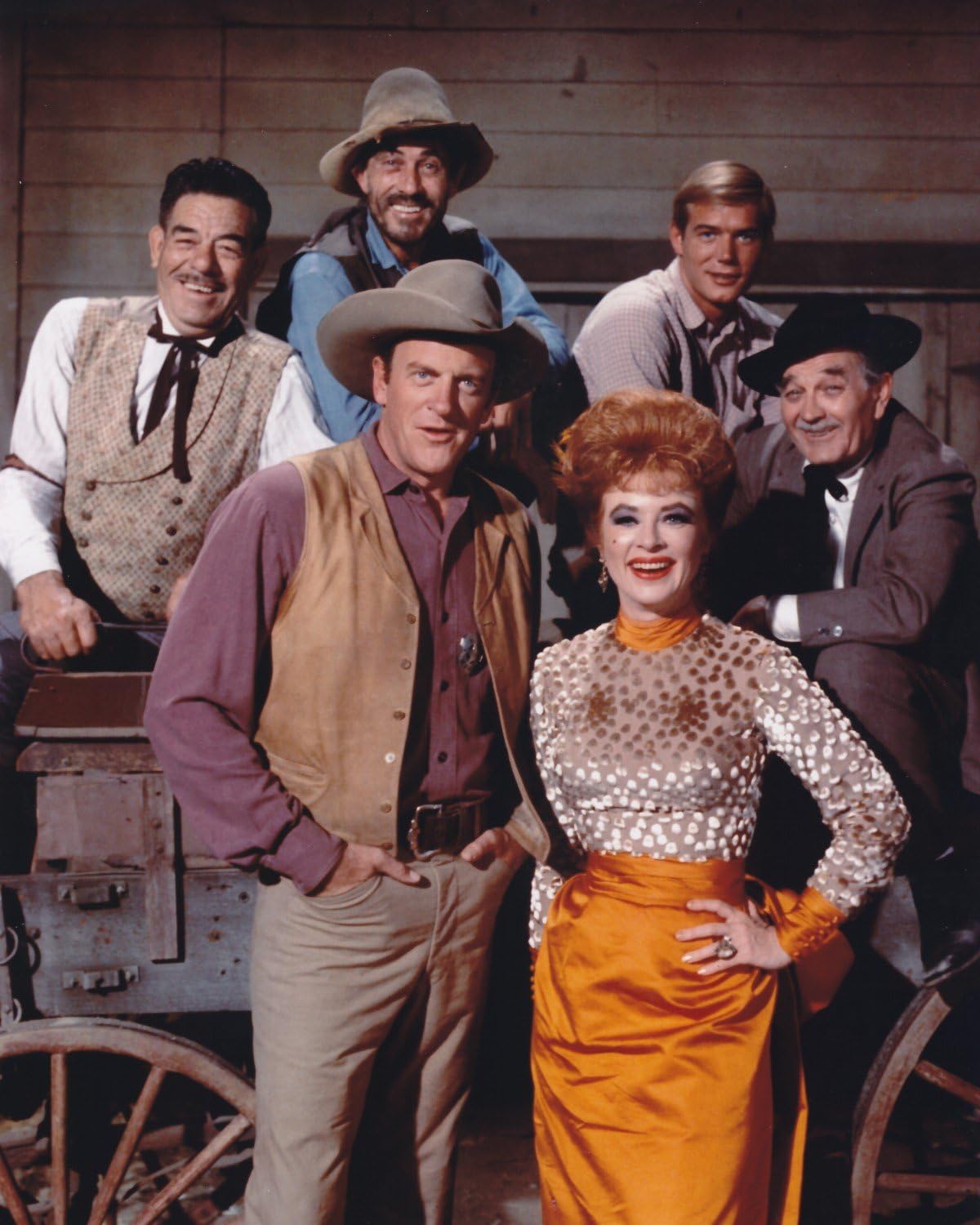
September 10, 1955: "Gunsmoke" Premieres

Back, left to right: Glenn Strange, Ken Curtis, Buck Taylor and Milburn Stone.
Front: James Arness and Amanda Blake.

September 10, 1955: Gunsmoke premieres. Outlasting every other classic TV Western, it becomes the longest-running fiction show in CBS' history.

It began as a radio show, with William Conrad -- later to star in Cannon, Nero Wolfe and Jake & the Fatman -- as Matt Dillon, U.S. Marshal for Dodge City, Kansas in the 1870s. (The city was, and remains, real; the character was fictional.) But he was too fat to play the character on TV. So was Raymond Burr, who was also considered, and ended up starring for 9 seasons as the titular lawyer on Perry Mason, and 8 seasons as the titular police commissioner on Ironside.

James Arness, 6-foot-7, solidly built, and looking like someone no desperado would want to mess with, played Dillon on TV for 20 years. Over that time, many men did mess with Dillon: He was shot at 56 times, knocked unconscious 29 times, stabbed 3 times, and poisoned once -- but survived, every time.

The show also starred Amanda Blake as Kathleen Russell, a.k.a. "Miss Kitty," proprietor of the Long Branch Saloon. For those of you who criticize modern entertainment as "woke," know this: No guns were allowed inside the Long Branch. If you wanted to get in, you had to turn your guns over at the door. It was the law. Matt and Kitty were big believers in gun control, "pardner."

But it was more than that: The Saloon was also real, and had that exact rule. As it turned out, the real Dodge City never had more than 2 murders a year. In this way, the "Wild West" was not as wild as we've been led to believe.

Matt and Kitty were clearly fond of each other, but they were never shown getting romantic with each other, and never got married. From the 1950s onward, fans of the show, including those of us who only know it in reruns, have been sure they were fooling around with each other, but this has never been canon.

Dillon had 2 other close allies. Milburn Stone, an actual Kansas native, played Galen Adams, the town doctor, always addressed as "Doc." And Dennis Weaver played Chester B. Goode, who walked with a limp and always said, "Yes, sir, Mr. Dillon!" (Chuck Berry's character Johnny B. Goode was almost certainly named after him.) Chester was never an official Deputy Sheriff, but helped Dillon out as if he were. Weaver left the show in 1964, and was replaced by Ken Curtis as Festus Haggen, a character that debuted 2 years earlier, and did eventually become an official Deputy.

Burt Rumsey played Sam Noonan, the bartender at the Long Branch, until 1959, when Glenn Strange took over the role. From 1962 to 1965, a young Burt Reynolds played a blacksmith named Quint Asper. From 1967 onward, Buck Taylor played Newly Smith, a gunsmith who becomes a Deputy Marshal.

Glenn Strange died in 1973, while the show was still on the air, but he was already 74 years old. As had happened with many other CBS shows in the 1970s, Gunsmoke was canceled without warning, in 1975. The cast learned about it in the trade papers, not through face-to-face meetings, phone calls, or even mail. The last episode aired on March 31, 13 days after M*A*S*H killed off Henry Blake, also on CBS. Milburn Stone died in 1980.

In 1987, CBS aired a reunion movie, Gunsmoke: Return to Dodge, with James Arness, Amanda Blake and Buck Taylor reprising their roles. Ken Curtis thought the network was lowballing him on pay for it, and refused to participate. Dennis Weaver also did not appear. No mention was made of the characters of Doc, Chester, Festus or Sam.

Amanda Blake died in 1989, and did not appear in the next reunion movie, the following year: Gunsmoke: The Last Apache. There would be 3 more made-for-TV movies, with Arness the only main character returning: Gunsmoke: To the Last Man, in 1992; Gunsmoke: The Long Ride, in 1993; and Gunsmoke: One Man's Justice, in 1994.

Dennis Weaver, who went on to star in McCloud, died in 2006; Arness, in 2011; and Burt Reynolds, in 2018. Taylor is the only one of these castmembers mentioned who is still alive as of September 10, 2022, age 84.

Arness' younger brother was Peter Graves, who was 6-foot-4, took his mother's family name so he wouldn't be seen as riding his brother's success, and went on to star on Mission: Impossible as IMF team leader Jim Phelps. (The family name is "Aurness.") In spite of their long and successful careers, the brothers never acted together.

I'd like to believe that Jim Phelps is Marshal Dillon's great-grandson. It would make sense, since Dillon and Phelps were both government agents. But that relationship is not canon, either. 

*

September 10, 1955 was a Saturday. These baseball games were played that day:

* The New York Yankees lost to the Chicago White Sox, 9-8 at Yankee Stadium. Bob Kennedy went 4-for-5 with a home run and 4 RBIs. Elston Howard hit a home run for the Yankees, while Mickey Mantle went 1-for-5, and Yogi Berra went 2-for-3.

* The New York Giants lost to the Cincinnati Redlegs, 4-3 at Crosley Field in Cincinnati. (From 1954 to 1958, the Reds bowed to the stupidity of Red-baiting, and called themselves the Redlegs.) Willie Mays went 0-for-4.

* The Brooklyn Dodgers and the Chicago Cubs got rained out after 6 innings, with the game tied 3-3 at Wrigley Field. Jackie Robinson went 0-for-3. Ernie Banks went 2-for-3 with an RBI.

* The Cleveland Indians beat the Boston Red Sox, 10-7 at Fenway Park in Boston. Ralph Kiner, playing out the string with the Indians, hit the 369th home run of his career. It turned out to be his last. I remember watching a Mets broadcast, and a player (I don't remember who) hit his 1st major league home run, and Tim McCarver, broadcasting with Kiner, said he didn't remember his first: "You'd think I would, since I didn't hit that many!" Kiner said, "I remember my first. I don't remember my last, because, at the time, I didn't think it would be my last!"

Norm Zauchin hit one for the Red Sox, while Ted Williams went 3-for-5 with an RBI.

* The Baltimore Orioles beat the Detroit Tigers, 5-3 at Memorial Stadium in Baltimore. Al Kaline went 1-for-4. Brooks Robinson, then a rookie, did not play for the Orioles.

* The Kansas City Athletics beat the Washington Senators, 8-6 at Griffith Stadium in Washington.

* The Milwaukee Braves beat the Pittsburgh Pirates, 13-5 at Milwaukee County Stadium. Eddie Mathews hit 2 home runs. Hank Aaron went 2-for-4. Roberto Clemente, then a rookie, went 1-for-4 with an RBI.

* And the St. Louis Cardinals beat the Philadelphia Phillies, 4-3 at Busch Stadium (formerly Sportsman's Park) in St. Louis, in a game shortened to 6 innings due to rain. Stan Musial went 1-for-2 with 2 RBIs. Tom Poholsky outpitched Robin Roberts.

Although it was a Saturday, there were no college football games that year until the following weekend. In English soccer, there was a North London Derby, and Tottenham Hotspur, playing at home at White Hart Lane, beat Arsenal, 3-1.

December 31, 1999 & January 1, 2000: The Millennium

December 31, 1999:  The Millennium arrives. The people of planet Earth survived. At a terrible cost. But we hadn't destroyed ourselves. ...