Showing posts with label 1911. Show all posts

Tuesday, December 13, 2022

December 14, 1911: Roald Amundsen Reaches the South Pole

December 14, 1911: Roald Amundsen becomes the 1st person to reach the South Pole. 

It made sense for a Norwegian to attempt to become the 1st person to reach the North Pole, 90 degrees North latitude: The only countries whose mainlands have points further north than Norway's northernmost point are Canada and Russia. This does not count Denmark, which owns Greenland, which has a more northerly point of land than any country: Kaffeklubben Island, at 83.63 degrees North.

It made sense for Amundsen to be the Norwegian to attempt it. In 1906, aboard the sloop Gjøa, he became the leader of the first expedition to sail the long-sought Northwest Passage. He did make an attempt to reach the North Pole, but in 1909, American expeditioner Robert Peary claimed to have gotten there first. Maybe Peary should have kept trying: It is now believed that he did not, in fact, beat Amundsen and everyone else to it.

It did not make much sense for a Norwegian to be the first person to attempt to reach the South Pole, 90 degrees South latitude. The country with the southernmost land is Chile, Hornos Island, at 55.97 degrees South latitude; followed by Argentina and Australia. (Villa Las Estrellas, on King George Island, is the northernmost point on Antarctica, at 62.11 degrees South.) Since Australia was part of the British Empire, a Royal Navy officer, Captain Robert F. Scott, made the first serious attempt at it.

But since Amundsen did have experience in a polar expedition, he thought he could reach the South Pole first. On June 3, 1910, he sailed his ship Fram out of his national capital of Oslo. Upon reaching the Portuguese colony of Madeira, he sportingly sent Scott a telegram stating his intentions. On January 14, 1911, he reached the continent of Antarctica, on the Ross Ice Shelf, and established base camp there.

An attempt set out on September 8, but had to turn back. A 2nd attempt was made on October 19, with 4 sleds, each pulled by 13 dogs. On December 8, they reached 88 degrees, 23 minutes south, the furthest point anyone had yet reached, in 1909 by Ernest Shackleton. They were 97 miles away. They went on.

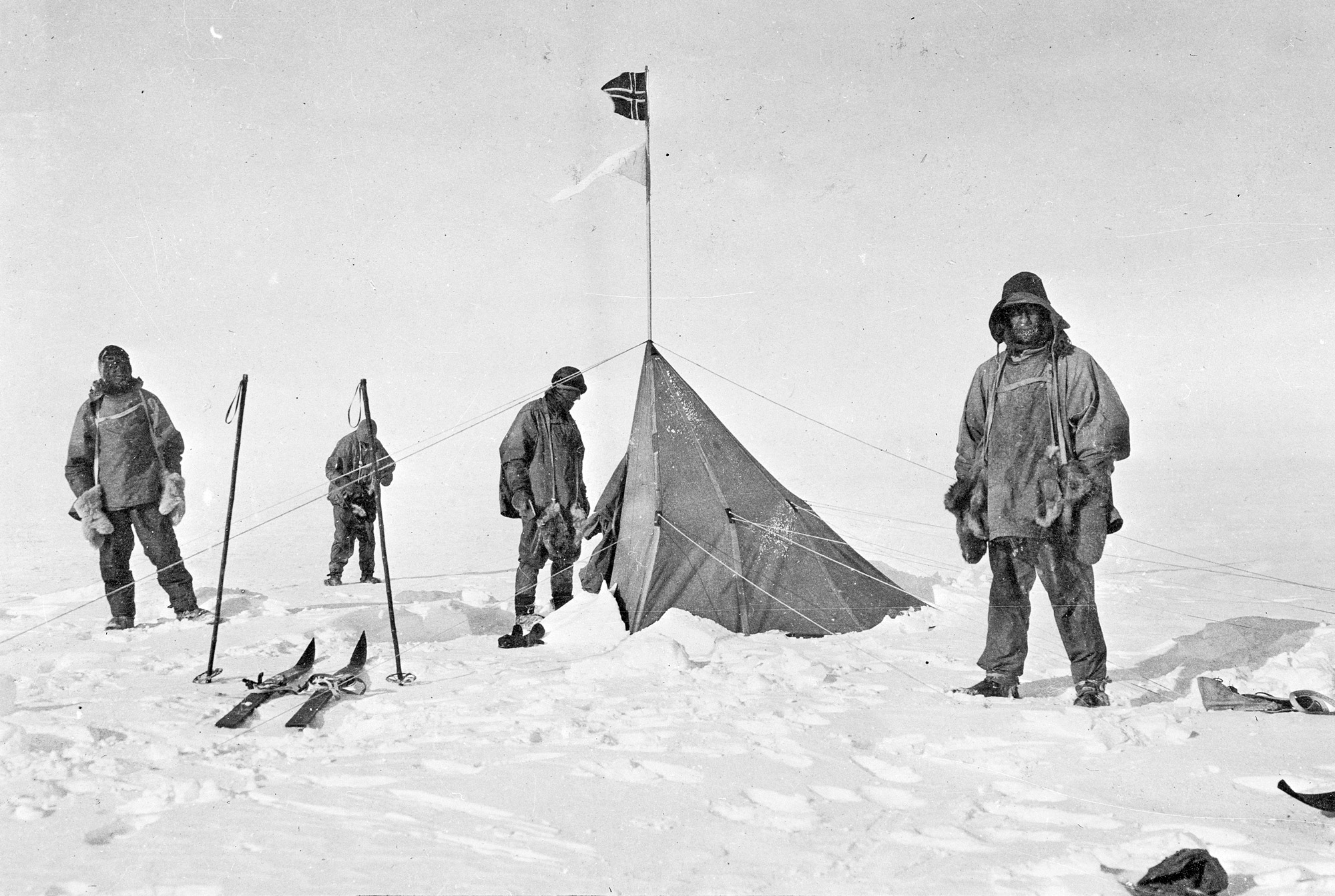
On December 14, 1911, Amundsen stopped, took some measurements, and told his crew, "Gentlemen, I am certain we are at the South Pole." He asked crewmates to take their own measurements, and a central point within them was decided as the Pole. They pitched a tent, topped with a Norwegian flag. Amundsen wrote a message for Scott, in case he made it, and left it inside the tent.
On March 7, 1912, the Fram reached Hobart, Tasmania, Australia. Amundsen made his claim, and learned that no word had yet been reached from Scott. Scott had reached the Pole on January 17, but found Amundsen's tent and note. Scott never made it back alive: Snowstorms prevented him from getting back to his base camp. A search party found him on November 12, with a last entry in his diary dated March 29. He was 43 years old.
Robert F. Scott

Scott was hailed as a hero in death. Amundsen lived on, and on May 12, 1926, led a team on the airship Norge to become the 1st people to fly over the North Pole. On June 18, 1928, he led a team searching the Arctic for the lost airship Italia. His plane, a Latham 47 "flying boat," also disappeared, and has never been found. He was 56.

*

December 14, 1911 was a Thursday. American novelty musician Lindley "Spike" Jones was born on this day. Baseball was out of season. Football season was over. There was no NBA yet. And the professional hockey season was about to start. So there were no scores on this historic day.

Friday, November 4, 2022

November 5, 1911: America's 1st Transcontinental Flight

November 5, 1911: The 1st airplane flight across America is completed. It is not as well remembered as the aerial achievements of Charles Lindbergh and Amelia Earhart, mainly because most people weren't yet used to hearing about aerial achievements, and it took so long to do. It didn't help that the man who did it didn't have long to brag about it. But it hadn't been done before, and deserves mention.

And his name sounds a bit hoity-toity: Calbraith Perry Rodgers. He might have been better remembered as "Cal Rodgers," just as Lindbergh was well-remembered due to the nickname "Lucky Lindy." And he was born rich, preventing the advantage of a poor-boy-makes-good story.

Born in Pittsburgh in 1879, he was a grandson of Oliver Hazard Perry, the hero of the War of 1812's Battle of Lake Erie; and a great-grandnephew of Matthew Calbraith Perry, whose naval expedition of 1853 opened Japan to the Western world.

He went deaf as a boy, keeping him out of the family business, the U.S. Navy. Nevertheless, his family's wealth meant that he could pursue his interests without having to work for a living. In August 1911, he became a licensed pilot, and became one of the earliest civilians to purchase an airplane. He entered the Chicago International Aviation Meet, and won $11,285.

As with Lindbergh, he achieved his big moment with the goal of winning prize money. In 1910, William Randolph Hearst offered the Hearst Prize to the 1st pilot to fly coast to coast, in either direction, in less than 30 days, requiring a stop in Chicago. The prize was $50,000 -- about $1.54 million in 2022 money. Rodgers talked Chicago meatpacking mogul J. Ogden Armour to sponsor it, and named the plane, a Wright Model EX, after Armour's grape soft drink: The Vin Fiz Flyer

On September 17, 1911, at 4:30 PM Eastern Time, he took off from Sheepshead Bay Race Track in Brooklyn. He made the required stop in Chicago on October 8, attracting national attention. To avoid the Rocky Mountains, he took a southerly route, flying through the Midwest until reaching Texas. He turned west after passing San Antonio. 

Although the plan called for a large number of stops along the way, there turned out to be 75 of them, including 16 crashes, and Rodgers was injured several times. His team of mechanics rebuilt the Vin Fiz Flyer when necessary, and only a few pieces of the original plane actually made the entire trip.
The Vin Fiz Flyer

On November 5, at 4:04 PM Pacific Time, a crowd of 20,000 people saw him land at Tournament Park in Pasadena, outside Los Angeles. He had flown a single plane from New York City to California without getting himself (or anyone else) killed, which had never been done before. But he had missed the prize deadline by 19 days, and Hearst refused to pay. Hearst never awarded the prize.

On April 3, 1912, while making an exhibition flight in a Wright Model B, over Long Beach, California, Rodgers flew into a flock of birds, causing the plane to crash into the ocean. His neck was broken and his thorax damaged by the engine of the airplane. He died within minutes. He was 33 years old, and left behind a wife, but no children.

In 1925, his cousin, John Rodgers, set a record for the longest nonstop flight be seaplane, 1,992 miles, trying to fly from San Francisco to Honolulu. He and his crew ran out of fuel, and had to turn a wing of their plane into a sail to get to the nearest Hawaiian Island, before they were rescued. He was killed in a crash in Philadelphia the next year.

The version of the Vin Fiz Flyer that completed the flight is now on display at the Smithsonian Institution's National Air and Space Museum, on the National Mall in Washington, D.C.

*

November 5, 1911 was a Sunday. Baseball season was over. Professional basketball and hockey barely existed. There was professional football, but it was still very minor-league at this point. So there were no scores on this historic day. 

Sunday, October 16, 2022

October 17, 1911: The Origin of Home Run Baker

October 17, 1911: John Franklin Baker of the Philadelphia Athletics becomes the only man in baseball history to receive "Home Run" as a nickname.

The A's had played the New York Giants in the 1905 World Series, and lost. Now, they were playing each other again, alternating home field: The Polo Grounds in New York, rebuilt in the Spring after a fire, for the odd-numbered games; and Shibe Park in Philadelphia, later to be renamed Connie Mack Stadium for the A's manager, for the even-numbered games.

Remembering that the Giants had beaten the A's in 5 games in 1905 while wearing all-black uniforms, Giant manager John McGraw chose to wear them again, hoping it would be good luck. The smartest, most scientific manager of the era -- mainly because he was one of the few scientific managers the game had yet seen -- was not generally superstitious, but he was also not one to take any chances.

The Giants won Game 1 at home, 2-1, with the Giants' ace, Christy Mathewson, who went 26-13 that season, outpitching the A's Albert "Chief" Bender, 17-5. This was the height of immigration to America, and when opposing fans would make "Indian war whoops" at Bender, he, a Native American from the Chippewa tribe, would yell, "You lousy foreigners! Go back where you came from!"

The A's won Game 2, 3-1. It was another battle of future Hall-of-Famers, as Eddie Plank, who went 23-8 that season, beat Richard "Rube" Marquard, who went 24-7. In the next day's paper, in a nationally-syndicated column "ghost-written" for him by an unknown sportswriter, Mathewson criticized Marquard's pitching, especially to Frank Baker, the A's 3rd baseman, who hit a home run in the game.

Was such criticism really Mathewson's intention? He probably shouldn't have arranged for the column in the first place, but it's understandable that he did it, given how much baseball team owners paid their players before free agency. Even Mathewson, the most popular player in the game and the best pitcher the sport had yet seen, was underpaid.

Mathewson took the mound for Game 3, against Jack Coombs, who went 28-12 that season. Matty took a 1-0 lead into the top of the 9th. With 1 out‚ he faced Baker. One of the earliest pitchers to throw the screwball, or the "fadeaway" as he called it, he threw it to Baker. Baker lined it over the right field fence to tie the game. This was the Dead Ball Era, so hitting home runs in back-to-back World Series games -- especially against a pair of pitchers like Marquard, then Mathewson, was a very big deal.

The game goes to extra innings. Errors by Giant 3rd baseman Buck Herzog and shortstop Art Fletcher give the A's 2 unearned runs in the top of the 11th. New York scores once‚ but the A's win 3-2.

And in the next day's paper, in "his own" column, Marquard chided Mathewson for the way he pitched to Baker. Quickly, Frank receives the nickname "Home Run" Baker.

Like I said, it was the Dead Ball Era. He only hit 96 home runs in his entire 13-season career, although he did have a .307 lifetime batting average and a very strong 135 OPS+, is regarded as one of the best 3rd basemen of the 1st half of the 20th Century, and is in the Hall of Fame. He, shortstop Jack Barry, 2nd baseman Eddie Collins (who would also make the Hall of Fame) and 1st baseman John "Stuffy" McInnis became known as the $100,000 Infield.

But the World Series, already later in the calendar year than any had yet been played (at least, in the current version that began in 1903), was not over -- and wouldn't be for a while. The Northeast got drenched by day after day of rain. It would not resume until October 24, in Philly. The A's won, 4-2, with Bender beating Mathewson.

Game 5 in New York had a controversial ending. It was 3-3 in the bottom of the 10th when Larry Doyle scored on a sacrifice fly. Or did he? Home plate umpire Bill Klem later said that Doyle didn't touch home plate when he slid in. But the A's did not appeal the play, and so Klem had to let the run, and the Giants' 4-3 win, stand.

The A's won Game 6, 13-2, to take the Series. They got 4 runs in the 4th inning, and 7 in the 7th, more than enough support for Bender. It was the 2nd straight World Championship for the A's. It turned out to be the 1st of 3 straight World Series losses for the Giants.

Baker would help the A's win the Series again in 1913, but they would lose it in 1914. Mack and team owners Tom and Jack Shibe began to break the team up, due to the salary war with the Federal League. Refusing to take a pay cut, Baker sat out the entire 1915 season, and the A's crashed to last place. (So an A's fire sale was not an Oakland invention of Billy Beane -- or Charlie Finley.)

Mack sold him to the New York Yankees, as Jacob Ruppert began to build a dynasty. He sat out the entire 1920 season, as his wife and his twin daughters died from scarlet fever. Grief and mental health were an issue back then as well. He returned, helped the Yankees win their 1st 2 Pennants in 1921 and 1922, and retired to the farm on which he was born in Trappe, on Maryland's Eastern Shore.

He remarried, but had no other children. In 1924, in nearby Easton, he intervened to save a black man from being lynched. He later ran Trappe's bank and served on its town council, was elected to the Hall of Fame in 1955, and appeared at Old-Timers' Day at Yankee Stadium that year, as part of a celebration of Hall-of-Famers. He died in 1963, at the age of 77.

In 1978, the Philadelphia Phillies founded the Philadelphia Baseball Wall of Fame. Each year until 2003, they elected one Athletics figure, starting with Connie Mack. Also elected from their 1910-14 dynasty were Baker, 2nd baseman Eddie Collins, outfielder Rube Oldring; and pitchers Eddie Plank, Chief Bender and Jack Coombs. Mack, Baker, Plank, Bender, Eddie Collins and Herb Pennock have also been elected to the Philadelphia Sports Hall of Fame.

*

October 17, 1911 was a Tuesday. Football was in midweek, and basketball and hockey barely existed at the professional level. So there were no other scores on this historic day.

Friday, October 7, 2022

October 7, 1911: The Story of Victory Faust

October 7, 1911: With just 1‚000 fans on hand at the Polo Grounds‚ and with the Pennant already clinched, Giant manager John McGraw finally listens to the appeals of Charles Victor "Victory" Faust, who'd told McGraw that a fortune teller in his home town of Marion, Kansas had told him that if he pitched for the Giants, they'd win the Pennant.

Faust was kept on the roster all season, as a good-luck charm. Now, 2 days short of his 31st birthday, he is sent to the mound in the 9th inning against the Boston Rustlers (named for their new owner, William H. Russell)‚ allowing a hit and a run in a 5-2 loss. Faust also hits‚ circling the bases for a score as the Rustlers, who are in on the joke, deliberately throw wildly.

Faust will reprise his act on October 12, in the regular season finale against Brooklyn: He allows a hit in his 1 inning; is hit by a pitch and then steals 2nd base and 3rd base‚ and scores on a grounder. In both cases, it was the 9th inning of games that the Giants were already losing.

On November 21, 1911, William H. Russell died. The team was purchased by James Gaffney, an officer in New York's Tammany Hall political organization. These officers are known as "Braves," and the team was renamed the Boston Braves.

The team carries the name to this day, although they are now in Atlanta. Braves Field is built in 1915, and one of the bordering streets is still named Gaffney Street. Boston University's Nickerson Field complex was built on the site, with the right-field pavilion of Braves Field still standing as the home stand. An NFL team named the Boston Braves will also play there, changing its name, to avoid confusion, to the Redskins. They will move to Washington in 1937. They became the Washington Commanders in 2022.

As for Charlie Faust, you may be thinking that he's the Rudy Roettiger of baseball. No, he wasn't: Rudy, at least, was good at football in high school. Faust was nothing but a joke. The laughter stopped: McGraw and Giants owner John T. Brush did not invite him to spring training in 1912, and his baseball career was over.

He told anyone who would listen that it wasn't, and in 1913, he was committed to a psychiatric hospital in Oregon, and then to another in Steilacoom, Washington, where he died of tuberculosis in 1915.

*

October 7, 1911 was a Saturday. These other baseball games were played that day:

* The Boston Red Sox beat the Washington Senators, 8-1 at the Huntington Avenue Grounds in Boston. Tris Speaker had to leave the game early due to an injury. The Red Sox moved into Fenway Park the next season.

* The Pittsburgh Pirates beat the Chicago Cubs, 5-0 at the West Side Grounds in Chicago. Honus Wagner goes 1-for-4.

* A doubleheader was split at Comiskey Park in Chicago. The Cleveland Naps won the 1st game over the Chicago White Sox, 4-3. George Kahler outpitched Ed Walsh, who was 27-18 on the season. The White Sox won the 2nd game, 4-1. Napoleon "Nap" Lajoie, the great 2nd baseman, great hitter, and not-so-great manager for whom the Indians-and-Guardians-to-be were named, went 1-for-8. Shoeless Joe Jackson went 3-for-4 with an RBI in the 1st game, and didn't play in the 2nd game.

* The Detroit Tigers beat the St. Louis Browns, 1-0 at Sportsman's Park in St. Louis. Ralph Works pitched a 3-hit shutout. Ty Cobb did not play.

* The St. Louis Cardinals were supposed to play the Cincinnati Reds at the Palace of the Fans in Cincinnati, but were rained out. It was made up as part of a doubleheader on October 9, since Sunday baseball was still illegal in Ohio. The Reds won the opener. The Cards won the nightcap. The score of each game was 6-2. The Reds would then demolish the fancy Palace of the Fans, and build Crosley Field on the site.

* The Brooklyn Dodgers and the Philadelphia Phillies were not scheduled to play.

* And the New York Highlanders, who became the Yankees in 1913, and the Philadelphia Athletics, had finished their season.

And there were college football games played, including these:

* Army beat Vermont, 12-0 on The Plain in West Point, New York.

* Harvard beat Holy Cross, 8-0 at Harvard Stadium in Boston.

* Princeton beat Villanova, 31-0 at Osborne Field in Princeton, New Jersey.

* Rutgers beat Haverford, 10-6 at Neilson Field in New Brunswick, New Jersey.

* Michigan beat Case, later Case Western Reserve, 24-0 at Ferry Field in Ann Arbor, Michigan.

* The University of Chicago beat Indiana, 23-6 at Marshall Field in Chicago.

* Vanderbilt, again the best team in the Southeast -- this was a long time ago -- beat Maryville College, 46-0 at Dudley Field in Nashville.

Thursday, October 6, 2022

October 6, 1911: Cy Young's Last Game

October 6, 1911: The New York Giants beat the Philadelphia Phillies, 10-5 at the Polo Grounds, and clinch the National League Pennant. They will play the other Philadelphia team, the Athletics, in the World Series.

Also on this day, Cy Young appears in his last major league game, starting for the Boston Rustlers (forerunners of the Braves, then named for their owner, William H. Russell). It doesn't go so well. The Brooklyn Dodgers win, 13-3, at Washington Park in Brooklyn. The old Cyclone, age 44, goes 6 1/3rd innings, giving up 11 hits. Here are the results of his last 8 at-bats: Triple, 4 straight singles, 3 straight doubles.

Young then retired, with all-time records for wins (511), losses (316), appearances by a pitcher (906), innings pitched (7,356), batters faced (29,565), starts (815), complete games (749), hits allowed (7,092), runs allowed (3,167), earned runs allowed (2,147 -- meaning, in those days of inadequate gloves, he allowed 1,020 unearned runs), and strikeouts (2,803). His records for appearances, runs (but not earned runs) and strikeouts have been broken. The rest still stand, 111 years later.

His ERA+ was 138, and his WHIP was 1.130, so he wasn't just lasting a long time amassing some big stats, an accusation that has been leveled against more recent pitchers like Nolan Ryan, Gaylord Perry and Don Sutton: He was great even by the standards of his own time.

Five hundred and eleven wins. The next-closest pitcher is Walter Johnson, with 417 -- 94 fewer. The winningest living pitcher is Greg Maddux with 355. Through the 2022 regular season, the winningest active pitcher is Justin Verlander with 235. So unless there's a change in baseball as radical as that of the Dead Ball Era to the Lively Ball Era in 1920, Young's 511 wins, and his other still-standing records, are as safe as records can be.

Young, who lived until 1955, age 87, was interviewed in 1945 by Chicago Daily News sports editor John P. Carmichael for his anthology My Greatest Day In Baseball. Young's choice was his 1904 perfect game for the Boston Americans (Red Sox). He added, "In my last game, I was beaten 1-0 by a kid named Grover Cleveland Alexander." He was a little off: On September 7, 1911, he did lose 1-0 to Alexander, then a 24-year-old rookie, but he made 6 more appearances.

*

October 6, 1911 was a Friday. Also on this day, Wilfrid Laurier left the Prime Minister's office in Canada, after 15 years, his Liberal Party having lost an election to Robert Borden and his Conservative Party. The 1st French-Canadian to serve as Prime Minister, and considered one of the country's greatest, he is on the Canadian $5.00 bill.

These other baseball games were played that day:

* The Boston-Brooklyn game was the 2nd game of a doubleheader. The 1st game was a 1-0 Rustlers/Braves win. Ed Donnelly pitched a 6-hit shutout.

* The Giants' Pennant-clincher was also part of a doubleheader, the 1st game. The Giants also won the 2nd game, 5-4.

* The New York Highlanders lost to the Philadelphia Athletics, 5-4 at Shibe Park in Philadelphia. The Highlanders officially became the Yankees, in 1913, after they had been unofficially called that for a while.

* The Boston Red Sox beat the Washington Senators, 3-1 at at the Huntington Avenue Grounds in Boston. The next year, the Red Sox moved into Fenway Park.

* The St. Louis Browns beat the Detroit Tigers, 11-5 at Sportsman's Park in St. Louis. Ty Cobb did not play for the Tigers in this game.

* The Cleveland Indians were supposed to play the Chicago White Sox at Comiskey Park in Chicago, but were rained out. They will play a doubleheader the next day.

* The Chicago Cubs, the Cincinnati Reds, the Pittsburgh Pirates and the St. Louis Cardinals were not scheduled to play.

Sunday, July 24, 2022

July 24, 1911: The Addie Joss Benefit Game

July 24, 1911: A benefit game is played at League Park in Cleveland, for the family of Addie Joss.

Adrian Joss was born on April 12, 1880 outside Milwaukee in Woodland, Wisconsin. Known as the Human Hairpin for his slender build and his tight pitching motion, he pitched for the Cleveland Naps from 1902 to 1910, going 160-97.

The Cleveland Whats? Napoleon Lajoie, one of the greatest all-around players of the era, a member of the 3,000 Hits Club and a great fielder, too, was the Cleveland team's 2nd baseman and manager. Starting as the Cleveland Blues in 1901, and the Cleveland Bronchos in 1902, they were renamed the Cleveland Naps in his honor in 1903. He left after the 1914 season, and they were renamed the Indians, which they would remain until becoming the Cleveland Guardians in 2022.

Addie Joss' career WHIP -- walks plus his, divided by innings pitches -- of 0.968 is the lowest ever, and his ERA of 1.89 is the 2nd-lowest. The lowest ERA belongs to Ed Walsh of the Chicago White Sox, at 1.82. And his WHIP, exactly 1.000, is 2nd all-time to Joss. In the 1900s (the 1900-09 decade), Joss and Walsh were the 2 best pitchers in the American League.

On October 2, 1908, they opposed each other as their teams and the Detroit Tigers all went down to the wire for the AL Pennant. Walsh struck out 15 batters, and AL record that stood for 30 years. But Joss pitched a perfect game, and the Naps won, 1-0. It remains the greatest pitching duel in AL history, but it ended up not mattering, as the Tigers won the Pennant, by half a game over the Naps and one and a half over the ChiSox.

Joss led the major leagues in wins in 1907, and led the major leagues in ERA in 1904 and 1908. On April 20, 1910, he pitched a no-hitter against the White Sox, making him the 1st pitcher to pitch no-hitters against the same team twice. Only one pitcher since has matched that: Tim Lincecum of the San Francisco Giants, against the San Diego Padres in 2013 and 2014.
Addie Joss

Joss died of meningitis on April 14, 1911, the eve of what would have been his 10th in the major leagues. He was only 31. Upon hearing of his death, the Cleveland Press newspaper wrote "every train brings flowers" and "floral tributes by the wagonload are hourly arriving at the Joss home from all sections of the country." Billy Sunday, then America's foremost evangelist, had been a major league pitcher from 1883 to 1890, mostly with the team now known as the Chicago Cubs, and accepted the Joss' family's request to preside over Addie's funeral.

A benefit "all-star" game for Joss's family was scheduled by the Naps for July 24, 1911. They invited players from the other 7 AL teams to play against them. Jimmy McAleer would manage the All-Stars against Lajoie. At the time, he was the manager of the Washington Senators. He had been the Cleveland team's 1st manager in 1901, and had played for their previous National League team, the Cleveland Spiders. He said, "The memory of Addie Joss is sacred to everyone with whom he ever came in contact. The man never wore a uniform who was a greater credit to the sport than he."

Cy Young, who had also played for the Spiders, was in his last season in the major leagues, and started for the Naps, pitching the 1st 3 innings. (He would be traded later in the season, to the Boston team that became known as the Braves, and end his career there.) Lajoie played in the game, but went 0-for-2. "Shoeless" Joe Jackson, in his 1st big season in the majors, also went 0-for-2. From the other 7 teams:

* From the Boston Red Sox: Pitcher "Smoky" Joe Wood (who started, and pitched the 1st 2 innings), center fielder Tris Speaker (who would be traded to Cleveland in 1916 and lead them to the 1920 World Series).

* From the Detroit Tigers: Right fielder Ty Cobb (who forgot his Tigers uniform, so he wore a Cleveland road uniform during the game), and left fielder Sam Crawford.

* From the New York Highlanders: 1st baseman Hal Chase, and pitcher Russ Ford, who pitched the last 4 innings.

* From the Philadelphia Athletics: 2nd baseman Eddie Collins, 3rd baseman Frank Baker (who would become known as "Home Run Baker" for his heroics in that year's World Series), and catcher Patrick "Paddy" Livingston.

* From the St. Louis Browns: Shortstop Bobby Wallace.

* From the Washington Senators: Pitcher Walter Johnson (who told the press, "I'll do anything they want for Addie Joss' family"), and pitched the 3rd, 4th and 5th innings; catcher Gabby Street and center field Clyde Milan.

* Only the Chicago White Sox did not send a representative. Ed Walsh had volunteered to play, but the team's travel schedule simply didn't allow it.

The game was attended by approximately 15,270 fans, and raised nearly $13,000 (about $40,000 in 2022 money) to help Joss' family members pay remaining medical bills. The All-Stars beat the Naps, 5–3. No home runs were hit.

Baseball would not have an official All-Star Game until 1933, when a team of AL stars beat a team of NL stars at Comiskey Park in Chicago, making the All-Star Game an annual event. Oddly, in 1920, when Ray Chapman, shortstop for the team by then known as the Cleveland Indians, became the only player ever to die as a result of an in-game incident, there was no benefit game for his family.

In 1978, the Baseball Hall of Fame gave Joss a special waiver on the rule that says players must have played at least 1 game in at least 10 different seasons to qualify for election, since he would have pitched in 1 such game had he been stricken just 1 week later. He was soon elected. It was deserved.

*

July 24, 1911 was a Monday. One reason why this date was chosen for the game is that only 3 games were scheduled. All were in the National League:

* The New York Giants beat the Cincinnati Reds, 8-3 at the Palace of the Fans in Cincinnati. Rube Marquard went the distance for the win.

* The Brooklyn Dodgers lost to the Pittsburgh Pirates, 8-2 at Forbes Field in Pittsburgh. Honus Wagner went 0-for-3, but did draw a walk.

* And the St. Louis Cardinals beat the Philadelphia Phillies, 10-2 at Baker Bowl in Philadelphia.  

Tuesday, June 28, 2022

June 28, 1911: The Polo Grounds Opens

June 28, 1911: The most familiar version of the Polo Grounds opens.

"Most familiar version"? Let me explain.

In 1880, the New York Metropolitans began playing baseball at a polo field owned by James Gordon Bennett Jr., publisher of the New York Herald, between 110th and 112th Street, and 5th and 6th Avenue. Since baseball fields, like English soccer fields, were usually called "grounds" in those days, it became known as the Polo Grounds.

In 1882, the Metropolitans -- yes, they were called the Mets for short -- joined the American Association. In 1883, the Troy Haymakers of the National League left the Albany area for Manhattan, moved into the Polo Grounds, and became the New York Gothams. In 1886, following a big win, manager Jim Mutrie was overheard calling them "my big boys, my Giants." And they were the New York Giants thereafter.

The Metropolitans won the AA Pennant in 1884, and the Giants won the NL Pennant in 1888. In 1883 and again in 1887, Harvard and Yale played each other in football on Thanksgiving Day at the original Polo Grounds.

In 1886, tired of groundsharing, the Metropolitans and moved to the St. George Cricket Grounds on Staten Island, which, in today's terms, was roughly in the parking lot between the St. George Ferry Terminal and Richmond County Bank Ballpark, where the Staten Island Yankees played. But after the 1887 season, financial concerns led to their demise.

In 1889, New York City -- then consisting of Manhattan Island and part of what is now The Bronx -- decided to extend its 1811 street grid, and chose to extend West 111th Street through the Polo Grounds. The Giants had to get out. They closed that season out at the St. George Cricket Grounds, and won the Pennant again.

Then they moved Uptown, to a new stadium that they called the Polo Grounds, at the terminus of the Ninth Avenue Elevated line, at 155th Street and 8th Avenue, at the foot of Coogan's Bluff.

But this was 1890, and the Players' League challenged the established leagues. They established a team they called the New York Giants, and built a new, better ballpark right next-door, which they named Brotherhood Field. That league folded after just 1 season, and the NL Giants moved in. The 1890 NL ballpark was renamed Manhattan Field, and Brotherhood Field became the Polo Grounds.

At this Polo Grounds, the Giants hired John McGraw as manager, traded for pitching icon Christy Mathewson, won the NL Pennant in 1904, won the Pennant and the World Series in 1905, and blew the 1908 Pennant on Fred Merkle's "Boner" and the subsequent replay against the Chicago Cubs.

This ballpark burned down on April 14, 1911, at the dawn of a new season. As a friendly gesture, the American League's New York Highlanders offered the Giants the use of their home field, Hilltop Park, while the Polo Grounds was rebuilt in fireproof concrete and steel.

On June 28, 1911, the Polo Grounds as most of the world would know it opened. The Giants faced the Boston Rustlers, and won, 3-0. Naturally, Mathewson started, and while he allowed 9 hits, he didn't walk anybody, and kept the shutout. A home run was hit by "Laughing Larry" Doyle, a man who once said, "It's great to be young and a Giant." With a little bit of irony, the home plate umpire was Hank O'Day, the former pitcher whose call overturned the Giants' win in the "Merkle's Boner" game 3 years earlier.

(The Rustlers were named for their owner, William H. Russell, who died right after that season ended. They were bought by James Gaffney, who held the rank of "Brave" in New York's Tammany Hall "political machine," and the team's name was changed to the Boston Braves.)

The Giants won the Pennant in 1911, but lost the World Series to the Philadelphia Athletics. They won the Pennant again in 1912, but lost the World Series to the Boston Red Sox. They won the Pennant again in 1913, but lost another World Series to the A's. That's 3 straight World Series lost. The only other team ever to do that has been the 1907-08-09 Detroit Tigers. The Giants won another Pennant in 1917, but lost the World Series to the Chicago White Sox.

In 1913, noting that the Highlanders, who had just officially changed their name to what people were already calling them, the Yankees, had their 10-year lease at Hilltop Park ended, the Giants offered them a 10-year lease at the Polo Grounds, as a way of thanking them for the use of Hilltop in 1911.

But in 1920, the Yankees signed Babe Ruth, and started bringing a lot more fans into the Polo Grounds than the Giants. The Giants said that, when the lease was up after the 1922 season, there would be no new lease. McGraw said, "The Yankees will have to move to Queens, or some other faraway place, to wither and die." Little did he know that, one day, the New York team in the National League would move from the Polo Grounds to play in Queens, and, usually, not well.

To make matters worse for the Yankees, they won their 1st Pennant in 1921, and again in 1922, but lost the World Series to the Giants both times. The Giants remained the greatest franchise in baseball.

But Jacob Ruppert, the owner of the Yankees, was just fine with leaving the Polo Grounds. He wanted a ballpark he could control. And, despite McGraw and Giants owner Charles Stoneham using their political connections to try to prevent them from getting land for a ballpark, Ruppert got it, and built Yankee Stadium right across the Harlem River from the Polo Grounds, at 161st Street and River Avenue in The Bronx. It dwarfed the Polo Grounds. Stoneham expanded the Polo Grounds to 55,987 seats, and it was still over 11,000 seats smaller.

That Autumn, the Polo Grounds hosted the Heavyweight Championship fight in which challenger Luis Firpo knocked Jack Dempsey out of the ring, but Dempsey got back in before the count of 10, and knocked Firpo out. And it hosted another World Series. This time, the Yankees beat the Giants.

In 1924, the Giants won another Pennant, but lost the World Series to the Washington Senators. Later that year, the football team at the U.S. Military Academy in West Point, New York hosted the University of Notre Dame, and Notre Dame won. Nationally-syndicated sportswriter Grantland Rice covered the game, and named Notre Dame's backfield "The Four Horsemen," after the Biblical riders of the Apocalypse.

In 1925, a football team named the New York Giants began playing at the Polo Grounds. They won the NFL Championship in 1927, won the NFL Championship Game there in 1934 and 1938, and lost it there in 1944. They moved to Yankee Stadium in 1956.

The Polo Grounds hosted the Army-Navy game 9 times: 1913, 1915, 1916, 1919, 1920, 1921, 1923, 1925 and 1927. In 1924, it hosted the game where Notre Dame beat Army, leading the country's leading sportswriter, Grantland Rice, to write a column calling Notre Dame's backfield "The Four Horsemen," comparing them to characters in the Bible's book of Revelation.

On May 1, 1926, a team of American Soccer League all-stars beat the all-Jewish Austrian team Hakoah Wien, 3-0, in front of 46,000 fans. It would remain the largest crowd to attend a soccer game on American soil until 1977.

The baseball Giants won the 1933 World Series, beating the Senators, but lost to the Yankees in the World Series in 1936 and 1937. This team featured slugging right fielder Mel Ott and the great pitcher "King Carl" Hubbell. In 1951, they came from 13 1/2 games behind their arch-rivals, the Brooklyn Dodgers, to win the Pennant in a Playoff game, on what we would now call a walkoff home run by Bobby Thomson. But they lost the World Series to the Yankees.

In 1954, they won the Pennant again, led by Willie Mays, who won the NL batting title. Game 1 of the World Series against the Cleveland Indians featured Mays making a catch that has gone down as the most famous defensive play in the history of sports, and a walkoff home run in the 10th inning by Dusty Rhodes. The Giants swept the Series.

But the stadium and its surrounding neighborhood had begun to fall apart. The Giants left for San Francisco after the 1957 season. Their last game was as 9-1 loss to the Pittsburgh Pirates on September 29.

In 1960, the American Football League was founded, and the New York Titans began play at the Polo Grounds. They would become the Jets in 1963. Also in 1960, the stadium hosted one last title fight, with Floyd Patterson regaining the Heavyweight Championship from Ingemar Johansson.

In 1962, a National League expansion team was placed in the Polo Grounds, the New York Mets. They played 2 terrible seasons there before moving into Shea Stadium in Flushing Meadow, Queens. The Jets joined them. The Mets played the last baseball game at the Polo Grounds on September 18, 1963, losing 5-1 to the Philadelphia Phillies. The last event was the Jets' game on December 14, 1963, a 19-10 loss to the Buffalo Bills.

On April 11, 1964, just 6 days before Shea Stadium opened, the Kratter Company, the same company that had demolished the Dodgers' home, Ebbets Field, 4 years earlier, used the same wrecking ball, painted to look like a baseball, to demolish the Polo Grounds. In 1968, Polo Grounds Towers opened on the site. It includes a playground known as Willie Mays Field. Across 155th Street is Rucker Park, one of New York's most famous basketball sites.

*

June 28, 1911 was a Wednesday. In professional terms, football, basketball and hockey barely existed, and were out of season, anyway. These were the other games played in Major League Baseball that day:

* The Brooklyn Dodgers beat the Philadelphia Phillies, 2-1 at Baker Bowl in Philadelphia.

* A doubleheader was split at Griffith Stadium in Washington, which had also just reopened after a fire at the previous ballpark on the site. The Washington Senators won the opener, 4-3. The Philadelphia Athletics won the nightcap, 16-9.

* The Cincinnati Reds played the Pittsburgh Pirates at Forbes Field in Pittsburgh. They were tied 3-3 after 9 innings, when the game was called due to darkness.

* The Cleveland Naps swept a doubleheader from the Chicago White Sox at League Park in Cleveland, winning the 1st game 6-4, and the 2nd game 6-3. The home team was named for their 2nd baseman and manager, Napoleon "Nap" Lajoie. After he left in 1914, they were renamed the Cleveland Indians, and they became the Cleveland Guardians in 2022.

* The Detroit Tigers beat the St. Louis Browns, 3-2 at Bennett Park in Detroit. At the end of that season, Bennett Park was torn down, and a new ballpark was built on the site. It was named Navin Field. In 1938, it was expanded, and renamed Briggs Stadium. In 1961, it was renamed Tiger Stadium.

* The St. Louis Cardinals beat the Chicago Cubs, 7-1 at Robison Field in St. Louis.

* And the New York Highlanders and the Boston Red Sox were supposed to play each other at Fenway Park in Boston, but got rained out. The game was made up the next day, as part of a doubleheader. The Y ankees-to-be won the 1st game 3-1, and the Red Sox won the 2nd game 3-2.

Monday, May 30, 2022

May 30, 1911: The 1st Indianapolis 500

May 30, 1911: The 1st Indianapolis 500-Mile Race is held. It is won by Ray Harroun, a 32-year-old Pennsylvanian.

(I had resisted adding auto racing events to this feature, because I don't like the event, and consider it to not be a sport. I finally changed my mind, given how many people are interested.)

The Indianapolis Motor Speedway was built in 1909, about 6 miles west of downtown Indianapolis, by Carl G. Fisher, who got rich in the automotive and real estate businesses. He combined the two with what is often said to be the 1st automobile dealership in America.

With a permanent capacity of 257,325 seats, it is the largest structure in the world built for the purpose of sports. (The largest stadium currently in use for sports other than auto or horse racing is the Narendra Modi Stadium, a 132,000-seat cricket facility in Ahmedabad, India.)
The oval track is 2.5 miles in length, and before it was asphalt, the track was brick, giving the track the nickname "The Old Brickyard." Today, 3 feet of original bricks remain exposed at the start-finish line. In addition to the "Indy 500," the Speedway is home to the Brickyard 400, and also hosted the United States Grand Prix and the Indianapolis Motorcycle Grand Prix. A major renovation was completed in 1992.

A tech facility was built over the finish line, among its purposes to aid in determining photo finishes. Because of its resemblance to the tiered towers of Japan, it is known as the Pagoda. The current version was erected in 2000.
The 1909 Bricks and the 2000 Pagoda

Why 500 miles? The math worked out: 2.5 miles times 200 laps, a nice round number, equals 500 miles, also a nice round number. Someone pointed out that this was the estimated distance a race car could, with refills of gasoline, run before dark descended on the track. In other words, if the Speedway had lights, they could have run a 24-hour race, as was already being done in places around the world, most notably in Le Mans, France. 

At the inaugural race, Harroun's use of what would now be called a rear-view mirror, rather than the riding mechanic specified in the rules, created controversy, but was ultimately allowed. Harroun went on to win at an average speed of 74.602 miles per hour. His historic Firestone-shod yellow #32 Marmon "Wasp" is on display at the Indianapolis Motor Speedway Hall of Fame Museum.
In 1927, Eddie Rickenbacker, a successful racer and a hero pilot of World War I, bought the Speedway from Fisher. He operated it through the 1941 racing season, then shut it down, to preserve gasoline for the World War II effort. Upon the war's end in 1945, he sold the Speedway to Tony Hulman, who restarted the 500 in 1946, and sold it to television as an annual Memorial Day Weekend spectacle. He died in 1977. Since 2019, the Speedway has been owned by the biggest man in auto racing, Roger Penske.

Just as "My Old Kentucky Home" is sung before every Kentucky Derby near the beginning of May, so, too, is "Back Home Again in Indiana" sung before this race, near the end of May. From 1972 to 2014, it was sung by entertainer Jim Nabors, known for his high-pitched Alabama drawl, but also having a deep operatic singing voice that shocked people with his ability.

The race begins with the words, "Gentlemen, start your engines!" Starting in 1955, it was always a member of the Hulman family saying it, until 2020, when Penske himself took over the duties. In 1977, Janet Guthrie became the 1st woman to qualify for the race. Not wanting to change the classic phrase, Tony Hulman, in what turned out to be his last race as owner, said, "In company with the first lady ever to qualify at Indianapolis, gentlemen, start your engines!" It became, "Lady (or Ladies) and gentlemen, start your engines!" Penske has made it, "Drivers, start your engines!" Danica Patrick has the best finish in the race by a woman, 3rd in 2009.

Because of the South's love of auto racing, the Atlanta-based comedian Jeff Foxworthy has included as part of his act, "If you think the last four words of the National Anthem are, 'Gentlemen, start your engines!' you might be a redneck!"

Sadly, there was a fatal crash in the 1st 500. With Harroun the only driver with a rear-view mirror, every other car was a two-seater, with a driver and a "riding mechanic." Sam Dickson, riding with Arthur Greiner, was killed on the 12th lap when one of the car's wheels came off and the car crashed. Greiner sustained only minor injuries, but survivor's guilt led to a mental breakdown, and he died in a sanitarium in 1917.

In 1919, Arthur Thurman and Louis LeCocq became the 1st 2 drivers killed in the race, followed by Bill Spence in 1929, Mark Billman and Lester Spangler in 1933, Clay Weatherly in 1935, Floyd Roberts (the defending Champion) in 1939, Shorty Cantlon in 1947, Carl Scarborough in 1953, Bill Vukovich (the defending Champion) in 1955, Pat O'Connor in 1958, Dave MacDonald and Eddie Sachs as a result of a crash between them in 1964, and David "Swede" Savage in 1973, for a total of 14. In addition, 9 drivers have been killed in qualifying runs, and 20 drivers have been killed in practice runs at the Speedway.

Between racing and qualifying, Jim Murray, the great sports columnist for the Los Angeles Times, claimed to have lost 3 friends at the Speedway. As the Kentucky Derby is "The Run for the Roses," Murray named the 500 "The Run for the Lilies," in honor of the flowers traditionally associated with funerals. He would end his annual column about the race, "Gentlemen, start your coffins."

Immediately after taking the checkered flag, the race winner drives to Victory Lane. The celebration to honor the winner begins with the car being wheeled onto a black and white checkered periphery. Since 1936, the driver is presented with one of the largest trophies in sports, the Borg-Warner Trophy. A floral wreath, containing 33 lilies to commemorate the 33 drivers of the field, is placed around the winner's neck. Since 1956, the winner is presented a bottle of milk for refreshment, sponsored by the American Dairy Association. 

In 1913, Jules Goux of France became the 1st non-American winner. Four drivers have won it 4 times: A.J. Foyt, whose last win was in 1977; Al Unser, in 1987; Rick Mears, in 1991; and Brazilian driver Hélio Castroneves, in 2021. Still active, Castroneves could become the 1st driver to win it 5 times.

Foyt remains the only driver to have won the Indianapolis 500, the Daytona 500, the 24 Hours of Le Mans and the 24 Hours of Daytona.

In 1961, the TV show I've Got a Secret -- which, like the similar game show To Tell the Truth, would be almost impossible with today's social media -- honored the race's 50th Anniversary, by bringing both inaugural winner Harroun and then-reigning champion A.J. Foyt on as guests.

Carl Fisher died in 1939, Ray Harroun in 1968, Eddie Rickenbacker in 1973.

*

May 30, 1911 was a Tuesday. Until 1970, Memorial Day was always celebrated on May 30. In 1971, it was moved to the last Monday in May.

Since this was Memorial Day, baseball was full of doubleheaders:

* The New York Highlanders were swept by the Philadelphia Athletics, 3-0 and 8-5 at Shibe Park in Philadelphia. Harry Krause pitched a 6-hit shutout in the opener. Over the 2 games, Eddie Collins was 1-for-7 with 2 walks and an RBI. The Highlanders became the New York Yankees in 1913.

* The New York Giants swept the Brooklyn Superbas, 4-1 and 3-0 at the Polo Grounds. Rube Marquard won the opener. In the nightcap, Arthur "Bugs" Raymond had to leave the game in the 5th inning, and Arthur Ames pitched the rest of the way, completing a 4-hit shutout. The Superbas became the Brooklyn Dodgers in 1911.

* The Philadelphia Phillies swept the Boston Rustlers, 3-0 and 11-4 at the South End Grounds in Boston. The 1st game went 10 innings, and Earl Moore pitched a 3-hit shutout. William Hepburn Russell had bought the Boston franchise of the National League from the Dovey family, and changed its name from the Doves to the Rustlers. But he died a few weeks after the 1911 season ended. He was involved in New York's Tammany Hall political machine, and one of his friends in that machine, James Gaffney, bought the team. In connection with their namesake being a Native American chief, a Tammany officer was called a "Brave," and so, Gaffney renamed the team the Boston Braves.

* The Boston Red Sox swept the Washington Senators, 6-5 and 5-4 at Griffith Stadium in Washington. The 1st game went 10 innings. Smoky Joe Wood outpitched Walter Johnson in the 2nd game. The following season, they would have one of the most famous pitchers' duels of all time. Tris Speaker went 2-for-8 with 3 walks. Wid Conroy went 5-for-9 with an RBI for the Senators.

* In the only single game of the day, the Pittsburgh Pirates beat the Chicago Cubs, 4-1 at Forbes Field in Pittsburgh. Honus Wagner went 2-for-4 with an RBI.

* The Detroit Tigers swept the Cleveland Naps, 3-2 and 6-5 at League Park in Cleveland. The 1st game went 10 innings. Over the 2 games, Ty Cobb went 2-for-8 with a walk; Sam Crawford went 5-for-9 with an RBI; and "Shoeless" Joe Jackson went 2-for-7 with a walk. Napoleon "Nap" Lajoie, the manager and 2nd baseman for whom the Cleveland team was named, did not put himself into either game. The Naps became the Cleveland Indians in 1915, and the Cleveland Guardians in 2022.

* There was a split at Comiskey Park in Chicago. The St. Louis Browns won the 1st game, 4-1. The Chicago White Sox won the 2nd game, 2-0, when Irv Young (no relation to Cy) pitched a 2-hit shutout.

* And there was a split at Robison Field in St. Louis. The St. Louis Cardinals won the 1st game, 4-2. The Cincinnati Reds won the 2nd game, 6-2.

Thursday, May 26, 2022

May 27, 1911: The Dreamland Fire

May 27, 1911: The fire destroys the Dreamland amusement park at Coney Island in Brooklyn, New York City.

The park had opened on May 15, 1904, in competition with Steeplechase Park (1897) and Luna Park (1903).  it included a human zoo (basically, a freak show), several early roller coasters, a Shoot the Chutes ride, and a replica of the canals of Venice, Italy. Dreamland also hosted entertainment and dramatic spectacles based on morality themes. Several buildings, such as the Pompeiian, Electricity, and Submarine Boat buildings, were dedicated to exhibits.
Dreamland Tower, 1904-1911, before the fire

But at the start of the Summer of 1911, a worker kicked over a bucket of hot pitch, starting a fire that spread through the park's wooden buildings. Firefighters were unable to control the fire because of low water pressure, and nearly all of the structures were quickly destroyed. It had been only 2 months since the Triangle Shirtwaist Factory fire killed 146 people in Lower Manhattan. This time, fortunately, no one was killed.

The northern portion of the site, on Surf Avenue, was quickly redeveloped with various concessions. The New York City government acquired the southern portion through condemnation in 1912, but disputes over compensation continued for 8 years. The site became a parking lot in 1921, and was redeveloped as a recreation center in 1935. The new version of the New York Aquarium, which had previously been at Castle Garden in The Battery at the southern tip of Manhattan since 1896, opened on June 6, 1957.

Luna Park burned down on August 13, 1944. Steeplechase Park hung on for another 20 years, closing on September 20, 1964. Steeplechase was driven out of business by a new park, Astroland, that opened on May 25, 1962. Astroland was badly damaged by a fire on July 12, 1975, but rebuilt. It closed for good on September 7, 2008. On May 29, 2010, a new Luna Park opened on the site of Astroland.

*

May 27, 1911 was a Saturday. These baseball games were played:

* The New York Highlanders split a doubleheader with the Philadelphia Athletics, at Shibe Park in Philadelphia. The A's win the opener, 8-1. Eddie Plank outpitches Ray Caldwell. Rube Oldring goes 3-for-5 with 2 RBIs. For the Highlanders, Birdie Cree goes 4-for-5, and Harry Wolter goes 3-for-5, but it's in vain.

The Highlanders win the nightcap, 8-3. Russ Ford (no relation to Whitey) pitches a complete game, while Jack Coombs has to leave the game due to injury after the 1st inning. Roy Hartzell and Earle Gardner each go 3-for-5 with 2 RBIs, and John Knight goes 2-for-3 with a walk and 3 RBIs. The Highlanders, already frequently called the Yankees, make that name official in 1913.

* The New York Giants beat the Philadelphia Phillies, 2-0 at Hilltop Park in Manhattan, home of the Highlanders, where the Giants were playing while they rebuilt the Polo Grounds after a fire the previous month. Christy Mathewson allowed 8 hits, but kept a shutout.

* The Brooklyn Dodgers beat the Boston Rustlers, 9-8 at the South End Grounds in Boston. The Rustlers were named for their owner, William H. Russell. He died after the season, and the new owner was James Gaffney, a "Brave" (officer) in New York's Tammany Hall political organization. He renamed the team the Boston Braves.

* The Washington Senators beat the Boston Red Sox, 9-4 at American League Park (later Griffith Stadium) in Washington.

* The Cincinnati Reds beat the Pittsburgh Pirates, 1-0 at Forbes Field in Pittsburgh. Art Fromme allowed only 1 hit, a double by Honus Wagner.

* The Detroit Tigers beat the St. Louis Browns, 9-3 at Bennett Park in Detroit. Ty Cobb went 2-for-5 with 3 RBIs.

* The Cleveland Naps beat the Chicago White Sox, 6-5 in 10 innings at Comiskey Park in Chicago. The Naps were named for their 2nd baseman and manager, Napoleon "Nap" Lajoie. After he left in 1914, they were renamed the Cleveland Indians, and they became the Cleveland Guardians in 2022. Lajoie did not put himself into this game. He did put "Shoeless" Joe Jackson in, and he went 2-for-3 with a walk.

* And the Chicago Cubs beat the St. Louis Cardinals, 7-6 in 11 innings at Robison Field in St. Louis.

Monday, May 23, 2022

May 23, 1911: The New York Public Library Main Branch Opens

May 23, 1911: The New York Public Library Main Branch opens, facing 5th Avenue between 40th and 42nd Streets, on the former site of the Croton Reservoir. It is built in the Beaux-Arts style, inspired by the 1893 World's Columbian Exposition in Chicago and the subsequent "City Beautiful" style. Along with the Library of Congress, it is 1 of the 2 greatest libraries in America.

The branch, one of four research libraries in the library system, contains nine separate divisions. The structure contains four stories open to the public. As of 2015, the branch contains an estimated 2.5 million volumes in its stacks.

The entrance is flanked by a pair of lions, named Leo Astor and Leo Lenox, in honor of the Library's founders, John Jacob Astor and James Lenox. In the 1930s, Mayor Fiorello La Guardia renamed them Patience (on the south side) and Fortitude (on the north), because he felt that these were the qualities that New Yorkers would need to get through the Great Depression.
Patience. The New York Public Library system was founded
in 1895; hence, 2020 was its 125th Anniversary.


Up until 1970, the Main Branch offered circulating books that could be taken out and returned. But even a building this grand can run out of space, so its circulation division was moved to the Mid-Manhattan Library, across 5th Avenue at 40th Street.

*

May 23, 1911 was a Tuesday. These baseball games were played on this day:

* The New York Highlanders beat the Chicago White Sox, 4-3 at Comiskey Park in Chicago. Russ Ford outpitched eventual Hall-of-Famer Ed Walsh. Both men went the distance: 12 innings.

* The New York Giants beat the Cincinnati Reds, 7-2 at Hilltop Park, the Manhattan home of the Highlanders. The American League team had offered them the use of their home after the 1890 version of the Polo Grounds had burned down the month before. The following month, a new Polo Grounds opened. In this game, Christy Mathewson went the distance for the win.

* The Brooklyn Dodgers beat the Pittsburgh Pirates, 4-3 at Washington Park in Brooklyn. Otto Miller went 3-for-4 with an RBI for the Dodgers. Honus Wagner went 2-for-3 with 2 walks and 2 RBIs for the Pirates.

* The Chicago Cubs beat the Boston Rustlers, 6-4 at the South End Grounds in Boston. The Boston team was then named for their owner, William H. Russell. He died after the season, and they were bought by James E. Gaffney, a "Brave" in New York's Tammany Hall political machine, and he renamed the team the Boston Braves.

* The St. Louis Cardinals beat the Philadelphia Phillies, 12-4 at Baker Bowl in Philadelphia.

* The Philadelphia Athletics beat the Cleveland Naps, 9-1 at League Park in Cleveland. A's left fielder Bristol Robotham "Bris" Lord, a.k.a. the Human Eyeball, went 4-for-5 with 2 RBIs. Napoleon "Nap" Lajoie, Cleveland's manager, 2nd baseman, best hitter and namesake, did not put himself into the game.

* The Detroit Tigers beat the Washington Senators, 9-8 at Bennett Park in Detroit. Ty Cobb went 3-for-4 with 2 RBIs and 3 stolen bases. Walter Johnson was the losing pitcher -- in relief.

* And the St. Louis Browns beat the Boston Red Sox, 3-2 in 11 innings at Sportsman's Park in St. Louis.

Sunday, May 15, 2022

May 15, 1911: The Breakup of Standard Oil

1904 political cartoon, showing Standard Oil as an octopus,
grabbing multiple smaller companies at once.

May 15, 1911: The Supreme Court of the United States renders its verdict in the case of Standard Oil Co. of New Jersey v. United States. It found Standard Oil Company of New Jersey guilty of monopolizing the petroleum industry, through a series of abusive and anticompetitive actions. The Sherman Antitrust Act was one of the broken laws cited in the case. The Court's remedy was to divide Standard Oil into several geographically separate and eventually competing firms.

John D. Rockefeller, his brother William A. Rockefeller Jr., and Henry Flagler founded Standard Oil in Cleveland in 1863. Through its streamlining of refining petroleum, and its brilliant logistics, it became one of the biggest companies in America. Rockefeller ran the company as its chairman, until his retirement in 1897.

He remained the major shareholder, and, in 1911, with the SCOTUS-forced dissolution of the trust into 43 smaller companies, Rockefeller became the richest person in modern history, America's 1st billionaire, as the initial income of these individual enterprises proved to be much bigger than that of a single larger company.
John Davison Rockefeller

Standard Oil of New Jersey, the entity controlling Standard Oil at the time of the breakup, has since continued on. It would eventually be known as Esso (S.O., for "Standard Oil,"). In 1972, the name was changed to Exxon. In 1998, it merged with Mobil. Today, ExxonMobil is the largest investor-owned oil company in the world. Chevron and Marathon Oil are also Standard Oil descendants, while British Petroleum (BP) bought Standard Oil descendant Amoco.

The federal government, presided over by President William Howard Taft, "busted" the "trust" that was Standard Oil. His predecessor, Theodore Roosevelt, has been called "the trustbuster," but Taft, with his legal background and absolute dedication to the law, used the law to bust more trusts in 4 years than TR did in 7 1/2 years. TR may have set that standard (if you'll pardon the unintentional pun), but, in this one regard, the usually much more conservative Taft surpassed the great progressive.

Charles Evans Hughes was the last serving Justice from Standard Oil v. U.S., on the Court until 1941. He was also the last surviving Justice, living until 1948.

By the middle of the 20th Century, enough time had passed that, when people thought of the Rockefeller family, thought of banking and politics -- not oil, the business that made its fortune. John D. Rockefeller Jr. and son David ran Chase Manhattan Bank; John Jr.'s sons Nelson and Winthrop served as Governors of New York and Arkansas, respectively, while Nelson ran for President 3 times and eventually served as Vice President under Gerald Ford; and John D. Rockefeller IV, a.k.a. Jay Rockefeller, served West Virginia as Governor and U.S. Senator.

*

May 15, 1911 was a Monday. These baseball games were played that day:

* The New York Highlanders beat the Cleveland Naps, 6-3 at League Park in Cleveland. Russ Ford (no relation to Whitey) outpitched Fred Blanding. Napoleon "Nap" Lajoie, the slugger, 2nd baseman and manager for whom the Cleveland team was named, did not play. A rookie named Joe Jackson, with shoes, did, and went 1-for-4. The Naps became the Indians in 1915, and the Guardians in 2022. The Highlanders became the Yankees in 1913.

* The New York Giants beat the St. Louis Cardinals, 10-6 at the Polo Grounds. Fred Merkle, he of the 1908 "Boner," hit a home run.

* The Brooklyn Dodgers lost to the Chicago Cubs, 6-2 at Washington Park in Brooklyn.

* The Pittsburgh Pirates beat the Boston Rustlers, 12-10 at the 3rd and last version of the South End Grounds in Boston. Honus Wagner went 3-for-5 with a home run and 4 RBIs.

The Boston team of the National League was known as the Doves when George Dovey, and then his brother John Dovey, owned the team. In 1911, William H. Russell bought the team, and renamed it for himself, the Rustlers.

He died a few weeks after the end of the 1911 season, and his heirs sold the team to James Gaffney, an official in New York's Tammany Hall political organization. Such officials were called "Braves," in connection with Tammany's identification with Native Americans. So the team became the Boston Braves in 1912.

* The Philadelphia Phillies beat the Cincinnati Reds, 21-5 at Baker Bowl in Philadelphia. Sherry Magee went 4-for-5, and Dode Paskert and Fred Luderus each got 3 hits for the Phils.

* The Detroit Tigers beat the Boston Red Sox, 5-4 in 10 innings at Bennett Park in Detroit. Ty Cobb went 2-for-4 with a walk, a stolen base and an RBI. In the next off-season, Bennett Park was torn down, and a new ballpark was built on the site, which would one day be renamed Tiger Stadium.

* The Chicago White Sox beat the Philadelphia Athletics, 6-2 at Comiskey Park in Chicago.

* And the St. Louis Browns beat the Washington Senators, 8-0 at Sportsman's Park in St. Louis. Jack Powell pitched a 3-hit shutout.

December 31, 1999 & January 1, 2000: The Millennium

December 31, 1999:  The Millennium arrives. The people of planet Earth survived. At a terrible cost. But we hadn't destroyed ourselves. ...