Showing posts with label brooklyn dodgers. Show all posts

Tuesday, December 13, 2022

December 13, 1956: Jackie Robinson Counter-Screws Walter O'Malley

December 13, 1956: Jackie Robinson retires from baseball. In moving on to the next chapter of his life, he also manages to tell his boss, "Screw me? No: Screw you."

Although Jackie always revered Branch Rickey, the Brooklyn Dodger team president who brought him into the organization to reintegrate the game in 1945, after the 1950 season Rickey was forced out by one of the other co-owners, Walter O'Malley, who concentrated his control. And, as much as O'Malley loved money and control, he hated Rickey and anything to do with him. Including Jackie Robinson.

So on the date listed above, with Jackie's weight going up, his once-great speed reduced, and his 38th birthday approaching, O'Malley traded him to, of all teams, the Dodgers' arch-rivals, the New York Giants, for Dick Littlefield, a lefthanded pitcher already with a reputation for being less than mediocre, and $30,000.
A Topps 1957 baseball card that never was

Jackie knew this was done not so much to improve the team (after all, they'd just won their 2nd straight Pennant, their 6th in the 10 years he was with them), but for spite. So he refused to report to the Giants, retiring instead. The trade was voided, and Littlefield was returned to the Giants, who ended up trading him to the Chicago Cubs instead.

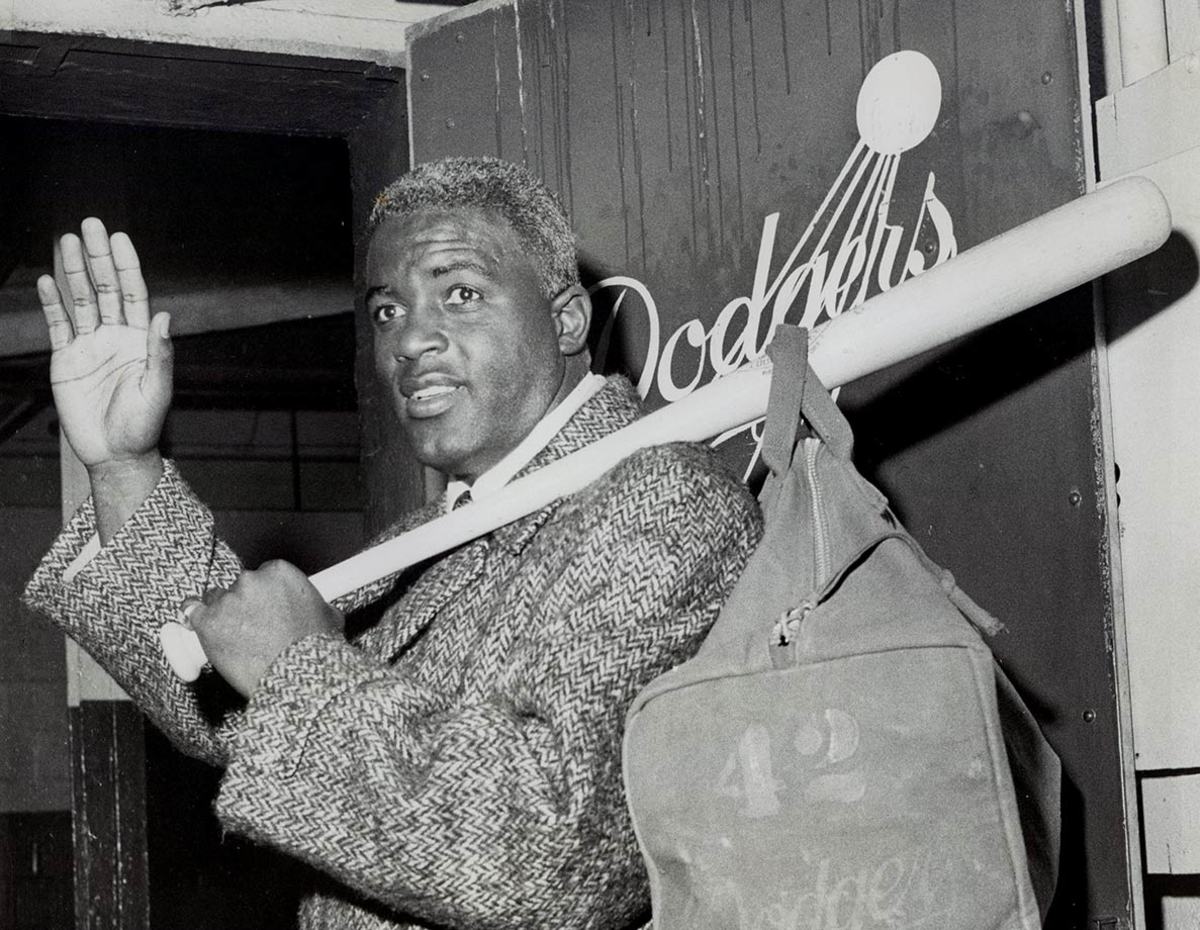
Jackie formally announced his retirement on January 5, 1957. A photo was taken of him, leaving the Dodger clubhouse at Ebbets Field. The contrast with the photo of him arriving is stark: In 1947, wearing his Montreal Royals uniform, he was 28 but looked 18; now, he was about to turn 38, but with his hair going gray and his face filled out, he looked 50. He was soon diagnosed with diabetes.

He became an executive with Chock full o'Nuts, then known more for their chain of lunch counters, a precursor to fast food, than for selling their coffee packs in supermarkets. The company had gone out of its way to hire black employees at good wages. He was later one of the founders of the black-owned Freedom National Bank. He died in 1972, only 53 years old.

In 1953, in between his hostile takeover of Rickey's stock (for which Rickey found a way to make him pay a lot more than he'd intended) and his exile of Robinson, O'Malley drove broadcaster Red Barber away, into the hands of the Yankees. Rickey, Barber, Robinson: Three of the most honorable and influential people in the history of American sport, and O'Malley drove them all away, all in a span of 6 years.

All this before he greedily moved the Dodgers to Los Angeles. In other words, had O'Malley gotten his new stadium where he originally wanted it, and were the Dodgers now preparing to play a 2012 season in Brooklyn, Walter Francis O'Malley would still have been a dirty filthy greedy bastard.

*

December 13, 1956 was a Thursday. Baseball was out of season. Football was in midweek. The NBA had no games scheduled. But the NHL's entire "Original Six" were in action:

* The New York Rangers lost to the Detroit Red Wings, 2-1 at the Olympia Stadium in Detroit.

* The Montreal Canadiens beat the Toronto Maple Leafs, 6-2 at the Montreal Forum.

* And the Boston Bruins beat the Chicago Black Hawks, 3-2 at the Boston Garden.

Thursday, December 8, 2022

December 8, 1947: The Trade That Made "The Boys of Summer"

Preacher Roe

December 8, 1947: The Brooklyn Dodgers trade right fielder Fred "Dixie" Walker, and pitchers Hal Gregg and Vic Lombardi to the Pittsburgh Pirates for pitcher Elwin Charles "Preacher" Roe, 3rd baseman Billy Cox and utility infielder Gene Mauch.

Walker was a 5-time All-Star. He had helped the Dodgers win the National League Pennant in 1941, their 1st in 21 years. He had led the NL In batting average in 1944, and in RBIs in 1945. He had helped the Dodgers win another Pennant just 3 months before the trade. He was so popular, that he was known as "The People's Cherce" -- "The People's Choice," in the Brooklyn accent. Why trade him away? And why trade Gregg and Lombardi, a pair of decent pitchers?

For one very good reason: Dixie, as his nickname suggests, was a Southerner, and opposed to team president Branch Rickey's desegregation of the team, starting with Jackie Robinson. Plus, Walker was 37, and the Dodgers had Carl Furillo coming up. He would also become an NL batting champion, in 1953; and while Walker was a good fielder in right field, Furillo was a better one, with an arm that got him nicknamed, after his Pennsylvania hometown, the Reading Rifle.

Walker played 2 more seasons, mainly as a pinch-hitter, and retired. Aside from the manpower-drain year of 1945, when he went 18-13, Gregg was never more than a journeyman, and was done after 1952. Lombardi was average at best, and was done after 1950.

What did the Dodgers get? Mauch was an afterthought. Ironically, he became one of a few players stuck at shortstop behind Pee Wee Reese who went on to become major league managers. That list would also include Dick Williams, Sparky Anderson and Don Zimmer.

Cox was certainly not acquired for his bat. Only once in Brooklyn would he top .279, only once reach double figures in home runs, and he never had more than 54 RBIs in a season. But he was one of the best-fielding 3rd basemen of all time.

Before Brooks Robinson, before the Yankees' Clete Boyer, he dove all over Ebbets Field to snare anything hit to the left side. It was said that he could get to a grounder and count the stitches on the ball, and still throw the batter out. My grandmother, a Dodger fan from Queens, insisted to the end of her life that Billy Cox was the best 3rd baseman she'd ever seen.
Billy Cox

The real key to the trade was Roe. A lefthander from Arkansas, his nickname came at the age of 3, when an uncle asked his name and Roe responded "Preacher," because of a minister who would take him on horse-and-buggy rides.

His key pitch was a sinker, though many have suggested that he really threw a spitball. Along with righthanders Don Newcombe and Carl Erskine, he gave the Dodgers what amounted to 3 aces in their starting rotation.

Rickey phased out the farmboys who helped the Dodgers win the 1941 and 1947 Pennants, and the near-misses of 1942 and 1946. By Opening Day 1949, he had the classic lineup that would become known, in the title of the book by Roger Kahn, a Brooklyn-born sportswriter who covered them, taken from the poetry of Dylan Thomas, as "The Boys of Summer": Gil Hodges at 1st base, Robinson at 2nd base, Reese at shortstop, Cox at 3rd base, they never quite settled on a left fielder, Edwin "Duke" Snider in center field, Furillo in right field, and Roy Campanella as catcher.

This Dodger team won the Pennant in 1949, fell 1 game short in 1950, lost a painful Playoff for the Pennant in 1951, won the Pennant in 1952, and won it again in 1953. But they couldn't quite win the World Series.

In 1949, Roe went 15-6. In 1950, he went 19-11. In 1951, he went 22-3, and would have won the NL Cy Young Award had one then been available. In 1952, missing part of the season due to injury, he went 11-2. In 1953, again missing time due to injury, he went 11-3. So, over a 3-year stretch, he was 44-8, a winning percentage of .846.

Roe was a terrible hitter, even by the standards of pitchers. My grandmother was always telling me that Roe was a great pitcher, but the worst hitter she ever saw. On July 7, 1953, the Dodgers swept a doubleheader against the Pirates at Forbes Field. Erskine started and won the 1st game. Roe started and won the 2nd game, and also hit a home run. On the radio, Red Barber said, "Well, old Number 28 has hit a home run, and we'll never hear the end of it, folks!" What Grandma didn't say was that Roe got a 2nd hit in the game; and that, in the same game, the light-hitting Cox hit 2 home runs. The Dodgers won, 9-5.

Roe and Cox arrived in Brooklyn together, and they left together: On December 14, 1954, they were traded to the Baltimore Orioles for a pair of minor-leaguers, infielder Harry Schwegman and right-handed pitcher John Jancse, and $60,000. The following year, with Johnny Podres having replaced Roe as Dem Bums' top lefty starter, and Robinson and Zimmer splitting time at 3rd base, the Dodgers finally won the World Series.

Roe retired rather than report to the Orioles, and never pitched again, finishing his career with a record of 127-84, an ERA of 3.43, a .110 batting average, 28 RBIs, and that 1 home run. Cox played 1 more season, and was replaced as Oriole 3rd baseman by Brooks Robinson. Cox died in 1978, while Roe proved more durable, living until 2009, age 92.
 
*

December 8, 1947 was a Monday. Rock music legend Gregg Allman was born. Baseball was out of season. Football was in midweek: Monday Night Football was 23 years away. There were no games scheduled in the NHL. There was 1 game in the league that would become the NBA: The New York Knicks beat the St. Louis Bombers, 71-56 at the old Madison Square Garden.

Wednesday, December 7, 2022

December 7, 1941: The Japanese Bomb Pearl Harbor

December 7, 1941: As President Franklin D. Roosevelt said the next day, asking Congress for a Declaration of War against the Empire of Japan, and getting it, it is "a date which will live in infamy." Japanese planes attack the U.S. Naval base at Pearl Harbor in Honolulu, Hawaii.

American casualties and losses: 2 battleships totally lost, 2 battleships sunk and recovered, 3 battleships damaged, 1 battleship grounded, 2 other ships sunk, 3 cruisers damaged, 3 destroyers damaged, 3 other ships damaged, 188 aircraft destroyed, 159 aircraft damaged, 2,403 people killed, 1,178 wounded.

To put that in perspective: In 1941, the U.S. had about 130 million people, and we lost 2,400 in Honolulu that day. In 2001, we had about 300 million, and lost 3,000 on 9/11. Proportionately, we lost about twice as many people at Pearl Harbor as we did at the World Trade Center and the Pentagon combined 60 years later.

The 1970 film Tora! Tora! Tora! -- named for the code given that the attack was on -- is usually still considered the best film about the attack, more so than From Here to Eternity (1953, in which the attack is secondary to the story), The Final Countdown (1980, ditto), and Pearl Harbor (2001, in which the acting has been heavily criticized). Playing the Japanese commander, Admiral Isoroku Yamamoto, Japanese actor Sō Yamamura said, "I fear that all we have done is to awaken a sleeping giant, and fill him with a terrible resolve." Yamamoto may have believed this, but there is no record of him actually saying it.

But it was true: For Japan, the attack on Pearl Harbor was a "Pyrrhic victory." The phrase originates from a quote from Pyrrhus of Epirus, whose triumph against the Romans in the Battle of Asculum, in what is now Southern Italy, in 279 BC destroyed much of his forces, forcing the end of his campaign. According to legend, he said, "If we are victorious in one more battle with the Romans, we shall be utterly ruined." The more common translation is, "Another such victory, and I am undone."

About 18,000 people were stationed at Pearl Harbor at the time. In 2013, 2,000 to 2,500 survivors were thought to be still alive, according to Eileen Martinez, chief of interpretation for the USS Arizona Memorial. But I can find no definitive number of how many people who were there who are still alive, only that there are believed to be 3 still alive who served on the Arizona.

UPDATE: An obituary for Lou Conter, the 102-year-old last survivor of the Arizona, who died on April 1, 2024, said that there were only 21 overall survivors left. A CNN report on December 6, 2024 said that 16 were left. A report the next day by Voice of America confirmed that total, and said that only 2 of them made it to a memorial service at the site, 83 years after the attack. One was 104 years old; the other, 102.

A CNN story about the memorial ceremony held at Pearl Harbor on December 7, 2025 said that there were only 12 survivors left, and, for the 1st time, 84 years after the attack, none was able to attend.

*

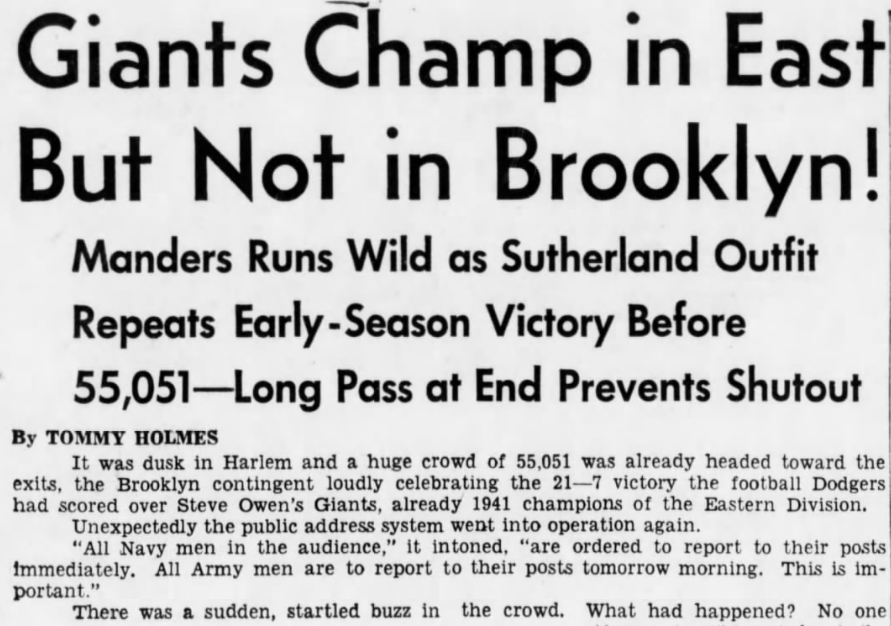
December 7, 1941 was a Sunday, and 3 games were played in the National Football League. The most notable was at the Polo Grounds in New York, between 2 teams that were named for established baseball teams: The New York Giants and the Brooklyn Dodgers.

The Giants had won the NFL's Eastern Division title, as they had previously done in 1933, 1934, 1935, 1938 and 1939, winning the NFL Championship Game in 1934 and 1938 -- Super Bowl -XXXIII and Super Bowl -XXIX, if you prefer. But before they could face the Chicago Bears in the 1941 edition (having beaten them in 1934 and lost to them in 1933), they had to face the football Dodgers, who, like their baseball namesakes, played home games at Ebbets Field.

It was Tuffy Leemans Day at the Polo Grounds. Alphonse Emil Leemans (1912-1979) was a native of Superior, Wisconsin, and had been an All-American back (offensive and defensive) at George Washington University in Washington, D.C. The Giants would later retire his Number 4, and he was elected to the Pro Football Hall of Fame.
The Dodgers didn't care. They were going for a season sweep of the Giants, and they got it, winning 21-7. The Giants may have been the official Division Champions, but the Dodgers were the unofficial City Champions.
The Brooklyn Eagle, December 8, 1941

The attack started at 7:48 AM Hawaii time, which was 1:48 PM East Coast time. During the 2nd half, word got to the press box, and announcements began to come over the public address system. In those days, it was rare for someone to get paged at a sporting event. Usually, it was a doctor, who had to go and attend to a medical emergency.

This time, with the draft already in place, and enlistments already well underway as well, military officers attending the game were paged, and told to report to their various bases in and around New York City.

At Comiskey Park in Chicago, home to the Great Lakes Naval Training Center on Lake Michigan, another crosstown battle was held. The Bears beat the host Cardinals 34-24. And at Griffith Stadium in Washington, in the capital so the number of government officials and military officers present was considerably larger than in New York and Chicago, the host Redskins beat the Philadelphia Eagles 20-14.

When the game in New York ended, Dodger fans could not openly celebrate, and Giant fans didn't care, either, because it was then announced to the crowd that Pearl Harbor had been attacked.

The NFL Championship Game was played as scheduled, at Wrigley Field in Chicago on December 21, and, despite a 9-9 deadlock in the 3rd quarter, the Bears went on to beat the Giants 37-9.

This was during Major League Baseball's offseason, so none of their games were played. This was 5 years before the founding of the NBA, so none of their games were played. There were 3 National Hockey League games played on the day that Pearl Harbor was attacked:

* At the old Madison Square Garden, the host New York Rangers beat the defending Stanley Cup Champions, the Boston Bruins, 5-4. Alex Shibicky scored 2 goals.

* At the Olympia Stadium, the host Detroit Red Wings beat the Montreal Canadiens, 3-2.

* And at the Chicago Stadium, the host Chicago Blackhawks beat the Brooklyn Americans, 5-4. Only in this, what turned out to be their last season, were the former New York Americans, or "Amerks," using the Brooklyn name, even though they still played all their home games at The Garden. A plan for a new arena in Brooklyn was proposed for after The War, but it never happened, and the franchise suspended at the conclusion of the 1941-42 season, was officially folded in 1946.

* The Toronto Maple Leafs were not scheduled to play that day.

Time magazine named Roosevelt its Man of the Year for the 3rd time, due to his efforts to aid Britain, France and the Soviet Union without getting Congress to declare war on the Axis Powers, until Pearl Harbor made it unavoidable.

Tuesday, November 29, 2022

November 29, 1931: The Packers' 1st "Threepeat"

Johnny "Blood" McNally

November 29, 1931: The Championship of the National Football League is clinched... at Ebbets Field. The Green Bay Packers beat the football team named the Brooklyn Dodgers, 7-0, to advance to 12-1 on the season.

Coached by Earl "Curly" Lambeau, the Packers' star player was John Victor McNally Jr., from New Richmond, Wisconsin, across the State, close to Minneapolis rather than to Green Bay or Milwaukee. He starred at St. John's University in Minnesota, and then at Lambeau's Alma Mater, Notre Dame.

In 1922, while at St. John's, he and a teammate, Ralph Hanson, were passing a Minneapolis movie theater, showing the movie Blood and Sand, starring Rudolph Valentino as a Spanish bullfighter. McNally turned to the teammate, and, knowing that they could secretly make money playing professional or semipro ball on Sundays, the day after playing for Notre Dame, if they used fake names, and said, "I'll be Blood, and you be Sand." Hanson, as Ralph Sand, never played in the NFL, but John McNally was "Johnny Blood" from then on.

He played in the NFL for the Milwaukee Badgers, the Duluth Eskimos and the Pottsville Maroons, before joining the Packers in 1929, eventually helping them win 4 NFL Championships. In this 1931 season, the two-way halfback scored 2 touchdowns rushing, a then-record 10 receiving, and another on an interception return. He later served as a player-coach with the football version of the Pittsburgh Pirates, before they changed their name to the Steelers; and returned to St. John's to coach. (St. John's is now an NCAA Division III school, and has no connection besides name to the one in New York City.)

The Packers benefited from having their 1st 7 games all at home, probably because most NFL teams then used the biggest stadium in their city, which tended to be not a college football stadium, including one of the many "Memorial Stadiums" built to honor the dead of World War I in the preceding decade, but a baseball park, and most of those parks were occupied in September.
City Stadium

The Packers beat the football version of the Cleveland Indians, 26-0; the Dodgers, 32-6; the team that would become their arch-rivals, the Bears, 7-0; the football version of the New York Giants, 27-7; the Chicago Cardinals, 26-7; the Frankford Yellow Jackets, 15-0; and the Providence Steam Roller (no "S" on the end), 48-20.

The Packers went to Wrigley Field to play the Bears again, and won, 6-2. They hosted the Staten Island Stapletons, and won, 26-0. They were finally beaten by Ernie Nevers and the Cardinals, 21-13 at Wrigley, where they played their home games that season, rather than at Comiskey Park, the usual home of the Cardinals and baseball's Chicago White Sox.

The Packers rebounded, beating the Giants, 14-10 at the Polo Grounds; beating the Steam Roller, 38-7 at the Providence Cycledrome on Thanksgiving; and clinching against the Dodgers at Ebbets Field. The following week, they lost to the Bears, 7-6 at Wrigley Field. But it didn't matter, because the Portsmouth Spartans finished at 11-3, and could not catch the Packers.

The Packers thus won their 3rd straight NFL Championship. It had never happened before. Through the 2021 season, it has happened only once since: The Packers again, in 1965, 1966 and 1967, including Super Bowls I and II.

This remains the last time the NFL Championship has been decided without some form of postseason play.

Lambeau and McNally were both charter inductees into the Pro Football Hall of Fame in 1963. Lambeau died in 1965, and Green Bay's new City Stadium was renamed Lambeau Field in his memory. McNally was one of a few 1920s players interviewed by NFL Films for their 1976 documentary Old Leather, and lived until 1985.

UPDATE: The Green Bay Packers have the largest team Hall of Fame of any team in the "Big Four" North American sports: The NFL, MLB, the NBA and the NHL. From the team's founding era, 1919 to 1928, but not on the 1929, '30 or '31 title teams, they have inducted tackle Howard "Cub" Buck, back Charlie Mathys, and team executive Andrew Turnbull.

From the 1929-30-31 title teams, they have inducted co-founder, owner, general manager, head coach and back Earl "Curly" Lambeau; co-founder George Whitney Calhoun; executives Frank Jonet, Gerald F. Clifford, Fred Leicht, Emil Fischer and Lee Joannes; backs Johnny "Blood" McNally, Verne Lewellen, Arnie Herber, Hank Bruder and Joseph "Red" Dunn; ends Lavern "Lavvie" Dilweg and Milt Gantenbein; tackle Cal Hubbard; guards Mike Michalske and Howard "Whitey" Woodin; centers Francis "Jug" Earp, Bernard "Boob" Darling and Nate Barragar; trainer Carl "Bud" Jorgensen and team doctor W. Webber Kelly; and the team's 1st broadcaster, Russ Winnie.

Lambeau, Buck, Dilweg, Dunn, Goldenberg, Lewellen, McNally and Michalske have also been inducted into the Wisconsin Athletic Hall of Fame.

*

November 29, 1931 was a Sunday. Only 2 other games were played that day. The Giants and the Steam Roller played to a 0-0 tie at the Polo Grounds. This turned out to be the last game the Steam Roller ever played. They had won the NFL Championship in 1928, but the Great Depression did them in.

And the Spartans beat the Bears, 3-0 at Universal Stadium in Portsmouth, Ohio. It still stands, as Spartan Memorial Stadium.

The day before, the Cardinals beat the Indians, 21-0 at Wrigley Field. And, 2 days before that, on Thanksgiving Day, these games were played:

* The Giants lost to the Stapletons, 9-6 at Thompson Stadium on Staten Island.

* The Bears beat the Cardinals, 18-7 at Wrigley Field.

* And, as I said, the Packers beat the Steam Roller, 38-7 at the Cycledrome.

Baseball was out of season. The NBA hadn't been founded yet. There were 2 games played in the NHL. The New York Rangers beat the Chicago Black Hawks, 5-0 at the Chicago Stadium. And the Detroit Falcons beat the Montreal Canadiens, 3-2 at the Olympia Stadium in Detroit. Ebenezer "Ebbie" Goodfellow scored the winning goal, 3:33 into overtime. The next season, the Falcons became the Detroit Red Wings.

Wednesday, November 9, 2022

November 9, 1953: Dylan Thomas Dies

November 9, 1953: Dylan Thomas dies at St. Vincent's Hospital in Greenwich Village, Manhattan, New York City. He was only 39 years old.

Dylan Marlais Thomas was born on October 27, 1904 in Swansea, Wales. (That was the day the New York Subway system opened.) A poet and playwright, he was called, in his time, "a roistering, drunken and doomed poet." He made radio recordings for the BBC during World War II, making him world-famous. But, as with other noted alcoholics (and abusers of other substances), he proved unreliable.

He came to New York in the early 1950s, lived at the Chelsea Hotel, and drank at the White Horse Tavern in Greenwich Village. In those last years, he wrote the short story A Child's Christmas in Wales, the play Under Milk Wood, and an untitled poem, published in 1952, that begins and ends with the words, "Do not go gentle into that good night. Rage, rage against the dying of the light."

When that poem appeared in Collected Poems, 1934-1952, British critic Philip Toynbee said, "Thomas is the greatest living poet in the English language."

Apparently, Thomas didn't take his own advice. Nor did he stay the greatest living English-language poet for long, and not because any other poet surpassed him. By October 24, 1953, after appearing in a New York performance of Under Milk Wood, he told a friend, "The circus out there has taken the life out of me for now." He turned 39 on October 27, but left the party thrown for him after just 1 hour, and headed back to the Chelsea.

New York was hit with a smog attack on November 2. By the end of the month, over 200 people had died. Whatever was wrong with Thomas' lungs, the smog made it worse. On November 3, he walked into the lobby of the Chelsea, after a night at the White Horse, saying, "I've had 18 straight whiskeys. I think that's the record." Interviewed some time after, the bartender said it might have been half as many, which would still be a dangerous amount.

His breathing got worse, and late at night on November 5, he was taken to St. Vincent's Hospital, where he died on November 9, leaving behind a wife, 2 sons and a daughter.

He has a sports connection, though he would never know it. In 1972, sportswriter Roger Kahn, who had been a student of the classics at New York University, titled his memoir of the Brooklyn Dodgers of the early 1950s after a Thomas poem: 
I see the boys of summer in their ruin Lay the gold tithings barren, Setting no store by harvest, freeze the soils; There in their heat the winter floods Of frozen loves they fetch their girls, And drown the cargoed apples in their tides.
This poem would also lend itself to "The Boys of Summer," a hit song by Don Henley in 1985. 

*

November 9, 1953 was a Monday. Comedian Dennis Miller and actress Kate Capshaw were born.

Baseball was out of season, the NFL didn't have Monday Night Football back then; and while both the NBA and the NHL had started their seasons, neither scheduled any games for that day. So there were no scores on this historic day.

Friday, October 28, 2022

October 28, 1953: Red Barber Has Had Enough of Walter O'Malley

October 28, 1953: Fed up with the meddling of Brooklyn Dodger owner Walter O'Malley, Red Barber leaves the Dodgers' broadcast booth, and signs with the crosstown New York Yankees.

Barber had been brought to the Dodgers by Larry MacPhail, who had previously hired him for the Cincinnati Reds. Since 1938, Barber's voice, broadcast over WHN, 1050 on the AM dial, had made the Dodgers popular beyond Brooklyn for the 1st time. They were arguably more popular than the more successful Yankees, and certainly more popular than the New York Giants, who, at this point, had won just 1 Pennant and no World Series in the last 16 years.

When MacPhail left the Dodgers after the 1942 season, and St. Louis Cardinals general manager Branch Rickey was handed the team presidency by its owners, he kept Barber on. After the 1950 season. O'Malley bought Rickey out, maneuvering himself into half-ownership of the team and effective control of the other half. And, despising Rickey despite their many commonalities, he associated everybody from the Rickey regime as having suspect loyalties to him.

Prior to the 1953 World Series, Barber was selected by the Gillette shaving products company, which sponsored the Series broadcasts, to call the games on NBC television, along with Mel Allen of the Yankees. Barber wanted a larger fee than was offered by Gillette, however, and when O'Malley refused to back him, Barber declined to work the Series, and his Dodger broadcast partner Vin Scully partnered with Allen on the telecasts instead.

As Barber later related in his 1968 autobiography, Rhubarb in the Catbird Seat, he was rankled by O'Malley's lack of support, and this, along with a dispute over the renewal of Barber's $50,000-a-year contract, led to his departure from the Dodgers' booth. He remained with the Yankees through the 1966 season, teaming with Allen through 1964, with Phil Rizzuto from 1957 onward, with Jerry Coleman from 1963 onward, and with Joe Garagiola taking Allen's place in the 1965 and '66 seasons.

During his time in Brooklyn, Walter O'Malley chased off Branch Rickey in 1950, Red Barber in 1953, and Jackie Robinson in 1956. And he shortchanged his players in contract negotiations.

In other words, O'Malley was already a rotten guy, and would have remained one even if he had kept the Dodgers in Brooklyn as God intended it.

Was Red Barber the greatest baseball broadcaster of all time? Many people said he was. As a later Gillette slogan put it, he was the best a man can get.

*

October 28, 1953 was a Wednesday. Songwriter Desmond Child was born.

Baseball season had ended 22 days earlier, when Barber's new team, the Yankees, beat his old team, the Dodgers, in Game 6 to win the World Series. Football was in midweek. The NBA season started 2 days later.

There was 1 game in the NHL: The Chicago Black Hawks beat the New York Rangers, 6-1 at the Chicago Stadium. 

Monday, October 24, 2022

October 24, 1972: Jackie Robinson Dies

October 24, 1972: Jackie Robinson dies. The 1st black player in modern baseball had been suffering from diabetes, which had robbed him of most his eyesight, caused such poor circulation in his legs that amputation was being considered, and damaged his heart to the point where it killed him at age 53.

Just 9 days earlier, he had flown from his home in Stamford, Connecticut, and was a special guest at Game 2 of the World Series between the A's and Reds in Cincinnati. It had been 25 years since the great experiment that he and Brooklyn Dodger president Branch Rickey (who died in 1965) had reached its successful conclusion with the Dodgers winning the Pennant and Jackie making it through the season, not just surviving but excelling. His former teammate, Pee Wee Reese, was on hand, and former Dodger broadcaster Red Barber introduced him.

Jackie said, "I'm extremely pleased to be here, but I must confess, I'm going to be even more pleased when I see a black face managing in baseball."

Jackie's eulogy was delivered by the Rev. Jesse Jackson, and his funeral was attended by most of his surviving teammates. Roy Campanella was there in his wheelchair. Among his pallbearers were former Dodger pitcher Don Newcombe and basketball legend Bill Russell, who had been the 1st black head coach in the NBA.

Earlier in the year, on June 4, in Los Angeles, Jackie's hometown (if not the team's), the Dodgers retired uniform numbers for the first time, packing away Jackie's Number 42, Campy's Number 39 and Sandy Koufax' Number 32. Jackie was the 1st black player in the Hall of Fame, Campy the 2nd, and Koufax had been newly elected at the time of the ceremony.

It would be 2 more years, on October 3, 1974, before Frank Robinson, no relation, was hired as Major League Baseball's 1st black manager, with the Cleveland Indians, the team that had been the first in the American League to add black players, with Larry Doby and Satchel Paige.

Oddly, Frank beat Jackie to being the 1st black player to get his number retired: The Orioles let him go before the 1972 season, and, though he was still active, announced the retirement of his number on March 10 of that year.

Ironically, while black Hispanics are the leading presence in the game in the 2020s, very few black Americans are in the major leagues. Jackie would probably be disturbed by that, but not puzzled, as he would surely factor in the rise of pro football and basketball as sports preferred by African-Americans, especially since he played those, in addition to baseball, at UCLA.

Of the 30 current MLB franchises, only the Houston Astros currently have a black manager: Dusty Baker, and he is 73 years old and managing his 5th different team. There's 3 others that have a Hispanic manager: Alex Cora of the Boston Red Sox, Oliver Marmol of the St. Louis Cardinals, and Dave Martinez of the Washington Nationals.

And 4 teams have never had a manager who was either black or Hispanic: The Yankees, the Minnesota Twins, the Oakland Athletics, and the Philadelphia Phillies -- by an unfortunate coincidence, also the last National League team to have had a black player.

(The Yankees have had black coaches, such as Elston Howard, Willie Randolph and Tony Peña, but no black or Hispanic managers, unless you count Peña on those occasions when Joe Torre or Joe Girardi was thrown out of a game, or took a personal day.)

As of this posting, 5 teams' managerial offices are vacant: The Chicago White Sox, the Kansas City Royals, the Miami Marlins, the Texas Rangers and the Toronto Blue Jays. That's right: More teams have their manager's jobs vacant than have them filled with a nonwhite man.

It took until 2016, with former Red Sox star Dave Roberts, for the Dodgers to have their 1st black manager. Currently, of the 24 MLB teams that don't have vacancies, 5 have a black or Hispanic manager.

In 1997, on the 50th Anniversary of Jackie's arrival, Baseball Commissioner Bud Selig announced that Jackie's Number 42 would be retired for all of baseball, as yet a unique honor. All players then wearing it would be allowed to continue to do so for the remainder of their careers, but no new players could wear it, and no current players could switch to it.

The last remaining Number 42 in baseball was Mariano Rivera of the Yankees; the Yankees appeared to have been waiting for Mariano to retire before retiring the number for both him and Jackie, but in 2007, on the 60th Anniversary of Jackie's arrival, they retired it for Jackie, and did so again for Mariano when he hung 'em up in 2013, just as they retired Number 8 for both Bill Dickey and Yogi Berra.

*

October 24, 1972 was a Tuesday. The baseball season had ended 2 days earlier, with the Oakland Athletics beating the Cincinnati Reds in the World Series. Football was in midweek. There were 5 NBA games played:

* The New York Knicks beat the Cleveland Cavaliers, 123-90 at Madison Square Garden.

* The Boston Celtics beat the Buffalo Braves, 105-97 at the Buffalo Memorial Auditorium.

* The Los Angeles Lakers beat the Kansas City-Omaha Kings, 114-94 at the Kansas City Municipal Auditorium.

* The Chicago Bulls beat the Phoenix Suns, 107-106 at the Arizona Veterans Memorial Coliseum in Phoenix. Charlie Scott scored 42 points for the Suns, but, for the Bulls, Bob Love scored 29 and Chet "the Jet" Walker scored 28.

* And the Atlanta Hawks beat the Portland Trail Blazers, 118-110 at the Veterans Memorial Coliseum in Portland.

There were 2 games played in the American Basketball Association. The Virginia Squires beat the Memphis Tams, 123-111 at the Mid-South Coliseum in Memphis. Julius "Dr. J" Erving scored 35 for the Squires. And the San Diego Conquistadors beat the Carolina Cougars, 123-109 at the San Diego Sports Arena (now the Pechanga Arena).

There were 4 games played in the NHL:

* The expansion New York Islanders lost to the Montreal Canadiens, 4-3 at the Nassau Coliseum.

* The Minnesota North Stars beat the St. Louis Blues, 2-1 at the St. Louis Arena.

* The Los Angeles Kings beat their then-geographic rivals, the California Golden Seals, 5-0 at The Forum outside Los Angeles in Inglewood, California. The Seals, the Memphis Tams, and the Oakland A's were all owned by Charlie Finley, and, at the time, all wore green and gold uniforms. But, unlike the A's, the Tams and the Seals never won anything.

* And the Pittsburgh Penguins beat the Vancouver Canucks, 4-0 at the Pacific Coliseum in Vancouver.

And there were 4 games played in the World Hockey Association:

* The Quebec Nordiques beat the Houston Aeros, 5-3 at the Colisée de Québec.

* The New England Whalers beat the Cleveland Crusaders, 3-2 in overtime at the Cleveland Arena.

* The Winnipeg Jets beat the Philadelphia Blazers, 5-3 at the Winnipeg Arena.

* And the Alberta Oilers and the Chicago Cougars played to a tie, 3-3 at the Edmonton Coliseum. The next season, the Oilers changed their name to the Edmonton Oilers.
Saturday, October 22, 2022

October 22, 1939: The 1st NFL Game On Television

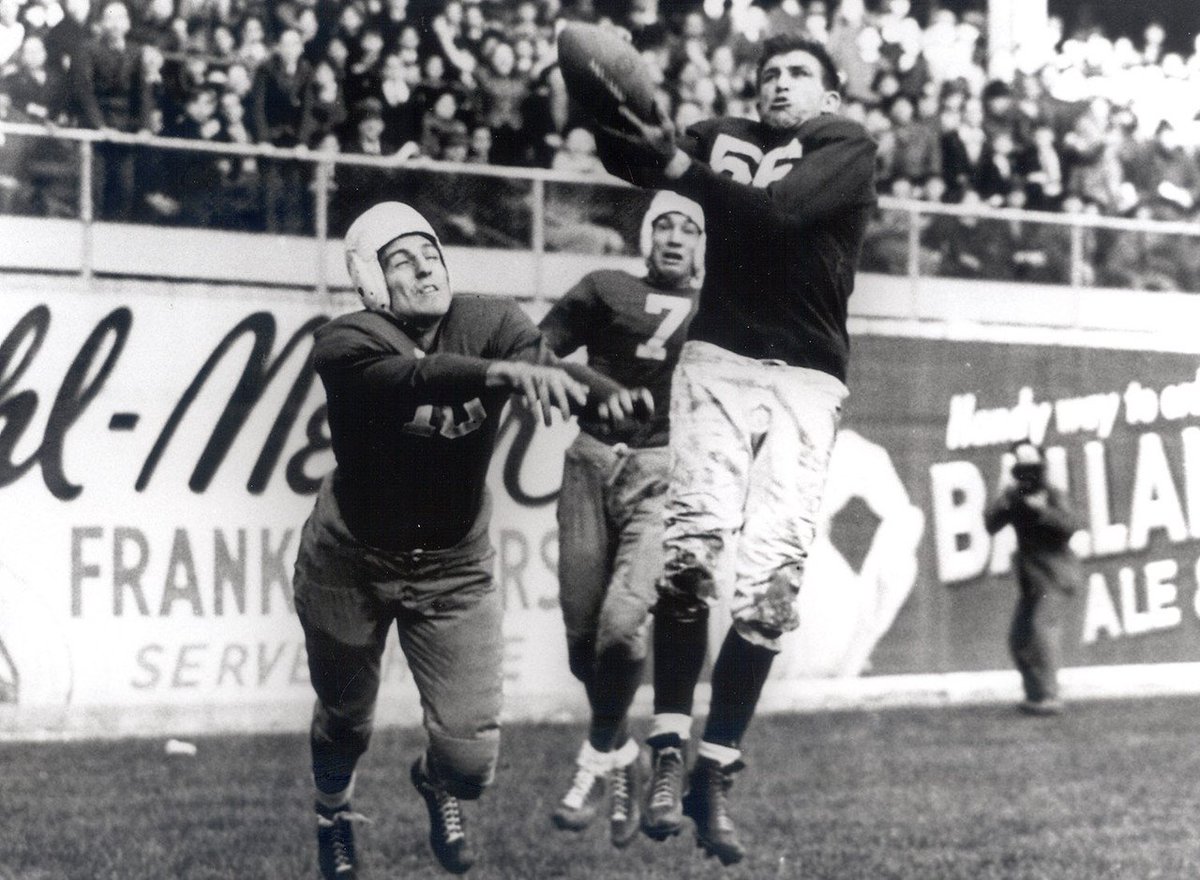
The only known photograph of the game.
Number 7 is Ace Parker. Number 56 is Bill Hewitt.
Both men are in the Pro Football Hall of Fame.
No, Hewitt hasn't lost his helmet: He didn't wear one
until the NFL passed a rule requiring it in 1940.

October 22, 1939: For the 1st time, a professional football game is televised, on experimental New York station W2XBS, the forerunner of WNBC-Channel 4. The Brooklyn Dodgers -- yes, there was an NFL team with that name -- play the Philadelphia Eagles at Ebbets Field in Brooklyn. The Dodgers win, 23-14, before only 13,057 fans.

There's no record of how many people paid to watch it in person, but there were apparently less than 300 TV sets capable of receiving the signal. No footage of the game survives, not even on newsreel.

The Dodgers struck first, on a 1-yard run by Clarence "Pug" Manders, who was in the middle of a run of 3 straight Pro Bowls. In the 2nd quarter, Fran Murray scored on a 1-yard run of his own for the Eagles. It remained 7-7 at the half, but the Dodgers took over: Ralph Kercheval kicked field goals of 44, 38 and 45 yards, and future Hall-of-Famer Clarence "Ace" Parker threw a 47-yard touchdown pass to Perry Schwartz. The Eagles added a 22-yard touchdown pass from Davey O'Brien, winner of the 1938 Heisman Trophy with Texas Christian, to Hall-of-Famer Bill Hewitt, but that would be as close as the Eagles got.

Football and television is an epic love story, but it was far from love at first sight. It would really take another 19 years, and the 1958 NFL Championship Game -- Baltimore Colts 23, New York Giants 17, in overtime at Yankee Stadium -- for it to become more than a flirtation. If there is an event that can be called "the wedding," it's probably Super Bowl III, 10 years after that, on January 12, 1969.

But the couple is inseparable, partly because of the shared TV revenue which allows Green Bay, Wisconsin, with a metropolitan area of 300,000 people, to compete on the same level as New York City, with a metro area of nearly 24 million people. It's also why the Big Ten Conference wanted to add Rutgers and the University of Maryland: Between the markets of New York, Philadelphia, Baltimore and Washington, they added about 40 million.

The NFL's TV revenue is so big (How big is it?), it's been said that the NFL can shut the doors of all 16 stadiums hosting games in a given weekend, with a total official attendance of zero, and still make a profit.

*

October 22, 1939 was a Sunday. George Cohen, the right back on the England team that won the 1966 World Cup, was born on this day.

The baseball season was over, the NHL season hadn't begun yet, and the NBA hadn't yet been founded. But there were 4 other NFL games founded:

* The New York Giants beat the Chicago Bears, 16-13 at the Polo Grounds.

* The Washington Redskins beat the Pittsburgh Pirates, 21-14 at Forbes Field in Pittsburgh. The Pirates, like the Giants named for their city's oldest baseball team, became the Pittsburgh Steelers the next season.

* The Cleveland Rams beat the Chicago Cardinals, 24-0 at Comiskey Park in Chicago. The Rams moved to Los Angeles in 1946, St. Louis in 1995, and back to Los Angeles in 2016. The Cardinals moved to St. Louis in 1960, and Arizona in 1988.

* And the Green Bay Packers beat the Detroit Lions, 26-7 at City Stadium in Green Bay. 

Monday, October 17, 2022

October 18, 1900: The Chronicle-Telegraph Cup Is Awarded

October 18, 1900: The Chronicle-Telegraph Cup is awarded for the first time. As it turned out, it was for the only time.

In 1900, the National League, the only major league in baseball at the time, contracted 4 of its teams out of existence: The Baltimore Orioles, the Cleveland Spiders, the Louisville Colonels and the Washington Senators. Except for Louisville, these cities would soon return to the major leagues.

When the 1900 NL season came to an end, the Brooklyn Superbas had repeated as Champions, winning the Pennant by 4 1/2 games over the Pittsburgh Pirates, 8 over the Philadelphia Phillies, 17 over the Boston Beaneaters, 19 over the St. Louis Cardinals and the Chicago Orphans, 21 1/2 over the Cincinnati Reds, and 23 over the New York Giants.

The Chicago team, formerly known as the White Stockings and, for their youth, as the Colts, had long been led by 1st baseman and manager Adrian Constantine Anson. He was known as "Cap," for "Captain," until he got older, and became known as "Pop." He retired after the 1897 season, and the team became known as the "Orphans," because "they missed their Pop." They were renamed the Chicago Cubs in 1903. The Beaneaters went through a few name changed before becoming the Boston Braves in 1912.

The Superbas were managed by Ned Hanlon, and were named after a popular circus troupe of the era, Hanlon's Superbas. He had managed the Orioles to the NL Pennant in 1894, '95 and '96, and his 1899 and 1900 Superbas had some of the Baltimore players, including Hall-of-Fame outfielders Willie Keeler and Joe Kelley, Hall of Fame shortstop Hughie Jennings, and pitchers William "Brickyard" Kennedy and Jack Dunn.

(Dunn would later return to Baltimore, and manage the minor-league version of the Orioles. He signed a teenage lefthanded pitcher named George Herman Ruth. When he sold Ruth to the Boston Red Sox in 1914, Ruth was explained to his new teammates as "Jack Dunn's baby." This was shortened to "Baby," and then to "Babe.")

But Pittsburgh fans were sure that their team was better than Brooklyn's. A newspaper, the Pittsburgh Chronicle Telegraph, offered to award a trophy to the winner of a best-of-five series between the two teams. And since the series was going to be held entirely at Exposition Park in Allegheny, Pennsylvania, across the Allegheny River from Pittsburgh, the Pirates were favored by gamblers.

(The city was officially "Pittsburg," with no H on the end, until 1911. Even the Pirates' uniforms said, "PITTSBURG," which can be seen on the famous 1909 "T-206" baseball card of their star, Honus Wagner. I'm spelling the name with the H for simplicity's sake. And the bigger city absorbed the smaller city of Allegheny in 1907.) 

The series opened on October 15. The Superbas won Game 1, 5-2, with Joe McGinnity outpitching George "Rube" Waddell. Both men would eventually be elected to the Baseball Hall of Fame, although mainly for what they did later, for different teams. Waddell, perhaps pitching's original "quirky lefthander," was undone by 4 errors by his fielders.

The Pirates' fielding got worse: They made 6 errors, all in the 6th inning, in Game 2, and the Superbas won, 4-2. The Pirates gave hints as to their later heavy-hitting history by winning Game 3, 10-0, and Charles "Deacon" Phillippe pitched a 6-hit shutout, avoiding a sweep.

But that just delayed the inevitable. In Game 4, Sam Leever gave the Pirates both insufficient pitching and insufficient fielding, making an error that led to 3 Brooklyn runs, giving a less-strong McGinnity what he needed to win, 6-1. While Game 1 brought in 18,000 fans, the Pirates' less-than-stellar play in all but Game 3 led to a Game 4 crowd of just 2,335, as the locals decided that it was just an exhibition series, and didn't mean anything.

The Brooklyn team was the champion of the baseball world. It would be 55 years before that would happen again, and 16 years before they even won another National League Pennant. In contrast, the Pirates of Honus Wagner, Fred Clarke and Deacon Phillippe went on to win the next 3 Pennants.

The Chronicle Telegraph awarded the Superbas the Cup. They did not award the Pirates a cup for their Pennant wins the next 3 years, and the Chronicle-Telegraph Cup was never awarded again. At some point, the Baseball Hall of Fame came into possession of the trophy, and they have it on display in their museum.

I've often wondered if baseball history would be different if there was a trophy symbolizing the championship before the current Commissioner's Trophy began to be awarded in 1967, the way hockey had for the Stanley Cup from 1893 onward. But neither the Chronicle-Telegraph Cup, nor the Dauvray Cup that was awarded from 1887 to 1893, nor the Temple Cup that was awarded from 1894 to 1897 managed to stick.

As for the paper: The Morning Chronicle was founded in 1841, and became the Evening Chronicle in 1851. The Pittsburgh Evening Telegraph was founded in 1873. The papers merged in 1884, becoming the Pittsburgh Chronicle Telegraph. While it did not officially have a hyphen in its name, the trophy's name was usually spelled with the hyphen: "Chronicle-Telegraph Cup."

The Pittsburgh Sun and the Pittsburgh Gazette Times were both founded in 1906. In 1927, William Randolph Hearst bought the Sun and the Chronicle Telegraph, merging them into the Pittsburgh Sun-Telegraph, while the Gazette Times merged with the Pittsburgh Post to become the Pittsburgh Post-Gazette, or the PG. In 1960, the Pittsburgh Post-Gazette bought out and phased out the Sun-Telegraph.

In 1992, Pittsburgh newspaper workers went on strike. Scripps-Howard News Service sold the Pittsburgh Press to the Block family, owners the P-G, who folded it and incorporated its assets into the remaining paper. This gave right-wing businessman Richard Mellon Scaife an opening, and expanded his daily paper, based in suburban Greensburg, to become the Pittsburgh Tribune-Review, providing a conservative counterweight to the liberal P-G. In 2018, the P-G shifted its editorial stance from liberal to conservative. In other words, Pittsburgh no longer had a "liberal media."

*

October 18, 1900 was a Thursday. There were no other scores on this day.

Sunday, October 16, 2022

October 16, 1950: O'Malley vs. Rickey, and the Brooklyn Dodgers' Fate Is Sealed

Branch Rickey

October 16, 1950: Branch Rickey's contract as president, and de facto general manager, of the Brooklyn Dodgers expires. He is still owner of 1/4 of the franchise. With the death of quarter-owner John L. Smith, another quarter-owner, Walter O'Malley, buys Smith's share from his heirs, making him the largest owner: O'Malley 50 percent, Rickey 25 percent, and James Mulvey and his wife, Elizabeth "Dearie" Mulvey each having 12.5 percent.

Dearie was the daughter of Steve McKeever, who with his brother Ed ran the construction company that helped former sole owner Charlie Ebbets build Ebbets Field in 1912-13.

O'Malley knew he could dominate the Mulveys, and did so until he finally bought their children out in 1975. But he and Rickey were both very strong personalities, with little in common except being lawyers, cheapness, the Republican Party, the love of a good cigar, and the belief that they always had to be right.
Walter O'Malley

O'Malley hated everything about Rickey, including his favorite player, Jackie Robinson, and his favorite broadcaster, Red Barber; and would force Rickey, Robinson and Barber out of the organization -- all before moving the team, meaning he would have been a dirty bastard even if the team were still in Brooklyn to this day.

O'Malley offered to buy Rickey's quarter-share of the club. Seeing no reason to hold onto it -- he was not going to be offered a new contract as president, and thus would no longer have control over transactions and salaries -- Rickey decided to comply.

But Rickey knew a trick that O'Malley didn't know. He knew that an agreement in the Dodger partnership said that if any of the partners got an offer for their shares, and another partner wanted to buy, that other partner had to match the offer. Rickey found someone willing to pony up a million bucks, and so O'Malley had to pay through the nose: The $350,000 of '42 was worth $515,000 in inflation-adjusted dollars, while, in reverse, the $350,000 of '50 was worth just $237,000, so O'Malley was really offering Rickey a 54 percent loss. Instead, O'Malley had to pay Rickey a 104 percent profit.

Nevertheless, O'Malley got what he wanted: Control. From this day onward, the Brooklyn Dodgers were doomed. Over the next 7 years, O'Malley guided them to 4 National League Pennants, their only World Series win -- and their move from Brooklyn to Los Angeles. From his takeover in 1950 until his death in 1979, the Dodgers won 11 Pennants, including 4 World Series.

Today, Rickey's original '42 investment is worth $6.3 million, O’Malley's '50 offer $4.3 million, and Rickey's $1.05 million becomes $12.8 million. In 1969, O'Malley admitted his holdings in the Dodgers were worth $24 million, which is $191 million in 2022 dollars.

At his death in 1979, at which point his son Peter became owner, they were said to be worth $50 million, or today's $201 million. When Peter sold the Dodgers in 1998, it was for $311 million, or today's $558 million. When Magic Johnson bought the Dodger franchise, including Dodger Stadium, in 2012, the price was rumored to be about $2 billion, or today's $2.55 billion.

Rickey's son, Branch Rickey Jr. -- known as "Twig," but never to his face, or to his father's -- was already the Dodgers' farm director. After leaving the Dodgers, Branch Sr. was offered the position of general manager for the Pittsburgh Pirates. He took it, and took Branch Jr. with him to direct their farm system. Health problems forced Branch Sr. to retire in 1955, but his contributions, and those of Branch Jr., would help lead to a World Championship for Pittsburgh in 1960.

Oddly, Branch Jr., who had diabetes, died first, in 1961; Branch Sr. died in 1965. Branch Jr.'s son, Branch Barrett Rickey (never "Branch Rickey III," but that's what people call him), served as the president of the Pacific Coast League, having also worked in the Pirates' organization, and also in that of the Cincinnati Reds (which makes sense, since Branch Sr. was from Ohio).

*

October 16, 1950 was a Monday. The baseball season had ended 9 days earlier, with the New York Yankees completing a 4-game sweep of the World Series over the Philadelphia Phillies. The NBA season began 2 weeks later. The NHL season was underway, but no games were scheduled. And football was in midweek. There would be no Monday Night Football for another 20 years. Therefore, there were no scores on this historic day.

However, this was the day on which C.S. Lewis published The Lion, the Witch and the Wardrobe, beginning his Chronicles of Narnia series. I have a separate entry for that event.

Thursday, October 13, 2022

October 14, 1888: "Roundhay Garden Scene"

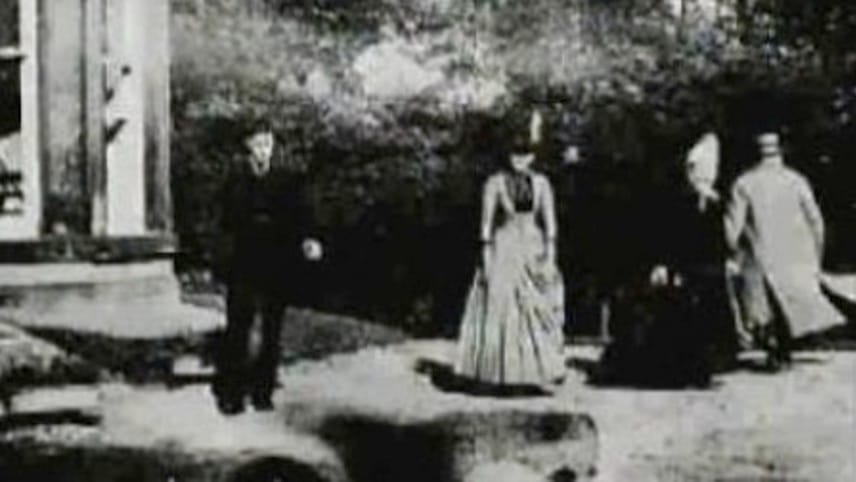
October 14, 1888: The oldest known surviving motion picture is filmed, in the backyard -- or, as the English would call it, the garden -- of a house in the Roundhay section of Leeds, West Yorkshire, England. It is known as Roundhay Garden Scene, is recorded by Frenchman Louis Le Prince, and features his son Adolphe, and his English in-laws, Joseph and Sarah Whitley, who owned the home. It lasts all of 2.11 seconds.
Louis Le Prince

A little over 2 years later, Louis Le Prince disappeared from a Dijon-to-Paris train, and was never seen again. He was 49, and it is suspected that he left the train at some point, and drowned.

*

October 14, 1888 was a Sunday. There was no pro football yet. But despite it being late in the year by today's standards, there were regular-season baseball games, all in the American Association, none in the National League, which then banned Sunday baseball:

* The Brooklyn Bridegrooms beat the Baltimore Orioles, 5-2 at Washington Park in Brooklyn. The Dodgers-to-be had seen several members get married a couple of off-seasons earlier. Both of these teams would join the National League, but the Orioles went out of business after the 1899 season.

* The Philadelphia Athletics beat the Cleveland Blues, 7-3. Since Pennsylvania forbid Sunday sports until 1933, this game was played at the Gloucester Point Grounds, across the Delaware River in Gloucester City, Camden County (not Gloucester County), New Jersey.

These Athletics folded after the 1890 season, and had no connection to the later American League team of the same name. The Blues became the Cleveland Spiders, joined the NL, and, like the Orioles, failed after the 1899 season.

* A doubleheader was split at League Park in Cincinnati. The St. Louis Browns, who would go on to win the AA Pennant, won the 1st game, 6-1. The Cincinnati Red Stockings won the 2nd game, 10-1. Both teams would join the National League, and are still in it today.

These Red Stockings were founded in 1882, and bear no connection to those of 1869-70. So when the modern Reds call themselves "baseball's oldest professional team," they're lying. The Browns became the Cardinals, and bear no direct connection to the later American League Browns.

* The Louisville Colonels swept a doubleheader from the Kansas City Cowboys, at Eclipse Park in Louisville. The hosts won the 1st game, 2-1; and the 2nd game, 9-1. The Colonels would join the NL, but, like Baltimore and Cleveland, fail after the 1899 season. The Cowboys only lasted through 1889.

Tuesday, October 11, 2022

October 12, 1913: The McGraw-Robinson Split

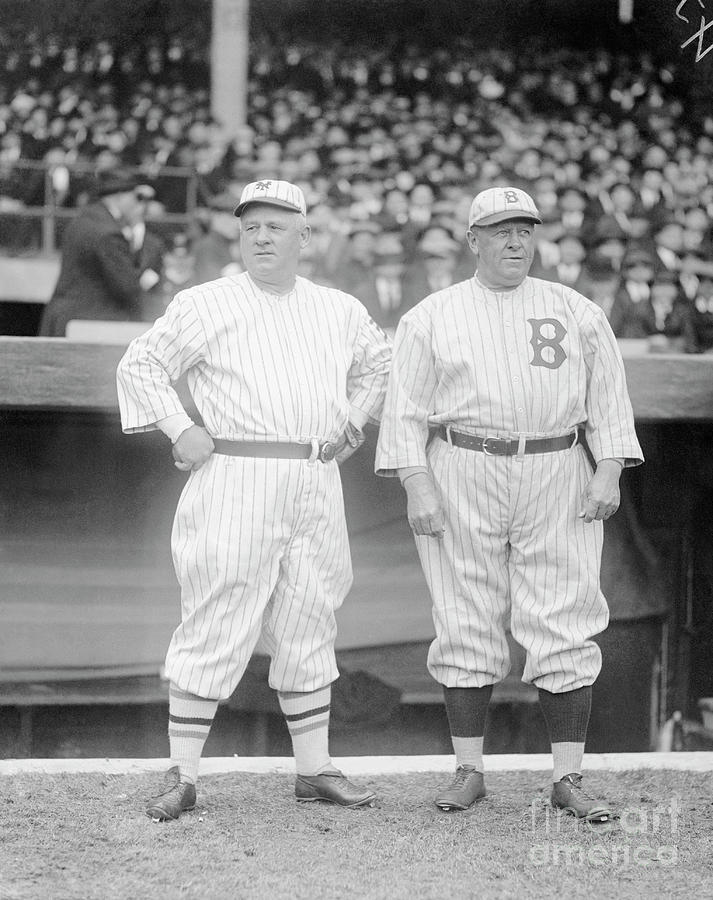
October 12, 1913: Following the World Series, which his New York Giants lost to the Philadelphia Athletics, John McGraw hosts a reunion for Hughie Jennings and the old National League version of the Baltimore Orioles, who won Pennants in 1894, 1895 and 1896, revolutionizing the game in the process.

After a night of heavy drinking‚ McGraw blames his longtime friend‚ Giants business partner, and former Oriole teammate Wilbert Robinson, perhaps baseball's 1st great pitching coach, for too many coaching mistakes in the 1913 Series. "Uncle Robbie" replies that McGraw made more mistakes than anybody. McGraw fires him. Eyewitnesses say Robbie doused McGraw with a glass of beer and left.

Six days later, Robbie will begin a legendary 18 years as manager of the crosstown Brooklyn franchise‚ replacing Bill Dahlen. The team will carry the nickname Robins‚ as well as Dodgers‚ during his tenure.

Robbie and Mac won't speak to each other for 17 years, and after winning 3 straight Pennants together, McGraw will win just 1 Pennant in the next 7 years, in 1917; while Robbie will win 2, in 1916 and 1920, the only Pennants the Brooklyn team will win between 1900 and 1941.

This is not the beginning of the rivalry between the Giants and the Dodgers, not by a long shot. That rivalry had its beginning in rivalries between clubs of New York (Manhattan) and Brooklyn when they were separate cities prior to 1898, even going back to the days of amateur baseball in the 1850s and '60s. And the rivalry between Manhattan and Brooklyn would have happened even if baseball had never been invented.

But the McGraw-Robinson bustup is the beginning of a rivalry that ruined one of baseball's great friendships, not resolved until both men were retired and near death, as seen in the photo above. Still, they both ended up in the Hall of Fame – neither lived to see the Hall's establishment, though – and are buried in the same Baltimore cemetery.

Somebody should write a book about it: We've seen books about the Giants, about the Dodgers, about the Dodger-Giant rivalry, about McGraw, and even about the old Orioles -- but the McGraw-Robinson relationship is a fascinating one. They're like the John Adams and Thomas Jefferson of baseball: Great friends in a great cause, then a nasty split and a nastier rivalry, and ultimately the relationship was repaired and the great friendship restored toward the end.

October 12, 1913 was a Sunday. Baseball season was over. Pro basketball and pro hockey barely existed, and, in those days, it was considered too early to start their seasons, anyway. Pro football existed, but only on a minor-league level.

But there was one score on this historic day: Despite it being a Sunday, a college football game was played. Georgia Tech beat the University of Chattanooga (now the University of Tennessee at Chattanooga), 71-6 at Chamberlain Field at Chattanooga, Tennessee.

Monday, October 10, 2022

October 10, 1956: New York Baseball: "There's No Tomorrow"

October 10, 1956: Game 7 of the World Series is played at Ebbets Field in Brooklyn. A pair of Jersey boys start: Johnny Kucks (pronounced like "cooks") of Hoboken, Hudson County, for the New York Yankees; Don Newcombe of Elizabeth, Union County, for the Brooklyn Dodgers. The New York Post's headline reads:
Kucks vs. Newk and…
THERE’S
NO
TOMORROW

(Sorry, I looked for a photo of it online, and couldn't find it.)

The Post is right: Win or lose, this is it for one of the best seasons in New York baseball history, as the Yankees had Mickey Mantle's Triple Crown and Most Valuable Player; the Dodgers had a fantastic Pennant race, over the Cincinnati Reds, the St. Louis Cardinals, and the Milwaukee Braves, edging the Braves by 1 game, a season highlighted by no-hitters from Carl Erskine and former Giant nemesis Sal Maglie; and the World Series had Don Larsen's perfect game in Game 5 and a 1-0 10-inning Dodger win in Game 6.
This is Game 7. This is it.
The Yankees turn out to be "it": They shell Newk, with 2 homers from Yogi Berra and a grand slam from Bill "Moose" Skowron. Kucks hardly needs to pitch a shutout, but does, and the Yankees win, 9-0. The Dodgers had been World Champions of baseball for 372 days.
Johnny Kucks
The last out turns out to be the last play in the career of Jackie Robinson: He strikes out swinging, but Yogi drops the ball, a flash of the Mickey Owen and Tommy Henrich play 15 years earlier. His weight up and his speed down, but his instincts as keen as ever, Robinson sees what's happening, and runs to 1st base. But, as I said, his great speed is gone, and Yogi quickly picks up the ball, and throws him out. Jackie retires 2 months later.
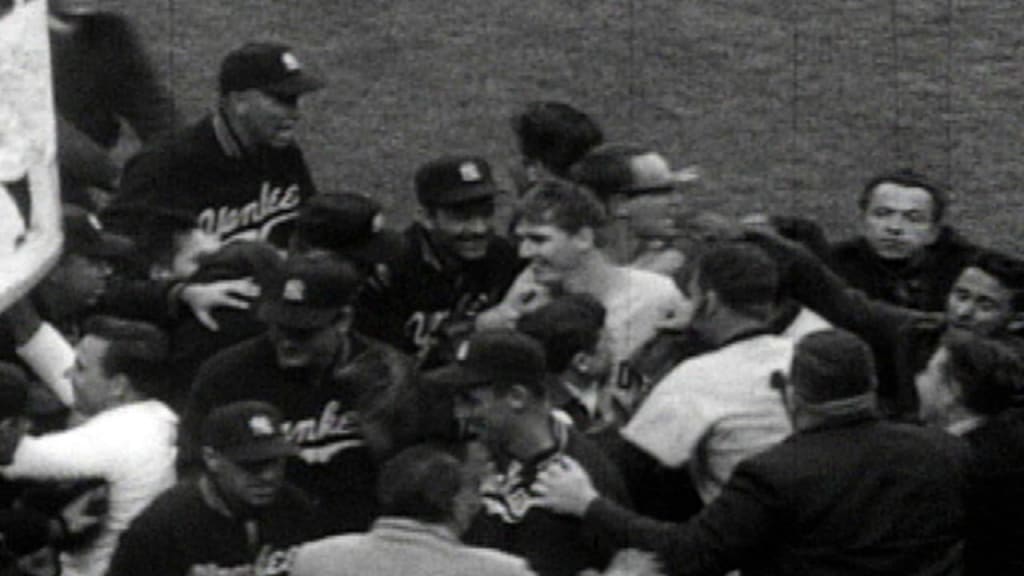
The Yankees' on-field celebration

What no one knows at the time -- not Robinson, not even Dodger owner Walter O'Malley -- is the extent of the finality of this game. It is not just the end of a terrific baseball season. It is the last Subway Series game for 44 years -- 33 years if you count the 1989 "BART Series."
Remember: It's only a Subway Series if it's a World Series. Nobody ever went to a regular-season game between the Brooklyn Dodgers and the New York Giants and called it a "Subway Series." And if they did, they'd be told, by fans of either team, "Go home, you're drunk." (The thought of being on drugs wouldn't have occurred to most baseball fans at the time.)
It is the last home game in a World Series for a National League team from New York for 13 years. And it is the last postseason game that Ebbets Field, or Brooklyn, will ever host. The next season, the Giants will announce they are moving to San Francisco, and the Dodgers will announce they are moving to Los Angeles.
"There's no tomorrow," indeed.
UPDATE: Bobby Richardson turned out to be the last surviving member of the 1956 World Champion New York Yankees.

*

October 10, 1956 was a Wednesday. There were no other scores on this day: Football was in midweek, the NHL season started the next day, and the NBA season started 17 days later.

This was, however, the day the film Giant premiered, starring Rock Hudson, Elizabeth Taylor and, in his last role, James Dean. 

December 31, 1999 & January 1, 2000: The Millennium

December 31, 1999:  The Millennium arrives. The people of planet Earth survived. At a terrible cost. But we hadn't destroyed ourselves. ...