Showing posts with label oakland athletics. Show all posts

Saturday, December 31, 2022

December 31, 1974: The Yankees Hook a Catfish

December 31, 1974: The era of baseball free agency begins, as the Yankees "hook a Catfish."

James Augustus Hunter was signed out of Perquimans High School in North Carolina by the Kansas City Athletics on June 8, 1964. Team owner Charles O. Finley thought "Jim Hunter" was too ordinary a name, and that he needed a nickname. Charlie asked "Jimmy" (as he was always known to his family) what he liked to do. Jim said he liked to hunt and fish, a common pair of passions for baseball players from rural areas in those days.

So Finley made up a story about how, when he was a boy, Jimmy caught a whole bunch of catfish, and that he had been nicknamed "Catfish Hunter" -- or, sometimes, just "Cat" -- from then on. Of course, no one had ever called him "Catfish" -- or "Cat" -- until June 8, 1964.

Hunter made his debut with the A's in 1965. In 1966, he made the 1st of what turned out to be 8 All-Star Games. The A's moved to Oakland in 1968. That season, Catfish pitched a perfect game. He helped them win the American League Western Division in 1971, and the World Series in 1972, 1973 and 1974. He won the AL Cy Young Award in 1974, leading in both wins (he went 25-12) and ERA. That year, despite Tom Seaver, Steve Carlton, Jim Palmer and Nolan Ryan all being in their prime, he was the best pitcher in baseball.

Charlie Finley was so cheap! (How cheap was he?) He was so cheap, he let the best pitcher in baseball get away because he refused to fulfill a part of the man's contract. The contract that Catfish signed for 1974 was for 2 years -- unusual under the still-holding reserve clause -- for $200,000, or $100,000 per year, which, while no longer a record, was still a benchmark for ballplayers.

But not all of that was salary: The contract stipulated that, in 1974 and again in 1975, Finley would make a $50,000 payment to a life insurance annuity. Since Finley had become rich selling insurance, he should have not only understood this, but respected this.

But after the 1974 season, Finley found out he had to pay $25,000 in taxes, due immediately. (Worth about $148,000 in 2022 money.) So he refused to pay the annuity. Catfish, who had been trying to secure his family's post-baseball future, was normally a very even-tempered man, which helped him a lot while pitching. Over this, though, he hit the roof, and appealed to Peter Seitz, Major League Baseball's arbitrator for contract disputes.

On December 16, 1974, foreshadowing the decision he would make a year later, killing the reserve clause, Seitz ruled in Catfish's favor: He was now a free agent, and the 24 teams then in Major League Baseball were all permitted to bid for his services for 1975 and beyond.

Suddenly, the small town of Hertford, in the Inner Banks of North Carolina, a small town of about 2,000 people, 60 miles south of the Class AAA city of Norfolk, Virginia, became the center of the baseball world. Every team, except the San Francisco Giants, bid for Catfish.

The winning bid came from the New York Yankees. Although team owner George Steinbrenner was suspended from operating the team until the 1976 season, general manager Gabe Paul had his permission to offer Catfish $3.35 million over 5 years -- $670,000 per season, a record at the time. (In today's money, about $3.98 million per year. How quaint that now sounds.)

Catfish actually refused 2 higher bids: From the San Diego Padres, because he was tired of being on the opposite coast from home; and from the Kansas City Royals, because he wanted to play on real grass, and Royals Stadium had artificial turf. (In 1993, that stadium was given both real grass and a new name, Kauffman Stadium, both of which it still has.)

To put the figure in perspective: The player who was paid the most for the 1974 season was Hank Aaron, MLB's new all-time home run leader: $240,000. (About $1.42 million in 2022 money.) Catfish's contract had broken the barriers of $250,000 (a quarter of a million), $300,000, $400,000, $500,000 (half a million) and $600,000.

Catfish struggled at first in 1975, losing his 1st 3 games. In fact, his debut, on April 8, 1975, was also Frank Robinson's 1st game as baseball's 1st black manager, and he hit a home run off Catfish to give the Cleveland Indians the win. But Catfish settled down, and went 23-12. It was his 5th straight season of at least 21 wins.

But all that pitching began to wear on his arm. He went just 17-15 in 1976, still helping the Yankees win the Pennant. He was injured for much of the 1977 and 1978 seasons, but a procedure on his shoulder allowed him to win 6 straight games down the stretch in 1978. After being hit hard in Game 2 of the 1977 World Series, but the Yankees won the Series anyway, Catfish won the clinching Game 6 of the 1978 World Series.

After the 1979 season, the 5th and last year of his contract, Catfish retired. He had always intended to, but his bad shoulder took the decision out of his hands. His final record was 224-166. After that season, the Houston Astros signed Ryan to the 1st contract to break the $1 million-per-season barrier.

Jim "Catfish" Hunter was elected to the Baseball Hall of Fame in 1987. Charlie Finley has never been elected. Then again, neither have George Steinbrenner, Gabe Paul and Peter Seitz.

Catfish died in 1999, like Lou Gehrig from amyotrophic lateral sclerosis, the disease now named for Gehrig.

For the 2023 season, the New York Mets will pay Max Scherzer and Justin Verlander, 2 pitchers whose statistics will make them sure Hall-of-Famers if they don't do anything stupid like Pete Rose did, record salaries of $43,333,333 each. In 1974, that would have been $7.1 million, or 10.6 times Catfish Hunter's former record salary.

*

December 31, 1974 was a Tuesday. Baseball was out of season. The NFL was in midweek. No college football bowl games were played that day. No NBA games were played. One game was played in the American Basketball Association: The San Antonio Spurs beat the Indiana Pacers, 140-105 at the HemisFair Arena in San Antonio. Despite that high score, the leading scorer for the Spurs was George Gervin: "The Iceman" scored 27.

Two games were played in the NHL. The Detroit Red Wings beat the California Golden Seals, 4-3 at the Olympia Stadium in Detroit. And the Los Angeles Kings beat the Chicago Black Hawks, 3-1 at the Chicago Stadium.

And 2 games were played in the World Hockey Association. The Chicago Cougars beat the Cleveland Crusaders, 4-3 at The Coliseum in the Cleveland suburb of Richfield, Ohio. And a 1-1 tie was played between the Phoenix Roadrunners and the Michigan Stags, at Cobo Hall in Detroit.

Tuesday, November 29, 2022

November 29, 1971: The Trade That Made the Big Red Machine

November 29, 1971: The Cincinnati Reds trade 1st baseman Lee May, 2nd baseman Tommy Helms and utility player Jimmy Stewart to the Houston Astros for 2nd baseman Joe Morgan, center fielder César Gerónimo, outfielder Ed Armbrister, utility player Denis Menke and pitcher Jack Billingham.

May was a power-hitting All-Star, and gave the Astros 3 strong seasons before they foolishly traded him to the Baltimore Orioles. Helms, a former National League Rookie of the Year, a 2-time All-Star and a 2-time Gold Glove, gave the Astros 3 decent seasons, but stopped hitting in his 4th. Stewart stopped hitting, and only played 2 more seasons in the major leagues. Still, getting May in the trade meant that the Astros were not exactly robbed.

If Morgan had gotten hurt and done nothing for the Reds, this would still have been a good trade for them. Menke didn't do much for them, but Billingham was a good starting pitcher, Gerónimo won 4 straight Gold Gloves as their center fielder and even batted .307 in 1976, and Armbrister was a key reserve, famously involved in the play that won Game 3 of the 1975 World Series.

But Morgan became perhaps the best all-around player in baseball, the sparkplug of what had already been known since the 1970 season as "The Big Red Machine." In 1972, he led the NL in walks, on-base percentage and runs scored, and helped the Reds win the Pennant. In 1975 and 1976, he helped them win the World Series, and was named the NL Most Valuable Player both times. In the top of the 9th inning of Game 7, his RBI single was the Series' winning run. He stole 689 bases in his career, 406 of them in his 8 seasons with Cincinnati. He also surpassed Helms by winning 5 straight Gold Gloves.

Unfortunately for Reds fans, their team had a cheap organization, and when his contract ran out after the 1979 season, they didn't try to re-sign him. He went back to the Astros, and helped them win the 1980 NL Western Division title. He was elected to the Baseball Hall of Fame in his 1st year of eligibility.

On this same day, another big trade was made: The San Francisco Giants, coming of a season in which they beat the Reds out for the NL West title, traded their best pitcher, Gaylord Perry, to the Cleveland Indians for their best pitcher, Sam McDowell.
Sam McDowell

It would be a huge mistake: "Sudden Sam" had succeeded Sandy Koufax as baseball's top strikeout artist, but his drinking was out of control, and he was out of the major leagues 3 1/2 years later, only 32 years old. He beat his problem to become one of baseball's foremost substance-abuse counselors.
Gaylord Perry

Perry won the American League's Cy Young Award in 1972, but the Indians made the trade less consequential than it could have been by letting him go too soon, probably for the same reason they traded McDowell: Salary concerns, as the Indians were always short on cash. In 1978, with the San Diego Padres, Perry won the NL's Cy Young Award, becoming the 1st man to win it in both Leagues. McDowell had been considered a possibility to join the 300 Wins and 3,000 Strikeouts Clubs, and the Baseball Hall of Fame. Perry actually did join them.

Two dumb trades in one day. Do I hear three? The Chicago Cubs traded pitcher Ken Holtzman to the Oakland Athletics for center fielder Rick Monday. Holtzman helped the A’s win 3 straight World Series, and Monday did little for the Cubs, until they traded him to the Los Angeles Dodgers.

*

November 29, 1971 was a Monday. Baseball was out of season. No NBA, ABA or NHL games were scheduled. On ABC Monday Night Football, the Miami Dolphins beat the Chicago Bears, 34-3 at the Orange Bowl in Miami.

Saturday, October 22, 2022

October 22, 1972: The "Hairs" Beat the "Squares"

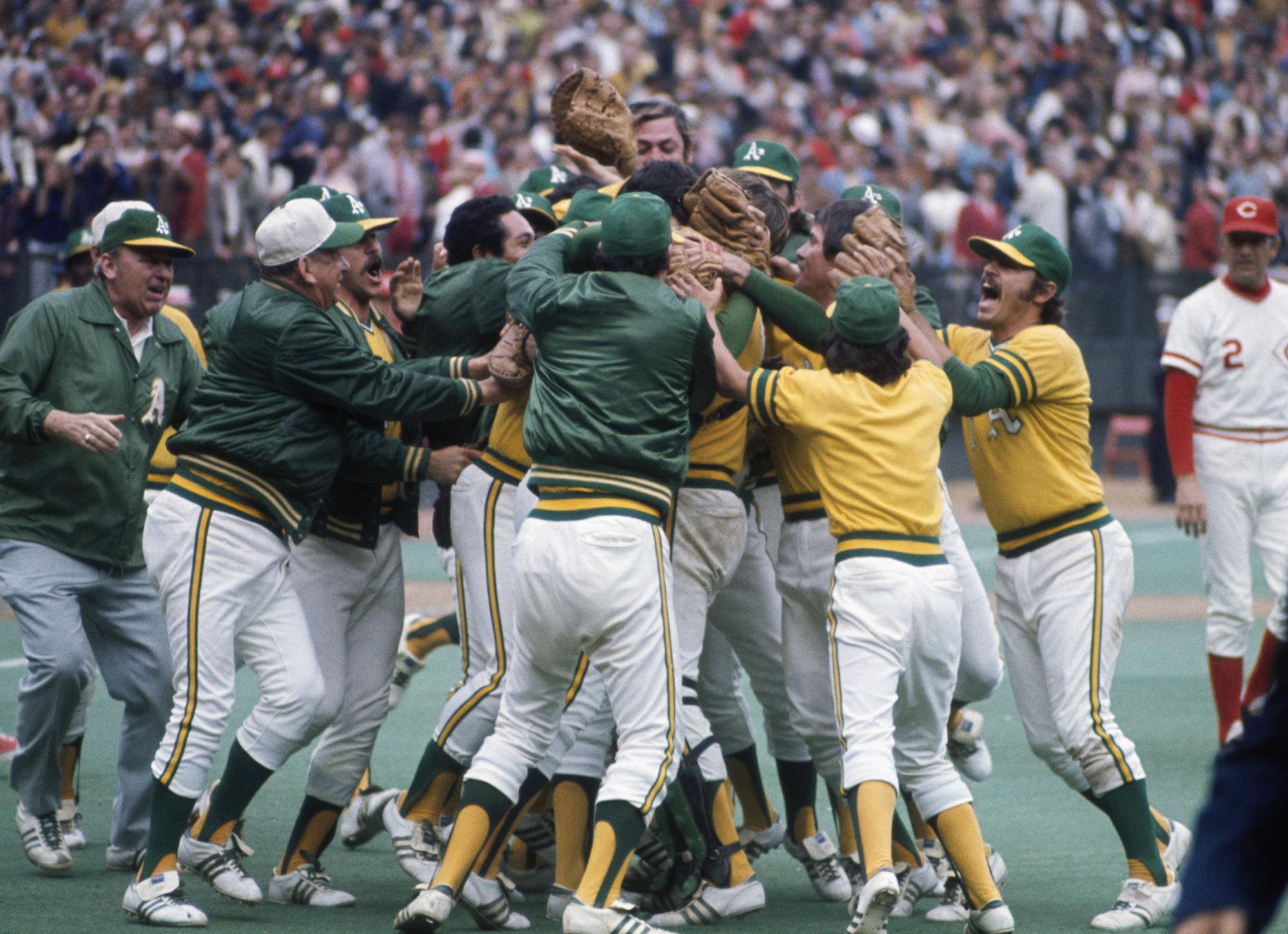
October 22, 1972: Game 7 of the World Series is played at Riverfront Stadium in Cincinnati. It is not just a baseball clash, but a culture clash.

The Cincinnati Reds, as their name implies, were dressed simply: White uniforms at home, gray ones on the road, and red lettering. Managed by George "Sparky" Anderson, with stars such as left fielder Pete Rose, catcher Johnny Bench, 1st baseman Tony Pérez and 2nd baseman Joe Morgan, and a bullpen led by Clay Carroll, whose 37 saves had just set a new major league record (which lasted all of 1 year), "The Big Red Machine" were dominant. They had won the National League Pennant in 1970, losing the World Series to the Cincinnati Reds. Now, they had won the Pennant again, and were ready to take the title.

The Reds were clean-cut, and clean-shaven. Nothing unusual about that in baseball at the time: The sport has often seemed to be 10 years behind the rest of the country. But until the 21st Century, the Reds had a rule banning facial hair. They were good, but not flashy. Appropriate for Cincinnati, one of the most conservative cities in the country. Good for southern Ohio and southern Indiana on one side of the Ohio River. Good for the actually-Southern State of Kentucky and the quasi-Southern State of West Virginia on the other side.

The Oakland Athletics -- "A's" for short -- were not designed to appeal to "Middle America." Insurance tycoon Charles Oscar Finley saw to that when he bought the team in 1960, while they were still in Kansas City, the major city closest to the geographic center of "the 48 Contiguous States." Finley changed the team's colors from their traditional red, white and blue to what he termed "Kelly Green, Wedding Gown White and Fort Knox Gold." After looking into the ideas of Louisville, Dallas and Denver, he moved them to Oakland in 1968.

By that point, he already had some of the players who would dominate the American League Western Division in the early days of Divisional Play. In Spring Training in 1972, with the rest of the world having gotten used to men letting their hair grow long, and growing facial hair, Finley saw his best player, slugging right fielder Reggie Jackson, grow a mustache.

Instead of fining him for not "looking like a big-league ballplayer," he used reverse psychology: He offered a $300 bonus to every player who grew a mustache by Opening Day. He figured, if everybody did it, it would no longer be an act of rebellion, and they'd stop. The move backfired, and Finley, famously cheap, had to pay nearly everybody on the team $300 -- about $2,100 in 2022 money -- at a time when the average salary was about $34,000 (or $238,000 today).

Most notable was the 19th-Century-style "handlebar" mustache worn by the Oakland relief ace, Rollie Fingers. He would end his career in 1986 with 341 saves, more than any pitcher to that point. Ironically, the reason he retired is that the only team willing to offer him a contract -- he was 39 years old at the time -- was the Reds, and they insisted that he shave off the mustache, which had become his trademark. He wouldn't do it, and hung up his cleats.

Both teams needed to go the full 5 games in their League Championship Series. The Reds trailed the Pittsburgh Pirates in the bottom of the 9th, but Bench hit a game-tying home run, kept it going, and then Bob Moose threw a wild pitch that scored George Foster with the Pennant-winning run. (This turned out to be the last game for Pirates' star Roberto Clemente.)

The A's played the Detroit Tigers, and won, but lost Jackson to a torn hamstring as he scored the winning run in Game 5. They would have to go into the franchise's 1st World Series in 41 years -- since 1931, when they were the Philadelphia Athletics -- without their best player.

In Game 1, at Riverfront, A's catcher Gene Tenace hit home runs in his 1st 2 World Series at-bats, which had never been done before. The A's won, 3-2. In Game 2, Joe Rudi hit a home run, and made a spectacular catch in left field off a drive by Denis Menke. Despite a Reds comeback in the 9th, the A's hung on to win, 2-1.

Just when it looked like the Reds would be utterly humiliated, they waited out a one-day rain delay, and won Game 3 at the Oakland Coliseum, 1-0. The only run came in the top of the 7th inning, when César Gerónimo singled Pérez home. The Reds won despite Bench getting fooled on a trick play in the 9th: After Bobby Tolan stole 2nd base on a pitch that made the count 3-and-2, manager Dick Williams went to the mound for conference. It then appeared that Williams had ordered Fingers to intentionally walk Bench. But after Tenace motioned for the outside ball 4, Fingers threw a strike on the outside corner, and Bench was out.

The Reds led Game 4, 2-1 with 1 out in the bottom of the 9th. But Gonzalo Márquez singled, Tenace did the same, Don Mincher added another that scored pinch-runner Allan Lewis, and Ángel Mangual singled Tenace home with the winning run, 3-2.

The A's looked to close it out in Game 5, at home. They led 3-1 after 2 innings, 4-2 after 4, and were still up 4-3 after 7, thanks to Tenace's 4th home run of the Series. That tied a Series record, which would be broken in 1977, by Reggie Jackson. But the Reds tied it in the 8th, and won it in the 9th, 5-4. The winning run was singled home by Rose, who had homered earlier.

Back in Cincinnati, the Reds won Game 6, 8-1, and tied the Series. Game 7 was Catfish Hunter against Jack Billingham. Tolan's error on a Mangual fly ball gave the A's a 1-0 lead in the 1st. The Reds tied it in the 5th on a sacrifice fly by Hal McRae. But in the 6th, Sparky Anderson replaced an exhausted Billingham with Pedro Borbón, who gave up RBI doubles to Tenace and Bando. The Reds scored a run in the 8th, but couldn't find a tying run, and the A's won, 3-2.

The A's had won their 1st World Championship in 42 years, since the 1930 Philadelphia team. Tenace‚ who had only 5 homers in the regular season, had 4 in the Series‚ and was named the Series' Most Valuable Player.

The Reds eventually won the World Series in 1975 and 1976, and won more games in the decade than the A's. They win 4 Pennants and 6 Division Titles in the decade, to the A's' 3 Pennants and 5 Division Titles. For these reasons, their surviving players are convinced that they, not the A's, were the team of the decade.

However, the A's won 3 World Series in a row, something not achieved by any other franchise in baseball history except for the New York Yankees. What's more, in the one head-to-head matchup between the A's and the Reds, the A's won, winning 3 of the 4 games in Cincinnati, including the clincher, and doing so without their best player, Reggie Jackson, who was injured in the American League Championship Series clincher. So there can be no doubt that the A's were the Team of the Seventies.

Besides, neither team was the one that won the most games in the decade: It was the Baltimore Orioles who did that, while winning 5 Division Titles and 3 Pennants, but only 1 World Series.

It would take until 1990 for the Reds to get revenge on the A's.

Having a fascinating (if occasionally controversial) history, even if you only count the Oakland years, the A's have had several books written about them, although they don't always put the team in a good light. The ones about the "Swingin' A's" of the 1970s invariably mention Finley's successes and excesses, including his cheapness and pettiness. And the players often don't come off much better in these books.

These books include Bruce Markusen's 2002 A Baseball Dynasty: Charlie Finley's Swingin' A's; Roger D. Launius and G. Michael Green's 2010 Charlie Finley: The Outrageous Story of Baseball's Super ShowmanFinley Ball: How Two Baseball Outsiders Turned the Oakland A's Into a Dynasty and Changed the Game Forever, by Nancy Finley, daughter of Charlie's cousin Carl, who was also involved with the team; and Jason Turbow's Dynastic, Bombastic, Fantastic: Reggie, Rollie, Catfish, and Charlie Finley's Swingin' A's.

In 2016, Ed Gruver published Hairs vs. Squares: The Mustache Gang, the Big Red Machine, and the Tumultuous Summer of '72, which culminates in the World Series between the A's and the Cincinnati Reds. Matthew Silverman wrote Swinging '73: Baseball's Wildest Season, and John Rosengren wrote Hammerin' Hank, George Almighty and the Say Hey Kid: The Year That Changed Baseball Forever, whose cover includes a photo of Reggie Jackson at Yankee Stadium -- the pre-renovation Stadium, and he's wearing an A's uniform.

*

October 22, 1972 was a Sunday. Gordon Banks crashed his Ford Consul into an Austin A60 van in Stoke-on-Trent, Staffordshire, England, and ended up in a ditch. He needed over 300 stitches on his face, and lost the sight in his right eye. The goalkeeper who had helped Stoke City win its 1st (and still only) major trophy the season before, the League Cup, and had backstopped the England team that won the 1966 World Cup, retires at the end of the season. He briefly came back to play in America for the Fort Lauderdale Strikers, but never played in Europe again.

Also on this day, Arthur Agee Jr. (no middle name) is born in Chicago. Along with William Gates, he was the focus of the documentary Hoop Dreams. He attended St. Joseph High School in the Chicago suburb of Westchester, Illinois, as had his hero, Detroit Pistons star Isiah Thomas. But it was too expensive for his parents, and he transferred to John Marshall High School in the city, winning the 1991 Public League Championship.

He played at Arkansas State, but never professionally. He now runs the Arthur Agee Role Model Foundation, "to help underprivileged kids to understand that their role models are not professional athletes, but their parents at home."

Gates -- no relation to legendary basketball coach William "Pop" Gates, and definitely not to Bill Gates -- stayed at St. Joseph, played at Marquette University in Milwaukee, also fell short of playing pro ball, and is now a minister outside San Antonio. His son, William Gates Jr., now plays basketball at Furman University in South Carolina. Neither man's hoop dream came true, but both are doing a lot of good now.

Being a Sunday, there were NFL games:

* The New York Giants beat the St. Louis Cardinals, 27-21 at Yankee Stadium.

* The New York Jets beat the Baltimore Colts, 24-20 at Shea Stadium. Yes, both New York teams were at home at the same time. (Both games were 1:00 starts.)

* The Washington Redskins beat their arch-rivals, the Dallas Cowboys, 24-20 at Robert F. Kennedy Memorial Stadium.

* The Miami Dolphins beat the Buffalo Bills, 24-23 at the Orange Bowl in Miami.

* The San Francisco 49ers and the New Orleans Saints played to a tie, 20-20 at Candlestick Park in San Francisco.

* The Cleveland Browns beat the Houston Oilers, 23-17 at the Astrodome in Houston.

* The Pittsburgh Steelers beat the New England Patriots, 33-3 at Three Rivers Stadium in Pittsburgh.

* The Detroit Lions beat the San Diego Chargers, 34-20 at Tiger Stadium in Detroit.

* The Atlanta Falcons beat the Green Bay Packers, 10-9 at Milwaukee County Stadium.

* The Philadelphia Eagles beat the Kansas City Chiefs, 21-20 at Arrowhead Stadium in Kansas City.

* The Los Angeles Rams beat the Cincinnati Bengals, 15-12 at the Los Angeles Memorial Coliseum. So, not a good day for Cincinnati sports. And the NBA's Cincinnati Royals couldn't help them, because they'd just moved, becoming the Kansas City-Omaha Kings.

* The Denver Broncos beat the Oakland Raiders, 30-23 at the Oakland Coliseum.

* And, the next night, on ABC Monday Night Football, the Chicago Bears beat the Minnesota Vikings, 13-10. Metropolitan Stadium in the Minneapolis suburb of Bloomington, Minnesota.

There were 3 games in the NBA:

* The Milwaukee Bucks beat the Cleveland Cavaliers, 104-84 at the Cleveland Arena.

* The Los Angeles Lakers beat the Chicago Bulls, 104-99 at The Forum outside Los Angeles in Inglewood, California. Jerry West scored 35 points.

* And the Seattle SuperSonics beat their arch-rivals, 120-119 in overtime at the Seattle Center Coliseum.

There was 1 game in the American Basketball Association: The New York Nets beat the Utah Stars, 119-116 at the Nassau Coliseum.

There were 5 games in the NHL:

* The New York Rangers and the Montreal Canadiens played to a tie, 1-1 at Madison Square Garden.

* The Vancouver Canucks beat the Boston Bruins, 5-4 at the Boston Garden.

* The Buffalo Sabres beat the Atlanta Flames, 7-2 at the Buffalo Memorial Auditorium.

* The Detroit Red Wings beat the Toronto Maple Leafs, 6-2 at the Olympia Stadium in Detroit.

* The Chicago Black Hawks beat the California Golden Seals, 4-2 at the Oakland Coliseum Arena.

* And the New York Islanders, the Philadelphia Flyers, the Pittsburgh Penguins, the Minnesota North Stars, the St. Louis Blues and the Los Angeles Kings were not scheduled.

And there were 4 games in the World Hockey Association:

* The New York Raiders lost to the Minnesota Fighting Saints, 5-4, as Madison Square Garden hosted both an NHL game and a WHA game on the same day.

* The Ottawa Nationals beat the Quebec Nordiques, 3-2 at the Colisée de Québec.

* The Winnipeg Jets beat the Philadelphia Blazers, 6-3 at the Winnipeg Arena.

* And the Chicago Cougars beat the Los Angeles, Sharks, 4-2 at the Los Angeles Sports Arena.

Thursday, October 20, 2022

October 20, 1990: The Not-So-Big Red Machine Upsets the Bash Brothers

October 20, 1990: One of the most stunning upsets in World Series history is completed. The Cincinnati Reds beat the Oakland Athletics, 2-1 at the Oakland Coliseum, completing a 4-game sweep of the World Series, a tremendous upset.

The teams had faced each other in the Series in 1972, when, despite losing their best player, Reggie Jackson, to injury, the A's beat the "Big Red Machine" in 7 games. But with an offense led by the "Bash Brothers," Jose Canseco and Mark McGwire, and a pitching staff led by ace Dave Stewart and reliever Dennis Eckersley, the A's had won their 3rd straight American League Pennant. They had lost the 1988 World Series in an upset by the Los Angeles Dodgers, but beaten their cross-Bay neighbors, the San Francisco Giants, in the earthquake-interrupted 1989 edition.

The Reds had won the NL Western Division 6 times in the 1970s, winning 4 Pennants and 2 World Series. But the team was broken up. From 1985 to 1988, with team legend Pete Rose returning as manager, they finished 2nd 4 straight seasons. No Central Division at the time, and no Wild Card berths. Rose was permanently banned the next season, for betting on baseball games, and was replaced by former New York Yankees player and manager Lou Piniella.

The Reds won their 1st 9 games in 1990, and held the lead in the NL West the entire way. The horse racing expression "led wire-to-wire" was frequently used. Nevertheless, they were considered underdogs in the NL Championship Series against the Pittsburgh Pirates. They won in 6 games, anyway.

In the AL Championship Series, the A's swept the Boston Red Sox in 4 straight. They were the easy betting favorites for this World Series, and some people were predicting a 4-game sweep. They got one, but not in the direction they expected. They didn't count on the hitting of Reds shortstop Barry Larkin, of 3rd baseman Chris Sabo, and of outfielders Eric Davis and Billy Hatcher. They didn't count on the starting pitching of José Rijo. And they didn't count on the three-headed monster of the Cincinnati bullpen, known as the Nasty Boys: Rob Dibble, Randy Myers and Norm Charlton.

In Game 1, at Riverfront Stadium in Cincinnati, Rijo pitched 7 shutout innings, outpitching Stewart, and was backed by a home run from Davis. The Reds won, 7-0. Game 2 went to extra innings, and, in the bottom of the 10th, Eckersley gave off 3 straight singles to lose it, to Billy Bates, Chris Sabo and Joe Oliver.

The action moved to Oakland for Game 3, and the same observers who had predicted an A's sweep now predicted that the A's would use home field to their advantage, and take control of the Series. They should have predicted that Chris Sabo would hit 2 home runs, in support Tom Browning, whose wife had a baby in between the games. The Reds scored 7 runs in the 3rd inning, and won, 8-3.

Game 4 was a rematch of Game 1, and while Stewart was considerably better than he was then, Rijo was strong again. The A's led 1-0 after 7 innings, and both Davis and Hatcher were injured. In the top of the 8th, Larkin singled, Herm Winningham beat out a bunt for a hit, and Stewart made a throwing error to allow Paul O'Neill to reach, loading the bases. A groundout by Glenn Braggs and a sacrifice fly by Hal Morris scored the runs the Reds would need to win the game. They had gotten 2 runs on only 2 hits. Myers saved the game for Rijo, who was named the Series' Most Valuable Player.

Neither team has reached the World Series since. The Reds have won 9 National League Pennants, while the A's, in Philadelphia and Oakland combined, have won 15 American League Pennants. But neither has won any from 1991 to 2022.

UPDATE: The Cincinnati Reds have won Division titles in 1995, 2010, 2012; and Wild Card berths in 2013, 2020 and 2025; but haven't won so much as a postseason series since the 1995 NL Division Series. But at least they still exist: After so many threats to move out of the San Francisco Bay Area, the Athletics moved to Sacramento in 2025, with the intent of using that only as a stopgap home until their domed stadium in Las Vegas is ready in 2028.

The Reds have a team Hall of Fame. Elected from this 1990 World Championship team have been 2nd baseman Ron Oester, shortstop Barry Larkin, 3rd baseman Chris Sabo, left fielder George Foster, center fielder Eric Davis; pitchers Tom Browning, José Rijo; manager Lou Piniella, and broadcasters Joe Nuxhall and Marty Brennaman.

From their 1979 NL Western Division title, but no other titles, their Hall has inducted pitchers Tom Seaver and Mario Soto. From their 4 straight 2nd-place finishes from 1985 to 1988, but not the 1979 or the 1990 postseason appearances, they have inducted right fielder Dave Parker.

From their 1995 Division Champions, they have inducted Larkin, Rijo, and outfielder Reggie Sanders. From the 2000s, but not either the 1995 or the 2010 postseason appearances, they have inducted center fielder Ken Griffey Jr., 1st baseman Sean Casey, left fielder Adam Dunn, and pitcher Danny Graves. From their 2010 Division title, they have inducted 2nd baseman Brandon Phillips and pitchers Aaron Harang and Bronson Arroyo.

*

October 20, 1990 was a Saturday. The NBA season wouldn't begin for another 13 days. There were 8 games played in the NHL:

* The New York Rangers beat the Pittsburgh Penguins, 4-3 at the Civic Arena in Pittsburgh.

* The New York Islanders lost to the Buffalo Sabres, 3-1 at the Nassau Coliseum.

* The New Jersey Devils lost to the Washington Capitals, 4-0 at the Capital Centre in the Washington suburb of Landover, Maryland.

* The Quebec Nordiques beat the Detroit Red Wings, 5-3 at the Colisée de Québec.

* The Philadelphia Flyers beat the Montreal Canadiens, 5-3 at the Montreal Forum.

* The Toronto Maple Leafs beat the Chicago Blackhawks, 6-2 at Maple Leaf Gardens in Toronto.

* The Minnesota North Stars and the St. Louis Blues played to a tie, 2-2 at the St. Louis Arena.

* The Calgary Flames beat the Boston Bruins, 8-1 at the Saddledome in Calgary.

And there were college football games, including the following:

* Number 1 Virginia beat Wake Forest, 49-14 at Groves Stadium in Wake Forest, North Carolina. The next week, Virginia began an awful collapse, losing 4 of their last 5 games, and blowing the Atlantic Coast Conference title. They were still invited to the Sugar Bowl.

* Number 2 Miami were upset by Number 6 Notre Dame, 29-20 at Notre Dame Stadium in South Bend, Indiana. The Fighting Irish later lost to Penn State, but were still Number 5 when they played Colorado in the Orange Bowl. Had they won that game, they wouldn't have been awarded the National Championship -- then again, it's Notre Dame, so you never know -- but Colorado certainly wouldn't have, being 8-2-1.

* Number 3 Tennessee lost to Alabama, 9-6 at Neyland Stadium in Knoxville, Tennessee. Tennessee still won the Southeastern Conference title, and beat Virginia in the Sugar Bowl. Alabama went to the Fiesta Bowl, losing to the University of Louisville.

* Number 4 Nebraska beat Oklahoma State, 31-3 at Memorial Stadium in Lincoln, Nebraska. Two weeks later, Nebraska lost to Colorado, to knock them out of the Big 8, and national, title picture.

* Number 5 Auburn beat Number 7 Florida State, 20-17 at Jordan-Hare Stadium in Auburn, Alabama. But the Tigers blew their chance by losing 3 games the rest of the way.

* Number 10 Michigan were upset by Number 22 Iowa, 24-23 at Michigan Stadium in Ann Arbor. Iowa went on to win the Big Ten Conference title.

* Number 11 Georgia Tech were tied by North Carolina, 13-13 at Kenan Stadium in Chapel Hill, North Carolina. This would turn out to be the only blemish on Tech's record, as they won the Atlantic Coast Conference title, and beat Nebraska in the Citrus Bowl, finishing 11-0-1.

* Number 13 Washington beat Stanford, 52-16 at the old Stanford Stadium in the San Francisco suburb of Palo Alto, California. Washington won the Pacific-Ten Conference title, and beat Iowa in the Rose Bowl.

* Number 14 Colorado beat Kansas, 41-10 at Memorial Stadium in Lawrence, Kansas. Colorado had already had their "Fifth Down" win over Missouri, and went on to win the Big Eight title, and beat Notre Dame in the Orange Bowl, to win one of the more dubious National Championships in college football history.

Why weren't Georgia Tech, at 11-0-1, the only undefeated team in the country, and a school with a considerably better historical legacy than Colorado, given the National Championship over Colorado, who were 11-1-1 and should've been 10-2-1?

The only thing I can think of is, the ACC, while probably the most-respected league when it comes to college basketball, were not as respected in college football as the Big 8 (Colorado's league), the Big 10, the Pac-10, the SEC and the SWC. Then again, in 1984, Brigham Young (BYU) won the Western Athletic Conference title and were the only undefeated team, and were selected over Washington (11-1 and the only team with 1 blemish, but not Pac-10 Champions).

* Number 16 Oklahoma lost to Iowa State, 33-31 at Owen Field in Norman, Oklahoma.

* Number 17 Florida beat Akron, 59-0 at Ben Hill Griffin Stadium in Gainesville, Florida.

* Number 19 Texas beat Arkansas, 49-17 at Memorial Stadium in Austin, Texas. They got up to Number 3 before losing to then-Number 4 Miami in the Cotton Bowl. And they'd already lost to Colorado on September 22. So even if they'd won the Cotton Bowl, they probably wouldn't have been ranked any higher than 3rd in the last poll.

This was also the day that a game in English soccer's football league got nasty and launched a rivalry, with North London team Arsenal beating Manchester United, 1-0 at United's home, Old Trafford. I have a separate entry for that event. 

October 20, 1973: The Saturday Night Massacre

October 20, 1973: The Sydney Opera House, Australia's most famous structure, opens. The Rolling Stones hit Number 1 on the U.S. singles charts with "Angie." The Six Million Dollar Man premieres on ABC, starring Lee Majors as astronaut-turned-bionic-federal-agent Steve Austin. (Definitely not to be confused with the Stone Cold "professional wrestler" using the same name.)

But the big story of the day is political, in the growing scandal known as Watergate, which began on June 17, 1972, with a break-in at the offices of the Democratic National Committee in Washington, perpetrated by 5 men working for the committee working to re-elect President Richard Nixon.

Whether Nixon knew about the break-in beforehand and authorized it has never been established, but he worked like crazy to cover it up. On July 16, 1973, it was revealed that there was a tape-recording system in the Oval Office at the White House, and that these tapes could prove Nixon guilty -- or, perhaps, prove him innocent; or, at least, provide enough reasonable doubt as to get him acquitted of any criminal charges.

On August 29, John Sirica, the Chief Judge of the United States District Court for the District of Columbia, ordered Nixon to turn the tapes over. Time magazine would name Sirica its Man of the Year for 1973.
On October 19, in an effort to get away with whatever he did that was recorded on those tapes, Nixon offered Congress a compromise: He would allow Senator John Stennis to review the tapes, and present Special Prosecutor Archibald Cox with summaries.

On this day, Cox publicly refuses to accept this compromise. He knows that Stennis is not only a conservative from Mississippi and a supporter of Nixon's -- he's a conservative Southern Democrat, a.k.a. a "Dixiecrat," and no friend of mainstream Democrats -- but also 72 years old and hard of hearing. If those tapes reveal that Nixon committed an impeachable offense, Stennis might not hear it properly. And even if he does, he might refuse to admit it to Cox, and claim his poor hearing caused him to miss it. Cox isn't buying it, and has enough guts to press onward.

Nixon decides that, in order to survive as President, he has to fire Cox -- whom he had never fully trusted, as Cox had been Solicitor General under President John F. Kennedy and an old friend of JFK's, and thus a partisan Democrat.

So he instructs his Attorney General, Elliot Richardson (in the photo on the right on that Daily News front page), the man who had hired Cox and had the power to fire him, to fire him. Richardson refuses, because he thinks it will spark a Constitutional crisis. Nixon says do it or you're fired. Richardson does the honorable thing, and resigns his post.

So Nixon goes to the next man in line, Richardson's Deputy Attorney General, William Ruckelshaus.  He tells Ruckelshaus to fire Cox. He refuses. Nixon says do it or you're fired. Ruckelshaus still refuses, but does not resign. Nixon fires him.

So with the top 2 men in the U.S. Department of Justice now gone, Nixon goes to the Number 3 man, the Solicitor General, and tells him to fire Cox. He does, because he values Nixon more than he values the Constitution.

Word quickly gets out, and the Washington press corps quickly dubs these events "The Saturday Night Massacre." People wake up the next morning to bold headlines in their Sunday papers. The Sunday morning news shows, NBC's Meet the Press, CBS' Face the Nation, and ABC's Issues and Answers (the predecessor program to This Week), can talk about nothing else.

The pressure on Congress to begin impeachment proceedings against Nixon vastly increases. And, with the Vice Presidency vacant, as Spiro Agnew has resigned and Gerald Ford has not yet been confirmed by either house of Congress as the new VP, the next man in line is the Speaker of the House of Representatives, Carl Albert -- a Democrat, and, while from a Southern State, Oklahoma, considerably more liberal than Stennis.
Carl Albert

If Nixon had died, were impeached by the House and removed by the Senate, or were pressured into resigning, or had the 25th Amendment invoked by his Cabinet and removed that way, and Albert were still next in line at the time, it would have been a political earthquake, much bigger than the end of Nixon's Presidency actually turned out to be.

Within days, Nixon realizes what a blunder he has committed, and tells the Acting Attorney General to appoint a new Special Prosecutor. That man would be Leon Jaworski. By December 6, Ford would be confirmed by both houses and sworn in as Vice President, and the danger of Nixon being impeached and removed, and replaced by a President of the other party, was gone, and things calmed down in Watergate -- for a while.

There would be ramifications, of course -- some lasting much longer than the Nixon Administration itself. In 1987, President Ronald Reagan appointed that same former Acting Attorney General to the U.S. Supreme Court, as his judicial views fit the archconservative vision that Reagan had for the country. But his role in the Saturday Night Massacre was held against him -- although it's possible that he might have been rejected by the Senate anyway. His name was Robert Bork. (That's him, in the photo on the left.)

On April 26, 1974, the Yankees traded 4 pitchers to the Cleveland Indians: Fritz Peterson, Fred Beene, Steve Kline and Tom Buskey. Essentially sending away half their pitching staff, this became known as the Friday Night Massacre.

But the trade was necessary: It got rid of 4 pitchers who didn't take the game as seriously as they did their social lives, and it brought in 2 players who would be essential in the Yankees' 1976, '77 and '78 Pennants: 1st baseman Chris Chambliss and pitcher Dick Tidrow. (They also got pitcher Cecil Upshaw, but he was injured, turned out to be a nonfactor, and was traded after the season.)

And on November 2, 1975, Ford, trailing in the polls for the '76 election to both Reagan in the race for the Republican nomination and to a generic Democrat in the general election, "reshuffled" his Cabinet, letting some men go, and moving others to new posts. Among these, he asked Henry Kissinger, who had been both Secretary of State and National Security Advisor for 2 years, to stay at State but resign as NSA. It was 2 days after Halloween, and the media dubbed this the Halloween Massacre.

UPDATE: After campaigning to return to the Presidency in 2024, partly on the lie that the Administration of President Joe Biden had "weaponized the Department of Justice," Donald Trump weaponized it, ordering Attorney General Pam Bondi to go after his political opponents, while giving special treatment to those public figures who went along with him.

He ordered the Acting U.S. Attorney for the Southern District of New York (which includes Manhattan, The Bronx, and the Counties of Westchester, Putnam, Dutchess, Rockland, Orange and Sullivan), Danielle Sassoon, to drop the office's corruption case against Mayor Eric Adams of New York. This was done because Adams, despite being black and a Democrat, had agreed to work with Trump on the "migrant crisis." It was a blatant quid pro quo that, in the past, would have forced both men to resign their offices.

Sassoon, a conservative who had clerked for the late Supreme Court Justice Antonin Scalia, followed the path of Elliot Richardson, and chose to resign rather than carry out Trump's order. She said, in a letter to Bondi, "It is a breathtaking and dangerous precedent to reward Adams's opportunistic and shifting commitments on immigration and other policy matters with dismissal of a criminal indictment." 

Also resigning was the lead prosecutor on the case, Hagan Scotten, who wrote to Emil Bove, the Acting Deputy Attorney General, Bove, saying of the motion to dismiss the charges against Adams, "I expect you will eventually find someone who is enough of a fool, or enough of a coward, to file your motion. But it was never going to me."

*

As Nixon himself would have said, I have made it perfectly clear: October 20, 1973 was a Saturday. Among the major college football games played that day were these:

* Number 1 Ohio State beat Indiana, 37-7 at Memorial Stadium in Bloomington, Indiana.

* Rivalry: Number 2 Alabama beat Number 10 Tennessee, 42-21 at Legion Field in Birmingham.

* Number 3 Oklahoma beat Number 16 Colorado, 34-7 at Owen Field in Norman, Oklahoma.

* Number 4 Michigan beat Wisconsin, 35-6 at Michigan Stadium in Ann Arbor.

* Number 5 Penn State beat Syracuse, 49-6 at Archbold Stadium in Syracuse, New York.

* Number 6 University of Southern California (USC) beat Oregon, 31-10 at the Los Angeles Memorial Coliseum.

* Number 7 Missouri beat Oklahoma State, 13-9 at Faurot Field in Columbia, Missouri.

* Number 8 Notre Dame beat Army, 62-3 at Michie Stadium in West Point, New York.

* Number 9 Louisiana State University (LSU) beat Kentucky, 28-21 at Tiger Stadium in Baton Rouge, Louisiana.

* Number 11 Nebraska beat Number 18 Kansas, 10-9 at Memorial Stadium in Lincoln, Nebraska.

* One ranked team lost to an unranked team: Number 19 Arizona lost to Texas Tech, 31-17 at Arizona Stadium in Tucson.

* Rivalry: Virginia Tech beat Virginia, 27-15 at Lane Stadium in Blacksburg, Virginia.

* Rivalry: Minnesota beat Iowa, 31-23 at Kinnick Stadium in Iowa City.

* Rivalry: Texas beat Arkansas, 34-6 at Razorback Stadium in Fayetteville, Arkansas.

* Navy beat Air Force, 42-6 at Navy-Marine Corps Memorial Stadium in Annapolis, Maryland.

* Yale beat Columbia, 29-0 at Baker Field in Upper Manhattan.

* Rutgers beat Delaware, 24-7 at Rutgers Stadium in Piscataway, New Jersey.

* Princeton beat Colgate, 37-21 at Palmer Stadium in Princeton, New Jersey.

There were no NFL games played that day. But a very big baseball game was played at the Oakland Coliseum: Game 6 of the World Series.

The New York Mets just need to win 1 of the last 2 games against the Oakland Athletics in Oakland, and they will have their 2nd World Championship in 5 seasons -- it has been 11 years since the Yankees went all the way. And Tom Seaver, "The Franchise," is on the mound. What can go wrong?

This can go wrong: Met manager Yogi Berra has sent Seaver out on just 3 days' rest, hoping that "Tom Terrific" can close out the defending World Champions on their own patch, so that no Game 7 will be necessary.

But Reggie Jackson, not yet a New York baseball legend, hits 2 doubles, scores 1 run and knocks in 2. Jim "Catfish" Hunter, also a future Hall-of-Famer and a future New York baseball legend, pitches brilliantly. The A's beat the Mets 3-1. So there will be a Game 7 tomorrow.

To this day, many Met fans are angry at Yogi for starting Seaver on short rest. I'm sure some of them thought of Yogi as a Yankee and hated him for that reason alone. They shouldn't: There are only 5 human beings who have managed the Mets to a Pennant: Yogi, Gil Hodges, Davey Johnson, Bobby Valentine and Terry Collins. And only Johnson, Valentine and Collins are still alive.

There are 8 National Basketball Association games played on this day:

* The New York Knicks do not play like defending World Champions, losing to the Chicago Bulls, 85-69 at Madison Square Garden. Indeed, in the other 7 NBA games played that day, only 1 other team scored fewer than the Bulls' 85, but that 85 was enough to win this game.

* The Capital Bullets play their 1st home game after 10 years in Baltimore, at the Cole Field House on the campus of the University of Maryland, in College Park, just inside the Capital Beltway. At this point, the Bullets are one of the better teams in the NBA, and they prove it, beating the Boston Celtics 96-87. Phil Chenier leads all scorers with 26 points.

It will take until December 2 for their new arena, the Capital Centre in Landover, on the other side of the Beltway, to be ready for the Bullets to play there. They then changed their name to the Washington Bullets. The following season, it also became home to an NHL expansion team, the Washington Capitals. In 1997, both teams would move into a new arena in the District of Columbia, now known as the Capital One Arena, and the Bullets would change their name to the Washington Wizards.

* The Buffalo Braves beat the Philadelphia 76ers, 116-100 at The Spectrum in Philadelphia.

* The Phoenix Suns beat the Atlanta Hawks, 118-108 at The Omni in Atlanta.

* The Milwaukee Bucks beat the Cleveland Cavaliers, 101-88 at the Cleveland Arena.

* The Golden State Warriors beat the Kansas City Kings, 100-81 at the Oakland Coliseum Arena (now the Oracle Arena).

* The Detroit Pistons beat the Houston Rockets, 107-104 at the Hofheinz Pavilion (now the Fertitta Center) in Houston.

* And the Portland Trail Blazers beat their regional rivals, the Seattle SuperSonics, 123-108 at the Portland Memorial Coliseum.

There were 3 games played in the American Basketball Association:

The Virginia Squires beat the Utah Stars, 106-95 at The Scope in Norfolk.

* The Carolina Cougars beat the Kentucky Colonels, 105-102 at Freedom Hall in Louisville.

* And the San Antonio Spurs beat the Indiana Pacers, 92-66 at the HemisFair Arena in San Antonio.

There were 6 games played in the National Hockey League:

* The New York Rangers lost to the Toronto Maple Leafs, 3-2 at Maple Leaf Gardens in Toronto.

* The New York Islanders lost to the Buffalo Sabres, 2-1 at the Nassau Coliseum.

The Atlanta Flames beat the Montreal Canadiens, 4-2 at the Montreal Forum.

* The Pittsburgh Penguins beat the California Golden Seals, 5-3 at the Civic Arena in Pittsburgh.

* The St. Louis Blues and the Minnesota North Stars played to a 4-4 tie, at the Metropolitan Sports Center in the Minneapolis suburb of Bloomington, Minnesota.

* And the Los Angeles Kings beat the Philadelphia Flyers, 3-0 at The Forum in the Los Angeles suburb of Inglewood, California.

There were 3 games played in the World Hockey Association:

* The New York Golden Blades lost to the Quebec Nordiques, 8-1 at Le Colisee de Quebec.

* The Cleveland Crusaders beat the Toronto Toros, 6-4 at the Cleveland Arena, which also hosted a Cavs game that day.

* And the Vancouver Blazers beat the Chicago Cougars, 4-3 at the Pacific Coliseum in Vancouver.
In notable college football games played that day:

* Number 1 Ohio State beat Indiana, 37-7 at Memorial Stadium in Bloomington, Indiana.

* In their traditional 3rd Saturday in October meeting, Number 2 Alabama beat Number 10 Tennessee, 42-21 at Legion Field in Birmingham.

* Number 3 Oklahoma also beat a ranked opponent, Number 16 Colorado, 34-7 at Owen Field in Norman, Oklahoma.

* Number 4 Michigan beat Wisconsin, 35-6 at Michigan Stadium in the Detroit suburb of Ann Arbor.

* Number 5 Penn State beat Syracuse, 49-6 at Archbold Stadium in Syracuse.

* Number 11 Notre Dame beat Army, 62-3 at Michie Stadium in West Point, New York. Army hadn't beaten Notre Dame since 1958, and still hasn't, losing 15 games over those 63 years.

* In New Jersey, Rutgers beat the University of Delaware, 24-7 at the old Rutgers Stadium in Piscataway.

* Princeton beat Colgate, 37-21 at Palmer Stadium in Princeton, New Jersey.

* And New York City's only major team of the time, Columbia University, lost to Yale, 29-0 at Baker Field.

Also, what would become my high school, East Brunswick in Middlesex County, New Jersey, beat New Brunswick, 41-0 at Memorial Stadium in New Brunswick.

And Arsenal drew 1-1 with Ipswich Town at Highbury.

Wednesday, October 19, 2022

October 19, 1990: "Dances With Wolves" Premieres

October 19, 1990: Dances With Wolves premieres, starring and directed by Kevin Costner, who wanted to make what's known as a "revisionist Western," taking the side of the Native Americans.

A decade earlier, another revisionist Western, Heaven's Gate, saw its costs run out of control, nearly put United Artists out of business, and became the standard by which all subsequent box office flops have been measured. When the price tag for Dances With Wolves grew, people began joking that it was Kevin's Gate.

But it not only made money, it was nominated for 12 Academy Awards. It won 7. Costner won for Best Picture and Best Director, but not for Best Actor. Graham Greene (the Native American actor, not the British novelist born Henry Graham Greene) was nominated for Best Supporting Actor, and Mary McDonnell was nominated for Best Supporting Actress.

In 1995, having had this success, and those of the baseball-themed films Bull Durham and Field of Dreams, Costner began to think he was commercially bulletproof, and made Waterworld. It became the 1st film ever to cost $200 million, and the Kevin's Gate jokes started again. But Waterworld made money, too.

So he really pushed the envelope: His next project was The Postman, based on a novel that was half-Western, half-post-apocalyptic story, set in 2013 Oregon. Released on Christmas Day 1997, this one did flop. Costner has made more movies, but he's never again been the big star that he was.

*

October 19, 1990 was a Friday. Actress Ciara Renée was born.

Game 3 of the World Series was played at the Oakland Coliseum, and the Cincinnati Reds beat the Oakland Athletics, 8-3. Tom Browning outpitched Mike Moore, and Chris Sabo hit 2 home runs. Harold Baines and Rickey Henderson hit home runs for the A's, and former Yankee Willie Randolph went 3-for-4, but Mark McGwire only went 1-for-4, with a single, and Jose Canseco went 0-for-4. The Reds completed the surprising sweep the next night.

The NBA season began 14 days later. There were 6 games played in the NHL:

* The New Jersey Devils beat their arch-rivals, the New York Rangers, 3-2 at the Brendan Byrne Arena at the Meadowlands.

* The New York Islanders lost to the Washington Capitals, 4-3 at the Capital Centre in the Washington suburb of Landover, Maryland.

* The Buffalo Sabres and the Pittsburgh Penguins played to a tie, 4-4 at the Buffalo Memorial Auditoirium.

* The Winnipeg Jets beat the Vancouver Canucks, 7-5 at the Winnipeg Arena.

* The Edmonton Oilers beat the Boston Bruins, 8-1 at the Northlands Coliseum in Edmonton. This was a rematch of the previous season's Stanley Cup Finals, with the same result.

* And the Los Angeles Kings beat the Hartford Whalers, 5-2 at The Forum outside Los Angeles in Inglewood, California.

And in New Jersey high school football, my Alma Mater, East Brunswick, in Middlesex County, playing at home at Jay Doyle Field, defeated the school now known as West Windsor-Plainsboro South, of Mercer County, 35-7. It was the 1st time we had ever held Homecoming at night.

Tuesday, October 18, 2022

October 18, 1988: “Roseanne” Premieres

Left to right: Roseanne Barr, Lecy Goranson,
Sara Gilbert, Michael Fishman and John Goodman

October 18, 1988: Roseanne premieres on ABC. At the time, she was a feminist, blue-collar, and hated rich guys. A lot can change in 30 years.

The show was based on the standup comedy of Roseanne Barr. Although she was born and raised in Salt Lake City, Utah, the show was based in the fictional town of Lanford, Illinois. Lanford was apparently outside Chicago, but it was no comfortable suburb: It was a run-down "Rust Belt" town, where factories had closed and laid people off.

Roseanne Barr played Roseanne Conner, formerly Roseanne Harris, a waitress at a diner. Eventually, she and a fellow waitress started their own diner, the Lanford Lunch Box. She was nasty and sarcastic, traits she inherited from her mother, Beverly (Estelle Parsons).

Her husband, Dan Conner (John Goodman), was a drywall contractor, who later ran a motorcycle shop. They had a few things in common: They were both fat and poor, and each could match the other for banter. And they each came from a broken home: Roseanne's father was a jerk and a womanizer, while Dan's mother was mentally ill, which left him emotionally stunted.

They had an older daughter, Becky (alternately played by Lecy Goranson and Sarah Chalke), who was more like Dan; a younger daughter, Darlene (Sara Gilbert, sister of Little House On the Prairie star Melissa Gilbert), who was athletic like Dan but, personality-wise, was just like Roseanne; a son, David Jacob, always referred to by his initials, D.J. (Michael Fishman); and, to reflect Roseanne's real-life pregnancy, 7 seasons into the show, another son, named Jerry in honor of Jerry Garcia, the lead singer of Roseanne's favorite band, The Grateful Dead, who had just died in real life.

Roseanne's sister, Jackie Harris (Laurie Metcalf) was in most episodes, and appeared to have more personal trauma from their rotten parents than Roseanne did: Unlike Roseanne, who married the first guy she ever dated (because she was pregnant), Jackie went through men like tissues, including an abusive boyfriend that Dan spent a night in jail for beating up, and an idiot husband with whom she had a child.

On July 25, 1990, the real Roseanne was invited to sing the National Anthem before a San Diego Padres game at Jack Murphy Stadium. In a conservative city with a large naval base, she yelled and screeched the Anthem, and got heavily booed.

In the 1995-96 season finale, Darlene married David, but Dan had a heart attack. In the 1996-97 season premiere, Dan recovered, and Roseanne won the lottery. They started splurging, and Dan had an affair. It all seemed so out of character. The show's ratings collapsed, and it was canceled. In the series finale, Roseanne is shown finishing a book, and says that the last season was her fantasy of what would have happened if Dan hadn't died from his heart attack.

At some point, the real Roseanne began veering to the political right, and became a supporter of Donald Trump, the kind of man that the 1988 version of Roseanne Conner would have hated -- on the basis of Trump's misogyny and his elitism.

In 2018, ABC revived Roseanne, with the same actors showing their characters' present-day lives. And the "retcon" was "retconned": Dan was alive and well, and there was no lottery win.

But after 1 season, Barr made a racist remark, and she, not the show, was canceled: The show was rebranded as The Conners, and it was revealed that Roseanne Conner had died due to her abuse of prescription drugs.

*

October 18, 1988 was a Thursday. This was also the day DC Comics issued the issue of Batman: A Death in the Family in which Jason Todd, the 2nd Robin, died. I have a separate entry for that event.

Game 3 of the World Series was played at the Oakland Coliseum. The Oakland Athletics beat the Los Angeles Dodgers, 2-1. Mark McGwire hit a game-winning home run for A's, just as Kirk Gibson of the Dodgers had in Game 1. That Gibson homer gave rise to the name "walkoff home run." This remains the only World Series with 2 walkoff homers. This turned out to be the only game the A's won in the Series.

Football was in midweek. The NBA season began 17 days later. There were 3 games played in the NHL:

* The New York Islanders beat the Vancouver Canucks, 3-2 at the Nassau Coliseum.

* The Pittsburgh Penguins beat their arch-rivals, the Pittsburgh Penguins, 4-2 at the Civic Arena in Pittsburgh.

* And in an "Original Six" matchup and an arch-rivalry, the Detroit Red Wings beat the Chicago Blackhawks, 4-3 at the Joe Louis Arena in Detroit. Steve Yzerman scored the winning goal, with 1 second left in overtime.

December 31, 1999 & January 1, 2000: The Millennium

December 31, 1999:  The Millennium arrives. The people of planet Earth survived. At a terrible cost. But we hadn't destroyed ourselves. ...