Showing posts with label crosley field. Show all posts

Sunday, October 9, 2022

October 9, 1961: The Yankees' M&M Boys

Roger Maris (left) and Mickey Mantle

October 9, 1961: Led by a pair of 5-run innings at Crosley Field in Cincinnati, the New York Yankees win the World Series, beating the Cincinnati Reds in Game 5, 13-5. Johnny Blanchard, a reserve player who will collect 10 hits in 29 at-bats in 5 Fall Classics, hits 2 home runs and bats .400, en route to the Bronx Bombers' 19th World Championship.

Mickey Mantle barely played in this Series, but Roger Maris hit an unofficial 62nd home run of the season, while Edward "Whitey" Ford broke the record for most consecutive scoreless innings pitched in the World Series, running his total to 30. The previous record? It was 29 2/3rds, set by a Boston Red Sox lefthander named… Babe Ruth.

Whitey would raise the record to 33 in 1962. Mariano Rivera would slightly break this record, pitching 33 1/3rd consecutive scoreless innings in postseason play, but not all of it in World Series play.

The 1961 Yankees were a bit streaky. They lost their season opener, then won 5 straight games. They followed this by losing 3 straight. At this point, April 26, Ralph Houk, a rookie manager, having been handed the job after the firing of Casey Stengel, then made a switch, putting Maris 3rd in the batting order and Mantle 4th. This gave Maris the protection he needed to be a better hitter, and launched the Yankees on an 8-1 run.

Then came another mediocre stretch, 3-9. But they straightened it out: From June 4 to 15, the Yankees went 13-2; from June 20 to 26, 6-1; from June 30 to July 27, 20-6; from August 2 to 11, 11-1; and from August 16 to 27, 9-3.

The Yankees would go on to hit 240 home runs, a major league record that stood until 1996, and a team record that stood until 2009. Mantle and Maris both seemed like they could break Babe Ruth's single-season record of 60, set in 1927. Mantle got sick near the end of the season, and finished with a career-high 54. Maris hit his 59th of the season on September 20 in Baltimore, which turned out to be the Pennant-clincher; his 60th on September 26 at home; and his 61st on the last day of the regular season, October 1, off Tracy Stallard of the Boston Red Sox at Yankee Stadium, for the only run in a 1-0 Yankee win.

Bill "Moose" Skowron led the team's righthanded hitters with 28 home runs. The 1960 season was the 1st in which usual catcher Lawrence "Yogi" Berra and left fielder Elston Howard had switched positions. In 1961, the Yankees got 22 homers from Berra, 21 from Howard, and another 21 from Blanchard, who was also a catcher, and played the outfield, including filling in at right field after Maris moved over to center at the end, in place of the ailing Mantle. So the Yankees got 64 home runs from their catchers.

The defense was exceptional, with an infield of Skowron at 1st base, Bobby Richardson at 2nd, Tony Kubek at shortstop, and Clete Boyer at 3rd base. Before Brooks Robinson of the Baltimore Orioles in 1970 and Graig Nettles of the Yankees in 1978, Boyer would be the 1st man to put on a spectacular fielding display at 3rd base in a World Series.

Berra had been a great catcher, and Howard was now one as well. Berra was all right in left field, Mantle was really good in center (if not quite the equal of his predecessor Joe DiMaggio or his National League contemporary Willie Mays), and Maris might have been the best defensive right fielder the Yankees ever had.

The pitching was strong. Under Stengel, Ford, as the team's ace, would be moved up or back in the rotation, to bypass lesser teams and face tougher ones. Houk let him pitch every 4th day, no matter what, and Whitey responded not just with his 1st 20-win season, but with a 25-4 season that earned him the Cy Young Award -- from its establishment in 1956 until 1966, given to the top pitcher in both Leagues.

Ralph Terry went 16-3, and would go 23-12 the next year, unfairly losing the Cy Young to Don Drysdale of the Los Angeles Dodgers. Bill Stafford went 14-9, Rollie Sheldon 11-5, and Luis Arroyo 15-5 with 29 saves, then a major league record. Bob Turley, the 1958 Cy Young winner, battled injury much of the year, and was only 3-5.

Still, this would not be a typical Yankee season, where they ran away with the Pennant, and the American League once again became "The New York Yankees and the Seven Dwarfs" -- especially since expansion meant the birth of the Los Angeles Angels and the "new" Washington Senators, who replaced the old team, which had moved to become the Minnesota Twins.

Because the Detroit Tigers hung tough, with future Hall-of-Famers Al Kaline and Jim Bunning, and All-Stars Rocky Colavito, Norm Cash, Bill Freehan, Bill Bruton, Dick McAuliffe, Don Mossi, and a pitcher whose wins over the Yankees the last few years had gotten him nicknamed "The Yankee Killer," Frank Lary.

On Friday, September 1, with the Yankees leading them by a game and a half, the Tigers came into The Bronx for a showdown. The game was won by 3 straight singles with 2 outs in the bottom of the 9th, by Howard, Berra and Skowron: 1-0 Yankees. The Yankees won the Saturday game, 7-2, thanks to 2 Maris homers, 1 off Lary.

The Sunday game was a back-and-forth affair that the Yankees led 4-1 after 5 innings, then trailed 5-4 going to the bottom of the 9th. But Mantle led off the inning with a home run, and, following a Berra single, an Arroyo sacrifice bunt, an intentional walk of Skowron, and a flyout by Boyer, Howard won it with a home run, 8-5.

The Yankees now led by 4 1/2 games, and it was the start of a 13-game winning streak that would put them 11 1/2 ahead. A last-gasp 4-game series at Tiger Stadium wasn't enough, as the Tigers could only manage a split. When it was over, the Yankees had 109 wins, the Tigers 101. No AL team since has won as many games and failed to make the Playoffs.

Mantle only played 1 game in the World Series, but it wasn't necessary. The Reds won Game 2, but the Yankees won the rest. The Yankees did need to come from behind in Game 3, when Maris homered in the 9th inning.

There was a funny moment at Crosley Field, before Game 3. Cincinnati is on the Ohio River, which separates Ohio and Kentucky. In 1970, Crosley's replacement, Riverfront Stadium, would be built on the river. Previously, a building with advertising on it faced left field at Crosley, with ads for Hudepohl beer and a laundry service, and it was known as "the Laundry Roof."

But in 1961, it was torn down, to make way for the Mill Creek Expressway, part of Interstate 75. In 1967, Cincinnati native Jimmy Wynn, playing for the Houston Astros, would hit a home run onto that freeway, over the Crosley scoreboard. But in 1961, there was just a sand-paved path where the road would be built. The construction had been halted for the Series, and Yogi said, "It must be Kentucky's turn to use the cement mixer."
Crosley Field, with space cleared for the Mill Creek Expressway

Mantle called the 1961 Yankees, "the best team I ever saw." The 1927, 1936 and 1998 Yankees have also been listed among the greatest teams ever. The 1961 Yankees were the first such team in the television era, aided by the Maris & Mantle "M&M Boys" home run record chase, and thus have stuck in fans' minds ever since.

For the Reds, this was their only Pennant between 1940 and 1970. From this team, their team Hall of Fame has inducted outfielders Frank Robinson, Wally Post, Gus Bell, Vada Pinson and Jerry Lynch; 1st baseman Gordy Coleman, shortstop Leo Cárdenas; pitchers Jim Maloney, Joey Jay, Jim O'Toole and Bob Purkey; and manager Fred Hutchinson.

The last active member of the 1961 Yankees was Al Downing, who was also the Yankees' 1st black pitcher. In 1963, he became the 1st black pitcher to lead the American League in strikeouts. He remained with the Yankees until 1969. In 1974, pitching for the Los Angeles Dodgers, he gave up Hank Aaron's 715th home run, breaking the other major record of Babe Ruth. Downing pitched his last game on July 13, 1977, for the Dodgers.

UPDATE: Among the Yankees' many traditions is Monument Park at Yankee Stadium. From the 1960-64 team that won 5 straight American League Pennants, including 2 World Series, they have honored center fielder Mickey Mantle with a Monument; and given Plaques to left fielder Lawrence "Yogi" Berra, right fielder Roger Maris, pitchers Edward "Whitey" Ford and Mel Stottlemyre (who arrived in 1964), catcher Elston Howard (who had switched positions with Yogi in 1960), public address announcer Bob Sheppard, and broadcasters Mel Allen and Phil Rizzuto.

The Yankees have retired the numbers 7 for Mantle, 8 for Berra, 9 for Maris, 16 for Ford and 32 for Howard. Casey Stengel managed the 1960 Pennant, and is in the Hall of Fame, with a Plaque, and his Number 37 retired. Ralph Houk managed the 1961, '62 and '63 Pennants, but is not honored with a Plaque or the retirement of his Number 35. Berra managed the '64 Pennant. Team owners Dan Topping and Del Webb are not honored with Plaques, and also not in the Hall of Fame.

*

October 9, 1961 was a Monday. The NHL season started 2 days later; the NBA season, 10 days. Football was in midweek: Monday Night Football would not arrive for another 9 years. But there were 2 games played that night in the Canadian Football League. The Ottawa Rough Riders beat the Hamilton Tiger-Cats, 14-10 at Civic Stadium (later Ivor Wynne Stadium) in Hamilton, Ontario. And the Saskatchewan Roughriders (yes, 2 teams with nearly-identical names) beat the BC Lions, 17-7 at Taylor Field in Regina, Saskatchewan.

October 9, 1919: The Fixed World Series

October 9, 1919: The World Series comes to a close, and millions of people find the result hard to believe.

Sometimes, it seems as though a sporting event was decided before it even began. This one was.

October 1, 1919: Game 1 is played at Redland Field (renamed Crosley Field in 1934) in Cincinnati. The Cincinnati Reds, Champions of the National League, are hosting the Chicago White Sox, Champions of the American League.

"Everybody" said that the White Sox were the superior team. Actually, while the ChiSox were more experienced – they had won the Series 2 years earlier, beating the New York Giants – they had won 88 games in the 1919 season, but the Reds had won more, 95. And the Reds had Hall-of-Famer Edd Roush, and a few players who would have been All-Stars at least once in their careers, had there been an All-Star Game at the time.

Still, everybody seemed to think the Sox were better. And yet, just before the Series began, the betting shifted to make the Reds the favorites. What had happened?

The Game 1 starter for the White Sox is knuckleballer Eddie Cicotte. The 1st batter for the Reds is 2nd baseman Morrie Rath. Cicotte, not known as a dirty pitcher, but who had taken $10,000 (about $164,000 in today's money) from gamblers the night before, throws a strike with his 1st pitch, but hits Rath with his 2nd. This is the signal to the gamblers, including ringleader Arnold Rothstein, that the fix to which they'd agreed is still on. (Ironically, Rath was a former White Sock.)

In the bottom of the 4th, the game is tied 1-1. So far, nothing has happened to suggest to the unaware spectator that anything is amiss. But then Cicotte melts down, and allows 5 runs. The Reds win, 9-1, and the "upset" is on, as is what became known as the Black Sox Scandal.
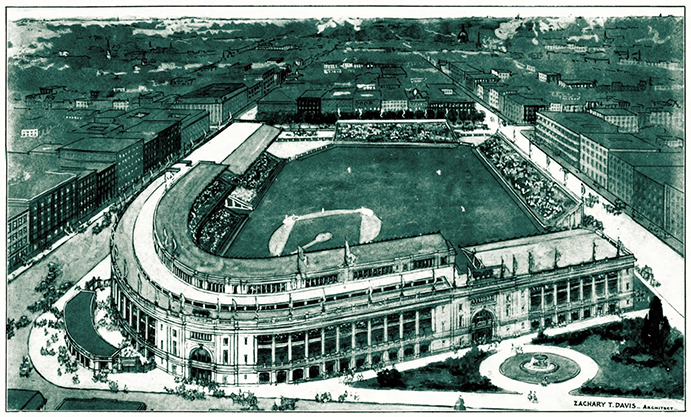
Redland/Crosley Field, in its 1912-37 configuration

October 2: Game 2 in Cincinnati. The Reds beat the White Sox 4-2, to go up 2 games to none. Sox pitcher Claude "Lefty" Williams, just as suddenly as had Cicotte the day before, goes from very effective to a meltdown. He holds the Reds scoreless for the 1st 3 innings, but in the 4th, he walks 3 batters, gives up a single to Roush, and then a triple to Larry Kopf.

After the game, Sox manager William "Kid" Gleason tells team owner Charlie Comiskey that he's suspicious of his players. But Comiskey has been feuding with his old friend Ban Johnson, President of the American League, with the 2 men having founded the League. So Comiskey goes to National League President John Heydler. Heydler tells Johnson about Gleason's suspicions. But Johnson does nothing about it, thinking people will see it as a vengeful act against Comiskey.

Gleason is not the only one who is suspicious: Hugh Fullerton of the Chicago Herald-Examiner, and his protégé, Ring Lardner of the Chicago Tribune, make note of some questionable plays. So does former Giants pitcher Christy Mathewson, covering the Series for a national newspaper syndicate.

October 3: Game 3, at Comiskey Park in Chicago. It's 289 miles between the ballparks, but there is no day off for travel, and the teams traveled by train, not plane. Rookie lefthander Dickie Kerr seems to show no effects of either the traveling, the lack of rest, or his teammates' treachery. He pitches a 3-hit shutout, left fielder Joe Jackson gets 2 hits, and 1st baseman Arnold "Chick" Gandil gets 2 RBIs.
Comiskey Park, in its 1910-26 configuration

The White Sox win, 3-0, and close the Reds' lead to 2 games to 1. Jackson and Gandil were in on the fix, but Kerr was not.

Adolfo "Dolf" Luque, the Reds' Cuban pitcher, pitches in relief, and thus becomes the 1st Latin American player to appear in a World Series game. He pitches a scoreless 8th inning.

Joseph Jefferson Jackson had become known as "Shoeless Joe" because of an incident in a minor league game. The shoes he'd been given were too tight, so he took them off in the outfield. He was a farmboy from the Appalachian western region of South Carolina, and had never learned how to read. He knew he had to learn how to sign his name, to give kids autographs, but he got around his illiteracy by having his wife order for him in restaurants.

He could "read" pitchers, though. Babe Ruth supposedly modeled his lefthanded swing after Jackson's. At the close of the 1920 season, just 33 years old, he had a .356 lifetime batting average (still the 3rd-highest ever), a whopping 170 OPS+, and 1,772 hits, including 307 doubles, 168 triples and 54 home runs. What would later be known as the 3,000 Hit Club was within reach for him.

He was also a good baserunner, having stolen 202 bases. How good a fielder was he? Ty Cobb called him the greatest left fielder he'd ever seen, and his glove "the place where triples go to die."

There was no Baseball Hall of Fame yet, but Shoeless Joe seemed to be on his way. None of the other players implicated in the scandal were likely to make it, though.

October 4: Game 4 in Chicago. Cicotte, in on the fix, didn't want to look as bad as he had in Game 1, so he could throw off suspicion. He and Jimmy Ring trade goose eggs for 4 innings. But in the 5th, Cicotte makes a bad throw of a comebacker. Jackson makes a run-allowing error on the next play. The Reds beat the White Sox 3-1, and take a 3-1 lead in the Series.

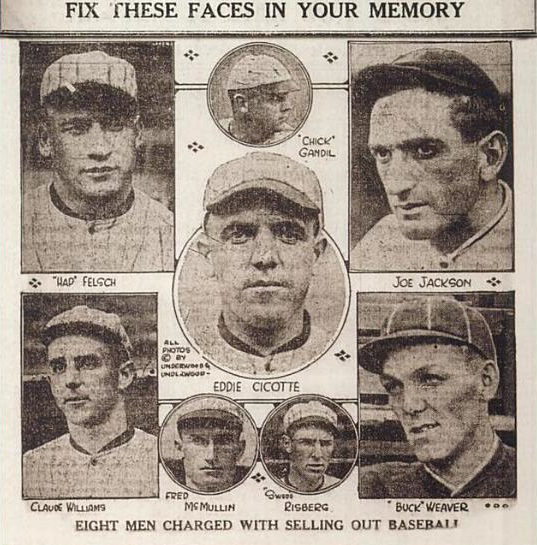
After the game, Joseph J. "Sport" Sullivan, the Boston bookmaker who helped Rothstein put the fix together, gives $20,000 to Gandil, who splits it equally among the 2 men who'd led the fix from the players' side, shortstop Charles "Swede" Risberg, center fielder Oscar "Happy" Felsch, and the next day's starter, Williams.

Allegedly, Cicotte had a good reason for getting in on the fix. Comiskey had promised him a $10,000 bonus if he won 30 games in the 1919 season. He got to 29, and then the ever-cheap Comiskey ordered Gleason to not pitch Cicotte again.

This wasn't true. Cicotte did win 29 games, but Gleason did start him again, and he was unable to win the 30th: He won his 29th on September 19, he was taken out after allowing 5 runs in 7 innings in a game the White Sox came back to win on September 24, and got knocked out of the box after 3 innings on September 28. Yet the story persists, because it's emblematic of Comiskey's cheapness. It got into the 1988 movie version of Eliot Asinof's 1963 book about the scandal, Eight Men Out.

There were 2 starts that Cicotte could have made between September 5 and 19, but didn't. I can't find an explanation for that. But he definitely was not held out once he won his 29th.

There is a story about Comiskey's cheapness that is absolutely true. In 1917, the White Sox won the World Series, but throughout the year, their uniforms seemed to get dirtier and dirtier, because Comiskey wouldn't pay to have them washed on the road. Hence, the term "Black Sox" referred not to the scandal that would later be attached to them, but to their dirty uniforms.

My grandmother, who grew up in Queens in the 1930s, knew that (with help from her and my Bronx native Yankee Fan grandfather) my knowledge of baseball history was encyclopedic, and asked me where the Black Sox name came from.

She was a Brooklyn Dodger fan, so she knew the National League cold, and knew that her team's name came from Brooklynites being called "trolley dodgers." But she did not know the lore of the American League. Until she asked me, she literally thought the team was officially called the Black Sox, and then changed to "White Sox" to clean their image up after the scandal.

I had to tell her that it was totally the opposite: Chicago teams had been called the "White Stockings" going back to the dawn of professional baseball in the 1870s, as a contrast to the Cincinnati and Boston teams being known as the Red Stockings, and that the AL team took the White Stockings name after the NL team became the Colts in 1890 (and eventually the Cubs in 1903), and that the Black Sox name was a nickname, and then came the scandal.

October 6: Game 5 in Chicago, following a Sunday rainout. Reds pitcher Horace "Hod" Eller pitches a 3-hit shutout. In the 2nd and 3rd innings, he strikes out 6 players in a row: Gandil, Risberg, Ray Schalk, opposing pitcher Williams, Harry "Nemo" Leibold and Eddie Collins.

In addition, the Reds score 4 runs in the 6th on, among other things, bad throws by Jackson and Felsch. Schalk is not in on the fix, but he does the kind of thing that could have gotten him suspected: He gets thrown out of the game for arguing a safe call on a slide into the plate by the Reds' Henry "Heinie" Groh.

The Reds win, 5-0, and go up 4 games to 1 in this best-5-out-of-9 Series. One more win, and the Reds take the title.

So of the 7 players in on the fix, 5 appeared in this game, and all had something to do with the defeat.

Collins, formerly a star with the Philadelphia Athletics, was not in on the fix. He remains one of the greatest 2nd basemen who ever lived, and is in the Baseball Hall of Fame.

Schalk is in the Hall as well, because he is considered one of the best-fielding catchers who ever lived. But his .253 lifetime batting average is the lowest for any player in the Hall not generally considered a pitcher. It is suspected that he was elected because he refused to go in on the fix. Did he actively refuse? There's no known record of him being asked.

One player who was asked, but refused, was 3rd baseman George "Buck" Weaver. He didn't think the gamblers who were setting the fix up could be trusted. But he also didn't report what he knew. And this would be his downfall.

Fred McMullin, a utility infielder, had overheard Gandil and Felsch discussing the fix, and he wanted in. Since the White Sox clinched the Pennant with a few games to spare, he could be sent to Cincinnati to scout the Reds, and so, even though he wouldn't get much playing time in the Series, he could tell the players on the take how best to take advantage of the Reds' tendencies.

On the train back to Cincinnati, Lardner vents his spleen at the White Sox. To the tune of one of the biggest hits of the year, "I'm Forever Blowing Bubbles" -- later to become the unofficial theme song of London soccer team West Ham United -- he sings:

I'm forever blowing ballgames
Pretty ballgames in the air
I come from Chi
I hardly try
Just go to bat
and fade and die
Fortune's coming my way
that's why I don't care
I'm forever blowing ballgames
and the gamblers treat us fair.

The scene would be recreated in the film version of Eight Men Out, with John Sayles directing, and also playing Lardner.

October 7: Game 6 in Cincinnati. The White Sox must win 4 straight to win the Series. Risberg makes 2 errors, and Felsch makes 1, holding up their end of their corrupt bargain. But Jackson and Weaver combine for 7 hits. Kerr, who had won Game 3, wins again, as the White Sox top the Reds 4-0.

Years later, Gandil said, "The eight of us did our best to lose it, but little Dickie Kerr did his best to win it."

October 8: Game 7 in Cincinnati. The White Sox are playing like they mean it. The supposedly tainted Jackson and Felsch each drive in 2 runs, and the supposedly tainted Cicotte pitches well. Meanwhile, uncharacteristically, the Reds make 4 errors. The White Sox win, 4-1, and close to within 4 games to 3.

All the White Sox need to do now is win the next 2, both at Comiskey Park. Is this thing on the level after all? Or have the guilty Sox players abandoned the fix? Or... are the Reds now on the take, too?

After the game -- all day games, as the Reds will be the 1st team to introduce night games in the major leagues, but not until 1935 -- the teams take trains to Chicago. At his home, Williams receives a visitor, telling him he had better lose Game 8, or else his family will be harmed. The gamblers are taking no chances. They've got too much money invested in a Cincinnati victory.

October 9: Game 8 at Comiskey Park. The Reds defeat the White Sox, 10-5, taking the best-5-out-of-9 World Series. It is the 1st World Championship for Cincinnati – or, at least, the 1st since the unofficial one for the Cincinnati Red Stockings, the 1st openly professional baseball team, in 1869, half a century earlier. (If that anniversary had been observed in Cincinnati, it wasn't mentioned in most of the books about the 1919 season. It was observed on the 100th Anniversary in 1969 and the 150th in 2019.)

Williams gets just 1 man out in the 1st before departing, having allowed 4 runs. The Reds go on to give Eller plenty of offense. Jackson hits the only home run of the Series. Collins' 3 hits give him a total of 42 in Series play‚ a record broken in 1930 by Frank Frisch‚ and bettered by Lou Gehrig in 1938. A stolen base by Collins is his 14th in Series competition‚ a record tied by Lou Brock in 1968, but still not broken to this day.

On September 28, 1920, with the White Sox, the Cleveland Indians, and the New York Yankees in a 3-way dogfight for the Pennant, the 7 Chicago players who were in on the fix were indicted for conspiracy to throw the Series. So was Weaver, who refused to take part, but was indicted because he knew about it and refused to report it.

On July 28, 1921, a Chicago jury acquitted the 8 players of conspiracy to defraud, because there wasn't enough evidence for a conviction. But on August 2, Kenesaw Mountain Landis, a Chicago-based former federal Judge who had been appointed Commissioner of Baseball by the team owners to help re-establish the sport's credibility, banned them all from participation in the sport, at either the major or the minor league level -- permanently.

For the rest of their lives, Roush, the last survivor (he lived until 1988), and the other 1919 Reds insisted that, if the Series had been on the up-and-up, they would have won anyway.

Really? Here's something else to consider: Down 4 games to 1 in that best-5-out-of-9, the Sox won Games 6 and 7, playing to win because the gamblers hadn't come through with their payments, and Williams only caved in for Game 8 because his family had been threatened if he did not comply. Williams was 0-3 for the Series, a record not "achieved" honestly until 1981 and George Frazier of the Yankees.

It's been said that Babe Ruth and his home runs "saved baseball after the Black Sox Scandal." This is ridiculous. Ruth was hitting home runs like crazy all season long in 1920, and attendance remained higher throughout the "Roaring Twenties" than it was in the years before America entered World War I. Babe's homers didn't save baseball after the scandal, but they may have helped cover it up.

What happened to the 8 banned players?

* Shoeless Joe Jackson played with and managed some semi-professional teams, not under the jurisdiction of "organized ball" and Judge Landis. (Landis was usually referred to by his former title of "Judge," instead of "Commissioner," and he liked it like that.) He later ran a drycleaning business, a barbecue restaurant, and a liquor store. In 1951, he suffered a heart attack, and died at age 64.

He was played by D.B. Sweeney in the 1988 film version of Eight Men Out, and Ray Liotta in the 1989 film Field of Dreams, based on W.P. Kinsella's 1982 novel Shoeless Joe.

* Fred McMullin, ironically, went into law enforcement, being named a Deputy Marshal in Los Angeles County in California in 1940. But high blood pressure led to a fatal stroke in 1952, at age 61. He was played by Perry Lang in EMO, but the actor playing him in FOD was not credited.

* Buck Weaver remained in Chicago, and continued to press his case for reinstatement, not because he felt the need to play again, but because he wanted his name officially cleared, not just by the court (as it had already been), but by baseball itself. He died of a heart attack in 1956, at 65. His family continues to appeal on his behalf, so far without success. He was played by John Cusack in EMO, and Michael Milhoan in FOD.

* Lefty Williams played in outlaw leagues, outside Landis' jurisdiction, then operated a garden nursery business outside Los Angeles. He died from the effects of years of heavy drinking, at 66, in 1959, 40 years after the Series in question, and the year the White Sox finally won their next Pennant. He was played by James Read in EMO, but the actor playing him in FOD was not credited.

* Happy Felsch played semi-pro ball in the west of America and Canada for another 15 years, before returning to his native Milwaukee, opening a grocery store and a series of bars. Apparently, he sampled his own product more than he should, because it died of liver failure, in 1964, shortly before turning 73. He was played by Charlie Sheen (perhaps appropriately) in EMO, but the actor playing him in FOD was not credited.

* Eddie Cicotte returned to Michigan, managed a service station, served as a game warden, worked for Ford Motor Company, and ran a farm outside Detroit. He died in 1969, at 84. He was played by David Strathairn in EMO and Steve Eastin in FOD.

* Chick Gandil had little to lose: He had already decided to leave organized ball, and returned to California, where he played semi-pro ball on a team with Jackson, Risberg, McMullin, and another player banned due to his connection to the scandal, Joe Gedeon of the St. Louis Browns. In 1925, he played in Arizona with some banned players, including Hal Chase, a former Yankee 1st baseman known for great fielding but also for throwing games.

Gandil gave an interview to Sports Illustrated in 1956, admitting to being the scandal's ringleader, expressing regret for it, and agreeing that he and the others deserved to be banned. He died of heart trouble in 1970, at 82. He was played by Michael Rookier in EMO and Art LaFleur in FOD. (LaFleur would later play the ghost of Babe Ruth in The Sandlot).

* Swede Risberg also played semi-pro baseball, including in 1922 in Minnesota on a team with Felsch and Williams. He returned to his native Northern California, worked on a dairy farm, and later ran a tavern and a lumber business. He was the last survivor, dying on his 81st birthday, October 13, 1975. He was played by Don Harvey in EMO, and Charles Hoyes in FOD.

It is arguable that the 2 most famous World Series of them all have been those of 1919, in which Risberg was heavily involved in the fix;and 1975, during which Risberg died -- and the Cincinnati Reds won them both, in each case under controversial circumstances. (At your own peril, ask a Red Sox fan about 1975 Game 3.)

Trust me on this one: If you want to get closer to the facts of the case, see the film Eight Men Out; but if you want to see a movie that makes you feel good, see the factually-challenged but beautiful
Field of Dreams.

UPDATE: The Reds have a team Hall of Fame. Elected from this 1919 team have been 1st baseman Jake Daubert, shortstop Larry Kopf, 3rd baseman Henry "Heinie" Groh, left fielder Raymond "Rube" Bressler, center fielder Edd Roush, Cuban pitcher Adolfo "Dolf" Luque, and team president August Herrmann.

From the 1920s, they have inducted catcher Eugene "Bubbles" Hargrave, 2nd baseman Hughie Critz; and pitchers Eppa Rixey, Pete Donohue and Charles "Red" Lucas.

*

October 9, 1919 was a Thursday. The NFL and NBA hadn't been founded yet, and it was too soon for the NHL season. So there were no other scores on this historic day.

Saturday, October 8, 2022

October 8, 1940: Red and Black In Cincinnati

Jimmie Wilson

October 8, 1940: Game 7 of the World Series is played at Crosley Field in Cincinnati. Paul Derringer of the Cincinnati Reds and Alva "Bobo" Newsom of the Detroit Tigers get into a pitchers' duel, and the Tigers lead 1-0 in the bottom of the 7th.
Crosley Field

But leadoff doubles by Frank McCormick and Jimmy Ripple tie the score, followed by a sacrifice bunt and Billy Myers' sacrifice fly, for the run that wins the game and the Series, 2-1 to Cincinnati. The game lasts just 1 hour and 47 minutes.

The Reds' Bill McKechnie becomes the 1st manager to win a World Series with 2 different teams. "The Deacon" also piloted the Pirates to the 1925 World Championship.

With NL batting champion Ernie Lombardi injured down the stretch, and backup catcher Willard Hershberger becoming (as far as can be proven) the only big-leaguer ever to commit suicide during the season -- slashing his throat on in a Boston hotel room during a roadtrip on August 3 -- 40-year-old coach Jimmie Wilson was signed to a playing contract, and was one of the factors in this World Series. So was an injury to Tiger star Hank Greenberg.

Newsom, a native of Hartsville, South Carolina, was one of the great characters of the game, wearing out his welcome multiple times. He started his career with the Brooklyn Dodgers' "Daffiness Boys" in 1929, and spent most of the 1932 season in the minor leagues, though he made 1 appearance for the Chicago Cubs, who on the NL Pennant. They did not include him on their World Series roster.

He had started and won Game 1, with his father in attendance. But his father died during the Series. Before Game 5, Newsom said, "I'll win this one for my Daddy," and he did. Tiger manager Del Baker risked him on short rest for Game 7, he was asked by reporters, "will you win this one for your Daddy too?" He said, "Why, no, I think I'll win this one for old Bobo." "Old Bobo" was 33 years old, and while he went the distance and held a back-to-back Pennant-winning team to 2 runs, it was in defeat.
Bobo Newsom

Newsom ended up pitching for 9 of the 16 franchises then in the major leagues, including 4 separate tenures with the Washington Seantors, 3 with the St. Louis Browns, and 2 each with the Dodgers and the Philadelphia Athletics, with whom he closed his career in 1953. He did win a World Series, with the New York Yankees in 1947. They obtained him from the Senators in midseason, and he went 7-5 for them down the stretch, starting and losing Game 3 of the Series, at the age of 39.

He finished with a career record of 211-222, with a 3.98 ERA and 2,082 strikeouts. That included 2 20-win seasons for the Browns, and 21 for the Tigers in the 1940 regular season. That suggests that, had he spent most of his career with good teams, he would have had more batting support and a lot more wins. He drank himself to death in 1962, only 55 years old.

In 1949, Ogden Nash, my grandmother's favorite poet, wrote "Line-Up for Yesterday" for Sport magazine, an alphabetical list of star players. For the letter N, he honored Newsom, the only player he mentioned who was still active, and the only one who ended up not making the Hall of Fame. He wrote:

N is for Newsom,
Bobo's favorite kin.
You ask how he's here,
He talked himself in.

The Tigers bounced back from their 1940 defeat, and won the Series again 5 years later. The Reds would need another 35 years, going 0-for-3 in World Series play, 5-12 in games, before triumphing in 1975.

UPDATE: The Reds have a team Hall of Fame. Elected from this 1940 team have been 1st baseman Frank McCormick, 2nd baseman Lonny Frey, shortstop Billy Myers, 3rd baseman Billy Werber, left fielder Mike McCormick, center fielder Harry Craft, right fielder Ival Goodman, catcher Ernie Lombardi; pitchers Bucky Walters, Paul Derringer and Johnny Vander Meer; manager Bill McKechnie, and general manager Warren Giles. But team owner and ballpark namesake Powel Crosley has not been inducted.

*

October 8, 1940 was a Tuesday. Football was in midweek. The NBA hadn't been founded yet. And the NHL season started over a month later. So there were no other scores on this historic day.

October 8, 1939: Ernie Lombardi's "Snooze"

October 8, 1939: Game 4 of the World Series is played at Crosley Field in Cincinnati. The New York Yankees already lead the Cincinnati Reds, 3 games to none. The game is scoreless until the top of the 7th inning, when Charlie Keller and Bill Dickey hit home runs for the Yankees. The Reds come right back with 3 runs, started by an error by the normally sure-fielding Red Rolfe.

Mel Allen, then in his 1st season as a Yankee broadcaster, would later call Rolfe his all-time 3rd baseman, ahead of Pie Traynor and Eddie Mathews, the 2 most-named candidates at that point. This was while Brooks Robinson was still active, and before Mike Schmidt and George Brett debuted. So that should give an idea of how good Rolfe was, even though he is not in the Baseball Hall of Fame.

The Reds scored another run in the 8th. But their ace pitcher, Bucky Walters, ran out of gas in the 9th, and the Yankees sent the game to extra innings.

Cliché Alert: Walks can kill you, especially the leadoff variety. Frank Crosetti led off the top of the 10th by drawing a walk off Walters. Rolfe bunted him over. Keller -- nicknamed "King Kong," which he hated, because he was big, strong and hairy -- reached on an error by shortstop Billy Myers And Joe DiMaggio, already the best player in baseball at age 24, singled to right. Crosetti easily scored the go-ahead run.

It got worse for the Reds: Right fielder Ival Goodman bobbled the ball, and Keller tried to score. The throw got to catcher Ernie Lombardi, but there was a collision, and Lombardi dropped the ball. For a moment, he just lay there at home plate, in a daze. DiMaggio noticed this as he approached 3rd base, and tried to score. Lombardi snapped out of it, got the ball, and leaned over to tag DiMaggio, who executed a fantastic slide, thrown his entire body away from the plate, just brushing it with his right foot. It was 7-4 Yankees. That completed the World Series sweep, and manager Joe McCarthy's team became the first club to win 4 consecutive Fall Classics. It was their 8th World Championship overall.

The prudish press of the day said that Lombardi "swooned" or "snoozed" at the plate, but, in reality, Keller had inadvertently kneed him in the groin. His inability to act for a few seconds thereafter was understandable, even if he was wearing a cup.

Lombardi died in 1977, and was posthumously elected to the Hall of Fame in 1986. He batted .306 for his career, won 2 National League batting titles, was the NL Most Valuable Player in 1938, and was selected for 8 All-Star Games. But, because of his large nose, he was nicknamed "Schnozz." And because of that and the aforementioned play, it was said that he was "known for his schnozz and his snooze." This was unfair.

Keller looked like he might be headed for the Hall, but missed the 1944 season due to World War II, hurt his back during his service with the U.S. Merchant Marine, and was never the same player. He played his last game just after his 36th birthday, and still ended up with a .286 batting average, 189 home runs, and a career OPS+ of 152 -- considerably higher than Lombardi's 126. He retired to a farm in his native Maryland, trained racehorses with Yankee-themed names, and lived until 1990.

The last surviving player from the Yankees' 1939 World Champions -- and their 1937, 1938 and 1941 titlists as well -- was right fielder Tommy Henrich, a.k.a. Ol' Reliable, who lived until 2009. The Reds would rebound from this defeat, and win the 1940 World Series, beating the Detroit Tigers in 7 games.

*

October 8, 1939 was a Sunday. This was the only baseball game. The NHL season didn't start until the next month. The NBA hadn't been founded yet. But these NFL games were played:

* The football version of the New York Giants beat the football version of the Pittsburgh Pirates, 14-7 at Forbes Field in Pittsburgh. The football Pirates would change their name to the Pittsburgh Steelers the next season.

* The football version of the Brooklyn Dodgers lost to the Washington Redskins, 41-13 at Griffith Stadium in Washington.

* The Chicago Bears beat the Cleveland Rams, 35-21 at Cleveland Municipal Stadium. The Rams moved to Los Angeles in 1946, to St. Louis in 1995, and back to Los Angeles in 2016.

* And the Green Bay Packers beat the Chicago Cardinals, 27-20 at the Dairy Bowl in the Milwaukee suburb of West Allis, Wisconsin. The Dairy Bowl was a football stadium built in the infield of a speedway, now known as the Milwaukee Mile, at the Wisconsin State Fair Park. The Cardinals moved to St. Louis in 1960, and to Arizona in 1988.

Also, Australian actor Paul Hogan, star of the Crocodile Dundee films, was born on this day. So was "underground" cartoonist Harvey Pekar.

Friday, September 30, 2022

October 1, 1927: Big Poison and Little Poison Lead a Pennant

Lloyd (left) and Paul Waner

October 1, 1927: The Pittsburgh Pirates beat the Cincinnati Reds, 9-6 at Redland Field (later renamed Crosley Field) in Cincinnati. This gives the Pirates the National League Pennant, their 5th, and their 2nd in the last 3 seasons.

Right fielder Paul Waner went 2-for-5, and center fielder Lloyd Waner went 3-for-5. That season, Paul, in his 2nd season, led the NL in batting with a .380 average, 237 hits including 18 triples and 131 RBIs; he added 9 home runs. Lloyd, a rookie, only had 2 homers and 27 RBIs despite playing 150 games, but batted .355 with 223 hits. Despite their heroics, and that of 3rd baseman Harold "Pie" Traynor, the Pirates were swept in 4 straight games in the World Series, by the New York Yankees.

At one point that season, while the Pirates were at the Polo Grounds to play the New York Giants, a sportswriter overheard a fan saying, in a New York accent, "Them Waners! It's always the little poison on toid and the big poison on foist!" Meaning, "the little person on third base and the big person on first base." The nicknames, "Big Poison" for Paul and "Little Poison" for Lloyd,stuck with them for the rest of their lives. Except Paul was 5-foot-8, and listed at 153 pounds during his playing career; while Lloyd was slightly taller, at 5-foot-9, and listed as 150 pounds. But both hit big.

Both brothers were born in Harrah, Oklahoma, about 20 miles east of Oklahoma City: Paul Glee Waner on April 16, 1903; and Lloyd James Waner on March 16, 1906, in each case before the Oklahoma Territory gained Statehood in 1907. Both graduated from Central High School in Oklahoma City, and both briefly attended what is now named East Central University in Ada, Oklahoma before turning pro.

Paul helped the San Francisco Seals win the 1925 Pacific Coast League Pennant, and the Pirates, who had won the World Series that season, purchased his contract. Lloyd was also a 1925 Seal, but did not hit well. But he won the batting title and the Most Valuable Player award in the South Atlantic League in 1926, playing for the South Carolina-based Columbia Comers, and the Pirates purchased him, too.

Both men batted lefthanded, but while Paul also threw lefthanded, Lloyd threw righthanded. Lloyd was usually the Pirates' leadoff hitter, with Paul batting 3rd. Both brothers remained with the Pirates through 1940, but, despite having Hall-of-Famers as teammates in Traynor through 1935 and shortstop Joseph "Arky" Vaughan starting in 1932, both of them solid hitters and great fielders, neither brother ever won another Pennant.

The Pirates finished 2nd in 1929, but 10 1/2 games behind the Chicago Cubs; 2nd again in 1932, but 4 games behind the Cubs; 2nd again in 1933, but 5 games behind the Giants; 3rd in 1937, but 10 games behind the Giants; and they led most of the way in 1938, but went 12-16 from September 2 to October 2, while the Cubs went 21-5 from September 4 onward, including a 3-game sweep of the Pirates from September 27 to 29, and the Pirates finished 2 back.

Paul played briefly with the Brooklyn Dodgers in 1941, spent most of 1941 and all of 1942 with the Boston Braves, collecting his 3,000th career hit in 1942, returned to the Dodgers in 1943 and '44, and closed his career with 9 games in 1944 and 1 in 1945 with the Yankees.

Lloyd played 3 more games with the Pirates in 1941, before being traded to the Braves, reunited with Paul, but only played 19 games with them before being traded to the Cincinnati Reds. He played for the Philadelphia Phillies in 1942, and retired, spending the 1943 season working in a war-production job with Douglas Aircraft. But the manpower drain of World War II led to the Dodgers offering to reunite him with Paul in 1944, but the Pirates reacquired him later that year, and he finished with them in 1945.

Along with pioneers Harry and George Wright, the Waners are the only brother combination to both be in the Baseball Hall of Fame. Lloyd's election is often considered one of the more dubious, but he finished his career with a .316 average and 2,459 hits. He led the NL with 20 triples in 1929 and with 214 hits in 1931. He never hit more than 5 home runs or drove in more than 74 runs in a season, but that was partly due to the Pirates playing at spacious Forbes Field.. In 10 seasons, he batted .309 or higher, peaking at .362 in 1930.

In contrast, Paul's election is unquestionable: A .333 average and 3,152 hits. His 1,959 hits in the 1930s led the decade. He led the NL in batting average 3 times, hits twice, doubles twice, triples twice (for those stats, Forbes' deep left and center field helped), and runs scored twice.

The Waners have more hits than any brother combination: 5,611. That's more for the 2 of them than the 3 Alou brothers with 5,094, more than the 3 DiMaggio brothers with 4,853, and more than the 5 Delahanty brothers with 4,025. It's also more than the Alomar brothers, Sandy Jr. and Roberto, and their father, Sandy Sr., had combined, with 5,128. Paul hit only 113 home runs in his entire career, Lloyd just 27. Yet, on September 15, 1938, they hit back-to-back home runs against Cliff Melton in a 7-2 win over the Giants at the Polo Grounds.

The brothers were also considered great fielders. Casey Stengel, a predecessor of Paul's in right field for the Pirates, said that Paul was the best right fielder in National League history -- although this was before the peak years of Hank Aaron. Baseball historian Frank Russo said, "Paul was a speedy outfielder who possessed perhaps the strongest arm in a Pittsburgh outfield until the arrival of Roberto Clemente."

Paul became a hitting coach for the Phillies, the St. Louis Cardinals and the Braves, who had moved to Milwaukee. He was also one of baseball's best golfers, frequently shooting rounds in the 70s. In 1952, he was elected to the Baseball Hall of Fame. Lloyd became a scout for the Pirates, and then for the Baltimore Orioles, and worked for the City of Oklahoma City in the off-season. He was elected to the Hall of Fame in 1967.

In 1999, The Sporting News ranked Paul 62nd on their list of the 100 Greatest Baseball Players. In 2007, the Pirates retired Paul's Number 11. They have not retired Lloyd's Number 10.

Both brothers became alcoholics: Lloyd Waner Jr. said his uncle was already a heavy drinker as a player, and his father's drinking intensified after his retirement -- in case case, like a later Oklahoma native in baseball, Mickey Mantle. Lloyd eventually quit.

Paul Waner died on August 29, 1965, in Sarasota, Florida, where he'd retired to be close to the Pirates' Spring Training complex in Bradenton. He was only 62 years old. He had recently been interviewed by Lawrence S. Ritter for his book The Glory of Their Times. When the book was published the next year, the chapter on Paul was made the last chapter.

Lloyd Waner died on July 22, 1982 in Oklahoma City, at the age of 76. Both brothers died from emphysema, a result of smoking rather than drinking. They are not buried together, or even in the same part of the country: Paul is laid to rest in Bradenton, Lloyd in Oklahoma City.

*

October 1, 1927 was a Saturday. These other baseball games were played:

* The New York Yankees beat the Washington Senators, 4-3 at Yankee Stadium. Wilcy Moore, one of baseball's first notable relief pitchers, started, pitched the 1st 5 innings, and got the win, to finish 19-7 on the season.

Babe Ruth, who hit his record-breaking 60th home run of the season the day before, went 0-for-3 with a walk. Lou Gehrig went 1-for-3, hitting a 3-run homer, for his 47th of the season -- at the time, the most of any player other than Ruth, who had hid 54 in 1920 and 51 in 1921. Tris Speaker, running down his career after starring in Boston and Cleveland, pinch-hit for Washington, and failed to reach base.

* The New York Giants beat the Brooklyn Dodgers (or the Robins, as they were called under manager Wilbert Robinson from 1914 to 1931), 6-1 at Ebbets Field. Burleigh Grimes out pitched Jesse Petty. Travis Jackson hit a home run. Rogers Hornsby went 2-for-3 with a walk and an RBI. Bill Terry went 2-for-4 with an RBI. Rookie Mel Ott did not play.

* The Boston Braves swept a doubleheader from the Philadelphia Phillies, 14-9 and 8-6 at Braves Field in Boston.

* The Philadelphia Athletics swept a doubleheader from the Boston Red Sox, 10-2 and 3-2 at Shibe Park in Philadelphia. Russell "Jing" Johnson and Sam Gray were the winning pitchers. In the nightcap, Gray allowed 8 hits over 8 innings, and Jimmy Dykes pitched a hitless 9th to complete the shutout.

Mickey Cochrane went 2-for-4 with a walk in the opener, and sat out the nightcap. Eddie Collins sat out the opener, but went 4-for-4 in the nightcap. Ty Cobb, playing out the string with the A's after starring with Detroit, sat out both games. Over the 2 games, Dykes went 5-for-9 with 3 RBIs, Jimmie Foxx went 3-for-9 with 3 RBIs, and Al Simmons went 5-for-7 with a walk and 2 RBIs.

* The Chicago White Sox beat the St. Louis Browns, 8-5 at Comiskey Park in the 1st game of a doubleheader. The White Sox were leading the 2nd game, 5-3 after 5, when the game was called due to rain, thus giving them a sweep.

* The Cleveland Indians and the Detroit Tigers were rained out at Navin Field (later Briggs Stadium and Tiger Stadium) in Detroit. The game was made up as part of a doubleheader the next day, the last day of the regular season. The Tigers swept, 11-5 and 5-4. The Indians led the 2nd game, 4-3 going to the bottom of the 9th, but 2 Cleveland errors and an RBI double by Jack Warner gave Detroit the victory.

* And the Chicago Cubs and their arch-rivals, the St. Louis Cardinals, were rained out at Sportsman's Park in St. Louis. Since this was the next-to-last day of the season, and the Cardinals had been eliminated (they finished 2 1/2 games out), the game was never made up.

Among the college football games played that day were these:

* Army beat the University of Detroit, 6-0 at Michie Stadium in West Point, New York.

* Navy beat Davis & Elkins University, 27-0 at Thompson Stadium in Annapolis, Maryland.

* 

The University of Michigan defeats Ohio Wesleyan (not Ohio State), 33-0. This was the 1st game played at Michigan Stadium in Ann Arbor, 38 miles west of downtown Detroit. I have a separate entry for this event. At the time, it seated 72,000. By 1956, it would top 100,000. Today, officially, capacity is 107,601.

* The University of Illinois beat fellow Central Illinois school Bradley University, 19-0 at Memorial Stadium in Champaign. The Fighting Illini finished undefeated at 7-0-1, would be credited with both the Big Ten Conference Championship and the National Championship.

* The University of Minnesota beat the University of North Dakota, 57-10 at Memorial Stadium in Minneapolis. The Golden Gophers finished undefeated at 6-0-2, but a tie with Indiana cost them the Big Ten title. They did not play Illinois that season.

* Missouri beat Kansas State, 13-6 at Memorial Stadium (now Faurot Field) in Columbia, Missouri. Mizzou went on to win the Championship of the Missouri Valley Conference, a forerunner of the Big Eight/Big Twelve.

* St. Mary's beat Stanford, 16-0 at Stanford Stadium in the San Francisco suburb of Palo Alto, California. This was not a Pacific Coast Conference game.

* The University of Southern California beat Santa Clara University, 52-12 at the Los Angeles Memorial Coliseum. USC and Stanford played each other in Palo Alto 2 weeks later, and it ended in a 13-13 tie. They went on to share the PCC title.

* Notre Dame beat Coe College, 28-7 at Cartier Field in South Bend, Indiana. This was not what would now be considered an early-season "cupcake" opponent for a national power's home game: Coe, a Presbyterian Church-affiliated school in Cedar Rapids, Iowa, went 4-3-1 that season. However, since the reorganization of the NCAA in 1973, they have played in Division III.

* The University of Oklahoma beat the University of Chicago, 13-7 at Stagg Field in Chicago.

* Georgia Tech beat Virginia Military Institute (VMI), 7-0 at Grant Field (now Bobby Doddy Stadium) in Atlanta. Tech finished 8-1-1.

* Tennessee beat North Carolina, 26-0 at Emerson Field in Chapel Hill, North Carolina. Tennessee finished undefeated at 8-0-1. However, since they were 5-0-1 in Southern Conference play, and Georgia Tech were 7-0-1 in the league, they were declared Co-Champions.

* In New York City: Columbia beat Union College of Schenectady, 28-6 at Baker Field in Upper Manhattan; New York University (NYU) beat West Virginia Wesleyan, 29-13 at Ohio Field in The Bronx; City College of New York (CCNY) lost to George Washington University, 19-6 at Lewisohn Stadium in Upper Manhattan; and Fordham beat Lebanon Valley College, 13-3 at Fordham Field in The Bronx.

* Among New Jersey teams, Princeton beat Amherst, 14-0 at Palmer Stadium in Princeton; and Monmouth College (now Monmouth University) lost to Iowa, 32-6 at Iowa Field in Iowa City.

* And in a New York City vs. New Jersey game, Rutgers beat Manhattan College, 24-6 at Neilson Field in New Brunswick, New Jersey.

And in English soccer, Arsenal drew with East London team West Ham Unitd, 2-2 at the Arsenal Stadium, nicknamed Highbury for its North London neighborhood.

Wednesday, August 10, 2022

August 10, 1944: A 58-Pitch Complete Game Shutout

August 10, 1944: The Boston Braves beat the Cincinnati Reds, 2-0 at Crosley Field in Cincinnati. Red Barrett goes the distance and pitches a 2-hit shutout. He throws only 58 pitches, the fewest any pitcher has ever thrown in a complete game.

Brian Cashman will not be born until 1967, leaving him unable to appreciate his dream game at the time.

Charles Henry Barrett was born in 1915 in Santa Barbara, California. Known as Red for his hair, he started his career with the Reds in 1937, but was a marginal pitcher for them. Although he appeared for them in their Pennant-winning seasons of 1939 and 1940, he did not make the World Series roster in either season. He was traded to the Braves in 1943, and became one of several marginal players who became regulars due to the manpower drain of World War II.

In this game against the Reds, he outpitched Bucky Walters, the Reds' ace. Barrett gave up a single to Gee Walker with 1 out in the 1st inning, and a single to Eddie Miller leading off the 6th. But he stranded him both, and those were the only baserunners he allowed. He was supported by an RBI single from Dee Phillips in the 2nd, and an error that allowed a run in the 5th. The game lasted just 75 minutes.

He finished 9-16 that season. In 1945, he went 23-12, despite being traded in midseason, going 2-3 for the struggling Braves 21-9 for the mighty St. Louis Cardinals. He led the National League in wins, innings pitched, and complete games. He was selected for the All-Star Game, although that was canceled due to wartime travel restrictions. (That didn't stop the Midsummer Classic from being played in 1942, '43 or '44, though.) He finished 3rd in the NL's Most Valuable Player voting, and might have won the NL's Cy Young Award had there been one. On April 1, 1946, a photograph of him at the Cards' Spring Training camp in St. Petersburg, Florida appeared on the cover of Life magazine.
But with The War over, and the veterans returning to baseball, he was mainly a reliever. He did appear for the Cardinals in the World Series, which they won. He was traded back to the Braves the next year, appeared in another World Series in 1948, and last pitched in the majors the year after that. His career record was exactly .500: 69-69. He died in 1990.

*

August 10, 1944 was a Thursday. These other baseball games were played:

* The New York Yankees lost to the St. Louis Browns, 3-0 at Yankee Stadium. Denny Galehouse pitched a 6-hit shutout.

* The New York Giants lost to the Pittsburgh Pirates, 10-4 at Forbes Field in Pittsburgh. Mel Ott, by this point the Giants' manager, and still playing, did not put himself in the game.

* The Brooklyn Dodgers beat the Chicago Cubs, 6-4 at Wrigley Field in Chicago. Tommy Warren singled home the winning run in the top of the 10th inning.

* The Boston Red Sox beat the Chicago White Sox, 2-1 at Fenway Park in Boston.

* The Cleveland Indians beat the Philadelphia Athletics, 5-4 at Shibe Park in Philadelphia.

* The Detroit Tigers beat the Washington Senators, 3-2 at Griffith Stadium in Washington. Rudy York drove in the winning run with a sacrifice fly in the top of the 10th inning.

* And the St. Louis Cardinals beat the Philadelphia Phillies, 2-0 at Sportsman's Park in St. Louis. Mort Cooper pitched a 4-hit shutout. Stan Musial went 0-for-3 with a walk.

Friday, June 10, 2022

June 10, 1944: Joe Nuxhall: MLB's Youngest Player

Joe Nuxhall, 1944

June 10, 1944: The St. Louis Cardinals beat the Cincinnati Reds, 18-0 at Crosley Field in Cincinnati. The Cardinals, on their way to their 3rd straight National League Pennant, had lost fewer players to the manpower drain of World War II than most teams. The Reds had lost a lot, to the point where, in this game, they fielded the youngest player in the history of Major League Baseball.

Joseph Henry Nuxhall was born on July 30, 1928 in Hamilton, Ohio, about 20 miles north of Crosley Field. By the time he was 15 years old, he was 6-foot-2, 190 pounds, and had a hard lefthanded fastball, but had trouble with his control. The Reds signed him on February 18, 1944, and, with permission from Hamilton High, they put him in uniform for Opening Day. On June 10, they put a Reds uniform with Number 43 on the back on him, and put him into the 9th inning of a game that was already 13-0 to St. Louis. He was 15 years, 10 months and 11 days old.

At first, he looked okay. The 1st batter he faced was George Fallon, and he got Fallon to ground to short. Then he walked Mort Cooper -- the opposing pitcher, who pitched a 5-hit shutout. He got Augie Bergamo to put up to short.

But he got wild. He threw a wild pitch. He walked Debs Garms. He gave up a single to Stan Musial, loading the bases. He walked Ray Sanders, forcing in a run. He walked Walker Cooper, Mort's brother and catcher, forcing in another run. He walked Danny Litwhiler, forcing in a 3rd run. And he allowed a single to Emil Verban, producing 2 more runs. Reds manager Bill McKechnie removed Nuxhall, replacing him with Jake Eisenhart. The Reds had batted around, and Eisenhart walked Fallon, before getting Mort Cooper to pop up to 1st.

The Reds put Nuxhall into a game with the Birmingham Barons of the Southern Association, and he pitched 1 inning, allowing 6 runs. Clearly, he wasn't ready even for that level.

In 1945, he pitched in Class D ball for the Ohio-based Lima Reds, and in Class AA ball for the Syracuse Chiefs. He left the Reds organization and finished high school. Some players might have been scarred for life by such a rough introduction to the major leagues.

But a funny thing happened on the way to obscurity: Joe Nuxhall made it to the major leagues a 2nd time. The Reds took him back, and he pitched in their system from 1947 to 1952. On May 21, 1952, now approaching his 24th birthday, he got back to the big club. Wearing Number 39, He went 1-4 that season, but matured as a pitcher. In 1955, he went 17-12, leading the National League with 5 shutouts.

He remained with the Reds, as both a starter and a reliever, until 1961, when he was traded to the Kansas City Athletics. In 1962, he pitched games for the Los Angeles Angels, and was traded back to the Reds, and switching to uniform Number 41. He went 15-8 in 1963, and retired after the 1966 season, 38 years old, with a record of 135-117, 1,372 strikeouts, and a 3.90 ERA. He was even a decent hitter for a pitcher, batting .198 with 15 home runs and 78 RBIs. Unfortunately, being in Kansas City in 1961 meant that he missed the Reds' only Pennant season between 1940 and 1970.
He became a broadcaster, calling games for the Reds from 1967 to 2004, and seeing them win Pennants in 1970 (losing the World Series to the Baltimore Orioles), 1972 (losing to the Oakland Athletics), 1975 (beating the Boston Red Sox), 1976 (beating the New York Yankees), and 1990 (beating the A's). He saw them move from Crosley Field to Riverfront Stadium in 1970, and to Great American Ball Park in 2003. He called games for players such as Pete Rose, Johnny Bench, Tom Seaver, Barry Larkin and Ken Griffey Jr.

His signoff, belying his youthful distinction, was, "This is the old lefthander, rounding third and heading for home." And so, in addition to "Nuxy" and "Hamilton Joe," "the Old Lefthander" became his nickname.
On June 6, 2007, the Reds honored 3 legendary broadcasters with pictures of microphones on the wall beneath the radio booth, in place of "retired numbers": Waite Hoyt (also a Hall of Fame pitcher with the Yankees), Marty Brennaman and Joe Nuxhall.

Time was of the essence: Nuxhall was battling cancer. The following November 15, he died at his home in Fairfield, Ohio, at the age of 79. Throughout the 2008 season, the Reds wore sleeve patches with NUXY 41 on them. On Opening Day, having gotten permission from Major League Baseball, all Reds players took the field with uniforms with his name and number on them.

*

June 10, 1944 was a Saturday. This was also the day of the Oradour-sur-Glane Massacre in World War II. I have a separate entry for that event. 

There was 1 other game played in the major leagues that day. The Pittsburgh Pirates beat the Chicago Cubs, 9-4 at Forbes Field in Pittsburgh.

Tuesday, May 17, 2022

May 17, 1970: Hank Aaron Is the 1st Player to 3,000 Hits & 500 Homers

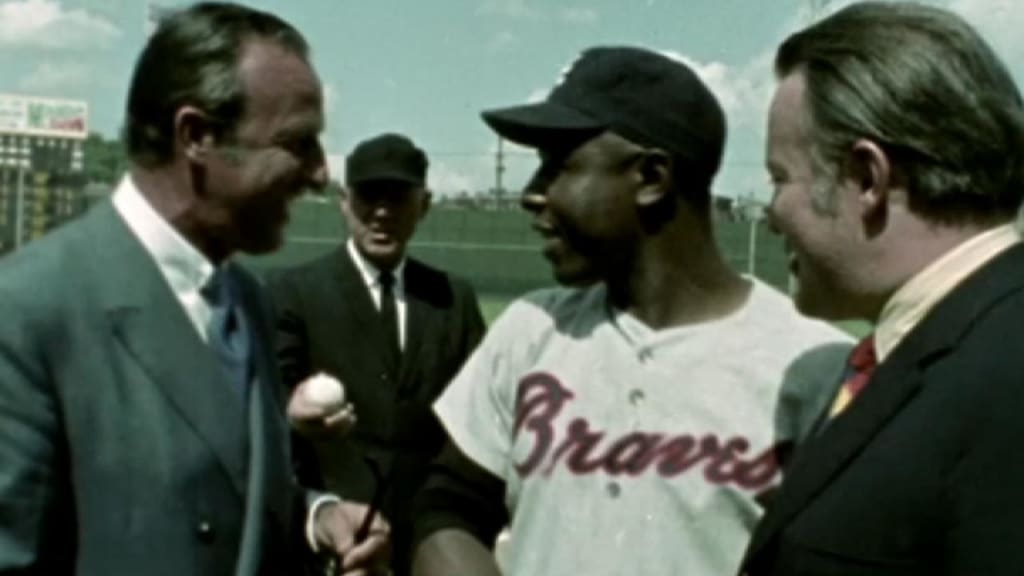
Left to right: Stan Musial, unknown umpire,
Hank Aaron, Braves owner Bill Bartholomay

May 17, 1970: Hank Aaron of the Atlanta Braves singles home a run against Wayne Simpson of the Cincinnati Reds, at Crosley Field in Cincinnati. It is the 3,000th hit of his career, making him the 1st player in Major League Baseball history to have both major career hitting milestones: 3,000 hits and 500 home runs.

Aaron beats Willie Mays to this distinction by 62 days. Later in the game, he hit his 570th home run, and finished the game 3-for-5 with 5 RBIs. But the Reds carried the day, which went 15 innings. It was pitcher Don Gullett, batting for himself because he was the last unused man on the Cincinnati roster, who singled home the winning run, and the Reds won, 7-6, completing a doubleheader sweep.

The Reds had won the 1st game, 5-1, with Jim Merritt outpitching Pat Jarvis. Five days earlier, Jarvis had pitched against the Chicago Cubs, and gave up the 500th career home run of Ernie Banks. The Cubs won that game, 4-3 in 11 innings at Wrigley Field in Chicago.

Over the 2 games, Aaron went 3-for-9 with a home run, 2 walks and 3 RBIs; Pete Rose went 2-for-9 with 2 home runs, 2 walks, and 3 RBIs; and Johnny Bench went 3-for-11 with a home run and and 3 RBIs.

Aaron joining the 500 Home Run Club in 1968, only 34 years old, was the first sign that maybe he would be the player to break Babe Ruth's record of 714 career home runs. Up until then, the player who seemed most likely to do it was Mays, who had surpassed Mickey Mantle as such when he surpassed Mantle on the home run list in 1964.

Among those on hand to congratulate Aaron on his milestone was Stan Musial, who, until then, was the last player to reach 3,000 hits. He finished his career with 475 home runs.

The list of players who have done 3000/500 is more surprising for who is not on it than it is for who is on it. The greatest hitter who ever lived? Most people will say either Ruth or Ted Williams. Ruth hit 714 home runs, a record that lasted until Aaron surpassed him with 755, but he finished with 2,873 hits. I suspect that if someone had told him that, one day, 3,000 hits would be considered a big deal, he would have gone for it.

As for Williams, he closed his career by hitting a home run in his last at-bat, his 521st homer. But, because he missed the equivalent of 5 seasons serving in 2 different wars, his career hit total was 2,654. Barry Bonds, who would use steroids to surpass Aaron's record and finish with 762 home runs, had 2,935 hits. Mantle's many injuries did not prevent him from hitting 536 home runs, but they did limit him to 2,415 hits.

Musial had 3,630 hits, but, as I said, fell short of 500 home runs, at 475. Carl Yastrzemski had 3,419 hits, but 452 home runs. Dave Winfield had 3,110 hits, but 465 home runs. Frank Robinson hit 586 home runs, but fell short of 3,000 hits, with 2,943. Mel Ott hit 511 home runs, but had 2,876 hits.

Here's the players who have done both:

1. May 17, 1970: Hank Aaron. He finished with 3,771 hits, including 755 home runs. In other words, without counting his home runs, he still had over 3,000 hits.

2. July 18, 1970: Willie Mays. He finished with 3,283 hits, including 600 home runs.

3. September 6, 1996: Eddie Murray. He is the only player, so far, to get his 3,000th hit first, and his 500th home run second. He finished with 3,255 hits, including 504 home runs.

4. July 15, 2005: Rafael Palmeiro. He finished with 3,020 hits, including 569 home runs. He would have finished with more, but he failed a steroid test, got benched, got released, and was not signed by anyone else, essentially blackballed from baseball.

5. June 19, 2015: Alex Rodriguez. He finished his career with 3,115 hits, including 696 home runs. But he, too, was exposed as a steroid user.

6. May 14, 2018: Albert Pujols. He finished his career with 3,308 hits, including 703 home runs.

7. April 23, 2002: Miguel Cabrera. As of May 17, 2022, he is still active. (UPDATE: He retired after the 2023 season, with 3,174 hits, including 511 home runs.)

So, out of 22,000 or so men who have played Major League Baseball since it began in 1871, only 7 have both 3,000 hits and 500 home runs -- and only 5 have done so honestly.

*

May 17, 1970 was a Sunday. Basketball player Hubert Davis and New Kids On The Block singer Jordan Knight were born.

These other games were played in Major League Baseball:

* The Montreal Expos beat the Pittsburgh Pirates, 8-7 at Forbes Field in Pittsburgh. Roberto Clemente went 2-for-5 with 2 RBIs. Willie Stargell appeared as a pinch-hitter, and drove in a run with a bases-loaded walk.

* The Kansas City Royals swept a doubleheader from the Chicago White Sox, 3-2 and 8-4 at Comiskey Park. Both games went to extra innings. In the opener, Joe Keough doubled Amos Otis home in the top of the 10th. In the nightcap, the Royals scored 4 runs in the top of the 11th, including a home run by Pat Kelly.

* The Minnesota Twins beat the Milwaukee Brewers, 6-1 at Milwaukee County Stadium. Harmon Killebrew went 0-for-3 with a walk. Rod Carew went 2-for-5 with an RBI.

* The St. Louis Cardinals beat their arch-rivals, 4-3 at Busch Memorial Stadium in St. Louis. Lou Brock went 0-for-4. Ernie Banks also went 0-for-4, but had an RBI on a groundout.

* The San Diego Padres beat the Houston Astros, 5-3 at San Diego Stadium (later Jack Murphy Stadium and Qualcomm Stadium).

* The Los Angeles Dodgers beat their arch-rivals, the San Francisco Giants, 8-0 at Dodger Stadium in Los Angeles. Claude Osteen pitched a 4-hit shutout. Willie Mays went 1-for-3 with a walk. Willie McCovey went 0-for-2 before getting the rest of the game off.

* A doubleheader was split at the Oakland Coliseum. The California Angels won the 1st game, 7-1. The Oakland Athletics won the 2nd game, 6-5. Greg Garrett walked Bert Campaneris with the bases loaded, forcing Sal Bando home, in the bottom of the 10th inning. Over the 2 games, Reggie Jackson went 1-for-8 with a walk and an RBI.

* The Baltimore Orioles and the Washington Senators were rained out at Robert F. Kennedy Stadium in Washington. The game was made up on June 29. The Senators won, 5-3. The Senators scored 3 runs, including a home run by Aurelio Rodríguez, off Mike Cuellar in the bottom of the 8th to come from behind, making Jim Shellenback the winning pitcher. Frank Howard also hit a home run. For the O's, Brooks Robinson and Frank Robinson each went 1-for-4.

* The New York Mets and the Philadelphia Phillies were rained out at Connie Mack Stadium in Philadelphia. The game was made up as part of a doubleheader on July 2. The Phils swept, 6-1 and 3-2.

* The Boston Red Sox and the Cleveland Indians were rained out at Fenway Park in Boston. The game was made up as part of a doubleheader on July 3. The Red Sox swept, 2-1 and 5-4. Over the 2 games, Carl Yastrzemski went 4-for-7 with a home run, 2 walks, and an RBI.

* The New York Yankees and the Detroit Tigers were rained out at Yankee Stadium. The game was made up as part of a doubleheader on August 6. The Tigers won the 1st game, 2-1. Mike Kilkenny outpitched Mel Stottlemyre. Al Kaline went 1-for-4, then got the 2nd game off.

The Yankees won the 2nd game, 7-5. Stan Bahnsen and Joe Niekro started, but Ron Klimkowski was the winning pitcher, and John Hiller was the losing pitcher. Roy White and Bobby Murcer hit home runs.

There was 1 other score to report: Game 2 of the American Basketball Association Finals was played at the Indiana State Fair Coliseum (now the Corteva Coliseum) in Indianapolis. The Indiana Pacers beat the Los Angeles Stars, 114-111. The Stars went on to win the title in 6 games.

The NBA Championship had been decided 9 days earlier, with the New York Knicks beating the Los Angeles Lakers in Game 7 of the Finals. The NHL Championship had been decided 7 days earlier, with the Boston Bruins sweeping the St. Louis Blues in the Stanley Cup Finals in 4 straight. And football was out of season.

December 31, 1999 & January 1, 2000: The Millennium

December 31, 1999:  The Millennium arrives. The people of planet Earth survived. At a terrible cost. But we hadn't destroyed ourselves. ...