Showing posts with label filibuster. Show all posts

Monday, October 17, 2022

October 17, 1939: "Mr. Smith Goes to Washington" Premieres

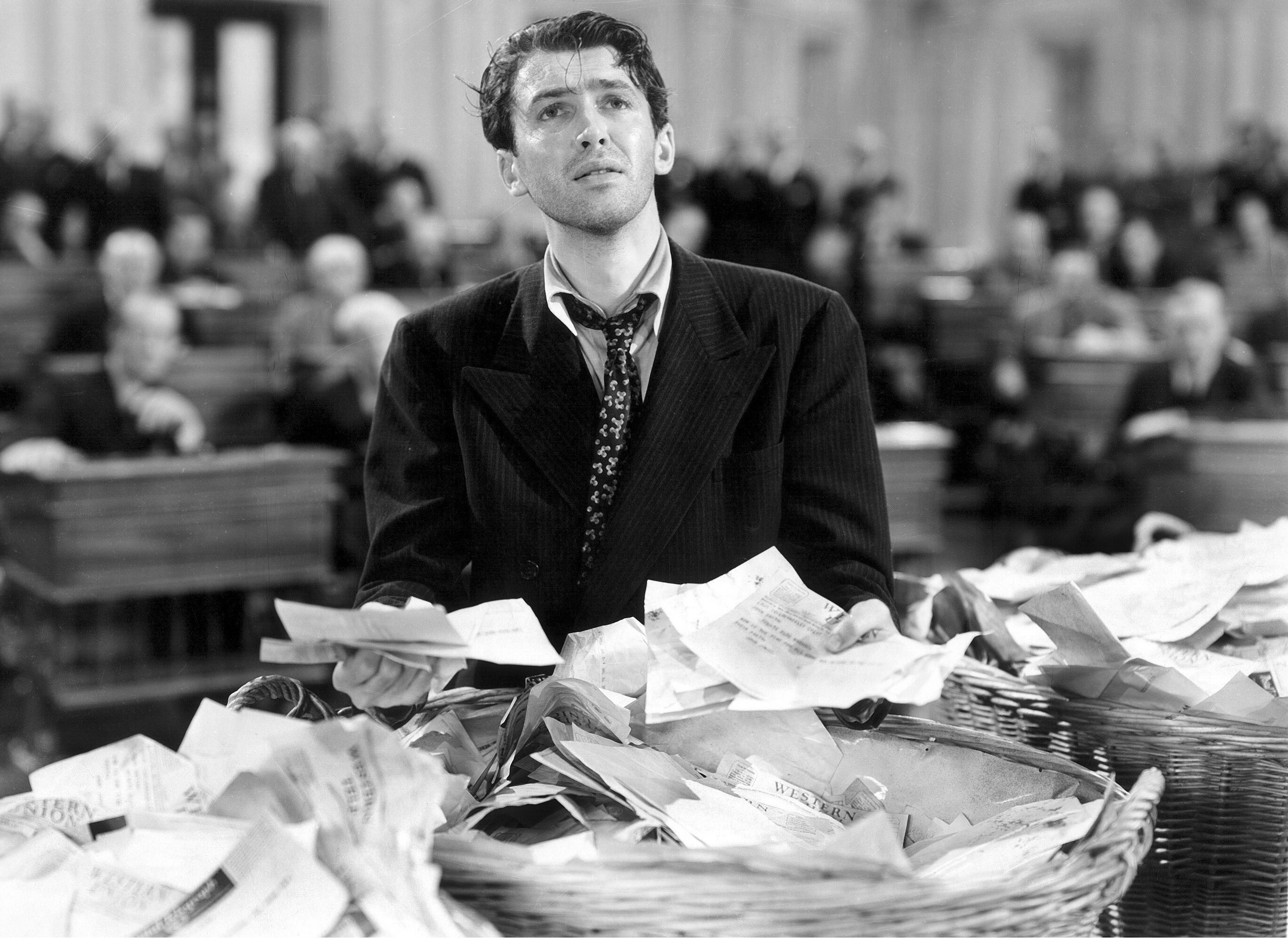
October 17, 1939: Mr. Smith Goes to Washington premieres, at Constitution Hall in Washington, D.C. It was the 2nd of the 3 films that were directed by Frank Capra and starred James Stewart. The 1st was You Can't Take It With You in 1938. The 3rd was It's a Wonderful Life in 1946, which became the defining Frank Capra film and the defining Jimmy Stewart film.

U.S. Senator Sam Foley -- his State is never identified, but is said to be in the West -- dies in office. The Governor Hubert "Happy" Hopper (played by Guy Kibbee) appoints Jefferson Smith (Stewart) to replace him, thinking the young activist will be easy to manipulate. Senator Joseph Paine (Claude Rains), a friend of Smith's late father, mentors him, and Smith takes a liking to the Senator's daughter, Susan (Jean Arthur).

The Washington press take advantage of Smith's naïveté, and he ends up looking like a dim country bumpkin. He comes up with a bill to authorize a federal government loan to buy some land in his home State for a national boys' camp, to be paid back by youngsters across America. It sounds like a typical Franklin Roosevelt-style New Deal bill, and the public likes it, with donations pouring in immediately. However, the proposed campsite is already part of a dam-building graft scheme included in an appropriations bill framed by the the political machine of the State's party boss, Jim Taylor (Edward Arnold), and supported by Paine.

Unwilling to politically destroy Smith so that their graft plan will go through, Paine tells Taylor he wants out, but Taylor reminds him that Paine is in power primarily through Taylor's influence. Paine then advises Smith to keep silent about the matter. The following day, when Smith speaks out about the bill at Senate, the machine, through Paine, accuses Smith of trying to profit from his bill, by producing fraudulent evidence that Smith already owns the land in question. Smith is too shocked and angry by Paine's betrayal to defend himself, and runs away.

Saunders, who looked down on Smith at first, but has come to believe in him, talks him into launching a filibuster, to postpone the appropriations bill and prove his innocence on the Senate floor just before the vote to expel him. In his last chance to prove his innocence, he talks non-stop for about 25 hours, reaffirming the American ideals of freedom and disclosing the dam scheme's true motives. Yet none of the other Senators are convinced.

Newspapers and radio stations in Smith's home State, on Taylor's orders, refuse to report what Smith has to say, and even distort the facts against the Senator. The Boy Rangers' effort to spread the news in support of Smith results in vicious attacks on the children by Taylor's gangsters.

Although all hope seems lost, the Senators begin to pay attention as Smith approaches utter exhaustion. Paine has one last card up his sleeve: He brings in bins of letters and telegrams from the home State, purportedly from average people demanding his expulsion. Nearly broken by the news, Smith finds a small ray of hope in a friendly smile from the President of the Senate. Smith vows to press on until people believe him, but immediately collapses in a faint.

Overcome with the pangs of remorse, Paine leaves the Senate chamber, and attempts to commit suicide by gunshot, but is stopped by onlooking Senators. He then bursts back into the Senate chamber, shouting a confession to the whole scheme. The reformed Paine further insists that he must be expelled from the Senate, and affirms Smith's innocence.

Because the film even suggested that the American federal government might harbor corruption, it was slammed as anti-American and pro-Communist. Senator Alben Barkley of Kentucky, the Majority Leader (and later Vice President under Harry Truman), called the film "a grotesque distortion."

Joseph P. Kennedy, the U.S. Ambassador to Britain (and later father to 3 U.S. Senators, 1 of whom became President), wrote to Harry Cohn, head of Columbia Pictures, the film's distributor, and urged that it be withdrawn from European release, because it would damage America's prestige in Europe. He needn't have worried: The major Fascist dictators -- Adolf Hitler in Germany, Benito Mussolini in Italy, and Francisco Franco in Spain -- all banned it in their countries. It wasn't shown in the Soviet Union until 1950.

Since World War II, the words "Mr. Smith goes to Washington" have become code for a "citizen legislator" getting himself elected and fighting the entrenched interests in Congress. Many such candidates have proven to have been already bought by special interests before they got there.

*

October 17, 1939 was a Tuesday. Baseball season had just ended, with the New Yankees sweeping the Cincinnati Reds in the World Series. The NBA hadn't been founded yet. And the NHL season didn't start for another 2 weeks. There was one score on this historic day, and it was in college football: William & Mary and VPI played to a 6-6 tie at City Stadium in Richmond, Virginia.

"VPI" was the abbreviation for what was known from 1896 to 1944 as the Virginia Agricultural and Mechanical College and Polytechnic Institute; and from 1944 to 1970 as simply the Virginia Polytechnic Institute. Since 1970, it has been Virginia Tech University.

Monday, August 29, 2022

August 29, 1957: The Longest Senate Filibuster

August 29, 1957: Strom Thurmond spends 24 hours making a racist ass of himself.

That was not his goal. He failed to achieve his goal.

Thurmond was born in 1902, was elected to the South Carolina State Senate in 1934, and a State judge in 1938. In World War II, he served with the U.S. Army's famed 82nd Airborne Division on D-Day, and rose to the rank of Lieutenant Colonel. In 1946, he was elected Governor.

In 1948, he was one of the Southern members of the Democratic Party who formed the States' Rights Party that split over the issue of civil rights, and was nominated by them for President. In an interview late in life, he said he thought the Republican nominee, Governor Thomas E. Dewey in New York, would win, because he would win the Southern States, taking them from the Democratic incumbent, President Harry S Truman. Truman won anyway, and Thurmond finished a distant 3rd.

In 1954, Thurmond became the 1st person elected to the U.S. Senate as a write-in candidate. In 1956, he co-wrote the Southern Manifesto, with Southern members of both houses of Congress promising "massive resistance" to federal laws backing up the U.S. Supreme Court's decision striking down State laws segregating public schools.

In 1957, the Administration of President Dwight D. Eisenhower introduced a civil rights bill, imposing expansion of federal supervision of integration in Southern States. It would establish the U.S. Commission on Civil Rights, and the Civil Rights Division of the U.S. Department of Justice. On June 18, the U.S. House of Representatives passed it, by a vote of 286-126. On August 7, the Senate passed an amended version, 72-18. On August 27, with the differences worked out, the House passed it again, 279-97. It became the Senate's turn to try again.

To block even a vote on the bill, Thurmond began a filibuster: A a tactic used in the Senate to delay or block a vote on a measure by preventing debate on it from ending. The Senate's rules place few restrictions on debate: In general, if no other Senator is speaking, a Senator who seeks recognition is entitled to speak for as long as they wish. Only when debate concludes, whether naturally or using a "cloture" vote, can the measure be put to a vote. One Senator can "hand off" a filibuster to another Senator, to further delay a vote, or to convince the sponsor to withdraw it.

Before 1957, the record for the longest filibuster was set on April 24, 1953, when Wayne Morse a Republican-turned-Independent (and eventually a Democrat) from Oregon spoke for 22 hours and 26 minutes, in an unsuccessful attempt to stop the Submerged Lands Act. That broke the 1908 record of 18 minutes and 23 seconds, by Robert La Follette Sr., Republican of Wisconsin, trying to stop the Aldrich-Vreeland Act, which established the National Monetary Commission.

On May 27, 1935, the Supreme Court struck down the National Industrial Recovery Act as unconstitutional. On June 12, Democrats tried to pass an amendment they believed would make it constitutional. But one Democrat, Huey Long of Louisiana, opposed it, and spoke for 15 hours and 30 minutes, filling the time by, among other things, reading recipes from a cookbook he had written: "Now, I come to pot likker... "

Thurmond shattered all records, going more than one full day: 24 hours and 18 minutes, spewing invective against the federal government and anti-racist crusaders, and reading aloud from The Case for the South, by W.D. Workman Jr., a reporter and a friend of his. 

Other Southern Senators, who had agreed as part of a compromise not to filibuster this bill, were upset with Thurmond, because they thought his defiance made them look incompetent to their constituents. Thurmond sent copies to each of his 95 Senate colleagues, and also to Vice President Richard Nixon,

Finally, the Senate invoked cloture, ending his filibuster, and approved the bill, 60-15. President Eisenhower signed the Civil Rights Act of 1957 into law on September 9. Just 15 days later, he sent the U.S. Army to enforce the integration of Central High School in Little Rock, Arkansas.

New Civil Rights Acts were passed in 1960, 1964, 1965 (the Voting Rights Act) and 1968 (the Fair Housing Act). After a multi-Senator filibuster was broken to pass the Civil Rights Act of 1964, Thurmond switched to the Republican Party, the 1st major American politician to do so.

Southern Democrats' switch to the Republicans over the issue of race would be a long process. However, by the time Thurmond finally retired from the Senate in 2002 -- at the age of 100, dying a few months later, on June 26, 2003 -- nearly every Southern State had 2 Republican Senators, including some who had previously been Democrats, and nearly every State had no white Democrats in the House, only white Republicans and black Democrats.

Republicans used the filibuster to stop 2 notable Supreme Court nominations, in the hopes that they could delay until after a Presidential election, when a Republican President would give them a Justice more to their liking: In 1968, to stop President Lyndon Johnson's intended promotion of Associate Justice Abe Fortas to Chief Justice, resulting in President Nixon's appointment of Earl Warren; and in 2016, to stop President Barack Obama's appointment of Merrick Garland, resulting in Donald Trump's appointment of Neil Gorsuch.

Alfonse D'Amato, Republican of New York, twice tried to break Thurmond's record: On October 17, 1986, against the Defense Authorization Act, getting to 23 hours and 30 minutes, within 48 minutes of the record; and on October 5, 1992, against the Revenue Act, getting to 15 hours and 14 minutes.

On September 24, 2013, Ted Cruz, Republican of Texas, tried to stop a Continuing Appropriations Act to keep the government funded, because it included funding for the Affordable Care Act, a.k.a. "Obamacare." He went 21 hours and 18 minutes, and included reading Green Eggs and Ham by Dr. Seuss aloud.

The point he wanted to make is that he didn't like "socialized medicine" here or there, he did not like it anywhere. It was pointed out to him that he had completely missed the point of this book that was so simple, a child could understand it: The point was that, if you try something new, however weird it might seem, you might like it. The move deepened Cruz's already-established reputation as a buffoon, who could not get elected outside a Southern State.

UPDATE: On March 31 and April 1, 2025, Senator Cory Booker, Democrat of New Jersey, gave a speech lasting 25 hours and 5 minutes, protesting the policies of Republican President Donald Trump. That broke Thurmond's record for the longest Senate speech. But, since it was not done to block a vote on a Senate bill, Thurmond still holds the record for the longest Senate filibuster.

*

August 29, 1957 was a Thursday. Jockey Jerry Bailey was born. There were only 3 scores on this historic day, all in baseball:

* The New York Yankees beat the Chicago White Sox, 2-1 at Comiskey Park in Chicago. Enos Slaughter, 41 years old, hit a home run in the top of the 11th inning. "Country" wasn't really known as a hitter: He retired after the 1959 season, with just 169, but also with a .300 lifetime batting average.

Whitey Ford was the winning pitcher, pitching 5 shutout innings in relief of Tom Sturdivant. Hank Bauer also hit a home run. Mickey Mantle went 2-for-5, and Yogi Berra went 1-for-3 with 2 walks.

* The Cleveland Indians beat the Baltimore Orioles, 13-4 at Cleveland Municipal Stadium. The Tribe scored 6 runs in the 1st inning and 3 in the 2nd, and never looked back. Brooks Robinson went 1-for-2 with a walk.

* And the Boston Red Sox beat the Detroit Tigers, 6-1 at Briggs Stadium in Detroit. (The ballpark was renamed Tiger Stadium in 1961.) Ted Williams went 0-for-1 -- with 4 walks. Al Kaline went 0-for-4.

December 31, 1999 & January 1, 2000: The Millennium

December 31, 1999:  The Millennium arrives. The people of planet Earth survived. At a terrible cost. But we hadn't destroyed ourselves. ...