Showing posts with label afl championship game. Show all posts

Saturday, December 31, 2022

December 31, 1967: The 1st Oakland Championship

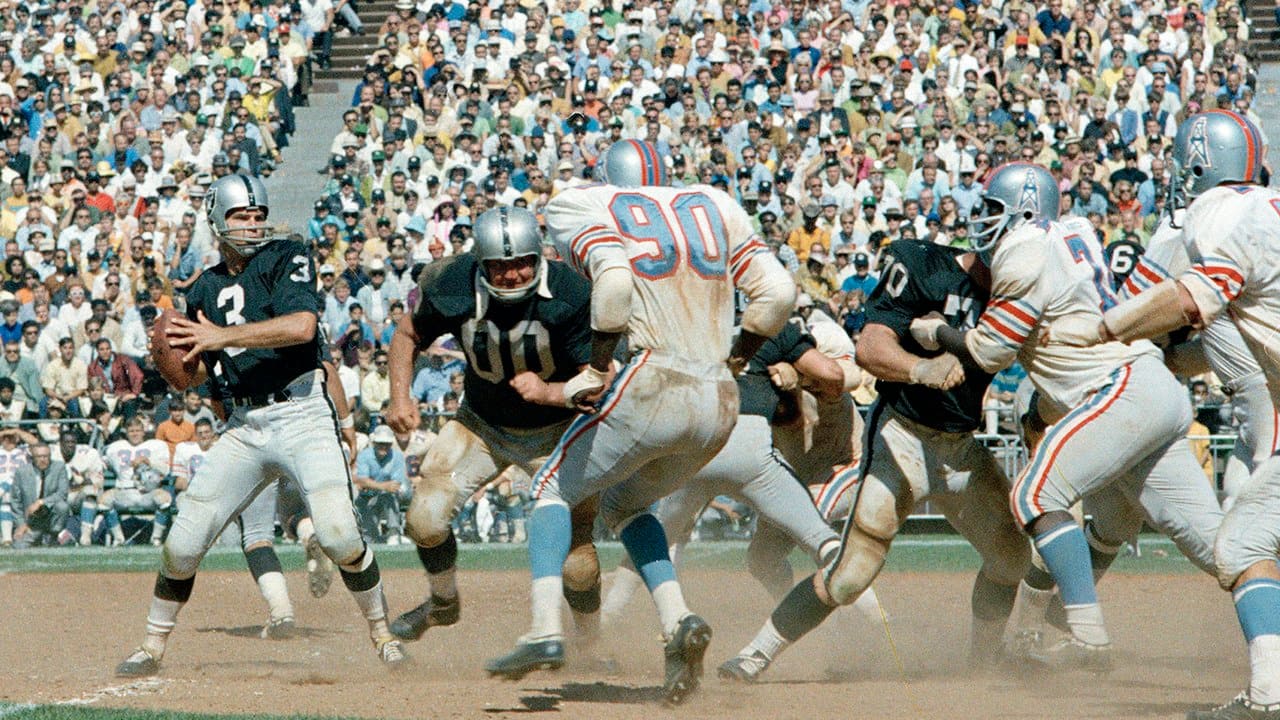
Daryle Lamonica (3) back to pass. Blocking for him
are Jim Otto (00), Dan Archer (78) and Jim Harvey (70).
Note the infield dirt, left over for baseball.

December 31, 1967: The American Football League Championship Game is played at the Oakland-Alameda County Coliseum on this New Year's Eve. The Oakland Raiders hosted the Houston Oilers.

The Oilers had played in the 1st 3 AFL Championship Games, winning in 1960 and 1961, but losing in 1962. Their starting quarterback was George Blanda. Pete Beathard was now the Oilers' quarterback. This would be the Raiders' 1st title game. Blanda was now playing for them.

But while he was their main placekicker, he was not their starting quarterback. That would be Daryle Lamonica, who threw the ball so often, and so far, he became known as "The Mad Bomber." Raider coach John Rauch, having been a quarterback himself, knew he had two good ones. Lamonica would not be elected to the Pro Football Hall of Fame, but Blanda would, along with receiver Fred Biletnikoff, center Jim Otto, guard Gene Upshaw, and cornerback Willie Brown.

The game kicked off at 2:00 Pacific Standard Time (5:00 Eastern), and the temperature was 47 degrees. Just a few minutes earlier, the NFL Championship Game had ended in Green Bay, Wisconsin, and, to those inside Lambeau Field, 47 degrees would have seemed like beach weather in comparison.

The only scoring in the 1st quarter was a 37-yard field goal by Blanda. But the Raiders pulled away in the 2nd quarter, with Hewritt Dixon scoring on a 69-yard run, and Lamonica throwing a 17-yard touchdown pass to Dave Kocourek. It was 17-0 Raiders at the half.

In the 3rd quarter, Lamonica scored on a quarterback sneak, and Blanda kicked a 40-yard field goal. Blanda kicked one from 42 yards, giving the Raiders a 30-0 lead early in the 4th quarter. The Oilers finally scored on a 5-yard touchdown pass from Beathard to Charley Frazier. But the Raiders put it away with another field goal from Blanda, this one 36 yards, and a 12-yard touchdown pass from Lamonica to Bill Miller. The final was Oakland 40, Houston 7.

This was the 1st league championship for Raiders owner Al Davis. There would be more. Moreover, while Oakland had been the much-maligned "little brother" to cosmopolitan San Francisco across the Bay, this game was the beginning of a shift.

The San Francisco Giants had won the National League Pennant in 1962, and just missed Pennants in 1964, '65 and '66. But the Raiders were now AFL Champions, and Oakland had just become home to the NHL's Seals and the ABA's Oaks, and were about to become home to baseball's Athletics. Oakland would soon have 4 teams, to San Francisco's 3 -- and when the San Francisco Warriors moved in 1971, taking the name "Golden State Warriors," taking the place of the Oaks who had moved, Oakland would, briefly, have 4 teams to San Francisco's 2.

From this game until the 49ers' NFC Championship of January 10, 1982, the City of San Francisco had no league champions in any sport, while the City of Oakland had 8: The 1967 AFL Champion Raiders; the 1969 ABA Champion Oaks; the 1972, 1973 and 1974 World Series Champion Athletics; the 1975 NBA Champion Warriors; and the 1976 and 1980 NFL Champion Raiders. And that doesn't even count the Oakland Clippers, earlier in 1967, winning the title in the National Professional Soccer League, which could hardly have been called "major league." But it did happen.

For a few years, sports-wise, Oakland was the place to be. It was a golden age -- or, as A's and Seals owner Charlie Finley might have put it, a Green and Golden Age.

In 1999, The Sporting News released their list of the 100 Greatest Football Players. Jim Otto was ranked 78th, and George Blanda 98th. In 2010, the NFL Network ranked Otto 63rd on its list of the 100 Greatest Players, but Blanda didn't make it.

*

December 31, 1967 was a Sunday. The 1967 NFL Championship Game was played the same day. While the Oakland Coliseum has been known for chilly conditions, there was no issue with the weather there on that day. That would not be the case for the NFL title game: It was well below zero at Lambeau Field in Green Bay, Wisconsin. The Green Bay Packers beat the Dallas Cowboys, 21-17, in a game that became known as the Ice Bowl. I have a separate entry for that event. The Packers went on to beat the Raiders, 33-14 in Super Bowl II, in a much-warmer Orange Bowl in Miami.

There were 2 games played in the NBA. The Los Angeles Lakers beat the expansion San Diego Rockets, 147-118. It was the 1st game the Lakers played at their new arena, The Forum, outside Los Angeles in Inglewood, California.

And the San Francisco Warriors beat the other expansion team, the Seattle SuperSonics, 126-124 at the Seattle Center Coliseum. For the Warriors, Nate Thurmond had 34 points and 25 rebounds.

There was 1 game played in the American Basketball Association, which was in its 1st season: The Pittsburgh Pipers beat the Indiana Pacers, 121-106 at the Civic Arena in Pittsburgh. The Pipers would go on to win the 1st ABA Championship. But before the 1972-73 season, they were out of business. The Pacers would win the ABA title in 1970, '72 and '73, and were 1 of the 4 teams absorbed from the ABA into the NBA in 1976.

There were 4 games played in the NHL that day:

* The New York Rangers beat the Toronto Maple Leafs, 4-0, in one of the last events at the old Madison Square Garden.

* The Philadelphia Flyers beat the Los Angeles Kings, 9-1 at The Spectrum in Philadelphia.

* The Detroit Red Wings beat the Boston Bruins, 6-4 at the Olympia Stadium in Detroit.

* The Chicago Blackhawks beat the Oakland Seals, 3-0 at the Chicago Stadium.

* The Montreal Canadiens, the Pittsburgh Penguins, the St. Louis Blues and the Minnesota North Stars were not scheduled. 

Thursday, December 29, 2022

December 29, 1968: The New York Jets Win the AFL Championship

December 29, 1968: The American Football League Championship Game is played at Shea Stadium in Flushing Meadow, Queens, New York City. By any objective measure, it was a better game than the Super Bowl that was held 2 weeks later.

The Oakland Raiders had won the AFL Championship the year before, and were back in the Championship Game. The New York Jets were in it for the 1st time. Earlier in the season, on November 17, in Oakland, The Jets blew a lead with a little over 1 minute to play, and the Raiders scored 2 touchdowns. Most of the country didn't see it, though, as NBC cut away at 7:00 PM Eastern Time, to show the children's movie Heidi, infuriating millions of TV viewers. "The Heidi Bowl" was a sign that the AFL had finally achieved a place in the American sports firmament, alongside the established NFL.

Quarterbacked by Joe Namath, who had already earned the nickname "Broadway Joe" for his showmanship, the Jets finished the season 11-3. The Raiders, with a quarterback named Daryle Lamonica, known as "The Mad Bomber," and with a devastating, often dirty, defense, were 12-2. Each team won its Division.

Since it was an even-numbered year, it was the Eastern Division Champion's turn to host the Championship Game. And so, Shea Stadium, also the home of baseball's New York Mets, hosted a football championship before it hosted a postseason game in baseball. A crowd of 62,627 was on hand, the biggest in AFL history.

A short punt led to Namath passing to Don Maynard for a touchdown to open the scoring. The Raiders stalled on their next drive, and George Blanda hit the crossbar on a field goal attempt. Jim Turner kicked a field goal to put the Jets up 10-0 at the end of the 1st quarter.

The Raiders got off the deck, and Lamonica threw a 29-yard touchdown pass to Fred Biletnikoff. Turner kicked another field goal, and Blanda kicked one right before the half, to close the Raiders to within 13-10.

Blanda tied the game with a field goal in the 3rd quarter, but Namath took the Jets downfield, and just before the quarter ended, he threw a touchdown pass to Pete Lammons, putting New York up, 20-13.

Early in the 4th quarter, George Atkinson intercepted a Namath pass, and took it to the Jets' 5-yard line. Pete Banaszak ran it in on the next play, and for the 1st time, the Raiders led, 23-20. But Namath needed just 3 passes -- 10 yards to George Sauer, 52 to Maynard, and 6 to Maynard -- to put the Jets up, 27-23.

With a little over 5 minutes left, with the Raiders having the ball on the Jets' 26-yard line and 4th & 10, head coach John Rauch decided to go for the 1st down. It didn't work, as Verlon Biggs sacked Lamonica. On their next drive, Lamonica got to the Jets' 24, but he made a bad throw that was ruled a fumble, and Ralph Baker recovered for the Jets. With 1 last chance, the Raiders had the ball on their own 22 with 42 seconds left, but could only get to midfield before the clock ran out. The Raiders had outgained the Jets, 443 total yards to 400, but the Jets had won, 27-23.

In the off-season, Rauch decided he'd had enough meddling by Raiders owner Al Davis, and resigned. Davis promoted the linebackers coach to head coach: John Madden. Madden's legend was just beginning, while Namath's was about to reach the stratosphere.

And a storybook period for New York sports had begun: In a span of 17 months, the Jets had won the AFL Championship, the Jets would pull off one of the greatest upsets in sports history by becoming the 1st AFL team to win a Super Bowl, the Mets would win a "Miracle" World Series, and the Knicks would win their 1st NBA Championship.

*

December 29, 1968 was a Sunday. The NFL Championship Game was played the same day, and the Baltimore Colts, 13-1 on the regular season, avenged their only defeated annihilating the Cleveland Browns, 34-0 at Cleveland Municipal Stadium. (As with the AFL, home-field advantage was determined on a rotating basis, not by best record. The merged NFL wouldn't start doing it that way until 1975.)

There were 4 games played in the NBA:

* The New York Knicks beat the Seattle SuperSonics, 120-112 at Madison Square Garden. Willis Reed scored 34 points.

* The Atlanta Hawks beat the Baltimore Bullets, 101-99 at the Alexander Memorial Coliseum (now the McCamish Pavilion) in Atlanta.

* The Chicago Bulls beat the Milwaukee Bucks, 102-97 at the Milwaukee Arena. In 1974, it was renamed the Milwaukee Exposition, Convention Center and Arena, or "The MECCA." Since 2014, it has been named the UW-Panther Arena.

* And the Los Angeles Lakers beat the Detroit Pistons, 111-108 at The Forum outside Los Angeles in Inglewood, California. Jerry West scored 34 points, Elgin Baylor scored 24, and Wilt Chamberlain scored 22 and had 25 rebounds.

There were 5 games in the American Basketball Association:

* The New York Nets lost to the Kentucky Colonels, 118-116 in overtime at the Long Island Arena in Commack, New York. Ron Perry scored 36 in defeat for the Nets.

* The Miami Floridians beat the New Orleans Buccaneers, 107-106 at the Miami Beach Convention Center.

* The Houston Mavericks beat the Los Angeles Stars, 93-83 at the Sam Houston Coliseum in Houston.

* The Oakland Oaks beat the Minnesota Muskies, 120-99 at the Metropolitan Sports Center in the Minneapolis suburb of Bloomington, Minnesota.

* The Denver Nuggets beat the Dallas Chaparrals, 102-92 at the Denver Auditorium Arena.

And there were 4 games in the NHL:

* The New York Rangers beat the Montreal Canadiens, 3-1 at Madison Square Garden.

* The Oakland Seals beat the Philadelphia Flyers, 2-1 at The Spectrum in Philadelphia.

* The Boston Bruins and the Detroit Red Wings played to a tie, 3-3 at the Olympia Stadium in Detroit.

* And the Chicago Black Hawks beat the Los Angeles Kings, 4-1 at the Chicago Stadium.

Monday, December 26, 2022

December 26, 1965: The Tom Matte Game

December 26, 1965: The Green Bay Packers play the Baltimore Colts in a Playoff to decide the Championship of the NFL's Western Conference, at Lambeau Field in Green Bay, Wisconsin. Like its predecessor, the facility had been named City Stadium, but had recently been renamed, in memory of Earl "Curly" Lambeau, the Packers' co-founder and original head coach, who guided them to 6 NFL Championships.

Both teams finished the season 10-3-1. The Packers had won both games between them that season, but head-to-head was not a tiebreaker: Won-lost record was the only one, and so a Playoff was mandated. 

In this win-or-go-home game, both teams would have to rely on backup quarterbacks. For the Packers, Edmund "Zeke" Bratkowski, a career backup now 34 years old -- he was born on October 20, 1931, the same day as baseball legend Mickey Mantle -- had to substitute for the injured Bart Starr early in the game.

The Packers were thus taken by surprise. The Colts were not, but they were down to their 4th string quarterback. They were 9-1-1 when Johnny Unitas, then considered the best quarterback in the game, was injured in a 13-0 loss to the Baltimore Colts. Gary Cuozzo stepped in, but he was injured in the next game, a 42-27 loss to the Packers.

The only player the Colts had left on their roster who had ever played quarterback was running back Tom Matte, who had played quarterback at Ohio State, under coach Woody Hayes. But, given Hayes' disdain for the passing game -- he famously said, "There are three things that can happen when you throw the football, and two of them are bad," meaning an incompletion and an interception -- that meant that he hardly ever threw the ball. So he wasn't considered a long-term option.

For their season finale, the Colts signed a free agent, Ed Brown, who was also a good punter. He guided them to a 20-17 win over the Los Angeles Rams. The problem was, he was signed too late in the season to be eligible for any postseason games. So the Colts were stuck with Matte as quarterback. And it would be in Green Bay, and it would be "Packer Weather": No snow, but just 22 degrees, with the wind-chill factor making it 12. Baltimore can get cold in the Winter, but that kind of cold was unusual for Colt games at Memorial Stadium.

At first, it seemed to work. Matte threw 12 passes, completing 5, ran for 57 yards, and was sacked only once. Don Shinnick picked up a fumble by the Packers' Donny Anderson, and returned it 25 yards for a touchdown, just 21 seconds into the game. Starr was the last man between the huge Shinnick and the end zone, and hurt his ribs in his failure to make the tackle, resulting in Bratkowski having to take over.

Lou Michaels kicked the extra point. In the 2nd quarter, Matte drove the Colts downfield, and Michaels kicked a 15-yard field goal, and the Colts went into the locker room leading, 10-0.

In the 3rd quarter, Paul Hornung, who was a Heisman Trophy-winning quarterback at Notre Dame before becoming a running back with the Packers, ran the ball in from the 1-yard line to score a touchdown. Don Chandler kicked the extra point.

With 1:58 left to play in regulation, Chandler attempted a tying field goal from 22 yards out. The ball appeared to be wide of the right upright, and Chandler's reaction suggested that he thought he'd missed it. But referee Jim Tunney ruled that it was good, and it was 10-10. Overtime.

Bratkowski led the Packers downfield, and, with 1:21 left in the 1st overtime, Chandler attempted a 25-yard field goal. There was no doubt about this one: It was good, and the Packers would host the NFL Championship Game, against the Cleveland Browns. 

Baltimore football fans have complained ever since that Chandler's 4th quarter field goal was no good. Before the 1966 season, the NFL made 2 changes in response to these complaints: Goalposts were extended from to 10 feet high to 20 feet, and an official would be placed directly under each upright on field goal attempts.

In 1981, John Thorn left his comfort zone, baseball, and published Pro Football's 10 Greatest Games. He included this game as one of them.

The Packers beat the Browns, 23-12. They won the next 2 NFL Championships, and the subsequent games, too, which were retroactively renamed Super Bowl I and Super Bowl II. With Matte as running back, and Earl Morrall filling in for an injured Unitas, the Colts won the 1968 NFL Championship, but lost Super Bowl III to the New York Jets. Unitas led them to win the 1970 NFC Championship, but got hurt in Super Bowl V, and Morrall had to come to the rescue, and the Colts beat the Dallas Cowboys. Matte, and all the other Colts who had lost Super Bowl III, got their redemptions and their rings.

Bratkowski died in 2019, Matte in 2021.

*

December 26, 1965 was a Sunday. The American Football League held its Championship Game that day, and the Buffalo Bills beat the San Diego Chargers, 23-0 at Balboa Stadium in San Diego. The Bills had now won 2 straight AFL Championships. They have not won a league championship since.

Baseball was out of season. There were 3 games played in the NBA:

* The Boston Celtics beat the Baltimore Bullets, 120-99 at the Boston Garden. Sam Jones scored 34 points.

* The Philadelphia 76ers beat the San Francisco Warriors, 121-107 at the Philadelphia Civic Center. Wilt Chamberlain had 33 points and 30 rebounds.

* And the Cincinnati Royals beat the St. Louis Hawks, 117-115 at the Kiel Auditorium in St. Louis. Oscar Robertson led all scorers on the day with 37 points.

And the NHL's entire "Original Six" were in action:

* The New York Rangers beat the Boston Bruins, 6-4 at the old Madison Square Garden. Bob Nevin had a hat trick.

* The Toronto Maple Leafs and the Chicago Black Hawks played to a tie, 1-1 at the Chicago Stadium.

* And the Detroit Red Wings beat the Montreal Canadiens, 1-0 at the Olympia Stadium in Detroit. This turned out to be a preview of the Stanley Cup Finals, but the Canadiens beat the Wings.

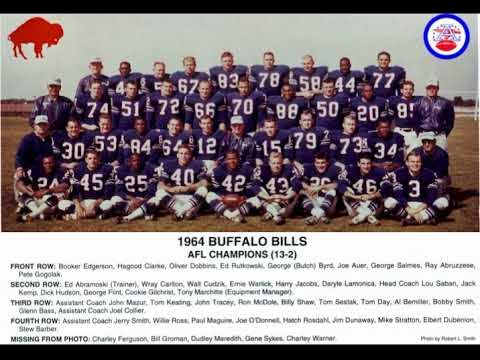
December 26, 1964: The Buffalo Bills Triumphant

December 26, 1964: The American Football League Championship Game is played for the 1964 season.

The season before, the San Diego Chargers, coached by Sid Gillman, had won the title, showing football fans that the AFL wasn't just a pass-happy "basketball league": It could feature good defense, too. The Buffalo Bills, coached by Lou Saban, followed the same path, with a defense led by end Ron McDole, tackle Tom Sestak, and linebacker Mike Stratton.

The Chargers would regret letting quarterback Jack Kemp go, as the Bills had acquired him to run their offense. Protected by a future Hall-of-Famer, guard Billy Shaw, he could hand off to running back Carlton Chester "Cookie" Gilchrist, or pass to receiver Elbert Dubenion.

There was once a common trivia question: Name the men wearing Number 32 who won the Most Valuable Player awards in the American League, the National League, the NFL and the AFL in 1963. But the question was no good: Elston Howard, Sandy Koufax, Jim Brown and Gilchrist won their respective awards, but, while the other 3 players wore 32, Gilchrist wore 34.

The Bills went 12-2 in 1964. They dropped 48 points on the Houston Oilers, and scored at least 30 points in 6 other games. Their only losses were on November 15, 36-28 at home to the Boston Patriots; and on December 6, 16-13 away to the Oakland Raiders.

As it was an even-numbered year, it was the Eastern Division winners' turn to host the AFL Championship Game, and the Bills welcomed the defending Champion Chargers into War Memorial Stadium. Built in 1938, it was already dilapidated, known as "The Old Rockpile." Buffalo native Brock Yates, a screenwriter who created the race upon which the Cannonball Run movies were based, said that it "looks as if whatever war it was a memorial to had been fought within its confines." And it was small: At 40,242 seats, its capacity would prove too small when the AFL and the NFL merged in 1970, so the Bills had to build a larger stadium.
In the 1st quarter, Tobin Rote threw a 26-yard touchdown pass to Dave Kocourek, to put the Chargers up, 7-0. But they never scored again. The Bills' defense was symbolized by Stratton hitting Keith Lincoln midway through the 1st quarter, breaking a rib and knocking him out of the game. It was the most famous defensive play in AFL history.
Pete Gogolak and his brother Charley, natives of Hungary, became pro football's 1st "soccer-style kickers," approaching the placement from the side and hitting the ball with the instep of the foot, rather than the traditional straight-on, hit-with-the-toes style. Pete kicked a field goal late in the 1st quarter, and another in the 2nd. In between, Kemp guided the Bills down to where Wray Carlton could score on a 4-yard run. In the 4th quarter, Kemp scored on a quarterback sneak. The Bills won, 20-7.
The Bills won the AFL Championship again in 1965, again beating the Chargers; then lost the 1966 AFL Championship Game to the Kansas City Chiefs. Saban would leave, then return as head coach, and lead the Bills to the AFC Wild Card Playoff berth in 1974.
Like basketball coach Larry Brown, Saban was known, somewhat unfairly, for never staying in the same place for very long, also serving as head coach for the Boston Patriots, the Denver Broncos, and several college teams. He died in 2009. His son, Nick Saban, in junior high school at the time of the Bills' AFL titles, would win 7 National Championships in the college ranks. Unlike many father & son coaching pairs, they never coached together. Indeed, while Lou was head coach at Army in 1979, Nick was an assistant coach at Navy in 1982.
The Bills had won the last 2 AFL Championships before the AFL Champion was allowed to play the NFL Champion for a World Championship, and had lost the game that would have put them in Super Bowl I. It would take until the 1990 season before they finally got into a Super Bowl. And they got into 4 in a row, something no other franchise has done. And yet, they lost all 4, and only the 1st one was all that close (although they were leading the 4th at the half).
The Bills have become to the NFL what the Chicago Cubs once were to baseball, the sport's "lovable losers" with a history of close calls breaking the hearts of some of the most passionate fans in the sport. From 1964 onward, they have been 1 of the last 2 teams standing 6 times, something only 7 other teams have done.
But the fact that the Bills' titles came before the advent of the Super Bowl means that they get discounted: Even before the distance of time became what it is now, NFL fans had come to regard any title won before the Super Bowl, NFL or AFL, as not a "real" championship.
As it stands, through Christmas 2022, no team based in, or near, Buffalo has ever won a major league sports championship. The NHL's Sabres are 0-for-2 in Stanley Cup Finals, and the NBA's Braves, like the Sabres a 1970 expansion team, moved in 1978. Due to Canadian COVID restrictions, the Toronto Blue Jays had to play some "home games" at Buffalo's Sahlen Field in 2020 and '21. Before that, there hadn't been a Major League Baseball team in Buffalo since the 1914-15 Blues of the Federal League; before that, the Bisons of the National League, who folded after the 1885 season. And none of those teams won a Pennant.
Unless you count soccer as a major league sport in North America, with the 1971 Rochester Lancers and the 2016 Western New York Flash, then the last World Championship won by a team that can be considered "Western New York" remains the 1955 NBA Champion Syracuse Nationals. If you don't count Syracuse as "Western," then it's the 1951 NBA Champion Rochester Royals.
In 1998, Vincent Gallo, a Buffalo native, wrote, directed and starred in the film Buffalo '66.. Despite the title, while there are flashbacks, the film took place mostly in the present day. He played Billy Brown, whose mother was going to go to the 1966 AFL Championship Game at War Memorial Stadium, but went into labor, and she has blamed the son's birth for her missing the game, and her missing the game for the Bills' inability to win a title ever since.

The son grew up to become a compulsive gambler, and when Scott Norwood missed his field goal attempt on the last play of Super Bowl XXV, causing the Bills to lose the game, still the closest they've come since 1965, Billy lost a $10,000 bet. Unable to pay up, his bookmaker forced him to clear his debt by confessing to a crime he did not commit, resulting in 5 years in prison.

When he gets out, he decides he wants to get revenge -- not on the bookie, but on Norwood (known as “Scott Wood” in the film), whom he's convinced took a payoff to miss the kick on purpose, a la the Chicago White Sox throwing the 1919 World Series. Have you ever wanted to kill someone who ruined a sporting event for you? Maybe. Would you ever actually attempt it? No. Billy sets out to attempt it. For the record, nobody has ever credibly accused Norwood of missing that kick on purpose.

UPDATE: The Bills have a Wall of Fame, with these members:
* From the 1960s: Quarterback Jack Kemp, running back Chester "Cookie" Gilchrist, receiver Elbert Dubenion, guards Billy Shaw and Bob Kalsu, defensive tackle Tom Sestak, linebacker Mike Stratton, cornerback Booker Edgerson, safety George Saimes; plus founding owner Ralph Wilson, team executive Pat McGroder, head coach Lou Saban, longtime broadcaster Van Miller and trainer Edward Abramoski. Kalsu only played one season before being drafted, and was the only active NFL player killed in action in the Vietnam War. 
* From the 1970s: Quarterback Joe Ferguson, guard Joe DeLamielleure, cornerback Robert James, and running back O.J. Simpson, whose name has never been removed despite his post-playing infamy; plus Wilson, McGroder, Saban, Miller and Abramoski.
* From the 1980s: Quarterback Jim Kelly, receivers Andre Reed and Steve Tasker, center Kent Hull, guard Jim Ritcher, defensive end Bruce Smith, defensive tackle Fred Smerlas, and linebacker Darryl Talley; plus Wilson, Miller and Abramoski.
* From the 1990s: Kelly, Reed, Tasker, Hull, Ritcher, Smith, running back Thurman Thomas and defensive end Phil Hansen; plus Wilson, Miller, Abramoski, head coach Marv Levy and general manager Bill Polian. The Bils have not yet honored whose main contribution was afterward.
In addition, Bills fans have been honored with induction, as "The 12th Man."
And the Greater Buffalo Sports Hall of Fame has honored Kemp, Gilchrist, Dubenion, Saimes, Sestak, Ferguson, DeLamielleure, Simpson, Smerlas, Kelly, Hull, Ritcher, Reed, Smith, Talley, Tasker, Thomas, Wilson, Levy, Saban, Polian, 1960s linebacker and later NBC broadcaster Paul Maguire, 1970s guard Reggie McKenzie, 1990s linebacker Shane Conlan, 1970s defensive tackle Jeff Yeates, 1990s kicker Steve Christie, and 2000s and 2010s defensive tackler Kyle Williams. Yeates and Williams were honored less for what they did with the Bills, and more because they were Buffalo area native who played in the NFL.
*
December 26, 1964 was a Saturday. The game was scheduled for that day, so as not to conflict with the NFL Championship Game being played the next day. One college bowl game was played: Georgia beat Texas Tech, 7-0 at the Sun Bowl, in the stadium of the same name, in El Paso, Texas.
Baseball was out of season. There were 4 games played in the NBA:

* The New York Knicks beat the Baltimore Bullets, 118-116 at the Baltimore Civic Center (now the CFG Bank Arena).

* The Cincinnati Royals beat the Philadelphia 76ers, 135-125 at the Philadelphia Civic Center. Oscar Robertson scored 38 points.

* The Boston Celtics beat the St. Louis Hawks, 97-84 at the Kiel Auditorium in St. Louis.

* And the Los Angeles Lakers beat the San Francisco Warriors, 129-122 at the Los Angeles Memorial Sports Arena. Jerry West scored 44 points.

The NHL's entire "Original Six" were in action:

* The New York Rangers lost to the Boston Bruins, 2-0 at the old Madison Square Garden.

* The Montreal Canadiens beat the Detroit Red Wings, 6-3 at the Montreal Forum.

* And the Chicago Black Hawks beat the Toronto Maple Leafs, 5-3 at Maple Leaf Gardens in Toronto.

And in English soccer, on this day after Christmas, Boxing Day, Arsenal beat Staffordshire team Stoke City, 3-2 at the Arsenal Stadium, a.k.a. "Highbury," in North London.

Friday, December 23, 2022

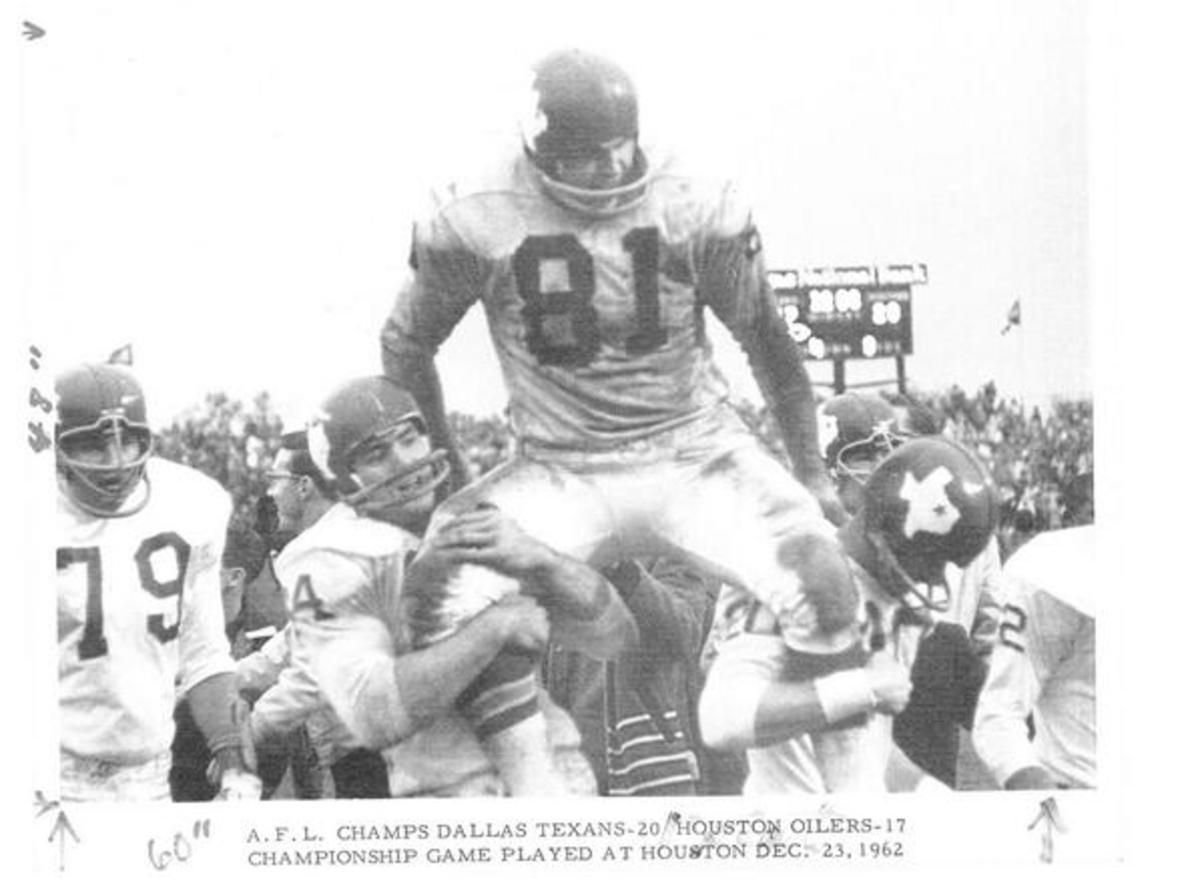
December 23, 1962: A Long Day In Texas

Tommy Brooker

December 23, 1962: The longest game in professional football history, to that point, is played. But not in the National Football League. This Championship Game is often given credit for boosting interest in the American Football League.

Like the NFL, the AFL was split into geographic Divisions, East and West. Also like the NFL, the AFL's Divisions didn't make as much sense as geography would make fans think. Putting the New York Titans, the Boston Patriots and the Buffalo Bills in the East made sense. Putting the Denver Broncos, the Oakland Raiders and the San Diego Chargers in the West made sense.

But there were 2 teams in Texas, and while Texas is the country's 2nd-biggest State by area after Alaska, both were in the eastern half of Texas. And yet, they were in different divisions: The Dallas Texans, founded and owned by AFL founder Lamar Hunt, were in the West, while the Houston Oilers were in the East.

The Cotton Bowl, then home to both the Texans and the NFL's Dallas Cowboys, is at 96 degrees, 45 minutes West longitude. Jeppesen Stadium, then home to the Oilers, was at 95 degrees, 20 minutes West. So the Texans were slightly to the west of the Oilers. This wasn't as bad as the NFL, putting the Cowboys in the Eastern Division and the East Coast's Baltimore Colts in the Western.

The Oilers won the AFL East in 1960, and beat the Los Angeles Chargers in the 1st AFL Championship Game. The Chargers moved to San Diego for 1961, and the Oilers beat them in the Championship Game again. The Oilers again won the East in 1962. This time, the Texans won the West Division. Both teams finished the regular season with a record of 11-3. They had played each other in back-to-back weeks of the regular season. On October 28, at Jeppesen, the Texans had won, 31-7. That was the last regular-season game the Oilers lost. Just 7 days later, they played again at the Cotton Bowl. Again, the visiting team won: The Oilers, 14-6.

Since the AFL followed the NFL's pattern of alternating the site of its Championship Game, the Oilers would host the Texans at Jeppesen. The facility was built in 1942, as Public School Stadium, but the University of Houston campus expanded toward it, and their football team made it their home field in 1946. In 1958, it was renamed for Holger Jeppesen, a school official who had lobbied for its construction. A crowd of 37,981, roughly a sellout, came for the Championship Game.

While the AFL had a reputation for emphasizing the passing game -- people who liked the more conservative NFL called the rebel league a "basketball league" -- both Texas teams relied on the running game. They played it mostly safe, and the only score of the 1st quarter was a field goal by the Texans' Tommy Brooker, a rookie who had been a member of the University of Alabama's National Championship team the year before. At the end of the quarter, George Blanda, the Oilers' quarterback and kicker, missed a 47-yard field goal, keeping the score 3-0 in the Texans' favor.

The Texans extended their lead in the 2nd quarter, as Abner Haynes scored on a 28-yard pass from Len Dawson, and later on a 2-yard run. The Texans led, 17-0, and any thoughts of this game being regarded as a classic had faded away.

But the Oilers weren't 2-time defending champions for nothing, and fought back. In the 3rd quarter, Blanda threw a touchdown pass to Willard Dewveall, to make it 17-7. Blanda kicked a field goal in the 4th quarter, to get the Oilers within a touchdown.

He then used the passing game to creep closer, throwing passes to Charley Hennigan, whose AFL receiving totals had surpassed the longtime NFL records of Don Hutson, and former Louisiana State Heisman Trophy winner Billy Cannon. Later, Blanda handed the ball to Charlie Tolar, a fullback known as "the Human Bowling Ball," and he barreled in the 1-yard line, tying the game at 17. The Oilers had 1 more shot, as Blanda tried a 42-yard field goal to win it on the last play of regulation, but Dave Grayson blocked his kick. The game went to overtime.

As with the opening of games, the captains met with the officials at midfield to start the overtime. The Texans won the toss. Haynes said, "We'll kick to the clock." He thought that would give the Texans the wind advantage. But by saying, "We'll kick," the referee, Harold Bourne, gave the Oilers the choice of which goal to defend, and thus whether to start with or against the wind.

This could have cost the Texans the championship, and it could have made Haynes the biggest goat in the history of Texas professional sports. As it turned out, it didn't matter: The entire "5th quarter" was played without either team scoring.

Early in the 2nd overtime, the 6th quarter, Dawson threw a 10-yard pass to Jack Spikes. Spikes then rushed for 19 yards. The Texans were in position for a title-winning field goal. Dawson ran a couple of more rushing plays to get Brooker a better kicking position. At 2:54 of the 2nd overtime, Brooker split the uprights, and the Texans won, 20-17. The team that founded the AFL had won its 1st Championship.

But, before the next season, realizing that, despite their title, they were never going to have more fans in Dallas than the NFL's Cowboys, the Texans moved, becoming the Kansas City Chiefs. The Oilers moved to Memphis in 1997 and Nashville in 1998, becoming the Tennessee Oilers, and the Tennessee Titans in 1999. In 2002, to replace the Oilers, the NFL added an expansion team -- and named it the Houston Texans.

The Tennessee team could take the Titans name because the New York team abandoned it in 1963, becoming the Jets. The New England moved to the Boston suburbs in 1971, and changed their name to the New England Patriots. The San Diego Chargers moved back to Los Angeles in 2017. The Raiders moved to Los Angeles in 1982, back to Oakland in 1995, and to Las Vegas in 2020.

The AFL Championship was won by the Oilers in 1960 and 1961; the Texans/Chiefs in 1962, 1966 and 1969; the Chargers in 1963; the Buffalo Bills in 1964 and 1965; the Raiders in 1967; and the Jets in 1968.

The fact that the Texans' title came before the advent of the Super Bowl means that it gets discounted: Even before the distance of time became what it is now, NFL fans have come to regard any title won before the Super Bowl, NFL or AFL, as not a "real" championship. 

In 1980, Jeppesen Stadium was renamed Corbin J. Robertson Stadium, after a University of Houston regent who had funded renovations. In 1996, it was renamed John O'Quinn Field at Corbin J. Robertson Stadium. O'Quinn was a Houston attorney who had donated to the latest round of renovations. The Houston Dynamo of Major League Soccer moved in for the 2006 season, and won back-to-back MLS Cups.

Robertson Stadium was demolished following the 2012 season, and John O'Quinn Field at TDECU Stadium opened on the site in 2014. UH plays football there, while in 2012, the Dynamo moved to a new soccer-specific stadium, currently named Shell Energy Stadium. (UPDATE: For 2026, UH's stadium will be renamed Space City Financial Stadium, due to TDECU's merger with another company.)

Tommy Brooker, who kicked the winning field goal, remained with the Chiefs through the 1966 season, and died in 2019.

*

December 23, 1962 was a Sunday. The NFL was in the off-week between the end of its regular season and its Championship Game. That game was played 1 week later. The Green Bay Packers beat the New York Giants, 16-7 at Yankee Stadium.

Baseball was out of season. The NBA was in season, but no games were scheduled for that day. But the NHL's entire "Original Six" were in action:

* The New York Rangers lost to the Chicago Black Hawks, 3-1 at the original Madison Square Garden.

* The Toronto Maple Leafs beat the Boston Bruins, 5-4 at the Boston Garden.

* And the Montreal Canadiens and the Detroit Red Wings played to a tie, 2-2 at the Olympia Stadium in Detroit.

Wednesday, January 5, 2022

January 5, 1964: The Singing Nun On "The Ed Sullivan Show"

January 5, 1964: The Ed Sullivan Show airs on CBS. Sullivan, a Catholic who preferred soft songs to rock and roll, and loved acts from Europe, has what might be the closest thing he will ever have to a perfect guest for him. It is the singer with the Number 1 song in America: The Singing Nun.

Jeanne Paule Deckers was born on October 17, 1933 in Brussels, Belgium. She took the name Sister Luc-Gabrielle when she became a Dominican nun, and her singing was so well-received that her superiors encouraged her to record her songs. One was about the founder of their order, Saint Dominic. The record, credited to "Sœur Sourire" (Sister Smile) took off, and became the most popular in Europe.

Dominic de Guzmán, born in Spain in 1170, and died in 1221, was a priest, and the founder of the Dominican Order. He is the patron saint of astronomers and natural scientists, and he and his order are traditionally credited with spreading and popularizing the rosary. The Dominican Republic and its capital city, Santo Domingo, are named for him.

Before Paul McCartney wrote "Michelle" for The Beatles, the chorus to "Dominique" became one of the few French passages that Americans knew:

Domi-nique -nique -nique s'en allait tout simplement,
Routier, pauvre et chantant.
En tous chemins, en tous lieux,
Il ne parle que du Bon Dieu,
Il ne parle que du Bon Dieu.
Literal translation:

Domi-nic -nic -nic went about simply,
a poor singing traveller.
On every road, in every place,
he talks only of the Good Lord,
he talks only of the Good Lord.
Noël Regney, who wrote the Christmas carol "Do You Hear What I Hear?" with his wife Gloria Shayne Baker, wrote English lyrics for "Dominique." Deckers recorded versions in Dutch, German, Hebrew, Japanese, Korean, and Portuguese. The English lyrics he wrote for the chorus are close to the literal translation:

Domi-nique -nique -nique, o'er the land he plods along,
And sings a little song.
Never asking for reward,
He just talks about the Lord,
He just talks about the Lord.

In the wake of the assassination of President John F. Kennedy on November 22, 1963, American radio stations were playing softer songs, and "Dominique" -- credited to "The Singing Nun" in the U.S. -- fit the bill. The fact that the late President was also Catholic may also have been a factor in the song's rise to Number 1 on our charts. On January 5, 1964, while the song was still Number 1 in America, she appeared on The Ed Sullivan Show. Three weeks later, The Beatles had the Number 1 song, "I Want to Hold Your Hand." Two weeks after that, Ed had The Beatles on his show, and the world would never be the same.

Things went downhill for Sister Luc-Gabrielle after that. In 1966, Debbie Reynolds -- married twice, divorced once, mother of two, and a convert to Judaism -- played her in a film titled The Singing Nun, but Luc-Gabrielle publicly said that the film was fiction. She left the order shortly thereafter, later claiming she was chased out, and began using the name Jeanine Deckers. That same year, she said she agreed with John Lennon's statement that the Beatles were more popular than Jesus. (A, At the time, it was true. B, Lennon never said that was a good thing.)

She wrote and recorded a song in favor of birth control: "Glory to God for the Golden Pill." It was not a hit. She made more recordings, but, for legal reasons, couldn't release them under the name "The Singing Nun." She released them as "Luc Dominique," but lamented, "Nobody knew who it was." The Belgian government claimed she owed back taxes from her royalties, which she hadn't been receiving anyway, as they went straight to the Church, and should have been tax-exempt.

She and autism activist Annie Pécher ran a special-needs school together in Wavre, Belgium. Responding to speculation about their relationship, Deckers publicly denied that they were lesbian lovers, but one of her biographers wasn't so sure.
Jeanne and Annie, date unknown

On March 29, 1985, both depressed over the downturns in their respective professional lives, they committed suicide, ages 51 and 41. They were buried together in Wavre.

"Dominique" remains the only song in French, and the only song by a performer from Belgium, to hit Number 1 on Billboard magazine's Hot 100.

*

January 5, 1964 was a Sunday. This was also the day that the San Diego Chargers won the AFL Championship, which remains their only title in any league. I have a separate entry for that event.

The NFL Championship Game had been played a week earlier, on December 29, 1963. The Chicago Bears beat the New York Giants, 14-10. Baseball was out of season. There were 4 games played in the NBA:

* The New York Knicks beat the Philadelphia 76ers, 142-118 at the Philadelphia Civic Center.

* The Cincinnati Royals beat the Baltimore Bullets, 111-106 at the Cincinnati Gardens.

* The St. Louis Hawks beat the Detroit Pistons, 116-99 at the Kiel Auditorium in St. Louis.

* And the Los Angeles Lakers beat the Boston Celtics, 97-95 at the Los Angeles Memorial Sports Arena.

And the NHL's entire "Original Six" was in action:

* The New York Rangers beat the Toronto Maple Leafs, 3-2 at the old Madison Square Garden.

* The Montreal Canadiens and the Detroit Red Wings played to a tie, 3-3 at the Olympia Stadium in Detroit.

* And the Chicago Black Hawks beat the Boston Bruins, 5-3 at the Chicago Stadium.
January 5, 1964: A Title for San Diego

 
January 5, 1964: The American Football League Championship Game is played for the 1963 season. It marks a turning point for the League. In its 1st 3 seasons, it was a pass-happy league, without much defense. But now, a team was able to combine big offense with big defense.

Barron Hilton received the Los Angeles franchise of the AFL at its founding in 1959. He named the team the Chargers, after the credit card he founded, Carte Blanche. He was the son of hotel magnate Conrad Hilton; the brother of Elizabeth Taylor's 1st husband Conrad Nicholson Hilton Jr., a.k.a. Nicky Hilton; and the grandfather of Paris and Nicky Hilton. He turned out to be the last surviving member of "The Foolish Club," the 8 original AFL owners.

After reaching the 1st AFL Championship Game in the 1960 season, he realized that, even with his money, he couldn't compete with the NFL's Rams and college football's USC and UCLA for the attention of Los Angeles' football fans. So he moved the team down the Coast, and they became the San Diego Chargers. They reached the title game again in 1961, with the same result, losing to the Houston Oilers.

Head coach Sid Gillman built a high-powered offense, with 2 quarterbacks, Tobin Rote and John Hadl. Rote had filled in for an injured Bobby Layne, and led the Detroit Lions to victory in the 1957 NFL Championship Game, 59-10 over the Cleveland Browns. It was a bit of foreshadowing. Oddly, Hadl had also been drafted by the Lions, but the AFL offered more money than the NFL.
Sid Gillman

These passers' favorite target was Lance Alworth, whose running reminded someone of a deer, and so he was nicknamed "Bambi." He would end up as the 1st former AFL player elected to the Pro Football Hall of Fame. (Contrary to what some people believe, it's not the NFL Hall of Fame.) Gillman's offense also had running backs Paul Lowe and Keith Lincoln, tight end Jacque MacKinnon, guard Walt Sweeney, and offensive tackle Ron Mix. Mix would join Alworth in Canton.
Lance Alworth

But it was the defense that marked the '63 Chargers as being different from previous AFL teams. They were one of the teams in the 1960s that called its defensive line "The Fearsome Foursome": Ends Ron Nery and Earl Faison, and tackles Ernie Ladd (also a successful professional wrestler, before that competition became a scripted joke) and Bill Hudson. The linebackers were pretty good, too: Chuck Allen, Frank Buncom and Emil Karas.
Ernie Ladd

Another distinctive feature of San Diego's 1st major league sports team was their uniforms. It wasn't just the lightning bolts on the helmets. From 1960 to 1973, they wore jerseys that had been called "collegiate blue" (probably a reference to UCLA, with whom they shared the Los Angeles Coliseum in 1960), "electric blue" (which matched the "charger" theme) and "powder blue" (which is what it usually gets called today).

The Chargers went 11-3, their only losses coming at the hands of the Denver Broncos and, twice, the Oakland Raiders. They won the AFL Western Division, which meant that, being that it was an odd-numbered year, they would get to host the AFL Championship Game at Balboa Stadium.
Their opponents were the Boston Patriots, who finished only 7-6-1, but that was good enough to tie the Buffalo Bills for 1st place in the Eastern Division. And 2 of the losses were to the Chargers. To be fair, 5 of the 6 losses were by 7 points or less, and the Pats did beat the Bills in Buffalo in a Playoff to get to the Championship Game.

The title game -- postponed a week, due to the postponement of the regular-season games of November 24, 1963, and that due to the assassination of President John F. Kennedy 2 days earlier -- would not be close. It turned out to be the biggest blowout in the 10-year history of AFL Championship Games. Since the 1970 merger with the NFL, only once has the winning team in the AFC Championship Game matched the Chargers' point total, the 1990-91 Buffalo Bills; and no team has surpassed it. No team has scored this many in the NFC Championship Game, either.

The Chargers wasted little time. Rote took a quarterback sneak for a touchdown. Lincoln scored on a 67-yard run. The Patriots scored on Larry Garron's 7-yard touchdown run, to close to within 14-7, but that was as close as they would get. Lowe ran 58 yards for a touchdown, and it was 21-7 San Diego after a quarter.

George Blair of the Chargers and Gino Cappelletti of the Patriots traded field goals in the 2nd quarter. But the fact that the Chargers were able to score 24 points in the 1st half, none of them on touchdown passes, was telling. Before the half ended, Rote threw a 14-yard touchdown pass to Don Norton, and it was 31-10.

Rote threw a 48-yard touchdown pass to Alworth in the 3rd quarter, and was relieved by Hadl in the 4th. But this proved not to be a mercy move by Gillman: Hadl threw a 25-yard touchdown pass to Lincoln, and later scored on a sneak. Final score: Chargers 51, Patriots 10. It remained the most dominating performance in the AFL's 10-year history.

The Chargers reached the Championship Game again in 1964 and 1965, losing to the Bills both times. The Kansas City Chiefs won the AFL title in 1966 and 1969; the Raiders in 1967; and the New York Jets in 1968. Each of these teams had a "Mad Bomber" quarterback -- Jack Kemp, Len Dawson, Daryle Lamonica and Joe Namath, respectively -- but each also followed the Chargers in the other way, too: The philosophy that "Defense wins championships."

Charger fans, and aficionados of the old AFL, are convinced that the Chargers could have beaten the NFL Champion Chicago Bears had there been a Super Bowl at the time. They are wrong: The Bears had a defense unlike any the AFL had yet seen, including on the Chargers.
This is what a Chargers championship ring looks like.
But "World Champions"? No.

The Chargers appeared in 5 of the 10 AFL Championship Games; the Oilers, 4; the Bills and the Chiefs, 3 each; the Raiders, 2; the Patriots and the Jets, 1 each; and the Denver Broncos, and the expansion Miami Dolphins and Cincinnati Bengals, none.

But the Chargers got old, and by 1973, as mentioned by the sportswriter character Oscar Madison on the TV series The Odd Couple, they and the Oilers were the 2 worst teams in the NFL. Alworth got a Super Bowl ring, but it was with the 1971-72 Dallas Cowboys.

In 1974, the Chargers switched to dark blue jerseys and helmets. In 1978, they became one of a few teams that preferred to wear white jerseys at home, and it did look better. They went back to dark blue at home in 1984, occasionally wore powder blue as "throwback uniforms" for a few years, and in 2019, their 60th season, they began wearing powder blue as their regular home color. They have also gone back to the white helmets.

The Chargers reached the 1981 AFC Championship Game, but lost it to the Bengals. They reached the 1994 AFC Championship Game, and beat the Pittsburgh Steelers in a thriller, but got clobbered by the San Francisco 49ers in Super Bowl XXIX. They reached the 2007 AFC Championship Game, but lost to the Patriots, revenge finally achieved.

In 1966, Barron Hilton sold the Chargers to Gene Klein. In 1984, Klein, who loved football but hated the business of it, sold the team to Alex Spanos. In his memoir, First Down and a Billion, he closed every chapter with the words, "Thank you, Alex."

In 1967, the Chargers moved to San Diego Stadium, which was renamed Jack Murphy Stadium in 1981 and Qualcomm Stadium in 1997. Spanos handed control of the team over to his son Dean in 1993, and Dean Spanos, a member of a billionaire family, continually demanded that either the City of San Diego or the County of San Diego use taxpayer money to build him a new stadium. He threatened to move the team back to Los Angeles, or perhaps to another city, if he didn't get the stadium.

A ballot initiative only got 43 percent of the vote, and so Dean proved he wasn't bluffing, and moved the team back to its original hometown. San Diego fans were angry, but seem to value their integrity more than their football team.

The 1963 Chargers remain the only major league sports team in San Diego that has gone as far as the rules of the time have allowed them to go. The San Diego Padres have won National League Pennants in 1984 and 1998, but lost the World Series each time.

The city lost the NBA's Rockets (1967-71) to Houston and the NBA's Clippers (1978-84) to Los Angeles. It's never had an NHL team or an MLS team. The ABA's Conquistadors and the WHA's Mariners each folded before their respective leagues did. And neither the WFL (1974-75) nor the USFL (1983-85) saw fit to put a team in what was already being called "America's Finest City," despite the Chargers being in decline on both occasions, with the Don Coryell "Air Coryell" teams being successful in between.

The San Diego Sockers won the Major Indoor Soccer League title 10 times in 11 seasons from 1982 to 1992, but, despite its name, the MISL could hardly be called major league. The old North American Soccer League could have been called that, but the Sockers never got past the Semifinals.

There has been speculation of a "curse" on San Diego sports. The most common one is that it is the result of letting Alworth go after the 1970 season, hence "The Curse of Bambi." What's more, the fact that the Chargers' title came before the advent of the Super Bowl means that it gets discounted: Even before the distance of time became what it is now, NFL fans have come to regard any title won before the Super Bowl, NFL or AFL, as not a "real" championship. And the fact that this one came during the sad interregnum between the Kennedy assassination and the arrival of The Beatles is another reason it tends to get forgotten.

As for the Patriots, who changed their name to the New England Patriots when they moved to suburban Foxborough, Massachusetts in 1971, they didn't make the Playoffs again until 1976, didn't reach the Super Bowl until the 1985 season, and didn't win one until the 2001 season. After that, though, they were off to the races.

UPDATE: In 2022, San Diego Wave FC joined the National Women's Soccer Association. They won the Supporters' Shield for best regular-season record, but not the league title. In 2025, San Diego FC joined MLS.

The Chargers have a team Hall of Fame. From their 1960s teams, they have inducted Quarterback John Hadl, running backs Paul Lowe and Keith Lincoln, receivers Lance Alworth and Gary Garrison, tight end Jacque MacKinnon, guard Walt Sweeney, offensive tackle Ron Mix; defensive end Earl Fiason, defensive tackle Ernie Ladd; linebackers Emil Karas, Bob Laraba, Chuck Allen and Frank Buncom; cornerback Leslie "Speedy" Duncan; majority owner Barron Hilton and head coach Sid Gillman. They've also inducted George Pernicano, who became a minority owner with the move from Los Angeles to San Diego in 1961, and, as of this writing, is still alive and involved with the team.

Hadl, Garrison, Lincoln, Alworth, Lowe, Mix, Faison, Ladd, and Gillman have also been inducted into the San Diego Hall of Champions. In 1999, The Sporting News released their list of the 100 Greatest Football Players. Alworth was ranked 31st. In 2010, the NFL Network released their list of the 100 Greatest Players. Alworth was ranked 38th.

The Patriots also have a team Hall of Fame. From their 1963 AFL Eastern Division Champions, they have inducted founding owner Billy Sullivan, quarterback Vito "Babe" Parilli, receiver Gino Cappelletti, center Jon Morris, defensive end Bob Dee, defensive tackles Houston Antwine and Jim Lee Hunt, and linebacker Nick Buoniconti. They've also inducted running back Jim Nance, who arrived in 1965.

*

January 5, 1964 was a Sunday. This was also the day that The Singing Nun appeared on The Ed Sullivan Show. I have a separate entry for that event.

The NFL Championship Game had been played a week earlier, on December 29, 1963. The Chicago Bears beat the New York Giants, 14-10. Baseball was out of season. There were 4 games played in the NBA:

* The New York Knicks beat the Philadelphia 76ers, 142-118 at the Philadelphia Civic Center.

* The Cincinnati Royals beat the Baltimore Bullets, 111-106 at the Cincinnati Gardens.

* The St. Louis Hawks beat the Detroit Pistons, 116-99 at the Kiel Auditorium in St. Louis.

* And the Los Angeles Lakers beat the Boston Celtics, 97-95 at the Los Angeles Memorial Sports Arena.

And the NHL's entire "Original Six" was in action:

* The New York Rangers beat the Toronto Maple Leafs, 3-2 at the old Madison Square Garden.

* The Montreal Canadiens and the Detroit Red Wings played to a tie, 3-3 at the Olympia Stadium in Detroit.

* And the Chicago Black Hawks beat the Boston Bruins, 5-3 at the Chicago Stadium.

Saturday, January 1, 2022

January 1, 1967: Shootout at the Cotton Bowl

January 1, 1967: The 1966 NFL Championship Game is held at the Cotton Bowl in Dallas. For the host Dallas Cowboys, Champions of the Eastern Conference (which made no sense geographically), it is their 1st title game, in only their 7th season. For the Green Bay Packers, Champions of the Western Conference, it is their 9th.

When the New York Giants won the 1956 NFL Championship, under head coach Jim Lee Howell, his offensive assistant (or offensive coordinator, as the position came to be called) was Vince Lombardi, previously a guard at Fordham University and an assistant coach at Army. His defensive assistant (defensive coordinator) was Tom Landry, a star two-way back at the University of Texas and with the Giants. Now, Lombardi was coaching the Packers, attempting to win a 4th NFL Championship in 6 seasons; and Landry was coaching the Cowboys, attempting to "win the big one" on the first try.

Okay, it was a big one, but not the big one: For the 1st time, the NFL Champions would not, automatically, be considered the World Champions of American-style football. The merger agreement with the American Football League, a few months earlier, meant that the two leagues' Champions would meet 2 weeks after their title games, in what was then officially named "The AFL-NFL World Championship Game." This would retroactively be renamed "Super Bowl I."

In those days, the NFL alternated the site of its Championship Game geographically. It was the Eastern Champions' turn to host, so, despite the Packers having the better record -- 12-2, to the Cowboys' 10-3-1 -- the Cowboys would host.

The Packers jumped out to a 14-0 lead, on a 17-tyard pass from Bart Starr to Elijah Pitts, and an 18-yard fumble return by Jim Grabowski. But before the 1st quarter was out, the Cowboys tied the game, on touchdown runs by Dan Reeves and Don Perkins. Starr threw a 51-yard touchdown pass to Carroll Dale, to give the Packers the lead. Danny Villanueva kicked an 11-yard field goal, and the Packers went into the locker room up 21-17.

Villanueva kicked a 32-yard field goal, and then Starr threw a 16-yard touchdown pass to Bowd Dowler, putting the Packers up 28-20 at the end of the 3rd quarter. In the 4th quarter, Starr threw a 28-yard touchdown pass to Boyd Dowler. Don Chandler kicked the extra points on the Packers' 1st 4 touchdowns, but missed it on the 5th one, so the Packers' lead was 34-20.

There was 5:20 left to play. Meredith threw a 68-yard touchdown pass to Franklin Clarke, making it 34-27. A bad punt by Chandler gave the Cowboys the ball on the Packer 47-yard line with 2:12 to go, to get a touchdown that would send the game to overtime.

Cowboy quarterback Don Meredith got the ball to the Packer 22. Each team then made a dumb penalty: The Packers' Tom Brown committed pass interference to put the ball on their own 2-yard line, and a false start pushed the Cowboys back to the 6. On 4th and goal, Meredith dropped back to pass. Packer linebacker Dave Robinson got to Meredith, who was still able to get a pass off. But Brown made up for his mistake by intercepting the pass in the end zone. Starr made 2 kneeldowns to run out the clock, and the Packers had won.

In 1981, John Thorn left his comfort zone, baseball, and published Pro Football's 10 Greatest Games. He included this game as one of them.

The American Football League Championship Game was also played that day, at War Memorial Stadium in Buffalo, New York. The Buffalo Bills were 2-time defending AFL Champions, but, this time, they were beaten by the Kansas City Chiefs, 31-7. So the Bills were the last AFL Champions who didn't get to play the NFL Champions in the Super Bowl. The Chiefs did, but the Packers beat them, 35-10 at the Los Angeles Memorial Coliseum.

*

January 1, 1967 was a Sunday. Future Pro Football Hall-of-Famer Derrick Thomas was born that day.

Because it was a Sunday, the usual New Year's Day college football bowl games were moved. The Cotton Bowl Classic was held the day before: Number 4 Georgia beat Number 10 Southern Methodist University (SMU), 24-9 at the Cotton Bowl in Dallas, where the NFL Championship Game was held the next day.

The other games were held on Monday, January 2. In the Sugar Bowl, Number 3 Alabama beat Number 6 Nebraska, 34-7. This completed an undefeated season for Alabama, which had won shares of the National Championship the preceding 2 years.

But not this time: Number 1 Notre Dame did not accept bowl bids in those days, and Number 2 Michigan State, which had played Notre Dame to a 10-0 tie on November 19, was barred from playing in the Rose Bowl due to the Big Ten Conference's rule against back-to-back appearances, and its rule that only the Rose Bowl representative could go to a bowl game. Both of those rules were repealed for the 1975 season. But that did neither Michigan State nor Alabama any good, and Notre Dame, despite the blemish on its record, was voted the National Champion.

In the Rose Bowl, at the stadium of the same name in Pasadena, California, outside Los Angeles, Number 7 Purdue beat Number 18 University of Southern California (USC), 14-13. And in the Orange Bowl, at the stadium of the same name in Miami, Number 11, Florida, led by Heisman Trophy-winning quarterback Steve Spurrier, beat Number 8 Georgia Tech, 27-12.

Baseball was out of season. There were 2 games played in the NBA. The New York Knicks lost to the St. Louis Hawks, 128-105 at the Kiel Auditorium in St. Louis. And the Los Angeles Lakers beat the Boston Celtics, 111-110 at the Los Angeles Memorial Sports Arena.

And the NHL's entire Original Six were in action:

* The New York Rangers lost to the Toronto Maple Leafs, 2-1 at the old Madison Square Garden.

* The Detroit Red Wings beat the Montreal Canadiens, 4-1 at the Olympia Stadium in Detroit.

* And the Chicago Black Hawks beat the Boston Bruins, 3-2.

January 1, 1961: The 1st AFL Championship

January 1, 1961: The American Football League concludes its 1st season with its 1st Championship Game.

Like the NFL, the AFL divided itself into geographical divisions. Like the NFL's,  the AFL's divisions did not make complete sense. In the Eastern, in alphabetical order: The Boston Patriots, the Buffalo Bills, the Houston Oilers and the New York Jets. In the Western: The Dallas Texans, the Denver Broncos, the Los Angeles Chargers and the Oakland Raiders.

Keen observers will note that Dallas and Houston are in the same State, Texas, which kind of makes the "Texans" name for the Dallas team a bit silly. (It had been used before, though, in the NFL in 1952.) Granted, Texas is huge, with Interstate 10 running 877 miles between El Paso and Port Arthur; but, despite the 242-mile northwest-to-southeast distance between the teams' stadiums, Houston is only 92 miles east of Dallas.

Like the NFL, the AFL established a format in which Championship Games would be alternated each year between the Division winners. The first game was originally scheduled to be played in the 103,000-seat Los Angeles Memorial Coliseum. But the Chargers had drawn less than 10,000 fans per home game. With the league fea-ring that ABC would pull its contract because of low ticket sales, the Chargers, the Oilers and the League met, and decided to move the game to the Oilers' home, Jeppesen Stadium.

Built in 1942 as a 14,500-seat high school football stadium, it was close enough to the University of Houston campus that UH could use it as a home field. In 1958, the school district renamed it for school board member Holger Jeppesen, who had vigorously lobbied for its construction.

When the Oilers arrived in 1960, team owner Kenneth Stanley Adams Jr., a.k.a. Bud Adams, a wealthy Oklahoma oilman -- his father, K.S. "Boots" Adams, ran Phillips Petroleum, and sponsored the Phillips 66ers, one of the top "amateur" basketball teams in America -- funded the stadium's expansion, and the AFL Championship Game drew a near-capacity crowd of 32,183.
Jeppesen Stadium in its final form,
as Robertson Stadium

However, it rained for 5 straight days before the game, and the field was a muddy mess. This played into the hands of the Oilers, who, with quarterback George Blanda and receiver Charley Hennigan, had done much to give the AFL its original reputation, as a pass-happy, high-offense, "basketball league," compared to the more conservative, more run-oriented, and some AFL fans saying "boring" NFL.

Ben Agajanian was 1 of only 2 players to play in the All-America Football Conference, the NFL and the AFL; the other was Hardy Brown. Agajanian, who preceded Tom Dempsey as an NFL kicker who had only half a foot and had to wear a special shoe, kicked 2 field goals in the 1st quarter, giving the Chargers a 6-0 lead.

In the 2nd quarter, Blanda threw a 17-yard touchdown pass to Dave Smith, giving the Oilers a 7-6 lead. Before the half was out, Agajanian and Blanda would each kick a field goal, making the score 10-9 Houston. In the 3rd quarter, Blanda threw a 7-yard touchdown pass to Bill Groman. The Chargers closed to within 17-16 on a 2-yard touchdown run by Paul Lowe.

But in the 4th quarter, Blanda threw a short pass to Billy Cannon, who had led Louisiana State University (LSU) to the National Championship in 1958, and had won the Heisman Trophy in 1959. Cannon took that pass, defied the mud, and ran 88 yards for a touchdown. That put the Oilers ahead, 24-16, and that would be the final score. The Houston Oilers were the 1st American Football League Champions.
Billy Cannon. The Oilers wore blue helmets
from 1960 to 1965, silver from 1966 to 1971,
blue again from 1972 to 1974, and white from 1975 to 1996.

The Oilers moved into the larger Rice Stadium in 1965, and the Astrodome in 1968, making them the 1st pro football team to play on artificial turf. The Chargers moved from Balboa Stadium (which, like Jeppesen Stadium, had been built for high school football and was too small) to San Diego Stadium in 1967. That facility would become home to baseball's expansion San Diego Padres in 1969, and was renamed Jack Murphy Stadium in 1981 and Qualcomm Stadium in 1997.

Corbin J. Robertson, former University of Houston Board of Regents member and Athletics Committee Chairman, funded the renovation of Jeppesen Stadium in 1970, and the University bought it, renaming it Robertson Stadium in his honor. In 1999, the playing field was named for another big donor, John O'Quinn Field. MLS' Houston Dynamo began play there in 2006. The stadium was demolished in 2012, and, the next year, a replacement opened on the site: John O'Quinn field at TDECU Stadium. UH still plays there, while the Dynamo have moved to a soccer-specific stadium.

The Chargers realized they couldn't compete with the NFL's Rams, and college football's USC and UCLA, for Los Angeles football fans' attention. So they moved down the Pacific Coast to San Diego. The Oilers beat the Chargers again in the 1961 AFL Championship Game.
Bud Adams with an Oilers helmet, a bust of himself,
and the 1st 2 AFL Championship trophies

In 1962, the Oilers nearly made it 3 straight, but lost the Championship Game to the Dallas Texans, who nonetheless moved to become the Kansas City Chiefs. The Chargers won the AFL Championship in 1963, beating the Boston Patriots, then lost the Championship Game to the Buffalo Bills in 1964, and again in 1965. The Oilers lost it to the Oakland Raiders in 1967.

Both teams then went into a down period. A 1973 episode of The Odd Couple featured Jack Klugman's character, sportswriter Oscar Madison, saying that the Oilers and the Chargers were going to play each other, and that they were the 2 worst teams in the post-1970s merged NFL. Both teams would get good again in the late 1970s, and be Playoff perennials for a few years, then tail off again in the mid-1980s, then get good again in the 1990s. The Chargers won the AFC Championship in 1994, but lost Super Bowl XXIX to the San Francisco 49ers.

But both teams' owners began to complain about their stadium leases. In 1997, Oilers founding owner Bud Adams moved them, and they became the Tennessee Titans. In 1999, they won the AFC Championship, but lost Super Bowl XXXIV to the St. Louis Rams, who had left Los Angeles in 1995. In spite of the complete change of location and identity, the Titans have a team hall of fame that combines the Oilers and the Titans, and they continue to keep the Oilers' retired uniform numbers out of circulation. The expansion Houston Texans began play in 2002, at what is now known as NRG Stadium.

In 2017, Chargers operating owner Dean Spanos moved his team back to Los Angeles -- as had the Rams, the year before, getting a big head-start on reclaiming L.A. football fandom. Although both teams now use SoFi Stadium in Inglewood, the Rams' owner, Stan Kroenke, owns it, although he gives the Chargers decent scheduling selection.

The fact that the Oilers'/Titans' titles came before the advent of the Super Bowl means that they get discounted: Even before the distance of time became what it is now, NFL fans have come to regard any title won before the Super Bowl, NFL or AFL, as not a "real" championship. 

*

January 1, 1961 was a Sunday. The game was scheduled for New Year's Day because the previous Sunday was Christmas Day, and they didn't want to go up against the NFL Championship Game. As it turned out, the NFL moved its Championship Game to the next day. At least the AFL didn't have to conflict with the annual New Year's Day college bowl games: As was usually done when New Year's Day fell on a Sunday, they moved their games to Monday, January 2.

The NBA scheduled 3 games:

* The Boston Celtics beat the Syracuse Nationals, 113-96 at the Onondaga County War Memorial (now the Upstate Medical University Arena) in Syracuse, New York.

* The Cincinnati Royals beat the St. Louis Hawks, 114-112 at the Cincinnati Gardens.

* And the Detroit Pistons beat the Los Angeles Lakers, 116-105 at Cobo Hall (now Huntington Place) in Detroit. Elgin Baylor led all scorers on the day, with 39 in defeat.

And, although it would be decades before the NHL began scheduling an outdoor "Winter Classic" on New Year's Day, its entire "Original Six" were in action:

* The New York Rangers lost to the Toronto Maple Leafs, 4-1 at the old Madison Square Garden.

* The Boston Bruins beat the Montreal Canadiens, 3-2 at the Boston Garden.

* And the Chicago Black Hawks beat the Detroit Red Wings, 3-0 at the Chicago Stadium.

December 31, 1999 & January 1, 2000: The Millennium

December 31, 1999:  The Millennium arrives. The people of planet Earth survived. At a terrible cost. But we hadn't destroyed ourselves. ...