Showing posts with label nha. Show all posts

Friday, December 30, 2022

December 30, 1916: The Assassination of Grigori Rasputin

In the early part of the 20th Century,
Russian women found this guy irresistible.

December 30, 1916: Grigori Rasputin is assassinated. Apparently, it wasn't easy.

Grigori Yefimovich Rasputin was born on January 21, 1869 in Pokrovskoye, in what is now Tyuman Oblast, in the central Siberia region of Russia. Little is known of his youth, although it is believed that he didn't learn how to read until he was an adult. In 1886, he went to Abalak, about 150 miles northeast of his hometown, where he met Prakovya Dubrovina. They married the next year, and had 7 children, though only 3 survived to adulthood.

In 1897, Rasputin had a religious awakening, and became a monk in Russian Orthodox Catholicism. By 1905, he had developed a following, particularly among women, who found him irresistible. With his long hair and long beard, he might not match a modern American woman's idea of an attractive man, but he was said to have had hypnotic eyes. He was also renowned for... how shall I put this... being extraordinarily well-endowed.

Czar Nicholas II wrote in his diary for November 1, 1905 (Russia was still using the Julian Calendar, so it was November 14 in most of the world) that he and his wife, Czarina Alexandra had "made the acquaintance of a man of God -- Grigory, from Tobolsk province." They met again on July 18, 1906, and again in October, when Rasputin first came into contact with the Romanov children. He was told that the heir to the throne, Czarevitch Alexei, had hemophilia, and that they had heard that Rasputin could heal the sick.

In 1907, Rasputin appeared to have saved Alexei during a hemophilic episode. In 1912, he did so again. One of the doctors who had been treating Alexei on this occasion wrote, "The recovery was wholly in explicable from a medical point of view." Alexandra, born a German Princess and raised Lutheran, had reluctantly converted to the Russian Orthodox Church, was now convinced that Rasputin was a holy man and a miracle worker.

It has been speculated that the real reason Alexei recovered is that he told the doctors not to disturb the boy, and that allowed him to rest and regain his strength; or that, by keeping his mother calm, Rasputin kept him calm, and that allowed him to regain his strength; or that he stopped Alexei's treatment through aspirin, which had helped with his pain, but prevents clotting of the blood. Indeed, that's what hemophilia is: An inability to have one's blood clot, so that bleeding continues. Maybe Alexei never had hemophilia at all, and he was just improperly treated with aspirin.

From this point on, Alexandra was convinced that Rasputin could do no wrong. And, since the Czar trusted the Czarina, and the Czarina trusted Rasputin, the Czar gave Rasputin pretty much anything he asked for. This meant access to the imperial family at any time. It also allowed Rasputin access to pretty much any woman he wanted, although the rumors of his having had an affair with the Czarina, or any of the 4 Romanov daughters (Grand Duchesses), have never been backed up by any evidence.

(At the time of Rasputin's assassination, Olga was 21 years old, Tatiana 19, Maria 17, Anastasia 15, and Alexei, the youngest but the heir because he was the only son, 12.)

By the Autumn of 1915, World War I was going badly for Russia. Their Army had huge numbers, but little else in the way of preparedness: Training, weapons, transportation, infrastructure. Every so often, Russia falls behind, and becomes a backward country, and needs a great leader to, as Maximilian Schell said while starring in the 1986 NBC miniseries Peter the Great, "drag you, kicking and screaming if I have to, into the modern world!"

Ivan IV, a.k.a. Ivan the Terrible, did it in the 1550s. Peter I, a.k.a. Peter the Great, did it in the 1680s. Catherine II, a.k.a. Catherine the Great, did it in the 1760s. Alexander II tried it in the 1860s, but it didn't take. In the 1910s, Nicholas II was on the throne, and he had neither the heart nor the will to do it, nor the mind to know how to do it if he wanted to.

This was made all too clear when Nicholas left St. Petersburg, then the capital, to take personal command of the Army. This left Alexandra in charge. Except, many saw her as having left Rasputin in charge. They, rather than the Czar, got blamed for everything going wrong in the country. After all, the Czar wasn't there, was he?

Finally, conditions in the country, and rumors about Rasputin's hedonistic behavior, became too much for some Russian noblemen. One was Grand Duke Dmitri Pavlovich, a grandson of Czar Alexander II and thus a first cousin of Nicholas II. Another was Prince Felix Yusupov, husband of Princess Irina Alexandrovna, Nicholas' niece. Another was Vladimir Purishkevich, a right-wing member of the Duma, the Russian Parliament. They invited Rasputin to the Moika Palace, Yusupov's home.

The date, on the Russian/Julian Calendar, was December 17, 1916 -- in most of the world, December 30. Historian Douglas Smith has written, "What really happened at the Yusupov home on 17 December will never be known." Yusupov's memoir contains the best-known version, and while it can't be certain that he was telling the truth, it is certain that he stuck by his story for the rest of his life. Here's that story:

Rasputin arrived shortly after midnight. Yusupov walked him into the basement, and offered him tea and small cakes. Rasputin drank the tea and, after first refusing the cakes, ate them. Then he asked for Madeira wine. He got it, and drank it. At about 2:30 AM, Yusupov excused himself, and went upstairs.

Upstairs was where the other conspirators were waiting. The tea, the cakes, and the wine had all been laced with poison. Rasputin had ingested enough doses to kill several men. So Yusupov decided to be certain. Dmitry Pavlovich gave him a loaded revolver. He took the gun, went downstairs, and, pointing to a crucifix on the wall, said, "Better look at the crucifix and say a prayer. And he fired once, hitting Rasputin in the chest. Rasputin slumped to the floor.

As cover, another conspirator, who had long hair and a long beard, was given Rasputin's coat and hat, was driven to Rasputin's apartment, and went in, so that witnesses could see that "Rasputin" had arrived home, thus moving suspicion away from the conspirators. They then drove back to the Moika Palace, to complete their plausible deniability.

But when Yusupov went back to the basement, Rasputin jumped up from the floor, and started hitting Yusupov. He'd been poisoned several times over and shot in the chest, and was still alive. Yusupov managed to get away, and run into the courtyard. Rasputin ran after him, but was shot by Purishkevich. He collapsed into a snowbank. Purishkevich then finished the job, by firing point-blank at Rasputin's forehead. "The Mad Monk" was 47 years old.

The conspirators wrapped his body in cloth, drove it to the Petrovsky Bridge, and dropped his body into the Malaya Nevka River. Grigori Rasputin now slept with the fishes.

Two days later, the body was found. An autopsy was conducted. Three bullet wounds were found, including the one to the head. No evidence of poison was found. According to legend, the autopsy found that the cause of death, after all that had happened, was drowning, that he had still been alive when he was thrown into the river. But the bullet in the head was found, and was proven to be the cause of death.

If the conspirators thought that getting rid of Rasputin would solve Nicholas' mismanagement of the Empire, they were wrong. They were proven wrong on March 15, 1917, when revolution had reached the point where the Army told the Czar that he had no choice but to abdicate, and he did. They were proven wrong again on November 7, 1917, when the Bolsheviks took control of the country. And they were proven wrong again on July 17, 1918, when the Bolsheviks executed the Czar, his wife, and all 5 of their children -- including Alexei, only 14 years old.

In 1932, the Barrymore family made the film Rasputin and the Empress, with Lionel as Rasputin, Ethel as the Czarina, and John as Prince Paul Chegodireff. Ralph Morgan played the Czar. In 1966, Hammer Films produced Rasputin the Mad Monk, starring Christopher Lee.

In 1997, Disney made Anastasia, an animated musical, far from the first version of the story where Grand Duchess Anastasia survived the execution, fled to the West, and tried to live a normal life. But, unique to this version, Rasputin, voiced by Christopher Lloyd, also survived, and is the villain of the story.

Through his daughter, Maria, Rasputin has descendants living in America.

Following viewer demands for a battle with a Russian, a 2013 episode of the YouTube series Epic Rap Battles of History, featured a five-man "battle royale": "Nice" Peter Shukoff played Rasputin, Vladimir Lenin and Vladimir Putin; while "Epic" Lloyd Ahlquist played Joseph Stalin and Mikhail Gorbachev.

*

December 30, 1916 was a Saturday. Baseball was out of season. All the college and pro football teams had completed their schedule. The NBA hadn't been founded yet.

Nor had the National Hockey League, for 1 more year. But in the National Hockey Association, the Ottawa Senators beat the Montreal Canadiens, 7-1 at Dey's Arena in Ottawa. And the Toronto Blueshirts beat the Quebec Bulldogs, 8-5 at the Mutual Street Arena in Toronto.

Monday, December 26, 2022

December 26, 1913: The Disappearance of Ambrose Bierce

December 26, 1913: Ambrose Bierce disappears in Mexico, covering that country's Revolution. He was never seen again.

Born on June 24, 1842 in Horse Cave Creek in southeastern Ohio, worked at an abolitionist newspaper in Indiana, and was decorated for heroism by the Union Army for his actions at the Battle of Rich Mountain in what's now West Virginia, before sustaining a head wound at the Battle of Kennesaw Mountain outside Atlanta.

After the American Civil War, he wrote for several magazines, and was noted for his crime reporting for the San Francisco News Letter. He lived in London from 1872 to 1875, and it was there that his 1st book was published, a compilation of his articles titled The Fiend's Delight. He went back to San Francisco, and in 1881, he joined the staff of the San Francisco Examiner, becoming the 1st high-profile hire of its ambitious young publisher, William Randolph Hearst. He would continue to work for Hearst until 1909.

He wrote 25 stories based around his Civil War service, which, collectively, would be called "the greatest anti-war document in American literature." Among these was "An Occurrence at Owl Creek Bridge," in 1890. This story about a condemned Confederate who thinks he's escaped being hanged by the Union Army became his most popular work, and has been filmed several times, including by French director Robert Enrico, winning Best Short Subject at the 1962 Cannes Film Festival, and the Academy Award for Best Short Subject in 1963. Rod Serling, creator, head writer, and narrator of The Twilight Zone, a show that specialized in twist endings, made that film the only one he ever bought for an episode of the show. It cost $25,000, whereas putting together a new episode from scratch usually cost his production company about $65,000.

In 1906, Bierce published The Cynic's Word Book. He re-published it in 1911, under the title The Devil's Dictionary, and it is by that title that it is better remembered. It is a darkly comic glossary. Some examples:

* Air (n.) A nutricious (that's how he spelled it) substance supplied by a bountiful providence for the fattening of the poor.

* Cannon (n.) An instrument employed in the rectification of national boundaries.

* Conservative (n.) A statesman who is enamoured of existing evils, as distinguished from the Liberal, who wishes to replace them with others.

* Egotist (n.) A person of low taste, more interested in himself than in me.

* Lawyer (n.) One skilled in circumvention of the law.

* Love (n.) A temporary insanity curable by marriage.

* Marriage (n.) A household consisting of a master, a mistress, and two slaves, making in all, two.

* Positive (a.) Mistaken at the top of one's voice.

* Religion (n.) A daughter of Hope and Fear, explaining to Ignorance the nature of the Unknowable.

Critic William Dean Howells said, "Mr. Bierce is among our three greatest writers." Bierce responded, "I am sure Mr. Howells is the other two."

In October 1913, Bierce departed from Washington, D.C. for a tour of his Civil War battlefields. Then, despite being 71 years old, he went to Mexico, at the height of its Revolution -- really, another civil war. The San Francisco-based journalist Blanche Partington, a friend and possibly girlfriend of the divorced Bierce, received a letter from him, dated December 26, 1913. He mentioned that he had joined the army of Pancho Villa as an observer, and witnessed Villa's victory at the Battle of Tierra Blanca on November 25. He closed his letter by saying, "As to me, I leave here tomorrow for an unknown destination."

No American ever heard from him again. It was suggested that he had been in the city of Chihuahua in January 1914. Another theory said that he'd gone back across the border, went to the Grand Canyon in Arizona, and committed suicide. Another said that he'd been captured by government forces in Sierra Mojada, and was executed by firing squad there.

If this last theory is true, it appears that he wouldn't have minded it. In one of his last letters, he wrote, "Good-bye. If you hear of my being stood up against a Mexican stone wall and shot to rags, please know that I think it is a pretty good way to depart this life. It beats old age, disease, or falling down the cellar stairs. To be a Gringo in Mexico -- ah, that is euthanasia!"

*

December 26, 1913 was a Friday. Frank Swift was born on this day. A star goalkeeper for English soccer team Manchester City, he became a journalist writing about the sport, and was killed in the Munich Air Disaster of 1958, covering Manchester United in the European Cup.

Baseball was out of season. Football season was over. Professional basketball barely existed. There was no hockey, either: The National Hockey Association season began the next day.

Being the day after Christmas, Boxing Day, there were soccer games played in England. At their brand-new home of Highbury in North London, Arsenal defeated Yorkshire team Bradford Park Avenue, 2-0. Manchester City defeated Liverpool, 1-0 at Anfield in Liverpool. And Everton FC defeated Manchester United, 5-0 at Goodison Park in Liverpool.

Sunday, December 18, 2022

December 18, 1915: President Woodrow Wilson Marries Edith Galt

No photograph of the wedding is known to exist.

December 18, 1915: President Woodrow Wilson marries Edith Galt, a wealthy widow and jeweler, at her home in Washington, D.C.

Edith Bolling was born on October 15, 1872 in Wytheville, in the Virginia Panhandle. She was related, either by blood or through marriage, to Pocahontas, George Washington's wife Martha, Thomas Jefferson, William Henry and Benjamin Harrison, and John Tyler's 1st wife Letitia Tyler. Her father was a slaveholding lawyer, and the family was proud of its Southernness and its support for the Confederate States of America. Which was also true for President Woodrow Wilson, and for his 1st wife, the former Ellen Axson.

In 1896, Edith met Washington jeweler Norman Galt. In 1903, she gave birth to a son, who lived only a few days, and due to complications, she could have no more children. Norman died in 1908, and she paid off his debts, and ran his business better than he ever did.

In March 1915, she was introduced to recently widowed President Woodrow Wilson at the White House, by his cousin, Helen Woodrow Bones, who was filling in as White House hostess after the death of Ellen Wilson on August 6, 1914. The President had been deeply depressed by Ellen's death, but took an instant liking to Edith, and proposed soon after meeting her.

The relationship was threatened by vicious rumors, that Wilson was already seeing Edith before Ellen died, and even that they had Ellen murdered. He was so disturbed by this that he tried to do the gallant thing, and offered to let Edith go. She refused, conceding only to postpone the wedding until after a year had passed since Ellen's death. In the end, it took a bit longer than that.

They had a common love of golf, and Edith's surviving diary contains notations of her having beaten him at the game. It's not surprising: Both a Sports Illustrated article during Bill Clinton's time in office and an article recently published on the Southern California Golf Association's website suggest that he was one of the worst golfers in Presidential history. The SCGA article suggests his handicap was between 25 and 30, and quotes him as saying, "Golf is a game in which one endeavors to put a small ball into an even smaller hole with implements ill-adapted for the purpose."

(The article says 2 Presidents were worse: Calvin Coolidge, who once said, "I did not see the sense in chasing a little white ball around a field"; and Lyndon Johnson, who admitted, "I don't have a handicap. I'm all handicap." The best ones? The SI article said John F. Kennedy was the best, and the SCGA article ranks him 3rd -- behind Joe Biden, who admits he hasn't played since 2018; and Donald Trump, who says his handicap is 3, but lies about everything, but they took him at his word. Before Trump, the Presidents most criticized for playing too much golf were Dwight D. Eisenhower and Gerald Ford, and both sources put them in the middle of the pack.)

On October 9, Wilson became the 1st incumbent President to attend a World Series game. He and Edith Galt went to Baker Bowl in Philadelphia, and saw Boston Red Sox pitcher George "Rube" Foster limit the Philadelphia Phillies to just 3 hits, and single home the winning run himself in the bottom of the 9th, to win Game 2 of the Series, 2-1.

It's not clear what team Wilson usually rooted for, although he did teach at Bryn Mawr University, near Philly, and attended Princeton University, taught there, and was its President, before becoming Governor of New Jersey. From 1887 onward, when the predecessor ground to Baker Bowl opened, the Phillies were the closest team to Princeton, 7 blocks closer than the Athletics.

It wasn't all a good day for the future Mr. and Mrs. Wilson: The Washington Post printed an article about a trip to a Washington theater the night before. It was, the article said, "their first appearance in public as an engaged couple."

All editions after the first said, suggesting that the play wasn't especially interesting, "The President gave himself up for the time being to entertaining his fiancee." The first edition, however, said, "The President gave himself up for the time being to entering his fiancee." Whoops... (No, I'm not making that up. This was in 1915. And it was almost certainly a mistake, not a purposeful attempt to embarrass Wilson.)

This was just 50 years after Abraham Lincoln took his wife Mary to Ford's Theatre. Moral of the story: If you're the President of the United States, don't go to a theater in Washington with the woman you love.

Two months later, on December 18, at Edith's home in Washington, the couple were married. As with his 1st marriage, the wedding had each family's pastor presiding: For Woodrow, the Rev. Dr. James H. Taylor; for Edith, the Rev. Dr. Herbert S. Smith.

Wilson thus became the 3rd President to marry while in office, following then-widower John Tyler in 1844 and then-bachelor Grover Cleveland in 1886. (There has not been a 4th.) The President was only 3 years older than his 1st wife, but 16 years older than his 2nd. That said, she was no kid: She was 43.

As First Lady during World War I, Edith Bolling Wilson observed gasless Sundays, meatless Mondays, and wheatless Wednesdays to set an example for the federal rationing effort. Similarly, she set sheep to graze on the White House lawn rather than use manpower to mow it, and had their wool auctioned off for the benefit of the American Red Cross.

She became the first First Lady to travel to Europe during her term, with her husband in 1918-19, to visit troops and to sign the Treaty of Versailles. (That is, he was among the signers, she wasn't.) During this time, her presence amongst the female royalty of Europe helped to cement America's status as a world power and propelled the position of First Lady to an equivalent standing in international politics.

She also accompanied him on his train trip around the country in the Summer of 1919, trying to lobby people to contact their State's U.S. Senators, and have them approve the Treaty of Versailles, allowing America into the League of Nations, thus making America part of the effort to preserve peace following the recently-won World War.

But he had run himself ragged, and his wife Edith saw he wasn't well, and on September 26, she ordered their return to Washington. It wasn't soon enough, and he suffered a massive stroke on October 2. He was paralyzed on his left side, and nearly blinded.

His inner circle concealed the extent of his impairment, and Edith and his private secretary, Joseph Tumulty, controlled who could see him and with what he would be presented in terms of official business. For this reason, Edith Wilson has been called "the 1st female President of the United States." It would be much fairer to say that she was the 1st female White House Chief of Staff. In real life, through October 2, 2022, neither of those positions has ever been held by a woman.

The 28th 1/2 President of the United States?

Wilson's stroke left him both physically and politically paralyzed. But he refused to resign and let Vice President Thomas R. Marshall take the job, due to an intense personal dislike for him that both he and Edith had developed. With no law in place to cover a living but incapacitated President at the time -- the 25th Amendment was ratified in 1967 -- for all intents and purposes, for nearly a year and a half, at a time when the nation really could have used some leadership, it had no functioning President.

Wilson recovered somewhat between the stroke and leaving office on March 4, 1921. He became the only former President to establish a permanent residence in Washington, D.C. after leaving the White House. He died in 1924.

Edith maintained her house in Washington, attending President Franklin D. Roosevelt's speech asking for a Declaration of War against Japan in 1941, and President John F. Kennedy's Inauguration in 1961. She was scheduled to be the guest of honor that year, on December 28, the anniversary of her husband's birth, for the dedication of the Woodrow Wilson Bridge, carrying Interstate 95 across the Potomac River at the southern corner of the District of Columbia. But she died that morning, at the age of 89.

Having outlived her husband by nearly 38 years, she was buried next to him at the National Cathedral in Washington, the only President and First Lady laid to rest in the capital city.

*

December 18, 1915 was a Friday. Baseball was out of season. Football season was over, except for the upcoming Rose Bowl, won by Washington State over Brown University, 14-0 at Tournament Park in Pasadena, California. Professional basketball existed only on a minor-league level.

The season of the National Hockey Association, predecessor to the National Hockey League, opened that night. The Montreal Canadiens, the one team from the NHA still playing today, beat the Toronto Blueshirts (not the Blue Jays, and not the forerunners of the Maple Leafs), 2-1 at the Mutual Street Arena in Toronto.

Wednesday, March 30, 2022

March 30, 1916: The 1st Canadien Cup

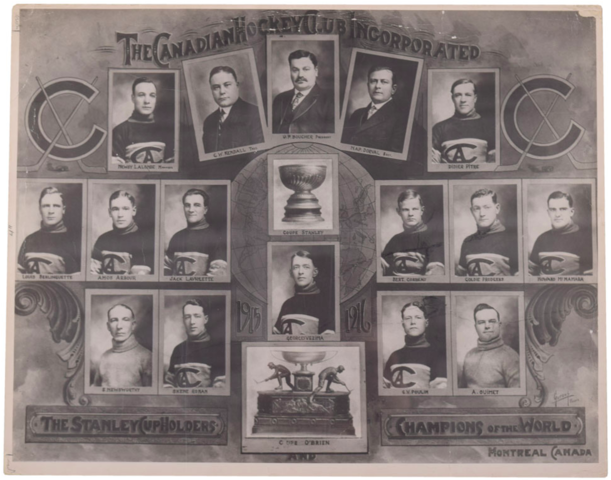
The 1916 Canadiens. Note the "CA" logo instead of "CH,"
the much smaller Stanley Cup, and the O'Brien Trophy.

Every great sporting institution had to start its greatness at some point. For hockey's greatest franchise, this was it.

March 30, 1916: The Montreal Canadiens win the Stanley Cup for the 1st time. They defeat the Portland Rosebuds, the 1st American-based team to compete for the Cup.

The team was founded in 1909, as Club Athlétique Canadien -- Canadian Athletic Club. The original logo was a Gothic C inside a maple leaf. Later, it became a "CA," for "Canadian Athletic." In the 1st NHL season of 1917-18, it became "Club de Hockey Canadien," and the logo became a "CH."

George "Tex" Rickard, the boxing promoter who built the 3rd Madison Square Garden and founded the Rangers, was once asked what the H in the Canadiens' "CH" logo stood for, and he said, "Habitantes," a reference to the early French settlers of Québec, especially farmers. This got shortened to "Habs," leading to the English chant, "Go, Habs, go!"

But at their founding, they quickly became the team of Montreal's French speakers, or "Francophones." The Montreal Wanderers, "the Little Men of Iron," Stanley Cup winners of 1906, 1908, 1909 and 1910, remained the team of the English speakers, of "Anglophones."

The Canadiens reached the Playoffs for the 1st time in 1914, and in 1916, won the Championship of the National Hockey Association, the O'Brien Cup, which was named after their founder, J. Ambrose O'Brien. This, effectively, made them the hockey champions of Eastern Canada, and entitled them to play the champions of Western Canada, the champions of the Pacific Coast Hockey Association. Only this time, it was the Portland Rosebuds, of Portland, Oregon, who won the PCHA title, becoming the 1st American team to play for the Cup.

The format was a best-3-out-of-5, and, because of the distance required for train travel in that pre-jet plane era, all the games were played at the Montreal Arena, so the Rosebuds would never have home-ice advantage. To make up for this, Games 2 and 4 would be played under Western rules, with 7 men on a side, including the "rover" position that the NHA had already eliminated, in favor of 6-a-side: Goaltender, 2 defensemen, left wing, center, right wing.

The Arena, also known as the Westmount Arena, because it was built just west over the city line, in the City of Westmount. It opened in 1898, as the 1st arena ever built specifically for ice hockey, with rounded corners, a style copied by hockey arenas ever since.
Despite playing under Eastern rules, the Rosebuds won Game 1, 2-0, holding the Canadiens to 6 shots. The Habs' Captain and best defender, Jean-Baptiste "Jack" Laviolette, got his jaw broken. And their head coach and best all-around player, Édouard Cyrille "Newsy" Lalonde, developed a bad cold, and would also miss Game 2, which would be played under Western rules. It looked like a major upset was in the making.

But the Canadiens won Game 2, anyway, 2-1, with a much tighter-checking defense. Laviolette and Lalonde both returned for Game 3. Lalonde got into a fight with Rosebuds star Ernie "Moose" Johnson, remembered by Montreal fans for his time with the Wanderers. The police had to come onto the ice to break up the fight, and Lalonde and Laviolette were both ejected from the game. Despite this, Didier "Cannonball" Pitre scored three goals -- the term "hat trick" didn't come into wide use until the 1950s -- and the Canadiens won, 6-3.

In Game 4, the Rosebuds blew a 3-0 lead, then the Canadiens blew a 4-3 lead, and the Rosebuds won, 6-5, to send the series to the distance. In Game 5, the Rosebuds took a 1-0 lead, but the Canadiens tied it, and George "Goldie" Prodgers won it for Montreal, 2-1.

It was the 26th time (counting the Cup's tenure as a "challenge cup") in 24 seasons that a Montreal team had won the Stanley Cup. But it was the first time for the Montreal Canadiens. Through the 2020-21 season, they have won 24. The only team in all of North American major league sports with more World Championships is the New York Yankees, with 27. From their 22nd Cup in 1979 until the Yankees' 24th World Series win in 1999, the Canadiens were actually in, or at least tied with the Yankees for, 1st place overall.

Hail the Champions: Goaltender, Number 1, Georges Vézina; defensemen, 2, Bert Corbeau; 3, Howard McNamara; and 8, Goldie Prodgers; centers, 4, Newsy Lalonde; 5, Didier Pitre; 6, George "Skinner" Poulin; and 12, Erskine "Skene" Ronan; and wingers, 7, Jack Laviolette; 9, Louis Berlinguette; 10, Albert John "Jack" Fournier; and 11, Amos Arbour. (Amos was a cousin of later New York Islanders coach Al Arbour.) Vézina, Lalonde, Pitre, Laviolette and O'Brien would be elected to the Hockey Hall of Fame.

The Canadiens won the NHL Championship again in 1917, but lost the Stanley Cup Finals to the Seattle Metropolitans, who thus became the 1st American team to win the Stanley Cup. They lost the 1st NHL Finals in 1918, to the team now known as the Toronto Maple Leafs. They faced the Metropolitans again in the 1919 Stanley Cup Finals, but they were called off due to the Spanish Flu epidemic hitting both teams, killing Canadien defenseman Joe Hall (who was with the Quebec Bulldogs in 1916). The Canadiens didn't win the Cup again until 1924.

The Montreal/Westmount Arena burned down in 1918, dooming the Wanderers franchise. Condominums are on the site today. The Montreal Forum was built a block away, on the other side of the Montreal City Line, in 1924. Place Alexis Nihon, a shopping mall, was built between the sites, on the Westmount side.

From the opening of the Forum in 1924 until 1938, the Montreal Maroons played there, taking the Wanderers' place as the team of Anglophone Montrealers. But despite winning the Cup in 1926 and 1935, the Great Depression did them in. The Canadiens united the city for the next 40 years.

In 1979, the NHL took on the World Hockey Association's Quebec Nordiques, and the dynamic was reversed: In the Province of Quebec, the Canadiens began to be seen as the team of Quebec's Anglophones and Canadian nationalists/federalists, while the Nords were seen as the team of Francophones and Quebec nationalists/separatists. And the rivalry got very nasty, including "the Good Friday Massacre" in the 1985 Playoffs. But in 1995, unable to get a new arena, the Nordiques' owners moved them to Denver, making them the Colorado Avalanche.

After the founding of the NHL, the O'Brien Trophy was given to the NHL Champion (even if they didn't beat the Western Champions for the Stanley Cup) until 1927, then the winners of the NHL Canadian Division until 1938, and then to the team that lost the Stanley Cup Final until the trophy was retired in 1950. In my opinion, it should be brought back, and given to the last Canadian team standing in the Stanley Cup Playoffs.

In 1998, The Hockey News released their list of the 100 Greatest Hockey Players. Lalonde was ranked 33rd, and Vézina 75th.

*

March 30, 1916 was a Thursday. There were no other scores on this historic day: Baseball was in Spring Training, and professional football and basketball only existed on a minor-league level. 

Sunday, March 27, 2022

March 27, 1926: The Death of Georges Vézina

March 27, 1926: Georges Vézina dies of tuberculosis in his hometown of Chicoutimi, Quebec, Canada. The greatest goaltender the sport of hockey had yet seen, he was only 39 years old.

Joseph Georges Gonzague Vézina was born on January 21, 1887 in Chicoutimi, since absorbed into the city of Saguenay, in the Saguenay–Lac-Saint-Jean region of Quebec, 125 miles north of Quebec City and nearly 300 miles northeast of Montreal. He dropped out of school at age 14 to work in his father's bakery.

In 1908, he married Marie-Adélaïde-Stella Morin. A story spread by his later boss, Montreal Canadiens part-owner Leo Dandurand, said that the couple had 22 children, and that Georges spoke no English. Although both parts were plausible -- the Catholic Church in Quebec heavily encouraged big families, to overcome the Anglophone dominance of their Province through "the revenge of the cradles," and rural Quebec was almost entirely Francophone -- neither part was true: They had just 2 children, and Georges did speak some English.

At the time, transportation and media links being what they were, Chicoutimi was so remote that there was only one way for a player for the Chicoutimi Hockey Club, nicknamed the Saguenéens, could get noticed by those larger cities, and that was to tour the Province of Quebec, playing exhibition games.

The Montreal Canadiens were founded in 1909, and, in their 1st season, on February 17, 1910, they played the Chicoutimi Hockey Club. They lost, and their goaltender, Joseph Cattarinich (later to be a part-owner with Dandurand) suggested that they offer Vézina a tryout. Vézina refused. Later in the year, the teams played each other again, and Chicoutimi won again. Again, the Canadiens offered Vézina a tryout. He accepted on the condition that they also try out his brother Pierre. They did, although Pierre didn't make the team. Georges did, and made his professional debut on December 31, 1910, a 5-3 loss to the Ottawa Silver Seven (the original Ottawa Senators).

It took a while for the Canadiens to get good. In 1914, they finished tied for 1st in the National Hockey Association, with the Toronto Blueshirts, and lost a Playoff for the title and the right to play the Pacific Coast Hockey Association Champions for the Stanley Cup. The Blueshirts ended up beating the Victoria Aristocrats.

In 1916, the Canadiens won the NHA title outright, and beat the PCHA Champion Portland Rosebuds for their 1st Stanley Cup. This was also the 1st time an American-based team had played for the Cup. In 1917, the Canadiens were NHA Champions again, but lost the Stanley Cup Finals to the Seattle Metropolitans, the 1st U.S. team to win the Cup.

The Canadiens joined the new National Hockey League for the 1917-18 season. On February 18, 1918, the Canadiens beat the Toronto Arenas, 9-0, and Vézina became the 1st NHL goalie to record a shutout. On December 28, 1918, again against Toronto, he became the 1st NHL goalie to be credited with an assist, when Édouard "Newsy" Lalonde, the Canadiens' best attacking player, took a rebound from one of his saves, took the puck up the ice, and scored. The Canadiens won the NHL title, but the worldwide influenza epidemic rebounded in the Spring of 1919, killing Canadiens defenseman Joe Hall, and forcing the abandonment of the Finals between the Canadiens and the Metropolitans.

The Canadiens won the NHL Championship again in 1924, and beat the Vancouver Millionaires for their 2nd Cup. They won the NHL Championship again in 1925, but lost the Finals to the Victoria Cougars, Champions of what was now known as the Western Hockey League. The Cougars became the last team from outside the NHL to win the Cup, as the WHL collapsed after 1 more season, making the Cup an all-NHL affair.

From 1917 to 1925, in NHL play, Vézina won 103 games, lost 81, and had a goals-against average of 3.28. At the time, that was the lowest in the League's young history. What's more, he had played every minute of every game. The attempt to do so was not rare, but actually doing it was. In fact, the Canadiens hadn't played a league (NHA or NHL) game without him since December 1910 -- almost 15 full seasons. He was seen as unflappable on the ice, "cool as a cucumber," and was nicknamed "the Chicoutimi Cucumber."

But when he reported to training camp for the 1925-26 season, he was noticeably ill. He made no mention of it. The season opened on November 28, against an expansion team, the Pittsburgh Pirates. (Named for the city's baseball team, they only lasted through the 1930 season, and have no connection to the Pittsburgh Penguins.) In the intervening 6 weeks, he had lost 35 pounds. When he reported for the opening game, he had a fever of 102 degrees. He insisted upon playing.

He got through the 1st period without allowing a goal. But upon his return to the locker room, he began to vomit blood, a sure sign of tuberculosis. Today, it is curable with antibiotics; but, then, the treatments were not very effective. For the rest of the game, he was replaced by Alphonse Lacroix. Despite his French name, he was an American, and had played for the U.S. in the 1st Winter Olympics in Chamonix, France the year before. The Canadiens lost, 1-0.

Vézina never played again, and the Canadiens finished last in the NHL for 1925-26. Nevertheless, knowing that he was dying and the family couldn't afford his medical expenses otherwise, the team paid his full salary of $6,000 (Canadian). He died on March 27, 1926, just 39.

*

March 27, 1926 was a Saturday. Baseball was in Spring Training. Football was out of season. The NBA hadn't been founded yet. As for hockey, the season was between the league finals and the Stanley Cup Finals. The Victoria Cougars were dethroned as Cup holders by the NHL Champions, the Montreal Maroons.

At the start of the 1926-27 season, the Canadiens donated the Vezina Trophy to the NHL, to be awarded to the goaltender of the team that allowed the fewest goals during the regular season. (Note that the Trophy's name does not have the accent over the E in "Vézina.") George Hainsworth, whom the Canadiens signed from the Saskatoon Crescents, one of the teams that went out of business with the Western Hockey League the season before, won the Trophy the 1st 2 times it was awarded.
In 1981, the NHL changed the format: The Vezina Trophy went to the winner of a poll for the best goalie of the year, while the Jennings Trophy was instituted, to go to the goalie with the fewest goals allowed.
In 1945, Vézina and Charlie Gardiner of the Chicago Black Hawks, who also died while still an active player, became the 1st 2 goalies elected to the Hockey Hall of Fame. In 1965, his hometown of Chicoutimi recognized Vézina, as the 1st professional athlete to come from there, by renaming their arena the Centre Georges-Vézina.

In 1998, The Hockey News ranked Vézina 75th on their list of the 100 Greatest Players. In 2017, the NHL named its 100th Anniversary 100 Greatest Players. Vézina was the earliest player selected.

Saturday, March 26, 2022

March 26, 1917: The 1st American Stanley Cup

March 26, 1917: For the 1st time, the Stanley Cup is won by a team from outside Canada. It would be the biggest shock to Canadian hockey until the 1972 Summit Series.

The Montreal Canadiens won the National Hockey Association title in 1916, and beat the Portland Rosebuds for their 1st Stanley Cup. The Rosebuds were the Champions of the Pacific Coast Hockey Association, and the 1st American-based team -- the 1st team from outside Canada -- to play for the Cup.

The Canadiens had some of the earliest members of the Hockey Hall of Fame: Centers Edouard "Newsy" Lalonde and Didier "Cannonball" Pitre, right wing Jack Fournier, left wing Jack Laviolette, and goaltender Georges Vézina, for whom the trophy for the NHL's top goalie would be named. (The Vezina Trophy has no accent mark over the E in its official name.)

In 1917, the Canadiens won the NHA title again. This time, the PCHA title was won by the Seattle Metropolitans. Founded in 1915, they included some future Hall-of-Famers: Centers Frank Foyston and Jack Walker, and goalie Harry "Hap" Holmes.
A surviving Seattle Metropolitans sweater

The entire Stanley Cup Finals, best-3-out-of-5, would be played at the Seattle Ice Arena, due to the huge distance between the competing teams' cities. But the rules would alternate between those of the NHA and the PCHA. The Canadiens surprised no one by winning Game 1, 8-4. Pitre scored 4 goals. But in Game 2, also played under NHA rules, the Metros took a 6-0 lead before the Canadiens got a late consolation goal.
Seattle Ice Arena

The PCHA rules took effect, and Seattle lead only 1-0 after 2 periods in Game 3, but Vézina couldn't hold the Metros off forever, and the game ended 4-0. Game 4 was played on March 26, and an early goal by Bernie Morris set the tone. The Metropolitans won, 9-1. Pete Muldoon, who had previously played for the Vancouver Millionaires of the PCHA, was just 29 years old, and remains the youngest head coach ever to win the Stanley Cup.

The shock to Canadian hockey sensibilities was great. In November, the National Hockey League was founded, to replace the NHA. However, there was no connection between the events: The real reason the NHL was formed was so that the member teams could get away from a troublesome owner, Eddie Livingstone of the Toronto Blueshirts. Essentially, they all dropped out of the NHA and formed the NHL, leaving Livingstone with control of a league with one team in it.

And the NHL took the NHA's place as the PCHA's challenger for the Stanley Cup. In 1918, the Toronto Arenas won the 1st NHL title, and beat the Vancouver Millionaires for the Cup. In 1919, Montreal and Seattle played each other again, but the worldwide flu epidemic forced a halt in the Finals, and no deciding game was ever played. The Ottawa Senators beat the Metropolitans in 1920 and the Millionaires in 1921. The Arenas, having become the Toronto St. Patricks, beat the Millionaires in 1922.

The PCHA folded, and was replaced by the West Coast Hockey League. The Senators beat the Edmonton Eskimos in the 1923 Finals. In 1924, the Canadiens beat the Calgary Tigers. In 1925, the Victoria Cougars beat the Canadiens, and remain the last non-NHL team to win the Cup. In 1926, the Cougars were dethroned by the Montreal Maroons.

The WCHL folded, and the freeing of their players led to the expansion of the NHL, which put teams in New York (2 of them), Boston, Pittsburgh, Detroit and Chicago. In 1928, the New York Rangers became the 2nd U.S.-based team to win the Stanley Cup.

The Seattle Ice Arena was bought in 1924, and the Metropolitans had no place else to go, so they went out of business. Seattle had minor-league teams for decades, not getting a team in either the NHL or the World Hockey Association, until finally getting the Seattle Kraken in the NHL in 2021.

*

March 26, 1917 was a Monday. There were no other hockey games. Professional basketball barely existed. Baseball was in Spring Training. And football was out of season. So there were no other scores on this historic day.

But on this day, disc jockey and soul singer Rufus Thomas was born. His daughter, Carla Thomas, would also be a big soul singer.

Sunday, March 13, 2022

March 13, 1912: Quebec City Win the Stanley Cup

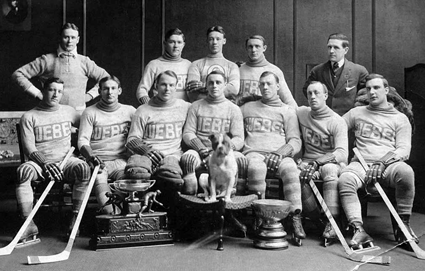
The 1913 Bulldogs, with "Phantom Joe" Malone in the center.
Notice how much smaller the Stanley Cup was then.

March 13, 1912: For the 1st time, the trustees of the Stanley Cup award it as a result of a true championship, not as a challenge trophy. They award it to the Quebec Bulldogs.

The team, from Quebec City, the capital of the Province of Quebec, won the championship of the National Hockey Association. Then they faced the Moncton Victorias, of Moncton, New Brunswick, the champions of the Maritime Professional Hockey League, in a best-2-out-of-3 series, and won it in 2 games, 9-3 on March 11 and 8-0 on March 13, with both games played at the Quebec Skating Rink.
Led by "Phantom" Joe Malone, the best scorer of the 1910s, the Bulldogs won the NHA Championship again in 1913. This time, their Maritime opponents were the Sydney Millionaires of Sydney, Nova Scotia. Malone scored 9 goals in the 1st game, on March 8, leading the Bulldogs to a 14-3 win. Malone didn't even play in the 2nd game, no March 10. The Bulldogs didn't need him: They won, 6-2.

The Bulldogs were invited to enter the NHL when it was founded in 1917, but the manpower drain of World War I meant that they were unable to field a team for the 1917-18 and 1918-19 seasons. They were admitted for 1919-20, but they finished last and lost a lot of money. For 1920-21, they were moved to Ontario, and became the Hamilton Tigers. In 1925, they were moved to America, becoming the New York Americans, lasting until 1942.

The Quebec Aces began play in 1928. In 1944, they won the Allan Cup, Canada's amateur championship. In 1952, led by future Montreal Canadiens stars Jean Béliveau and Jacques Plante, they won the Alexander Cup, the championship of Canadian senior hockey. In 1971, led by future Canadiens star Guy Lafleur, the Quebec Remparts won the Memorial Cup.

In 1972, the World Hockey Association was founded, and with it, the Quebec Nordiques. They reached the Finals in 1975, and won the league title in 1977. In 1979, they were 1 of the 4 WHA teams admitted to the NHL. They reached the Conference Finals in 1982 and 1985, but lost money, and were moved to Denver in 1995, becoming the Colorado Avalanche -- and then won the Stanley Cup in their 1st season away. To their credit, the Avs players took the Cup back to Quebec City, and let their former fans celebrate.

A new Quebec Remparts won the Memorial Cup in 2006, but, as yet, Quebec City has not returned to the NHL. The 1912 and 1913 Bulldogs remain their only Stanley Cup winners; the 1977 Nordiques, their last title winners in what could be called a major hockey league.

The Quebec Skating Rink, the 4th in a series of buildings with that name, was built in 1891, and lasted until it burned down 1918. In 1913, it was replaced by the Quebec Arena, which burned down in 1942, and was replaced by the Colisée de Québec, which burned down in 1948, and was replaced by a new Colisée in 1949, which still stands, although it's been replaced by the Centre Vidéotron in 2015.

*

March 13, 1912 was a Wednesday. Baseball was in Spring Training. Football was out of season. And professional basketball barely existed. So there were no other scores on this historic day.

Monday, March 7, 2022

March 8, 1916: Pancho Villa's Raid on Columbus, New Mexico

March 8, 1916: Pancho Villa crosses from Mexico into New Mexico, and attacks the town of Columbus, 3 miles north of the border. It remains the last land invasion of the United States of America.

Mexico had been in a state of revolution since 1910. In 1914, 9 U.S. sailors came ashore at the Mexican port city of Veracruz to secure supplies, and were detained by Mexican forces. The Mexican government refused to release them, and, despite the country being in a state of revolution and civil war, all the factions united against the U.S.

President Woodrow Wilson sent troops to Veracruz, under the command of Admiral Henry T. Mayo, and taking the city turned out to be easy. The occupation lasted 6 months, and led to the fall of President Victoriano Huerta. But this led to a renewal of the hatred of Americans by Mexicans, originally stoked by the Mexican-American War of 1846 and 1847.

José Doroteo Arango Arámbula was born on June 5, 1878 in San Juan del Río, in the State of Durango. He began calling himself Francisco Villa, taking his grandfather's surname, although it's not clear where the nickname "Pancho" came from. His friends called him "La Cucaracha" (The Cockroach), but he would he would eventually be called the Lion of the North, the Centaur of the North, and the Mexican Napoleon.

He became a key figure in the movement that forced out President Porfirio Diaz. But when the next President, Francisco Madero, was ousted by General Victoriano Huerta in 1913, Villa led the Constitutionalist Army against him.

But, as so often happens, after the revolution, the victors split, between the forces of Villa and Venustiano Carranza. The U.S. government aided the Carranza government against Villa in the Second Battle of Agua Prieta in November 1915. Villa lost, and most of his army left him.

Angry over this, on March 8, 1916, he took what he had left, crossed the border into Columbus, New Mexico -- New Mexico had only gained Statehood 4 years earlier -- and raided an American military outpost manned by the 13th U.S. Cavalry, because he needed weapons. In so doing, 8 American soldiers and 10 civilians were killed. But 67 of Villa's men were killed, and 7 were captured. He got the weapons he needed, but, in terms of manpower, he was considerably worse off.

But, like George Washington, he knew he wasn't the best of generals, but was a savvy politician. He gave interviews to foreign journalists, including John Reed, whose fame now rests on his reporting on the Bolshevik Revolution. He had film cameras follow him, and allowing the films to be sent to Hollywood and released, with the label "And starring Pancho Villa as himself." In 2003, that became the title of a film about Villa, starring Spanish actor Antonio Banderas.

The raid led to another American invasion of Mexico, which became known as the Punitive Expedition. While failing to capture Villa, it sent him into hiding, leading to his downfall. It was also a convenient warmup for the U.S. Army for fighting in World War I, especially since its commander was General John J. Pershing. "Black Jack" would go on to command U.S. troops in Europe in World War I. General George S. Patton, then a Lieutenant, credited much of his later career to having served on this Expedition.
Cartoon by Clifford Berryman for The Washington Star

In 1920, Carranza was ousted from power, and the new President, Adolfo de la Huerta, offered Villa a deal: Amnesty and a landed estate, if he would retire from politics. He took it. But on July 20, 1923, while visiting Parral, in the State of Chihuahua, he was assassinated in his car, a 1919 Dodge, probably on the orders of the next President, Álvaro Obregón, who still saw him as a threat. Supposedly, Villa's last words were, "Don't let it end like this. Tell them I said something."

After his death he was excluded from the pantheon of revolutionary heroes until the Sonoran generals Obregón and Calles, whom he battled during the Revolution, were gone from the political stage. Villa's exclusion from the official narrative of the Revolution might have contributed to his continued posthumous popular acclaim. He was celebrated during the Revolution and long afterward by corridos, films about his life, and novels by prominent writers. In 1976, his remains were reburied in the Monument to the Revolution in Mexico City in a huge public ceremony.

*

March 8, 1916 was a Wednesday. Baseball was in Spring Training. Football was in the off-season. Professional basketball didn't really exist.

This was before the National Hockey League, but there was a National Hockey Association, from which only the Montreal Canadiens survive today, although a new Ottawa Senators team took up the name of an NHA/NHL franchise that went out of business in 1934; and a Pacific Coast Hockey Association, from which no teams survive.

The PCHA wrapped up its season on February 25. Two games were played in the NHA on this day. The Toronto Blueshirts beat the Montreal Wanderers, 3-2 at the Montreal Arena. And the Ottawa Senators beat the Quebec Bulldogs, 8-5 at the Ottawa Arena.

Monday, February 7, 2022

February 7, 1914: Charlie Chaplin Debuts "The Tramp"

February 7, 1914: The film Kid Auto Races at Venice premieres. Like all films of the era, it is silent, and in black and white. Like nearly all films of the era, it is short: 6 minutes and 22 seconds. It is not the 1st film to star Charlie Chaplin. But it is the debut appearance of the character Chaplin played in most of his films: "The Tramp," a.k.a. "The Little Tramp."

Charles Spencer Chaplin Jr. was born on April 16, 1889 in Walworth, South London. His childhood was one of deprivation: His father was out of the picture, he was sent to a workhouse twice before his 9th birthday, and his mother was committed to a psychiatric institution when he was 14.

He turned to performing, and by the age of 19, he had had enough success in London's music halls that Fred Karno, an English stage comedian who is credited with popularizing a pie thrown in someone's face as a comedy staple, made Chaplin part of his company, and took him on an American tour. While there, he began appearing in films for Keystone Studios, including once for producer Mack Sennett's "Keystone Kops."

Kid Auto Races at Venice, directed by Henry Lehrman, who directed some of the Kops' films, premiered on February 7, 1914, so it was the 1st film released with the character -- but not the 1st one made with him. Released 2 days later, on February 9, but filmed earlier, was Mabel's Strange Predicament, starring the biggest film actress of the era, Mabel Normand, who also directed -- and a woman directing a film then was, as it would be for decades to come, rare. Both films were produced by Sennett for Keystone.

In a 1933 interview, Chaplin told of the character's origin:

A hotel set was built for Mable Normand's picture "Mabel's Strange Predicament," and I was hurriedly told to put on a funny make-up. This time, I went to the wardrobe, and got a pair of baggy pants, a tight coat, a small derby hat, and a large pair of shoes. I wanted the clothes to be a mass of contradictions, knowing pictorially the figure would be vividly outlined on the screen.

To add a comic touch, I wore a small mustache which would not hide my expression. My appearance got an enthusiastic response from everyone, including Mr. Sennett. The clothes seemed to imbue me with the spirit of the character. He actually became a man with a soul, a point of view. I defined to Mr. Sennett the type of person he was. He wears an air of romantic hunger, forever seeking romance, but his feet won't let him.

Chaplin made 26 short film starring The Tramp in 1914 alone. He was enough of a hit that, in 1915, a film titled The Tramp and starring Chaplin could be released, and be one of the biggest hits of the year. By 1918, he was one of the world's best-known figures.

In 1919, Chaplin co-founded the film distribution company United Artists, along with D.W. Griffith, famous for directing Birth of a Nation and Intolerance; and the husband & wife actors Douglas Fairbanks and Mary Pickford. Having an ownership share of UA, and the okay from Griffith, Fairbanks and Pickford to pretty much do whatever he wanted, gave him complete control over his films.

Indeed, the studio was premised on allowing actors to control their own interests, rather than being dependent upon commercial studios. This, of course, did not last long. As the historian Hannah Arendt would later put it, "The most ardent revolutionary will become a conservative the day after the revolution."

In 1921, he made his 1st feature-length film: The Kid, coming in at 1 hours and 8 minutes, and co-starring 6-year-old Jackie Coogan, who became one of the earliest child stars. As an older man, TV audiences would know him as Uncle Fester on The Addams Family. Perhaps Chaplin's best-known film came in 1925, The Gold Rush, the Tramp's struggle to survive while searching for gold in Alaska typical of his mixture of slapstick and pathos.

Talking pictures came in 1927, but Chaplin refused to make the switch, making City Lights in 1931 and Modern Times in 1936. Both were considered immediate classics, and film historians still think of them as such.

But with the occasional exception like Mel Brooks' 1976 spoof Silent Movie and the 2011 French film The Artist, the age of silent films was over, a fact parodied in a 1966 episode of Batman, where villain the Riddler uses them as a theme for his scheme, and the famous silent film star Francis X. Bushman made his last acting appearance before his death a few months later.

Finally, in 1940, Chaplin gave in, but made a point, anyway. His 1st sound film was The Great Dictator. Because of his similar mustache, people seeing Adolf Hitler for the first time said he looked like Chaplin. But there was nothing funny about the repression of the Nazi regime. So The Great Dictator, a "Prince and the Pauper" story where a peasant ends up impersonating the dictator and reversing his policies, is only a semi-comedy. Millions of people who had seen Chaplin heard his voice for the first time, and they heard him give one of the greatest speeches in movie history.

But he had issues in real life. His career would not have survived in the #MeToo era, as he preyed on underage women. He married 4 times:

* In 1918, to Mildred Harris, a 16-year-old actress, who told him she was pregnant. They married, and she soon found out she wasn't. She soon got pregnant anyway. They were divorced in 1920. She married and divorced twice more, and died in 1944, only 43, from pneumonia following abdominal surgery, at a time before antibiotics were common.

* In 1924, to Lillita "Lita" Grey, also a 16-year-old actress, who, at 13, had played "the flirting angel" in The Kid. She, too, forced him into marriage because she was pregnant. The marriage lasted until 1927, and she also married 4 times. She lived until 1995, at 87.

* In 1936, to Paulette Goddard, another actress. This time, it was different: She was 26 and it was her 2nd marriage. She was his leading lady in Modern Times and The Great Dictator. He tried to talk producer David O. Selznick into casting her as Scarlett O'Hara in Gone with the Wind, without success. They divorced in 1942, but remained friends. She later married and divorced actor Burgess Meredith, and married writer Erich Maria Remarque, a marriage that lasted until his death. She lived until 1990, at 79.

* And in 1943, to Oona O'Neill, 18, the daughter of playwright Eugene O'Neill. She became an actress, and they stayed married for the rest of Chaplin's life. She died in 1991, at 66.

Between his 4 marriages, Chaplin had 11 children. Charles III, a.k.a. Charlie Chaplin, Jr., went into acting. So did Sydney, whom Charlie named for his brother. So did Geraldine, who is not only still alive as of February 7, 2022, but recently played a friend of her father's, Wallis Simpson, the Duchess of Windsor, in the TV series The Crown. Michael, Josephine, Victoria and Christopher also went into acting. Son Eugene became a renowned recording engineer for rock music. Sadly, Charlie Jr. predeceased his father.

The FBI accused Charlie of Communist sympathies, and in 1952, he went back to London to promote his semi-autobiographical film Limelight, the most serious film he had ever made. He was banned from re-entering the U.S., and did not return until 1972, when the Academy of Motion Picture Arts and Sciences awarded him an honorary Oscar. He was given a 12-minute standing ovation. In the interim, he had made just 2 films, A King in New York in 1957, and A Countess from Hong Kong in 1967.

In 1975, Queen Elizabeth II awarded him a knighthood: Sir Charles Spencer Chaplin. But his health had been failing for years, through strokes. on December 25, 1977, Christmas Day of a year that had seen the deaths of early talking-pictures star Groucho Marx, crooner Bing Crosby, actress Joan Crawford, Broadway legend Zero Mostel, King of Rock and Roll Elvis Presley and comedian Freddie Prinze Jr. -- at ages 86, 74, 73, 62, 42 and 22, respectively -- Charlie Chaplin died of another stroke, at the age of 88, at his home in Corsier-sur-Vevey, Switzerland. He was buried there.

By that point, it had been 50 and 60 years since the Tramp's heyday. Chaplin could, had his health and his desire allowed it, have seen The Godfather, Jaws and Star Wars, and was increasingly seen as an icon of a long-ago era. More so than his contemporaries, damsel-in-distress Pauline (Pearl White) and the Keystone Kops, the Tramp had become the symbol of the Silent Film Era.

Chaplin was played by Clyde Revill in the 1980 film The Scarlett O'Hara War, Robert Downey Jr. in the 1992 film Chaplin, and Eddie Izzard in the 2001 film The Cat's Meow. French mime Marcel Marceau and Indian actor Raj Kapoor both cited Chaplin as a tremendous influence.

Federico Fellini called him "a sort of Adam, from whom we are all descended." Jacques Tati: "Without him, I never would have made a film." François Truffaut: "My religion is cinema. I believe in Charlie Chaplin." Satyajit Ray: "If there is any name which can be said to symbolize cinema, it is Charlie Chaplin... I am sure Chaplin's name will survive even if the cinema ceases to exist as a medium of artistic expression. Chaplin is truly immortal."

He was right: Starting in 1981, IBM, having bought the rights to use the character, used him for a series of commercials, showing him doing what he couldn't do in Modern Times in 1936: Adjust to what the ads called "a tool for modern times." It's been called the most successful ad campaign ever, speaking to the character's lasting fame.

*

February 7, 1914 was a Saturday. Baseball and football were out of season. Basketball was still all-amateur. But there was action in the 1st professional hockey league, the National Hockey Association:

* The Toronto Blue shirts beat the Montreal Canadiens, 3-0 at the Westmount Arena in Montreal.

* The Montreal Wanderers beat the Ottawa Senators, 4-2 at Dey's Arena in Ottawa.

* And the Quebec Bulldogs beat the Toronto Ontarios, 6-4 at the Arena Gardens (later named the Mutual Street Arena) in Toronto.

December 31, 1999 & January 1, 2000: The Millennium

December 31, 1999:  The Millennium arrives. The people of planet Earth survived. At a terrible cost. But we hadn't destroyed ourselves. ...