Showing posts with label william howard taft. Show all posts

Tuesday, December 13, 2022

December 14, 1911: Roald Amundsen Reaches the South Pole

December 14, 1911: Roald Amundsen becomes the 1st person to reach the South Pole. 

It made sense for a Norwegian to attempt to become the 1st person to reach the North Pole, 90 degrees North latitude: The only countries whose mainlands have points further north than Norway's northernmost point are Canada and Russia. This does not count Denmark, which owns Greenland, which has a more northerly point of land than any country: Kaffeklubben Island, at 83.63 degrees North.

It made sense for Amundsen to be the Norwegian to attempt it. In 1906, aboard the sloop Gjøa, he became the leader of the first expedition to sail the long-sought Northwest Passage. He did make an attempt to reach the North Pole, but in 1909, American expeditioner Robert Peary claimed to have gotten there first. Maybe Peary should have kept trying: It is now believed that he did not, in fact, beat Amundsen and everyone else to it.

It did not make much sense for a Norwegian to be the first person to attempt to reach the South Pole, 90 degrees South latitude. The country with the southernmost land is Chile, Hornos Island, at 55.97 degrees South latitude; followed by Argentina and Australia. (Villa Las Estrellas, on King George Island, is the northernmost point on Antarctica, at 62.11 degrees South.) Since Australia was part of the British Empire, a Royal Navy officer, Captain Robert F. Scott, made the first serious attempt at it.

But since Amundsen did have experience in a polar expedition, he thought he could reach the South Pole first. On June 3, 1910, he sailed his ship Fram out of his national capital of Oslo. Upon reaching the Portuguese colony of Madeira, he sportingly sent Scott a telegram stating his intentions. On January 14, 1911, he reached the continent of Antarctica, on the Ross Ice Shelf, and established base camp there.

An attempt set out on September 8, but had to turn back. A 2nd attempt was made on October 19, with 4 sleds, each pulled by 13 dogs. On December 8, they reached 88 degrees, 23 minutes south, the furthest point anyone had yet reached, in 1909 by Ernest Shackleton. They were 97 miles away. They went on.

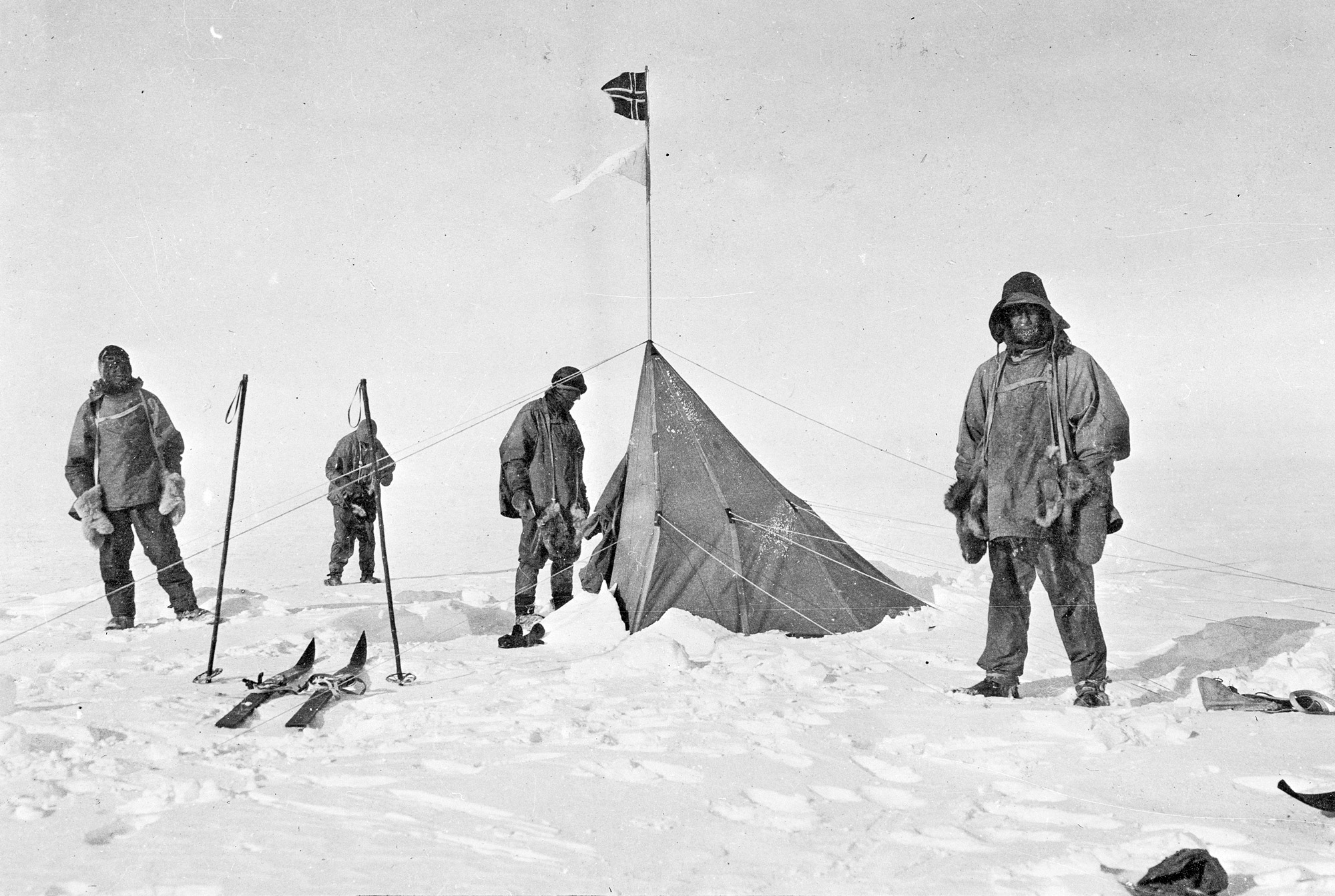
On December 14, 1911, Amundsen stopped, took some measurements, and told his crew, "Gentlemen, I am certain we are at the South Pole." He asked crewmates to take their own measurements, and a central point within them was decided as the Pole. They pitched a tent, topped with a Norwegian flag. Amundsen wrote a message for Scott, in case he made it, and left it inside the tent.
On March 7, 1912, the Fram reached Hobart, Tasmania, Australia. Amundsen made his claim, and learned that no word had yet been reached from Scott. Scott had reached the Pole on January 17, but found Amundsen's tent and note. Scott never made it back alive: Snowstorms prevented him from getting back to his base camp. A search party found him on November 12, with a last entry in his diary dated March 29. He was 43 years old.
Robert F. Scott

Scott was hailed as a hero in death. Amundsen lived on, and on May 12, 1926, led a team on the airship Norge to become the 1st people to fly over the North Pole. On June 18, 1928, he led a team searching the Arctic for the lost airship Italia. His plane, a Latham 47 "flying boat," also disappeared, and has never been found. He was 56.

*

December 14, 1911 was a Thursday. American novelty musician Lindley "Spike" Jones was born on this day. Baseball was out of season. Football season was over. There was no NBA yet. And the professional hockey season was about to start. So there were no scores on this historic day.

Monday, December 12, 2022

December 12, 1910: The Disappearance of Dorothy Arnold

December 12, 1910: Socialist and heiress Dorothy Arnold disappears in New York. She is never found.

Dorothy Harriet Camille Arnold was born on July 1, 1885 in Manhattan, and raised on the Upper East Side by a Social Register family of Mayflower descendants. A graduate of Bryn Mawr College, she wanted to be a writer. During calendar year 1910, she submitted 2 stories to McClure's magazine, but both were rejected.

On December 12, she left her home at around 11:00 AM, telling her mother that she was going shopping for a dress, to wear for her younger sister Marjorie's upcoming debutante party. She had about $25 or $30 in cash in her possession. She walked from the family home at 108 East 79th Street to the Park & Tilford store, at the corner of 59th Street and 5th Avenue.

At Park & Tilford, at around 12:00 Noon, she charged a half pound box of chocolates to her account, but did not buy a dress. She then walked to Brentano's bookstore, at 27th Street & 5th Avenue. There, she bought Engaged Girl Sketches, a book of humorous essays by Emily Calvin Blake. Of course, she did not buy a dress at a bookstore. The clerks who waited on Arnold in both stores later said that she was courteous, and did not exhibit any unusual behavior.

Outside the bookstore, Arnold ran into a female friend named Gladys King. King recalled that the two spoke briefly about Marjorie's upcoming debutante party, and that Arnold seemed to be in good spirits. King then excused herself to meet her mother for lunch at the Waldorf-Astoria Hotel, at 34th Street & 5th Avenue. (The Waldorf moved to its current location, at 49th Street & Park Avenue, in 1931, and the Empire State Building was built on the site of the original.)

King recalled that Arnold told her she was going to walk home through Central Park. King last saw Arnold on 27th Street, shortly before 2:00 PM, when she turned to wave goodbye for a second time. She had already walked 52 blocks, over two and a half miles. No Subway, bus or trolley for her; but then, no private car and chauffeur were used, either.

By the early evening, Arnold had failed to return home for dinner. As she never missed meals without informing her family, the Arnolds became worried. They began calling her friends to find her whereabouts, but no one had seen her.

Arnold's father initially wanted to avoid publicity, and thus social embarrassment, over his daughter's disappearance, and so sought the help of private investigators in locating her. After these attempts proved fruitless, the family filed a missing persons report with the New York Police Department (NYPD) on January 25, 1911.

Various theories, sightings and rumors regarding Arnold's disappearance circulated in the years and decades after she was last seen. Suicide, from despondency over her early rejection as a writer, seemed unlikely, given the word of those who saw her on December 12. An ex-boyfriend, with whom she had previously run off, was interrogated, but he said he knew nothing about her disappearance, and his involvement was concluded to have been a dead end.

Another theory is that she had gotten pregnant, ran off to get an illegal abortion, had died on the operating table, and that she had been cremated to get rid of the evidence. But while this happened to many women at the time, no one has found evidence tying Arnold to the theory. King and the clerks gave no indication that she exhibited any of the emotion connected to an unwanted pregnancy.

Her fate remains unknown. She should not be confused with actress Dorothy Arnold (1917-1984), who was married to baseball star Joe DiMaggio from 1939 to 1944, and was the mother of his only child, Joe DiMaggio Jr.

*

December 12, 1910 was a Monday. Baseball was out of season. Football was in midweek. Professional basketball barely existed. And while professional hockey did, the season was a few days away from starting. So there were no scores on this historic day.

Wednesday, December 7, 2022

December 7, 1909: The Invention of Plastic

December 7, 1909: Leo Baekeland patents Bakelite, the 1st plastic made from synthetic components. The world will never be the same.

Leo Hendrik Baekeland was born on November 14, 1863 in Ghent, Belgium. In a 1936 interview with The Literary Digest, a popular magazine of the time, "The name is a Dutch word meaning 'Land of Beacons.'" He earned his Ph.D., maxima cum laude, from the Ghent University when he was only 21 years old. He taught physics and chemistry in Bruges, before Ghent University hired him in 1889.

A trip to the United States led him to invent Velox photographic paper in 1893. As important as that was, his 1907 invention of Bakelite, an inexpensive, non-flammable and versatile plastic, was a major step forward, marking the beginning of the modern plastics industry.

Bakelite, formally poly­oxy­benzyl­methylene­glycol­anhydride -- don't try it, trust me -- is a thermosetting resin, formed from a condensation reaction of phenol with formaldehyde. Baekeland developed it in his laboratory in Yonkers, just north of New York City, in 1907, and patented it on December 7, 1909.

It was one of the first plastic-like materials to be introduced into the modern world, and was popular because it could be molded and then hardened into any shape. Because of its electrical nonconductivity and heat-resistant properties, it became a great commercial success. It was used in electrical insulators, radio and telephone casings, and such diverse products as kitchenware, jewelry, pipe stems, children's toys, and firearms.

As Baekeland grew older he became more eccentric, entering fierce battles with his son and presumptive heir over salary and other issues. He sold the General Bakelite Company to Union Carbide in 1939 and retired. He became a recluse, eating all of his meals from cans and becoming obsessed with developing an immense tropical garden on his winter estate outside Miami. He died of a stroke, in a sanatorium in Beacon, New York, on February 23, 1944.

*

December 7, 1909 was a Tuesday. Baseball was out of season. Football season had just ended. And professional basketball and hockey barely existed. So there were no scores on this historic day.

Saturday, December 3, 2022

December 4, 1909: The 1st Grey Cup

December 4, 1909: The 1st Grey Cup football game is held, for the Canadian Dominion Football Championship.

As with hockey's Stanley Cup, 16 years earlier, the trophy is donated by the man who was then the Governor-General of Canada, the British monarch's representative in the country. This was Albert Grey, the 4th Earl Grey (1851-1917, held the office 1904-1911).
His grandfather, Charles, the 2nd Earl Grey, was Prime Minister of Great Britain from 1830 to 1834, and was the namesake of Earl Grey tea, which had been presented to him as a diplomatic gift from China.

The game is held at Rosedale Field, about 3 miles north of downtown Toronto. Attendance was a full house, 3,807. It was between the University of Toronto Varsity Blues, Champions of the Intercollegiate Rugby Football Union (IRFU), and the Toronto Parkdale Canoe Club, Champions of the Ontario Rugby Football Union. Essentially, they were, respectively, the best college and professional rugby teams in the country. (Canadian football came out of rugby, and the Canadian Football League, the CFL, would become the successor to the Canada Rugby Union, the CRU.)
Rosedale Park, site of the 1st Grey Cup game

At the time, though, much like in American football, the professional game was semi-pro at best. Most of the men had real jobs they had to work, and didn't really have time to dedicate to improving their game through organized practices. The Blues, on the other hand, were considerably better organized and, under head coach Harry Griffith, better prepared. It was no contest: UT won, 26-6.
The 1909 Varsity Blues. The trophy at the right
is the original version of the Grey Cup.

The Varsity Blues would repeat in 1910, beating the Hamilton Tigers at the Amateur Athletic Association Grounds in Hamilton, Ontario; and in 1911, beating the Toronto Argonauts at UT's new on-campus home, Varsity Stadium, at which the Argos had begun to "groundshare," helping to making it the most successful location in the history of Canadian football. These games drew 12,000 and 13,687 fans, respectively, showing that the sport was already growing.

The Varsity Blues would win a 4th Grey Cup in 1920, before the professional teams began to catch up. Varsity Stadium went on to host 30 Grey Cups, sometimes as a neutral site, though the Argos would end up winning it there 9 times.

By the early 1930s, things had consolidated, and only professional teams were playing for the Grey Cup. Through the 2022 season, here are the totals of the current teams in the CFL: The Toronto Argonauts 18, the Edmonton Elks (formerly the Edmonton Eskimos) 14, the Winnipeg Blue Bombers 12, the Hamilton Tiger-Cats 8, the Calgary Stampeders 8, the Montreal Alouettes 7, the Vancouver-based BC Lions 6, the Regina-based Saskatchewan Roughriders (1 word) 4, and the Ottawa Redblacks (formerly the Senators and the Rough Riders, 2 words) 1.

And here are the totals won by the various cities, including teams that no longer compete for the Cup (and, in some cases, no longer even exist): Toronto 25, Hamilton 15, Edmonton 14, Winnipeg 12, Ottawa 10, Montreal 9, Calgary 8, Vancouver 6, Regina 4, Kingston (Ontario) 3, Sarnia 2, Baltimore 1.

(Yes, you read that right: Baltimore 1. I'll get to this.)

The Montreal Amateur Athletic Association won it in 1931, making them the 1st team from outside Ontario to win it. The Blue Bombers (then known simply as the 'Pegs, for Winnipeg) won it in 1935, making them the 1st team from west of Ontario to win it. The Stampeders won it in 1948, making them the 1st team from Western Canada to win it.

In 1993, the CFL was in trouble, and so it tried to expanded to the U.S., adding teams in Sacramento, Las Vegas, Shreveport, Birmingham, Memphis, San Antonio, and Baltimore. The Baltimore Stallions, wearing blue like the old Colts, taking on a horse name like the Colts, and playing in Memorial Stadium like the Colts, reached the Final in 1994, but lost to BC. In 1995, the Stallions won it, beating the Stampeders. In other words, since 1993, no Canadian team has won the Stanley Cup, but an American team has won the Grey Cup

With the Baltimore Ravens arriving in 1996, the Stallions moved to Montreal, becoming the 2nd edition of the Alouettes. The CFL ended its American experiment.

*

December 4, 1909 was a Saturday. Baseball was out of season. Professional basketball barely existed. There were 2 college football games on this day, but only 1 of the 4 teams involved is now thought of as being in a "Power Five" Conference. Colorado School of Mines beat St. Vincent's College, 16-0 at Fiesta Park in Los Angeles. Colorado Mines now playin NCAA Division II. St. Vincent's went through several name changes before becoming Loyola Marymount University in 1973. But they dropped football after the 1951 season.

And the University of Denver beat Washington State College, 11-6 at Recreation Park in Spokane, Washington. "Wazzu" was renamed Washington State University in 1959. Denver scrapped its football program after the 1961 season.

December 4, 1909 is also recognized as the founding date of the greatest of all hockey franchises, the Montreal Canadiens, by Canadian silver magnate John Ambrose O'Brien, who had also owned the Renfrew Creamery Kings, west of Ottawa. The Canadiens then co-founded the National Hockey Association, and were co-founders of the National Hockey League in 1917, on their way to 24 Stanley Cups. O'Brien had played hockey, but not football, at the University of Toronto, winners of the 1st 3 Grey Cups.

Sunday, November 13, 2022

November 14, 1910: The 1st Aircraft Carrier

November 14, 1910: Eugene Burton Ely takes off in a Curtiss Pusher airplane, from the deck of the U.S. Navy cruiser USS Birmingham, off Norfolk Navy Base in Virginia. Thus was born the aircraft carrier.

On January 18, 1911, Ely landed his Pusher on a platform on the armored cruiser USS Pennsylvania, anchored in San Francisco Bay, proving that a ship could be safely used as a landing point as well as a takeoff point. On May 9, 1912, Commander Charles Samson of Britain's Royal Naval Air Service made the 1st takeoff from a ship already in motion, off the HMS Hibernia.
On September 6, 1914, the Imperial Japanese Navy ship Wakamiya conducted the 1st successful ship-launched air raid, against the German gunboat Jaguar and the Austrian cruiser SMS Kaiserin Elisabeth. Perhaps "successful" is too strong a word: Although the attack was launched, and the planes returned safely, they did no damage to the enemy vessels. (We hear so much about how Japan was part of Nazi Germany's "Axis" during World War II that we often forget that, in World War I, they were on the same side as Britain, France, Russia, and, eventually, America.)

On August 2, 1917, Squadron Commander Edwin H. Dunning became the 1st pilot to land on a moving ship, the HMS Furious, in his Sopwith Pup, at Scapa Flow in the Orkney Islands. Landing on the forward flight deck required the pilot to approach round the ship's superstructure, a difficult and dangerous maneuver. Just 5 days later, Dunning was later killed when his airplane was thrown overboard while attempting another landing on Furious. He was 25.

On March 20, 1922, the USS Langley was commissioned, as America’s 1st ship specifically designed as an aircraft carrier. It was named for Samuel Langley (1834-1906), astronomer and aviation pioneer. It was sunk by the Japanese during World War II. A 2nd carrier named Langley was launched in 1943, but only remained in service until 1947.

Eugene Burton Ely died in a crash in 1911. He was just short of turning 25. Charles Samson was a little luckier: Heart trouble forced him into early retirement, and he lived to be 47.

The USS Birmingham was in service from 1907 to 1923, and scrapped in 1930.

Carriers such as the original Enterprise, the Lexington, the Ranger, the Yorktown, the Hornet and the Essex were vital in winning World War II. In the post-Vietnam era, the U.S. Navy has tended to name carriers after Presidents, or people involved with the Navy in some capacity (or, in some cases, both). Carriers have been named after Presidents George Washington, Abraham Lincoln, Theodore Roosevelt, Franklin D. Roosevelt, Harry Truman, Dwight D. Eisenhower, John F. Kennedy, Gerald Ford, Ronald Reagan and George H.W. Bush. A 3rd carrier named USS Enterprise is now under construction.

*

November 14, 1910 was a Monday. Baseball was out of season. Football was in midweek. Professional basketball barely existed. And hockey season hadn't yet started. So there were no scores on this historic day.

Wednesday, November 9, 2022

November 9, 1912: Carlisle Upsets Army

Jim Thorpe. In this case, the C doesn't stand
for his college team, the Carlisle Indians,
but for his pro team, the Canton Bulldogs.
The picture is colorized, but otherwise real.

November 9, 1912: The biggest upset that college football had ever seen to that point takes place. In hindsight, though, it shouldn't have been considered an upset.

The football team at the United States Military Academy, at West Point, New York, usually called just "Army" in the newspapers, played their home games on The Plain, essentially a parade ground, which it still is. It would take until 1924 before they built a proper football facility, Michie Stadium.

But they were one of the top teams in the country, along with Ivy League schools Harvard, Yale, Princeton and the University of Pennsylvania; and Midwestern schools Michigan, Minnesota, and the University of Chicago.

Not considered one of the top teams in the country was the Carlisle Indian Industrial School, of Carlisle, Pennsylvania, established in 1879 as America's top boarding school for Native American teenagers. One of these was a member of the Sac and Fox tribe of Oklahoma, named Wa-Tho-Huk. No, that doesn't mean what it sounds like. It means "Bright Path." His "white man's name" was Jim Thorpe.

Thorpe was the greatest athlete in America. He had already showed his prowess on the football field at Carlisle, taking them to an 11-1 record in 1911, their only loss a 12-11 defeat away to Syracuse. They had beaten Harvard, Penn, Brown, and the University of Pittsburgh.

Before the 1912 season, he went to Stockholm for the Olympic Games, and won the Gold Medal in the decathlon and the pentathlon. When the Games' host, King Gustav V of Sweden, gave him his medals, he said to Thorpe, "You, sir, are the greatest athlete in the world." Thorpe said, "Thanks, King." Ever since, the winner of the Olympic decathlon has been granted the unofficial title of "the world's greatest athlete."

In 1912, Carlisle went into their game away to Army at 10-0-1, having beaten Pittsburgh again, avenged their defeat to Syracuse, and come away with just one blemish on their record, a 0-0 tie against Washington & Jefferson University.

No one expected them to beat Army at West Point. But they did, 27-6. Thorpe scored 3 touchdowns, and kicked 3 extra points, missing 1.

It was called the biggest victory of Indians over the U.S. Army since the Battle of the Little Bighorn in 1876.

Legend has it that Dwight D. Eisenhower, later the leading General of World War II and the 34th President of the United States, broke his leg trying to tackle Thorpe in this game. It's not true: He played in Army's next game, against Tufts University, and that's when he sustained the injury that ended his playing career -- though, fortunately, not his Army career.

Ironically, just 7 days after their greatest victory, Carlisle would suffer their greatest defeat, losing their undefeated season by losing to Penn 34-26 at Franklin Field in Philadelphia. Army would also lose at Franklin Field that season, to Navy, and had already done so the previous season.

Thorpe, already the greatest track & field athlete in the world, became the 1st great player in pro football. He also played Major League Baseball, famously getting the only hit in the only MLB game whose 1st 9 innings had no hits, the "double no-hitter" by Fred Toney of Cincinnati and Jim "Hippo" Vaughn of the Chicago Cubs in 1917, won as Thorpe singled home a run for the Reds in the top of the 10th inning. And he played in an early pro basketball league.

But it was discovered that he had played minor league baseball under an assumed name, and the International Olympic Committee took his medals away. In 1950, the Associated Press named him the greatest athlete of the 1st half of the 20th Century. He died in 1953. In 1982, the IOC restored his medals to his family.

The Army would get its revenge on Carlisle in only 6 years. In 1918, with America having gotten into World War I, the federal government, which already ran the school, closed it, and transferred control from the U.S. Department of the Interior, which since its creation has run "Indian Affairs," to the U.S. Department of War (renamed the Department of Defense in 1947). The property is now part of the U.S. Army War College.

How good a football player was Jim Thorpe, by today's standards? Hard to tell, although the college award for the best defensive back is named the Jim Thorpe Award. In 1999, The Sporting News ranked him 88th on its list of the 100 Greatest Football Players.

In 2010, 57 years after his death and 82 years after he last played so much as a down in the pro game, the NFL Network ranked him 37th on the list of the 100 Greatest Players. I don't know what happened in the ensuing 11 years to make him jump 57 places in spite of new players making the list. Maybe some old film was discovered, providing previously lost insight.

*

November 9, 1912 was, naturally, a Saturday. Baseball was out of season. Basketball was still a new sport, and not played professionally. Hockey was at the dawn of its professional era, and its season usually started in December. Football had begun to go professional, but it usually played on Sunday so that it wouldn't interfere with the college game on Saturday. So it was all college football on the day:

* Did I mention that Franklin Field in Philly was a tough place to play? On this day, Penn beat Michigan, 27-21. That version of Franklin Field was built in 1895, and the site has hosted America's greatest track meet, the Penn Relays (the University of Pennsylvania Relay Carnival) ever since. The current stadium on the site was built in 1922.

* Harvard beat Vanderbilt, 9-3 at Harvard Stadium in Boston. Both teams came in with 6-0 records, and Vanderbilt had outscored its opponents 342-3. Two weeks later, led by star runner and kicker Charley Brickley, Harvard beat Yale to complete its undefeated season. When National Champions were retroactively named for the pre-poll era (1869 to 1935), Harvard were named the 1912 National Champions.

* In a "crosstown" matchup, the University of Chicago beat Northwestern University, 3-0 at Marshall Field in Chicago. Yes, it was named after the leading department store in Chicago, which was named after its founder, Marshall Field. I suppose they could have called it "Marshall Field Stadium," but they didn't.

* In another North vs. South matchup, Wisconsin wrecked Arkansas 64-7 at Randall Field, in Madison, Wisconsin. Camp Randall Stadium would be built on the site in 1917.

* Princeton University hosted New York University, and beat NYU 54-0.

* Rutgers College beat Rensselaer Polytechnic Institute of Troy, New York, 21-0 at Neilson Field in New Brunswick, New Jersey. What became Rutgers University moved across the river to Rutgers Stadium in 1938. In 1953, the school's main library was built on the site of Neilson Field.

* Fordham beat Albright College of Reading, Pennsylvania, 13-6 at Fordham Field in The Bronx.

* For a reason I can't find, Columbia University did not play football between 1906 and 1914.

And Woolwich Arsenal lost to West Bromwich Albion, 2-1 at The Hawthorns in West Bromwich, outside Birmingham in England's West Midlands. The 1912-13 campaign remains the worst season in the history of the team that would become simply Arsenal Football Club, the one and only season in which they have ever been relegated. 

Saturday, November 5, 2022

November 5, 1912: America's Wildest Presidential Election

November 5, 1912: Woodrow Wilson is elected the 28th President of the United States. The Governor of New Jersey and the former President of Princeton University, he remains the only New Jersey-based politician ever to become President, although he was born in Virginia and raised in Georgia and South Carolina.
He wins because the Republican Party is split between the conservative wing, led by incumbent President William Howard Taft, and the progressive wing, led by former President Theodore Roosevelt, who believes that Taft and his allies have betrayed what he tried to do from 1901 to 1909.
It's actually a 4-way race, also including the Socialist Party nominee, labor union leader Eugene V. Debs. In the popular vote, it's Wilson 6.3 million, Roosevelt 4.1 million, Taft 3.5 million, and Debs 900,000. (Debs would slightly top that total when he ran while in prison in 1920, but with a lower percentage of the vote.) In popular vote percentage, it's Wilson 41.8, Roosevelt 27.4, Taft 23.2, Debs 6.0 -- meaning that, combined, the 2 Republicans got 50.6 percent, a majority, making Wilson a plurality President.
But it's Electoral Votes that matter. Wilson won 435, Roosevelt 88 (winning Michigan, Minnesota, Pennsylvania, South Dakota, Washington, and 11 of the 13 then available in California), Taft 8 (winning only Utah and Vermont), while Debs won 2 Counties in Minnesota and 1 in North Dakota, but no States.

Wilson won 40 of the 48 States then in the Union -- New Mexico and Arizona having gained Statehood that very year, and voting for President for the 1st time. Had the votes for TR and the votes for Taft been combined in each State, Wilson would have won Alabama, Arkansas, Florida, Georgia, Kentucky, Louisiana, Mississippi, North Carolina, Oklahoma, South Carolina, Tennessee, Texas and Virginia -- 13 States, all of them Southern, for a total of 149 Electoral Votes, while the Republican nominee would have won 382. But Taft's conservatism and TR's ego split the GOP, and Wilson got in.
Although Wilson has become identified with Princeton, New Jersey, where he lived before entering the White House; and elsewhere in Washington, where he lived after leaving, his birthplace was in Staunton, Virginia, in the Blue Ridge Mountains in the western part of the State (not to be confused with the separate State of West Virginia), and the house where he was born, and a now-connected house next door, have been converted into his Presidential Library, which opened on January 1, 1990.

The bridge carrying Interstate 95 over the Potomac, at the southern end of the District of Columbia, is the Woodrow Wilson Bridge. And, on the Virginia side, in Arlington, a major thoroughfare is named Wilson Boulevard. High schools have been named for Wilson in Camden, New Jersey; Washington, D.C.; Portsmouth, Virginia; Beckley, West Virginia; Dallas, Texas; Los Angeles and Long Beach, California; and Tacoma, Washington.

The USS Woodrow Wilson was a submarine in service from 1963 to 1994. The Woodrow Wilson International Center for Scholars opened in Washington in 1968.

There are high schools named for Wilson in Los Angeles, in neighboring Long Beach, in Dallas, in the suburbs of Philadelphia, and in Virginia and West Virginia. The Wilson High in Dallas is the only high school in the country to graduate 2 winners of the Heisman Trophy: Davey O'Brien of Texas Christian University in 1938, and Tim Brown of Notre Dame in 1987.

But Wilson's racism has led to several cities taking his name off schools, replacing them with the names of black leaders: August Martin in New York's Jamaica neighborhood in Queens, Jackson-Reed in D.C., Ida B. Wells-Barnett in Portland, and Silas in Tacoma.

Also named Woodrow Wilson High School, but no longer: Eastside High in Camden, New Jersey; Harry S Truman High in the Philadelphia suburb of Levittown, Pennsylvania; Manor High in Portsmouth, Virginia; Dakota High in Fargo, North Dakota; and, outright closed, in Middletown, Connecticut; Youngstown, Ohio; and San Francisco.

Statues of Wilson are more common in Europe, where he's more popular than in America, including in Poznan, Poland; Prague, Czechia; and Tirana, Albania. A Wilson statue was removed from the campus of the University of Texas in Austin. But the "Presidential City" display in Rapid City, South Dakota still has him on display.
Statue, Rapid City, South Dakota

In 1934, a gold certificate bearing Wilson's portrait and the value of $100,000 was issued by the U.S. Department of the Treasury. It was a one-time thing, to help stabilize the economy during the Great Depression. It was never put into circulation, only 12 are known to survive, and it is illegal for private citizens to possess them.

Wilson remains the last President born in Virginia, and the only one to represent New Jersey in politics.

Wilson, in 1944, was the 1st color film about a President. Alexander Knox starred, with Ruth Nelson as 1st wife Ellen, Geraldine Fitzgerald as 2nd wife Edith, Thomas Mitchell (Uncle Billy in It's a Wonderful Life) as private secretary Joseph Tumulty, a young Vincent Price as son-in-law and Secretary of the Treasury William Gibbs McAdoo, and Cedric Hardwicke as Wilson's Congressional nemesis, Senator Henry Cabot Lodge.

Among the other actors who have played Wilson are: Earl Lee in The Story of Will Rogers in 1952, Whit Bissell in Profiles in Courage in 1965, Frank Forsyth in Oh! What a Lovely War in 1969, Backstairs at the White House in 1979, Josef Sommer in The Young Indiana Jones Chronicles in 1993, Bob Gunton in Iron Jawed Angels in 2004, Bryan Scott Johnson in Timeless in 2018, and Ian Kelly in The King's Man in 2021.

Bainbridge Colby, Secretary of State for the last year of the Administration, was  the last surviving member of the Wilson Cabinet, living until 1950.

*

Like all modern U.S. Election Days, November 5, 1912  was a Tuesday, so no football; and November, so no baseball. And neither the NBA nor the NHL had been founded yet. So there were no scores on this historic day.

Friday, November 4, 2022

November 5, 1911: America's 1st Transcontinental Flight

November 5, 1911: The 1st airplane flight across America is completed. It is not as well remembered as the aerial achievements of Charles Lindbergh and Amelia Earhart, mainly because most people weren't yet used to hearing about aerial achievements, and it took so long to do. It didn't help that the man who did it didn't have long to brag about it. But it hadn't been done before, and deserves mention.

And his name sounds a bit hoity-toity: Calbraith Perry Rodgers. He might have been better remembered as "Cal Rodgers," just as Lindbergh was well-remembered due to the nickname "Lucky Lindy." And he was born rich, preventing the advantage of a poor-boy-makes-good story.

Born in Pittsburgh in 1879, he was a grandson of Oliver Hazard Perry, the hero of the War of 1812's Battle of Lake Erie; and a great-grandnephew of Matthew Calbraith Perry, whose naval expedition of 1853 opened Japan to the Western world.

He went deaf as a boy, keeping him out of the family business, the U.S. Navy. Nevertheless, his family's wealth meant that he could pursue his interests without having to work for a living. In August 1911, he became a licensed pilot, and became one of the earliest civilians to purchase an airplane. He entered the Chicago International Aviation Meet, and won $11,285.

As with Lindbergh, he achieved his big moment with the goal of winning prize money. In 1910, William Randolph Hearst offered the Hearst Prize to the 1st pilot to fly coast to coast, in either direction, in less than 30 days, requiring a stop in Chicago. The prize was $50,000 -- about $1.54 million in 2022 money. Rodgers talked Chicago meatpacking mogul J. Ogden Armour to sponsor it, and named the plane, a Wright Model EX, after Armour's grape soft drink: The Vin Fiz Flyer. 

On September 17, 1911, at 4:30 PM Eastern Time, he took off from Sheepshead Bay Race Track in Brooklyn. He made the required stop in Chicago on October 8, attracting national attention. To avoid the Rocky Mountains, he took a southerly route, flying through the Midwest until reaching Texas. He turned west after passing San Antonio. 

Although the plan called for a large number of stops along the way, there turned out to be 75 of them, including 16 crashes, and Rodgers was injured several times. His team of mechanics rebuilt the Vin Fiz Flyer when necessary, and only a few pieces of the original plane actually made the entire trip.
The Vin Fiz Flyer

On November 5, at 4:04 PM Pacific Time, a crowd of 20,000 people saw him land at Tournament Park in Pasadena, outside Los Angeles. He had flown a single plane from New York City to California without getting himself (or anyone else) killed, which had never been done before. But he had missed the prize deadline by 19 days, and Hearst refused to pay. Hearst never awarded the prize.

On April 3, 1912, while making an exhibition flight in a Wright Model B, over Long Beach, California, Rodgers flew into a flock of birds, causing the plane to crash into the ocean. His neck was broken and his thorax damaged by the engine of the airplane. He died within minutes. He was 33 years old, and left behind a wife, but no children.

In 1925, his cousin, John Rodgers, set a record for the longest nonstop flight be seaplane, 1,992 miles, trying to fly from San Francisco to Honolulu. He and his crew ran out of fuel, and had to turn a wing of their plane into a sail to get to the nearest Hawaiian Island, before they were rescued. He was killed in a crash in Philadelphia the next year.

The version of the Vin Fiz Flyer that completed the flight is now on display at the Smithsonian Institution's National Air and Space Museum, on the National Mall in Washington, D.C.

*

November 5, 1911 was a Sunday. Baseball season was over. Professional basketball and hockey barely existed. There was professional football, but it was still very minor-league at this point. So there were no scores on this historic day. 

Thursday, November 3, 2022

November 3, 1908: William Howard Taft Is Elected President

November 3, 1908: William Howard Taft, the U.S. Secretary of War, is elected the 27th President of the United States. The nominee of the Republican Party defeats William Jennings Bryan, who had been nominated by the Democratic Party for the 3rd time. Taft gets 51.6 percent of the popular vote, and wins the Electoral Vote 321 to 162.

Theodore Roosevelt chose not to run for what would have been a 3rd term, and chose Taft, who would really have preferred to have been named Chief Justice of the U.S. Supreme Court. TR warned Taft to not let the press take his picture on the golf course. Despite this warning, and his weight, which made him look ridiculous on the golf course, it happened, and TR called him onto the carpet.

Taft was a physical heavyweight, reaching a peak of 355 pounds, our heaviest President -- although Donald Trump may have broken this record. Taft was no lightweight intellectually, either: He was a graduate of Yale University, although he returned to his hometown to go to law school, at the University of Cincinnati. When TR read him the riot act over the golf pictures, Taft stood up for himself, and said, "Mr. President, you play tennis. That's a more elitist sport than golf!" TR said, "Yes, but I don't let the press take my picture while I do it!"

Taft won anyway, mainly because Bryan was running for the 3rd time, and the issue that had first vaulted him to prominence, the free coinage of silver, was no longer as effective when there wasn't a depression on, as there was when he first ran in 1896. One of the Taft slogans was, "Vote for Taft this time. You can vote for Bryan anytime."

The Democrats tried to suggest that Taft would be nothing but Roosevelt's puppet. That only helped him, as the Republicans made buttons and signs reading, "U-N-I, Ted." A campaign song was launched: "Get on the raft with Taft, boys, get in the winning boat!"

Taft is remembered largely for his, well, largeness. However, the story that he got stuck in a bathtub in the White House is not true. Nor is it true that, on Opening Day at the Washington Senators' American League Park (predecessor to Griffith Stadium) on April 14, 1910, he inadvertently invented the seventh-inning stretch, by getting up to stretch his legs, making everyone else stand out of respect to the President. That may have happened at some point in the game, but the stretch had been invented years earlier. What Taft did start that day was the tradition of the President throwing out the ceremonial first ball at the Washington team's home opener.

And while TR was known as "the trust buster," Taft actually broke up more monopolies than Roosevelt did. Nevertheless, Taft ended up running his Presidency as a conservative, far from the progressive vision that TR had expected.

As a result, TR tried to regain the office in 1912. But, as the incumbent, Taft controlled the party machinery. TR ran as a 3rd party candidate, and finished 2nd. They split the Republican vote, and Democrat Woodrow Wilson got elected as a plurality candidate. Wilson appointed Bryan his Secretary of State, but Bryan resigned in 1915, because he was a pacifist, Wilson seemed to be inching too closely to going to war.

Roosevelt and Taft patched things up, and Wilson's successor, Warren Harding, appointed Taft to be Chief Justice -- the only President to also have served on the Supreme Court. Today, "Teddy 26" and "Bill 27" are part of the Washington Nationals' "Racing Presidents."

Taft was the 1st President to be buried at Arlington National Cemetery, across the Potomac River from Washington, in Arlington, Virginia. Only John F. Kennedy has joined him. There are high schools named for Taft in New York (The Bronx), Chicago, San Antonio and Los Angeles. There's a William Howard Taft University in Denver, and a Taft Law School in the Los Angeles suburb of Santa Ana, California.
Statue of Taft as Chief Justice,
University of Cincinnati Law School

His father Alphonso Taft had served as U.S. Attorney General and Secretary of War. His son Robert Taft served as Senate Majority Leader, and ran for President in 1940, 1948 and 1952. Robert's son, Robert Taft Jr., served Ohio in both houses of Congress. And his son, Bob Taft, served as Governor.

Taft was played by Ross Durfee in The Winds of Kitty Hawk in 1978, Victor Buono in Backstairs at the White House in 1979, and Walter Massey in The Greatest Game Ever Played in 2005.

Henry L. Stimson served as Secretary of War under Taft, and later again under Franklin Roosevelt. He lived until 1950, making him last surviving member of Taft's Cabinet.

*

November 3, 1908 was a Tuesday. The baseball season -- one of the wildest ever, with 3-team races going down to the wire in both Leagues, including "Merkle's Boner" and its aftermath -- was over. Saturday had been standardized as the weekday for college football. Football barely existed on a professional level, and basketball and hockey were still all-amateur. So there were no scores on this historic day.

But there was an event on this day that would have an effect on sports: Bronislau Nagurski was born in Rainy River, Ontario. He grew in International Falls, Minnesota. "Bronko" wasn't big by today's standards, but, at 6-foot-3 and 230 pounds, he was enormous for his era. He could do it all: Block, run, catch, tackle, even throw every once in a while. He helped the Chicago Bears win the NFL Championship in 1932 and 1933, and, during the manpower shortage of World War II, came out of retirement to help them do it again in 1943.

He was a charter inductee into the Pro Football Hall of Fame in 1963. When John Madden named his "All-Madden All-Millennium Team" in 1999, the 1st 3 names he chose were Jim Thorpe, and the 1930-34 Chicago running tandem of Red Grange and Nagurski -- the prototypes, respectively, of the modern speedy halfback and the big, bruising fullback.

Tuesday, November 1, 2022

November 1, 1909: The Museum of Fine Arts Opens In Boston

November 1, 1909: The Museum of Fine Arts opens, at 465 Huntington Avenue in the Fenway section of Boston. It moved there from its original location, which opened in 1870. It remains New England's foremost museum.

It has been expanded a few times. The Decorative Arts Wing was built in 1928, and expanded in 1968. An addition was built from 1966 to 1970, and another opened in 1976. The West Wing, now the Linde Family Wing for Contemporary Art, was designed by I.M. Pei, and opened in 1981. This wing now houses the museum's cafe, restaurant, meeting rooms, classrooms, and a giftshop/bookstore, as well as large exhibition spaces. The Tenshin-En Japanese Garden designed by Kinsaku Nakane opened in 1988, and the Norma Jean Calderwood Garden Court and Terrace opened in 1997.
Stuart's unfinished George Washington, 1796

The front of the building is graced with Cyrus Dallin's statue of a Native American on horseback, Appeal to the Great Spirit. There are permanent exhibitions devoted to Egyptian, Nubian, Dutch, French impressionist, Native American, Chinese, and Japanese -- the largest collection of Japanese artworks under one roof outside Japan.
Copley's Paul Revere, 1768

Its best-known works are Gilbert Stuart's unfinished portrait that remains the best-known image of George Washington, and John Singleton Copley's definitive portrait of Boston's own Paul Revere.

*

November 1, 1909 was a Monday. There were no scores on this historic day: Baseball season had ended, football was in midweek, and professional basketball and hockey barely existed.

Sunday, October 30, 2022

October 30, 1912: Vice President James S. Sherman Dies

October 30, 1912: Vice President James S. Sherman dies in his hometown of Utica, New York. He was 57 years old, and he remains the last incumbent Vice President to die in office.

There have been 7 Vice Presidents who have died in office: George Clinton, under James Madison, on April 20, 1812; Elbridge Gerry, also under Madison, on November 23, 1814; William R. King, under Franklin Pierce, on April 18, 1853; Henry Wilson, under Ulysses S. Grant, on November 22, 1875; Thomas A. Hendricks, under Grover Cleveland, on November 25, 1885; Garret Hobart, under William McKinley, on November 21, 1899; and Sherman, under William Howard Taft.

There have been 9 Vice Presidents who have vacated the office due to a vacancy in the Presidency: John Tyler, upon the death of William Henry Harrison, April 4, 1841; Millard Fillmore, upon the death of Zachary Taylor, July 9, 1850; Andrew Johnson, upon the death by assassination of Abraham Lincoln, on April 15, 1865; Chester Arthur, upon the death by assassination of James Garfield, September 19, 1881; Theodore Roosevelt, upon the death by assassination of McKinley, September 14, 1901; Calvin Coolidge, upon the death of Warren Harding, August 2, 1923; Harry Truman, upon the death of Franklin D. Roosevelt, April 12, 1945; Lyndon Johnson, upon the death by assassination of John F. Kennedy, November 22, 1963; and Gerald Ford, upon the resignation due to scandal of Richard Nixon, August 9, 1974.

Two Vice Presidents have resigned: John C. Calhoun, due to a dispute with President Andrew Jackson, on December 28, 1832, at which point he had already been thrown off the ticket for re-election and replaced, anyway; and Spiro Agnew, under Richard Nixon, due to a plea deal on corruption charges, on October 10, 1973.

James Schoolcraft Sherman was born on October 25, 1855 in Utica, New York. He was a member of the interrelated Baldwin, Hoar, and Sherman families, prominent lawyers and politicians of New England, New York and Ohio. The Shermans he was related to included Roger Sherman, who signed both the Declaration of Independence and the Constitution of the United States; and General William Tecumseh Sherman and his brother John, a Senator from Ohio, Secretary of the Treasury under Rutherford B. Hayes, and Secretary of State under McKinley.

James S. Sherman married Carrie Babcock in 1881, and they had 3 sons: Sherrill, Richard and Thomas. James was elected Mayor of Utica as a Republican in 1884, and to the U.S. House of Representatives in 1886 and 1888. Losing in the Democratic landslide of 1890, he returned to the House in 1892, and was continually re-elected until 1908, when he was elected Vice President on a ticket with William Howard Taft.

At first, Sherman and Taft found themselves at odds over both tariff policy and the role of the Vice President. During the beginning of his term, Taft, who had been associated with progressives, had to deal with the Speaker of the House, Joseph G. Cannon of Illinois, who was the leader of the Republicans' conservative wing. Sherman, who had more experience in Congress, was expected to be a liaison for Taft with Cannon. "I am going to rely on you, Jim, to take care of Cannon for me. Whatever I have to do there will be done through you," proposed Taft.

Some later Vice Presidents have done this for their bosses. Sherman refused, saying, "Not through me. You will have to act on your own account. I am to be Vice President, and acting as a messenger boy is not part of the duties as Vice President." This is why, from Jimmy Carter with Walter Mondale from 1976 onward, Presidential nominees have talked things out with potential Vice Presidents before offering their names to the Party's Convention, so that the would-be VP knows what the would-be Prez wants, and can accept or decline on that basis.

But as Taft became embattled with parts of the progressive faction of the Republican Party, the two of them worked together more harmoniously – a relationship eased further by First Lady Helen Taft's enjoyment of the company of James and Carrie Sherman. Mrs. Taft, who wanted to be First Lady more than her husband wanted to be President -- he really wanted to be Chief Justice of the Supreme Court, which he eventually became -- was definitely the power behind the throne.

Taft declared that Sherman accomplished much on Capitol Hill by his "charm of speech and manner, and his spirit of conciliation and compromise," backed by a "stubborn adherence" to his principles. In other words, he ended up doing what Taft had wanted him to do in the first place.

So Sherman became the 1st Vice President to be nominated for re-election since Calhoun in 1828. (Calhoun had served a term with John Quincy Adams and a term with Jackson.) But the conservative-progressive split in the party led former President Theodore Roosevelt to challenge Taft, who had been his handpicked successor, for the nomination. Taft controlled the Delegates, and won.

Roosevelt then formed the Progressive Party, splitting the Republican vote, and making it nearly impossible for either of them to beat the Democratic Party's nominee, Governor Woodrow Wilson of New Jersey.
Roosevelt was shot while campaigning in Milwaukee on October 14, but recovered. What hardly anyone knew was that Wilson's health wasn't as good as it appeared. But in the most danger of all was Sherman: In 1904, he had been diagnosed with Bright's disease, a kidney disorder that is treatable now, but, at the time, was usually a death sentence within 5 years. Sherman should have told Taft about it as far back as being offered the Vice Presidential nomination in 1908 -- although it almost certainly wouldn't have had any effect on either the 1908 or the 1912 election.

On October 30, 1912, 6 days before the election, Sherman died at his home in Utica. Wilson and his running mate, Governor Thomas R. Marshall, finished 1st in a landslide in the Electoral Vote, but did not get a majority of the popular vote. Roosevelt and his running mate, Governor Hiram Johnson of California, finished 2nd.

Nicholas Murray Butler, the much-admired President of Columbia University, was designated by the Republican Party to receive whatever Electoral Votes to which Sherman would have been entitled. But, since Taft won only 2 States, Vermont and Utah, he and Butler each received only 8 Electoral Votes.

The Vice Presidency remained vacant until Inauguration Day, March 4, 1913, when Wilson and Marshall were sworn in. In that interim, the next person in line for the Presidency, under the law in effect at the time, the Presidential Succession Act of 1886, was the Secretary of State, Elihu Root.
Elihu Root

Carrie Sherman lived on until 1931. She was buried next to her husband at Forest Hill Cemetery in his hometown of Utica. Several other political figures are buried there, including Horatio Seymour, Governor of New York, and the Democratic nominee for President in 1868; and Roscoe Conkling, who was, at a time when that office did not yet officially exist, effectively the Senate Majority Leader in the 1870s. Despite their difference of party, Conkling married Seymour's sister.

*

October 30, 1912 was a Wednesday. There were no scores on this historic day: Baseball season had ended with the Boston Red Sox winning the World Series over the New York Giants 14 days earlier, football was in midweek, professional basketball barely existed, and it was too early for the National Hockey Association and Pacific Coast Hockey Association seasons to start.

Saturday, October 15, 2022

October 16, 1912: The Fred Snodgrass Game


October 16, 1912: Game 8 of the World Series. Game 2 had been called due to darkness while tied – no lights at ballparks in those days – so this will decide it. The greatest pitcher the game had yet seen, Christy Mathewson, hero of the 1905 Series, squares off against Hugh Bedient in quest of his 1st win of this Series.
Fenway Park at its opening, 1912

Matty takes a 1-0 lead into the 7th‚ but with 1 out‚ Boston manager Jake Stahl hits a pop-up to short left field. The ball drops among Art Fletcher‚ Josh Devore‚ and Fred Snodgrass. Heinie Wagner walks‚ and with 2 outs‚ pinch hitter Olaf Henriksen doubles home the tying run. Smoky Joe Wood relieves Bedient‚ and the 2 aces match zeroes until Red Murray doubles and Fred Merkle singles in the 10th to give New York a 2-1 lead. It looks like the Giants will win the Series.

But in the last of the 10th‚ pinch hitter Clyde Engle lifts an easy fly, a "can of corn," to center fielder Snodgrass. Interviewed about it in 1965, Snodgrass said, "Well, I dropped the darn thing." Engle reaches 2nd base on the error.

In the next at-bat, Snodgrass makes a great catch of a long drive by Harry Hooper. If only Snodgrass had made an ordinary catch of Engle's popup, and let Hooper's drive drop for a hit, the final score would have been exactly the same, but the perception of how the teams got there would have been totally different, and Snodgrass wouldn't have gone down in history as the man who made "The $30,000 Muff," a figure equivalent to the difference between the totals of the winning and losing teams’ shares. (About $877,000 in today's money.)

To be fair, though, Snodgrass wasn't a bad ballplayer at all, and dealt with it far better than teammate Merkle did with his "boner" that helped to cost the Giants the 1908 Pennant. As it is, Merkle has, for the moment, the RBI that will win the World Series, and stands to have been completely redeemed.

But Mathewson, for a decade the very definition of a control pitcher, walks Steve Yerkes, bringing up Tris Speaker. The all-time leader in victories by a National League pitcher, with 373, faces the all-time leader in doubles, with 792, a true classic confrontation.

"Matty" gets "Spoke" to pop a high foul along the first-base line. Catcher John Meyers -- a member of the Cahuilla Indian tribe and thus nicknamed "Chief" -- chases it‚ but it drops a few feet from Merkle‚ who could have taken it easily. Much more so than the 1908 "boner," this is something for which to fairly criticize Merkle.

Reprieved‚ Speaker didn't need a written invitation to put his .345 lifetime batting average to work. He singles in the tying run and sends Yerkes to 3rd. After Duffy Lewis is walked intentionally‚ 3rd baseman Larry Gardner hits a long sacrifice fly to a retreating Devore that scores Yerkes with the winning run.

Just as in the playoff necessitated by the Merkle's Boner game in 1908, Mathewson, often hailed as the greatest pitcher of all time (especially back then), did not get the job done.

The Red Sox win the World Series in their 1st season in Fenway Park. By the time Fenway has hosted 7 seasons, the Sox will have won 4 World Championships there, plus the 1st-ever World Series from when they were playing at the Huntington Avenue Grounds. In their next 85 seasons at Fenway, the Sox will win a grand total of no World Series.

If either Merkle or Meyers had caught Speaker's popup, the Giants might have held on to win. In fact, you can make a better case for Merkle being a "bonehead" on October 16, 1912 than you can for him being such on September 23, 1908. Ordinarily, both he and the Chief were very smart players, but they both blew it big-time on this one.

Then there's Mathewson. Even more than a century later, it seems like sacrilege to blame "The Christian Gentleman" for this loss. But, just as in the Merkle playoff 4 years earlier, if he had pitched like Christy Mathewson, the Giants would have won both games.

Most of all, the Red Sox were better. True, the Giants won 103 games and were defending NL Champions. But the Sox won 105, a record for Boston baseball that stood until the 2018 Red Sox won 108. And the Sox did win 3 of the 1st 4 decisions in the Series. While the Giants won the Pennant again in 1913 and again in 1917, the Sox would win the World Series again in 1915, 1916 and 1918 -- the Giants wouldn't win another until 1921.

Snodgrass was a standup guy about it all for the last 62 years of his life, becoming a banker in Oxnard, California, and later being elected the city's Mayor. He died on April 5, 1974, at the age of 86.

The last survivors of this Series were: For the Red Sox, Wood, who lived on until 1985, at the age of 95; and, for the Giants, Hall of Fame lefthander Richard "Rube" Marquard, who lived on until 1980, at the age of  93.

*

October 16, 1912 was a Wednesday. It was the last game of the baseball season. Football was in midweek. Professional basketball barely existed, and the hockey season was a few weeks away. So there were no other scores on this historic day.

Clifford Hansen was born on this date. A Republican, he served the State of Wyoming as Governor from 1963 to 1967, and then as a U.S. Senator until 1978.

December 31, 1999 & January 1, 2000: The Millennium

December 31, 1999:  The Millennium arrives. The people of planet Earth survived. At a terrible cost. But we hadn't destroyed ourselves. ...