Showing posts with label milos forman. Show all posts

Saturday, November 19, 2022

November 19, 1975: "One Flew Over the Cuckoo's Nest" Premieres

November 19, 1975: One Flew Over the Cuckoo's Nest premieres, directed by Miloš Forman, and based on the 1962 novel by Ken Kesey. Kesey himself hated the film.

Maybe the film's star, Jack Nicholson, had something to do with it. After all, in 1980, Stanley Kubrick directed a film version of Stephen King's The Shining, and cast Nicholson as the lead, and King hated it.

Shortly after its publication, the novel had been produced on Broadway, starring Kirk Douglas. Gene Wilder, not yet a star, played Billy Bibbitt. Ed Ames, already a star, 6-foot-3, and, despite being Jewish, dark-skinned enough to have played Native Americans before and after, played Chief Bromden.

Douglas held the film rights to it, but it remained stuck in "development hell." He allowed his son, actor Michael Douglas, to produce the film. Michael hired Hal Ashby to direct, but Ashby decided that Kirk was now too old to play the lead, and Michael backed him up on this. When Forman, Kirk's first choice to direct but stuck in Communist Czechoslovakia, escaped to America, Ashby gracefully stepped aside, but Forman also maintained that Kirk was too old. (He was just short of turning 59 when the film was released.)

Oddly, Michael Douglas would have been about the right age (31 when the film was released), but things were already strained between him and his father, so he stepped aside, and served as producer only. Gene Hackman (45) and Marlon Brando (51) were also too old for the role, but were offered it, anyway. So were James Caan and Burt Reynolds, who were age-appropriate (35 and 39, respectively). All 4 turned it down. Nicholson (38) accepted.

The title comes from a nursery rhyme read to Chief Bromden as a child by his grandmother, mentioned in the book:

Vintery, mintery, cutery corn,
Apple seed and apple thorn,
Wire, briar, limber lock,
Three geese in a flock.
One flew East, one flew West,
And one flew over the cuckoo's nest.

It was filmed in the exact same place that the book takes place, the Oregon State Hospital, in the State capital of Salem, although the building where most of the action takes place has since been torn down. (Kesey lived most of his life in Oregon, and had worked as an orderly in that hospital.) Since it's a psychiatric hospital, the patients are "cuckoo," hence, "cuckoo's nest."

The film takes place in 1963, a year after the novel was published. We know it's 1963 because, when Randle Patrick McMurphy, played by Nicholson, asks the other inmates to imagine they're watching the World Series on television, he says that Sandy Koufax of the Los Angeles Dodgers is pitching against the New York Yankees.

McMurphy is 38, and has been arrested for assault many times. This time, he is convicted of the statutory rape of a 15-year-old girl. The film makes no effort to suggest that he was innocent. Let me make that clear: McMurphy is not the hero of the film, or any kind of hero.

He is sentenced to a State work farm, but wants to avoid hard labor. He pretends to be insane -- which, of course, is what Nicholson spent much of the 1970s and 1980s doing for a living, pretending to be insane -- so that he can be transferred to a psychiatric institution, and avoid hard labor. He would have been better off leaving well enough alone, and serving his sentence and doing the labor. Let me make this clear, as well: McMurphy was not as smart as he thought he was.

Louise Fletcher plays Mildred Ratched, the "Big Nurse" (big in power, not in physical size -- she's not especially tall, and not fat) who runs the ward. Like the character of Major Margaret "Hot Lips" Houlihan on the TV show M*A*S*H, she was an Army nurse. Unlike Margaret, she let her wartime experience turn her into a cold, passive-aggressive tyrant. She maintains her World War II-era hairstyle, as Kesey pointed out in the book that "life had stopped for her a long time ago." (In real life, years later, he ran into the woman on whom he modeled the character, recalling, "She was much smaller than I remembered, and a whole lot more human.")

She holds near-absolute power over the patients' access to medications, privileges, and basic necessities such as food and toiletries. She capriciously revokes these privileges whenever a patient displeases her. She maintains order, keeping the patients from acting out, either through antipsychotic and anticonvulsant drugs, or her own brand of psychotherapy, which consists mostly of humiliating patients into doing her bidding. They are terrified of her, and, since the doctors and the hospital administrators value order, they let her get away with it all. Let's make one more thing clear: The 1960s were not a golden age for the treatment of mental health.

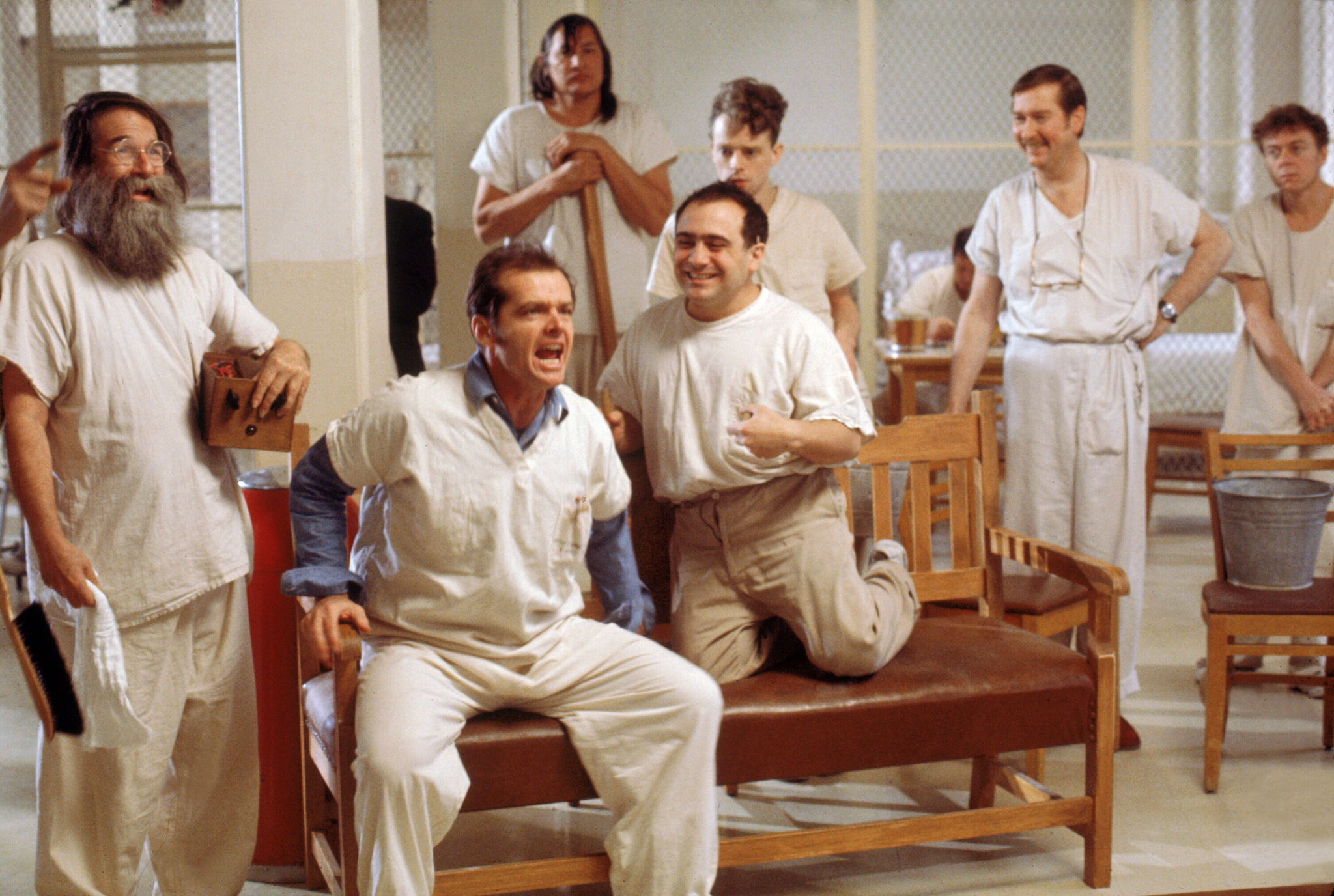
Among the actors playing patients are Danny DeVito and Christopher Lloyd, not yet stars, and later reunited in the cast of the TV sitcom Taxi. Will Sampson, a 6-foot-7 member of the Muscogee Nation, plays Chief Bromden, a very tall Native American who acts as though he is deaf and mute. Brad Dourif, later to be the voice of Chucky in the Child's Play franchise, plays Billy Bibbitt.

McMurphy quickly realizes that some of the patients don't really belong there, and wouldn't be if people had just taken more care with them, especially Billy. McMurphy and Ratched begin a war of wills, which leads to her decision to have him given electroconvulsive therapy. It doesn't work, and only makes him more defiant. That inspires the other inmates.

But they're still too scared to stand up to Ratched. Murphy says he'll pick up the hydrotherapy console and throw it out the window, breaking it, and allowing the inmates to escape. He can't, as it's too heavy. He tells them, "At least I tried!"

Bromden reveals to McMurphy that he can hear and speak. They plan to escape. But first, McMurphy gets a hold of the ward's phone, and makes arrangements for what he calls "a Christmas party." He brings a pair of prostitutes over, with bottles of booze.

The next morning, Ratched sees the ward is a mess, and sees Billy and a prostitute named Candy sleeping naked together. She verbally abuses Billy, as always. This time, he stands up to her, and even loses his stutter. But she has one more "fear card to play": She threatens to tell his mother. He goes back to fear and stuttering, and is taken to the office. Billy breaks some glass, and slits his throat with it, killing himself. Upon learning this, McMurphy blames Ratched, and lunges at her, and tries to strangle her to death, before the orderlies can pull him off her.

Time passes without McMurphy being seen, and rumor spreads that he has escaped -- leaving Bromden behind, breaking his promise that they would do it together. But McMurphy is brought back to his bed. He has been lobotomized, and is now "a vegetable." Ratched appears to have won the war.

But Ratched has suffered the consequences of the attack: She is wearing a neck brace, and her voice is only a whisper. And McMurphy has kept his promise to Bromden, although not in the way he had hoped. Bromden carries out a "mercy killing," smothering McMurphy with a pillow, and ending his suffering. Bromden is strong enough to lift the hydrotherapy machine, and to throw it through the window. He escapes. Ratched and the orderlies can't stop him. The other inmates cheer -- but don't follow him. 

Bromden is the hero of the film. But, since neither the book nor the film have ever had an authorized sequel, we have no idea of what will happen to him afterward: Maybe he'll truly escape, maybe he'll get caught; maybe he can now "make it" in the outside world, maybe he can't. Given this, and given what happened to every inmate but Bromden, it's arguable that Ratched is still "the winner." The "bad guy" wins -- barely.

Bromden narrates the book, which, unlike the film, details his background: He became a paranoid schizophrenic due to his World War II experiences, and his white mother committed him to embarrass his Native father.

Another big difference from the book: McMurphy is considerably less violent in the film, which treats him as more of a con man than a serious threat. And the fishing trip isn't McMurphy hijacking a hospital bus on a whim, taking the patients with him, doing the fishing, and then taking them back rather than making it a permanent escape. In the book, it's planned by the doctors, but Ratched attempts to sabotage it.

The film was nominated for 8 Academy Awards, and swept the 5 major "Oscars": Best Picture for producer Michael Douglas, Best Director for Forman, Best Actor for Nicholson, Best Actress for Fletcher, and Best Adapted Screenplay for Laurence Hauben and Bo Goldman. The only other films to do that have been It Happened One Night in 1934 and The Silence of the Lambs in 1991.

Michael Douglas would later win Best Actor in 1988, for Wall Street. His 2nd wife, Catherine Zeta-Jones, would win Best Supporting Actress in 2003, for Chicago. Kirk Douglas was nominated for Best Actor 3 times, but never won an Oscar, in any capacity. Jack Nicholson has 12 acting nominations (only Meryl Streep, who's won 3 times out of 21 nominations, has more), and 3 wins: Along with One Flew Over the Cuckoo's Nest, he won Best Supporting Actor in 1983, for Terms of Endearment; and a 2nd Best Actor in 1997, for As Good As It Gets.

Laurence Hauben died in 1985, Will Sampson in 1987, Kirk Douglas in 2016 (at the age of 103), Miloš Forman in 2018, and Louise Fletcher earlier in 2022. As of November 19, 2022, Jack Nicholson, Danny DeVito, Christopher Lloyd, Brad Dourif, Bo Goldman and Michael Douglas are still alive. (UPDATE: Goldman died in 2023.)

*

November 19, 1975 was a Wednesday. Baseball was out of season. Football was in midweek. There were 6 games in the NBA:

* The Philadelphia 76ers beat the Kansas City Kings, 113-103 at The Spectrum in Philadelphia.

* The Atlanta Hawks beat the Golden State Warriors, 104-98 in overtime at The Omni in Atlanta.

* The Detroit Pistons beat the Portland Trail Blazers, 120-114 at Cobo Hall (now Huntington Place) in Detroit.

* The Los Angeles Lakers beat the Houston Rockets, 118-110 at The Summit in Houston. (The arena has been converted into the "Central Campus" of televangelist Joel Osteen's Lakewood Church.)

* The Milwaukee Bucks beat the Phoenix Suns, 96-94 at the Arizona Veterans Memorial Coliseum in Phoenix.

* And the Seattle SuperSonics beat the Chicago Bulls, 97-87 at the Seattle Center Coliseum.

There were 4 games played in the American Basketball Association:

* The New York Nets lost to the Virginia Squires, 110-100 at The Scope in Norfolk, Virginia.

* The Denver Nuggets beat the Spirts of St. Louis, 119-106 at the St. Louis Arena.

* The San Antonio Spurs beat the Kentucky Colonels, 113-106 at the HemisFair Arena in San Antonio.

* And the Indiana Pacers beat the Utah Stars, 130-110 at the Salt Palace in Salt Lake City.

There were 5 games in the NHL:

* The New York Rangers lost to the Kansas City Scouts, 6-4 at Madison Square Garden. The Scouts played 2 seasons before moving, and won exactly 7 away games. This was the 6th. The Rangers had indeed fallen on hard times.

* The Vancouver Canucks beat the Washington Capitals, 5-2 at the Capital Centre in the Washington suburb of Landover, Maryland.

* In an "Original Six" matchup, the Boston Bruins and the Detroit Red Wings played to a tie, 3-3 at the Olympia Stadium in Detroit.

* The Montreal Canadiens beat the Minnesota North Stars, 6-0 at the Metropolitan Sports Center in the Minneapolis suburb of Bloomington, Minnesota.

* And the Chicago Black Hawks beat the Los Angeles Kings, 4-2 at The Forum outside Los Angeles in Inglewood, California.

And there were 2 games in the World Hockey Association. The Cleveland Crusaders beat the Minnesota Fighting Saints, 4-3 in overtime at The Coliseum in the Cleveland suburb of Richfield, Ohio. And the Indianapolis Racers beat the New England Whalers, 3-1 at the Market Square Arena in Indianapolis.

Monday, October 17, 2022

October 17, 1967: The Musical "Hair" Premieres

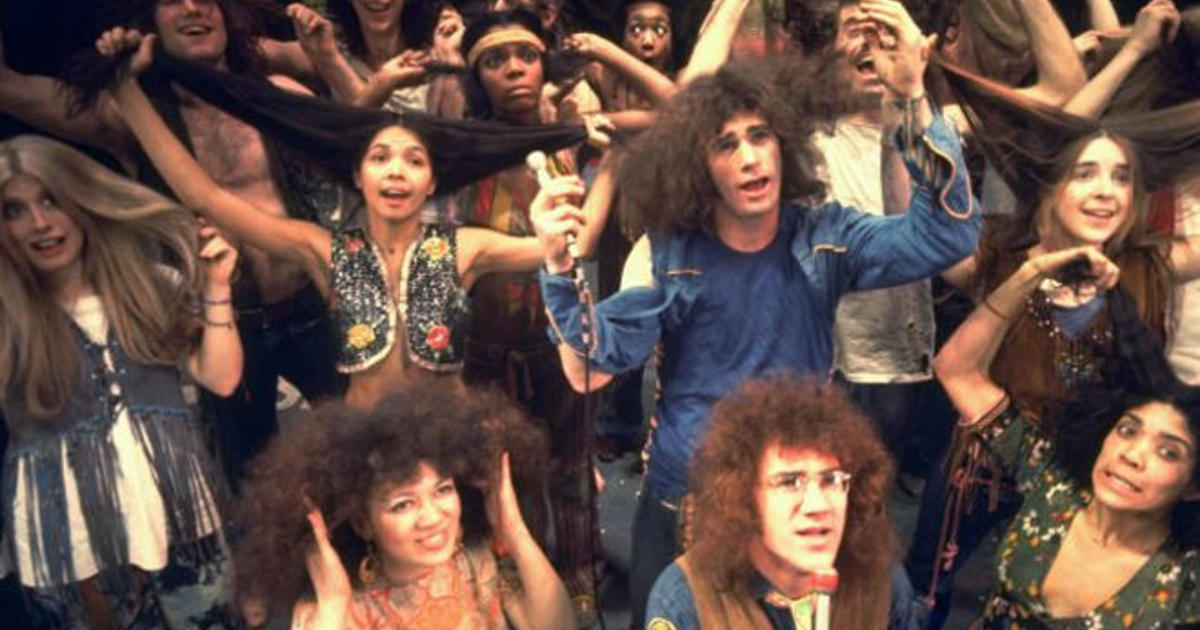
A scene from the original production

October 17, 1967: Hair: The American Tribal Love-Rock Musical premieres. It was not the 1st Broadway musical to incorporate rock and roll music -- Bye Bye Birdie had preceded it by 7 years -- but it was the 1st to be written by members of the 1st generation of rock and roll fans, and treated the musical style, and its fans, and the culture of youth and the difficulties it was having at the time, not as a curious phenomenon at best and a silly joke at worst, but as something to be taken seriously, even embraced.

In 1964, actors James Rado, a 32-year-old Polish Los Angeleno born James Radomski, and Gerome Ragni, a 29-year-old Italian Pittsburgher, met while appearing in an Off-Broadway play titled Hang Down Your Head and Die. It was a flop, but it launched their collaboration.

They began writing what became Hair almost immediately, with Rado writing his own pensive, romantic character into that of Claude Hooper Bukowski, and Ragni his extroversion into that of George Berger. Rado said the show's inspiration was "a combination of some characters we met in the streets, people we knew and our own imaginations. We knew this group of kids in the East Village who were dropping out and dodging the draft, and there were also lots of articles in the press about how kids were being kicked out of school for growing their hair long."

This matched a story that baseball pitcher Jim Bouton told in his book Ball Four. In 1967, despite struggling with injury at the time, he was invited to his former high school's sports awards banquet. He took questions. A kid stood up, and asked Jim what he thought about boys having long hair. Jim said the problem wasn't that an entire generation of teenage boys decided to let their hair get longer, it was that schools were ready to expel otherwise well-behaved kids over it. The kids gave him a standing ovation. The parents, he said, resolved never to invite Jim Bouton again.

Rado continued: "There was so much excitement in the streets and the parks and the Hippie areas, and we thought if we could transmit this excitement to the stage it would be wonderful... We hung out with them and went to their Be-In, let our hair grow."

Many cast members, including Shelley Plimpton, were recruited right off the street. Rado said, "It was very important historically, and if we hadn't written it, there'd not be any examples. You could read about it and see film clips, but you'd never experience it. We thought, 'This is happening in the streets,', and we wanted to bring it to the stage."

In 1966, while the two were developing Hair, Ragni performed in The Open Theater's production of Megan Terry's play Viet Rocka story about young men being deployed to the Vietnam War. In addition to the war theme, Viet Rock employed the improvisational exercises being used in the experimental theatre scene and later used in the development of Hair, which probably couldn't have been fully adapted without it.

Rado and Ragni brought their drafts of the show to producer Eric Blau, who, through common friend Nat Shapiro, connected the two with Canadian composer Galt MacDermot. (He thus surpassed the entirely fictional and evil John Galt of Ayn Rand's novel Atlas Shrugged as the most important Galt in the history of popular culture.) MacDermot had won a Grammy Award in 1961, for his composition "African Waltz," recorded by jazz saxophonist Julian "Cannonball" Adderley.

MacDermot seemed not to be the ideal target audience: "I had short hair, a wife, and, at that point, four children, and I lived on Staten Island... I never even heard of a Hippie when I met Rado and Ragni." He may not have known of the lifestyle, but, surely, he had heard the word: In 1963, the Philadelphia-based vocal group The Orlons had a hit song titled "South Street," which asked the question, "Where do all the hippies meet?" By "hippies," they meant jazz musicians. And, indeed, the South Street neighborhood turned out to be Philly's version of New York's Greenwich Village, just as Cambridge became that for Boston, Old Town for Chicago, Haight-Ashbury for San Francisco, and West Hollywood for Los Angeles.

But he shared their enthusiasm to do a rock and roll show. "We work independently," MacDermot told an interviewer in May 1968. "I prefer it that way. They hand me the material. I set it to music." MacDermot wrote the 1st score in 3 weeks. He first wrote "Aquarius" as an unconventional art piece, as befitting the apparent adoption of astrology by many Hippies, but later rewrote it into an uplifting anthem.

No Broadway producer would touch the play: They were all too set in their ways to try such an experiment. Enter Joseph Papp, boss of the New York Shakespeare Festival. He was used to adapting the works of William Shakespeare in unconventional ways, but had never produced a work by still-living authors. He thought Hair would be the perfect show to open the Public Theater, which he was converting the former Astor Library into, at 425 Lafayette Street in the East Village.

Papp hired Gerald Freedman as director, but decided that, now that Rado was 35, he was too old to play Claude. He did accept Ragni, now 32, as Berger.

The Public, and Hair, opened on October 17, 1967, with an intentionally-limited engagement of 6 weeks. The timing was right, at both ends: San Francisco's "Summer of Love," the Monterey Pop Festival, and the premiere of The Smothers Brothers Comedy Hour had already happened, and the establishment's backlash against the Hippies hadn't. So the general public were aware of the Hippies, but hadn't yet gotten tired of them. Ragni played Berger, Walker Daniels played Claude, Jill O'Hara played Sheila Franklin, Steve Dean played Neil "Woof" Donovan, Arnold Wilkerson played Lafayette "Hud" Johnson, Sally Eaton played Jeanie Ryan, and Shelley Plimpton played Crissy.

Act I of the play actually predicted Seinfeld: It's "a show about nothing"; "nothing happens"; "just talking." And singing. The characters discuss fashion, including hair. They discuss the 1960s trinity of sex, drugs, and rock and roll. They discuss politics, including President Lyndon B. Johnson, his potential 1968 rivals Richard Nixon and George Wallace (but not Robert F. Kennedy or Eugene McCarthy), and the Vietnam War, which appears to have no end in sight. They discuss how Berger was expelled from school, and how Claude was disowned by his parents, and has been drafted.

The scene at the end of Act I where everybody takes their clothes off and walks off the stage naked was not in the original production.

Act II is where things get heavy, man. Claude is inducted into the U.S. Army. Woof says he is "hung up" on Rolling Stones lead singer Mick Jagger; while musical theater had long been a haven for gay men, this wasn't something that was openly admitted on the live stage. Three white women, dressed like Catholic schoolgirls, sing about how they like "black boys"; followed by three black women, dressed like The Supremes (glittering gold sleeveless gowns, long white gloves, bouffant hairdos), singing about how they like "white boys."

Berger gives Claude a hallucinogenic drug, and he has a "bad trip," with each small group he sees -- Buddhist monks, Catholic nuns, astronauts, Chinese people in "Mao suits," Native Americans and Green Berets -- being killed by the next group with their usual weapons: Hands (the nuns strangle the monks), ray guns, knives, tomahawks, and machine guns. The sequence ends when, with no one left to kill except each other, the Green Berets do just that.

The script has varied depending on the production, but, in the original version, Claude goes off to fight, and is killed, and the show ends with "the tribe" dancing around his dead body, singing "The Flesh Failures/Let the Sun Shine In."

Chicago businessman Michael Butler saw the show, and abandoned his plan to run for the U.S. Senate on an antiwar platform to finance the show on Broadway. It moved to The Cheetah, a discothèque at 53rd and Broadway, running 45 performances in December 1967 and January 1968. Again, no nude scene. Again, the controversy over the show was relatively minor, inspiring more curiosity than rage.

Finally, on April 29, 1968, between the assassinations of Dr. Martin Luther King and Robert F. Kennedy, and after the premiere of Rowan & Martin's Laugh-In, Hair premiered at the Biltmore Theatre, at 261 West 47th Street. (As with the Public Theatre, it is still in operation, although it is now named the Samuel J. Friedman Theatre.)

Ragni again played Berger, Sally Eaton again played Jeanie, and Shelley Plimpton again played Crissy. This time, though, Rado got to play Claude, Lynn Kellogg played Sheila, Steve Curry played Woof, and Lamont Washington played Hud. This 1st Broadway production also included Ronnie Dyson, beginning the show by singing "Aquarius," later hit songwriter Paul Jabara, and actresses Melba Moore and Diane Keaton.

Some of the songs became hits, all in 1969, the biggest being The Fifth Dimension's medley of "Aquarius/Let the Sun Shine In," a Number 1 hit. The Cowsills hit Number 2 with "Hair," including the riff on "The Star-Spangled Banner": "Oh, say, can you see... my eyes? If you can, then, my hair's too short!" The singer Oliver hit Number 2 with "Good Morning Starshine," and Three Dog Night had a Top 10 hit with "Easy to Be Hard." (In 1970, Dyson had a Top 10 hit with "(If You Let Me Make Love To You Then) Why Can't I Touch You?" which came from a different musical, Salvation.)

The original production ran until July 1, 1972. Among the performers who would appear in it were Ben Vereen, Heather MacRae (daughter of Broadway legends Gordon and Sheila MacRae), Keith Carradine, La La Brooks of the vocal group The Crystals, "Eve of Destruction" singer Barry McGuire, Lovin' Spoonful drummer Joe Butler, Blues Magoos lead singer Peppy Castro, singer Beverly Bremers, future disco diva Vickie Sue Robinson, future Love Boat actor Ted Lange... and, having previously appeared in the Los Angeles production of the show, Marvin Aday, a.k.a. Meat Loaf.

In 1979, a film version was made, directed by Miloš Forman, with choreography by Twyla Tharp. John Savage played Claude, Treat Williams played Berger, Beverly D'Angelo played Sheila, Annie Golden played Jeannie, Dorsey Wright played Hud, and Don Dacus played Woof.

Ronnie Dyson and Melba Moore were also in it, as were film legend Nicholas Ray; Broadway star Nell Carter, soon to star on the sitcom Gimme a Break!; Charlotte Rae, then on Diff'rent Strokes and soon to star on its spinoff, The Facts of Life; Michael Jeter, later part of the case of Evening Shade; and Ellen Foley, who had sung the girlfriend part on Meat Loaf's hit "Paradise By the Dashboard Light," and would later be part of the cast of Night Court.

But there was no Crissy in this version. Some of the songs from the play were omitted. And the ending is incredibly different: In order to allow a soon-to-be deployed Claude to see Sheila one more time, Berger makes what he considers to be the ultimate sacrifice: He cuts his own hair, puts on Claude's Army uniform, goes to the base, and reports for duty under Claude's name. But before he can make the reverse switcheroo, the orders are given, and Berger is put on the plane, and he ends up dying in Claude's place -- which is what is usually meant by the words "make the ultimate sacrifice."

One of the last scenes shows Claude and the "tribe" standing over a tombstone in a military cemetery. The stone is revealed to have Berger's name on it. Somehow, it was figured out that it was Berger, not Claude, who had died.
Making Berger 22 years old.

The film doesn't explain what happened to Claude: Clearly, he didn't run away to Canada, but he also appears not to have been prosecuted for draft evasion. Is he under indictment, free while awaiting trial? There has never been a sequel, either to the play's continuity or the film's, so we can only speculate.

But times had changed. By 1979, America had seen the war end, with an unsatisfying conclusion. It had seen President Johnson refuse a run for a 2nd full term, in order to concentrate on getting a peace agreement, and fail at that. It had seen Nixon elected on a promise to end the war, run for re-election not having done so, win 49 out of 50 States anyway, be inaugurated for a 2nd term, and only end the war 3 days after that, and, finally resign the office over a scandal that could be traced directly to his paranoia over the war.

America had seen the rise and the fall of the Hippies, and had tired of the psychedelic musical and fashion styles of the 1960s, and had turned to disco. It had seen the War On Poverty, and had come to believe Ronald Reagan's lie that poverty had definitively "won." It had seen inflation, twice now, take over as a more hit-us-at-home issue than the Vietnam War. It had seen the rise of self-expression of women, blacks, Hispanics and gays, and had tired of it all.

If Hair had been released as a film in 1968, '69, '70, maybe even in '71 or early '72, it might have been a hit. But the age of liberalism, of civil rights, of cultural progress, of the Hippies, was over. Even many of the Hippies gave up, cut their hair, put on suits, and got "real jobs," becoming "Young Urban Professionals," or "Yuppies." The age of Reagan, and the Decade of Greed, were about to begin, and nobody wanted to be reminded of the Sixties and its Hippies.

By the early 1990s, of course, America began to see that the Hippies were right. Many former Hippies, and other activists, were now running for office. Antiwar activist Bill Clinton was elected President. Civil rights leader John Lewis and former Black Panther Bobby Rush were elected to Congress. Tom Hayden of the Chicago Seven was elected to both houses of the California State legislature. And Bernie Sanders was elected to both houses of Congress as an independent, and ran in the Democratic Party's Primaries for President in 2016 and 2020, finishing 2nd in popular votes and Delegates both times.

In 1993, on Opening Day, the San Francisco Giants invited The Grateful Dead to sing "The Star-Spangled Banner." This merging of Establishment and Hippiedom got one of the biggest cheers in the history of Candlestick Park, as big as Willie Mays, Joe Montana or The Beatles ever got there. (The Beatles gave what turned out to be their last paying concert there on August 29, 1966, and the reaction was mostly screaming rather than cheering.)

Yes, times had changed again, had somewhat changed back, and mainstream America had accepted what rock singer David Crosby said of his fellow Hippies, something he knew from painful personal experience: "We were right about a lot of things. We were right that peace is better than war. We were right that love is better than hate. We were not right, as it turned out, about drugs."

History repeated itself in 2015, as the Public Theater became the 1st major New York theater to host a show with hip-hop music, a show which, instead of being current like Hair, turned American history on its head, and soon became a massive on-Broadway hit: Lin-Manuel Miranda's Hamilton.

Lamont Washington was trapped in a fire in his apartment on August 10, 1968, and died 15 days later. Ronnie Dyson died in 1990, Gerome Ragni and Joe Papp in 1991, Steve Curry in 2014, Galt McDermot in 2018, Gerald Freedman and Lynn Kellogg in 2020, and James Rado and Paul Jabara in 2022. As of October 17, 2022, Walker Daniels, Jill O'Hara, Steve Dean, Arnold Wilkerson, Sally Eaton, Shelley Plimpton (mother of actress Martha Plimpton), Melba Moore and Diane Keaton are still alive.

UPDATE: In 2023, Treat Williams, star of the film version, was hit by a car while riding his motorcycle near his home in Vermont, and died. Diane Keaton died in 2025.

*

October 17, 1967 was a Tuesday. On the same day, Don Holleder, a former Army quarterback, was killed in action in Vietnam. I have a separate entry for that event.

Baseball season had ended 5 days earlier, when the St. Louis Cardinals beat the Boston Red Sox in Game 7 of the World Series. Football was in midweek. The NHL season was underway, but no games were scheduled for this day. But there were 4 games played in the NBA:

* The New York Knicks beat the San Francisco Warriors, 124-122 at the old Madison Square Garden. The Knicks, and the NHL's Rangers, moved into the new Garden the following February.

* The Detroit Pistons beat the Cincinnati Royals, 131-108 at Cobo Hall (now Huntington Place) in Detroit. Dave Bing scored 35 points for the Pistons.

* The Los Angeles Lakers beat the Chicago Bulls, 107-105 at the Chicago Stadium, despite 36 points from the Bulls' Bob Boozer.

* And the St. Louis Hawks beat the expansion San Diego Rockets, 123-105 at the San Diego Sports Arena (now the Pechanga Arena). This was the last season in St. Louis for the Hawks: They moved to Atlanta the next season. The Rockets moved to Houston in 1971.

And there was 1 game in the American Basketball Association: The Houston Mavericks beat the Denver Rockets, 102-85 at the Denver Auditorium Arena. You read that right: Houston beat the Rockets, and the Houston team was called the Mavericks.

The Houston Mavericks failed. Anticipating being one of the ABA teams invited into the NBA (which they were, in 1976, along with the New York Nets, the Indiana Pacers, and the San Antonio Spurs), and knowing they couldn't have the same name as the Houston franchise of the NBA, the Denver Rockets switched to the name of the city's original NBA team, the Denver Nuggets. And the NBA would later have a team named the Dallas Mavericks, which became the arch-rivals of the Houston Rockets.

Monday, September 19, 2022

September 19, 1984: The Film Version of "Amadeus" Premieres

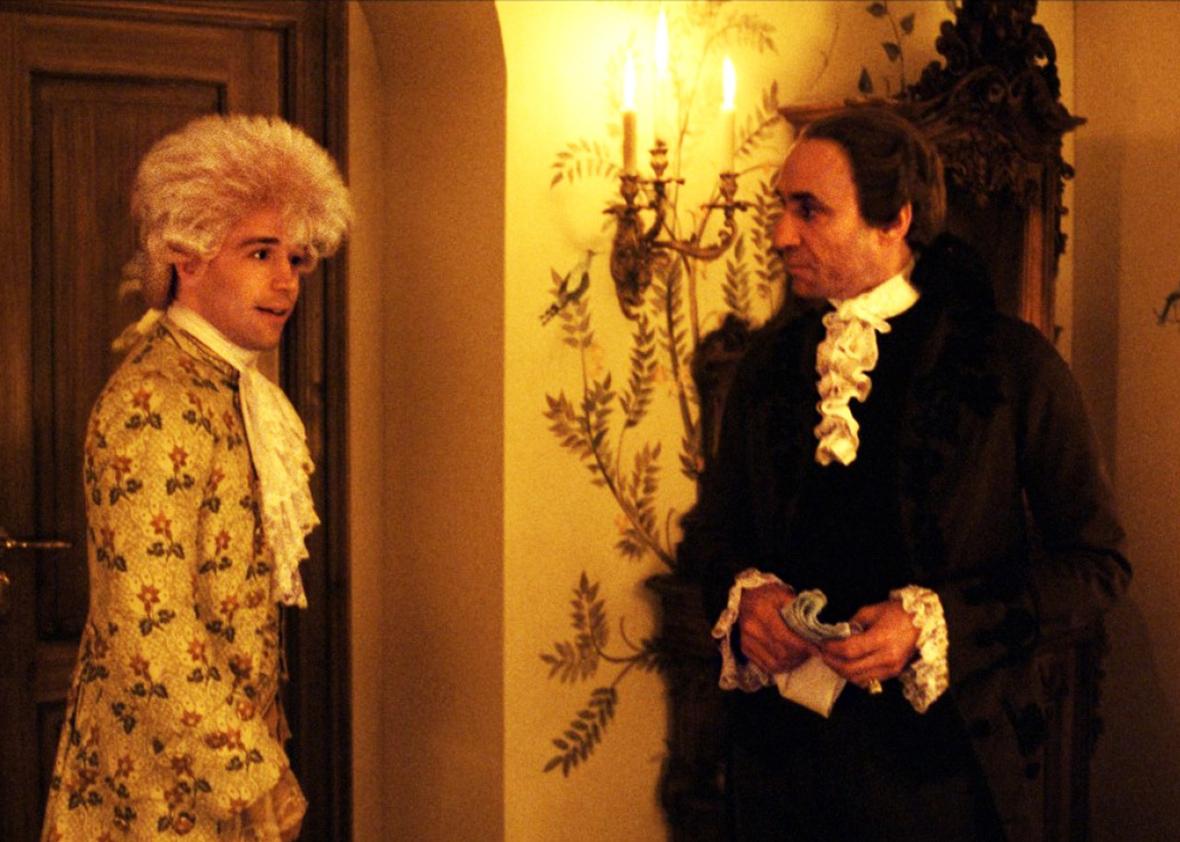
Hulce (left) as Mozart, and Abraham as Salieri

September 19, 1984: The film Amadeus premieres, directed by Miloš Forman, and based on the 1979 play by Peter Shaffer. In the play, Simon Callow, best known in America as Gareth in Four Weddings and a Funeral, played the laughing lunatic but genius Wolfgang Amadeus Mozart (1756-1791); and Paul Scofield, who played Sir Thomas More in the film version of A Man for All Seasons, played Italian composer Antonio Salieri (1750-1825).

It's the movie, far more than the play, that brought Mozart back to the public mind as the greatest composer of all time, with the comic strip Peanuts having raised Mozart's -- and Salieri's -- former student, Ludwig van Beethoven, to a higher point up until then.

But it's also the film that gave the public a story about Mozart and Salieri that is mostly bogus. And not even original: The great Russian writer Alexander Pushkin had written the play Mozart and Salieri in 1830, and Nikolai Rimsky-Korsakov turned that into an opera in 1897.

This was a musical biopic in which the title character is not really the main character. F. Murray Abraham -- he added the F., as a stand-in for his father's name, Frederick -- played Salieri, and was nominated for an Oscar for Best Actor in a Leading Role, which he won. As Mozart, Tom Hulce was nominated for Best Supporting Actor, but lost to Dr. Haing S. Ngor for The Killing Fields.
Wolfgang Amadeus Mozart

For the record, there was no contemporary evidence of Mozart and Salieri having anything resembling a rivalry; there were no contemporary accounts that Mozart's death at age 36 was due to anything other than illness; and the idea that Salieri was responsible is completely ridiculous. It would be like somebody suggesting today that John Lennon was shot by Cliff Richard. But it makes a great story. (The parts about Mozart having daddy issues and a fascination with ribaldry, especially with human solid waste, those have been documented as being true.)
Antonio Salieri

Despite his brief life, Mozart was incredibly prolific. He wrote 41 symphonies. His operas The Marriage of Figaro (1786), Don Giovanni (1787, the same year he wrote A Little Night Music) and The Magic Flute (1791, just 2 months before his death) made him a legend in his own time.

In a 2013 episode of the YouTube series Epic Rap Battles of History, "Nice" Peter Shukoff played Mozart, while "Epic" Lloyd Ahlquist played electronic "musician" Sonny "Skrillex" Moore.
*
September 19, 1984 was a Wednesday. These Major League Baseball games were played:

* The New York Yankees beat the Baltimore Orioles, 6-5 at Yankee Stadium. Joe Cowley outpitched Mike Boddicker. Mike Pagliarulo hit a home run. Don Mattingly went 3-for-4 with 3 RBIs, while Dave Winfield did not play.

* The New York Mets lost to the Philadelphia Phillies, 13-5 at Veterans Stadium in Philadelphia. Steve Carlton was the winning pitcher, while Ron Darling didn't get out of the 2nd inning. Jeff Stone and Von Hayes each had 4 hits. For the Mets, Kelvin Chapman went 3-for-5 with 3 RBIs.

* The Cincinnati Reds beat the Atlanta Braves, 4-2 at Atlanta-Fulton County Stadium. Reds player-manager Pete Rose went 1-for-4 with an RBI.

* The Boston Red Sox beat the Toronto Blue Jays, 10-4 at Exhibition Stadium in Toronto.

* The Detroit Tigers beat the Milwaukee Brewers, 4-2 at Tiger Stadium in Detroit. Jack Morris outpitched knuckleballer Tom Candiotti. Nelson Simmons went 3-for-4. Robin Yount went 2-for-5 with an RBI, while Paul Molitor did not play. The Tigers clinched the American League Eastern Division title the day before, and went on to win the World Series.

* The Pittsburgh Pirates beat the Chicago Cubs, 11-6 at Wrigley Field in Chicago.

* The Chicago White Sox beat the Minnesota Twins, 7-3 at the Metrodome in Minneapolis.

* The St. Louis Cardinals beat the Montreal Expos, 1-0 at Busch Memorial Stadium in St. Louis. Danny Cox pitched a 3-hit shutout, outpitching Steve Rogers.

* The Los Angeles Dodgers beat the Houston Astros, 3-1 at the Astrodome in Houston.

* The San Diego Padres beat the San Francisco Giants, 5-4 at Jack Murphy Stadium in San Diego. In the bottom of the 10th inning, Garry Templeton attempted a bunt, bunt Giant catcher Bob Brenly threw it away, allowing Eddie Miller to score.

* The California Angels beat the Kansas City Royals, 4-3 at Anaheim Stadium (now Angel Stadium of Anaheim). Bobby Grich singled Rick Burleson home with the winning run in the bottom of the 11th inning. Reggie Jackson went 0-for-3 with 2 walks. Rod Carew did not play.

* The Oakland Athletics beat the Texas Rangers, 8-7 at the Oakland Coliseum. Rickey Henderson went 0-for-3 with 2 walks and a stolen base.

* And the Seattle Mariners beat the Cleveland Indians, 4-3 at the Kingdome in Seattle.

December 31, 1999 & January 1, 2000: The Millennium

December 31, 1999:  The Millennium arrives. The people of planet Earth survived. At a terrible cost. But we hadn't destroyed ourselves. ...