Showing posts with label madison square garden. Show all posts

Friday, December 30, 2022

December 31, 1902: The World Series of Football

 
The 2nd Madison Square Garden, 1891-1925

December 31, 1902: The 1st World Series of Football is held, at Madison Square Garden in New York.

This might be a little confusing. The term "World Series" was first used for a baseball championship in 1884, although the current event of that title did not begin until 1903. And this was the 2nd Madison Square Garden, built in 1891 on the site of the 1st, in 1879, at the northeastern corner of 26th Street and Madison Avenue, overlooking Madison Square Park, closed in 1925.

So the game was held indoors, on a field too short and too narrow for American football as we now understand it: 70 by 35 yards. The event was the idea of Tom O'Rourke, a boxing manager who was then the manager of The Garden, who wanted an event for what was then a slow time of the year for sporting events, as basketball and hockey were not yet major sports in America, much less in New York. 
O'Rourke is 2nd from the right.
2nd from the left is George "Tex" Rickard,
also a boxing promoter, who took over
management of the 2nd Garden, and built the 3rd Garden.

He decided to invite several professional and college teams to The Garden for the series, envisioning a series of games, showcasing the best in college and pro teams, eventually leading to one climactic game, crowning the "champion of the world."

But he had a tough time finding teams to play in the tournament. The colleges refused, due to increased pressure from the Amateur Athletic Association (AAU) to stop participating in professional games. The Philadelphia baseball teams, the Phillies and the Athletics, had sponsored football teams, but had disbanded them.

In the end, only 4 teams competed: The Knickerbocker Athletic Club of Manhattan, the Warlow Athletic Club of Queens, the Orange Athletic Club of New Jersey, and the Syracuse Athletic Club of the city of the same name.

O'Rourke did finally get a fifth team to join the series when some players from the Phillies and Athletics got together and formed what was called the New York Club. In calling them the "New York" team, O'Rourke expected to give his patrons the pleasure of watching a "home team" win.

He was wrong. In the 1st game, on December 29, Syracuse beat "New York," 5-0. On December 30, Knickerbocker beat Warlow, 11-6. On New Year's Eve, December 31, Syracuse beat Knickerbocker, 36-0, and clinched the title. On New Year's Day, January 1, 1903, Syracuse beat Orange, 36-0.

O'Rourke planned another series for 1903, planning 15 football games in a span of 6 days, something that wouldn't be physically possible with players the size the would become in the mid-20th Century. Knickerbocker and Orange returned, but it would be the Franklin Athletic Club, of northwestern Pennsylvania, that won the tournament. With crowds too small to maintain the event, O'Rourke never scheduled another "World Series of Football."

One note of interest: The Orange Athletic Club had been founded in 1887, and in 1929, they entered the NFL, as the Orange Tornadoes. In 1930, they moved a few miles and became the Newark Tornadoes, playing at what became known as Newark City Schools Stadium.

They had to drop out of the NFL due to declining revenue in the Great Depression, and moved back to Orange for the 1931 season. In 1937, the Tornadoes moved back to Newark, and renamed themselves the Newark Bears, after the city's baseball team, in 1939. They remained a semi-pro team, in the Atlantic Coast Football League, through the 1965 season. From 1966 to 1969, they competed in the ACFL as the Orlando Panthers, and then folded.

*

December 31, 1902 was a Wednesday. There were no other scores on this historic day: Baseball was out of season, professional basketball barely existed, and while there was professional hockey, no games were scheduled.

Roy Goodall was born that day. The defender captained Yorkshire soccer team Huddersfield Town to the 1922 FA Cup, and then to 3 straight Football League titles, in 1924, '25 and '26.

December 30, 1936: Hank Luisetti Revolutionizes Basketball

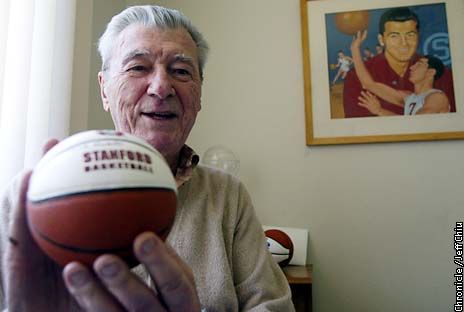
December 30, 1936: Hank Luisetti changes the game of basketball forever.

A forward, he took his Stanford University team, defending Champions of the Pacific Coast Conference, into the old Madison Square Garden in New York, to play the Number 1- ranked team in the country, Brooklyn-based Long Island University.

New Yorkers, who, even then, thought they knew everything about basketball, and that their teams had practically invented it (this while Dr. James Naismith was still alive), had heard that Luisetti had taken shots with just one hand. This was blasphemy: You had to use both hands, to steady your shot and make it more accurate. One-handed shots were took risky, unless you wanted to use a hook shot.

But Luisetti not only used one hand, he used jump shots. Combining the two? This was madness. Well, on this night, it was a glorious madness. He scored 15 points, but that was a big total in those days. Stanford beat LIU, 45-31, not merely ending the Blackbirds' 43-game winning streak, the longest in college basketball history to that point, but blowing them out.

"I'd get the ball, take a dribble or two and jump and shoot on the way up," Luisetti explained. "I didn't jump and shoot at the height of my jump, the way they do now. I'd let the ball go right near my face. I'd push and shoot, off my fingertips."

"Hank could take over a game like Michael Jordan if he had to," said former Stanford teammate Don Williams. "He was an absolute artist on the basketball court." Certainly, Ned Irish, head of basketball operations at Madison Square Garden and eventually the founding owner of the New York Knicks, thought so: Thinking that Luisetti was the only player who could singlehandedly sell out an arena the size of The Garden, he invited Stanford back for a Holiday Festival in 1937, and they won again. Two nights later, on January 1, 1938, in Cleveland, they played Pittsburgh school Duquesne, and won 92-27. In that game, Luisetti became the 1st player in NCAA history to score 50 points in a game.

Luisetti led the Stanford Indians -- they became the Cardinal in 1972 -- to 3 straight Conference Championships. This was before there was an NCAA Tournament, but they were voted National Champions in 1937.

He arrived on the scene too late to make the 1936 Olympics. He kept his amateur status by playing for Amateur Athletic Union (AAU) teams, including the Olympic Club of his hometown of San Francisco, but the 1940 and 1944 Olympics were canceled due to World War II. He served as a Navy officer, but developed spinal meningitis, ending his basketball career, ruining Irish's hopes of making him the Knicks' 1st star.

In 1950, when he was only 34 years old and should still have been playing, the Associated Press voted him 2nd behind the still-active George Mikan on their list of the top basketball players of the 1st half of the 20th Century. He was a charter inductee into the Basketball Hall of Fame. He ran a travel services company, and died in 2002, at the age of 86.

*

December 30, 1936 was a Wednesday. Baseball and football seasons were over. The NBA hadn't been founded yet. And no NHL games were scheduled. So there were no other scores on this historic day.

Thursday, December 29, 2022

December 29, 1934: The 1st Madison Square Garden Doubleheader

December 29, 1934: Madison Square Garden in Midtown Manhattan hosts its 1st college basketball doubleheader. It was set up by Edward S. "Ned" Irish, then head of promotions for The Garden.

Irish, then 29 years old and a native of Brooklyn, had covered Manhattan College basketball games for the New York World-Telegram, and saw that their games, especially against other teams in New York City, had more demand than the seats had supply. So he quit his job to become promotions director for The Garden, whose current version, built in 1925, was between 49th and 50th Streets, and 8th and 9th Avenues.
Ned Irish

For the 1st doubleheader, each game featured a New York City-based team vs. one from outside the city. In the 1st game, New York University, of Manhattan, beat the University of Notre Dame, of South Bend, Indiana, 25-18. NYU would finish the 1934-35 season 19-1, and were recognized as National Champions. In the 2nd game, St. John's University, of Queens, lost to Westminster College, of New Wilmington, Pennsylvania, 37-33.

If those scores seem low to you, consider the state of the sport at the time: It was almost all slow, skinny white guys; there was no shot clock; and, until 1938, there was a center jump after every basket. In other words, what would become known as the fast break was not only difficult, it was completely impractical.

A crowd of 16,138 attended, then the largest crowd ever to pay to see a basketball game, at any level, marking the experiment as a success. Another doubleheader was set up for a week later, on January 5, 1935. NYU beat Kentucky, 23-22, before a new record high, 16,539.

Though defeated, Kentucky coach Adolph Rupp liked the idea so much that he suggested that there should be a national college basketball tournament. That was such a good idea that, by the end of the decade, there were 2: The National Invitation Tournament (NIT) started in 1938, the 1st one won by Temple University of Philadelphia; and the NCAA Tournament started in 1939, the 1st one won by the University of Oregon.

After the 1934-35 season, being invited to play in a "Garden doubleheader" was a sign that a school had made the big time. Already known as "The Mecca of Boxing," The Garden became known as "The Mecca of Basketball."
But the point-shaving scandal of 1951 crippled New York City basketball, with only St. John's among the City's schools emerging unscathed. After that, the pro game became more popular, with Ned Irish becoming the founding owner of the New York Knicks. The event that opened the new Garden in 1968 was a doubleheader. Dave DeBusschere scored the new Garden's 1st basket -- not for the Knicks, but for the Detroit Pistons in the 1st game of the doubleheader.

In 1959, Irish sold the Knicks to Irving Felt, but remained team president. He was elected to the Basketball Hall of Fame in 1964. In 1968, he and Felt moved the Knicks into the current Madison Square Garden, between 31st and 33rd Streets, and 7th and 8th Avenues. He retired as team president in 1974, and died in 1982.

The event that opened the new Garden in 1968 was a doubleheader. Dave DeBusschere scored the new Garden's 1st basket -- not for the Knicks, but for the Detroit Pistons, in the 1st game of the doubleheader.

*

December 29, 1934 was a Saturday. ABC News reporter Tom Jarriel was born on this day.

The NBA hadn't been founded yet. Baseball was in the off-season. No college football games were played that day, as there were, as yet very few bowl games. The NFL season had ended 20 days earlier, with the New York Giants beating the Chicago Bears in the Championship Game.

There were 2 games played in the NHL: The New York Americans beat the Montreal Canadiens, 3-1 at the Montreal Forum. and the Montreal Maroons beat the Toronto Maple Leafs, 4-2 at Maple Leaf Gardens in Toronto.

And in English soccer, Arsenal and Hampshire team Portsmouth played to a 1-1 draw at Highbury in North London.

Sunday, December 25, 2022

December 25, 1984: Bernard King Decks the Halls

December 25, 1984: For about a year now, the best basketball player in the world has not been Kareem Abdul-Jabbar, or Magic Johnson, or Larry Bird, or Julius Erving, and certainly not newly-minted NBA rookie Michael Jordan. It's been Bernard King.

The Brooklyn native, who had starred at the University of Tennessee with later Knick teammate Ernie Grunfeld -- they called it "The Bernie and Ernie Show" -- had just turned 28, and was dropping stunning performances, game after game. On January 31 and February 1, 1984, he became the 1st NBA (or ABA) player in 17 years to score at least 50 points in back-to-back games.

On this Christmas Day, he came down the chimney at Madison Square Garden and scored 60 points, a record for the "new" Garden that opened in 1968. He scored 21 points in the 1st quarter, 19 in the 2nd, 11 in the 3rd, and 9 in the 4th.

In spite of this performance for the New York Knicks, the cross-river New Jersey Nets beat them, 120-114. Micheal Ray Richardson scored 36 for New Jersey. (Yes, he spells his name "Micheal," not "Michael.")

King was only the 10th player in NBA history to score at least 60 in a game. Joe Fulks was the 1st to do it, with 63 in a 1949 game for the Philadelphia Warriors. George Mikan scored 61 in a 1952 game for the Minneapolis Lakers. Fulks and Mikan were the only players to do it before the 1954 institution of the 24-second shot clock.

Wilt Chamberlain had done it 32 times, topping out at 100. At the time, the record for anyone other than Chamberlain was 73, by David Thompson, on the last day of the 1977-78 season. On the exact same day, George Gervin scored 63, and won the scoring title for the season.

Elgin Baylor had scored 60 or more 4 times, including a Playoff record 61 in 1962. On November 15, 1960, Baylor topped out at 71, against the Knicks at "the old Garden," and that remains a record for any building named Madison Square Garden, college or pro.

The other players to score 60 in an NBA game before King were Jerry West with 63 in 1962, Rick Barry with 63 in 1974, and Pete Maravich with 68 in 1977.

Sadly, 'Nard saw his reign come to an end on March 23, 1985, with a terrible knee injury in Kansas City. He had been averaging 32.9 points per game up until then, and that would lead the league. That game ended up being the 1st of 12 straight games the Knicks, already plagued with injuries, lost to end the season. Then they got the 1st pick in the 1985 NBA Draft, and selected Patrick Ewing.

King came back for 6 games at the end of the 1986-87 season. The Knicks thought that was all they could get out of him, so they traded him to the Washington Bullets. Incredibly, he played 4 seasons for them, including 1988-89, when he played in 81 out of 82 games; and 1989-90, when he played in all 82. He missed 1991-92 in its entirety, again due to the knee, and closed his career with the team with whom he started -- the Nets, playing 32 games in 1992-93.

He was 37 years old. Knick fans can only wonder what they could have done from the Autumn of 1985 to the Spring of 1993 with a healthy Bernard King added to Patrick Ewing, Mark Jackson and Charles Oakley.

His injuries kept his career numbers down. He was belatedly elected to the Basketball Hall of Fame. He was not named to the NBA's 50th Anniversary 50 Greatest Players in 1996, but was named to their 75th Anniversary 75 Greatest Players in 2021.

King's 60 remained a record for the new Garden until January 24, 2014, when Carmelo Anthony set a building record, and a Knick franchise record, with 62 points in a 125-96 win over the team then known as the Charlotte Bobcats. Baylor's 71 remains a record for any Garden. The college record was set by Oscar Robertson of the University of Cincinnati, scoring 56 points to outscore Seton Hall all by himself on January 9, 1958.

Scoring 60 points in an NBA game has now been done 87 times.

*

December 25, 1984 was a Tuesday. Elsewhere in the NBA that Christmas Day:

* The Cleveland Cavaliers beat the Atlanta Hawks, 109-106 at The Coliseum in the Cleveland suburb of Richfield, Ohio.

* The Philadelphia 76ers beat the Detroit Pistons, 109-108 at the Silverdome in the Detroit suburb of Pontiac, Michigan.

* And the Portland Trail Blazers beat the Golden State Warriors, 106-97 at the Portland Memorial Coliseum.

The day saw no games in the NHL, and no bowl games in college football.

Also on this day, twin Australian singers, actresses and fashion designers Jessica and Lisa Origliasso were born.

Saturday, December 24, 2022

December 24, 1950: The Cleveland Browns Make Their Point

The winning field goal, kicked by Groza, then wearing Number 50.
He would later switch to 76, which the Browns retired for him.
Note the snow on the field.

December 24, 1950: The NFL Championship Game is held at Cleveland Municipal Stadium. The weather was bitterly cold, but the action was hot.

In 1945, the Cleveland Rams had won the NFL Championship, but had low attendance. Team owner Dan Reeves (no relation to the later NFL coach of the same name) moved them to Los Angeles, where they became a runaway success at the box office, and on the field as well. In 1949, they won the NFL Western Division, and reached the NFL Championship Game. But, contrary to the image of sunny Southern California, a rainstorm hit the Los Angeles Memorial Coliseum, and the Rams lost to the Philadelphia Eagles.

They played the 1950 season as if on a benzedrine kick, with the most potent offense the NFL has ever seen. The "Greatest Show On Turf" that the St. Louis version of the Rams had half a century later had noting on this bunch.

Alternating quarterbacks between Bob Waterfield and Norm Van Brocklin, their runners included former Army Heisman Trophy winner Glenn Davis, Verda Thomas Smith (known as V.T. or "Vitamin"), Dick Hoerner, early black star "Deacon" Dan Towler, and one of the earliest NFL players from a "historically black" school, Paul "Tank" Younger of Grambling State University in Louisiana. Waterfield and Van Brocklin could throw to any of them, and to receivers Tom Fears and Elroy Hirsch, who was so fast, he was nicknamed "Crazy Legs."

The Rams went 9-3, and one of the losses was a 56-20 embarrassment against the Eagles. The other 2 losses came against the Chicago Bears. But on October 22, 1950, the Rams answered this question: "What would happen if the best offense in NFL history played the worst defense in NFL history?" The Rams ended up scoring more points per game in a season than any other, and the Baltimore Colts ended up allowing more per game than any other. Result: Rams 70, Colts 27. To this day, it's still the 3rd-highest-scoring single-game performance in NFL history. In addition, they hung 65 point on the Detroit Lions, 51 and 45 on the Green Bay Packers, 45 and 43 on the New York Yanks (not "Yankees"), and 35 on the San Francisco 49ers.

But the Cleveland Browns could match them for firepower. After winning the All-America Football Conference in all 4 seasons of its existence, 1946 to 1949, the Browns were invited to join the NFL from it, as were the 49ers and the Colts. The opening game of the 1950 season was against the defending Champion Eagles, in Philadelphia, and the Browns embarrassed the allegedly superior league's top team, 35-10.

Head coach Paul Brown was an offensive genius, and he built a team to carry out that genius: Quarterback Otto Graham, running back Marion Motley, and ends Mac Speedie and Dante Lavelli were weapons that any team would be lucky to have. Blocking for them were guard Bill Willis and tackles Lou Groza and Mike McCormack. All of these men would join Brown in the Pro Football Hall of Fame.

Motley and Willis were the men who provided the premiering AAFC with its racial integration, as the Rams' Kenny Washington and Woody Strode had done for the NFL. Alas, by 1950, neither Washington nor Strode was still with the Rams, but Younger and Towler were.

The Browns went 10-2, their only losses to the New York Giants, by a total of 10 points. In addition to the 35 they scored on the Eagles, they scored 45 each on the Pittsburgh Steelers and the Washington Redskins, 34 each on the 49ers and the Chicago Cardinals, and 31 on the Colts.

The Rams and the Browns won their respective Divisions, and, as it was the Eastern Division Champion's turn to host the NFL Championship Game, they met in Cleveland on a frigid Christmas Eve on the shore of Lake Erie. It was the team that did make it in Cleveland vs. the one that didn't in spite of bringing the city a title. It was also the 1st game back in Cleveland for the Rams, as the NFL did not yet allow crossover games from one Division to the other, except in the Championship Game.
The Rams wasted no time: On their 1st play from scrimmage, Waterfield passed to Davis, and he went 82 yards for a 7-0 Ram lead. The Browns responded with their own touchdown, but the Rams came back with another, leading 14-7 at the end of the 1st quarter.

The Browns scored a touchdown in the 2nd quarter, but a high snap caused Groza, also the team's main kicker, to miss the extra point. Waterfield, also the Rams' main kicker, attempted a field goal as the half ran out, from only 15 yards, but the stiff wind blasting in off the lake stopped it, and it was 14-13 Los Angeles.

In the 3rd quarter, Graham threw a 39-yard touchdown pass to Lavelli, giving the Browns a 20-14 lead. But the Rams scored 2 touchdowns, and it was 28-20 Rams after 3 quarters. With 10 minutes to go, the Browns faced 3 4th-down conversion attempts, and made them all. Graham threw another touchdown pass, and it was 28-27 Rams.

With 1:49 left, the Browns got the ball on their own 31-yard line. Graham threw for 1st downs, and ran for 2 of them himself. With 28 seconds left, Groza was sent on to attempt a 16-yard field goal. It was perfect, and it was 30-28 Cleveland. The Rams had 1 more chance, but could do nothing with it. The Browns had won, in their 1st season in the League, and, by staying in the city, gave Cleveland its 1st pro football championship defenders since the 1924 Cleveland Bulldogs.

Paul Brown called it the best game he ever saw, and never changed his mind. NFL Commissioner Bert Bell, who had orchestrated the sort-of-merger between the NFL and the AAFC, called the Browns "the greatest team ever to play football." The Browns may have dominated an inferior league, but now, they had won the superior one. They had made their point.

But it is more than that: By being the winning coach, Paul Brown, having coached Ohio State in 1942, became 1st head coach ever to win both a college football National Championship and an NFL Championship. It would take until the Super Bowl era before that happened again: Jimmy Johnson, with 1987 Miami and the 1993 and 1994 Dallas Cowboys; Barry Switzer, 1974, 1975 and 1985 Oklahoma and the 1996 Cowboys; and Pete Carroll, 2003 and 2004 USC and the 2014 Seattle Seahawks.

In 1981, historian John Thorn left his comfort zone, baseball, and published Pro Football's 10 Greatest Games. He included this game.

The same teams faced each other again the following year. But in 1951, at the Coliseum, the Rams beat the Browns for Los Angeles' 1st major league sports championship. They would play each other again in 1955, with the Browns winning in L.A. It would be Graham's last game, as he retired. The Browns had been to the AAFC or NFL Championship Game every year for 10 straight years. After missing in 1956, they made it 11 out of 12 in 1957. They beat the Detroit Lions in 1954, but lost to them in 1952, '53 and '57.

The fact that the Browns', the Lions', and the Chicago (now Arizona) Cardinals' titles came before the advent of the Super Bowl means that they get discounted: Even before the distance of time became what it is now, NFL fans have come to regard any title won before the Super Bowl, NFL or AFL, as not a "real" championship. This is unfair: A title is a title.

UPDATE: The Browns have a Ring of Honor. From their founding era, they have honored head coach Paul Brown, quarterback Otto Graham, running back Marion Motley; receivers Dante Lavelli, Mac Speedie and Bobby Mitchell; center Frank Gatski, guard Bill Willis, tackle and placekicker Lou Groza, tackle Mike McCormack and defensive end Len Ford.

From their 1964 NFL Championship, they have honored running backs Jim Brown and Leroy Kelly, receiver Paul Warfield and guard Gene Hickerson. From the 1980s, they have honored guard Joe DeLamielleure, tight end Ozzie Newsome, and linebacker Clay Matthews Jr. It says something about how the Browns have been run since their re-establishment in 1999 that they have honored just 1 player in that period, offensive tackle Joe Thomas.

Motley, Willis, Lavelli, Groza, Warfield, Hickerson, founding owner Arthur "Mickey" McBride, 1940s running back Tony Adamle, 1950s guard Chuck Noll, 1950s defensive tackle Bob Gain, 1950s linebacker Sam Palumbo (a Cleveland native), 1970s running backs Greg Pruitt and Mike Pruitt (not related to each other), 1970s offensive tackle Doug Dieken, 1980s head coach Sam Rutigliano, 1980s quarterback Bernie Kosar, 1980s running back Kevin Mack, 1980s defensive tackle Bob Golic, 1980s linebacker Tom Cousineau, and 1999-2002 re-establishing owner Al Lerner have been elected to the Greater Cleveland Sports Hall of Fame.

In 1999, The Sporting News released their list of the 100 Greatest Football Players. Graham ranked 7th, and Motley 32nd. In 2010, the NFL Network released their list of the 100 Greatest Players, with Graham 16th and Motley 74th.


*


December 24, 1950 was a Sunday. It was the end of the football season. No college games were played on this day. Baseball was out of season. No NBA games were played. And only 1 NHL game was played: The New York Rangers beat the Chicago Black Hawks, 6-1 at the old Madison Square Garden. Nick Mickoski had 4 goals and an assist for the Broadway Blueshirts.

Monday, December 19, 2022

December 20, 1926: The Hornsby-Frisch Trade

Rogers Hornsby

December 20, 1926: The New York Giants trade their 2nd baseman and Captain, Frankie Frisch, and Jimmy Ring to the St. Louis Cardinals for Rogers Hornsby.
Frisch had led the Giants to 4 straight National League Pennants from 1921 to 1924, including winning the 1921 and 1922 World Series. But on August 20, Giant manager John McGraw berated him in front of his teammates for missing a sign that cost the team a run in a game -- with retroactive irony, against the Cardinals. So he quit the team.
Frankie Frisch, the Fordham Flash
Giants management refused to step in and straighten things out between the manager and his best player. And since McGraw was also a part-owner of the Giants, and had the backing of main owner Charles Stoneham, he was not going to be the one to go. And Ring was a mediocre pitcher nearing the end of the line.
John McGraw
In exchange, the Giants got Hornsby, also a 2nd baseman, and the best hitter in the National League. From 1920 to 1925, Hornsby had won 6 straight NL batting titles, batting .370, .397, .401, .384, .424 (which remains the highest batting average since 1901, and the highest in the NL since 1887) and .403. In 1922 and 1925, he also led the NHL in home runs (with 42 and 39, respectively) and RBIs (152 and 143), becoming the 1st player to win the Triple Crown twice (an achievement since matched only by Ted Williams).
How good a hitter was he? Legend tells of the greatest umpire of that era, Bill Klem, calling a pitch that Hornsby took a ball; and, when the catcher objected, Klem told him, "Young man, when the pitcher throws a strike, Mr. Hornsby will show you." In other words, by hitting it.
Hornsby had also managed the Cardinals in 1925 and '26, and even owned some stock in them. Since he had to divest himself of that stock in order for the trade to go through, and majority owner Sam Breadon was offering less than Hornsby wanted, the trade was held up for a while. But it did go through.
At first, this blockbuster deal looked great for the Giants. The trade was great -- for the Cardinals. Hornsby's attitude was considerably worse than Frisch's, and McGraw had enough of him that 1st season, trading him afterward. The Giants didn't win another Pennant until 1933, after McGraw retired.
McGraw could be one ornery cuss, but Hornsby was nearly impossible to deal with. As would a later slugger, Dick Allen, he put up All-Star-worthy numbers 4 years in a row, for 4 different teams: He batted .317 with 11 home runs and 93 RBIs for the 1926 Cardinals; .361, 26 and 125 for the 1927 Giants; a League-leading .387, 21 and 94 for the 1928 Boston Braves; and .380, 39 and 149 for the 1929 Chicago Cubs.
He did help the Cubs win Pennants in 1929 and 1932, but was in decline by the latter year. The Cardinals took him back in 1933, but quickly traded him to their Sportsman's Park landlords, the woeful St. Louis Browns, and he served as a player-manager until 1937, when he retired as a player. He was elected to the Baseball Hall of Fame in 1942.
His .358 lifetime batting average ranks 2nd all-time behind Ty Cobb, and tops all National League hitters and all righthanded hitters. His 301 home runs included 298 in NL play, which topped all NL players at the time of his retirement in 1937. He fell short of 3,000 hits, though, at 2,930. 
Like later basketball star Bill Russell, he found it considerably harder to be a manager/head coach without himself as a contributing player. He was also a racist, and a compulsive gambler. Had the extent of his betting on horse racing been known at the time, he might have gotten banned from baseball.
But because he had lost so much money gambling, he had to stay employed in baseball, which wasn't easy. He was a player-manager for the Chattanooga Lookouts of the Southern Association in 1938, and the Baltimore Orioles of the International League in 1939. He went back to Texas, and got into the Texas League Playoffs managing the Oklahoma City Indians in 1940 and the Fort Worth Cats in 1942. Then the TL decided to suspend play for the duration of World War II.
He served as a Spring Training instructor for the Chicago White Sox and the Cleveland Indians. In 1949, he broadcast Cubs games on TV. In 1950, he went back to the Texas League, and led the Beaumont Roughnecks to the Pennant. In 1951, he won the Pacific Coast League Pennant with the Seattle Rainiers.
That got the majors' attention again. In 1952, Bill Veeck hired him to manage the Browns. It lasted 2 months, and when Veeck fired him, the Browns players gave him an engraved trophy to thank him. A few weeks later, the Cincinnati Reds hired him, but, frustrated, he resigned with 8 games left in the season. He coached for the Cubs.
In 1962, when no one else would hire him, his former Giant teammate Casey Stengel hired him as 3rd base coach for the expansion New York Mets. Rogers Hornsby coached that season, and was expecting to be brought back for the next season, when he died on January 5, 1963, in Chicago, of a heart attack. He was 66 years old.
Helped tremendously by a change of scenery, teammates and bosses, Frisch helped the Cardinals win Pennants in 1928, '30, '31 and, as player-manager of a team that became known as the Gashouse Gang, '34. So he was a member 8 Pennant winners, and 4 World Series winners.
He was elected to the Hall of Fame in 1947, and became a broadcaster, first for the Giants, then for CBS and its Game of the Week. He became known for moaning about walks: "Oh, those bases on balls!"
As a member of the Hall of Fame's Committee on Veterans, he was known for lobbying for the election of his former Giant and Cardinal teammates, which many later fans have suggested were undeserving. The term "The Frisch Five" was coined, although there is not consensus on who the 5 players are. From the Giants, they have included George "High Pockets" Kelly, Ross Youngs, Dave Bancroft, Travis Jackson and Freddie Lindstrom. From the Cardinals, they have included Jim Bottomley, Chick Hafey, Jesse Haines and Burleigh Grimes.
Frankie Frisch died on March 12, 1973, at the age of 75, at a hospital in Wilmington, Delaware, from injuries sustained in a car crash in nearby Elkton, Maryland.

In 1949, Ogden Nash, my grandmother's favorite poet, even though he was a Giant fan and she was a Brooklyn Dodger fan, wrote "Line-Up for Yesterday" for Sport magazine, an alphabetical list of star players. For the letter F, he wrote: 

F is for Fordham
And Frankie and Frisch;
I wish he were back
With the Giants, I wish.

And for H:

H is for Hornsby;
When pitching to Rog,
The pitcher would pitch,
Then the pitcher would dodge.

*
December 20, 1926 was a Monday. Baseball and football were out of season. The NBA hadn't yet been founded. One game was played in the NHL, and what would eventually be called "the old Madison Square Garden," but was then new: The New York Americans beat the Toronto Maple Leafs, 2-0.

Thursday, December 15, 2022

December 15, 1925: New York's 1st NHL Team

"Bullet" Joe Simpson

December 15, 1925: For the 1st time, a National Hockey League game is played in New York City. But the home team is not the New York Rangers. A few hours before the new, later "Old," Madison Square Garden held its 1st boxing card, it hosted a matinee of a brand-new hockey team, the New York Americans. In their 5th game, they lost to the Montreal Canadiens, 3-1.

The NHL began to expand into America the season before, with the Boston Bruins. This expansion continued in 1925-26, with the Americans and the Pittsburgh Pirates, who would also end up failing; then, in 1926-27, with the New York Rangers, the Detroit Red Wings and the Chicago Black Hawks.

The Americans' 1st game was on December 2, against the Pirates, at the Duquesne Gardens in Pittsburgh, and they won, 2-1, with Charlie Langlois scoring the winner, 3:10 into overtime.

The Americans were owned by Bill Dwyer, a bootlegger who was making money during Prohibition, and the hockey team became the toy he spent his money on. If that seems odd, let the record show that another major league sports team debuted in New York City that season: The football version of the New York Giants, and they were founded and owned by Tim Mara, who was a bookmaker at a time when that was legal in New York City.
Bill Dwyer

George "Tex" Rickard, builder and owner of the new version of Madison Square Garden -- eventually to be known as "The Old Garden" -- made so much money on the Americans' rent and concessions that he wanted his own team. The media called them "Tex's Rangers," and they immediately became more successful than the Americans. The Rangers became known as the "classy" team, while the Amerks were the "blue-collar" or "working man's" team.

When Prohibition ended in 1933, Dwyer's hockey ownership was doomed. The League took over ownership of the franchise in 1936, and let its head coach, one of their former players, run it: Norman "Red" Dutton. It didn't change the image of either team: The Rangers were seen as the team of classy people, the Americans the team of the working class, struggling through the Great Depression.

The Americans made the Playoffs for the 1st time in 1929, but lost -- to the Rangers. They didn't make it again until 1936, beating Chicago before losing to the Toronto Maple Leafs in the Semifinals, coming within 5 wins of the Stanley Cup. In 1938, the Americans beat the Rangers in the Quarterfinals, with Lorne Carr scoring in overtime to win the deciding Game 3, before losing to Chicago in the Semifinals, again coming within 5 games of the Cup. They made the Playoffs again in 1939, losing to Toronto; and in 1940, losing to Detroit.

As New York teams would later tend to do, the Americans became a haven for great players looking for one last payday, including Boston Bruins legend Eddie Shore. But they had some Hockey Hall-of-Famers that they could call their own: Center Billy Burch; left wing David "Sweeney" Schriner; defensemen Bullet Joe Simpson and the aforementioned Red Dutton;, and, at 5-foot-3 the shortest player in NHL history, and thus nicknamed "Shrimp," but the winner of the Hart Memorial Trophy as league Most Valuable Player in 1929, and the Vezina Trophy as best goaltender in 1931, Roy Worters.
Roy "Shrimp" Worters

By the 1939-40 season, Canadian players were going off to fight for the British Empire in World War II. The Americans missed the Playoffs in 1941. In 1941-42, still bogged down by lingering debt from the Dwyer era, Dutton had to sell off his best players for cash.
Red Dutton

At his wit's end, Dutton changed the team's name to the Brooklyn Americans. He intended to move the team to Brooklyn, but there was no arena in that borough suitable enough even for temporary use. As result, they continued to play their home games at The Garden, while practicing in Brooklyn. They barely survived the season, finishing dead last for the second year in a row with a record of 16–29–3.

St. Patrick's Day, March 17, 1942, was no lucky day for the New York Americans. New York City's original National Hockey League team loses to the Boston Bruins, 8-3 at the Boston Garden. Since the Amerks did not qualify for the Playoffs, this was their last game of the season. Two days earlier, they had played their last home game, at the old Madison Square Garden, and won, beating the Maple Leafs, 6-3. Murph Chamberlain scored a hat trick.

The Amerks suspended operations for The War's duration. In 1945, a group emerged willing to build a new arena in Brooklyn, and Dutton was ready to resume operations. But in 1946, the year Bill Dwyer died, the NHL reneged on previous promises to reinstate the Amerks, and canceled the franchise.

Legend has it that Dutton blamed the Rangers for canceling the Americans' franchise, and placed a curse on them, saying they would never win the Stanley Cup again for as long as he lived. They had won it in 1928, 1933 and 1940. Dutton died in 1987, and the Rangers had not won the Cup again. But the New York Islanders, founded as an expansion team in 1972, had won 4 straight Cups, from 1980 to 1983.

The Rangers finally won the Cup again in 1994. The New Jersey Devils, founded when the Colorado Rockies moved to the Meadowlands in 1982, won the Cup in 1995, 2000 and 2003. Since the Americans were cut off in 1942, the won-loss records of the New York Tri-State Area's teams in the Stanley Cup Finals -- keeping in mind that it was only the Rangers from 1942 to 1972 -- are 1-4 for the Rangers, 4-1 for the Islanders, and 3-2 for the Devils.

The Americans' records and trademarks are still owned by the NHL. The Islanders have never worn "throwback uniforms" in their style. I don't know if they've ever even asked for permission to wear them.

*

December 15, 1925 was a Tuesday. This was also the day that Louis Mbarick Fall, the former Light Heavyweight Champion boxer known as Battling Siki, was murdered a few blocks downtown from Madison Square Garden. I have a separate entry for that event. And Hockey Hall of Fame executive Sam Pollock was born.

Baseball was out of season. The NBA hadn't been founded yet. The NFL season ended 3 days earlier, with the Chicago Cardinals claiming the title amid controversy.

There was 1 other game in the NHL: The Ottawa Senators beat the Boston Bruins, 2-1 at the Boston Arena, now named the Matthews Arena.

December 15, 1925: The Death of Battling Siki

December 15, 1925: The 1st fight card is held at the brand-new version of Madison Square Garden -- which will eventually become known as "The Old Garden," "The Mecca of Basketball," and "The Mecca of Boxing." This Garden would be replaced in 1968.

Battling Siki would never get to fight at this Garden. The same night, he was found shot and killed on 42nd Street, where the Port Authority Bus Terminal would later be built. He was 28, and may have been shot by a policeman for drunk and disorderly conduct.

He was born as Louis Mbarick Fall on September 16, 1897 in Saint-Louis, in Senegal, the West African land that had been a French colony since 1677, during the reign of King Louis XIV. He began boxing at the age of 14. When World War I broke out in 1914, he joined the French Army, serving in the 8th Colonial Infantry Regiment. He was decorated for bravery in battle with the Croix de Guerre and the Médaille Militaire.

After the war, he moved to Amsterdam, the Netherlands, and resumed his boxing career, under the name Battling Siki. He was romantically involved with a Dutch woman, Lijntje van Appelteer, who became his common-law wife, and, in 1921, the mother of his son, Louis Fall Jr.

From 1919 to 1922, he was 43 out of 46 fights, with 1 loss and 2 draws. He earned a fight against the Light Heavyweight Champion of the World, a white Frenchman named Georges Carpentier, a war hero who had famously lost a bout for the Heavyweight Championship to Jack Dempsey in 1921.

The fight was set for September 24, 1922, at the Stade Buffalo in Paris. The venue, normally a cycling track or "velodrome," was named for Buffalo Bill Cody, who had brought his Wild West Show to the site many years before. Ernest Hemingway, not yet world-famous but already known to the Paris literati, was in attendance.

Siki claimed that he had agreed to take a dive, but when Carpentier knocked him down, he was outraged: Although he had agreed to throw the fight, he did not intend to get beat up doing so. In the 6th round, Siki hit Carpentier with a powerful right uppercut that appeared to put him down and out for the count.

The referee, however, claimed Siki had tripped Carpentier, and awarded the bout to the unconscious champion on a foul. Fearing a riot from the aroused crowd, the three ringside judges overruled the referee, and Siki was declared the champion.

Like many boxers before and after, Siki let his newfound fame go to his head. He would walk down the Avenue des Champs-Élysées in Paris, wearing a tuxedo and top hat, and walking a pet lion. His carousing in postwar Paris knew no bounds, and his appetites for champagne and white women seemed endless. Had he acted like that in America, as had the 1st black Heavyweight Champion, Jack Johnson, his end might have come sooner.

He refused offers to come to America and fight boxers such as Dempsey and Harry Greb. He stayed in Europe, and lost his 1st title defense, to Mike McTigue, in Dublin, Ireland on March 17, 1923. He had been the champ for less than 6 months.

Later that year, he came to America, fighting at the soon-to-be-replaced Madison Square Garden at 26th Street and Madison Avenue, and also in Philadelphia, Buffalo, Memphis, New Orleans, Minneapolis, Rochester, Columbus, Syracuse and Baltimore. His partying had badly caught up with him: In 25 fights in America, he went 9-15-1.

He also married Lillian Werner, a white artist from Memphis who was 7 years older. His friends were under the impression that he was still married to Lijntje. With America under Prohibition, he would go into speakeasies, refuse to pay his tab, and fight his way out.

On December 15, 1925, a policeman saw him drunkenly staggering down 42nd Street. He told the cop he was on his way home, and walked off. That was the cop's story. Later that night, Siki was found dead, shot twice in the back at close range. No one was ever arrested for the crime.

He was buried in Flushing Cemetery in Queens. In 1993, his remains were repatriated to Senegal, which gained its independence from France in 1960.

*

December 15, 1925 was a Tuesday. Baseball was out of season. The NBA hadn't been founded yet. The NFL season ended 3 days earlier, with the Chicago Cardinals claiming the title amid controversy.

There were 2 games in the NHL. A few hours before the new, later "Old," Madison Square Garden held its 1st boxing card, it hosted a matinee of a brand-new hockey team, the New York Americans. In their 5th game, they lost to the Montreal Canadiens, 3-1. I have a separate entry for that event. And the Ottawa Senators beat the Boston Bruins, 2-1 at the Boston Arena, now named the Matthews Arena.

And Hockey Hall of Fame executive Sam Pollock was born.

Wednesday, December 14, 2022

December 14, 1920: George Gipp Dies

December 14, 1920: George Gipp dies of pneumonia, possibly related to a streptococcus infection, at St. Joseph's Hospital in South Bend, Indiana, seat of the University of Notre Dame, where he was a student. He was 25 years old.

He was born on February 18, 1895, 13 days after Babe Ruth, and 16 days after George Halas, in Laurium, on the Upper Peninsula of Michigan. He went to Notre Dame hoping to play baseball. But their head coach, Knute Rockne, thought he would be a good back, both offensive and defensive, in football. Gipp had never played the sport before, but tried it anyway.

Rockne proved to be right: Gipp was named an All-American for the 1920 football season, as Notre Dame went undefeated, 9-0:

* October 2: Beat Kalamazoo College at home, 39-0. (They are now in NCAA Division III.)
* October 9: Beat Western State at home, 42-0. (Also based in Kalamazoo, they are now named Western Michigan University.)
* October 16: Beat Nebraska in Lincoln, 16-7.
* October 23: Beat Valparaiso at home, 28-3. (Valparaiso is based in the Indiana town of the same name.)
* October 30: Beat Army at West Point, 27-17.
* November 6: Beat Purdue at home, 28-0.
* November 13: Beat Indiana at Washington Park in Indianapolis, 13-10.
* November 20: Beat Northwestern in Evanston, 33-7.
* November 25, Thanksgiving Day: Beat Michigan Agricultural in East Lansing, 25-0. (Now known as Michigan State.)

Notre Dame outscored its opponents 251-44, for an average of 29-5. And Gipp was a major reason why, on both sides of the ball. There were no official National Championships in those days, but, retroactively, some sources have listed Notre Dame as such. (Other sources awarded it to Harvard or the University of California.) 

So how did he get sick? Most likely, he was giving punting lessons in cold weather. Being in northeastern Indiana, the cold weather is the reason that the Notre Dame-USC game is played in October when it's the Fighting Irish's turn to host it, and on Thanksgiving Saturday when it's USC's turn to host in Los Angeles.

The more popular version, but the less likely one, is that Gipp, a known carouser, returned to campus after curfew one night, and found his residence hall locked. He went to Washington Hall, the campus' theatre building, because he knew the back door was often unlocked, and spent many post-curfew nights in the hall. This time, the door was locked, so he slept outside, and that's how he got pneumonia.

This story is believable because Gipp was a carouser. He was a gambler, a womanizer, and a drunkard. He was a cardplayer and a pool hustler. He would bet on anything. He even bet on his own team, just like Pete Rose would decades later. He also tended to not show up for classes (mandatory) or Mass (equally mandatory for a Catholic school in those days).

And the University, including Rockne himself, covered up for him. Under modern NCAA rules, Gipp might have singlehandedly gotten Notre Dame put on probation.

At any rate, there were no antibiotics available then. Had there been, he could have recovered quickly, spent a nice Christmas at home on the U.P., and played in the early National Football League and become a star, making bundles of money. He, rather than Red Grange of Illinois and the Chicago Bears a few years later, could have become the NFL's 1st real star. (Or maybe its 2nd, after Jim Thorpe, who was already playing for the Canton Bulldogs.) Alas, in those pre-antibiotic days, you really could die from something as simple as "strep throat."

He was buried in Lake View Cemetery, outside Calumet, Michigan. Laurium put up a monument to him.

On November 10, 1928, Notre Dame played Army at Yankee Stadium. A crowd of 78,188 saw the Cadets lead the Fighting Irish 6-0 at halftime. It wasn't that surprising: Army was undefeated, 6-0, while Notre Dame was only 4-2.

In his halftime pep talk, instead of discussing strategy, Rockne told his players, who would have been in junior high school in 1920, about George Gipp. As Rockne told it, he went to see Gipp on his deathbed, and Gipp told him: 

I've got to go, Rock. It's all right. I'm not afraid. Some time, Rock, when the team is up against it, when things are wrong, and the breaks are beating the boys, ask them to go in there with all they've got, and win just one for the Gipper. I don't know where I'll be then, Rock. But I'll know about it, and I'll be happy.

Having told the 1928 players that story, Rockne concluded by saying, "Gentlemen, this is that game." And the players left the locker room in tears, and came from behind, and beat Army 12-6.

That's the story. But it makes no sense. First of all, why choose this game? Because it was in New York? Because it was against Army? Certainly, Rockne didn't need to be afraid of losing his job: He was already an icon in South Bend.

Second of all, they were only down by 6 points. Maybe if they needed a much bigger effort, to overcome a 2-touchdown deficit, such a speech might be warranted.

Third of all, like I said, those players were just kids when Gipp died. They never saw him play. It's not like there was television back then. The newsreels probably never showed Gipp. For all they knew, Rockne could have been lying, and Gipp could have walked into the room at that moment, and they wouldn't have recognized him. (Another coach, Edward "Slip" Madigan of St. Mary's in the San Francisco Bay Area, allegedly once tearfully told his players about his sick son, and said to win the game for him, when the son walked in, just fine.) Gipp's legend shouldn't have had any effect on the 1928 Fighting Irish.

And fourth of all, if the locker room speech did happen, Rockne probably made it up. As one sportswriter put it, decades later, If Gipp said anything to Rockne as he was dying on December 14, 1920, it was probably more along the lines of, "Put a hundred bucks on the 4 horse in tomorrow's 7th race at Arlington for me."

Rockne was killed in a plane crash near Bazaar, Kansas on March 31, 1931. So, whatever the truth of the final meeting between Gipp and Rockne was, it died with Rockne.

On October 4, 1940, the film Knute Rockne, All-American premiered. Pat O'Brien played the coach. Ronald Reagan, who had played guard at Eureka College in Illinois, now an NCAA Division III school, played Gipp, and played the speech scene straight.
Reagan as Gipp

As Reagan went into politics in the 1960s, and was elected President in 1980, he often played up his connection to Notre Dame. At the 1988 Republican Convention, at the Superdome in New Orleans, knowing he couldn't run for a 3rd term, he told the new nominee, his Vice President, George H.W. Bush (who played baseball at Yale), "Go out there, and win one for the Gipper!" Meaning himself. Bush did win the election.

As Reagan fell victim to Alzheimer's disease, and could no longer make public appearances, campaign signs reading, "WIN ONE FOR THE GIPPER" appeared at rallies for Bob Dole in 1996 and George W. Bush in 2000. Reagan died in 2004, and during Bush's re-election campaign, there were more "Gipper" signs than ever before. They still come up, every 4 years: For John McCain in 2008, for Mitt Romney in 2012, and for Donald Trump in 2016 and 2020.

Reagan's political career was built on many, many lies. The "Win one for the Gipper" story was the first. If the truth about Gipp had been widely known in 1966, when Reagan was making his 1st run for public office, for Governor of California, he might never have won an election. After all, the other movie people tended to remember him for was Bedtime for Bonzo, where he worked with a chimpanzee.

George Gipp was a real person, and he really was a great football player. But the thing everybody remembers about him almost certainly isn't true. But, like Reagan's campaign promises, Rockne's Gipper speech was a fraud -- or, as the actual Irish would say, it was blarney -- that worked very well.

*

December 14, 1920 was a Tuesday. There were no scores on this historic day: The college football season was over except for the Rose Bowl, baseball was out of season, the NBA hadn't been founded yet, and while the NHL season was underway, no games were scheduled.

But there was one notable sporting event that day. Jack Dempsey defended the Heavyweight Championship of the World, knocking Bill Brennan out in the 12th round, at the 2nd Madison Square Garden, the one that stood off the actual Madison Square, at 26th Street and 5th Avenue, from 1890 to 1925. It was his only fight at any building with the name Madison Square Garden.

Monday, December 12, 2022

December 12, 2012: The 12-12-12 Concert for Hurricane Sandy Relief

Billy Joel

December 12, 2012: When terrorists struck New York City on September 11, 2001, people from all over the world chipped in to help, and a tribute concert to the victims and the rescue workers was held at Madison Square Garden. When Hurricane Katrina wrecked New Orleans on August 29, 2005, a fundraising concert was held at The Garden. When Hurricane Sandy pounded New York and New Jersey on October 29, 2012, a fundraising concert at MSG was inevitable.

As with the Concert for New York City in 2001, there were non-singing celebrities on hand. Returning from that show were host Billy Crystal, Susan Sarandon, Adam Sandler, Paul Shaffer and Jimmy Fallon. Among the musical performers who had also been at the CFNYC were Paul McCartney, Mick Jagger and Keith Richards (who brought the rest of the current Rolling Stones lineup with them), The Who's Roger Daltrey and Pete Townsend, Billy Joel, Eric Clapton, Jon Bon Jovi, and Pearl Jam's Eddie Vedder.
"Sprung from cages on Highway 9":
Sayreville's Jon and Freehold's Bruce

Among those new to this show were Bruce Springsteen -- one of the few bills he's ever shared with Joel -- Roger Waters of Pink Floyd, Aerosmith, Alicia Keys, Chris Martin of Coldplay, and Kanye West in a rare moment of sane behavior; and nonmusical personalities Whoopi Goldberg, Kristen Stewart, Jon Stewart (no relation), Chelsea Clinton (but not Bill or Hillary, as in 2001), Stephen Colbert, Sean "Diddy" Combs, Olivia Wilde, James Gandolfini, Chris Rock, Seth Meyers, Blake Lively, Katie Holmes, Jason Sudeikis, and Quentin Tarantino and his Django Unchained stars Jamie Foxx and Christoph Waltz.

*

December 12, 2012 was a Wednesday. Baseball was out of season. Football was in midweek. There was only 1 game played in the NHL that night: The New Jersey Devils beat the Tampa Bay Lightning, 5-4 at the Tampa Bay Times Forum (now the Benchmark International Arena) in Tampa. The Devils blew a 2-0 lead, and then nearly blew a 5-2 lead, but hung on for the win.

In contrast, there were 13 NBA games, with all but 4 teams in the league playing. Given that Madison Square Garden was occupied, it isn't surprising that the New York Knicks were one of them, along with the Los Angeles Lakers, the Detroit Pistons and the Portland Trail Blazers. The teams that did play:

* The Brooklyn Nets beat the Toronto Raptors, 94-88 at the Air Canada Centre (now the Scotiabank Arena) in Toronto.

* The Boston Celtics beat the Dallas Mavericks, 117-115 in double overtime at the TD Garden.

* The Chicago Bulls beat the Philadelphia 76ers, 96-89 at the Wells Fargo Center in Philadelphia.

* The Los Angeles Clippers beat the Charlotte Bobcats, 100-94 at the Time Warner Cable Arena (now the Spectrum Center) in Charlotte. The following year, with the New Orleans Hornets, who used to be the Charlotte Hornets, gave up the name to become the New Orleans Pelicans, the Bobcats took on the Charlotte Hornets name.

* The Atlanta Hawks beat the Orlando Magic, 86-80 at the Amway Center in Orlando. (It's now named the Kia Center.)

* The Golden State Warriors beat the Miami Heat, 97-95 at the American Airlines Arena (now the Kaseya Center) in Miami.

* The Houston Rockets beat the Washington Wizards, 99-93 at the Toyota Center in Houston.

* The Oklahoma City Thunder beat the New Orleans Hornets, 92-88 at the Chesapeake Energy Arena (now the Paycom Center) in Oklahoma City. Kevin Durant led all scorers on the night with 35 points.

* The Indiana Pacers beat the Cleveland Cavaliers, 96-81 at the Bankers Life Fieldhouse (now the Gainbridge Fieldhouse) in Indianapolis.

* The Milwaukee Bucks beat the Sacramento Kings, 98-85 at the Bradley Center in Milwaukee.

* The Minnesota Timberwolves beat the Denver Nuggets, 108-105 at the Target Center in Minneapolis.

* The Utah Jazz beat the San Antonio Spurs, 99-96 at the Delta Center in Salt Lake City (then named the EnergySolutions Arena).

* And the Phoenix Suns beat the Memphis Grizzlies, 82-80 at the US Airways Center (now the Mortgage Matchup Center) in Phoenix.

Monday, December 5, 2022

December 5, 1947: The 1st Louis vs. Walcott Fight

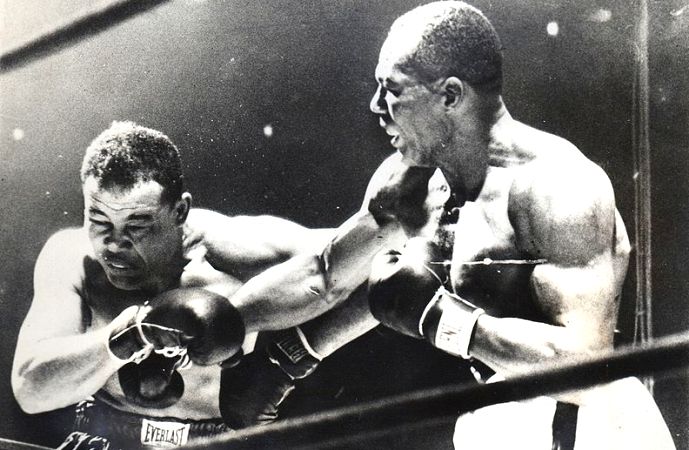
December 5, 1947: Joe Louis defends the Heavyweight Championship of the World against Jersey Joe Walcott, at the old Madison Square Garden. Joseph Louis Barrow had held the title for 10 years. Arnold Raymond Cream, a son of an immigrant from the U.S. Virgin Islands, had named himself after Joe Walcott, from the Caribbean island of Barbados, who held the Welterweight Championship from 1901 to 1906. Jersey Joe, from Pennsauken, across the Delaware River from Philadelphia, was 33, and was thus becoming the oldest man ever to fight for the heavyweight title to that point.

Louis, 56-1 going into the fight, has been called the greatest Heavyweight Champion ever. Those who disagree cite his fighting of what came to be called "The Bum-of-the-Month Club." Most of his opponents were not on his level, although a few were, including Max Schmeling and Billy Conn.

But Louis had trouble with mobile boxers, and Walcott, 42-13-1, was one of them. He knocked Louis down in the 1st round, stunning the live crowd and a nationwide radio audience. He knocked Louis down again in the 4th. As the fight went on, it looked like the twilight of a god: Louis, only 4 months younger than Walcott, looked done.

The fight went the distance, and many observers believed Walcott deserved to be named the winner. But Louis was given a split decision. It was a very controversial decision, even mentioned on an episode of M*A*S*H, 35 years later.

The decision wasn't based on race, as Walcott was also black. It was almost certainly based on money: A rematch could be held in warm weather, outdoors, at the enormous Yankee Stadium, and make more money. Louis won that fight by knockout, on June 25, 1948.

Walcott finally won the title on July 18, 1951, by beating Ezzard Charles. He and Walcott fought 4 times, Charles winning the 1st 2, Walcott the last 2. At 37, he was the oldest man ever to win the title. He lost the title a year later, to Rocky Marciano.

He later refereed the 2nd Muhammad Ali-Sonny Liston fight. In 1971, he was elected Sheriff of his native Camden County, the 1st black Sheriff in New Jersey, serving for 3 years. From 1975 to 1984, he was the Chairman of the New Jersey State Athletic Commission. He died in 1994, 10 months before George Foreman replaced him as the oldest Heavyweight Champion ever. He had outlived Louis by 13 years.

*

December 5, 1947 was a Friday. Baseball was out of season. Football was in midweek: Neither the college ranks, nor the NFL, nor the rebel All-America Football Conference played any games that night. And there were no games scheduled in the NHL.

One game was played in the Basketball Association of America, the league that became the NBA 2 years later: The Boston Celtics beat the Providence Steam Rollers, 73-69 at the Boston Garden.

December 31, 1999 & January 1, 2000: The Millennium

December 31, 1999:  The Millennium arrives. The people of planet Earth survived. At a terrible cost. But we hadn't destroyed ourselves. ...