Showing posts with label 1923. Show all posts

Thursday, December 8, 2022

December 8, 1923: The HOLLYWOOD Sign

December 8, 1923: The HOLLYWOOD Sign begins operating. Or, as originally constructed, the HOLLYWOODLAND Sign.

It's become the most famous sign in the world. And it was only supposed to be temporary. As the saying today goes, it had one job.

That one job was to advertise "Hollywoodland." No, not "Hollywood," the section of Los Angeles where the film industry had already set up, due to the kind of climate that allowed studios to make movies all year long. (And which, like Bel Air, is part of the City of Los Angeles, not a separate city, as Beverly Hills is.) Rather, it was a new housing development, named Hollywoodland, set up at the bottom of Mount Lee, in Los Angeles' Griffith Park, not far from the famous Observatory.
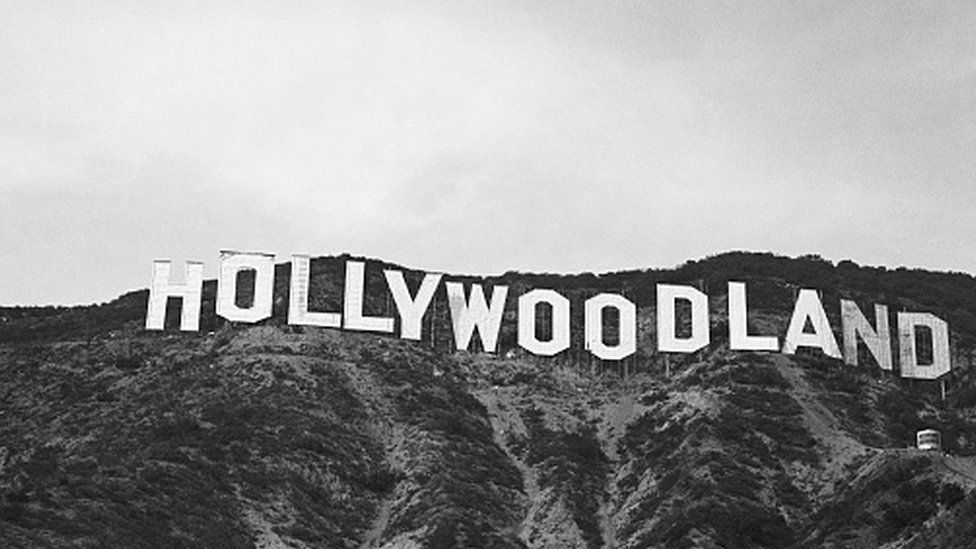
Thomas Fisk Goff (1890-1984) set up 13 white letters, 30 feet wide and 50 feet high, facing south. The letters had 4,000 light bulbs, that would flash: First "HOLLY," then "WOOD," then "LAND," and back to "HOLLY," in sequence. The sign outlasted its need, because people liked it. The lighting was switched off in 1933, to save money during the Great Depression.

On September 16, 1932, Peg Entwistle, a Welsh actress who had come to America and starred on Broadway, but had seen her 1st film role, in Thirteen Women, severely cut, climbed to the top of the H in the sign, and jumped to her death. She was 24, and remains the sign's only suicide.
In 1944, high winds blew the H over, wrecking it, leaving the sign as "OLLYWOODLAND." In 1949, the Hollywood Chamber of Commerce made a deal with the City of Los Angeles, and rebuilt the sign, dropping the last 4 letters, so that it read "HOLLYWOOD." It has, ever since.

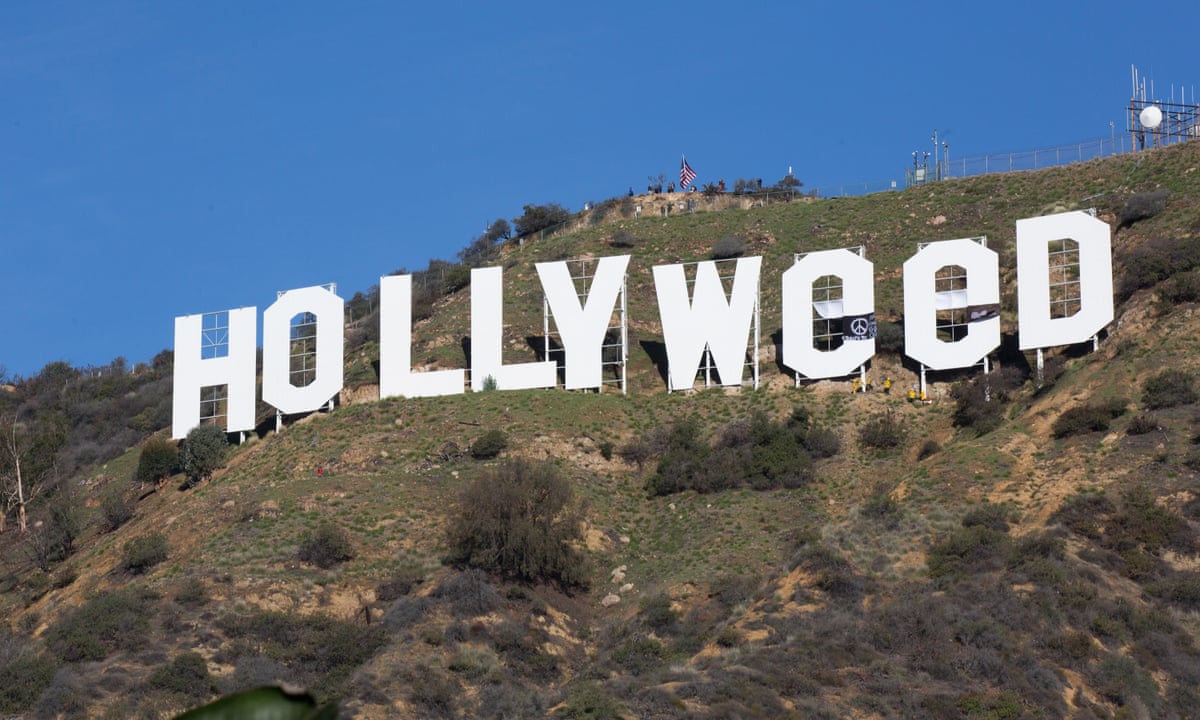
With some exceptions. Pranksters have occasionally altered it. Marijuana activists have placed black tape over the capital O's, turning them into lower-case e's. And, on at least one occasion, with the USC-UCLA football game coming up, USC students have altered the sign to read "BEAT UCLA." Other football fans, usually with their teams playing in the Rose Bowl, have altered the sign.
By the time the New York Yankees played the Los Angeles Dodgers in the 1977 World Series, the sign was in bad shape, as shown by stock footage of Los Angeles at the time that was included in ESPN's 2006 miniseries The Bronx Is Burning.
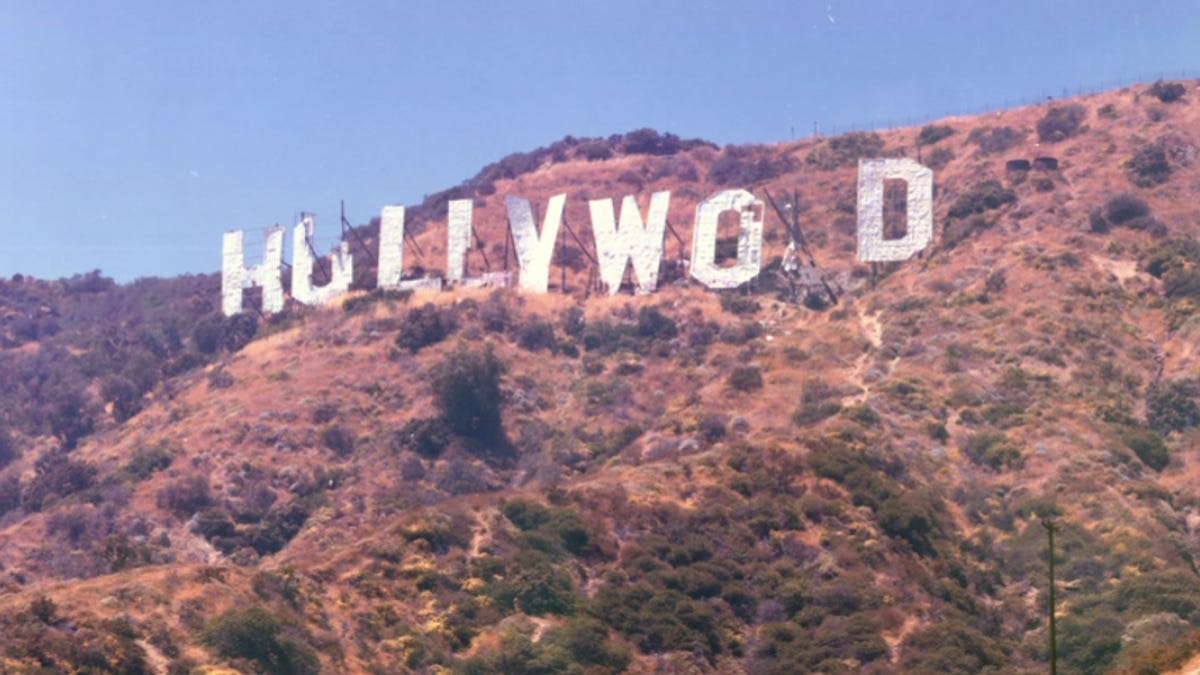
This led Playboy publisher Hugh Hefner to raise money for the sign's restoration. This included replacing the original wooden letters with metal ones, 44 feet high. It was restored again in 2005, and will be restored again in time for its 100th Anniversary in 2023.

*

December 8, 1923 was a Saturday. Baseball was out of season. The NBA hadn't been founded yet. There were no college football games. The NFL played the next day, concluding its season, with the Ohio-based Canton Bulldogs repeating as NFL Champions. And the NHL didn't open its season for another 7 days. So there were no scores on this historic day.

Wednesday, November 9, 2022

November 9, 1923: The Beer Hall Putsch

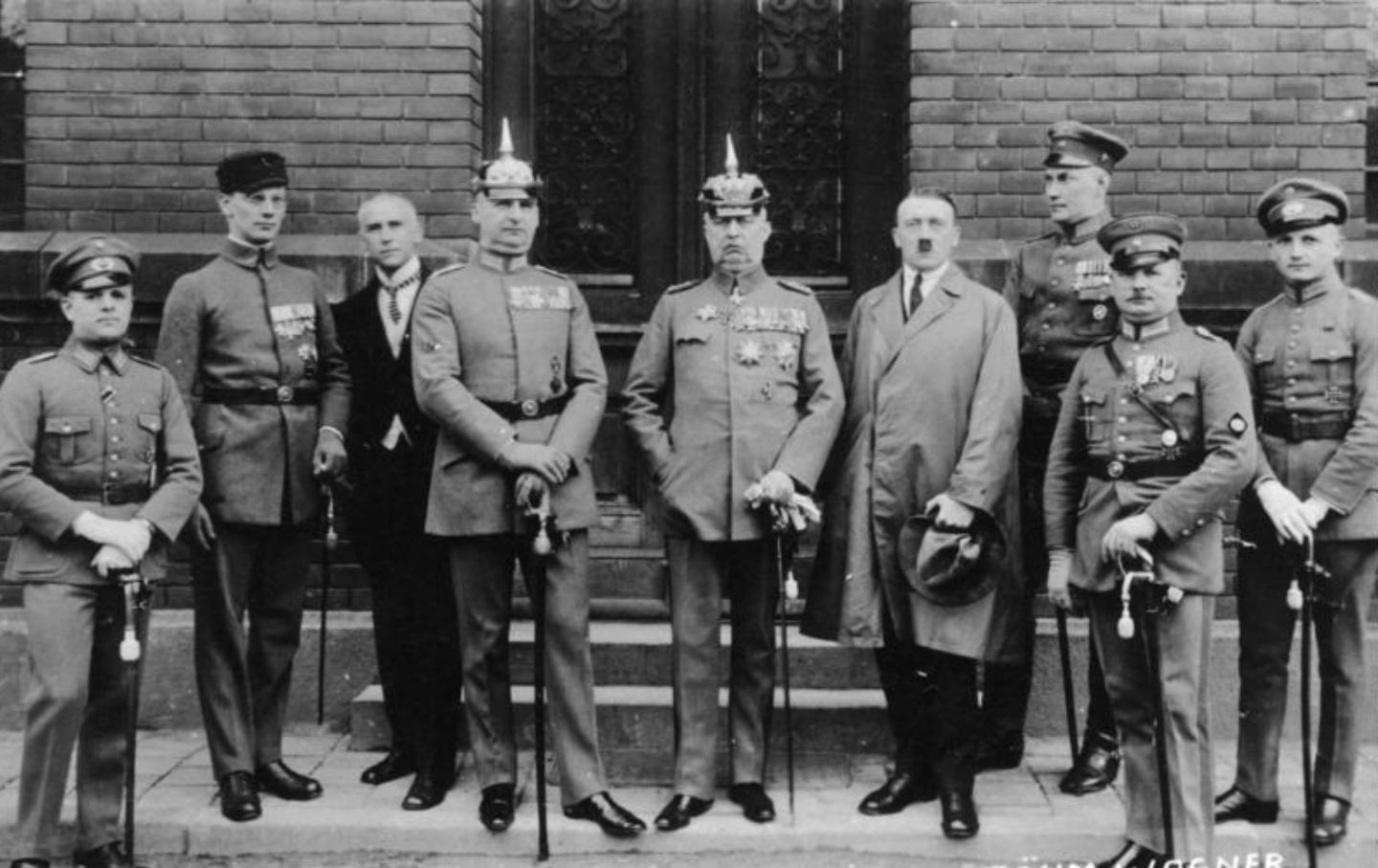
Center: Ludendorff. To the immediate right: Hitler.

November 9, 1923: An attempt is made to overthrow the government of the German state of Bavaria. It doesn't go so well. The man behind it doesn't truly pay for it, and gets to try again. He succeeds, on a far larger scale.

After its defeat in what is now known as World War I, Germany fell into chaos. The Weimar Republic straightened things out for a while, but by 1923, the payments of reparations to the countries that Germany had attacked in the war, and payments due on the borrowing done to finance their part in the war, had become so hard to make, the currency fell into hyperinflation, becoming just about worthless.

For much of the year, Germany, one of the largest countries in the world, with more people than any other on the European continent (except Russia, which straddled Europe and Asia), essentially had no economy. The Republic had to scrap the old currency: On October 15, 1923, the parliament, the Reichstag, issued a decree that the Reichsmark would be replaced by the Rentenmark on November 16.

That stabilized the German economy, until the worldwide stock market crashes of 1929. But on November 8, nobody knew for sure that the stabilization would happen. People were still worried. Many believed more drastic measures needed to be taken.

Many of those belonged to the National Socialist German Workers' Party -- Nationalsozialistische Deutsche Arbeiterpartei, or NSDAP. Or, "Nationalsozialistische" shortened to "Nazi." They were led by Adolf Hitler, a 34-year-old World War I veteran and failed painter; and a former General, Erich Ludendorff.

Note: If you saw the 2017 film Wonder Woman, in which the titular superheroine killed Ludendorff in the closing days of World War I, keep in mind that the film is a work of fiction. They didn't use the heroine as a stand-in for how he really died. In real life, Ludendorff survived that war, and lived on until 1937, having seen the Nazis come to power.

On November 8, inspired by the previous year's fascist March On Rome, about 600 Nazi Party members marched into the Bürgerbräukeller (Citizen brew cellar) in Munich, the capital of the state of Bavaria. Hitler fired a shot into the ceiling, and jumped on a chair, yelling: "The national revolution has broken out! The hall is surrounded by six hundred men. Nobody is allowed to leave." He went on to state that the Bavarian government was deposed, and declared the formation of a new government with Ludendorff. He got a big cheer from the people who were already inside.

At around 3:00 AM on November 9, some of Hitler's men left the beer hall, in an attempt to reach the nearby barracks, and thus get some weapons, of the Reichswehr (Army). Except the army was waiting for them, and fired some shots. No one was killed, but it was a sign that the putsch was doomed to fail.

In the morning, Hitler ordered the seizure of the Munich City Council as hostages. It didn't happen. By mid-morning, it was clear that the putsch was going nowhere. Ludendorff cried out, "We will march!" Now having about 2,000 men, they did:  Ludendorff led them to the Bavarian Defense Ministry. But the army was in the way, and fire was exchanged, killing 16 Nazis and 4 state police officers.

Hitler escaped immediate arrest, and was spirited off to safety in the countryside. After 2 days, he was found, arrested, and charged with treason. He was found guilty, and, on April 1, 1924, he was sentenced to 5 years in Landsberg Prison.

Five years. For treason.

While there, he dictated what became his book, Mein Kampf (My Struggle) to fellow prisoners. On December 20, 1924, having served only 9 months, he was released. This turned out to be a very bad idea. Once released, Hitler redirected his focus towards obtaining power through legal means, rather than by revolution or force, and accordingly changed his tactics.

On January 30, 1933, with the Great Depression at its lowest point, Adolf Hitler was appointed Chancellor of Germany by President Paul von Hindenburg, and proclaimed the Third Reich -- as he put it, "The Thousand Year Reich." It lasted 12 years, and caused a war that killed 75 million people.

November 9 has become Germany's "Day of Destiny": On that date, in 1918, the Kaiser abdicated and the 1st German Republic was proclaimed; in 1923, the Beer Hall Putsch failed; in 1938, Kristallnacht was carried out by the Nazis; and in 1989, the Berlin Wall was rendered legally moot.

*

November 9, 1923 was a Friday. Baseball was out of season. The NBA hadn't been founded yet. And the NHL season didn't start until December 15. There was 1 college football game on this day: Clemson beat Davidson, 12-0 at Riggs Field in Calhoun, South Carolina.

Friday, October 28, 2022

October 29, 1923: The Birth of the Charleston

October 29, 1923: The musical Runnin' Wild premieres at the Colonial Theatre in New York, with a tune by James P. Johnson: "Charleston." It inspires the dance of the same name, which becomes every bit as synonymous with "The Roaring Twenties" as the jazz music that inspired it.

Runnin’ Wild was a two-act musical comedy taking place in Jimtown and St. Paul, Minnesota, about the adventures of two likable scamps played by F.E. Miller and Aubrey Lyles. The feature tune of the show was "Old Fashioned Love." But what would now be called the "breakout" song was "Charleston," along with its accompanying dance. The show ran through June 28, 1924, but the dance outlived it.

The kicks, and the crossing of the hands on the knees, became an absolute craze. Josephine Baker, the black American entertainer who was even bigger in Europe than at home, became identified with it.
Josephine Baker

The dance caught on with white American audiences when Bessie Love did it in the 1925 film The King on Main Street, and got another boost in 1926 in when she did it in The Song and Dance Man. The 1946 film It's a Wonderful Life, with a scene set in 1929, featured a Charleston contest. In the 1980s, when impersonating the film's star, James Stewart, on Saturday Night Live, Dana Carvey would do the Charleston.

The 1952 musical Singin' in the Rain, set in 1927, includes a demonstration of the dance. So does the 1974 adaptation of F. Scott Fitzgerald's The Great Gatsby, set in the Summer of 1922 -- an anachronism, because that was over a year before the dance's Broadway debut. But that film, and It's a Wonderful Life and Singin' in the Rain, helped to cement the Charleston in the public memory as the dance of the Jazz Age.

The Colonial Theatre was on Broadway at 62nd Street. It hosted black-produced, black-starring entertainment from 1905 to 1925. It was bought, renamed Hampden's Theatre, and became a whites-only theater. In 1932, it became the RKO Colonial Theatre, and a movie house only. In 1951, NBC bought it, and used it as a TV studio until 1971. It became the Harkness Theatre in 1974, showing live entertainment again, but closed in 1977, and was then torn down. A new movie theatre, Lincoln Plaza, opened on the site.

*

October 29, 1923 was a Monday. The baseball season had ended 13 days earlier, when the New York Yankees beat the New York Giants in the World Series. Football was in midweek. Professional basketball barely existed. And the NHL season was several weeks away. So there were no scores on this historic day.

Sunday, October 23, 2022

October 23, 1923: Babe Ruth of the New York... Giants?

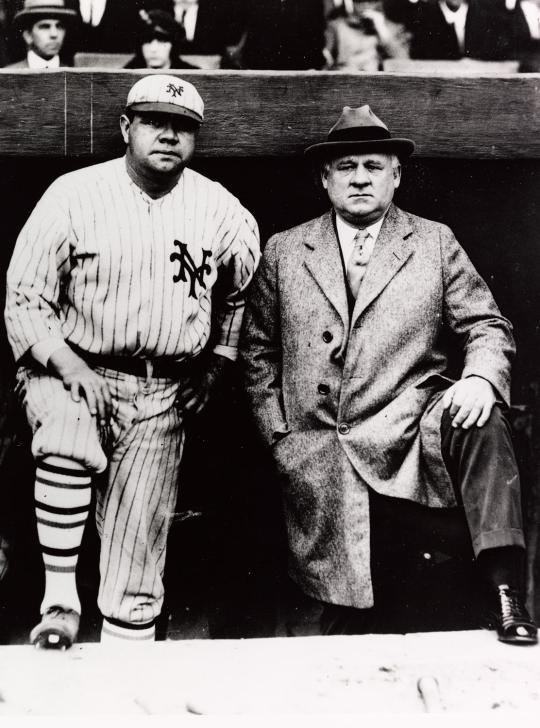
Babe Ruth (left) and John McGraw

October 23, 1923: Babe Ruth plays for the New York Giants at the Polo Grounds.

No, this is not an "alternate history" or "counterfactual" story, where he was signed by a different team. Or chose another sport and played football. It is one of the many quirks of actual baseball history.

McGraw had tried to get Ruth in 1914. He had seen Ruth pitch for his hometown team, the Baltimore Orioles of the International League, against the Newark Indians. McGraw called Orioles owner Jack Dunn, and offered $5,000. Dunn turned him down, later accepting $8,500 from the Boston Red Sox.

In the meantime, Ruth had helped the Red Sox win the World Series in 1915, 1916 and 1918, move to the New York Yankees, and help them win American League Pennants in 1921 and 1922. But the way Ruth revolutionized the home run was taken by McGraw as a personal affront.

Like the man Ruth had replaced as baseball's greatest player, Ty Cobb of the Detroit Tigers, McGraw preferred what had come to be called "inside baseball" or "scientific baseball," what would be known today as "small ball": Get your runs any way you can, instead of getting somebody on base and then waiting for a home run.

McGraw made his point when the Giants won the National League Pennant in 1921 and 1922, by having his pitchers through Ruth nothing by off-speed pitches in the World Series. It was successful enough that the Giants won, both times. But the Yankees gained their revenge in the 1923 World Series, for their 1st World Championship, clinching in Game 6 at the Polo Grounds on October 15.

Just 8 days later, a benefit game was held at the Polo Grounds, for 2 destitute men who had been at the founding of the Giants, as the New York Gothams, in 1883: Original owner John B. Day, a tobacco magnate who had lost his fortune in the Players' League war of 1890; and original manager Jim Mutrie, who gave the team its permanent name in 1886, when he referred to his players as, "my big boys, my giants."

Ruth and McGraw swallowed their differences, despite being about to have their teams play each other in the World Series for the 3rd straight season. Ruth's Yankee teammates Aaron Ward and Elmer Smith also suited up for the Giants. The opponents were the champions of the International League, the Baltimore Orioles -- not just Ruth's 1st professional team, but the namesake of the National League team for whom McGraw played, winning Pennants in 1894, 1895 and 1896, and made his reputation as a rough but smart baseball man.

Ruth was 1 of 4 Giants who hit home runs, in his case a 5th-inning blast that soared over the right-field roof, as the Giants won, 9-3. It's not clear how much money was raised. Day, already ill with cancer, died a little over a year later, in early 1925. Mutrie lasted until 1938.

McGraw died in 1934, just before Ruth began his last season with the Yankees. Between playing and managing, McGraw was involved with 13 Pennant winners and won 3 World Series. Ruth died in 1948, having been with 10 Pennant winners and 7 World Series winners. Ruth was 1 of the 1st 5 players elected to the Baseball Hall of Fame, in 1936. The following year, McGraw and Connie Mack were the 1st 2 managers elected.

*

October 23, 1923 was a Thursday. There were no other scores on this day: The baseball season was over, no football games were scheduled, professional basketball was strictly minor-league at this point, and the NHL season would not begin until December 15.

Wednesday, October 19, 2022

October 20, 1923: Oklahoma Memorial Stadium Opens

October 20, 1923: Oklahoma Memorial Stadium opens on the campus of the University of Oklahoma in Norman, 20 miles south of Oklahoma City. The Sooners defeat Washington University of St. Louis 62-7. Just 7 days earlier, Oklahoma had visited Nebraska, which would become their arch-rivals in the Conference alternately known as the Big Six, the Big Seven, the Big Eight and the Big Twelve, for the opening of their Memorial Stadium in Lincoln, and lost.
Originally, the stadium seated 16,000. It was expanded to 32,000 in 1929, 55,000 in 1949, 61,000 in 1957, 71,000 in 1975, 75,000 in 1980, 81,000 in 2003, and 86,000 in 2016, before a seat-widening reduced capacity to 80,126 in 2019.
Since 1905, the Sooners had played at Boyd Field. Bennie Owen, head football coach from 1905 to 1926, basketball coach from 1908 to 1921, baseball coach from 1906 to 1922, and athletic director from 1907 to 1934, directed its replacement's construction. In his honor, the playing surface was named Owen Field. That surface was artificial from 1970 to 1993, but has been natural grass again since then.
In 2002, after a gift from the Gaylord family, publishers of the State's largest newspaper, the Daily Oklahoman, the structure was renamed Gaylord Family Oklahoma Memorial Stadium.
Since moving into "The Palace On the Prairie," the Sooners have claimed 47 Conference Championships: 1938, '43, '44, '46, '47, '48, '49, '50, '51, '52, '53, '54, '55, '56, '57, '58, '59, '62, '67, '68, '72, '73, '74, '75, '76, '77, '78, '79, '80, '84, '85, '86, '87, 2000, '02, '04, '06, '07, '08, '10, '12, '15, '16, '17, '18, '19 and '20. And they claim 7 National Championships: 1950, 1955 and 1956 under head coach Bud Wilkinson; 1974, 1975 and 1985 under Barry Switzer; and 2000 under Bob Stoops.
They have had 7 players win the Heisman Trophy: Running backs Billy Vessels in 1952, Steve Owens in 1969, and Billy Sims in 1978; and quarterbacks Jason White in 2003, Sam Bradford in 2008, Baker Mayfield in 2017 and Kyler Murray in 2018. Their legendary players have also included 1950s receiver Tommy McDonald, 1950s linebacker Jerry Tubbs, 1970s running backs Greg Pruitt and Joe Washington, 1970s defensive end Lee Roy Selmon, 1980s defensive tackle Tony Casillas, 1980s linebacker Brian Bosworth, and 2000 quarterback Josh Heupel.
Unfortunately for Oklahoma, the stadium's most famous game was one they lost: The 1971 "Game of the Century," in which they came in at Number 2 and Nebraska at Number 1, and Nebraska won, to win the Big Eight title, and go on to the National Championship.
*
October 20, 1923 was a Saturday. These other notable college football games were played that day:
* In an unusual North vs. South matchup, Army beat Auburn, 28-6 on The Plain at West Point, New York.
* Navy lost to Penn State, 21-3 at Beaver Field (not to be confused with the later Beaver Stadium) in State College, Pennsylvania.
* Fordham lost to Lehigh, 7-0 at Taylor Stadium in Bethlehem, Pennsylvania.
* Columbia lost to the University of Pennsylvania, 19-7 at Franklin Field in Philadelphia. This was only the 4th game at the new Franklin Field, which had replaced the one that had stood there since 1895.
* Rutgers beat New York University (NYU), 7-3 at Neilson Field in New Brunswick, New Jersey.
* Princeton lost to Notre Dame, 25-2 at Palmer Stadium in Princeton.
* Syracuse beat the University of Pittsburgh, 3-0 at Yankee Stadium. It was the 1st college football game played there.
* Harvard beat Holy Cross, 6-0 at Harvard Stadium in Boston.
* In what would later become an arch-rivalry, Michigan beat Ohio State, 23-0 at Ferry Field in Ann Arbor, Michigan.
* The University of Chicago beat nearby Northwester University, 13-0 at Stagg Field in Chicago.
* The University of Missouri and Saint Louis University played to a 0-0 tie at Sportsman's Park in St. Louis.
This was also the day that Zev, America's leading thoroughbred racehorse, beat Papyrus, Britain's leading thoroughbred, in a match race at Belmont Park. I have a separate entry for that event.
Also on this day, "Beat Generation" writer Philip Whalen was born. 

October 20, 1923: Zev vs. Papyrus

October 20, 1923: One of the biggest match races in American history is held at Belmont Park.

It's easy to ask, "If Man o' War was the most famous thoroughbred race horse of the era, how come he didn't win the Triple Crown?" Well, at the time, the Triple Crown had been won only once, by Sir Barton in 1919, and it was not the big deal that it would later become. Man o' War won the Preakness and the Belmont Stakes in 1920, but did not even enter the Kentucky Derby.

Zev had been the leading 2-year-old horse in America in 1922. In 1923, the Preakness was run before the Kentucky Derby, and Zev, ridden by Earl Sande, ran a bad race. But he came back to win the Derby and the Belmont Stakes.

In England, which still thought of itself as the worldwide capital of horse racing -- "The Sport of Kings," partly because the British royal family had owned champion horses, and still does -- Papyrus had been doing much the same thing as Zev. Ridden by Steve Donoghue, he was his country's leading 2-year-old racehorse, and, the next year, won the country's leading race, The Derby (and, unlike in America, that's pronounced "DAR-bee," not "DER-bee") at Epsom Race Course in Surrey.

On August 19, 1923, a deal was struck to have Papyrus race against Zev, to determine the best racehorse in the world. The winning horse would win $100,000 (about $1.7 million in 2022 money), with the losing horse getting just $2,000. But Papyrus would be running at something of a disadvantage: In 2 warmup races, he was bumped by another horse, the one in the 2nd race actually drawing blood.

But he was determined to be fit enough to sail to America and race against Zev. Accompanying him on the voyage were Donoghue, trainer Basil Jarvis, 2 stable boys, his stablemate Bargold, a cat with whom Papyrus had bonded, and a special feed mix. But the British media, normally so jingoistic, was actually pessimistic, thinking the effects of the voyage and the change in environment -- normally racing on grass, this would be his 1st time running on a dirt track -- would work against Papyrus.

A crowd of 70,000 people filed into Belmont Park, just outside New York City in Elmont, Nassau County, New York. The track was muddy, and while Papyrus held his own for the first half of the race, Zev pulled away, and won by 5 lengths. Although noting the conditions, Jarvis acknowledged that he had been fairly beaten by a better horse.

Papyrus was never the same horse. He ran 4 races as a 4-year-old, didn't win any of them, and was retired to stud. He lived until 1941. In contrast, Zev won races as a 4-year-old, and broke Man o' War's record as horse racing's all-time leading money-winner. He was less successful at stud than Papyrus, and lived until 1943.

*

October 20, 1923 was a Saturday. Oklahoma Memorial Stadium, now named Gaylord Family Oklahoma Memorial Stadium, opened on this day in Norman, Oklahoma. The University of Oklahoma beat Washington University of St. Louis, 62-7. I have a separate entry for this event. These other notable college football games were played that day:
* In an unusual North vs. South matchup, Army beat Auburn, 28-6 on The Plain at West Point, New York.
* Navy lost to Penn State, 21-3 at Beaver Field (not to be confused with the later Beaver Stadium) in State College, Pennsylvania.
* Fordham lost to Lehigh, 7-0 at Taylor Stadium in Bethlehem, Pennsylvania.
* Columbia lost to the University of Pennsylvania, 19-7 at Franklin Field in Philadelphia. This was only the 4th game at the new Franklin Field, which had replaced the one that had stood there since 1895.
* Rutgers beat New York University (NYU), 7-3 at Neilson Field in New Brunswick, New Jersey.
* Princeton lost to Notre Dame, 25-2 at Palmer Stadium in Princeton.
* Syracuse beat the University of Pittsburgh, 3-0 at Yankee Stadium. It was the 1st college football game played there.
* Harvard beat Holy Cross, 6-0 at Harvard Stadium in Boston.
* In what would later become an arch-rivalry, Michigan beat Ohio State, 23-0 at Ferry Field in Ann Arbor, Michigan.
* The University of Chicago beat nearby Northwester University, 13-0 at Stagg Field in Chicago.
* The University of Missouri and Saint Louis University played to a 0-0 tie at Sportsman's Park in St. Louis.
Also on this day, "Beat Generation" writer Philip Whalen was born. 

Saturday, October 15, 2022

October 15, 1923: The 1st Yankee World Series Win

The 1923 World Champion New York Yankees.
Babe Ruth is in the top row, 2nd from the right.

October 15, 1923: The New York Yankees, managed by Miller Huggins, win Game 6 of the World Series, riding a 1st-inning home run by Babe Ruth and the pitching of "Sad" Sam Jones, to beat the New York Giants, 6-4 at the Polo Grounds, and clinch their 1st World Championship, in their 1st season of playing in Yankee Stadium in The Bronx.

This was not, however, the 1st title for many of the Yankee players. Some of them, including Ruth and Jones, had won titles with the Boston Red Sox in the 1910s. In fact, of the 25 men on the Yankee roster when they won their 1st World Championship, 12, nearly half, had been Red Sox sold off by Boston owner Harry Frazee.

This was also the beginning of the end for Giant manager John McGraw and his style of baseball: Finally, the Yankees had put together a team that did not have to simply rely on Ruth's home runs to beat McGraw's style of "inside baseball" – what would, today, be called "small ball." The Giants would win another Pennant the next season, but that would be their last under McGraw’s leadership.

Up until this moment, the Giants had won 11 Pennants and 3 World Championships, either through the World Series, pre-1900 postseason series, or the title of the only league then playing; the Brooklyn Dodgers, 6 and, by the means available to them to win a "world championship" at the time, 3, but none since 1900; the Yankees, 3 and none.

From the Yankees' 3rd Pennant in September 1923 until the end of the Giants' and Dodgers' last season in New York, September 1957, the count was: Yankees, 21 and 17; Giants, 7 and 2; and Dodgers, 7 and 1.

Lou Gehrig had made his major league debut on June 15, 1923, a 10-0 Yankee win over the St. Louis Browns at Yankee Stadium. But he only played 13 games at the major league level that 1st season, and was not included on the World Series roster.

The last active member of the 1923 Yankees was rookie 1st baseman Lou Gehrig. The last surviving member of the team was center fielder Ladislaw Waldemar Wittkowski, a.k.a. Lawton Walter Witt, a.k.a. Whitey Witt, who lived until 1988.

*

October 15, 1923 was a Monday. Football was in midweek. Professional basketball barely existed. And the NHL season was 2 months away. So this was the only score on this historic day. 

Thursday, October 13, 2022

October 13, 1923: Nebraska's Memorial Stadium Opens

October 13, 1923: Memorial Stadium opens on the campus of the University of Nebraska in Lincoln. The Cornhuskers are not yet arch-rivals with the University of Oklahoma, but that's who they play in the 1st game, and they beat the Sooners 24-0. A week later, Oklahoma opened its own Memorial Stadium.
From 1909 to 1922, the 'Huskers had played at Nebraska Field. Their new stadium originally seated 31,080. In 1962, with Bob Devaney in his 1st season as head coach, they got good, and began a streak of selling out that lasted through the 2019 season. The COVID restrictions of 2020 meant that the 4 Nebraska home games that season were played behind closed doors, so the NCAA recognizes the streak as still being intact as of October 13, 2022.
Because of the team's success, the stadium was expanded to 64,000 in 1967, 73,000 in 1972, 74,000 in 1999, 81,000 in 2006, and 87,000 in 2013. Subsequently, wider seats were installed, and by 2017, capacity was reduced to 85,458. Every seat is still filled, known as "The Sea of Red." The field was concerted to artificial turf in 1970, was renamed for coach Tom Osborne in 1998, and since 1999 has been FieldTurf.
Since moving in, Nebraska have won 30 Conference Championships: 1923 in the Missouri Valley Intercollegiate Athletic Association; in the league alternately known as the Big Six, the Big Seven and the Big Eight, in 1928, '29, '31, '32, '33, '35, '36, '37 and '40, '63, '64, '65, '66, '69, '70, '71, '72, '75, '78, '81, '82, '83, '84, '88, '91, '92, '93, '94, '95; and in 1997 and '99 in the Big Twelve. They joined the Big Ten in 2011, and have won their Division in 2013, but not the Conference. They were awarded National Championships under Devaney in 1970 and 1971; and under Osborne in 1994, 1995 and 1997.
UPDATE: On August 30, 2023, Nebraska's renowned women's volleyball team, in a sport normally played indoors, played at Memorial Stadium, defeating the University of Nebraska at Omaha in 3 straight games. The attendance was 92,003, a record for the stadium, and a record for any women's sporting event, at any level, anywhere in the world. The football attendance record is 91,585, for the Cornhuskers' 41-31 win over the University of Miami on September 20, 2014.
*
October 13, 1923 was a Saturday. Among the other notable college football games played that day were these:
* Notre Dame beat Army, 13-0 at Ebbets Field.
* Navy beat West Virginia Wesleyan, 26-7 at Worden Field in Annapolis, Maryland.
* Columbia beat Wesleyan University, 12-6 at Baker Field (now Wien Stadium) in Upper Manhattan.
* Rutgers beat Lehigh, 10-0 at Neilson Field in New Brunswick, New Jersey
* Princeton beat Georgetown, 17-0 at Palmer Stadium in Princeton, New Jersey.
* Harvard were held to a 6-6 tie by Middlebury College at Harvard Stadium in Boston.
* In a rivalry that would one day be known as the "Backyard Brawl," West Virginia beat the University of Pittsburgh, 13-7 at Forbes Field in Pittsburgh.
* Ohio State were held to a 23-23 tie by Colgate at Ohio Stadium in Columbus.
* Unusually, there were 3 North vs. South matchups on this day, all held in the North. Yale beat Georgia, 40-0 at the Yale Bowl in New Haven, Connecticut. Syracuse beat Alabama, 23-0 at Archbold Stadium in Syracuse, New York.
And Michigan beat Vanderbilt, 3-0 at Ferry Field in Ann Arbor, Michigan. Given that each was a major power in its own region, this was a major measuring stick for Southern college football, and the fact that Vandy only lost by 3 points on the road was taken as a good sign.
Game 4 of the World Series was played that day. A 6-run 2nd inning leads the New York Yankees to an 8-4 win over the New York Giants at the Polo Grounds, and ties up the Series. Bob Shawkey was the winning pitcher, and Babe Ruth went 1-for-3 with 2 walks.
Also, Dutch soccer legend Servaas "Faas" Wilkes was born on this day.

Friday, October 7, 2022

October 7, 1923: The Horween Brothers

Arnold Horween (left) and Ralph Horween

October 7, 1923: The Chicago Cardinals beat the Rochester Jeffersons, 60-0 at Normal Park on the South Side of Chicago. Fullback Ralph Horween scores a touchdown, and halfback Arnold Horween kicks 2 extra points. This makes them the 1st brother combination to score for the same team in an NFL game. On December 2, they will do it again. But it hasn't happened since.

The family name was actually Horwitz, as was that of two of the Three Stooges, Moe and Jerry "Curly" Howard. Ralph was born on August 3, 1896, and Arnold was born on July 7, 1898, both in Chicago. Each was an All-American offensive and defensive back at Harvard University, helping them win the 1920 Rose Bowl. Arnold became Harvard football's 1st Jewish captain.

Ralph played for the Cardinals from 1921 to 1923, and Arnold did so from 1921 to 1924. However, at the time, professional football was still looked down upon. So they used the name "McMahon," to fool people into thinking they were Irish. When that didn't work, they used "Horween," which sounded Jewish, and at least gave them the same initials.

Both men went back to Harvard. Arnold was their head coach from 1925 to 1930, going 21-17-3. More importantly, he went 3-2-1 against Yale. He later became a trustee of the Chicago Symphony Orchestra. Both he and his brother helped run the family leather tannery business. Arnold lived until August 5, 1985.

Ralph went back to Harvard, graduated from their Law School, became a patent attorney, a federal government official, and raised cattle. He died on May 26, 1997, making him the 1st former NFL player to live to be 100 years old. He was also the last surviving player from the early days of the NFL.

The Horweens were the last pair of Jewish brothers to play in the NFL until 2012, when Geoff Schwartz was a guard for the Minnesota Vikings, and Mitchell Schwartz was an offensive tackle for the Cleveland Browns.

*

October 7, 1923 was a Sunday. These other NFL games were played that day:

* The Buffalo All-Americans beat the Akron Pros, 9-0 at Olympic Park in Buffalo, New York.

* The Canton Bulldogs beat the Louisville Brecks, 37-0 at Lakeside Park in Canton, Ohio, outside Cleveland. The fact that this was the only other game of the weekend that was not close shows how good the Bulldogs were: From 1922 to 1924, they won the NFL Championship all 3 times, with a record of 28-1-4.

* The Toledo Maroons beat the Oorang Indians, 7-0 at Swayne Field in Toledo, Ohio. Swayne Field was also home to the Toledo Mud Hens of the International League from 1909 to 1955, the team best known as the hometown team of M*A*S*H character Max Klinger, played by Toledo native Jamie Farr.

The Indians were a team of native Americans organized by Jim Thorpe, based in LaRue, Ohio, outside Marion, hometown of the recently deceased President Warren Harding, but essentially a "traveling team" that played all away games. They were named for Oorang Kennels, their sponsor, and so a dog was their symbol. Thorpe had been the best football player, and the best track & field athlete, of the 1910s, but by this point, he was 36 years old, much slower as a player, and he was no coach or administrator. The team lasted only 2 seasons, this being the 2nd, going 3-6 and 1-10.

* The Hammond Pros beat the Dayton Triangles, 7-0 at League Park in Hammond, Indiana, outside Chicago.

* The Rock Island Independents and the football version of the Cleveland Indians played to a tie, 0-0 at Douglas Park in Rock Island, Illinois.

* The Chicago Bears beat the Racine Legion, 3-0 at Horlick Park in Racine, Wisconsin. Although Racine is in Wisconsin, it is closer in distance to Chicago than to Milwaukee.

* The Milwaukee Badgers and the Columbus Tigers played to a tie, 0-0 at Athletic Park (later Borchert Field) in Milwaukee.

* The Green Bay Packers and the St. Louis All-Stars played to a tie, 0-0 at Bellevue Park in Green Bay, Wisconsin.

* The Duluth Kelleys beat their in-State rivals, the Minneapolis Marines, 10-0 at Nicollet Park in Minneapolis.

And these baseball games were played:

* The New York Yankees lost to the Philadelphia Athletics, 9-7 at Yankee Stadium. The Yankees had already clinched the American League Pennant. Babe Ruth hit a home run, and Harvey Hendrick hit a grand slam, but it wasn't enough.

* The Brooklyn Robins (as the Dodgers were known under the managing of Wilbert Robinson, from 1914 to 1931) beat their arch-rivals, the New York Giants, 6-1 at Ebbets Field. The Giants had already clinched the National League Pennant, and the Yankees went on to beat them, winning their 1st World Series.

* The Washington Senators beat the Boston Red Sox, 5-2 at Griffith Stadium in Washington.

* The Cleveland Indians beat the Chicago White Sox, 9-6 at League Park in Cleveland. Indians center fielder and manager Tris Speaker went 1-for-3 with 2 walks and an RBI.

* The Pittsburgh Pirates beat the Cincinnati Reds, 7-5 at Redland Field (later Crosley Field) in Cincinnati.

* The Detroit Tigers beat the St. Louis Browns, 7-6 at Navin Field (later Briggs Stadium and Tiger Stadium) in Detroit. Tigers center fielder and manager Ty Cobb went 2-for-5 with an RBI. George Sisler, the Browns' greatest player ever, was at the height of his powers, but did not play in this game.

* A doubleheader between arch-rivals was split at Sportsman's Park in St. Louis. The Chicago Cubs won the opener, 10-3. The St. Louis Cardinals won the nightcap, 6-3.

* And the Boston Braves and the Philadelphia Phillies, the 2 worst teams in the league, losing 100 and 104 games, respectively, ended their season against each other the day before.

Thursday, October 6, 2022

October 6, 1923: A Big Day In College Football

Jack Trice

October 6, 1923: It's a big day in college football. The University of Minnesota hosts Iowa State University at Northrop Field in Minneapolis. Iowa State's lone black player, Jack Trice, gets hurt on the 2nd play of the game, breaking his collarbone. He insists he is all right, and stays in the game. But in the 3rd quarter, he tries to tackle a runner, falls, and 3 Minnesota players trample him. He is taken to a hospital, but doctors don't think his life is in danger, and he is released as fit to travel back to Iowa State's campus in Ames. But he has suffered internal bleeding, and dies 2 days later at age 21.

Trice was from the Cleveland area, and in 1979, 56 years after the fact, that city's major paper, The Plain Dealer, investigated his death. A surviving Iowa State teammate, Johnny Behm, said, "One person told me that nothing out of the ordinary happened. But another who saw it said it was murder."

In 1997, Iowa State's home field was named Jack Trice Stadium. It is the only stadium in the NCAA's Football Bowl Subdivision (FBS, formerly known as Division I-A) named for a black person. A statue of him stands outside.
Also on this day, 2 of the classic stadiums of the Big Ten Conference open. Memorial Stadium opens on the campus of the University of Illinois in Champaign. The Fighting Illini beat Nebraska 24-7, and, led by sophomore running back Harold "Red" Grange, go on to win the National Championship.

The stadium's dedication game wouldn't come until the next season, October 18, 1924, when Grange would put on a legendary show in a win over Michigan. The Chicago Bears played their home games at Memorial Stadium in 2002, while the original Soldier Field was torn down and the new one built in its place.
Also on this day, College Field opens on the campus of Michigan State College in East Lansing, but not with a game. The school would be renamed Michigan State University on its Centennial in 1955; the stadium, Macklin Field in 1935, Macklin Stadium in 1948, and Spartan Stadium in 1957. John Macklin was their football coach from 1911 to 1915.

It opened with 14,000 seats. By the time Clarence "Biggie" Munn was coaching the school's 1st great team in the early 1950s, it seated 51,000. When Hugh "Duffy" Daugherty coached its great team of the mid-1960s, it had peaked at 76,000. Today, it seats 75,005. It switched to artificial turf in 1969, and has kept it.
Also on this day, the Los Angeles Memorial Coliseum, which had opened on the preceding May 1, hosts a football game for the 1st time. The University of Southern California hosts Pomona College, and wins, 23-7.

The USC Trojans have used the Coliseum as their home field ever since. Their nearby rivals, the University of California at Los Angeles, played home games there from 1933 to 1981. The UCLA Bruins now play home games at the Rose Bowl in Pasadena, which, due to the Trojans' success, has often seemed like a secondary home field to them.
The Coliseum has also been the leading professional football venue in Southern California. In the NFL, the Los Angeles Rams played there from 1946 to 1979, and again from 2016 to 2019; the Los Angeles Raiders from 1982 to 1994; Super Bowl I in 1967 and Super Bowl VII in 1973; and the postseason Pro Bowl from 1951 to 1972, and again in 1979.

Other pro football teams using the Coliseum: The Los Angeles Dons of the All-America Football Conference from 1946 to 1949, the Los Angeles Chargers of the American Football League in 1960, the Los Angeles Express of the United States Football League from 1983 to 1985, and the Los Angeles Xtreme of the XFL in 2001.

It has hosted the U.S. national soccer team 20 times, starting in 1965; and Mexico's team 61 times. In 1967, the only season of play for the United Soccer Association, it hosted the Los Angeles Wolves, who won that league's title. It also hosted the city's entry in another league starting that season, the Los Angeles Toros of the National Professional Soccer League. After that year, the two leagues merged to form the North American Soccer League, whose Los Angeles Aztecs used the Coliseum as their home field in the 1977 and 1981 seasons.

The Los Angeles Dodgers used the Coliseum as their 1st home field after leaving Brooklyn, while waiting for Dodger Stadium to be built, from 1958 to 1961. Their home games in the 1959 World Series against the Chicago White Sox attracted over 92,000 fans, the highest-attended competitive games in Major League Baseball history. An all-time record crowd for baseball, 115,300, attended a preseason game between the Dodgers and the Boston Red Sox on March 29, 1958, honoring the Dodgers' 50h Anniversary in Los Angeles.

And, of course, the Coliseum was the main venue for the 1932 and 1984 Summer Olympic Games, and will be again in 2028. 

*

October 6, 1923 was a Saturday. These other noteworthy college football games were played:

* Army beat Florida, 20-0 on The Plain in West Point, New York.

* Navy beat Dickinson College, 13-7 at Worden Field in Annapolis, Maryland.

* Maryland beat Pennsylvania, 3-0 at Franklin Field in Philadelphia.

* Notre Dame beat Lombard, 14-0 at Cartier Field in South Bend, Indiana.

* The University of Washington beat Willamette, 54-0 at Husky Stadium in Seattle. They would play Navy in the Rose Bowl, and it would end in a 14-14 tie.

* And in New Jersey, Princeton beat Johns Hopkins, 16-7 at Palmer Stadium in Princeton; and Rutgers beat Villanova, 44-0 at Neilson Field in New Brunswick.

In a regular-season baseball game, Ernie Padgett of the Boston Braves, in only his 2nd major-league appearance, pulled off an unassisted triple play in a doubleheader sweep of the Philadelphia Phillies, at Braves Field in Boston. It is the 1st such play in National League history. The Braves won the opener, 5-4 in 14 innings; and won the nightcap, 4-1 in a game called after 5 innings due to darkness.

Born in Philadelphia in 1899, the infielder would only last 5 seasons in the majors, and died in 1957 in East Orange, Essex County, New Jersey.

* The Brooklyn Robins -- as the Dodgers were known during the managerial tenure of Wilbert Robinson, 1914 to 1931 -- beat their arch-rivals, the New York Giants, 4-3 at Ebbets Field. Jack Fournier's grounder into a fielder's choice got Gene Bailey home with the winning run in the bottom of the 10th inning.

* The New York Yankees beat the Philadelphia Athletics, 3-1 at Yankee Stadium. Babe Ruth went 3-for-4 with an RBI, but no home run.

* The Chicago White Sox swept a doubleheader from the Cleveland Indians, 6-3 and 7-6 at League Park in Cleveland.

* The Pittsburgh Pirates beat the Cincinnati Reds, 7-1 at Redland Field (later Crosley Field) in Cincinnati.

* The Detroit Tigers beat the St. Louis Browns, 12-3 at Navin Field (later Briggs Stadium and Tiger Stadium) in Detroit. Ty Cobb, by this point the player-manager of the Tigers, went 1-for-3 with 2 walks and 2 RBIs. George Sisler did not play for the Browns.

* And the St. Louis Cardinals beat the Chicago Cubs, 5-2 at Sportsman's Park in St. Louis.

Wednesday, September 14, 2022

September 14, 1923: Jack Dempsey vs. Luis Firpo

September 14, 1923: A fight for the Heavyweight Championship of the World is held at the Polo Grounds in New York. It is one of the most spectacular prizefights in American history.

Jack Dempsey had been Heavyweight Champion since July 4, 1919. He was enormously popular with many people, but hated by others, for the accusation that he was a "slacker" in World War I. But he was still the most devastating puncher that boxing had ever seen.

He was one of the people who made the 1920s "the Roaring Twenties." Even at the time, the 1920s was called "The Golden Age of Sports." It was Babe Ruth in baseball, Red Grange in football, Howie Morenz in hockey, Paavo Nurmi in track, Bill Tilden in tennis, Bobby Jones in golf, and Man o' War in horse racing. In boxing, it was the Manassa Mauler, Jack Dempsey. (Manassa was his hometown, in Colorado.)
Luis Ángel Firpo was the heavyweight champion of South America, and the 1st native of that continent, and the 1st fighter of Spanish descent, to get a shot at the title. Known as the Wild Bull of the Pampas, the Argentine had already faced contenders Edward "Gunboat" Smith and Bill Brennan, and had ended the career of the man from whom Dempsey brutally took the title, Jess Willard. He seemed like the obvious next opponent for Dempsey.
And it would be held in New York City. Boxing had just been legalized in the State of New York, and both the Polo Grounds, newly-expanded to 56,000 seats, and the brand-new Yankee Stadium, with 67,000, had already hosted professional prizefights. For this fight, the crowd, including in seats on the field, was 80,000. In terms of pre-fight hype, this would be the biggest fight ever held in the Empire State, and would remain so even after the old Madison Square Garden was built in 1925, and after the new Garden was built in 1968, possibly until the 1st fight between Muhammad Ali and Joe Frazier in 1971.
The 1923-64 edition of the Polo Grounds

Firpo came in with a record of 25-2, with 2 no-contests. Dempsey was 61-4, with 9 draws. (Don't be shocked by that last statistic: In those days, some States' athletic commissions had rules that any fight that didn't end with a knockout was classified as a draw.) It was one of the earliest prizefights to be broadcast nationwide on radio.

And the bell had barely rung to begin the fight when Dempsey lunged at Firpo, and left himself undefended, and Firpo threw a right hand that knocked him down. Dempsey was one of those fighters with whom the worst thing you could do was make him mad. With no knockdown rule, and no neutral-corner rule, Dempsey was able to pound away at Firpo, knocking him down 7 times. That's not a typographical error: Dempsey knocked Firpo down seven times in one round.

But the round still wasn't over. Firpo came back, trapped Dempsey against the ropes, and slammed a right into Dempsey's chin. It knocked Dempsey out of the ring. As he fell, he hit the back of his head against a sportswriter's typewriter. He could have been knocked unconscious, but wasn't.

According to the rules, when a fighter is knocked out of the ring, he gets 20 seconds to get back in, instead of the 10 he gets if he's merely knocked down inside the ring. It took Dempsey 14 seconds to get back in. There were those who believed that the writers had given Dempsey help in getting back in, which should have disqualified him. But he was not disqualified, and survived the round.

In the 2nd round, Dempsey knocked Firpo down twice more, and Firpo was counted out at the 57-second mark of the round. It was 4 minutes unlike any that boxing had ever seen, or has since. Bert Sugar, a sportswriter who was boxing's foremost historian, called it the greatest fight in the history of the sport. Did I mention that it wasn't even 4 minutes? Seriously: Roger Bannister's mile run that was the 1st in less than 4 minutes took 2 seconds longer than this fight.

George Bellows, one of the leading American painters of that generation, produced Dempsey and Firpo, one of the most famous paintings ever made of a sporting event. Showing Dempsey falling out of the ring, copies of it seem to appear in every saloon in America.
Firpo never fought for the title again, but remained popular, both in America and in Latin America. At the time of the fight, the Washington Senators had a pitcher named Fred Marberry. Due to a perceived facial resemblance, he was nicknamed Firpo Marberry.

Firpo retired with a career record of 31-4-2, his last fight in 1936, a defeat by another South American who would challenge for the Heavyweight Championship: Arturo Godoy of Chile, who twice fought Joe Louis, losing both times.

Firpo invested his boxing winnings in a ranch in Argentina, becoming one of the most successful ranchers in the country. He managed Abel Cestac, who became South America's Heavyweight Champion, and later fought Archie Moore for the Light Heavyweight Championship, but lost. Firpo lived until 1960.

Dempsey didn't fight again for 3 years, and when he did, he lost to Gene Tunney. He fought Tunney again, losing the "Long Count Fight." He became more popular in defeat than he ever had in victory. He ran a restaurant at the northern end of Times Square, a block from the old Madison Square Garden, from 1934 to 1974, and died in 1983.

*

September 14, 1923 was a Friday. Football was in midweek. Basketball and hockey were out of season. These baseball games were played that day:

* The New York Yankees lost to the Chicago White Sox, 7-4 at the brand-new original Yankee Stadium. Babe Ruth went 1-for-4, but Eddie Collins hit a home run off Bob Shawkey.

* The New York Giants lost to the Chicago Cubs, 7-1 at Cubs Park in Chicago. (It was renamed Wrigley Field in 1926.)

* The Boston Red Sox beat the Cleveland Indians, 4-3 at Fenway Park. Tris Speaker went 2-for-6, but Ira Flagstead singled home the winning run in the bottom of the 12th inning.

* The Detroit Tigers beat the Washington Senators, 8-3 at Griffith Stadium in Washington. Ty Cobb went 1-for-3.

* The Brooklyn Robins -- as the Dodgers were known under the managing of Wilbert Robinson, from 1914 to 1931 -- and the Pittsburgh Pirates were supposed to play each other at Forbes Field in Pittsburgh. The game was postponed -- due not to rain, but to cold. The game was played the next day, as part of a doubleheader. The Pirates won the 1st game, 4-1; and the Robins won the 2nd game, 13-2.

* The Philadelphia Athletics and the St. Louis Browns were supposed to play each other at Shibe Park in Philadelphia. This game was also postponed due to cold. The game was played the next day, as part of a doubleheader. The A's won the opener, 8-1; and the Browns won the nightcap, 3-2.

* A doubleheader was played at Redland Field in Philadelphia. (It was renamed Crosley Field in 1934.) The Cincinnati Reds won the 1st game, 9-1. The Boston Braves won the 2nd game, 4-0. Jesse Barnes allowed 11 hits, but only 1 walk, and pitched a shutout.

* And the St. Louis Cardinals beat the Philadelphia Phillies, 3-2 at Sportsman's Park in St. Louis.

Thursday, September 8, 2022

September 8, 1923: The Honda Point Disaster

September 8, 1923: The Honda Point Disaster occurs. It remains the largest peacetime loss of ships in U.S. Navy history.

Honda Point, also called Point Pedernales, is located on the seacoast at Vandenberg Air Force Base, near the city of Lompoc, California, 165 miles up the coast from Los Angeles.

Destroyer Squadron Eleven, consisting of 14 ships, headed into the Santa Barbara Channel, ignoring their radio navigation aids, which were still new, and not completely trusted. The Squadron's commanding officer, Captain Edward H. Watson, aboard USS Delphy, was running them in an exercise that simulated wartime conditions. He wanted the squadron to make a fast passage to San Diego, so the decision was made not to slow down.

Despite heavy fog, he ordered all ships to travel in close formation and, turning too soon, went aground. Six others followed and sank. Two ships whose captains disobeyed the close-formation order survived, although they also hit the rocks. There were 23 deaths.

Eleven officers, including Watson, were brought before general courts-martial, the largest single group of officers ever court-martialed in the U.S. Navy's history. The court martial ruled that the events of the Honda Point Disaster were "directly attributable to bad errors and faulty navigation" by Watson. He was stripped of his seniority, and 3 other officers were admonished. The others were acquitted.

Nevertheless, Watson was commended by his peers and the government for assuming full responsibility for the disaster. He was assigned to a command in Hawaii, and held it until retiring from the Navy in 1929. He died in 1942.

There is a plaque and a memorial to the disaster at the site.

*

September 8, 1923 was a Saturday. These baseball games were played:

* The New York Yankees lost to the Washington Senators, 4-0 at Griffith Stadium in Washington. Paul Zahniser pitched a 5-hit shutout, outpitching Herb Pennock. Babe Ruth went 1-for-2 with 2 walks.

* The New York Giants beat the Philadelphia Phillies, 9-6 at the Polo Grounds. Frankie Frisch went 4-for-4 with a walk and an RBI. Casey Stengel -- yes, the future Yankee manager -- went 3-for-4 with a 3-run home run.

Oddly, neither starting pitcher got into the 3rd inning. Phillies manager Art Fletcher pulled Charles "Whitey" Glazner after allowing 4 runs in the 1st inning; while Giants manager John McGraw pinch-hit for Art Nehf in the 2nd inning, after he'd allowed a run on 3 hits. Jack Scott pitched the rest of the way for the Giants, getting the win.

* The Brooklyn Robins (as the Dodgers were known when Wilbert Robinson managed them from 1914 to 1931) swept a doubleheader from the Boston Braves, 7-4 and 5-4 at Braves Field in Boston. Burleigh Grimes outpitched Rube Marquard in the opener. In the nightcap, the Braves scored 4 runs in the bottom of the 9th, but fell just short.

* The Pittsburgh Pirates beat the Chicago Cubs, 4-0 at Forbes Field in Pittsburgh. Johnny Morrison pitched a 2-hit shutout, for his 21st win of the season. He finished the season 25-13. He went 103-80 over his career, which included winning the 1925 World Series with the Pirates.

* The Cleveland Indians beat the Detroit Tigers, 4-3 at League Park in Cleveland. Tris Speaker went 2-for-4. Ty Cobb went 0-for-3 with a walk.

* The St. Louis Browns swept a doubleheader from the Chicago White Sox, 7-3 and 1-0 at Comiskey Park in Chicago. Ray Kolp allowed 8 hits in the 2nd game, but kept the shutout.

* The St. Louis Cardinals swept a doubleheader from the Cincinnati Reds, 5-4 and 13-4 at Sportsman's Park in St. Louis. Hi Myers singled Ray Blades home with the winning run in the bottom of the 13th inning.

* And the Boston Red Sox and the Philadelphia Athletics were not scheduled.

And in English soccer, North London team Arsenal went to the Birmingham area, and lost to West Bromwich Albion, 4-0 at The Hawthorns.

December 31, 1999 & January 1, 2000: The Millennium

December 31, 1999:  The Millennium arrives. The people of planet Earth survived. At a terrible cost. But we hadn't destroyed ourselves. ...