Showing posts with label ku klux klan. Show all posts

Thursday, September 15, 2022

September 15, 1963: The Birmingham Church Bombing

A recent photo of the restored 16th Street Baptist Church

September 15, 1963: A bomb goes off at the 16th Street Baptist Church in Birmingham, Alabama, killing what became known as the "Four Little Girls."

Dr. Martin Luther King Jr., who preached in Montgomery, the State capital of Alabama, from 1954 to 1960, had called Birmingham, the State's largest city, "probably the most thoroughly segregated city in the United States." Whether he was correct or not, the city did little to convince people otherwise: It had no black police officers, and no black firefighters.

On January 14, 1963, George Wallace was sworn in as Governor of Alabama. the State's Governors are sworn in on a star on the floor of the front of the State House, where Jefferson Davis had been sworn in as President of the Confederate States of America. And in his Inaugural Address, Wallace promised, "Segregation now, segregation tomorrow, and segregation forever!"

On April 3, Dr. King began the Birmingham Campaign, and on April 12, he was arrested. On April 16, he wrote what's become known as the Letter from Birmingham Jail, saying, "Injustice anywhere is a threat to justice everywhere." He was soon bailed out by Walter Reuther, president of the United Auto Workers, who had been working for racial equality since Dr. King and his contemporaries were children, and could see how important the Birmingham Campaign was.

On May 2, people walked out of the 16th Street Baptist Church, intending to march to Birmingham's City Hall, to talk to the Mayor, Albert Boutwell. The Mayor didn't want that. Theophilus Eugene "Bull" Connor had been Commissioner of Public Safety from 1937 to 1952, and had been again since 1957. Boutwell called Connor, and by the end of the day, 959 children were arrested. Nearly one thousand children.

The next day, the march was even bigger, and Connor ordered the use of attack dogs, German shepherds. He ordered the use of fire hoses -- "water cannons," powerful enough to cause internal injuries. These actions were caught on film, and broadcast on the evening news.

Bombings at the homes of black people, and at black-run institutions, had occurred 21 times in Birmingham between 1955 and 1963, earning the city the nickname "Bombingham." Despite the destruction, there had not yet been any deaths.

On June 11, Wallace stood in the doorway of Foster Auditorium, then both the main indoor athletic facility and the registration building for the University of Alabama, in Tuscaloosa. The purpose was to deny the registration of the school's 1st black students. Two were making the attempt: James Hood and Vivian Malone. He said, as Governor, he had to "denounce and forbid this unwarranted and illegal action by the central government!"

It was not illegal: The Supreme Court had ruled segregation illegal in 1954, so Wallace was the one breaking the law. And it was not unwarranted.

President John F. Kennedy knew beforehand that Wallace was going to do this, and wanted his Attorney General and brother Robert F. Kennedy to do something about it. So RFK sent his Deputy, Nicholas Katzenbach, and federal marshals to Tuscaloosa. Katzenbach showed Wallace a federal warrant for his arrest, and essentially told him, "Get your sorry scrawny ass out of that door, or you will be handcuffed and arrested, and exposed as a federal criminal on national television."

Everybody remembers Wallace's Stand In the Schoolhouse Door. Most people forget that he backed down, because he didn't want to go to jail. Martin Luther King was willing to go to jail to challenge a law he believed was unjust. George Corley Wallace was not.

On August 28, the March On Washington for Jobs and Freedom was held. About 300,000 people attended an assembly at the Lincoln Memorial. Dr. King was not even considered the main speaker going in: A. Philip Randolph, a longtime union leader, who had first proposed such a march in 1941, and had gone through with it this time, was. But with his "I Have a Dream" speech, he made himself an American legend.

Finally, the white supremacists could take no more. On September 15, a bomb was placed under the front steps of the 16th Street Baptist Church -- a building specifically targeted, for its role in the Birmingham Campaign. At 10:22 AM, a phone call was placed to the church. Carolyn Maull, just 14 years old, and one of the children who had been hit by the water cannons, picked up the phone. A male voice said just 2 words before hanging up: "Three minutes."

It wasn't three minutes. It was less than one minute before the bomb went off. In a basement bathroom, five girls were changing into choir robes for the day's service. One, Sarah Collins, 12, barely survived, was badly cut, and lost the use of an eye. Four others were killed: Sarah's sister, Addie Mae Collins, 14; Carole Robertson, also 14; Cynthia Wesley, also 14; and Carol Denise McNair (usually listed as "Denise"), only 11.
Plaque at the church

No one else was killed, but the explosion was powerful enough that it knocked over a passing car, and the driver was thrown from it, sustaining some injuries. The total number of injuries may have been as high as 22.

If the bombers thought that this would intimidate the Civil Rights Movement, they guessed wrong: If anything, it was emboldened. On July 2, 1964, President Lyndon Johnson signed the Civil Rights Act of 1964 into law. On March 7, 1965, a march from Selma, Alabama to Montgomery began. While the police brutally broke it up, it was finished, and it inspired LBJ to demand a Voting Rights Act. He signed that into law on August 6, 1965.

Dr. King kept pressing for more advancements until his assassination on April 4, 1968. That turned out to be the turning point the white supremacists hoped for: The Movement began to lose steam, although it has never really gone away.

In 1965, the FBI, then run by Director J. Edgar Hoover, who was no friend of the Movement, foolishly thinking it run by Communists, concluded that the bombing was committed by 4 known members of the Ku Klux Klan: Thomas Blanton, Herman Cash, Robert Chambliss and Bobby Frank Cherry. But the Bureau refused to prosecute any of them. They refused to do their job.

It took years, but State prosecutors finally took action. On November 18, 1977, Chambliss was convicted of the murder of Denise McNair. He was only charged with one murder, in case he was acquitted, so that the prosecution could then move on to one of the other three. 

On February 7, 1994, Herman Cash died, having never been prosecuted. He was the only one who got away with it for the rest of his life. On May 1, 2001, Blanton was convicted of his role in all 4 murders. On May 22, 2002, Cherry was convicted of his role in all 4 murders. All 3 surviving defendants died in prison: Chambliss on October 29, 1985; Cherry on November 18, 2004; and Blanton on June 26, 2020.

In 2017, Doug Jones, the prosecutor of Blanton and Cherry, won a special election for U.S. Senator from Alabama, as a Democrat. It seemed to be an affirmation that the system works. In 2020, he was defeated in his bid for a full term, by Tommy Tuberville, a far-right idiot who had failed as head football coach at Auburn. So much for justice.

Carolyn Maull McKinstry, who took the phone call at the church warning about the bomb, survived a 2nd bomb, that destroyed a large portion of her home in 1964. She went on to graduate from Fisk University in Nashville, and received a Master of Divinity Degree from Samford University’s Beeson Divinity School. She has written several books about the civil rights experience, and is still alive as of September 15, 2022.

*

September 15, 1963 was, as I said, a Sunday. It was the opening week of the NFL season.

* The New York Giants beat the Baltimore Colts, 37-28 at Memorial Stadium in Baltimore.

* The Philadelphia Eagles and the Pittsburg Steelers played to a 15-15 tie, at Franklin Field in Philadelphia.

* The Cleveland Browns beat the Washington Redskins, 37-14 at Cleveland Municipal Stadium.

* The Chicago Bears beat their arch-rivals, the Green Bay Packers, 10-3 at Green Bay City Stadium. This was the replacement for the previous City Stadium, renamed Lambeau Field in 1965, after team founder Earl "Curly" Lambeau died.

* The Minnesota Vikings beat the San Francisco 49ers, 24-20 at Kezar Stadium in San Francisco.

* The day before, the football version of the St. Louis Cardinals beat the Dallas Cowboys, 34-7 at the Cotton Bowl in Dallas.

* Also the day before, the Detroit Lions beat the Los Angeles Rams, 23-2 at the Los Angeles Memorial Coliseum.

The AFL season started the week before. However, the New York Jets, in their 4th season, but their 1st after dropping the New York Titans name, had the week off. So did the Kansas City Chiefs, who had been the Dallas Texans in the AFL's 1st 3 seasons.

* The Oakland Raiders beat the Buffalo Bills, 35-17 at Frank Youell Field in Oakland.

* The day before, the San Diego Chargers beat the Boston Patriots, 17-13 at Balboa Stadium in San Diego. This was a preview of the AFL Championship Game, and the Chargers won that in a blowout.

* Also the day before, the Houston Oilers beat the Denver Broncos, 20-14 at Jeppesen Stadium in Houston.

And there were Major League Baseball games played on the day:

* The New York Yankees beat the Minnesota Twins, 2-1 at Metropolitan Stadium in the Minneapolis suburb of Bloomington, Minnesota. Whitey Ford went the distance to advance to 23-7 on the season, and backed by a 2-RBI single by Clete Boyer in the 2nd inning.

The Yankees had clinched the American League Pennant by beating the Twins 2 days earlier, so there was no reason to risk Mickey Mantle, who'd missed 2 months in the middle of the season, for another injury.

* The New York Mets got swept in a doubleheader at the Polo Grounds, by their 1962 expansion brethren, the Houston Colt .45s. The Astros-to-be won the opener 5-4, and the nightcap 5-0. Chris Zachary pitched 6 innings, allowing 3 hits, and Hal Woodeshick went the last 3, hitless, completing the shutout.

* The Philadelphia Phillies beat the Los Angeles Dodgers, 6-1 at Connie Mack Stadium, in Philadelphia.

* The San Francisco Giants beat the Pittsburgh Pirates, 13-5 at Forbes Field in Pittsburgh. Willie Mays went 2-for-4 with a home run and 4 RBIs for the Giants. Roberto Clemente went 0-for-4 for the Pirates. This was the day all 3 Alou brothers played in the outfield at the same time, with Mays having been taken out late. I have a separate entry for that event.

* The Baltimore Orioles beat the Detroit Tigers, 2-1 at Tiger Stadium in Detroit.

* The Cincinnati Reds beat the Chicago Cubs, 3-1 at Wrigley Field in Chicago.

* The St. Louis Cardinals swept a doubleheader from the Milwaukee Braves at the 1st Busch Stadium in St. Louis, formerly named Sportsman's Park. The Cards won the 1st game 3-2, and the 2nd game 5-0. Ray Sadecki pitched a 5-hit shutout.

In his last month as an active player, Stan Musial went 0-for-4 in the doubleheader, appearing only as a pinch-hitter in the nightcap. Hank Aaron went 2-for-7 with a home run and 2 RBIs.

* The Boston Red Sox beat the Kansas City Athletics, 5-3 at Kansas City Municipal Stadium.

* And the Cleveland Indians beat the Los Angeles Angels, 6-3 at Dodger Stadium in Los Angeles, where the Angels played before their stadium in suburban Anaheim opened.

Saturday, August 27, 2022

August 27, 1949: Paul Robeson & the Peekskill Riot

August 27, 1949: Paul Robeson arrives to perform a concert at Lakeland Acres, in Mohegan Lake, Westchester County, New York. But the show does not go on, as anti-Communist protestors start attacking the concertgoers. The police do nothing to stop it. It becomes known as the Peekskill Riot. Robeson's reputation does not recover during his lifetime.

Born on April 9, 1898 in Princeton, Mercer County, New Jersey, and growing up in nearby Somerville, Somerset County, Robeson had been an All-American football player at what was then called Rutgers College. Walter Camp, who invented the concept of college football’s All-America team, put the Rutgers player on his all-time team in 1920, calling him the best defensive end he’d ever seen.

He played 8 games for the Akron Pros in 1921, coached by another early black football star, Frederick Douglass "Fritz" Pollard; and 7 for the Milwaukee Badgers in 1922. On November 19 of that season, he scored 2 touchdowns, on a fumble recovery and on a pass from Bo McMillin, in a 13-0 win over Jim Thorpe's Oorang Indians at Milwaukee Athletic Park (later renamed Borchert Field).

The following year, he got his law degree from Columbia University, and was done with playing football at age 25. Yet he was soon done with legal practice as well, because of racist hiring practices at law firms. Fortunately, he was already one of the top actors and singers of his generation, the man who defined the basso profundo voice in the 20th Century. But his dealings with racism gave him an affinity for underdogs, including the labor movement around the world. Unfortunately, this led him to Communism.

On June 20, 1949, with the Cold War at a very chilly point -- the Berlin blockade and airlift, and the Greek Civil War, were ongoing, and China was about to fall to Mao Zedong -- Robeson spoke at the Paris Peace Congress:

We in America do not forget that it was on the backs of the white workers from Europe, and on the backs of millions of Blacks, that the wealth of America was built. And we are resolved to share it equally.

We reject any hysterical raving that urges us to make war on anyone. Our will to fight for peace is strong. We shall not make war on anyone. We shall not make war on the Soviet Union. We oppose those who wish to build up imperialist Germany, and to establish Fascism in Greece. We wish peace with Franco's Spain, despite her Fascism. We shall support peace and friendship among all nations, with Soviet Russia and the people's Republics.

He was blacklisted for saying this in the mainstream press within the United States, including in many periodicals of the Negro press such as the NAACP's magazine, The Crisis.

A concert, organized as a benefit for the Civil Rights Congress, was scheduled to take place on August 27 at Lakeland Acres, in Mohegan Lake, just north of Peekskill. Before Robeson arrived, a mob of locals attacked concertgoers with baseball bats and rocks. Robeson saw what was happening from the car he was riding in, and wanted to get out and intervene, but the other passengers stopped him.

The local police arrived hours later, and did little to intervene. Thirteen people were seriously injured, Robeson was lynched in effigy, and a cross was seen burning on an adjacent hillside. Following the concert, request for Ku Klux Klan memberships from the Peekskill area numbered 748 persons.

The concert was rescheduled for September 4, the Sunday of the following week. It was free from violence, but marred by the presence of a police helicopter overhead, and the flushing out of at least one sniper's nest. The concert was located on the grounds of the old Hollow Brook Golf Course in Cortlandt Manor, near the intended site of the original concert. A crowd of 20,000 people showed up.

Security was organized by the Communist Party and Communist-dominated labor unions. The men were directed by the Communist Party and some unions to form a line around the outer edge of the concert area, and were sitting with Robeson on the stage. They were there to fight any protestors who objected to Robeson's presence. They effectively kept the local police from the concert area. The musicians performed without incident.

Nevertheless, Robeson was ruined in America. And his passport was revoked, so he couldn't travel to anywhere that did want him. In 1958, the U.S. Supreme Court ruled, in Kent v. Dulles, that his passport should be restored. Only in Britain, Europe, and especially the Soviet Union was he now welcome as an actor and a singer, and he went there.

In the early 1960s, his health, physical and mental, began to break down. He returned to America in 1963. Bayard Rustin asked him to help the Civil Rights Movement, but Robeson knew that his reputation in his homeland, still in tatters, would hurt the Movement. His wife and public spokesperson, Essie, died in 1965. After that, he never appeared in public again.

He died on January 23, 1976, at the age of 77. He is buried in Fernclliff Cemetery in Greenburgh, Westchester County, New York, also the final resting place of notable black figures Cab Calloway, Moms Mabley, Thelonious Monk, James Baldwin, Malcolm X and several members of his family, Whitney Young, Ossie Davis & Ruby Dee, Adolph Caesar, Jam Master Jay, Heavy D and Aaliyah.

Among the notable white figures buried there are actors Basil Rathbone, Joan Crawford and Judy Tyler; film director Preston Sturges; composers Béla Bartók, Harold Arlen, Jerome Kern, Oscar Hammerstein II, Alan Jay Lerner and Ray Bloch; historians Charles and Mary Beard; playwright Moss Hart and his wife, actress Kitty Carlisle; variety show host Ed Sullivan; authors Diana and Lionel Trilling; consumer advocate Betty Furness; economist Ludwig von Mises; restaurateur Toots Shor; ice cream mogul Tom Carvel; and film producer Robert Evans.

The country that Paul Robeson loved had moved to erase him from history. For most of his life, they succeeded. Eventually, establishment America began to act as though the Communist phase of Robeson's career never happened -- or, perhaps, that it no longer mattered. In 1995, having been blacklisted (or so to speak) for many years, the College Football Hall of Fame finally elected him. The U.S. Postal Service honored him with a stamp in 2004. In 2020, New Brunswick, Middlesex County, New Jersey, the seat of his Alma Mater, Rutgers University, renamed Commercial Avenue, between RU's College Avenue and Douglass Campuses, "Paul Robeson Boulevard."

The Paul Robeson Center has been established as a museum in his birthplace of Princeton, at 110 Witherspoon Street. His alma mater, Rutgers University, established the Paul Robeson Cultural Center, at 600 Bartholomew Road on its Busch Campus in Piscataway; and the Robeson Campus Center, at 350 Dr. Martin Luther King Jr. Boulevard on its Newark campus. And residences of his have been declared historic sites and museums: At 555 Edgecombe Avenue at 160th Street in Harlem, and at 4951 Walnut Street in West Philadelphia.

All these places work to advance the causes of civil and labor rights. Robeson would have appreciated that more than having his name put on anything.

*

August 27, 1949 was a Saturday. These baseball games were played:

* The New York Yankees beat the Cleveland Indians, 4-0 at Cleveland Municipal Stadium. Tommy Byrne pitched a 2-hit shutout, outpitching Early Wynn. Joe DiMaggio went 2-for-4.

* The New York Giants were swept by the St. Louis Cardinals in a doubleheader, 5-2 and 11-2 at the Polo Grounds. Stan Musial went 2-for-4 in each game, including 2 home runs in the opener.

* The Brooklyn Dodgers beat the Chicago Cubs, 6-1 at Ebbets Field. Dem Bums scored all dem runs in da 6th inning, including a 2-RBI double by Jackie Robinson and back-to-back homers by Carl Furillo and Billy Cox. Elwin "Preacher" Roe went the distance for the win.

* The Boston Braves beat the Cincinnati Reds, 6-5 at Braves Field in Boston. Jeff Heath led off the bottom of the 9th with a home run to tie it, and hit another homer with 2 out in the 10th to win it.

* And the Pittsburgh Pirates beat the Philadelphia Phillies, 8-2 at Shibe Park in Philadelphia. Ralph Kiner hit a home run.

* The Detroit Tigers beat the Washington Senators, 7-6 at Briggs Stadium (later Tiger Stadium) in Detroit.

* The Boston Red Sox beat the Chicago White Sox, 7-2 at Comiskey Park in Chicago. Ted Williams hit 2 home runs and had 5 RBIs.

* And the St. Louis Browns beat the Philadelphia Athletics, 5-1 at Sportsman's Park in St. Louis.

And in English soccer, North London team Arsenal traveled to the North-East, and lost to Sunderland, 4-2 at Roker Park.

August 27, 1960: Jacksonville's Racist "Ax Handle Saturday"

August 27, 1960: A reminder that Florida is the opposite of the rest of the country: The further south you go, the more it's like the North, including a lot of New Yorkers in Miami; but the further north you go, the more "Southern" it gets.

Although Miami, Tampa Bay and Orlando all have more people in their respective metropolitan areas, the city in Florida with the most people within its city limits is Jacksonville. It's also the most populous city named after a President, ahead of Washington, D.C.; Madison, Wisconsin; Lincoln, Nebraska; and Jackson, Mississippi, also named after Andrew Jackson. It's in the northeast corner of the State, in Duval County, on the St. John's River, about 35 miles from the Georgia State Line.

Because of its high visibility and patronage, Hemming Park and surrounding stores were the site of numerous civil rights demonstrations in the 1960s. In 1899, it was named for Charles C. Hemming, who installed a 62-foot monument to Jacksonville's Confederate veterans of the American Civil War.

Black sit-ins began 2 weeks earlier, on August 13, 1960, when students asked for service at the segregated lunch counter at W.T. Grant, Woolworth's, Morrison's Cafeteria, and other eateries. They were denied service, kicked, spat at, and addressed with racial slurs.

On August 27, a group of approximately 200 white men, some of whom were thought to have Ku Klux Klan affiliations, gathered in Hemming Park armed with baseball bats and ax handles. (Not with the blades of axes. This was not a Friday the 13th movie. But it was bad enough.) They attacked the protesters conducting sit-ins. The violence spread, and the white mob started attacking all black people in sight.

Rumors were rampant on both sides that the unrest was spreading around Duval County. Actually, the violence stayed in relatively the same location, and did not spill over into the mostly white, upper-class Cedar Hills neighborhood, for example. A black street gang called the Boomerangs came to protect the demonstrators. Police had not intervened when the protesters were attacked, but when "blacks started holding their own," and the Boomerangs and other black residents attempted to stop the beatings, the police arrested them for it.

Several white people had joined the black protesters on that day. Richard Charles Parker, a 25-year-old student attending Florida State University in Tallahassee, was among them. White protesters were the object of particular dislike by racists, so when the fracas began, Parker was hustled out of the area for his own protection. The police had been watching him and arrested him as an instigator, charging him with vagrancy, disorderly conduct and inciting a riot. After Parker stated that he was proud to be a member of the NAACP, Judge John Santora sentenced him to 90 days in jail. He was attacked there, suffering a broken jaw, after which Santora sentenced him to a road gang.

Local authorities and news media downplayed the violence. Mayor Haydon Burns flat-out lied and claimed there was no violence. Jacksonville's leading newspaper, the Florida Times-Union, buried the story on Page 15. It was covered by local Black publications, by out-of-town reporters, and in Life magazine. The Mayor alleged most rioters were not Jacksonville residents, and refused to convene a committee requested by the NAACP to address racial discrimination.

On October 18, 1960, both major-party Presidential candidates, John F. Kennedy and Richard Nixon, gave speeches at Hemming Park, within a few hours of each other. Lunch counters in Jacksonville were desegregated in 1961.

In 2020, as a result of the Black Lives Matter protests of the murder of George Floyd in Minneapolis, Hemming's Confederate monument was taken down, and the park was renamed James Weldon Johnson Park, after the Jacksonville native and civil rights activist.

*

August 27, 1960 was, as the name suggests, a Saturday. These baseball games were played:

* The New York Yankees swept a doubleheader from the Cleveland Indians, 7-4 and 3-0. Bill Stafford won the opener. Clete Boyer hit a home run, Mickey Mantle went 1-for-3 with 2 walks, and neither Yogi Berra nor Roger Maris played. Ralph Terry pitched a 2-hit shutout in the nightcap. Bob Cerv hit a home run, Mantle went 2-for-4, Berra went 1-for-4, and, again, Maris did not play.

* The Chicago White Sox beat the Boston Red Sox, 9-6 at Fenway Park in Boston. Ted Williams, in his last few weeks as an active player, did not play.

* The Kansas City Athletics beat the Baltimore Orioles, 5-3 at Memorial Stadium in Baltimore. Brooks Robinson went 1-for-4 with an RBI.

* The Washington Senators beat the Detroit Tigers, 4-1 at Griffith Stadium in Washington. Al Kaline went 2-for-4.

* The Chicago Cubs beat the Philadelphia Phillies, 5-4 at Wrigley Field in Chicago. Ernie Banks went 1-for-4 with an RBI.

* The St. Louis Cardinals beat the Pittsburgh Pirates, 5-4 at Busch Stadium (formerly Sportsman's Park) in St. Louis. Bob Gibson started for the Cards, but their bullpen blew the game, allowing 4 runs in the top of the 8th inning to tie the game. But, once again, Stan was The Man: In the bottom of the 9th, 39-year-old Stan Musial hit a home run. Roberto Clemente went 0-for-3 with a walk.

* The San Francisco Giants beat the Milwaukee Braves, 3-1 at Candlestick Park in San Francisco. Willie Mays and Felipe Alou hit home runs for the Giants. Hank Aaron went 0-for-4.

* And the Cincinnati Reds and the Los Angeles Dodgers were not scheduled.

And in English soccer, Arsenal defeated Nottingham Forest, 2-0 at the Arsenal Stadium, a.k.a. Highbury, in North London. 

Saturday, July 16, 2022

July 16, 1964: Extremism In the Defense of Liberty

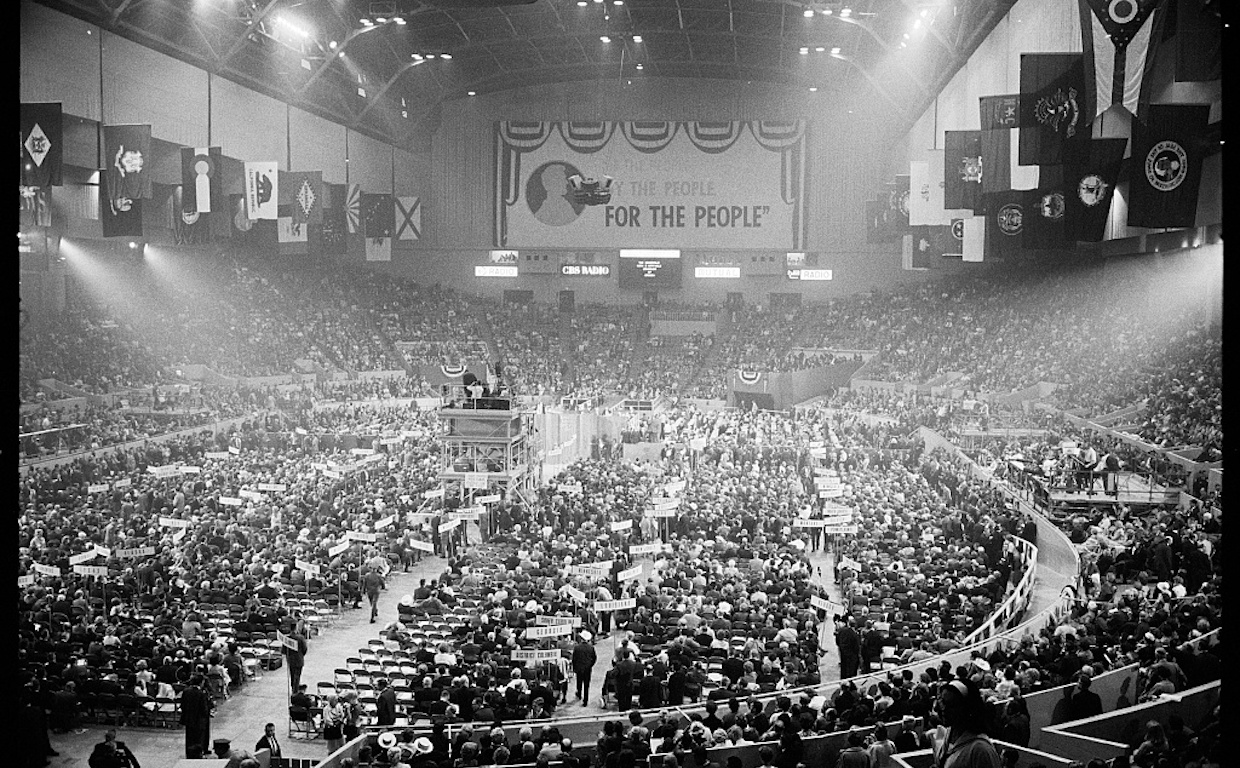
July 16, 1964: Senator Barry M. Goldwater of Arizona accepts the Republican Party's nomination for President, at their National Convention, at the Grand National Livestock Pavilion, a.k.a. the Cow Palace, just outside San Francisco in Daly City, California.

The site of the 1964 Republican National Convention may surprise people who know San Francisco as the most liberal city in America, which might not even be accurate. But, like all cities, San Francisco has its "old money" conservative elite. And this was the 2nd time the Grand Old Party had held its convention at the Cow Palace, built in 1940 for rodeo shows but later adapted for professional sports and concerts. They had previously nominated Dwight D. Eisenhower for a 2nd term there in 1956.

Then 55 years old, Goldwater was a Presbyterian, but had a Jewish grandfather, as the family name was originally Goldwasser. This makes the 1964 Republican Convention the closest either major party has ever come to nominating a Jewish person for President.

He was also very Western, living on a ranch outside Phoenix, with a solar-powered flagpole: Every morning, when the Sun came up, it raised the Stars & Stripes; every evening, when the Sun went down, the mechanism lowered the flag into a box.

A bomber pilot in World War II, Goldwater had been elected to the Phoenix City Council, and in 1952 defeated an incumbent Democrat for the U.S. Senate. Re-elected in 1958, he thought he could be the conservative alternative in 1960 to Vice President Richard Nixon, once considered the anti-Communist hard right's man, but now widely seen as more moderate -- the very thing that gave him a legitimate chance of election.

What is a conservative? According to Franklin D. Roosevelt, who knew difficulty walking, "A conservative is a man who, despite having two good legs, has never learned to walk forward." Comedian Mort Sahl said, "A conservative is someone who believes in reform -- but not now." Educator John Holt said, "Conservatism is the worship of dead radicals -- emphasis on the 'dead.'" (That quote is one of many that has been misattributed to Mark Twain.) Years later, Robert Orban would say, "A conservative is someone who wants the rules changed so that no one can make a pile the way he did."

No true conservative had been elected President since 1928, and that was Herbert Hoover, on whose watch the Great Depression began, and whose policies were seen as having made it worse, leading to his landslide loss to FDR in 1932. Every Republican nominee since had basically said, "We accept the New Deal, but we can do it better, and more efficiently, and with fewer Communists."

But there was another alternative to Nixon in 1960: Governor Nelson Rockefeller of New York, who had replaced a previous holder of his office, 1944 and 1948 Presidential nominee Thomas Dewey, as the leader of the moderate-to-liberal Eastern wing of the GOP. He wanted to be President, too. But he also wanted to win. So he invited Nixon to his apartment, and made a deal where he would endorse Nixon to hold off any conservative challenge. It became known as "The Compact of Fifth Avenue."

So, at the 1960 Republican Convention in Chicago, Goldwater told his supporters that they could take their party back, if they were properly organized: "Let's grow up, conservatives!"

Whether the conservative movement, as it came to be known, "grew up" is debatable: Conservatism has often listed from side to side, from old and stuffy to very childish. But they were very well organized, and, on the morning of November 22, 1963, with Nixon branded as a "loser," Goldwater and Rockefeller were the 2 leaders for the Party's nomination in 1964.

That day, John F. Kennedy, who had beaten Nixon in 1960, was assassinated. In his memoir, Goldwater admitted that his chance of winning had died with Kennedy. The 2 men had been friendly rivals, and Goldwater had really looked forward to a clash of ideas with JFK.

But with Vice President Lyndon B. Johnson now President, and sure to be the Democratic nominee in 1964, any chance for a real clash of ideas was doomed: LBJ would do anything to win, including "making Kennedy's ghost his running mate." His actual Vice Presidential nominee turned out to be Senator Hubert Humphrey of Minnesota, but he essentially "ran with JFK" every bit as much as Harry Truman ran with Franklin Roosevelt in 1948.

Goldwater told his advisers that he didn't want to run against Johnson. They told him that he had to do it, anyway, as the best way to continue the building of the conservative takeover of the Republican Party. To use a sports analogy, they were asking him to sacrifice himself, to "take one for the team."

And so he ran. He ran his campaign as a moral crusade, to bring down government spending, to end welfare programs that encouraged "immoral behavior," and to stand up to the Communist world better than the Democrats had.

His supporters took the "morality" thing even further, citing the fact that Rockefeller had divorced his first wife and quickly remarried -- as if that had anything to do with his qualifications for the job. When Goldwater refused to campaign in the Oregon Primary, and Rockefeller went, accompanied by signs saying, "He cared enough to come," Goldwater knew that the California Primary was it: Win it, or you're out.

And when Margaretta "Happy" Rockefeller gave birth to Nelson Rockefeller Jr. just 3 days before the Primary, it bolstered the "morality" argument by reminding voters of Rocky's divorce and remarriage --and the fact that Happy gave up custody of the children she already had, in order to more quickly gain the divorce, in order to more quickly marry the Governor. Goldwater won California, and clinched the nomination.

But right after that came the Senate's vote on the Civil Rights Act of 1964. Most of those voting against it were Southern Democrats. A higher percentage of Republicans than Democrats voted for it, because the Senate Minority Leader, Everett Dirksen of Illinois, was for it, and all but the most conservative of Republican Senators followed his lead.

But Goldwater voted against it -- on constitutional grounds, he said. But the vote tarred him as a racist, even though he wasn't one. He had gone out of his way to appeal to black, Hispanic, and Native American voters in Arizona. But most people outside that State didn't know that. There was no social media for people from Arizona to tell the other 49 States, "Hey, he's not like that! Let me show you what he's doing here!"

The fact that Senator Strom Thurmond of South Carolina, the "States' Rights" Presidential nominee of 1948, switched from the Democratic Party to the Republican Party after LBJ signed the bill, and then endorsed Goldwater, didn't help Goldwater at all -- at least, not outside the Deep South.

Jackie Robinson, the 1st black player in modern baseball, had been a Republican because he believed their favoring of "self-reliance" would be good for African-Americans. He had worked with Rockefeller on civil rights-friendly initiatives, all over New York State, and that had helped Rockefeller win black voters over.

Starting with his role as a Delegate from New York to the 1964 Republican National Convention, Robinson never voted for another Republican nominee for President. He told journalist Roger Kahn, who once covered Robinson's team, the Brooklyn Dodgers, for the New York Herald Tribune, "It would make everything I've worked for meaningless if baseball were integrated, but America's political parties were segregated."

That 1964 Convention set the standard for future ugly GOP Conventions to come in 1992, 2004 and 2016. Goldwater chose Representative William E. Miller of Western New York, then also the Chairman of the Republican National Committee, as his Vice Presidential nominee, "Because he drives Lyndon Johnson nuts."
The Cow Palace during the Convention

There was a proposed plank for the Party platform denouncing "extremist groups," specifically mentioning, on the left, the Communist Party; and, on the right, the Ku Klux Klan and the John Birch Society. They did not specifically mention liberal groups like Americans for Democratic Action (ADA), Students for a Democratic Society (SDS), or the Student Nonviolent Coordinating Committee (SNCC). The Black Panther Party had not yet been founded, so they couldn't be mentioned.

The problem was, many of Goldwater's supporters were in the Birch Society, including Fred Koch, an oil baron whose sons Charles and David followed in his footsteps as major conservative/libertarian donors, hated by liberals as "The Koch Brothers."

When Rockefeller came on to speak in favor of the plank, Goldwater supporters in the seats tried to boo him off the stage. It was a disgraceful spectacle, but Rocky stood up to them, and finished his speech. The plank was easily voted down, making the GOP look like extremists.
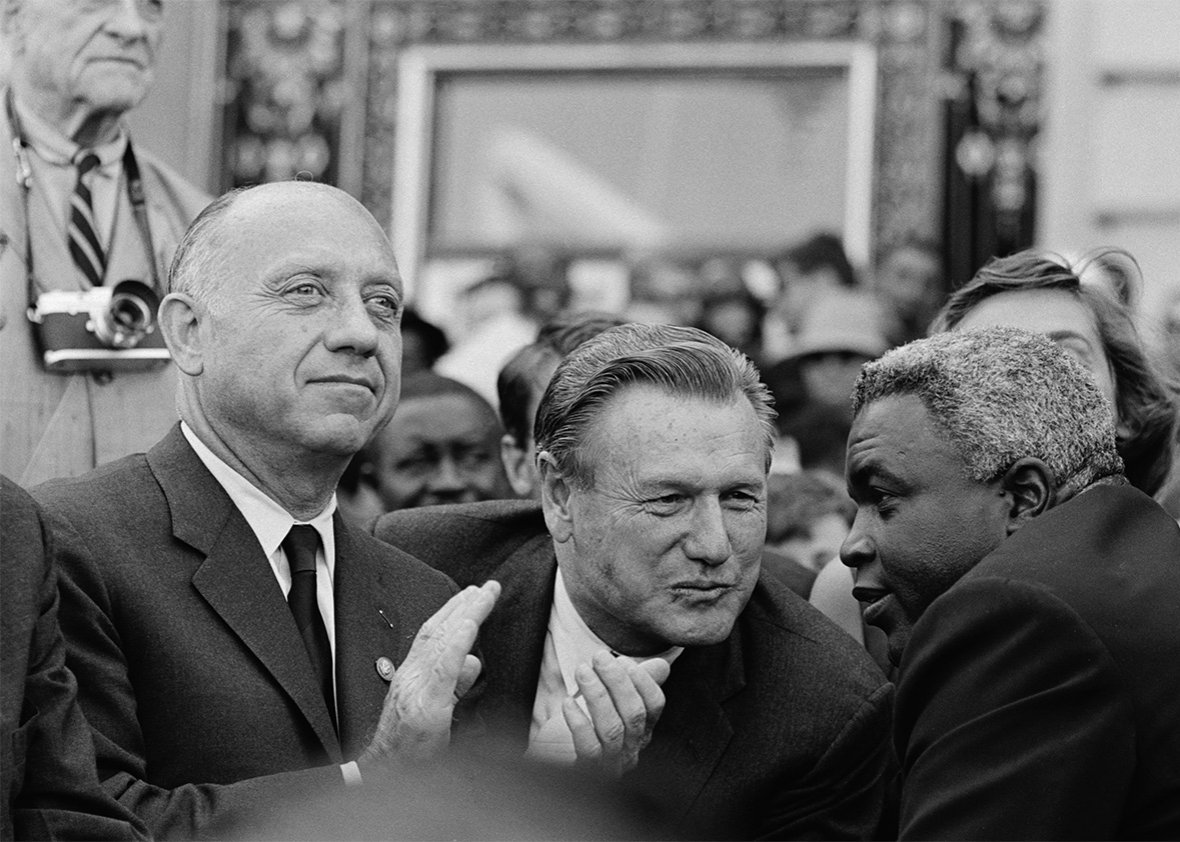
Three Delegates from New York. Left to right: Senator Jacob Javits,
Governor Nelson Rockefeller, and Jackie Robinson.

So, to use another sports analogy, Goldwater knew he needed a home run for his speech. He started off well: "This Party, with its every action, every word, every breath, and every heartbeat, has but a single resolve, and that is freedom. Freedom made orderly for this nation by our constitutional government. Freedom under a government limited by laws of nature and of nature's God. Freedom, balanced, so that order, lacking liberty, will not become the slavery of the prison cell; balanced, so that liberty, lacking order, will not become the license of the mob and of the jungle."

He knew that if he attacked the late President Kennedy and his policies, he had no chance. So he attacked the Democratic way in general: "During four futile years, the administration which we shall replace has distorted and lost that faith. It has talked and talked and talked and talked the words of freedom. Now, failures cement the wall of shame in Berlin. Failures blot the sands of shame at the Bay of Pigs. Failures mark the slow death of freedom in Laos. Failures infest the jungles of Vietnam."

This was a few days before what became known as the Gulf of Tonkin Incident. At the time, Berlin and Cuba were more familiar to Americans than Vietnam. At the time JFK took office, even Laos was more familiar.

Goldwater gave a few more platitudes about freedom, and fired a few more potshots at the Democrats. If he had then gone into his summation, it would have been a terrific speech. Instead, he addressed the need for unity within the Party's own ranks, and threw the Democrats a bone that they chewed on the rest of the way:

Anyone who joins us in all sincerity, we welcome. Those who do not care for our cause, we don't expect to enter our ranks in any case.

And let our Republicanism, so focused and so dedicated, not be made fuzzy and futile by unthinking and stupid labels.

Johnson would not go on to say it, but I can imagine a still-living Kennedy responding to this by saying, "I would remind you, my fellow Americans, that extremism in the defense of liberty is no defense of liberty."

What Johnson did go on to say was, "Extremism in the defense of liberty is an unpardonable vice. And moderation in the pursuit of justice is the highest virtue."

The Goldwater campaign produced buttons saying, "In your heart, you know he's right." The Johnson campaign produced buttons countering this, saying, "In your guts, you know he's nuts." And it produced other suggestions that he was too extreme to be President, including an ad known as the Daisy Spot.

Goldwater ended up winning only 6 States: His home State of Arizona, barely, and 5 Southern States who liked his apparent stance on civil rights, and may have been swayed by the Thurmond endorsement. In a few other Western States, embracing the idea of a Westerner becoming President, he came close.

But in most States, extremism was rejected as a defense of liberty. Richard Nixon, Ronald Reagan and both George Bushes learned from this campaign, and put a human face on conservative policies.

*

July 16, 1964 was a Thursday. Miguel Induráin, the Spanish (Basque) cyclist who won 5 straight Tours de France from 1991 to 1995, was born on this day.)

These baseball games were played:

* The New York Yankees lost to the Baltimore Orioles, 6-1 at Yankee Stadium. Steve Barber outpitched Jim Bouton, and helped his own cause with a home run. To counter the quote that Barber had in Bouton's later book Ball Four, Barber's arm wasn't sore, and it wasn't even a little stiff. Brooks Robinson went 1-for-2 with 2 walks. Mickey Mantle went 0-for-2 with 2 walks. Roger Maris went 0-for-4.

* The New York Mets lost to the Chicago Cubs, 11-1 at Wrigley Field in Chicago. Ernie Banks went 2-for-4 with 2 RBIs. The winning pitcher was Ernie Broglio, recently acquired for Curt Flood. For the rest of his tenure with the Cubs -- and in the major leagues -- he would go 9-15.

* The Chicago White Sox beat the Boston Red Sox, 9-3 at Fenway Park. Carl Yastrzemski and Tony Conigliaro both went 0-for-4.

* The Philadelphia Phillies beat the Pittsburgh Pirates, 7-5 at Forbes Field in Pittsburgh. Roberto Clemente went 2-for-5.

* The Cincinnati Reds beat the Houston Colt .45s, 3-2 at Crosley Field in Cincinnati. Frank Robinson went 0-for-4, and Pete Rose went 1-for-4. The Colt .45s became the Houston Astros the next year.

* The Milwaukee Braves beat the San Francisco Giants, 6-0 at Milwaukee County Stadium. Hank Fischer outpitches Gaylord Perry. Hank Aaron, Joe Torre and Denis Menke hit home runs for the Braves. Willie Mays went 1-for-4.

* The Washington Senators beat the Minnesota Twins, 7-2 at Metropolitan Stadium in the Minneapolis suburb of Bloomington, Minnesota. The only Twin runs came on solo homers by Bob Allison and Tony Oliva. Harmon Killebrew went 0-for-4.

* The Los Angeles Dodgers beat the St. Louis Cardinals, 10-2 at Busch Stadium (formerly Sportsman's Park) in St. Louis. Lou Brock went 2-for-4 in defeat.

* The Cleveland Indians beat the Kansas City Athletics, 12-9 at Kansas City Municipal Stadium. Woody Held won it with a home run in the top of the 10th inning.

* And the Detroit Tigers and the Los Angeles Angels were not scheduled to play.

Friday, July 1, 2022

July 1, 1946: Superman vs. the Ku Klux Klan

July 1, 1946: The Ku Klux Klan, America's leading proponents of bigotry, face one opponent they cannot defeat: Superman.

Superman, of course, is a fictional character. He does not exist in real life. He beat the Klan, anyway. With help.

In 1946, Stetson Kennedy, a human rights activist, 29 years old and a native of Jacksonville, Florida, infiltrated the KKK and other racist/terrorist groups. Concerned that the organization had links to the government and police forces -- which, in the Southern States, it most certainly did -- Kennedy decided to use its findings to strike at the Klan in a different way. (Note: William Stetson Kennedy, his full name, was not related to the Kennedy political family of Massachusetts.)
He contacted the producers of the Superman radio show, which was recorded at station WOR in New York, and syndicated nationally over the Mutual Broadcasting System. He proposed a story where the superhero, voiced by actor and game show host Bud Collyer (born Clayton Johnson Heermance Jr.), battles the Klan. Looking for new villains, and unable to reproduce the effects of some Superman opponents from the comic books due to budgetary reasons, the producers eagerly agreed.

Kennedy provided information, including details of Klan rituals and the like to the writers. The result was a series of episodes, "Clan of the Fiery Cross," in which Superman took on the Klan. The trivialization of the Klan's rituals and natures had a negative impact on Klan recruiting and membership numbers. According to one source, it "led to a steep decline in membership from which the KKK never recovered."

Reportedly, Klan leaders denounced the show, and called for a boycott of Kellogg's products, which sponsored the radio show. However, the story arc earned spectacular ratings, making Superman the most highly rated kids' radio program, and the food company stood by its support of the show. They later sponsored the TV show The Adventures of Superman, starring George Reeves.

Bud Collyer lived until 1969; Stetson Kennedy, until 2011. In 2019, Chinese-American writer Gene Luen Yang and the Japanese-American artist team calling itself Gurihiru adapted the story into a comic book series, Superman Smashes the Klan, setting it in 1946 like the original radio series, and making Chinese-Americans the focus, with assistance from African-Americans, the Daily Planet newspaper, and Superman himself.

*

July 1, 1946 was a Monday. These baseball games were played that day:

* The Brooklyn Dodgers beat the Philadelphia Phillies, 11-6 at Ebbets Field. Cookie Lavagetto went 3-for-5 with 2 RBIs.

* The Cleveland Indians beat the St. Louis Browns, 6-4 at Cleveland Municipal Stadium.

* The Detroit Tigers beat the Chicago White Sox, 2-0 at Briggs Stadium (later Tiger Stadium) in Detroit. Virgil Trucks pitches a 7-hit shutout. Roy Cullenbine hits a home run, and Hank Greenberg goes 1-for-4 with an RBI.

* The Pittsburgh Pirates beat the Chicago Cubs, 1-0 at Wrigley Field in Chicago. Rip Sewell pitched a 4-hit shutout, outpitching Hank Wyse.

* The Cincinnati Reds beat the St. Louis Cardinals, 5-4 at Sportsman's Park in St. Louis. Ray Lamanno hit a sacrifice fly to score Benny Zientara with the winning run in the top of the 13th inning. Al Libke went 3-for-5 with a home run, a walk, and 2 RBIs. Stan Musial went 0-for-6, but Enos Slaughter went 4-for-6.

* And the New York Yankees, the Boston Red Sox, the Philadelphia Athletics, the Washington Senators, the New York Giants and the Boston Braves were not scheduled.

Tuesday, June 21, 2022

June 21, 1964: The Murders in the Mississippi Freedom Summer

Left to right: Michael Schwerner, James Chaney and Andrew Goodman

June 21, 1964: Three men working on the "Mississippi Freedom Summer" project are murdered by agents of the Ku Klux Klan, outside the small city of Philadelphia, Mississippi. The assassination infuriates the nation.

Andrew Goodman was 20 years old, from the Upper East Side of Manhattan. Michael Schwerner was 24, from The Bronx. Both being Jewish, the felt the sense of the underdog from watching African-Americans struggle for their civil rights, and volunteers for the Freedom Summer project of the Congress of Racial Equality (CORE) in 1964, attempting to register black people to vote, and to change the course of governance in the Magnolia State. James Chaney was 20, a native of Meridian, Mississippi, and had been on the Freedom Rides in the early 1960s.

Goodman, Schwerner and Chaney were investigating the burning of Mt. Zion Methodist Church, which had been a site for a CORE Freedom School. In the wake of Schwerner and Chaney's voter registration rallies, parishioners had been beaten by Ku Klux Klan members. They accused the sheriff's deputy, Cecil Price, of stopping their caravan and forcing the deacons to kneel in the headlights of their own cars, while white men beat them with rifle butts. The same Klansmen who beat them were also identified as having burned the church.

Price arrested Chaney, Goodman, and Schwerner for an alleged traffic violation, and took them to the Neshoba County Jail. They were released that evening, without being allowed to telephone anyone. On the way back to Meridian, they were stopped by patrol lights and two carloads of KKK members on Highway 19, then taken in Price's car to another remote rural road. The men approached then shot and killed Schwerner, then Goodman, both with one shot in the heart; then Chaney with three shots, after severely beating him. They buried the young men in an earthen dam nearby.

The men's bodies remained undiscovered for 44 days. The FBI was brought into the case by John Doar, the U.S. Department of Justice representative in Mississippi monitoring the situation during Freedom Summer. The missing civil rights workers became a major national story, especially coming on top of other events as civil rights workers were active across Mississippi in a voter registration drive; and, the previous year, the March On Washington, and the uses in Birmingham, Alabama of firehoses and police dogs on demonstrators and the bombing of a church.

Schwerner's widow, Rita, who also worked for CORE in Meridian, expressed indignation that the press had ignored previous murders and disappearances of blacks in the area, but had highlighted this case because 2 white men from New York had gone missing. She said she believed that if only Chaney were missing, the case would not have received nearly as much attention.

The assassination inspired the songs "Mississippi Goddam" by Nina Simone and "Here's to the State of Mississippi" by Phil Ochs; and the 1988 film Mississippi Burning.

In 1967, the federal government charged 10 men with conspiracy to deprive the 3 murdered men of their civil rights, under the Enforcement Act of 1870, the only federal law then applying to the case. The jury convicted 7 men, including Deputy Sheriff Price; but 3 were acquitted, including Edgar Ray Killen, the former KKK organizer who had planned and directed the murders.

Price was sentenced to 6 years in prison, and served 4. He died in 2001. In 2005, the State of Mississippi convicted Killeen of 3 counts of manslaughter, and sentenced him to 60 years in prison. He died in prison in 2018, nearly 93 years old, having gotten away with the crime for 41 years.

The historical markers marking the locations of the murders of Emmett Till and of civil rights workers Andrew Goodman, Michael Schwerner and James Chaney, 9 years earlier, are 117 miles apart.

*

June 21, 1964 was a Sunday. This was also the day that Fascist Spain defeated the defending Champions, the Communist Soviet Union, to win the European Football Championship. I have a separate entry for that event.

As was often the case in that era, Sundays often featured baseball doubleheaders. These games were played:

* The Philadelphia Phillies swept a doubleheader from the New York Mets, 6-0 and 8-2 at Shea Stadium. In the opener, Jim Bunning pitched a perfect game for the Phillies, the 1st perfect game in the National League since 1880. It was Father's Day, and Bunning was already the father of 6 children. He would eventually have 9. It made him only the 2nd pitcher ever to pitch a no-hitter in each League: He had previously pitched one in the American League, for the Detroit Tigers in 1958. I have a separate entry for this event, too.
* The New York Yankees had one of their longest days, but a successful one, sweeping the Chicago White Sox, 2-0 and 2-1 at Comiskey Park in Chicago. In the opener, Jim Bouton pitched 3-hit shutout ball over 7 2/3rds innings, then Pete Mikkelsen went the rest of the way, completing a 4-hit shutout. Mickey Mantle and Elston Howard hit home runs.

The nightcap went 17 innings. With 1 out in the top of the 17th, Héctor López doubled of Don Mossi. White Sox manager Al López (no relation to Héctor) ordered that Howard be intentionally walked. But Mossi unintentionally walked Phil Linz to load the bases. Having no more available pinch-hitters, Yankee manager Yogi Berra sent pitcher Bill Stafford up to bat for himself. He hit a grounder to short, and future Met hero Al Weis bobbled it, allowing to Héctor to score. Stafford finished the South Siders off, getting the win. Al Downing had started, going 12 innings.

The games took a combined 26 innings to play, but, in time, just 6 hours and 42 minutes. To really show how times have changed, over those 26 innings, the Yankees used just 5 pitchers, although Mikkelsen pitched in both games. The Yankees ended up beating the White Sox for the Pennant by only 1 game, so this day may have decided the title.

* The Boston Red Sox beat the Baltimore Orioles, 9-6 at Memorial Stadium in Baltimore. Carl Yastrzemski went 3-for-4 with a walk and 2 RBIs. Brooks Robinson went 1-for-4 with a walk.

* The Chicago Cubs swept the Pittsburgh Pirates, 2-1 and 7-2 at Forbes Field in Pittsburgh. Ernie Banks went 1-for-8 with a walk and 2 RBIs, and Roberto Clemente went 0-for-8.

* A doubleheader was split at Crosley Field in Cincinnati. The Los Angeles Dodgers won the 1st game, 4-2. Sandy Koufax outpitched Bob Purkey. The Cincinnati Reds won the 2nd game, 2-1. Over the 2 games, Frank Robinson went 3-for-8. Pete Rose only appeared as a pinch-hitter in the 1st game, and did not reach base.

* The Houston Astros swept the Milwaukee Braves, 5-2 and 5-4 at Milwaukee County Stadium. Rusty Staub hit 2 home runs in the 1st game. Bob Bruce outpitched Warren Spahn. Ken Johnson won the 2nd game, and helped his own cause with a homer. Hank Aaron went 2-for-9 with 3 RBIs, but none was on a home run.

* The Detroit Tigers beat the Minnesota Twins, 4-2 at Metropolitan Stadium in the Minneapolis suburb of Bloomington, Minnesota. Al Kaline went 0-for-3, but drew a walk. Harmon Killebrew went 1-for-4.

* The San Francisco Giants beat the St. Louis Cardinals, 7-3 at Busch Stadium (formerly Sportsman's Park) in St. Louis. Willie Mays and Hal Lanier hit home runs for the Giants, while the newly-acquired Lou Brock did so for the Cardinals. Gaylord Perry pinch-hit for Giants starter Jack Sanford in the 6th, and had a sacrifice bunt. He then pitched the rest of the way for the save.

* The Washington Senators swept the Kansas City Athletics, 13-2 and 5-2 at Kansas City Municipal Stadium.

* And the Los Angeles Angels beat the Cleveland Indians, 4-1 at Dodger Stadium in Los Angeles, where the Angels groundshared with the Dodgers until their stadium in suburban Anaheim could open.

Monday, May 30, 2022

May 30, 1927: The Ku Klux Klan Rally In Queens

May 30, 1927: On this Memorial Day, a national holiday, the Ku Klux Klan marched in Queens to protest that "Native-born Protestant Americans" were being "assaulted by Roman Catholic police of New York City."

What, you thought the KKK only hated black people? They hate Catholics and Jews, too. In fact, given the way they treated the Governor of the State of New York, Alfred E. Smith, it could legitimately be argued that, in the 1920s, hating Catholics was a higher priority for them than hating blacks. Maybe not in the South, but definitely in the North.

According to an article in The New York Times, "1,000 white-robed Klansmen marched through the Jamaica neighborhood, eventually spurring an all-out brawl in which seven men were arrested."

Among those arrested, the article identifies a man with the name and address of the home of Fred Trump, in the Queens neighborhood of Jamaica. The article details the charges filed against six of the men. However, it does not identify any charges against Fred Trump, and merely states that he "was discharged."
The Times article did not say that Fred Trump was a member, or even a supporter, of the KKK, or whether he was a bystander, falsely accused or otherwise the victim of mistaken identity during the chaotic event.

A contemporaneous article from another newspaper, the Daily Star, noted that Fred Trump was detained "on a charge of refusing to disperse from a parade when ordered to do so."

Frederick Christ Trump -- and that's pronounced "Krihst," not "Krighst" like in Jesus' title -- was born on October 11, 1905, in The Bronx, meaning he was 21 years old at the time of the arrest. Although both of his parents were born in Germany -- Fred's grandfather had changed the name from "Drumpf" -- long after World War II, Fred told people that his family was of Swedish origin. According to his nephew John Walter, "He had a lot of Jewish tenants, and it wasn't a good thing to be German in those days."

He went into the real estate business, owning apartment buildings in Queens and Brooklyn. In 1950, folksinger Woody Guthrie rented one of Fred Trump's buildings, and wrote a song titled "Old Man Trump" (Fred was 45, 7 years older than Guthrie), about how he stirred up racial hate "in the bloodpot of human hearts."

In 1954, Fred was investigated by a U.S. Senate committee for profiteering from public contracts, including overstating his Beach Haven building charges by $3.7 million -- about $40 million in 2022 money. He ended up not being charged.

He was listed as chairman of The Trump Organization. His son Donald, born on June 14, 1946, would become the Organization's president. On October 16, 1973, 27-year-old Donald's name appeared in The New York Times for the 1st time. It was in an article about how the Civil Rights Division of the U.S. Department of Justice filed suit against the Trump Organization, charging them with violating the Fair Housing Act of 1968. Within 2 years, the case was settled, with both sides claiming victory.

But think about that for a moment: The U.S. Department of Justice. The federal government. In 1973. This means that Fred and Donald Trump were, officially, too racist for Richard Nixon.

Donald was not Fred's oldest child: That would be Maryanne Trump Barry, who became a federal Judge appointed by, oddly, President Bill Clinton. Unlike her father and her brother, she has never been accused of any impropriety.

Nor was Donald Fred's oldest son. That was Frederick Christ Trump Jr. But being the eldest son and the namesake didn't help Freddy. He wasn't strong like his father. He was weak. Weak enough to become an alcoholic. (This is known, as opposed to Donald's addictions to the drugs cocaine and Adderall, which remain, for the moment, pure speculation.)

Freddy became a pilot with Trans World Airlines. (Another company associated with the Trumps that has since gone out of business, although I don't think any member of the family can be blamed for it.) As far as I know, there was never an incident of him flying drunk. Nevertheless, Freddy died in 1981, at age 43, as a result of complications of his drinking.

For this reason, Donald not only swore off alcohol -- except for his brief marketing of Trump Vodka, which apparently didn't wash Trump Steaks down well -- but learned to be the strong, tough son for his father that Freddy wasn't.

The results speak for themselves: Donald merely talks tough, but is truly a bigoted, whiny little bitch. Just like his daddy was.

From his father, Donald learned that discrimination was okay, and that you had to be strong, and fight every perceived slight.
By the time Donald married Marla Maples in 1993, by which point he had become one of the most famous (but not, as he claimed, one of the richest) people in America, Fred had begun to fall victim to Alzheimer's disease. He died on June 25, 1999, at the age of 93.

Is there any publicly known proof that Fred Trump was a member of the Ku Klux Klan, or even a sympathizer? No. Is there evidence? Yes. Certainly, the amount of evidence gathered since 1927 suggests that, at the very least, he shared their views toward black people.

When asked about the issue in September 2015 by The New York Times, Donald lied, and denied that his father had been arrested:

He was never arrested. He has nothing to do with this. This never happened. This is nonsense and it never happened...

This never happened. Never took place. He was never arrested, never convicted, never even charged. It's a completely false, ridiculous story. He was never there! It never happened. Never took place.

But it did. Whatever Fred Trump had done, 88 Memorial Days earlier, he had been arrested.

Criminal behavior, like bigotry, cruelty and cowardice, runs in the Trump family.

*

May 30, 1927 was a Monday -- but, at the time, that was not a given: May 30 had been Memorial Day in America since 1868, and it wasn't until 1968 that it became, by law, the last Monday in May, and thus a 3-day weekend.

As was once traditional, baseball teams played doubleheaders on Memorial Day. This time, all 16 teams then in the major leagues played them:

* The New York Yankees split with the Philadelphia Athletics at Shibe Park in Philadelphia. The A's won the opener, 9-8. Lefty Grove went the distance, but George Pipgras didn't get out of the 3rd inning. The  Yankees won the nightcap, 6-5. Babe Ruth won it with a home run in the top of the 11th inning, the 14th of 60 home runs he would hit that season.

Over the 2 games, Ruth went 4-for-9 with 2 walks and 2 RBIs, Lou Gehrig went 5-for-10 with a walk and 5 RBIs; and Ty Cobb, running out the string with the A's, went 1-for-6 with 6 walks.

* A weird doubleheader was played at the Polo Grounds. The 1st game had a football score: The New York Giants beat the Philadelphia Phillies, 14-10. The 2nd game had a soccer score: The Phillies won, 1-0. For the Giants, Rogers Hornsby went 2-for-5 with 2 walks and 2 RBIs, Bill Terry went 2-for-9 with 3 RBIs, and Mel Ott went 0-for-3 with 2 walks in the 1st game and sat out the 2nd game.

* The Brooklyn Robins -- as the Dodgers were known from 1914 to 1931, while Wilbert Robinson was their manager -- swept the Boston Braves, 5-2 and 6-2 at Braves Field in Boston. Babe Herman went 0-for-3 in the 1st game, but 3-for-5 with 4 RBIs in the 2nd game.

* The Washington Senators swept the Boston Red Sox, 3-0 and 13-5 at Griffith Stadium in Washington. Walter Johnson pitched a 3-hit shutout in the 1st game. Having started the season injured, this was his 1st appearance, and it was his 113th career shutout, still far and away a major league record. It was his last. And it was his 413th career win, still far and away an American League record, and 2nd only to Cy Young overall. He would win 4 more games, and made his last major league appearance on September 30 of that year -- as a pinch-hitter, against the Yankees, in the same game where Ruth his his 60th homer.

* There was a split at Forbes Field in Pittsburgh. The Chicago Cubs won the 1st game, 7-6. Their shortstop, Jimmy Cooney, turned an unassisted triple play in the bottom of the 4th inning, off a line drive by Paul Waner. Hack Wilson singled Sparky Adams home with the winning run in the top of the 10th inning. The Pittsburgh Pirates won the 2nd game, 6-5. This game also went 10 innings, and Joe Harris singled Glenn Wright home with the winning run.

* There was a split at Navin Field in Detroit. (It was renamed Briggs Stadium in 1938, and Tiger Stadium in 1961.) The Cleveland Indians won the 1st game, 9-8. The Detroit Tigers won the 2nd game, 11-3.

* There was a split at Comiskey Park in Chicago. The St. Louis Browns won the 1st game, 11-3. The Chicago White Sox won the 2nd game, 10-0. Alphonse "Tommy" Thomas pitched a 7-hit shutout.

* And the St. Louis Cardinals swept the Cincinnati Reds, 6-3 and 3-1 at Sportsman's Park in St. Louis.

December 31, 1999 & January 1, 2000: The Millennium

December 31, 1999:  The Millennium arrives. The people of planet Earth survived. At a terrible cost. But we hadn't destroyed ourselves. ...