Showing posts with label nfl championship game. Show all posts

Saturday, December 31, 2022

December 31, 1961: Those Who Stayed Were Champions

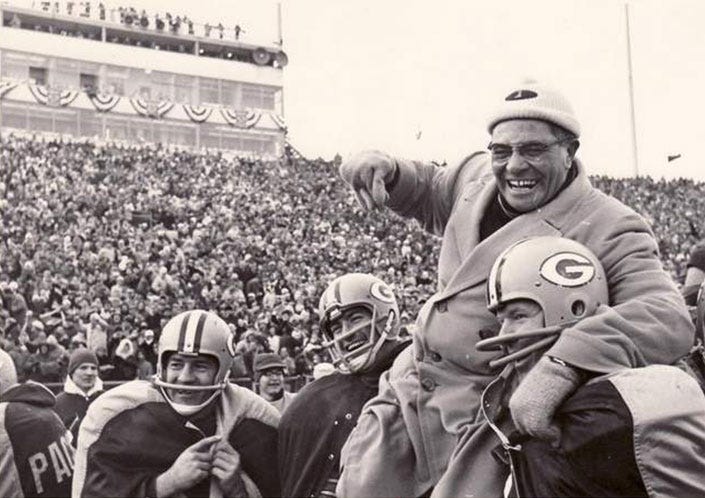
December 31, 1961: The NFL Championship Game is played at the 2nd City Stadium in Green Bay, Wisconsin. In 1965, it will be renamed Lambeau Field.

In spite of the previous success of the Green Bay Packers, this is the 1st time the game is played in Green Bay. The previous City Stadium had never hosted it. The Packers had finished 1st in the NFL in 1929, 1930 and 1931; and 2nd behind a team that would have been in the Eastern Division in 1927. But there was no NFL Championship Game for them to host, or for which to be the visiting team, until 1933.

Once that was established, the way the old system worked out, the Championship Game was hosted by the Eastern Division winners in even-numbered years, and the Western Division winners in odd-numbered years. The Packers won the West in 1936, 1938, 1944 and 1960, and played the Championship Game on the road. Their only previous time hosting was in 1939, and with a seating capacity of just 25,000, City Stadium was considered too small, so they moved it to Wisconsin State Fair Park in the Milwaukee suburb of West Allis. They won, beating the New York Giants, 27-0.

In 1956, the NFL gave the Packers an ultimatum: Build a bigger stadium, or move. They built what became Lambeau Field in 1957, and seating capacity was 32,500. By 1961, it was 38,669. (By the time of the 1967 title game, the Ice Bowl, it was 50,861. It reached 56,263 in 1970, 60,890 in 1990, 72,515 in 2003, and 81,441 by 2013.) Now, all they had to do was qualify for the title game, by winning the Western Division.

The 1961 season was also the one in which the teams involved adopted their familiar helmet logos: The Packers, football-shaped "G" monogram, for Green Bay (they've never used a "GB," although Lombardi had practice caps made with such a logo); the Giants, the lower-case "ny," for "New York."

The Giants won the NFL Championship in 1956, with head coach Jim Lee Howell. What we would now call his offensive coordinator was Vince Lombardi, and his defensive coordinator was Tom Landry. Lombardi left to become the head coach of the Packers in 1959. Landry left to become the head coach of the expansion Dallas Cowboys in 1960. It would take them a few years to get their act together.

Meanwhile, the Giants again reached the Championship Game in 1958 and 1959, losing to the Baltimore Colts both times. In 1961, Allie Sherman replaced Howell as Giants head coach, and Y.A. Tittle replaced Charley Conerly as quarterback. But running back Frank Gifford came out of retirement, and Sam Huff still led the best defense in the NFL.

The Giants lost their opener, home to the St. Louis Cardinals, then won 5 straight -- the 1st 4 on the road, as the New York Yankees kept using Yankee Stadium all the way to the World Series -- then lost at home to the Dallas Cowboys, won 4 straight, lost to the Packers in Green Bay, beat the defending Champion Philadelphia Eagles away, and finished with a home tie with the Cleveland Browns. At 10-3-1, they won the Eastern Division.

Back to Lombardi: When he arrived, the Packers were coming off a 1-10-1 season. He told his players, "We may not win, but we won't be losing with the same people." With that in mind, he cut the man then regarded as the team's best player, end Billy Howton, because he didn't think Howton was serious enough.

But he kept the actual best player, Paul Hornung: While Hornung was the life of the party off the field, he was completely dedicated on it. And that summed up what Lombardi meant when he gave the Packers their slogan: "Those who stay will be champions."

Sure enough, in just 1 season, having gotten rid of the unserious, and having promoted the dedicated, he took the Packers to to 7-5. In 1960, they went 8-4, and won the Western Division, but lost the NFL Championship Game to the Philadelphia Eagles. It would be the only postseason game Lombardi ever lost.

In 1961, they lost their opener to the Detroit Lions in Milwaukee, then won 6 straight, lost to away to the Baltimore Colts, won their next 4, lost away to the San Francisco 49ers, and closed with a win away to the Los Angeles Rams, finishing 11-3.

With Bart Starr quarterbacking an offense with Hornung and Jim Taylor running, Boyd Dowler receiving, and one of the great offensive lines of all time, including Hall-of-Famers Jim Ringo at center, Jerry Kramer at guard and Forrest Gregg at tackle -- Lombardi called Gregg "the finest player I ever coached," and he later coached the Cincinnati Bengals into their 1st Super Bowl -- the Pack dropped 49 points on the Browns, 45 on the Colts, and 35 on the Rams.

The defense was fearsome, with end Willie Davis, tackle Henry Jordan, linebacker Ray Nitschke, cornerback Herb Adderley, and safeties Willie Wood, and former Giant Emlen Tunnell all going to the Hall of Fame. They shut out the Chicago Bears, held the Colts and the Minnesota Vikings to just 7 points each, held the Lions to 9 in their rematch, and held the 49ers in their earlier win and the Vikings in their other game to 10.

This was the 1st title game played in Green Bay, which would become famous for its cold weather, especially after the 1967 NFL Championship Game, which became known as the Ice Bowl. Green Bay wasn't the furthest-north city in the NFL anymore -- the expansion Vikings now were -- but they were further north than 2 of the Canadian Football League's 9 teams, the Toronto Argonauts and the Hamilton Tiger-Cats.

For the 3rd time, the Giants faced a frozen field for an NFL Championship Game. For the 3rd time, they decided to try sneakers rather than cleats, to get better traction. (This would eventually be outlawed.) In 1934 and 1956, both times against the Bears, it worked. This time, it didn't.

The game kicked off at 1:00 PM Central Time (2:00 Eastern). The 1st quarter ended with the game scoreless, and that would be the highlight of the day for the Giants. It was all Packers: Hornung scored on a 6-yard run, Starr threw a 13-yard pass to Dowler, Starr threw a 14-yard pass to Ron Kramer, and Hornung kicked a 17-yard field goal -- all in the 2nd quarter. Green Bay led, 24-0.

In the 3rd quarter, Hornung kicked a 22-yard field goal, and Starr threw a 13-yard touchdown pass to Kramer. Hornung added a 19-yard field goal. Meanwhile, the Packer defense completely shut Big Blue down. Packers 37, Giants 0. It was only the 5th shutout in an NFL Championship Game -- and, after 4 more NFL Championship Games and 56 Super Bowls, it remains the last. (The 1939 game was also a Packer shutout of the Giants, 27-0.

The Packers beat the Giants again in the 1962 NFL Championship Game, 16-7 at Yankee Stadium. The Giants made one more Championship Game in 1963, losing to the Chicago Bears, then collapsed, not reaching the Playoffs again until 1981.

The Packers fell short in 1963 and 1964, then became the only team ever to win 3 straight NFL Championship Games: 1965, 1966 and 1967. This included the 1st 2 Super Bowls, before Lombardi retired. After coaching the Washington Redskins to a big improvement in 1969, Lombardi developed colon cancer, and died the next year.

Nevertheless, he was right about his Packers: In 7 seasons, 5 times, those who stayed were champions.

UPDATE: The Packers have the largest team Hall of Fame in North American sports. Through the 2025 NFL season, the inductees from the Lombardi Era, 1959 to 1968, are:

* Offense: Quarterbacks Bart Starr and Zeke Bratkowski; running backs Paul Hornung, Jim Taylor, Elijah Pitts, Donny Anderson and Travis Williams; wide receivers Gary Knafelc, Ron Kramer, Max McGee and Boyd Dowler; tight ends Marv Fleming and Carroll Dale; centeres Jim Ringo and Ken Bowman; guards Jerry Kramer, Fred "Fuzzy" Thurston and Gale Gillingham; tackles Forrest Gregg, and Bob Skoronski; and kicker-punter Don Chandler.

* Defense: Ends Willie Davis, Dave Hanner and Lionel Aldridge; tackles Henry Jordan and Ron Kostelnik; linebackers Ray Nitschke, Bill Forester, Dan Currie, Dave Robinson and Lee Roy Caffey; cornerbacks Herb Adderley and Jesse Whittenton; and safeties Willie Wood and Bob Jeter.

* Management: Head coach and general manager Vince Lombardi, assistant coaches Red Cochran and Phil Bengtson; scout Jack Vainisi; longtime executives Fred Leicht, Frederick Trowbridge, Jerry Atkinson, Dominic Olejniczak and Tom Miller; trainer Bud Jorgensen and team physician E.S. Brusky; team historian Lee Remmel; team photographer Vernon Biever; band director Wilner Burke; video director Al Treml; broadcaster Ray Scott; journalist Art Daley; the Hall of Fame's founder, William Brault; and longtime Packer fan Al Schneider.

Lombardi, Starr, Hornung, Taylor, Kramer, Thurston, Davis and Nitschke have also been inducted into the Wisconsin Athletic Hall of Fame.

After Lombardi left, it would be a long time before there was another title. Elected to the Packers Hall of Fame from the 1970s: Linebacker Fred Carr, cornerbacks Ken Ellis and Willie Buchanon, running back John Brockington, and placekicker Chester Marcol.

Elected from the 1980s: Quarterbacks Lynn Dickey and Don Majkowski; running back Gerry Ellis; receivers James Lofton and Sterling Sharpe; tight end Paul Coffman; center Larry McCarren; tackle Greg Koch; defensive end Ezra Johnson; linebackers Mike Douglass, John Anderson, Tim Harris and Johnny Holland; cornerback Mark Lee; safeties Johnny Gray and Mark Murphy (not to be confused with the Mark Murphy who was Packer team president from 2007 to 2025); placekicker Jan Stenerud; and executive Robert Parins.

*

December 31, 1961 was a Sunday. The AFL Championship had been played a week earlier, with the Houston Oilers beating the San Diego Chargers, 10-3 at Balboa Stadium in San Diego. There had been 2 college bowl games the day before the NFL Championship Game, and the 4 major bowls were played the next day, New Year's Day. This included the Sugar Bowl, at Tulane Stadium in New Orleans, in which Number 1-ranked Alabama clinched the National Championship, beating Arkansas, 10-3.

Baseball was out of season. The NBA scheduled no games for the day. The NHL scheduled 2. The New York Rangers lost to the Boston Bruins, 7-4 at the old Madison Square Garden. And the Detroit Red Wings beat the Toronto Maple Leafs, 4-2 at the Olympia Stadium in Detroit. The Montreal Canadiens and the Chicago Black Hawks were not scheduled.

Friday, December 30, 2022

December 30, 1962: The Birth of NFL Films

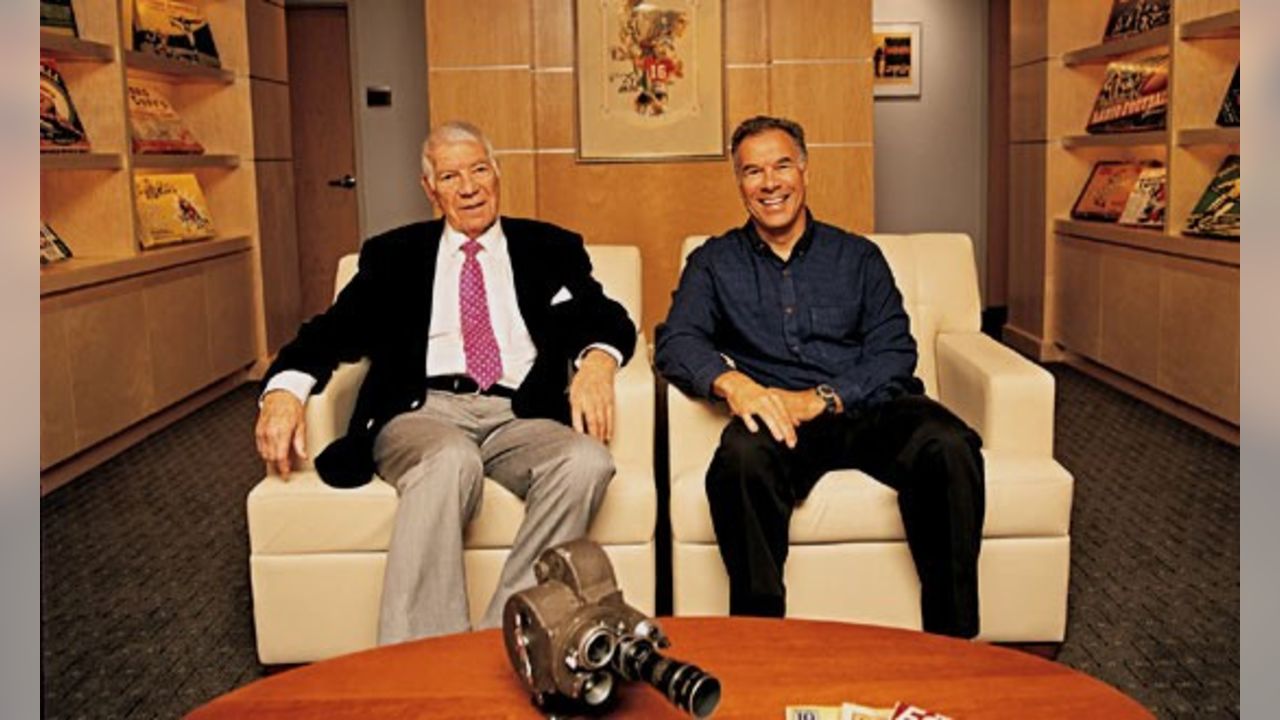
Ed Sabol (left), Steve Sabol,
and the camera that started it all.

December 30, 1962: The Green Bay Packers beat the New York Giants, 16-7 at Yankee Stadium in The Bronx. Aside from being bitterly cold, with New York dealing with the kind of weather that Green Bay was used to, the game itself was not especially remarkable.

But it was filmed by a crew from Blair Motion Pictures of Philadelphia. This was the birth of NFL Films. That company would be nearly as responsible for the League's growth in popularity as Commissioner Pete Rozelle and the various television network executives.

A son of Romanian Jewish immigrants, growing up in Blairstown, Warren County, New Jersey, Ed Sabol served in World War II, then sold topcoats. But he got a home movie camera as a wedding present. He used it to record his son Steve's high school football games. Then he formed a small film company, named for his daughter, Blair. In 1962, he won the rights to film the NFL Championship Game, by bidding $5,000. And even that was double the winning bid of the season before.

Rozelle was impressed by the resulting film, and in 1965, the NFL team owners bought Blair Motion Pictures, renaming it NFL Films. Each of the League's 14 team owners gave Ed $20,000, and the right to shoot all NFL games, and produce an annual highlight film for each team.

In 1967, NFL Films released a half-hour documentary, The Call It Pro Football, including footage of the game that was retroactively renamed Super Bowl I. It began with the narrator, Philadelphia newscaster John Facenda, saying, "It starts with a whistle, and ends with a gun. Sixty minutes of close-in action from kickoff to touchdown. This is pro football: The sport of our time." It was one of the earliest successes for the company.

In 1970, ABC began broadcasting Monday Night Football, and, during halftime, showed NFL Films' footage of the previous day's games. In 1971, the company began producing This Is the NFL, a Saturday show that showed highlights of the previous week's games, on CBS, featuring the network's lead announcing team, former New York Giants tackle and kicker Pat Summerall, and former Philadelphia Eagles cornerback Tom Brookshier. That program did such a great job of raising the NFL's profile, it inspired Major League Baseball to start Major League Baseball Productions, and start the series This Week In Baseball in 1977.

Three things stood out in NFL Films' broadcasts: The marching-band music, the use of slow motion to capture things like the spinning of a passed football in flight, and the narration of Facenda. Let the record show, however, that he never described the field in Green Bay as "the frozen tundra of Lambeau Field." That was later ESPN announcer Chris Berman, imitating him.

ESPN eventually began doing historical programs, featuring footage from NFL Films' vault at their massive headquarters in Mount Laurel, Burlington County, New Jersey, a suburb of Philadelphia; and interviews with surviving figures from those films, conducted by Steve Sabol.

These included Old Leather, from 1976, about stars of the 1920s, with Red Grange, Fritz Pollard, and Johnny "Blood" McNally among those alive and well enough to sit for interviews; and Their Deeds and Dogged Faith, from 1977, about some of the toughest figures in NFL history, including Chicago Bears (and NFL) founder George Halas.

Facenda died in 1984, his last film being the highlights of Super Bowl XVIII. Another Philadelphia broadcast legend, Phillies announcer Harry Kalas, took over until his death in 2009. They have used various announcers since.

Ed Sabol was elected to the Pro Football Hall of Fame as a "Contributor" in 2011. It seemed to be just in time: He was 95 years old and in a wheelchair; and Steve was dealing with brain cancer. Steve died the next year, at age 69. Ed lived until 2015, age 98. Steve was posthumously elected to the Hall in 2020.

*

December 30, 1962 was a Sunday. There were no other football games that day: The NCAA had college football bowl games scheduled for the day before and the day after, but not this day; and the AFL Championship Game was the week before, with the Dallas Texans (soon to be the Kansas City Chiefs) beating the Houston Oilers in double overtime.

There were 2 games played in the NBA. The Los Angeles Lakers beat the Detroit Pistons, 135-130 at Cobo Hall (now Huntington Place) in Detroit. Elgin Baylor scored 38 points. And the St. Louis Hawks beat the Chicago Zephyrs, 107-100 at the Chicago Coliseum. The failing Zephyrs moved the next season, becoming the Baltimore Bullets. They moved to Washington in 1973, and became the Washington Wizards in 1997.

There were 2 games played in the NHL. The New York Rangers and the Montreal Canadiens played to a 4-4 tie at the old Madison Square Garden. And the Chicago Black Hawks beat the Boston Bruins, 4-2 at the Chicago Stadium. The Toronto Maple Leafs and the Detroit Red Wings were not scheduled. 

December 30, 1956: "De-FENSE!"

Sam Huff

December 30, 1956: The NFL Championship Game is played at Yankee Stadium. This was the 1st season in which the football version of the New York Giants played their home games there, after 31 seasons across the Harlem River, at the Polo Grounds, home of the baseball Giants.

The Giants selected linebacker Sam Huff of West Virginia in the 3rd round of the 1956 NFL Draft. He did not get along with head coach Jim Lee Howell, and quit. But before he could get on a plane to go home, the team's offensive coordinator caught him at the airport, and talked him into going back. That coach's name was Vince Lombardi.

The defensive coordinator was Tom Landry, who had been perhaps the 1st player in the two-platoon era to became a great defensive back without also playing on offense. He devised the 4-3 defense, with 2 tackles, 2 ends, and 3 linebackers, and dropped Huff to the position of middle linebacker, which did not previously exist. (Up to then, most teams used a 5-2 defense.)

Huff recalled, "Before, I always had my head down, looking right into the center's helmet. Now, I was standing up, and I could see everything, and I mean everything. I always had outstanding peripheral vision. It's one of the reasons I was so perfectly suited for the position."

The Giants had a good offense, with quarterback Charley Conerly; running backs Frank Gifford, Mel Triplett and Alex Webster; end Kyle Rote; and offensive tackle Roosevelt Brown. But, for the 1st time in NFL history, it was a defense that caught everybody's attention. Before the various Fearsome Foursomes (at least 3 teams had lines nicknamed that), before the No-Name Defense in Miami, before the Steel Curtain in Pittsburgh, before the Doomsday Defense in Dallas, before the Jets' New York Sack Exchange, and before the 46 Defense in Chicago, there was the Big Blue Wrecking Crew.

The tackles were Dick Modzelewski and Rosey Grier. The ends were Jim Katcavage and Andy Robustelli. The linebackers were Sam Huff, flanked by Bill Svoboda and Harland Svare. The cornerbacks were Ed Hughes and Dick Nolan. The safeties were Emlen Tunnell and Jimmy Patton. They were so good, a new chant rang around the rafters of the pre-renovation original Yankee Stadium: "De-FENSE! De-FENSE! De-FENSE!"

Huff said, "Landry built the 4-3 defense around me. It revolutionized defense, and opened the door for all the variations of zones and man-to-man coverage, which are used in conjunction with it today."

Gifford, the 1st in a long line of great tailbacks at the University of Southern California, was the glamour boy on offense, but Huff became that on defense. And on December 30, 1956, with the field at Yankee Stadium frozen solid, the Giants played the NFL Championship Game against the Chicago Bears. They were a far cry from the "Monsters of the Midway" who had dominated the NFL in the 1940s.

Three weeks earlier, on December 9, the Bears were playing the Chicago Cardinals at Wrigley Field, in a game that would be depicted in an episode of the ABC sitcom Happy Days. Ed Brown, playing quarterback for the Bears, threw an interception. Richie Cunningham, played by Ron Howard, said he wanted the other quarterback put in. His friend Ralph Malph, played by Donny Most, said of that quarterback, "He's washed up. He's old. He's 30. He's got no future." Richie said, "George Blanda has 2 or 3 good years left."

The Bears won the game, 10-3. And, while Brown got the Bears into the Championship Game, Blanda kept on playing and playing and playing, until the 1975 AFC Championship Game, played 16 days before that episode of Happy Days aired.

Record-wise, the Bears were better, 9-2-1, compared to the Giants' 8-3-1. But the game was no contest. Especially since, echoing their 1934 Championship Game win over the Bears, the Giants wore sneakers instead of shoes with cleats, getting better traction on the frozen field. This would finally be outlawed -- too late for the Bears.

Tunnell returned Blanda's opening kickoff 53 yards. Just 3 plays later, Triplett ran 17 yards for a touchdown. On the Bears' 1t play from scrimmage, Brown fumbled a handoff, and the Giants recovered. On their next drive, Brown was intercepted by Jim Patton. Both times, Ben Agajanian kicked a field goal, and the Giants ended the 1st quarter up 13-0.

In the 2nd quarter, Alex Webster scored on a 3-yard touchdown run. Rick Casares ran the ball in from 9 yards to put the Bears on the scoreboard. They would not get on it again. Before the half was out, Webster would score another touchdown, and Henry Moore would block a punt in the end zone, making it 34-7 New York.

As Huff and the dee-fense continued to shut the Bears down (if not quite shutting them out), the Giants carried out the kind of ball-control offense that Bill Parcells would use for them 30 years later. In the 3rd quarter, Conerly threw a 9-yard touchdown pass to Rote, although Agajanian missed the extra point. In the 4th quarter, Conerly threw a 14-yard pass to Gifford. Final score: Giants 47, Bears 7. It wasn't a "miracle on ice," it was a massacre on ice.

This began a run of 8 seasons in which the Giants would win their Division 6 times, but they wouldn't win the NFL Championship Game again. In 1958, the Giants hosted the Baltimore Colts, and lost in overtime, in what has become known as "The Greatest Game Ever Played." In 1959, they had a rematch at Memorial Stadium in Baltimore, and the Colts won again.

By that point, Lombardi was gone, having been named the head coach of the Green Bay Packers. In 1960, Landry was named the 1st head coach of the expansion Dallas Cowboys. That season, the Giants lost the Division title to the Philadelphia Eagles, after a fumble-forcing tackle by Chuck Bednarik knocked Gifford out for the rest of the season.

Gifford sat out the 1961 season, while Allie Sherman was named the Giants' new head coach, and Y.A. Tittle replaced Conerly as quarterback. They won the Division again, but lost the Championship Game to Lombardi's Packers on a snow-strewn Lambeau Field on New Year's Eve. In 1962, with Gifford returning, it was Giants vs. Packers again, this time at Yankee Stadium, again with the field frozen, and the Packers won. In 1963, on yet another frozen field, the Giants went out against the Bears at Wrigley Field, and lost a tough battle.

All the while, Huff became more and more famous. He was named to 5 Pro Bowls. Time magazine had placed college football players on its cover before, but Huff became the 1st NFL player on it, for its issue dated November 30, 1959.

In the 1960 preseason, the CBS news program The Twentieth Century approached Huff, offering to put a microphone on his uniform for practices and an exhibition game, to show TV viewers what a football game really sounded like. Hosted by Walter Cronkite, it was titled "The Violent World of Sam Huff," and it aired, perhaps appropriately, on October 30, Mischief Night.

How successful was the program? The next day, a CBS executive wrote a letter, put it in an envelope, and wrote nothing on the envelope except "Number 70." No actual name, no return address, nothing except "Number 70." Three days later, the letter was delivered to Huff's locker at Yankee Stadium.

The U.S. Postal Service employees knew exactly what, and who, it meant. Even before Lawrence Taylor was born, Huff might have been a better linebacker.

The team seemed to get old all at once in 1964. Huff was traded to the Washington Redskins, Tunnell was already gone, and 1964 would be the last season for Tittle, Gifford and Robustelli. Roosevelt Brown lasted 1 more season. The Yankees, too, seemed to get old overnight between the Autumn of 1964 and the Spring of 1965. Yankee Stadium became a very different place through its closing for renovations in 1973.

In October 1976, the Yankees would be back in the World Series, in a renovated Yankee Stadium; while the new Giants Stadium opened in the New Jersey Meadowlands. It took until 1981 for the Giants to make the Playoffs again, and the 1986 season before they won another title.

*

December 30, 1956 was a Sunday. Actresses Sheryl Lee Ralph and Patricia Kalember were born.

At the time, the NCAA did not permit college football games, even bowl games, to be played on Sundays. Baseball was out of season. There were 4 games played in the NBA:

* The New York Knicks beat the Rochester Royals, 96-88 at the old Madison Square Garden. Kenny Sears scored 33 points for the Knicks. This would be the last season in Rochester, as the Royals moved to Cincinnati for 1957-58.

* The Boston Celtics beat the Syracuse Nationals, 105-92 at the Boston Garden.

* The Fort Wayne Pistons beat the Philadelphia Warriors, 104-99 at the Allen County War Memorial Coliseum in Fort Wayne, Indiana. In spite of the defeat, the Warriors' Paul Arizin scored 35 points. This would be the last season in Fort Wayne, as the Pistons moved to Detroit for 1957-58.

* And the St. Louis Hawks beat the Minneapolis Lakers, 100-93 at the Kiel Auditorium in St. Louis. Bob Pettit scored 41 points and had 18 rebounds for the Hawks.

And there were 2 games in the NHL. The Boston Bruins beat the Detroit Red Wings, 4-2 at the Olympia Stadium in Detroit. And the Chicago Black Hawks beat the Toronto Maple Leafs, 2-0 at the Chicago Stadium. The New York Rangers and the Montreal Canadiens were not scheduled.

Thursday, December 29, 2022

December 29, 1963: Two Old Men and a Football

George Halas and John Johnson

December 29, 1963: The NFL Championship Game is played at a frigid Wrigley Field in Chicago. As with the 1st official title game, 30 years earlier, the opposing teams were the Chicago Bears and the New York Giants.

Coached, run, and owned by the man who founded the NFL, George Halas, the Bears had a relatively ordinary offense, led by quarterback Bill Wade and running backs Willie Galimore and Ronnie Bull. But they had Mike Ditka, who practically invented the position of tight end. Only once all season did they score more than 27 points, although that was in a 52-14 clobbering of the Los Angeles Rams in Los Angeles.

It was on defense where they were truly dominant. End Doug Atkins, tackle Stan Jones and middle linebacker Bill George -- described after his death by Sports Illustrated columnist Rick Reilly as "the meanest Bear ever," and that's saying something -- would be elected to the Pro Football Hall of Fame. End Ed O'Bradovich, linebackers Joe Fortunato and Larry Morris, cornerback J.C. Caroline and safety Richie Petitbon were also All-Pros. Not once all season did the Bears allow more than 21 points in a game, and only twice more than 17.

They also had an unexpected advantage: Two key players from other teams in the Western Division, running back Paul Hornung of the Green Bay Packers and defensive tackle Alex Karras of the Detroit Lions, had been suspended for the season due to gambling (on sports other than football, which is why they only got one year).

As a result, it was neither the two-time defending NFL Champion Packers or the Lions, who had dealt the Packers their only loss the season before, who put any blemishes on the Bears' record. The Bears jumped out to a 5-0 start before losing 20-14 away to the San Francisco 49ers. They got up to 9-1, then faced back-to-back 17-17 ties, away to the Pittsburgh Steelers and at home to the Minnesota Vikings, before closing by avenging their loss to the 49ers and completing their sweep of the Lions.

The Bears were the NFL's founding team. But its flagship team, as is usually the case in sports, was in New York. The Giants had half of the "Million Dollar Backfield" of the 1950s San Francisco 49ers: Quarterback Yelberton Abraham (Y.A.) Tittle and running back Hugh McElhenny. The other two, Joe "the Jet" Perry and John Henry Johnson, never appeared in an NFL Championship Game, and this was one last chance for Y.A. and Hugh. All 4 would be elected to the Pro Football Hall of Fame.
Y.A. Tittle

They also still had the NFL's biggest glamour boy of the 1950s, Frank Gifford, hanging on. And they still had some members of the defense, including Hall-of-Famers Andy Robustelli at defensive end and Sam Huff at middle linebacker, who allowed them to reach the Championship Game 6 times in 8 years. But they had only won in 1956, beating the Bears. They had lost to the Baltimore Colts in 1958 and '59, and, with Allie Sherman taking over from Jim Lee Howell as coach, to the Packers in '61 and '62.

Tittle was 37 years old, bald, and what little hair he had left was already gray, so he looked even older. Halas was 68, at the time the oldest head coach in NFL history. It was looking like the last chance for either of them, which it did turn out to be.

Wrigley Field is known to baseball fans for, among other things, its lack of lights until 1988, and the Chicago Cubs' continuation of scheduling as many day games as they can, so fans can sit in the bleachers and soak up the Summer sun. But this was between Christmas and New Year's, and the temperature was in the single digits, Fahrenheit. The field was frozen.

It would have been frozen at the much larger Soldier Field, but NFL Commissioner Pete Rozelle asked Halas to move the game there, so the lights could be used. Halas refused. So, in order to avoid the game ending in darkness, the starting time was moved up to 12:05 PM, Central Time (1:05 Eastern).

With extra bleachers running north-to-south from left field to the right-field foul line, seating capacity was 45,801. Despite the cold, every seat was filled. Chicago fans may be divided between the Cubs and the White Sox when it comes to baseball, but the NFL's Chicago Cardinals had moved, and locals had given up on them before that. No team is more popular in Chicago than the Bears -- not the Cubs, not the White Sox, not the Bulls even in their Michael Jordan years, not the Blackhawks, not even Notre Dame. It was true then, and it is true now.

With the kind of drive that would have pleased later coach Bill Parcells, the Giants methodically moved down the field on the game's opening drive, eating the clock, taking up the 1st half of the 1st quarter, until Tittle threw a 14-yard touchdown pass to Gifford. Just before the end of the quarter, Wade tied things with a 2-yard run.

Don Chandler, later to be the kicker and punter for the Packer teams that won the 1st 2 Super Bowls, kicked a field goal in the 2nd quarter, putting the Giants up, 10-7. But on their next drive, Morris hit Tittle and reinjured a knee that had been hurt earlier in the year. Sherman took Tittle out and replaced him with Glynn Griffing, but showed so little confidence him him that he ordered a punt on a 3rd down.

Much like New York Yankees star Mickey Mantle, with whom he shared a home stadium, Tittle tried to play through his pain. He got shots of cortisone and Novocaine, and threw off his back foot, normally unwise for a quarterback, but with his collected know-how, he thought he could lead the Giants to victory.

But late in the 3rd quarter, Tittle tried a screen pass, and O'Bradovich intercepted it, setting up a Bears drive that ended with a quarterback sneak by Wade. The Bears led, 14-10. Tittle gamely trudged through the 4th quarter, trying to get one more touchdown. But with 10 seconds left, in range of the end zone, Tittle threw, and was intercepted in the end zone by Petitbon.

It was the Bears' 5th interception of the day. With the country watching on CBS, seeing him limp off the field, Tittle had won the hearts of millions of fans, but the Bears had won the NFL Championship. It was their 1st since the last of the Sid Luckman titles in 1946.

Halas was ecstatic, but the players knew better than to lift the aging "Papa Bear" onto their shoulders and carry him off the field in triumph. So the defensive players picked up Halas' defensive coordinator, and carried him, and gave him the game ball in the locker room. He had been nearly as responsible for this title as Halas. His name was George Allen, and he would later coach the Rams into the Playoffs, and the Washington Redskins to the 1972 NFC Championship, and be elected to the Hall of Fame.

It was the 8th and last Championship for Halas as owner, his 6th as head coach, each a record that has never been matched. (Bill Belichick has coached 6 title winners, but he cheated.)

It also made Chicago the 1st city to win both the NFL Championship and the NCAA Basketball Tournament in the same calendar year. Loyola University had won the title in March. It's only happened once since, in 2018, with the Super Bowl by then played in February: Philadelphia did it with the Eagles and Villanova.

The following year would be a bad one for both teams, starting eras of mediocrity. During the Summer, Willie Galimore and fellow Bear running back Bo Farrington were killed in a car crash outside the team's Indiana training camp. This led them to draft Gale Sayers in 1965. They also drafted Dick Butkus, to shore up their aging defense. In spite of having 2 of the top 5 players in the game in the late 1960s, the Bears didn't reach the Playoffs again until 1977, by which point both Sayers and Butkus were retired.

And, just as the Yankees got old in a hurry in the 1964-65 off-season, so, too, did the Giants suddenly look very old in Autumn 1964. Huff had been traded to Washington, and 1964 would be the last season for both Tittle and Gifford. Hall of Fame offensive tackle Roosevelt Brown only lasted one year after that. The Giants didn't make the Playoffs again until 1981.

Halas' reasons for not moving the Bears to Soldier Field have been debated. Finally, the AFL-NFL merger of 1970 forced his hand: NFL stadiums now had to have both lights and a seating capacity of over 50,000, and Wrigley Field then had neither. In 1971, Halas moved the Bears to Soldier Field. Given his love of football, and his love of making money, he must have been very happy being able to play Monday Night Football, and the Bears did so 14 times, 7 at Soldier Field, before his death in 1983.

The Giants and the Bears have met to decide the NFL Championship 6 times, more than any other pairing. The Bears won in 1933, 1941, 1946 and 1963; the Giants, in 1934 and 1956. With the realignment of the NFL, they cannot face each other in the Super Bowl. But they have faced each other in the NFC Playoffs again in the seasons of 1985, when the Bears won; and 1990, when the Giants won. On each of those occasions, the winner did go on to win the title.

The Bears are the founding franchise of the NFL. Yet they’ve won only one title since, Super Bowl XX in the 1985-86 season. That’s just 2 titles in the last 77 years.

But consider this: The Bears won 8 World Championships in their 50 seasons playing at Wrigley Field. It took the Cubs 101 seasons playing there to win one.

In 2019, in connection with their 100th Season (not their 100th Anniversary, which was the next year), the Bears did fan balloting for their 100 Greatest Players. From this 1963 title team, they chose quarterback Billy Wade, running backs Willie Galimore, Rick Casares, receiver Johnny Morris, tight end Mike Ditka, center Mike Pyle, guard Stan Jones, tackles Herm Lee and Bob Wetoska; defensive ends Doug Atkins and Ed O'Bradovich, linebackers Joe Fortunato and Larry Morris (no relation to Johnny; cornerbacks J.C. Caroline, Roosevelt Taylor and Bennie McRae; safety Richie Petibon, and punter Bobby Joe Green.

From the period between the 1963 and 1985 titles, they chose running back Gale Sayers, linebackers Dick Butkus and Doug Buffone, receiver Dick Gordon, defensive tackles Jim Osborne and Wally Chambers, cornerback Allan Ellis and safety Doug Plank.

*

December 29, 1963 was a Sunday. Sean Payton, who would coach the New Orleans Saints to their 1st World Championship, was born.

Baseball was out of season. There were 2 games played in the NBA. The New York Knicks lost to the Cincinnati Royals, 105-99 at the Cincinnati Gardens. And the Los Angeles Lakers beat the Detroit Pistons, 140-128 at Cobo Hall (now Huntington Place) in Detroit. Jerry West scored 39 points.

And the NHL's entire "Original Six" were in action:

* The New York Rangers lost to the Montreal Canadiens, 6-2 at the old Madison Square Garden.

* The Detroit Red Wings beat the Boston Bruins, 2-1 at the Olympia Stadium in Detroit.

* And the Chicago Black Hawks beat the Toronto Maple Leafs, 2-0 at the Chicago Stadium.

December 29, 1957: The Detroit Lions' Last Title (So Far)

One of the two touchdown passes caught by Steve Junker

December 29, 1957: The NFL Championship Game is held at Briggs Stadium in Detroit. For the 4th time in the last 6 seasons, it will be between the Detroit Lions and the Cleveland Browns.

Although separate by just 170 miles of road, and even less as the crow flies, over Lake Erie, the teams were in separate divisions: The Lions has won the NFL Western Division in 1952, '53, '54, and now again in '57; while the Browns had won the NFL Eastern Division every year since entering the League in 1950. In fact, they had reached their league's championship game every year, until the year before this:

* 1946, in the All-America Football Conference: Beat the New York Yankees. Aside from playing in Yankee Stadium, they had no official connection to the baseball team of the same name.
* 1947: Beat the Yankees again.
* 1948: Beat the Buffalo Bills. This team was folded along with the AAFC, and bears no connection besides name to the current Bills franchise, which was founded with the American Football League in 1960, and joined the NFL with the 1970 merger.
* 1949: Beat the San Francisco 49ers. Both teams were then admitted to the NFL.
* 1950: Beat the Los Angeles Rams.
* 1951: Lost to the Rams.
* 1952: Lost to the Lions in Cleveland, 17-7.
* 1953: Lost to the Lions again, in Detroit, 17-16.
* 1954: Beat the Lions in Cleveland, 56-10.
* 1955: Beat the Rams.

In 1956, their 1st season without Otto Graham as quarterback, they fell to 5-7. But in 1957, their 1st season with Jim Brown in their backfield, they went 9-2-1, giving them the best record in the League. The only blemishes on their record were a loss away to the Philadelphia Eagles, a draw away to the Washington Redskins, and a loss away to the Lions, 3 weeks before the Championship Game.

The Lions had seen the retirement of their great running back, 1948 Heisman Trophy winner Doak Walker. And, unlike the Browns, with Paul Brown, they had lost the coach who had led them to glory: Buddy Parker, who had also been a player on their previous NFL Championship team, in 1935, had left in a dispute with ownership. George Wilson was now the head coach, while Parker was quickly hired by the Pittsburgh Steelers.

But they still had Bobby Layne as quarterback, and they still had a Heisman winner in their backfield: 1955 winner Howard "Hopalong" Cassady. And John Henry Johnson was also in their backfield now. And they still had another Heisman winner for Layne to pass to: 1949 winner Leon Hart.

Their offensive line included center Frank Gatski, guard Harley Sewell, and tackle Lou Creekmur. Their defense was led by end Darris McCord, linebacker Joe Schmidt, cornerbacks Jack Christiansen and Jim David, and safety Yale Lary. Layne, Johnson, Gatski, Creekmur, Schmidt, Christiansen and Lary are in the Pro Football Hall of Fame.

The Lions went 8-4. But they were significantly less convincing: A visit to San Francisco resulted in a loss of only 35-31. But they lost 34-14 away to the Baltimore Colts, 35-17 to the Rams in Los Angeles, and 27-7 to the Chicago Bears in Detroit.

To make matters worse, Layne broke his ankle late in the season. Tobin Rote stepped in, and got them to a tie for the Western Division title with the San Francisco 49ers. The Lions trailed 27-7 at Kezar Stadium in San Francisco, but Rote led them to come from behind, winning 31-27, to set up their meeting with the Browns. As it was an odd-numbered year, it was the West winner's turn to host.
Tobin Rote

Despite the game being in Detroit, the Browns were favored. The Lions quickly made everyone wonder why. Jim Martin kicked a field goal. Rote finished the Lions' next drive with a 1-yard touchdown run of his own. He led another drive, ending with another 1-yard run, by Gene Gedman. It was 17-0 Lions after the 1st quarter.

Jim Brown scored on a 29-yard touchdown run to get the Browns on the board. But Rote threw a 26-yard touchdown pass to Steve Junker, and Terry Barr intercepted Browns quarterback Tommy O'Connell, returning it 19 yards for a touchdown. At halftime, it was Lions 31, Browns 7.

The game was effectively over, but, at this point, nobody would consider any team coached by Paul Brown to be finished. Alas, O'Connell was his quarterback now, not Otto Graham.  O'Connell led a drive that finished with a 5-yard run by Lew Carpenter, and the Browns were within 31-14. But the Lions put the game away, with Rote throwing a 78-yard touchdown pass to Jim Doran, and a 23-yard pass to Junker. It was 45-14 after 3 quarters.

Rote threw a 32-yard touchdown pass to Dave Middleton. Finally, Rote came out of the game, but his backup, Jerry Reichow, threw a 17-yard pass to Cassady, putting the finishing touches on a 59-14 win.

It was the most points scored in an NFL Championship Game, except for the Bears' 73-0 win over the Redskins in 1940. It remains the 2nd-most, as no team has scored more than 55 in a Super Bowl. And the Lions did it with a backup quarterback.

But the Lions have never won another title. Layne joined Parker in Pittsburgh in 1958, and some fans wonder if the Lions might be under "The Curse of Bobby Layne." They went 11-3 in 1962, giving the Packers their only defeat of the season. But, under the system of the time, they didn't make the Playoffs. It was their 3rd straight year finishing 2nd to Green Bay.

They didn't make the Playoffs again until 1970, winning the newly-instituted Wild Card berth in the NFC. From 1957 to 2021, they've won exactly one Playoff game, in 1991, though they went on to lose the NFC Championship Game to Washington. They've hosted exactly 2 Playoff games in 64 seasons. The Lions haven't always been bad, but when they have been bad, they've been atrocious: 2 3-13 seasons, 3 2-14s, and the 1st 0-16 season in NFL history in 2008.

Briggs Stadium was renamed Tiger Stadium in 1961. The Lions played there through 1974, moved into the Silverdome in suburban Pontiac in 1975, and back into the city into Ford Field in 2002.

In 1960, George Wilson hired Don Shula to be one of his assistant coaches. In 1961, Shula was named defensive coordinator. In 1963, Shula was named head coach of the Baltimore Colts. Wilson went on to become the 1st head coach of the Miami Dolphins in 1966. He was fired in 1970, and replaced by Shula, who led them to 5 Super Bowls, winning 2.

Tobin Rote would again step in for an injured starter, John Hadl, and lead the San Diego Chargers to the 1963 AFL Championship. Come to think of it, that's the Chargers last league title, too -- and, unlike the Lions, their only one.

Only 3 active NFL teams have won an NFL Championship Game, but not a Super Bowl. Two of them were in this game: The Lions, and the Browns, who have not won one since 1964. The other is the Chicago Cardinals, who last won in 1947, before moving to St. Louis in 1960 and Arizona in 1988.

UPDATE: In the 2023 season, the Lions went 12-5, their best record since 1991. And they won 2 Playoff games, before losing the NFC Championship Game to San Francisco. Maybe things are finally looking up.

*

December 29, 1957 was a Sunday. No college football bowl games were played on this day. Baseball was out of season. There were 2 games played in the NBA. The Syracuse Nationals beat the Philadelphia Warriors, 105-97 at the Onondaga County War Memorial (now the Upstate Medical University Arena) in Syracuse, New York. And the Minneapolis Lakers beat the Cincinnati Royals, 111-103 at the Cincinnati Gardens.

And the NHL's entire "Original Six" were in action:

* The New York Rangers lost to the Montreal Canadiens, 4-3 at the old Madison Square Garden.

* The Detroit Red Wings and the Boston Bruins played to a tie, 2-2 at the Olympia Stadium in Detroit.

* And the Chicago Black Hawks beat the Toronto Maple Leafs, 2-1 at the Chicago Stadium.

Wednesday, December 28, 2022

December 28, 1958: Pro Football's "Greatest Game"

Alan Ameche scores the winning touchdown.
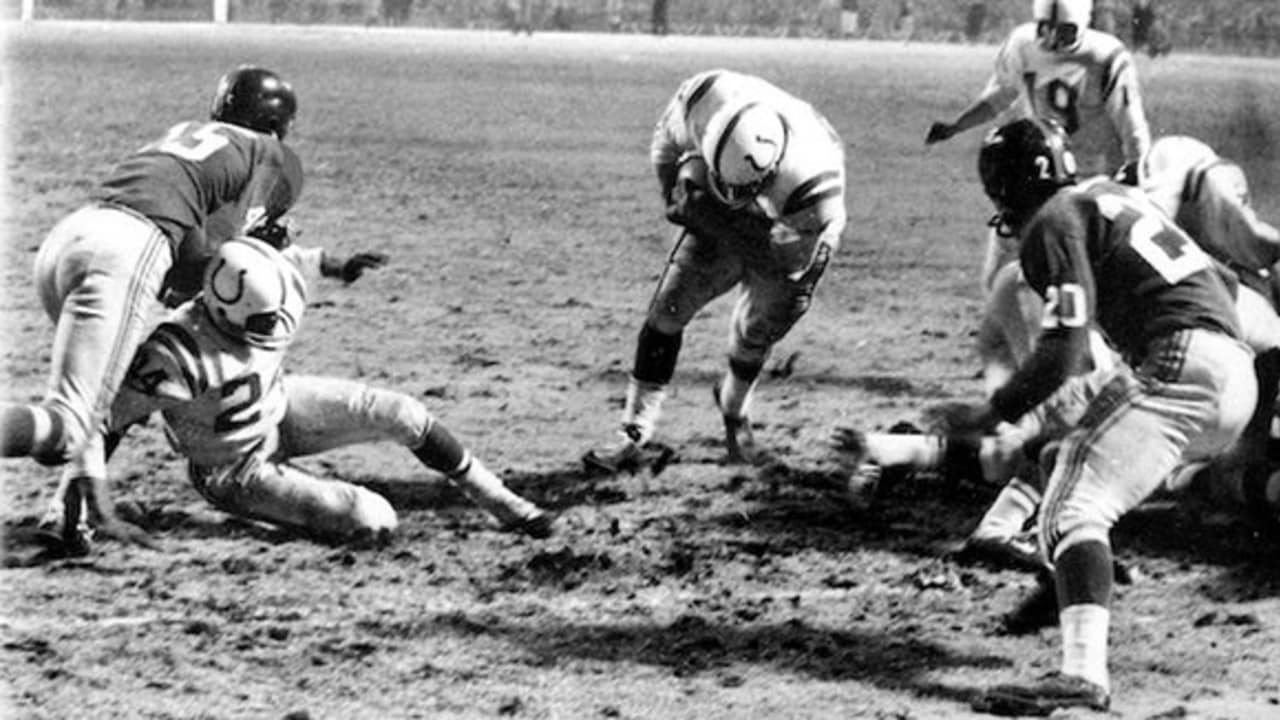
Lenny Moore (24) provides the key block on Emlen Tunnell.
Johnny Unitas (19) watches.

December 28, 1958: The NFL Championship Game is held at Yankee Stadium. The New York Giants, Champions of the NFL Eastern Division, play the Baltimore Colts, Champions of the Western Division. It is the 1st Championship Game for the Colts, the 10th for the Giants, who had previously won it in 1934, 1938 and 1956. (Why Baltimore, a Northeastern city, was placed in the League's Western Division, I don't know.)

The Giants had Charlie Conerly as their quarterback, and the biggest football star of the time, Frank Gifford, at running back. They were the 1st team to really make defense a priority, led by future Hall-of-Famers Sam Huff, Andy Robustelli and Emlen Tunnell. Two years earlier, they had destroyed the Chicago Bears in the Championship Game, 47-7.
The pre-renovation original Yankee Stadium, set up for football


But the Colts were on the rise. Their quarterback was Johnny Unitas. He had Raymond Berry to throw to, Lenny Moore in his backfield, and Jim Parker to block for him. All 4 would make the Hall of Fame. His defense was led by Hall-of-Famers Gino Marchetti and Art Donovan.

The 1st half was a bit sloppy, and didn't live up to the legend. Pat Summerall, future broadcasting legend, began the scoring with a field goal in the 1st quarter, putting the Giants up 3-0. In the 2nd quarter, Alan Ameche, who won the Heisman Trophy at the University of Wisconsin in 1954, scored a touchdown to put the Colts ahead. Unitas threw a touchdown pass to Berry, giving the Colts a 14-13 lead at the half.

In the 3rd quarter, Mel Triplett snuck the ball over the goal line to put the Giants back in it. Early in the 4th quarter, Conerly threw a touchdown pass to Gifford, giving the Giants a 17-14 lead. As the clock wound down, Unitas drove the Colts, but couldn't get them over. So Steve Myhra was sent in to kick a field goal as time expired. With the clock reading 0:00, the scoreboard read 17-17.

No NFL Championship Game had ever ended in a tie. Overtime was needed, for the 1st time in NFL history. (The League didn't institute overtime for the regular season until 1974.) The Giants won the toss, but couldn't score. Unitas led an inspiring drive, toward what would have been left field in The Stadium's baseball setup, which finally ended with Ameche scoring from the 1-yard line -- appropriately where Monument Park would later be in The Stadium's post-renovation period (1976-2008).

Bob Wolff, who had been in the same Stadium 2 years earlier to call Don Larsen's perfect game for the New York Yankees against the Brooklyn Dodgers in the 1956 World Series, was at the microphone for NBC again, and had the call: "Unitas gives to Ameche... The Colts are the World Champions! Ameche scores!" He later said he was glad he didn't "bury the lead" by saying, "Ameche scores!" first.

This game had the largest TV audience in NFL history to that point, 45 million people. The fact that it was in New York, and involved a New York team, helped it loom large in the public consciousness. This was the game that launched the NFL on a path to becoming, at least in perception, more popular than Major League Baseball.

It made legends of the Colts, and Unitas in particular. He would go on to be recognized as the greatest quarterback of all time. It's been 62 years, and some people still think he is. And the Colts, playing in a city that didn't have a big college football team -- Morgan State University is a historically black school, the U.S. Naval Academy is a national school, and the University of Maryland is closer to Washington -- became known as the team of America's working class, an "America's Team" in a way that felt artificial when the Dallas Cowboys later called themselves that.
Johnny Unitas

It also became known as "The Greatest Game Ever Played." It has been noted that it would never have been called that had the Colts beaten, say, the Philadelphia Eagles. But it was the New York team that they beat, in New York City. And so, every so often, polls are taken that show this game as the "greatest." The most recent was in 2019, for the NFL's 100th Anniversary. In 1981, John Thorn left his comfort zone, baseball, and published Pro Football's 10 Greatest Games. He included this game as one of them.

The teams had a rematch in the 1959 NFL Championship Game. In those days, home field was rotated between the Eastern and Western Champions, and the Colts hosted it at Memorial Stadium, beating the Giants again.

It remains the longest game in New York Giants history.

*

December 28, 1958, as you may have guessed, was a Sunday. There were no more NFL games to be played. It was the off-season for baseball.

There was only 1 NBA game played that day: The Cincinnati Royals beat the Minneapolis Lakers, 120-116 at the Cincinnati Gardens. Jack Twyman of the Royals scored 32 to lead all players in this game. Bob "Slick" Leonard, later to coach the Indiana Pacers to 3 ABA Championships, led the Lakers with 20 points.

The Lakers moved to Los Angeles in 1960. The Royals moved to Kansas City, becoming the Kings, in 1972, and to Sacramento in 1985.

All of the NHL's "Original Six" were in action that day:

* The New York Rangers beat the Montreal Canadiens, 5-3 at the old Madison Square Garden. This was an anomaly, as the Canadiens were in the middle of a run of 5 straight Stanley Cups, and the Rangers were in a down period.

* The Detroit Red Wings, beat the Boston Bruins, 5-3 at the Olympia Stadium in Detroit.

* And the Chicago Black Hawks beat the Toronto Maple Leafs, 4-3 at the Chicago Stadium. ("Black Hawks" was written as 2 words until 1986, when the team's original charter document was found, and it was discovered that "Blackhawks" was written as one word, and it has officially been so ever since.) 

December 28, 1952: Lions vs. Browns

December 28, 1952: The Detroit Lions and the Cleveland Browns, both NFL powerhouses? Well, this was a long time ago.

Quarterback Bobby Layne and running back Doak Walker were teammates and best friends at Highland Park High School in Dallas. But they were rivals in college: Layne at the University of Texas in Austin, Walker staying in Dallas at Southern Methodist University (SMU). After 2 years with other teams, Layne was traded to the Lions in 1950, which, due to military service interrupting his college career, was Walker's rookie season with them.

By the time they got to Detroit, the Lions hadn't done much since their 1935 NFL Championship. Raymond "Buddy" Parker was a rookie running back on that team, and was now head coach of the Lions. In contrast, Paul Brown, as head coach and general manager, had built the Browns into the best franchise in the sport, winning the title in all 4 seasons of operation by the All-America Football Conference, coming into the NFL in 1950, winning the title, and then getting back to the title game in 1951 but losing it -- in both cases, against the Los Angeles Rams.

The Browns went through the 1952 regular season 8-4, winning the Eastern Division. The Lions rebounded from a 1-2 start to go 9-3, including a 17-6 win over the Browns at Briggs Stadium (renamed Tiger Stadium in 1961) on November 2. The Lions tied the Rams for the Western Division title, and beat the Rams in a Playoff on December 21, 31-12 at Briggs Stadium.

That set up an NFL Championship Game against the Browns. Being an even-numbered year, it was the East winners' turn to host, so it would be at Cleveland Municipal Stadium. There would be 14 future members of the Pro Football Hall of Fame on that field. For the Lions: Layne, Walker, guard Dick Stanfel, tackle Lou Creekmur, and safeties Yale Lary and Jack Christiansen. For the Browns: Quarterback Otto Graham, running back Marion Motley, center Frank Gatski, guard Bill Willis, tackle-placekicker Lou Groza, receivers Dante Lavelli and Mac Speedie, and defensive end Len Ford.

There was no scoring in the 1st quarter. The only scoring in the 2nd quarter was a 2-yard touchdown run by Layne. In the 3rd quarter, Walker broke off a 67-yard run to put the Lions up, 14-0. Harry "Chick" Jagade run 7 yards for a touchdown later in the quarter, to close Cleveland within 7. But in the 4th quarter, Pat Harder kicked a 36-yard field goal, and the Lions had a 17-7 win.

The teams would face each other again the next 2 years. The Lions had home-field advantage, but the Browns played them tougher. Perhaps the addition of rookie linebacker Joe Schmidt, a future Hall-of-Famer, made a difference, as the Lions won, 17-16. Back in Cleveland in 1954, it was no contest: The Browns blew the Lions away, 56-10.

In 1955, the Browns played the Rams in the title game, winning 38-14 at the Los Angeles Coliseum. The team went into a transition, as this was Graham's last game. The 1956 title game was the New York Giants blowing the Chicago Bears away, 47-7.

But in 1957, with both teams having been revamped, the Browns and Lions again faced each other at Briggs Stadium. Parker had left the Lions in a dispute, and became head coach of the Pittsburgh Steelers. George Wilson replaced him. And Layne got hurt, and had to be replaced by Tobin Rote. And the Browns had the top rookie in the League, running back Jim Brown. Still, the Lions wrecked the Browns, 59-14. It remains the 2nd-most points scored in an NFL championship game, under any name, behind the 73 the Chicago Bears scored in 1940.

The Lions haven't been to an NFL championship game since. Only in the 1991 season have they even reached the NFC Championship Game. The Browns won the Championship in 1964, but that was their last title. They reached the NFL Championship Game in 1965, '68 and '69; and reached the AFC Championship Game in the seasons of 1986, '87 and '89 -- losing each of those.

Along with the Chicago, now Arizona, Cardinals, the Lions and Browns are 2 of the 3 teams to have won an NFL Championship, but not since the title game was renamed the Super Bowl. Indeed, of the 4 teams that have never reached the Super Bowl, the Houston Texans are a 2002 expansion team; the Jacksonville Jaguars are a 1995 expansion team, one that has, at least, reached 3 AFC Championship Games; and the other 2 are the Browns and the Lions, whose last titles could be called Super Bowl -II and Super Bowl -IX, respectively.

The fact that the Lions', Browns' and Cardinals' titles came before the advent of the Super Bowl means that they get discounted: Even before the distance of time became what it is now, NFL fans have come to regard any title won before the Super Bowl, NFL or AFL, as not a "real" championship.

And the fact that the 1970 AFL-NFL merger put the Browns in the AFC ended any real rivalry between the Browns and the Lions. So while Ohio State vs. Michigan is one of the biggest rivalries in college football, Cleveland vs. Detroit is much bigger in baseball and the NBA than it is in the NFL.

UPDATE: The Lions do not have a team Hall of Fame. But they did name an All-Time Team in 2019, in connection with the NFL's 100th Season. From their 1952, 1953 and 1957 NFL Championship teams, they named quarterback Bobby Layne, running back Doak Walker, guards Dick Stanfel and Harley Sewell, offensive tackle Lou Creekmur; and defensive backs Jack Christiansen, Jim David, Yale Lary and Don Doll. 

*

December 28, 1952 was a Sunday. There were no college football bowl games played on this day. Baseball was out of season. There were 4 games played in the NBA:

* The New York Knicks beat the Philadelphia Warriors, 72-54 at the old Madison Square Garden.

* The Syracuse Nationals beat the Indianapolis Jets, 84-73 at the Onondaga War Memorial (now the Upstate Medical University Arena) in Syracuse, New York.

* The Boston Celtics beat the Fort Wayne Pistons, 89-66 at the War Memorial Coliseum in Fort Wayne, Indiana.

* And the Minneapolis Lakers beat the Milwaukee Hawks, 86-77 at the Minneapolis Auditorium.

And there were 2 games in the NHL. The New York Rangers lost to the Chicago Black Hawks, 6-3 at the old Madison Square Garden, which hosted the NBA and the NHL on the same day. And the Detroit Red Wings beat the Boston Bruins, 7-1 at the Olympia Stadium in Detroit. Gordie Howe, Ted Lindsay and Marty Pavelich each scored 2 goals. The Canadian teams, the Montreal Canadiens and the Toronto Maple Leafs, were not scheduled.

December 28, 1947: A Dream Backfield Wins a Title for the Chicago Cardinals

"The Dream Backfield." Left to right: Paul Christman
Pat Harder, Marshall Goldberg and Charley Trippi.

December 28, 1947: The NFL Championship Game is played at Comiskey Park in Chicago. As was tradition at the time, the Western Division Champions hosted the Championship Game in odd-numbered years, the Eastern Division Champions in even-numbered years. So, this year, it is the Chicago Cardinals hosting the Philadelphia Eagles.

This was the 1st title game for the Eagles, established in 1933, coached by Earle "Greasy" Neale, and led by running back Steve Van Buren. They finished 8-4, including a loss to the Cardinals just 3 weeks earlier, 45-21 at Shibe Park in Philadelphia. Thus, they finished in a tie for the Eastern Division title, with their cross-State rivals, the Pittsburgh Steelers. A Playoff was necessary, and the Eagles won it, 21-0 at Forbes Field in Pittsburgh. The Steelers would not reach the postseason again until 1972, with the AFC Division Playoff won with "the Immaculate Reception."

The Cardinals, who dated their founding to a South Side athletic club in 1898, were charter members of the NFL in 1920. They had won the Championship in controversial fashion in 1925, but this was the 1st time they'd advanced to the Championship Game, which was 1st played in 1933.

They were playing under a cloud. Charles Bidwill, a lawyer who ran the company that ran the city's main arena, the Chicago Stadium, had bought the team in 1933, rescuing it from Depression-induced bankruptcy in 1933. He had been a part-owner of the Chicago Bears, and had to sell his share to buy the Cardinals. He had died on April 19, from pneumonia, only 51 years old. His widow, Violet, became the 1st woman to own an NFL team.

No one knew it at the time, but the Cardinals were on the verge of their greatest era -- and had sown the seeds of their own destruction.

Jimmy Conzelman, a former NFL quarterback who was player-coach of the 1928 NFL Champion Providence Steam Roller, was the Cards' head coach. He had what had become known as "The Dream Backfield": Quarterback Paul Christman, halfback Charley Trippi of the University of Georgia's 1942 National Champions; halfback Marshall "Biggie" Goldberg of the University of Pittsburgh's 1937 National Champions; and fullback Pat Harder.

Halfback Elmer Angsman was sometimes considered part of The Dream Backfield. In the era of "single-platoon football," each of these men played both offense and defense, and each played it very well. Indeed, football historians usually consider Harder to be the best defensive back of the 1940s, and Goldberg not that far behind him. Harder was also an excellent placekicker.

With the Bears having won the NFL Championship in 1940, 1941, 1943 and 1946, the Cards were reading to take over. They went 9-3, their losses all coming on the road, against the Los Angeles Rams, the Washington Redskins and the New York Giants. They served notice on the Bears, beating them 31-7 at Comiskey and 30-21 at Wrigley Field.
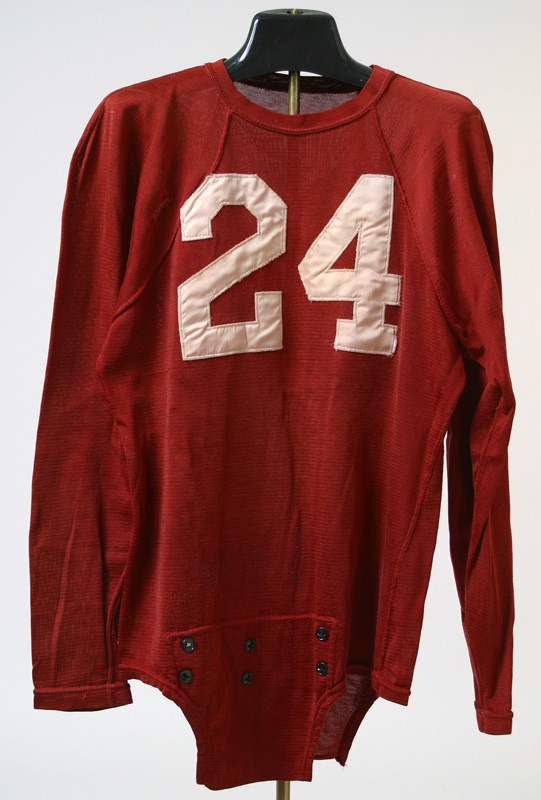
Game-worn 1947 Chicago Cardinals jersey.
Number 24 was backup back John "Red" Cochran.

Due to the Eastern Division Playoff, the Championship Game was moved to December 28, its latest date thus far. Although Comiskey Park was not right on Lake Michigan, it was still only 29 degrees at kickoff. Knowing that the field was frozen, the Cardinals wore sneakers instead of cleats, which was legal at the time.

The game kicked off at 1:05 PM Central Time (2:05 Eastern). Trippi scored a touchdown on a 44-yard run in the 1st quarter. In the 2nd, Angsman scored on a 70-yard run in the 2nd quarter. Tommy Thompson threw a 53-yard touchdown pass to Pat McHugh, to close the Eagles to within 14-7 at halftime.

Special teams made the difference: In the 3rd quarter, Trippi returned a Joe Muha punt 75 yards for a touchdown, making it 21-7 Cards. The Eagles marched downfield, and Van Buren ran the ball in from the 1-yard line to make it 21-14. But in the 4th quarter, Angsman broke off a 70-yard run to make it 28-14. Russ Craft scored on a 1-yard run, but the Eagles got no closer. The Cardinals won, 28-21.

The teams played each other in the opening game of the next season, also at Comiskey, and the Cardinals won, 21-14. However, Cardinal tackle Stan Mauldin died from a head injury sustained in the game, the 1st NFL player known to have died as a result of an in-game condition. Still, the Cardinals may have been even better than in the season before: They lost their next game, to the Bears, and then ran the table, finishing 11-1. But they lost the Championship Game to the Eagles in Philadelphia.

That would be their last Playoff game for 26 years, and their last NFL championship game, under any name, for 58 years. The '47 title game would be their last postseason victory for 51 years. 

The '48 title game was Conzelman's last in any active role in football, as he was making more money and getting less stress in his off-season job in the advertising industry. It was also Goldberg's last game before retiring as a player. Christman last played for the Cardinals in 1949, Harder in 1950, while Trippi hung on until 1955.

In 1949, Violet Bidwill married Walter Wolfner, a St. Louis-based businessman who got rich selling coffee to the U.S. Army in World War I, who took over the operation of the Cardinals. From 1949 to 1959, 11 seasons, they went through 8 different head coaches. From 1950 onward, they never had another winning season, bottoming out at 1-10-1 in 1953. And, despite not winning another title until 1963, the Bears surged ahead of the Cardinals in popularity in Chicago.

After flirting with moving to Minneapolis, and even playing some "home games" at the new Metropolitan Stadium nearby, Wolfner moved the team to his hometown for the 1960 season, fully aware that there was already a baseball team named the St. Louis Cardinals, with whom they shared Busch Stadium (formerly Sportsman's Park) until 1965, and Busch Memorial Stadium thereafter.

Violet died in 1962, and left her 80 percent ownership of the team to her adopted sons, Charles Bidwill Jr. and William Bidwill. They immediately fired Wolfner. He sued, claiming that, as adoptees, they couldn't inherit the team. The court didn't buy it, and Wolfner was out. In 1972, Billy Bidwill bought out his brother "Stormy." In 1988, he moved the team, becoming the Phoenix Cardinals. In 1993, he renamed them the Arizona Cardinals. They reached Super Bowl XLIII, but lost it. The 2022 season will be the 75th in a row that they will not end as NFL Champions.

UPDATE: The Arizona Cardinals have established a Ring of Honor. It includes all Chicago Cardinals in the Pro Football Hall of Fame in Canton, Ohio: John "Paddy" Driscoll, Ernie Nevers, Charlie Trippi, Marshall "Biggie" Goldberg, Dick "Night Train" Laine, Ollie Matson, 1947 NFL Championship coach Jimmy Conzelman, and team owner Charles Bidwill.

*

December 28, 1947 was a Sunday. Aurelio Rodríguez, a fine-fielding 3rd baseman for several teams, mainly the 1970s Detroit Tigers, was born on this day.

Baseball was out of season. In the Basketball Association of America, the league that would rename itself the NBA in 1949, there was 1 game: The St. Louis Bombers beat the Baltimore Bullets, 67-63 at the St. Louis Arena.

And there were 2 games in the NHL. The New York Rangers and the Toronto Maple Leafs played to a tie, 1-1 at the old Madison Square Garden. And the Detroit Red Wings beat the Boston Bruins, 3-0 at the Olympia Stadium in Detroit. The Boston Bruins and the Chicago Black Hawks were not scheduled.

Tuesday, December 27, 2022

December 27, 1964: The Cleveland Browns' Last Title -- So Far

Jim Brown (32) takes a handoff from Frank Ryan (13)

December 27, 1964: The NFL Championship Game is played, at Cleveland Municipal Stadium. The host Cleveland Browns had been a dominant team from their 1946 inception until 1957, and were back after a rebuild.

Controversially, that rebuild involved Art Modell buying the team, and firing the founding head coach and general manager, Paul Brown. Blanton Collier was put in charge, and he revamped the team, including installing Frank Ryan at quarterback. Ryan was working on a doctorate in mathematics, and would later teach at the university level.

Collier also gave Jim Brown a bit more leeway. In 1963, Collier's 1st season, Brown rushed for 1,863 yards, an NFL record that stood for another 10 years. In 1964, he ran for 1,446. The Browns had another Hall-of-Fame running back in Leroy Kelly. Paul Warfield, a rookie receiver, would also go to Canton. So would guard Gene Hickerson. And so would their one holdover from their 1950s titlists, placekicker Lou Groza.

The Browns went 10-3-1. The St. Louis Cardinals tied them 33-33 at Cleveland Municipal Stadium, and beat them 28-19 in St. Louis. The Browns also lost 23-7 at home to the Pittsburgh Steelers, and 28-21 to the Green Bay Packers in Milwaukee. The losses in Milwaukee and St. Louis were both late in the season. But a 52-20 demolition of the Giants at Yankee Stadium in the final regular-season game gave them the Eastern Division title by half a game over the Cardinals, who went 9-3-2.

They would host the NFL Championship Game against the Baltimore Colts, who were favored, having gone 12-2. With Johnny Unitas quarterbacking several holdovers from their 1958 and '59 NFL Champions, they lost their opener away tot he Minnesota Vikings, and their next-to-last game at home to the Detroit Lions. But they won the rest of their games. They did not play the Browns in the regular season. Despite the Browns having the home field, the Colts were favored by 7 points.

There was no scoring in the 1st half. The Browns began the 3rd quarter with the wind at their backs, and Groza's kickoff went beyond the end zone. The Browns' defense held the Colts, and Tom Gilburg had to punt into the wind. The Browns took over in Colt territory, but could only get a 43-yard field goal from Groza.

That seemed to break the ice, though: The Colts could do nothing on their ensuing drive, and an 18-yard run by Brown was followed by an 18-yard touchdown pass from Ryan to Gary Collins, and the Browns were up, 10-0.

The Colts could not recover. Tony Lorick ran Groza's kickoff out of the end zone, and was tackled at his own 11. A clipping penalty forced another punt into the wind, and the Browns got the ball back at the Colt 39. Another pass from Ryan to Collins made it 17-0. Unitas got the Colts into Browns territory on the next drive, but the usually reliable Lenny Moore fumbled a handoff, and the Browns recovered. The 3rd quarter closed with a 23-yard run by Jim Brown.

Never before had a single quarter so turned around an NFL championship game, and none would again for 23 years, until the 2nd quarter of Super Bowl XXII, when Denver led 10-0 at the start, and Washington led 35-10 at the end.

The Colts held the Browns to another Groza field goal, and it was 20-0. Unitas looked to have gotten the Colts to the Brown 15, by a wide-open Jimmy Orr dropped the pass, and the Colts had to punt. This time, they had the wind, but it made no difference, and a 3rd Ryan-to-Collins touchdown made the final score 27-0. Collins -- no relation to the actor and game-show host of the same name -- thus became the 1st player ever to catch 3 touchdown passes in an NFL title game.

In spite of the performances of Ryan, Brown and Collins, the Browns' defense was as much of a story. They held Unitas to 95 passing yards, and the team as a whole to 92 rushing yards.

This game had 5 officials: A referee, an umpire, a head linesman, a back judge and a field judge. And their penalty flags were white. The next season, a line judge was added, and penalty flags were changed to yellow, to show up better on color television. In 1978, the side judge brought the on-field officials' complement to their current 7.

This would prove to be Jim Brown's only title. The next season, the Browns got back into the NFL Championship Game, but lost to the Green Bay Packers. Jim then retired to focus on acting and civil rights activism. The Browns would reach the NFL Championship Game again in 1968, but lost to the Colts; and again in 1969, but lost to the Vikings. They reached the AFC Championship Game in the seasons of 1986, 1987 and 1989, but lost all 3. They have never won another NFL title, not since this game, which could be retroactively labeled "Super Bowl -II."

The Colts lost Super Bowl III to close the 1968-69 season, but won Super Bowl V. In 1984, they moved to Indianapolis. In 1995, angry that he couldn't get a new stadium, or at least a better lease at Municipal Stadium, Art Modell moved the Browns -- to Baltimore, where they became the Ravens. You would think that, having had their hearts broken 11 years earlier, Baltimore would have known better. They won Super Bowls XXXV and XLVII.

A new Browns franchise was established for 1999, but they have largely struggled: In their 1st 24 seasons, they've only made the Playoffs twice, winning just 1 game.

Along with the Detroit Lions, the Browns are 1 of 2 teams to have won an NFL Championship, but, through the 2021 season, never reached the Super Bowl. The Browns, the Lions, and the team now known as the Arizona Cardinals are the only 3 teams to have won an NFL Championship, but not won a Super Bowl. (The Cardinals have reached one, but lost it. I should say 4 teams, as the Minnesota Viking won the 1969 NFL Championship, but lost Super Bowl IV.)

The fact that the Browns' titles came before the advent of the Super Bowl means that they get discounted: Even before the distance of time became what it is now, NFL fans had come to regard any title won before the Super Bowl, NFL or AFL, as not a "real" championship.

What's more, the 1964 Browns are often considered, along with the 1963 Chicago Bears, to be an NFL Champion that would have lost to that season's AFL Champions. The day before this game, the AFL Championship Game was played at War Memorial Stadium in Buffalo, New York. The Buffalo Bills beat the San Diego Chargers, 20-7.

The Browns' 1964 NFL Championship would be the last title won by any Northern Ohio team for a long time, and many gut-wrenching close calls would come in the interim. The Browns would have "The Drive" in the 1986 AFC Championship Game, and "The Fumble" in the 1987 edition, before "The Move" and "The Return."

The Cleveland Indians, now known as the Cleveland Guardians, wouldn't even get close to the Playoffs until winning the American League Pennant in 1995, lost that year's World Series, and then lost the 1997 World Series despite leading in the bottom of the 9th inning of Game 7. And they blew a 3-games-to-1 lead in the 2007 AL Championship Series. The Cleveland Cavaliers were a hard-luck team, losing a 1989 NBA Playoff series to the Chicago Bulls on the last play, when Michael Jordan made "The Shot."

Finally, in 2016, the Cavaliers won the NBA Championship, ending Cleveland's overall title drought after 51 1/2 years. LeBron James and Jim Brown posed together with the NBA trophy.

*

December 27, 1964 was a Sunday. Baseball was out of season. There were 3 games in the NBA:

* The New York Knicks lost to the St. Louis Hawks, 99-89 at the old Madison Square Garden.

* The Boston Celtics beat the Detroit Pistons, 112-106 at the Boston Garden. Sam Jones scored 40 points.

* And the Baltimore Bullets beat the Cincinnati Royals, 126-119 at the Baltimore Civic Center (now the CFG Bank Arena). Walt Bellamy and Gus Johnson each scored 32 for the Bullets, while Oscar Robertson scored 48 for the Royals.

And There were 2 games in the NHL. The New York Rangers lost to the Detroit Red Wings, 3-1 at the Olympia Stadium in Detroit. And the Chicago Black Hawks beat the Boston Bruins, 6-2 at the Chicago Stadium. The Montreal Canadiens and the Toronto Maple Leafs were not scheduled.

December 31, 1999 & January 1, 2000: The Millennium

December 31, 1999:  The Millennium arrives. The people of planet Earth survived. At a terrible cost. But we hadn't destroyed ourselves. ...