Showing posts with label harold macmillan. Show all posts

Sunday, June 5, 2022

June 5, 1963: The Profumo Affair

June 5, 1963: John Profumo resigns as Britain's Secretary of State for War. The equivalent position in America would be the Secretary of Defense.

The issue wasn't that he had been exposed as having an affair with model Christine Keeler. It wasn't even that she was also having an affair with Captain Yevgeny Ivanov, a naval attaché at the Soviet Embassy in London, who had been exposed as a Soviet spy. Powerful men in the British government had been getting away with naughty behavior since the Romans invaded 2,000 years earlier.

No, the issue was that Profumo had stood before the House of Commons, and had lied about it. That was the true unforgivable sin in British politics.

Keeler was just 17 when she met Stephen Ward, an osteopath with several prominent clients, including Profumo, who served in the Cabinet of Prime Minister Harold Macmillan. Keeler and Ward lived together, but she later said there was no sex involved. She had already had a baby that did not survive, with a U.S. Air Force officer stationed in London. Keeler and Ward had been introduced by Mandy Rice-Davies, an ex-girlfriend of a friend of Ward's -- and she was only 15 at the time.

She was 19 when Ward introduced her to Profumo, who was 46, on July 8, 1961, at a pool party at a Buckinghamshire mansion. Ward also introduced her to Ivanov, who was 35. She soon began affairs with both men, neither of which lasted long -- but lasted long enough to ruin the lives of everyone involved.
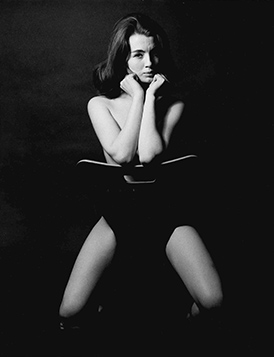
The infamous photo of Keeler, taken by Lewis Morley.
She later said she wasn't totally nude, and was wearing underwear.

In 1962, she had simultaneous affairs with jazz singer Lucky Gordon and promoter Johnny Edgecombe. The jealousy between the men boiled over, and Edgecombe slashed Gordon's face with a knife. A few weeks later, she broke up with Edgecombe, and, following her to Ward's house, he fired gunshots into it, hitting no one. He was arrested, and, as the investigation grew, one revelation led to another, until, finally, Profumo could deny it no longer, and had to resign.

Ward went on trial -- not for espionage, but for "living on the earnings of prostitution." One thing led to another, and it was revealed that Rice-Davies had also had an affair with William Waldorf Astor, the 3rd Viscount Astor. He denied this, and when Rice-Davies was asked about it, she told the media, "Well, he would, wouldn't he?" This phrase became famous, and would be abbreviated to "MRDA," for "Mandy Rice-Davies Applies."

Ward was convicted, but committed suicide via pills before sentence could be pronounced. Ivanov was recalled by his country, and resumed his naval career. Keeler was convicted of perjury, was sentenced to 9 months in prison, and served 6. She later married twice, with a child from each marriage. Having lost her money in legal fees, she got by over the years with paid TV appearances, talking about the scandal. Rice-Davies was never prosecuted, and became a singer and a novelist.

The government appointed Tom Denning, Baron Denning, the Master of the Rolls, to investigate the various rumors that had emanated from and around the Profumo affair. His report, published on September 26, 1963, concluded that there had been no security leaks, nor evidence to link members of the government with associated scandals. In other words, there was no evidence that any state secrets were leaked to the Soviet Union as a result of the affair(s). Denning laid most of the blame for the affair on Ward, an "utterly immoral" man whose diplomatic activities were "misconceived and misdirected."

Nevertheless, Macmillan resigned as Prime Minister on October 18, 1963, citing his health, replaced by Foreign Minister Alec Douglas-Home. While the Conservative Party government might have been doomed in the 1964 election anyway, the Profumo affair didn't help, as Labour won 317 seats to the Tories' 304, and Harold Wilson became Prime Minister.

Profumo's wife, actress Valerie Hobson, forgave him, and they retreated into charity work, rebuilding his reputation. By the time he died, he had long been back in British society's good graces.

In 1989, the story gained back some traction for 2 reasons: The film Scandal retold the story, with Ian McKellen as Profumo, Deborah Grant as Hobson, Joanne Whalley as Keeler, Bridget Fonda as Rice-Davies, John Hurt as Ward, Leslie Phillips as Astor, Dutch actor Jeroen Krabbé as Ivanov, Leon Herbert as Gordon, Fine Young Cannibals lead singer Roland Gift as Edgecombe. And it was mentioned in Billy Joel's rapid-fire history song "We Didn't Start the Fire," leading a generation not old enough to remember 1963 what the line "British politician sex" was about.

Astor died in 1966, Macmillan in 1986, Ivanov in 1994, Hobson in 1998, Denning in 1999, Profumo in 2006, Edgecombe in 2010, Rice-Davies in 2014, Keeler and Gordon in 2017.

*

June 5, 1963 was a Wednesday. These baseball games were played that day:

* The New York Yankees beat the Baltimore Orioles, 4-3 in Baltimore, but it was costly for them. At the time, Memorial Stadium had a chain-link fence in the outfield, making for easier removal for football games. After already going 2-for-2, Mickey Mantle went deep into center field to try to catch a ball hit by Brooks Robinson. It was no use, as it went over that fence for a home run. But it making the attempt, Mantle got his foot caught in the fence, and broke it. He was out for 2 months, the longest of his many in-season injuries. At any rate, Whitey Ford outpitched Milt Pappas, and Roger Maris hit a home run.

* The New York Mets lost to the Milwaukee Braves, 11-9 at the Polo Grounds. The Mets scored 7 runs in the 6th inning, and forced extra innings. But Bubba Morton singled home 2 runs in the top of the 10th inning to win it for the Braves. Hank Aaron and Eddie Mathews each went 3-for-5, and Mathews added 2 RBIs.

* The Philadelphia Phillies beat the St. Louis Cardinals, 6-0 at Connie Mack Stadium in Philadelphia. Ray Culp pitched a 3-hit shutout. Stan Musial, in his last season, when 0-for-4.

* The Pittsburgh Pirates swept a doubleheader from the Cincinnati Reds, 5-4 and 4-3 at Forbes Field in Pittsburgh. Over the 2 games, Roberto Clemente went 2-for-8, Bill Mazeroski went 5-for-8 with a home run and 4 RBIs; Frank Robinson went 4-for-7 with 2 home runs and 4 RBIs, and rookie Pete Rose went 0-for-5 with a walk.

* The Detroit Tigers beat the Cleveland Indians, 5-4 at Cleveland Municipal Stadium. Jim Bunning outpitched Jim "Mudcat" Grant. Al Kaline went 1-for-3 with 2 walks and an RBI.

* The Chicago Cubs swept a doubleheader from the San Francisco Giants, 9-5 and 5-4 at Wrigley Field in Chicago. Willie Mays went 1-for-2 with a home run, a walk and 2 RBIs in the 1st game, and appeared as a pinch-hitter without reaching base in the 2nd game. Over the 2 games, Ernie Banks went 4-for-7 with 2 home runs, a walk, and 3 RBIs.

* The Minnesota Twins beat the Kansas City Athletics, 4-0 at Kansas City Municipal Stadium. Jim Roland (7 innings) and Bill Dailey combined on a 5-hit shutout. Harmon Killebrew went 1-for-3 with a walk.

* The Los Angeles Dodgers beat the Houston Colt .45s, 5-1 at Colt Stadium in Houston. Sandy Koufax went the distance for the win. The Colts became the Houston Astros in 1965.

* A doubleheader was split at Dodger Stadium in Los Angeles, where the Los Angeles Angels groundshared with the Dodgers until their stadium in Anaheim was built. The Chicago White Sox won the opener, 3-0. John Buzhardt allowed 9 hits, but kept the shutout. The Angels won the nightcap, 8-2.

And the Boston Red Sox and the Washington Senators were rained out at District of Columbia Stadium in Washington. (And yet, just 42 miles away, Baltimore got its entire game in.) The game was rescheduled as part of a doubleheader on August 2. The Red Sox won the 1st game, 5-0. Earl Wilson pitched a 6-hit shutout, and helped his own cause with a home run. The Senators won the 2nd game, 4-3. Over the 2 games, Carl Yastrzemski went 3-for-8 with a walk and an RBI.

Monday, April 18, 2022

April 18, 1957: Britain Ends National Service, With Unintended Consequences

"Teddy Boys"

April 18, 1957: The United Kingdom of Great Britain and Northern Ireland ends compulsory "national service" for men aged 18 to 21. This involved serving in the armed forces, or in other "vital" positions, such as on farms, in factories, in mines, in forests, in service roles in hospitals.

Britain did not completely "demobilise" as World War II ended in 1945: Those already in the armed forces were given a release class determined by length of service and age. In practice, releases began in June 1945, and the last of the wartime conscripts had been released by 1949. However, urgently needed men, particularly those in the building trades, were released in 1945, although some restrictions on their immediate employment were supposed to be enforced. All women were released at the end of the war.

The National Service Act 1948 streamlined the process of young men serving: From January 1, 1949, healthy males 17 to 21 years old were required to serve in the armed forces for 18 months, and remain on the reserve list for four years. They could be recalled to their units for up to 20 days for no more than three occasions during these four years. Men were exempt from National Service if they worked in one of the three "essential services": Coal mining, farming, and the merchant navy for a period of eight years. If they quit early, they were subject to being called up. Exemption continued for conscientious objectors, with the same tribunal system and categories.

National Service ended gradually from 1957. It was decided that those born on or after October 1, 1939 (thus turning 18) would not be required, but conscription continued for those born earlier whose call-up had been delayed for any reason. In November 1960, the last conscripted men entered service, as call-ups formally ended on December 31, 1960, and the last conscripted servicemen left the armed forces in May 1963.

Britain has had an all-volunteer military ever since, just as America has had with the post-Vietnam ending of the draft in 1973. Both countries have found that having an armed forces staffed entirely by men and women who want to be there works far more effectively.

But having so many more men ages 17 to 21 out on the streets, without an equivalent of America's G.I. Bill to send them to college, led to unintended consequences, including the creation of some subcultures that became nationally infamous, and then world-famous.

This was around the time that England's first rock and roll bands were being formed. It is no coincidence that 1957 was also the year that 17-year-old John Lennon met 15-year-old Paul McCartney in Liverpool; and that, early in 1958, they met 15-year-old George Harrison. By that point, 17-year-old Richard Starkey was already drumming in a band, and would begin calling himself "Ringo Starr" a year earlier.

After The War, young men in delinquent gangs who had adopted Edwardian-era fashion -- in the style of the years from 1901 to 1910, when the King was Edward VII, or "Good Old Teddy" -- were sometimes known as "Cosh Boys" or "Edwardians." On September 23, 1953, the national newspaper the Daily Express shortened "Edwardian Boy" to "Teddy Boy," and the name stuck.

Long coats, high "drainpipe" trousers, bolo ties and suede shoes -- with retroactive irony, sometimes called "beetle crushers" -- became a rebellion against postwar austerity, and, just as American teenagers had begun to be able to afford to indulge in the postwar prosperity by 1955, it became possible in Britain as well, especially after national service ended in 1957. There were also "Teddy Girls," a.k.a. "Judies" (even though King Edward's Queen was named Alexandra), who wore drape jackets, pencil skirts or rolled-up jeans, straw boater hats and espadrille shoes.

On August 24, 1958, white Teddy Boys, angry that black immigrants from Britain's Caribbean territories were taking the jobs their no-longer-draftable selves thought they were entitled to, began assaulting black teenagers in West London, beginning 2 weeks of "the Notting Hill Riots." There were 140 arrests, but no deaths.

By the early 1960s, the fad had ended the way most fads do: The originators grew out of it, and moved on. But 2 new subcultures took the Teddy Boys' place: The Mods and the Rockers. The Rockers were based on motorcycle culture, inspired by Marlon Brando in the 1953 film The Wild One. (Brando played a character named Johnny, which caught John Lennon's attention. And the film included a motorcycle gang named the Beetles. But the Beatles were named as a play on Buddy Holly's band, The Crickets.)
The Rockers wore leather jackets, leather pants or blue jeans, and leather boots, and generally made nuisances of themselves everywhere they went. Their choice of music was that of the early rockers who had toured Britain: Bill Haley, Chuck Berry, Little Richard, Buddy Holly, Eddie Cochran and Gene Vincent. (Cochrane and Vincent had completed a tour of Britain in 1960, and were heading home to London's Heathrow Airport when their driver crashed, killing Cochran and badly injuring Vincent.)

The Rockers were leather-clad slobs. The Mods were different. They dressed up. And instead of big motorcycles like the kind produced in Britain and America, they preferred scooters, small and efficient enough for getting around streets in the countries that were producing them, Italy and France. If they could work in Rome and Paris, it was reasoned, they could work in London. But, what was more, you could show up to work dressed like a Mod, and keep your job. It was "respectable."
Their musical tastes were different as well. They were originally called "mod" because they preferred "modern jazz," instead of "traditional jazz," whose fans became known as "trad." But they also embraced rock and roll, not the harder stuff of Elvis and Chuck Berry, but vocal groups with the black and Italian "doo-wop" sound. 

Pete Townshend, lead songwriter and guitarist for The Who, defined the Mods for Americans in an interview with Rolling Stone magazine for their September 28, 1968 issue:

It was a movement of young people, much bigger than the hippie thing, the underground and all these things. It was an army, a powerful, aggressive army of teenagers with transport. Man, with these scooters and with their own way of dressing.

It was acceptable, this was important; their way of dressing was hip, it was fashionable, it was clean and it was groovy. You could be a bank clerk, man, it was acceptable. You got them on your own ground. They thought, "Well, there's a smart young lad." And also you were hip, you didn't get people uptight. That was the good thing about it.

To be a mod, you had to have short hair, money enough to buy a real smart suit, good shoes, good shirts; you had to be able to dance like a madman. You had to be in possession of plenty of pills all the time and always be pilled up. You had to have a scooter covered in lamps. You had to have like an army anorak to wear on the scooter. And that was being a mod and that was the end of the story.

The Mods seemed like the perfect counterweight to the Rockers and their predecessors, the Teddy Boys. They launched the 1960s culture that became known as "Swinging London." But, soon enough, it would be fists that would be swinging, between the Mods and the Rockers.

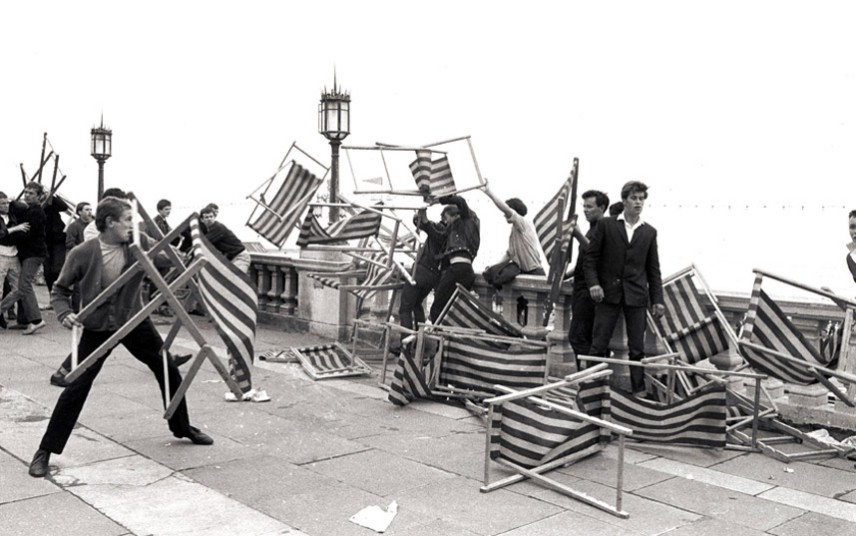
On May 18, 1964, the 1st warm weekend of the calendar year, it came to a head in several seaside communities in England. The worst of the Mod vs. Rocker violence was in Brighton in Sussex, where, as all surviving sources agree, the Mods started it, not the Rockers with what was then the more aggressive reputation. The fighting moved along the coast, to Hastings, which led to the media calling it "the Second Battle of Hastings."
There were also beach and beach-town battles in Margate, Kent and Clacton, Essex. Newspapers called the groups "vermin" and "louts." The Birmingham Post warned that Mods and Rockers were "internal enemies" who would "bring about disintegration of a nation's character." The Who were not directly involved, but Townsend would write the rock opera Quadrophenia about the events, releasing it in 1973. It became a film in 1979.

The Beatles' film A Hard Day's Night was filmed in March and April 1964, a few weeks before the Brighton violence, but not released until after: July 6 in Britain, and August 11 in America. If Americans had heard about Brighton at all, they had quickly forgotten about it. In the film, a female reporter asked Ringo, "Are you a Mod or a Rocker?" And with the "cheeky humour" for which the group was then known, he answered, "I'm a Mocker!"

Every so often, as with other fads, the British youth subcultures come back. Teddy Boys had a revival in the Glam Rock period of the 1970s. The subsequent rise of punk rock in 1976 brought the Rocker subculture back. The "Northern Soul" movement of the 1980s, centered around Manchester, revived interest in the Mods. And The Stray Cats, an American retro-rock band, proved more popular in Britain, and, wittingly or not, was another revival of the Rockers.

But the lack of a military draft sometimes combines with a lack of jobs, or a lack of satisfying ones, that has left young people, in Britain as in any other country, with little to do. Punk band The Sex Pistols sang, "No future for you!" in their 1977 song "God Save the Queen."

Soon, right-wing groups like the National Front and the English Defence League, espousing the very bigoted ideals that the last large group of British draftees fought, began recruiting young men, particularly at football matches, knowing that the "hooligan firms" that had begun to form in the late 1968, and seemed to be peaking in the late 1970s, were easy pickings for their rhetoric of camaraderie in Englishness, whiteness, and "Christian"-ness. This helped to make the 1980s the nastiest era in the history of English soccer.

In light of these events, some people have occasionally asked for a return to national service for Britain. In 2009, actor Sir Michael Caine, a British Army veteran of the Korean War, said, "I'm just saying, put them in the Army for six months. You're there to learn how to defend your country. You belong to the country. Then, when you come out, you have a sense of belonging, rather than a sense of violence." In 2015, Prince Harry, an Army veteran of the Afghan phase of the War On Terror, made a call to bring back conscription. 

*

April 18, 1957 was a Thursday. Football was out of season. The NBA season had ended 5 days earlier. The Stanley Cup had been awarded 2 days earlier. These baseball games were played that day:

* The New York Yankees beat the Boston Red Sox, 3-2 at Fenway Park in Boston. It was tied 1-1 going into the 9th. Cliché Alert: Walks can kill you, especially the leadoff variety. Mickey Mantle drew a walk. After 2 outs, Gil McDougald tripled him home, and Elston Howard singled him home. The Sox scored a run in the bottom of the 9th, but Bob Grim shut them down, getting the win in relief of Johnny Kucks. Ted Williams went 2-for-4.

* The New York Giants beat the Philadelphia Phillies, 6-2 at the Polo Grounds. Ruben Gomez outpitched Curt Simmons. Willie Mays went 1-for-3 with a walk.

* The Brooklyn Dodgers beat the Pittsburgh Pirates, 6-1 at Ebbets Field. Sal Maglie, the former Giant ace who never looked right in a Dodger uniform, went the distance for the win. Gil Hodges and Duke Snider hit home runs. Roberto Clemente did not play.

* The Washington Senators beat the Baltimore Orioles, 6-4 at Griffith Stadium in Washington. Brooks Robinson went 0-for-2.

* The Cleveland Indians beat the Detroit Tigers, 8-3 at Briggs Stadium in Detroit. (The ballpark was renamed Tiger Stadium in 1961.) The Tigers' bullpen collapsed in the top of the 11th inning, including allowing the 1st major league home run of an Indians rookie named Roger Maris. Al Kaline went 0-for-5.

* The Chicago White Sox beat the Kansas City Athletics, 6-2 at Comiskey Park in Chicago.

* The Milwaukee Braves beat the Cincinnati Redlegs, 1-0 at Milwaukee County Stadium. (The Reds were called the Redlegs from 1954 to 1958.) Lew Burdette pitched a 6-hit shutout. Hank Aaron hit a home run. Frank Robinson went 1-for-4.

* And the Chicago Cubs beat their arch-rivals, the St. Louis Cardinals, 10-2 at the original Busch Stadium, formerly the last Sportsman's Park. Ernie Banks went 2-for-5 with a walk. Stan Musial went 0-for-3 with a walk.

December 31, 1999 & January 1, 2000: The Millennium

December 31, 1999:  The Millennium arrives. The people of planet Earth survived. At a terrible cost. But we hadn't destroyed ourselves. ...