Showing posts with label heisman trophy. Show all posts

Tuesday, December 13, 2022

December 13, 1973: John Cappelletti's Heisman Speech

As a native of New Jersey, and a fan of the football team at Rutgers University, I loathed Penn State University, their Nittany Lions, and their head coach, Joe Paterno, long before it was cool. But they have provided perhaps the greatest speech any college football player has ever given.

December 13, 1973: Penn State running back John Cappelletti wins the Heisman Trophy, as yet the only Nittany Lion so honored. His acceptance speech transcended sports.

Born in 1952 in the Philadelphia suburb of Upper Darby, Pennsylvania, he was apparently no relation to New England Patriots legend Gino Cappelletti. He graduated from the storied Monsignor Bonner High School. He did not play for Penn State in his freshman season, 1970, because the NCAA did not let freshmen play on the varsity until 1972. He was a defensive back in his sophomore season, 1971, because the starting running back slots were occupied by Franco Harris and Lydell Mitchell, who went to 12 Pro Bowls between them. He did start as a junior in 1972.

In 1973, helping Penn State complete an undefeated regular season, he rushed for 1,522 yards and scored 17 touchdowns in 11 games. Paterno would later call him the best player he ever coached. Ohio State also went through the regular season undefeated, but they had 3 players splitting the votes that only 1 would have gotten: Offensive tackle John Hicks finished 2nd, sophomore running back Archie Griffin finished 5th, and linebacker Randy Gradishar finished 6th.

Giving his acceptance speech at the Downtown Athletic Club in Manhattan, after having been seated next to newly-sworn-in Vice President Gerald Ford, himself an All-American center at the University of Michigan in 1935, Cappelletti said:

I'm very happy to do something like this. I thought about it since the Heisman was announced 1- days ago, and this is to dedicate a trophy that a lot of people earned, I've earned, my parents and the people I've mentioned, and numerous other people that are here tonight and been with me for a long time.

The youngest member of my family, Joseph, is very ill. He has leukemia. If I can dedicate this trophy to him tonight, and give him a couple days of happiness, this is worth everything.

I think a lot of people think that I go through a lot on Saturdays and during the week, as most athletes do, and you get your bumps and bruises, and it is a terrific battle out there on the field. Only for me, it is on Saturdays, and it's only in the Fall. For Joseph, it is all year 'round, and it is a battle that is unending with him. And he puts up with much more than I'll ever put up with. And I think that this trophy is more his than mine, because he has been a great inspiration to me.
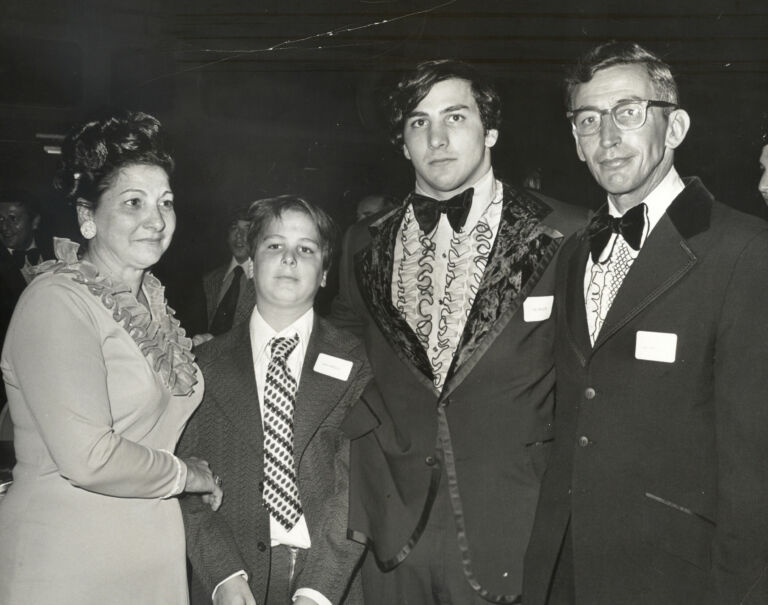
At the Heisman ceremony. Left to right:
Anna, Joey, John Jr., John Sr.

It was similar to the speech that Gale Sayers gave in New York in 1970, upon receiving the NFL's George S. Halas Most Courageous Player Award, named for the owner of his team, the Chicago Bears. Despite having led the League in rushing after surgery on both knees in 1969, Sayers dedicated the award to an even more courageous teammate, running back Brian Piccolo, who was dying of cancer.

Cappelletti's speech brought those big tough football men to tears. Archbishop Fulton J. Sheen, the famed "TV priest" of the 1950s, had been asked to deliver the ceremony's benediction. He told a national TV audience, "There is no need for a benediction. God has already blessed you with John Cappelletti." Between this, and the Italian ancestry of both player and head coach, the viewing audience could have been excused for thinking that, like Notre Dame, Penn State was a Catholic school, instead of a State school.

(I used to make that same mistake with Temple University, thinking it was either Catholic or Jewish. Villanova, St. Joseph's and La Salle are Catholic schools in or around Philadelphia, but Temple is not.)

Despite their undefeated record, being an independent meant that Penn State meant that they had no Conference Championship to play for, and they didn't play a single ranked team until their Thanksgiving Saturday matchup with arch-rival University of Pittsburgh, and even they were only ranked Number 20. Penn State won that game, but remained at Number 6. In Cappelletti's last college game, Penn State beat Louisiana State University (LSU) in the Orange Bowl, but stayed Number 6 in the last poll. For the 3rd time in the last 6 years, the Nittany Lions had gone undefeated for an entire season, and yet were denied the National Championship. Not until 1982 would they be awarded one.

Joey Cappelletti hung on until 1976, at the age of 13. In 1977, the film Something for Joey was made about the brothers.

John Cappelletti played for the Los Angeles Rams from 1974 to 1979, and the San Diego Chargers from 1980 to 1983. But, like so many Heisman winners, his professional career was a disappointment, in his case due to injuries. The Rams reached Super Bowl XIV in the 1979-80 season, but Cappelletti was unable to play in it.

He was elected to the College Football Hall of Fame, the National Italian American Sports Hall of Fame, the Philadelphia Sports Hall of Fame, and the Orange Bowl Hall of Honor. On September 7, 2013, at their home opener, Penn State honored their 1973 football team, and retired Cappelletti's Number 22. He remains the only Penn State athlete to have his number retired.

Cappelletti moved to Laguna Niguel, California, with his wife Betty and 4 sons. Betty's sister is the daughter of another Heisman Trophy winner, Alan Ameche, who won the Trophy with Wisconsin in 1954, and starred in the NFL for the Baltimore Colts.
UPDATE: In 2023, on the 50th Anniversary of the award and the speech, Cappelletti was interviewed. He said, "The speech gave me an opportunity to express some things I think on all our behalf’s. Just what we were feeling. I don’t think even I expected it to come out like that. It’s something you can’t really rehearse. It was just a feeling at the time, the feeling of all my family, not just myself."

*

December 13, 1973 was a Thursday. Baseball was out of season. Football was in midweek. There were 2 games in the NBA. The Chicago Bulls beat the Milwaukee Bucks, 97-94 at the Milwaukee Exposition & Convention Center Arena, a.k.a. The MECCA. (It's now named the UW-Milwaukee Panther Arena.) And the Portland Trail Blazers beat the Phoenix Suns, 119-108 at the Arizona Veterans Memorial Coliseum.

There were 2 games in the American Basketball Association. The San Antonio Spurs beat the Virginia Squires, 96-94 at the Scope in Norfolk, Virginia. And the San Diego Conquistadors beat the Memphis Tams, 107-104 at the Mid-South Coliseum in Memphis.

There were 4 games in the NHL:

* The New York Islanders lost to the Los Angeles Kings, 3-2 at The Forum outside Los Angeles in Inglewood, California.

* The Boston Bruins beat the Minnesota North Stars, 4-2 at the Boston Garden.

* The Detroit Red Wings beat the St. Louis Blues, 7-3 at the Olympia Stadium in Detroit.

* And the Toronto Maple Leafs beat the Atlanta Flames, 6-1 at The Omni in Atlanta.

And there was 1 game in the World Hockey Association: The Toronto Toros beat the Cleveland Crusaders, 3-1 at the Varsity Arena in Toronto.

Saturday, December 10, 2022

December 10, 1935: The 1st Heisman Trophy Is Awarded

Jay Berwanger

December 10, 1935: The Heisman Trophy is awarded for the 1st time, to Jay Berwanger.

John Jacob Berwanger was born on March 19, 1914 in Dubuque, Iowa. Like every other football star of the era, he played both offense and defense, in the backfield in his case. Like baseball legend Honus Wagner, he was of German descent, but nicknamed "The Flying Dutchman."

In a 1934 game for the University of Chicago against Michigan, he collided with their center, and left him a permanent scar near his eye. That Michigan center was Gerald Ford, who later became the President of the United States. Both men ended up in the College Football Hall of Fame. In his senior year, 1935, he rushed for 577 yards, passed for 405, returned kickoffs for 359, scored 6 touchdowns, and kicked 5 points-after-touchdown. 

And yet, both seasons, the Chicago Maroons went only 4-4. This was part of a decline of a once-great program: In 1939, they went 2-6, closing on November 25 with a 46-0 home loss to Illinois. On December 22, the University of Chicago dropped its football program. It reinstated its program in 1969, on an NCAA Division III level, where they remain. The Big Ten Conference dropped to a Big Nine, until 1953, when they admitted Michigan State.

As a pre-television football star at a school that no longer plays at the top level, Berwanger probably would have been forgotten, if not for a vote made by the Downtown Athletic Club in New York. They decided to recognize "the most valuable college football player east of the Mississippi." The following year, the Club's athletic director, coaching legend John Heisman, died, and the award was renamed for him: The Heisman Memorial Trophy. It was also expanded to allow for the best player in the entire country.

The trophy, designed by sculptor Frank Eliscu, is modeled after Ed Smith, a leading player in 1934 for New York University (NYU). The two men were classmates at Manhattan's George Washington High School, and so, commissioned by the Downtown Athletic Club for a commissioned sculpture of a football player, he asked Smith to pose in his uniform.

Smith did not realize until 1982, when Sports Illustrated decided to have the model tracked down, that the sculpture for which he had posed had become the Heisman Trophy. The DAC presented Smith with a Heisman Trophy of his own in 1985, on its 50th Anniversary.

The trophy is made out of cast bronze, 13.5 inches tall, 14 inches long, 16 inches wide, and weighs 45 pounds. From its inception in 1935, the statue was cast by Dieges & Clust in New York, and later Providence, Rhode Island, until 1980, when Dieges and Clust was sold to Herff Jones. Since 2005, the trophy has been made by MTM Recognition in Del City, Oklahoma.
The 1st vote went to Berwanger, receiving 43 percent of the votes. For as long as the Trophy is awarded, he will be remembered as its 1st winner. It was awarded at the Downtown Athletic Club in Lower Manhattan from 1936 to 2000. The DAC's facilities were ruined as a result of the 9/11 attacks, and so the Yale Club took over hosting duties in 2001.

The DAC went out of business, and the Heisman Trust was created to award the Trophy and to do the other things that the DAC had done. The Marriott Marquis Hotel in Times Square hosted in 2002, '03 and '04. From 2005 to 2019, the ceremony was held across the street at the PlayStation Theater in Times Square. The COVID-19 epidemic prevented a full ceremony for 2020, and so the award was presented at the ESPN Studios in Bristol, Connecticut.  Since 2021, it has been held at Jazz at Lincoln Center.

As the player of the year, Berwanger was an easy choice to be the 1st pick in the 1st-ever NFL Draft, the following February. He was chosen by the team with the previous season's worst record: The Philadelphia Eagles.

But the Eagles also made the 1st-ever puzzling Draft Day move: Team owners Bert Bell (later to be the Commissioner of the NFL) and Lud Wray had heard that Berwanger was going to demand $1,000 per game (NFL contracts were per game back then, not per season), and they didn't think they could afford that, so they traded Berwanger's rights to the Chicago Bears, in exchange for tackle Art Buss. Buss played 2 seasons for the Eagles, having already played 2 for the Bears, and this is the most interesting thing about him.

But at least the Eagles got something for Berwanger's rights. The Bears got nothing. At first, Berwanger chose not to sign for the Bears, or any team for that matter, because he wanted to maintain his amateur status, so that he could compete in the decathlon at the 1936 Olympics in Berlin. Certainly, a worthy goal, and one that Bears owner, general manager and head coach George Halas could respect. The Olympics would be in early August, and the Bears' 1st game wouldn't be until September 20. Halas could afford to bide his time.

But Berwanger didn't make the Olympic team, and the Gold Medal in the decathlon went to another American, Glenn Morris, who had also played football, at Colorado A&M University (which became Colorado State in 1958). So Berwanger went to Halas, and asked for $15,000 for the season -- which worked out to $1,250 a game, more than the Eagles thought he would demand.

Halas was known for his cheapness, but was willing to go as high as $13,500. Berwanger declined, and got a job with a Chicago-based rubber company, and also coached at the University of Chicago until it dropped its football program in 1940. He never played a down of professional football, and told an interviewer that he regretted not having accepted Halas' offer.
Ed Smith was chosen in the 3rd round of that 1st draft, by the Washington Redskins. He played for them in 1936, and for the Green Bay Packers in 1937. He later worked for the Otis Elevator Company, and lived until 1998. Trophy sculptor Frank Eliscu lived until 1996. Berwanger died after a lengthy battle with lung cancer, at his home in the Chicago suburb of Oak Brook, Illinois, on June 26, 2002, at the age of 88. 

*

December 10, 1935 was a Tuesday. Football was in midweek. The NFL Championship Game was played the following Saturday: The Detroit Lions beat the New York Giants, 26-7 at the University of Detroit Stadium.

Baseball was out of season. The NBA hadn't been founded yet. There were 2 games played in the NHL. The New York Americans beat the Toronto Maple Leafs, 4-2 at the old Madison Square Garden. And the Boston Bruins beat the Montreal Maroons, 2-0 at the Boston Garden.

Friday, December 2, 2022

December 2, 1975: Archie Griffin Is Awarded a 2nd Heisman Trophy

December 2, 1975: Archie Griffin becomes the 1st player ever to be awarded the Heisman Trophy as college football player of the year for a 2nd time.

Archie Mason Griffin was born (as "Archie," not "Archibald") on August 21, 1954, in Columbus, Ohio, the seat of The... Ohio State University. Perhaps he was born to play football there. He started at running back as a freshman in 1972, the 1st year that freshmen were eligible to play in NCAA Division I. He ran for 867 yards.

Head coach Woody Hayes said, "He's a better young man than he is a football player, and he's the best football player I've ever seen." For the 1973 season, to better take advantage of Griffin's skills, Hayes switched from the T formation to the I formation, with Griffin at the back. He rushed for 1,428 yards, and was named a First Team All-American. Ohio State went 10-0-1, winning the Big Ten Conference title and the Rose Bowl.

Griffin finished 5th in the voting for the Heisman Trophy. At the time, this was considered an astounding achievement for a sophomore. His teammate, guard John Hicks, finished 2nd. In any era, this would be considered an astounding achievement for an offensive lineman. Griffin also finished behind John Cappelletti of Penn State (1st), Roosevelt Leaks of Texas (3rd) and Dave Jaynes of Kansas (4th), and just ahead of another Ohio State player, linebacker Randy Gradishar.

In 1974, Griffin ran for 1,620 yards, as Ohio State went 10-1, winning the Big Ten again, before losing the Rose Bowl. He won the Heisman in, appropriately enough, a runaway. He beat out fellow running backs Anthony Davis of USC and Joe Washington of Oklahoma.

In 1975, Griffin made the most of his senior year, rushing for 1,357 yards, making himself the 1st player ever to lead the Big Ten in rushing for 3 straight years. He remained the only one until Jonathan Taylor did it for Wisconsin from 2017 to 2019.

Ohio State won the Big Ten again, going undefeated, until losing the 1976 Rose Bowl in Griffin's last college game. Overall, the Buckeyes went 40-5-1 with him in the starting lineup. Overall, he rushed for 5,589 yards and 26 touchdowns.

No player had ever won the Heisman twice. Four players had won it as juniors before Griffin: Doc Blanchard of Army in 1945, Doak Walker of Southern Methodist in 1948, Vic Janowicz of Ohio State in 1950, and Roger Staubach of Navy in 1963. Each had good senior years. But, in each case, another player simply had a better season. (In Blanchard's case, it was his Army backfield mate, Glenn Davis.)

But in 1975, the Heisman voters saw no problem with giving the Trophy to Griffin again, as he won by about as big a margin as he had the year before. And he beat a better crop of running backs, too: Joe Washington again, Chuck Muncie of California, Ricky Bell of USC, and the one who ended up winning it the next year, Tony Dorsett of Pittsburgh.

Winning 2 Heisman Trophies has never happened again. The closest call so far has come in 2008, when Tim Tebow of Florida came within 151 votes of a 2nd Heisman. And with players leaving after their junior year having become common, it is unlikely that there will ever be another.

In 1992, Ron Powlus, the most sought-after high school quarterback in the country, signed a letter of intent to play at Notre Dame. Beano Cook of ESPN, a shameless Notre Dame fan, predicted that Powlus would win 2 Heismans. He had a decent college career, but went 0-3 in bowl games, and never came close to winning the Trophy. Having sustained 2 notable injuries in that time, he went undrafted, and, despite having signed with 3 different NFL teams, he never played a down in the League.

Griffin? He was taken in the 1st round of the 1976 NFL Draft, by his home-State Cincinnati Bengals, where his teammates included a pair of Ohio State teammates: His brother Ray Griffin and Pete Johnson. But injuries limited him to 2,808 career rushing yards. He did help the Bengals win their 1st AFC Championship in the 1981 season, but he had a fumble (which he recovered himself) in Super Bowl XVI, and the Bengals lost.

After playing a season with the Jacksonville Bulls of the United States Football League, he retired from playing, and became a successful businessman. He served as President of The Ohio State University Alumni Association, and as an assistant athletic director. He is, essentially, an ambassador for the University, and speaks to the team before every game. Although his pro career was a disappointment, he is a member of the College Football Hall of Fame. 
In 1991, he filmed a commercial for the University, one of those ads you see colleges air during their football games. He spoke briefly about his experiences, and two Heisman Trophies were shown. He closed by saying, "I received something no one else in the world has: A degree from The Ohio State University with my name on it." A clever piece of misdirection.

*

December 2, 1975 was a Tuesday -- although, since the early 1980s, the Heisman ceremony has been held on a Saturday night, after the regular season but before the bowls. At any rate, on that date, the baseball season was over, and football was in midweek. There were 7 games played in the NBA that night:

* The New York Knicks lost to the Boston Celtics, 103-100 at Madison Square Garden.

* The Washington Bullets beat the Los Angeles Lakers, 107-104 at the Capital Centre in the Washington suburb of Landover, Maryland.

* The New Orleans Jazz beat the Buffalo Braves, 108-96 at the Buffalo Memorial Auditorium. The Braves lost by 12 points despite getting 40 points and 16 rebounds from Bob McAdoo.

* The Cleveland Cavaliers beat the Portland Trail Blazers, 90-81 at The Coliseum in the Cleveland suburb of Richfield, Ohio.

* The Houston Rockets beat the Chicago Bulls, 91-77 at the Chicago Stadium.

* The Seattle SuperSonics beat the Kansas City Kings, 101-90 at the Kemper Arena in Kansas City. (It's now named the Hy-Vee Arena.)

* And the Phoenix Suns beat the Golden State Warriors, 115-98 at the Arizona Veterans Memorial Coliseum in Phoenix.

There were 2 games played in the American Basketball Association. The Spirits of St. Louis beat the Kentucky Colonels, 122-112 at Freedom Hall in Louisville. And the San Antonio Spurs beat the Virginia Squires, 119-101 at the HemisFair Arena in San Antonio.

There were 2 games played in the NHL. The New York Islanders beat the St. Louis Blues, 4-1 at the St. Louis Arena.

And there were 4 games played in the World Hockey Association. The Quebec Nordiques beat the Cleveland Crusaders, 9-2 at the Colisee de Quebec. The New England Whalers beat the Houston Aeros, 5-2 at The Summit in Houston. (The arena has since been converted into the Central Campus of the Lakewood Church, Dr. Joel Osteen's "megachurch.") The Winnipeg Jets beat the Denver Spurs, 4-3 in overtime at the McNichols Arena in Denver. The Edmonton Oilers beat the Toronto Toros, 7-2 at the Northlands Coliseum in Edmonton. 

Friday, October 21, 2022

October 21, 1984: Billy Sims, Martyr to Artificial Turf

October 21, 1984: Billy Sims wrecks his knee, landing on the ungiving and unforgiving turf of the Metrodome in Minneapolis. The 1978 Heisman Trophy winner from the University of Oklahoma never plays another down.

Incredibly, he had already gained 103 yards for the Detroit Lions in the game against the Minnesota Vikings, and the Lions won, 16-14.

Forced to retire after gaining 5,106 rushing yards, and 2,072 receiving yards, in only 4 1/2 seasons, what should have been a Hall of Fame career gets cut in half.

After a series of failed businesses, forcing him to sell his Trophy, he succeeded with the Billy Sims Barbecue restaurant chain, enabling him to buy his Trophy back. He has been elected to the College Football Hall of Fame, and a statue of him, along with those of Oklahoma's other Heisman winners, stands in Heisman Park outside their stadium.

The Lions have retired Number 20, making it the only number in North American sports retired for 3 players: Sims, later running back Barry Sanders (himself a Heisman winner at Oklahoma State), and earlier defensive back Lem Barney.

Forced to play under a permanent roof at the Silverdome in the Detroit suburb of Pontiac, Michigan, the Lions had to continue to play on artificial turf. This proved dangerous in 1991, when offensive tackle Mike Utley was flipped on a play, landing on his hand, and breaking his neck. He remained paralyzed for several years, and only learned to take a few steps after years of difficulty. In 2002, the Lions opened Ford Field, at the edge of downtown Detroit. It has FieldTurf, which is a softer surface.

*

October 21, 1984 was a Sunday. These other NFL games were played that day:

* The New York Giants lost to the Philadelphia Eagles, 24-10 at Veterans Stadium in Philadelphia.

* The New York Jets beat the Kansas City Chiefs, 28-7 at Giants Stadium in the Meadowlands.

* The Miami Dolphins beat the New England Patriots, 44-24 at Sullivan Stadium (formerly Schafer Stadium, later Foxboro Stadium) in the Boston suburb of Foxborough, Massachusetts.

* The Chicago Bears beat the Tampa Bay Buccaneers, 44-9 at Tampa Stadium.

* The Denver Broncos beat the Buffalo Bills, 37-7 at Rich Stadium (formerly Ralph Wilson Stadium) in the Buffalo suburb of Orchard Park, New York.

* The Cincinnati Bengals beat their arch-rivals, the Cleveland Browns, 12-9 at Riverfront Stadium in Cincinnati.

* The Indianapolis Colts, in their 1st season after moving from Baltimore, beat the Pittsburgh Steelers, 17-16 at the Hoosier Dome in Indianapolis.

* The football version of the St. Louis Cardinals beat the Washington Redskins, 26-24 at Busch Memorial Stadium in St. Louis.

* The Seattle Seahawks beat the Green Bay Packers, 30-24 at Milwaukee County Stadium

* The Dallas Cowboys beat the New Orleans Saints, 30-27 at Texas Stadium in the Dallas suburb of Irving, Texas.

* The San Francisco 49ers beat the Houston Oilers, 34-21 at the Astrodome in Houston.

* The Los Angeles Raiders beat the San Diego Chargers, 44-37 at Jack Murphy Stadium in San Diego.

* And the next night, on ABC Monday Night Football, the Los Angeles Rams beat the Atlanta Falcons, 24-10 at Atlanta-Fulton County Stadium.

Baseball season ended a week earlier, when the Detroit Tigers won the World Series, beating the San Diego Padres in 5 games. So Detroit sports fans had 7 days to feel good about things.

The NBA season started 5 days later. There were 6 games in the NHL:

* The New York Rangers beat their arch-rivals, the New York Islanders, 6-5 at Madison Square Garden.

* The Philadelphia Flyers beat their arch-rivals, the Pittsburgh Penguins, 4-2 at The Spectrum in Philadelphia.

* The Buffalo Sabres beat the Minnesota North Stars, 8-6 at the Buffalo Memorial Auditorium. 

* The Chicago Black Hawks beat the Los Angeles Kings, 5-2 at the Chicago Stadium.

* The Winnipeg Jets beat the Boston Bruins, 3-2 at the Winnipeg Arena.

* And the Edmonton Oilers beat their arch-rivals, the Calgary Flames, 6-4 at the Northlands Coliseum in Edmonton.

Thursday, June 2, 2022

June 2, 1943: The Death of Nile Kinnick

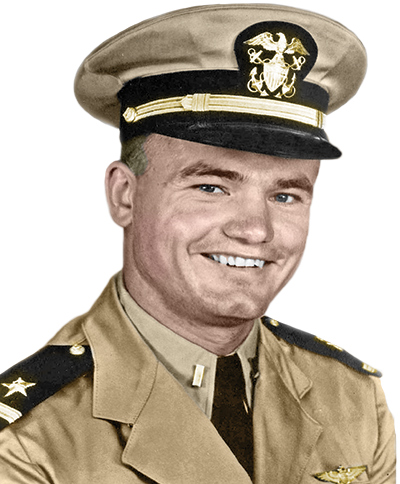
June 2, 1943: Ensign Nile Kinnick is killed in a U.S. Navy training flight. He was a month short of his 25th birthday.

Nile Clarke Kinnick Jr. was born on July 9, 1918 in Adel, Iowa, the grandson of George Clarke, a Republican who served as Governor of Iowa from 1913 to 1917. His family were devout Christian Scientists, and, while Nile Jr. was already a sports star at Adel High School, Nile Sr. got a job in Omaha, Nebraska, and the family had to move. At Benson High School, he won a State Championship in baseball, and starred in basketball.

But his best sport was football, and he chose to attend the University of Iowa, supposedly because their program, then in a down period, would represent a better test for him than his other major option, the University of Minnesota, then one of the best programs in the country -- and Iowa's arch-rival.

Iowa still struggled, going just 1-7 in his sophomore year, 1937. (Freshmen were not eligible for varsity sports under NCAA rules until 1972, with occasional exceptions, such as during the upcoming World War II.) They went 1-6-1 in 1938. Head coach Irl Tubbs was fired, and Eddie Anderson was lured away from Holy Cross in Massachusetts.

He turned the team around in just 1 year: Iowa went 6-1-1, beating South Dakota and Indiana at home, losing away to Michigan, then winning away to Wisconsin and Purdue, beating then-Number 3 Notre Dame and then-Number 20 Minnesota at home, rising to Number 9 in the country, before closing the season with a tie away to Northwestern.

The loss to Michigan cost Iowa the Big Ten Conference title, throwing it to Ohio State, whom Iowa did not play. They did not receive an invitation to a bowl game. But the Notre Dame game became their signature win, and it was recognized as Kinnick's signature performance, scoring Iowa's only touchdown and pinning Notre Dame deep in their own end zone with a late punt, to secure a 7-6 win.

Kinnick was awarded the Heisman Trophy. In his acceptance speech, he said:, "I thank God I was warring on the gridirons of the Midwest, and not on the battlefields of Europe. I can speak confidently and positively that the players of this country would much more, much rather struggle and fight to win the Heisman award than the Croix de Guerre." Another writer cited a pair of famed speechmakers from classical times, saying that his remarks "tackled Demosthenes and threw Cicero for a 15-yard loss."

He was elected student body president, maintained a grade-point average of 3.4, and gave the commencement address for his Class of 1940. That Summer, he played for the College All-Stars in the Chicago College All-Star Game at Soldier Field, losing to the defending NFL Champion Chicago Bears, 45-28.

But he never played football again. The NFL version of the Brooklyn Dodgers drafted him, but he turned down a $10,000 salary to go to the University of Iowa College of Law. He also served as an assistant coach at Iowa in the 1940 and '41 seasons, as the team went 4-4 and 3-5, respectively.

He spoke before the Young Republicans, and introduced Wendell Willkie, the 1940 Republican nominee for President, at an Iowa campaign rally. An Iowa newspaper, the Marion Sentinel, endorsed him for the 1956 Presidential election, the 1st in which he would be eligible, having met the minimum age requirement of 35.

He enlisted in the U.S. Naval Reserve, and reported for induction -- 3 days before the Japanese attack on Pearl Harbor. He received leave to visit his family in Omaha in September 1942, and attended Iowa's season opener, at home at Iowa Stadium in Iowa City, a 26-7 win over Washington University of St. Louis.
On June 2, 1943, Ensign Nile Kinnick was stationed aboard the aircraft carrier USS Lexington, off the coast of Venezuela. He was on a routine training flight in a Grumman F4F Wildcat, when it developed an oil leak. Radio contact was made, determining that he was 4 miles from the carrier, and was forced to carry out an emergency landing in the water. Rescue boats arrived 8 minutes later, but they found only an oil slick.

His body was never recovered. It took until 1996 for the plane to be found but, given that he might have still been inside, it was decided not to disturb the site.

A legend developed that the deck of the Lexington was covered with planes preparing to take off, and that trying to land on it would have caused an explosion that would have killed many of his crewmates, so Kinnick sacrificed himself to save them. The Navy later determined that it wouldn't have mattered: He couldn't have reached the carrier anyway, so the choice was out of his hands.

With the award's establishment in 1935, he was the 1st winner of the Heisman Trophy to die. There wouldn't be another until 1963, when 1961 winner Ernie Davis of Syracuse died from leukemia.

For nearly 30 years, Nile Kinnick Sr., having outlived his son, refused all requests by the University of Iowa to honor his son, not wanting to single him out over all other students who died in World War II. Finally, in 1972, he consented to the renaming of Iowa Stadium, which opened in 1929, as Kinnick Stadium. It remains the only stadium in American college football named for a Heisman Trophy winner. A statue of Kinnick was placed outside in 2006. His Number 24 was retired. The school plays an excerpt from his Heisman Trophy acceptance speech at every home game, before playing the National Anthem.

The coin flipped at the start of every Big Ten football game bears his image. He was a charter inductee into the Iowa Sports Hall of Fame in 1951. That same year, he was elected to the College Football Hall of Fame. In 1999, Sports Illustrated named him Iowa's 3rd-greatest sports figure, behind only wrestler and wrestling coach Dan Gable, and Cleveland Indians pitcher Bob Feller, who had been on a youth baseball team with Kinnick.

Feller, also a U.S. Navy veteran, went to his grave believing that, had he lived, Kinnick would have been elected Governor of Iowa, and would have beaten John F. Kennedy in the 1960 Presidential election.

*

June 2, 1943 was a Wednesday. These baseball games were played that day:

* The New York Yankees lost to the Chicago White Sox, 2-1 at Yankee Stadium.

* The New York Giants lost to the Cincinnati Reds, 13-6 at Crosley Field in Cincinnati. Mel Ott went 1-for-4.

* The Brooklyn Dodgers beat the St. Louis Cardinals, 3-2 at Sportsman's Park in St. Louis. Stan Musial went 1-for-1 with 3 walks.

* A doubleheader was split at Fenway Park in Boston, and both games went to extra innings, not an easy feat given that Fenway didn't get lights until 1947. The St. Louis Browns won the opener, 7-4. Chet Laabs, Frankie Hayes and George McQuinn all singled home runs in the top of the 12th inning. The Boston Red Sox won the nightcap, 3-2. Jim Tabor tripled home the winning run in the bottom of the 10th.

* The Detroit Tigers beat the Philadelphia Athletics, 7-2 at Shibe Park in Philadelphia.

* The Washington Senators beat the Cleveland Indians, 13-1 at Griffith Stadium in Washington.

* The Pittsburgh Pirates beat the Boston Braves, 3-2 at Forbes Field in Pittsburgh.

* And the Philadelphia Phillies beat the Chicago Cubs, 6-5 at Wrigley Field in Chicago.

December 31, 1999 & January 1, 2000: The Millennium

December 31, 1999:  The Millennium arrives. The people of planet Earth survived. At a terrible cost. But we hadn't destroyed ourselves. ...