Showing posts with label pasadena. Show all posts

Friday, December 30, 2022

December 30, 1940: Los Angeles' 1st Freeway Opens

December 30, 1940: The Arroyo Seco Parkway opens, along the seasonal river of the same name, running 8 miles northeast from downtown Los Angeles to Pasadena. It is the 1st of many freeways in the Los Angeles metropolitan area.

It became part of the historic U.S. Route 66, but is no longer designated as such. Rather, it is California Route 110. In 1954, it was renamed the Pasadena Freeway. In 2010, its original name was restored.

In the 1988 film Who Framed Roger Rabbit?, Judge Doom (played by Christopher Lloyd) lays out his plan for such a road: "Eight lanes of shimmering cement, running from here to Pasadena. Smooth, safe, fast. Traffic jams will be a thing of the past." (Yeah, surrre! He continued.) "I see a place where people get on and off the freeway, on and off, off and on, all day, all night! Soon, where Toontown once stood will be a string of gas stations, inexpensive motels, restaurants that serve rapidly prepared food, tire salons, automobile dealerships, and wonderful, wonderful billboards, reaching as far as the eye can see! My God, it'll be beautiful!"

In other words, he foresaw freeway exits, and the shopping centers that sprang up around them, serving as the new "downtown shopping districts" in what became suburban America after World War II. Except that the film took place in 1947, when said 8 lanes were already in place in real life. (But then, that entire film requires a major suspension of disbelief.)

Those 8 lanes would be the first of many, strangling Southern California in asphalt, and choking it in smog, because all those cars would be producing carbon dioxide, drifting east until the gas smacked into the San Gabriel Mountains, which would push it back, causing it, with nowhere else to go, to settle dangerously over what had become America's 3rd-largest city after World War II, and by 1970, the 2nd-largest.

Not until 1990 would Los Angeles open its 1st subway line.

*

December 30, 1940 was a Monday. TV sitcom writer, director and producer James Burrows was born.

Baseball and football were out of season. The NBA hadn't been founded yet. And no games were scheduled for the NHL. Therefore, there were no scores on this historic day.

Friday, November 4, 2022

November 5, 1911: America's 1st Transcontinental Flight

November 5, 1911: The 1st airplane flight across America is completed. It is not as well remembered as the aerial achievements of Charles Lindbergh and Amelia Earhart, mainly because most people weren't yet used to hearing about aerial achievements, and it took so long to do. It didn't help that the man who did it didn't have long to brag about it. But it hadn't been done before, and deserves mention.

And his name sounds a bit hoity-toity: Calbraith Perry Rodgers. He might have been better remembered as "Cal Rodgers," just as Lindbergh was well-remembered due to the nickname "Lucky Lindy." And he was born rich, preventing the advantage of a poor-boy-makes-good story.

Born in Pittsburgh in 1879, he was a grandson of Oliver Hazard Perry, the hero of the War of 1812's Battle of Lake Erie; and a great-grandnephew of Matthew Calbraith Perry, whose naval expedition of 1853 opened Japan to the Western world.

He went deaf as a boy, keeping him out of the family business, the U.S. Navy. Nevertheless, his family's wealth meant that he could pursue his interests without having to work for a living. In August 1911, he became a licensed pilot, and became one of the earliest civilians to purchase an airplane. He entered the Chicago International Aviation Meet, and won $11,285.

As with Lindbergh, he achieved his big moment with the goal of winning prize money. In 1910, William Randolph Hearst offered the Hearst Prize to the 1st pilot to fly coast to coast, in either direction, in less than 30 days, requiring a stop in Chicago. The prize was $50,000 -- about $1.54 million in 2022 money. Rodgers talked Chicago meatpacking mogul J. Ogden Armour to sponsor it, and named the plane, a Wright Model EX, after Armour's grape soft drink: The Vin Fiz Flyer

On September 17, 1911, at 4:30 PM Eastern Time, he took off from Sheepshead Bay Race Track in Brooklyn. He made the required stop in Chicago on October 8, attracting national attention. To avoid the Rocky Mountains, he took a southerly route, flying through the Midwest until reaching Texas. He turned west after passing San Antonio. 

Although the plan called for a large number of stops along the way, there turned out to be 75 of them, including 16 crashes, and Rodgers was injured several times. His team of mechanics rebuilt the Vin Fiz Flyer when necessary, and only a few pieces of the original plane actually made the entire trip.
The Vin Fiz Flyer

On November 5, at 4:04 PM Pacific Time, a crowd of 20,000 people saw him land at Tournament Park in Pasadena, outside Los Angeles. He had flown a single plane from New York City to California without getting himself (or anyone else) killed, which had never been done before. But he had missed the prize deadline by 19 days, and Hearst refused to pay. Hearst never awarded the prize.

On April 3, 1912, while making an exhibition flight in a Wright Model B, over Long Beach, California, Rodgers flew into a flock of birds, causing the plane to crash into the ocean. His neck was broken and his thorax damaged by the engine of the airplane. He died within minutes. He was 33 years old, and left behind a wife, but no children.

In 1925, his cousin, John Rodgers, set a record for the longest nonstop flight be seaplane, 1,992 miles, trying to fly from San Francisco to Honolulu. He and his crew ran out of fuel, and had to turn a wing of their plane into a sail to get to the nearest Hawaiian Island, before they were rescued. He was killed in a crash in Philadelphia the next year.

The version of the Vin Fiz Flyer that completed the flight is now on display at the Smithsonian Institution's National Air and Space Museum, on the National Mall in Washington, D.C.

*

November 5, 1911 was a Sunday. Baseball season was over. Professional basketball and hockey barely existed. There was professional football, but it was still very minor-league at this point. So there were no scores on this historic day. 

Thursday, October 27, 2022

October 28, 1922: The Rose Bowl Stadium Opens

October 28, 1922: The Rose Bowl stadium opens in the Los Angeles suburb of Pasadena, California. And the matchup for the opener couldn't have been better: A battle of unbeatens.

The University of California, from the system's main campus in Berkeley, outside San Francisco, was 4-0, and took on the 5-0 team from the University of Southern California, based in Los Angeles. A safety gave Cal a 2-0 lead at halftime, and the Golden Bears held on 2 goal-line stands, before adding a touchdown and a field goal to beat USC, 12-0.

On January 1, 1923, the Rose Bowl game, previously played at the 40,000-seat Tournament Park, was played there for the 1st time. This time, USC won, beating Penn State 14-3. The Rose Bowl has been played there annually since, except for 1942, when concerns over the bombing of Pearl Harbor led it to be moved to Durham, North Carolina, where host Duke lost to Oregon State; and 2021, when it was moved to Arlington, Texas due to COVID restrictions.

Originally a horseshoe, an expansion in 1928 made it the largest stadium in the country. Attendance peaked at 106,869, for the 1973 Rose Bowl, in which USC beat Ohio State 42-17. A renovation in 2013, with wider seats, dropped seating capacity to 92,542.

It was the home field for Caltech from 1923 to 1976, California State University at Los Angeles from 1957 to 1969, the North American Soccer League's the Los Angeles Wolves in 1968 and Los Angeles Aztecs in 1978 and '79, and MLS' Los Angeles Galaxy from 1996 to 2002. UCLA have played home games there sine 1982.

It has also hosted the 1983 Army-Navy Game (Navy won, 42-13), 8 games of the 1994 World Cup (including the U.S.' win over Colombia and loss to Romania, and Brazil's win over Italy in the Final), 4 games of the 1999 Women's World Cup (including the U.S.' win over China in the Final), cycling at the 1932 Olympics, and soccer at the 1984 Olympics.

And it has hosted 5 Super Bowls: XI, 1977, the Oakland Raiders beating the Minnesota Vikings 32-14; XIV, 1980, the Pittsburgh Steelers beating the Los Angeles Rams 31-19; XVII, 1983, the Washington Redskins beating the Miami Dolphins 27-17; XXI, 1987, the New York Giants beating the Denver Broncos 39-20; and XXVII, 1993, the Dallas Cowboys beating the Buffalo Bills 52-17.

*

October 28, 1922 was a Saturday. There was another major college football milestone: For the 1st time, a football game is broadcast on live nationwide radio. The year before, the University of Chicago had become one of the first colleges to send its football team to play a team outside its home region, beating Princeton University 9-0 at Palmer Stadium in Princeton, New Jersey. Now, they would have a rematch at Stagg Field on the South Side of Chicago.

The Princeton Tigers entered the game 4-0, the Chicago Maroons 3-0. After 3 quarters, thanks to 3 touchdowns by John Thomas, Chicago led 18-7. Then came the kind of collapse people would still be talking about nearly a century later if it had happened on TV and the footage had been preserved. The Maroons fumbled, the Tigers recovered, and took it in for a 40-yard touchdown. Harry Crum scored for Princeton in the closing minutes, and, since Princeton made their PATs, and Chicago didn't make theirs, the Tigers emerged victorious, 21-18.

On the basis of the win over Chicago, Eastern and Midwestern sportswriters proclaimed Princeton to be the National Champions after the season. Western writers gave the title to Cal. No playoff in those days. Bowl games? Cal had won the Rose Bowl in 1920 and tied it in 1921, but in 1922 and 1923, they didn't go. From September 25, 1920 to October 3, 1925, under coach Andy Smith, the Golden Bears had a 50-game unbeaten streak, still the longest in college football history: Played 50, won 46, tied 4, lost exactly none.

Coaching took a severe toll on Smith, who went just 6-3 with Cal in 1925. On a visit to Philadelphia, where he had coached the University of Pennsylvania from 1909 to 1912, he was hospitalized with pneumonia, and died on January 8, 1926, only 49 years old. His career coaching record was 116-32-13, including 74-16-7 at Cal.

This was also the day that Benito Mussolini's Fascists marched on Rome. I have a separate entry for that event. And on the opposite end of the political spectrum, if not quite on the opposite end of the Eurasian continent, the Communists finally completed their conquest of Russia, as the Red Army conquered the Siberian port city of Vladivostok. The Reds would be in power in Russia for the next 69 years, the Fascists in Italy for 21 years.

Also on this day, basketball coach Butch van Breda Kolff and French soccer star Ernest Vaast were born.

The Major League Baseball season had ended earlier in the month, with the New York Giants winning the World Series over the New York Yankees. There was, as yet, no major professional basketball league. The National Hockey League's new season was still a few weeks away. The nascent National Football League did play games that weekend, but all the next day, Sunday.

But, being a Saturday, there were college football games. In addition to Cal vs. USC and Princeton vs. Chicago, including the following:

In New York City, New York University played Rhode Island State at Ohio Field in The Bronx, and won 23-7. Fordham University played Westminster College of Pennsylvania at Fordham Field, also in The Bronx, and won 12-0. Columbia University wasn't so lucky: They played Williams College of Massachusetts, at South Field, just south of their famed Low Library in the Morningside Heights section of Manhattan, and lost 13-10.

And, aside from Princeton the main team in New Jersey, Rutgers University went to Morgantown and lost to West Virginia University 28-0.

Also, in English soccer, Arsenal lost to Newcastle United, 2-1 at the Arsenal Stadium, a.k.a. Highbury, in North London.

Sunday, July 17, 2022

July 17, 1994: The World Cup Final On American Soil

The Rose Bowl, Pasadena, California, July 17, 1994.
Attendance: 94,194.

July 17, 1994: For the 1st time -- and, so far, for the only time -- the Final of soccer's World Cup is held on American soil. ABC broadcast it.

There were 9 venues. From East to West:

* Foxboro Stadium, built in 1971, in the Boston suburb of Foxboro, Massachusetts, home of the NFL's New England Patriots. It had been the home of the North American Soccer League's Boston Minutemen and New England Tea Men, and would become the home of Major League Soccer's New England Revolution.

* Giants Stadium, 1976, in the New York suburb of East Rutherford, New Jersey, home of the NFL's New York Giants and New York Jets. It had been the home of the NASL's New York Cosmos, and would become the home of MLS' New York/New Jersey MetroStars, who became the New York Red Bulls.

* Robert F. Kennedy Memorial Stadium, known as District of Columbia Stadium from 1961 to 1969, in Washington, D.C., home of the NFL's Washington Redskins (now the Washington Commanders). It had been the home of the NASL's Washington Darts and Washington Diplomats, and would become the home of MLS' D.C. United.

* The Citrus Bowl, 1936, now named Camping World Stadium, in Orlando, Florida, the only venue not then the regular home of a professional or college football team. It was home of college football's annual Florida Citrus Bowl. It would later become the home of MLS' Orlando City Soccer Club.

* The Silverdome, 1975, in the Detroit suburb of Pontiac, Michigan, home of the NFL's Detroit Lions. It had been the home of the NASL's Detroit Express. Alone among these 9 metropolitan areas, Detroit has never had an MLS team.

* Soldier Field, 1924, in Chicago, home of the NFL's Chicago Bears. It had been the home of the NASL's Chicago Sting, and would become the home of MLS' Chicago Fire.

* The Cotton Bowl, 1930, in Dallas, home of the annual Cotton Bowl game, and the former home of the NFL's Dallas Cowboys. It had been the home of the NASL's Dallas Tornados, and would become the home of MLS' Dallas Burn, who became F.C. Dallas.

* The Rose Bowl, 1922, in the Los Angeles suburb of Pasadena, California, home of the football team at the University of California at Los Angeles (UCLA) and the annual Rose Bowl game. It had been the home of the NASL's Los Angeles Wolves and Los Angeles Aztecs, and would become the home of MLS' Los Angeles Galaxy.

* And Stanford Stadium, 1921, in the San Francisco suburb of Palo Alto, California, home of the football team at Stanford University.

Thus, the Silverdome, Soldier Field, the Rose Bowl and Stanford Stadium became the only stadiums to host both a Super Bowl and a World Cup match -- and the Rose Bowl would become the only one to host both a Super Bowl and a World Cup Final.
 
This tournament remains the World Cup with the highest per-game attendance: 68,991. And what an array of talent, not dampened in the slightest by England, which still thinks of itself as the country in world "football," failing to qualify for the 1st time since 1978:

* From finalists Brazil: Romário, Ronaldo, Cafu, Bebeto, Dunga, Leonardo, and Claudio Taffarel.

* From finalists Italy: Franco Baresi, Paolo Maldini, Gianfranco Zola, Mauro Tassotti, Roberto Donadoni, Antonio Conte, and Roberto and Dino Baggio (not related).

* From semifinalists Sweden: Henrik Larsson and Tomas Brolin.

* From semifinalists Bulgaria: Hristo Stoichkov.

From quarterfinalists the Netherlands: Frank Rijkaard, Ronald Koeman, Dennis Bergkamp, Marc Overmars, Danny Blind, Edwin van der Sar, and the twins Frank and Ronald de Boer. (Marco van Basten had already had to retire due to injury.)

* From quarterfinalists Germany: Lothar Matthäus, Jürgen Klinsmann, Jürgen Kohler, Rudi Völler, Thomas Häßler, Andreas Brehme, Matthias Sammer and Oliver Kahn.

* From quarterfinalists Romania: Gheorghe Hagi and Gheorghe Popsecu.

* From quarterfinalists Spain: Pep Guardiola and Luis Enrique.

* From the Round of 16: From Argentina: Diego Maradona (who ended up getting suspended for drugs), Gabriel Batistuta and Claudio Caniggia. From Ireland: Roy Keane, Paul McGrath, Ray Houghton, John Aldridge, Steve Staunton, Ronnie Whelan, Tony Cascarino and Packie Bonner. From Nigeria: Jay-Jay Okocha.

* From teams that didn't make it to the knockout round: Roger Milla from Cameroon, and Carlos Valderrama and his hair from Colombia.

* And from our own team, which did make it past the Group Stage for the 1st time since 1930: Alexi Lalas, Eric Wynalda, Cobi Jones, Marcelo Balboa, Paul Caligiuri and Jersey Boys Tony Meola, John Harkes, Tab Ramos and Claudio Reyna.

True, we got knocked out by Brazil, on home soil, on the 4th of July no less, at the old Stanford Stadium in the San Francisco suburb of Palo Alto, California. And we wore horrid uniforms. But it was still a big boost for American soccer, just what the upcoming founding of Major League Soccer (MLS) needed going into 1996.
Yes, we actually wore these things.

Certainly, we got the pageantry right. Having America play on the 4th of July worked out well, despite the loss. And the New York market got lucky, as 2 of the country's, and particularly the Tri-State Area's, biggest ethnic groups ended up having their ancestral homelands playing each other at the Meadowlands: The Republic of Ireland and Italy.
Ireland vs. Italy, Giants Stadium, June 18, 1994.
Attendance: 75,338. Ireland pulled the upset, winning 1-0.

But, from the American perspective, the 2 worst things that could have happened did happen. Someone got killed. Not in the stadium, or in the streets; it wasn't a fight between hooligans. Not even in the country. After his own goal sent Colombia down to defeat against us, Andrés Escobar of Atlético Nacional went back home to Medellín, and was shot and killed. He was only 27 years old.

The other was that the Final ended scoreless. There were the 2 best teams in the world, Brazil and Italy, and, after a full 90 minutes, plus extra time making it 120 minutes, the final score was 0-0. Nil-nil. Nothing to nothing. Americans like scoring, and any American watching this Final, not knowing all that goes into a soccer game, would have found it boring as hell. It probably set American interest in the sport back several years.

Roberto Baggio blasted a penalty kick over the crossbar, and Brazil won the penalty phase, 3-2. And Americans not already into soccer shrugged their shoulders, and either went back to watching baseball or began preparing for a new NFL season.
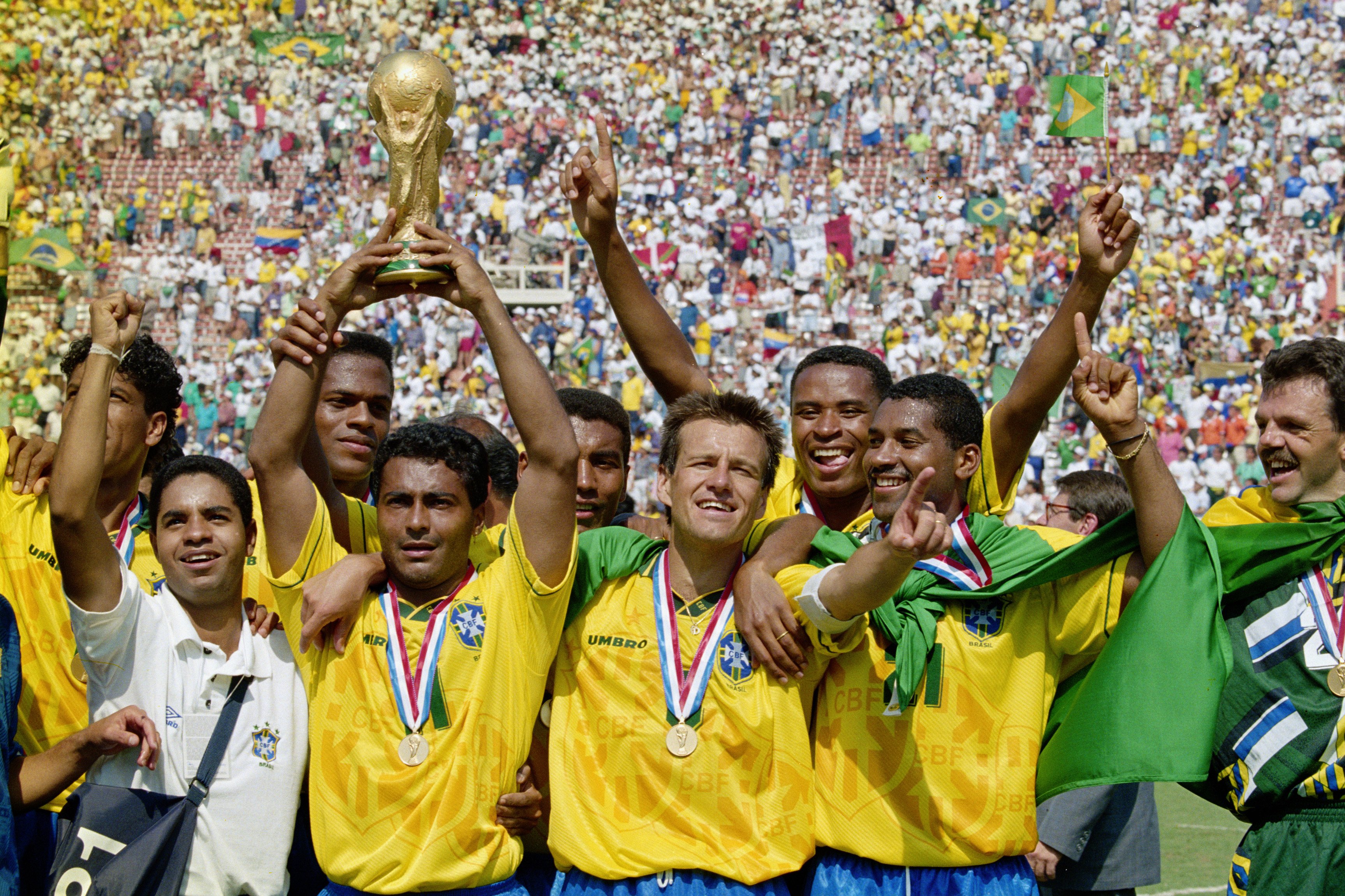
Romário (Number 11) lifts the Jules Rimet Trophy,
next to Dunga (8), the Captain

Foxboro Stadium was torn down in 2002, having been replaced by the next-door Gillette Stadium. Soldier Field was torn down in 2002, and replaced by a new stadium on the same site. Stanford Stadium was torn down in 2004, and replaced by a new stadium on the same site. Giants Stadium was torn down in 2010, having been replaced by the next-door MetLife Stadium. The Silverdome was torn down in 2017, after the Detroit Lions moved into Ford Field in 2002. RFK Stadium is scheduled to be torn down in 2023.

The 2026 World Cup was awarded jointly to all 3 North American nations: The United States, Canada (which has never hosted), and Mexico (which hosted in 1970 and 1986). Most of the host stadiums from 1994 are unlikely to host again in 2026, since they've been replaced.

If Los Angeles gets the Final again, it won't be played at the Rose Bowl, even though it is still in use and still in good shape. It will probably go to the new SoFi Stadium in Inglewood, because of its retractable roof. If New York gets the Final, it will be at MetLife Stadium, Giants Stadium's replacement.

UPDATE: In 2024, the 2026 World Cup Final was awarded to MetLife Stadium. SoFi Stadium got a Quarterfinal, while the Semifinals went to Mercedes-Benz Stadium in Atlanta and AT&T Stadium outside Dallas.

An article for ESPN.com, published after the 2026 World Cup, ranking all 23 tournaments, rated the 1994 edition 10th, citing "turmoil" and "tension"; but adding, "In terms of pure imagery, it will be difficult to ever top 1994." 

*

July 17, 1994 was a Sunday. It was the off-season for the NFL, the NBA and the NHL. But, in addition to the World Cup Final, there was a full slate of Major League Baseball games played that day. It was, however, well past the age of Sunday doubleheaders:

* The New York Yankees beat the Seattle Mariners, 14-4 at the Kingdome in Seattle. Jim Leyritz hit 2 home runs, and Danny Tartabull added another, to make a winning pitcher out of Scott Kamieniecki. Tino Martinez hit one of the M's, and would be a big part of them driving the Yankees crazy in the 1995 Playoffs. But the Yankees traded for him, and he became a part of their next Dynasty.

* The New York Mets lost to the San Diego Padres, 10-1 at Shea Stadium.

* The Philadelphia Phillies beat the Los Angeles Dodgers, 9-7 at Veterans Stadium in Philadelphia.

* The San Francisco Giants beat the Montreal Expos, 6-4 at the Olympic Stadium in Montreal.

* The Houston Astros beat the Pittsburgh Pirates, 9-0 at Three Rivers Stadium in Pittsburgh.

* The Atlanta Braves beat the Florida Marlins, 2-1 at Atlanta-Fulton County Stadium.

* The Cincinnati Reds beat the Chicago Cubs, 3-2 at Riverfront Stadium in Cincinnati. Reggie Sanders singled home the winning run in the bottom of the 10th inning.

* The Chicago White Sox beat the Cleveland Indians, 5-2 at the new Comiskey Park in Chicago. (It is now named Rate Field.)

* The Milwaukee Brewers beat the Minnesota Twins, 5-3 at the Metrodome in Minneapolis.

* The Kansas City Royals beat the Detroit Tigers, 4-1 at Kauffman Stadium in Kansas City.

* The Toronto Blue Jays beat the Texas Rangers, 3-1 at The Ballpark (now Choctaw Stadium) in the Dallas suburb of Arlington, Texas.

* The Colorado Rockies beat the St. Louis Cardinals, 10-6 at Mile High Stadium in Denver.

* The Baltimore Orioles beat the California Angels, 10-5 at Anaheim Stadium in the Los Angeles suburb of that name. (It is now named Angel Stadium of Anaheim.)

* And the Boston Red Sox beat the Oakland Athletics, 4-3 at the Oakland Coliseum. 

Sunday, July 10, 2022

July 10, 1999: Women's Soccer Grows Up

July 10, 1999: The Women's World Cup Final is held at the Rose Bowl in Pasadena, in the suburbs of Los Angeles, in front of 90,185 people. It was the highest attended women's sporting event in history.

FIFA, the governing body for world soccer, had first held a Women's World Cup in 1991, in China, with only 12 teams, so it was difficult to take it seriously. The U.S. beat Norway in the Final, 2-1 at Tianhe Stadium in Guangzhou on November 30. Outside of soccer fanatics, few Americans noticed. Even women devoted to women's sports barely seemed to notice. A 2nd tournament was held in Sweden in 1995, with Norway beating the U.S. in the Semifinal and then Germany in the Final. That one wasn't well-acknowledged, either.

But the 1999 tournament was set for the U.S., and ESPN, and its parent company ABC, were ready to promote it, having successfully broadcast the men's World Cups in 1990, '94 and '98. They worked with the U.S. Soccer Federation to promote the tournament, and hired studio analysts, men and women alike, who were thoroughly experienced former players, and knew the game enough, and could explain it well enough, to first-time viewers.

And America embraced its national team. They were women, but they didn't fit the previous stereotype of the female athlete. As Rick Reilly put it in his post-tournament column for Sports Illustrated, most men had figured that the first great American team in women's sports would have players who looked like "Joe Torre in heels." I guess he forgot how good the 1996 U.S. women's basketball team was. (Torre, the Yankees' manager, had, in his playing days, been mocked for his appearance. In his book, Ball Four, Jim Bouton said Torre was so ugly, he broke mirrors just by looking at them.)

But these women were not stereotypical female athletes, the kind you might find in tennis or field hockey: Unattractive, musclebound, lesbian, or some combination thereof. Most of them were attractive, and most of them were straight. Some of them were married, and some even already had children, bringing kids in strollers and diaper bags to practice along with their gym bags. And they were from all over the country:

* From the Northeast: Sara Whalen, a midfielder, and Tracy Ducar, a backup goalkeeper, were from Massachusetts; Kristine Lilly, a midfielder, was from Wilton, Connecticut; Shannon MacMillan, a midfielder, was from Syosset, Long Island; Saskia Webber, a backup goalkeeper, was from Princeton, in Central Jersey; and Christie Pearce, a left back, was from Point Pleasant, on the Jersey Shore.

* From the South: Danielle Fotopoulos, a forward, was from Florida; Mia Hamm, a forward, was from Alabama; and Cindy Parlow, a forward, was from Memphis.

* From the Midwest: Kate Sobrero, a centerback, was from the Detroit suburbs; and Briana Scurry, the team's starting goalkeeper, was from Minneapolis.

* From California: Julie Foudy, a midfielder, was from San Diego; Carla Overbeck, the Captain and a centerback, and Joy Fawcett, a right back, were from the Los Angeles area; midfielders Michelle Akers, Lorrie Fair, and Tiffany Roberts, and left back Brandi Chastain, were all from the San Francisco Bay Area; and Trisha Venturini, a midfielder, was from nearby Modesto.

* And from the Northwest: Tiffeny Milbrett, a forward, was from Portland, Oregon.

The U.S. team began the tournament on June 19, beating Denmark, 3-0 at Giants Stadium in the Meadowlands. The promotions paid off: The were 78,972 paying customers, the largest attendance for a women's sporting event, ever, anywhere in the world.

On June 24, at Soldier Field in Chicago, they beat Nigeria, 7-1, with Milbrett scoring 2 goals. Attendance: A full house of 65,080. On June 27, in Foxboro Stadium outside Boston, they beat North Korea, 3-0, with Venturini scoring twice. This one was attended by 50,484, about 10,000 short of a sellout. But the U.S. had topped their group.

The quarterfinal, on July 1 at Jack Kent Cooke Stadium (now Northwest Stadium) outside Washington, was their first real test. Germany led them 1-0 after 5 minutes and 2-1 going into halftime. But Chastain scored early in the 2nd half, and Fawcett won the game in the 66th minute, 3-2. Attendance: 54,642, about 30,000 short of a sellout. One ticket bought 2 games: In another Quarterfinal, Brazil beat Nigeria, 4-3, in extra time and on a "golden goal" by Sissi in the 104th minute.

The other 2 Quarterfinals were held the day before, at Spartan Stadium in San Jose. China beat Russia, 2-0; and Norway beat arch-rivals Sweden, 3-1. Attendance: 21,411 -- but that was a sellout.

Both Semifinals were played on the 4th of July, one on each coast. At Stanford Stadium outside San Francisco, Parlow scored in the 5th, and the U.S. were awarded a penalty in the 80th, converted by Akers, and beat Brazil, 2-0. The crowd was 73,123. In Foxboro, China beat Norway, 5-0. Attendance: 28,986. With no Americans, and no familiar names, to root for, the New England Patriots' old oversized high school stadium, with its professionally-appropriate replacement, eventually to be named Gillette Stadium, going up next door, was less than half-full.

The Final was held on July 10, at the Rose Bowl in the Los Angeles suburb of Pasadena, California. The crowd of 90,185 broke the record set at the Meadowlands for the highest-attended women's sporting event -- and, as of July 10, 2022, that record still holds. ABC's coverage averaged 17.9 million viewers throughout, peaking at 40 million (presumably, during the penalty shootout). Not only was America watching these women, but America cared about them.

Manager Tony DiCicco selected this starting lineup: Scurry in goal; a back four of Fawcett, Overbeck, Sobrero and Chastain; a midfield of Lilly, Foudy and Akers; and a forward line of Hamm, Parlow and Milbrett. The U.S., as the home team, had the choice of colors, and wore white, leaving China, as they might have preferred, anyway, to wear red.

And then, as with the men's Final at the same stadium 5 years earlier, the worst possible thing could have happened: Nobody scored. Not in the assigned 90 minutes, plus stoppage time. Not in the assigned 30 minutes of extra time, plus stoppage time. It was 125 or so minutes of 0-0 ball.

DiCicco replaced Parlow with MacMillan in the 57th, switching from a 4-3-3 formation to a 4-4-2; Akers with Whalen at the start of extra time; and Milbrett with Venturini in the 115th, going to a 4-5-1 with Hamm, the team's most-heralded player and probably its best overall player, as the lone striker. Chinese manager Ma Yuanan also made the allowable 3 substitutions, going from his starting 4-4-2 to a 3-4-3 for much of the 2nd half, and then going back to a 4-4-2 in extra time. Nothing worked, for either side: Nobody scored.

But a funny thing happened on the way to this game being denounced as being as boring as the 1994 men's World Cup Final: The crowd was into it the whole way. It may have been about 50-50 gender-integrated, and the sound was very different from a men's game: The higher-pitched voices of women, and especially of girls, echoed through the venerable old gridiron-football stadium. This crowd got it. They understood what was a nice pass or a nice shot, even if the ball didn't go in the net. They understood what was a strong defensive play from a defender, or a great save by Scurry or China's Gao Hong. This crowd treated a 0-0 draw the way an English crowd might have treated a local "derby" rivalry.

And it was a clean game. The referee, Katrina Eloverta of Finland, issued just 1 yellow card to the U.S., to Akers in the 74th. She issued 2 to China: To Zhang Ouying in the 70th, and to Liu Ailing in the 80th.

The game went to penalties. China went first. In the 1st round, Xie Huilin and Overbeck scored. In the 2nd round, Qiu Haiyan and Fawcett scored. But in the 3rd round, Scurry stopped Liu Ying, and Lilly put the U.S. 3-2 up. In the 4th round, Zhang and Hamm scored. Chinese Captain Sun Wen converted to start the 5th round.

Now, DiCiccio sent Chastain up. It seemed odd to some people that what could have been the title-deciding penalty was being taken by a defender, but having defenders in the penalties -- Overbeck also was one, as was Xie -- is not very unusual.

There wasn't nearly as much pressure on Chastain as there could have been: Had she lost, the penalties would have continued until a winner was found. But she, and every other person in the stadium rooting for the U.S., wanted to end it there. With her left foot, she sent the ball to the left of the goal. Gao dove to her right, but she couldn't stop it. The U.S. had won, 5-4.

Like so many men celebrating major goals before her, Chastain ripped off her shirt (Number 6), spun around, and dropped to her knees. She was wearing a black "sports bra," and the celebration became iconic.

Some people criticized Chastain for doing what any man would do in her situation, and ripping her shirt off. Well, she told an interviewer, "I ran my ass off for this body. I'm proud of it." There's now a statue of it outside the Rose Bowl, along with statues of former UCLA multi-sport athlete and Pasadena native Jackie Robinson, former UCLA football coach Terry Donahue, and longtime ABC sportscaster Keith Jackson, who broadcast many games there, including his last, the 2006 Rose Bowl.

Collectively, the 1999 U.S. Women's World Cup team was named Sportswomen of the Year by Sports Illustrated.

With this victory, American soccer became the 1st sport where "You play like a girl!" was accepted as an improvement. And the image of women in sports has changed tremendously. The U.S.' 2015 and 2019 World Cup winners are the product of that influence, and will be an extension of it as they add their own. It has reached the point where some of them are openly gay, and the fans don't care.

*

July 10, 1999 was a Saturday. These Major League Baseball games were played, all of them Interleague:

* The New York Mets beat the New York Yankees, 9-8 at Shea Stadium. This was The Matt Franco Game, where Franco singled home 2 runs off Mariano Rivera in the bottom of the 9th inning. I have a separate entry for this event.

* The Toronto Blue Jays beat the Montreal Expos, 7-6 at the Olympic Stadium in Montreal.

* The Baltimore Orioles beat the Philadelphia Phillies, 8-4 at Veterans Stadium in Philadelphia. Mike Mussina outpitched Paul Byrd. Cal Ripken went 1-for-4 with 2 RBIs.

* The Atlanta Braves beat the Boston Red Sox, 2-1 at Turner Field (now Center Parc Stadium) in Atlanta. Cliché Alert: Walks can kill you, especially the leadoff variety. John Wasdin walked Andruw Jones to start the bottom of the 11th inning. Brian Hunter bunted, and Wasdin threw the ball away, allowing Jones to score the winning run.

* The Tampa Bay Devil Rays beat the Florida Marlins, 9-8 at Pro Player Stadium (now Hard Rock Stadium) in Miami Gardens, Florida.

* The Cleveland Indians beat the Cincinnati Reds, 11-10 at Jacobs Field (now Progressive Field) in Cleveland. The Reds led 9-4 going into the bottom of the 5th, but the Indians clawed back, and tied the game in the 8th. The Reds took a 10-9 lead in the top of the 9th.

Cliché Alert: Walks can kill you, especially the leadoff variety. Danny Graves started the bottom of the 9th by walking Jim Thome. He was replaced by Scott Williamson, who gave up a game-winning home run to Omar Vizquel. Thome drawing a walk, and Vizquel hitting a home run, instead of the other way around? That's the way it happened.

* The Detroit Tigers beat the Milwaukee Brewers, 9-3 at Tiger Stadium in Detroit.

* The Chicago Cubs beat the Chicago White Sox, 10-2 at the new Comiskey Park (now Rate Field). Sammy Sosa went 0-for-5, but the Cubs got home runs from José Hernández and Glenallen Hill.

* The Minnesota Twins beat the Pittsburgh Pirates, 5-4 at the Metrodome in Minneapolis.

* The Houston Astros beat the Kansas City Royals, 3-2 at Kauffman Stadium in Kansas City.

* The Anaheim Angels beat the Colorado Rockies, 9-3 at Coors Field in Denver.

* The Oakland Athletics beat the Arizona Diamondbacks, 2-0 at Bank One Ballpark (now Chase Field) in Phoenix. Tim Hudson took a 3-hit shutout into the 9th inning, but A's manager Art Howe decided he needed Billy Taylor to get the last 2 outs.

* The San Diego Padres beat the Texas Rangers, 5-4 at Qualcomm Stadium (formerly San Diego Stadium and Jack Murphy Stadium). Tony Gwynn did not play.

* The Los Angeles Dodgers beat the Seattle Mariners, 2-1 at Dodger Stadium in Los Angeles. Adrián Beltré singled Devon White home with the winning run in the bottom of the 9th inning. Ken Griffey Jr. went 0-for-4.

* And the San Francisco Giants beat the St. Louis Cardinals, 4-2 at Candlestick Park (then known as 3Com Park at Candlestick Park) in San Francisco. Barry Bonds and Mark McGwire did not play.

Monday, July 4, 2022

July 4, 2023: Major League Soccer's Biggest Crowd

July 4, 2023: Major League Soccer has the biggest crowd in its history, in one of the league's defining cities.

NOTE: While these entries are dated 2022, I decided to backdate the posting dates of events from 2023 onward to the same date in 2022.

The league's first attendance record was, of course, set in its first game, but it lasted a long time. On April 13, 1996, the Los Angeles Galaxy beat the New York/New Jersey MetroStars, the team now known as the New York Red Bulls, 2-1 at the Rose Bowl in Pasadena, in front of 69,255.

That record lasted until September 16, 2017, when expansion team Atlanta United got 70,425 fans for a game at Mercedes-Benz Stadium in Atlanta, against Orlando City, which ended in a 3-3 draw. They managed to keep raising the record until the 2018 MLS Cup Final, when they topped out at 73,019 for their 3-0 win over the Portland Timbers.

On March 5, 2022, that expansion team got topped by another expansion team. Charlotte Football Club moved into Bank of America Stadium, home of the NFL's Carolina Panthers. Their 1st-ever home game attracted 74,479, a new record. With some appropriateness, the opponent was the 1st-ever MLS regular-season hosts, the Galaxy, who emerged victorious, 1-0, on a 77th minute goal by Efrain Álvarez.

But the record was reclaimed by the Rose Bowl on the 4th of July, 2023. The establishment of Los Angeles Football Club in 2018 led to an intra-metro-area rivalry named not El Clásico, like the one between Spain's Real Madrid and FC Barcelona; but El Tráfico, for the L.A. area's awful traffic.

The derby was first played at what's now named Dignity Health Sports Park in suburban Carson on March 31, 2018, and the Galaxy won a thriller, 4-3. LAFC play at BMO Stadium (formerly Banc of California Stadium), built on the site of the Los Angeles Memorial Sports Arena, next-door to the Los Angeles Memorial Coliseum. So, like the newer New York City FC says to the New Jersey-based New York Red Bulls, LAFC, despite being the newer team, can claim to be the real team of the city, because they actually play in the city.

The Galaxy lead the league with 5 MLS Cup wins, most recently in 2014. LAFC won the MLS Cup in 2022, so they came into this game as defending Champions.

The Galaxy wanted to reclaim the MLS attendance record, so they recommended that their 2023 season opener, set to be an El Tráfico, be moved to the Rose Bowl. MLS management agreed, but bad weather forced the game to be postponed. They decided to play it on the national holiday. Attendance was 82,110, breaking the old record by over 7,000 fans.

Tyler Boyd put the Galaxy on the scoreboard in the 26th. Ilie Sánchez equalized in the 57th. Ricard Puig scored for the Galaxy in the 73rd, and his goal held up as the winner: LAG 2-1 LAFC.

"It felt like it should," said LAFC head coach Steve Cherundolo said after the game. "It felt like a playoff game and a real game that matters not just to the 22 players out on the field, but to 82,000 people here and around LA. It's fantastic and a great atmosphere for everybody who was here tonight."

LAFC have expressed interest in playing a game they would host at the Coliseum, or at SoFi Stadium in Inglewood. Renovations have meant that the Coliseum no longer holds over 100,000 people, but SoFi can, supposedly, be expanded to that many.

*

July 4, 2023 was a Tuesday. These 4 other games were played in MLS that day:

* Orlando City beat Toronto FC, 4-0 at Exploria Stadium in Toronto.

* Inter Miami and the Columbus Crew played to a draw, 2-2 at DRV PNK Stadium in the Miami suburb of Fort Lauderdale, Florida.

* D.C. United beat FC Dallas, 1-0 at Toyota Stadium in the Dallas suburb of Frisco, Texas.

* And the Colorado Rapids and the Portland Timbers played to a draw, 0-0 at Dick's Sporting Goods Park in the Denver suburb of Commerce City, Colorado.

And these Major League Baseball games were played:

* The New York Yankees beat the Baltimore Orioles, 8-4 at Yankee Stadium II. Gleyber Torres and Jose Trevino hit home runs, in support of Clarke Schmidt.

* The New York Mets beat the Arizona Diamondbacks, 8-5 at Chase Field in Phoenix.

* The Texas Rangers beat the Boston Red Sox, 6-2 at Fenway Park in Boston.

* The Cincinnati Reds beat the Washington Nationals, 8-4 at Nationals Park in Washington.

* The Philadelphia Phillies beat the Tampa Bay Rays, 3-1 at Tropicana Field in St. Petersburg, Florida.

* The Miami Marlins beat the St. Louis Cardinals, 15-2 at LoanDepot Park in Miami.

* The Cleveland Guardians beat the Atlanta Braves, 6-5 at Progressive Field in Cleveland. David Fry singled home the winning run in the bottom of the 10th inning.

* The Oakland Athletics beat the Detroit Tigers, 1-0 at Comerica Park in Detroit. Ryan Noda singled home the winning run in the top of the 10th inning. The A's used 4 pitchers to pitch a 6-hit, 10-inning shutout: JP Sears (7 1/3rd innings), Lucas Erceg (2/3rds), Shintario Fujinami (the 9th inning, and the winning pitcher) and Trevor May (10th inning, save).

* The Toronto Blue Jays beat the Chicago White Sox, 4-3 at Guaranteed Rate Field (now Rate Field) in Chicago.

* The Chicago Cubs beat the Milwaukee Brewers, 7-6 at American Family Field in Milwaukee. Nico Hoerner singled home the winning run in the top of the 11th inning.

* The Minnesota Twins beat the Kansas City Royals, 9-3 at Target Field in Minneapolis.

* The Houston Astros beat the Colorado Rockies, 4-1 at Minute Maid Park (now Daikin Park) in Houston.

* The San Diego Padres beat the Los Angeles Angels, 8-5 at Petco Park in San Diego.

* The Pittsburgh Pirates beat the Los Angeles Dodgers, 9-7 at Dodger Stadium in Los Angeles.

* And the Seattle Mariners beat the San Francisco Giants, 6-0 at Oracle Park in San Francisco. Logan Gilbert pitched a 5-hit shutout.

Monday, May 16, 2022

May 16, 1983: Michael Jackson Overshadows the Motown 25 Special

May 16, 1983: NBC airs the special Motown 25: Yesterday, Today, Forever – a year ahead of Motown Records' actual 25th Anniversary. It was taped before a live audience at the Pasadena Civic Auditorium, in the Los Angeles suburb of Pasadena, California, on March 25.

It was thought that the highlight might be the "Battle of the Bands" between the Temptations and the Four Tops, which led to a highly successful joint tour between them. Or it might be Smokey Robinson reuniting with his former group, The Miracles. Or it might be Marvin Gaye continuing his comeback, with a speech about the history of black music and a performance of his song "What's Going On."

Or it might be Diana Ross singing with The Supremes for the 1st time since 1969. She reunited with Mary Wilson and Cindy Birdsong, who had replaced Florence Ballard in 1967. But the reunion was acrimonious.
 
But when Michael Jackson decided to sing his current single, the Number 1 song in the country at the time, it became one of those "Where Were You?" moments. I was at home in East Brunswick, and I didn't watch it.

Jackson had been a star since he and his brothers, as The Jackson Five, had their 1st Number 1 hit, "I Want You Back," in 1969. He had become a solo star with his 1979 album Off the Wall. He'd released Thriller, including "Billie Jean," the preceding November 29, making him bigger than ever. But this performance lifted him up to another level, the way appearing on The Ed Sullivan Show did for Elvis Presley in 1956 and The Beatles in 1964.

"Billie Jean" had hit Number 1 on March 5, and lasted 7 weeks on top, including the day of the special's taping. It had been succeeded for 1 week by "Come On Eileen" by Dexys Midnight Runners. That was succeeded, immediately the next week, by Jackson's next single, "Beat It," which had Eddie Van Halen on lead guitar, the 1st fusion of Motown and metal. "Beat It" was still Number 1 when the special aired.

When the Jackson Five were starting out, Michael said he wanted to wear a hat onstage, like his idol, the aforementioned Marvin Gaye. He was told no, because it was an "adult" thing to do. Apparently, women went crazy when Marvin took off his hat, and flung it offstage.

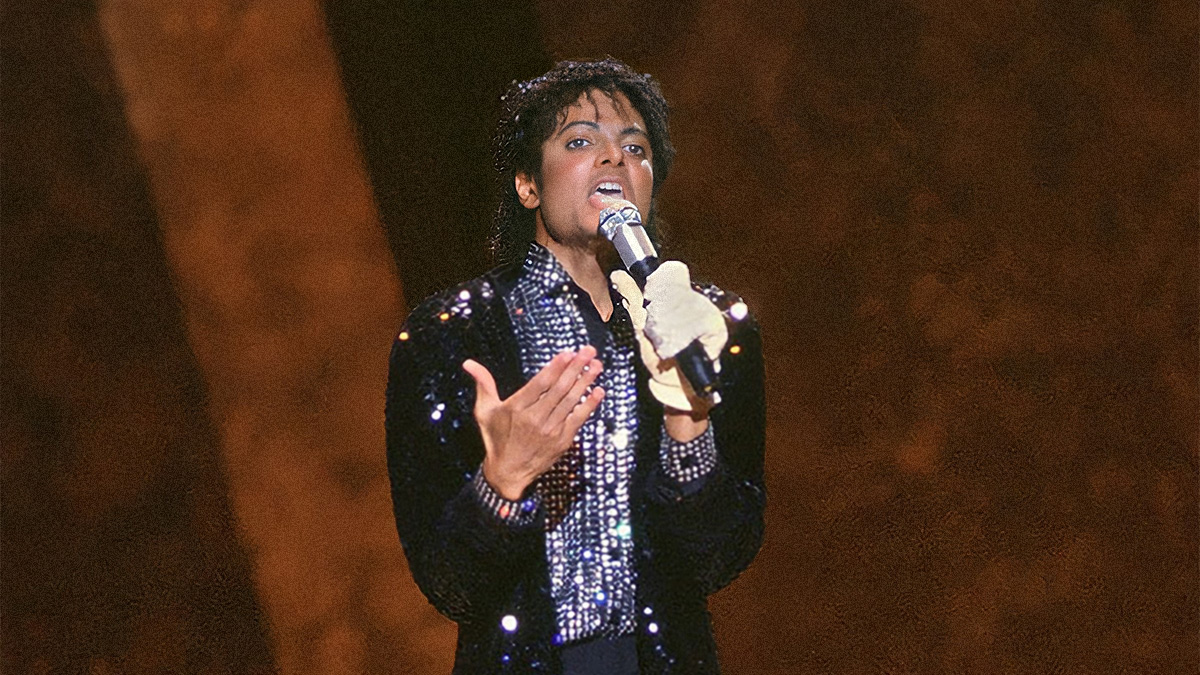
This time, as the opening notes to "Billie Jean" began, Michael put a hat on, and the girls screamed. He did some moves that no one had ever seen before, but became a standard part of his routine. Then he took the hat off, and flung it offstage. Then he started sliding backwards, which he called the "moonwalk."

He didn't invent it. Cab Calloway was seen using it on film in 1932. Suggesting it was already well-known back then, he said in 1985 that it was called "the buzz." Bill Bailey did it in the all-black 1943 film musical The Cabin in the Sky. In 1944, Judy Garland and Margaret O'Brien did it in Meet Me in St. Louis. Around the same time, Marcel Marceau, the world's foremost mime, began doing something like it.

In 1958, Dick Van Dyke appeared on, of all things, The Pat Boone Show, and did a routine he called "Mailing a Letter on a Windy Corner," which included a move similar to the Moonwalk. And in 1969, just 4 months after Apollo 11 landed on the actual Moon, Judy the Frog taught a dance called "The Moonwalk" on the kids' show H.R. Pufnstuf.

During the special, Jackson wore a sequined glove on his left hand, but not on his right. In later appearances, he would wear one on his right, but not on his left. He later explained: "I felt that one glove was cool… Wearing two gloves seemed so ordinary."

A joke came out of this: "Did you hear the New York Mets signed Michael Jackson? Just what they need: Another guy who wears a glove on only one hand for no apparent reason." Actually, there had already been a Mike Jackson in the major leagues, pitching for 4 different teams from 1970 to 1973; and there would later be a Michael Jackson, pitching for 8 teams from 1986 to 2004, collecting 142 saves. But neither of them ever played for the Mets.

Before the special, Michael Jackson was as big as most stars ever get. After it, he was as big as the biggest stars ever got.

It would become a blessing... and, alternately, a curse.

In a 2012 episode of the YouTube series Epic Rap Battles of History, Michael Jackson was played as a boy by Bentley Green, and as an adult by "Nice" Peter Shukoff, against "Epic" Lloyd Ahlquist as Elvis Presley.

*

May 16, 1983 was a Monday. The NBA was in the middle of its Conference Finals, but no games were played. The Philadelphia 76ers would beat the Milwaukee Bucks, the Los Angeles Lakers would beat the San Antonio Spurs, and then the Sixers would beat an injury-stricken Laker team in 4 straight to win the title.

The Stanley Cup Finals were between Games 3 and 4. The next night, the New York Islanders beat the Edmonton Oilers, 4-2 at the Nassau Coliseum in Hempstead, New York, to win their 4th straight Stanley Cup. One dynasty was not quite ready to give way to the next. The following season, it did: The Isles' "Drive For Five" was ended in the Finals by the Oilers of Wayne Gretzky.

And there were 5 games played in Major League Baseball:

* The New York Yankees beat the Detroit Tigers, 7-0 at Tiger Stadium in Detroit. Ron Guidry pitched a 3-hit shutout, giving up only a double to Lou Whitaker, and singles to Lance Parrish and Chet Lemon. For the Yankees, Ken Griffey Sr. went 3-for-4 with a walk, and Dave Winfield went 1-for-5 with 2 RBIs.

* The New York Mets beat the Pittsburgh Pirates, 11-4 at Three Rivers Stadium in Pittsburgh. Darryl Strawberry, on his way to being named National League Rookie of the Year, hit a home run.

* The Toronto Blue Jays beat the Milwaukee Brewers, 2-1 at Milwaukee County Stadium. An error by catcher Ted Simmons, with former Yankee top prospect Mickey Klutts at the plate, allowed Barry Bonnell to score the winning run in the top of the 11th inning. Robin Yount went 1-for-5. Paul Molitor went 0-for-5, but did draw a walk.

* The Oakland Athletics beat the Minnesota Twins, 7-6 at the Metrodome in Minneapolis. The A's led 7-0 going into the bottom of the 9th, but the Twins nearly came all the way back: The inning began with back-to-back home runs by Dave Engle and Bobby Mitchell, followed by a walk, a strikeout, a groundout, a 2-run homer by Gary Gaetti, another walk, another 2-run homer by Mickey Hatcher, and a single, meaning the tying run was on base, before reliever Tom Burgmeier, replacing the melting-down Dave Beard, slammed the door. Rickey Henderson went 1-for-4.

* And the Texas Rangers beat the Cleveland Indians, 3-1 at Arlington Stadium in the Dallas suburb of Arlington, Texas.

Monday, January 31, 2022

January 31, 1993: Jimmy Johnson's "Double" Restores the Dallas Cowboys

January 31, 1993: The Dallas Cowboys beat the Buffalo Bills, 52-17 at the Rose Bowl in the Los Angeles suburb of Pasadena, California. It is the 3rd straight Super Bowl loss for the Bills, and the 1st Super Bowl win for the Cowboys in 15 years, the 1st since their rebuild following their 1989 purchase by Jerry Jones.

But it is more than that: By being the winning coach, Jimmy Johnson becomes the 1st head coach ever to win both a college football National Championship and a Super Bowl. Paul Brown had previously been the only head coach ever to win both a college football National Championship and an NFL Championship: 1942 Ohio State; 1950, 1954 and 1955 Cleveland Browns.

Johnson, then 49 years old and from Port Arthur, Texas, had played as a defensive lineman on the University of Arkansas' 1964 team that won a share of the National Championship. He later served as an assistant coach at Louisiana Tech, Wichita State, Iowa State, Oklahoma, Arkansas and the University of Pittsburgh.

He was named head coach at Oklahoma State in 1979, and got them into the Independence Bowl in 1981, and won the Astro-Bluebonnet Bowl in 1983. In 1984, he was named head coach at the University of Miami, getting them into the 1985 Fiesta Bowl, the 1986 Sugar Bowl, and the 1987 Fiesta Bowl, before winning the National Championship in 1987, completing an undefeated season with the 1988 Orange Bowl. He followed that with an 11-1 season and another Orange Bowl win. Overall, his record as a college coach was 81-34-3.

Jerry Jones had been an Arkansas classmate of Johnson's, and hired him as Cowboys boss after firing the legendary Tom Landry. It took time to build, but, with quarterback Troy Aikman, running back Emmitt Smith, receiver Michael Irvin, and a strong defense, it took them just 3 seasons to get into the Playoffs, and a 4th to get into the Super Bowl.

(UPDATE: Michael Wilbon,  as a columnist for The Washington Post, covered the press conference in which Jones announced he bought the team and fired Landry. In a 2025 appearance on ESPN's Pardon the Interruption, he said, "It was crude, it was thuggish, and it worked.")

The Cowboys led 14-7 after the 1st quarter, and 28-10 at the half. In the 3rd quarter, the Bills closed to within 31-17. But it got ugly thereafter. With 5 minutes left in regulation, the Cowboys were up 52-17, had already returned 2 fumbles for touchdowns, and were just 1 touchdown away from setting new Super Bowl records for most points and largest margin of victory.

The Bills were on the Cowboys' 31-yard line, and looked close to a consolation score. But, with the Cowboys having already knocked starting quarterback Jim Kelly out of the game, Jim Jeffcoat stripped the ball from backup Frank Reich. Leon Lett picked the ball up, and looked like he would return it for the touchdown that would make it 58, potentially 59, to 17.

Except he celebrated too early, and was waving the ball around in the air. Bills receiver Don Beebe ran like a bat out of hell, and managed to strip the ball away from Lett at the Bills' 1-yard line. The play was ruled a touchback, and the Bills got the ball back. It ended 52-17.

In the locker room, Jimmy Johnson yelled his catchphrase: "How 'bout them Cowboys!" He would yell it a few more times the next season, making it back-to-back Super Bowl wins. He would then have a falling-out with Jerry Jones, and we may never know who decided that Johnson should go.

Jones hired former University of Oklahoma coach Barry Switzer. After 2 years, he won Super Bowl XXX, making him the 2nd coach to be both an NCAA and an NFL Champion. Pete Carroll, of the University of Southern California and the Seattle Seahawks, has become the 3rd coach to do the NCAA & NFL "Double."

Johnson served as head coach of the Miami Dolphins from 1996 to 1999, making the Playoffs 3 times, but never winning a Playoff game. Overall, his NFL record was 80-64. He and Jones have made peace, and Jones inducted him into the Cowboys' Ring of Honor. Johnson has spent his time since coaching as a panelist on Fox NFL Sunday. The Cowboys have not been to a Super Bowl since the 1996 season.

*

January 31, 1993 was a Sunday. Baseball was out of season. The NBA, not wanting to compete with the Super Bowl for TV ratings, scheduled only 1 game, but it was their biggest rivalry, between their 2 most historic teams: The Los Angeles Lakers beat the Boston Celtics, 96-87 at the Boston Garden.

There were 3 games played in the NHL:

* The Montreal Canadiens beat the Philadelphia Flyers, 6-4 at the Montreal Forum.

* The Pittsburgh Penguins and the Washington Capitals, played to a tie, 2-2 at the Capital Centre in the Washington suburb of Landover, Maryland.

* The Edmonton Oilers beat the Buffalo Sabres, 5-4 at the Buffalo Memorial Auditorium. Kelly Buchberger scored the winning goal, 46 seconds into overtime.

Sunday, January 30, 2022

January 30, 1983: John Riggins and the Hogs

John Riggins

January 30, 1983: Super Bowl XVII is played at the Rose Bowl in Pasadena, California. The Washington Redskins come from behind to defeat the Miami Dolphins, 27-17. It is the team's 1st NFL Championship in 40 years, and the beginning of a decade of greatness for the franchise. Under coach Joe Gibbs, they would reach 4 Super Bowls, winning 3, in 10 seasons.

Running back John Riggins is named Most Valuable Player, running behind the offensive line known as the Hogs: Center Jeff Bostic, guards Russ Grimm and "Mean" Fred Dean, and tackles Joe Jacoby and George Starke. Tight end Don Warren was considered an "Honorary Hog." (Later Hogs would include guards Raleigh McKenzie and R.C. Thielemann, tackles Mark May and Jim Lachey, and tight end Clint Didier.)
Top row, left to right: Don Warren, Bruce Kimball, Roy Simmons,
assistant coach Joe Bugel, Bob Winckler and Ken Huff.
Bottom row, left to right: George Starke, Mark May,
Jeff Bostic, Russ Grimm, Joe Jacoby and Rick Walker.

There are other heroes: South River, New Jersey native Joe Theismann, the Redskin quarterback, throws a pass that Dolphin linebacker Kim Bokamper -- one of the Miami defense's "Killer Bs" -- deflects, but is unable to intercept, as Theismann knocks it away and prevents a touchdown. The Redskins' receiving corps, led by Charlie Brown, was known as "The Fun Bunch." For the Dolphins, Fulton Walker returns a kickoff 98 yards, the 1st kickoff returned for a touchdown in the history of NFL championship games under any name.

I don't know if the 1982-92 Redskins were the best sports team in Washington-area history, but they were easily the most fun.

UPDATE: The Commanders have a Ring of Honor. From their Super Bowl XVII winners, they have elected quarterback Joe Theismann, running back John Riggins, receiver Art Monk; "Hogs" center Jeff Bostic, guard Russ Grimm and tackle Joe Jacoby; defensive tackle Dave Butz, defensive end Dexter Manley, linebacker Monte Colrman, kicker Mark Moseley; owner Jack Kent Cooke, head coach Joe Gibbs, assistant coaches Charley Taylor and Richie Petitbon, general manager Bobby Beathard, former star turned executive Bobby Mitchell, trainer Bubba Tyer, public address announcer Phil Hochberg, and former star turned broadcasters Sonny Jurgensen and Sam Huff.

Theismann, Riggins, Monk, Grimm, Jacoby, Butz, Manley, Moseley, Gibbs, Beathard, Taylor, Petitbon, Cooke, Huff and Jurgensen have also been elected to the Washington DC Sports Hall of Fame. So have safety Mike Nelms, executive Charley Casserly, and broadcaster Frank Herzog. So has Johnny Holliday, a legendary radio personality in Cleveland, the San Francisco Bay Area, and the Washington area, who has worked with the Bullets/Wizards, the Senators, the Nationals, the Redskins/Commanders and the Capitals.

Strangely, while assistant coach Petitbon has been inducted into both the Ring and the DC Sports Hall of Fame, without having truly been a star player like fellow assistant Charley Taylor, assistant coach Joe Bugel, who built the "Hogs," has not yet been inducted into either.

*

January 30, 1983 was, like all Super Bowl days, a Sunday. Baseball was out of season. The NBA, accepting that TV ratings would probably be lousy, scheduled only 1 game, but it was the right game, with what were already the league's 2 most popular franchises: The Boston Celtics beat the Los Angeles Lakers, 110-95 at the Boston Garden.

And there were 2 games in the NHL. One turned out to be a preview of the Stanley Cup Finals, as the New York Islanders beat the Edmonton Oilers, 4-2 at the Northlands Coliseum in Edmonton. The other was an "Original Six" matchup: The Chicago Black Hawks beat the New York Rangers, 5-4 at Madison Square Garden.

Tuesday, January 25, 2022

January 25, 1987: The Giants Win Their 1st Super Bowl

January 25, 1987: Super Bowl XXI is played at the Rose Bowl, in the Los Angeles suburb of Pasadena, California.

The AFC Champions were the Denver Broncos. They had never won a Super Bowl, and had lost one, 9 years earlier.

The NFC Champions were the New York Giants. They had never won a Super Bowl, and had never even been in one, although they had won 4 NFL Championships. They had won 3 NFL Championship Games in the pre-Super Bowl era, although they were 0-5 in Championship Games.

But head coach Bill Parcells and general manager George Young had built a very strong team, one that had triumphed over Mike Ditka's Chicago Bears, Bill Walsh's San Francisco 49ers, and Joe Gibbs' Washington Redskins.

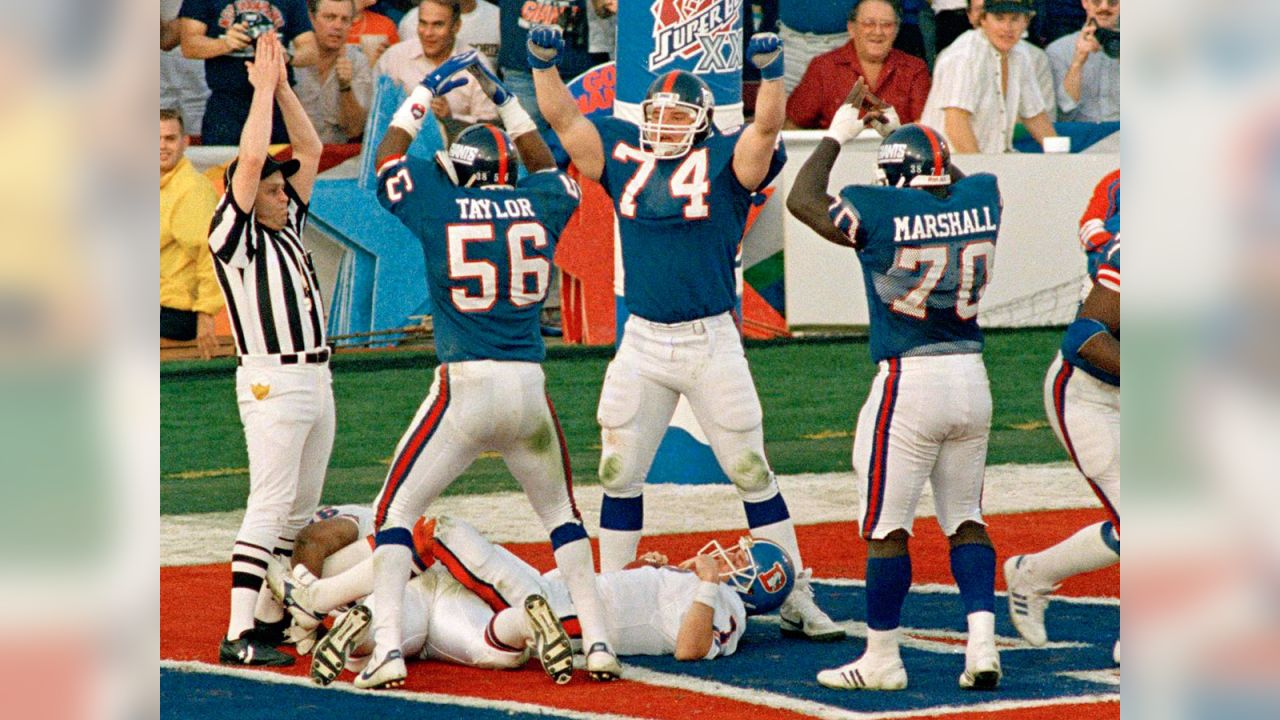
Quarterback Phil Simms and running back Joe Morris led the offense, but, as with their "dynasty of one" (winning the title game in 1956, then making 5 of the next 7 and losing them all) what really marked the Giants was their defense: The Big Blue Wrecking Crew had 2 future Hall of Fame linebackers in Lawrence Taylor and Harry Carson, and All-Pros in linemen George Martin, Leonard Marshall and Jim Burt, and linebacker Carl Banks.
The Rose Bowl

Rich Karlis kicked a 48-yard field goal on the Broncos' 1st drive, tying Jan Stenerud's 1970 record for longest Super Bowl field goal. The Giants responded with a 6-yard touchdown pass from Simms to Zeke Mowatt, giving Big Blue the lead. The Broncos came right back, with quarterback John Elway driving them to the Giants' 6-yard line, and then scoring on a draw to make it 10-7 Broncos at the end of the 1st quarter.

In the 2nd quarter, Karlis set a new record for shortest miss on a Super Bowl field goal attempt, 23 yards. On their next drive, the Broncos had the ball on their own 13, and Elway threw to Clarence Kay for a 25-yard gain. But the officials believed Kay hadn't controlled the ball before the tackle, and, for the 1st time, instant replay review was used in a Super Bowl. The replay suggested that the call of incomplete pass was correct.

On the next play, Elway was sacked in the end zone by Martin, costing the Broncos a safety, and making it 10-9 Broncos. That safety was the only scoring of the 2nd quarter, as Karlis missed another field goal later on.

But the 3rd quarter saw the G-Men break the game open. On a 4th down, the Giants pulled a fake punk with backup quarterback Jeff Rutledge (who had quarterbacked the University of Alabama to a National Championship), and converted a 1st down. Simms threw a 13-yard touchdown pass to Mark Bavaro, and the Giants were ahead. A good punt return by Phil McConkey put the Giants in good position for another score, and Raul Allegre's field goal made it 19-10.

Simms was putting together, stats-wise, the finest NFL Championship Game, under any name, any quarterback has ever had, completing 22 out of his 25 passes. He once again drove New York through the Orange Crush defense (although the Broncos were wearing their road white jerseys), until Morris was able to score from 1 yard. The quarter ended 26-10 Giants.

And Simms did it again. He got to the Bronco 6, and threw a pass meant for Bavaro. It bounced off Bavaro's fingers, but McConkey was right there to catch it -- reminiscent of Bob Boone and Pete Rose of the Philadelphia Phillies in the 1980 World Series -- and it was 33-10.

The Broncos got down and kicked a field goal, but the Giants tacked on another touchdown, although Allegre missed the extra point. A 47-yard bomb from Elway to Vance Johnson gave the Broncos their 1st touchdown since very early in the game, but it was little consolation.

As the final seconds of a 39-20 win ticked away, Giants Captain Carson carried out a custom that had begun in the middle of the previous season: Taking the Gatorade bucket, and dumping it over Parcells. In cold weather, as occasionally happed at home at the Meadowlands, all that cold liquid and all those ice cubes were not exactly fun. But in the warmth of an early evening in Pasadena, having won the game of his life, Parcells didn't mind.

Actually, that wasn't the game of Parcells' life. He coached the Giants to another Super Bowl win 4 years later, with his offense controlling the ball for more than 40 minutes. In contrast, the Broncos would lose the next year's Super Bowl, and another one 2 years after that. It would take until Super Bowl XXXII, 11 years to the day after this game, for the team, and Elway, to finally emerge on top of the world.

But, for now, the Giants were World Champions, as were the Mets. It was the 1st time since 1970, when the Mets and the Knicks both were, that 2 teams in the New York Tri-State Area were titleholders at once.

It also broke the traditional fandoms: Fans of one of the older teams in each sport, the Yankees, the Giants, the Knicks and the Rangers, who also tended to be together geographically, in Manhattan and The Bronx, tended to root for the other older teams; while fans of the younger teams, the Mets, the Jets, the Nets and the Islanders, who also tended to be together geographically, in Queens and Long Island, tended to root for the other younger teams.

But with the Giants, the Nets and the Jets having moved to New Jersey (in 1976, 1977 and 1984, respectively), and an outside team, the NHL's Colorado Rockies in 1982, having been moved to New Jersey to become the Devils, geography was less of a factor. And there's always been a front-runner element to Tri-State Area fandom. So we now had a whole lot of fans of both the Mets and the Giants -- when Met fans were previously Jet fans, and Giant fans were previously Yankee fans.

It was actually a pretty good time to be a New York sports fan. The Jets were also in the Playoffs, the Rangers had gotten to the Conference Finals, the Yankees had been in back-to-back Pennant races, the Islanders had been Stanley Cup winners 4 years earlier and were still a Playoff team, the Nets were a Playoff team, the Devils were bad but still had the novelty factor, and the Knicks had the young Patrick Ewing and seemed to have a great future ahead of them.

But, for now, it was all about Big Blue. Mayor Ed Koch, angry that the Giants had moved to New Jersey in 1976, refused to give them a ticker-tape parade. So, instead, their celebration was at Giants Stadium. Koch was out of the country, and so Andrew Stein, President of the City Council, and next in line for Mayor under the law of the time, stood in for him. In spite of his claim that New York City loved New Jersey and that "We're all part of the same region," he got booed by the crowd. I hope Koch at least bought him dinner for taking that bullet for him.

In 1999, The Sporting News released their list of the 100 Greatest Football Players. Taylor was ranked 4th. In 2010, the NFL Network ranked him 3rd on its list of the 100 Greatest Players. In each case, he was 1st among defensive players.


*


January 25, 1987 was a Sunday. Obviously, there were no other NFL games played on the day. Baseball was out of season. And the NHL wasn't stupid: They scheduled no games on the day.

The NBA scheduled only one. It was early in the day. And it was a major rivalry. The Boston Celtics beat the Philadelphia 76ers, 111-96 at the Boston Garden. Kevin McHale scored 30 points, Robert Parish 21, Larry Bird 17 and Danny Ainge 1.

December 31, 1999 & January 1, 2000: The Millennium

December 31, 1999:  The Millennium arrives. The people of planet Earth survived. At a terrible cost. But we hadn't destroyed ourselves. ...