Showing posts with label roger maris. Show all posts

Sunday, December 11, 2022

December 11, 1959: The Yankees Trade for Roger Maris

December 11, 1959: The New York Yankees trade right fielder Hank Bauer, pitcher Don Larsen, outfielder Norm Siebern, and 1st baseman Marv Throneberry to the Kansas City Athletics. In exchange, the Yankees get right fielder Roger Maris, infielder Joe DeMaestri and 1st baseman Kent Hadley.

This was one of several trades the Yankees made with the A's from their 1955 arrival in Kansas City until 1960, when team owner Arnold Johnson died and the team was bought by Charles O. Finley, who stopped the original Yankee "shuttle." Anytime the A's got a player the Yankees thought was good, the Yankees would send the A's a veteran player they didn't need anymore, and get the prospect. Some players would go back and forth between the teams, including pitcher Ralph Terry and outfielder Bob Cerv.

It got to the point where people, remembering that the Kansas City Blues had been the Yankees' top farm team before the A's left Philadelphia, said that Kansas City was still a Yankee farm team.

Bauer helped the Yankees win 9 Pennants in 11 years, played 2 more years for the A's, and retired. Siebern became an All-Star for the A's, and then again for the Baltimore Orioles, where Bauer was his manager. (Bauer managed the Orioles to their 1st Pennant and World Series win in 1966, but, by then, Siebern was gone.) Larsen, the man who pitched a perfect game in the 1956 World Series, got to the San Francisco Giants, and helped them win the 1962 National League Pennant, even pitching against the Yankees in the World Series.

Throneberry was the Yankees' top prospect. But he didn't do much in Kansas City, and then not much in Baltimore. Early in the 1962 season, the Orioles traded him to the New York Mets. While the short right field fence at the Polo Grounds allowed him to hit 17 home runs, showing what used to be known as "oafish clout," his fielding at 1st base was legendarily bad, on the same level (if not as a slugger) with that of Dick "Dr. Strangeglove" Stuart.

Hadley played the 1960 season with the Yankees, got sent down to the minors, and then played a few seasons in Japan. DeMaestri was a decent reserve infielder on the early 1960s Pennant winners. But those 5 Pennants, including the 1961 and '62 World Series, wouldn't have been won without Maris.

He became the American League's Most Valuable Player in 1960. He won the MVP again the next year, setting a new single-season home run record, the famous "61 in '61," despite seemingly everybody hoping that he wouldn't break Ruth's record of 60 in 1927, and that teammate Mickey Mantle would. In addition, Maris might have been the best-fielding right fielder in Yankee history. Perhaps no player in Yankee history was treated worse, by fans, by team management, and by the sportswriters. And few deserved it less. He didn't have Hall of Fame career statistics, but he was a Hall of Fame person.

Would Brian Cashman, general manager of the Yankees since 1998, make this trade? Never in a million years. Maris was a lefty, and Throneberry was the crown jewel of the Yankee farm system, having already made a bit of a contribution to their 1958 World Championship season. Who knew his name would become a byword for baseball ineptitude?

*

December 11, 1959 was a Friday. Baseball was out of season. Football was in midweek. No games were scheduled in the NHL.

There were 2 games in the NBA. The New York Knicks beat the Syracuse Nationals, 152-121 at the old Madison Square Garden. Richie Guerin scored 57 points for the Knicks. This would be a team record until Christmas Day 1984, when Bernard King scored 60. That record lasted for 29 years and 1 month, before Carmelo Anthony scored 62 in a 2014 game. (UPDATE: Julius Randle scored 57 in a 2023 game.)

And the Boston Celtics beat the St. Louis Hawks, 122-99 at the Boston Garden.

Thursday, December 8, 2022

December 8, 1966: Roger Maris for Charley Smith

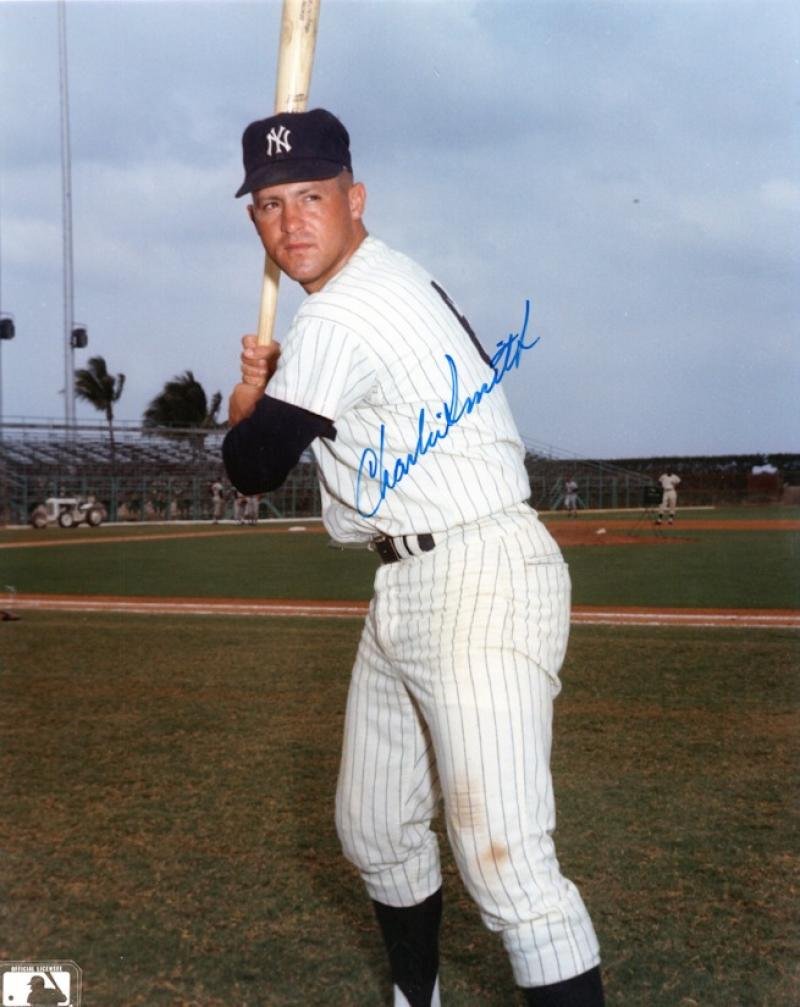
December 8, 1966: The New York Yankees trade right fielder Roger Maris to the St. Louis Cardinals for infielder Charley Smith.

The Yankee brass had treated Maris badly, failing to publicly support him as he set a single-season home run record of 61 in the 1961 season, helped them to win 5 American League Pennants and the 1961 and 1962 World Series, and suffered through a misdiagnosed hand injury in 1965.

Now, they had traded him for a nothing infielder who had already failed with 5 teams, including the New York Mets. In terms of decency, this one is right down there with the Mets' 1977 trade of Seaver for the worst in New York baseball history.

Free of Yankee management and the New York media, and happy to play for a team and a fan base that made him feel welcome, Maris helped the Cards win the 1967 World Series and the 1968 National League Pennant, then accepted Cardinal and Anheuser-Busch owner Gussie Busch's retirement gift of a beer distributorship in sunny Gainesville, Florida -- quite a prize for someone who grew up in Hibbing, Minnesota and Fargo, North Dakota. He died in 1985.

As for Smith? In 2 seasons in The Bronx, he batted .224 with 10 homers and 45 RBIs. At age 30, the Yankees traded him, and after another year he had played his last big-league game. He died in 1994.
Number 6. At least they didn't give him Roger's number.
They gave 9 to Steve Whitaker, not exactly worthy of it.

*

December 8, 1966 was a Thursday. Baseball was out of season. Football was in midweek. Two games were played in the NBA. The Chicago Bulls beat the Baltimore Bullets, 132-120 at the Baltimore Civic Center (now the CFG Bank Arena). And the San Francisco Warriors beat the St. Louis Hawks, 124-106 at the Cow Palace outside San Francisco in Daly City, California. Rick Barry scored 50 points for the Warriors.

Two games were played in the NHL. The New York Rangers beat the Detroit Red Wings, 4-2 at the Olympia Stadium in Detroit. And the Chicago Black Hawks beat the Boston Bruins, 10-2 at the Boston Garden. Doug Mohns scored 3 goals and an assist. Bobby Hull, the Golden Jet, and his brother, Dennis Hull, the Silver Jet, each scored a goal. The Montreal Canadiens and the Toronto Maple Leafs were not scheduled.

Wednesday, October 12, 2022

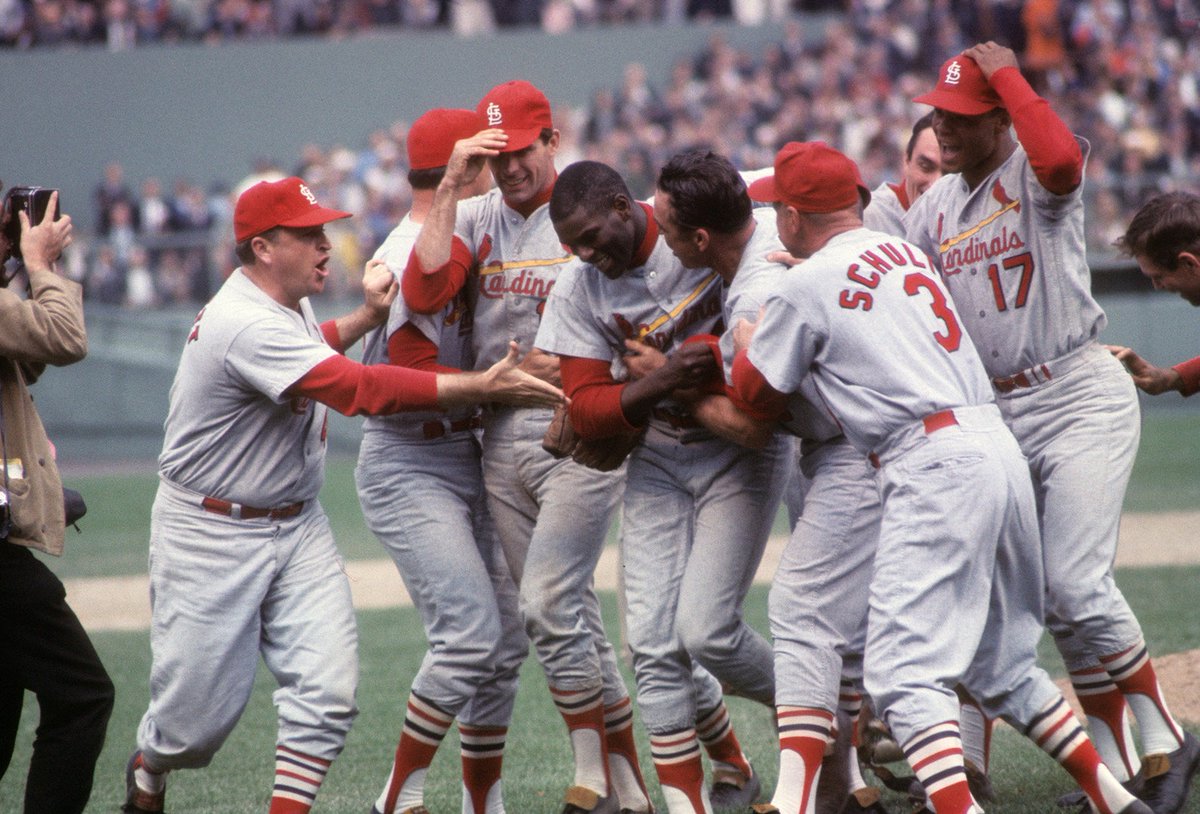
October 12, 1967: Gibson and Champagne

Ball Four fans, take note: Number 3 here is Joe Schultz,
then the Cardinals' 3rd base coach,
who would manage the Seattle Pilots 2 years later.
Working for Gussie Busch on the Cardinals explains
his frequent mentions of Budweiser in that book.

October 12, 1967: Baseball and the Summer of Love converge on Fenway Park in Boston for Game 7 of the World Series, as a fan holds up a sign saying, "THE RED SOX ARE VERY BEAUTIFUL PEOPLE."

Because the Boston Red Sox were in such a tight race for the American League Pennant, they had to use their ace, Jim Lonborg, on the final day of the regular season, a 5-3 win over the Minnesota Twins which, combined with the Detroit Tigers only splitting a doubleheader, clinched the flag for the Sox.

The St. Louis Cardinals had clinched the National League Pennant earlier, and their manager, Red Schoendienst, who had played on their 1940s dynasty and also with the 1957 World Champion Milwaukee Braves, was able to set up his pitching rotation just the way he wanted: Bob Gibson, who won Games 5 and 7 for the Cardinals in the 1964 World Series, would pitch Games 1 and 4, and, if necessary, Game 7 this time.

Red Sox manager Dick Williams, who had won a Pennant in his 1st season as a major league manager, would have to wait until Game 2 to use Lonborg again. With Gibson on the mound, the Cards won Game 1 in Boston, but the Sox won Game 2, as Lonborg took a perfect game into the 7th inning and a no-hitter into the 8th.

The Series moved to St. Louis, and the Cards won Games 3 and 4, the latter behind Gibson, and were 1 win away. But Lonborg again pitched well in Game 5. In Game 6 at Fenway, the Sox won, thanks to a home run by Triple Crown winner Carl Yastrzemski, one by Reggie Smith, and 2 by their slick-fielding but not especially powerful shortstop, Rico Petrocelli.

So Game 7 would be Gibson on 3 days' rest, against Lonborg on 2 days' rest. If either one felt tired, he had until the following March to regain his strength. With his ace, and with home-field advantage, Williams makes a bold prediction made the day before, after a Game 6 win, by Sox manager Dick Williams, of "Lonborg and champagne." It's put on the front page of the Boston Record-American.
It does not happen: Gentleman Jim has nothing, and gets shelled. Gibson not only had plenty left, he hit a home run off Lonborg. Lou Brock stole 2 bases, raising his total to 7, a new World Series record. In the 6th, a Julián Javier home run ended Lonborg's day. In contrast, Gibson was still going in the 9th, when he struck George Scott out for the last out. The Cardinals won, 7-2, for Gibson's 3rd win of the Series, the team's 2nd title in 4 seasons, and their 7th World Championship.

If only... If only Tony Conigliaro, the hometown hero who got off to as good as career start as any slugger ever had, before or since, hadn't been beaned in August and missed the rest of the season, and all of 1968... If only Lonborg had just 1 more day of rest before Game 7... If only general manager Dick O'Connell had gotten manager Dick Williams one more good starting pitcher, thus giving Lonborg that extra day of rest... 

No, it was, "If only Bob Gibson had not been, in 1967 and 1968, as good as any pitcher has ever been." A fully-rested Jim Lonborg was not going to beat Gibson on October 12, 1967.

For the Red Sox, what had become known as "the Impossible Dream" came to an end a game too soon, but the season did revitalize the franchise, restoring its profitability and its place of veneration among the people of New England. They lost the World Series, but they cannot be called a failure. Without this season, the Red Sox might have ended up leaving Fenway Park, sharing a stadium out in Foxborough with the NFL's New England Patriots. Or owner Tom Yawkey, who really wanted out of Fenway, might have moved them out of Boston entirely.

So, even more than 2004, this is the most important season in Red Sox history. Years later, after the Red Sox failures of 1975, 1978 and 1986, but before the tainted triumphs of 2004, 2007 and 2013, Boston Globe columnist Dan Shaughnessy would write that, of all Red Sox teams, this one is absolved from criticism by "Red Sox Nation" -- which, he says, essentially began that summer.

By the same -- pardon my choice of words here -- token, this was an incredibly important season in St. Louis. The holdovers from the 1964 season proved it was no fluke, and, much more so than the '64 team, the '67 team, with its mixture of white stars (Tim McCarver, Dal Maxvill and an aging but still power-hitting Roger Maris), black stars (Gibson, Brock and Curt Flood) and Hispanic stars (Javier and Orlando Cepeda) showed St. Louis, still thinking of itself as a Southern city, what integration could really do. Fans in Brooklyn had learned that 20 years earlier.

Yet, somehow, the 1964-68 Cards, as good as they were, have not been celebrated by Baby Boomers as much as have the 1950s and '60s New York Yankees, the 1950s Brooklyn Dodgers, the '60 and '71 Pittsburgh Pirates, the 1962-66 Los Angeles Dodgers, the 1962-66 San Francisco Giants, the 1966-71 Baltimore Orioles, the '67 Red Sox, the '68 Tigers and the '69 New York Mets. Hopefully, that's mainly because St. Louis was, and is, one of baseball's smallest markets. Still, the Cardinals were then, and are now, one of baseball's most profitable and most admired franchises.

This title was the 1st and only one for Cepeda, who was named the National League's Most Valuable Player; and the 3rd and last for Maris. It was something of a redemption for both.

This was also the 5th title, and the last game, for Elston Howard, who had been traded by the Yankees to the Red Sox in midseason. In his last at-bat, against Gibson, he flied to left field in the 5th inning, being removed for a pinch-hitter.

Instead of Lonborg, it was Gibson and champagne.

UPDATE: The Cardinals have a team Hall of Fame. From their 1967 World Champions and their 1968 National League Pennant winners, they have inducted team owner August "Gussie" Busch, manager Albert "Red" Schoendienst, scout George Kissell, left fielder Lou Brock, center fielder Curt Flood, right fielder Mike Shannon, 2nd baseman Julián Javier,  catcher Tim McCarver, pitcher Bob Gibson, and broadcaster Jack Buck. Through the 2025 season, general manager Vaughan "Bing" Devine, 1st baseman Orlando Cepeda (only 3 seasons with the Cardinals), right fielder Roger Maris (only 2 seasons) and broadcaster Harry Caray (once every bit as identified with the Cardinals as he now is with their arch-rivals, the Chicago Cubs) have not yet been inducted.

The Cardinals fell apart after their 1968 Pennant. From between their 1968 and 1982 Pennants, their Hall of Fame has inducted catcher Ted Simmons, 1st baseman Joe Torre, and pitcher Al Hrabosky, "The Mad Hungarian."

Busch, Schoendienst, Gibson, Flood, Brock, Cepeda, Simmons, Torre, Reuss, and 2nd baseman Ted Sizemore were elected to the St. Louis Sports Hall of Fame. Busch, Schoendienst, Kissell, Gibson, Brock, Cepeda, Simmons, Reuss and Hrabosky were elected to the Missouri Sports Hall of Fame.

The Red Sox also have a team Hall of Fame. From their 1967 American League Pennant winners, they have inducted left fielder Carl Yastrzemski, right fielder Tony Conigliaro, center fielder Reggie Smith, 1st baesman George Scott, shortstop Rico Petrocelli, pitcher Jim Lonborg; team owner Tom Yawkey, manager Dick Williams, general manager Dick O'Connell, scout George Digby, executive Edward Kenney; public address announcer Sherm Feller, and broadcasters Ken Coleman and Ned Martin.

Busch, Schoendienst, McCarver, Shannon, Brock, Flood, Gibson, Maris, Cepeda, Kissell, Buck, Devine, Simmons, Hrabosky, pitcher Jerry Reuss, 3rd baseman Ken Reitz, and team scorekeeper Lou Adamie were elected to the Missouri Sports Hall of Fame.

*

October 12, 1967 was a Thursday. The NBA began its season, and the American Basketball Association began its history, the next day. And the NHL season had begun the day before, but no games were scheduled for this day.

But there was one other score on this historic day, in the Southwest Conference in college football: Texas A&M beat Texas Tech, 28-24 at Clifford B. & Audrey Jones Stadium, Tech's home, in Lubbock. A&M went on to win the SWC Championship, and beat Alabama in the Cotton Bowl.

Monday, October 10, 2022

October 10, 1968: The Tigers Win One for Detroit

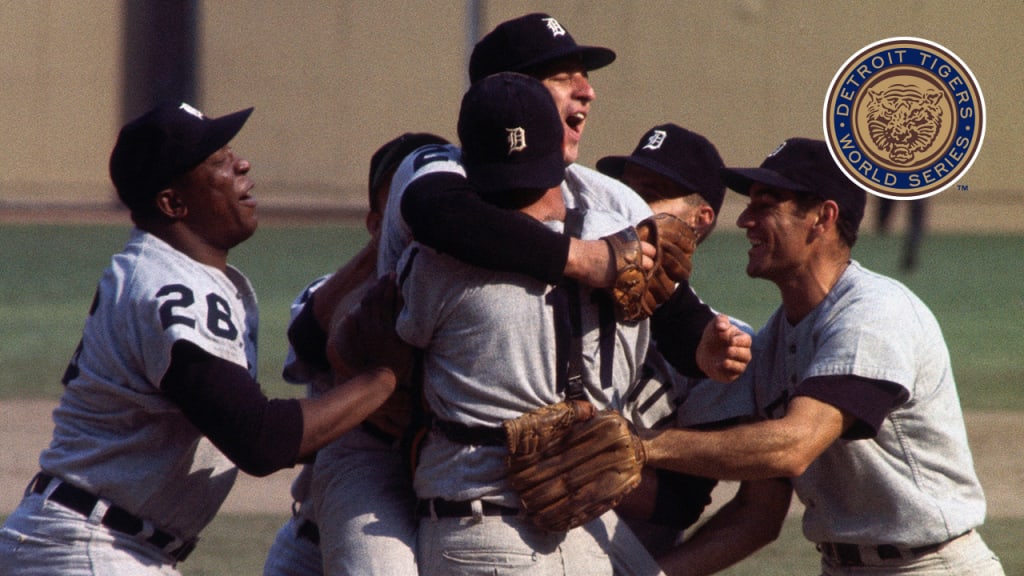
October 10, 1968: Mickey Lolich wins his 3rd game of the Series – matching Harry Brecheen as the only lefthander ever to do it thus far – and the Detroit Tigers win their 1st World Series in 23 years (to the day), beating the indomitable Bob Gibson and the defending champion St. Louis Cardinals in Game 7, 4-1 at Busch Memorial Stadium.

Mike Shannon hits a home run for the Cardinals, Jim Northrup's triple past the normally sure-fielding Curt Flood in the top of the 7th makes the difference. In the bottom of the 7th, Roger Maris, the Cardinals' right fielder pops up to short, closing an 0-for-3 day. It is the last at-bat of his career, as he has already decided to retire.

After the race riot and near-miss for the Pennant in 1967, after 23 years without a Pennant (let alone a title), after 11 years without a World Championship in any sport (since the 1957 NFL Champion Lions), and after 16 years without a Pennant for their legendary star Al Kaline, Detroit needed this World Championship very badly. With Kaline, Lolich, Northrup and Willie Horton being the stars of the Tigers' comeback from 3-games-to-1 down, the '68 Tigers remain the most beloved team in the history of Michigan sports, ahead of any Lions, Pistons, Red Wings, Michigan Wolverine or Michigan State Spartan team.

Lolich, who would retire with 217 wins and as the all-time strikeout leader among lefthanders with 2,832, was criticized for being fat. He was the original "hefty lefty." He was 6 feet even, and is usually listed as having been 210 pounds. Seriously, that was considered fat for a pitcher in 1968. Paging David Wells. Paging CC Sabathia. And on the right side, paging Bartolo Colon. Paging Rich Garces.
The last at-bat was future broadcaster Tim McCarver, popping up halfway down the 1st base line. Catcher Bill Freehan caught it, and Lolich jumped into his arms. Freehan must have been a very strong man to be able to hold Lolich in his arms for 6 seconds.
Michigan sports fans have held the '68 Tigers in their hearts ever since. In spite of the achievements of the Tigers in 1984, the Pistons in 1989-90 and 2004, the Red Wings from 1997 to 2008, and various teams at the University of Michigan and Michigan State University, the 1968 Tigers remain the most beloved team in Michigan sports history.
UPDATE: The Tigers do not have a team Hall of Fame. But they honor their players who have been elected to the Baseball Hall of Fame on the outfield wall at Comerica Park. From the 1968 World Champions, they honor right fielder Al Kaline and broadcaster Ernie Harwell. They also honor left fielder Willie Horton, who is not in the Hall of Fame, but whose uniform Number 23, like Kaline's 6, is retired.
They are in the Michigan Sports Hall of Fame, along with shortstops Dick McAuliffe and Mickey Stanley, 1st baseman Norm Cash, catcher Bill Freehan, outfielder Gates Brown, center fielder Jim Northrup; pitchers Denny McLain, Mickey Lolich and John Hiller; executive Jim Campbell; and broadcasters George Kell and Ray Lane. Manager Mayo Smith, however, has not received any of these honors. 
*
October 10, 1968 was a Thursday. This was the only baseball game played that day. Football was in midweek. The NHL season started the next day, the NBA season 4 days after that, and the ABA season 3 days after the NBA. So there were no other scores on this historic day.

Sunday, October 9, 2022

October 9, 1961: The Yankees' M&M Boys

Roger Maris (left) and Mickey Mantle

October 9, 1961: Led by a pair of 5-run innings at Crosley Field in Cincinnati, the New York Yankees win the World Series, beating the Cincinnati Reds in Game 5, 13-5. Johnny Blanchard, a reserve player who will collect 10 hits in 29 at-bats in 5 Fall Classics, hits 2 home runs and bats .400, en route to the Bronx Bombers' 19th World Championship.

Mickey Mantle barely played in this Series, but Roger Maris hit an unofficial 62nd home run of the season, while Edward "Whitey" Ford broke the record for most consecutive scoreless innings pitched in the World Series, running his total to 30. The previous record? It was 29 2/3rds, set by a Boston Red Sox lefthander named… Babe Ruth.

Whitey would raise the record to 33 in 1962. Mariano Rivera would slightly break this record, pitching 33 1/3rd consecutive scoreless innings in postseason play, but not all of it in World Series play.

The 1961 Yankees were a bit streaky. They lost their season opener, then won 5 straight games. They followed this by losing 3 straight. At this point, April 26, Ralph Houk, a rookie manager, having been handed the job after the firing of Casey Stengel, then made a switch, putting Maris 3rd in the batting order and Mantle 4th. This gave Maris the protection he needed to be a better hitter, and launched the Yankees on an 8-1 run.

Then came another mediocre stretch, 3-9. But they straightened it out: From June 4 to 15, the Yankees went 13-2; from June 20 to 26, 6-1; from June 30 to July 27, 20-6; from August 2 to 11, 11-1; and from August 16 to 27, 9-3.

The Yankees would go on to hit 240 home runs, a major league record that stood until 1996, and a team record that stood until 2009. Mantle and Maris both seemed like they could break Babe Ruth's single-season record of 60, set in 1927. Mantle got sick near the end of the season, and finished with a career-high 54. Maris hit his 59th of the season on September 20 in Baltimore, which turned out to be the Pennant-clincher; his 60th on September 26 at home; and his 61st on the last day of the regular season, October 1, off Tracy Stallard of the Boston Red Sox at Yankee Stadium, for the only run in a 1-0 Yankee win.

Bill "Moose" Skowron led the team's righthanded hitters with 28 home runs. The 1960 season was the 1st in which usual catcher Lawrence "Yogi" Berra and left fielder Elston Howard had switched positions. In 1961, the Yankees got 22 homers from Berra, 21 from Howard, and another 21 from Blanchard, who was also a catcher, and played the outfield, including filling in at right field after Maris moved over to center at the end, in place of the ailing Mantle. So the Yankees got 64 home runs from their catchers.

The defense was exceptional, with an infield of Skowron at 1st base, Bobby Richardson at 2nd, Tony Kubek at shortstop, and Clete Boyer at 3rd base. Before Brooks Robinson of the Baltimore Orioles in 1970 and Graig Nettles of the Yankees in 1978, Boyer would be the 1st man to put on a spectacular fielding display at 3rd base in a World Series.

Berra had been a great catcher, and Howard was now one as well. Berra was all right in left field, Mantle was really good in center (if not quite the equal of his predecessor Joe DiMaggio or his National League contemporary Willie Mays), and Maris might have been the best defensive right fielder the Yankees ever had.

The pitching was strong. Under Stengel, Ford, as the team's ace, would be moved up or back in the rotation, to bypass lesser teams and face tougher ones. Houk let him pitch every 4th day, no matter what, and Whitey responded not just with his 1st 20-win season, but with a 25-4 season that earned him the Cy Young Award -- from its establishment in 1956 until 1966, given to the top pitcher in both Leagues.

Ralph Terry went 16-3, and would go 23-12 the next year, unfairly losing the Cy Young to Don Drysdale of the Los Angeles Dodgers. Bill Stafford went 14-9, Rollie Sheldon 11-5, and Luis Arroyo 15-5 with 29 saves, then a major league record. Bob Turley, the 1958 Cy Young winner, battled injury much of the year, and was only 3-5.

Still, this would not be a typical Yankee season, where they ran away with the Pennant, and the American League once again became "The New York Yankees and the Seven Dwarfs" -- especially since expansion meant the birth of the Los Angeles Angels and the "new" Washington Senators, who replaced the old team, which had moved to become the Minnesota Twins.

Because the Detroit Tigers hung tough, with future Hall-of-Famers Al Kaline and Jim Bunning, and All-Stars Rocky Colavito, Norm Cash, Bill Freehan, Bill Bruton, Dick McAuliffe, Don Mossi, and a pitcher whose wins over the Yankees the last few years had gotten him nicknamed "The Yankee Killer," Frank Lary.

On Friday, September 1, with the Yankees leading them by a game and a half, the Tigers came into The Bronx for a showdown. The game was won by 3 straight singles with 2 outs in the bottom of the 9th, by Howard, Berra and Skowron: 1-0 Yankees. The Yankees won the Saturday game, 7-2, thanks to 2 Maris homers, 1 off Lary.

The Sunday game was a back-and-forth affair that the Yankees led 4-1 after 5 innings, then trailed 5-4 going to the bottom of the 9th. But Mantle led off the inning with a home run, and, following a Berra single, an Arroyo sacrifice bunt, an intentional walk of Skowron, and a flyout by Boyer, Howard won it with a home run, 8-5.

The Yankees now led by 4 1/2 games, and it was the start of a 13-game winning streak that would put them 11 1/2 ahead. A last-gasp 4-game series at Tiger Stadium wasn't enough, as the Tigers could only manage a split. When it was over, the Yankees had 109 wins, the Tigers 101. No AL team since has won as many games and failed to make the Playoffs.

Mantle only played 1 game in the World Series, but it wasn't necessary. The Reds won Game 2, but the Yankees won the rest. The Yankees did need to come from behind in Game 3, when Maris homered in the 9th inning.

There was a funny moment at Crosley Field, before Game 3. Cincinnati is on the Ohio River, which separates Ohio and Kentucky. In 1970, Crosley's replacement, Riverfront Stadium, would be built on the river. Previously, a building with advertising on it faced left field at Crosley, with ads for Hudepohl beer and a laundry service, and it was known as "the Laundry Roof."

But in 1961, it was torn down, to make way for the Mill Creek Expressway, part of Interstate 75. In 1967, Cincinnati native Jimmy Wynn, playing for the Houston Astros, would hit a home run onto that freeway, over the Crosley scoreboard. But in 1961, there was just a sand-paved path where the road would be built. The construction had been halted for the Series, and Yogi said, "It must be Kentucky's turn to use the cement mixer."

Mantle called the 1961 Yankees, "the best team I ever saw." The 1927, 1936 and 1998 Yankees have also been listed among the greatest teams ever. The 1961 Yankees were the first such team in the television era, aided by the Maris & Mantle "M&M Boys" home run record chase, and thus have stuck in fans' minds ever since.

For the Reds, this was their only Pennant between 1940 and 1970. From this team, their team Hall of Fame has inducted outfielders Frank Robinson, Wally Post, Gus Bell, Vada Pinson and Jerry Lynch; 1st baseman Gordy Coleman, shortstop Leo Cárdenas; pitchers Jim Maloney, Joey Jay, Jim O'Toole and Bob Purkey; and manager Fred Hutchinson.

The last active member of the 1961 Yankees was Al Downing, who was also the Yankees' 1st black pitcher. In 1963, he became the 1st black pitcher to lead the American League in strikeouts. He remained with the Yankees until 1969. In 1974, pitching for the Los Angeles Dodgers, he gave up Hank Aaron's 715th home run, breaking the other major record of Babe Ruth. Downing pitched his last game on July 13, 1977, for the Dodgers.

UPDATE: Among the Yankees' many traditions is Monument Park at Yankee Stadium. From the 1960-64 team that won 5 straight American League Pennants, including 2 World Series, they have honored center fielder Mickey Mantle with a Monument; and given Plaques to left fielder Lawrence "Yogi" Berra, right fielder Roger Maris, pitchers Edward "Whitey" Ford and Mel Stottlemyre (who arrived in 1964), catcher Elston Howard (who had switched positions with Yogi in 1960), public address announcer Bob Sheppard, and broadcasters Mel Allen and Phil Rizzuto.

The Yankees have retired the numbers 7 for Mantle, 8 for Berra, 9 for Maris, 16 for Ford and 32 for Howard. Casey Stengel managed the 1960 Pennant, and is in the Hall of Fame, with a Plaque, and his Number 37 retired. Ralph Houk managed the 1961, '62 and '63 Pennants, but is not honored with a Plaque or the retirement of his Number 35. Berra managed the '64 Pennant. Team owners Dan Topping and Del Webb are not honored with Plaques, and also not in the Hall of Fame.

*

October 9, 1961 was a Monday. The NHL season started 2 days later; the NBA season, 10 days. Football was in midweek: Monday Night Football would not arrive for another 9 years. But there were 2 games played that night in the Canadian Football League. The Ottawa Rough Riders beat the Hamilton Tiger-Cats, 14-10 at Civic Stadium (later Ivor Wynne Stadium) in Hamilton, Ontario. And the Saskatchewan Roughriders (yes, 2 teams with nearly-identical names) beat the BC Lions, 17-7 at Taylor Field in Regina, Saskatchewan.

Tuesday, October 4, 2022

October 4, 2022: Aaron Judge Hits His 62nd Home Run of the Season

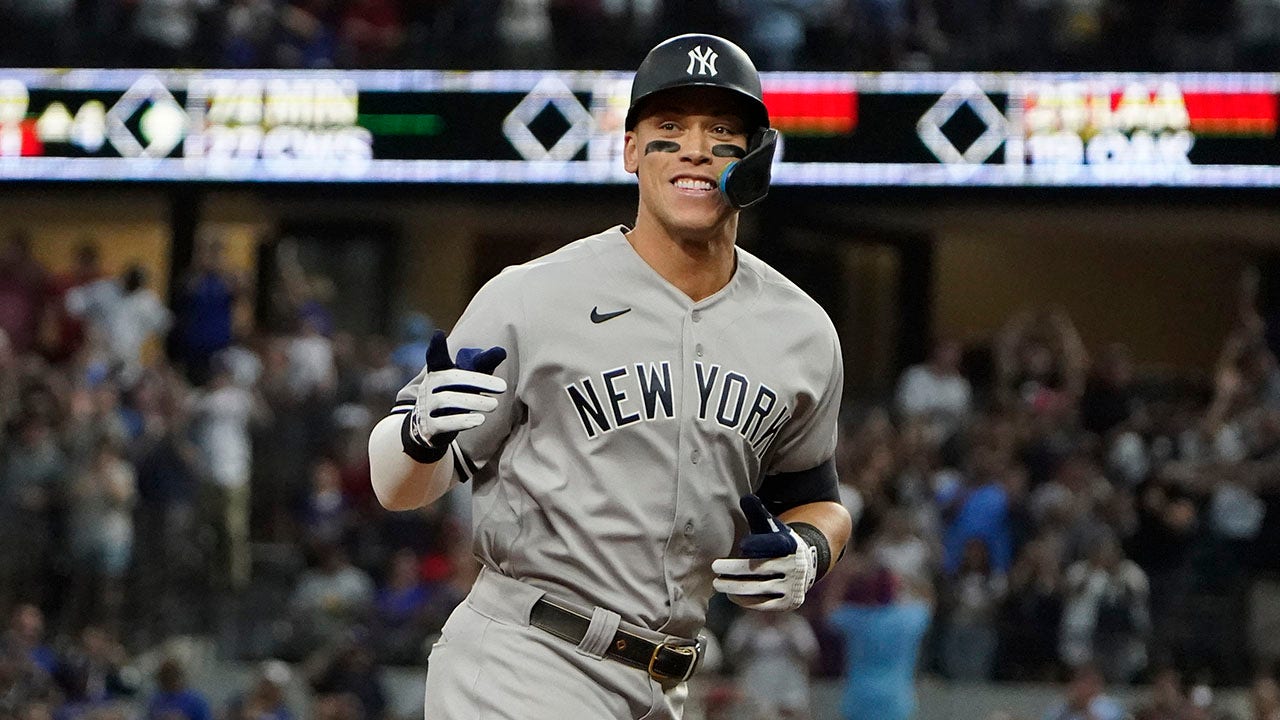
October 4, 2022: First batter of the game between the New York Yankees and the Texas Rangers: Aaron Judge. Pitcher: Jesus Tinoco. On a 1-1 count, Judge drilled a ball deep into the left-field stands at Globe Life Park in the Dallas suburb of Arlington, Texas, 391 feet.

It was his 62nd home run of the season, surpassing Roger Maris, the most that any American League player -- the most that any player has ever hit without evidence of cheating -- in a single season in the 152-season history of Major League Baseball.

As for the rest of the game: Giancarlo Stanton, who hit 59 with the Miami Marlins in 2017, hit a home run in the 5th inning, but that was all that the Yankees were going to get. Gerrit Cole started for them, and pitched 6 innings, striking out 9, setting a new Yankee single-season record of 257 strikeouts, breaking the 1978 record of 248 set by Ron Guidry. But he didn't get the run support he needed. After the Stanton homer, the Yankees got only 2 baserunners, both walks. The Rangers won, 3-2.

It was the 2nd game of a doubleheader, forced by the postponement of the 1st week of the regular season due to the MLB lockout. The Yankees won the 1st game, 5-4.

There was 1 game left to play in the regular season, and Judge was given the day off, so he finished the season with 62 home runs. He also led the AL with 131 RBIs, and batted .311, which was nearly enough to win the AL batting title and thus the Triple Crown.

Judge, who grew up in Linden, California, less than 100 miles from San Francisco, and grew up as a San Francisco Giants fan, told an interviewer that the 73 home runs hit by Barry Bonds in 2001, recognized as the official MLB record in spite of his proven cheating, should still be considered the real record.

He is the only person who could look better instead of worse by saying that. Everybody else saying that Bonds holds "the real record" is saying 1 of 2 things:

A. "I don't believe that Bonds cheated." Which makes them dumb. Or:
B. "I know that Bonds cheated, but I don't care." Which makes them rotten.

And don't tell me that throwing out Bonds' record means you have to throw out all pre-1947, pre-Integration records. That's not the same thing at all. As evil as it was, it was the owners doing it. It wasn't the players choosing to take an unfair advantage. Babe Ruth's 60 in 1927 was legitimate. Roger Maris' 61 in 1961 was legitimate. Aaron Judge's 62 in 2022 is legitimate. The totals exceeding those by Bonds, Mark McGwire and Sammy Sosa are bogus.

Babe Ruth, Roger Maris, Aaron Judge. All Yankees. All right fielders.

UPDATE: The difference was, when Ruth hit 60 in 1927, the Yankees won the World Series; when Maris hit 61 in 1961, the Yankees won the World Series; when Judge hit 62 in 2022, the Yankees were knocked out of the Playoffs in the American League Division Series. The 1927 and 1961 editions of the Yankees are considered finalists for the title of greatest team of all time. The 2022 edition is considered a failure, in spite of Judge's feat.

*

October 4, 2022 was a Tuesday. These other games were played in Major League Baseball that day:

* The New York Mets swept a doubleheader from the Washington Nationals at Citi Field, 8-0 and 4-2. In the opener, Taijuan Walker (4 1/3rd innings), Stephen Nogosek (2 2/3rds, winning pitcher) and Tylor Megill (2) combined on a 9-hit shutout, striking out 17 and walking none. The nightcap was the Mets' 100th win of the season, the 4th time they had reached that milestone.

* The Boston Red Sox beat the Tampa Bay Rays, 6-0 at Fenway Park in Boston, in a game shortened to 5 innings due to rain, a remnant of Hurricane Ian that had devastated Florida and also soaked the Carolinas a few days earlier.

* The Atlanta Braves beat the Miami Marlins, 2-1 at LoanDepot Park in Miami.

* The St. Louis Cardinals beat the Pittsburgh Pirates, 8-7 at PNC Park in Pittsburgh. Juan Yepez singled home the winning run in the top of the 10th inning.

* The Cleveland Guardians beat the Kansas City Royals, 5-3 at Progressive Field in Cleveland.

* The Cincinnati Reds beat the Chicago Cubs, 3-2 at Great American Ball Park in Cincinnati.

* The Chicago White Sox beat the Minnesota Twins, 8-3 at Guaranteed Rate Field (now Rate Field) in Chicago.

* The Milwaukee Brewers beat the Arizona Diamondbacks, 3-0 at American Family Field in Milwaukee. Eric Lauer (6 innings) and 2 relievers combined on a 1-hit shutout.

* The Houston Astros beat the Philadelphia Phillies, 10-0 at Minute Maid Park (now Daikin Park) in Houston. Justin Verlander and 2 relievers pitched 8 innings of no-hit ball, before Will Smith allowed 3 hits in the 9th. Combined, the Astro pitchers struck out 16 and walked 2.

* The San Diego Padres beat the San Francisco Giants, 6-2 at Petco Park in San Diego.

* The Colorado Rockies beat the Los Angeles Dodgers, 5-2 at Dodger Stadium in Los Angeles.

* The Oakland Athletics beat the Los Angeles Angels, 2-1 at the Oakland Coliseum (then named the RingCentral Coliseum). Ryan Tepera walked Shea Langeliers with the bases loaded in the bottom of the 10th inning, giving the A's the win.

* And the Seattle Mariners swept a doubleheader from the Detroit Tigers, 7-6 and 9-6 at T-Mobile Park in Seattle. Abraham Toro won the 1st game with a sacrifice fly in the bottom of the 10th.

* And the Baltimore Orioles and the Toronto Blue Jays were rained out at Camden Yards in Baltimore.

Saturday, October 1, 2022

October 1, 1961: Roger Maris Hits 61 in '61

October 1, 1961: Roger Maris comes to bat for the New York Yankees in the bottom of the 4th inning, against Tracy Stallard of the Boston Red Sox, in the last game of the regular season. The game would seem to be meaningless, as the Yankees had clinched the Pennant on September 20.

It was far from meaningless. Maris had 60 home runs, tying the single-season record set by Babe Ruth in 1927. This game would be his last chance to break the record.

He was born in Hibbing, Minnesota in 1934, and grew up in Fargo, North Dakota. After playing with the Cleveland Indians in 1957 and '58, and then for the Kansas City Athletics, the Yankees acquired him after the 1959 season. In 1960, he hit 39 home runs, 2nd in the American League to teammate Mickey Mantle with 40, and was named the American League's Most Valuable Player, as the Yankees won the Pennant.

Then came 1961. Roger got off to a slow start, and late in April, manager Ralph Houk tinkered with the batting order, putting Roger 3rd and Mickey 4th. That did the trick: Mickey kept hitting well, and Roger, who couldn't be walked (intentionally or "unintentionally") for fear of bringing Mickey up with a man on base, saw better pitches to hit, and did he ever hit them. By the All-Star break, both men had over 30 home runs, and Ruth's record of 60 home runs in a season was in doubt.

This was the 1st season of a 162-game schedule, due to the expansion of the AL from 8 to 10 teams, after over 50 years of a 154-game schedule. Thus, Commissioner Ford Frick, who had been a good friend of the Babe's, said that the record books would have 2 separate entries for single-season records, in the event that such a record needed more than 154 games to be broken.

(This also became an issue the next season, though with much less fuss: Ty Cobb stole 96 bases with the 1915 Detroit Tigers, but Maury Wills of the Los Angeles Dodgers stole 104 -- but didn't get his 97th until after the 154th game.)

All the while, the New York media wouldn't let up, bothering Roger from the moment he walked out of his car as he arrived at the Stadium until the moment he got back into his car after the game. He was being bothered at home. Fans who didn't want to see Ruth's record broken booed him.

They would have preferred Mickey as the record-breaker, since Mickey was a career Yankee. (They must have forgotten that the Babe was not. This may have been the first-ever "True Yankee" debate, symbolized later by Thurman Munson & Reggie Jackson, and more recently by Derek Jeter & Alex Rodriguez.) The point was made that Roger was a .270 hitter, whereas the Babe hit .342 lifetime. They brought up the extra games, and the addition of pitchers due to expansion.

Had the Babe lived, he would have been 66 years old, not a terribly old man. I've got to believe that he would have said, "Anything that's good for baseball, and anything that's good for the Yankees, is good for me. If this kid can break my record, it'll help the Yankees win, and it's getting people talking about baseball, so I'm fine with it." Alas, he had died in 1948, and the writers never figured out that attacking Roger did nothing to protect the Babe's legacy.

It got so bad that Roger was getting death threats in the mail, and at least one telephoned threat to kidnap his children. It got so bad that his hair started falling out. (This sounds like a legend, to exaggerate what really happened, but it has been well-documented.) Still, the media kept treating him like dirt, partly because he was threatening the sacred record of the beloved Babe, partly because, unlike the Babe and the Mick, he wasn't the kind of man who liked a lot of attention.

(When Hank Aaron approached Ruth's career record of 714 home runs in 1973, Roger was the only man who had an understanding of what Hank was going through, although in Roger's 1961 case there wasn't a racial aspect to it. By then living in Florida, where the closest MLB team was Hank's Atlanta Braves, Roger took his kids up there to see Hank play, and praised him for his great career and his courage in standing up to the abuse. Hank, of course, got to 715 early in the 1974 season, and finished with 755, which stood until 2007 when it was broken, with "help," by Barry Bonds, who raised it to the current record of 762.)

In the 154th game, Roger hit his 59th home run, but that was it. He got to 60 on September 26. But, through Game 161 on September 30, no more. He would have one more game, 4 or 5 more at-bats.

The game was scoreless when Maris stepped to the plate against Tracy Stallard in the bottom of the 4th inning. Stallard's 1st pitch was outside, and the Yankee Fans, hoping that Stallard would give Maris something to hit, booed. His 2nd pitch was in the dirt for ball 2, and, as Yankee broadcaster and shortstop legend Phil Rizzuto noted, the boos got louder. Then Stallard threw a fastball down the middle. Maris swung. Rizzuto had the call, on WPIX-Channel 11:

Here's the windup. Fastball, hit deep to right, this could be it! Way back there! Holy cow, he did it! Sixty-one for Maris! And look at the fight for that ball out there! Holy cow, what a shot! Another standing ovation for Roger Maris! Sixty-one home runs, and they're still fighting for that ball out there, people are climbing over each other's back. One of the greatest sights I've ever seen here at Yankee Stadium.

The ball fell into the right-field stands near the Yankee bullpen, about 375 feet. As Maris crossed the plate, a fan who has never been identified was on the field, shook his hand, and slapped him on the back. Maris' teammates kept pushing him out of the dugout to acknowledge the standing ovation that wouldn't end.

That would be the only run of the game. The Yankees won, 1-0. Bill Stafford pitched shutout ball for 6 innings, and was followed by Hal Reniff in the 7th and Luis Arroyo in the 8th and 9th, between them allowing just 4 hits and 1 walk.

Attendance: 23,154. That doesn't sound like much. It becomes more embarrassing when you consider that most of them seemed to be sitting in right field, hoping to catch the ball. Sam Gordon, a restaurant owner in Sacramento, California, had offered $5,000 (about $45,700 in today's money) for the ball, and they were hoping to cash in.

Sal Durante, a 19-year-old truck driver, caught the record-breaking ball. After the game, Durante was invited into the Yankee clubhouse to pose with Maris and the ball. Durante offered Maris the ball, but Maris declined, saying to get what you can for it.

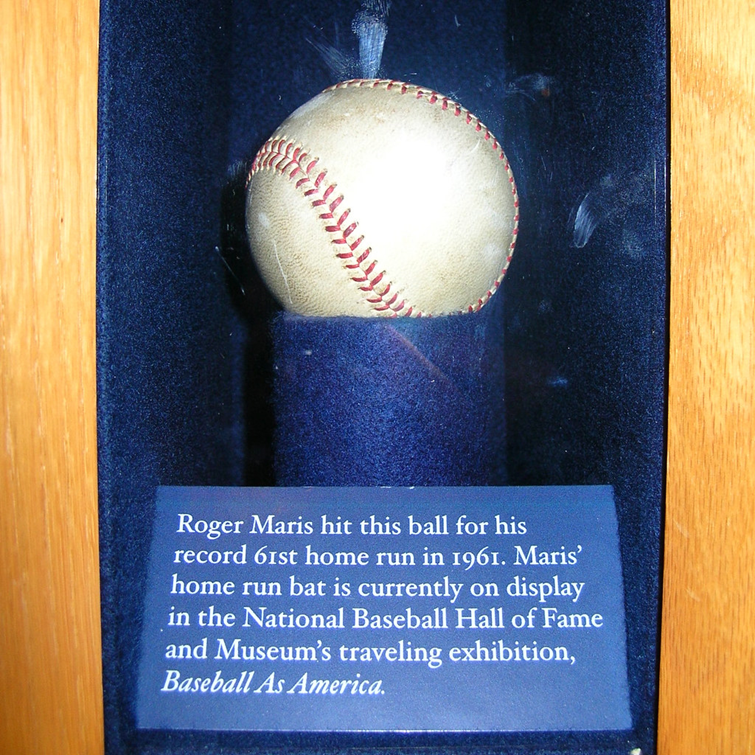
Durante, who had brought his fiancée Rosemary to the game, bought her an engagement ring. Gordon paid for the Durante's honeymoon, put the ball on display in his restaurant for a while, and then gave it back to Maris. In 1973, Maris donated it to the Baseball Hall of Fame in Cooperstown, New York, where it rests today.
Still alive from this game, 61 years later: For the Yankees, Bobby Richardson, Tony Kubek, Héctor López and Jack Reed. For the Red Sox: Only their rookie left fielder, a 22-year-old native of Southampton, Long Island named Carl Yastrzemski.

Also still alive, in the Yankee dugout but not appearing in the game, was a rookie pitcher named Al Downing. In 1974, Downing gave up Hank Aaron's 715th home run. I don't know if anybody else was in the ballpark for both moments, but Downing was definitely the only one in uniform for both.

(UPDATE: López died on September 29, 2002; Reed on November 10, 2022; and Durante on December 1, 2022. Mrs. Durante died in 2014.)

One of my favorite trivia questions is, "Who played right field for the Yankees the day Roger Maris hit his 61st home run in 1961?" The easy answer is, "Roger Maris," but that's wrong. Mickey Mantle was sick, and Roger was playing center field that day. The right fielder? Backup catcher Johnny Blanchard.

Roger batted .269 that season, but his 61 home runs, 141 RBIs and 366 total bases all led the AL. In spite of his relationship with the New York writers, the Baseball Writers Association of America voted him MVP again. The Yankees won the World Series, beating the Cincinnati Reds in 5 games, and Roger hit another homer in the series.

The rest of his career was an anticlimax. How could it not be? He hit 33 home runs in 1962. He helped the Yankees win 5 straight Pennants, including the 1961 and 1962 World Series. He broke his hand early in the 1965 season, one of several injuries that caused the Yankees to fall apart that year and tumble from the top to the middle of the League, and the next year to the bottom. But Yankee management told him the injury was something less severe, and publicly suggested that he was faking the extent of the injury. This caused a breach between Roger and the Yankee management of the time that never healed, even after the hand did.

After the 1966 season, he was traded to the St. Louis Cardinals for 3rd baseman Charley Smith. 
Roger helped the Cardinals win the World Series in 1967, and another Pennant in 1968. He finished his career with a .260 batting average, 275 home runs and 851 RBIs. Decent totals, but not those of an all-time great.

Cardinals owner Gussie Busch gave him an Anheuser-Busch beer distributorship in Gainesville, Florida, and the family still lives there today. In 1978, by which point most people who felt he didn't deserve to break the record had either died or changed their minds, George Steinbrenner invited him back to Yankee Stadium. He appeared on Opening Day 1978, to raise the previous season's World Championship banner with Mantle, and got a standing ovation.
He attended Old-Timers' Day from 1978 to 1984, in the last of those getting his Number 9 retired and a Plaque for Monument Park. But he was beginning to suffer from cancer, and died in 1985. He did not live to see his record raised, through dubious means, to 70 by Mark McGwire in 1998, and then to 73 by Barry Bonds in 2001.

A Roger Maris Museum had also been dedicated in his hometown of Fargo, at the West Acres Regional Shopping Center. Roger said he would allow it as long as admission was free. It still is.

*

October 1, 1961 was a Sunday. It was also the day that District of Columbia Stadium, later renamed Robert F. Kennedy Memorial Stadium, opened in Washington; and broadcast network CTV went on the air in Canada. I have separate entries for those events.

These other games were played on the final day of baseball's regular season:

* The St. Louis Cardinals beat the Philadelphia Phillies, 2-0 at Connie Mack Stadium in Philadelphia. Bob Gibson pitched a 6-hit shoutout. Stan Musial appeared only as a pinch-hitter, and did not reach base.
* The Pittsburgh Pirates beat the Cincinnati Reds, 3-1 at Forbes Field in Pittsburgh. Roberto Clemente did not play. Frank Robinson went 0-for-2 with a walk. Despite this game, the Reds had dethroned the Pirates as National League Pennant winners, and would face the Yankees in the World Series. The Yankees won in 5 games.
* The Los Angeles Dodgers beat the Chicago Cubs, 8-2 at Wrigley Field in Chicago. Ernie Banks went 1-for-4 with an RBI. Duke Snider drew a walk as a pinch-hitter.
* A doubleheader was split at Milwaukee County Stadium. The San Francisco Giants won the opener, 8-2. The Milwaukee Braves won the nightcap, 3-2. Al Spangler singled Hank Aaron home with the winning run in the bottom of the 10th inning. Over the 2 games, Aaron went 4-for-9, and Willie Mays went 3-for-7 with a home run and 3 RBIs.
* The Detroit Tigers beat the Minnesota Twins, 8-3 at Metropolitan Stadium in the Minneapolis suburb of Bloomington, Minnesota. Norm Cash hit a home run, and Al Kaline had an RBI double as a pinch-hitter. This was the Tigers' 101st win of the year, but the Yankees won 109 to take the American League Pennant.
For the Twins, completing their 1st season after being "the old Washington Senators," Harmon Killebrew went 0-for-3 with a walk, and relief pitcher Pedro Ramos hit a home run, 1 of 3 he hit on the season, and 1 of 15 he hit in a surprisingly powerful career for a pitcher who was mainly a reliever.
* The Kansas City Athletics beat "the new Washington Senators," 3-2 at Kansas City Municipal Stadium.
After providing a venue for the Pacific Coast League's Los Angeles Angels from 1925 through 1957, and the major league expansion team with the same name this season, the West Coast version of Wrigley Field hosts its last professional baseball game. The Halos are defeated by the Cleveland Indians, 8-5 in front of 9,868 fans. Wrigley West will be torn down in 5 years, to make room for an eventual public playground and senior center.
* And the Baltimore Orioles and the Chicago White Sox completed their seasons the day before, against each other, with the O's winning, 4-3 at Memorial Stadium in Baltimore.
These games were played in the NFL:
* The New York Giants beat the Washington Redskins, 24-21 at District of Columbia Stadium in Washington. This was the 1st event at what would be renamed Robert F. Kennedy Stadium in 1969. I have a separate entry for that event. (The opener, not the renaming.)
* The football version of the St. Louis Cardinals beat the Philadelphia Eagles, 30-27 at Franklin Field in Philadelphia.
* The Baltimore Colts beat the Minnesota Vikings, 34-33 at Memorial Stadium in Baltimore.
* The Cleveland Browns beat the Dallas Cowboys, 25-7 at Cleveland Municipal Staidum.
* The San Francisco 49ers beat the Detroit Lions, 49-0 at Tiger Stadium in Detroit.
* The Green Bay Packers beat their arch-rivals, the Chicago Bears, 24-0 at Green Bay City Stadium (later renamed Lambeau Field).
* And the Los Angeles Rams beat the Pittsburgh Steelers, 24-14 at the Los Angeles Memorial Coliseum.
And in the American Football League:
* The New York Titans beat the Boston Patriots, 37-30 at the Polo Grounds. The Titans became the Jets in 1963, and the Patriots became the New England Patriots in 1971.
* The Dallas Texans beat the Houston Oilers, 26-21 at the Cotton Bowl in Dallas. The Texans became the Kansas City Chiefs in 1963, and the Oilers became the Tennessee Titans in 1999.
* The Oakland Raiders beat the Denver Broncos, 33-19 at Candlestick Park in San Francisco. The Raiders wouldn't actually play a game in Oakland until 1962, moved to Los Angeles in 1982, moved back to Oakland in 1995, and moved to Las Vegas in 2020.
* And, the day before, the San Diego Chargers beat the Buffalo Bills, 19-11 at War Memorial Stadium in Buffalo. This was the Chargers' 1st game as a San Diego team, after spending the AFL's founding year of 1960 in Los Angeles. They returned to Los Angeles in 2017.

Thursday, September 8, 2022

September 8, 1998: Mark McGwire Hits His 62nd Home Run

September 8, 1998: The St. Louis Cardinals beat their arch-rivals, the Chicago Cubs, 6-3 at Busch Memorial Stadium in St. Louis. Ray Lankford and Ron Gant hit home runs for the Cardinals. Nobody remembers those. What they remember is the home run hit by Mark McGwire. It is his 62nd of the season, setting a new single-season record.

Babe Ruth had raised the record to 29 in 1919, 54 in 1920, 59 in 1921 and 60 in 1927. Another right fielder for the New York Yankees, Roger Maris, raised it to 61 in 1961. In spite of the media, especially in New York, seeming to not want Maris to break the record, he ended up holding it longer than Ruth did: 37 years to 34.

While there were serious challenges to Ruth's 60 before Maris' 61 -- Hack Wilson hit 56 in 1930, Jimmie Foxx 58 in 1932, and Hank Greenberg 58 in 1938 -- challenges to Maris' 61 were fewer. In 1969, Reggie Jackson, in his 2nd full season with the Oakland Athletics, had 41 home runs through August 2, and, in his memoir, said, "People were now saying I was dating a lady named Ruth Maris." But he only hit 6 more the rest of the way, and didn't even lead the American League: Harmon Killebrew topped him, 49 to 47.

Willie Mays hit 52 in 1965, but no other National Leaguer hit 50 again until George Foster hit 52 in 1977. And no American Leaguer hit 50 after Maris until 1990, when Cecil Fielder hit 51. When the Strike of '94 hit, Matt Williams was leading the majors with 43, and Ken Griffey Jr. led the AL with 40. Both were thought to have a chance at 61, but that went out the window.

And despite accusations of a "juiced ball" in 1987, no player hit 50 that season. Each League's leader hit 49: Andre Dawson of the Chicago Cubs and... Mark McGwire of the Athletics. McGwire thus set a record for home runs in a season by a rookie.

The 1st baseman was 6-foot-5 and 215 pounds, and had an even taller younger brother, Dan McGwire, who played quarterback for 5 seasons in the NFL, mostly as a backup for the Seattle Seahawks. Still, at the time, Mark was seen as big and solidly built, but not out of regular human proportions. He didn't look like a superhero, or a bodybuilder such as Arnold Schwarzenegger.

He and Jose Canseco became known as the Bash Brothers, helping the A's win 3 straight Pennants and the 1989 World Series. Through the 1992 season, he was 29 years old, and had hit 220 home runs, making 6 All-Star Games, and had even won a Gold Glove. He looked like he was headed for the Hall of Fame. So did Canseco, who was 28 and already had 231 home runs.

But between the A's perennial cash flow problems and his bad attitude, Canseco became expendable, and was traded after that season. McGwire wasn't, falling victim to injuries, making only 279 plate appearances in '93 and '94 combined.

The fact that Canseco used steroids wasn't publicly known, but it was one of the worst-kept secrets in baseball. McGwire found out that a steroid called androstendione, or "andro" for short, could make it easier to return from injury and regrow lost muscle. He came back with a bang in 1995 -- 39 bangs, in fact, and made the All-Star Game again.

In 1996, now with a goatee and his arms bulging like the cartoon character Popeye's, he led the AL with 52 home runs, the most any AL player had hit since Maris. And he was doing this while playing his home games at the Oakland Coliseum, a pitcher's park. Suddenly, the idea that Maris' record could fall was taken seriously for the 1st time.

But, again, A's management was losing money, and on July 31, 1997, with McGwire having hit 34 home runs already, he was traded to the Cardinals for pitchers Eric Ludwick, T.J. Mathews and Blake Stein. Ludwick won just 1 game for the A's, and was traded after the season. Stein did poorly, and was traded in 1999. Mathews pitched well in relief for them, but they traded him in 2001. None of these men appeared in a major league game after the 2002 season. Still, the A's had Jason Giambi coming up, and he replaced McGwire at 1st base, so the trade was pretty much a wash for them.

McGwire was warmly embraced by Cardinal fans. He seemed just the kind of wholesome player that fit in with the Midwest, and "the Best Baseball City in America." He finished the season with 58 homers, while Griffey, with the Seattle Mariners, finished with 56. Now, the national media seemed to treat the breaking of Maris' record no longer as an "if," but as a "when." In cheering on McGwire, and to a lesser extent (because he was black, of course) Griffey, it was as if the media was once again rooting against the considerably less "likable" Maris, who died in 1985, and could not speak up on his own behalf.

And it wasn't just that McGwire and Griffey were hitting so many home runs, it was how far they were going. Griffey was the only batter who ever reached the upper deck of the Kingdome in Seattle, and he had now done it a few times. McGwire was hitting balls 500 feet. Not since Mickey Mantle -- not even Killebrew or Jackson -- had a guy hit the ball that far that often. McGwire may have been a righthanded batter, playing outside New York, and hadn't pitched since he was at USC, but he really was treated as if he was the closest thing to Ruth since Ruth. He was a folk hero.

As it turned out, 1998 became not only "The Year of the Home Run," but it was a 3-way race: McGwire and Griffey were joined by Sammy Sosa of the Cubs. A Dominican, Sosa had never hit more than 40 in a season, and had made just 1 All-Star Game by age 29. But he kept pace with McGwire and Griffey. In June, he topped both of them, and everybody else, too: He hit 20 home runs, still a record for a single player in a single month. When June was over, it was McGwire 37, Sosa 33, Griffey 33.

Neither McGwire nor Sosa added any homers by the All-Star Break on July 7, while Griffey had overtaken Sosa with 35. But all 3 got going after the Break: July ended with McGwire 45, Sosa 42, Griffey 41. McGwire got to 50 on August 20, Sosa on August 23. Griffey went into a slump, so, when August ended, it was McGwire 55, Sosa 55, Griffey 47.

August was also the month that the scandal surrounding President Bill Clinton and his affair with former White House intern Monica Lewinsky got more serious, with Special Counsel Kenneth Starr and the Republican-controlled Congress amping up the pressure. The general consensus was that Clinton had done something immoral, but there didn't appear to be anything illegal, and that Starr and Congress were going too far in trying to prove it.

The home run race provided a distraction, much as Hank Aaron's pursuit of Babe Ruth's career record of 714 helped to distract from Richard Nixon and Watergate in 1973 and '74, Joe DiMaggio's hitting streak and Ted Williams' pursuit of a .400 batting average did from the war fever of 1941, and a few Pennant races did during the Great Depression of the 1930s and the Vietnam War in the 1960s.

By this point, the scoreboard at Busch Memorial Stadium was keeping a running total of McGwire's and Sosa's totals -- but not Griffey's. After all, Sosa was playing for the Cubs, the Cards' arch-rivals.

Also by now, Steve Wilstein, a reporter for the Associated Press, had made public the fact that he had seen a bottle of andro in McGwire's locker. McGwire said it was legal -- which, at the time, it was. He said it was no big deal -- which, at the time, the public accepted. They wanted to believe this whole thing was totally legit.

Indeed, fans turned on Wilstein for reporting it: How dare he ruin this wonderful story with an accusation that "Big Mac" was cheating! What next? Was "Slammin' Sammy" also cheating? Was Junior cheating?

On September 5, McGwire hit his 60th, Sosa hit his 58th, and Griffey hit his 48th. Griffey was having a historic season, and yet was hopelessly behind the Southern Californian and the Dominican. On September 7, Griffey hit Numbers 49 and 50. That same day, McGwire hit Number 61, and Cardinal broadcaster Jack Buck said, "Flight 61, now leaving for Planet Maris!"

Fox broadcast the September 8 Cardinals-Cubs game at Busch live, on its regular national network, not Fox Sports, figuring that it would be the night that the record was broken. The Cardinals, for whom Maris had played his last 2 seasons, 1967 and '68, invited his widow, Pat Maris, and their 5 now-grown children to attend. Pat felt ill and couldn't go, but the kids all did.

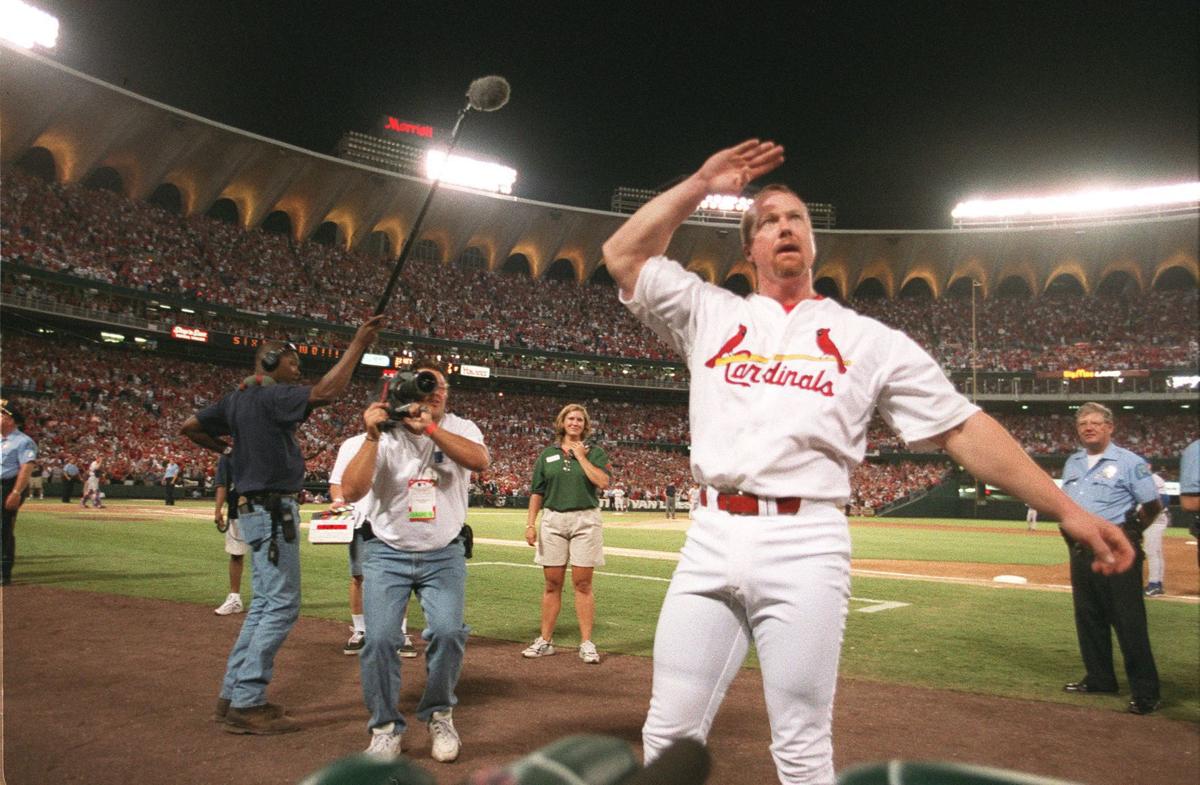
McGwire grounded to short in the 2nd inning. With 2 out in the 4th, he again came up against Cub pitcher Steve Trachsel. He hit a screaming liner down the left-field line. Joe Buck, Jack's son, had the call: "Down the left field line! Is it enough? Gone! Number 62! Touch first, Mark: You've made history!" In his excitement, McGwire rounded 1st base without touching it, and Dave McKay, who had also been manager Tony La Russa's 1st base coach when he and McGwire were in Oakland, had to tell him to go back to do so. At 341 feet, it was his shortest home run of the season.

Greeting him at home plate was his 11-year-old son, Matt, a Cardinal batboy, whom he gave a huge hug. Sosa had run in from right field, and he hugged McGwire as well. McGwire then went over to where the Marises were sitting, and hugged them, too. With those andro-boosted arms.

But the home run race wasn't over: There was no guarantee that McGwire would even end up leading the NL in homers. Sosa hit his 59th on September 11 and his 60th on September 12. A week earlier, in the entire history of Major League Baseball, there had been only 2 men ever to hit 60 home runs in a season. Now, that total had doubled. On September 13, Sosa hit his 61st and his 62nd. He and McGwire were now tied. Griffey was at 51.

McGwire hit his 63rd on September 15, Sosa his the next day. McGwire hit his 64th on September 18, and his 65th on September 20. On September 23, Sosa hit his 64th and 65th. Griffey was up to 55. On September 25, against José Lima of the Houston Astros at the Astrodome, Sosa hit his 66th, making him the all-time single-season leader -- for a few minutes. This was shortly followed by McGwire's 66th.

There were 2 days left. Nobody knew it yet, but Sosa wouldn't hit another homer, finishing with 66. Griffey would finish with 56. On September 26, the next-to-last day of the season, back at Busch, McGwire hit his 67th off Dustin Hermanson, giving him the lead for good; and hit his 68th later in the game. On the last day, September 27, he hit his 69th, and finally, he cracked a barrier that nobody thought was possible, hitting Number 70 off Carl Pavano, then a rookie with the Montreal Expos. Joe Buck had the call: "Into left field! Number 70! How much more can you give us, Big Mac?"

The answer, at least for that season, was, "No more." The Cardinals finished 73-89, and were nowhere near the NL Pennant race. But the Cubs had finished in a tie with the San Francisco Giants for the NL's Wild Card berth, and won a Playoff at Wrigley Field. Sosa did not hit a homer, which, since this was officially a regular-season game, would have counted as his 67th. But the starting and winning pitcher for the Cubs? Steve Trachsel. That, not giving up McGwire's 62nd, was his most important moment of the year.

And, since the Cubs made the Playoffs, and the Cardinals didn't, Sosa was named the NL's Most Valuable Player, not McGwire. Nevertheless, Sports Illustrated named them joint Sportsmen of the Year -- not their first retroactively problematic choice for that title, and not their last.

In 1999, McGwire hit 65 home runs, while Sosa hit 63. Griffey led the AL with 48. Both McGwire and Sosa had, by comparison, off-seasons in 2000: Sosa 50, still enough to lead the NL; McGwire, 32. Griffey had been traded to the Cincinnati Reds, and hit 40. In 2001, Sosa hit 64. But McGwire battled injuries, hit 29 homers, and retired after the season, with 583 for his career. Griffey also faced injuries, and was limited to 22 homers.

In 2001, the Fox TV show Dark Angel, set in a dystopian future of 2020 -- the dystopia being due to an electromagnetic pulse in 2009 having led to an economic depression and a fascist government, not an epidemic and a nearly-fascist government, as actually happened -- had a story about the theft of the ball that Sosa hit for his 756th home run, breaking Hank Aaron's career record.

Barry Bonds of the San Francisco Giants hit 37 home runs in 1998, having reached a career high, to that point, of 46 in 1993. But, already known for having a surly personality, he was respected as much as baseball's other big stars, but not liked as much. He became intensely jealous of the attention heaped on McGwire, Sosa and Griffey, and, knowing he was a better all-around player than any of them (well, maybe not Griffey), began using steroids after the 1998 season.

In 1999, he hit 34 homers. In 2000, he hit a new career high, 49. Neither of which was out of the ordinary. But in 2001, he set a new single-season record, with 73. That record still stands. Sosa, who again led the NL in 2002, with 49, would end up with 609. Griffey would finish with 630, and, as far as is publicly known, he did that without ever using steroids. Bonds would be the one to break Aaron's record, finishing with 762 in 2007.

By then, McGwire and Sosa had already irreparably damaged their reputations: The 2005 Congressional hearings into steroid use in baseball had made them both look foolish. Sosa has never confessed to using steroids. McGwire has, after having put it off during those hearings (saying, "I'm not here to talk about the past"), and this admission allowed him to get back into baseball's good graces, as he has served as a hitting instructor for the Cardinals and the San Diego Padres. However, the section of Interstate 70 -- a convenient number -- running through St. Louis had been named the Mark McGwire Highway. In 2010, the signs were changed to honor an earlier local hero, who was a baseball fan: It became the Mark Twain Highway.

Through the 2022 election, neither McGwire, nor Sosa, nor Bonds has ever been elected to the Baseball Hall of Fame. Griffey was elected in his 1st year of eligibility. However, with known steroid cheats David Ortiz, Mike Piazza and Iván Rodríguez already in, keeping McGwire, Sosa, Bonds, Alex Rodriguez, and any other player known to have used steroids -- or, like Roger Clemens, widely believed to have used them, though in his case acquitted in court -- out of the Hall on the basis of steroid use seems stupid: Either cheating matters, or it doesn't. If it doesn't bother you, let all of them in; if it does, keep all of them out. Be consistent.

Jose Canseco would finish his career with 462 home runs. In other words, he's a borderline candidate for the Hall of Fame even with his admission of cheating.

The Summer of '98 has been called baseball's best season, for all the home run heroics. Certainly, Yankee Fans, getting to watch a team go 114-48 in the regular season and 11-2 in the postseason, loved it. But the knowledge that McGwire and Sosa cheated to reach and pass 61 home runs taints it, irrevocably. The U.S. Senate may have acquitted Clinton, but history has convicted McGwire, Sosa and Bonds.

*

September 8, 1998 was a Tuesday. These other games were played in Major League Baseball:

* The New York Yankees beat the Boston Red Sox, 3-2 at Fenway Park in Boston. David Cone was the winning pitcher, striking out 11 and walking none. Derek Jeter went 0-for-2, but did draw 2 walks and score a run. The next night, with a 7-5 win at Fenway, the Yankees clinched the American League Eastern Division, on their way to a 114-win regular season and their 24th World Championship.

* The New York Mets lost to the Philadelphia Phillies, 16-4 at Veterans Stadium in Philadelphia.

* The Montreal Expos beat the Atlanta Braves, 6-3 at the Olympic Stadium in Montreal.

* The Pittsburgh Pirates beat the Milwaukee Brewers, 8-7 at Three Rivers Stadium in Pittsburgh.

* The Chicago White Sox beat the Detroit Tigers, 12-6 at the new Comiskey Park (now Rate Field) in Chicago.

* The Texas Rangers beat the Kansas City Royals, 7-6 at The Ballpark (now Choctaw Stadium) in the Dallas suburb of Arlington, Texas.

* The Houston Astros beat the Cincinnati Reds, 13-7 at the Astrodome in Houston.

* The Colorado Rockies beat the Florida Marlins, 11-10 at Coors Field in Denver.

* The Los Angeles Dodgers beat the Arizona Diamondbacks, 6-5 at Bank One Ballpark (now Chase Field) in Phoenix. Eric Karros won the game with a sacrifice fly in the top of the 11th inning.

* The San Francisco Giants beat the San Diego Padres, 5-1 at Qualcomm Stadium in San Diego. Bonds went 0-for-3 with 2 walks. Tony Gwynn went 1-for-3, the hit a solo home run.

* The Minnesota Twins beat the Anaheim Angels, 5-0 at Edison International Field (now Angel Stadium of Anaheim). Brad Radke (7 innings) and Eddie Guardado (2) combined on an 8-hit shutout.

* The Baltimore Orioles beat the Oakland Athletics, 5-2 at the Oakland Coliseum (then named the Network Associates Coliseum). Cal Ripken went 2-for-4. Rickey Henderson went 0-for-4, but did draw a walk and steal a base.

* And the Tampa Bay Devil Rays beat the Seattle Mariners, 10-0 at the Kingdome in Seattle. Wilson Alvarez and 2 relievers combined on a 2-hit shutout. Ken Griffey Jr. went 0-for-3 with a walk. Wade Boggs went 2-for-5 with the Rays.

Saturday, August 13, 2022

August 13, 1961: The Berlin Wall Goes Up

August 13, 1961: The German Democratic Republic -- better known as East Germany, since it was not democratic and not a republic -- closes the border between the Eastern and Western Sectors of Berlin, to thwart its inhabitants' attempts to escape to the West. Construction of the Berlin Wall -- Der Berliner Mauer -- is started. The day is known as Stacheldraht-Sonntag -- Barbed Wire Sunday.

After the defeat of the Nazis in 1945, the German capital of Berlin was divided into 4 Sectors, 1 for each of the main victorious Allies: American in the southwest, British in the central west, French in the northwest, and Soviet in the east. In 1948, the Soviet Union sealed the border, trying to starve West Berlin (American, British and French) into submission. In response, President Harry S Truman started the Berlin Airlift, and the Soviets couldn't stop it, and gave up.

Now, in 1961, tensions had been again been rising between America and the Soviet Union over the status of Berlin. In June, President John F. Kennedy and Soviet Premier Nikita Khrushchev met for a summit in Vienna, Austria. It was the only time they would meet face-to-face.

The 67-year-old Khrushchev, already a hardened veteran of World War I by the time JFK was born in 1917, thought he could intimidate the youngest man ever elected President of the United States. He was right: The 44-year-old Kennedy was out of his league -- for the moment. By July, he was calling up U.S. Army Reserve units to send to West Berlin, because Khrushchev was doing the same with his country's Red Army.

The Warsaw Pact, dominated by the Soviets with East Germany as its 2nd-ranking partner, called the Wall "the Antifascist Protection Rampart." The idea was that it was supposed to keep America and its NATO allies, including Britain and France, out. This was a cover: So many people were fleeing from East Berlin to West Berlin that the Pact was willing to put the Wall up, heavily guarded by sniper towers, to stop them.

In his speech accepting the 1964 Republican nomination for President, Senator Barry Goldwater of Arizona called it "the wall of shame in Berlin." But, at the time, Kennedy was relieved: Better a wall than a war. Time magazine named Kennedy its Man of the Year for 1961.

The Cold War had nearly gotten hot, but had cooled off again. It nearly became World War III in October 1962, with the Cuban Missile Crisis. But Kennedy and Khrushchev, communicating by translator-aided phone, avoided it. In June 1963, Kennedy proposed a Nuclear Test Ban Treaty, and Khrushchev accepted it.

Later that month, Kennedy visited West Berlin. At City Hall, not far from the Wall, he gave a speech remembered for its metaphor-launching close: "All free men, wherever they may live, are citizens of Berlin. Therefore, as a free man, I take pride in the words, 'Ich bin ein Berliner.'" More important were these words, earlier in the speech: "Freedom has many difficulties, and democracy is not perfect. But we have never needed to put a wall up to keep our people in."

Goldwater thought he could use "the wall of shame" to beat Kennedy in 1964. But when Kennedy died a year before the election, from an assassin's bullet, Goldwater knew his chance of winning had also died. The Cold War was supposed to be his issue, not the Democrats', and the new President, Lyndon Johnson, clobbered him with it (among other issues).

In 1987, another President, Ronald Reagan, spoke in front of the Brandenburg Gate, which turned out to be a convenient landmark between East and West, with the Wall blocking access to it, and challenged the current Soviet leader, Mikhail Gorbachev: "Mr. Gorbachev, tear down this wall!"

He didn't. It would be another 2 1/2 years, after Reagan left office, before the East German government removed travel restrictions, rendering the Wall meaningless. It was the people of Berlin, East and West, who began tearing it down, after 28 years.

No one is sure how many people tried to escape through openings in the Wall, or climbing over it, or tunneling under it, during those 28 years. A fair estimate was 5,000 succeeding, and about 200 being shot and killed in attempts.

*

August 13, 1961 was a Sunday. Actress Dawnn Lewis was born.

This was the off-season for the NFL, the AFL, the NBA and the NHL. But it was still the era of Sunday doubleheader, so a full slate of Major League Baseball games was played, and then some:

* The New York Yankees split a doubleheader with the Washington Senators at Griffith Stadium in Washington. 

The Senators won the opener, 12-2. Bud Daley got shelled, and then so did Hal Reniff. The only Yankee runs came on a pair of solo home runs -- Roger Maris' 44th of the season, and Mickey Mantle’s 45th.

The Yankees won the nightcap, 9-4. Jim Coates went the distance for the win. Maris hit his 45th homer, and Clete Boyer hit his... 8th. Mantle didn't get a hit in this game.

* The Baltimore Orioles beat the Boston Red Sox, 6-5 at Memorial Stadium in Baltimore. The Sox scored in the 1st inning, and led 1-0 in the 4th, 3-1 in the 5th, and scored in their half of the 10th and the 11th, and still blew it. They blew 4 separate leads.

Arnold Earley pitched to 1 batter in the game, Russ Snyder, who bunted on him, and Earley threw the ball away, allowing the winning run to score in the bottom of the 11th inning.

* The Pittsburgh Pirates beat the Philadelphia Phillies, 13-4 at Forbes Field in Pittsburgh. This was the 16th game in a string of 23 consecutive losses for the Phils, still the longest in MLB since 1899.

* The Los Angeles Angels beat the Cleveland Indians, 8-7 at Cleveland Municipal Stadium. 

* The Chicago White Sox beat the Kansas City Athletics, 9-3 at Comiskey Park in Chicago.

* The Milwaukee Braves beat the Chicago Cubs, 8-3 at Milwaukee County Stadium. Hank Aaron got 2 hits, neither of them a home run. Eddie Mathews hit one.

* The Minnesota Twins beat the Detroit Tigers, 13-5 at Metropolitan Stadium in the Minneapolis suburb of Bloomington, Minnesota.

* The Los Angeles Dodgers beat the St. Louis Cardinals, 8-0 at the Los Angeles Memorial Coliseum. Despite allowing 8 hits, Stan Williams pitched a shutout.

* And the Cincinnati Reds beat the San Francisco Giants, 8-1 at Candlestick Park in San Francisco. Willie Mays went 1-for-4 in a losing cause.

December 31, 1999 & January 1, 2000: The Millennium

December 31, 1999:  The Millennium arrives. The people of planet Earth survived. At a terrible cost. But we hadn't destroyed ourselves. ...