Showing posts with label rice owls. Show all posts

Thursday, December 8, 2022

December 8, 1914: The Southwest Conference Is Founded

December 8, 1914: The Southwest Intercollegiate Athletic Conference is founded at the Rice Hotel in Houston, Texas, after previous organizing meetings in May at the Oriental Hotel in Dallas. L. Theo Bellmont, the athletic director at the University of Texas, convened the meetings that led to the league's foundation. 

The 8 original members were the University of Arkansas, in Fayetteville; Baylor University, of Waco, Texas; the University of Oklahoma, in Norman; Oklahoma A&M University, of Stillwater; Rice University, of Houston; Southwestern University; of Georgetown, Texas; the University of Texas, in Austin; and Texas A&M University, in College Station.

Southwestern dropped out in 1917. Southern Methodist University, a.k.a. SMU, of Dallas, joined in 1918. Oklahoma left for the league that became the Big Eight Conference in 1919, and Oklahoma A&M followed them in 1925, becoming Oklahoma State in 1958. Phillips University, of Enid, Oklahoma, was a member only for the 1920-21 schoolyear. Texas Christian University, a.k.a. TCU, of Fort Worth, joined in 1923.

That membership remained steady until 1956, when Texas Tech University, of Lubbock, were admitted. The University of Houston joined in 1972. So it was a 9-team league, with Arkansas and 8 Texas-based teams.

From its founding in 1937 to 1995, the Cotton Bowl Classic in Dallas usually invited the SWC football champion to participate. Of those 59 appearances: Texas made 16, Texas A&M 9, Arkansas 8, TCU 6, SMU 4, Rice 4, Houston 4, and Baylor and Texas Tech 2 each. There was no SWC team in the 1940 Cotton Bowl.

The Texas Longhorns dominated in football, and so every other school in the league hated them. Their rivalry with Texas A&M, usually on Thanksgiving Weekend, sometimes on Thanksgiving Day, inspired the saying, "If football is a religion in Texas, then this game is a holy war." The Longhorns also built a significant rivalry with Arkansas, culminating in the 1969 "Game of the Century." But many Texas fans consider Oklahoma, then of the Big 8, to be their biggest rival.

The intra-"Metroplex" rivalry of SMU in Dallas and TCU in Fort Worth is pretty intense, and resulted in an earlier "Game of the Century" in 1935. And intra-city rivals Houston and Rice can get pretty heated.

Houston made a pair of NCAA Final Fours before joining the SWC, and then became the league's premier basketball school. Texas, Texas A&M and Rice became great baseball schools, while Arkansas became one of the country's greatest track programs.

In 1991, Arkansas announced it was leaving the SWC for the Southeastern Conference (SEC). That left the SWC with only the 8 Texas schools. They could have added another school from the Lone Star State, possibly the University of Texas at El Paso: UTEP were then a member of the Western Athletic Conference, and their (relative) proximity to New Mexico and New Mexico State made for easier and cheaper travel.

Instead, in the 1995-96 schoolyear, Texas, Texas A&M, Texas Tech and Baylor applied for, and received, membership to the Big 8. The 4 remaining SWC schools -- Texas Christian, Southern Methodist, Houston and its crosstown rival Rice -- joined other leagues: Houston joined Conference USA, and the other 3 joined the WAC, though all would join C-USA at some point.

Thus did 2 of the great college sports leagues, the Big 8 and the SWC, come to an end, but a better league, the Big Twelve Conference, was formed. The 4 Texas schools and the 2 Oklahoma schools formed the South Division, the other teams the North Division.

But that league did not hold: Nebraska went to the Big Ten, Colorado went to the Pac-10, and Texas, Texas A&M and Oklahoma all left for the Southeastern Conference. The Big 12 had a connection to the old SWC, but little remains of that Texas (and Arkansas) collegiate sports tradition.

*

December 8, 1914 was a Tuesday. Baseball season was over. Football was in midweek. Professional basketball barely existed. There was professional hockey, in the forms of Eastern Canada's National Hockey Association, and Western Canada's Pacific Coast Hockey Association.

The NHA season didn't begin until December 26, but the PCHA season opened on December 8, with 1 game: The Vancouver Millionaires beat the Portland Rosebuds, 6-3 at the Portland Ice Arena. The Millionaires would win the PCHA title, and beat the NHA Champion Ottawa Senators for the Stanley Cup. No Vancouver team has won the Cup since.

This was also the day that Philadelphia Athletics manager Connie Mack, needing a quick infusion of cash, sold his best player, 2nd baseman Eddie Collins, ending his 1st dynasty, and beginning the A's tradition of "fire sales." I have a separate entry for that event.

Saturday, January 1, 2022

January 1, 1954: Too Full of Alabama

January 1, 1954: The Cotton Bowl Classic is played in the Cotton Bowl stadium in Dallas. And it includes a bizarre play.

From its founding in the 1936 season until the dissolution of the Southwest Conference in 1996, the Classic featured, with a few exceptions, the Champions of the SWC against another team that had a really good season.

In 1953, the SWC Champion was Rice University of Houston. At the time, this was not unusual: They had previously won in 1934, 1937, 1946 and 1949. They won again in 1957. After that, the program went downhill, and they have only won their league twice since: The SWC in 1994, and Conference USA in 2013.

In 1953, Rice went 8-2. They lost by 5 points to Southern Methodist (SMU) and 6 points to Kentucky, then coached by former University of Alabama end Paul "Bear" Bryant. But they beat 2 ranked teams, Florida and Baylor, and also beat Texas. They did not play the University of Houston, which would become their arch-rival. But on the Saturday after Thanksgiving, they beat Number 17 Baylor, 41-19, to rise to Number 6 in the rankings.

Alabama had a weird season. They were ranked Number 5 in the preseason, but in their 1st 6 games, the lost to Mississippi Southern in Montgomery, tied Louisiana State (LSU) in Mobile, beat Vanderbilt in Nashville (big deal), beat the University of Tulsa at home in Tuscaloosa (big deal), tied Tennessee in Birmingham, and died Mississippi State in Tuscaloosa. 2-1-3.

But they beat Georgia away, Chattanooga at home, and Georgia Tech in Birmingham. They lost to Maryland away, before winning the Iron Bowl against Auburn in Birmingham, finishing 6-2-3 and winning the Southeastern Conference Championship. So they were invited to face Rice in the 1954 Cotton Bowl Classic.

Bart Starr, later to lead the Green Bay Packers to 5 NFL Championships including the 1st 2 Super Bowls, played both ways in this game, and intercepted a pass. He then quarterbacked Alabama to an early drive, and a 2-yard run by Tommy Lewis gave the Crimson Tide a 6-0 lead.

But in the 2nd quarter, the Owls equalized on a 79-yard touchdown run by Dicky Moegle. (Later in life, he would change the spelling of his name to match its pronunciation: "Maegle.") LeRoy Fenstemaker, Rice's quarterback and kicker, made the extra point, to take a 7-6 lead.

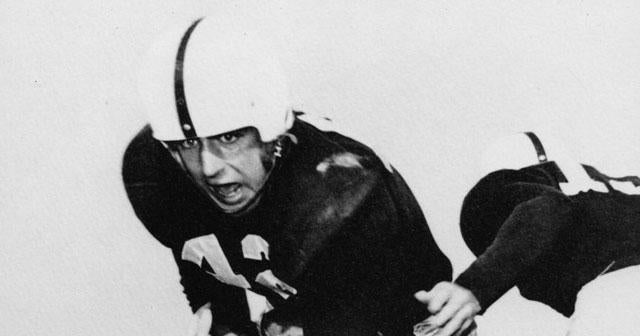
With 8:34 left in the 2nd quarter, and Rice having the ball on their own 5-yard line, Fenstemaker handed off to Moegle, and he broke free, and ran down the sideline occupied by the Alabama team. No Tide player on the field was going to catch him.

But Lewis, Alabama's co-captain, jumped off the sideline, and tackled Moegle at the Alabama 42. He figured he would get penalized for illegal participation, being a 12th man on the field, and that the referee would put the ball at the spot of the foul, and then mark off 5 yards, giving Rice the ball at the Alabama 37.
Tommy Lewis

Referee Cliff Shaw thought otherwise. There is a rule known as the "Palpably Unfair Act": A referee may award a touchdown when he believes that there has been a flagrant rule violation, and said violation is the only thing that would have prevented a touchdown.

Certainly, Lewis' violation was flagrant. It is possible that Moegle could have tripped and fallen, or suffered a sudden attack of illness that caused him to fall short of the end zone. But no 'Bama player was going to legally tackle him. So Shaw awarded the touchdown. Rice led 14-6, following the only application of this rule ever made in a major college football game. It has never happened in an NFL game, either.

Moegle scored a 3rd touchdown in the 3rd quarter, and a run by Buddy Grantham in the 4th quarter capped the day for Rice, as they won 28-6.

Two days later, both Moegle and Lewis were guests on The Ed Sullivan Show, broadcast live from New York on CBS. Moegle couldn't figure out why Lewis was invited. Why was he being rewarded for breaking the rules? Sullivan, a big sports fan, asked Lewis why he did it. He said, "I guess I was just too full of Alabama."

Surely, Moegle must have been thinking that Lewis was too full of something.

Lewis played for the Ottawa Rough Riders of the Canadian Football League in 1956 and 1957, went into coaching, and died in 2014. Moegle was drafted by the San Francisco 49ers, made the Pro Bowl as a rookie safety in 1955, and ended up playing 7 seasons in the NFL. He later broadcast for the Houston Oilers and managed hotels in Texas, and was elected to the College Football and Texas Sports Halls of Fame. He died in July 4, 2021.

Alabama did not win another SEC Championship until 1961, and it turned out to be the 1st National Championship they won with Bear Bryant as head coach. He restored them to a position of glory, and they remain one of college football's elite programs.

Rice haven't been so lucky. They didn't win another bowl game until December 30, 2008, winning the Texas Bowl against Mid-American Conference team Western Michigan.

*

January 1, 1954 was a Friday. This is the birthdate of U.S. Senator Bob Menendez, Democrat of New Jersey.

Baseball was out of season. The NFL had just wrapped up its season. In the other New Year's Day bowl games:

* Rose Bowl, Pasadena, California: Number 3 Michigan State beat Number 5 UCLA, 28-20.

* Orange Bowl, Miami: Number 4 Oklahoma upsets Number 1 Maryland, 7-0. This was the season in which Bud Wilkinson's Sooners began a 47-game winning streak, a record that still stands.

* Sugar Bowl, Tulane Stadium, New Orleans: Number 8 Georgia Tech beat Number 10 West Virginia, 42-19.

* Gator Bowl, Jacksonville, Florida: Number 12 Texas Tech beat Number 17 Auburn, 35-13.

* Sun Bowl, Kidd Field, El Paso, Texas: Texas Western beat Mississippi Southern, 37-14. Neither of those teams was ranked in the national Top 20. Both have since changed their names: Mississippi Southern College became the University of Southern Mississippi in 1962; and Texas Western, the home team, became the University of Texas at El Paso (UTEP) in 1967, a year after winning the NCAA basketball title.

* Tangerine Bowl, from the stadium of the same name, Orlando, Florida: East Texas State and Arkansas State played to a 7-7 tie. Despite both being undefeated, neither team was nationally ranked: The Tangerine Bowl usually played 2 of the stronger "small college" teams in the South against each other.  The game was renamed the Florida Citrus Bowl for the 1982 season. The stadium still stands, now named Camping World Stadium.

In 1996, East Texas State, located in Commerce, Texas, became part of the Texas A&M system, and is now named Texas A&M University-Commerce. Since the reorganization of the NCAA in 1973, they have played in Division II. Arkansas State, located in Jonesboro, remain at the top level, the Football Bowl Subdivision, what used to be known as Division I-A. However, they have changed the name not of the school, but of the team: In 2008, they switched from Indians to Red Wolves.

There were 3 NBA games played on New Year's Day 1954:

* The Boston Celtics beat the Syracuse Nationals, 95-92 at the Boston Garden. The Nats became the Philadelphia 76ers in 1963.

* The Rochester Royals beat the Philadelphia Warriors, 79-76 at the Edgerton Park Arena in Rochester. The Warriors moved to San Francisco in 1962. The Royals left Rochester in 1957, and are now the Sacramento Kings.

* And the Milwaukee Hawks beat the Baltimore Bullets, 62-52 at the Milwaukee Arena. In 1974, it was renamed the Milwaukee Exposition, Convention Center and Arena, or "The MECCA." Since 2014, it has been named the UW-Panther Arena. By the start of the 1955-56 season, the Hawks would be in St. Louis, and this original version of the Bullets would be defunct. The Hawks moved again in 1968, to Atlanta.

And there were 2 NHL games. The New York Rangers beat the Boston Bruins, 2-1 at the Boston Garden. And the Chicago Black Hawks beat the Detroit Red Wings, 4-2 at the Chicago Stadium. 

December 31, 1999 & January 1, 2000: The Millennium

December 31, 1999:  The Millennium arrives. The people of planet Earth survived. At a terrible cost. But we hadn't destroyed ourselves. ...