Showing posts with label university of kentucky. Show all posts

Friday, September 30, 2022

September 30, 1967: SEC Football's Painful Integration

Nate Northington

September 30, 1967: For the 1st time, a black man plays football for a school in the Southeastern Conference. The circumstances become physically painful. They were already emotionally painful, and for a reason above and beyond the region's racist history.

The University of Kentucky, the northernmost school in the SEC, and far better known for their basketball program, which had already won 4 NCAA Tournaments, was the 1st school to break the barrier. They signed 2 black players: Running back Nate Northington and defensive end Greg Page.

But on August 22, 1967, in a preseason practice, Page was injured. His back was broken, and he was paralyzed. Northington, his dorm-mate, would have to go into the season's home opener, at home to the University of Mississippi (a.k.a. "Ole Miss"), as the lone black player in the game.
Greg Page

The season did not begin with that home opener. Kentucky started the season away to Indiana University -- a major rivalry in basketball, but not in football -- and Indiana won, 12-10. Page did not play in that game.

Things went from bad to worse. Complications from his condition killed Page the day before the game. He was only 19 years old. A moment of silence was held before the game at McLean Stadium in Lexington, Kentucky.

Northington played the 1st 3 plays against Ole Miss, but on the 3rd play, he separated his shoulder, and had to leave the game. Ole Miss won, 26-13. With Page dead and Northington injured, the Wildcats went 2-8, beating only West Virginia at home and, in their lone SEC win, Vanderbilt away.

Northington left the team after his sophomore season, and transferred to Western Kentucky University. In 1970, he scored a touchdown in WKU's rivalry game with Eastern Kentucky.

In September 2016, 50 years after Northington, Page, Wilbur Hackett and Houston Hogg debuted on Kentucky's freshman team, statues of the 4 of them were dedicated outside Kroger Field, which (under the name Commonwealth Stadium) replaced McLean Stadium in 1973. As of September 30, 2022, Northington is still alive.

Here's when the other SEC schools -- the ones in the league then, and the ones who have since entered the league -- integrated their football teams:

* Tennessee: Lester McClain, September 14, 1968.

* Florida: Leonard George and Willie Jackson, both debuting on September 12, 1970.

* Mississippi State: Robert Bell and Frank Dowsing, both debuting on September 12, 1970.

* Georgia Tech (left the SEC in 1963): Eddie McAshan, September 12, 1970. He became the 1st black quarterback for a major formerly all-white Southeastern university -- but not the 1st in the SEC.

* South Carolina (did not join the SEC until 1992): Jackie Brown, September 12, 1970. Same game in which McAshan debuted for Tech.

* Auburn: James Owens, September 19, 1970.

* Alabama: John Mitchell, September 10, 1971.

* Vanderbilt: Taylor Stokes, September 11, 1971.

* Georgia: Richard Appleby, Horace King, Chuck Kinnebrew and Larry West, all debuting on September 11, 1971.

* Tulane (left the SEC in 1965): Charlie Hall, Charles Inniss, Robert Johnson and John Washington, all debuting on September 11, 1971.

* Louisiana State (LSU): Mike Williams, September 16, 1972.

* And Mississippi (Ole Miss), not surprisingly, was the last one: Ben Williams, September 30, 1972.

*

September 30, 1967 was a Saturday. Actress Andrea Roth was born. And, in Philadelphia, their new arena, The Spectrum, opened. I have a separate entry for that event.

Among the other college football games played that day were these:

* Number 1 Notre Dame were upset by Number 10 Purdue, 28-21 at Ross-Ade Stadium in West Lafayette, Indiana.

* Number 2 Southern California (USC) beat Michigan State, 21-17 at Spartan Stadium in East Lansing, Michigan.

* The night before, Number 3 University of Houston beat Wake Forest, 50-6 at the Astrodome in Houston.

* Number 4 UCLA beat Washington State, 51-23 at the Los Angeles Memorial Coliseum.

* Number 5 Georgia beat Clemson, 24-17 at Memorial Stadium in Clemson, South Carolina.

* Number 7 Nebraska beat Minnesota, 7-0 at Memorial Stadium in Lincoln, Nebraska.

* Number 8 Texas lost to Texas Tech, 19-13 at Memorial Stadium in Austin, Texas.

* Number 9 Alabama beat Southern Mississippi, 25-3 at Ladd Stadium in Mobile, Alabama.

* Among the service academies, Army beat Boston College, 21-10 at Alumni Stadium, just outside Boston in Chestnut Hill, Massachusetts; Navy lost to Rice, 21-7 at Rice Stadium in Houston; and Air Force lost to the University of Washington, 30-7 at Falcon Stadium in Colorado Springs, Colorado.

* In New Jersey, Princeton beat Rutgers, 22-21 at Palmer Stadium in Princeton.

And in New Jersey high school football, East Brunswick, the school that would one day be my Alma Mater, beat Woodbridge, 14-0 at home, at the stadium that would one day be named Jay Doyle Field.

And these games were played in Major League Baseball:

* The Boston Red Sox beat the Minnesota Twins, 6-4 at Fenway Park in Boston. This was the next-to-last day of the regular season, and the Red Sox and Twins were battling the Detroit Tigers and the Chicago White Sox for the American League Pennant. Carl Yastrzemski of the Red Sox and Harmon Killebrew of the Twins each hit his 44th home run of the season. Neither of them homered the next day, so they finished in a tie for the AL home run lead.

With Yaz also leading the AL in batting average and runs batted in, that means that, despite only being tied for the home run lead, he was awarded the Triple Crown. There would not be another Triple Crown winner for 45 years.

At the time, the Red Sox' games were broadcast on WHDH-Channel 5. With the Sox involved in a Pennant race for the 1st time in a generation, the station went against protocol, which was to save money on videotape by taping over old games, and saved several games from that season. These clips were edited down into a highlight reel, except for the last 2 games, this one and the next day's. As a result, this Boston victory over Minnesota is, as far as is publicly known, the oldest surviving full color video broadcast of an MLB game.

* A doubleheader was split at Tiger Stadium in Detroit. The Detroit Tigers won the opener, 5-0. Mickey Lolich pitched a 3-hit shutout. The California Angels won the nightcap, 8-6. Over the 2 games, Al Kaline went 1-for-8 with a walk.

With this doubleheader, the AL standings now featured the Red Sox and the Twins tied for 1st place, with the Tigers only half a game back. The Red Sox and Twins played each other again the next day, with the winner assured of no worse than a Playoff for the Pennant the next day. The Tigers had another doubleheader, and if they swept it, they would have a Playoff with the Red Sox-Twins winner. As it turned out, the Red Sox beat the Twins, and the Tigers only split their doubleheader, so the Sox won the Pennant.

* The Washington Senators beat the Chicago White Sox, 4-0 at Comiskey Park in Chicago. The White Sox had been eliminated from the race when the Senators beat them the night before, so this game was meaningless -- except, perhaps, to Senators pitcher Frank Bertaina, who pitched a 5-hit shutout.

* The New York Yankees beat the Kansas City Athletics, 5-4 at Yankee Stadium. Mickey Mantle drove in the Yankees' 1st run with a groundout, and then left the game due to injury. Rookie Reggie Jackson did not play for the A's in this game. The next day, the Yankees won, 4-3. This was the last game for the A's representing Kansas City. The next season, they moved to Oakland.

* The New York Mets beat the Los Angeles Dodgers, 5-0 at Dodger Stadium in Los Angeles. Les Rohr pitched 8 shutout innings, and Ron Taylor completed a 7-hit shutout, to outpitch Don Drysdale. Ken Boswell hit a home run.

* The St. Louis Cardinals beat the Atlanta Braves, 3-1 at Atlanta Stadium (later Atlanta-Fulton County Stadium). In contrast to the AL, the Cardinals had the National League Pennant wrapped up several days earlier. Lou Brock went 3-for-4. Roger Maris went 1-for-4 with an RBI. Joe Torre went 1-for-3 with an RBI. Hank Aaron only appeared as a pinch-hitter, and struck out.

* The Houston Astros beat the Pittsburgh Pirates, 4-3 at Forbes Field in Pittsburgh. Roberto Clemente went 1-for-3 with a walk. Willie Stargell went 1-for-4 with an RBI.

* The Baltimore Orioles beat the Cleveland Indians, 5-2 at Cleveland Municipal Stadium. Frank Robinson went 0-for-4, and Brooks Robinson did not play.

* The Chicago Cubs beat the Cincinnati Reds, 9-4 at Crosley Field in Cincinnati. Ernie Banks went 4-for-5 with an RBI. Pete Rose went 1-for-5 with 2 RBIs. Rookie Johnny Bench did not play for the Reds in this game.

* And the San Francisco Giants swept a doubleheader with the Philadelphia Phillies, 3-2 and 1-0 at Candlestick Park in San Francisco. Willie McCovey hit a home run in the 1st game. Willie Mays went 0-for-4, and then did not play in the 2nd game. Three Giant pitchers -- Bill Henry (3 innings), Nestor Chavez (4, winning pitcher) and Lindy McDaniel (2, save) combined on a 4-hit shutout.

September 30, 1933: The 1st Southeastern Conference Football Game

September 30, 1933: The football team at the University of Kentucky beats Sewanee: The University of the South, 7-0 at McLean Stadium in Lexington, Kentucky. UK is normally thought of as one of the great powers of college basketball, certainly the leading hoop school in the Southeastern Conference. It is not one of the traditional leaders in SEC football. Nevertheless, the Wildcats hosted, played, and won the first game between two SEC teams -- technically, the 1st SEC football game.

Sewanee left the SEC after the 1940 season, and downgraded their program. They now play in NCAA Division III.

Although schools that are currently members of the SEC have been playing football since 1892, it was only in 1933 that the league was formed, mostly with teams leaving the Southern Conference, whose rump members would invite other schools, and, 20 years later, face another exodus, one that resulted in the founding of the Atlantic Coast Conference (ACC).

Other SEC schools played on this day, but not against other SEC teams:

* Alabama beat Oglethorpe University, of Brookhaven, Georgia, 34-0 at Denny Stadium (now Bryant-Denny Stadium) in Tuscaloosa, Alabama.

* Arkansas beat Oklahoma Baptist, 42-7 at The Hill in Fayetteville, Arkansas.

* Florida beat Stetson University, of DeLand, Florida, 28-0 at Florida Field in Gainesville.

* Georgia beat North Carolina State, 20-0 at Sanford Stadium in Athens, Georgia.

* Georgia Tech, a charter member of the SEC but no longer in it, beat Clemson, 39-2 at Grant Field in Atlanta.

* Louisiana State University (LSU) beat Rice, 13-0 at Tiger Stadium in Baton Rouge, Louisiana.

* Mississippi (a.k.a. Ole Miss) beat Mississippi State Teachers College, 45-0 at Hemingway Stadium (now Vaught-Hemingway Stadium) in Oxford, Mississippi. MSTC is now the University of Southern Mississippi.

* Mississippi State beat Millsaps College, of Jackson, Mississippi, 12-0 at Scott Field (now Davis-Wade Stadium) in Starkville, Mississippi.

* Tennessee beat Virginia Tech, 27-0 at Shields-Watkins Field (now Neyland Stadium) in Knoxville, Tennessee.

* The night before, Alabama Tech beat Howard College, 19-0 at Legion Field in Birmingham, Alabama. In 1960, Alabama Tech was renamed Auburn University. In 1965, Howard, of Homewood, Alabama, was renamed Samford University. It should not be confused with Howard University in Washington, D.C.; or with Stanford University in Palo Alto, California.

Most of the SEC did rather well. But not all of them. Vanderbilt played Oklahoma to a 0-0 tie at Owen Field in Norman, Oklahoma. Tulane lost to Texas A&M, 13-6 at Tulane Stadium in New Orleans. And, the night before, South Carolina, a member of the SEC now but not then, lost to Temple, 26-6 at Temple Stadium in Philadelphia.

When the season ended, Alabama had a conference record of 5-0-1, and LSU were 3-0-2. Because they played more games and had fewer blemishes on their record, Alabama were declared the 1st SEC football Champions. They finished 7-1-1, having lost to Fordham, 2-0 at the Polo Grounds, and a tie with Ole Miss at Legion Field.

That game at the Polo Grounds? It attracted 60,000. 'Bama's other 8 games combined? 112,000. The SEC already had most of the stadiums it is known for today, but they had yet to be expanded to the massive size they are today.

*

September 30, 1933 was a Saturday. These other notable college football games were played that day:

* Army beat Mercer University, of Macon, Georgia, 19-6 at Michie Stadium in West Point, New York.

* Navy beat William & Mary, 12-0 at Thompson Stadium in Annapolis, Maryland.

* Rivalry: Colorado A&M, which became Colorado State in 1957, beat Wyoming, 7-0 at Corbett Field in Laramie, Wyoming.

* Fordham beat Albright College, of Reading, Pennsylvania, 52-0 at Fordham Field in The Bronx.

* Manhattan College beat Clarkson University, of Potsdam, New York, 13-7 at Manhattan Field, next-door to the Polo Grounds in Upper Manhattan.

* City College of New York (CCNY) beat Brooklyn College, 18-12 at Lewisohn Stadium in Upper Manhattan.

* Rutgers beat Franklin & Marshall, 10-0 at Neilson Field in New Brunswick, New Jersey. New York City's Columbia and New York University (NYU), and New Jersey's Princeton, began their season the following week.

And Major League Baseball entered its final weekend. These games were played:

* The New York Yankees lost to the Washington Senators, 7-2 at Yankee Stadium. The Senators had already clinched the American League Pennant. Babe Ruth went 2-for-3 with a home run. Lou Gehrig went 1-for-3.

* The New York Giants beat their arch-rivals, the Brooklyn Dodgers, 4-2 at Ebbets Field. The Giants had already clinched the National League Pennant. Player-manager Bill Terry and Mel Ott both went 2-for-5 with an RBI. 

* The Philadelphia Phillies beat the Boston Braves, 2-1 at Braves Field in Boston. Virgil Davis hit a home run to win it in the to of the 10th inning.

* The Boston Red Sox swept a doubleheader from the Philadelphia Athletics, 2-1 and 12-1 at Shibe Park in Philadelphia. Over the 2 games, Jimmie Foxx went 1-for-6 with a walk.

* The Detroit Tigers beat the Cleveland Indians, 3-0 at Navin Field in Detroit. (That ballpark was later renamed Briggs Stadium and Tiger Stadium.)

* The Chicago White Sox beat the St. Louis Browns, 4-1 at Comiskey Park in Chicago.

* The Chicago Cubs beat their arch-rivals, the St. Louis Cardinals, 12-2 at Sportsman's Park in St. Louis. Babe Herman, formerly a star with the Brooklyn Dodgers, went 4-for-6 with a home run and 4 RBIs. Woody English went 3-for-6 with 2 RBIs. Billy Herman (no relation to Babe) went 3-for-5 with a walk and an RBI. Riggs Stephenson went 2-for-6 with 2 RBIs. Kiki Cuyler went 2-for-5 with an RBI. Every Cubs player, including pitcher Guy Bush, got at least 1 hit. Bush outpitched Dizzy Dean.

* And, in an action that wouldn't be done today, the Cincinnati Reds and the Pittsburgh Pirates moved their game scheduled for today, at Crosley Field in Cincinnati, up, to July 30. The Pirates won that game, 8-6. Paul Waner went 1-for-5 with 2 RBIs. Lloyd Waner had no RBIs -- he usually batted leadoff -- but went 4-for-5.

And in English soccer, Arsenal beat North Yorkshire team Middlesbrough, 6-0 at the Arsenal Stadium, a.k.a. Highbury, in North London.

Friday, April 1, 2022

April 1, 1996: Kentucky Basketball's Redemption

April 1, 1996: The University of Kentucky defeats Syracuse University, 76-67 at the Continental Airlines Arena in East Rutherford, New Jersey, and wins the National Championship.

It is the Wildcats' 1st NCAA Tournament title in 18 years, their 6th overall. They would win again in 1998 and 2012 -- the latter breaking a pattern that had held since 1949: Whenever Kentucky won the NCAA title, the Yankees won the World Series: 1949, 1951, 1958, 1978, 1996 and 1998. And years with noted Kentucky flops also had noted Yankee flops: 1954, 1966, 1975, 1997 and 2015.

The title was also the last Final Four held at a venue with a seating capacity under 40,000. It was also the 1st for Kentucky coach Rick Pitino, who had previously taken Rhode Island’s Providence College to the Final Four. Today, he coaches Kentucky’s arch-rivals, the University of Louisville.

Kentucky had been put on probation in 1989, for the kind of scandal that some people suggested would have led to a suspension of the program, "the death penalty," if the team involved wasn't one of college basketball's "blue bloods." Eddie Sutton was fired, and Pitino, who had been coaching the New York Knicks, was brought in to stabilize things.

UK had fallen to 13-19 in 1989, and, in his 1st 2 seasons, Pitino got them to 14-14 and 22-6 -- in 1991, having the best record in the Southeastern Conference, but, as a result of the probation, ineligible for the SEC Championship and the NCAA Tournament. He got them to the NCAA Elite Eight in 1992 and the Final Four with a 30-4 record in 1993. They lost in the 1st round in 1994, but made the Elite Eight in 1995, and won the National Championship in 1996, going 34-2.

Pitino coached 1 more season, and in 1997, got the Wildcats back into the NCAA Tournament Final, losing to Arizona. He then got an offer he couldn't refuse, returning to the NBA to coach the Boston Celtics. His assistant, Tubby Smith, led Kentucky to the 1998 National Championship.

With the Celtics, missed the Playoffs 3 straight seasons and quit early in his 4th. Late in the 3rd season, he explained that great players of the past, like Larry Bird, were "not walking through that door." After that, he never had a chance with Celtic fans.

Later, he coached at Kentucky's arch-rivals, the University of Louisville, and led them to the 2013 National Championship. It came a year after a man often compared to Pitino, John Calipari, led Kentucky to a National Championship. But UL were stripped of the 2013 title and put on probation, for a scandal even more sordid than the one that brought him to Lexington.

*

April 1, 1996 was a Sunday. It was also Opening Day for Major League Baseball, but it was touched by tragedy: Umpire John McSherry died of a heart attack while officiating at the game between the Cincinnati Reds and the Montreal Expos, at Riverfront Stadium in Cincinnati. The game was called, restarted the next day, and the Reds won, 4-1.

These other MLB games were played that day:

* The New York Mets beat the St. Louis Cardinals, 7-6 at Shea Stadium. Todd Hundley and Bernard Gilkey hit home runs for the Mets; John Mabry and Willie McGee for the Cards.

* The Atlanta Braves beat the San Francisco Giants, 10-8 at Atlanta-Fulton County Stadium. Barry Bonds went 0-for-3.

* The Pittsburgh Pirates beat the Florida Marlins, 4-0 at Joe Robbie Stadium (now Hard Rock Stadium) in Miami Gardens, Florida. It took the Pirates 3 pitchers, starting with 6 2/3rds innings from Paul Wagner, to pitch a 3-hit shutout against a weak Marlin team.

* The Chicago Cubs beat the San Diego Padres, 5-4 at Wrigley Field in Chicago. Mark Grace singled home the winning run in the bottom of the 10th inning. For the Padres, Tony Gwynn went 1-for-4 with a walk, and Rickey Henderson went 0-for-4 with a walk.

* The Minnesota Twins beat the Detroit Tigers, 8-6 at the Metrodome in Minneapolis.

* The Texas Rangers beat the Boston Red Sox, 5-3 at The Ballpark (now Choctaw Stadium) in the Dallas suburb of Arlington, Texas.

* The Los Angeles Dodgers beat the Houston Astros, 4-3 at the Astrodome in Houston.

* The Toronto Blue Jays beat the Oakland Athletics, 9-6 at... Cashman Field in Las Vegas, Nevada. The extra stands that the Raiders demanded at the Oakland Coliseum, known as "Mount Davis" for their owner, Al Davis, weren't quite finished, so the A's had to play their 1st 6 "home games" of the season on the road, at the 9,000-seat Cashman Field, home to a Class AAA team.

* The New York Yankees and the Cleveland Indians were snowed out at Jacobs Field (now Progressive Field) in Cleveland. The game was made up the next day, and the Yankees won, 7-1. Making his debut as the Yankees' regular shortstop, Derek Jeter hit his 1st major league home run, and made a fancy defensive play. Bernie Williams also hit a home run, and David Cone was the winning pitcher.

* The Baltimore Orioles and the Kansas City Royals were rained out at Oriole Park at Camden Yards in Baltimore. The game was made up the next day, and the Orioles won, 4-2. Cal Ripken went 2-for-4 with 3 RBIs.

* The Philadelphia Phillies and the Colorado Rockies opened the season against each other at Coors Field in Denver the next day, as scheduled, and the Rockies won, 5-3.

* The California Angels and the Milwaukee Brewers opened the season against each other at Milwaukee County Stadium the next day, as scheduled, and the Brewers won, 15-9.

* One game was played the night before, as ESPN's Sunday Night Baseball season-opener. The Seattle Mariners beat the Chicago White Sox, 3-2 at the Kingdome in Seattle. Ken Griffey Jr. went 0-for-4, but did draw 2 walks. Alex Rodriguez went 1-for-6, his single driving in the winning run in the bottom of the 12th inning. Randy Johnson struck out 14 batters in 7 innings, but was not involved in the decision.

Football was out of season. No games were scheduled in the NBA, but there were 4 games played in the NHL:

* The Buffalo Sabres beat the Montreal Canadiens, 6-4 at the Molson Centre (now the Bell Centre) in Montreal.

* The Florida Panthers beat the Hartford Whalers, 3-2 at the Miami Arena.

* The Boston Bruins and the Ottawa Senators played to a tie, 1-1 at the Corel Centre (now the Canadian Tire Centre) in the Ottawa suburb of Kanata, Ontario. (The town was absorbed into Ottawa proper in 2001.)

* And the Edmonton Oilers beat the Vancouver Canucks, 6-2 at General Motors Place (now the Rogers Arena) in Vancouver.

Wednesday, March 30, 2022

March 30, 1998: A Black Coach Wins the Title at Kentucky

March 30, 1998: The University of Kentucky basketball team, coached by Orlando "Tubby" Smith and led by Nazr Mohammed and Jamaal Magloire, beats the University of Utah 78-69 at the Alamodome in San Antonio, which is also where the Final Four will be held this weekend.

Smith played at High Point College in North Carolina (it became "High Point University" in 1991), but was never an NBA prospect. He went into coaching, first as a high school head coach in his native Southern Maryland, then in the suburbs of Charlotte, North Carolina.

He became an assistant coach in college, including under Rick Pitino at Kentucky, alongside Billy Donovan, who went on to win National Championships at the University of Florida. In 1991, Smith was named head coach at the University of Tulsa, and in 1995 at the University of Georgia. Twice and Tulsa and once at Georgia, he got his team to the NCAA Tournament's Sweet 16.

Pitino led Kentucky to the National Championship in 1996, and reached the Final but lost in 1997. He then left to accept the head job of the Boston Celtics, and Smith was hired, the 1st black head coach at the school that long seemed to stand for white supremacy in college basketball.

Smith got the Wildcats into the NCAA Final with a 34-4 record. They lost to Number 1 Arizona, who had beaten them in the previous year's Final, in a Thanksgiving weekend tournament in Hawaii. Their other losses were all at home at Rupp Arena in Lexington: By 3 points to arch-rival Louisville; to Florida; and to the University of Mississippi (Ole Miss).

They won the Southeastern Conference regular-season title, blazed through the SEC Tournament; and, in the NCAA Tournament, beat South Carolina State, easily beat St. Louis University, crushed Number 19 UCLA, edged Number 3 Duke, and beat Number 10 Stanford in overtime to get to the Final.

Coached by Rick Majerus (who was considerably tubbier than Tubby Smith), Utah made the Final Four for the 4th time, but the 1st since 1966. They had won the National Championship in 1944, but not since, while Kentucky had won it 7 times.
Utah jumped out ahead, and led 41-31 at the half. But, as they had in their last 2 games in the Tournament, the "Comeback Cats" came back, and won the game, 78-69. Jeff Sheppard was named the Tournament's Most Outstanding Player.

For Kentucky, whose old-time coach Adolph Rupp had been seen since the 1960s as a protector of white supremacy in college basketball, to be coached by a black man to a National Championship, was considered a very big deal.

This was the 4th time that Kentucky won the title in a year ending in an 8, having also done so in 1948, 1958 and 1978. It would turn out to be the 6th time the Yankees won the World Series in a year that Kentucky won basketball's National Championship (1949, 1951, 1958, 1978, 1996 and 1998).

Smith led Kentucky back to the Elite Eight in 1999, 2003 and 2005; and to the SEC Championship in 2000, 2001, 2003 and 2005. But he couldn't get them back to the Final Four, and UK's "blue blood" fans got frustrated. Some UK fans went as far as to place "for sale" signs on his front lawn. I'd like to think they would have done the same thing to a similarly struggling white coach.

In 2007, Smith was offered a lifeline, the head coaching job at the University of Minnesota, and took it, leaving Kentucky. Things settled down, and he was elected to UK's Athletic Hall of Fame in 2013. He coached at Minnesota until 2013, then at Texas Tech for 3 years, then at the University of Memphis for 2 years.

In 2018, he was named head coach at his Alma Mater, High Point University, lasting 4 years, long enough to raise enough money to build them a new arena, the 4,500-seat Qubein Center, with its playing surface named for Tubby and his wife: The Tubby and Donna Smith Court. In 2022, he retired, turning the job over to his son, G.G. Smith, who had previously coached at Loyola University Maryland in Baltimore.

*

March 30, 1998 was, like most NCAA basketball Finals in the modern era, a Monday. The NBA had no games scheduled. Major League Baseball opened its regular season the next day. Football was out of season. There were 5 games in the NHL:

* The New York Rangers lost to the Tampa Bay Lightning, 3-1 at Madison Square Garden.

* The Boston Bruins lost to the Colorado Avalanche, 4-1 at the FleetCenter (now the TD Garden) in Boston.

* The Los Angeles Kings beat the Toronto Maple Leafs, 3-2 at Maple Leaf Gardens in Toronto.

* The St. Louis Blues beat the San Jose Sharks, 6-2 at the Kiel Center (now the Enterprise Center) in St. Louis.

* And the Edmonton Oilers beat their Provincial arch-rivals, the Calgary Flames, 3-1 at the Edmonton Coliseum (as the Northlands Coliseum was then known).

Wednesday, March 23, 2022

March 23, 1948: Kentucky's "Fabulous Five"

March 23, 1948: The University of Kentucky win the NCAA Basketball Tournament for the 1st time, defeating Baylor University, 58-42 at the old Madison Square Garden in New York.

Baylor had a player named Jackie Robinson -- a white man who would play with some of the Kentucky players on the 1948 U.S. Olympic Team in London, and became a minister. That's the most interesting thing about the Baylor squad.

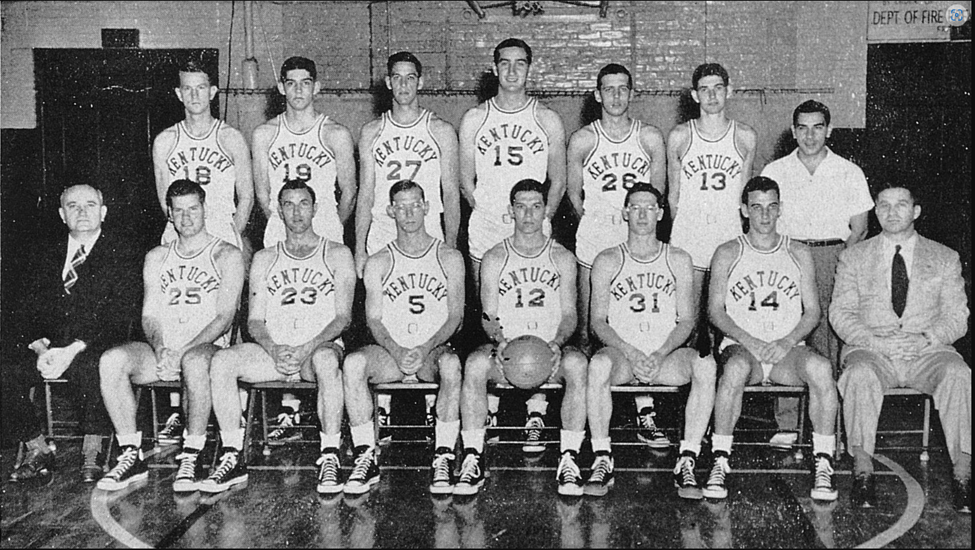
But the Kentucky team was perhaps the best college basketball team ever assembled to this point. Their head coach, Adolph Rupp, called them "The Fabulous Five": Guards Ralph Beard and Kenny Rollins, forwards Wallace "Wah Wah" Jones and Cliff Barker, and center Alex Groza. They went 34-2, with the only losses being by 1 point to Temple in Philadelphia, a loss they avenged by 20 points in a rematch in Lexington; and 9 away to Notre Dame.

Rupp had been born in 1901 in Kansas, and had played at the University of Kansas under Forrest "Phog" Allen, while Allen's mentor, Dr. James Naismith, the literal inventor of basketball, was still alive and teaching there. After coaching in high school, Kentucky named him head coach in 1930, and he would lead them to 27 Southeastern Conference titles, 13 SEC Tournament wins, and 876 wins, more than any coach before him. He became known as "the Baron of the Bluegrass."

Rollins graduated in 1948, but the other four of the returned for the 1948-49 season. Dale Barnstable took Rollins' place in the starting lineup, and the Wildcats went 32-2, losing by 2 away to Saint Louis University, and by 11 against Loyola of Chicago, knocking UK out of the NIT at The Garden. But they won the NCAA, beating Oklahoma A&M (who became Oklahoma State in 1958) in the Final at Seattle.

After the 1949 NCAA Tournament, Coach Rupp then retired the uniform numbers of Beard, 12; Groza, 15; Barker, 23; Rollins, 26; and Jones, 27. Barnstable's 18 has never been retired.

It was these back-to-back National Championships that established Kentucky as an elite team. Fans of the "Bluegrass Boys" are sometimes mocked as the "Blue Bloods," and are said to be as arrogant as fans of the New York Yankees, the Dallas Cowboys, the Boston Celtics, the basketball team at Duke University, and the football team at the University of Notre Dame. (The Yankees, the Cowboys and Duke also wear blue and white; Notre Dame, blue but with gold.)

In 1948, Rollins was selected by the Fort Wayne Pistons in the NBA Draft, but they traded him to the Chicago Stags. In 1949, a new team in the NBA, the Indianapolis Olympians, tried to reassemble the U.S. Olympic Team. They selected Groza in the 1st round of the NBA Draft, Beard in the 2nd round. Barker was drafted by the Washington Capitols, but the Olympians acquired him in a trade. Barnstable was drafted by the Boston Celtics in 1950, but instead took a teaching and coaching job at a Louisville high school.

With Barker as player-coach, the Olympians won the NBA Western Division in 1950, and beat the Sheboygan Red Skins in the 1st round of the Playoffs, before losing the Division Finals to the Anderson Packers. In 1951, they just made the Playoffs, and lost to the Minneapolis Lakers in the 1st round.

But at the start of the 1951-52 season, Groza, Beard and Barnstable were arrested for taking bribes from gamblers to "shave points" while they were at Kentucky. When the dust settled in 1952, they were banned from the NBA for life. UK got its 1952-53 season canceled, and was banned from competing in the NCAA Tournament and the NIT in 1954.

Barker, Rollins and Jones were not implicated, and were allowed to play the 1951-52 season. But Barker and Jones left Olympians after that season, and never played professionally again. Rollins last played in 1953, with the Celtics. After that season, the Olympians folded, having lost to the Lakers again in the Playoffs in 1952 and '53.

Kentucky, still banned from the postseason at that point, went 25-0 in 1954, and the Helms Foundation declared them -- not NCAA Champion LaSalle or NIT Champion Holy Cross -- the National Champions.

Kentucky would win another title in 1958, with a bunch of players that Rupp said were "just fiddling around." Thus, they became known as the Fiddlin' Five. They made the Final again in 1966, with a team lacking much height, and thus known as "Rupp's Runts," but famously lost to the school now known as Texas-El Paso. This would lead to Rupp finally racially integrating his team.

After his retirement, Joe B. Hall, a reserve on the 1949 and 1951 title teams, led Kentucky to the National Championship in 1978, a few months after Rupp's death. Rick Pitino did so in 1996, Tubby Smith in 1998, and John Calipari in 2012. Baylor made what would later be called the Final Four again in 1950, but did not do so again until 2021, when they won the whole thing. By that point, they had become better known for their successful women's basketball program.

Groza, brother of Pro Football Hall-of-Famer Lou Groza, would later coach in college and in the ABA. Beard tried to play professional baseball, but his gambling connection got him banned from that sport as well. He became a scout for the ABA's Kentucky Colonels, and worked in the pharmaceutical industry. Barnstable wasn't playing in the pros anyway, but had gotten a job as a high school coach in Louisville, and was fired from that job as a result of the scandal. He later became a successful seller of air filters, and won senior golf tournaments. But none of the 3 were were ever involved in the NBA again, as their bans were never lifted.

Groza died in 1995, Barker in 1998, Beard in 2007, Rollins in 2012, Jones in 2014, Barnstable in 2019. None of them has ever been elected to the Basketball Hall of Fame. They were, however, all allowed to keep their Olympic Gold Medals.

*

March 23, 1948 was a Tuesday. Baseball was in Spring Training. Football was out of season. And the NHL was between the end of the regular season and the start of the Stanley Cup Playoffs.

There were 2 games in the NBA. The Chicago Stags beat the Washington Capitols, 74-70 at the Chicago Stadium. And the St. Louis Bombers beat the Philadelphia Warriors, 60-58 at the St. Louis Arena.

Saturday, March 19, 2022

March 19, 1966: Texas Western vs. Kentucky

March 19, 1966: The NCAA hosts the Final of its University Division Men's Basketball Tournament, at Cole Field House, on the campus of the University of Maryland, in College Park, outside Washington, D.C.

The University of Kentucky went into the game 27-1, having lost only to the University of Tennessee. Their players included Louie Dampier, who would team with later Kentucky star Dan Issel to lead the Kentucky Colonels to the 1975 ABA Championship; and Pat Riley, who would play for the Los Angeles Lakers' 1972 NBA Champions, and then coach the Lakers to 4 titles and the Miami Heat to 1.

The Wildcats were coached by Adolph Rupp, known as the Baron of the Bluegrass. He was 64 years old, looked older, and had been their head coach since 1930. He had already coached them to 22 Southeastern Conference (SEC) regular-season Championships, 13 SEC Tournament wins, 6 berths in what would now be known as the Final Four, and 4 National Championships: 1948, 1949, 1951 and 1958. That did not include the 1954 season, when they were undefeated, but chose not to play in the NCAA Tournament, because 2 players were declared ineligible for having already graduated -- a rule since overturned.

Rupp was from Kansas, and was not known to be personally racist. However, Kentucky was a Southern State, and, while the Wildcats' arch-rivals, the University of Louisville, had racially integrated, UK had not.

But the writing was on the wall. The Civil Rights Movement had made great gains. And a black man from Louisville, Muhammad Ali -- born Cassius Clay, and that Sports Illustrated cover shown above still listed him as such, 2 years after he changed his name -- was the Heavyweight Champion of the World.

Rupp had asked University President John W. Oswald to take the program out of the SEC, so that he could recruit black players. At one point during the 1965-66 season, Rupp did some writing of his own. He wrote the top 3 teams in the Associated Press poll on his blackboard at practice:

1. KENTUCKY
2. DUKE
3. VANDERBILT

Duke University is in Durham, North Carolina. Vanderbilt University is in Nashville, Tennessee. Rupp told his players, "Look at that. The top three teams in the country. All Southern. All white. You'll never see that again." He knew that Southern teams that integrated would be able to compete for national honors, and those that were slow to do so would get left in the dust. Not just in basketball, but in football, and in every other sport.

Previous Rupp teams had had nicknames: His 1948 National Champions were the "Fabulous Five." His 1958 team didn't look so good at first, and he complained to the press that they were "just fiddling around." So they were known as the "Fiddlin' Five," but won the title, anyway. His 1966 team was short, and were known as "Rupp's Runts."

At the time, the NCAA Tournament had 24 teams, with only conference champions and a few independents invited. Kentucky were SEC Champions, and got a bye into the round of 16, the Regional Semifinals, where they beat the University of Dayton. They beat Michigan to make the Final Four at Cole Field House. In the National Semifinal, they beat Number 2 Duke 83-79. They figured that was "the real final," because they underestimated their Final opponents.

That team was Texas Western University, based in El Paso, Texas, on the State Line with New Mexico and the national border with Ciudad Juarez, Mexico. Their head coach was Don Haskins, only 36, and despite Texas being a segregated State, he fielded an integrated team. They finished the regular season ranked Number 3, and also entered the Final at 27-1. Their only loss was 74-72 against Seattle University, then famous as the Alma Mater of Laker superstar Elgin Baylor, who led them to the NCAA Final in 1958, but downgraded to the NAIA in 1980, before being restored to NCAA Division I in 2008.

The Miners entered the NCAA Tournament with an all-black starting lineup: Guards Bobby Joe Hill from Detroit and Orsten Artis from Gary, Indiana, outside Chicago; forwards Dave Lattin from Houston and Harry Flournoy from Gary; and center Willie Cager from New York. Willie Worsley and Nevil Shed were also black players from New York.

In the 1st Round of the tournament, Texas Western beat Oklahoma City University. They needed overtime to beat the University of Cincinnati. They needed double overtime against the University of Kansas to make the Final Four. And they beat the University of Utah in the Semifinal.

The Final began at 10:00 PM Eastern Time, and was not broadcast on national television. While Loyola University of Chicago had won the 1963 NCAA Final with a majority-black starting lineup, four out of five, Texas Western was the first team that had dared to start an all-black starting lineup. Kentucky, of course, was all-white.
Cole Field House. It would host the Final Four again in 1970.

Haskins told Lattin to dunk the ball early if he got the chance, to "send a message" to Kentucky. He did, twice. Hill made steals on back-to-back Wildcat plays, putting the Miners up 16-11. They led at halftime, 34-31.

Curry Kirkpatrick covered the game for Sports Illustrated, and said it was "slow, tedious, almost flat." Disagreeing was Gary Williams, then a junior at the host school, the University of Maryland. He was impressed by the Miners' ball movement, recalling, "There were possessions where Texas Western passed it 10 times before taking a shot." He would be Maryland's captain the next season, and coach them to the National Championship in 2002.

Kentucky continually fouled Texas Western, with 2 players fouling out and 2 relegated to the bench after receiving 4 fouls each. Over a stretch of 37 minutes, the Miners went 26-for-27 on free throws. This made the difference: Had they made 2/3rds of their free throws, they would have lost. Instead, they made 96 percent of them. Final score, Texas Western 72, Kentucky 65.

Point totals: For Texas Western: Hill 20, Lattin 16, Artis 15, Worsley 8, Cager 8, Shed 3, Flournoy 2; for Kentucky: Dampier 19, Riley 19, Larry Conley 10, Thad Jaracz 7, Tom Kron 6, Cliff Berger 4; and Bob Tallent, Jim LeMaster and Gary Gamble played without scoring.
On March 13, 1967, just short of 1 full year later, Texas Western University changed its name to the University of Texas at El-Paso, a.k.a. "Texas-El Paso" or "UTEP," though keeping the team name of Miners.

The Miners were less successful in the pro game than the Wildcats. Bobby Joe Hill, Orsten Artis, Harry Flournoy and Willie Worsley went undrafted. Cager was drafted by the Baltimore Bullets, but a heart condition prevented him from playing. Nevil Shed was drafted by the Boston Celtics, but was injured in his 1st training camp, and never played a professional game.

Dave Lattin played the 1967-68 season with the San Francisco Warriors, 1968-69 as an original member of the Phoenix Suns, 1970-71 and 1971-72 with the ABA's Pittsburgh Condors, and 1972-73 with the ABA's Memphis Tams.

Indeed, despite the team's great achievement, the man who turned out to be the most famous athlete at the school at the time was Bob Beamon, who set a stunning world record in the long jump at the 1968 Olympics.

Rupp finally recruited a black player for the 1970-71 season, Tom Payne. But he became a disciplinary issue. He played 1 season in the NBA, 1971-72, for the Atlanta Hawks. Three times, he would be convicted and imprisoned for rape.

Rupp retired in 1972, having won 876 games, more than any college basketball coach before him. He died in 1977, a few months before his former assistant and successor, Joe B. Hall, took Kentucky to its 1st National Championship in 20 years.

Both head coaches now have their names on their respective schools' buildings: Rupp Arena at Central Bank Center opened in downtown Lexington, Kentucky in 1976; and the Special Events Center opened on the UTEP campus in 1977, renamed the Don Haskins Center in 1998.

Haskins never got past the NCAA Tournament's Sweet Sixteen again, but remained at UTEP through the 1999 season. He won 7 regular season titles and 4 Tournaments in the Western Athletic Conference. His career record was 719-353. He was elected to the Basketball Hall of Fame in 1997. In 2006, on the 40th Anniversary of the title, the entire team was elected to the Hall as a unit.

Among the other players Haskins coached at TWU/UTEP were Nolan Richardson, who coached the University of Arkansas to the 1994 National Championship; and Nate "Tiny" Archibald and Tim Hardaway Sr., who have joined Haskins, Richardson and the entire 1965-66 TWU Miners team in the Hall of Fame.

Hill died in 2002, Haskins in 2008, Flournoy in 2016. Artis in 2017. As of March 19, 2022, the rest are still alive, including Cager, despite his heart condition.

TWU/UTEP were the only team from Texas to win the NCAA Tournament until Baylor University did it in 2021.

UPDATE: Cager died on March 19, 2023, the 57th Anniversary of the epochal game. 

*

March 19, 1966 was a Saturday. Baseball was in Spring Training. Football was out of season. There were 4 games in the NBA that day:

* The New York Knicks lost to the Boston Celtics, 126-113 at the old Madison Square Garden.

* The Philadelphia 76ers beat the Cincinnati Royals, 127-121 at the Convention Hall of the Philadelphia Civic Center. Wilt Chamberlain had 39 points and 28 rebounds.

* The St. Louis Hawks beat the Detroit Pistons, 115-12 at the Kiel Auditorium in St. Louis.

* And the San Francisco Warriors beat the Los Angeles Lakers, 125-119 at the Cow Palace outside San Francisco in Daly City, California. Rick Barry had 43 points and 16 rebounds.

There were 2 games played in the NHL. The New York Rangers lost to the Montreal Canadiens, 6-2 at the Montreal Forum. And the Toronto Maple Leafs lost to the Chicago Black Hawks, 4-2 at Maple Leaf Gardens in Toronto. The Boston Bruins and the Detroit Red Wings were not scheduled.

Also, Arsenal lost 2-0 to Manchester United at Old Trafford. Times were good for United, bad for Arsenal. Arsenal would soon turn it around.

December 31, 1999 & January 1, 2000: The Millennium

December 31, 1999:  The Millennium arrives. The people of planet Earth survived. At a terrible cost. But we hadn't destroyed ourselves. ...