Showing posts with label benito mussolini. Show all posts

Monday, November 14, 2022

November 14, 1934: The Battle of Highbury

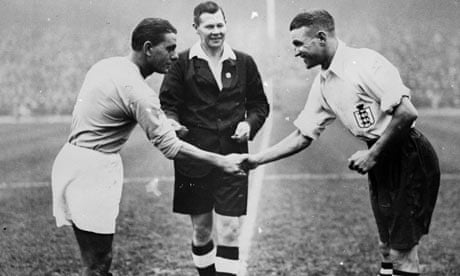
Left to right: Italy Captain Attilio Ferraris,
referee Otto Olsson, England Captain Eddie Hapgood

November 14, 1934: The most-hyped soccer game ever to that point is played. And, while the competition lived up to the hype, everything else was horrible.

In 1928, a dispute with the governing body of world soccer, the Fédération internationale de Football Association (FIFA), England left their jurisdiction. The other "home nations" of the United Kingdom of Great Britain and Northern Ireland -- Wales, Scotland and Northern Ireland -- followed suit. (To this day, I don't know why they compete as a single united kingdom in the Olympics Games, but, for every other event, the home nations each have their own separate teams.)

This made the home nations ineligible to play in FIFA's signature tournament, the World Cup, which began in 1930, with Uruguay winning on home soil. The 1934 tournament would be the 1st held in Europe, in Italy, then ruled by fascist dictator Benito Mussolini. With a team dominated by players from Juventus FC of Turin and FC Internazionale Milano of Milan, Italy won it.

But England, which "invented football" (at the least, it did so in an organized way), still thought it had the best team in the world. So they challenged Italy in a game to decide "the real world championship." Italy accepted. The game would be in England, so Mussolini couldn't use his authority to cheat. But he did offer an incentive: If they won, each player would receive a new Alfa Romeo car and a cash prize which, converted into 2022 U.S. money, was about $7,000, a pretty good figure during the Great Depression..

Italy manager Vittorio Pozzo sent out this lineup (with neither side wearing uniform numbers):

* Goalkeeper: Carlo Ceresoli of Inter. This was a change from the World Cup, where his keeper, and his Captain, was Gianpiero Combi of Juventus.
* Right Back: Eraldo Monzeglio of Bologna FC.
* Left Back: Luigi Allemandi of Inter.
* Right Half: Attilio Ferraris of SS Lazio of Rome, Italy's Captain for this game.
* Center Half: Luis Monti of Juventus.
* Left Half: Luigi Bertolini of Juventus.
* Outside Right: Enrique Guaita of AS Roma of Rome.
* Inside Right: Pietro Serantoni of Juventus.
* Center Forward: Giuseppe Meazza of Inter. He had been the inside right in the World Cup, but was moved to center forward for this game, replacing Angelo Schiavio of Bologna. The Milan stadium used by both Inter and AC Milan, known worldwide as the San Siro for its neighborhood, is officially named for Meazza, as he was the greatest Italian player of his generation.
* Inside Left: Giovanni Ferrari of Juventus.
* Outside Left: Raimundo Orsi of Juventus.

At the time, England did not have a "manager" as we now understand that term. Essentially, the team Captain was the head coach. Rather, a board of directors selected the starting eleven:

* Goalkeeper: Frank Moss of Arsenal FC. Arsenal, of North London, were the dominant team in England in the 1930s, winning 5 Football League titles and 2 FA Cups.
* Right Back: George Male of Arsenal.
* Left Back: Eddie Hapgood of Arsenal. So respected by his peers was Hapgood that he was named Captain of his country before he was named Captain of his club: Arsenal's Captain at the time was the great Scottish forward Alex James.
* Right Half: Cliff Britton of Everton FC, based in Liverpool.
* Center Half: Jack Barker of Derby County FC, in the East Midlands.
* Left Half: Wilf Copping of Arsenal. A purely defensive player, he never scored a goal for Arsenal. But he was the most feared player in the league. Not that he was dirty: Not once was he ever booked for a foul. (This was before Mike Riley, a known Arsenal hater, was in charge of English referees.)
* Outside Right: Stanley Matthews of Stoke City FC. At 19, he was the youngest player on the team. He would eventually become the grand old man of English football, playing for Stoke in Division One at age 50. In between tenures at Stoke, he would play for Lancashire side Blackpool FC. Playing his career for struggling teams, "The Wizard of Dribble" only won 1 trophy in his career, the 1953 FA Cup. In that game, his teammate Stan Mortensen became the 1st, and remains the only, player to score 3 goals in an FA Cup Final. And yet, the game is still called "The Matthews Final," such was his dominance of the game.
* Inside Right: Ray Bowden of Arsenal.
* Center Forward: Ted Drake of Arsenal. Recently acquired from Hampshire team Southampton FC, he became the top scorer in the country. The following year, he would tie the League record by scoring 7 goals against Birmingham team Aston Villa.
* Inside Left: Cliff Bastin of Arsenal. Normally an outside left, he would score 178 goals for "The Gunners," a team record that would last until surpassed by Ian Wright in 1997. He finished with 185, which was surpassed by Thierry Henry with 228.
* Outside Left: Eric Brook of Manchester City FC.

Seven players from Arsenal. It remains the only time 1 team has had 7 players in the England starting XI. So the match was set for Arsenal's home, Arsenal Stadium, known for its neighborhood as "Highbury." Although having little experience at the international level, these players were battle-tested in the toughest league in the world.

The referee was Otto Olsson, of Sweden. The crowd was given as 56,044 people. England wore white shirts and navy blue shorts, while Italy wore sky blue shirts and white shorts.

But when the game began at 3:00 on that Wednesday afternoon -- 10:00 in the morning, U.S. Eastern Time -- it was pouring rain, and the rain continued throughout the game. And the Italians were dirty from the outset. In only the 1st minute of the game, Drake had a one-on-one with Ceresoli, who crashed into him. Olsson awarded a penalty, but it was taken by Brook, who missed it.

Just a minute later, Monti tackled Drake, and broke his own foot in the process. A minute later, Brook headed in a cross from Matthews, and it was one-nil to England. Shortly thereafter, Hapgood took an elbow to the face, breaking his nose. In the 10th minute, Brook fired a free kick that Matthews said was "like a thunderbolt." It was 2-0 England. Just 2 minutes later, Drake made it 3-0. It looked like a wipeout.

By the 15-minute mark, both Monti and Hapgood had to leave the pitch. Both sides were down to 10 men. Pozzo changed tactics, and the Italian defense got tighter. And dirtier: Drake was punched, Brook's arm was broken, and Bowden got his ankle hurt. Olsson booked none of these offenses.

The Italians kept their tactics up in the 2nd half, and the tide of the game turned. Meazza scored twice within 4 minutes on either side of the hour mark. He fought hard for an equalizer, denied by saves from Moss and once hitting the post. When Olsson blew his whistle for full-time, it was still England 3, Italy 2.

England claimed to be the true world champions, their "gentlemen" having defeated the World Cup winners at their dirtiest, in a match that Matthews, whose length and greatness of career can be compared to American baseball pitcher Nolan Ryan and Canadian hockey player Gordie Howe, called it the most violent match in which he had ever played.

But Italy received its players as heroes. Recognizing that they had played under completely unfavorable conditions, they were hailed as "The Lions of Highbury." Mussolini, not bound by his promise because of the defeat, followed through anyway, giving the players the cash prizes and the cars.

Ceresoli lived until 1995, making him the last surviving Italian player from this game. Matthews was the game's last survivor, living until February 23, 2000.

Italy would repeat as World Cup winners in 1938. World War II canceled the World Cup of 1942, and the inability to set up qualifying matches because the European phase of the war didn't come until 1945 forced the cancellation of the 1946 edition. FIFA and the British home nations settled their differences, and England entered the 1950 World Cup, but failed until hosting the tournament in 1966. That remains the only international tournament that England have ever won. Italy have won the World Cup again in 1982 and 2006; and the UEFA European Championships of 1968 and 2020.

*

November 14, 1934 was a Wednesday. Baseball season was over. Football was in midweek. The NBA hadn't been founded yet. And no games were scheduled for the NHL. So there were no other scores on this historic day.

Thursday, October 27, 2022

October 28, 1922: The March On Rome

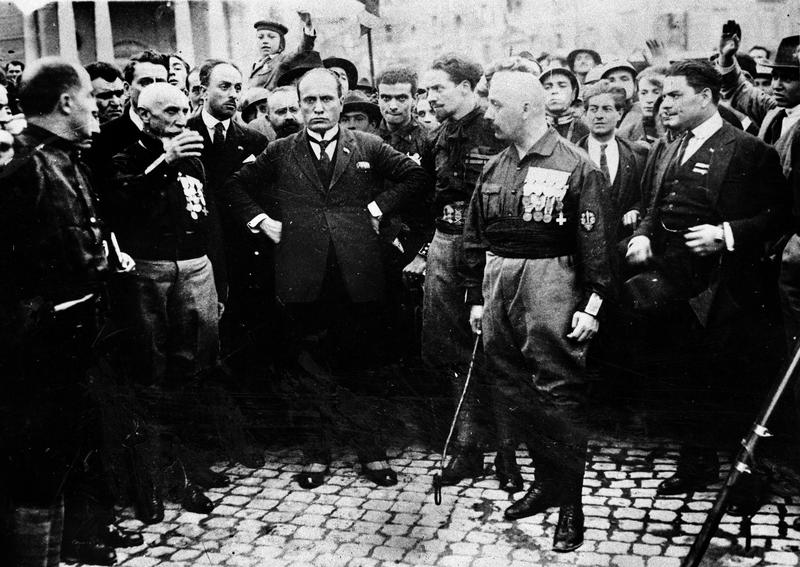
October 28, 1922: The March on Rome takes place. It was an organized mass demonstration by 25,000 right-wing Blackshirt paramilitary men, representing the National Fascist Party, led by Benito Mussolini, seeking to rescue Italy from the economic and social chaos of the post-World War I world.

Prime Minister Luigi Facta told King Victor Emmanuel III that he wanted to declare a state of siege, but the King, conservative like most European monarchs tended to be then, and sympathetic to the Fascists, overruled him. The next day, the King dismissed Facta, and gave the job to Mussolini.

For the next 21 years, Mussolini ruled Italy with an iron fist, having opponents killed, including Socialist Party leader Giacomo Matteotti in 1924; aiding the Fascist movement in Spain during that country's Civil War of 1936 to 1939; and expanding Italy's influence into Africa, taking over Libya and Ethiopia, in an attempt to establish a new Roman Empire with himself as Caesar.

Mussolini considered Fascism to be the direct opposite of liberalism. In article in the 1932 edition of the Enciclopedia Italiana, he wrote, "Fascism should more appropriately be called Corporatism because it is a merger of state and corporate power." As the 1930s proved, Fascism also includes militarism and nationalism, which, inevitably, includes bigotry -- if not at first, then, eventually, lurching toward it and eventually carrying it out on a governmental level.

He also launched what would later be called a "cult of personality," in which the leader and the nation became inseparable, much as King Louis XIV of France once proclaimed, "I am the state."

The American journalist George Seldes, whom Mussolini had befriended on the way up in the hopes of gaining American patrons, turned on him after gaining power. Seldes then wrote a biography of Mussolini, titled Sawdust Caesar. 

And in aiding the Fascists in Spain, led by Generalissimo Francisco Franco, Mussolini sent troops, which became known as Franco's Italian Army. That name would later be adopted by a family that owned an Italian restaurant in Pittsburgh, to honor Pittsburgh Steelers running back Franco Harris, whose mother grew up in Italy under Mussolini -- but whose father was an African-American soldier who participated in the liberation of Italy from Fascism, and married her and took her to America.

While Harris always showed appreciation to the restaurateurs and the other Steeler fans, it is not known if it made him uncomfortable to know what Francisco Franco did in Spain and Benito Mussolini did in Ethiopia, before that country was liberated.

Mussolini was deposed in 1943, and executed in 1945. And that old saying, "At least he made the trains run on time"? It was a myth: On the average, the trains in Italy ran no better than they did before he took over.

At heart, Italy is a conservative country. But, since World War II, more of its governments have been left of center rather than right. When one government falls, it is usually replaced by another leftward one. An exception was Silvio Berlusconi, the broadcast executive whose Forza Italia party is economically and socially conservative. He served as Prime Minister in 1994 and '95, from 2001 to 2006, and 2008 to 2011.

But on September 25, 2022, a right-wing party named Fratelli d'Italia, meaning "Brothers of Italy," won the most seats, and built a coalition that made its Leader -- ironically, given the name of the party, a woman, Giorgia Meloni -- the new Prime Minister. She will be Italy's furthest-right head of government since Mussolini, noticeably further to the right than Berlusconi.

*

October 28, 1922 was a Saturday. The Major League Baseball season had ended earlier in the month, with the New York Giants winning the World Series over the New York Yankees. There was, as yet, no major professional basketball league. The National Hockey League's new season was still a few weeks away. The nascent National Football League did play games that weekend, but all the next day, Sunday.

But, being a Saturday, there were college football games. One was the 1st football game ever broadcast on live nationwide radio. The year before, the University of Chicago had become one of the first colleges to send its football team to play a team outside its home region, beating Princeton University 9-0 at Palmer Stadium. Now, they would have a rematch at Stagg Field on the South Side of Chicago.

The Princeton Tigers entered the game 4-0, the Chicago Maroons 3-0. After 3 quarters, thanks to 3 touchdowns by John Thomas, Chicago led 18-7. Then came the kind of collapse people would still be talking about nearly a century later if it had happened on TV and the footage preserved. The Maroons fumbled, the Tigers recovered, and took it in for a 40-yard touchdown. Harry Crum scored for Princeton in the closing minutes, and, since Princeton made their PATs and Chicago didn't, the Tigers emerged victorious, 21-18. 

Another battle of unbeatens took place at the new Rose Bowl stadium in the Los Angeles suburb of Pasadena. The University of California, from the system's main campus in Berkeley, outside San Francisco, was 4-0, and took on the 5-0 team from the University of Southern California, based in Los Angeles. A safety gave Cal a 2-0 lead at halftime, and the Golden Bears held on 2 goal-line stands, before adding a touchdown and a field goal to win 12-0. I have a separate entry for this event.

On the basis of the win over Chicago, Eastern and Midwestern sportswriters proclaimed Princeton to be the National Champions after the season. Western writers gave the title to Cal. No playoff in those days. Bowl games? Cal had won the Rose Bowl in 1920 and tied it in 1921, but in 1922 and 1923, they didn't go. From September 25, 1920 to October 3, 1925, under coach Andy Smith, the Golden Bears had a 50-game unbeaten streak, still the longest in college football history: Played 50, won 46, tied 4, lost exactly none.

Coaching took a severe toll on Smith, who went just 6-3 with Cal in 1925. On a visit to Philadelphia, where he had coached the University of Pennsylvania from 1909 to 1912, he was hospitalized with pneumonia, and died on January 8, 1926, only 49 years old. His career coaching record was 116-32-13, including 74-16-7 at Cal.

In New York City, New York University played Rhode Island State at Ohio Field in The Bronx, and won 23-7. Fordham University played Westminster College of Pennsylvania at Fordham Field, also in The Bronx, and won 12-0. Columbia University wasn't so lucky: They played Williams College of Massachusetts, at South Field, just south of their famed Low Library in the Morningside Heights section of Manhattan, and lost 13-10.

And, aside from Princeton the main team in New Jersey, Rutgers University went to Morgantown and lost to West Virginia University 28-0.

Also, Arsenal FC lost to Newcastle United, 2-1 at the Arsenal Stadium, a.k.a. Highbury, in North London. 

Saturday, October 15, 2022

October 15, 1940: "The Great Dictator" Premieres

October 15, 1940: The Great Dictator premieres, at a time in World War II when things are looking good for the real-life dictators. Charlie Chaplin directs, and plays 2 roles: A poor Jewish man identified only as "The Barber," for his profession, and living in the fictional European country of Tomania (a play on "ptomaine poisoning"); and that nation's dictator, Adenoid Hynkel, who physically resembles Adolf Hitler, except for having curly hair like Chaplin's silent-film era "Tramp" character.

Indeed, when Hitler first became famous, he was said to look like Chaplin, because of the small black mustache. They were born 4 days apart: Chaplin on April 16, 1889 in Walworth, South London; and Hitler on April 20, 1889 in Branau am Inn, northern Austria, on the border with Germany.

Paulette Goddard, Chaplin's real-life wife at the time, plays Hannah, the Barber's girlfriend, and would turn out to be the film's last surviving castmember, living until 1990. Jack Oakie plays Benzino Napaloni, dictator of Tomania's ally, Bacteria. He is meant to invoke Italy's Benito Mussolini, although his name is also a nod toward the chemical benzene and an earlier European dictator, Napoleon Bonaparte.

It is a "prince and the pauper" story: Through a turn of events involving an aide to Hynkel, remembering the Barber as a soldier who saved his life in the previous war, the Barber impersonates Hynkel, who is about to give a radio speech, to be broadcast all over the world (television is still in its infancy), which everyone believes will be justifying Tomania's upcoming invasion of Osterlich (based on Austria), an invasion that Bacteria supports. (Italy also borders Austria, and they've fought a few times.) But with Hynkel secretly out of the picture, the Barber, impersonating him, tells the world that he has had a change of heart, and wants peace, and human rights for all.

Chaplin, a known leftist, had continued to make silent films into the era of "talkies," and this was his 1st full-length sound film. Most people around the world had heard of him and, at the least, had seen his picture, but had never heard his voice before. So he put it to good use.

Chaplin would not have lasted in the #MeToo era. He married 4 times, to women then ages 16, 16, 26 (Goddard) and 18 (Oona O'Neill, daughter of playwright Eugene O'Neill, and together she and Charlie were grandparents of Game of Thrones actor Oona Chaplin). And he did get a little too friendly with the Soviet Union after World War II. But he was a pioneer of one of the great arts, and should still be celebrated.

*

October 15, 1940 was a Tuesday. Baseball season had just ended, with the Cincinnati Reds defeating the Detroit Tigers in the World Series. Football was in midweek. The NBA hadn't been founded yet. And the NHL season wouldn't begin until November 2. So there were no scores on this historic day.

Sunday, July 10, 2022

July 10, 1943: The Allied Invasion of Sicily

July 10, 1943: Operation Husky begins, as the Allies invade the island of Sicily. This begins the liberation of Fascist-controlled Italy.

As had already happened in North Africa the preceding November -- and with many of the same troops -- and would happen the following June in France, this was an amphibious operation with air cover. By August 17, Sicily was secured, as all Axis forces on the island either evacuated, or were captured before they could. The Allied progress so rattled the Fascist national government that it removed its own founder, Benito Mussolini, from power.

On September 3, the Allies invaded Italy proper, as Salerno, Calabria and Taranto. Chancellor Adolf Hitler got so scared, he diverted 1/5th of the entire German Army from the Eastern Front against the Soviet Union to southern Europe, fighting the Allies in Italy, Yugoslavia and Greece. It did him no good: On June 4, 1944, Rome was liberated. Two days later, the Allies invaded "Fortress Europe" at Normandy.

*

July 10, 1943 was a Saturday. Tennis legend Arthur Ashe was born. And these baseball games were played:

* The New York Yankees swept a doubleheader from the Chicago White Sox, 9-2 and 8-3 at Comiskey Park in Chicago. Ernie "Tiny" Bonham went the distance to win the opener. Charles Wensloff went the distance to win the nightcap.

* A doubleheader was split at the Polo Grounds. The Chicago Cubs won the 1st game, 10-4. The New York Giants won the 2nd game, 9-2. Giants player-manager Mel Ott went 2-for-6 with a home run and 3 walks over the 2 games.

* The Brooklyn Dodgers beat the Pittsburgh Pirates, 23-6 at Ebbets Field. Yes, that's baseball, not football. The Dodgers scored 10 runs in the 1st inning, and another 10 in the 4th. They only got 1 home run, from Al Glossop. Billy Herman went 3-for-4 with a walk and 7 RBIs. Red Barkley went 3-for-5 with a walk and 4 RBIs. Augie Galan went 2-for-3 with 2 walks and 4 RBIs.

* The St. Louis Cardinals beat the Boston Braves, 6-0 at Braves Field in Boston. Howie Pollet pitched a 4-hit shutout. Stan Musial went 2-for-5 with an RBI.

* The Cincinnati Reds beat the Philadelphia Phillies, 6-2 at Shibe Park in Philadelphia.

* The Washington Senators beat the Cleveland Indians, 4-0 at Cleveland Municipal Stadium. Early Wynn pitched a 4-hit shutout. He would later help the Indians win 2 Pennants.

* The Philadelphia Athletics beat the Detroit Tigers, 6-1 at Briggs Stadium in Detroit. (It was renamed Tiger Stadium in 1961.)

* The Boston Red Sox beat the St. Louis Browns, 6-3 at Sportsman's Park in St. Louis. The Browns' bullpen and defense collapsed in the top of the 10th inning, allowing 3 runs.

Thursday, June 30, 2022

June 30, 1936: Emperor Haile Selassie's Plea Falls On Deaf Ears

June 30, 1936: Emperor Haile Selassie of Ethiopia speaks before the League of Nations, at the Palais Wilson on the shore of Lake Geneva in Switzerland.

Ethiopia was one of the few independent nations in Africa when Italy invaded on October 2, 1935, in fascist dictator Benito Mussolini's bid to create a new Roman Empire. At the end of the year, for his resistance, Time magazine named Haile Selassie its Man of the Year. On May 7, 1936, Italy completed its annexation of the country. Two days later, Mussolini declared the colony of Italian East Africa, also including Eritrea and Somalia.

Like all who had sat on his throne, Haile Selassie claimed to trace his lineage back to the affair between Solomon, one of the Biblical Kings of Israel, and the Queen of Sheba, known in modern Ethiopia as Makeda. But now, the man known to his people as King of Kings, Lord of Lords, Elect of God, and Lion of Judah had been overthrown, and had to flee his country.

The League of Nations had been founded after World War I, by President Woodrow Wilson (hence, the name of the its assembly hall), in the hopes of preventing small conflicts, especially to prevent them from becoming bigger conflicts, as the fight between Serbia and the Austrian Empire in July 1914 snowballed into World War I.

But America's U.S. Senate refused to ratify the Treaty of Versailles, which had created the League. Thus, America, and the large moral authority it had gained from winning the war, were not in the league. Therefore, the League was considerably weaker than it could have been.

Still, Haile Selassie believed that, if he told the League what the Italians were doing in his country, they would respond, and help. Although fluent in French, the League's working language, the Emperor delivered his speech in his native language, Amharic, translated for the Assembly. He said:

I, Haile Selassie I, Emperor of Ethiopia, am here today to claim that justice which is due to my people, and the assistance promised to it eight months ago, when fifty nations asserted that aggression had been committed in violation of international treaties.
There is no precedent for a Head of State himself speaking in this assembly. But there is also no precedent for a people being victim of such injustice and being at present threatened by abandonment to its aggressor. Also, there has never before been an example of any Government proceeding to the systematic extermination of a nation by barbarous means, in violation of the most solemn promises made by the nations of the earth that there should not be used against innocent human beings the terrible poison of harmful gases.
It is to defend a people struggling for its age-old independence that the head of the Ethiopian Empire has come to Geneva to fulfil this supreme duty, after having himself fought at the head of his armies...
Apart from the Kingdom of the Lord there is not on this earth any nation that is superior to any other. Should it happen that a strong Government finds it may with impunity destroy a weak people, then the hour strikes for that weak people to appeal to the League of Nations to give its judgment in all freedom. God and history will remember your judgment...
On behalf of the Ethiopian people, a member of the League of Nations, I request the Assembly to take all measures proper to ensure respect for the Covenant. I renew my protest against the violations of treaties of which the Ethiopian people has been the victim. I declare in the face of the whole world that the Emperor, the Government and the people of Ethiopia will not bow before force; that they maintain their claims that they will use all means in their power to ensure the triumph of right and the respect of the Covenant...
It is us today. It will be you tomorrow...
I ask the fifty-two nations, who have given the Ethiopian people a promise to help them in their resistance to the aggressor, what are they willing to do for Ethiopia? And the great Powers who have promised the guarantee of collective security to small States on whom weighs the threat that they may one day suffer the fate of Ethiopia, I ask what measures do you intend to take?
Representatives of the World: I have come to Geneva to discharge in your midst the most painful of the duties of the head of a State. What reply shall I have to take back to my people?
The League's reply was pathetic: Only partial and ineffective sanctions on Italy. It is often said that the League of Nations effectively collapsed due to its failure to condemn Italy's invasion of Ethiopia. 
He spent his exile in Bath, England. Back in Ethiopia, one of his daughters died in captivity, and his sons-in-law were executed. Another daughter died in childbirth shortly after the restoration.
But the restoration did come. When Britain declared war on Nazi Germany on September 3, 1939, it also declared war on Italy, as part of the same Axis. On January 18, 1941, a combined force of Ethiopian, British Empire, Free France and Free Belgium troops invaded. On May 5, the Italians surrendered, and Haile Selassie entered the capital of Addis Ababa, and addressed his people again.
By that point, the League of Nations had only a skeleton staff. For all intents and purposes, it existed only on paper. In 1946, with the United Nations already operating, the League Assembly voted to dissolve the League.
*
June 30, 1936:  was a Tuesday. These baseball games were played that day:

* The New York Yankees swept a doubleheader from the Boston Red Sox, 10-5 and 6-3 at Yankee Stadium. Lou Gehrig went 3-for-6 with a home run in each game, 3 walks and 4 RBIs. Rookie Joe DiMaggio went 3-for-9 with an RBI. For the Sox, Jimmie Foxx 3-for-7 with 2 walks and 2 RBIs.

* The New York Giants lost to the Boston Bees, 7-6 at National League Park in Boston. This was the 1st season for which the Boston Braves tried to abandon their losing tradition by changing the name of their team and their ballpark, Braves Field. After 5 years, they realized it wasn't working.

* And the St. Louis Cardinals swept a doubleheader from the Pittsburgh Pirates, 2-1 and 4-3 at Forbes Field in Pittsburgh.

Friday, June 10, 2022

June 10, 1924: Italian Opposition Leader Giacomo Matteotti Is Assassinated

June 10, 1924: Giacomo Matteotti is assassinated, for daring to speak against his country's leader. He was 39 years old.

Born on May 22, 1885 in Fratta Polesine, in Veneto near Venice, Matteotti was a lawyer who was elected as a Socialist to Italy's Chamber of Deputies in 1919, and became the leader of the Unitary Socialist Party.

He opposed Benito Mussolini's 1922 Fascist takeover of the country. In 1924, his book The Fascisti Exposed: A Year of Fascist Domination was published, and he made two impassioned and lengthy speeches in the Chamber of Deputies, denouncing Fascism and declaring that the last election, marked by intimidation and militia violence, was "invalid."

On May 30, 1924, in Parliament, he again declared the recent election a fraud. He also found evidence of bribes from American company Sinclair Oil in favor of Mussolini, in order to get permission for Sinclair's exploitation of petroleum reservoirs under Italian control.

Like all tyrants and would-be tyrants, Mussolini couldn't handle being criticized. On June 10, Matteotti was bundled into a car, a Lancia Kappa, and stabbed several times with a carpenter's file as he was struggling to escape. His corpse was found after an extensive search near Riano, 14 miles north of Rome, on August 16. 1924.

Five men were arrested: Amerigo Dumini, Giuseppe Viola, Albino Volpi, Augusto Malacria and Amieto Proveromo. A sixth, Filippo Panzeri, fled from arrest. Dumini, Volpi and Poveromo were convicted, but were soon released under amnesty by King Victor Emmanuel III, who, by this point, was little more than a puppet of Mussolini.

Of those 6 defendants, Malacria was murdered in 1934; and Volpi died in 1939, apparently of natural causes, and still in Mussolini's good graces. Mussolini remained in power for another 19 years, before being overthrown in 1943 and executed in 1945, and so no evidence of his involvement in Matteotti's kidnap and assassination was ever presented. In 1947, the other 4 defendants were charged, tried, convicted, and sentenced to life imprisonment.

Poveromo died in prison in 1952. Dumini was given amnesty in 1953, and died in 1967 as the result of a household accident. I can't find information on the deaths of Viola and Panzeri.

One of Matteotti's sons, Gianmatteo "Matteo" Matteotti, became a Social Democratic parliamentary deputy, serving as Italy's Minister of Tourism in 1970–72, and Minister of Foreign Trade from 1972–1974.

*

June 10, 1924 was a Tuesday. These baseball games were played:

* The New York Yankees beat the St. Louis Browns, 5-0 at Sportsman's Park in St. Louis. Waite Hoyt pitched a 6-hit shutout. 3rd baseman Ernie Johnson hit a home run. Babe Ruth went 0-for-2, but drew 2 walks and scored a run. For the Browns, George Sisler went 2-for-4.

* The New York Giants lost to the Pittsburgh Pirates, 10-6 at the Polo Grounds. Frankie Frisch went 2-for-5 with 2 RBIs. Bill Terry went 1-for-4 with a walk.

* The Brooklyn Robins (as the Dodgers were known during Wilbert Robinson's managing, from 1914 to 1931) beat the Chicago Cubs, 4-2 at Ebbets Field. Zack Wheat went 0-for-4.

* The Boston Braves beat the St. Louis Cardinals, 6-2 at Braves Field in Boston.

* The Cincinnati Reds beat the Philadelphia Phillies, 4-2 at Baker Bowl in Philadelphia.

* The Cleveland Indians beat the Washington Senators, 4-3 at League Park in Cleveland. Indians manager-center fielder Tris Speaker went 0-for-2 with a walk. He sent George Uhle, normally a pitcher, up to pinch-hit with 1 out in the bottom of the 9th, and he doubled Chick Fewster home to tie the game. Charlie Jamieson then singled Joe Sewell home to win it.

* The Philadelphia Athletics beat the Detroit Tigers, 4-3 at Navin Field (later Briggs Stadium and Tiger Stadium) in Detroit. Ty Cobb went 1-for-3.

* And the Chicago White Sox beat the Boston Red Sox, 3-2 at Comiskey Park in Chicago. Bibb Falk (his real name) hit a home run in the bottom of the 13th inning to win it.

Saturday, June 4, 2022

June 4, 1944: The Liberation of Rome

June 4, 1944: Allied troops liberate Rome, the capital of Italy, one of the nations of the Axis.

In 1922, Benito Mussolini took advantage of Italy's post-World War I chaos, and had his Fascists make their "March On Rome." For 21 years, "Il Duce" (The Leader) ruled the land of Garibaldi, Leonardo and Vivaldi with a fist more iron than ever imagined by Caligula, Commodus or Diocletian. George Seldes, an American journalist who covered his entire career (and lived to be 104), wrote a book about him titled Sawdust Caesar.

The reputation of Italy having a weak army -- which both Mussolini and Giuseppe Garibaldi had taken advantage of in the preceding 80 years -- still held, as British and American troops kicked them out of North Africa, and then invaded Sicily, and finally the Italian mainland. On July 25, 1943, his own Grand Council of Fascism passed a vote of no confidence in him, and King Victor Emmanuel III, who had appointed him Prime Minister, dismissed him and ordered his arrest.

But that didn't mean that the liberation of Italy was easy. The country's mountainous terrain made progress slower than was hoped. On February 10, 1944, the U.S. won the Battle of Anzio at a high cost. Among the 7,000 men killed were 4 from my hometown of East Brunswick, New Jersey: Brothers Lawrence and William Kossman, Constantine Haransky and Henry Jensen. Just 7 days later, another E.B. resident, Adam Albrecht, would be killed while fighting in Italy.

The Allies rolled into Rome on June 4, 1944, and, to borrow a phrase that would haunt later American leaders, were welcomed as liberators. Among them was an Army stenographer from The Bronx, Staff Sergeant George Goldberg -- my grandfather.

Within a year, Mussolini was dead, and so was Adolf Hitler.

As big a story as this was, it wasn't the biggest war story of the week.

Also on June 4, 1944: A hunter-killer group of the United States Navy captured the German submarine U-505, marking the first time a U.S. Navy vessel had captured an enemy vessel at sea since the 19th Century.

A neat story, and a nice victory... but that wouldn't be the biggest war story of the week, either. Two days later was D-Day.

*

June 4, 1944 was a Sunday. Michelle Phillips, singer with The Mamas & The Papas, and later an actress, was born.

This being a Sunday, and with wartime travel restrictions in effect, it should surprise no one that all the games were doubleheaders:

* The New York Yankees split with the Cleveland Indians at Cleveland Municipal Stadium. The Yankees won the opener, 6-4. Hal Kleine began the top of the 11th inning by hitting Johnny Lindell with a pitch. Joe Page, later better known as a reliever but having gone the distance in this game, tried to bunt Lindell over, and both of them reached base. Snuffy Stirnweiss singled the runners over, loading the bases with nobody out. Bud Metheny brought Lindell home on a sacrifice fly, Larry Rosenthal walked, and Nick Etten's groundout scored Page.

The Indians won the nightcap, 4-3. Allie Reynolds was the winning pitcher. After the 1946 season, Joe DiMaggio told Yankee management to get Reynolds, and they traded Joe Gordon for him, in a trade that worked out great for both teams.

* The New York Giants were swept by the Pittsburgh Pirates at the Polo Grounds, 9-4 and 7-4. Giants player-manager Mel Ott went 1-for-8 with a walk over the 2 games.

* The Brooklyn Dodgers lost the 1st game to the Chicago Cubs, 6-5 at Ebbets Field. The 2nd game was tied 8-8 after 10 innings, when it was called due to a Sunday curfew. (They'd had lights since 1938, and the weather wasn't an issue. The curfew was.)

* The Cincinnati Reds swept the Boston Braves, 1-0 and 7-3 at Braves Field in Boston.

* There was a split at Shibe Park in Philadelphia. The St. Louis Cardinals won the 1st game, 4-2. The Philadelphia Phillies won the 2nd game, 1-0. Bill Lee (no relation to the later Red Sox pitcher of the same name) pitched a 2-hit shutout. Over the 2 games, Stan Musial went 1-for-9, although he had an RBI.

* There was a split at Briggs Stadium in Detroit, later renamed Tiger Stadium. The Detroit Tigers won the 1st game, 2-1. The Boston Red Sox won the 2nd game, 5-1.

* The Chicago White Sox swept the Washington Senators at Comiskey Park in Chicago, 6-5 and 9-1. The Senators led the 1st game 5-0 going to the top of the 4th, but blew it, and Mike Tresh's sacrifice fly won it in the bottom of the 10th.

* There was a split at Sportsman's Park in St. Louis. The Philadelphia Athletics won the 1st game, 4-3. The St. Louis Browns won the 2nd game, 4-3. Jack Kramer pitched 3 innings of relief, and won his own game with an RBI single in the bottom of the 10th.

Thursday, May 5, 2022

May 5, 1941: The Liberation of Ethiopia

May 5, 1941: Five years to the day after Italy completed its annexation of the African nation of Ethiopia, the Allies liberate that country. Freedom defeats fascism.

Ethiopia was one of the few independent nations in Africa when Italy invaded on October 2, 1935, in fascist dictator Benito Mussolini's bid to create a new Roman Empire. On May 7, 1936, Italy completed its annexation of the country. Two days later, Mussolini declared the colony of Italian East Africa, also including Eritrea and Somalia.

Emperor Haile Selassie of Ethiopa, like all who had sat on his throne, claimed to trace his lineage back to the affair between Solomon, one of the Biblical Kings of Israel, and the Queen of Sheba, known in modern Ethiopia as Makeda. But now, the man known to his people as King of Kings, Lord of Lords, Elect of God, and Lion of Judah had been overthrown, and had to flee his country.

The League of Nations had been founded after World War I, by President Woodrow Wilson (hence, the name of the its assembly hall), in the hopes of preventing another small conflicts, especially to prevent them from becoming bigger conflicts, as the fight between Serbia and the Austrian Empire in July 1914 snowballed into World War I.

But America's U.S. Senate refused to ratify the Treaty of Versailles, which had created the League. Thus, America, and the large moral authority it had gained from winning the war, were not in the league. Therefore, the League was considerably weaker than it could have been.

Still, Haile Selassie believed that, if he told the League what the Italians were doing in his country, they would respond, and help. Although fluent in French, the League's working language, the Emperor delivered his speech in his native language, Amharic, translated for the Assembly.

On June 30, 1936, Haile Selassie traveled to Geneva, Switzerland, to speak before the League. Among h is remarks:

On behalf of the Ethiopian people, a member of the League of Nations, I request the Assembly to take all measures proper to ensure respect for the Covenant. I renew my protest against the violations of treaties of which the Ethiopian people has been the victim. I declare in the face of the whole world that the Emperor, the Government and the people of Ethiopia will not bow before force; that they maintain their claims that they will use all means in their power to ensure the triumph of right and the respect of the Covenant...

It is us today. It will be you tomorrow...

I ask the fifty-two nations, who have given the Ethiopian people a promise to help them in their resistance to the aggressor, what are they willing to do for Ethiopia? And the great Powers who have promised the guarantee of collective security to small States on whom weighs the threat that they may one day suffer the fate of Ethiopia, I ask what measures do you intend to take?

Representatives of the World: I have come to Geneva to discharge in your midst the most painful of the duties of the head of a State. What reply shall I have to take back to my people?

The League's reply was pathetic: Only partial and ineffective sanctions on Italy. It is often said the League of Nations effectively collapsed due to its failure to condemn Italy's invasion of Ethiopia. At the end of the year, Time magazine named Haile Selassie its Man of the Year.
He spent his exile in Bath, England. Back in Ethiopia, one of his daughters died in captivity, and his sons-in-law were executed. Another daughter died in childbirth shortly after the restoration.
In 1937, the Italian massacre of Yekatit 12 took place, in which between 1,400 and 30,000 civilians were killed, and many others imprisoned. This massacre was a reprisal for the attempted assassination of Rodolfo Graziani, Mussolini's Viceroy for Italian East Africa.
The Italians employed the use of asphyxiating chemical weapons in their Ethiopian invasion. They regularly dropped bombs throughout Ethiopia that carried mustard gas (a nasty weapon of World War I, banned thereafter) and debilitated the Ethiopian forces. On the whole, the Italians dropped about 300 tons of mustard gas as well as thousands of other artillery. This use of chemical weapons amounted to egregious war crimes.
But the Italians did make investments in Ethiopian infrastructure development during their rule. They created the so-called "imperial road" between Addis Ababa and Massaua. More than 500 miles of railways were reconstructed, dams and hydroelectric plants were built, and many public and private companies were established.
When Britain declared war on Nazi Germany on September 3, 1939, it also declared war on Italy, as part of the same Axis. On January 18, 1941, a combined force of Ethiopian, British Empire, Free France and Free Belgium troops invaded. On May 5, the Italians surrendered, and Haile Selassie entered the capital of Addis Ababa, and addressed his people again.
By that point, the League of Nations had only a skeleton staff. In 1946, with the United Nations already operating, the League Assembly dissolved.
Haile Selassie ruled his nation until 1974, when he was deposed by a leftist regime. He died under house arrest the following year.
*

May 5, 1941 was a Monday. These baseball games were played that day:

* The New York Yankees lost to the Detroit Tigers, 7-3 at Briggs Stadium (later Tiger Stadium) in Detroit. Tommy Bridges outpitched Lefty Gomez. Hank Greenberg went 1-for-3. Joe DiMaggio went 0-for-3, although he did draw a walk. Ten days later, he began his 56-game hitting streak.

* The St. Louis Cardinals beat the Boston Braves, 5-1 at Braves Field in Boston.

* The Philadelphia Athletics beat the Chicago White Sox, 5-4 at Comiskey Park in Chicago. Les McCrabb singled home the winning run in the top of the 11th inning. Pete Suder went 3-for-5 with 2 RBIs for the A's. Luke Appling went 3-for-5 with an RBI for the South Siders.

* And the Cleveland Indians beat the Washington Senators, 2-1 at League Park in Cleveland. Rollie Hemsley singled Lou Boudreau home in the bottom of the 9th, to make a winning pitcher out of Bob Feller.

Thursday, April 28, 2022

April 28, 1945: The Execution of Benito Mussolini

April 28, 1945: Benito Mussolini, the fascist dictator of Italy from 1922 to 1943, is captured by Communist partisans and executed. He was 61 years old, and few wept for him.

Mussolini was originally a journalist who entered politics as a Socialist. He served in the Italian Army in World War I, and was wounded in 1917. His experience shifted him from left to right. On October 28, 1922, thinking the postwar Italian national government weak, he led the Fascists in a March On Rome. The government fell rather than oppose him with the Army, and King Victor Emmanuel III appointed Mussolini to be the country's youngest Prime Minister ever to that point. He became known as Il Duce (The Leader).

After removing all political opposition through his secret police, and outlawing labor strikes, Mussolini and his followers consolidated power through a series of laws that transformed the nation into a one-party dictatorship. In 1924, he ordered the assassination of Giacomo Matteotti, the Leader of the country's Socialist Party. In 1929, he signed the Lateran Treaty with the Holy See, to establish Vatican City.

His supporters, including in America, liked to say, "He made the trains run on time." In fact, they ran no better under him than under the previous government. They also liked to say he put an end to the Mafia. This also wasn't true. It would be more accurate to say that he made a deal with the Mafia, a non-aggression pact: Leave my officials -- including policemen, prosecutors and judges -- alone, let them do as they please, or, rather, as I please; and I'll do the same for you.

He also wanted to build a new Roman Empire. He established a protectorate over nearby Albania, and in 1935 invaded Ethiopia, annexing it into Italian East Africa (comprised of the current nations of Somalia and Eritrea). From 1936 to 1939, he and Adolf Hitler, the dictatorial Chancellor of Nazi Germany, aided fellow fascist Francisco Franco in his takeover of Spain.

(This included Hitler sending his air force, the Luftwaffe, to bomb opposing cities; and Mussolini sending troops, which became known as Franco's Italian Army. In the 1970s, this name would be adapted by Italian-American fans of the Pittsburgh Steelers, who formed a fan club for the half-Italian, half-black running back Franco Harris. Not to be outdone, a group of black fans honored defensive tackle Joe Greene with "Mean Joe Greene's Ethiopian Brigade." Given what Mussolini's men did in Spain and Ethiopia, both names should already have been considered cringeworthy.)

With the onset of World War II, Mussolini brought Italy into the Axis with Nazi Germany and Imperial Japan. But the reputation of Italy having a weak army -- which both Mussolini and Giuseppe Garibaldi had taken advantage of in the preceding 80 years -- still held, as British and American troops kicked them out of North Africa, and then invaded Sicily, and finally the Italian mainland.

On July 25, 1943, his own Grand Council of Fascism passed a vote of no confidence in him, and the King who had appointed him dismissed him as Prime Minister after 21 years, and ordered his arrest. The King then agreed to an armistice with the Allies.

German paratroopers broke Mussolini out of prison, resulting in a civil war. The Allies did not intervene, since their focus had moved to Western Europe. This time, Mussolini did not have enough troops to even oppose the regular Italian Army.

On April 25, 1945, Mussolini took his mistress, Clara Petacci -- leaving his wife and 6 children behind -- along with 13 others, including Clara's brother, who was posing as a Spanish consul, and fled. They set out for adjoining and neutral Switzerland, intending to board a plane and escape to also-neutral Spain, under Franco's protection.

But on April 27, they were stopped by Communist partisans near Lake Como, just 20 miles from the Swiss border. On April 28, instead of being turned over to the United Nations, as per Allied agreement in the event that he should be captured, they were executed in a village named Giulini de Mezzegra, on the orders of a partisan named Walter Audisio.

The witnesses' accounts of his last words differed. One said that he was defiant to the end, telling them, "Aim at my heart!" One said that he was a coward, yelling, "No! No!" The other said that Mussolini said nothing at all as the rifles were raised.

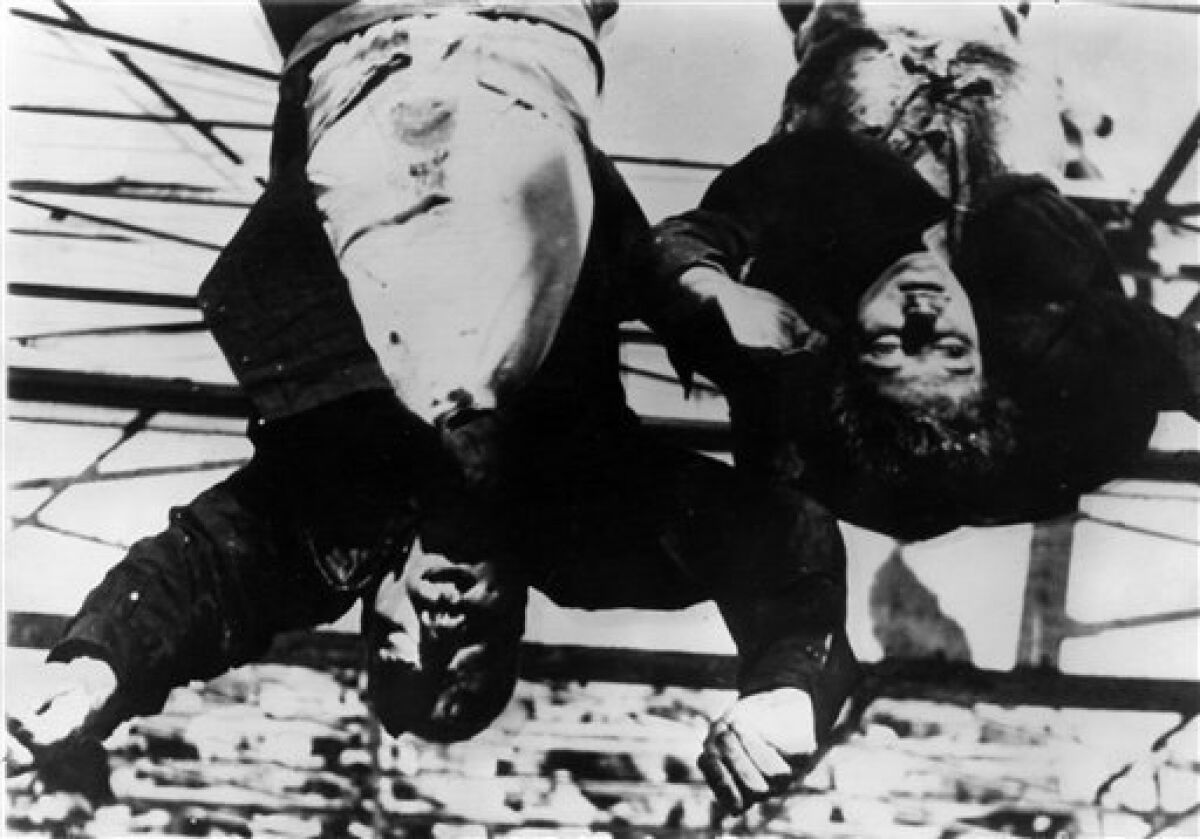
On April 29, the bodies of the executed were loaded in a van and moved to Milan, the largest city in northern Italy. They were dumped on the ground in the Piazzale Loreto, where people kicked them and spat on them. Finally, the bodies of Mussolini and the Petaccis were hung, upside-down, from the roof of an Esso gas station, and people threw stones at them.
On April 30, upon hearing a report of what happened to Mussolini, and knowing that the Soviet Union's Red Army had Berlin surrounded, and that his own escape was unlikely, Hitler decided that he was not going to face the same fate. The Nazi dictator killed himself.

Initially, Mussolini was buried in an unmarked grave. In 1946, his body was dug up and stolen by Fascist supporters. Four months later, it was recovered by the authorities, who then kept it hidden. In 1957, his remains were allowed to be interred in the Mussolini family crypt in his hometown of Predappio. His tomb has become a place of pilgrimage for neo-fascists, and the anniversary of his death is marked by neo-fascist rallies.

His granddaughter, Alessandra Mussolini, is a member of the European Parliament, and has been one of the leaders of far-right politics in Italy since the early 21st Century. Her son, Romano Mussolini, plays for SS Lazio, the Rome-based team known for a Fascist fan base. He says he has no interest in politics.

*

April 28, 1945 was a Saturday. This was also the day American troops rescued the Lipizzaner horses from Czechoslovakia, saving them from extinction. I have a separate entry for that event.

The National Football League was in its off-season. The National Hockey League had already completed its season, with the Toronto Maple Leafs having won the Stanley Cup. And the National Basketball Association wouldn't begin play for another year and a half. But there were baseball games played that day:

* The New York Yankees beat the Washington Senators, 2-1 at Yankee Stadium. Nick Etten singled home the winning run in the bottom of the 13th inning.

* The Brooklyn Dodgers beat their arch-rivals, the New York Giants, 4-3 at Ebbets Field in Brooklyn. The Giants led 3-1 going into the bottom of the 9th, but the Dodgers scored 3 runs, with the winning run driven in on a single by center fielder Goodwin "Goody" Rosen.

* The Boston Braves beat the Philadelphia Phillies, 8-7 at Braves Field in Boston.

* The Boston Red Sox beat the Philadelphia Athletics, 8-4 at Shibe Park in Philadelphia.

* The Detroit Tigers beat the Cleveland Indians, 5-1 at League Park in Cleveland.

* The Cincinnati Reds beat the St. Louis Cardinals, 1-0 at Crosley Field in Cincinnati. Arnold Carter pitched a 6-hit shutout.

* The Chicago Cubs beat the Pittsburgh Pirates, 6-0 at Wrigley Field in Chicago. Hank Wyse lost a no-hitter in the 8th inning, on a single by Bill Salkeld.

* And the Chicago White Sox and the St. Louis Browns were rained out at Sportsman's Park in St. Louis. The game was made up as part of a doubleheader the next day. The ChiSox started the season 5-0, but the Browns swept the doubleheader, 3-2 and 10-4.

And while England's Football Association had shut Football League and FA Cup competition down for the duration of the war, there was Football League South play. Arsenal beat Chelsea, 3-0 at White Hart Lane in Middlesex.

Yes, The Arsenal used the ground of their arch-rivals, Tottenham Hotspur, because their home, Arsenal Stadium, a.k.a. Highbury, in North London was appropriated by the government for defense purposes. The London Government Act 1963 redrew the boundaries of the city of London (not to be confused with "The City of London") so that White Hart Lane was inside the city for the first time.

Thursday, April 7, 2022

April 7, 1926: The Attempted Assassination of Benito Mussolini

April 7, 1926: An attempt is made to assassinate Benito Mussolini, the Fascist dictator of Italy.

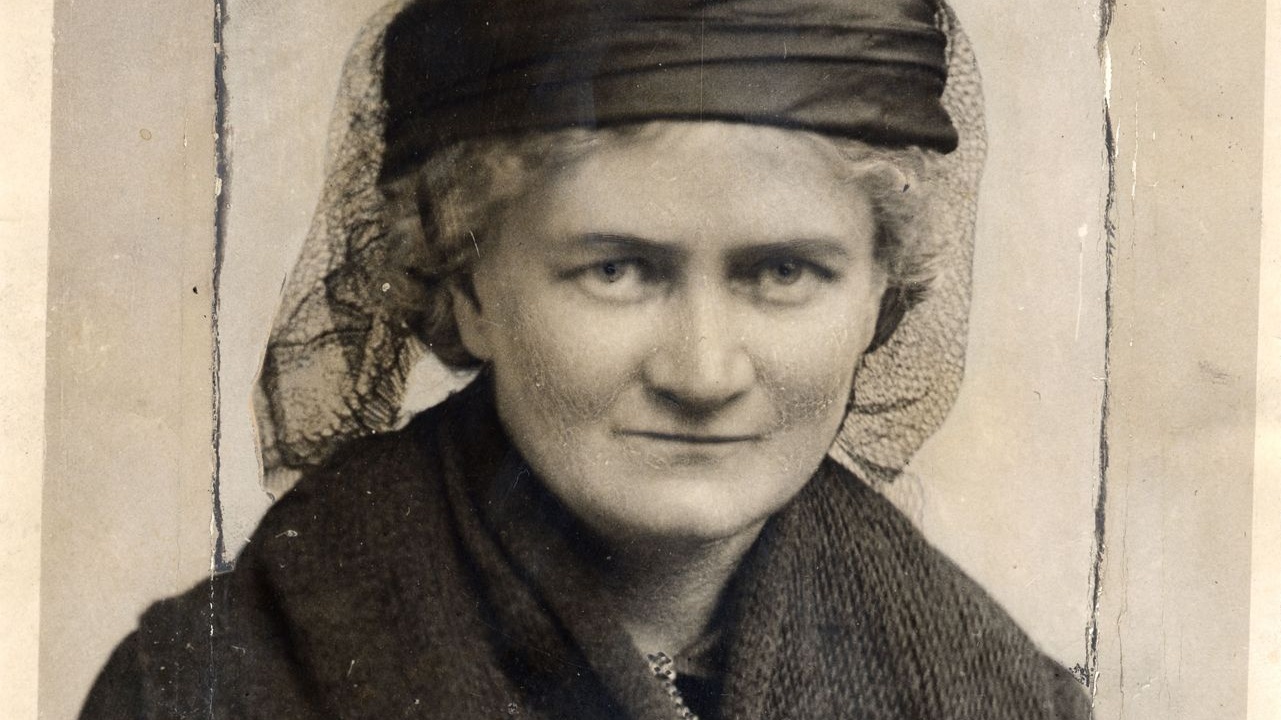
Violet Gibson was born in 1876 in Dublin, Ireland. She was the daughter of Edward Gibson, the 1st Baron Asbourne, and the Lord Lieutenant of Ireland from 1885 to 1905. She fell victim to mental illness, having a nervous breakdown in 1922, the year that Mussolini and his Fascist thugs marched on Rome and took control of the Italian government. She was committed to a psychiatric institution for 2 years. Mussolini was not. She attempted suicide in Rome in 1925.

She was still in Rome on April 7, 1926, when she saw Mussolini walking among the crowd in the Piazza del Campidoglio, after leaving an assembly of the International Congress of Surgeons, to whom he had delivered a speech on modern medicine. Gibson pulled a Modèle 1892 revolver, loaded with 8-millimeter bullets, roughly equivalent to .32 caliber, and fired.

Mussolini turned his head at just the right moment -- for him -- and the shot only grazed his nose. Gibson tried a 2nd shot, but her gun misfired. Gibson was almost lynched on the spot by an angry mob, but police intervened, and took her away for questioning. Mussolini dismissed his injury as "a mere trifle."
As she didn't hold Irish citizenship, due to her Unionist views, she was deported to Britain, after being released without charge at the request of Mussolini, an act for which he received the thanks of the British government.

The assassination attempt backfired, triggering a wave of popular support for Mussolini, resulting in the passage of pro-Fascist legislation which helped consolidate his control of Italy. Gibson spent the rest of her life in a psychiatric hospital, and died in 1956, at age 79.

Between November 4, 1925 and October 31, 1926, a span of one year, Mussolini faced 4 assassination attempts. Gibson's was by far the closest call. After 1926, new laws made making such an attempt considerably harder. Mussolini remained in power until 1943, and was executed in 1945.

*

April 7, 1926 was a Wednesday. Baseball was in Spring Training, with Opening Day 6 days away. Football was out of season. The NBA hadn't been founded yet. The Stanley Cup had been awarded the day before, as the Montreal Maroons beat the Victoria Cougars, 2-0 at the Montreal Forum, to win the Finals, 3 games to 1. So there were no scores on this historic day.

December 31, 1999 & January 1, 2000: The Millennium

December 31, 1999:  The Millennium arrives. The people of planet Earth survived. At a terrible cost. But we hadn't destroyed ourselves. ...