Showing posts with label 1936. Show all posts

Friday, December 30, 2022

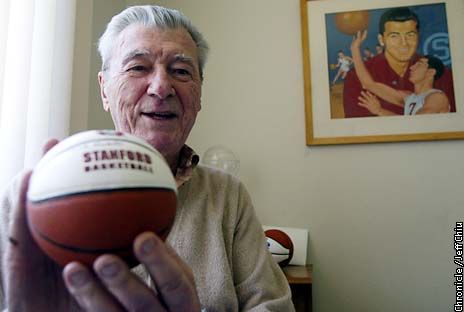
December 30, 1936: Hank Luisetti Revolutionizes Basketball

December 30, 1936: Hank Luisetti changes the game of basketball forever.

A forward, he took his Stanford University team, defending Champions of the Pacific Coast Conference, into the old Madison Square Garden in New York, to play the Number 1- ranked team in the country, Brooklyn-based Long Island University.

New Yorkers, who, even then, thought they knew everything about basketball, and that their teams had practically invented it (this while Dr. James Naismith was still alive), had heard that Luisetti had taken shots with just one hand. This was blasphemy: You had to use both hands, to steady your shot and make it more accurate. One-handed shots were took risky, unless you wanted to use a hook shot.

But Luisetti not only used one hand, he used jump shots. Combining the two? This was madness. Well, on this night, it was a glorious madness. He scored 15 points, but that was a big total in those days. Stanford beat LIU, 45-31, not merely ending the Blackbirds' 43-game winning streak, the longest in college basketball history to that point, but blowing them out.

"I'd get the ball, take a dribble or two and jump and shoot on the way up," Luisetti explained. "I didn't jump and shoot at the height of my jump, the way they do now. I'd let the ball go right near my face. I'd push and shoot, off my fingertips."

"Hank could take over a game like Michael Jordan if he had to," said former Stanford teammate Don Williams. "He was an absolute artist on the basketball court." Certainly, Ned Irish, head of basketball operations at Madison Square Garden and eventually the founding owner of the New York Knicks, thought so: Thinking that Luisetti was the only player who could singlehandedly sell out an arena the size of The Garden, he invited Stanford back for a Holiday Festival in 1937, and they won again. Two nights later, on January 1, 1938, in Cleveland, they played Pittsburgh school Duquesne, and won 92-27. In that game, Luisetti became the 1st player in NCAA history to score 50 points in a game.

Luisetti led the Stanford Indians -- they became the Cardinal in 1972 -- to 3 straight Conference Championships. This was before there was an NCAA Tournament, but they were voted National Champions in 1937.

He arrived on the scene too late to make the 1936 Olympics. He kept his amateur status by playing for Amateur Athletic Union (AAU) teams, including the Olympic Club of his hometown of San Francisco, but the 1940 and 1944 Olympics were canceled due to World War II. He served as a Navy officer, but developed spinal meningitis, ending his basketball career, ruining Irish's hopes of making him the Knicks' 1st star.

In 1950, when he was only 34 years old and should still have been playing, the Associated Press voted him 2nd behind the still-active George Mikan on their list of the top basketball players of the 1st half of the 20th Century. He was a charter inductee into the Basketball Hall of Fame. He ran a travel services company, and died in 2002, at the age of 86.

*

December 30, 1936 was a Wednesday. Baseball and football seasons were over. The NBA hadn't been founded yet. And no NHL games were scheduled. So there were no other scores on this historic day.

Wednesday, December 14, 2022

December 14, 1936: “You Can’t Take It With You” Premieres

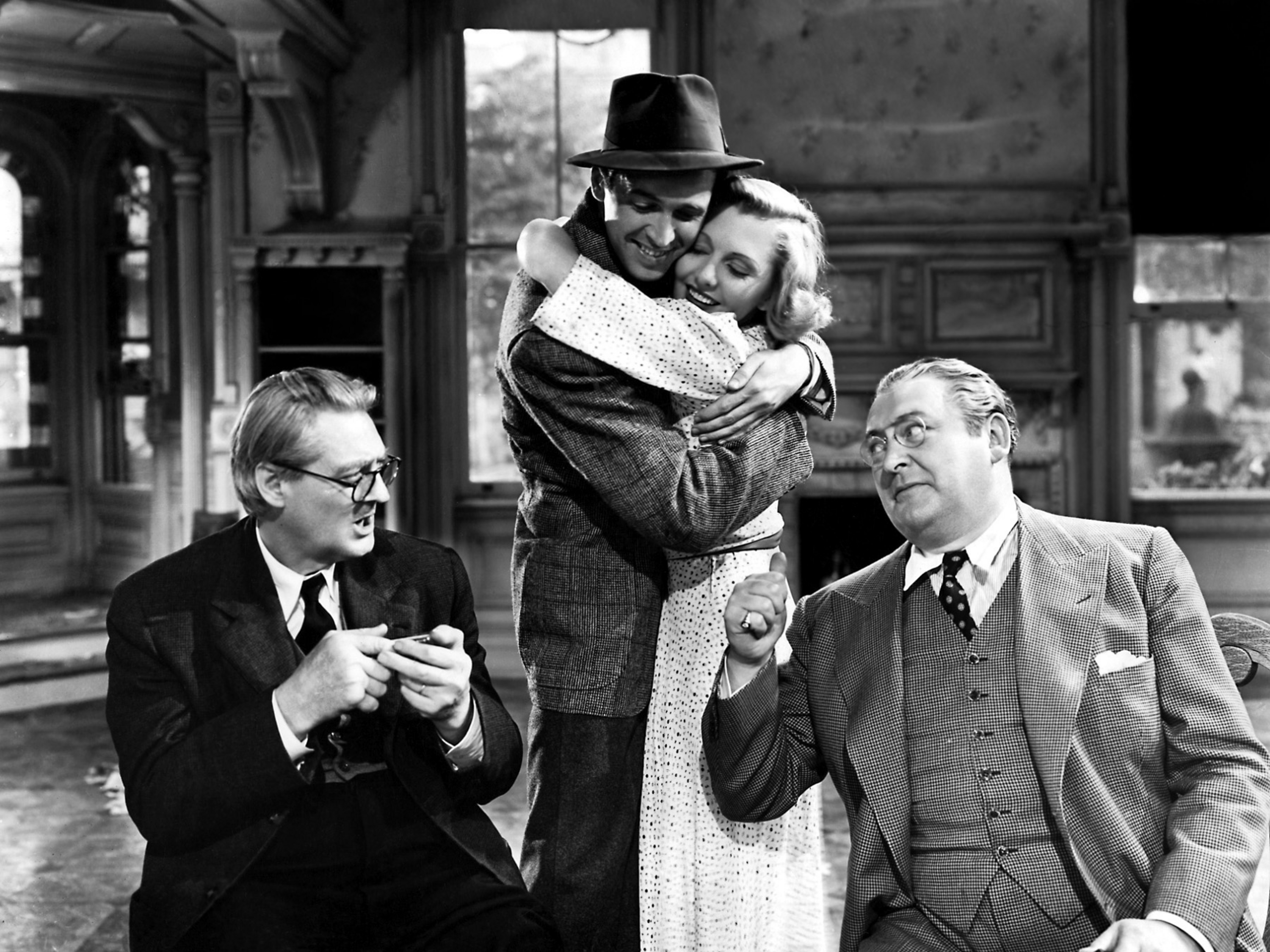
Scene from the 1938 film version

December 14, 1936: You Can't Take It With You, a play by George S. Kaufman and Moss Hart, premieres at the Booth Theatre, which still stands at 222 West 45th Street. It is directed by Kaufman, and stars Henry Travers as Martin Vanderhof, a.k.a. Grandpa, and becomes one of the biggest comedies in Broadway history.

It was filmed in 1938, with Lionel Barrymore, Jimmy Stewart, Jean Arthur, Spring Byington, Ann Miller, Mischa Auer, Eddie Anderson (Jack Benny's "Rochester"), and, uncredited, dance icon Arthur Murray. It won Best Picture, and Best Director for Frank Capra, who in 1945 would direct It's a Wonderful Life, including Stewart, Barrymore and Travers (Clarence the angel -- and who also appeared in "The Bells of St. Mary's," which was showing at the Bedford Falls Bijou in IAWL).

I saw a version on CBS in 1979, with several veterans of the network: Art Carney, Jean Stapleton, Blythe Danner, Harry Morgan, Robert Mandan, Barry Bostwick, Howard Hesseman, and Alice castmembers Polly Holliday (Flo) and Beth Howland (Vera). CBS tried to make it a series in 1987, with Morgan as Grandpa, but set it in the present day, so that, instead of never having paid income taxes (the 16th Amendment had only passed 23 years before the play's debut), he hadn't paid any since 1962.

*

December 14, 1936 was a Monday. Baseball was out of season. Football season was over, except for the New Year's Day bowl games. The NBA hadn't been founded yet. And the NHL had no games scheduled. So there were no scores on this historic day.

Tuesday, December 13, 2022

December 13, 1936: When Boston Didn't Care About Pro Football

Cliff Battles, Hall of Fame running back
for the Boston and Washington Redskins, 1932-37.

December 13, 1936: The NFL Championship Game is played, and it proved to be pivotal in the history of the league. The Green Bay Packers played the Boston Redskins… at the Polo Grounds in New York.

This game, 30 years before the 1st Super Bowl, was the first NFL title game, under any name, to be played at a neutral site. Redskins owner George Preston Marshall, having had small crowds for his home games at Fenway Park, decided that Boston didn't care about pro football, so it didn't deserve a pro football team.

The Redskins went 7-5 in 1936, though that was good enough to win the Eastern Division. They went 4-3 in home games. They got 15,000 fans for a 7-0 loss to the football version of the New York Giants on October 4, only 4,000 for a 17-7 win over the Philadelphia Eagles on October 18, 7,000 for a 13-10 win over the Chicago Cardinals on November 1, 11,220 (for some reason, they didn't settle for an estimate that time) for a 7-3 loss to the Packers on November 8, 12,000 for a 26-0 loss to the Chicago Bears on November 15, 5,000 for a 30-6 win over the football version of the Brooklyn Dodgers on November 22, and 7,000 for a 30-0 win over the Pittsburgh Pirates (who became the Steelers in 1940) on November 29. That's an average of 8,746 fans per home game.

Well, it was the Great Depression. And Boston is not exactly known for having nice weather in Autumn. However, Harvard University went 3-3-1 at home that season, and averaged 22,143 fans per home game. Boston College played 8 home games that season, going 5-1-2 in them. They averaged 10,833 fans for their 3 games at Alumni Field (predecessor to the current Alumni Stadium), and 16,720 for the 5 they played at Fenway.

One of those BC "home games" at Fenway was a 0-0 tie with Boston University, in front of 15,000. BU went 5-1-2 overall that season, but attendance records for their games are incomplete. The point is, the Depression and the weather didn't hurt Harvard, BC or BU as much as it hurt the Redskins.

So, since the Eastern Division Champion was the home team for NFL Championship Games played in even-numbered years, he asked NFL President Joe F. Carr for permission to move the game. Packers owner-coach Earl "Curly" Lambeau was in favor of it, since the visiting team would receive a share of the gate, and he wanted a bigger share.

Carr gave permission, and Marshall called up Horace Stoneham, owner of baseball's New York Giants and their ballpark, the Polo Grounds, and asked if he could rent it out. Stoneham was happy for the money, and he took it. (Football Giants owner Tim Mara had no say in it.)

The attendance at the Polo Grounds was 29,545, larger than for any home game that the Redskins had played in their 5-season history. In the 1st quarter, Arnie Herber threw a 48-yard touchdown pass to Don Hutson, the NFL's 1st great receiver, and the Packers went up, 7-0. In the 2nd quarter, Ernest "Pug" Rentner ran the ball in from 2 yards, but the Redskins missed the extra point, and it was 7-6 Green Bay at the half.

The Redskins did not score again. Herbert threw an 8-yard pass to Milt Gantenbein for a touchdown in the 3rd quarter, and Bob Monnett ran the ball in from 2 yards in the 4th quarter, making the final score Packers 21, Redskins 6.

Having moved his Championship Game to Boston, Marshall, who lived in Washington, D.C., moved his team there. (He had previously owned a pro basketball team, the Washington Palace Five.) The next year, 1937, the Redskins won the NFL Championship in their 1st year in the nation’s capital, and have been an enormous success ever since – frequently on the field, and always at the box office, even when the team hasn’t played well.

Marshall, whose innovations helped move the League forward, but whose prejudices held his team back, had a stroke in 1963, rendering him incapable of running the team from then until his death in 1969. The team got better in the 1970s, and were a perennial contender thereafter, reaching 4 Super Bowls, winning 3, in 9 years from 1983 to 1992. Its racist operations faded away, but the racist name stuck until 2020, when they became "The Washington Football Team" for 2 years, before settling on "Washington Commanders."

Boston would try its hand at pro football a few more times, never succeeding, until the American Football League set up the Boston Patriots in 1960. This team would eventually succeed, although it would take the AFL-NFL merger of 1970, a move out to the suburb of Foxborough, and a change of name to the New England Patriots.

Even so, into the 1980s -- especially in 1983 and '84, when Doug Flutie was quarterbacking BC -- there were times when the Patriots were only the 5th-most popular football team in Boston, behind BC, BU, Harvard, and Notre Dame. In those 2 seasons, BC played 5 home games at what was then named Sullivan Stadium, averaging 51,745. In contrast, the Patriots, not a bad team at 8-8 in '83 and 9-7 in '84, averaged 47,702. That included 2 games that wouldn't have sold out BC's Alumni Stadium, which then seated 32,000.

It would be interesting if the Commanders and Patriots ever played each other in a Super Bowl. Between them, they have played in 16 Super Bowls – counting the pre-Super Bowl era, 22 NFL Championship Games – but never against each other.

UPDATE: The Green Bay Packers have the largest team Hall of Fame of any team in the "Big Four" North American sports: The NFL, MLB, the NBA and the NHL. From their 1936 NFL Championship, they have inducted co-founder, owner, general manager and head coach Earl "Curly" Lambeau; co-founder George Whitney Calhoun; executives Frank Jonet, Gerald F. Clifford, Fred Leicht, Emil Fischer and Lee Joannes; backs Johnny "Blood" McNally, Arnie Herber, Hank Bruder, Clarke Hinkle, Bob Monnett, Joe Laws and Chester "Swede" Johnston; ends Milt Gantenbein and Don Hutson; tackle Charles "Buckets" Goldenberg; guards Mike Michalske, Len Evans, Paul "Tiny" Engebretsen and Russ Letlow; center George Svendsen; trainer Carl "Bud" Jorgensen and team doctor W. Webber Kelly; and the team's 1st broadcaster, Russ Winnie.

Lambeau, Herber and Hutson have also been inducted into the Wisconsin Athletic Hall of Fame.

*

December 13, 1936 was a Sunday. This was the only football game played that day, college or pro. Baseball was out of season. The NBA hadn't been founded yet. There were 2 games played in the NHL. The Boston Bruins beat the New York Americans, 4-3 at the old Madison Square Garden. And the Detroit Red Wings beat the Chicago Black Hawks, 2-1 at the Chicago Stadium. At the time, an entire 20-minute overtime period was played, regardless of whether anyone had scored, and Marty Barry scored the winning goal 7 minutes exactly into the overtime, with the remaining 13 minutes played.

Saturday, December 10, 2022

December 10, 1936: King Edward VIII Abdicates

The Abdication speech

December 10, 1936: His Majesty, Edward VIII, By the Grace of God, of Great Britain, Northern Ireland and the British Dominions beyond the Seas King, Defender of the Faith, Emperor of India, abdicates all of the preceding.

He was born on June 23, 1894 as Edward Albert Christian George Andrew Patrick David, of the House of Saxe-Coburg and Gotha (the name was changed to the House of Windsor in 1917), as the great-grandson of Queen Victoria. He known as David to his family. Victoria died in 1901, and on the 1910 death of his grandfather, King Edward VII, David's father became King George V. This elevated David to being the heir to the throne, making him Prince of Wales.

Many things in North America, especially in Canada, which to this day is a part of the British Commonwealth, have things named "Prince of Wales," and many of them are named for this particular one, including the Prince of Wales Trophy, awarded to the Champions of the Eastern Conference of the National Hockey League.

He was very popular as Prince of Wales. But there was a problem: He had no Princess. It is now known that Edward/David had lots of affairs, but there was no serious candidate for his hand in marriage. He preferred married women, and his father said, "After I am dead, the boy will ruin himself in 12 months." (As it turned out, George V gave his son 1 month's too much credit.)

One of the married women Edward lured was Thelma Furness, the American wife of a British peer. In 1930, she introduced Edward to her American friend, Wallis Simpson, who had divorced her 1st husband and was now married to a 2nd. The King and his wife, Queen Mary (namesake of the famous British cruise liner), did not approve.

On January 20, 1936, King George V died. At the age of 41, the never-married Edward was now King Edward VIII. And he needed a Queen and at least one legitimate heir.

As things stood, the next person in line for the throne was his brother, Albert Arthur Frederick George, Duke of York. He had married a Scottish noblewoman, Lady Elizabeth Bowes-Lyon. They had 2 daughters, Elizabeth (9 years old at the time) and Margaret (5).

But Edward wanted to marry Wallis. As the year moved on, and his Coronation was set for May 12, 1937, he wanted Wallis to already be his wife and Queen before then. She was always by his side. In October, divorce proceedings were brought, but wouldn't be completed until May 4 -- right before the scheduled Coronation.

The American media reported on the affair. The British media, in respect to the Crown, did not. The general public of the United Kingdom did not know until early December. As far as the average person in London or Liverpool, Cardiff or Newcastle, Glasgow or Belfast knew, "Mrs. Simpson" was simply the King's "friend."

On November 16, the King invited Prime Minister Stanley Baldwin to Buckingham Palace, and said he wanted to marry Wallis as soon as her divorce was final. Baldwin told him he could not. As King, Edward was the head of the Church of England (part of his title: "Defender of the Faith"), and, at the time, in the Church of England, even for its head, remarriage after divorce was unacceptable. Baldwin told him that the Archbishop of Canterbury (the closest thing the Church of England has to a "pope") had determined that, if Edward wanted to marry Wallis, he would have to abdicate as King.

Edward had served in World War I, a conflict often said to have been kicked off by the assassination of the heir to the Austrian throne, Archduke Franz Ferdinand. He had married someone unacceptable, so it was made a "morganatic marriage": She would not become Queen/Empress when her husband became King/Emperor, and their children would not be in the line of succession. Edward didn't care about producing a future king, he just wanted the woman he wanted. So Edward would still be King, but Wallis would not be Queen, instead having a lesser title.

No go: Baldwin's Cabinet rejected the idea. The heads of government in other dominions within the British Empire hated it, too: Prime Ministers William Lyon Mackenzie King of Canada (ironically, this man named King never married), Joseph Lyons of Australia and J.B.M. Hertzog of South Africa made their opposition clear.

It became clear that if Edward did marry Wallis, the government would resign. This would force an election. And the government that would be elected would be chosen by the people of Britain, most of whom would have been opposed to the King marrying a divorcée -- and an American divorcée, at that. His position would be untenable, and then he would be forced to abdicate. Edward knew that he didn't have the cards, and he knew that Baldwin wasn't bluffing.

On December 10, Edward signed the Instruments of Abdication, in the presence of his brothers: Albert; Prince Henry, Duke of Gloucester; and Prince George, Duke of Kent. The next day, December 11, in his last act as King, he gave his royal assent. He had been on the throne for 346 days, the shortest reign of any English or British monarch since Jane Grey in 1553. And 1936 would become retroactively known as "The Year of the Three Kings."

The British Broadcasting Corporation (BBC) allowed him to make a speech over radio, carried to all the Empire, and to any foreign country willing to also broadcast it, including America. Here is the speech, in its entirety:

At long last, I am able to say a few words of my own. I have never wanted to withhold anything, but until now, it has not been constitutionally possible for me to speak.

A few hours ago I discharged my last duty as King and Emperor, and now that I have been succeeded by my brother, the Duke of York, my first words must be to declare my allegiance to him. This I do with all my heart.

You all know the reasons which have -- have impelled me to renounce the throne. But I want you to understand that, in making up my mind, I did not forget the country or the Empire, which, as Prince of Wales, and lately as King, I have for 25 years tried to serve.

But you must believe me when I tell you that I have found it impossible to carry the heavy burden of responsibility and to discharge my duties as King as I would wish to do without the help and support of the woman I love.

And I want you to know that the decision I have made has been mine and mine alone. This was a thing I had to judge entirely for myself. The other person most nearly concerned has tried up to the last to persuade me to take a different course.

I have made this, the most serious decision of my life, only upon the single thought of what would, in the end, be best for all.

This decision has been made less difficult to me by the sure knowledge that my brother, with his long training in the public affairs of this country and with his fine qualities, will be able to take my place forthwith without interruption or injury to the life and progress of the empire. And he has one matchless blessing, enjoyed by so many of you, and not bestowed on me -- a happy home with his wife and children.

During these hard days, I have been comforted by Her Majesty my mother, and by my family. The ministers of the Crown, and in particular, Mr. Baldwin, the Prime Minister, have always treated me with full consideration. There has never been any constitutional difference between me and them, and between me and Parliament. Bred in the constitutional tradition by my father, I should never have allowed any such issue to arise.

Ever since I was Prince of Wales, and later on when I occupied the throne, I have been treated with the greatest kindness by all classes of the people wherever I have lived or journeyed throughout the Empire. For that I am very grateful.

I now quit altogether public affairs, and I lay down my burden. It may be some time before I return to my native land, but I shall always follow the fortunes of the British race and Empire with profound interest. And if, at any time in the future, I can be found of service to His Majesty in a private station, I shall not fail.

And now, we all have a new King. I wish him and you, his people, happiness and prosperity with all my heart. God bless you all. God save the King!

Edward left for Austria, as he could not be seen in public with Wallis until her divorce was final. Albert took the name King George VI. Princess Elizabeth became heir presumptive. Time magazine, acknowledging that their distinction "Man of the Year" was not an honor, but an acceptance that the person in question was the one who most affected the news over the course of the calendar year, made Wallis their 1st-ever Woman of the Year.

The Coronation was held, as scheduled, on May 12, 1937 at Westminster Abbey in London, but for George VI, not Edward VIII. The new King gave his brother the title "His Royal Highness, the Duke of Windsor," after the family name. On June 3, 1937, at a chateau outside Tours, France, Edward and Wallis were married, and she became the Duchess of Windsor. No members of the royal family attended.
The less said about what Edward and Wallis did from that point to the end of World War II, the better.

The brothers never saw each other again. On February 6, 1952, prematurely aged by the effects of The War and his unremittent smoking, George VI died at age 56. The Duke of Windsor -- but not the Duchess -- was invited to the funeral, and, with his remaining brothers, walked behind the horse-drawn coffin, in his Army uniform, wearing a black mourning band on his left sleeve.

Queen Elizabeth II, by this point married to Lieutenant Philip Mountbatten and the mother of Prince Charles and Princess Anne, was crowned on June 2, 1953. Edward stayed at his home in Paris and watched it on television. The Duke and Duchess were invited to the White House by Presidents Dwight D. Eisenhower in 1955 and Richard Nixon in 1970.

In 1965, the Queen visited the Duke and Duchess on their visit to London. In 1969, she invited the Duke, but not the Duchess, to attend Charles' investiture as Prince of Wales in Cardiff. Edward declined, saying that Charles would not want his "aged great-uncle" on hand.
On May 18, 1972, the Queen made a state visit to France. The Duke, living at a villa in the 16th arrondissement of Paris, was suffering from throat cancer, and appeared to be at the end of the line. A representative of the Queen said, "The Duke may die before the Queen's visit or after, but not during." Elizabeth and Edward met for 15 minutes. The Queen returned to London. On May 28, a month before his 78th birthday, Edward died. In spite of his estrangement from the family, he was buried at the Royal Burial Ground at Windsor Castle.

It is believed that Wallis was incapable of bearing children. In other words, had Edward VIII stayed on the throne, then, upon his death, Elizabeth would have been bypassed in favor of Edward's closest living male relative. That would have been his grandnephew, who would have become King Charles III in 1972, at the age of 23 -- instead of finally gaining the throne at 73.

Wallis remained at the villa, and died in 1986, with the attention given to Charles' wife at the time, Princess Diana, having made her more of a relic of the past than Edward ever was. Ironically, the villa is owned by the City of Paris, and is now leased by Mohamed al-Fayed, father of Dodi al-Fayed, who was Diana's boyfriend, and died along with her in Paris in 1997. (UPDATE: Mohamed al-Fayed died in 2023, and the villa has been turned into a museum.)

Edward and Wallis have been played by Edward Fox & Cynthia Harris in Edward & Wallis in 1978, Anthony Andrews & Jane Seymour in The Woman He Loved in 1988, Charles Edwards & Amber Rose Sealey in Bertie & Elizabeth in 2002, Steven Campbell Moore & Joely Richardson in Wallis & Edward in 2005, Guy Pearce & Eve Best in The King's Speech in 2010, and Alex Jennings & Lia Williams in The Crown in 2019.

The King's Man tanked at the box office in 2021, leading to the suspension of the Kingsman franchise. The plan was to film Kingsman: The Traitor King, depicting (in the franchise's slightly alternate history) Edward VIII as the Nazi sympathizer he has long been suspected of being, seduced into such feelings by Wallis.

*

December 10, 1936 was a Thursday. It was the off-season for baseball. The NBA wasn't founded yet. The NFL season was about to end: Three days later, the Championship Game was held at the Polo Grounds in New York, and the Green Bay Packers beat the Boston Redskins 21-6.

It was the Eastern Division winners' turn to host the game, and Redskins owner George Preston Marshall got permission to move the game from Boston, where the team hadn't been drawing well. Before the next season, he moved them to Washington, and became one of the most successful teams in the League over the next few years, both on the field and at the box office.

There were 2 NHL games played on December 10, 1936. Neither the New York Rangers nor the New York Americans were involved. The Montreal Maroons beat the Chicago Black Hawks, 2-1 at the Montreal Forum. And the Detroit Red Wings beat the Montreal Canadiens, 2-1 at the Olympia Stadium in Detroit.

Wednesday, November 23, 2022

November 23, 1936: Life Magazine Premieres

November 23, 1936: Life magazine begins publication. Henry Luce, publisher of Time magazine, bought the rights to the name Life, and used it as the title of a picture-based news magazine.

The first cover showed the Fort Peck Dam in Montana, photographed by Margaret Bourke-White, one of the few well-known female journalists of the era.  The first series of photographs were the sequence of the birth of a baby, the last showing the doctor holding the baby up by the legs, with the caption, "LIFE BEGINS." Ha, ha.

The red border made Life iconic. And some of the imagines contained within became so as well. The best-known was Alfred Eisenstaedt's photo of a soldier kissing a nurse in Times Square on V-J Day, August 14, 1945.

Life followed Luce's personal views. The son of Protestant missionaries, he was born in China while they were stationed there. As a result, he was a very conservative Republican and an anti-Communist with a strong interest in China. As a result, he supported the Republican candidate for President in every election, and used his magazines, including Life, to push for the overthrow of Red China after 1949.

Fortunately, Luce hated fascism in equal measure, and so, in 1940, he wanted to make sure that the Republican nominee for President would be someone who would stand up to Adolf Hitler, in case, as Luce would have otherwise preferred, that candidate beat FDR as he ran for a 3rd term.

So he plucked Wendell Willkie, a businessman with no political experience, out of near obscurity, and promoted him relentlessly before the Republican Convention. More than any other person, Luce made Willkie a potential President; more than any other publication, Life made him one. But FDR won, and Luce put him on the next cover, with the caption "THE WINNER." He included a quote from Republican newspaper baron William Allen White: "We who hate your gaudy guts salute you."

Luce remained a staunch Republican. In 1950, Dwight D. Eisenhower, the leading General of World War II, was appointed the president of Columbia University in New York. Luce put him on the cover of Life, with the caption, "PRESIDENT EISENHOWER." It was a shot across the bow at President Harry Truman, who had succeeded FDR, and ended up not running in 1952. Eisenhower won 2 terms.

The rising cost of ink and paper, the continued growth of television news, and the 1967 death of guiding light Luce, led to the magazine's downfall. Time, Inc. decided to stop publishing life on a weekly basis at the end of 1972. But in 1978, it was brought back as a monthly, and occasionally issued special commemorative issues. That held until the May 2000 issue.

The baby from the 1st issue? Fittingly, he grew up to become a journalist. And his name was appropriate to his profession: George Story. He suffered a heart attack and died on April 4, 2000, allowing his obituary to be printed in the last issue, with the headline, "A Life Ends."

*

November 23, 1936 was a Monday. Baseball was out of season. Football was in midweek. The NBA hadn't been founded yet. And while the NHL season was underway, no games were scheduled. So there were no scores on this historic day.

Saturday, November 12, 2022

November 12, 1936: The Bay Bridge Opens

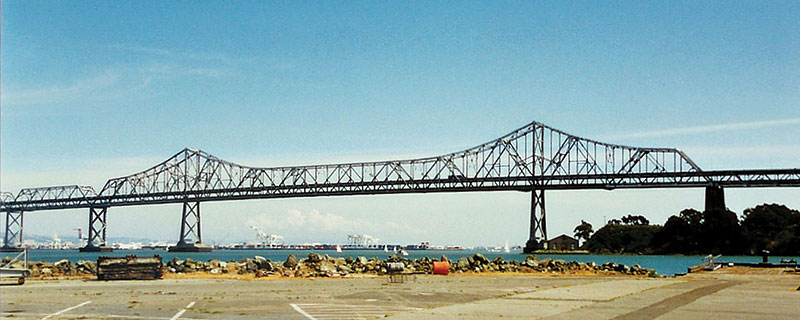
The western span

November 12, 1936: The San Francisco-Oakland Bay Bridge opens to automobile, bus and commuter rail traffic.

It often gets short shrift in comparison to the more famous Golden Gate Bridge. But the Bay Bridge (for simplicity's sake, I'm going to call it that from here on out) not only came first, but is longer (4.4 miles to 1.7), and carries more cars every day (260,000 to 110,000).

There are 2 sections. The western section, a suspension bridge, connects downtown San Francisco to Yerba Buena Island. It has 2 decks, with westbound (SF) traffic on the upper level and eastbound (Oakland) traffic on the lower level. The eastern section connects Yerba Buena Island to Oakland, and marks the western end of the transcontinental Interstate 80.
The original eastern span

The original eastern section was a cantilever bridge, also double-decked. In 1989, the Loma Prieta Earthquake not only interrupted the World Series between the San Francisco Giants and the Oakland Athletics, but it caused a part of the eastern section's upper deck to collapse onto the lower deck. On the official World Series highlight film, Giants catcher Terry Kennedy can be seen telling his teammates, "The Bay Bridge collapsed!" as it turned out, it was not the entire bridge, just one section; but people did die as a result.

The immediate fix took a month. But it was decided to replace the eastern section with a more quake-safe structure. On September 2, 2013, the new eastern section opened, a suspension bridge that took both directions of traffic on one level, then the widest bridge in the world.
The Key System ended commuter rail service in 1958, and bus service when it went out of business in 1960. Thus, the bridge has been all-car (and truck, and bus) since then. The Bay Area Rapid Transit (BART) system began service between the cities in 1972, but uses an underwater tunnel, not the Bay Bridge.

*

November 12, 1936 was a Thursday. Baseball was out of season. Football was in midweek. The NBA hadn't yet been founded. Two games were played in the NHL. The New York Americans and the Chicago Black Hawks played to a 0-0 tie at the old Madison Square Garden. And the Montreal Canadiens beat the Montreal Maroons, 2-1 at the Montreal Forum. 

Thursday, November 3, 2022

November 3, 1936: President Franklin D. Roosevelt Is Re-Elected

November 3, 1936: President Franklin D. Roosevelt defeats his Republican opponent, Governor Alfred M. Landon of Kansas, winning 46 out of 48 States, all but Vermont and Maine. He wins 523 Electoral Votes, Landon just 8. FDR wins 60.8 percent of the popular vote, to Landon's 36.5 percent.

Landon's next-best States? He won almost 48 percent in New Hampshire, almost 46 percent in his native Kansas, almost 45 percent in Delaware. If he had won those States, the Electoral Vote would have been 507-24 Roosevelt.
There were 8 other States where he got at least 40 percent. But even if he had won all of those, it would still have been 406-125 Roosevelt.

FDR increased his 1932 totals in part because black voters, still sticking with Herbert Hoover because he represented "the Party of Lincoln," saw that, while the Great Depression hit them harder than white people, as all economic slowdowns do, the New Deal helped them tremendously. (Though not fully: There was sharp criticism over a refusal to hire black people, including officials, in the various "Alphabet Soup" agencies.) Black voters gave Hoover a majority in 1932, but gave Roosevelt 71 percent of their vote in 1936.

In addition, Roosevelt broke the back of the Socialist movement in America. Norman Thomas, the Presbyterian minister who was the Socialist Party's nominee for President in every election from 1928 to 1948, was asked in 1936 if he thought Roosevelt had "carried out the Socialist platform." He said, "No, unless you mean he carried it out on a stretcher."

With Socialist labor leaders like Sidney Hillman, who ran the left-leaning Congress of Industrial Organizations (CIO), leading the way, people who had been voting Socialist voted Democratic. Thomas got 2.2 percent of the vote in 1932, but just 0.41 percent in 1936.

He actually finished 4th, behind the 1.9 percent of William Lemke, a former Republican Congressman from North Dakota. His Union Party was supported by such agitators as Father Charles Coughlin, the Detroit-based "radio priest" who turned on FDR for his seeming ingratitude in making the difference for him in 1932 (a delusion, as Coughlin's support made absolutely no difference); Gerald L.K. Smith, a Disciples of Christ minister from Wisconsin, who started out as a leftist populist like Senator Huey Long of Louisiana, whose Presidential ambitions died with his assassination in 1935, but turned far-right, and who was one of the few public figures in America willing to be as publicly anti-Semitic as Coughlin; and Francis Townsend, a California physician known for a pension plan that presaged the Social Security Act that FDR signed in 1935.

In other words, the Union Party couldn't decide whether it wanted to be far-left (like Townsend or Long) or far-right (like Coughlin and Smith), an early example of what would come to be known as "Horseshoe Theory": That each extreme began to resemble the other.

Aside from his home State of North Dakota, where he got 13 percent, Lemke's best performance was 6.6 percent in neighboring Minnesota. Thomas topped out at 1.5 percent in New York.

Seeing the array of would-be candidates for 1936 in 1935, including the still-living Long, who was bold enough to say, "I can take him," FDR said, "Gosh, everyone seems to be against me. Everyone but the people."

Because Maine had previously held its Presidential election a few weeks earlier, and it usually matched the vote in the country overall, there was a saying: "As Maine goes, so goes the nation." In November 1936, that became, "As Maine goes, so goes Vermont." Indeed, those would be the only 2 States that FDR never won. (Times have changed: Neither of those States have voted for the Republican Presidential nominee since 1988.)

A prankster put up a sign on the Badger's Island Bridge, over the Piscataqua River, connecting Portsmouth, New Hampshire with Kittery, Maine. Intended to be seen by people going to Maine, it read, "You are now leaving the United States."

Let the record show that Thomas did not swing a single State from Landon to Roosevelt. Nor did Lemke, with the possible exception of the other northern New England State, New Hampshire, where FDR got 49.7 percent, Landon got 48.0 percent, Lemke got 2.2 percent, and Thomas wasn't even on the ballot.

The Great Depression wasn't nearly as bad as it was in 1932, but by no means was it over. FDR winning was understandable -- but why by that much?

Well, the American people still did not trust the Republican Party. It had been just 4 years since the depth of the Depression. Plus, there were crazy people on the right wing back then, as there are now; and they made the GOP look not like the bunch of moderates their big names claimed to be, and Landon actually was, but like a bunch who couldn't be trusted with power.

Then there was the media. The major newspaper chains were all Republican-owned, and behind Landon. And in an era when they were the entirety of the media, Landon might have been a great candidate. He was smart, honest, and understood that he served the public, not the other way around. But this was now the era of radio and newsreels. He wasn't well-suited to it. FDR was.

The GOP didn't have anyone else who could beat FDR, either. Most of their big guns who had been elected in the Congressional elections of 1918, '20, '24 and '28 had been beaten in the elections of 1922, '26, '30, '32 and '34.

Finally, credit must be given to FDR: He was the master politician of his era, and his New Deal worked. Not perfectly, of course, but for the people for whom it did work, it was the difference between destitution and a living.

A story FDR liked to tell as he ran for a 2nd term in 1936 was this:

A wealthy man in a fine suit and top hat fell into deep water. He didn't know how to swim, and was on the verge of drowning. Hearing his cries, another man dove into the water, and saved him, as his top hat floated away. The man who had almost drowned regained his breath, and, for a moment, seemed grateful.

Three years later, though, he returned, and denounced his rescuer for not saving his hat, too!

The very rich, and their hired spokesmen, said FDR was trying to "destroy capitalism." Sound familiar? Their successors have said it about every Democratic President since.

Presidential candidates have frequently held rallies close to the election, sometimes in New York, sometimes in their hometowns. FDR, from Hyde Park, in Dutchess County, actually closer to Albany than to Midtown Manhattan, did have a home in Manhattan, so New York, for practical purposes, could be called his hometown. And so he had his close-to-Election Day rally at Madison Square Garden, arguably already, even though it did not use the slogan until well after its 1968 replacement was built, the world's most famous arena. Among other things, he said:

We had to struggle with the old enemies of peace -- business and financial monopoly, speculation, reckless banking, class antagonism, sectionalism, war profiteering. They had begun to consider the Government of the United States as a mere appendage to their own affairs. We know now that Government by organized money is just as dangerous as Government by organized mob.

Never before in all our history have these forces been so united against one candidate as they stand today. They are unanimous in their hate for me -- and I welcome their hatred.

I should like to have it said of my first Administration that, in it, the forces of selfishness and of lust for power met their match. I should like to have it said of my second Administration that, in it, these forces met their master!

And so they did.

FDR would be elected to a 3rd term in 1940, and a 4th in 1944, dying in office in 1945. Landon would serve out his term as Governor, return to the oil industry where he had made his money, and never ran for office again. He lived to be 100 years old, dying in 1987. His daughter, Nancy Landon Kassebaum, served Kansas in the U.S. Senate from 1978 to 1997.

*

November 3, 1936 was, as all American Election Days are, a Tuesday. Baseball season had ended the month before. Football was in midweek. The NBA hadn't been founded yet. And hockey season wouldn't start for another 2 days. So there were no scores on this historic day. But a sports legend was born on this day: Australian tennis star Roy Emerson.

Wednesday, November 2, 2022

November 2, 1936: The CBC & the BBC

November 2, 1936: The Canadian Broadcasting Corporation (CBC) is founded. It picks up Canada's favorite (or, should I say, its favourite) radio show, Hockey Night In Canada, which began in 1931. In 1952, a bit late, they began TV broadcasting, and HNIC remains the country's most popular TV show.

On the same day, the British Broadcasting Corporation begins the BBC Television Service, inventing what we would now call "network television." In 1964, it is renamed BBC1.
"The Beeb" beat America to network by 11 years. Oddly, they would be behind the curve when it came to "colour" TV: While nearly every U.S. TV show that had not already switched to broadcasting in color would do so by the start of the 1965-66 season, the CBC the next season (using a butterfly as a logo, as opposed to NBC's Peacock), and the U.K.'s BBC and ITV wouldn't do so until 1969.

Currently, the CBC airs on 14 affiliates. From east to west, they are:

* St. John's Newfoundland and Labrador: CBNT, Channel 8
* Charlottetown, Prince Edward island: CBCT, Channel 13
* Halifax, Nova Scotia: CBHT, Channel 3
* Saint John, New Brunswick: CBAT, Channel 4
* Montreal, Quebec: CBMT, Channel 6
* Ottawa, Ontario: CBOT, Channel 4
* Toronto, Ontario: CBLT, Channel 5
* Windsor, Ontario (across from Detroit): CBET, Channel 9
* Winnipeg, Manitoba: CBWT, Channel 6
* Regina, Saskatchewan: CBKT, Channel 9
* Calgary, Alberta: CBRT, Channel 9
* Edmonton, Alberta: CBXT, Channel 5
* Vancouver, British Columbia: CBUT, Channel 2
* Yellowknife, Northwest Territories: CFYK, Channel 8

CTV was launched as a competitor to the CBC in 1961. TVA was launched as a French-only network in Quebec in 1971.

*

November 2, 1936 was a Monday. Baseball season was over. Football was in midweek. The NBA hadn't been founded yet. And the NHL season started 3 days later. so there were no scores on this historic day.

Monday, October 31, 2022

October 31, 1936: FDR Welcomes Conservatives' Hatred

October 31, 1936: Madison Square Garden -- the 3rd one, on 8th Avenue between 49th and 50th Streets, then still fairly new, but known to my generation as "The Old Garden" -- hosts its greatest moment. And it had nothing to do with sports.

It is 3 days before a Presidential election. President Franklin Delano Roosevelt, the incumbent Democrat, is running for re-election. The Republican nominee is the Governor of Kansas, Alfred M. Landon. Landon is not the problem: His campaign was rather inoffensive.

Considerably more offensive are the charges that many have made against Roosevelt and his series of programs for lifting the country out of the Great Depression, programs he put under the umbrella term "The New Deal." FDR summarized these, in a more palatable way, in a speech to the nation over the radio networks of the time, a.k.a. one of his "Fireside Chats," on June 28, 1934:

A few timid people, who fear progress, will try to give you new and strange names for what we are doing. Sometimes they will call it "Fascism," sometimes "Communism," sometimes "Regimentation," sometimes "Socialism." But, in so doing, they are trying to make very complex and theoretical something that is really very simple and very practical.

A story FDR liked to tell as he ran for a 2nd term in 1936 was this:

A wealthy man in a fine suit and top hat fell into deep water. He didn't know how to swim, and was on the verge of drowning. Hearing his cries, another man dove into the water, and saved him, as his top hat floated away. The man who had almost drowned regained his breath, and, for a moment, seemed grateful.

Three years later, though, he returned, and denounced his rescuer for not saving his hat, too!

The very rich, and their hired spokesmen, said FDR was trying to "destroy capitalism." Sound familiar? Their successors have said it about every Democratic Presidential nominee since.
Presidential candidates have frequently held rallies close to the election, sometimes in New York, sometimes in their hometowns. John F. Kennedy had his at the Boston Garden in 1960. Bill Clinton, having already had the Democratic Convention at the 4th and current version of The Garden, had one at the Meadowlands Arena 2 days before.

FDR, from Hyde Park, in Dutchess County, actually closer to Albany than to Midtown Manhattan, did have a home in Manhattan, so New York, for practical purposes, could be called his hometown. And so he had his close-to-Election Day rally at The Garden, which was arguably already, even though it did not use the slogan for decades to come, the world's most famous arena. He said:

We had to struggle with the old enemies of peace -- business and financial monopoly, speculation, reckless banking, class antagonism, sectionalism, war profiteering. They had begun to consider the Government of the United States as a mere appendage to their own affairs. We know now that Government by organized money is just as dangerous as Government by organized mob.

Never before in all our history have these forces been so united against one candidate as they stand today. They are unanimous in their hate for me -- and I welcome their hatred.

I should like to have it said of my first Administration that, in it, the forces of selfishness and of lust for power met their match. I should like to have it said of my second Administration that, in it, these forces met their master!...
Here is an amazing paradox! The very employers and politicians and publishers who talk most loudly of class antagonism and the destruction of the American system now undermine that system by this attempt to coerce the votes of the wage earners of this country. It is the 1936 version of the old threat to close down the factory or the office if a particular candidate does not win. It is an old strategy of tyrants to delude their victims into fighting their battles for them.

FDR went on in this vein for some time. Tweaking the details, this speech could have been given by a Democratic leader in every Presidential election that has followed.
*
October 31, 1936 was a Saturday. Actor Michael Landon was born on this day.
Baseball season was over. The NHL season began 5 days later. The NBA hadn't been founded yet. And while the NFL had been known to schedule games for Saturdays in this era, they did not do so on this occasion. But there were college football games, including the following:
* Number 1 Minnesota were beaten by Number 3 Northwestern, 6-0 at Dyche Stadium (now Ryan Field) in the Chicago suburb of Evanston, Illinois. This was the 1st season with the Associated Press poll, of the nation's college football writers. This win, and Number 2 Pitt's tie, vaulted Northwestern to Number 1 in the next poll. They went on to win the Big Ten Conference title, but blew their undefeated season in their last game, losing to Notre Dame. Despite not even winning their own league, Minnesota were awarded the National Championship by the AP. So the poll system was flawed from the very beginning.
* Number 2 University of Pittsburgh and Number 5 Fordham played to a 0-0 tie at the Polo Grounds. This was the 2nd of 3 straight seasons in which Pitt and Fordham played each other at the Polo Grounds, without either scoring. Finally, in 1938, they played at Pitt Stadium, and Pitt won, 24-13.
* Number 4 University of Washington beat Oregon, 7-0 at Multnomah Stadium (now Providence Park) in Portland, Oregon. Washington won the Pacific Coast Conference title, but Pitt beat them in the Rose Bowl
* Number 6 Army were upset by Colgate, 14-7 at Michie Stadium in West Point, New York.
* Number 8 Louisiana State beat Vanderbilt, 19-0 at Dudley Field (now First Bank Stadium) in Nashville. LSU finished the regular season undefeated, and won the Southeastern Conference title.
* Number 9 Tulane beat Louisiana Tech, 22-13 at Tulane Stadium in New Orleans.
* Number 10 Marquette beat Number 20 Saint Mary's of California, 20-6 at Marquette Stadium in Milwaukee. 
* Number 11 Nebraska beat Missouri, 20-0 at Memorial Stadium in Lincoln, Nebraska. Nebraska won the Big Six Conference title (later the Big Seven, the Big Eight, and the Big Twelve). They were not invited to any of the early bowl games, but they did have inter-sectional matchups, losing to Pittsburgh at home, and beating Oregon State in Portland.
* Number 12 Yale were upset by Dartmouth, 11-7 at the Yale Bowl in New Haven, Connecticut.
* Number 16 Auburn were upset by Number 19 Santa Clara, 12-0 at Kezar Stadium in San Francisco. Santa Clara were invited to the Sugar Bowl, and beat LSU.
* Number 20 Pennsylvania beat Navy, 16-6 at Franklin Field in Philadelphia.
* Notre Dame beat Ohio State, 7-2 at Notre Dame Stadium in South Bend, Indiana.
* North Carolina beat North Carolina State, 21-6 at Kenan Stadium in Chapel Hill, North Carolina.
* Mississippi State beat Sewanee University, 68-0 at Municipal Stadium in Jackson, Mississippi. Sewanee, based in Sewanee, Tennessee, downgraded their football program in 1940, dropping out of the Southeastern Conference. Since 1973, they have played in NCAA Division III.
* The night before, Duquesne University of Pittsburgh lost to the University of Detroit, 14-7 at University of Detroit Stadium. Duquesne rebounded from this, and were invited to the Orange Bowl, where they beat Mississippi State. Duquesne closed its football program after the 1950 season, and restored it at the NCAA Division I-AA (now NCAA FCS) in 1993. The University of Detroit closed its football program after the 1964 season, and haven't restarted it. They've been the University of Detroit Mercy since 1980.
* Texas Christian University beat Baylor, 28-0 at Amon G. Carter Stadium in Fort Worth, Texas. TCU, led by quarterback Sammy Baugh, won the Southwest Conference title. They were invited to play in the inaugural Cotton Bowl in Dallas, and beat Marquette, 16-6. Marquette closed its football program after the 1960 season.
* In New York City, in addition to Fordham's scoreless tie with Pitt, New York University beat Lafayette, 46-0 at Yankee Stadium; and Manhattan beat City College, 28-7 at Ebbets Field.
And among New Jersey's teams, Number 17 Princeton were held to a tie by Harvard, 14-14 at Harvard Stadium in Boston; and Rutgers lost to Lehigh, 19-0 at Neilson Field in New Brunswick.

Monday, October 24, 2022

October 24, 1936: "The Devil and Daniel Webster" Is Published

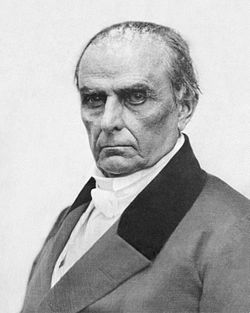
Daniel Webster

October 24, 1936: The Devil and Daniel Webster, written by Stephen Vincent Benét, is published in The Saturday Evening Post.

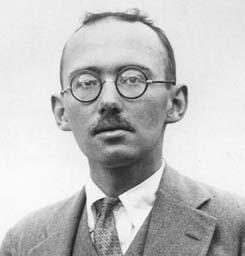
Benét was born on July 22, 1898 in Fountain Hill, in the Lehigh Valley in northeastern Pennsylvania. He graduated from Yale University, where he and Our Town writer Thornton Wilder were fellow members of the Elizabethan Club and fellow staff members of The Yale Literary Magazine. He became famous in 1928 with the publication of the short story John Brown's Body.
Stephen Vincent Benét

Short stories were his milieu, and, 3 times, he won the O. Henry Award for the best short story of the year. One of these would come in 1937, for The Devil and Daniel Webster. He died of a heart attack on March 13, 1943, only 44 years old. 

The Devil and Daniel Webster is a variation on the German story of Faust, a man highly successful yet dissatisfied with his life, which leads him to make a deal with the Devil at a crossroads, exchanging his soul for unlimited knowledge and worldly pleasures. It has been told by English writer Christopher Marlowe in The Tragical History of Doctor Faustus in 1594, by German writer Johann Wolfgang von Goethe in Faust in 1808, and Charles Gounod's 1859 opera based directly on Goethe's work.

In Benét's story, farmer Jabez Stone, from the small town of Cross Corners, New Hampshire, is plagued with unending bad luck. He finally says, "It's enough to make a man want to sell his soul to the devil!" The next day, he is visited by a stranger, identified as "Mr. Scratch," who offers to give him 7 years of prosperity in exchange for his soul. Stone agrees.

Scratch comes for Stone's soul at the appointed time, and Stone bargains for more years. Scratch refuses. To get him out of the deal, Stone hires the greatest American lawyer of his time: Daniel Webster, longtime U.S. Senator from New Hampshire.

Webster has to get around the fact that the contract, and Stone's signature thereon, are clear. He says, "Mr. Stone is an American citizen, and no American citizen may be forced into the service of a foreign prince." Scratch insists on his own American citizenship, citing his presence at the worst events in the history of the U.S., concluding, "Though I don't like to boast of it, my name is older in this country than yours."

Webster demands a trial, as the right of every American. Mr. Scratch agrees after Webster says that he can select the judge and jury, "So long as it is an American judge and an American jury."

A jury of evil men enters. They had all played a part in the formation of the United States, including the Wampanoag chief known to settlers as King Philip, Royal Governor Thomas Dale of the Virginia Colony, and Edward Teach, a.k.a. the pirate Blackbeard. Benedict Arnold is said to be out "on other business." The judge is the one who presided at the Salem witch trials of 1692, John Hathorne. It seems the trial is rigged.

Webster speaks passionately of how wonderful it is to be human and to be an American. He admits the wrongs done throughout the course of American history, but points out that something new and good had grown from them and that "everybody had played a part in it, even the traitors.". Humankind "got tricked and trapped and bamboozled, but it was a great journey," something that no demon could ever understand.

Thus is the jury swayed: "We find for the defendant, Jabez Stone." Scratch tears up the contract, having agreed to a jury trial, and thus put his contract within the reach of the Common Law used in the United States, under which a jury can enter whatever verdict it likes, regardless of the law.

In real life, Webster was not just one of his era's greatest lawyers, but one of its greatest politicians and public speakers. He was one of the few members of Congress to have been elected from 2 different States: At-large from New Hampshire in 1812 and 1814, and from the 1st District of Massachusetts in 1822, 1824 and 1826. He served in the Senate from Massachusetts from 1827 to 1841, and again from 1845 to 1850. He was U.S. Secretary of State from 1841 to 1843, under Presidents William Henry Harrison and John Tyler; and again from 1850 until his death in 1852, under President Millard Fillmore.

His verbal sparring with Senator John Hayne of South Carolina over the issue of slavery in 1830 has gone down in legend. His defense of the Compromise of 1850, which allowed a Fugitive Slave Law but probably held the Civil War off for 10 years, earned him vitriol at the time, but praise over a century later from another Senator from Massachusetts, future President John F. Kennedy, in his book Profiles in Courage.

In 1957, Kennedy headed a committee to name the 5 greatest Senators in history, and Webster was chosen. The others were 2 contemporaries of Webster's, Henry Clay of Kentucky and John C. Calhoun of South Carolina; and 2 from the 20th Century, Robert La Follette of Wisconsin and Robert Taft of Ohio. Portraits of these "Famous Five" were hung in the Senate Reception Room.

Daniel Webster was not related to Noah Webster, who in 1828 published An American Dictionary of the English Language, despite being contemporaries and fellow New Englanders. (Noah was from Connecticut.)

The story has been filmed twice, sort-of. In 1941, a film was released under the title All That Money Can Buy, before reverting to the story's original title. James Craig played Stone, Edward Arnold played Webster, and Walter Huston was nominated for an Academy Award for playing Mr. Scratch.
Arnold as Webster (left) and Huston as Scratch

In 2001, a version set in the present day was made with Alec Baldwin as a struggling author named Jabez Stone, Anthony Hopkins as a publisher named Daniel Webster, and Jennifer Love Hewitt as a female Devil. (Perhaps borrowing from Elizabeth Hurley in the 2000 remake of Bedazzled.) This version, with some linguistic irony, "got stuck in development hell," before being released in 2007 as Shortcut to Happiness.

The story was also adapted for a 1968 episode of The Monkees, "The Devil and Peter Tork."

*

October 24, 1936 was a Saturday. Bill Wyman, longtime bass guitarist for The Rolling Stones, was born.

Among the college football games played that day, in this 1st season of the Associated Press poll rankings, were these:

* Number 1 Minnesota beat Number 5 Purdue, 33-0 at Memorial Stadium in Minneapolis.

* Number 2 Duke lost to Tennessee, 15-13 at Shields-Watkins Field (renamed Neyland Stadium in 1962) in Knoxville, Tennessee.

* Number 3 Army beat Springfield College, 33-0 at Michie Stadium in West Point, New York. Springfield, site of the invention of basketball in 1891, now play in NCAA Division III.

* Number 4 Northwestern beat their arch-rivals, Illinois, 13-2 at Memorial Stadium in Champaign, Illinois.

* Number 6 University of Southern California beat Stanford, 14-7 at the old Stanford Stadium in the San Francisco suburb of Palo Alto, California.

* Number 7 Notre Dame lost to Number 9 University of Pittsburgh, 26-0 at Pitt Stadium in Pittsburgh.

* Number 8 Washington beat the University of California, 13-0 at University of Washington Stadium (renamed Husky Stadium in 1970) in Seattle.

* Number 10 Yale beat Rutgers, 28-0 at the Yale Bowl in New Haven, Connecticut.

* Navy lost to Princeton, 7-0 at Palmer Stadium in Princeton.

* In what would eventually become a major rivalry game, Nebraska beat Oklahoma, 14-0 at Memorial Stadium in Norman, Oklahoma.

* In what was already a major rivalry game, Colorado beat Colorado A&M, 9-7 at Colorado Field in Fort Collins, Colorado. A&M became Colorado State University in 1957.

* In another rivalry game, Utah State beat Utah, 12-0 at Aggie Stadium in Logan, Utah.

* Among New York City teams, Number 16 Fordham mildly upset Number 12 Saint Mary's of the San Francisco Bay Area, 7-6 before 50,000 at the Polo Grounds; New York University (NYU) played Georgetown to a tie, 7-7 before 16,000 at Yankee Stadium; Manhattan College lost to the University of Detroit, 20-0 before 15,000, not in Manhattan but at Ebbets Field in Brooklyn; City College of New York (CCNY) beat Drexel, 6-0 at Drexel Field in Philadelphia; and Columbia lost 13-0 to Michigan, 13-0 at Michigan Stadium in Ann Arbor; 

The baseball season had ended 18 days earlier, when the New York Yankees beat the New York Giants in the World Series. The NBA hadn't been founded yet. The NHL season began 12 days later.

In English soccer, Arsenal and Grimsby Town played to a 0-0 draw at the Arsenal Stadium, a.k.a. Highbury, in North London.

Monday, October 10, 2022

October 10, 1936: The 1st "Script Ohio"

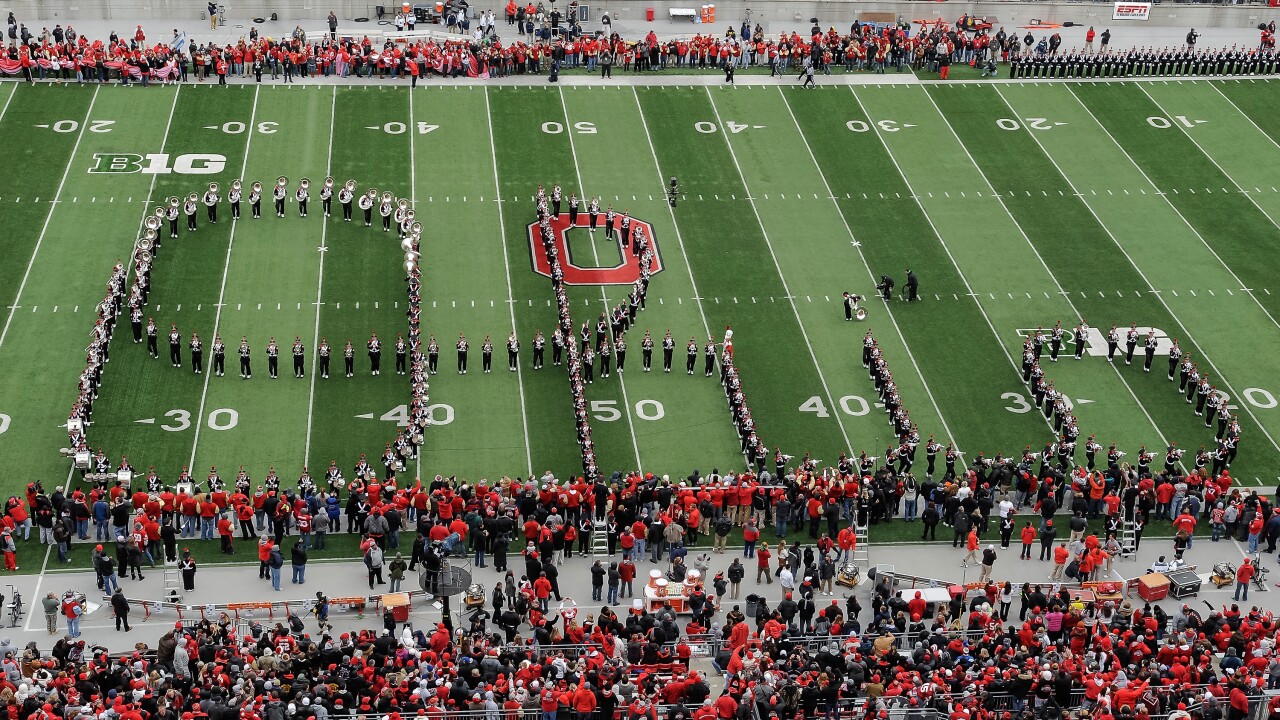
October 10, 1936: The Ohio State University Marching Band first performs their Script Ohio
formation, at Ohio Stadium in Columbus. Their football team is not up to the task: It loses to the University of Pittsburgh, 6-0.

The formation is based on the sign at the Loew's Ohio Theatre in downtown Columbus, although the capital O now resembles the block O in Ohio State's logos. They march to "Le Régiment de Sambre et Meuse," a French poem by Paul Cézano (not to be confused with the painter Paul Cézanne), set to music by Robert Planquette and arranged and expanded into a military march by Joseph-François Rauski. It was composed in 1870 -- the same year in which The... Ohio State University was founded.

At the various junctions in the formation, the band members swing their horns. This is especially difficult for those with heavy instruments, like the sousaphone. At the conclusion of the formation, the drum major leads a sousaphone player to the top of the lower case i in "Ohio," and he "dots the i." It's always a senior, and the seniors get their choice of games. The one with the most seniority inevitably chooses the Michigan game.

"Dotting the i" is considered the highest honor at Ohio State. The following people have been honorary i-dotters:

* 1971: Novice Fawcett, University President, 1956-72.

* 1974: Richard Heine, Band head composer and arranger, 1935-85, making him, essentially the father of Script Ohio.

* 1978: Bob Hope, entertainer, who grew up in Cleveland.

* 1979: Jack Evans, Band Director, 1952-64.

* 1983: Dr. Paul Droste, Band Director, 1970-83.

* 1983: Woody Hayes, head football coach, 1951-78.

* 1985: Robert Ries, Ohio State ticket director, 

* 1990: James "Buster" Douglas, a Columbus native, then in his brief reign as Heavyweight Champion of the World.

* 1995: Dr. E. Gordon Gee, University President, 1990-98, and again 2007-13.

* 2006: Jack Nicklaus, golf legend, Columbus area native, played at Ohio State. He left a few credits short of a degree, but was awarded an honorary doctorate in 1972.

* 2009: John Glenn, former astronaut and U.S. Senator, and his wife, Annie Glenn, advocate for people with disabilities. Both graduated from nearby Muskingum College, but maintained ties to Ohio and to OSU.

* 2011: Dr. Jon Woods, band director, 1984-2012.

* 2011: Lex Wexner, Ohio State Class of 1959, CEO of L Brands, makers of women's lingerie and beauty products, and a major OSU donor.

* 2016: Earle Bruce, head football coach, 1979-87.

UPDATE: 2024: Archie Griffin, Ohio State running back, the only 2-time winner of the Heisman Trophy, 1974 and '75.

On occasion, the Band will do a "Double Script": A Script facing each side. On Homecoming, they join with the Alumni Band to do a "Quadruple Script."

*

October 10, 1936 was a Saturday. The baseball season had ended 4 days earlier, when the New York Yankees beat the New York Giants in the World Series. It was too early for the basketball season or the hockey season. The NFL played the next day. But there were other college football games on this day:

* Minnesota beat Nebraska, 7-0 at Memorial Stadium in Minneapolis. Nebraska would win the Big Six Conference title anyway.

* Northwestern beat North Dakota Agricultural, 40-7 at Dyche Stadium in Evanston, Illinois. Northwestern would later be ranked Number 3 in the nation -- 1936 was the 1st season of the Associated Press (AP) poll of sportswriters -- and beat Number 1 Minnesota at Dyche Stadium, giving them the Big Ten Conference title. But a season-ending loss to Notre Dame would cost them the National Championship, which ended up being awarded to Minnesota, anyway.

Northwestern would rename Dyche Stadium Ryan Field in 1997. North Dakota Agricultural would change its name to North Dakota State in 1960.

* Speaking of Notre Dame, they beat Washington University of St. Louis, 14-6 at Notre Dame Stadium in South Bend, Indiana.

* Louisiana State beat Georgia, 47-7 at Tiger Stadium in Baton Rouge, Louisiana. LSU were declared Southeastern Conference Champions, but blew a shot at the National Championship when they went into the Sugar Bowl ranked Number 2 in the country, and lost to Santa Clara University. (For some reason, they did not play on this day, instead playing the next day, a rare college game on Sunday: They beat the University of San Francisco, 15-7 at Kezar Stadium in San Francisco.)

* Alabama beat Mississippi State, 7-0 at Denny Stadium in Tuscaloosa, Alabama. It was renamed Bryant-Denny Stadium in 1975. Like LSU, 'Bama finished the regular season undefeated, but it had a tie in conference play, to Tennessee the week after this, and that cost them the SEC title.

* Arkansas beat Baylor, 14-10 at The Hill in Fayetteville, Arkansas. They went on to win the Southwest Conference Championship.

* The University of Washington beat UCLA, 14-0 at the Los Angeles Memorial Coliseum. Washington went on to win the Pacific Coast Conference, but lost to the University of Pittsburgh in the Rose Bowl. Pitt thus claims this season's National Championship -- although, at 8-1-1, it's debatable as to whether they had a better claim to it than did 7-1 Minnesota.

* Navy beat Virginia, 35-14 at Thompson Stadium in Annapolis, Maryland.

* In New York City, Army beat Columbia, 27-16 at Yankee Stadium.

* New York University beat Pennsylvania Military College, 26-0 at Ohio Field in The Bronx. PMC became Widener University in 1972, and now compete in NCAA Division III. At least they still have a football team: NYU suspended their program in 1953, and its other sports teams also compete in Division III.

* And in New Jersey, Princeton beat Rutgers, 20-0 at Palmer Stadium in Princeton.

December 31, 1999 & January 1, 2000: The Millennium

December 31, 1999:  The Millennium arrives. The people of planet Earth survived. At a terrible cost. But we hadn't destroyed ourselves. ...