Showing posts with label john elway. Show all posts

Tuesday, January 25, 2022

January 25, 1998: The Denver Broncos Finally Win a Super Bowl

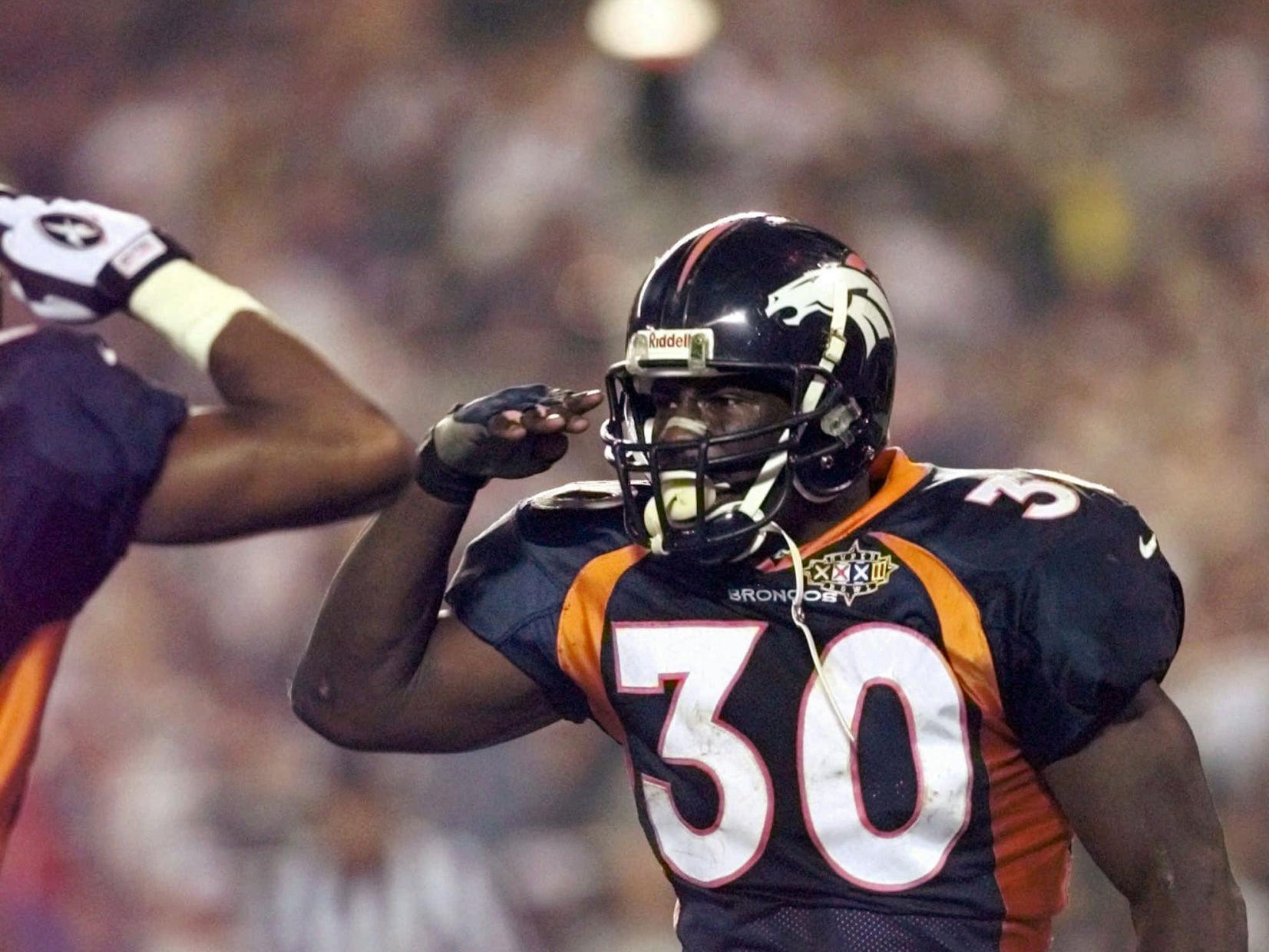
Terrell Davis and "The Mile High Salute"

January 25, 1998: Super Bowl XXXII is played, at what was then known as Qualcomm Stadium in San Diego.

The NFC Champions were the Green Bay Packers. They had won the Super Bowl the year before, taking their 12th World Championship, leading all NFL teams. With an offense led by future Hall-of-Fame quarterback Brett Favre, and a defense led by future Hall-of-Famer Reggie White, they looked primed to repeat. Especially since the NFC had won 13 straight Super Bowls, going back to Super Bowl XVIII, won by the then-Los Angeles Raiders.

Another good sign for the Packers is that the AFC Champions were the Denver Broncos. This was their 5th trip to the Super Bowl, and they had lost the 1st 4. They had lost Super Bowl XII to the Dallas Cowboys, despite having a great defense known as the Orange Crush. They lost Super Bowl XXI to the New York Giants, Super Bowl XXII to the Washington Redskins, and Super Bowl XXIV to the San Francisco 49ers, all with John Elway as their quarterback and Dan Reeves as their head coach.

They had always sold out Mile High Stadium since 1977, the season of "Broncomania" that ended with the Super Bowl XII defeat. They were, far and away, the most popular sports team in the Rocky Mountain region, even thought the recently arrived Colorado Avalanche had won the 1996 Stanley Cup, for the region's 1st title; and the Colorado Rockies had sold more tickets than any team in Major League Baseball since their 1993 expansion debut.

They had some dramatic victories over the years, including their defeats of the Oakland Raiders in the 1977 AFC Championship Game, and of the Cleveland Browns in back-to-back AFC title games for the 1986 and 1987 seasons. But they couldn't win the big one.

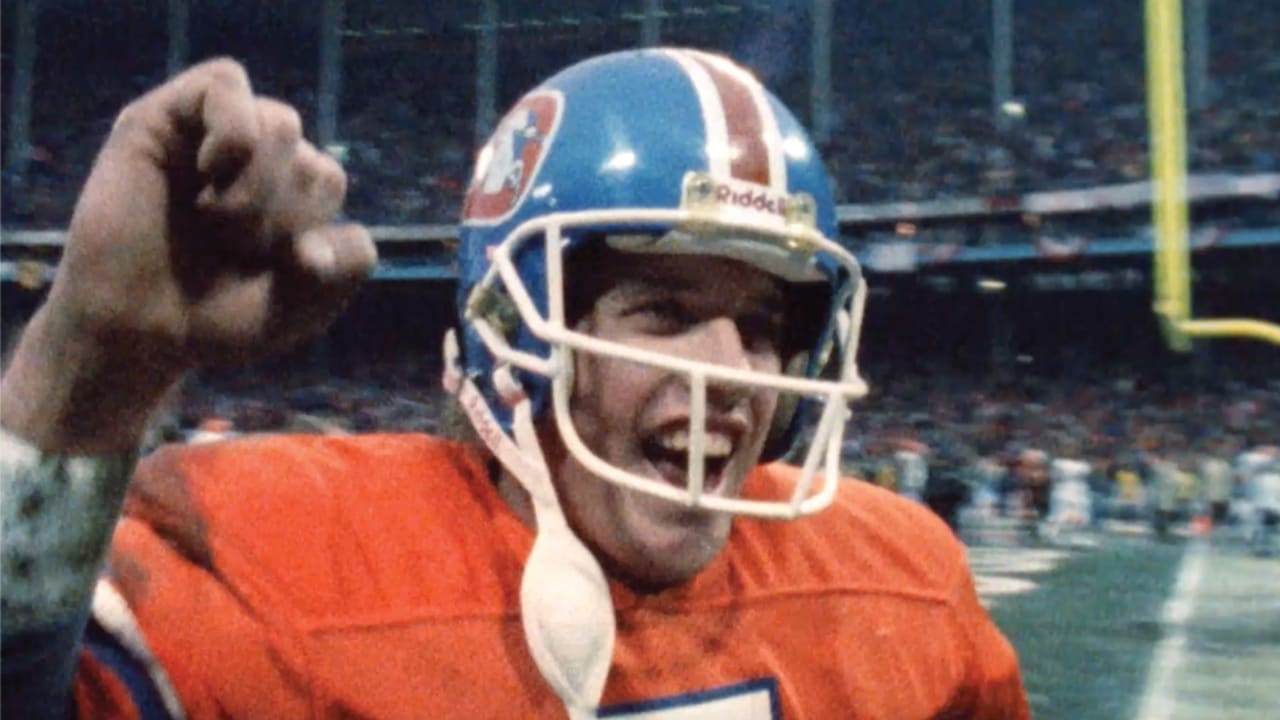
Starting in 1968, the Broncos had worn orange jerseys (hence the "Orange Crush" nickname), and bright blue helmets with an orange D, with a charging white horse inside it. It was a hard logo to draw, but the whole thing was among the most distinctive uniform designs in sports.
John Elway, 1987

For 1997, they scrapped that for a new design, with purple jerseys with a weird new number font, and purple helmets with a white horse's head. This, too, was distinctive. I didn't like the change in number font, but the helmet was much better.
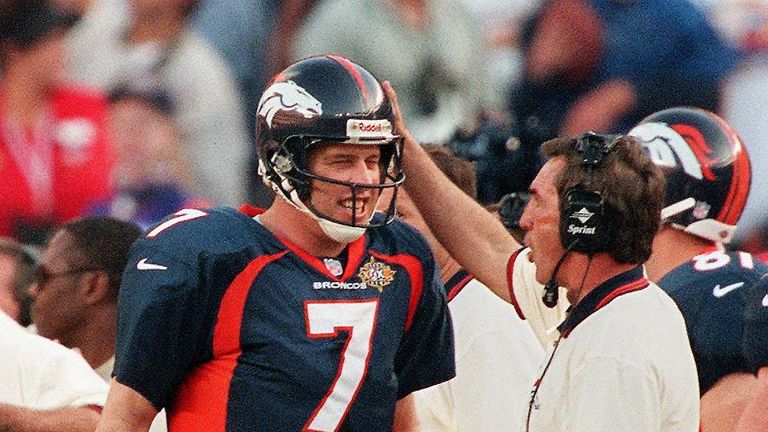
Elway and head coach Mike Shanahan, 1997

But new uniforms wouldn't be enough. The Cincinnati Bengals found that out in 1981, when they switched to their striped helmets, and made the Super Bowl, only to lose it.

But head coach Mike Shanahan had revamped the team after the Reeves years. He built a new defense, with end Neil Smith, linebacker Bill Romanowski, former San Francisco cornerback Tim McKyer, and a holdover from the previous Bronco Super Bowls, safety Steve Atwater, possibly the hardest hitter in the game at the time.

But Shanahan was an offense-first coach. He got Elway something he'd never had before: A star running back, to take some of the pressure off him. He was a University of Georgia graduate named Terrell Davis, and he was exactly what Elway needed to remove his name from consideration, alongside Y.A. Tittle, Dan Marino and Jim Kelly, for the title of "greatest quarterback to never win a World Championship."

The Broncos went 12-4 in 1997. All 4 losses were on the road: By 3 to the Oakland Raiders, 2 to the Kansas City Chiefs, 11 to the Pittsburgh Steelers, and 17 to the San Francisco 49ers. However, they did have a 2-3 stretch toward the end of the season, followed by a win over the San Diego Chargers in the regular-season finale.

The season before, they had an ignominious Playoff defeat at the hands of the Jacksonville Jaguars. This time, they not only avenged that defeat with a 42-17 win over the Jags at Mile High, but they also went on the road and avenged 2 of their regular-season defeats: They beat the Chiefs 14-10 at Arrowhead Stadium, and then, in the AFC Championship Game, went to Three Rivers Stadium, and beat the Steelers, 24-21.

The Broncos had shown character. Elway was much more mature, much more patient, and much less reliant on his cannon of an arm that he had been in the 1980s. If any AFC team could dethrone the Packers as Champions, it was the '97 Broncos.

UPDATE: The Broncos have a Ring of Fame. As of the 2025 NFL season, it includes:

* From their founding era, 1960 to 1976: Quarterbacks Frank Tripucka and Charley Johnson, running backs Gene Mingo and Floyd Little, end Lionel Taylor, defensive end Rich "Tombstone" Jackson, safety Austin "Goose" Gonsoulin, owner Gerald Phipps. Tripucka, Gonsoulin, Jackson, Taylor, Little, Phipps, founding owner Bob Howsam, and running back Bobby Anderson have also been elected to the Colorado Sports Hall of Fame.

* From their 1977 AFC Champions: Phipps, quarterback Craig Morton, receivers Haven Moses and Rick Upchurch, tight end Riley Odoms, defensive tackle Paul Smith, linebackers Randy Gradishar and Tom Jackson, cornerback Louis Wright, safeties Billy Thompson and Steve Foley, kicker Jim Turner, and head coach Robert "Red" Miller. Phipps, Morton, Moses, Upchurch, Gradishar, Wright, Thompson, Miller, running back Otis Armstrong and 1970s and '80s defensive coordinator Joe Collier have also been elected to the Colorado Sports Hall of Fame.

* From their 1986, 1987 and 1989 AFC Champions: Quarterback John Elway, linebacker Karl Mecklenburg, safety Dennis Smith, head coach Dan Reeves, and owner Pat Bowlen. Collier, Elway, Mecklenburg, Smith, Reeves and Bowlen have also been elected to the Colorado Sports Hall of Fame.

* From their Super Bowl XXXII and XXXIII winners: Elway, Bowlen, running back Terrell Davis, receiver Rod Smith, tight end Shannon Sharpe, center Tom Nalen, tackle Gary Zimmerman, linebacker Simon Fletcher, safety Steve Atwater, kicker Jason Elam, and head coach Mike Shanahan. Elway, Bowlen, Smith, Davis, Sharpe, Atwater, Elam, Shanahan, receiver Ed McCaffrey and defensive end Alfred Williams have also been elected to the Colorado Sports Hall of Fame.

* From the 2000s: Safety John Lynch. Lynch has not been elected to the Colorado Sports Hall of Fame, but tight end Daniel Graham has.

* From their 2013 AFC Champions who lost Super Bowl XLVIII: Elway (by then the general manager), Bowlen, receiver Demaryius Thomas and cornerback Champ Bailey.

* From their 2015 AFC Champions who won Super Bowl 50: Elway, Bowlen, Thomas, Bailey, and quarterback Peyton Manning. Elway, Bowlen, Bailey and Manning  have also been elected to the Colorado Sports Hall of Fame.

*

The Packers got the ball first, and scored on their opening drive, a 22-yard touchdown pass from Favre to Antonio Freeman. The Broncos immediately struck back, helped by a defensive holding penalty that nullified an Elway incompletion on 3rd down. Davis, a San Diego native playing in the stadium where he'd grown up rooting for the Chargers and baseball's San Diego Padres, scored from a yard out. This remains the only Super Bowl where both teams scored on their opening drives.

The Packers' next drive ended when Tyrone Braxton intercepted Favre in Green Bay territory. Elway took advantage, and scored himself on a 1-yard run. The Broncos had led 10-9 at the half in Super Bowl XXI, and 10-0 early in the 2nd quarter of Super Bowl XXII. Both of those games fell apart, as the opposition outscored them 30-10 and 42-0 the rest of the way. But, having watched those games, I sensed something was different this time.

David later claimed that he played the game with a migraine headache, to the point where, until he took some medication, he was blind. But the Broncos made their own breaks: When Atwater sacked Favre and forced a fumble that Smith recovered, Jason Elam kicked a 51-yard field goal, then the 2nd-longest in Super Bowl history, and it was 17-7 Denver.

Late in the half, the Packers began a drive from their own 5, and Favre ended it with a 6-yard pass to Mark Chmura. The Pack went into the locker room trailing 17-14, and felt like they had the momentum. Would this be another Bronco Super Bowl collapse?

Maybe: Davis fumbled on the opening drive of the 2nd half, and the Packers converted that into a game-tying field goal. But the Packers stalled, and Elway went to work. His drive included a 36-yard pass to Ed McCaffrey. On 3rd & 6 from the Packer 12, Elway ran for 8 yards, and was hit by the Packers' LeRoy Butler and Mike Prior, spinning him in midair. The play became known as "The Helicopter," and it showed that Elway, previously thought of as a privileged pretty boy who couldn't get the big joe done, had some toughness. Two plays later, Davis scored on another 1-yard run. It was 24-17 Denver.

Early in the 4th quarter, Favre threw another touchdown pass to Freeman, tying the game. It was still tied with 3:27 left in regulation, when the Broncos forced the Packers to punt and got the ball back at the Packer 49. On the next play, Darius Holland made what might be the biggest mistake in Packer history, a facemask penalty on Davis that cost Green Bay 15 yards.

With 1:47 left, the Broncos were at 2nd & goal on the Packer 1. With 2 time-outs left, Packer coach Mike Holmgren told his players to let the Packers score, to give the offense enough time. Davis became the 1st player (and remains the only one) to rush for 3 touchdowns in a single Super Bowl. It was Broncos 31, Packers 24.

After each touchdown, Davis found the nearest teammate, and gave him a military-style salute. It became known as "The Mile High Salute."

There was 1:45 to go, with the Packers having 2 time-outs left. Freeman returned Elam's kickoff to the 30. Favre threw a screen pass to Dorsey Levens, who got to the Bronco 48 with 1:30 left. But the next play was also a screen pass to Levens. He caught it, but was stopped for no gain, and the Packers had to burn a time-out.

The Packers reached the Bronco 31, with 37 seconds to go. A field goal would do them no good. It was 3rd & 6. Favre threw to Brooks, who was covered by Randy Hilliard. Atwater also went for the ball, and his hit knocked out Brooks, Hilliard, and himself. NFL rules say that if players on both teams are injured and need medical attention on the field in the last 2 minutes of a game, both teams are charged with a time-out.

So it was 4th & 6 at the Bronco 31. There were 32 seconds left, and no time-outs. Favre looked for Chmura, but John Mobley broke it up, and the Broncos took over on down. Elway knelt on the ball for the last play of his greatest victory. After going 0-3 with Elway as quarterback, and 0-4 overall, the Denver Broncos were World Champions for the 1st time.

This broke a 13-year winning streak for the NFC. And a 37-year streak of failure for the Broncos to win the big one. It was John Elway's moment. But it wouldn't have happened without Terrell Davis, who, along with Atwater, tight end Shannon Sharpe, offensive tackle Gary Zimmerman, and team owner Pat Bowlen (but, thus far, not Shanahan), would join him in the Pro Football Hall of Fame.

Nine months later, Qualcomm Stadium became the only stadium ever to host the Super Bowl and the World Series in the same calendar year, as the Yankees beat the San Diego Padres. With no more groundsharing between MLB and professional football teams, it will likely never happen again. In the pre-Super Bowl era, the only stadiums hosting the World Series and the NFL Championship Game in the same year were in New York: The Polo Grounds in 1936; and Yankee Stadium in 1956, 1958 and 1962.

The Broncos went 15-1 the next season, and beat the Atlanta Falcons in Super Bowl XXXIII. Elway then retired.

*

January 25, 1998 was a Sunday. Obviously, there were no other football games. Baseball was out of season. The NBA wasn't stupid: They knew that if they were going to get any TV viewers away from the Super Bowl pregame programming, they would need a showcase game. So they put the previous season's Finalists up against each other.

The Utah Jazz beat the Chicago Bulls, 101-94 at the United Center in Chicago. Karl Malone scored 35 points, proving that "The Mailman" could deliver on Sunday. Michael Jordan led the Bulls with 32. Nevertheless, as they did the previous season, the Bulls would beat the Jazz in the NBA Finals.

The NHL didn't take much of a chance, either, scheduling only 2 games. Both were satisfying for me, as New Jersey won, and Boston lost:

* The New Jersey Devils beat the Montreal Canadiens, 3-1 at the Molson Centre (now the Bell Center) in Montreal. The Devil goals came from Lyle Odelein, Bobby Holik and Brian Rolston.

* And the Washington Capitals beat the Boston Bruins, 4-1 at the MCI Center (now the Capital One Arena) in Washington.

Tuesday, January 11, 2022

January 11, 1987: John Elway's 98-Yard Drive

January 11, 1987: The Cleveland Browns and their fans thought they were going to the Super Bowl. John Elway had other ideas.

The Browns had been founded in the All-America Football Conference in 1946, and won that league's championship all 4 seasons it ran. In 1950, they were admitted to the NFL, and won its Championship. They won it again in 1954, 1955 and 1964.

They hadn't won it since. They reached the NFL Championship Game in 1965, 1968 and 1969, but lost. They made the Playoffs in 1971, 1972, 1980, 1982 and 1985, but fell short of the Super Bowl, which had started with the 1966 season.

In 1986, coached by Marty Schottenheimer, and quarterbacked by local boy made good Bernie Kosar, they went 12-4, thrilling a metropolitan area that had been hammered by the decline of local industry over the last 20 years. With the Pittsburgh Steelers, their arch-rivals, having seen their 1970s dynasty get old and retire, the Browns became the new national darlings of blue-collar football fans.

The bleachers at the east end of Cleveland Municipal Stadium became known as the Dawg Pound, because players would go over to the fans there, and bark at them like dogs. Some of the fans barked back, and some even started wearing rubber dog masks, bringing chew-toy bones, and throwing dog biscuits on the field to celebrate touchdowns. They became the football equivalent of the Chicago Cubs' Wrigley Field Bleacher Bums.

The Browns won an overtime thriller with the New York Jets in the Divisional round of the Playoffs. They were ready to host the AFC Championship Game. All that stood between them and a berth in Super Bowl XXI was the Denver Broncos.

The Broncos had started in the American Football League in 1960, and struggled through their early years, including after they were merged into the NFL in 1970. They won the AFC Championship in 1977, but lost Super Bowl XII. They were usually in the Playoffs thereafter. In 1986, coached by Dan Reeves and quarterbacked by John Elway, they went 11-5, and beat the defending AFC Champion New England Patriots to get to the title game.

They say home field advantage is worth 3 points, and the Browns were favored by 3, so an even game was expected. It was 31 degrees at kickoff, 21 with the wind chill factor. The Browns were used to that kind of cold, with Municipal Stadium being right on Lake Erie. Sometimes, the entire city was referred to with the pejorative nickname "The Mistake On the Lake." Sometimes, it was just the stadium, often known as "Cavernous Cleveland Stadium," which seated nearly 86,000 at its peak. But, being at the foot of the Rocky Mountains, the Broncos were also used to very cold weather, so this didn't faze them.

The only score of the 1st quarter was a touchdown pass from Kosar to Herman Fontenot. In the 2nd quarter, Rich Karlis, the last notable barefoot kicker in the NFL, kicked a field goal to get the Broncos on the board. The Broncos added a touchdown, by Mark Moseley, formerly a Super Bowl winner with the Washington Redskins, kicked a field goal to have the game tied 10-10 at the half.

A Karlis field goal was the only scoring of the 3rd quarter. Early in the 4th, Moseley tied it back up. The Broncos had to punt. Kosar led the Browns to midfield, and threw a touchdown pass to Brian Brennan. It was Browns 20, Broncos 13.

The Browns kicked off, and the ball fell dead on the Broncos' 2-yard line. There were 5 minutes and 32 seconds left to play in regulation. That's a lot of time. But a field goal wouldn't help the Broncos. They needed a touchdown. And they needed 98 yards.

Broncos guard Keith Bishop said, "We got 'em right where we want 'em!" It was the beginning of what's known as "The Drive."

Elway threw a 5-yard pass to Sammy Winder. Winder rushed for 3 yards. Winder rushed for 2 yards. 1st down on the Bronco 12.

Winder rushed for 3 yards. Elway rushed for 11 yards. 1st down on the Bronco 26.

Elway threw a 22-yard pass to Steve Sewell. 1st down on the Bronco 48.

Elway threw a 12-yard pass to Sammy Watson. 1st down on the Brown 40. There was now 1:59 left, so the 2-minute warning kicked in. Still plenty of time.

Elway threw to Vance Johnson, incomplete. Dave Puzzuli sacked Elway for an 8-yard loss. There was 1:47 left, and it was 3rd & 18 on the Brown 48. A paid crowd of 79,973 was sure that the Broncos' luck was about to run out.

It wasn't. Elway threw a 20-yard pass to Mark Jackson. (No relation to the New York Knicks player of the same name, or to any other famous person named Jackson.) 1st down on the Brown 28. 1:19 to go.

Elway threw to Watson, incomplete. 1:10 left. Then he threw to Sewell, complete for 14 yards. 1st down on the Brown 14. 57 seconds to go.

Elway threw to Watson, incomplete. 42 seconds left. Then he ran for 9 yards. 3rd & 1 on the Brown 5. Elway looked for Jackson, and found him. Touchdown. Karlis kicked the extra point.

Elway had marched the Broncos 98 yards in 15 plays, taking 4 minutes and 51 seconds. The game was tied, 20-20.

The Drive was a slow death for Browns fans, but the game wasn't over. They still had a chance to win. There were 39 seconds left, and they only needed a field goal. But they couldn't advance the kickoff much, and the game went to overtime.

The Browns won the toss. Under the rules of the time, they could have kicked a field goal -- and Moseley had once kicked a 54-yarder -- and won the game without the Broncos ever touching the ball. But they couldn't get into Denver territory, and had to punt. With 9:12 left in the 1st overtime, Karlis attempted a 33-yard field goal, and it was good. Denver 23, Cleveland 20.

It remains the closest the Browns have ever come to reaching the Super Bowl. The following season, the same 2 teams met in the AFC Championship Game again, in Denver. This time, the Browns were driving for a potentially tying touchdown, when Earnest Byner, who'd had a monster game to that point, fumbled near the goal line, and the Broncos recovered. A safety made the final score 38-33 in Denver's favor. They met each other in the AFC title game again 2 years later, again in Denver. That one wasn't so close: The Broncos won, 37-21.

The Browns fell apart after that, making the Playoffs again in 1994, but were moved out of Cleveland in 1995. As the Baltimore Ravens, they went on to win the Super Bowl in the 2000 and 2012 seasons. An expansion franchise was given the Browns' names, trademarks and history, and began play in 1999. That team made the Playoffs in 2002, but, plagued by horrible management, didn't do so again until 2020.

The Broncos beat the Browns in 3 AFC Championship Games in 4 seasons -- and lost the Super Bowl every time. They finally won one in the 1997 season, and again in 1998, Elway's last 2 seasons. With Elway as general manager, they reached the Super Bowl again in the 2013 season, losing it; and again in the 2015 season, winning it.

The Browns are still looking for their 1st NFL Championship since 1964.

In 2019, a poll ranked this game 11th on a list of the 100 Greatest Games of the NFL's 1st 100 years.

*

The 2010 film Hot Tub Time Machine features 4 friends, in an outdoor hot tub at a Colorado ski resort, getting zapped back to 1986. One of them is so discombobulated by the trip that he throws up on a squirrel. He and one of the others, both Bronco fans, use their knowledge of the future to bet on the outcomes of various plays in a football game. It works until the last play: What was, in the original timeline, a touchdown pass by Elway, doesn't happen, because the same squirrel had run from the ski resort all the way to Mile High Stadium, and interfered with the receiver, and the Broncos lost.

The film never specifies the game, or what else changes, but it would be a lot. Instead of going 11-5, the 1986 Broncos go 10-6. Instead of winning the AFC West, they only get a Wild Card berth in the Playoffs. Instead of their 1st Playoff game being a Divisional Playoff at home to the New England Patriots, it's a Wild Card game away to the New York Jets. Maybe they lose, and don't even get to that title game in Cleveland. They never reach the Super Bowl with Elway. Without Elway to later become general manager, they never sign Peyton Manning, and don't win one with him, either.

Without Elway to worry about, the Browns win the AFC Championship, and the Super Bowl. They make it back the next season, but lose to the Washington Redskins. They make it back 2 years later, but lose to the San Francisco 49ers, but, who cares, they've got one.

It gets bigger. By losing that Super Bowl to the Browns, the New York Giants don't have the experience of winning one. They also lose their next Super Bowl, 4 years later -- to the Buffalo Bills. The Bills end up winning their rematch with the Dallas Cowboys 3 years later (remember, they were leading 13-6 at the half), so they now have 2. Having never won one, the Giants don't win a Super Bowl until 2008. Lawrence Taylor ends up as the only Giant of his generation to make the Pro Football Hall of Fame.

That includes head coach Bill Parcells: He is not thought of as a genius, and isn't hired to rebuild the Patriots, and then the Jets. His defensive coordinator, Bill Belichick, is also not thought of as a genius, and never becomes an NFL head coach. They end up coaching together at Army, and their biggest achievement is beating Navy a few times.

The Patriots get moved to Baltimore (as they very nearly were), where they are renamed the Ravens, while the Browns (Belichick's 1st head coaching job) get moved to Boston where they are given the Patriots' name and history, and it's the Ravens who win Super Bowl XXXVI, instead of XXXV, while the new Browns start in 1999. The Ravens also win Super Bowl XLVII, on schedule, because enough time has passed for history to reassert itself.

The new Patriots? Without Belichick, without even Drew Bledsoe, since Parcells wasn't there to see that he got drafted, they suffer for a few years under quarterback Ryan Leaf. They get Tom Brady, but, without Belichick to teach him everything he knows (and you may interpret that any way you want), he never gets anywhere, and, like Tim Tebow, he ends up as a college football color commentator. And, to this day, the Patriots -- old or new -- have never won a Super Bowl.

So the Carolina Panthers win a Super Bowl, and the Philadelphia Eagles win one 13 years sooner than they actually did. The Pittsburgh Steelers win 2 more, on top of the 2 that they won in this period, including the one that the Atlanta Falcons choked away, giving them a record 8. The Indianapolis Colts win 1 more, the Seattle Seahawks go back-to-back, and the Broncos finally win one, quarterbacked by Andrew Luck. The Eagles' 2nd Super Bowl win is over the Jacksonville Jaguars, the Los Angeles Rams beat the Kansas City Chiefs, then the Chiefs get to 3 straight Super Bowls, and win them back-to-back by beating Aaron Rodgers and the Green Bay Packers.

All because a man who wasn't supposed to be in a hot tub in 1986 puked on a squirrel. Hot Tub Time Machine is Back to the Future Part II, but in reverse: Instead of a bad guy running with a good guy's idea to use time travel to "bet on the winner, and you'll never lose," after the good guy is talked out of it by an older and wiser good guy, a good guy tries it, but is thwarted because of the problem of a friend, and loses. And, in each film, the results are disastrous -- for the characters, if not for the teams.

*

January 11, 1987 was a Sunday. The NFC Championship Game was also played that day, and the New York Giants beat the Washington Redskins, 17-0 at Giants Stadium. Two weeks later, at the Rose Bowl, the Giants beat the Broncos to win Super Bowl XXI, 39-20.

Baseball was out of season. There were 3 games played in the NBA that day:

* The Portland Trail Blazers beat the Milwaukee Bucks, 103-91 at the Milwaukee Exposition, Convention Center and Arena, or "The MECCA." Since 2014, it has been named the UW-Panther Arena.

* The Los Angeles Lakers beat the San Antonio Spurs, 111-109 at The Forum outside Los Angeles in Inglewood, California.

* And the Seattle SuperSonics beat the Utah Jazz, 127-111 at the Seattle Center Coliseum.

There were 4 games played in the NHL:

* The New York Rangers beat the Vancouver Canucks, 8-3 at Madison Square Garden.

* The Philadelphia Flyers and the Washington Capitals played to a tie, 2-2 at The Spectrum in Philadelphia.

* The Chicago Blackhawks beat their arch-rivals, the Detroit Red Wings, 5-3 at the Chicago Stadium.

* And the Edmonton Oilers beat their arch-rivals, the Calgary Flames, 5-3 at the Northlands Coliseum in Edmonton.

Also, English soccer star Jamie Vardy was born on this day.

December 31, 1999 & January 1, 2000: The Millennium

December 31, 1999:  The Millennium arrives. The people of planet Earth survived. At a terrible cost. But we hadn't destroyed ourselves. ...