Showing posts with label pyrrhic victory. Show all posts

Wednesday, December 7, 2022

December 7, 1941: The Japanese Bomb Pearl Harbor

December 7, 1941: As President Franklin D. Roosevelt said the next day, asking Congress for a Declaration of War against the Empire of Japan, and getting it, it is "a date which will live in infamy." Japanese planes attack the U.S. Naval base at Pearl Harbor in Honolulu, Hawaii.

American casualties and losses: 2 battleships totally lost, 2 battleships sunk and recovered, 3 battleships damaged, 1 battleship grounded, 2 other ships sunk, 3 cruisers damaged, 3 destroyers damaged, 3 other ships damaged, 188 aircraft destroyed, 159 aircraft damaged, 2,403 people killed, 1,178 wounded.

To put that in perspective: In 1941, the U.S. had about 130 million people, and we lost 2,400 in Honolulu that day. In 2001, we had about 300 million, and lost 3,000 on 9/11. Proportionately, we lost about twice as many people at Pearl Harbor as we did at the World Trade Center and the Pentagon combined 60 years later.

The 1970 film Tora! Tora! Tora! -- named for the code given that the attack was on -- is usually still considered the best film about the attack, more so than From Here to Eternity (1953, in which the attack is secondary to the story), The Final Countdown (1980, ditto), and Pearl Harbor (2001, in which the acting has been heavily criticized). Playing the Japanese commander, Admiral Isoroku Yamamoto, Japanese actor Sō Yamamura said, "I fear that all we have done is to awaken a sleeping giant, and fill him with a terrible resolve." Yamamoto may have believed this, but there is no record of him actually saying it.

But it was true: For Japan, the attack on Pearl Harbor was a "Pyrrhic victory." The phrase originates from a quote from Pyrrhus of Epirus, whose triumph against the Romans in the Battle of Asculum, in what is now Southern Italy, in 279 BC destroyed much of his forces, forcing the end of his campaign. According to legend, he said, "If we are victorious in one more battle with the Romans, we shall be utterly ruined." The more common translation is, "Another such victory, and I am undone."

About 18,000 people were stationed at Pearl Harbor at the time. In 2013, 2,000 to 2,500 survivors were thought to be still alive, according to Eileen Martinez, chief of interpretation for the USS Arizona Memorial. But I can find no definitive number of how many people who were there who are still alive, only that there are believed to be 3 still alive who served on the Arizona.

UPDATE: An obituary for Lou Conter, the 102-year-old last survivor of the Arizona, who died on April 1, 2024, said that there were only 21 overall survivors left. A CNN report on December 6, 2024 said that 16 were left. A report the next day by Voice of America confirmed that total, and said that only 2 of them made it to a memorial service at the site, 83 years after the attack. One was 104 years old; the other, 102.

A CNN story about the memorial ceremony held at Pearl Harbor on December 7, 2025 said that there were only 12 survivors left, and, for the 1st time, 84 years after the attack, none was able to attend.

*

December 7, 1941 was a Sunday, and 3 games were played in the National Football League. The most notable was at the Polo Grounds in New York, between 2 teams that were named for established baseball teams: The New York Giants and the Brooklyn Dodgers.

The Giants had won the NFL's Eastern Division title, as they had previously done in 1933, 1934, 1935, 1938 and 1939, winning the NFL Championship Game in 1934 and 1938 -- Super Bowl -XXXIII and Super Bowl -XXIX, if you prefer. But before they could face the Chicago Bears in the 1941 edition (having beaten them in 1934 and lost to them in 1933), they had to face the football Dodgers, who, like their baseball namesakes, played home games at Ebbets Field.

It was Tuffy Leemans Day at the Polo Grounds. Alphonse Emil Leemans (1912-1979) was a native of Superior, Wisconsin, and had been an All-American back (offensive and defensive) at George Washington University in Washington, D.C. The Giants would later retire his Number 4, and he was elected to the Pro Football Hall of Fame.
The Dodgers didn't care. They were going for a season sweep of the Giants, and they got it, winning 21-7. The Giants may have been the official Division Champions, but the Dodgers were the unofficial City Champions.
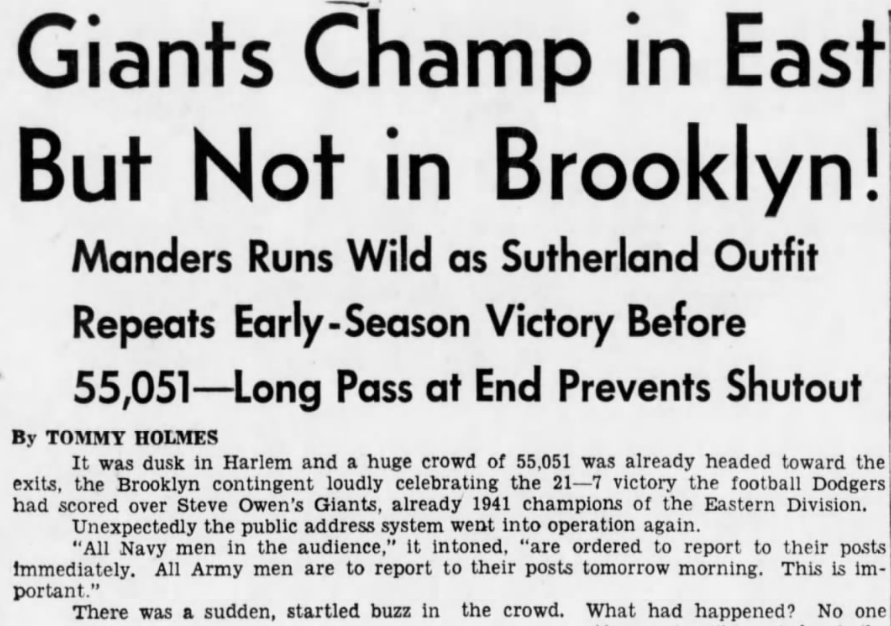
The Brooklyn Eagle, December 8, 1941

The attack started at 7:48 AM Hawaii time, which was 1:48 PM East Coast time. During the 2nd half, word got to the press box, and announcements began to come over the public address system. In those days, it was rare for someone to get paged at a sporting event. Usually, it was a doctor, who had to go and attend to a medical emergency.

This time, with the draft already in place, and enlistments already well underway as well, military officers attending the game were paged, and told to report to their various bases in and around New York City.

At Comiskey Park in Chicago, home to the Great Lakes Naval Training Center on Lake Michigan, another crosstown battle was held. The Bears beat the host Cardinals 34-24. And at Griffith Stadium in Washington, in the capital so the number of government officials and military officers present was considerably larger than in New York and Chicago, the host Redskins beat the Philadelphia Eagles 20-14.

When the game in New York ended, Dodger fans could not openly celebrate, and Giant fans didn't care, either, because it was then announced to the crowd that Pearl Harbor had been attacked.

The NFL Championship Game was played as scheduled, at Wrigley Field in Chicago on December 21, and, despite a 9-9 deadlock in the 3rd quarter, the Bears went on to beat the Giants 37-9.

This was during Major League Baseball's offseason, so none of their games were played. This was 5 years before the founding of the NBA, so none of their games were played. There were 3 National Hockey League games played on the day that Pearl Harbor was attacked:

* At the old Madison Square Garden, the host New York Rangers beat the defending Stanley Cup Champions, the Boston Bruins, 5-4. Alex Shibicky scored 2 goals.

* At the Olympia Stadium, the host Detroit Red Wings beat the Montreal Canadiens, 3-2.

* And at the Chicago Stadium, the host Chicago Blackhawks beat the Brooklyn Americans, 5-4. Only in this, what turned out to be their last season, were the former New York Americans, or "Amerks," using the Brooklyn name, even though they still played all their home games at The Garden. A plan for a new arena in Brooklyn was proposed for after The War, but it never happened, and the franchise suspended at the conclusion of the 1941-42 season, was officially folded in 1946.

* The Toronto Maple Leafs were not scheduled to play that day.

Time magazine named Roosevelt its Man of the Year for the 3rd time, due to his efforts to aid Britain, France and the Soviet Union without getting Congress to declare war on the Axis Powers, until Pearl Harbor made it unavoidable.

Friday, July 1, 2022

July 1, 1916: The Battle of the Somme

British "Tommies" emerging from the trenches
and "going over the top"

July 1, 1916: The Battle of the Somme breaks out, along the River Somme, outside Ovillers-la-Boisselle, 100 miles north of Paris. It becomes the 2nd-longest battle of World War I, behind the Battle of Verdun -- which started earlier in the year, and finished after the Somme -- and is the war's largest battle in terms of manpower.

On one side: Imperial Germany, with 1 million men, commanded by Rupprecht, Crown Prince of Bavaria. On the other side: France, defending their homeland with 1.3 million men, commanded by Marshal Ferdinand Foch; and Britain, assisting their ally with 1.2 million men, commanded by General Douglas Haig.
Douglas Haig

The 1st day at the Somme was one of the few days on which the Allies made significant progress in World War I. But it was also one of the bloodiest: In one day, the British lost 19,240 men. To put that in perspective: America lost its mind when nearly 60,000 men were lost in the 8 years of the Vietnam War. The British lost nearly 20,000 men in one day, the worst day in terms of losses that their army has ever had, since there has been a nation of England to keep records. The Germans lost 12,000. The French, 1,590.

But that battle continued. In September, the British used tanks in battle for the 1st time. It was also one of the earliest battles in which air power was used. Hostilities finally ceased on November 18, at which point the British and French had gained... 6 miles.

Among the British soldiers -- known as "Tommies," derived from "Tommy Atkins," a long-standing name for them, not from "Thompson submachine guns," as the term "tommy-guns" was -- was Lieutenant John Ronald Ruel Tolkien, later the author of the Lord of the Rings books. He arrived early in July, and suffered all the horrors of the trenches, including lice, which led to trench fever, which led to him being evacuated in early November. After that, everyone in his platoon was killed in action. People who thought his books were allegories for World War II were way off: They were allegories for World War I.
J.R.R. Tolkien, 1916

When the battle was over, the Germans claimed losses of 440,000 men, plus 73,000 prisoners of war; the French, 200,000 dead; the British, 420,000. Add it up: 1,060,000 soldiers killed. That's right: One battle, over one million men dead. And for what? Six miles.

It was a "Pyrrhic victory." The phrase originates from a quote from Pyrrhus of Epirus, whose triumph against the Romans in the Battle of Asculum, in what is now Southern Italy, in 279 BC destroyed much of his forces, forcing the end of his campaign. According to legend, he said, "If we are victorious in one more battle with the Romans, we shall be utterly ruined." The more common translation is, "Another such victory, and I am undone."

Haig was promoted to Field Marshal in 1917, given the title The Earl Haig in 1919, and lived until 1928. His grandson is Alexander, the 3rd Earl Haig. Despite the name and the shared profession, former U.S. Army General and Secretary of State Alexander Haig was not closely related.

For many years thereafter, the 1st Earl Haig was considered one of the most effective commanders of the war. But, in the words of the Canadian War Museum, "His epic but costly offensives at the Somme (1916) and Passchendaele (1917) have become nearly synonymous with the carnage and futility of First World War battles."

Marshal Foch became France's greatest military hero of the modern era, and accepted the German surrender on November 11, 1918. He lived until 1929.
Ferdinand Foch

With the Bavarian monarchy, as well as the larger German one, abolished by the Weimar Republic, Crown Prince Rupprecht tried and failed to establish a constitutional monarchy for Bavaria. The Nazis never asked him to be a part of their movement. He fled to Italy, then to Hungary, and was captured by the Nazis, and held at the Dachau concentration camp (which, at the absolute least, was in Bavaria). The postwar American occupation allowed him to return home, and he lived until 1955.

*

July 1, 1916 was a Saturday. Actress Olivia de Havilland was born on this day. And a series of shark attacks along the Jersey Shore began. I have a separate entry for this event.

These baseball games were played:

* The New York Yankees beat the Philadelphia Athletics, 5-4 at Shibe Park (later renamed Connie Mack Stadium) in Philadelphia. Les Nunamaker doubled home the winning run in the top of the 9th inning.

* The New York Giants lost to the Philadelphia Phillies, 9-2 at the Polo Grounds. Al Demaree went the distance for the Phils, allowing only 5 hits, 3 of them to Dave Robertson. He appears not to have been related to the later Yankee pitcher David Robertson.

* The Brooklyn Dodgers were swept in a doubleheader by the Boston Braves, 7-4 and 2-0 at Braves Field in Boston. Pat Ragan pitched a 2-hit shutout in the 2n game, outpitching future Hall-of-Famer Rube Marquard. The Dodgers -- or, more accurately, the Brooklyn Robins, as they were known from 1914 to 1931, as Wilbert Robinson was their manager -- won the National League Pennant, anyway.

* The Washington Senators beat the Boston Red Sox, 4-2 at American League Park (later renamed Griffith Stadium) in Washington. Walter Johnson pitched the last 2 innings for the Senators, and got the save, not that anyone knew what a "save" was at the time. Babe Ruth started for the Red Sox, pitched 3 1/3rd innings, and got the loss. He had no official at-bats, but had an RBI on a sacrifice fly. The Red Sox went on to beat the Dodgers/Robins in the World Series.

* The Cleveland Indians beat the St. Louis Browns, 5-4 at League Park in Cleveland. The game went 11 innings, although I can't find how the winning run was scored. Stan Coveleski was the winning pitcher, Eddie Plank the losing pitcher. Neither started the game. Both made the Baseball Hall of Fame. Tris Speaker went 2-for-3 with 2 walks. George Sisler went 1-for-4.

* The Pittsburgh Pirates beat the Cincinnati Reds, 2-1 at Redland Field (later renamed Crosley Field) in Cincinnati. Honus Wagner hit a home run.

* The Chicago White Sox beat the Detroit Tigers, 6-0 at Comiskey Park in Chicago. Eddie Collins went 3-for-4 with an RBI. Shoeless Joe Jackson went 1-for-3 with an RBI. Ty Cobb went 1-for-4.

* And a doubleheader between arch-rivals was played at Robison Field in St. Louis. The Chicago Cubs won the opener, 9-2. The St. Louis Cardinals won the nightcap, 4-3. This was another game that went 11 innings, without Baseball-Reference or Retrosheet having a record of how the winning run was scored.

Thursday, June 23, 2022

June 22, 1945: The Battle of Okinawa

June 22, 1945: The Battle of Okinawa ends. It is an American victory. But it is a hard one, perhaps a "Pyhrric victory."

U.S. troops had been "island-hopping" all across the Pacific Ocean, taking one piece of territory after another from Japan. But as they got closer to Japan's "home islands" -- Hokkaido, Honshu, Shikoku and Kyushu -- the Japanese fought harder. The Battle of Iwo Jima, ending in March, was brutal, to the point where it remains the defining victory of the U.S. Marine Corps.

Okinawa would be as close to the home islands as could be gotten without getting all the way there, about 400 miles from Kyushu, and 1,300 miles from Tokyo (on Honshu). Okinawa had an airstrip, and it was close enough that, should the battle be won, U.S. planes could take off from there, attack the home islands, and fly back without having to refuel.

But the Japanese fought harder than ever. The U.S. invaded on April 1, and it took 83 days to secure the island. There were over 12,500 American troops killed, including the overall commander, Lieutenant General Simon Bolivar Buckner Jr. The Japanese lost 77,000. For comparison's sake, in the Vietnam War, America lost 59,000 in 8 years. This was 12,500 in less than 3 months.

The phrase "Pyrrhic victory" originates from a quote from Pyrrhus of Epirus, whose triumph against the Romans in the Battle of Asculum, in what is now Southern Italy, in 279 BC destroyed much of his forces, forcing the end of his campaign. According to legend, he said, "If we are victorious in one more battle with the Romans, we shall be utterly ruined." The more common translation is, "Another such victory, and I am undone."

So President Harry Truman knew that an invasion of Japan's home islands would be even worse. The study he commissioned suggested that the U.S. would lose 500,000 men -- half a million -- while their Allies would lose at least as many, and the Japanese would lose twice that, over a full million, and that wasn't even counting civilians.

Truman realized that, if he had the atomic bomb, and he didn't use it, and half a million American soldiers were dead when the war could be ended quickly -- almost literally in a flash -- the backlash would be horrible. He was willing to trade however many Japanese lives that the bomb would kill to save those American, Allied, and, yes, Japanese men. And he did. And so, Okinawa became the site of the last major American battle of World War II.

The U.S. returned control of Okinawa to Japan in 1971, although it maintains a military base there, the largest U.S. base in Asia. Today, the Okinawa Prefecture -- Japan calls their State equivalents "Prefectures" -- includes 160 islands, 49 of them inhabited, with about 1.4 million people living on them.

*

June 22, 1945 was a Friday. These baseball games were played:

* The New York Yankees beat the Philadelphia Athletics, 2-0 at Yankee Stadium. Bill Bevens pitched a 4-hit shutout, and Tuck Stainback hit a home run.

* A doubleheader was split at Shibe Park in Philadelphia. The New York Giants won the opener, 3-0. Van Lingle Mungo pitched a 3-hit shutout. The Philadelphia Phillies won the nightcap, 5-4.

* The Brooklyn Dodgers beat the Boston Braves, 8-7 at Ebbets Field.

* The Boston Red Sox beat the Washington Senators, 10-5 at Fenway Park in Boston.

* A doubleheader was split at Cleveland Municipal Stadium. The Cleveland Indians won the opener, 2-1. The Chicago White Sox won the nightcap, 3-0. Orval Grove pitched a 6-hit shutout.

* The Pittsburgh Pirates beat the Cincinnati Reds, 3-1 at Crosley Field in Cincinnati.

* The St. Louis Cardinals beat their arch-rivals, the Chicago Cubs, 5-2 at Wrigley Field in Chicago.

* The St. Louis Browns beat the Detroit Tigers, 8-4 at Sportsman's Park in St. Louis.

Monday, January 31, 2022

January 31, 1968: The Tet Offensive

January 31, 1968: The Viet Cong launch the Tet Offensive, an attack on American and South Vietnamese installations in South Vietnam, on Tết Nguyên Đán, the Vietnamese lunar new year.

More than 80,000 troops hit more than 100 towns, including 36 out of the country's 44 provincial capitals, including the national capital of Saigon. The idea was to trigger a popular uprising that would lead to the collapse of the South Vietnamese government, and its replacement by one more favorable to the North Vietnamese government, thus uniting the country under Communism, and forcing the American troops out.

The Viet Cong didn't get that. At least, not in the short term. But they got the next best thing, which gave them their goal in the long term.

Over 4,000 U.S. personnel were killed, and another 5,000 South Vietnamese. But the Viet Cong lost 45,000 men, about as many as America lost in the war from its beginning until 1971 or so. And they were fought back, capturing very little territory, and not getting the popular uprising. Militarily, the Tet Offensive was one of the biggest blunders in the history of warfare.

But that was offset by the psychological victory they gained. They had gotten troops inside the U.S. Embassy in Saigon. They couldn't hold it, but they did it. And it was caught on U.S. television.

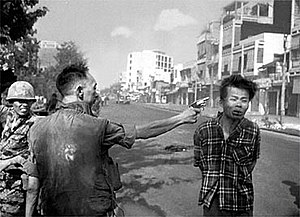
Also caught on U.S. television was an event on February 1: The Chief of South Vietnam's National Police, Major General Nguyễn Ngọc Loan, personally executing Nguyễn Văn Lém. It looked like one of America's best friends in the conflict was shooting a handcuffed teenage boy in the head, a brutal act.

In fact, Lém was 36 years old, held the rank of Captain, and had murdered not just a friend of General Loan, Lieutenant Colonel Nguyen Tuan, but also Tuan's wife, six of his seven children, and his 80-year-old mother. Women, children, even the elderly were not safe. The Vietcong even went after the families of their enemies. They were worse than the Mafia.

Eddie Adams of the Associated Press was standing next to the NBC cameraman who filmed the shooting, and clicked his shutter at the moment of impact for bullet against head. He won the Pulitzer Prize for the photo, but regretted he hadn't gotten a photo of what Lém did to deserve it.

"Two men died in that photograph," Adams said. "The General killed the Viet Cong. I killed the General with my camera." 

After the fall of Saigon, General Loan fled to America, and lived out his life in Virginia, near Washington, D.C. He died in 1998. Adams lived until 2004.

There was one survivor of Lém's killing of Tuan's family: Huan Nguyen, Tuan's son, was 9, and survived 2 bullet wounds. After the fall of Saigon, he was smuggled out of the country. He grew up in Oklahoma, and enlisted in the U.S. Navy in 1993. He is the highest-ranking officer of Vietnamese descent in U.S. military history: In 2019, he was promoted to the rank of Rear Admiral.

But people saw the film and the photo of the shooting, and began to ask themselves why we were supporting such an ally. Were they unworthy allies? There had been plenty of corruption in the South Vietnamese government. (Loan has never been accused of any of it.)

The Battle of Khe Sanh was also underway, lasting from January 21 to July 9. The U.S. lost 274 men, while Vietcong losses may have been as high as 15,000. Still, U.S. troops withdrew from the area, and the Vietcong legitimately claimed victory.

Each was a "Pyrrhic victory." The phrase originates from a quote from Pyrrhus of Epirus, whose triumph against the Romans in the Battle of Asculum, in what is now Southern Italy, in 279 BC destroyed much of his forces, forcing the end of his campaign. According to legend, he said, "If we are victorious in one more battle with the Romans, we shall be utterly ruined." The more common translation is, "Another such victory, and I am undone."

A few days after the Tet Offensive, CBS Evening News anchorman Walter Cronkite went to Vietnam to personally see what was going on. He had dinner with General Creighton Abrams, who had become a friend in World War II, and was now the commander of all forces in Vietnam. Abrams told Cronkite a painful truth: "We cannot win this goddamned war, and we ought to find a dignified way out."

On February 27, 1968, back at the CBS News desk in New York, Cronkite said this:

To say that we are mired in stalemate seems the only realistic, if unsatisfactory conclusion. On the off chance that military and political analysts are right, in the next few months we must test the enemy's intentions, in case this is indeed his last big gasp before negotiations.
But it is increasingly clear to this reporter that the only rational way out then will be to negotiate, not as victors, but as an honorable people who lived up to their pledge to defend democracy, and did the best they could.
Upon seeing this report, President Lyndon B. Johnson said, "If I've lost Cronkite, I've lost Middle America." Just 32 days later, with this in mind, having taken National Security Council meetings where nobody seemed to know how to solve the war, with Senator Eugene McCarthy having come close to beating him in the New Hampshire Primary, and with Senator Robert F. Kennedy having gotten into the race for President, Johnson announced that he would not seek another term as President, and would devote the last 9 months of his Presidency to seeking a peace deal.

He didn't get it. Why is a story for another time. His successor could have ended the war any time he wanted. He ended it 3 days into his 2nd term, 1 day after Johnson died. A little more than 2 years after that, Vietnam was united, and it was Communist.

*

January 31, 1968 was a Wednesday. Baseball and football were out of season. These 4 games were played in the NBA that night:

* The New York Knicks beat the Cincinnati Royals, 128-126 in overtime at the Cincinnati Gardens. For the Royals, Oscar Robertson scored 42 points, and Jerry Lucas had 22 points and 22 rebounds. For the Knickerbockers, Walt Bellamy had 23 points, Cazzie Russell 21, Willis Reed 20, Walt Frazier 19 and Dick Van Arsdale 18.

* The Boston Celtics beat the Chicago Bulls, 118-109 at the Boston Garden.

* The Baltimore Bullets beat the Detroit Pistons, 113-108 at the Baltimore Civic Center (now the CFG Bank Arena). Dave Bing scored 41 for the Pistons, while Earl "the Pearl" Monroe got 35 for the Bullets.

* And the Los Angeles Lakers beat the St. Louis Hawks, 110-102 at The Forum outside Los Angeles in Inglewood, California.

There were 3 games played in the American Basketball Association, which was in its 1st season:

* The New Jersey Americans beat the Dallas Chaparrals, 119-111 at the Teaneck Armory in Teaneck, New Jersey. The next season, the Americans moved to Long Island, and became the New York Nets. The Chaps moved in 1973, to become the San Antonio Spurs. Both teams were admitted to the NBA in 1976, then the Nets became the New Jersey Nets in 1977, and the Brooklyn Nets in 2012.

* The Indiana Pacers beat the Pittsburgh Pipers, 119-113 at the Indiana Fairgrounds Coliseum (now the Corteva Coliseum) in Indianapolis. The Pacers were admitted to the NBA in 1976.

* And the Anaheim Amigos beat the Denver Rockets, 112-105 at the Anaheim Convention Center outside Los Angeles. The Rockets became the Denver Nuggets in 1974, and were admitted to the NBA in 1976.

And there were 3 games played in the NHL:

* The New York Rangers lost to the Chicago Black Hawks, 3-2 at the old Madison Square Garden. The Rangers would play only 3 more games there before moving to the new Garden on February 18.

* The St. Louis Blues beat the Pittsburgh Penguins, 9-4 at the St. Louis Arena.

* And the Minnesota North Stars beat the Los Angeles Kings, 6-1 at the Metropolitan Sports Center in the Minneapolis suburb of Bloomington, Minnesota.

December 31, 1999 & January 1, 2000: The Millennium

December 31, 1999:  The Millennium arrives. The people of planet Earth survived. At a terrible cost. But we hadn't destroyed ourselves. ...