Showing posts with label olympia stadium. Show all posts

Monday, October 31, 2022

October 31, 1963: The Indianapolis Holiday On Ice Explosion

October 31, 1963: A propane leak at a concession stand at the Indiana State Fair Coliseum in Indianapolis causes an explosion that kills 74 people during a Holiday On Ice show.

Opened in 1939, the 6,800-seat building was not seriously damaged. It still stands, known as the Indiana Farmers Coliseum. It was the 1st home of the Indiana Pacers, from 1967 to 1974, and they won the American Basketball Association title there in 1970, 1972, and 1973.

A recent photo of the Coliseum

It has also been home to a series of minor-league hockey teams. The Indianapolis Capitals won the Calder Cup, the championship of the American Hockey League, in 1942 and 1950. The Indianapolis Ice won the Turner Cup, the championship of the International Hockey League, in 1990; and the Ray Miron Cup, the championship of the Central Hockey League, in 2000. The Indiana Ice won the Clark Cup, the championship of the United States Hockey League, in 2009 and 2014. The current team is called the Indy Fuel.

UPDATE: The name was the Indiana State Fairgrounds Coliseum from its opening in 1939 to 1991, the then the Pepsi Coliseum until 2012, then the Fairgrounds Coliseum until 2014, then the Indiana Farmers Coliseum until 2024, before adopting its current name, the Corteva Coliseum. Corteva, Inc. (also known as Corteva Agriscience), headquartered in Indianapolis, is devoted to products for seed and crop protection. The company's name combines "cor" (Latin for "heart") with "teva" (the Hebrew word for nature).

*

October 31, 1963 was a Thursday. Baseball Hall-of-Famer Fred McGriff and All-Star Matt Nokes were born on this day. So were Brazilian soccer star Dunga, actors Rob Schenider and Dermot Mulroney, and Smiths guitarist Johnny Marr.

Baseball season was over. Football was in midweek. And there were no NBA games scheduled for this Halloween. There was 1 NHL game: The Detroit Red Wings beat the New York Rangers, 4-1 at the Olympia Stadium in Detroit. 

Sunday, October 16, 2022

October 16, 1946: The NHL's Postwar Jump Start

Gordie Howe (left) and Clarence Campbell.
Not in 1946.

October 16, 1946: With the World Series having ended the day before, with the St. Louis Cardinals beating the Boston Red Sox in Game 7, there was only one sporting event on this day. And it is the NHL debut of Gordie Howe.

The 18-year-old native of Saskatoon, Saskatchewan wore Number 17, instead of the familiar 9 that he will start wearing the next season. The right wing scores against Turk Broda, and the Detroit Red Wings play the Toronto Maple Leafs to a 3-3 tie at the Olympia Stadium in Detroit.

The goal will be the 1st of 786 that the man who becomes known as Mr. Hockey will score for the Wings, going on to win 4 Stanley Cups and becoming the greatest player the game has ever known, and I don't want to hear about no Number 99: Gordie was better. We lost him in 2016, at the age of 88.

This new season was one of big changes in the NHL. Former player Red Dutton, who had been interim President of the League after the death of original President Frank Calder in 1943, was finally able to hand the office over to Calder's handpicked successor, Clarence Campbell, who had been away in the Canadian Army, even after World War II.

Campbell's experience in law and in hockey made him an ideal choice as President. Campbell hired Ken McKenzie, who would become the league's first publicity director, in September 1946, as his first hiring. McKenzie would go on to found The Hockey News and other publications, including the annual NHL Guide.

Campbell extended the regular season from 50 games to 60 games. Linesmen were now hired for each game from neutral cities. The NHL adopted the system of hand gestures to symbolize penalties, devised by the man then recognized as its best referee, Bill Chadwick.

(Chadwick was so well-regarded that, following his retirement as a referee and his election to the Hockey Hall of Fame, the New York Rangers hired him as a color commentator. "The Big Whistle" broadcast for the Broadway Blues from 1967 to 1981.)

Campbell presided over the NHL until 1977, including the expansions of 1967, 1970, 1972 and 1974, increasing the number of teams from 6 to 18. Except for Montreal Canadiens fans, still angry at his handling of a situation involving Maurice Richard in 1955 -- and, except for his mistake of showing up at the Forum for the next game, he handled it exactly right -- he was universally admired, for having grown the game tremendously.

Additionally, the league modified the captaincy rule, so that captains wore the letter "C" and alternate captains wore the letter "A" on the front of their jerseys. The rule was that only the Captain -- and thus whoever was on the ice wearing a C or an A -- can talk to the officials on behalf of their team, not any other player, not any of the coaches.

Tommy Gorman, who had been associated with the National Hockey League since its inception in 1917, announced his retirement as general manager of the Montreal Canadiens, the defending Stanley Cup Champions. He left behind him 7 Stanley Cup wins -- 3 with the Ottawa Senators, 1 each with the Chicago Black Hawks and the Montreal Maroons, and 2 with the Canadiens -- and a Hall of Fame career as a coach and general manager.

Frank Selke, released from the Toronto Maple Leafs, took over as the Montreal GM. The Canadiens were in financial trouble at this time, despite their winning team, and Selke would turn things around by buying up talent and keeping the cream of the crop, selling some players to teams that needed talent. He went on to build the greatest dynasty hockey ever knew in the late 1950s.

*

October 16, 1946 was a Wednesday. Actress Suzanne Somers and English soccer goalkeeper Geoff Barnett were born.

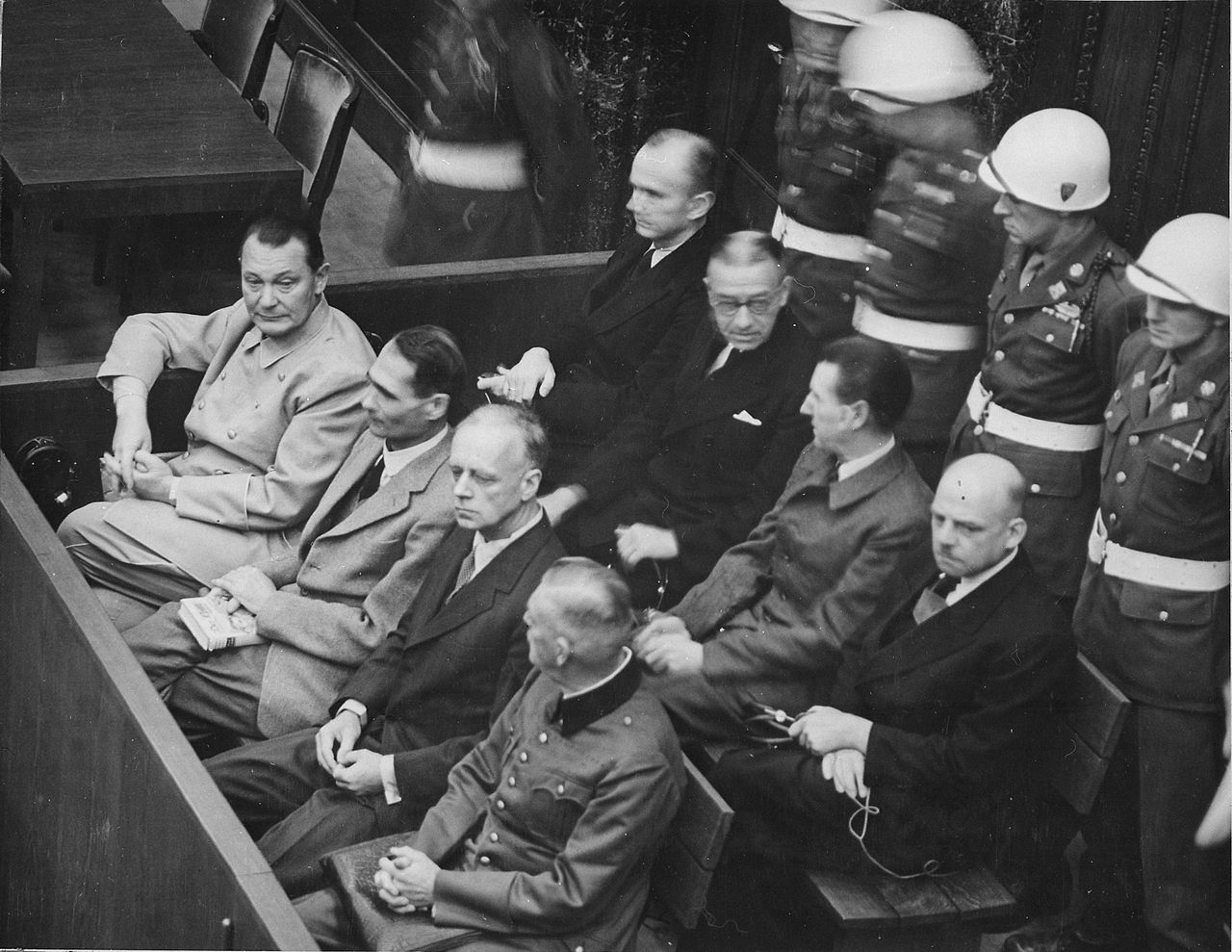
Also on this day, 10 Nazi war criminals, convicted of crimes against humanity, are executed by hanging at the Palace of Justice in Nuremberg, Germany. They include Joachim von Ribbentrop, Adolf Hitler's Foreign Minister; Julius Streicher, Nazi Germany's top propaganda publisher; General Alfred Jodl, Chief of the Armed Forces, who had signed the surrender papers on V-E Day; and Field Marshal Wilhelm Keitel.

Not among the condemned, but scheduled to be so, was Reichsmarschall Hermann Göring, the highest-ranking Nazi official to have survived V-E Day. He had made an appeal, asking to be shot as a soldier instead of hanged as a common criminal, but the court refused. So he committed suicide with a potassium cyanide capsule the night before he was to be hanged.

October 16, 1946: The Nuremberg Executions

Göring, at the far left (or so to speak)

In the year 1947, America was able to do fun things again. In that year, we desegregated baseball, established network television, began watching Howdy Doody Time on said television, invented the microwave oven and the transistor, and began looking for UFOs.

But first, in 1946, we had serious work to tend to: Punishing Nazis.

October 16, 1946: Ten Nazi war criminals, convicted of crimes against humanity, are executed by hanging at the Palace of Justice in Nuremberg, Germany. They included:

* Joachim von Ribbentrop, age 53, Adolf Hitler's Foreign Minister.
* Julius Streicher, 61, Nazi Germany's top propaganda publisher.
* General Alfred Jodl, 56, Chief of the Armed Forces, who had signed the surrender papers on V-E Day.
* Field Marshal Wilhelm Keitel, 64.
* Hans Frank, 46, Governor-General of occupied Poland.

You may have seen the "Hitler Rants Parodies," based on a scene from the 2004 film Downfall, starring Bruno Ganz as Hitler. Christian Redl played Jodl in that scene, and Dieter Mann played Keitel.

As for the other 2 Generals that Hitler had asked to remain in the room: Hans Krebs, played by Rolf Kanies, and Wilhelm Burgdorf ("Mein Führer, this is an outrage!"), played by Justus von Dohnányi, both committed suicide in the Bunker on May 2, 1945. Krebs was 47, and Burgdorf was 50.

Minister of Propaganda Joseph Goebbels, not named, also remained in the room. He committed suicide in the Bunker the day before. He was 47, and was played by Ulrich Matthes. Also not named, but remaining in the room, was Martin Bormann, head of the Nazi Party Chancellery. He escaped on May 2, but saw the Soviets closing in, and committed suicide. He was 44, and was played by Thomas Thieme. SS leader Heinrich Himmler committed suicide in British custody on May 23. He was also 44. He did not appear in the scene, but did appear in the film, and was played by Ulrich Noethen.

Not among the condemned, but scheduled to be so, was Reichsmarschall Hermann Göring, the highest-ranking Nazi official to have survived V-E Day. He had made an appeal, asking to be shot as a soldier instead of hanged as a common criminal, but the court refused. So he committed suicide with a potassium cyanide capsule the night before he was to be hanged. He was 53. He also was not in the scene, but was in the film, played by Mathias Gnädinger.

*

October 16, 1946 was a Wednesday. Actress Suzanne Somers was born.

With the World Series having ended the day before, with the St. Louis Cardinals beating the Boston Red Sox in Game 7, there was only one sporting event on this day. And it is the NHL debut of Gordie Howe. The 18-year-old native of Floral, Saskatchewan wore Number 15, instead of the familiar 9 that he will start wearing the next season. The right wing scores against Turk Broda, and the Detroit Red Wings play the Toronto Maple Leafs to a 3-3 tie at the Olympia Stadium in Detroit.

The goal will be the 1st of 786 that the man who becomes known as Mr. Hockey will score for the Wings, going on to win 4 Stanley Cups and becoming the greatest player the game has ever known, and I don't want to hear about no Number 99: Gordie was better. We lost him in 2016, at the age of 88.

Saturday, October 15, 2022

October 15, 1927: The Olympia Stadium Opens

October 15, 1927: The Olympia Stadium opens, at 5920 Grand River Avenue on the northwest side of Detroit. "The Old Red Barn" seated 11,563 people. At the time, the only sports arenas in the world that seated more were Madison Square Garden in New York (then new, but eventually known as "the old Madison Square Garden") and the London Olympia. In 1965, it was expanded to 15,609 seats.

The first event there was the International Stampede and Rodeo, running until October 22. On November 22, the Detroit Cougars of the National Hockey League played their 1st game there, after playing their 1st season in the NHL, the previous one, across the river at the Border Cities Arena in Windsor, Ontario, Canada. (It's now named the Windsor Arena.)

Johnny Sheppard of the Cougars scored the 1st goal in the building. However, the Ottawa Senators, the defending Stanley Cup Champions, won the game, 2-1. The Cougars changed their name to the Detroit Falcons in 1930, and the Detroit Red Wings in 1932.

The Wings would host the Stanley Cup Finals in 1934, 1936, 1937, 1941, 1942, 1943, 1945, 1948, 1949, 1950, 1952, 1954, 1955, 1956, 1961, 1963, 1964 and 1966. Led by stars such as Larry Aurie, Ebbie Goodfellow, Herbie Lewis and Syd Howe (no relation to Gordie), the Wings won the Cup in 1936, 1937 and 1943. Led by the Production Line of Gordie Howe, Ted Lindsay and Sid Abel, the Wings won again in 1950 and 1952. With Abel replaced by Alex Delvecchio, they won again in 1954 and 1955.
In 1946-47, the 1st season of the Basketball Association of America, the league that would become the NBA, the Olympia was home to both that league's Detroit Falcons and the National Basketball League's Detroit Gems. Both teams lasted just 1 year, although the Gems moved to become the Minneapolis, and later the Los Angeles, Lakers. The NBA's Detroit Pistons played there from 1957 to 1961.

Boxing was a major tenant of the arena. Of the 6 times that Jake LaMotta fought Sugar Ray Robinson, he only won the 2nd, and that was at the Olympia on February 5, 1943. LaMotta would win the Middleweight Championship in Detroit, by knocking out Marcel Cerdan, but that was at Briggs (later Tiger) Stadium, not the Olympia.

The Olympia was 1 of 16 buildings to have hosted concerts by both Elvis Presley and The Beatles. The Beatles played there on September 6, 1964 and August 13, 1966. Elvis sang there early in his career, on March 31, 1957; and late in his career on September 11, 1970; April 6, 1972; September 29 and October 4, 1974; and April 22, 1977. (He also sang at the Pontiac Silverdome on December 31, 1975.)

After the riot of 1967, the transition of Detroit's sports teams from the city to the suburbs was underway. Pontiac planned a domed stadium, hoping that all 4 Detroit teams might move there. The Lions did, playing at the Silverdome from 1975 to 2001, before moving to Ford Field at the northern edge of downtown. The Pistons did, playing there from 1978 to 1988, before building a new arena nearby in Auburn Hills, The Palace, where they stayed until 2017.

The Tigers and the Red Wings refused to move to Pontiac, or to Auburn Hills. The Tigers remained at Tiger Stadium until 1999, then moved into Comerica Park. Ford Field was built next-door. The Red Wings moved to the waterfront Joe Louis Arena in 1979.

The Wings played their last game at the Olympia on December 15, 1979, playing the Quebec Nordiques to a 4-4 tie. Greg Joly of the Wings scored the last goal. The Wings moved into the Joe Louis Arena on December 27, before moving to the Little Caesars Arena in 2017, sharing it with the Pistons. On February 21, 1980, the last event was held at the Olympia, an old-timers' hockey game.

It was the neighborhood, not the building, that was falling apart: Lincoln Cavalieri, its general manager in its last years, once said, "If an atom bomb landed, I'd want to be in Olympia." It was not a nuclear attack, but an ordinary demolition crew, that took it down in 1987. The Olympia Armory, home of the Michigan National Guard, is now on the site.

From the outside, it looked more like a big brick movie theater, complete with the Art Deco marquee out front. The letters on the marquee were preserved, and have been put on display at the Little Caesars Arena.

*

October 15, 1927 was a Saturday. The baseball season was over. The NHL season hadn't started yet. The NBA hadn't been founded yet. There was 1 NFL game: Because Pennsylvania prohibited professional sports on Sunday until 1933, the Northeast Philadelphia-based Frankford Yellow Jackets played home games on Saturdays. On this one, they beat the Buffalo Bisons, 54-0.

But most of the day's action was in college football:

* Notre Dame played Navy for the 1st time, at Municipal Stadium in Baltimore. Notre Dame won, 19-6. Municipal Stadium, which opened in 1922, was converted into Memorial Stadium in 1953-54.

* Illinois and Iowa State played to a 12-12 tie at Memorial Stadium in Champaign, Illinois. This was the only blemish on the Illini's record, as they won the Big Ten and National Championships.

* Missouri beat Washington University of St. Louis, 13-0 at Francis Field in St. Louis. Missouri went on to win the Championship of the Missouri Valley Conference, a precursor to the Big Eight/Twelve.

* Georgia Tech beat Alabama, 13-0 at Grant Field in Atlanta. They ended up winning the Southern Conference.

* Texas A&M beat Arkansas, 40-6 at Kyle Field in College Station, Texas. They went on to win the Southwest Conference.

* USC and Stanford played to a 13-13 tie, at Stanford Stadium in the San Francisco suburb of Palo Alto, California. This forged a tie for the Pacific Coast Conference title, and, since USC had been to the Rose Bowl more recently, Stanford was invited instead. They beat the University of Pittsburgh.

* Army beat Davis & Elkins College, 27-6 at Michie Stadium in West Point, New York. Davis & Elkins, in Elkins, West Virginia, now compete in NCAA Division II.

* In New York City, New York University beat Fordham, 32-0 before 43,000 at Yankee Stadium.

* Columbia lost to Colgate, 13-7 at Baker Field.

* City College of New York beat Upsala College (now defunct) of East Orange, New Jersey, 79-0 at Lewisohn Stadium.

* In New Jersey, Princeton hosted Washington and Lee University of Lexington, Virginia at Palmer Stadium, and won, 13-0.

* And Rutgers lost to George Washington University, 6-0 at Neilson Field in New Brunswick, New Jersey.

Also, Arsenal drew with Leicester City, 2-2 at Highbury in North London. 

Saturday, April 23, 2022

April 23, 1964: The Bobby Baun Game

April 23, 1964: Game 6 of the Stanley Cup Finals is played, at the Olympia Stadium in Detroit. The Detroit Red Wings lead the Toronto Maple Leafs, 3 games to 2, and can wrap up the Cup on home ice. But, as the 2-time defending Champions, the Leafs will not give up without a fight.

The Wings had 6 players who would be elected to the Hockey Hall of Fame: Right wing Gordie Howe, centers Alex Delvecchio and Norm Ullman, defensemen Marcel Pronovost and Bill Gadsby, and perhaps the greatest goaltender that the sport had yet seen, Terry Sawchuk. Their head coach had also been a Hall of Fame center: Sid Abel.

The Leafs were coached by George "Punch" Imlach, and had 10 players who would end up in the Hall, although 1, defenseman Al Arbour, would be elected as a "Builder" for his later coaching. The rest: Goaltender Johnny Bower; defensemen Red Kelly (who had starred with the Wings in the 1950s), Tim Horton, Allan Stanley; left wings Frank Mahovlich and Bob Pulford; centers George Armstrong and Dave Keon; and right wing Andy Bathgate, picked up in midseason from the New York Rangers. But the player who ended up making the difference has, through the 2021-22 season, never been elected to the Hall.

The 1st 2 games were at Maple Leaf Gardens in Toronto. The Leafs won Game 1, 3-2, but the Wings won Game 2, 4-3, when Larry Jeffrey scored 7:52 into overtime. The action moved to Detroit, where the Wings won Game 3, 4-3, but the Leafs tied it back up by winning Game 4, 4-2. The Wings won Game 5 in Toronto, 2-1.

In the middle of Game 6, with the scored tied, 3-3, Howe fired a shot. Bobby Baun blocked it -- not with his stick but with his ankle, and he went down in a heap. He was taken off the ice, and it looked like he was out until the next season's training camp.

Such is the desire for the Stanley Cup that Baun told the trainer to freeze his ankle with ethyl chloride, and put his skate back on. He returned for overtime, and scored 1 minute and 43 seconds into it, to give the Leafs a 4-3 win and send the series to a Game 7 in Toronto.

A defenseman, Baun had been with the Leafs at the major league level since 1957, and in their farm system since 1953. He had already been part of 2 Cup winners. There was never any question that he was going to ignore all medical advice, including getting an X-ray that would have told him exactly what was wrong, and play in Game 7.

The roar of the Toronto fans when he came on the ice confirmed his choice. Bathgate scored 3 minutes into the game, and the Wings never had a chance at the Gardens. The Leafs won the game, 4-0, and had their 3rd straight Cup.

Sure enough, a post-Game 7 X-ray showed that his ankle was broken. Nevertheless, he returned to play all 70 games of the next season. The Leafs won 1 more Cup in 1967, after which, with the expansion draft coming, Imlach broke up his dynasty. The Leafs have never been back to the Finals. Baun's courageous performance remains a highlight in the team's history, and he was among the surviving players honored at what's now named the Scotiabank Arena for the 50th Anniversary celebrations of those Cups, in 2012, 2013, 2014 and 2017.

UPDATE: Bobby Baun died in 2023.

*

April 23, 1964 was a Thursday. Game 6 of the Stanley Cup Finals was held, and the Toronto Maple Leafs beat the Detroit Red Wings, 4-3 at the Olympia Stadium in Detroit, on an overtime goal by Bobby Baun, who was playing on a broken ankle. I have a separate entry for that event.

The NBA Finals were between Games 3 and 4. The Boston Celtics would beat the San Francisco Warriors in 5 games.

And these other baseball games were played:

* The Cincinnati Reds beat the Houston Colt .45s, 1-0 at Colt Stadium in Houston. Ken Johnson pitched a no-hitter, but, thanks in part to his own error in the 9th inning, he lost the game. I have a separate entry for this event.

* The New York Mets lost to the Chicago Cubs, 5-1 at the newly-opened Shea Stadium. Ernie Banks went 3-for-5. The Mets' only run came on a home run by Ron Hunt.

* A doubleheader was split at Memorial Stadium in Baltimore. The Boston Red Sox beat the Baltimore Orioles in the opener, 3-1. Jack Lamabe was the winning pitcher, while Steve Barber was the losing pitcher for Baltimore, allowing 2 runs in the 1st inning and being replaced for the 2nd. I guess his arm was sore, not just a little stiff. (Ball Four reference.)

The Orioles won the nightcap, 1-0. Former Phillies ace Robin Roberts allowed 9 hits, but kept the shutout. Over the 2 games, Brooks Robinson went 3-for-5 with a walk, while Carl Yastrzemski went 3-for-7 with a home run, a walk, and an RBI.

* The Philadelphia Phillies beat the Pittsburgh Pirates, 6-5 at Connie Mack Stadium in Philadelphia. Dick Allen hit a home run. Roberto Clemente went 1-for-5 with 2 RBIs.

* The Washington Senators beat the Minnesota Twins, 5-4 at Metropolitan Stadium in the Minneapolis suburb of Bloomington, Minnesota. Harmon Killebrew went 1-for-4 with a walk.

* The Los Angeles Dodgers beat the St. Louis Cardinals, 7-5 at Busch Stadium (formerly Sportsman's Park) in St. Louis.

* The Cleveland Indians beat the Los Angeles Angels, 3-2 at Dodger Stadium in Los Angeles, where the Angels were groundsharing while waiting for their Anaheim stadium to be built.

* And the New York Yankees, the Chicago White Sox, the Detroit Tigers, the Kansas City Athletics, the Milwaukee Braves and the San Francisco Giants were not scheduled.


April 23, 1950: The Pete Babando Goal

April 23, 1950: Only twice in the history of the Stanley Cup Finals has a Game 7 gone to overtime. They happened within 4 years of each other, and both were won by the Detroit Red Wings.

The Wings had won the Cup in 1936, 1937 and 1943. In 1946, a rookie named Gordie Howe arrived. The Wings reached the Finals again in 1948 and 1949, but lost both to the Toronto Maple Leafs. In 1950, they got back, and faced the New York Rangers.

There were 3 holdovers from 1943: Center and Captain Sid Abel, defenseman Jack Stewart, and right wing Joe Carveth. Abel centered a line with Howe on right wing and Ted Lindsay on left wing, which became known as "The Production Line," in honor of Detroit's automotive industry. Leonard "Red" Kelly and Marcel Pronovost were young defensemen. And in goal was Harry Lumley. All of these, except for Carveth, would make the Hockey Hall of Fame.

However, the Wings would have to go through the Finals without Howe: During the Semifinals against the Leafs, he attempted to check Ted "Teeder" Kennedy, but missed, and crashed into the boards, breaking bones in his face and putting his life in danger. He recovered, and became perhaps the greatest player the game had ever known, but would not be available for the Finals.

The Rangers had last made the Finals in 1940, which was also their most recent Cup win. They had no holdovers, but they had future Hall-of-Famers in centers Edgar Laprade and Buddy O'Connor, defenseman Allan Stanley, and goaltender Chuck Rayner.

(Two other Ranger players would be elected to the Hall, but in the "Builders" category: Bud Poile, for a long career as an NHL executive, including as the 1st general manager of the Philadelphia Flyers; and Fred Shero, who coached many of the players Poile acquired to the 1974 and 1975 Stanley Cups, and then coached the Rangers to the Finals in 1979.)

But the Rangers had a problem: No home-ice advantage. The biggest annual moneymaker for the Madison Square Garden corporation wasn't the Rangers, or the NBA's New York Knicks. It was the Ringling Brothers Barnum and Bailey Circus, which, in those days, came in April -- when the NBA and Stanley Cup Finals were both held.

At the time, arenas could not be configured to host a circus and a hockey game on the same day. And since the Circus made more money for The Garden than Playoff hockey (which is no longer the case), the Rangers were forced to play their "home games" elsewhere. They ended up playing Games 2 and 3 at Maple Leaf Gardens in Toronto, while all the other games of the Finals were played at the Wings' Olympia Stadium.

The Wings won Game 1, 4-1. The Rangers won Game 2, 3-1. The Wings won Game 3, 4-0. The Finals nearly became the Don Raleigh Show: Raleigh scored 8:34 into overtime, to win Game 4 for the Rangers, 4-3; and 1:38 into overtime, to win Game 5, 2-1.
Don Raleigh 

But it was not to be. The Wings won Game 6, 5-4. The next night, April 23, the Rangers took a 2-0 lead midway through Game 7, the 2nd goal being scored by Tony Leswick. But Pete Babando got the Wings on the board, and Abel tied the game just 21 seconds later. The teams exchanged goals later in the period, and there were no goals in the 3rd period. So, for the 1st time since the Stanley Cup Finals went to a best-4-out-of-7 format in 1939, its Game 7 went to overtime, 3-3.

The 1st overtime also saw no goals, making this the 1st Stanley Cup Final Game 7 to go to a 2nd overtime. Through the 2021 season, it remains the only one. At the 8:30 mark of the 2nd overtime, Babando backhanded a shot past Rayner, and it was over: Red Wings 4, Rangers 3. Detroit had won the Stanley Cup, and Babando had become the 1st player to win the Cup on a Game 7 goal in overtime.

Babando, approaching his 25th birthday, was born in Braeburn, Pennsylvania, outside Pittsburgh, making him one of the few American-born players in the NHL at the time. But, like the vast majority of the players, he was trained to play in Canada, as he grew up in Timmins, Ontario.

And how did the Wings' organization thank him for his 2 Game 7 goals, including the clincher? They traded him to the Chicago Black Hawks before the next season. (Since James E. Norris owned the Wings and the Chicago Stadium, and his son, James D. Norris, owned the Hawks, they made a lot of deals, especially to get a player one or the other didn't like away from him. And the NHL allowed this arrangement at the time.) After 3 seasons with the Hawks, he was traded to, of all teams, the Rangers. He continued to play professional hockey until 1967, and lived until 2020.

The Wings began a sort-of-dynasty in which they won 4 Cups in 6 seasons. But the Rangers didn't reach the Finals again until 1972. Blowing a 2-goal lead in 1950's Game 7 was the 1st of a long series of Ranger chokes from 1940 onward, until they finally won the Cup again in 1994. Which turned out to be not an ending but an interruption, as they have choked many times since.

Don Raleigh was born in Kenora, Ontario, famous for being the home of the 1907 Stanley Cup Champions, the Kenora Thistles; but lived most of his life in Winnipeg, Manitoba. He played for the Rangers from 1944 to 1956, made 2 All-Star Games, and was named to the Manitoba Sports Hall of Fame. He lived until 2012.

The next 3 years, the Knicks would also be hurt by The Garden's circus priority. They had to play Games 3, 4 and 6 of the 1951 NBA Finals at the 69th Regiment Armory, instead of the Garden. They lost Game 7 on the road, losing in overtime to the Rochester Royals. The same thing happened in 1952, when they lost Game 7 to the Minneapolis Lakers. It didn't get that far in 1953: They lost Games 3, 4 and 5 at the Armory, with the Lakers clinching in Game 5.

In 1954, Game 7 scorer Tony Leswick would be with the Wings, and become the 2nd, and so far last, man to score an overtime goal in the Game 7 of a Stanley Cup Finals. Others to score an overtime Cup-clincher:

* In Game 6: Bryan Hextall, 1940 Rangers; Henri Richard, 1966 Montreal Canadiens; Bobby Nystrom, 1980 New York Islanders; Brett Hull, 1999 Dallas Stars; Jason Arnott, 2000 New Jersey Devils; Patrick Kane, 2010 Blackhawks.

* In Game 5: Bill Barilko, 1951 Maple Leafs; Elmer Lach, 1953 Canadiens; Alec Martinez, 2014 Los Angeles Kings.

* In Game 4: Bill Cook, 1933 Rangers (before it was a best-of-7); Harold "Mush" March, 1934 Black Hawks (ditto); Hector "Toe" Blake, 1944 Canadiens; Bobby Orr, 1970 Bruins; Jacques Lemaire, 1977 Canadiens; Uwe Krupp, 1996 Colorado Avalanche.

UPDATE: The Red Wings do not yet have a team Hall of Fame, but they do retire numbers. From their 1950 Stanley Cup: 4, for defenseman Leonard "Red" Kelly; 7, for left wing Ted Lindsay; 9, for right wing Gordie Howe; and 12, for center Sid Abel.

Kelly, Lindsay, Howe, Abel, team owner James E. Norris, head coach and general manager Jack Adams, and broadcaster Budd Lynch have been elected to the Michigan Sports Hall of Fame.

*

April 23, 1950 was a Sunday. The NBA Championship was also decided that night: The Minneapolis Lakers won Game 6 of the Finals, 110-95 over the Syracuse Nationals at the Minneapolis Auditorium.

Football was out of season. These baseball games were played that day:

* A doubleheader was split at Braves Field in Boston. The Boston Braves won the opener, 4-3. The Philadelphia Phillies won the nightcap, 6-5.

* A doubleheader was split at Shibe Park in Philadelphia. The Philadelphia Athletics won the 1st game, 9-4. The Boston Red Sox won the 2nd game, 12-2, in a game shortened to 6 innings by a Pennsylvania Sunday curfew. Ted Williams did not play in either game.

* The Pittsburgh Pirates beat the Cincinnati Reds, 5-3 at Forbes Field in Pittsburgh.

* The Chicago White Sox beat the Detroit Tigers, 5-4 at Briggs Stadium (later Tiger Stadium) in Detroit.

* The Cleveland Indians beat the St. Louis Browns, 9-6 and 7-5. at Sportsman's Park in St. Louis.

* The New York Giants and the Brooklyn Dodgers were rained out at Ebbets Field. The game was made up on June 19. The Dodgers won, 8-6. Carl Furillo hit a home run. Jackie Robinson went 3-for-5.

* The Chicago Cubs and the St. Louis Cardinals were rained out at Wrigley Field in Chicago. The game was made up as part of a doubleheader on June 27. The Cards swept, 3-2 and 4-1. Over the 2 games, Stan Musial went 4-for-10 with a home run.

* And the New York Yankees and the Washington Senators were rained out at Yankee Stadium. The game was made up as part of a doubleheader on September 25. The Yankees swept, 8-3 and 7-4. Over the 2 games, Joe DiMaggio went 5-for-7 with 3 walks and 4 RBIs.

Friday, April 22, 2022

April 22, 1945: The Triumph of Frank "Ulcers" McCool

April 22, 1945: Game 7 of the Stanley Cup Finals is played at the Olympia Stadium arena in Detroit. It is set up as a reverse of the 1942 Finals.

That time, the Detroit Red Wings had won the 1st 3 games, but the Toronto Maple Leafs came back to win the next 4, the 1st time any team, in any sport, had done that. The Wings did rebound to win the Cup in 1943. The Montreal Canadiens won it in 1944. This time, with both the Wings and the Leafs having lost a lot of players to the manpower drain of World War II, they still returned to the Finals.

The Leafs won Game 1 in Detroit, 1-0; Game 2 in Detroit, 2-0; and Game 3 at Maple Leaf Gardens in Toronto, 1-0. They only needed 4 goals, scored by 4 separate players, because they had a goaltender putting on a show like no one had ever seen.

With regular goalie Walter "Turk" Broda serving in the Canadian Army, the job was given to Frank McCool, a 26-year-old native of Calgary who had never played in the NHL before the 1944-45 season, and had been discharged from the Army as medically unfit to serve, due to the condition that gave him his nickname: "Ulcers."

He won the Calder Trophy as NHL Rookie of the Year, and then shut the Wings out in each of the 1st 3 games. Three shutouts in a single Stanley Cup Finals had never been done before, and has been done only once since, by Martin Brodeur of the New Jersey Devils against the Anaheim Ducks in 2003.

With Game 4 also in Toronto, it looked like a sure thing for the Leafs. But the Wings won, 5-3, scoring more goals than the had in the previous 3 games. That may have rattled McCool, who was noted for being nervous, in spite of his name -- hence, his famed ulcers. He was better in Game 5 in Detroit, but the Wings still won, 2-0.

He was better than that in Game 6, in front of a Toronto crowd expecting to win the Cup. Regulation ended scoreless, with Wings goalie Harry Lumley proving McCool's equal. Ed Bruneteau scored 14:16 into the 1st overtime, and there would be a Game 7, in Detroit. All signs pointed to the Wings reversing the 1942 result, and redeeming themselves for it.

Mel Hill, nicknamed "Sudden Death" for his overtime goals for the Boston Bruins in the 1939 Playoffs, scored 5:38 into the game. The Leafs led, 1-0. There was no scoring in the 2nd period. It looked like the Leafs had it, but Murray Armstrong scored for the Wings at 8:16 of the 3rd period. The Leafs now looked like they just might blow it.

But defenseman Walter "Babe" Pratt, a hero of the New York Rangers' 1940 Stanley Cup win, put the puck past "Apple Cheeks" Lumley with 7:46 left in regulation. McCool and the Leafs hung on for dear life, and were 2-1 winners.

There would be no 3-0 to 4-3 reversal for the Wings. They would also lose in the Finals in 1948 and 1949, also to the Leafs, before winning the Cup in 1950, and starting a quasi-dynasty of 4 Cups in 6 seasons.

With their best players coming back from the War, the Leafs won the Cup again in 1947, 1948, 1949 and 1951. Broda's return meant that McCool only played 22 games in the 1945-46 season, after playing all 50 the season before. He really did have ulcers, and they forced him into retirement. He went back to Calgary and became the publisher of a newspaper. But this was not a good job for a man with ulcers, and he died in 1973, only 54 years old.

The Wings rebuilt, and reached the Stanley Cup Finals every year from 1948 to 1956, winning in 1950, 1952, 1954 and 1955.

*

April 22, 1945 was a Sunday. Obviously, there were no other hockey scores. The NBA hadn't been founded yet. And football was in the off-season. But these baseball games were played:

* The New York Yankees beat the Washington Senators, 5-2 at Griffith Stadium in Washington.

* The Brooklyn Dodgers beat their arch-rivals, the New York Giants, 3-1 at the Polo Grounds.

* The Philadelphia Athletics beat the Boston Red Sox, 6-1 at Fenway Park in Boston.

* A doubleheader was split at Shibe Park in Philadelphia. The Boston Braves won the opener, 3-2. The Philadelphia Phillies won the nightcap, 7-6.

* The Chicago Cubs swept a doubleheader from the Pittsburgh Pirates, 3-0 and 5-2 at Forbes Field in Pittsburgh. Bob Chipman pitched a 3-hit shutout in the opener.

* The Detroit Tigers beat the Cleveland Indians, 6-3 at Briggs Stadium (later Tiger Stadium) in Detroit.

* The Chicago White Sox swept a doubleheader from the St. Louis Browns, 4-3 and 5-3 at Comiskey Park in Chicago. The 1st game went 10 innings.

* A doubleheader was split at Sportsman's Park in St. Louis. The St. Louis Cardinals won the opener, 2-0. Ted Wilks allowed 8 hits, but kept the shutout. The Cincinnati Reds won the nightcap, 9-7 in 10 innings.

Tuesday, April 19, 2022

April 19, 1945: "Carousel" Premieres On Broadway

April 19, 1945: The musical Carousel premieres at the Majestic Theatre, 245 West 44th Street in Midtown Manhattan, just off Broadway. It was based on Liliom, a play by Hungarian author Ferenc Molnár.

The music was written by Richard Rodgers, who later called it his favorite among all his musicals. Oscar Hammerstein II wrote the book and the lyrics.

The story begins in 1873, in a seaside community in Maine. Billy Bigelow is a carnival barker, and Julie Jordan is a millworker. Billy romances Julie while he's on the clock. Julie appreciates this, but his boss doesn't, and Billy is fired. Julie stays out late with Billy. Billy appreciates this, but her boss, who sees them, and presumes this means she won't be on time to work tomorrow morning, doesn't, and she's fired.

Billy and Julie get married. A month goes by, and Billy is offered a chance to make a lot of money -- in a robbery. He's not sure he should do it. Julie tells him she's pregnant. Now, he knows he needs the money, and goes in on the robbery. It goes sideways, and Billy dies. Julie is comforted by her cousin and best friend Nettie Fowler, leading to the musical's most familiar song, "You'll Never Walk Alone."

Billy arrives in Heaven, and is told that the good he's done in life is outweighed by the bad. He's told that as long as there's a person alive who remembers him with fondness, he can get into Heaven.

He's taken to the future, to see his now-grown daughter Louise. He makes himself visible to her, telling her not that he's her father, but that he was her father's friend. He offers her a gift: A star that he took from Heaven. She refuses it. He slaps her hand, seemingly ruining his chance at getting back to Heaven. Julie notices the star on the ground, picks it up, and seems to feel Billy's presence.

Invisible, Billy attends Louise's graduation. Dr. Seldon, the town doctor, who resembles the Starkeeper who has been advising Billy "Up There," tells the graduating class that they shouldn't rely on their parents' successes, but also shouldn't be held back by their failures. Still invisible, Billy whispers in Louise's ear, telling her to believe the doctor. Then he whispers to Julie, telling her that he loves her. Both his widow and his daughter join in singing "You'll Never Walk Alone," and Billy is taken to Heaven.

In the original Broadway production, Billy was played by John Raitt, father of rock legend Bonnie Raitt; Julie by Jan Clayton; Louise by Bambi Linn; Nettie by Christine Johnson; and the dual role of the Starkeeper and Dr. Seldon by Russell Collins.

It was made into a film in 1956. Gordon MacRae played Billy, Shirley Jones played Julie, Susan Luckey played Louise, Claramae Turner played Nettie, and Gene Lockhart played the Starkeeper and the doctor.

"You'll Never Walk Alone" became a standard. Jerry Lewis would use it to close his annual Labor Day telethon for research into muscular dystrophy and related conditions. Elvis Presley made it a mainstay of his live performances from his Las Vegas debut in 1969 until his death in 1977.

In 1963, Liverpool rock band Gerry & The Pacemakers recorded a version that hit Number 1 on the British charts. (It was not released as a single in the U.S.) In the 1960s, at Anfield, the home stadium of Liverpool F.C., games would be preceded by the public address system playing the Top 10 songs in the country. "You'll Never Walk Alone" seemed to stick with the fans, as they began to ask to have it played last every week, even after it began to drop from the charts, just before the team walked onto the pitch. This was done, and Liverpool, managed by Bill Shankly, won the Football League in 1964.

After that, in England, the song was irrevocably tied to the Mersey Reds. After the Hillsborough Disaster of 1989, the words of the song gave hope to a grieving city. The words "YOU'LL NEVER WALK ALONE" are now cast in iron atop the Shankly Gates leading into Anfield.

Most Liverpool fans don't even realize that the song debuted on Broadway, in New York, in America, during the waning days of World War II.

*

April 19, 1945 was a Thursday. It was 7 days after the death of President Franklin D. Roosevelt, 11 days before the death of Adolf Hitler, 19 days before Nazi Germany surrendered, and 4 months before Japan surrendered to end World War II.

April 19 was also the day of Game 5 of the Stanley Cup Finals. The Detroit Red Wings beat the Toronto Maple Leafs, 2-0 at the Olympia Stadium in Detroit.

In 1942, the Wings had won the 1st 3 games of the Finals, then the Leafs took the next 4, becoming the 1st team to come back from a 3-0 deficit to win a finals in any sport. It has since happened in other rounds, but never again in a finals. In 1945, it looked like it might be reversed: The Leafs took the 1st 3, then the Wings took the next 3. But the Leafs won Game 7 on April 22, and won the Cup.

And an entire slate of major league baseball games was played, and then some:

* The New York Yankees beat the Boston Red Sox, 4-3 at Yankee Stadium. No home runs, but George "Snuffy" Stirnweiss reached base 5 times: A double, 2 singles and 2 walks. Monk Dubiel went the distance for the win.

* A doubleheader was split at Braves Field in Boston. The New York Giants won the opener, 4-3. The Boston Braves won the nightcap, 13-5.

* The Brooklyn Dodgers beat the Philadelphia Phillies, 3-1 at Ebbets Field.

* The Washington Senators beat the Philadelphia Athletics, 4-3 at Shibe Park in Philadelphia. George Case, better known for his baserunning, won the game with a home run leading off the top of the 12th inning.

* The Chicago White Sox beat the Cleveland Indians, 14-6 at League Park in Cleveland.

* The Pittsburgh Pirates beat the Cincinnati Reds, 5-1 at Crosley Field in Cincinnati.

* The St. Louis Cardinals beat the Chicago Cubs, 8-2 at Wrigley Field in Chicago.

* And the Detroit Red Wings beat the St. Louis Browns, 1-0 at Sportsman's Park in St. Louis. Al Benton pitched a 4-hit shutout. Benton is better remembered as the only pitcher to strike out both Babe Ruth and Mickey Mantle. 

Saturday, April 16, 2022

April 16, 1961: The Chicago Black Hawks Win the Stanley Cup

Bobby Hull (left) and Jack "Tex" Evans

April 16, 1961: The NHL season comes to an end, as the Chicago Black Hawks beat the Detroit Red Wings, 5-1 at the Olympia Stadium in Detroit, in Game 6 of the Stanley Cup Finals.

The Hawks were loaded. Glenn Hall was in the middle of a streak of 502 consecutive games played, still a record for a goaltender. The defense had Al Arbour, Pierre Pilote, Elmer "Moose" Vasko, Jack "Tex" Evans, and former Montreal Canadiens Cup-winner Dollard St. Laurent.

The Hawks had the man who was on his way to becoming the game's leading sniper, Bobby Hull, whose hair -- still real, not yet long and flowing, and not yet receding before becoming covered by hockey's most famous hairpiece -- and speed earned him the nickname "The Golden Jet." At this point, he was wearing uniform Number 16. The next season, he switched to 7. In 1963, as befitting his offensive prowess, he adopted the Number 9, which would eventually be retired for him.

The Chicago attack also included the speedy "Scooter Line": Stan Mikita, Ken Wharram and Alvin "Ab" McDonald. Also among the forwards were team captain Ed Litzenberger, Tod Sloan, Bill Hay, Reg Fleming and Murray Balfour.

Coached by Rudy Pilous, the Hawks finished 3rd in the 6-team NHL, and ended the 5-year Cup run of the Canadiens in the Semifinals, to earn their 1st Finals berth since 1944. They would face the Detroit Red Wings, the team already regarded as their arch-rivals.

The home team won each of the 1st 5 games: At the Chicago Stadium, the Hawks won Game 1, 3-2; Game 3, 3-1; and Game 5, 6-3; while, at the Olympia, the Wings won Game 2, 3-1; and Game 4, 2-1. But the Hawks broke the pattern in Game 6: The Wings led 1-0 after the 1st period, but Fleming and McDonald scored in the 2nd. Nesterenko put the game away a minute into the 3rd, followed by goals by Evans and Wharram. The Hawks won, 6-1.

Pilous, Hall, Hull, Mikita and Pilote would be elected to the Hockey Hall of Fame. So would Arbour, although that was due to his later accomplishments as head coach of the New York Islanders.

It was the Hawks' 1st Cup win since 1938. It would take until 2010 for them to win another. Losing Litzenberger and Sloan in an off-season trade with the Toronto Maple Leafs cost them. They lost in the Finals in 1962, 1965, 1971 and 1973 -- the last of these in part because Hull had feuded with Hawks management, and gone to the World Hockey Association.

They reached the Finals in 1992, and the Conference Finals in 1995, then went into a tailspin. It was only with the 2007 death of owner Bill Wirtz that his son, Rocky Wirtz, totally revamped the franchise, and led them to Cup wins in 2010, 2013 and 2015.

In 2001, in celebration of their 75th Anniversary, the Blackhawks named an All-Time Team. From the 1961 Cup winners, Bobby Hull, Glenn Hall, Pierre Pilote and Stan Mikita were selected. They, owner Art Wirtz, head coach Rudy Pilous, head coach Tommy Ivan, and defenseman Al Arbour were elected to the Hockey Hall of Fame. It should be noted that, while Arbour was an All-Star for the Hawks, he was elected for what he did as head coach of the New York Islanders in the 1980s.

From the 1971 and 1973 Stanley Cup Finalists, but not the '61 Cup winners, Tony Esposito, Keith Magnuson, and Dennis Hull, Bobby's brother, a.k.a. the Silver Jet, were selected for the 75th Anniversary Team.

From between the 1973 and 1992 Finalists, Denis Savard, Doug Wilson, Pat Stapleton, Bill White and Al Secord were chosen. From the 1992 Finalists, fans chose Ed Belfour, Chris Chelios, Jeremy Roenick and Steve Larmer. And they chose one player then with the team, Tony Amonte.

*

April 16, 1961 was a Friday. Football was out of season. The NBA season had ended 6 days before, as the Boston Celtics beat the St. Louis Hawks, 121-112 at the Boston Garden, to take the Finals in 5 games.

And these baseball games were played:

* The Minnesota Twins swept a doubleheader from the Baltimore Orioles, 10-5 and 6-4 at Memorial Stadium in Baltimore. They did this without Harmon Killebrew playing in either game. Bob Allison hit 2 home runs in the opener. Zoilo Versalles won the nightcap with a home run in the top of the 11th inning. Over the 2 games, Brooks Robinson went 1-for-9 with an RBI.

* The Cleveland Indians beat the Washington Senators, 3-2 at Griffith Stadium in Washington.

* The St. Louis Cardinals beat the Cincinnati Reds, 5-3 at Busch Stadium (formerly Sportsman's Park) in St. Louis. Stan Musial went 0-for-2 with a walk, and had an RBI on a sacrifice fly. Frank Robinson went 0-for-4.

* The Los Angeles Dodgers beat the Pittsburgh Pirates, 13-6 at the Los Angeles Memorial Coliseum. Tommy Davis, Wally Moon and Norm Sherry hit home runs. Duke Snider went 1-for-4 with a walk and an RBI, and Gil Hodges got a hit as a pinch-hitter. Roberto Clemente went 0-for-5.

* The San Francisco Giants beat the Philadelphia Phillies, 5-2 at Candlestick Park in San Francisco. Willie Mays went 1-for-3 with a walk.

* The New York Yankees and the Kansas City Athletics were rained out at Yankee Stadium. The game was made up the next day. The Yankees won, 3-0. Whitey Ford pitched a 3-hit shutout. Mickey Mantle went 3-for-3 with a home run, a walk, and 3 RBIs. It was his 1st homer of the season. He ended up with 54. Roger Maris went 0-for-3 with a walk against his former team. He would not hit his 1st home run until April 26. He ended up with 61.

* The Boston Red Sox and the Los Angeles Angels  were rained out at Fenway Park in Boston. The game was made up the next day. The Sox won, 3-2. Carl Yastrzemski, in only his 3rd major league game, went 0-for-4.

* The Chicago White Sox and the Detroit Tigers were postponed due to cold weather at Tiger Stadium in Detroit. The game was made up as part of a doubleheader on June 27. The ChiSox swept, 6-5 and 11-1. Al Kaline went 2-for-5 in the 1st game, but 0-for-4 in the 2nd game.

* And the Chicago Cubs and the Milwaukee Braves, at Wrigley Field in Chicago, were also postponed due to cold weather. The game was made up as part of a doubleheader on August 2. The Braves won the 1st game, 4-2. The 2nd game went was tied 7-7 after 11 innings, when, at the last MLB stadium without lights, the umpires called the game due to darkness.

Over the 2 games, Hank Aaron went 1-for-8 with a home and a walk, and Ernie Banks went 1-for-10 with 2 RBIs, but each man's lone hit in the twinbill was a home run in the 2nd game. Aaron's was a grand slam. Billy Williams (twice), the Braves' Frank Thomas and the Cubs' Jack Curtis also homered in the 2nd game, while Williams and Ron Santo homered in the 1st game.

Friday, April 15, 2022

April 15, 1952: The Legend of the Octopus

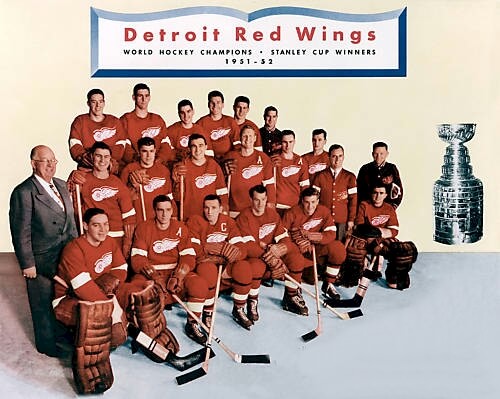
April 15, 1952: The Detroit Red Wings win the Stanley Cup, in a way that had never happened before: They swept both series, going 8-0.

In the Semifinals, they beat the Toronto Maple Leafs 3-0 and 1-0 at the Olympia Stadium in Detroit; and 6-2 and 3-1 at Maple Leaf Gardens in Toronto. In the Finals, they beat the Montreal Canadiens 3-1 and 2-1 at the Montreal Forum, and 3-0 twice at the Olympia.

The '52 Wings became not only the 1st team to pull off this feat, but one of the few ever that could send out a starting lineup made up entirely of future members of the Hockey Hall of Fame: Goaltender Terry Sawchuck; defensemen Leonard "Red" Kelly and Marcel Pronovost; and the forward "Production Line" of right wing Gordie Howe, left wing Ted Lindsay, and center Sid Abel. (Abel retired after the season, and was replaced by Alex Delvecchio, who would also go to the Hall of Fame.) They had already won the Cup in 1950.

Following the clincher on April 15, Pete and Jerry Cusimano, brothers who owned a seafood stand in Detroit's Eastern Market threw an octopus onto the rink. The creature's 8 legs symbolized the 8 wins, and a tradition was born. When the Wings won the Cup again in 1954 and 1955, clinching at home both times, the Cusimanos threw octopi onto the ice, in spite of the team not going 8-0.

The Wings lost in the Finals in 1956, 1961, 1963, 1964 and 1966, then went into a long down period that got them nicknamed "The Dead Things." They rebounded in the early 1990s, and their new home, the Joe Louis Arena, was besieged with octopus-throwing fans. Pete Cusimano was interviewed on the subject as the Wings marched back to the Finals in 1995, and he said that you've got to boil the octopus first, so that it will be lighter, and slide down the ice. If it's raw, it might not get far enough; and, wherever it lands, it will just go splat.
Pete Cusimano

Before Game 1 of those Finals, Fox announcer Joe Micheletti, a former Edmonton and St. Louis defenseman, held up a raw octopus, and said, "Here's my vote that the tradition ends tonight." And, as Claude Lemieux, who won the Conn Smythe Trophy as the Playoffs' Most Valuable Player as he led the New Jersey Devils over the Wings for the Cup, put it, "These things are disgusting, by the way."

The tradition did not end there. During Playoff games in Detroit, hanging from the roof is a big purple balloon shaped like an octopus, named Al the Octopus, after Al Sobotka, the arena's building operations manager, who drives the Zamboni, and whose job it is to pick up any octopi that fans throw onto the ice. Since it now takes 16 wins, there are 2 Als hanging from the rafters.
This one, obviously, is not hanging from the rafters.

Although, officially, you can be thrown out of the arena for doing it, if the Wings are winning late, Sobotka will pick the octopus up off the ice by hand, and swing it around by the legs over his head, driving the crowd wild. 
Other teams have sort-of copied the tradition: The Boston Bruins, lobster; the Edmonton Oilers, slabs of Alberta beef; the San Jose Sharks, a leopard shark (considerably smaller than a great white); the Nashville Predators, catfish. Say what you want about certain fan bases, but we don't see New York Ranger fans throw pizza slices, or Philadelphia Flyer fans throw cheesesteaks, or New Jersey Devils fans throw pork roll sandwiches.

The 8 straight feat would only be matched once, by the Canadiens in 1960. With the NHL's "Great Expansion" of 1967, it was rendered no longer possible. In 1976, the Canadiens went 12-1; in 1977, they went 12-2. Since the Playoffs became 4 rounds of best-4-out-of-7 in 1987, the best performance has been by the 1988 Edmonton Oilers, 16-2.

UPDATE: The Red Wings do not yet have a team Hall of Fame, but they do retire numbers. From their 1952 Stanley Cups: 1, goaltender Terry Sawchuk; 4, defenseman Leonard "Red" Kelly; 7, left wing Ted Lindsay; 9, right wing Gordie Howe; 10, center Alex Delvecchio; and 12, center Sid Abel.

Sawchuk, Kelly, Lindsay, Howe, Delvecchio, Abel, defenseman Marcel Pronovost, team owner James E. Norris, head coach and general manager Jack Adams, and broadcaster Budd Lynch have been elected to the Michigan Sports Hall of Fame.

*

April 15, 1952 was a Tuesday. It was a travel day in the NBA Finals, in which the Minneapolis Lakers would beat the New York Knicks in 7 games. Football was out of season. There were 6 games played in Major League Baseball:

* The Brooklyn Dodgers beat the Boston Braves, 3-2 at Braves Field in Boston, 5 years to the day after the same 2 teams played in Jackie Robinson's major league debut at Ebbets Field. This time, Robinson goes 1-for-3, and Elwin "Preacher" Roe outpitches Warren Spahn.

* The Boston Red Sox beat the Washington Senators, 3-0 at Griffith Stadium in Washington. Ted Williams went 1-for-3, and Mel Parnell pitched a 3-hit shutout.

* The Chicago Cubs beat the Cincinnati Reds, 6-5 at Crosley Field in Cincinnati. Former Dodger outfielder Gene Hermanski singled home the winning run for the Cubs in the top of the 10th inning.

* The St. Louis Browns beat the Detroit Tigers, 3-0 at Briggs Stadium in Detroit. (It was renamed Tiger Stadium in 1961.) Ned Garver pitched a 6-hit shutout.

* The Cleveland Indians beat the Chicago White Sox, 3-2 at Cleveland Municipal Stadium.

* The St. Louis Cardinals beat the Pittsburgh Pirates, 3-2 at Sportsman's Park in St. Louis. Stan Musial went 0-for-2 with 2 walks.

Thursday, April 14, 2022

April 14, 1955: The Red Wings Kiss the Cup... Goodbye

April 14, 1955: The Detroit Red Wings, taking the home-ice advantage of which they were assured when Maurice Richard was suspended, beat the Montreal Canadiens 3-1 in Game 7 at the Olympia Stadium, and win the Stanley Cup. Alex Delvecchio scored 2 goals, with Gordie Howe scoring in between them.

It is their 2nd straight, their 4th in the last 6 years, and their 7th overall. At this point, only the Canadiens themselves with 7 and the Toronto Maple Leafs with 9 can at least match that. Howe, Red Kelly, Ted Lindsay, Marty Pavelich, Marcel Pronovost, and Johnny Wilson played on all 4 Cup winners. Delvecchio, coming into his own after replacing Sid Abel as the center on the "Production Line" with Lindsay on the left and Howe on the right, played on the last 3 of them. Goalie Terry Sawchuk had played for them in the 1949-50 season, but did not appear in the Finals.

Larry Hillman, age 18, became the youngest player to have his name engraved on the Cup. Of those, Howe, Kelly, Lindsay, Pronovost, Delvecchio and Sawchuk all made the Hockey Hall of Fame.

So did Jack Adams, the Wings' general manager. It was the 9th Cup win he had been a part of: The 1918 Toronto Arenas (Maple Leafs) and the 1927 Ottawa Senators as a player; the 1936, 1937 and 1943 Wings as both head coach and general manager; and the 1950, 1952, 1954 and 1955 Wings as GM only.

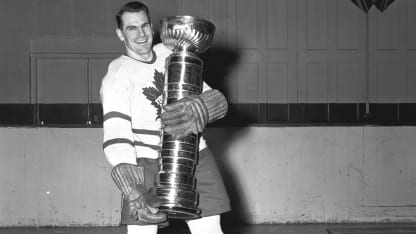
When the Cup is presented, Wings coach Jimmy Skinner -- kisses it. As you can see, NHL President Clarence Campbell, in the dark suit, seems amused by it. Howe, to the right of the photo, looks skeptical. But Skinner's kiss does start a tradition.

Skinner was in his 1st season as Wings head coach, having taken over from Tommy Ivan, who was appointed general manager of the Chicago Black Hawks.

The Wings will not take part in this tradition again for 42 years, due mainly to some epic mismanagement by the owners, the Norris family. Luckily, Skinner, Ivan, Howe, Kelly, Lindsay, Pronovost, Pavelich, Wilson and Delvecchio all lived to see that 1997 Cup win. Sawchuk did not. (UPDATE: Delvecchio died in 2025, making him the last surviving player from the 1952, 1954 and 1955 Cup wins. Pavelich, who lived until 2024, was the last survivor from the 1950 win,

In contrast, with Richard playing as if a man on a mission, the Canadiens won the next 5 Cups in a row. Richard then retired, but Les Habitantes kept on winning: From 1956 to 1979, they won 15 of the 24 available Stanley Cups.

*

April 14, 1955 was a Thursday. There were 6 other games played in the majors that day:

* The New York Yankees lost to the Boston Red Sox, 8-4 at Fenway Park in Boston. Elston Howard plays left field for the Yankees from the 6th inning onward, and singles in his 1st at-bat, making him the 1st black player for the Yankees. I have a separate entry for this event. Mickey Mantle went 1-for-2, with 2 walks. Ted Williams, the Red Sox' biggest star, did not play.

* The Brooklyn Dodgers beat the New York Giants, 10-8 at the Polo Grounds. Don Newcombe was the winning pitcher, Sal Maglie the losing one. Newcombe himself hit 2 home runs, and was also backed by homers from Roy Campanella and Carl Furillo. Jackie Robinson went 2-for-3 with 2 walks. Hank Thompson and Bobby Hofman hit homers for the Giants, and Willie Mays went 1-for-4 with a walk.

* The Philadelphia Phillies beat the Pittsburgh Pirates, 4-3 at Forbes Field in Pittsburgh. For the Pirates, Roberto Clemente made his major league debut 3 days later.

* The Chicago Cubs beat the Cincinnati Redlegs, 6-4 at Crosley Field in Cincinnati. Ernie Banks went 3-for-4 with a home run. He and Randy Jackson hit home runs in the top of the 10th inning to win it.

* The Cleveland Indians beat the Detroit Tigers, 5-3 at Briggs Stadium in Detroit. (It was renamed Tiger Stadium in 1961.) Al Kaline went 2-for-4 with 3 RBIs in a losing cause.

* The Chicago White Sox beat the Kansas City Athletics, 7-1 at Comiskey Park in Chicago.

* And the St. Louis Cardinals beat the Milwaukee Braves, 8-7 at Sportsman's Park in St. Louis. Bill Virdon won it with a home run in the bottom of the 11th. Stan Musial also hit a home run. Hank Aaron went 2-for-6, but neither hit was a homer.

The NFL was out of season. The NBA season ended 5 days earlier, when the Syracuse Nationals beat the Fort Wayne Pistons in Game 7 of the Finals.

April 14, 1948: Syl Apps Goes Out a Winner

Syl Apps (left) and Teeder Kennedy

April 14, 1948: The Toronto Maple Leafs beat the Detroit Red Wings, 7-2 at the Olympia Stadium in Detroit, and complete a 4-game sweep of the Stanley Cup Finals. It is their 2nd straight Cup, their 3rd in the last 4 seasons, and their 4th in the last 7.

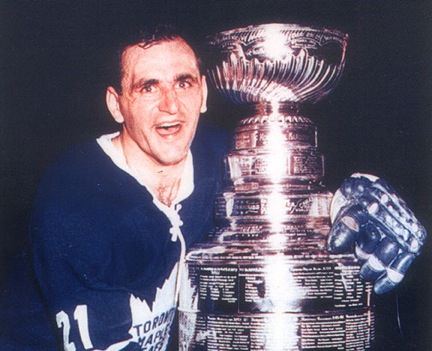
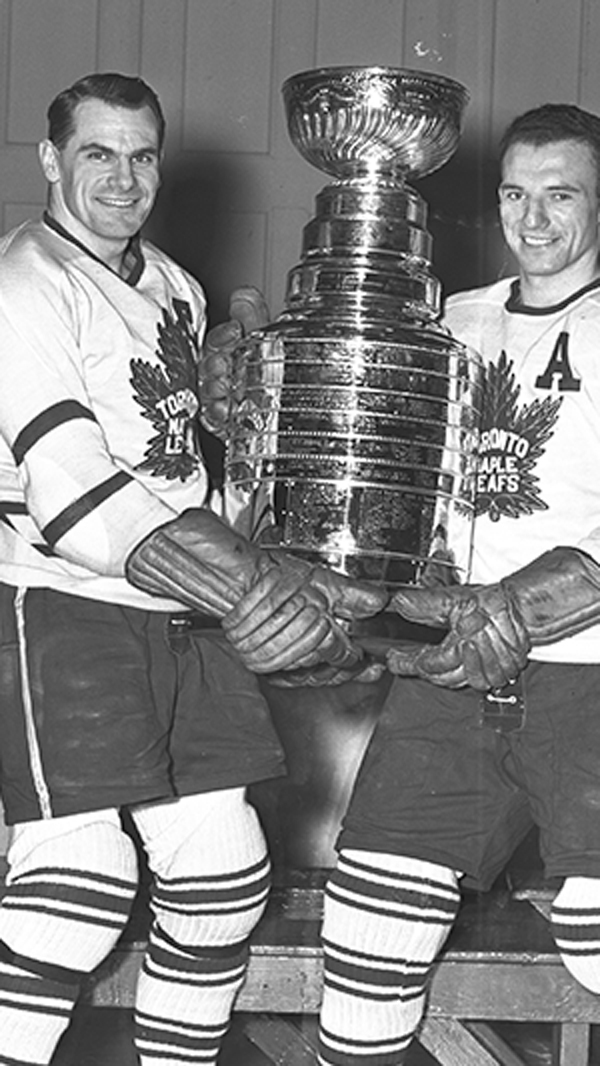
It was also the 1st time the Cup was awarded in its current "barrel" shape, instead of the "cigar" or "elephant leg" shape it had had since 1932.
Apps with the previous version

The team had 5 players who would be elected to the Hockey Hall of Fame: Goaltender Walter "Turk" Broda; left wing Harry Watson; and centers Max Bentley, Ted "Teeder" Kennedy and Syl Apps. Right wing Howie Meeker can't be included: Although a good player, he was elected to the Hall as a broadcaster.

Unlike longtime U.S. Senator Edward M. Kennedy, and several other Edwards who have been nicknamed "Ted" or "Teddy," Teeder's birth name really was "Theodore." A boy he'd played street hockey with couldn't pronounce "Theodore," and it came out "Teeder." He would succeed Apps as team Captain.

Syl Apps -- Charles Joseph Sylvanus Apps -- had been the Captain of the Leafs for the 1942 and 1947 Cup wins, and was again in 1948. He had been in the Canadian Army during World War II, and it was Bob Davidson who had captained the Leafs to the 1945 Cup.

Tired of getting lowballed in salary by Leafs general manager Conn Smythe, Apps had wanted to retire after the 1947 Cup. But he wanted to reach 200 career goals, a total which, at that point, very few players had reached. He got there on the final weekend of the 1947-48 regular season. He accepted a job with Simpson's department store, and another as Ontario Athletic Commissioner.

In spite of their salary disputes, and the fact that he was only 33 years old when he retired, Smythe called Apps the greatest player in Leafs history. Jack Adams, longtime head coach and GM of the Red Wings, called Apps the greatest center he had ever seen. Ted Lindsay of the Wings called him the greatest center he'd ever played against. And Boston Bruins center Milt Schmidt called him the greatest player he'd ever played against.

In 1961, Apps was elected to the Hockey Hall of Fame. From 1963 to 1975, Apps served in the Legislative Assembly of the Province of Ontario, as a member of the Progressive Conservative Party. In 1975, he was elected to Canada's Sports Hall of Fame. In 1977, he was made a Member of the Order of Canada.

He died in 1998. That year, The Hockey News ranked him 33rd on their list of the 100 Greatest Hockey Players; and the Leafs made the Number 10 an "Honoured Number," with both Apps and George Armstrong honored for wearing it. In 2016, as part of the team's Centennial celebrations, it was retired for both Apps and Armstrong. In 2017, Apps was named one of the NHL's 100th Anniversary 100 Greatest Players.

His son, Syl Apps Jr. -- Sylvanus Marshall Apps -- was a center who played in the NHL from 1970 to 1980, mostly for the Pittsburgh Penguins. His son, Syl Apps III -- Sylvanus Marshall Apps III -- played hockey at Princeton University, but couldn't get from the minor leagues to the NHL. Syl Jr.'s daughter, Gillian Apps, won Gold Medals with Canada in the Winter Olympics in 2006, 2010 and 2014. Another daughter of Syl Jr., Amy Apps, played for Canada's national women's soccer team. Another grandchild of Syl Sr., Darren Barber, competed for Canada in rowing, winning a Gold Medal at the 1992 Olympics.

Apparently, for any number of sports, there's an Apps for that.

*

April 14, 1948 was a Tuesday. Opening Day of the baseball season was 6 days away. Football was out of season. The Finals of the Basketball Association of America, the league that would become the NBA in 1949, were underway, and tied at 1 game apiece. The Baltimore Bullets went on to beat the defending Champions, the Philadelphia Warriors, in 6 games.

Thursday, April 7, 2022

April 7, 1949: "South Pacific" Premieres On Broadway

April 7, 1949: South Pacific premieres on Broadway, at the Majestic Theatre, at 245 West 44th Street. (The Theatre is still operating.) It is based on Tales of the South Pacific, the Pulitzer Prize-winning World War II book by James Michener. Richard Rodgers wrote the music, Oscar Hammerstein II wrote the lyrics, and Hammerstein and Joshua Logan wrote the text. Logan also directed.

The story: Ensign Nellie Forbush is a young U.S. Navy nurse serving on a Polynesian island. Living there is Emile de Becque, a middle-aged French plantation owner. They fall in love, and recall their first meeting, with the musical's best-remembered song, "Some Enchanted Evening."

But Nellie, from the Southern city of Little Rock, Arkansas, discovers that he has had 2 children from a previous relationship with a native woman. After deciding that her prejudice is stronger than her love, singing, "I'm Gonna Wash That Man Right Outa My Hair," he persuades her to change her mind, and she sings, "I'm In Love with a Wonderful Guy."

A secondary plot involves men in the Navy's Construction Battalions -- C.B.'s, or Seabees. Some have become infatuated with Navy nurses, and they have to contend with the fact that nurses are officers, and off-limits to enlisted men like themselves. This leads to the song "There Is Nothing Like a Dame."

The two plots eventually combine, and one of the Seabees laments that he didn't start out feeling prejudiced, singing, "You've Got to Be Carefully Taught." Given that this was 2 years after the debut of Jackie Robinson, and 5 years before Brown v. Board of Education, Rodgers & Hammerstein (and Michener) had to use the Polynesians as an allegory for black Americans.

In the original Broadway cast, Nellie was played by Mary Martin, who ended up washing her hair (wearing a bathing suit inside a large tub, obscuring most of her body) onstage 8 times a week for 2 years; and Emile by the Italian bass singer Ezio Pinza.

The musical was filmed, with Logan again directing, in 1958, by which point Brown v. Board and the Montgomery Bus Boycott had happened. Mitzi Gaynor played Nellie, and, this time, Emile was played by 2 Italian actors: Rossano Brazzi played his physical form, but Giorgio Tozzi dubbed his singing. It was filmed again in 2001, long after the Civil Rights Movement. This time, Nellie was played by a much older actress, Glenn Close, and Emile by Croatian actor Rade Šerbedžija.

To put it in perspective: When they played Nellie, their ages were: Martin, 35; Gaynor, 27; and Close, 54. When they played Emile, Pinza was 56, Brazzi 41, and Šerbedžija 55. So only the 2001 couple were age-appropriate for each other.

Ezio Pinza died in 1957, before he could be included in the film. Oscar Hammerstein II died in 1960, Richard Rodgers in 1979, Joshua Logan in 1988, Mary Martin in 1990, Rossano Brazzi in 1994, and James Michener in 1997. As of April 7, 2022, Mitzi Gaynor is still alive. (UPDATE: She died in 2024.)

*

April 7, 1949 was a Thursday. Mitch Daniels was born. He was elected Governor of Indiana as a Republican, and served President George W. Bush as the Director of the Office of Management and Budget.

Scores were hard to come by, at least in America. The baseball season hadn't started yet. Football was in the off-season. The Basketball Association of America and the National Basketball League would merge before the next season to form the National Basketball Association. Their 1948-49 regular seasons had not yet ended, but the BAA had no games scheduled for April 7, and NBL teams' records don't seem to be available on any source I can find.

The Stanley Cup Finals began the next day. The Toronto Maple Leafs opened them by beating the Detroit Red Wings, 3-2 on an overtime goal by Joe Klukay. On April 10, the Leafs won again, 3-1. Both of those games were played at the Olympia Stadium in Detroit. At Maple Leaf Gardens in Toronto, the Leafs won Game 3, 3-1 on April 13; and completed the sweep, 3-1 on April 16.

December 31, 1999 & January 1, 2000: The Millennium

December 31, 1999:  The Millennium arrives. The people of planet Earth survived. At a terrible cost. But we hadn't destroyed ourselves. ...