Showing posts with label roman empire. Show all posts

Friday, November 18, 2022

November 18, 1959: "Ben-Hur" Premieres

Stephen Boyd (left) and Charlton Heston

November 18, 1959: Ben-Hur premieres, directed by William Wyler, based on the 1880 novel by Lew Wallace. It had previously been filmed in 1925, starring Mexican actor Ramon Navarro in the title role, and Francis X. Bushman as the villain.

That was in black & white, and silent. This was in Technicolor, in full sound, and filmed in Italy with the largest budget ($15.175 million -- about $152 million in 2022 money), and the largest sets built, of any film produced at the time.

The story takes place in Jerusalem, in the early 1st Century AD, in the years immediately before, during, and after the ministry of Jesus of Nazareth. Judah Ben-Hur, played by Charlton Heston, already the preeminent performer of "historical epics," is a wealthy Jewish prince and merchant.

A childhood friend, Messala, played by Stephen Boyd, becomes commander of the nearby Roman fortress. While Judah has remained Jewish, Messala has totally bought into the Roman Empire's way of doing things. One thing leads to another, and Messala throws Judah into slavery, leading to the famous rowing scene.

After 3 years as a galley slave, Judah is assigned to Roman Consul Quintus Arrius' flagship. Arrius (Jack Hawkins) notices Judah's determination and self-discipline, and, after Judah saves his life in a battle with Macedonian pirates, Arrius petitions Emperor Tiberius to free him.

In Rome, Judah becomes a champion charioteer, driving the horses of Sheik Ilderrim (Hugh Griffith), and reunites with former girlfriend Esther (Israeli actress Haya Harareet). He enters a chariot race against Messala, in front of the new Governor of Judea, Pontius Pilate (Frank Thring), resulting in one of the most spectacular scenes ever filmed. Messala attempts to cheat, but, in response, a move by Judah results in Messala's method resulting in his own wreck and death. With his dying breath, Messala tells his friendy-turned-enemy that his mother, Miriam (Martha Scott), and his sister, Tirzah (Cathy O'Donnell), are alive, and where to find them.

Judah hears about a prophet he seeks who preaches love and forgiveness and urges Judah to cast off his consuming hate and vengeance. Judah and Esther attend the Sermon on the Mount. Soon afterward, Judah meets Pilate, who warns him against using his victory to lead a rebellion against Roman rule. Judah renounces his Roman citizenship. He finds out Tirzah is dying, and seeks Jesus to heal her.

But he is too late, and is a witness to the walk down the Via Dolorosa. History repeats itself: He recognizes Jesus (Claude Heater, uncredited) as a man who once tried to give him water as a galley slave, and tries to return the favor; but, as in the earlier incident, the gift is prevented by a Roman soldier (not the same one). After witnessing the Crucifixion, Judah walks through a storm to the cave where Miriam Tirzah and Esther are hiding. As the storm ends, he sees his mother and sister cured of their maladies, and accepts the miracle and forgives his enemies.

Metro-Goldwyn-Mayer spent $14.7 million, almost as much as it cost to make the film in the first place, to market it. It worked: Ben-Hur became the highest-grossing film premiering in 1959, and the 2nd-highest grossing film in history to that point, behind Gone with the Wind (also an MGM film). It became the 1st film to win 11 Academy Awards, including Best Picture, Best Director for Wyler, Best Actor for Heston, and Best Supporting Actor for Griffith.

Cathy O'Donnell (Tirzah) married Robert Wyler, brother of Ben-Hur director William Wyler. She died of cancer in 1970. Haya Harareet (Esther) died in 2021, and was the last surviving credited member of the film's cast.

Also premiering on this date was A Summer Place, based on the previous year's novel by Sloan Wilson. It starred Richard Egan and Dorothy McGuire as lovers reunited after 20 years, with Sandra Dee as the former's daughter and Troy Donahue as the latter's son, who begin their own affair.

The film was pretty steamy by the standards of the time. But now, it’s best known for its theme song, conducted by Percy Faith, which held the Number 1 spot on Billboard magazine's Hot 100 chart for 9 weeks in the Winter and Spring of 1960.

*

November 18, 1959 was a Wednesday. Baseball was out of season. Football was in midweek. No games were scheduled in the NHL. There were 3 games scheduled for the NBA:

* The New York Knicks beat the Minneapolis Lakers, 106-105 at the Minneapolis Armory.

* The Syracuse Nationals beat the Boston Celtics, 138-103 at the Onondaga County War Memorial (now the Upstate Medical University Arena) in Syracuse, New York.

* And the Detroit Pistons beat the Cincinnati Royals, 110-93 at the Cincinnati Gardens.

Friday, October 7, 2022

October 7, 1960: "Spartacus" and "Route 66" Premiere

October 7, 1960: The film Spartacus premieres, a dramatization of the story of the Thracian gladiator who led a slave revolt in Rome in 71 BC. The film was based on the 1951 novel by Howard Fast, was directed by Stanley Kubrick, and was written by Dalton Trumbo, one of the Hollywood Ten. All were selected by the film's star, Kirk Douglas, who wanted to break the Hollywood Blacklist for once and for all. He did.
Among the film's other stars: Jean Simmons, Laurence Olivier, Charles Laughton, Peter Ustinov, Tony Curtis, Nina Foch, John Ireland, Herbert Lom, John Hoyt, and Woody Strode, who had previously broken a different barrier: He was 1 of the 4 black players who broke professional football's color barrier in 1946, before becoming an actor, working mainly in Westerns.
The film is best remembered for a scene near the end, where the Roman commander Crassus (Olivier), having surrounded Spartacus' army, offers a pardon (and return to enslavement) if the men will identify Spartacus, living or dead. But this would mean a return to slavery, and they would rather die. So every surviving man responds by shouting "I'm Spartacus!" (Most people trying to quote the movie get that wrong, saying, "I am Spartacus!")
History suggests that Spartacus died in battle, and no marriage or children have been ascribed to him. The film shows the character crucified, but living long enough for his wife to show him his infant son.
In modern times, Spartacus became an icon for the Communist movement. The most popular sports team in the Soviet Union was the soccer team run by Spartak Moscow, ironically because it turned the Spartacus ideal back on the Communist government, and became "the people's team." It remains the most popular sports team in the Russian Federation. Many other teams in former Soviet countries have the Spartak name.
*
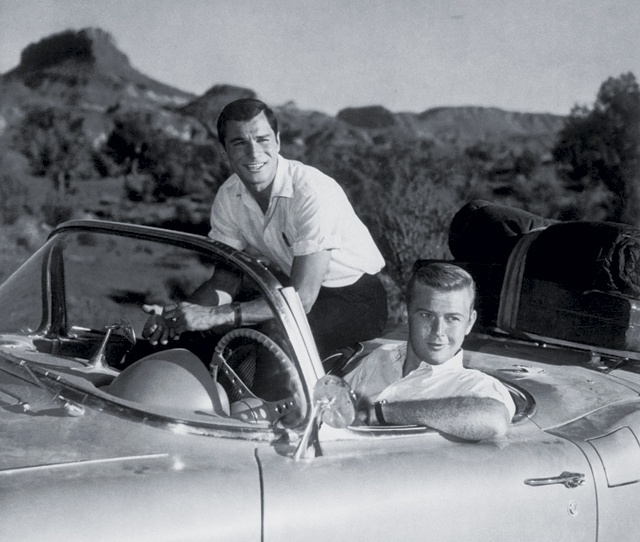
Also on this day, Route 66 premieres on CBS. It stars Martin Milner as Tod Stiles, and George Maharis as Buz Murdock, who travel around the country in a Chevrolet Corvette convertible, helping people wherever they can, because they were no longer needed or wanted where they were.
Maharis (left) and Milner
Tod grew up rich in Rye, Westchester County, New York, the son of a wealthy businessman. When his father died, he learned that his father's company was virtually bankrupt. The only thing his father had to leave him was the Corvette.
In contrast, Buz was a working-class orphan, who worked for the eldery Mr. Stiles in a New York shipyard. He talked Tod into going around the country together in the 'Vette.
U.S. Route 66 was commissioned in 1926. It started on Chicago's Loop, went down through Illinois, crossed the Mississippi River into St. Louis, went southwest across Missouri, briefly across the southeastern corner of Kansas, into Oklahoma through Tulsa to Oklahoma City. Then, it turned west, crossed the Texas Panhandle, and went through New Mexico, Arizona and California, including Los Angeles, before terminating at the Santa Monica Pier.
The federal government decommissioned the highway in 1985, as it had been mostly replaced by Interstate highways that bypassed some of the smaller towns along the route: I-55 in Illinois, I-44 from St. Louis to Oklahoma City, I-40 from there to Barstow, California, and I-15 and I-10 in California. Nevertheless, many of those small towns still call the remaining street "Route 66." For many of those towns, it served as their Main Street, and the road is still remembered as "America's Main Street."
But the show didn't exclusively stick to 66: Many of its adventures took place further east, even showing Tod and Buz working with lobstermen in Maine, and the series finale took place in Florida. 
Maharis came down with hepatitis, and decided to leave the show to focus on his health, saying, "Even if you have $4 million in the bank, you can't buy another liver." This soon proved to be incorrect, as liver transplants were becoming more common.
So, late in the show's 3rd season, with no explanation for what happened to Buz, Tod encountered Lincoln Case, played by Glenn Corbett. (Star Trek fans will recognize his name, as the first actor to play warp-drive inventor Zefram Cochrane.) "Linc" was a former U.S. Army Ranger and prisoner of war in Vietnam. This episode aired on March 22, 1963, so it was the 1st TV series featuring a character who was a Vietnam War veteran, and the earliest pop-culture representation of a Vietnam vet with post-traumatic stress disorder. After a difficult opening encounter, Tod invited Linc to join him on his travels.
Route 66 may have been the 1st regular TV series to have a planned series finale: On March 20, 1964, with the action in Tampa, far from the actual highway for which the show was named, Tod met Margo Tiffin, a commodities trader from Houston, played by Barbara Eden. They got married, and, since Linc was also from Texas, that's where Tod and Linc both ended up.
This show inspired many imitators, including The Fugitive and Run For Your Life in the 1960s, The Incredible Hulk in the 1970s, and Knight Rider and Hot Pursuit in the 1980s.
Despite having to leave the show due to illness, Maharis recovered. As of October 7, 2022, he is still alive, age 93. Milner died in 2015, Corbett in 1993. (UPDATE: Maharis died on May 24, 2023.)

In 1993, NBC tried a reboot, starring James Wilder as Nick Lewis, whose estranged father has recently died. It turns out, his father was Buz Murdock, who left him the Corvette, which suggests that Tod gave it to him at some point between 1964 and 1993. He then picks up Dan Cortese as hitchhiker Arthur Clark, and they start off on their own adventures together. But not many: Fans of the original series hated it, especially the suggestion that the orphaned Buz would gain and then abandon a family; and viewers not old enough to remember the original series didn't like it, either. Only 4 episodes aired.

*

October 7, 1960 was a Friday. So there was neither collegiate nor professional football played. The World Series was in a travel day. The NBA season hadn't started yet. And, while the NHL season had, 2 days earlier, no games were played on this day.

But there was one score, in the Canadian Football League: The Toronto Argonauts beat the Hamilton Tiger-Cats, 24-14 at Varsity Stadium in Toronto.

Sunday, June 12, 2022

June 12, 1963: Liz & Dick's "Cleopatra" Premieres

June 12, 1963: The film Cleopatra premieres. It is the biggest entertainment spectacle of the 1960s.

Notice I said, "biggest," not "best"; and "spectacle," not "success." The distinctions do matter.

NOTE: This was the same day that Medgar Evers was assassinated.

Cleopatra VII Philopator, the last Pharoah of Egypt, mistress of Julius Caesar and later of Marc Antony, who life began in 69 BC, whose reign began in 51 BC, both ended in 30 BC, and by far the most famous woman to live BC (Before Christ), had been portrayed on film many times before, including by Theda Bara in 1917, Claudette Colbert in 1934, Vivien Leigh in 1945, Rhonda Fleming in 1953, and a young Sophia Loren in 1954.

The 1963 version was based on the 1957 book The Life and Times of Cleopatra, by Carlo Maria Franzero. It was produced by Walter Wanger, who had long wanted to make a film about her, and when he saw Elizabeth Taylor in A Place in the Sun in 1951, he knew he had his Queen of Egypt. He went on to produce the original version of Invasion of the Body Snatchers and I Want to Live! So he had the studio credibility.

Taylor was approached to play the title role, and accepted. Twentieth Century Fox agreed to film it. Alfred Hitchcock was asked to direct, but he turned it down. Instead, Armenian-American director Rouben Mamoulian was hired. He had previously directed the 1931 version of Dr. Jekyll and Mr. Hyde, Queen Christina and the 1940 version of The Mark of Zorro, but had directed only 2 films since 1942.

But Taylor was not finalized as Cleopatra. Among those considered were Joan Collins (yes, later from Dynasty), Susan Hayward (who won on Oscar for Wanger's I Want to Live!), and, at Mamoulian's suggestion, black actress Dorothy Dandridge. (For the record: The last several Pharoahs, including Cleopatra, were ethnically Greek, not black Africans as some want to believe.) Dandridge declined, telling Mamoulian there would be no way the studio would approve of her kissing a white Caesar or a white Antony.

So they want back to Taylor, and she asked for the biggest film contract ever: $1 million (about $10 million in 2022), plus 10 percent of the box office gross. She got it. Peter Finch (later in Network) was cast as Caesar, and Stephen Boyd as Antony.

In 1960, sets were built, and the film was already becoming a boondoggle. In November, filming had to stop for weeks because Taylor developed meningitis. The script kept getting rewritten. On January 18, 1961, Mamoulian quit as director.

Taylor had previously worked with George Stevens for A Place in the Sun, and Joseph L. Mankiewicz for Suddenly, Last Summer, and said either one would be good. Fox chose Mankiewicz. That did not settle things, and, finally, production at Pinewood Studios outside London shut down. It cost $600,000 just to dismantle the sets. Mankiewicz ordered them moved to Cinecittà in Rome -- which had not initially been available, due to the 1960 Olympics being held in the Eternal City. But now that the Olympics were over, "Cinema City" was available. As Caesar, Finch was out, and Rex Harrison was in.

And then Taylor went to New York, and saw Richard Burton play King Arthur in the musical Camelot, opposite Julie Andrews, who had starred with Harrison in My Fair Lady. Burton was already a huge star, particularly in period pieces like The Robe.

He was married to actress Sybil Williams. Taylor was married to singer Eddie Fisher, whom she had stolen from his wife, actress Debbie Reynolds. Previously, Taylor had married and divorced hotel heir Conrad Hilton Jr. and stage producer Michael Wilding. The true love of her life had been her 3rd husband, Mike Todd, and they still argued like crazy, until his death in a plane crash.

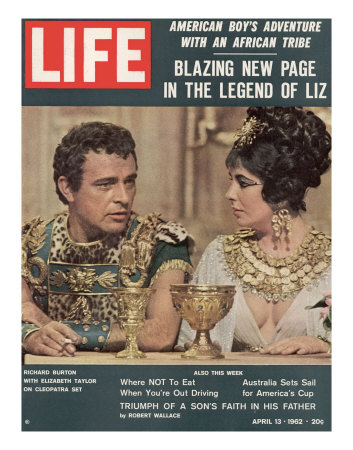
But Burton was hired to play Antony, and on January 22, 1962, both the filming of his scenes and his affair with Taylor started. Wanger observed in his journal: "There comes a time during the making of a movie when the actors become the characters they play... It was quiet, and you could almost feel the electricity between Liz and Burton."

It began the greatest "Couldn't live with each other, couldn't live without each other" story in the history of show business. By late February, word had reached the outside world. Laurence Olivier, whom Burton had started to rival for the title of the greatest living British actor, sent Burton a telegram: "Make up your mind, dear heart. Do you want to be a great actor or a household word?" Burton's response: "Both."

He got his wish. Bennifer? Brangelina? Kimye? In that era, before "ship names" -- no one ever called them "BurTay," or anything like that -- they became known as "Liz and Dick," and they were the biggest couple of all time, generating more press than any in history. More even than Joe DiMaggio and Marilyn Monroe, mainly because, unlike DiMaggio, who was 2 years retired from baseball before he married Monroe, Burton and Taylor were both still in their prime.
Interestingly, this film had an actress named Jacqui Chan. Not "Jackie": Instead of the Hong Kong martial-arts star, this Jacqui Chan was born on the Caribbean island of Trinidad to Chinese parents, and made her name dancing on Broadway. She played a character named Lotus.
Jacqui Chan as Lotus, with Rex Harrison as Julius Caesar

The cost of filming, including some scenes actually in Egypt, continued to rise. It almost brought the Fox studio down. On July 28, 1962, filming was finally finished. There was 5 hours and 20 minutes' worth of footage. This was going to make Gone with the Wind look like a short subject. By February 1963, Cleopatra had been cut down to 3 hours and 4 minutes, still over twice as long as most movies released in those days. Even historical epics tended to stay close to the 2-hour mark.

Total cost: $31.1 million, easily a record to that point. In 2022 money, a little over $300 million. It would take until 1978, when the 1st Christopher Reeve Superman move was released, for a movie to cost more in straight dollars: $55 million. The current record, in both straight and constant dollars, is Pirates of the Caribbean: On Stranger Tides: When released in 2011, $378.5 million; with inflation, in 2022, $491.8 million.

Cleopatra premiered at the Rivoli Theatre in New York on June 12, 1963, with an estimated audience of 10,000 spectators congregated outside. Burton and Taylor were not in attendance: They were in London, where Burton was filming Becket, another historical epic. Ticket price: $5.50, a new record. (About $52.50 today. For a movie. A very long movie with very big stars, but a movie, not a live play.)

Reviews were mixed. Some greatly praised the film, others ripped it. A common complaint was that it was too big, that the huge sets and the huge cast dwarfed even those big performers. Perhaps the harshest criticism was this: "They had cut out the heart, the essence, the motivations, the very core, and tacked on all those battle scenes. It should have been about three large people, but it lacked reality and passion. I found it vulgar." The person who made this pronouncement? None other than Elizabeth Taylor.

Having obtained divorces from their respective spouses, Liz and Dick were married on March 15, 1964, at the Ritz-Carlton Hotel in Montreal. They made 11 films together. Other than Cleopatra, the most notable was a 1966 studio version of Edward Albee's play Who's Afraid of Virginia Woolf?

Their schedules, their egos (in each case, sometimes strong, sometimes fragile), and their copious drinking led to lots of fights. They divorced in 1974, remarried in 1975 -- making Burton both Taylor's 5th and her 6th husband -- and divorced again in 1976, always in the tabloids.

Burton married twice more, to British model Suzy Miller and British author Sally Hay, who is still alive as of June 12, 2022, and still calls herself Sally Burton. Dick died in 1984, only 58 years old, and Sally kept Taylor and his other ex-wives away from the funeral.

Taylor also married twice more, to Senator John Warner and construction worker Larry Fortensky, and lived until 2011, having won over a new generation of fans through her massive fundraising for research into AIDS treatment and her friendship with singer Michael Jackson -- whom, despite all her health difficulties, she outlived.

Warner died in 2021, the last survivor among Taylor's 8 husbands. Of her children: Michael Wilding Jr. became an actor, specializing in soap operas; Christopher Wilding became a film editor; and Liza Todd and Maria Burton, whom she adopted with Dick, have largely stayed out of the spotlight. Elizabeth Taylor had 10 grandchildren, some of whom have gone into show business.

Cleopatra made more money than any other film that was released in 1963. But it did not quite earn enough to make a profit. So it is widely considered a "bust." It, and the next year's The Decline and Fall of the Roman Empire, helped end the era of historical epics "with a cast of thousands."

And while Cleopatra continues to be a subject explored in historical TV shows with smaller budgets, few films about her have been made since. Chilean actress Leonor Varela starred in an ABC TV-movie in 1999, and Italian superstar Monica Bellucci in a 2002 feature film.

In 1997, Gina Torres, a black New Yorker of Cuban descent, played Cleopatra in an episode of Xena: Warrior Princess, before joining the starring cast of a show produced by the same people, the sci-fi dystopia Cleopatra 2525, but she did not play the character named Cleopatra, who shared a name with the ancient Egyptian queen, and little else.

As of 2022, Patty Jenkins, who directed Israeli actress Gal Gadot in the Wonder Woman films, is trying to put together a new Cleopatra film, to star Gadot.

UPDATE: In an August 2023 interview, Gadot said the project was still in the planning stage, with Jenkins to produce and Kari Skogland to direct: "It’s a beautiful script. We're not rushing ourselves, because you have to be responsible when you deal with such an incredible, iconic, legendary woman."

In March 2025, Universal Pictures announced that the film was still something they wanted to produce. Given everything that goes into making a film, don't expect filming to being prior to 2026, or a release before 2028. Gadot is already older than the real Cleopatra lived to be.

In a 2012 episode of the YouTube series Epic Rap Battles of History, Angela Trimbur played Cleopatra, against Kimmy Gatewood playing Marilyn Monroe. A 2015 episode featured "Nice" Peter Shukoff as Julius Caesar, against early 19th Century South African Chief Shaka Zulu, played by DeStorm Power. The Cleopatra episode mentioned Caesar, and vice versa.

*

June 12, 1963 was a Wednesday. These baseball games were played that day:

* The New York Yankees beat the Baltimore Orioles, 3-2 at Yankee Stadium. Roger Maris singled home the winning run in the bottom of the 10th inning, making Marshall Bridges a winner in relief of Ralph Terry. Mickey Mantle was injured, and did not play. Yogi Berra, in his last season with the Yankees, only appeared as a pinch-hitter, unsuccessfully.

* The New York Mets lost to the Milwaukee Braves, 9-0 at Milwaukee County Stadium. Lew Burdette pitched a 3-hit shutout. Hank Aaron and Del Crandall hit home runs. Duke Snider, playing out the string with the Mets, went 0-for-3, although he did draw a walk.

* The Boston Red Sox beat the Washington Senators, 5-3 at Fenway Park in Boston. Carl Yastrzemski went 1-for-3 with a solo home run.

* The Cincinnati Reds beat the Pittsburgh Pirates, 3-0 at Crosley Field in Cincinnati. Jim O'Toole pitched a 3-hit shutout. Frank Robinson went 2-for-3 with an RBI. Rookie Pete Rose went 2-for-4. Roberto Clemente went 1-for-4.

* The Cleveland Indians beat the Detroit Tigers, 12-6 at Tiger Stadium in Detroit. Al Kaline went 3-for-5 with 2 RBIs, but it wasn't enough.

* A doubleheader was split at Comiskey Park in Chicago. The Chicago White Sox won the opener, 3-1. The Los Angeles Angels won the nightcap, 5-0. Former Yankee Cy Young Award winner Bob Turley allowed only 1 hit, a 6th-inning single by Pete Ward.

* A doubleheader was split at Metropolitan Stadium in the Minneapolis suburb of Bloomington, Minnesota. As Harmon Killebrew went, so went the Minnesota Twins: In the 1st game, he went 0-for-4, and the Kansas City Athletics beat the Twins, 12-4; in the 2nd game, he went 1-for-3 with a home run, 2 walks and 2 RBIs, and the Twins won, 8-1.

* The Philadelphia Phillies beat the St. Louis Cardinals, 6-2 at Busch Stadium in St. Louis. (It had been known as Sportsman's Park from 1909 to 1953.) Stan Musial went 2-for-3 with an RBI.

* The Los Angeles Dodgers beat the Houston Colt .45s, 9-1 at Dodger Stadium in Los Angeles. (The Colts became the Houston Astros in 1965.)

* And the San Francisco Giants beat the Chicago Cubs, 3-1 at Candlestick Park in San Francisco. Willie McCovey hit 2 home runs, Willie Mays went 1-for-4, and Ernie Banks went 0-for-3.

Thursday, May 5, 2022

May 5, 2000: The film "Gladiator" premieres

May 5, 2000: The film Gladiator premieres, directed by Ridley Scott. As Mel Gibson did 5 years earlier, Russell Crowe stars in a historical epic that’s a lot better with drama than it is with historical accuracy. Still, most people who saw it were entertained.

For all intents and purposes, it's a remake of the 1964 film The Fall of the Roman Empire, directed by Anthony Mann, which is often said to have marked the beginning of the end of historical epics, although that wasn't quite the case. Both films are set AD 180, roughly the high point of the Empire. In the 1964 film, the general-turned-gladiator is named Livius, and he's played by Stephen Boyd; in the 2000 film, he is named Maximus, and played by Crowe.

In the 1964 film, old Emperor Marcus Aurelius is played by Alec Guinness, new Emperor Commodus by Christopher Plummer, Commodus' sister and the gladiator's ex-girlfriend Lucilla by Sophia Loren. In the 2000 film, those roles are played, respectively, by Richard Harris, Joaquin Phoenix and Connie Nielsen. The 1964 film also features James Mason, Mel Ferrer, Omar Sharif, Anthony Quayle and John Ireland; while the 2000 film also features Oliver Red, Derek Jacobi, Djimon Hounsou and David Hemmings.

Gladiator was nominated for 12 Academy Awards, and won 5, including Best Picture, and Best Actor for Crowe. Apparently, sufficient members of the Academy of Motion Picture Arts and Sciences were entertained.

In real life, Marcus Aurelius, who reigned from AD 161 to 180, dying in office at the age of 58, is considered the last of "The Five Good Emperors," and his surviving writing, The Meditations of Marcus Aurelius, have led to him being called a "philosopher-king." In contrast, his son Commodus, both in his time and since, was regarded as an evil dictator, who did, indeed, enter the gladiatorial field of combat himself. He reigned until 192, and was assassinated, although not as a gladiator. He was 31.

*

May 5, 2000 was a Friday. These Major League Baseball games were played:

A wild game was played at the old Yankee Stadium. The New York Yankees blew a 3-0 lead over the Baltimore Orioles, then blew a 5-3 lead. Then the Orioles blew an 8-5 lead. The Orioles took a 10-8 lead in the top of the 9th.

Paul O’Neill led off the bottom of the 9th against Mike Timlin, and crushed a home run. Bernie Williams singled. Oriole manager Mike Hargrove brought B.J. Ryan in to pitch. Tino Martinez worked him for a walk. Yankee manager Joe Torre sent Clay Bellinger in to pinch-run for Tino. And Jorge Posada hit one out. Four runs without an out in the bottom of the 9th, and the Yankees won, 12-10. And that wasn't the highest-scoring game that day.

* The New York Mets beat the Florida Marlins, 4-1 at Pro Player Stadium (now Hard Rock Stadium) in Miami Gardens, Florida. Al Leiter was the winning pitcher. Mike Piazza hit a home run.

* The Boston Red Sox beat the Tampa Bay Devil Rays, 5-3 at Fenway Park in Boston.

* The Atlanta Braves beat the Philadelphia Phillies, 6-5 at Turner Field (now Center Parc Stadium) in Atlanta. Tom Glavine and Randy Wolf started, but neither figured in the decision. The Phils scored 4 runs in the top of the 9th, including a home run by Scott Rolen, to take a 5-4 lead. But in the bottom of the 9th, Wally Joyner singled, and Andruw Jones hit a game-winning home run.

* The Toronto Blue Jays beat the Cleveland Indians, 11-10 at the SkyDome (now the Rogers Centre) in Toronto. The Jays got home runs from Darrin Fletcher, Raúl Mondesí Sr., Carlos Delgado, José Cruz Jr. and Alex Gonzalez. The Tribe got them from Manny Ramirez and Jim Thome. And that wasn't the highest-scoring game that day.

* The Cincinnati Reds beat the St. Louis Cardinals, 3-2 at Cinergy Field (formerly Riverfront Stadium) in Cincinnati. Ken Griffey Jr. went 2-for-4 with a home run and 2 RBIs.

* The Pittsburgh Pirates beat the Chicago Cubs, 4-2 at Wrigley Field in Chicago.

* The Montreal Expos beat the Milwaukee Brewers, 10-2 at Milwaukee County Stadium.

* The Detroit Tigers beat the Minnesota Twins, 10-8 at the Metrodome in Minneapolis.

* The Kansas City Royals beat the Chicago White Sox, 5-1 at Kauffman Stadium in Kansas City.

* The Texas Rangers beat the Oakland Athletics, 17-16 at The Ballpark (now Choctaw Stadium) in the Dallas suburb of Arlington, Texas. The Rangers got only 1 home run, from Iván Rodríguez; but they got 2 hits and 4 RBIs from Scott Sheldon; and 3 hits each from Rodríguez, Rafael Palmeiro, Chad Curtis, Rubén Mateo and Tom Evans. The A's got homers from Frank Menechino; Ramón Hernández ,Jeremy Giambi, Adam Piatt and Terrence Long (3, off Jeff Zimmerman, 8th inn, 0 on, 2 outs to RF).

* The Arizona Diamondbacks beat the San Diego Padres, 5-3 at Bank One Ballpark (now Chase Field) in Phoenix. Tony Gwynn did not play.

* The Los Angeles Dodgers beat the Houston Astros, 3-2 at Dodger Stadium in Los Angeles.

* The San Francisco Giants beat the Colorado Rockies, 5-0 at Pacific Bell Park (now Oracle Park) in San Francisco. Joe Nathan pitched 7 innings of 2-hit shutout ball, and John Johnstone and Alan Embree finished the 3-hit shutout. J.T. Snow hit a home run. Barry Bonds went 0-for-4.

* And the Anaheim Angels beat the Seattle Mariners, 6-5 at Safeco Field (now T-Mobile Park) in Seattle.


Football was out of season. There were 2 games in the NBA Playoffs. The Utah Jazz beat the Seattle SuperSonics, 96-93 at the Delta Center in Salt Lake City, Utah. And the Los Angeles Lakers beat the Sacramento Kings, 113-86 at the Staples Center (now the Crypto.com Arena) in Los Angeles. Shaquille O'Neal scored 32 points and grabbed 18 rebounds.

There were 2 games in the Stanley Cup Playoffs. The Colorado Avalanche beat the Detroit Red Wings, 4-2 at the Pepsi Center (now the Ball Arena) in Denver. And the Dallas Stars beat the San Jose Sharks, 5-4 at the San Jose Arena (now the SAP Center).

Tuesday, February 15, 2022

February 15, 1980: "Caligula" Premieres

Malcolm McDowell

February 15, 1980: Cruising premieres, directed by William Friedkin, and starring Al Pacino as an undercover cop. It is loosely based on the 1970 novel of the same title, by The New York Times reporter Gerald Walker, about a serial killer targeting gay men. The title is a double entendre, because "cruising" can describe both police officers on patrol and men who are "cruising for sex" -- for women or men.

The film was poorly received by critics when released. The shooting and promotion were dogged by gay rights protesters, who believed that the film stigmatized them. Pacino subsequently called the film "exploitative." 

Despite its theme, it is not the most controversial film released in America on this day. That would be Caligula, with Malcolm McDowell playing the mad Roman Emperor, in a film that would have made even his earlier Alex DeLarge of A Clockwork Orange say, "Blimey, you've gone too far!"

In real life, Gaius Caesar Augustus Germanicus became Emperor of Rome at age 25, in AD 37, about 4 years after the execution (and resurrection?) of Jesus of Nazareth, upon the death of his great uncle, Emperor Tiberius. He was known as Caligula, meaning "Little Boots," for the uniform he was given as boy while on campaigns with his father.

At first, he was popular. But after an illness that nearly killed him, he seemed to change. Perhaps the wilder stories about him were made up after the fact by his enemies, but those stories included having an affair with his own sister, raping the wives of captive Senators in front of them, and naming his horse a proconsul and himself a god. In AD 41, his own Praetorian Guard, having had enough of him, assassinated him.

The film was directed by Tinto Brass, written by none other than novelist Gore Vidal, and financed by Bob Guccione, publisher of the pornographic magazine Penthouse. With that in mind, it is not surprising that the film is loaded with sex scenes and outright sadism, reflecting what had been widely believed about not only Caligula, but Tiberius, whose depravity was often forgotten due to being allegedly surpassed by that of Caligula, whose name has become synonymous with depraved national leaders.

Teresa Ann Savoy played Drusilla, Caligula's sister/lover. Peter O'Toole played Tiberius, John Gielgud played his aide Nerva, Giancarlo Badessi played Claudius, Guido Mannari played Prateorian Guard leader Macro, and Helen Mirren played Milonia Caesonia, Caligula's 4th and last wife.

With the death of Caligula, his uncle, Claudius, was supported as the new Emperor. The BBC had already done a single-season series I, Claudius about that era of Rome, including Caligula's reign. In that series, which went about as far as the BBC's censors would allow -- and, in America, could then be shown only on PBS -- Caligula was played by John Hurt.

*

February 15, 1980 was a Friday. Singer Conor Oberst was born.

The Winter Olympics were underway in Lake Placid, New York. The U.S. hockey team was between Group Stage games: The day before, they beat Czechoslovakia, 7-3; and the day after, they beat Norway, 5-1. Seven days later, they would enter the Medal Round, and play the Soviet Union.

Baseball and football were out of season. There were 8 games in the NBA:

* The Philadelphia 76ers beat the Detroit Pistons, 114-104 at the Silverdome in the Detroit suburb of Pontiac, Michigan.

* The Golden State Warriors beat the Indiana Pacers, 118-107 at the Market Square Arena in Indianapolis. Sonny Parker of the Warriors led all scorers on the night with 36 points.

* The Milwaukee Bucks beat the Houston Rockets, 114-103 at The Summit in Houston. It's now the Central Campus of televangelist Joel Osteen's Lakewood Church.


* The San Antonio Spurs beat the Chicago Bulls, 131-124 at the Chicago Stadium.

* The Denver Nuggets beat the Atlanta Hawks, 111-98 at the McNichols Arena in Denver.

* The Phoenix Suns beat the Washington Bullets, 116-104 at the Arizona Veterans Memorial Coliseum in Phoenix.

* The Los Angeles Lakers beat the Kansas City Kings, 114-100 at The Forum outside Los Angeles in Inglewood, California.

* The Boston Celtics beat the Portland Trail Blazers, 106-91 at the Portland Memorial Coliseum.

And there were 2 games in the NHL. The Hartford Whalers beat the Winnipeg Jets, 5-4 at the Hartford Civic Center (now the PeoplesBank Arena). And the Edmonton Oilers beat the Washington Capitals, 8-2 at the Northlands Coliseum in Edmonton. The hero for the Oilers wasn't Wayne Gretzky, Mark Messier or any other Hall-of-Famer: It was Blair MacDonald, with 3 goals and an assist.

December 31, 1999 & January 1, 2000: The Millennium

December 31, 1999:  The Millennium arrives. The people of planet Earth survived. At a terrible cost. But we hadn't destroyed ourselves. ...