Showing posts with label social security. Show all posts

Sunday, August 14, 2022

August 14, 1935: The Social Security Act

August 14, 1935: President Franklin D. Roosevelt signs the Social Security Act into law. It becomes the keystone of his domestic program, the New Deal.

By the 1930s, America was the only modern industrial country without any national system of pensions for older people. In the depths of the Great Depression, a physician named Francis Townsend rallied support for a proposal to issue direct payments to the elderly.

Responding to that movement, Roosevelt organized a committee led by Secretary of Labor Frances Perkins to develop a major social welfare program proposal. Roosevelt presented the plan to Congress in January 1935. An ally of his from his tenure as Governor of New York, and from that of his predecessor in that office, Alfred E. Smith, FDR had made Perkins the 1st woman appointed to any post in the President's Cabinet, upon taking office in 1933.
The actual bill was written by Senator Robert F. Wagner, a fellow New Yorker, who would write another key piece of New Deal legislation, the National Labor Relations Act. His son, Robert F. Wagner Jr., would serve as Mayor of New York City from 1954 to 1965. However, these Robert Wagners were not related to the actor Robert Wagner.
The program was expanded to provide payments to widows and dependents of Social Security recipients. Job categories that were not covered by the act included workers in agricultural labor, domestic service, government employees, and many teachers, nurses, hospital employees, librarians, and social workers.

As a result, 65 percent of the African-American workforce, and 27 percent of white workers, were excluded from the initial Social Security program. It may have been the only way for FDR to get Southern Congressmen and Senators to support the bill. Many of these workers were covered only later on, when Social Security was expanded in 1950, and again in 1954.

The program was funded through a newly-established payroll tax, which later became known as the Federal Insurance Contributions Act tax (FICA). Social Security taxes would be collected from employers by the States, with employers and employees contributing equally to the tax.

In addition to creating the program, the Social Security Act also established a state-administered unemployment insurance system and the Aid to Dependent Children, which provided aid to families headed by single mothers.

As with many other American "reforms," compared with the social security systems in Western Europe, the Social Security Act of 1935 was rather conservative. However, it was the first time that the federal government took responsibility for the economic security of the aged, the temporarily unemployed, dependent children, and the handicapped.

It's important to note that, in 1935, the average life expectancy for an American man was 67 years -- two years past the age when Social Security kicked in. This was a time before the wide availability of antibiotics, the polio vaccine, seat belts in cars, speed limits, raising the drinking age to 21, the prohibition of lead in paint, most environmental regulations, and the Surgeon General's warnings about the dangers of smoking.

FDR himself didn't even live to be 65: He died of a cerebral hemorrhage at 63, due in large part to his constant smoking, and the pressures of World War II, driving his blood pressure sky-high. The first person to receive a Social Security number also didn't make it: On November 24, 1936, SSN 055-09-0001 went to John Sweeney, a 23-year-old electrical supply clerk from New Rochelle, New York, who was scheduled to collect an estimated $85 per month beginning in 1978. Except he died in 1975, at the age of 61.

Senator Wagner lived to be 75, Secretary Perkins to be 85. In 1936, the Republican nominee for President, Governor Alfred M. Landon of Kansas, ran on a Party platform that called for the repeal of Social Security, and he lost 46 out of the 48 States then in the Union. Ironically, he lived to be 101, the longest-lived major-party nominee in the history of Presidential elections. (UPDATE: Through the 2024 election, he remains so, as Jimmy Carter died at age 100.)

Today, with men and women just about equally in the workforce, the average life expectancy at around 79, and living to be 100 or more becoming less of a novelty, the Social Security age has been raised to 67.

*

August 14, 1935 was a Wednesday. It was the off-season for the NFL and the NHL, and the NBA hadn't been founded yet. But there was a full slate of Major League Baseball games played, and then some:

* The New York Yankees lost to the Cleveland Indians, 7-6 at League Park in Cleveland. The Yankees trailed 5-2 going into the 8th, then took a 6-5 lead into the bottom of the 9th, but the normally reliable reliever Johnny Murphy blew it.

* The New York Giants split a doubleheader with the St. Louis Cardinals at the Polo Grounds. The Jints won the 1st game 6-4, as King Carl Hubbell outpitched Paul "Daffy" Dean. But the defending World Champions struck back in the 2nd game, winning 3-0. Bill Hallahan allowed 10 hits and 4 walks, and Daffy had to step in and get the last 2 outs, but the Cards got the shutout. Daffy's brother Jay "Dizzy" Dean did not appear in either game. (It's worth noting that Diz didn't mind his nickname, but Paul hated his. He was a very smart and stable guy, not daffy in the slightest.)

* The Brooklyn Dodgers swept a doubleheader from the Chicago Cubs at Ebbets Field. Dem Bums took the 1st game 9-5, and the 2nd game 3-2.

* The Boston Braves swept a doubleheader from the Cincinnati Reds at Braves Field in Boston. The Braves won the 1st game 8-1, and the 2nd game 11-5. This may have been the highlight of the worst season in the Braves' 150-season history: They went 38-115.

* The Pittsburgh Pirates swept a doubleheader from the Philadelphia Phillies at Baker Bowl in Philadelphia. The Bucs won the opener 8-1, and the nightcap 7-4.

* The Detroit Tigers beat the Washington Senators, 18-2 at Navin Field in Detroit. That ballpark would be renamed Briggs Stadium in 1938 and Tiger Stadium in 1961.

* The Boston Red Sox beat the Chicago White Sox, 7-1 at Comiskey Park in Chicago.

* And the Philadelphia Athletics beat the St. Louis Browns, 8-2 at Sportsman's Park in St. Louis.

Saturday, July 30, 2022

July 30, 1965: Medicare and Medicaid Become Law

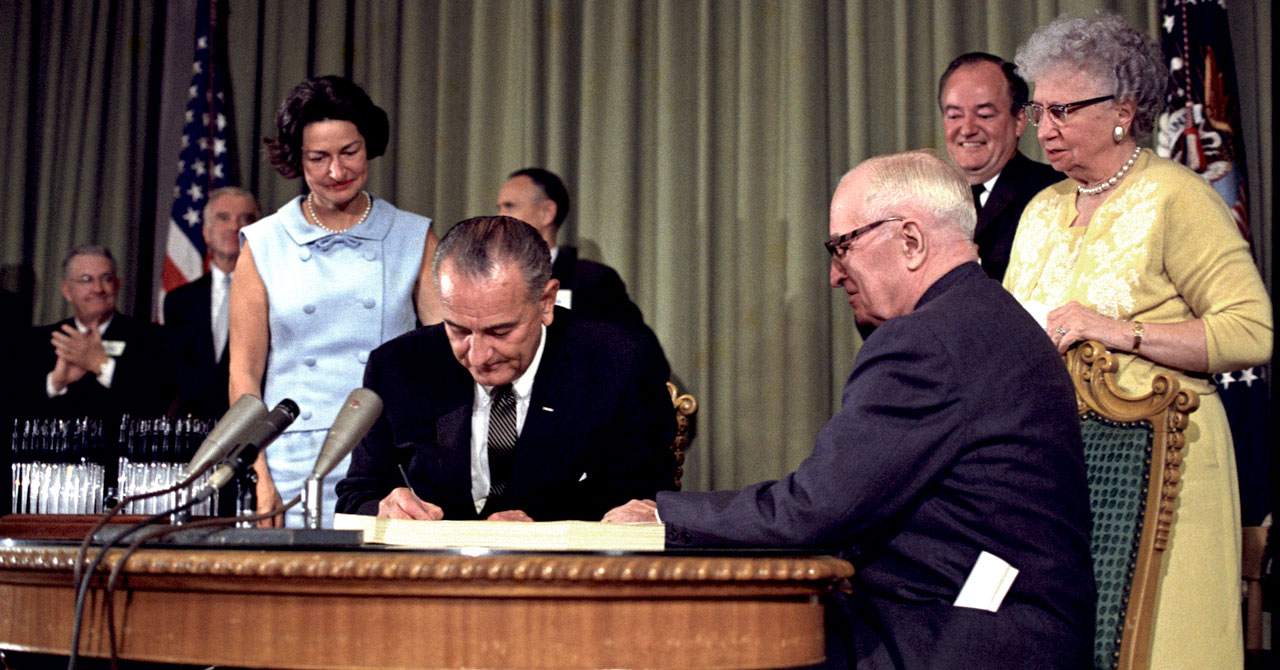
July 30, 1965: President Lyndon B. Johnson signs the Social Security Amendments of 1965 into law, in a ceremony at the Harry S Truman Presidential Library and Museum, in Independence, Missouri, outside Kansas City.

Former President Truman had tried to get a national health service, offering universal coverage, similar to Britain's passed in 1949, but failed. Holding the signing ceremony at his library was a tribute to his efforts. Also in attendance were each man's wife, Claudia "Lady Bird" Johnson and Elizabeth "Bess" Truman; Vice President Hubert Humphrey, and Governor Warren Hearnes of Missouri, for whom the University of Missouri's arena is named.

Although the Amendments increased benefits for people who met the legal definition of being disabled, the two main components were Medicare and Medicaid. Medicare provides coverage for healthcare for people aged 65 and up. Medicaid helps with health care costs for people of limited income, including nursing home and personal care services, which Medicare doesn't cover.

Medicare and Medicaid joined the Office of Economic Opportunity (a.k.a. "the War On Poverty"), and two major education reform bills to form Johnson's "Great Society." Within days of signing this bill, LBJ would add the Voting Rights Act of 1965. It remains the high point of American liberalism.

Canada passed National Health Service with universal coverage in 1967. Australia did so in 1984. In both cases, they use the term Medicare. In America, however, that term is still limited to health care for senior citizens.

*

July 30, 1965 was a Friday. It was the offseason for the NFL, the NBA and the NHL. However, there was a full slate of Major League Baseball games played:

* The New York Yankees lost to the Cleveland Indians, 5-0 at Yankee Stadium. The Yankees were shut out by Sonny Siebert, who allowed only 4 hits, 2 of them by Elston Howard.

* The New York Mets lost to the Philadelphia Phillies, 5-3 at Connie Mack Stadium in Philadelphia.

* The Pittsburgh Pirates beat the Chicago Cubs, 3-1 at Forbes Field in Pittsburgh.

* The Cincinnati Reds beat the Houston Astros, 7-1 at Crosley Field in Cincinnati.

* The Detroit Tigers beat the Chicago White Sox, 3-1 at Comiskey Park in Chicago.

* The San Francisco Giants beat the Milwaukee Braves, 9-2 at Milwaukee County Stadium.

* The Minnesota Twins beat the Baltimore Orioles, 3-2 at Metropolitan Stadium in the Minneapolis suburb of Bloomington, Minnesota.

* The Los Angeles Dodgers beat the st. Louis Cardinals, 4-2 at Busch Stadium, formerly Sportsman's Park, in St Louis.

* The Washington Senators beat the Kansas City Athletics, 3-1 at Kansas City Municipal Stadium.

* And the California Angels beat the Boston Red Sox, 9-2 at Dodger Stadium in Los Angeles. From 1962 to 1965, the Angels shared Chavez Ravine with the city's National League team, before opening Anaheim Stadium for 1966, now named Angel Stadium. 

Friday, March 4, 2022

March 4, 1933: The 1st Female Cabinet Secretary

March 4, 1933: Franklin Delano Roosevelt is sworn in as the 32nd President of the United States. He begins to implement his "New Deal" program, to alleviate the Great Depression. I have a separate entry about his Inauguration.

He will be aided by many, including the Secretary of Labor who also takes office on this day: Frances Perkins, the 1st woman to serve in any President's Cabinet.

Fannie Coralie Perkins was born on April 10, 1880 in Boston. She earned a bachelor of science degree from Mount Holyoke College is South Hadley, Massachusetts. She changed her name to "Frances," and volunteered as Jane Addams' Hull House in Chicago.

In 1910, she was appointed the head of the New York office of the National Consumers League. The next year, she witnessed the Triangle Shirtwaist Factory Fire, where the deaths of 146 people led her and others to push for new labor and fire safety laws.

In 1913, Perkins married New York economist Paul Caldwell Wilson. She kept her maiden name because she did not want her activities in Albany and New York City to affect the career of her husband, then the secretary to Mayor William J. Gaynor of New York. The couple had a daughter, Susanna, born in 1916.

In 1919, a new Governor, Alfred E. Smith, appointed her to the Industrial Commission of the State of New York. Her fellow Commissioner, James M. Lynch, called Perkins' contributions "invaluable," and added, "From the work which Miss Perkins has accomplished I am convinced that more women ought to be placed in high positions throughout the state departments."

In 1929, another newly-elected Governor, Franklin Roosevelt, appointed Perkins as the inaugural New York State Industrial Commissioner. Perkins helped put New York in the forefront of progressive reform, as she expanded factory investigations, reduced the workweek for women to 48 hours, championed minimum wage and unemployment insurance laws, and worked vigorously to put an end to child labor and to provide safety for women workers.

So, even as a woman, she was a natural for FDR's Secretary of Labor. This made her not only the 1st woman in the Cabinet, but the 1st woman in the line of succession to the Presidency.

She held the post for the entirety of his Administration, and into Harry S Truman's: 12 years and 116 days. Only 3 Cabinet officials have served longer, in any Department, including Harold Ickes at Interior at the same time. The other 2 have been James Wilson at Agriculture from 1897 to 1913, and Albert Gallatin at Treasury from 1801 to 1814. FDR's 1st Secretary of State, Cordell Hull, and his 1st Secretary of the Treasury, Robert Morgenthau, each served 11 years.

She helped write the Social Security Act, helped create the Civilian Conservation Corps, and, by herself, created the Immigration and Naturalization Service. So, not only was she one of FDR's most influential officials at the time, but her stamp on the federal government has been one of the longest-lasting and most effective. She is one of the most important Cabinet officials of all time, for reasons that have nothing to do with her status as the 1st woman.

After FDR's death, Truman wanted his own people in place, and Perkins stepped aside on June 30, 1945. Her replacement was Lewis Schwellenbach, a federal Judge and a former U.S. Senator from the State of Washington. He didn't make it through a full term, dying in 1948.

However, Truman didn't fire Perkins; his action was more of a "reshuffling" of the executive branch. He appointed her to serve on the U.S. Civil Service Commission, leaving office in 1952 after the death of her husband.

She taught at Cornell University, and died on May 14, 1945, at the age of 85. The U.S. Department of Labor Building in Washington is named for her, and her house in Washington, at 2326 California Street NW, is a historical landmark.

*

March 4, 1933 was a Saturday. Baseball teams were starting Spring Training, the NFL was out of season, and the NBA hadn't been founded yet. There was only the NHL to provide games and scores. Even then, there were slim pickings:

* Only one American-based team was scheduled to play: The New York Americans lost to the Montreal Canadiens, 2-0 at the Montreal Forum.

* And, in a game broadcast on the Canadian Broadcasting Corporation's most popular radio show, which would become, and remains, the CBC's most popular television show, Hockey Night In Canada, the Toronto Maple Leafs beat the Montreal Maroons, 4-2 at Maple Leaf Gardens in Toronto.

* The Detroit Red Wings and the Ottawa Senators had last played on March 2, against each other at the Ottawa Auditorium, with the Wings winning 3-2. They would play each other again on March 5, at the Olympia Stadium in Detroit, with the Wings winning 2-0.

* The Chicago Black Hawks had also last played on March 2, beating the Americans 3-2 at Chicago Stadium. They would next play on March 5, also at the Stadium, losing to the Maple Leafs 2-1.

* The Boston Bruins had last played on February 28, against the Senators at the Boston Garden. It ended in a 0-0 tie.

* The New York Rangers hadn't played since February 26, a 4-1 win over the Hawks in Chicago. Their next game would also be the Bruins' next game, on March 5, at what was then called the new, but would eventually be called the old, Madison Square Garden, and the Bruins won 2-1.

Also, Arsenal beat Liverpool, 1-0 at Highbury in North London.

December 31, 1999 & January 1, 2000: The Millennium

December 31, 1999:  The Millennium arrives. The people of planet Earth survived. At a terrible cost. But we hadn't destroyed ourselves. ...