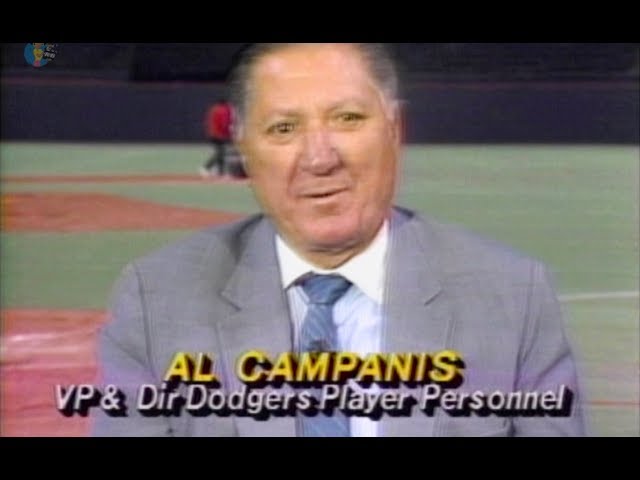
April 6, 1987: It is Opening Day of the Major League Baseball season. Late that night, ABC's news program Nightline dedicated its show to the 40th Anniversary of Jackie Robinson and the Brooklyn Dodgers desegregating MLB. (The anniversary was on the 15th).
Host Ted Koppel had videotaped interviews, ready for broadcast, of Jackie's widow, Rachel Robinson, and former Dodger broadcaster Red Barber. The original intention was to have a live conversation with Jackie's former Dodger teammate and fellow former Negro Leagues player, pitcher Don Newcombe; sportswriter Roger Kahn, a Brooklyn native who covered the Dodgers for the New York Herald Tribune in 1952 and 1953, and knew Jackie well for the rest of his life; and Al Campanis, a former minor-league teammate of Jackie's, later an executive who had been with the Dodgers during their 1957-58 move to Los Angeles, and had been their general manager since 1968.
Newcombe turned out to be unable to participate, due to travel issues. And that turned out to be the least of the broadcast's issues. The taped interview with Mrs. Robinson closed with her saying, "It's not coincidental that baseball in the 40-year period has not been able to integrate at any other level other than the players' level. We have a long way to go."
At this point, there had been 3 black field managers in MLB: Frank Robinson, with the Cleveland Indians, and then with the San Francisco Giants; Larry Doby, with the Chicago White Sox; and Maury Wills, with the Seattle Mariners. Only Robinson (no relation to Jackie) had lasted a full season. Plenty of teams had black coaches, but only 4 out of the 26 teams then in MLB had had a black manager.
Officially, there had never been a black general manager in MLB. Bill Lucas had the duties of a GM, but not the title, with the Atlanta Braves, starting in 1976, but died unexpectedly less than 3 years later, and there had not yet been another.
Next up was Campanis' segment. He was sitting in the press box at the Astrodome in Houston, where the Dodgers had just opened the season by losing to the Houston Astros, 4-3. Mike Scott outpitched Orel Hershiser. Sitting at his usual desk at ABC's Washington office, Koppel asked Campanis why there were, at the moment, no black managers or GMs.
Campanis' answer: "Well, Mr. Koppel, there have been some black managers, but I really can't answer that question directly. The only thing I can say is that you have to pay your dues when you become a manager. Generally, you have to go to the minor leagues. There's not very much pay involved, and some of the better-known black players have been able to get into other fields, and make a pretty good living in that way."
They hadn't paid their dues? To his credit, Koppel gave Campanis a chance to clarify his remarks, and perhaps recover from what could have been a career-ruining moment: "Yeah, but you know, in your heart of hearts, you know that that's a lot of baloney. I mean, there are a lot of black players, there are a lot of great black baseball men who would dearly love to be in managerial positions, and I guess what I'm really asking you is to, you know, peel it away a little bit. Just tell me, why you think it is. Is there still that much prejudice in baseball today?"
Instead of coming up with a better answer, Campanis doubled down: "No, I don't believe it’s prejudice. I truly believe that they may not have some of the necessities to be, let's say, a field manager, or perhaps a general manager."
"Necessities"? What would those be? Interviewed years later, Kahn, sitting in the ABC studio in New York, said, "When he said that blacks lacked the necessities, my legs almost fell off my body."
Koppel asked Campanis, "Do you really believe that?" And he said, "Well, I don't say that all of them, but they certainly are short. How many quarterbacks do you have? How many pitchers do you have that are black?" (This was 10 months before Doug Williams became the 1st black quarterback to start in, and the 1st to win, a Super Bowl.)
Koppel was Jewish. He knew what discrimination was. Campanis was the 1st person born in Greece ever to play in the major leagues, growing up in America at a time when Catholics -- especially Eastern Orthodox ones, as he was -- were treated by the establishment as less than fully American. He knew what discrimination was. Campanis should have known better, and Koppel knew that he should have known better.
Koppel went to a commercial, and when he came back, challenged Campanis again: "Yeah, but I mean, I gotta tell you, that sounds like the same kind of garbage we were hearing 40 years ago about players, when they were saying, 'Ah, not really, not really cut out.' Remember the days, you know, 'Hit a black football player in the knees,' and you know, no. That really sounds like garbage, if you'll forgive me."
Campanis still didn't realize he was in a hole, and kept digging: "No, it's not, it's not garbage, Mr. Koppel, because I played on a college team, and the center fielder was black, and the backfield at NYU, with a fullback who was black, never knew the difference, whether he was black or white, we were teammates. So, it might just be... Why are black men, or black people, not good swimmers? Because they don’t have the buoyancy."
"Buoyancy"? Where was he getting this stuff? Kahn, Jewish, and a victim of professional discrimination as a young man, had had enough. He said, "Oh, I get it, Al. Blacks have the ability to work in the cotton fields, but not to manage a baseball team."
Koppel responded to the swimming remark by saying, "Oh, I don't... It may just be that they don't have access to all the country clubs and the pools."
Koppel tried one more time to get Campanis to take the high road: "From everything I understand, you're a very decent man and a highly respected man in baseball. I confess to you, before we began this program, baseball is not one of my areas of expertise. I'd like to give you another chance to dig yourself out, because I think you need it."
Instead of taking this lifeline, Campanis took the offensive. He had a point, but he was the wrong man to make it: "Well, let me just say this, Mr. Koppel. How many executives do you have on a higher level or higher echelon in your business, in TV, I mean, or anchormen? How many black anchormen do you have?"
Koppel: "You're absolutely right, but I... "
Campanis: "Let's just, let's just turn around."
Koppel: "Yeah, fortunately, there are a few black anchormen. But if you want me to tell you why there aren't many black executives, I'm not going to tell you it's because the blacks aren't intelligent enough. I'm going to tell you it's because it is that whites have been running the establishment of broadcasting, just as they've been running the establishment of baseball for too long, and seem to be reluctant to give up power. I mean, that's what it finally boils down to, isn't it?"
Campanis: "Well, we have scouts in our organization who are black, and they're very capable people. I have never said that blacks are not intelligent. I think many of them are highly intelligent, but they may not have the desire to be in the front office. I know that they have wanted to manage and some of them have managed, but they're outstanding athletes, very God-gifted, and they're very wonderful people, and that's all I can tell you about them."
The Dodgers fired Campanis than 48 hours later. He never held another job in baseball.
In 1989, National League President Bart Giamatti was named Commissioner of Baseball. Hired to take his place as NL President was Bill White, then a broadcaster for the New York Yankees, and previously one of the game's top 1st basemen. He was black. He served in the office until 1994. That year, Leonard Coleman was named the 1st black President of the American League.
Most MLB teams have since had a black manager. The Yankees are not one of them. They have, however, had a black GM, Bob Watson.
*
April 6, 1987 was a Monday. This was also the night of the fight between Sugar Ray Leonard and Marvelous Marvin Hagler. I have a separate entry for that event.
These games were played on MLB's Opening Day, in addition to the Dodger-Astro game:
* The New York Yankees beat the Detroit Tigers, 2-1 at Tiger Stadium in Detroit. Rickey Henderson doubled Claudell Washington home with the winning run in the top of the 10th inning, making Dave Righetti a winning pitcher in relief of Dennis Rasmussen. Dave Winfield went 1-for-4. Don Mattingly went 0-for-5.
* The Baltimore Orioles beat the Texas Rangers, 2-1 at Memorial Stadium in Baltimore. Larry Sheets drove in the winning run, Rene Gonzales, with a sacrifice fly in the bottom of the 9th. Eddie Murray went 1-for-4, and Cal Ripken went 0-for-4.
* The Toronto Blue Jays beat the Cleveland Indians, 7-3 at Exhibition Stadium in Toronto.
* The Cincinnati Reds beat the Montreal Expos, 11-5 at Riverfront Stadium in Cincinnati.
* The Milwaukee Brewers beat the Boston Red Sox, 5-1 at Milwaukee County Stadium. Paul Molitor went 2-for-4 with an RBI. Robin Yount went 2-for-4 with 2 RBIs.
* The Chicago White Sox beat the Kansas City Royals, 5-4 at Royals Stadium (now Kauffman Stadium) in Kansas City. George Brett hit a home run.
* The San Francisco Giants beat the San Diego Padres, 4-3 at Candlestick Park in San Francisco. Chili Davis singled Jeffrey Leonard home with the winning run in the bottom of the 12th inning. Tony Gwynn went 1-for-4.
* And the New York Mets, the Atlanta Braves, the Chicago Cubs, the Philadelphia Phillies, the Pittsburgh Pirates, the St. Louis Cardinals, the California Angels, the Minnesota Twins, the Oakland Athletics and the Seattle Mariners each opened their seasons the next day.
Football was out of season. The NHL was between its regular season and the Stanley Cup Playoffs. There were 6 games played in the NBA:
* The New York Knicks beat the Philadelphia 76ers, 108-101 at Madison Square Garden.
* The Atlanta Hawks beat the Cleveland Cavaliers, 110-105 at The Omni in Atlanta. Dominique Wilkins scored 41 points.
* The Phoenix Suns beat the Dallas Mavericks, 118-110 at the Arizona Veterans Memorial Coliseum in Phoenix.
* The Sacramento Kings beat the Utah Jazz, 110-104 at the Salt Palace in Salt Lake City, Utah.
* The Los Angeles Lakers beat the Los Angeles Clippers, 135-112 at The Forum outside Los Angeles in Inglewood, California.
* And the Houston Rockets beat the Portland Trail Blazers, 114-108 at the Veterans Memorial Coliseum in Portland.