Showing posts with label chicago college all-star game. Show all posts

Sunday, October 9, 2022

October 9, 1924: Soldier Field Opens

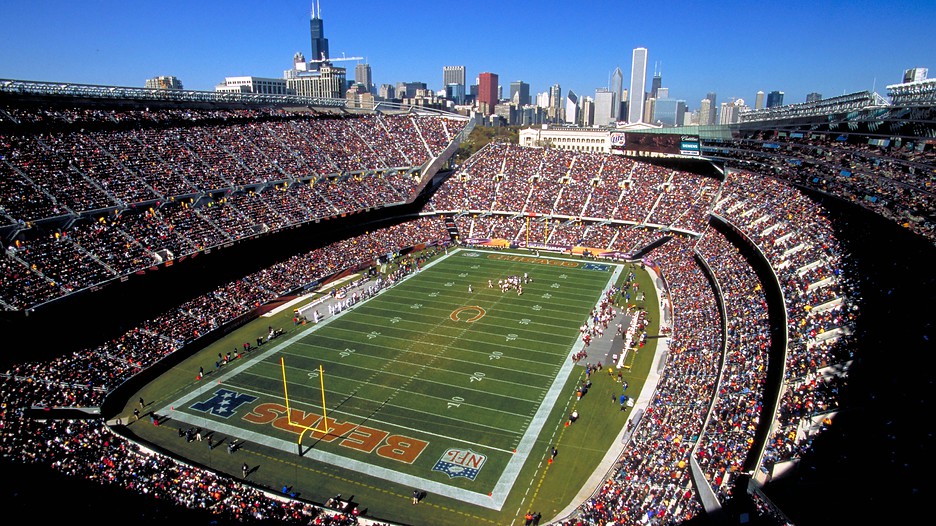
October 9, 1924: Municipal Grant Park Stadium opens on Chicago's lakefront. It would be renamed Soldier Field the next year. It would host many big college football games, including the annual Chicago College All-Star Game between a team of recently graduated players and the defending NFL Champions (who nearly always won) from 1934 to 1976.

And the name is "Soldier" Field. Never "Soldiers" or "Soldiers' Field." There is a Soldiers Field in Boston, part of Harvard University's sports complex.

Its best-known event was the 2nd fight between Heavyweight Champion Gene Tunney and the man from whom he took the title, Jack Dempsey, on September 22, 1927. In the 7th round, Dempsey knocked Tunney down, but he forgot to obey a new rule (which he, himself, had demanded): The referee would not start the count until the standing fighter retreated to a neutral corner. This gave Tunney an extra 5 seconds to regain his bearings, and he got up at the count of 9 (14), and went on to beat Dempsey in a decision.

It became known as the Long Count Fight, and, to this day, some people think Dempsey was robbed. He wasn't: The film clearly shows Tunney watching the referee's count. He could have gotten up at the count of 4, which should have been 9. Dempsey wasn't robbed. He didn't even blow it. He got beat, fair and square. 
may have had what remains the greatest attendance ever for a U.S. sporting event, with figures ranging from 104,000 to 130,000, depending on who you believe.
It definitely was the site of the largest football crowd ever, 123,000, to see Notre Dame play USC a few weeks after the Long Count. That record stood until a 2016 Tennessee-Virginia game was staged at Bristol Motor Speedway in front of 156,990. The 1926 Army-Navy Game was played there, in front of over 100,000.
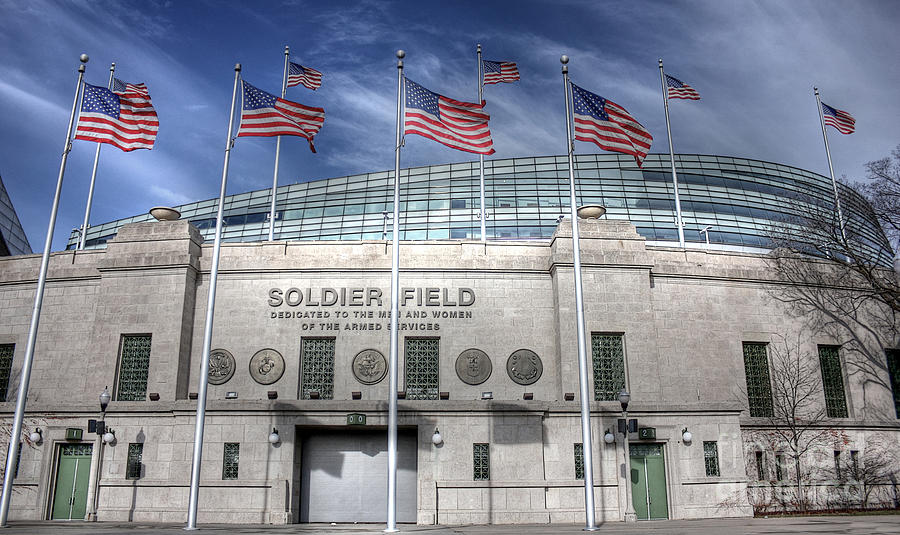
The original south side gate. Along with the columns,
it was the only thing saved from the original stadium.
The Chicago Rockets of the All-America Football Conference played at Soldier Field in 1946, '47 and '48, changing their name to the Chicago Hornets in '49. They were not admitted into the NFL with their AAFC brethren in Cleveland, San Francisco and Baltimore. The Chicago Cardinals played their last season there, in 1959, before moving to St. Louis. The Chicago Fire of the World Football League played there in 1974. And the Chicago Blitz of the United States Football League played there in 1983 and 1984.

Amazingly, the Chicago Bears played at Wrigley Field from 1921 to 1970, with the occasional single-game exception. The story I heard is that Bears founder-owner-coach George Halas was a good friend of both the Wrigley and Veeck families, and felt loyalty to them, and that's why he stayed at Wrigley even though it had just 47,000 seats for football.

But I heard another story that Halas was a Republican, and didn't like Chicago's Democratic Mayor, Richard J. Daley (whose son Richard M. later broke his father's record for longest-serving Mayor), and didn't want to pay the city Parks Department a lot of rent. This is believable, because Halas was known to be cheap. The real reason the Bears moved to Soldier Field in 1971 was Monday Night Football: Halas wanted the revenue, and Wrigley didn't have lights until 1988.
Games of the 1994 World Cup and the 1999 Women's World Cup were also held at the old Soldier Field. MLS' Chicago Fire made it their 1st home ground, playing at the old version from 1998 to 2001, and the new version from 2003 to 2005, and returning there starting in 2020.
Soldier Field during the 1994 World Cup

A 2002-03 renovation, during which the Bears played "home" games at the University of Illinois' Memorial Stadium in Champaign, demolished all but the south gate, and the iconic (if not Ionic, they're in the Doric style) Greek-style columns that used to hang over the stadium, and are now visible only from the outside. It doesn't look like "Soldier Field" anymore: One critic called it The Eyesore on the Lake Shore.
Capacity is now roughly what it was in the last few years prior to the renovation, 61,500. And while the Bears won 8 Championships while playing at Wrigley (it took the Cubs until 2016 to win even 1 title there), they've only won one more at Soldier Field, the 1985 title capped by Super Bowl XX. The Monsters of the Midway have been tremendous underachievers since leaving Wrigley, having been to only 1 of the last 35 Super Bowls, and losing it.
The reduced atmosphere, and thus the reduced home-field advantage, may be a part of that, much as similar reductions in atmosphere, passion and on-field performance has been blamed by Washington Redskins fans on the 1997 move from the in-the-District Robert F. Kennedy Stadium to the suburban FedEx Field, Yankee Fans on the 2009 move from the old Yankee Stadium to the new one, and Arsenal fans on the 2006 move from Arsenal Stadium (a.k.a. "Highbury") to the Emirates Stadium.
UPDATE: In 2023, the Bears announced a plan to tear down the Arlington Park horse-racing track, 27 miles northwest of the Loop in Arlington Heights -- nearly twice as far from downtown as O'Hare International Airport -- and build a dome there, possibly groundsharing with baseball's White Sox. Nearly every Bears fan was against this.
So an alternative plan was drawn up, to build a stadium on the parkland just south of the current one, keeping the only parts that remained from the original stadium: The columns on each sideline, and the southern gate with its dedication to the military personnel.
*
October 9, 1924 was a Thursday. There was only one score on this historic day. Game 6 of the World Series was played at Griffith Stadium in Washington. The Washington Senators beat the New York Giants, 2-1. The next day, the Senators won the World Series for what turned out to be the only time.

Wednesday, August 31, 2022

August 31, 1934: The 1st Chicago College All-Star Game

August 31, 1934: The 1st Chicago Tribune Charities College All-Star Game is played at Soldier Field.

Like the Major League Baseball All-Star Game, first played the year before at Chicago's Comiskey Park, it was the idea of Chicago Tribune sports editor Arch Ward, in connection with the 1933-34 "Century of Progress" World's Fair. Unlike the All-Star Game, it was set for Chicago every year. In 1943 and 1944, it was held at Dyche Stadium (now Ryan Field), in nearby Evanston, Illinois, home field of Northwestern University. Other than those 2, it was always played at Soldier Field.

The format of "the Chicago College All-Star Game" was always the same: An all-star team of recently graduated college players would play the defending NFL Champions. In this case, the Chicago Bears, featuring Harold "Red" Grange, the template for all speedy halfbacks who followed him; and Bronislau "Bronko" Nagurski, the role model for all big, bruising fullbacks after him. Nevertheless, a crowd of 79,432 saw the All-Stars hold the defending Champions to a 0-0 draw.

The NFL Champions won 30 games, the College All-Stars 9, with 2 ties. The defending NFL Champions who fell to the College All-Stars: The 1937 and 1963 Green Bay Packers, the 1938 and 1943 Washington Redskins, the 1946 Los Angeles Rams, the 1947 Chicago Bears, the 1950 Philadelphia Eagles, the 1955 Cleveland Browns, and the 1958 Detroit Lions.

In 1974, a players' strike in the preseason canceled the game. In 1976, with the Pittsburgh Steelers leading 24-0 late in the 3rd quarter, a lightning storm halted play, and the game was never resumed. And by "never," I mean never: The Tribune announced it would no longer sponsor the game.

And no one seems to miss it. Certainly, the team owners were glad to no longer risk the players on whom they were spending increasing sums of money.

*

August 31, 1934 was a Friday. Only 4 major league baseball games were played:

* The New York Yankees beat the Washington Senators, 3-1 at Yankee Stadium. Red Ruffing outpitched Jack Russell, for whom the Phillies' 1955-2003 Spring Training stadium would be named. Babe Ruth went 1-for-2 with 2 walks. Lou Gehrig went 0-for-3 with a walk.

* The New York Giants beat their arch-rivals, the Brooklyn Dodgers, 2-1 at Ebbets Field. Fat Freddie Fitzsimmons outpitched Van Lingle Mungo. Mel Ott went 0-for-3 with a walk. Bill Terry, by now also the Giants' manager, went 1-for-4.

* The St. Louis Cardinals beat their arch-rivals, the Chicago Cubs, 3-1 at Wrigley Field in Chicago. Dizzy Dean outpitched Guy Bush. Gabby Hartnett hit a home run, but it was the only run that Ol' Diz gave up.

* And the St. Louis Browns beat the Chicago White Sox, 3-2 at Sportsman's Park in St. Louis. Ray Pepper brought home the winning run with a sacrifice fly in the bottom of the 11th inning.

Tuesday, August 2, 2022

August 2, 1963: The College All-Stars Upset the Green Bay Packers

Bart Starr, quarterbacking the Packers in the All-Star Game

August 2, 1963: The Green Bay Packers, defending NFL Champions, are upset, 20-17, by the College All-Stars in the annual Chicago College All-Star Game, at Soldier Field in Chicago. This would be the last time the All-Stars would win the Game, which began in 1934 and was discontinued after 1976.

The All-Stars were coached by Otto Graham, the Hall of Fame quarterback of the Cleveland Browns, who was then the head coach of the football team at the U.S. Coast Guard Academy in New London, Connecticut. He had been the head coach for the All-Stars since 1958, and would remain the Coast Guard coach and the All-Star coach until 1966, when he accepted the job as head coach of the Washington Redskins.

The Packers had won the last 2 titles, going through the 1962 season 13-1, their only loss a Thanksgiving Day shocker to the Detroit Lions. They had beaten the New York Giants, 16-7 at Yankee Stadium in the NFL Championship Game. To emphasize how much of a shock this All-Star Game was: The previous season, the Packers had beaten the All-Stars, 42-20.
The All-Stars' uniforms, in color,
on display at the College Football Hall of Fame in Atlanta

But the Packers would have to go through the 1963 season without their best running back. On April 17, Paul Hornung had been suspended indefinitely by NFL Commissioner Pete Rozelle, for betting on sporting events. Lions defense tackle Alex Karras had received the same suspension, for the same reason. Unlike Pete Rose, then starting his rookie season in Major League Baseball, Hornung and Karras came clean immediately, and cooperated completely. As a result, both men had their suspensions lifted after the 1963 season, and resumed their careers.

Hornung was thus unavailable for this game. So was the Packers' great linebacker Ray Nitschke, due to an injury. Their other star running back, Jim Taylor, was playing hurt.

Ron Vander Kelen, who had led the University of Wisconsin to the Big Ten Conference title the year before, quarterbacked the All-Stars. Also on that team was a future Packer star, Penn State linebacker Dave Robinson; a man who would oppose the Packers in Super Bowl I, linebacker Bobby Bell of Minnesota; and a man who would oppose the Packers in back-to-back NFL Championship Games, Lee Roy Jordan of Alabama.
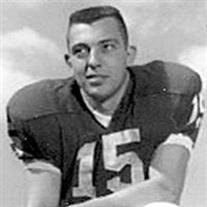
Ron Vander Kelen

Without Hornung, the Packers finished 11-2-1, with both of their losses coming to their arch-rivals, the Chicago Bears, who went on to win the NFL Championship. So, not counting games in or against Chicago, they were 11-0-1, even without Hornung.

They missed the Playoffs again in 1964, but won the next 3 NFL Championships, including Super Bowls I and II.

Graham would be fired as Redskins coach after the 1968 season. His successor was... Vince Lombardi. Lombardi coached the Redskins to a 7-5-2 record in 1969, but died of colon cancer before the next season could begin. Graham never coached in the NFL again. To show how medicine had progressed: Graham not only survived colon cancer, but became an advocate for early screening. He lived until 2006, and it was his heart, rather than his digestive system, that ended his life.

Despite his collegiate heroics and his starring in this game, Vander Kelen did not become a pro star: He played 5 seasons as a backup to Fran Tarkenton on the Minnesota Vikings, and 1 more season with the CFL's Calgary Stampeders.

*

August 2, 1963 was a Friday. These baseball games were played that day:

* The New York Yankees lost to the Baltimore Orioles, 5-3 at Yankee Stadium. Former Phillies ace Robin Roberts outpitched Whitey Ford. Mickey Mantle was injured and did not play. Brooks Robinson went 2-for-3 with an RBI.

* The New York Mets split a doubleheader with the Milwaukee Braves at Milwaukee County Stadium. The Braves won the opener, 8-0. Bob Hendley pitched a 4-hit shutout. Hank Aaron, Eddie Mathews and Joe Torre all hit home runs. The Mets won the nightcap, 3-1. Joe Hicks singled home the winning run in the top of the 11th inning. Over the 2 games, Aaron went 4-for-8 with 4 RBIs.

* A doubleheader was split at District of Columbia Stadium in Washington. (It was renamed Robert F. Kennedy Memorial Stadium in 1969.) The Boston Red Sox won the opener, 5-0. Earl Wilson pitched a 6-hit shutout, and helped his own cause with a home run. The Washington Senators won the nightcap, 4-3. Carl Yastrzemski went 3-for-4 with a walk and an RBI, but then went 0-for-4.

* The Cincinnati Reds beat the Pittsburgh Pirates, 3-0 at Crosley Field in Cincinnati. Jim Maloney pitched a 4-hit shutout. Frank Robinson went 1-for-3. Rookie Pete Rose went 0-for-3 with a walk. Roberto Clemente went 0-for-4.

* The Detroit Tigers beat the Cleveland Indians, 10-9 at Tiger Stadium in Detroit. Al Kaline went 2-for-5 with an RBI.

* The Chicago Cubs beat the San Francisco Giants, 12-11 at Wrigley Field in Chicago. This was one of those days when the wind was blowing out at Wrigley. Billy Williams, Leo Burke and Ellis Burton hit home runs for the Cubs; while Willie Mays and Orlando Cepeda hit them for the Giants.

Ironically, it was a future major league pitching coach, with a .223 lifetime batting average, Jimmy Schaffer, who drove in the winning run, with a single in the bottom of the 10th inning. Ernie Banks did not start the game, later came in as a pinch-hitter and 1st baseman, and drew 2 walks.

* The St. Louis Cardinals beat the Philadelphia Phillies, 3-2 at Busch Stadium (formerly Sportsman's Park) in St. Louis. Stan Musial, in his last 2 months as an active player, did not appear in the game.

* The Minnesota Twins beat the Kansas City Athletics, 10-3 at Kansas City Municipal Stadium. Harmon Killebrew went 2-for-4 with 2 walks.

* The Houston Colt .45s beat the Los Angeles Dodgers, 4-1 at Colt Stadium in Houston. The Colts became the Astros in 1965.

* The Chicago White Sox beat the Los Angeles Angels, 5-1 at Dodger Stadium in Los Angeles. The Angels groundshared with the Dodgers until their Anaheim stadium was built in 1966.

Saturday, July 23, 2022

July 23, 1976: The Rainy Last Chicago College All-Star Game

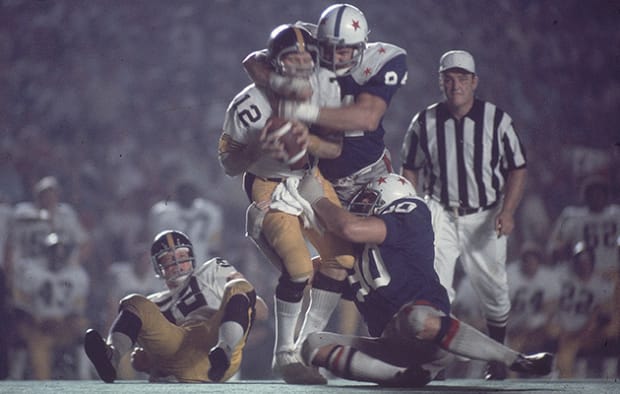
Randy White sacks Terry Bradshaw

July 23, 1976: The Chicago College All-Star Game is played at Soldier Field -- as it turns out, for the last time.

It had been played for the 1st time in 1934, as a football counterpart to the baseball All-Star Game, first played the year before. Each was played in connection with the Century of Progress World's Fair in Chicago, but was deemed such a success that it continued. The main difference was that, for the annual game between the defending NFL Champions and a team of collegiate All-Stars, it would always be held in Chicago.

The 1976 contest took place 8 days before the 2-time defending Champion Pittsburgh Steelers embarked on a 6-game preseason slate that preceded a 14-game regular-season schedule.

That didn't stop head coach Chuck Noll from sending his starters out to take on a college team that featured future Hall of Fame defensive end Lee Roy Selmon (selected No. 1 overall in the 1976 draft by the Tampa Bay Buccaneers), as well as other top picks like running backs Chuck Muncie (New Orleans Saints), Mike Pruitt (Cleveland Browns), and the only 2-time Heisman Trophy winner Archie Griffin (Cincinnati Bengals).

More notably still, the college team, coached by Notre Dame's Ara Parseghian, included 3 of Pittsburgh’s own rookies: 1st-round pick Bennie Cunningham (tight end, Clemson), 2nd-round pick Ray Pinney (offensive line, University of Washington), and 3rd-round pick Mike Kruczek (Boston College), the latter of whom served as starting quarterback for the All-Stars.

When Noll learned that Kruczek would be starting the game, he reportedly said, "We only worry about the guys who have our jerseys on. We'll worry about Kruczek when he has our jersey on."

Unfortunately for Kruczek, he didn't survive the 1st quarter, as he was knocked out of the game with a thigh injury, courtesy of a hit from a Steelers defender. His backup, Craig Penrose of San Diego State, was soon injured too, requiring Parseghian to turn to Jeb Blount of Tulsa.

"Near the end [Blount] was running for his life to get away from Steve Furness, L.C. Greenwood, Dwight White and Ernie Holmes. These defensive linemen were shedding the blocks of the All‐Stars' second‐string offensive line as though flicking away flies," noted William N. Wallace in his recap for The New York Times.

Meanwhile, Pinney had his difficulties, too. At one point he snapped the ball over the head of his punter, Rick Engels. The ball went through the end zone for a safety, gifting the Steelers 2 points.

As the 4th quarter approached, the Steelers held a commanding 24-0 lead. Then came a thunderstorm and torrential rains that would do a disaster movie proud.

"I don't think I've ever seen it rain this hard at a football game," said announcer Bud Wilkinson, the former head coach at Oklahoma, during the ABC telecast, to which broadcast partner Frank Gifford, a native of Southern California before a Hall of Fame career as a New York Giants running back, responded: "I don't think I've ever seen it rain this hard."

Not long afterwards, hundreds of fans stormed the field, prompting Noll to escort his players into the locker room. If there was any thought of resuming the contest, that possibility became moot when fans tore down the goal posts.

Ultimately, the contest was called with 1:22 left in the 3rd quarter, marking the 1st time in the history of the NFL that a game was halted while in progress on account of weather, bringing the series to a memorable, if ignoble, end.

For what it's worth, the College All-Stars did have some success playing against the professionals, at least in the early years of the series. All in all, the pros won 31 games, the collegiate players won 9, and there were 2 ties. But the professionals emerged victorious in 16 of the last 17 games played, with the lone NFL loss in that period coming at the expense of the Green Bay Packers in 1963.

*

July 23, 1976 was a Friday. These baseball games were played that day:

* The New York Yankees beat the Boston Red Sox, 9-1 at Yankee Stadium. Doyle Alexander outpitched Bill Lee. Mickey Rivers, Graig Nettles and Fred Stanley each had 3 RBIs.

* The New York Mets lost the Montreal Expos, 3-2 at Jarry Park in Montreal. Del Unser hit a home run off Skip Lockwood in the bottom of the 11th inning, ruining a pitcher's duel between Tom Seaver and Steve Rogers. Dale Murray was the winning pitcher for the Expos.

* The Philadelphia Phillies beat the Pittsburgh Pirates, 11-1 at Veterans Stadium in Philadelphia. Jim Lonborg went the distance for the win. Mike Schmidt and Dave Cash hit home runs for the Phils. The Pirates' only run came on a home run by Dave Parker. Willie Stargell went 2-for-4.

* The Milwaukee Brewers beat the Baltimore Orioles, 4-3 at Memorial Stadium in Baltimore. The Brewers got 2 runs in the top of the 13th inning, and the O's could only come back with 1 in the bottom half, on a home run by Reggie Jackson in his only season with Baltimore. Brooks Robinson went 0-for-5. For the Brewers, Hank Aaron drew a walk as a pinch-hitter, and Robin Yount went 1-for-5 with a walk.

* The Cincinnati Reds beat the Atlanta Braves, 3-1 at Atlanta-Fulton County Stadium. Pete Rose went 0-for-2 with 3 walks. Johnny Bench went 0-for-4.

* The Cleveland Indians beat the Detroit Tigers, 9-4 at Cleveland Municipal Stadium. Indians manager Frank Robinson, not yet retired as a player, did not put himself into the game.

* The Minnesota Twins beat the Chicago White Sox, 6-2 at Comiskey Park in Chicago. Rod Carew went 2-for-5 with an RBI.

* The Chicago Cubs beat their arch-rivals, the St. Louis Cardinals, 4-3 at Busch Memorial Stadium in St. Louis. Lou Brock went 1-for-4 with a walk.

* The Los Angeles Dodgers beat the San Diego Padres, 5-0 at Dodger Stadium in Los Angeles. Tommy John, in his 1st season after his eponymous surgery, pitched a 4-hit shutout. Dave Winfield went 1-for-3.

* The San Francisco Giants beat the Houston Astros, 3-0 at the Astrodome in Houston. Jim Barr pitched a 4-hit shutout.

* The Oakland Athletics beat the Kansas City Royals, 2-0 at the Oakland Coliseum. Vida Blue pitched a 6-hit shutout, striking out 13 and walking only 1. George Brett got 2 of those hits.

* And the California Angels and the Texas Rangers were not scheduled.

December 31, 1999 & January 1, 2000: The Millennium

December 31, 1999:  The Millennium arrives. The people of planet Earth survived. At a terrible cost. But we hadn't destroyed ourselves. ...