Showing posts with label thomas dewey. Show all posts

Monday, November 7, 2022

November 7, 1944: President Franklin Roosevelt Is Elected to a 4th Term

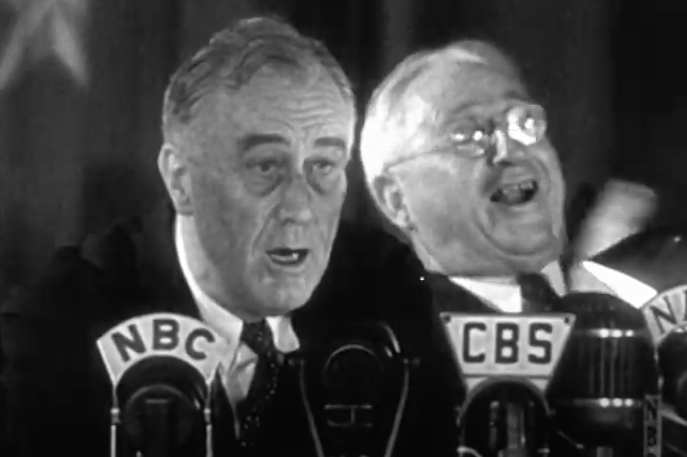
November 7, 1944: For the 1st time in 80 years, America holds a Presidential election in the middle of a war. President Franklin D. Roosevelt is elected to an unprecedented 4th term, defeating Thomas E. Dewey, who held FDR's former post of Governor of New York.

With World War II raging, and America and its Allies widely viewed as winning it, but not yet having won it, FDR won 432 Electoral Votes to Dewey's 99. The popular vote was 25.6 million for FDR, 22.0 million for Dewey. That looks close, but it worked out to 53.4 percent for FDR, and 45.9 for Dewey.

Dewey won 12 States: Maine, Vermont (the only 2 States that FDR never won), Ohio, Indiana, Wisconsin, Iowa, North Dakota, South Dakota, Nebraska, Kansas, Colorado and Wyoming. FDR won the other 36 States, including New York, where both men lived; and Michigan, where Dewey was born and raised.

How close was it? Take out "the Solid South," still not willing to vote for a Republican because it was "The Party of Lincoln," even if he was as conservative as they were, and the Electoral Vote would have been 276-99 for FDR. Not enough to cost him the election. Nor the popular vote: FDR still would have won, 21.1 million to 19.9 million.

But if Dewey had won every State in which he got at least 47 percent of the vote, including New York, Pennsylvania and Illinois, which were then the 3 States with the largest population, he would have won the Electoral Vote, 275-256. (48 percent wouldn't have done it, because he would still have lost New York, and the election, 303-238.)

The consensus, in both candidates' camps, was that the key to FDR winning was to have him be seen as winning The War, but not having already won it, meaning he was needed to "finish the job." As in 1940, the consensus was that, if he were running solely on domestic policy, he would have lost, because a lot of people were tired of the New Deal and its regulations, but trusted the experienced old hand to win The War.

The last time America had a Presidential election in the middle of a war was in 1864, when Abraham Lincoln was by no means a shoo-in for re-election, but military success gave him the win. The Democrats brought back Lincoln's slogan: "Don't change horses in mid-stream." But, with Senator Harry Truman of Missouri replacing Henry Wallace as the nominee for Vice President, the Republicans joked that the Democrats had changed the back half of the horse. The Republicans had nominated Governor John Bricker of Ohio, their 2nd-place finisher in delegates, for Vice President, and this gave them a rhyming slogan: "Win the war quicker with Dewey and Bricker."

FDR was not well, struggling with heart disease and high blood pressure, brought on by the pressure of fighting, essentially, 2 major wars at once: Against Nazi Germany in Europe, and against the Japanese Empire in the Pacific. And he was also trying to set up the postwar country, with his G.I. Bill of Rights and other postwar economic measures; and the postwar world, with the United Nations.

His smoking and drinking didn't help. He was 62 years old, and looked at least 72. The Republicans began a "whispering campaign," saying that the Democratic titan was too old and tired to handle the Presidency, and possibly dying.

To counter this, FDR held a parade down Broadway in Lower Manhattan. In the rain. Not good for his health. I wonder if anyone warned him about William Henry Harrison, who was inaugurated as President on March 4, 1841, and then proceeded, without a hat, overcoat or gloves, in freezing rain, to give the longest Inaugural Address ever, 1 hour and 45 minutes. He died 1 month later.

FDR's parade was attended by millions, cheering and chanting, "We want Roosevelt!" Prior to the parade, he held a rally at Ebbets Field in Brooklyn. "I've got a confession to make," he told the crowd. "I come from the State of New York, and I've practiced law in New York City. But I have never been in Ebbets Field before." He was not booed.

He did say, "I've rooted for the Dodgers" -- even though he had, on numerous occasions, been to Yankee Stadium to cheer on the Yankees, to the Polo Grounds to cheer on the Giants, and saw them both at the Polo Grounds in Game 2 of the 1936 World Series. "And I hope to come back someday and watch 'em play." That got a huge roar.

FDR would be unable to go back. He had not been to a major league game since before Pearl Harbor, thinking it inappropriate for the President to do so. (There was Presidential precedent: Woodrow Wilson loved baseball, and threw out the first ball at every Opening Day of his first term, but not in 1917 and '18 due to World War I, not in '19 due to his trip to the postwar peace conference, and not in '20 due to his health.) FDR died at the dawn of the next season, of a stroke brought on by working himself to death to save civilization from fascism.

In 2016, there was no "whispering campaign": The Republicans came right out and said that the year's Democratic nominee, also (officially) from the State of New York, Hillary Clinton, was "dying" and "doesn't have the stamina to be President." She did 3 90-minute debates, and kicked Donald Trump's ass in each of them.

In 2020, when it became clear that Trump was becoming more and more unhealthy and unhinged, they said it was Joe Biden who had "dementia." He did 2 debates that, because of Trump's interruptions, lasted more than 90 minutes, and mopped the floor with him both times.

As of November 7, 2022, both Hillary Clinton, age 78, and Joe Biden, a few days away from turning 80, are still alive, and appear to be in good health. So, you tell me.

UPDATE: After a disastrous debate with Trump, Biden, 81, accepted the appeals of major Democratic officials, and dropped out of the race, and endorsed Vice President Kamala Harris, who turned 60 late in the campaign. Trump, 78, now looked like a very old man indeed. He did emerge as the official winner of the election, but acted ever more like a grumpy old man as his 2nd term went on.

*

November 7, 1944 was a Tuesday. Midweek, so no football. The baseball season was over. The NHL season had started, but had no games scheduled for this day. And the NBA hadn't yet been founded. So there were no scores on this historic day.

Wednesday, November 2, 2022

November 2, 1948: "Dewey Defeats Truman"

November 2, 1948: The most famous newspaper headline of all time? It might be the New York Daily News of October 30, 1975: "FORD TO CITY: DROP DEAD." Or it might be the one the Chicago Tribune (a proud Republican paper at the time) put up the morning after today's Presidential election.

As it turned out, despite all predictions and despite all polls, Governor Thomas E. Dewey of New York, the Republican nominee, did not defeat the incumbent Democrat, President Harry S Truman. This made Truman, the 33rd President of the United States, the patron saint of every Presidential underdog since.

The problem is, Harry was smarter than most of them. Which is why he's enjoying himself so much in the photo above: He fooled 'em all.

But Dewey was dumb to have blown what should have been a sure win. How dumb was he? Well, maybe not that dumb:
Dewey remains the only major-party Presidential nominee
with facial hair since the Republicans nominated
Charles Evans Hughes in 1916.

The Republican Party didn't give him the support he needed, because they presumed he wouldn't need it. The polls all indicated a Dewey romp. 
Why? Because the Democratic Party had been splintered, from both wings. From the left: Henry A. Wallace, who had been Secretary of Agriculture in President Franklin D. Roosevelt's 1st 2 terms, Vice President in the 3rd, and Secretary of Commerce in FDR's 4th term before he died and it became Truman's 1st.

He was the darling of what's now called the progressive movement, but, then, it was an actual group named the Progressive Party. Aside from the name, it had no connection to the previous parties of that name, nominating Theodore Roosevelt in 1912 and Robert La Follette in 1924.
It was feared that Wallace would take the black vote. He did, but not as much as was feared. It was feared that he would take organized labor with him. He did, but with this, too, not as much as was feared. It was feared that his campaign would swing New York to Dewey. It did. It was feared that his campaign would swing California to Dewey. It didn't. And it was feared that losing New York and California, with a combined 72 Electoral Votes, would cost Truman the election. Even if Truman had lost California's 25 EVs, he still would have won.

From the right: Strom Thurmond, Governor of South Carolina, who welcomed the Southern Delegates who walked out of the Democratic Convention in Philadelphia (both parties held their Conventions at the Philadelphia Civic Center that year), following a pro-civil rights speech by the Mayor of Minneapolis, who was running for the U.S. Senate, and won: Hubert Humphrey.

Thurmond was happy to accept the Presidential nomination of the States' Rights Party, a.k.a. the Dixiecrats. A precursor to the 1968 independent candidacy of George Wallace (no relation to Henry), he managed to win his home State of South Carolina, plus Alabama, Mississippi, Louisiana, and 1 Electoral Vote in Tennessee.
Later famously the oldest U.S. Senator ever,
Thurmond was just 45 years old at this point.
I don't think a picture of him looking young exists.

And Dewey himself seemed to be a great candidate. A crusading District Attorney in Manhattan, he had put some of the nation's nastiest organized crime bosses in prison, including the creator of the governing body of the American Mafia, "the Commission," Charles "Lucky" Luciano.

He was in his 2nd term as a successful, popular Governor. He had been the Republican nominee for President in 1944, running against wartime Commander-in-Chief Roosevelt, and had done well enough to earn himself a shot at a vulnerable peacetime President in Truman. And he was a young, good-looking guy: Just 46, and there was the thought that he could redeem the idea of mustaches after the bad reputation they had recently gotten from Adolf Hitler.

Surely, with Dewey popular, Thurmond splitting the formerly "Solid South," and Wallace moving New York and California from the Truman column to the Dewey column, Dewey would win. Interviewed in 1995, even Thurmond -- who wasn't even on the ballot in all 48 States, and knew he had no chance, but was very much willing to spoil things for Truman -- admitted, "I thought Dewey would win."

On the day before the election, the nation's foremost political columnist, Drew Pearson of The Washington Post -- no relation to the later black football star of the same name -- wrote that any chance of a Truman victory was "impossible," and his column printed the day after the election stated that Pearson had "surveyed the closely-knit group around Tom Dewey who will take over the White House 86 days from now." Another national columnist, Walter Winchell, reported that gambling odds were 15 to 1 against Truman.

More than 500 newspapers, accounting for over 78 percent of the nation's total circulation, endorsed Dewey. Truman picked up 182 endorsements, accounting for just 10 percent of America's newspaper readership, being surpassed by Thurmond, who got the remaining 12 percent from many Southern papers.

Alistair Cooke, writing in England for the Manchester Guardian, published an article on the day of the election entitled "Harry S. Truman: A Study of a Failure." For its 1st-ever television coverage of a Presidential election, NBC News had constructed a large cardboard model of the White House containing two elephants that would pop out when NBC announced Dewey's victory. Since Truman's defeat was considered certain, no donkeys were placed in the White House model.

As Truman made his way to his hometown of Independence, Missouri
, 10 miles east of downtown Kansas City, to await the election returns, some among his inner circle had already accepted other jobs, and not a single reporter traveling on his campaign train thought that he would win. Some prominent Republicans, anticipating serving in a Dewey Presidency, had already bought homes in Washington.

But the Republicans got too complacent. Truman did win California after all, by a razor-thin margin of 18,000 votes. And there was no State that Thurmond threw from Truman to Dewey -- although Maryland was close enough, and its largest city Baltimore black enough, that Wallace, who got 10,000 votes there, might have thrown it to Dewey.

The Cold War was supposed to be Dewey's winning issue. Instead, it was Truman's, with the Truman Doctrine protecting Greece and Turkey from Communist takeover, the Marshall Plan aiding Western Europe before the Soviet Union could, and the Berlin Airlift preventing the Soviets from starving West Berlin into capitulation.

Also, after 16 years, voters still didn't trust the Republicans with the economy. Truman never mentioned Herbert Hoover, the last Republican President and the man who presided over the start of the Great Depression, by name, because they were on good terms. (Whereas Hoover was definitely not on good terms with FDR -- or with his own Republican predecessor, Calvin Coolidge.) So he blamed the Republicans in general for the Depression of the 1930s, and it worked.
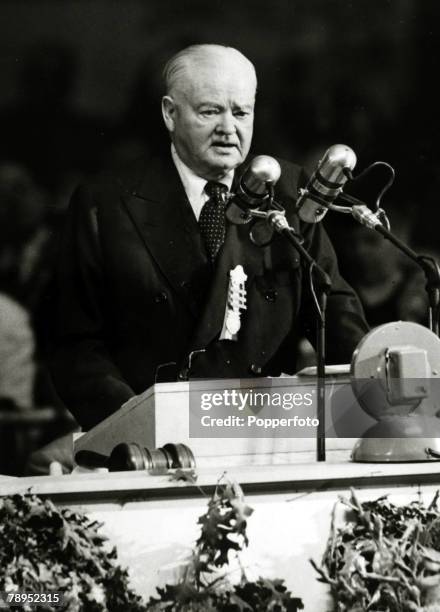
Hoover at the 1948 Republican Convention in Philadelphia.
They continued to invite him to every Convention,
and he kept coming until 1960.

From their days as fellow members of the U.S. Senate, Truman was good friends with Alben Barkley, the Kentuckian who was the Democrats' Senate Leader, and had no problem accepting him as the nominee for Vice President. But he hitched his wagon to the legacy of Franklin Delano Roosevelt, effectively making the New Deal his platform (his 1949 State of the Union Address would update it for the times as "the Fair Deal"), and FDR's ghost his running mate.
Truman and Roosevelt, at FDR's Hyde Park estate,
after the 1944 Democratic Convention

Truman knew he could win, and he knew how he could do it: By going to the people themselves, in what the GOP derisively called "a whistle-stop campaign," a phrase Truman ran with, and explaining the truth to people where they were, and in terms they could understand -- without talking down to them, as Donald Trump does today. He connected with people the same way FDR did, even though they were very different men.

The crowds Truman got at the "whistle stops" were huge. Writers for conservative papers tried to say that it was just people coming out to the political equivalent of a vaudeville show. Walter Lippman, often called "the Father of American Journalism," pointed out that it took Truman away from Washington for 16 days, and inadvertently proved how little he mattered.

But Lippman had never left Washington. Nor had most of the tour's critics seen it. As would be said today, they remained inside their bubble. Or, as Bob Dylan would sing in 1965, "Something is happening here, but you don't know what it is, do you, Mr. Jones?"

On Election Night, NBC announcer H.V. Kaltenborn announced, "Well, the President is leading by over a million votes in the popular vote, but we believe that when the country vote comes in, he will be defeated by an overwhelming majority." Indeed, at one point, he saw something that suggested that the election had swung to Dewey, and proclaimed him the winner.

On his way back from Kansas City to Washington, Truman stopped at Union Station in St. Louis, and was presented with a copy of that morning's Chicago Daily Tribune. The publication calling itself "The World's Greatest Newspaper" (hence the call letters of the radio station they founded, WGN) was published by "Colonel" Robert McCormick, the Rupert Murdoch of his era: A man who would tell any lie and spread any rumor, so long as it fulfilled his principle of electing more Republicans, so he could make more money.

But the Trib had violated what would later be called the Felix Unger Rule: "You should never assume, because, when you ASSUME, you make an ASS of U and ME." The result was the most famous headline in newspaper history, and Truman was delighted to see his old enemy the Colonel make an ass of himself. After all, it wasn't enough for the Colonel to have his paper say, in a huge headline, "DEWEY WINS" or "DEWEY ELECTED." He wanted to rub it in, telling the President he hated so much that he had lost: "DEWEY DEFEATS TRUMAN." Oops.

At a celebratory dinner in Washington a few days later, Truman threw the guests into laughter, imitating Kaltenborn's clipped delivery. He also thanked those who had stood by him, and those who should have: "The September Democrats and the October Democrats... and the Monday Democrats, and the Tuesday Democrats, and the Wednesday Democrats!"

Ever since, Ol' Harry S has been the patron saint of political underdogs, of the people who are told they can't possibly win.

(There's no period on his middle initial, since it legally didn't stand for anything, as his parents couldn't agree on whether to name him after one of his grandfathers, Anderson Shippe Truman or Solomon Young. So his entire middle name was the letter S, with no period. His mother's brother was Harry Young, and the name was "Harry," not "Henry" or "Harrison." His legal name was "Harry S Truman.")

Even Republicans cite him as an inspiration. As Truman himself would have said, "Well, that's just political conversation." Or, as his only child, Margaret, who became a noted writer of mystery novels after a failed singing career, put it while editing one of her father's books, and seeing the words "political conversation" written down, "My father originally used a shorter word here, but decided to change it." Clearly, Margaret was too much of a lady, even then, to say what the word was. Just as clearly, the word was "bullshit."

Truman did love him some of what I like to call "George Carlin words." Legend has it that Harry and his wife Bess (formerly Elizabeth Wallace) toured a greenhouse, and Harry, a former farmer himself, told the owner, a woman, that she "must have used some good manure." The owner pulled Bess aside and said, "Can't you get the President to say, 'Fertilizer'?" And Bess said, "It's taken me this long just to get him to say, 'manure'!"

Truman won 24.1 million votes, Dewey 22.0 million, Thurmond 1,175,930, Wallace 1,157,328. Popular vote share: Truman 49.5 percent, Dewey 45.1, Thurmond 2.41, Wallace 2.37. States: Truman 28, Dewey 16, Thurmond 4, Wallace none. Electoral Votes, with 266 being a majority: Truman 303, Dewey 189, Thurmond 39, Wallace none. Wallace got 8.2 percent of the popular vote in New York, 4.7 percent in California, and in no other State did he get more than 4 percent.

After the election, a study by the University of Michigan revealed that "14 percent of Truman's voters, or 3,374,800, had decided to vote for him in the last fortnight of the campaign." In the last 2 weeks.

Gallup and Roper also did an analysis of the votes: They "learned that one voter in every seven (6,927,000), made up his mind in the last two weeks before the election. Of these, 75 percent picked Truman."

The Democrats also swept back into power in Congress, taking 75 seats in the House of Representatives and 9 in the Senate. Notable newly-elected Senators included Democrats Humphrey, Estes Kefauver of Tennessee, Paul Douglas of Illinois, and Bob Kerr of Oklahoma. Only 2 new Republicans were elected: Margaret Chase Smith of Maine (making her the 1st woman to serve in both houses of Congress) and Robert Hendrickson of New Jersey. Indeed, of the 91 Republicans newly elected to the House in 1946, more than half of them went down to defeat.

Charles Bennett of Florida was the last Congressman elected in 1948 still continuously serving, retiring before the 1992 election. However, Sidney Yates of Illinois, elected in 1948, left the House in 1962 to run for the Senate. He lost, but regained his House seat in 1964, and remained until retiring before 1998.

The truth was, it wasn't that close. People who voted for Dewey were basically voting for him simply because he was the Republican nominee. Outside New York State, he was not especially popular. Even people who met him didn't find him personally likable. In 2 elections as the Republican nominee for President, he only won a total of 288 Electoral Votes, barely enough to win 1. This time, the non-Republican vote was 54.3 percent. Truman had made the election a referendum on the Republicans, and it worked in his favor. 

The polls had gotten it all wrong. Radio comedian Fred Allen used a horse racing metaphor: He said that Truman had become the 1st man to lose in a Gallup and win in a walk. 

If Dewey hadn't been so complacent, he would have realized that Truman was reaching the hearts and minds of the people. And he might have gone out to answer Truman's charges against him and "that do-nothing Republican 80th Congress." Maybe the Republicans, as a party, blew it for Dewey. But he also blew it for himself.

No friend of Truman's, or any Democrat's, Time magazine boss Henry Luce named Truman his magazine's Man of the Year for 1948, as he had for 1945. I suspect it was more for the Marshall Plan and the Berlin Airlift than it was for the election.

Truman could have run for what would have amounted to a 3rd term in 1952, but didn't. He went back to Independence, where he built, opened, operated, and lectured at his Presidential Library, until a broken hip in 1965 put an end to his public life. He died in 1972.

Vice President Barkley ran a half-hearted campaign to succeed Truman in 1952, but, already 74 years old and a Southerner, he knew he had little chance. He died in 1956.

Dewey was elected to a 3rd term as Governor of New York in 1950, and left office after that 3rd term. The New York State Thruway is also known as the Governor Thomas E. Dewey Thruway. Despite being 17 years younger, he died in 1971, a year before Truman.

Wallace drifted into obscurity, and wrote books about farming, his specialty. He died in 1965, of Lou Gehrig's disease. Thurmond returned to the Democratic fold, was elected to the Senate in 1956, became a segregationist leader, switched to the Republican Party after the signing of the Civil Rights Act of 1964, and kept getting re-elected to the Senate until 2002, when, approaching his 100th birthday, even he had to admit that he wouldn't survive another term. He died the next year.

Truman's Presidential Library opened in Independence, 10 miles east of downtown Kansas City, on July 6, 1957. The USS Harry S Truman is a nuclear-powered aircraft carrier, CVN-75, a.k.a. The HST, in service since 1996. There are high schools named for Truman in Independence (naturally), New York City (as part of the Co-Op City complex in The Bronx), the suburbs of Philadelphia (Levittown, Pennsylvania), Detroit (Taylor, Michigan) and Seattle (Federal Way, Washington). And there is a Truman College in Chicago.
Statue, U.S. Capitol Building

Truman remains the only President born in Missouri, or representing it in politics. Aside from Ulysses S. Grant, he remains the only one to have lived there for a significant amount of time; and, unlike Grant, it was for his entire life.

He has been played by Robert Vaughn in The Man from Independence in 1974, James Whitmore in Give 'em Hell, Harry! in 1975, E.G. Marshall in Collision Course: Truman vs. MacArthur in 1976, Ed Flanders in MacArthur in 1977, Harry Morgan in Backstairs at the White House in 1979, Walker Edmiston in J. Edgar Hoover in 1987, Richard Dysart in Day One in 1989, Gary Sinise in Truman in 1995, David Patrick Kelly in Flags of Our Fathers in 2006, and Bob Gunton in Project Blue Book in 2019. (UPDATE: He was played by Gary Oldman in Oppenheimer in 2023.)

Charles F. Brannan was the last surviving member of the Truman Cabinet, serving as Secretary of Agriculture in the 2nd term. He lived until 1992.

As for Dewey, in 1964, the New York State Thruway, which he got built as Governor, was officially renamed the Governor Thomas E. Dewey Thruway, although most people in the State call it just "The Thruway."

Robert McCormick died in 1955. The Tribune dropped "Daily" from its name in 1963, and began its shift away from doctrinaire conservatism in 1969. Still, it didn't endorse a Democrat for President until 2008, with home-State Senator Barack Obama.

*

November 2, 1948, like all modern Election Days in America, was a Tuesday. The baseball season was over. There were no football games played. The NBA season had started the day before, but there were no games on this day. And the NHL also had no games scheduled. So there were no scores on this historic day.

Sunday, October 23, 2022

October 23, 1935: Dutch Schultz Is Rubbed Out

October 23, 1935: Mobster Dutch Schultz is rubbed out, along with 2 bodyguards and his accountant, at the Palace Chophouse at 12 E. Park Street in Newark. He was 34 years old.
(The address no longer exists, as the 60 Park Place Building has wiped it out. A restaurant called Dutch's Lounge has opened at 24 E. Park.)
Schultz had asked the Mafia Commission for permission to kill the U.S. Attorney investigating him in New York, Thomas Dewey. They refused, because it would have meant the U.S. government declaring all-out war on them, a war the Mob knew it couldn't win. They thought he might try it anyway, and rival Charles "Lucky" Luciano sent 2 hitmen from Murder, Incorporated to do it. He was shot at 10:15 that night, and died at 2:20 the next morning.
Born on August 6, 1901 as Arthur Simon Flegenheimer, Dutch Schultz started as a bouncer at a Bronx speakeasy, whose owner, Joey Noe, took a liking to him for his ruthlessness in throwing guys out. He joined Noe's bootlegging operation, and took over when Noe was rubbed out in 1928, as part of the Castellamarese War. Schultz may have ordered the 1928 killing of Arnold Rothstein, the gambler who fixed the 1919 World Series; and the 1930 attempted rubout of Legs Diamond, who recovered, only to be killed by another gang the following year.
When Prohibition ended in 1933, Schultz moved into a numbers racket (an illegal lottery) and extortion. But Dewey, remembering how Al Capone was brought to justice, indicted Schultz for tax evasion. So Schultz made his request, and it ended up backfiring.
He didn't die immediately, and was still conscious when he was loaded into an ambulance that would take him to Newark City Hospital (now University Hospital). He had $3,000 in cash (about $64,000 in 2022 money) on him, and gave it to an intern in the ambulance, because, "It's not going to do me any good where I'm going." When it looked like Schultz might live, the intern got scared that Schultz might want the cash back, and gave it to the police.
Schultz lived for 29 hours, and remained lucid long enough for the police to question him, and ask him if he knew who shot him, or if he knew who sent them. Keeping the Mob's code of silence, he wouldn't say.
With a tombstone bearing his real name, he is buried in Gate of Heaven Cemetery in Hawthorne, New York -- the same cemetery as Babe Ruth, Billy Martin, Ralph Branca, Giants owners Tim and Wellington Mara, Heywood Broun, Dorothy Kilgallen, Conde Nast; steel magnate Charles M. Schwab (no relation to the investment guru Charles R.), Fred Allen, James Cagney, Sal Mineo and 1920s Mayor Jimmy Walker.
One of the gunmen, Charles Workman, served 23 years in prison. The other, Emmanuel Weiss, was arrested for a different murder, and executed in 1944. Albert Anastasia, the Commission head, "the boss of all bosses," remained in power until getting whacked himself in 1957.
Lucky Luciano and his business partner Meyer Lansky allowed their friend Abner "Longy" Zwillman, a former bootlegger and the king of Newark's "numbers racket," to take over Schultz's New Jersey operations. He became the most powerful gangster between the Hudson and Delaware Rivers, until his tax problems piled up, and he was found dead in his West Orange home in 1959, shortly before he was to testify before a Senate Committee in Washington. It's been alleged that Vito Genovese, head of the New York crime family that still bears his name, ordered it, with Lansky's blessing.
Luciano was convicted in 1936, a case prosecuted by Dewey, but the charges had nothing to do with the Schultz murder, for which he was never charged. He was sentenced to 30 to 50 years in prison. During World War II, he accepted a deal with the federal government, negotiated by Lansky: Through his operations, he had naval knowledge that could help win The War. In 1946, his sentence was commuted, on the condition that he accept deportation back to Italy. He accepted, and died in Naples in 1962. Lansky lived on until 1983, his power and fortune having waned, but he was never imprisoned. Nor was he assassinated, like the Hyman Roth, the character based on on him for the film The Godfather Part II.
Schultz has been played by Lawrence Dobkin on 3 episodes of the TV series The Untouchables in 1959, Vic Morrow in Portrait of a Mobster in 1961, Vincent Gardenia in Mad Dog Coll the same year, James Remar in The Cotton Club in 1984, Dustin Hoffman in Billy Bathgate in 1991, and Tim Roth in Hoodlum in 1997.
In 1998, Michael Walsh published As Time Goes By, an authorized combination prequel and sequel to the film Casablanca. It imagines Humphrey Bogart's character as a young man named Yitzik Baline, working for Solly Horowitz, a mobster based on Schultz. When Horowitz is rubbed out on October 23, 1935, "Rick" Baline, by then running Horowitz' speakeasy, has to flee the country, and changes his name to Richard Blaine.
*

October 23, 1935 was a Wednesday. Puerto Rican golfer Juan Antonio "Chi-Chi" Rodríguez was born.

The baseball season was over, the hockey season didn't start for another 2 weeks, there was no NBA, and it was a Wednesday, so there were no football games. So there were no scores on this historic day.

Wednesday, October 5, 2022

October 5, 1953: Earl Warren is appointed Chief Justice

October 5, 1953: Earl Warren is appointed Chief Justice of the Supreme Court of the United States. President Dwight D. Eisenhower made the appointment. He would have preferred not to.

Earl Warren (no middle name) was born on March 19, 1891 in Los Angeles, and grew up in Bakersfield, California. He graduated from the University of California, and served in the U.S. Army in World War I, rising to the rank of 1st Lieutenant. He remained in the Army Reserve, rising to the rank of Captain.

He clerked for the Judiciary Committee of the California Assembly, became a Deputy City Attorney for Oakland, a Deputy District Attorney for Oakland's Alameda County, and then started running for office. He was elected District Attorney for Alameda County in 1924, and continually re-elected until 1938, when he was elected Attorney General of California, also serving 6 years as Chair of the State's Republican Party.

In 1942, 1946 and 1950, he was elected Governor. (California didn't limit its Governors and other major State offices to 2 terms until 1992.) In 1944, he was considered for the Vice Presidential nomination at the Republican Convention, and he got it in 1948. He received no blame for the defeat of the Presidential nominee, Governor Thomas E. Dewey of New York, and was considered a front-runner for 1952. He did not run, because General Dwight D. Eisenhower was too popular.

But "Ike" wouldn't have it easy: The conservative wing of the party wanted Senator Robert Taft of Ohio. Ike needed the support of the California delegation, which Warren controlled, and so he promised Warren the first vacancy on the Supreme Court in return. Warren agreed, Ike got the nomination, and won the general election.

But when Chief Justice Fred Vinson died in office on September 8, 1953, Ike tried to welch on his deal, telling Warren he meant the first vacancy for Associate Justice. He even offered the Chief Justice post to Dewey, who declined. Warren threatened to reveal the deal, which would have seriously damaged Ike's reputation -- not that he made such a deal, but that he broke it.

Ike decided that, no matter how popular he was, it wasn't worth finding out if Warren was bluffing. He made the appointment, and, despite 3 Southern Senators opposing him on the Judiciary Committee, the full Senate confirmed him by a vote of acclamation: No vote, just an overwhelming advantage of "Yea" votes.

Eventually, Ike would say his two greatest mistakes as President were appointing Warren and Bill Brennan to the Court. But those were political mistakes, not real mistakes. They turned out to be two of the best Justices ever.

The Warren Court (the Supreme Court is often named after the Chief Justice) took America forward in civil rights: For nonwhite people, for women, and for innocent people charged with crimes. It was Warren who insisted that Brown v. Board of Education, the 1954 case that struck down public school segregation based on race, be a unanimous vote, and managed to persuade the last holdout Justice, Stanley Reed, to join the 9-0 opinion.

If I were going to make my all-time nine-person Supreme Court, it would include Warren and 3 Justices who served with him: Brennan, William O. Douglas and, for about a year and a half starting in late 1967, Thurgood Marshall.

As Governor in 1946 when Richard Nixon was first elected to the House of Representatives from a District in California, in 1950 when Nixon was elected to the Senate, and in 1952 when Nixon was elected Vice President, Warren knew Nixon well, and didn't trust him. He was not happy about having to swear Nixon into office as President in 1969, or about Nixon getting to appoint his successor, Warren Burger.

Warren wanted to retire in 1968, but due to political circumstances, stayed on until 1969. He died on July 9, 1974, at the age of 83, knowing that Nixon's impeachment, or his resignation to avoid that, was likely, but a month before the resignation actually happened.

*

October 5, 1953 was a Monday. The New York Yankees beat the Brooklyn Dodgers, 4-3 at Yankee Stadium, when Billy Martin singled Hank Bauer home in the bottom of the 9th inning, to win Game 6, and thus the World Series. It was their 5th straight World Championship, a feat never done before or since in baseball. I have a separate entry for that event.

This was before Monday Night Football, so there were no football games. It was too early to start the new NBA and NHL seasons. So there were no other scores on this historic day.

Friday, September 23, 2022

September 23, 1944: President Franklin D. Roosevelt's "Fala Speech"

September 23, 1944: The President of the United States, running for re-election, makes his dog an issue in the campaign. Why not? They started it.

On April 7, 1940, a litter of Scottish terrier puppies was born at Wilderstein, in Rhinebeck, Dutchess County, New York. This mansion was the home of, among others, Margaret Suckley. Known as Daisy, she lived 10 miles up the Hudson River from Springwood, the Hyde Park home of her 6th cousin, the President of the United States, Franklin Delano Roosevelt. Whose wife, Eleanor Roosevelt, was a 5th cousin, and a niece of a previous President, Theodore Roosevelt. (FDR's own parents, James Roosevelt and Sara Delano, were 6th cousins. The Hudson Valley of the time saw quite a bit of inbreeding, often closer than that.)

Among the puppies was one that Daisy named Big Boy, although Scottish terriers, a.k.a. "Scotties," are not very big. She trained the dog to sit, roll over, and jump. She was closer to FDR than their blood relationship would suggest, although their physical distance wasn't much. (It was rumored that they were, how shall I put this, a little too close, but this has never been proven.) As a Christmas present, she gave the dog to FDR.

FDR, like many members of old, established New York State families, had (and many of those who didn't, claimed) patrilineal Dutch descent. But he also had Scottish descent, with a grandfather named John Aspinwall, and the Scottie reminded him of an ancestor, known as Murray the Outlaw of Falahill. This became the dog's formal name with the American Kennel Club. FDR called him "Fala" for short, and took him back with him to the White House, to which he had just been elected to an unprecedented 3rd term.

Within a few weeks, Fala was taken to a veterinary hospital. As it turned out, he had figured out how to reach the kitchen, and was being overfed. FDR gave orders to everyone, from kitchen staff to West Wing employees: No one but the President was to feed Fala.

In his 2nd campaign for President, in 1936, the Republicans relentlessly attacked FDR. They also attacked Eleanor, for various reasons. They even printed campaign buttons reading, "And that goes for Eleanor, too!" These attacks got harsher in 1940.

As America entered World War II, FDR's sons entered military service. Franklin D. Roosevelt Jr. served in the U.S. Navy, where he rose to the rank of Lieutenant Commander, served in combat, commanded the destroyer USS Ulvert M. Moore, and earned the Silver Star (for exposing himself under fire to carry a critically wounded sailor to safety), the Bronze Star, the Legion of Merit, the Purple Heart, and the nickname "Big Moose." FDR Jr. was a legitimate war hero.

Elliott Roosevelt, named for Eleanor's father and TR's brother, was also genuinely heroic in The War. (As my grandmother, who lived through it, explained, "It was always Capital T, Capital W.") He was classified 4-F, unfit for service, due to poor eyesight. He asked his father, as Commander-in-Chief, to overrule this so he could serve. He was given a Captain's commission in the U.S. Army Air Forces, and flew 89 combat missions, earning the Legion of Merit and the Distinguished Flying Cross. He later became, like actor and hero pilot Jimmy Stewart, a Brigadier General in the U.S. Air Force Reserve.

James Roosevelt, named for FDR's father, was already a military aide to his father before the attack on Pearl Harbor got America into The War, a Lieutenant Colonel in the U.S. Marine Corps. He served in combat in the Makin Raid (at what's now named Butaritari, in the Pacific Island nation of Kiribati) of August 17, 1942, received the Navy Cross (then as now, the Marines were part of the Department of the Navy), was promoted to full Colonel, and became a postwar Brigadier General in the Marine Corps Reserve.

Youngest son John Aspinwall Roosevelt was talked out of seeking conscientious objector status. He received an Ensign's commission in the Navy, and, according to brother James, "John was the only one of us who had no opportunity to lead a fighting unit, yet he, too, served under fire." He received the Bronze Star, and reached the rank of Lieutenant Commander. (Franklin and Eleanor also had a daughter, Anna, and a son, the 1st Franklin Jr., who died as an infant.)

Any or all of the 4 Roosevelt sons could have taken the easy way out. They could have gotten out of serving, by taking necessary (or "necessary") government jobs. They could have been given military posts that would have kept them stateside, or even in either the European or the Pacific Theater of Operations, but away from combat. Indeed, James already had a stateside, non-combat post. But they all served in combat, all were legitimately decorated, Franklin Jr. was wounded, and all but John were awarded commands.

Still, as FDR ran for a 4th term, the Republicans, who had nominated Governor Thomas E. Dewey of New York for President and Governor John Bricker of Ohio for Vice President (with the slogan, "Win the war quicker with Dewey and Bricker"), noted that all 4 sons started out as officers, not enlisted men working their way up. Which, as college graduates (except for Elliott: He refused to attend college, but the other 3 graduated from Harvard like their father), they were qualified to do, if not entitled.

Noting that all but John had received commands, and that any Naval officer who commands any unit is addressed by his crew as "Captain," regardless of his actual rank, the GOP made campaign buttons reading, "I wanna be a Cap'n too!" Never mind that Elliott and James weren't even in the Navy.

It got worse. There was a "whispering campaign" that FDR was dying. As it turned out, he was: The stress of The War, and his incessant smoking, had given him heart disease and very high blood pressure. But the details were kept out of reach of the media.

The GOP even spread a rumor that, while on an inspection tour of a base in the Aleutian Islands of Alaska, FDR had left Fala behind, and had, at significant cost to U.S. taxpayers, ordered a destroyer to get Fala and bring him back to the mainland. The story spoke to both corruption and a sense of entitlement on the Roosevelts' part.

The story was a total lie, as Republican rumors about the Democrats tend to be. FDR was angry. But Orson Welles, a great actor and director but not really known for comedy, suggested to the President that he use comedy on the Republicans.

In those days, before Primaries became deciding factors, and before "exploratory committees" became vital, Presidential campaigns didn't start nearly 2 years before the election. Sometimes, candidates didn't launch their official campaigns until after their nominating conventions. FDR not only could do this in 1944, but, given The War, he pretty much had to.

And so, his 1st campaign speech took place on September 23, in Washington, at a dinner of the International Teamsters Union, to emphasize his long connection with the labor unions. It lasted half an hour, and was broadcast by all American radio networks. He made the audience laugh, both in the room and in the living rooms:

Well, here we are, together again, after four years. And what years they have been!

You know, I am actually four years older, which is a fact that seems to annoy some people. In fact, in the mathematical field, there are millions of Americans who are more than eleven years older than when we started in to clear up the mess that was dumped in our laps in 1933.

We all know that certain people who make it a practice to depreciate the accomplishments of labor – who even attack labor as unpatriotic – they keep this up usually for three years and six months in a row. But then, for some strange reason, they change their tune, every four years, just before Election Day. When votes are at stake, they suddenly discover that they really love labor, and that they are anxious to protect labor from its old friends...

The whole purpose of Republican oratory these days seems to be to switch labels. The object is to persuade the American people that the Democratic Party was responsible for the 1929 crash and the Depression, and that the Republican Party was responsible for all social progress under the New Deal.

Now, imitation may be the sincerest form of flattery, but I am afraid that, in this case, it is the most obvious common or garden variety of fraud!...

Can the Old Guard pass itself off as the New Deal? I think not. We have all seen many marvelous stunts in the circus, but no performing elephant could turn a handspring without falling flat on his back.

He moved on to foreign policy, and the conduct of The War:

There are some politicians who kept their heads buried deep in the sand while the storms of Europe and Asia were headed our way, who said that the Lend-Lease bill "would bring an end to free government in the United States," and who said, "only hysteria entertains the idea that Germany, Italy, or Japan contemplates war on us."

These very men are now asking the American people to entrust to them the conduct of our foreign policy and our military policy. What the Republican leaders are now saying in effect is this: "Oh, just forget what we used to say. We have changed our minds now. We have been reading the public opinion polls about these things, and now we know what the American people want."

And if that wasn't enough, he addressed the rumor about his dog:

These Republican leaders have not been content with attacks on me, or my wife, or on my sons. No, not content with that, they now include my little dog, Fala!

Well, of course, I don't resent attacks, and my family don't resent attacks, but Fala does resent them!
FDR, and Daniel J. Tobin,
President of the International Teamsters Union

FDR waited for the laughter to subside, to provide the full effect for the radio audience, and continued:

You know, Fala is Scotch, and, being a Scottie, as soon as he learned that the Republican fiction writers -- in Congress, and out -- had concocted a story that I'd left him behind on an Aleutian Island, and had sent a destroyer back to find him, at a cost to the taxpayers of two, or three, or eight, or twenty million dollars... his Scotch soul was furious. He has not been the same dog since.

The next line wasn't funny in the slightest, but it still drew laughter from the room:

I am accustomed to hearing malicious falsehoods about myself. But I think I have a right to resent, to object, to libelous statements about my dog!

After that, Dewey's only chance was if FDR had died before the election. He did not. But he did die on April 12, 1945, less than 3 months into his 4th and final term.

After his death, Eleanor took Fala home with her to Val-Kill, her home in Hyde Park. (She and Franklin each had separate "retreats" away from the main Hudsonside mansion, Springwood. His was called Top Cottage.) Once, in her nationally-syndicated newspaper column, My Day, she wrote, "Fala accepted me after my husband's death, but I was just someone to put up with until the master should return."
Eleanor and Fala, 1951

In 1952, Fala's health began to fail. He was euthanized on April 5, 2 days before his 12th birthday, and was laid to rest on the grounds of Springwood, next to a previous Roosevelt dog, Chief, not far from where Franklin was buried, and where Eleanor would follow in 1962. Statues of Fala were placed at the entrance to the visitor's center at the FDR Library on the Springwood grounds, and at the FDR Memorial in Washington.
The FDR Memorial
Fala remains the most famous Presidential pet, though not for a lack of trying. On September 23, 1952, 8 years to the day after the Fala Speech, when his integrity was challenged, Richard Nixon, then the Republican nominee for Vice President, mentioned a gift he'd received from a supporter: A cocker spaniel that his daughter, Tricia, had named Checkers. The intention was to remind people of Fala, thinking it would annoy Democrats and thrill Republicans. Checkers lived until 1964, not making it into the White House when Nixon was eventually elected President in 1968.
Both George Bushes had dogs, and when the father's dog (actually, his wife Barbara's dog) Millie had puppies, the father said, "Those puppy pictures saved my first hundred days!" One of those puppies was adopted by the son, who named it Ranger after the baseball team he owned. By the time George W. became President, he had his own Scottish terrier, named Barney.
*
September 23, 1944 was a Saturday. These baseball games were played that day:
* The New York Yankees beat the Cleveland Indians, 7-2 at League Park in Cleveland. Nick Etten hit a home run in support of Bill Bevens. Most of the Yankees' stars were serving, including Joe DiMaggio and Red Ruffing in the Army Air Force, Bill Dickey and Phil Rizzuto in the Navy, Tommy Henrich in the Coast Guard, and Charlie Keller in the Merchant Marine. Yogi Berra was also in the Navy, but hadn't yet made his major league debut. He had already participated in the D-Day invasion, and would become the only man who had done so to also play in the major leagues. Indians ace Bob Feller was in the Navy.
* The New York Giants lost to the Pittsburgh Pirates, 6-4 at the Polo Grounds. Mel Ott, both player and manager by this point, was too old to be drafted. However, he did not put himself into this game.
* The Brooklyn Dodgers beat the Chicago Cubs, 12-3 at Ebbets Field. Manager Leo Durocher had retired as a player, and was too old to be drafted. But Pee Wee Reese, his successor as shortstop and already the team's Captain, was in the Navy, as was Cookie Lavagetto. Pete Reiser was in the Army. So was Jackie Robinson, but the Dodgers didn't know about him yet, unless they knew he'd played college football at UCLA.
* The Boston Braves beat the Cincinnati Reds, 4-0 at Braves Field in Boston. Al Javery pitched a 6-hit shutout. Warren Spahn had made his debut for the Braves in 1942, but didn't win a single game, then went into Army, where he was wounded at the Battle of the Bulge. Then he came back, and won 363 games in the major leagues.
* The St. Louis Cardinals beat the Philadelphia Phillies, 6-2 at Shibe Park in Philadelphia. Stan Musial went 2-for-4. The Cards were hit less by the manpower drain of The War than any other team. Hence, they won the National League Pennant every year from 1942 to 1946, except 1945, the year that Musial was in the Navy. However, they did lose Enos Slaughter to the Army Air Corps, where he served in action in the Pacific.
* The Detroit Tigers beat the Boston Red Sox, 8-2 at Briggs Stadium (later Tiger Stadium) in Detroit. Tigers superstar Hank Greenberg was in the Army, while the Red Sox' Ted Williams was in the Marines.
* The Chicago White Sox beat the Washington Senators, 5-4 at Comiskey Park in Chicago.
* And the St. Louis Browns, about to win their one and only Pennant under that name, beat the Philadelphia Athletics, 3-1 at Sportsman's Park in St. Louis.
All NFL games that weekend were played the next day. And it was too early for the basketball and hockey seasons. But there were college football games played that day. Among them:
* Army, understandably on its way to the National Championship, did not open its season until the following week. Nor did Navy, also understandably one of the best teams in the country. They would be ranked Number 2 when they faced Number 1 Army at Municipal Stadium in Baltimore, a game won by Army. Notre Dame also did not open its season until the following week, and would also be Number 2 when they lost to Number 1 Army.
* Ohio State did not open its season until the next week. It won the Big Ten Conference title and finished undefeated. It did not play in a bowl game, and was ranked Number 2 behind Army.
* Oklahoma did not open its season until the next week. It won the Big Six Conference title (a forerunner of the Big 12), but did not play in a bowl game.
* Georgia Tech did not open its season until the next week. It won the Southeastern Conference title.
* Two other SEC teams went to bowl games that season. Tennessee did not open its season until the next week. Like Georgia Tech, they went undefeated in SEC play, and did not play Tech, but a tie with Alabama cost them the title.
* Alabama also did not open its season until the next week. Despite going 3-1-2 in SEC play, they were 5-2-2 overall, and were invited to the Sugar Bowl.
* Duke beat the University of Richmond, 61-7 at Duke Stadium (now Wallace Wade Stadium) in Durham, North Carolina. then they lost 4 straight games, although 1 was to Army and the other was to Navy. They won the Southern Conference title, a precursor to the Atlantic Coast Conference, and beat Alabama in the Sugar Bowl. (It could have been called the Wallace Wade Bowl, since Wade had coached both schools.)
* The University of Tulsa beat North Texas Agricultural, now known as the University of Texas at Arlington, 47-6 at Skelly Field in Tulsa. They went on to beat Georgia Tech in the Orange Bowl.
* Oklahoma A&M (now Oklahoma State) beat West Texas State (now West Texas A&M), 41-6 at Lewis Field (now Boone Pickens Stadium) in Stillwater, Oklahoma.
* Texas Christian beat Kansas, 7-0 on neutral ground at Ruppert Stadium, later renamed Kansas City Municipal Stadium. TCU won the Southwest Conference title, but lost to Oklahoma A&M in the Cotton Bowl.
* The University of Southern California and the University of California at Los Angeles played to a 13-13 tie at the Los Angeles Memorial Coliseum. USC rebounded from this, and, due to wartime travel restrictions, played only on the West Coast, including a rematch with UCLA, winning 40-13, to win the Pacific Coast Conference, a forerunner of the Pac-12. USC went on to beat Tennessee in the Rose Bowl.
* There wasn't much local action in the New York Tri-State Area. In New York City, Fordham suspended its program for the duration of The War. Columbia opened its season the following week, New York University (NYU) the week after that. In New Jersey, Rutgers only played 5 games, and didn't play their 1st until October 28. Princeton only played 3 games, and didn't start until November 11.

Thursday, September 22, 2022

September 22, 1944: Disney's Dewey Rally at the L.A. Coliseum

Walt Disney

September 22, 1944: A rally for Governor Thomas E. Dewey of New York, the Republican Party's nominee for President, is held at the Los Angeles Memorial Coliseum. It is organized by Walt Disney, head of America's leading cartoon studio.

Disney had been a supporter of Franklin D. Roosevelt and the Democratic Party in the 1932 and 1936 elections. But in 1940, he became a Republican. In 1944, despite World War II being waged and America and its allies appearing to be doing well, Disney supported Dewey, contributing heavily to his campaign.
Disney was approached by film producer and director Cecil B. DeMille and actor Lionel Barrymore, both dedicated conservatives, to help them organize a rally for Dewey at the Coliseum, designed to make it look like Dewey was popular in Los Angeles, then the 5th-largest city in the country and easily the largest in the American West (with 1.5 million people, then trailing New York, Chicago, Philadelphia and Detroit), and in California overall, then the 5th-largest State and just ahead of Texas as the largest in the West (with 6.9 million, then trailing New York, Pennsylvania, Illinois and Ohio).

Disney agreed, and, with his contacts, he got some of the biggest names in Hollywood to agree to come. A crowd of 93,427 attended. Admission to the rally was free, but, in 2018, a ticket to it was auctioned off at $50.

The whole thing looked like a Hollywood premiere, with floodlights, a giant flag, the Olympic torch being lit, and big signs featuring the names of Dewey and his Vice Presidential nominee, Governor John Bricker of Ohio. (There was a rhyming slogan, which seems ridiculous in hindsight: "Win the war quicker with Dewey and Bricker.")
The spectators heard speeches by Dewey, and Disney; producer David O. Selznick; and these actors, in alphabetical order: Don Ameche, George Burns and his wife Gracie Allen, Gary Cooper, Irene Dunne, Clark Gable, Cary Grant, Fred MacMurray, Raymond Massey, Adolphe Menjou, Ray Milland, George Murphy, Mary Pickford, William Powell, Ginger Rogers and Barbara Stanwyck. Not speaking, but also attending, were directors Howard Hawks, Preston Sturges and King Vidor; and actors Wallace Beery, William Bendix, Janet Blair, Lillian Gish, Jeannette MacDonald and Joel McCrea.

Mary Pickford was a legend of the silent film era, but neither her ex-husband and partner in founding United Artists, Douglas Fairbanks, nor her stepson, Douglas Fairbanks Jr., was at this rally. Douglas Sr. had died in 1939, and Douglas Jr. remained a devoted Democrat throughout his long life. Lillian Gish was another silent film legend, as was her sister, Dorothy Gish, who was not at the rally, although she was also a Republican. (Lillian did admit to voting for FDR in 1936.)

George Murphy, better known as a dancer, was elected a U.S. Senator from California in 1964, but lost his bid for re-election in 1970. William Powell was famous for starring in the Thin Man movies with Myrna Loy, but Loy wasn't there: She was a Democrat. Ginger Rogers was famous for her dance routines with Fred Astaire, but Astaire wasn't there, although he was a lifelong Republican. Jeannette MacDonald was famous for her musical films with Nelson Eddy, but Eddy wasn't there, although he was a Republican.

Also notably not attending, despite being devout Republicans, were Bob Hope and Bing Crosby, who had already starred together in 3 "Road to... " movies since 1940, and would do 4 more.

It was not notable at the time, but is in hindsight, that Ronald Reagan was not there: While he had been appearing in movies since 1937, and was a genuine star from 1940 onward, he didn't begin to turn from left to right until 1947, and didn't switch his party registration from Democratic to Republican until 1962. He was in the U.S. Army Air Force at this point, but was based just outside Hollywood in Culver City, so if he had wanted to attend, he just would have needed to get a pass from his commanding officer.

People born after 1960, who know Reagan as a Republican icon and Hollywood as "liberal," would be shocked to know about this rally. In that year's campaign, FDR got huge crowds to see his motorcades, but in stadiums, he got no crowd bigger than the 40,000 who squeezed themselves into Fenway Park in Boston the weekend before the election.

Did the Coliseum rally for Dewey work? Not by a long shot: FDR won the election, taking 36 States for 432 Electoral Votes, to Dewey's 99 from 12 States. FDR got 55.9 percent of the popular vote nationally, 56.5 percent in the State of California, and 56.7 percent in the County of Los Angeles. Dewey won just 12 of the State's 58 Counties, including only 3 in the South: Orange, Riverside and Imperial. San Diego County, then as now home to a major naval base, has usually voted Republican. At the time, the sailors stationed there must have voted for their Commander-in-Chief.

I can find no reference to any supporter of FDR and the Democrats telling Walt Disney, or any of the people at the rally, "Stick to show business, leave politics out of it." When conservatives say that to liberals today, I remind them that nobody ever says, "Stick to (whatever you do), leave politics out of it" when they agree with your politics.

One more thing: At this point, the Republicans were getting most of the attention in the campaign. Rather than hitting the trail, FDR was staying close to home, and doing his job as head of government and commander-in-chief. Many Democratic activists, not aware of the state of his health, and seeming to care that there was a war on, were telling him to do something.

The night after the Coliseum rally, he did. He had a speech nationally broadcast from a union dinner in Washington, and showed Hollywood what a real showman was, invoking "my little dog, Fala!"

*

September 22, 1944 was a Friday. These baseball games were played that day:

* The New York Yankees beat the Cleveland Indians, 7-3 at Cleveland Municipal Stadium.

* The New York Giants lost to the Chicago Cubs, 8-1 at the Polo Grounds. Giant manager Mel Ott, still playing, did not put himself into the game.

* The Boston Braves beat the St. Louis Cardinals, 11-2 at Braves Field in Boston. Stan Musial went 1-for-4.

* The Detroit Tigers swept a doubleheader from the Boston Red Sox, 7-4 and 8-6 at Briggs Stadium in Detroit. (It was renamed Tiger Stadium in 1961.)

* The St. Louis Browns beat the Philadelphia Athletics, 4-2 at Sportsman's Park in St. Louis.

* The Chicago White Sox and the Washington Senators were rained out at Comiskey Park in Chicago. It was made up as part of a doubleheader 2 days later. The White Sox swept, 9-3 and 2-0, with future Yankee Eddie Lopat pitching a 6-hit shutout in the nightcap.

* And the game scheduled for this day between the Brooklyn Dodgers and the Pittsburgh Pirates at Ebbets Field was moved up, so that they played a doubleheader the day before. The Pirates swept, 10-4 and 14-6.

December 31, 1999 & January 1, 2000: The Millennium

December 31, 1999:  The Millennium arrives. The people of planet Earth survived. At a terrible cost. But we hadn't destroyed ourselves. ...