Showing posts with label john lewis. Show all posts

Sunday, August 28, 2022

August 28, 1963: The March On Washington

August 28, 1963: The March On Washington for Jobs and Freedom is held at the Lincoln Memorial. A crowd usually listed as 250,000 or 300,000 attends.

It is organized by A. Philip Randolph, the leading figure of the black wing of America's labor movement, who had canceled a similar march in 1941, after getting concessions from President Franklin D. Roosevelt; and Bayard Rustin, who had organized the anti-segregation Freedom Rides in 1961.

Mahalia Jackson, then America's greatest living singer of gospel music, sang "How I Got Over." Marian Anderson, who had sung at the Lincoln Memorial in an Easter concert before 75,000 in 1939, sang "He's Got the Whole World in His Hands."

Joan Baez sang "We Shall Overcome," Bob Dylan sang, "Only a Pawn in Their Game," and, then a couple, together they sang Bob's song "When the Ship Comes In." Peter, Paul and Mary sang "If I Had a Hammer" and Bob's song "Blowin' in the Wind." Odetta sang "I'm On My Way."

Other celebrities on hand: Singers Josephine Baker, Harry Belafonte, Sammy Davis Jr., Diahann Carroll, Lena Horne, Judy Garland and Bobby Darin; actors Sidney Poitier, Marlon Brando, Burt Lancaster, James Garner, Robert Ryan, Rita Moreno, married couple Ossie Davis and Ruby Dee, married couple Paul Newman and Joanne Woodward, and, surprising many people only old enough to remember him as a conservative and a gun-rights advocate, Charlton Heston; novelist James Baldwin; and baseball trailblazer Jackie Robinson.

The speakers were, in order: Randolph; Walter Reuther, the President of the United Auto Workers (UAW), who'd been bringing black leaders into the labor movement since the 1930s; Roy Wilkins, the Executive Director of the National Association for the Advancement of Colored People (NAACP); John Lewis, the Chairman of the Student Nonviolent Coordinating Committee (SNCC); Daisy Bates, a journalist in Little Rock, Arkansas, who had aided the Little Rock Nine in 1957; Dr. Eugene Carson Blake, of the United Presbyterian Church and the National Council of Churches; Floyd McKissick, the National Director of the Congress of Racial Equality (CORE); Whitney Young, President of the National Urban League; and the Rev. Dr. Martin Luther King Jr., Chairman of the Southern Christian Leadership Conference (SCLC).

Dr. King's speech lasted 17 minutes, and turned out to be the highlight of the demonstration. Already famous since his role in the Montgomery Bus Boycott in Alabama in 1955 and '56, he had written Letter from Birmingham Jail earlier in the year, so his speech was highly anticipated.

Early in his speech, he said some things that many white Americans did not want to hear -- and probably still don't, because they are largely still true:

In a sense, we have come to our Nation’s Capital to cash a check. When the architects of our great republic wrote the magnificent words of the Constitution and the Declaration of Independence, they were signing a promissory note to which every American was to fall heir.
This note was a promise that all men, yes, black men as well as white men, would be guaranteed the inalienable rights of life, liberty, and the pursuit of happiness.
It is obvious today that America has defaulted on this promissory note insofar as her citizens of color are concerned. Instead of honoring this sacred obligation, America has given its colored people a bad check, a check that has come back marked "insufficient funds."
But we refuse to believe that the bank of justice is bankrupt. We refuse to believe that there are insufficient funds in the great vaults of opportunity of this nation. So we have come to cash this check, a check that will give us upon demand the riches of freedom and security of justice.
A little later, he said, confronting the differing challenges of South and North:
We cannot be satisfied as long as a colored person in Mississippi cannot vote, and a colored person in New York believes he has nothing for which to vote.
No, no, we are not satisfied, and we will not be satisfied until justice rolls down like waters and righteousness like a mighty stream.
It sounded pretty radical then. In some places in this country, it would be radical now.
When he seemed to be wrapping up, Mahalia Jackson remembered a speech he had given a few weeks earlier, at Cobo Hall in Detroit, in which he spoke of a dream he had. She said, "Martin, tell them about the dream." He did:
I still have a dream. It is a dream deeply rooted in the American dream. I have a dream that, one day, this nation will rise up and live out the true meaning of its creed: "We hold these truths to be self-evident that all men are created equal."
I have a dream that, one day, out in the red hills of Georgia, the sons of former slaves and the sons of former slaveowners will be able to sit down together at the table of brotherhood.

I have a dream that, one day, even the state of Mississippi, a State sweltering with the heat of oppression, will be transformed into an oasis of freedom and justice.


I have a dream that my four little children will, one day, live in a nation where they will not be judged by the color of their skin but by the content of their character. I have a dream today.

He went on a little longer with this point. And his closing was unforgettable: 

And if America is to be a great nation, this must become true. So let freedom ring from the hilltops of New Hampshire. Let freedom ring from the mighty mountains of New York. Let freedom ring from the heightening Alleghenies of Pennsylvania. Let freedom ring from the snow-capped Rockies of Colorado. Let freedom ring from the curvaceous slopes of California.

But, not only that, let freedom ring from Stone Mountain of Georgia. Let freedom ring from Lookout Mountain of Tennessee. Let freedom ring from every hill and molehill of Mississippi.

"My country, 'tis of thee, sweet land of liberty, of thee I sing. Land where my fathers died. Land of thy pilgrims' pride. From every mountainside, let freedom ring."

When we let freedom ring, when we let it ring from every tenement and every hamlet, from every State and every city, we will be able to speed up that day when all of God’s children, black men and white men, Jews and Gentiles, Protestants and Catholics, will be able to join hands and sing in the words of the old spiritual, "Free at last, free at last. Thank God Almighty, we are free at last."

Watching the speech on television, President John F. Kennedy told the others in the room, "He's damn good." Afterward, Dr. King was among the figures from the demonstration invited to meet him at the White House. Despite everything revolving around JFK, from his civil rights work to his Cold War ups and downs to his assassination, it would be MLK who was named Time magazine's Man of the Year, making him the 1st black person, of any nationality, so designated.

Martin Luther King was assassinated in 1968. Walter Reuther was killed in a plane crash in 1970, which may have been the result of sabotage, and thus also an assassination. Whitney Young lived until 1971, A. Philip Randolph until 1979, Roy Wilkins until 1981, Eugene Carson Blake until 1985, Floyd McKissick until 1991, and Daisy Bates until 1999.

The last survivor among the speakers was John Lewis. Among the victims of the police attack on civil rights demonstrators in Selma, Alabama in 1965, he was elected to Congress from an Atlanta-based district in 1986, and led anniversary celebrations at the Lincoln Memorial and at Selma's Edmund Pettus Bridge for as long as he could, until he made his march to Heaven in 2020.

In another speech, Dr. King said, "The arc of the moral universe is long, but it bends toward justice." Some of his dream has come true. This nation is the better for it. But hardly all of it. And, in many ways, the nation still suffers for that.

The comedy team of Key & Peele starred in a 2013 episode of the YouTube series Epic Rap Battles of History, with Keegan-Michael Key playing Gandhi, and Jordan Peele playing Gandhi's most famous follower, Martin Luther King Jr. One would think they wouldn't have been rivals, but, as Gandhi, Key started with, "You want to battle wits? So who's the better pacifist? I fought the caste system, but you still cannot touch this!" And, as King, Peele said, "I admire the way you broke the British power, but I have a dream that, one day, you'll take a shower!"

*

I don't know why this demonstration was scheduled for a Wednesday afternoon, instead of a weekend. There were baseball games scheduled for this day, and these were the results:

* The New York Yankees beat the Boston Red Sox, 4-1 at Yankee Stadium. The Yankees hit no home runs. The only Boston run came on a homer by Dick Stuart, the slugging 1st baseman whose fielding was so bad, he was known as "Dr. Strangeglove."

Whitey Ford pitched a complete game, outpitching Earl Wilson. In spite of the Red Sox' poor record on race relations, a year earlier, pitching for them, Wilson became the 1st black pitcher to throw a no-hitter in the American League. (The 1st in the National League was Sam Jones of the Chicago Cubs, in 1959. Like an earlier white Yankee pitcher named Sam Jones, he was known as Sad Sam.)

* The New York Mets lost to the Pittsburgh Pirates, 7-2 at Forbes Field in Pittsburgh.

* The Baltimore Orioles beat the Kansas City Athletics, 3-1 at Memorial Stadium in Baltimore.

* The Chicago White Sox swept a doubleheader from the Cleveland Indians at Cleveland Municipal Stadium, winning the 1st game 8-3, and the 2nd game 3-1.

* The Detroit Tigers beat the Los Angeles Angels, 2-1 at Tiger Stadium in Detroit.

* The Philadelphia Phillies beat the Chicago Cubs, 8-7 at Wrigley Field in Chicago.

* The Milwaukee Braves beat the Houston Colt .45s (who became the Astros in 1965), 9-1 at Colt Stadium in Houston.

* The Cincinnati Reds beat the Los Angeles Dodgers, 9-5 at Dodger Stadium.

* And the San Francisco Giants beat the St. Louis Cardinals, 5-3 at Candlestick Park in San Francisco. 

Tuesday, March 15, 2022

March 15, 1965: President Lyndon B. Johnson Says "We Shall Overcome"

LBJ addressing Congress, in front of Vice President Hubert Humphrey
(left) and Speaker of the House John McCormack

March 15, 1965: President Lyndon B. Johnson speaks before a Joint Session of Congress, on the need for a Voting Rights Act.

The speech comes 8 days after "Bloody Sunday," when demonstrators attempting to march from Selma, Alabama to the State capital in Montgomery were beaten by local police. Having gotten the Civil Rights Act of 1964 passed the previous summer, and with the biggest majorities that the Democratic Party has had since the 1937-38 session, Johnson now knew it was time to act.

As as a native of Texas, he had previously resisted advances in civil rights. At the time, it was a requirement for a Southerner who wanted to stay in office. But after he became the Senate Majority Leader in 1955, he began to open up to the idea. He was one of the few Southern Senators who refused to sign the Southern Manifesto of 1956.

In a speech written by Richard Goodwin, one of the few White House employees he had kept from the John F. Kennedy Administration, he said: 

There is no Negro problem. There is no Southern problem. There is no Northern problem. There is only an American problem...

Our mission is at once the oldest and the most basic of this country: To right wrong, to do justice, to serve man...

What happened in Selma is part of a far larger movement, which reaches into every section and State of America. It is the effort of American Negroes to secure for themselves the full blessings of American life. Their cause must be our cause too.

Because it is not just Negroes, but, really, it is all of us, who must overcome the crippling legacy of bigotry and injustice.

Johnson then leaned forward slightly, to make his point more deeply, and said, "And we shall overcome." He emphasized the word "shall."

The inclusion of that last line bolstered Johnson's status within the Civil Rights Movement. It showed that this 56-year-old white Southerner was completely serious about making sure that black people were going to get the right to vote.

The line came Pete Seeger's civil rights folk anthem. Seeger stated he first heard the line sung by striking African-American tobacco workers in the 1940s.

John Lewis, who had been one of those beaten at Selma, watched the speech with Dr. Martin Luther King Jr., and said that King wiped away a tear when Johnson uttered the phrase.

The Voting Rights Act of 1965 was introduced into Congress 2 days later. The Senate passed it on May 26. The House of Representatives passed it with amendments on July 9. A conference committee worked out the differences on July 29. It was passed by the House, 328-74, on August 3. It was passed by the Senate, 79-18, on August 4. And on August 6, 1965, LBJ signed it into law.

It was the high-water mark of American liberalism, and of Johnson's Administration, coming just 7 days after he signed Medicare and Medicaid into law. Just 5 days after he signed the Voting Rights Act into law, a race riot broke out in the Watts section of Los Angeles. It wasn't the first such riot, but nor would it be the last. Meanwhile, people began to realize that the Vietnam War was not coming to an end.

From November 22, 1963 to August 6, 1965, a span of 622 days, Lyndon Baines Johnson did more good as President than most others who have held the office have done, even if given a full 8 years. But from 1967 onward, he has been remembered as "The Vietnam President" first, and the pro-civil rights and anti-poverty President second, if that. It's been over half a century. It's time to remember the good he did.

*

March 15, 1965 was a Monday. Baseball was in Spring Training. Football was out of season. And there were no games scheduled for the NBA or the NHL. So there were no scores on this historic day.

Monday, March 7, 2022

March 7, 1965: Bloody Sunday in Selma, Alabama

March 7, 1965: Selma, Alabama becomes a flashpoint in the Civil Rights Movement. A crowd estimated at 600 people were determined to march from Selma to the State capital of Montgomery, 54 miles away, to demand a Voting Rights Act to follow the Civil Rights Act of the previous year.

The march was led by John Lewis of the Student Nonviolent Coordinating Committee (SNCC), and the Rev. Hosea Williams of the Southern Christian Leadership Conference (SCLC).

The marches reached the Edmund Pettus Bridge, carrying U.S. Route 80 over the Alabama River. Built in 1940, the bridge was already heavy with symbolism: Pettus was a Brigadier General in the Confederate Army, and later an official in the Ku Klux Klan. He was elected to the U.S. Senate in 1896, and served until his death in 1907.

By 1965, Pettus was virtually unknown outside Alabama, but the bridge named for him became a landmark.

When the marchers got to the other side of the bridge, State Troopers were waiting for them. Their commanding officer, John Cloud, ordered them to disband. Williams tried to speak to him, but was shoved. The Troopers then moved forward, shoved other demonstrators, and began beating them with their nightsticks. Tear gas was fired. Mounted Troopers charged.

Williams escaped serious injury. Lewis did not: He sustained a fractured skull. (That's him in the overcoat, in the middle of the photograph above.) Amelia Boynton, another organizer of the march, was beaten unconscious. Television cameras captured it all: The horses, the shoving, the beating, the gas. There were 67 injuries, including 17 people admitted to hospitals. Incredibly, no one died. But the event became known as Bloody Sunday.

There have been many "Bloody Sundays" in human history:

* Many of them have involved the struggle for Ireland: An 1887 police attack on a demonstration in London, a 1920 battle between the Irish Republican Army and undercover British intelligence agents in Dublin, a 1921 Loyalist massacre in Belfast, and a 1972 British Army shooting of protesters in Derry City.

* Some of them were in connection with the labor movement: A police charge during the 1911 Liverpool transit strike, the Everett Massacre in Washington State in 1916, police attacking a steelworkers' strike in Nova Scotia in 1923.

* Probably the best-known one outside the English-speaking world was in St. Petersburg, leading to the failed Russian Revolution of 1905.

This was America's Bloody Sunday. March 9 was "Turnaround Tuesday." Dr. Martin Luther King led marchers over the bridge, then, faced with another phalanx of State Troopers, turned them around and marched back. That night, 4 KKK members attacked the 3 white Unitarian Universalist ministers who had been assisting the black marchers. One of them, the Rev. James Reeb, died from his injuries on March 11. 

On March 15, President Lyndon B. Johnson addressed a joint session of Congress, demanding the Voting Rights Act that the marchers wanted. This white Southerner, once an opponent of civil rights, had made a complete turnaround, and told the nation, "It is not just Negroes, but, really, it is all of us, who must overcome the crippling legacy of bigotry and injustice. And we shall overcome."

On March 17, the bill for the Act was introduced in Congress. The same day, a federal judge ruled that the marchers had the legal right to proceed, and that the government of the State of Alabama, through any of its law enforcement agencies, could not interfere.

On March 21, 2 Sundays after the 1st attempt, the marchers, led by Dr. King, tried again. Among the celebrities who joined the march were black singers Sammy Davis Jr., Harry Belafonte and Nina Simone, and Hispanic singer Joan Baez -- but also white singers Tony Bennett, Frankie Laine, the Chad Mitchell Trio, and Peter, Paul and Mary (Peter Yarrow, Paul Stookey and Mary Travers). Many of those had been at the March On Washington a year and a half earlier.

On March 25, the march reached the State Capitol, where Dr. King said, "I know you are asking today, 'How long will it take?' I come to say to you this afternoon, however difficult the moment, however frustrating the hour, it will not be long."

That night, Viola Liuzzo, a 39-year-old white mother of 5 from Detroit was driving marchers back to Selma, as she had volunteered to do. A car full of Klansmen pulled up to her, and shot her. The KKK had no respect for the dead, especially those they murdered: They said she was a registered member of the Communist Party who had abandoned her white children in the North to have sex with black men in the South. It was a total lie.

On July 15, Barry McGuire recorded "Eve of Destruction," a song written by P.F. Sloan. The 4th and last verse contains these lines, invoking strife foreign and domestic:

Think of all the hate
there is in Red China
then take a look around
to Selma, Alabama.
You may leave here
for four days in space
but when you return
it's the same old place.

Some things did change: On August 6, 1965, 5 months after the 1st attempt at the march, LBJ signed the Voting Rights Act into law.

Some things didn't change: On April 4, 1968, Dr. King was assassinated in Memphis. In 1975, his widow, Coretta Scott King, led 4,000 marchers over the Edmund Pettus Bridge to commemorate the 10th Anniversary of the march.

In 1986, John Lewis was elected to Congress from a district in Atlanta. In 1995, Lewis led a 30th Anniversary march. In 1996, with the Olympics set for Atlanta, the Olympic torch was carried over the bridge.

In 2015, on the 50th Anniversary, Lewis, Amelia Boynton Robinson, Barack Obama (the 1st black President), Michelle Obama (the 1st black First Lady, and she and her husband flanked Lewis and held hands with him), their daughters Malia and Sasha, Vice President Joe Biden, and George W. Bush (whose record on race relations as Governor of Texas and then as President was, to put it politely, less than stellar), led a new march, of 40,000 people, including some of the original marchers, some now elderly and in wheelchairs.
Mrs. Robinson died later that year. Hosea Williams had died in 2000. On July 17, 2020, John Lewis died at age 80, having served in Congress for 33 years. On July 26, a horse-drawn carriage carried his coffin over the Edmund Pettus Bridge, and he lay in state at the Alabama State Capitol. The coffin was flown back to Washington, where it lay in state in the Rotunda of the U.S. Capitol on July 27 and 28.

He was buried in South-View Cemetery in Atlanta, which is also the final resting place of fellow civil rights figure Julian Bond, several members of Dr. King's family (but not Dr. King himself), singer Chuck Willis, baseball icon Hank Aaron, and Basketball Hall-of-Famer Walt Bellamy.

*

March 7, 1965 was a Sunday, but it was during the NFL's (and, given that this was the 1960s, also the AFL's) off-season. And baseball was in its Spring Training, so there were no regular-season games in that sport, either. There were, however, 4 games played in the NBA that day:

* The New York Knicks lost to the St. Louis Hawks, 132-106 at the Kiel Auditorium in St. Louis. The Hawks moved to Atlanta in 1968. The Auditorium was torn down in 1992, and the St. Louis Blues' new arena, now named the Enterprise Center, opened on the site in 1994.

* What was then the NBA's biggest rivalry was played at the Boston Garden. The Boston Celtics of Bill Russell beat the Philadelphia 76ers of Wilt Chamberlain, 133-111. A month later, in Game 7 of the Eastern Conference Finals, the Celtics beat the Sixers when John Havlicek stole the ball on the final play, the most famous defensive play in the sport's history.

* The Baltimore Bullets beat the Detroit Pistons, 111-105 at the Baltimore Civic Center (now the CFG Bank Arena). The Bullets moved to Washington in 1973, and changed their name to the Washington Wizards in 1997. The Civic Center still stands, under the name of the Royal Farms Arena.

* And the Los Angeles Lakers of Jerry West and Elgin Baylor beat the Cincinnati Royals of Oscar Robertson and Jerry Lucas, 106-104 at the Los Angeles Memorial Sports Arena. The Lakers would reach the NBA Finals in 1965, but lose them to the Celtics. They moved to the Forum in Inglewood in 1967 and the Staples Center in downtown L.A. in 1999. The L.A. Sports Arena was demolished in 2016, and in 2018, the new home of soccer's Los Angeles FC, Banc of California Stadium, opened on the site. The Royals became the Kansas City Kings in 1972 and the Sacramento Kings in 1985. 

* There were 9 teams in the NBA at the time. The San Francisco Warriors, who became the Golden State Warriors in 1971, were not scheduled for that day.

All 6 teams then in the NHL were in action on March 7, 1965:

* The New York Rangers lost to the Detroit Red Wings, 6-5 at the old Madison Square Garden.

* The Boston Bruins and the Toronto Maple Leafs played to a 3-3 tie at the Boston Garden. In other words, the old barn on Causeway Street hosted games by the Celtics and the Bruins on the same day.

* And the Chicago Black Hawks beat the Montreal Canadiens, 7-0 at Chicago Stadium. In spite of this result, the Canadiens would beat the Hawks in that season's Stanley Cup Finals.

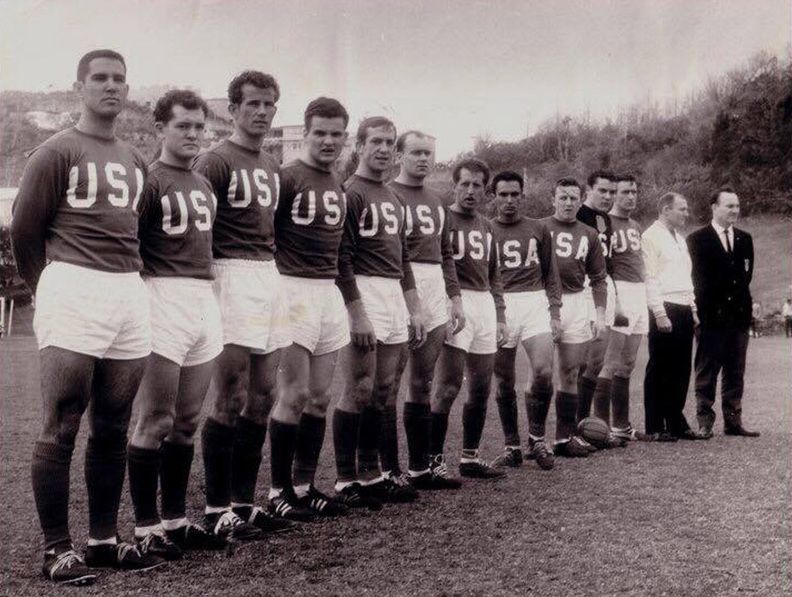
There is one more game that took place on that day that should be mentioned. The U.S. national soccer team was in qualification, through CONCACAF -- the governing body for soccer in North America, Central America, and the Caribbean region -- for the 1966 World Cup in England.
The 1965 U.S. soccer team

The U.S. was placed in a group with Mexico and Honduras. We got a 1-0 win and a 1-1 draw with Honduras, but only a 2-2 draw and a 2-0 loss with Mexico. Had that 2-2 draw with Mexico at the Los Angeles Memorial Coliseum on March 7, 1965 been a 3-2 win, we would have advanced to the round-robin with Costa Rica and Jamaica.

Could we have won that? We'll never know. We still would have had to beat Mexico out for the one and only berth in the World Cup awarded to CONCACAF.

But even if we had won that game with Mexico, it would not have been the biggest story of the day. The Selma-to-Montgomery March was a story that should be remembered for all time. 

December 31, 1999 & January 1, 2000: The Millennium

December 31, 1999:  The Millennium arrives. The people of planet Earth survived. At a terrible cost. But we hadn't destroyed ourselves. ...