Showing posts with label john nance garner. Show all posts

Saturday, July 16, 2022

July 16, 1940: "We Want Roosevelt!"

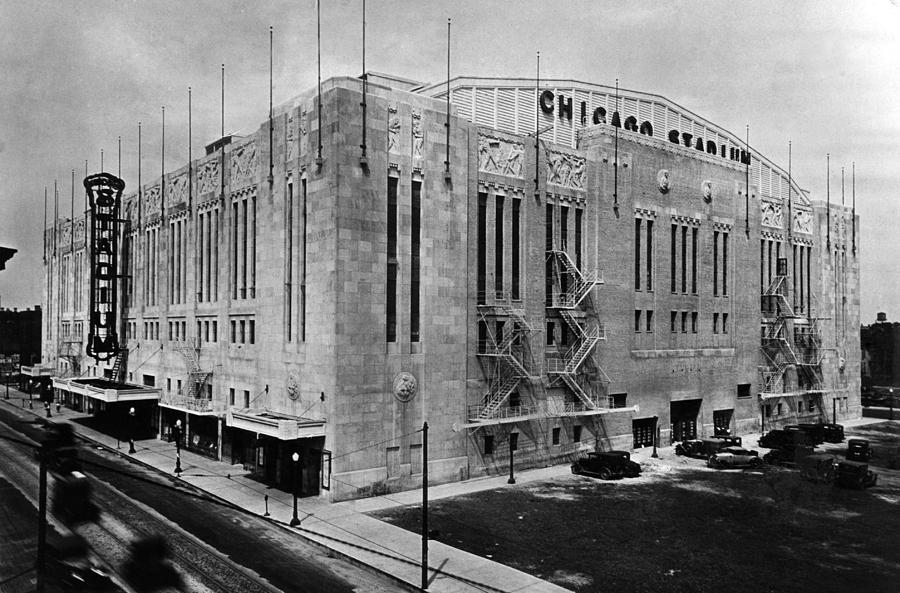
July 16, 1940: The Democratic National Convention is being held at the Chicago Stadium, the big Midwestern city's largest arena, home of the NHL's Chicago Black Hawks. (Starting in 1986, the official spelling became one word: "Blackhawks.")

It's not going well. The Democratic Party is badly divided. Their leader, the incumbent President, Franklin Delano Roosevelt, is in his 8th year, the last year of his 2nd term. Only 2 of the previous 30 men to hold the Presidency have run for a 3rd term, or what would have amounted to one: Ulysses S. Grant and FDR's cousin, Theodore Roosevelt. Only 2 others have even seriously considered it, before realizing that they were unlikely to win: Grover Cleveland and Woodrow Wilson.

But FDR has made no announcement as to whether he would run again. To make matters worse, the Democrats appear to have no obvious successor in place:

* Vice President John Nance Garner was a Southerner, from Texas. Although Andrew Johnson had become President upon the death of Abraham Lincoln, and Woodrow Wilson had been a Virginia native but the Governor of New Jersey when he was elected, no politician representing a Southern State had been elected President since Zachary Taylor from Kentucky in 1848. And even he wasn't exactly a "politician": He was the leading General of a war that had just been won, and had never run for office before. Garner was also considered too conservative outside the South.

* The other major candidate was the Chairman of the Democratic National Committee, who was also in FDR's Cabinet, as Postmaster General: James A. Farley of New York. Farley was considered a great organizer, but didn't really have name recognition among the general public, and was a Catholic. Except for Alfred E. Smith, who lost the general election of 1928 very badly, no Catholic had ever even been nominated for President by a major party.

* FDR might have wanted his Secretary of State, Cordell Hull, to be the next President. But Hull was another Southerner, having served Tennessee in both houses of Congress. What's more, Hull had a speech impediment on top of his Southern accent, which would have ruined a campaign in this era of radio and newsreels.

* Another would-be President, Joseph P. Kennedy, the U.S. Ambassador to Great Britain, a Boston native who thought that his large personal fortune and network of personal contacts could make him the 1st Catholic President, but his isolationism and apparent favoritism toward Nazi Germany made him persona non grata in the Party.

* Several potential Presidential candidates had been defeated in the Republican tide of the 1938 elections, including James Michael Curley, the former Mayor of Boston and Governor of Massachusetts, who lost a Senate race that year. And, besides, he was a Catholic.

* And then, of course, there were the Republicans. Having gotten clobbered in the elections of 1930, 1932, 1934 and 1936, they didn't have a clear President-in-the-making, either. They ended up nominating Wendell Willkie, a man with no political experience, but a strong anti-New Deal message, but also a willingness to help Britain against Nazi Germany in World War II, while otherwise keeping the U.S. out of it -- in other words, FDR's position.

FDR had been thinking about running for a 3rd term, even in 1939, but he really wanted to retire to his mansion on the Hudson River in Hyde Park, New York. Certainly, the Republicans' rhetoric at their Convention, in Philadelphia, suggested that they were running against him, as the avatar of American liberalism, rather than against the Democratic Party in general.

What made FDR run again was the Nazis' leader, Adolf Hitler. In May, his troops began marching across Western Europe. By mid-June, it had all fallen to him, even France. Britain was next in their sights, and whoever was going to be President starting on January 20, 1941, the end of FDR's 2nd term, was going to have to deal with Hitler's seemingly limitless ambition. And he, Roosevelt, was the only person in the country who was even remotely experienced enough to take Hitler on.

The problem was, being that he was seeking an unprecedented 3rd term, he had to do what Presidential candidates used to do, before his time: Make it look like he wasn't actively running. The idea was that the office should seek the man, not the other way around. So he drafted a statement for the Convention Chairman, Senate Majority Leader Alben Barkley of Kentucky, to read to the Delegates. It concluded:

The President has never had, and has not today, any desire or purpose to continue in the office of President, to be a candidate for that office, or to be nominated by the convention for that office. He wishes in earnestness and sincerity to make it clear that all of the Delegates in this Convention are free to vote for any candidate.

The Delegates sat in shocked silence for a moment. Then came a voice thundering over the stadium loudspeakers: "We want Roosevelt! We want Roosevelt! We want Roosevelt!"

The voice belonged to Thomas D. Garry, Superintendent of Chicago's Department of Sanitation -- in other words, the sewer department. He was a trusted henchman of Chicago Mayor Edward J. Kelly, the Convention's host, an FDR loyalist, and, himself, chief engineer of the Chicago Sanitary District during the 1920s.

Garry was stationed in a basement room with a microphone, waiting for that moment. Kelly had posted hundreds of Chicago city workers and precinct captains around the Stadium. Other Democratic bosses had brought followers from their home territories. All of them joined Garry's chant. Within a few seconds, hundreds of delegates joined in. Many poured into the aisles, carrying state delegation standards for impromptu demonstrations. Whenever the chant began to die down, State chairmen, who also had microphones connected to the speakers, added their own endorsements: "New Jersey wants Roosevelt!" "Arizona wants Roosevelt!" "Iowa wants Roosevelt!"

Despite coming out of the loudspeakers, Garry was in the basement, and thus became known as "The Voice From the Sewers." Life magazine, conservative as always, called it a "shabby pretense" that "fooled nobody." Nevertheless, on the 1st ballot, FDR got 946 Delegates, Farley 73, Garner 61, and others got 20. There would be no 2nd ballot.

It would be harder to get the Vice President FDR wanted. Nobody wanted Garner to have the job for a 3rd term, including Garner himself: The former Speaker of the House had said, "The job isn't worth a pitcher of warm piss." For public consumption, it was printed as "a pitcher of warm spit."

FDR wanted his Secretary of Agriculture, Henry Wallace. There were problems with this: Wallace was a former Republican, was pro-civil rights, and was considered to have questionable ties, both to the Soviet Union and to Nicholas Roerich, a Russian painter, writer and philosopher with some odd views. The conservative Southerners were adamant that Wallace not be nominated.

So FDR sent First Lady Eleanor Roosevelt to Chicago, to speak on behalf of Wallace. She flew there, and told the Delegates, "You cannot treat this as you would an ordinary nomination in an ordinary time." It was the best-received speech of the Convention, and Wallace defeated the Speaker of the House, William Bankhead of Alabama, on the 1st ballot.

Perhaps Bankhead would have made a stronger bid for the office had he not been ill, and he died 2 months later. His father, John, had served Alabama in both houses of Congress; his brother, John II, was a Senator and a Delegate to the Convention; and his daughter, Tallulah Bankhead, was one of America's greatest actresses.

Unlike in 1932 in Chicago, and in 1936 in Philadelphia, FDR felt he had to stay in Washington, and so he delivered his acceptance speech remotely, by radio, which was piped into the Convention. He would do the same in Chicago in 1944. He was the 1st Presidential nominee to deliver his acceptance speech in person, and he remains, through the 2020 election, the last one to not do so.
The 1940 Convention was not one of the Democratic Party's best. But it did show a commitment to the principles that FDR had stood for, and wanted to stand for. For all intents and purposes, it is still his Party.

Ed Kelly served as Mayor of Chicago from 1933 to 1947, and lived until 1950. Thomas D. Garry, who had worked on a sewer survey under Kelly, served as Assistant Commissioner until 1963, and who always insisted that the D stood for "Democrat," lived until 1976.

*

July 16, 1940 was a Tuesday. These baseball games were played:

* Elsewhere in Chicago, at Wrigley Field, the New York Giants lost to the Chicago Cubs, 2-0. Vern Olsen pitched a 6-hit shutout, outpitching Harry Gumbert. Phil Cavarretta drove in both runs with a 7th-inning single. Mel Ott went 1-for-3 with a walk.

* The New York Yankees lost to the Chicago White Sox, 5-1 at Yankee Stadium. Johnny Rigney outpitched Marius Russo. Joe Kuhel hit a home run. Joe DiMaggio went 1-for-4, driving in the Yankees' only run.

* The Brooklyn Dodgers lost to the Pittsburgh Pirates, 5-3 at Forbes Field in Pittsburgh.

* The Philadelphia Athletics beat the Detroit Tigers, 3-1 at Shibe Park in Philadelphia. Hank Greenberg went 1-for-4.

* The Washington Senators beat the Cleveland Indians, 11-8 at Griffith Stadium in Washington.

* The St. Louis Cardinals beat the Boston Bees, 4-3 at Sportsman's Park in St. Louis. This was the last of 5 seasons in which the Boston team of the National League used the Bees name. The next season, they went back to their former name, the Boston Braves.

* The Boston Red Sox and the St. Louis Browns moved their game scheduled for today back 2 days, to have a Sunday doubleheader and a bigger gate. The BoSox won the opener, 5-4. Roger "Doc" Cramer doubled Dom DiMaggio (Joe's brother) home with the winning run in the bottom of the 11th inning. This made Emerson Dickman the winning pitcher in relief of Lefty Grove. Dickman would win 22 games in his career; Grove, 300.

The Red Sox won the nightcap, 7-3. Over the 2 games, Ted Williams went 1-for-9.

* And the Cincinnati Reds and the Philadelphia Phillies were rained out at Crosley Field in Cincinnati. It was agreed to play the game on July 28, as part of a Sunday doubleheader, and move it to Shibe Park. The Reds won the 1st game, 7-2. The Phils won the 2nd game, 4-1.

Saturday, July 2, 2022

July 2, 1932: The Democrats Almost Blow It

July 2, 1932: The Democratic National Convention, meeting at Chicago Stadium, home of the NHL's Blackhawks (and later the NBA's Bulls), almost blows a golden opportunity. With incumbent Republican President Herbert Hoover saddled with the Great Depression, the Democratic nominee could win -- if he could draw a contrast with the failed conservatism of the Republicans.

But so many people are opposed to the front-runner, Governor Franklin D. Roosevelt of New York, because they think either that he's too liberal, or that his health will be an issue. They knew he'd had polio, and it was not widely known how much it had affected him.

Four years earlier, at the Convention, in Houston, FDR had given the nomination speech for his predecessor as Governor, Alfred E. Smith. Smith was nominated, but lost badly. Someone asked Smith if he was worried that he was raising a rival in FDR. He said, "No, he will be dead within a year."

Instead, within 6 months, FDR was Governor of what was then the nation's largest and strongest State, and Smith was out of a job. He was asked to run the company that was building the Empire State Building. That done, he thought the Democratic Party owed him the nomination again, but even New York's Democrats were behind FDR. Smith thought he could count on the national Catholic vote, but that wouldn't be enough to help him at the Convention.

Also running were the Speaker of the House of Representatives, John Nance Garner of Texas, a.k.a. Cactus Jack; former Governor Harry Byrd of Virginia, who went on to be elected to the U.S. Senate, eventually succeeded by his son, Harry Jr.; Governors Albert Ritchie of Maryland, George White of Ohio, and William H. "Alfalfa Bill" Murry of Oklahoma; James A. Reed, Senator from Missouri and former Mayor of Kansas City; and Newton D. Baker, who had served as Secretary of War and Mayor of Cleveland.

The rule requiring that a nominee receive two-thirds of the delegates to be nominated -- a rule designed to give the racist South a veto over any candidate that is too liberal on civil rights -- nearly derails FDR, as other, more conservative candidates try to wait him out, ballot after ballot, to become the nominee.

It took 769 1/2 Delegates to be nominated. On the 1st ballot, FDR had 666 1/4, Smith had 201 3/4, and Garner had 90 1/2. On the 2nd, FDR gained to 677 3/4, Smith dropped to 194 1/4, and Garner remained at 90 1/4. On the 3rd, FDR gained to 682 3/4, Smith dropped to 190 1/4, and Garner gained to 101 1/4, with 180.25 votes scattered among others. FDR was still 87 1/4 short of the nomination, so he needed about half the Delegates not already with himself, Smith or Garner -- and it looked like none of them would budge, each of them hoping to be the one to benefit from FDR's dropoff, whenever it would happen.

If Roosevelt had dropped off, and the Democrats had nominated anybody else, he would have beaten Hoover, simply because the people were pissed at the Republicans. But it's hard to imagine any of them, except maybe Al Smith, who had already instituted a precursor to the New Deal in New York State. But whether he would have gone as far as FDR ended up going, no one can be sure. But it is impossible to imagine Garner, Byrd, Ritchie going even as far as Smith. Baker had been in the Cabinet of President Woodrow Wilson, who was progressive on many issues -- but terribly regressive on race.

A Democrat other than Roosevelt as President in 1933, '34, '35 and '36 would have faced an electorate who would have considered him a failure for not doing enough. In Canada, in the early stages of the Depression, the Liberal Party were defeated by the Conservative Party in the 1930 election, with a net loss of 36 seats. William Lyon Mackenzie King was out as Prime Minister, and Richard B. Bennett was in. But, like Hoover, Bennett did very little to ease the Depression, and held off calling a new election as long as the law allowed. In 1935, the Liberals gained a net 91 seats, Mackenzie King was back in, and Bennett actually left the country. He's the only Prime Minister of Canada not buried in the country.

But if the Republicans had regained control in the 1936 election, they could have gone into the 1940 vote saying, "We're the only party that can be trusted, because the Democrats' answer is Communism." They likely would have supported the Nazis against the Soviets in 1941, there certainly wouldn't have been Lend-Lease for Britain, a Republican Secretary of State might have negotiated a separate peace between Chancellor Adolf Hitler and a Prime Minister other than Winston Churchill, and the Nazis would have won the war.

There would have been no argument for African-Americans to say, "If we can stop bullets, why not baseballs?" Professional sports would not have been integrated. The Supreme Court would not have had Hugo Black, Felix Frankfurter or William O. Douglas appointed in the 1930s, or Robert H. Jackson in the 1940s, or Earl Warren or William J. Brennan in the 1950s. Some of the civil rights gains of the 1940s, '50s and '60s would have been delayed; and some would not have happened at all.

The Democratic Party would have remained divided between big-city liberals and Southern conservatives. Harry Truman, Adlai Stevenson, John F. Kennedy and Hubert Humphrey might have been elected Senators or Governors; none of them would have been nominated for President. Lyndon B. Johnson might have been, but he would not have won on his own.

The Republicans would have remained divided between Eastern liberals and Western conservatives. But without FDR winning 4 straight elections, and Truman, JFK and LBJ running as his political heirs, the split would not have been as nasty. The turn toward evangelicalism in the wake of civil rights would not have happened, but the Grand Old Party would still have been guided by greed.

Without America getting into World War II, Dwight D. Eisenhower would never have become President; but Richard Nixon, Ronald Reagan and the George Bushes could have been. Then again, it's unlikely that Donald Trump would have. And the gains made under Democratic Presidents from Roosevelt to Biden are almost impossible to imagine.

And the Democrats almost threw this chance away, because some of them were scared of FDR's health, and some of them were scared of his liberalism. We may never know how many ballots they came to blowing it, and making the next 90 years incredibly different.

After the 3rd ballot, FDR offered the Vice Presidential nomination to Garner. He accepted, and brought the South with him. On the 4th ballot, FDR had 945, Smith 190 1/2, and everybody else combined had 17.5. They had a nominee.

Once nominated, Roosevelt was taken to an airport, and flew a rather rickety plane in bad weather from New York to Chicago, a perilous journey even 5 years after Charles Lindbergh flew across an ocean.

And, up until then, a potential Presidential nominee -- unless he was already a Delegate, and thus a surprise choice -- never even attended the Convention. Being publicly seen as actually seeking the nomination was considered to be wrong, and so they would go through the motions of sending a messenger to his home, and formerly informing him of his nomination there.

Instead, FDR gives his acceptance speech in person. He tells a nationwide radio audience, "I pledge you, I pledge myself, to a new deal for the American people. Let us all here assembled constitute ourselves prophets of a new order of competence and of courage. This is more than a political campaign; it is a call to arms. Give me your help, not to win votes alone, but to win in this crusade to restore America to its own people."

The phrase "New Deal" evoked the "Square Deal" of his distant cousin, Theodore Roosevelt, who had been President from 1901 to 1909. No one, not even FDR, yet knew what specific measures would be involved. But the phrase "New Deal" sticks.

So does a song played during the Convention, written right before the stock market crash of 1929, and it becomes the Democratic Party’s theme song for decades to come: "Happy Days Are Here Again."

After this Convention, at FDR's direction, the Democratic Party junked its 2/3rds rule. From 1936 onward, as the Republicans were already doing, the Democrats would have a nominee as soon as a candidate had a simple majority of the Delegates.

*

July 2, 1932 was a Saturday. These baseball games were played:

* The New York Yankees split a doubleheader with the Boston Red Sox at Fenway Park in Boston. The Yanks won the opener, 8-5. Herb Pennock went the distance for the win, and went 2-for-5 with 2 RBIs in his own cause. The Red Sox won the nightcap, 6-5. John Michaels outpitches Red Ruffing. Over the 2 games, Babe Ruth went 1-for-8 with a walk and an RBI, and Lou Gehrig went 1-for-7 with 2 RBIs.

* The New York Giants lost to the Boston Braves, 7-4 at the Polo Grounds. Billy Urbanski and Wally Berger hit home runs for the Braves. "Fat Freddie" Fitzsimmons was the losing pitcher for the Giants, but he and James "Shanty" Hogan both him home runs. 1st baseman and manager Bill Terry went 0-for-4. Mel Ott went 1-for-4 with an RBI.

* The Brooklyn Dodgers lost to the Philadelphia Phillies, 6-3 at Ebbets Field.

* The Philadelphia Athletics swept the Washington Senators, 2-1 and 5-4 at Shibe Park in Philadelphia. In the 1st game, George "Mule" Haas led off the bottom of the 11th with a triple, and Eric McNair hit a sacrifice fly to bring him home with the winning run. George Earnshaw went the distance for the win. 

Mickey Cochrane went 0-for-5 in the 1st game, and did not play in the 2nd. Over the 2 games, Haas went 3-for-8; McNair went 3-for-8 with a home run, a walk, and 3 RBIs; Doc Cramer went 4-for-9; Al Simmons went 3-for-9; and Jimmie Foxx went 2-for-7 with 2 walks and an RBI.

* The St. Louis Cardinals beat the Pittsburgh Pirates, 5-4 at Forbes Field in Pittsburgh. For the Cards, George Watkins went 1-for-4 with 3 RBIs. For the Bucs, Paul Waner went 1-for-4, and Lloyd Waner went 1-for-5.

* The Detroit Tigers beat the Cleveland Indians, 5-4 at Navin Field (later Briggs Stadium and Tiger Stadium) in Detroit.

* The Cincinnati Reds beat the Chicago Cubs, 6-3 at Wrigley Field in Chicago.

* And the Chicago White Sox beat the St. Louis Browns, 15-5 at Sportsman's Park in St. Louis.

Tuesday, February 15, 2022

February 15, 1933: The Attempted Assassination of Franklin D. Roosevelt

Anton Cermak (left) and Franklin Roosevelt

February 15, 1933: An assassination attempt is made against President-elect Franklin D. Roosevelt, at Bayfront Park in Miami. The shooter, an Italian immigrant named Giuseppe Zangara, missed him, but hit Mayor Anton Cermak of Chicago, who died on March 6. Zangara was executed 14 days later.

Had the attempt succeeded, Vice President-elect John Nance Garner would have become President on March 4. We don't know who would have been next in line: Under the Presidential Succession Act of 1886, the Secretary of State would have been next, but there's no way to know if Garner would have appointed Senator Cordell Hull of Tennessee to the post, as FDR did.

There would have been an attempt to ease the Great Depression, but it wouldn't have been what we know as the New Deal. The Depression would still have been going on in 1941, and there would have been no effort from whoever was President at that point to oppose Nazi Germany and Imperial Japan, including no Atlantic Charter with Britain. The Nazis would have beaten Britain, likely without attacking the Soviet Union.

This would have set up a Cold War against the Soviets, with the U.S., the Nazis and the Japanese on the same side. And of those 3 big nations on that side, the U.S. would be the weakest, since it would still be in a post-Depression hangover, with a post-World War I attitude of isolation and a post-World War I minimal Army and Navy.
 
This likely means that the Civil Rights Movement would have gained very little traction. Jackie Robinson is a forgotten former UCLA running back. Martin Luther King dies in a Southern jail sometime between 1955 and 1968.

There might have been a President Kennedy, but it would have been Joe Jr., especially since, in this case, Joe Sr. would not have been disgraced for supporting the Nazis. And, aside from being the 1st Catholic President, Joe Jr. wouldn't have had the kind of impact that the President Kennedy that we know had. The Nazis would have gotten to space first, and to the Moon first.

Woody Guthrie, Pete Seeger, Bob Dylan and Paul Simon all end up as quirky folksingers who don't really catch on in mainstream America. Rock and roll is a fad that dies out by 1960. Elvis Presley becomes a renowned country singer, with a voice that puts him on a level with, say, George Jones; but not the "King" of anything. Chuck Berry and Little Richard both end up in prison, on morals charges -- Chuck with girls, Richard with boys. Buddy Holly might have become a country star, but, like Jim Reeves and Patsy Cline, he still might have died young in a plane crash.

John Lennon is one of many British rockers we know who, without the outlet of rock, end up in jail -- especially if Britain has a Nazi-friendly government, similar to Vichy France. Paul McCartney becomes a minor musical figure outside Britain. Mick Jagger is a frustrated economics professor.

Motown singers like Smokey Robinson, Marvin Gaye, Diana Ross, and even Michael Jackson get to be no bigger than cabaret acts. David Bowie becomes an experimental filmmaker who never gets the credit he deserves. Elton John and Billy Joel remain piano players in lounges. Bruce Springsteen is a mechanic. Madonna is a waitress who used to dance on Broadway. Prince becomes a Jehovah's Witness preacher. Britney Spears and Taylor Swift never cross over from country. If Beyoncé becomes famous, it might also be as a country singer. And as for rappers, forget it: The market for their skills will never be allowed to develop.

Eventually, the Soviets' part in the Cold War is to launch insurgencies in the colonies that Germany took from Britain, France and the rest in Africa; and Japan took from them in Asia. This means that the Nazis, the Japanese, and, at their insistence, the U.S. fight the Vietnam War, and each is weakened by it, but not defeated. The Soviet Union falls on schedule in 1991. And then there were 3. But America is still an economic and technical backwater compared to the Nazi-led European Union and the Empire of Japan.

Rights for women? A struggle few accept. Rights for black people and other nonwhites? A nonstarter. Rights for gay people? We don't even talk about that kind of people, because we don't talk about that kind of behavior. Social Security? Medicare? Medicaid? OSHA? The Environmental Protection Agency? What the hell are those things?

Donald Trump has never become President. He's never needed to run for the office. He says, "I'm thrilled with how America is run. Believe me!"

*

But Zangara did not hit Roosevelt. And the only thing we had to fear was fear itself.

*

February 15, 1933 was a Monday. Baseball and football were out of season. The NBA hadn't been founded yet. And there were no games scheduled in the NHL. So there were no scores on this historic day.

December 31, 1999 & January 1, 2000: The Millennium

December 31, 1999:  The Millennium arrives. The people of planet Earth survived. At a terrible cost. But we hadn't destroyed ourselves. ...