
As Mike Cole, of the East End, wrote for the website Historic UK:
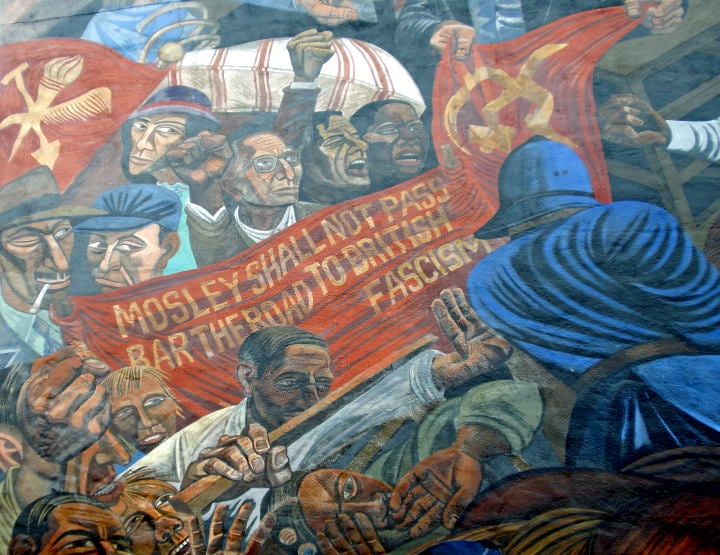
The 1930s was a period of seismic political change throughout Europe. Fascist dictators took power in Germany, Italy and Romania and left wing and communist movements rebelled against expanding fascism in countries like Spain. In Britain, this tension culminated in a violent event in the East London area of Stepney, on Cable Street.
The murderous pogroms in Russia and elsewhere in Europe had lead to many Jewish refugees arriving in the East End of London by the late 19th Century. The backlash against this contributed to the suspicion that serial killer Jack the Ripper might have been an immigrant, Jewish or otherwise. By the early 1900s, Stepney was one of the poorest and most densely populated suburbs of London. By the 1930s, that part of the East End had a distinct Jewish population and culture.
Sir Oswald Mosley was the leader of the British Union of Fascists (BUF) in 1931, when America's Time magazine put him on their cover, calling him "America's Hitler." At 35, he had already been knighted for his government service. He met Italian dictator Benito Mussolini in early 1932, and very much admired and modelled himself on the man known as "Il Duce." Mosley even created a new, sinister organization, the Blackshirts, a quasi-military group of around 15,000 thugs, modelled on Mussolini's Squadrismo.
As the number of fascists was growing, so too was the opposition against them. Trade unionists and Communists, as well as the Jewish community, were becoming increasingly mobilized. When Mosley announced a march into the heart of the Jewish community in the East End of London, planned for Sunday, the 4th of October, 1936, the community was in disbelief and it was a clear provocation.
The Jewish People’s Council presented a petition of 100,000 names to urge the Home Secretary to ban the march. But, the BUF had the support of the press and police, and with the Daily Mail running headlines in the 1930s such as “Hurrah for the Blackshirts” the government failed to ban the march and the people of the East End set about organizing to defend themselves. (After World War II, the Daily Mail continued to be far enough to the right that it was nicknamed the Daily Heil.)
The Communist newspaper, The Daily Worker, called people to the streets on the day of the march, to block Mosley’s way. There were many who were worried about violence, and the Jewish Chronicle warned its readers to stay home on the day. Many other groups such as the Communists and Irish Dockers encouraged the defense of the diverse community from Fascist intimidation. The Communist Party even cancelled a planned demonstration in Trafalgar Square and redirected its supporters to the East End.
On October 4, thousands of antifascists began to gather at Gardeners Corner in Aldgate. The battle lines were set as Mosley gathered his men at the Royal Mint by The Tower of London. The police amassed 6,000 officers to clear a path for them into Whitechapel. The police used mounted officers at Aldgate to beat back the crowds onto the pavements but thousands more were streaming into the area. Four sympathetic tram drivers strategically abandoned their vehicles to help block the road to the fascists.
“Down with the fascists!” chants were heard across East London as the police clashed with the community blocking their way. Communists, Jews, Irish Dockers, Trade Unionists all united under the chant “They Shall Not Pass!” -- a line used by French Field Marshal Henri Petain against the Germans in World War I, and recently taken up by the Spanish Republic in their eventually failed effort to prevent a Fascist takeover.
As the police could not get through the crowds towards Whitechapel, Mosley decided to change the route, and head down narrow Cable Street, that ran parallel to his original route. The Blackshirts were headed up and flanked by the Metropolitan Police as they headed into Cable Street.
Everything from rotten fruit to boiling water rained down on them from windows on all sides. The Met reached the first barrier, but brawls broke out, and the police withdrew and demanded that Mosley turn around.
Celebrations broke out across the East End that afternoon. 79 antifascists were arrested, many of whom were beaten by the police, some even sentenced to hard labor. Only 6 fascists were arrested.
Mural honoring the Battle, on Cable Street
Within 2 years, the British government was appeasing Nazi Germany. Within another year, Britain and Germany were at war.
Two days after the Battle of Cable Street, and 3 years after the death of his 1st wife, Mosley, who had cheated on her endlessly, married his longtime mistress, Diana Guinness -- in Germany, in a ceremony held at the home of propaganda minister Joseph Goebbels, and attended by Chancellor Adolf Hitler.
On May 23, 1940, after Winston Churchill became Prime Minister, Mosley was arrested under Defence Regulation 18B. Diana was interned a month later, the gap due to the fact that she was pregnant with their son, Max. Most other BUF members were interned, and Fascism was eliminated as a threat in the country. Diana was released in November 1943, but Oswald was kept under house arrest for the duration of The War.
Afterward, he became an advocate for a united Europe, and a leader of Holocaust denial. After the Notting Hill Riots of 1958, he ran for Parliament on an anti-immigrant platform, and lost badly. He ran again in 1966, from a district in East London, but his evil there was not forgotten, and, again, he was clobbered at the polls. He moved to France, and never returned to Britain except for brief visits.
By 1977, he was suffering from Parkinson's disease, but dissension in Britain led to a turn back to the right, and a partial restoration of his reputation. Rock singer Elvis Costello mentioned this in his hit song "Less Than Zero." He lived to see the election of the Conservative Party government led by Prime Minister Margaret Thatcher, the most right-wing government Britain had ever had. He died on December 3, 1980.
Between his 2 marriages, he had 5 children, including the novelist Nicholas Mosley, 3rd Baron Ravensdale, a title from his mother's family; and Max Mosley, who served 16 years as President of the International Automobile Federation. Through 2022, none of Mosley's descendants have run for public office in any country.
*
October 4, 1936 was a Sunday. Game 4 of the World Series. Carl Hubbell was in the middle of a 24-game regular season winning streak, and Time magazine called this Series "a personal struggle between Hubbell and Gehrig."
Well, Hubbell had won Game 1, but Lou Gehrig homers off him in this Game 4, and the Yankees win, 5-2. Monte Pearson is the winning pitcher, and now the Yankees are 1 win away from taking the Series. I have a separate entry for this event.
And there were 4 games played in the NFL:
* The New York Giants beat the Boston Redskins, 7-0 at Fenway Park in Boston. The following year, the Redskins moved to Washington.
* The Brooklyn Dodgers beat the Philadelphia Eagles, 18-0 at Ebbets Field. The football version of the Dodgers went out of business after the 1948 season.
* The Chicago Bears beat the Pittsburgh Pirates, 27-9 at Forbes Field in Pittsburgh.
* And the Green Bay Packers beat the Chicago Cardinals, 24-0 at the Dairy Bowl in the Milwaukee suburb of West Allis, Wisconsin. The Dairy Bowl was a football stadium built in the infield of a speedway, now known as the Milwaukee Mile, at the Wisconsin State Fair Park.


